• Emerasoft srl
• Mission
• Vision
• Market & Solutions
Monica Burzio
Federico Pagnozzi
Guido Levi
Agenda
• La Continuous Delivery per il database
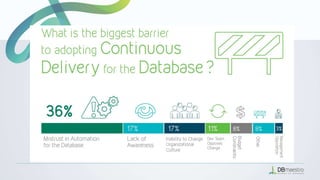
• Le principali barriere e criticità
• Il business value generato dall’automazione del DB
• La soluzione
Mini-seminario: “Mai sentito parlare di Continuous Delivery per il database? Ecco come e
perchè”
maggio 2016
Data di nascita: 2005
Dove siamo:
via Po, 1 – Torino
via del Poggio Laurentino, 118 - Roma
“Il nostro impegno è nella costante ricerca della migliore soluzione
per il cliente, garantendo eccellenza nella qualità di servizi e
prodotti proposti. La nostra promessa è di svolgere il nostro lavoro
con costanza e passione”
DevOps
IoT
Testing
ALM
SOA
Business Intelligence
Security
Digital Publishing
Training
ALM+PLM
traceability
standard compliance
Open Source
Big DataUser Experience
SS4B
Enterprise Mobility
agile
IoD
University
Usability
APIBPM
DevOps
IoT
Testing
ALM
SOA
Business Intelligence
Security
Digital Publishing
Training
ALM+PLM
traceability
standard compliance
Open Source
Big DataUser Experience
SS4B
Enterprise Mobility
agile
IoD
University
Usability
APIBPM
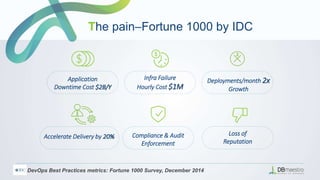
The pain–Fortune 1000 by IDC
Application
Downtime Cost $2B/Y
Deployments/month 2x
Growth
Accelerate Delivery by 20% Compliance & Audit
Enforcement
Infra Failure
Hourly Cost $1M
IDC DevOps Best Practices metrics: Fortune 1000 Survey, December 2014
Loss of
Reputation
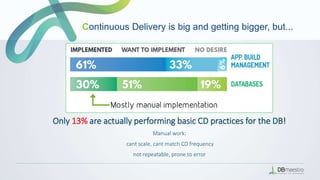
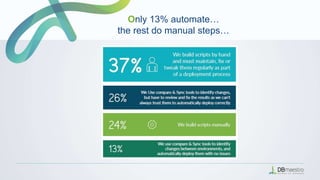
Only 13% are actually performing basic CD practices for the DB!
Manual work:
cant scale, cant match CD frequency
not repeatable, prone to error
Continuous Delivery is big and getting bigger, but...
Only 13% automate…
the rest do manual steps…
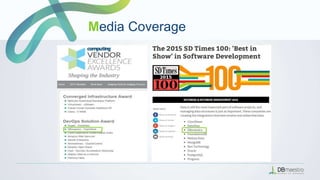
Media Coverage
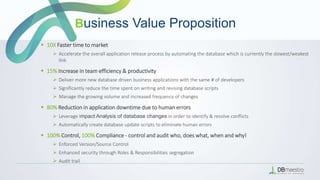
Business Value Proposition
 10X Faster time to market
 Accelerate the overall application release process by automating the database which is currently the slowest/weakest
link
 15% Increase in team efficiency & productivity
 Deliver more new database driven business applications with the same # of developers
 Significantly reduce the time spent on writing and revising database scripts
 Manage the growing volume and increased frequency of changes
 80% Reduction in application downtime due to human errors
 Leverage Impact Analysis of database changes in order to identify & resolve conflicts
 Automatically create database update scripts to eliminate human errors
 100% Control, 100% Compliance - control and audit who, does what, when and why!
 Enforced Version/Source Control
 Enhanced security through Roles & Responsibilities segregation
 Audit trail
What is the problem?
▪ Root Causes for issues:
− Challenging manual source control process
− Static deployments code overrides and configuration drift
− Dynamic deployments tools unaware of version control
− No release automation red-flags – don’t know when to stop the line…
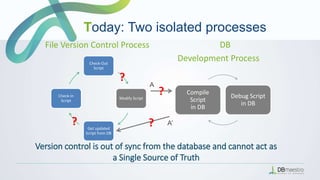
File Version Control Process
Today: Two isolated processes
DB
Development ProcessCheck-Out
Script
Modify Script
Get updated
Script from DB
Check-In
Script
Compile
Script
in DB
Debug Script
in DB
?
?
?
?
A
A’
Version control is out of sync from the database and cannot act as
a Single Source of Truth
X
1.11.1.11.11.21.31.41.51.61.7
Int QA Stage Prod
Database Deploy Script
Dev
Dev
Dev
Model
1.1 1.2
1.2 1.3
1.3 1.4
1.4 1.5
1.5 1.6
1.6 1.7
1.11.11.41.7
1.1 1.2
1.2 1.3
1.3 1.4
1.4 1.5
1.5 1.6
1.6 1.7
1.1 1.2
1.2 1.3
1.3 1.4
1.4 1.5
1.5 1.6
1.6 1.7
Out of Process
Change
X
X
X
X
X
? 1.1.1
X
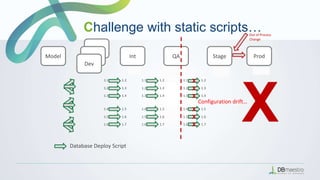
Challenge with static scripts…
Configuration drift…
Safe to automate?
Sure… (?)
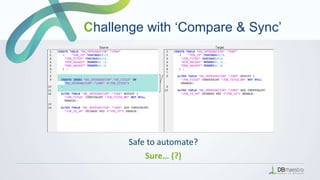
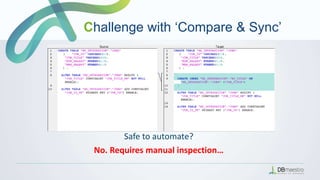
Challenge with ‘Compare & Sync’
Safe to automate?
No. Requires manual inspection…
Challenge with ‘Compare & Sync’
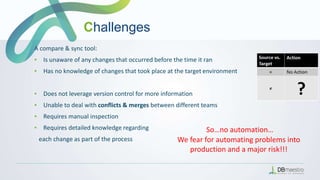
A compare & sync tool:
▪ Is unaware of any changes that occurred before the time it ran
▪ Has no knowledge of changes that took place at the target environment
▪ Does not leverage version control for more information
▪ Unable to deal with conflicts & merges between different teams
▪ Requires manual inspection
▪ Requires detailed knowledge regarding
each change as part of the process
So…no automation…
We fear for automating problems into
production and a major risk!!!
Challenges
The Solution to the challenges
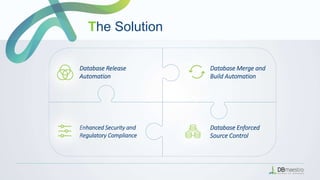
Database Enforced
Source Control
Enhanced Security and
Regulatory Compliance
Database Merge and
Build Automation
Database Release
Automation
The Solution
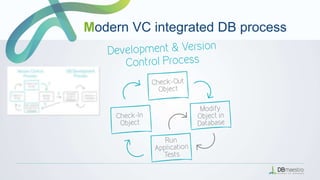
Modern VC integrated DB process
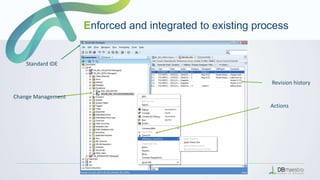
Revision history
Actions
Standard IDE
Change Management
Enforced and integrated to existing process
Leverage
Version control knowledge
into
Deployment decisions
1.11.21.31.41.51.61.7
*
Int QA Stage Prod
Dev
Dev
Dev
Model
1.1 1.2
1.2 1.3
1.3 1.4
1.1 1.7
1.1.1 1.7
1.1 1.1 1.11.41.7
Out of Process
Change
1.1.11.7 1.1.11.7
Validate
1.4 1.5
1.5 1.6
1.6 1.7
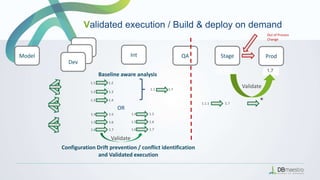
Configuration Drift prevention / conflict identification
and Validated execution
1.4 1.5
1.5 1.6
1.6 1.7
OR
Baseline aware analysis
Validated execution / Build & deploy on demand
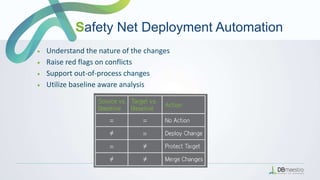
Validate
■ Understand the nature of the changes
■ Raise red flags on conflicts
■ Support out-of-process changes
■ Utilize baseline aware analysis

Safety Net Deployment Automation
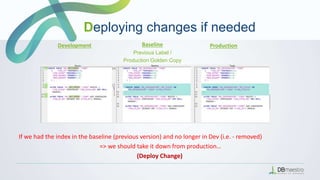
If we had the index in the baseline (previous version) and no longer in Dev (i.e. - removed)
=> we should take it down from production…
(Deploy Change)
Deploying changes if needed
Development Baseline
Previous Label /
Production Golden Copy
Production
Development Baseline
Previous Label /
Production Golden Copy
Production
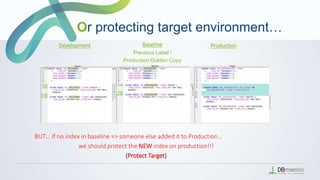
BUT… If no index in baseline => someone else added it to Production…
we should protect the NEW index on production!!!
(Protect Target)
Or protecting target environment…
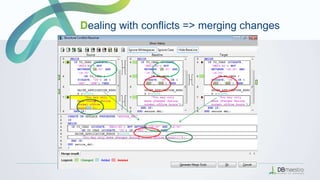
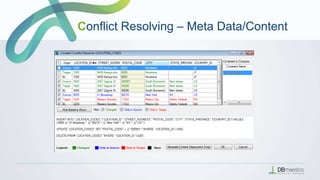
Dealing with conflicts => merging changes
Conflict Resolving – Meta Data/Content
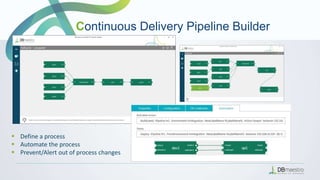
Continuous Delivery Pipeline Builder
 Define a process
 Automate the process
 Prevent/Alert out of process changes
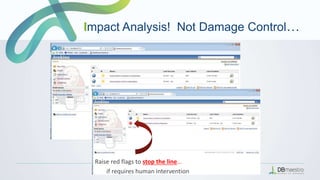
Raise red flags to stop the line…
if requires human intervention
Impact Analysis! Not Damage Control…
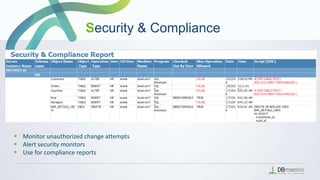
Security & Compliance
 Monitor unauthorized change attempts
 Alert security monitors
 Use for compliance reports
Selected Customers
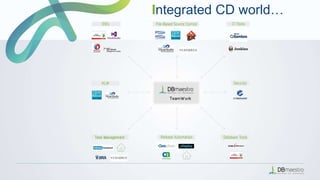
Integrated CD world…
Contenuti disponibili su:
Canale slideshare di Emerasoft
Canale Youtube Emerasoft
Visita il nostro sito emerasoft.com
What’s next
Contattaci: sales@emerasoft.com
Email: federico.pagnozzi@emerasoft.com Q&A ?
@
WWW
Segui i nostri canali …
www.emerasoft.com
sales@emerasoft.com
Emerasoft Srl
via Po, 1 – 10124 Torino
via del Poggio Laurentino, 118 – 00144 Roma
T +39 011 0120370
T +39 06 87811323
F +39 011 3710371
Grazie…
Contatti

Webinar: “Mai sentito parlare di Continuous Delivery per il database? Ecco come e perché”

  • 1.
    • Emerasoft srl •Mission • Vision • Market & Solutions Monica Burzio Federico Pagnozzi Guido Levi
  • 2.
    Agenda • La ContinuousDelivery per il database • Le principali barriere e criticità • Il business value generato dall’automazione del DB • La soluzione Mini-seminario: “Mai sentito parlare di Continuous Delivery per il database? Ecco come e perchè” maggio 2016
  • 3.
    Data di nascita:2005 Dove siamo: via Po, 1 – Torino via del Poggio Laurentino, 118 - Roma “Il nostro impegno è nella costante ricerca della migliore soluzione per il cliente, garantendo eccellenza nella qualità di servizi e prodotti proposti. La nostra promessa è di svolgere il nostro lavoro con costanza e passione”
  • 4.
    DevOps IoT Testing ALM SOA Business Intelligence Security Digital Publishing Training ALM+PLM traceability standardcompliance Open Source Big DataUser Experience SS4B Enterprise Mobility agile IoD University Usability APIBPM
  • 5.
    DevOps IoT Testing ALM SOA Business Intelligence Security Digital Publishing Training ALM+PLM traceability standardcompliance Open Source Big DataUser Experience SS4B Enterprise Mobility agile IoD University Usability APIBPM
  • 6.
    The pain–Fortune 1000by IDC Application Downtime Cost $2B/Y Deployments/month 2x Growth Accelerate Delivery by 20% Compliance & Audit Enforcement Infra Failure Hourly Cost $1M IDC DevOps Best Practices metrics: Fortune 1000 Survey, December 2014 Loss of Reputation
  • 7.
    Only 13% areactually performing basic CD practices for the DB! Manual work: cant scale, cant match CD frequency not repeatable, prone to error Continuous Delivery is big and getting bigger, but...
  • 8.
    Only 13% automate… therest do manual steps…
  • 10.
  • 11.
    Business Value Proposition 10X Faster time to market  Accelerate the overall application release process by automating the database which is currently the slowest/weakest link  15% Increase in team efficiency & productivity  Deliver more new database driven business applications with the same # of developers  Significantly reduce the time spent on writing and revising database scripts  Manage the growing volume and increased frequency of changes  80% Reduction in application downtime due to human errors  Leverage Impact Analysis of database changes in order to identify & resolve conflicts  Automatically create database update scripts to eliminate human errors  100% Control, 100% Compliance - control and audit who, does what, when and why!  Enforced Version/Source Control  Enhanced security through Roles & Responsibilities segregation  Audit trail
  • 12.
    What is theproblem? ▪ Root Causes for issues: − Challenging manual source control process − Static deployments code overrides and configuration drift − Dynamic deployments tools unaware of version control − No release automation red-flags – don’t know when to stop the line…
  • 13.
    File Version ControlProcess Today: Two isolated processes DB Development ProcessCheck-Out Script Modify Script Get updated Script from DB Check-In Script Compile Script in DB Debug Script in DB ? ? ? ? A A’ Version control is out of sync from the database and cannot act as a Single Source of Truth
  • 14.
    X 1.11.1.11.11.21.31.41.51.61.7 Int QA StageProd Database Deploy Script Dev Dev Dev Model 1.1 1.2 1.2 1.3 1.3 1.4 1.4 1.5 1.5 1.6 1.6 1.7 1.11.11.41.7 1.1 1.2 1.2 1.3 1.3 1.4 1.4 1.5 1.5 1.6 1.6 1.7 1.1 1.2 1.2 1.3 1.3 1.4 1.4 1.5 1.5 1.6 1.6 1.7 Out of Process Change X X X X X ? 1.1.1 X Challenge with static scripts… Configuration drift…
  • 15.
    Safe to automate? Sure…(?) Challenge with ‘Compare & Sync’
  • 16.
    Safe to automate? No.Requires manual inspection… Challenge with ‘Compare & Sync’
  • 17.
    A compare &sync tool: ▪ Is unaware of any changes that occurred before the time it ran ▪ Has no knowledge of changes that took place at the target environment ▪ Does not leverage version control for more information ▪ Unable to deal with conflicts & merges between different teams ▪ Requires manual inspection ▪ Requires detailed knowledge regarding each change as part of the process So…no automation… We fear for automating problems into production and a major risk!!! Challenges
  • 18.
    The Solution tothe challenges
  • 19.
    Database Enforced Source Control EnhancedSecurity and Regulatory Compliance Database Merge and Build Automation Database Release Automation The Solution
  • 20.
  • 21.
    Revision history Actions Standard IDE ChangeManagement Enforced and integrated to existing process
  • 22.
  • 23.
    1.11.21.31.41.51.61.7 * Int QA StageProd Dev Dev Dev Model 1.1 1.2 1.2 1.3 1.3 1.4 1.1 1.7 1.1.1 1.7 1.1 1.1 1.11.41.7 Out of Process Change 1.1.11.7 1.1.11.7 Validate 1.4 1.5 1.5 1.6 1.6 1.7 Configuration Drift prevention / conflict identification and Validated execution 1.4 1.5 1.5 1.6 1.6 1.7 OR Baseline aware analysis Validated execution / Build & deploy on demand Validate
  • 24.
    ■ Understand thenature of the changes ■ Raise red flags on conflicts ■ Support out-of-process changes ■ Utilize baseline aware analysis Safety Net Deployment Automation
  • 25.
    If we hadthe index in the baseline (previous version) and no longer in Dev (i.e. - removed) => we should take it down from production… (Deploy Change) Deploying changes if needed Development Baseline Previous Label / Production Golden Copy Production
  • 26.
    Development Baseline Previous Label/ Production Golden Copy Production BUT… If no index in baseline => someone else added it to Production… we should protect the NEW index on production!!! (Protect Target) Or protecting target environment…
  • 27.
    Dealing with conflicts=> merging changes
  • 28.
    Conflict Resolving –Meta Data/Content
  • 29.
    Continuous Delivery PipelineBuilder  Define a process  Automate the process  Prevent/Alert out of process changes
  • 30.
    Raise red flagsto stop the line… if requires human intervention Impact Analysis! Not Damage Control…
  • 31.
    Security & Compliance Monitor unauthorized change attempts  Alert security monitors  Use for compliance reports
  • 32.
  • 33.
  • 35.
    Contenuti disponibili su: Canaleslideshare di Emerasoft Canale Youtube Emerasoft Visita il nostro sito emerasoft.com What’s next Contattaci: sales@emerasoft.com Email: federico.pagnozzi@emerasoft.com Q&A ? @ WWW
  • 36.
    Segui i nostricanali … www.emerasoft.com sales@emerasoft.com Emerasoft Srl via Po, 1 – 10124 Torino via del Poggio Laurentino, 118 – 00144 Roma T +39 011 0120370 T +39 06 87811323 F +39 011 3710371 Grazie… Contatti

Editor's Notes

  • #7 Average total cost of unplanned application downtime per year is $1.25b - $2.5b Hourly cost of an infrastructure failure is $100K/hour to $500K – $1 M Average number of deployments/month is expected to double in two years DevOps-led projects will accelerate the delivery of capabilities to the customer by 15%–20% Over the next two years, DevOps will adopt security, compliance, and audit The average cost percentage (per year) of a single application's development, testing, deployment, and operations life cycle considered wasteful and unnecessary is 25% Development teams are the leading sponsors of DevOps teams, with operations and architecture teams close behind There are significant acceleration advantages for IT leaders that decide to create a DevOps team or center of excellence versus a less-organized DevOps organizational approach
  • #11 IT organizations that have tried to custom adjust current tools to meet DevOps practices have a failure rate of 80%, thus making tool replacement and/or addition a critical requirement The average cost percentage (per year) of a single application's development, testing, deployment, and operations life cycle considered wasteful and unnecessary is 25% Development teams are the leading sponsors of DevOps teams, with operations and architecture teams close behind There are significant acceleration advantages for IT leaders that decide to create a DevOps team or center of excellence versus a less-organized DevOps organizational approach
  • #13 הצלחה עסקית - מוכרים בהצלחה ליותר מלקוחות 500 - 2000 הגדולים בעולם
  • #20 IT organizations that have tried to custom adjust current tools to meet DevOps practices have a failure rate of 80%, thus making tool replacement and/or addition a critical requirement The average cost percentage (per year) of a single application's development, testing, deployment, and operations life cycle considered wasteful and unnecessary is 25% Development teams are the leading sponsors of DevOps teams, with operations and architecture teams close behind There are significant acceleration advantages for IT leaders that decide to create a DevOps team or center of excellence versus a less-organized DevOps organizational approach
  • #33 הצלחה עסקית - מוכרים בהצלחה ליותר מלקוחות 500 - 2000 הגדולים בעולם