Exquisite Cambodia
Challenges & Opportunities for AEC 2015
May 2015
Most Liberal
Economy
within ASEAN
 Favorable geography; abundant
resources
 Macroeconomic stability and sound
financial sector
 Pro-business government
 Competitive investment incentives and
protection, including a one-stop service
investment promotion agency
 Preferential access to regional & world
markets via trade and investment
BGA Cambodia |
2
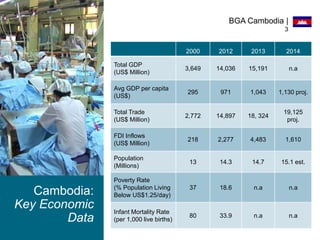
2000 2012 2013 2014
Total GDP
(US$ Million)
3,649 14,036 15,191 n.a
Avg GDP per capita
(US$)
295 971 1,043 1,130 proj.
Total Trade
(US$ Million)
2,772 14,897 18, 324
19,125
proj.
FDI Inflows
(US$ Million)
218 2,277 4,483 1,610
Population
(Millions)
13 14.3 14.7 15.1 est.
Poverty Rate
(% Population Living
Below US$1.25/day)
37 18.6 n.a n.a
Infant Mortality Rate
(per 1,000 live births)
80 33.9 n.a n.a
Cambodia:
Key Economic
Data
BGA Cambodia |
3
Invest in Cambodia
and you have
14.7 million
customers
and
600 million
more customers
at your doorstep
BGA Cambodia | 4
Macroeconomic
Stability and
Sound Financial
Sector
BGA Cambodia |
5
 GDP growth averaged 8% per annum the last 10
years
 Stable exchange rate
 Low inflation
 Debt to GDP ratio of 32.8% (at the end of 2013)
 Low budget deficit
 International reserves on the rise
Pro-Business
Government
BGA Cambodia |
6
 Full foreign ownership of commercial entities
allowed
 No foreign exchange controls
 Government private sector forum concept
implemented since 1999; the best among other
countries adopting similar approach
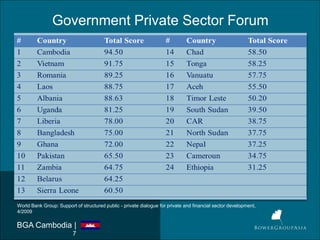
Government Private Sector Forum
World Bank Group: Support of structured public - private dialogue for private and financial sector development,
4/2009
BGA Cambodia |
7
Inside SEZ Outside SEZ
Fiscal Incentives
Same regime: Corporate tax rate, tax
holidays, duty exemptions.
Same regime: Corporate tax rate,
tax holidays, duty exemptions.
VAT
VAT suspension for all exported oriented
activities.
VAT suspension ONLY for garments
and footwear production.
Non Fiscal
Incentives
One Stop Shop at each SEZ:
-Investment approvals
-Minimum inspections (Customs,
CAMCONTROL)
-Speedy import-export procedures:
• Duty exemptions
• Customs clearance
• Certificate of origin
• CAMCONTROL
-Lower electricity cost, better security, low
insurance fees
-Fewer labor disputes
One Stop Shop at the CDC:
investment approvals, duty
exemptions.
Competitive Investment Incentives
BGA Cambodia | 8
• Australia
• China P.R.
• Croatia
• Cuba
• Czech Republic
• DPR of Korea
• Germany
• France
• Indonesia
• Japan
• Kuwait
• Lao PDR
• Malaysia
• Netherlands
• OPEC
• OPIC
• Pakistan
• Philippines
• ROK
• Singapore
• Switzerland
• Thailand
• Vietnam
In process:
o Algeria
o Bulgaria
o Egypt
o Libya
o Myanmar
o Qatar
o Russia
o Ukraine
o UK
o USA
o Hungary
o Malta
Investment
Protection
Agreements
BGA Cambodia |
9
Preferential
Access to
World Markets
BGA Cambodia | 10
 Access to the U.S. market - 1996
 Access to the E.U. market - 1996
 Member of the Association of South-East Asian
Nations (ASEAN) - 1999
 Member of World Customs Organization (WCO)
- 2001
 Member of World Trade Organization (WTO) -
2004
 Member of various regional trade agreements
• Australia
• Austria
• Belarus
• Belgium
• Bulgaria
• Canada
• China
• Czech Republic
• Denmark
• Finland
• France
• Germany
• Hungary
• Ireland
• Italy
• Korea
• Luxemburg
• Japan
• Netherlands
• New Zealand
• Norway
• Poland
• Portugal
• ROK
• Russian
Federation
• Slovakia
• Spain
• Sweden
• Switzerland
• UK
• USA
Generalized
System of
Preferences
(GSP)
BGA Cambodia | 11
Progress &
Opportunities:
Integration into Global
Economy via Trade
BGA Cambodia | 12
 Trade with ASEAN countries has almost doubled
since 2009, as well as risen significantly with
other Asian neighbors.
 FTA’s: ASEAN continues to focus on its
integration into the global economy by
implementing and upgrading the ASEAN+1
FTA’s with China, Japan, Korea, Australia-New
Zealand, Hong Kong and India.
 Regional Comprehensive Economic Partnership
(RCEP): Will represent a combined GDP of
about US$21.2 trillion (30% of global GDP) and
a market of 3.4 billion people (half of the world’s
population).
ASEAN
Economic
Community
BGA Cambodia | 13
• The AEC, due to be implemented by 2015, will
establish ASEAN as a single market and production
base, making ASEAN more dynamic and competitive.
• An ASEAN single market and production base
comprises five core elements: (i) free flow of goods;
(ii) free flow of services; (iii) free flow of investment;
(iv) freer flow of capital; and (v) free flow of skilled
labor.
• Economic activities covered under AEC include:
finance, tourism, transport, agriculture, forestry,
competition, consumer protection, intellectual property
rights, information and communication technology
(ICT), energy, SME and connectivity.
• The AEC should lead to a 5.3% increase in regional
welfare ($69 billion) due to elimination of non-tariff
barriers, lower trade costs, and anticipated increases
in FDI
Source: “Realizing AEC: a Comprehensive Assessment,” Johns Hopkins University
Progress: Free Flow of Goods
Category Status
Agreements
The ASEAN Trade in Goods Agreement (ATIGA) created a legal
framework to realize the free flow of goods within the AEC.
Mutual Recognition Arrangements (MRAs) are in place for testing
standards in many areas.
The Royal Government of Cambodia is in the process of preparing to
implement the 1st self-certification pilot project.
Tariffs
The ASEAN-6 eliminated their import duties for 99.2% of the total tariff
lines by January 1, 2010.
For the ASEAN-4 (CLMV), 97.5% of tariff lines have been reduced to 0-
5% by 2015 but some products granted flexibility until 2018.
Non-Tariff
Barriers/Custo
ms
ASEAN Single Window will be fully implemented by the end of 2015, is a
single point of decision for release of cargo, harmonizing standards of
goods traded in ASEAN.
BGA Cambodia | 14
6
Progress:
Free Flow of
Services and
Skilled Labor
BGA Cambodia | 15
 The ASEAN Framework Agreement on Services (AFAS) and
ASEAN Agreement on Movement of Natural Persons (AMNP)
eases restrictions on providing services and establishing
companies across borders within the region.
 ASEAN has already signed 7 Mutual Recognition
Arrangements (MRAs) for professional services such as
Engineering Services, Architectural Services, Accountancy
Services, Medical Practitioners, Dental Practitioners, Nursing
Services and Surveying Professionals.
 BUT these agreements are subject to domestic regulations like
national labor laws and regulations in ASEAN Member States.
 In the post-2015 AEC framework, the ASEAN Trade in
Services Agreement (ATISA) will replace the AFAS. The
ATISA will improve upon both the substance and form of the
AFAS and respond to the needs and requirements of ASEAN
in line with regional integration efforts.
6
https://www.facebook.com/moc.gov.kh
Progress:
Freer Flow of
Investment &
Capital
BGA Cambodia |
16
 The ASEAN Comprehensive Investment Agreement
(ACIA) aims to create an integrated investment region
by harmonizing investment rules and progressively
reducing investment restrictions.
 ACIA covers the 4 pillars of investment: liberalization,
protection, facilitation and promotion.
 Further liberalization will be implemented to improve
the investment regime and eliminate investment
impediments according to global best practices.
 The ASEAN Recognition Framework for Mutual Funds
will be an important step towards capital market
integration. Cambodia is at the early preparation stage
for joining the ASEAN Recognition Framework for
Mutual Funds.
15
Stakeholder Benefits
ASEAN
Businesses
(including SME’s)
• Greater market access and lower input and transaction costs
through elimination of tariffs and non-tariff barriers on goods and
improved regulatory environment on services
• Improved trade facilitation via customs reform, improved
transportation connectivity and logistics efficiencies, and improved
ICT
• Rationalized rules of origin, product and technical standards
ASEAN
Professionals and
Labor
• Better employment opportunities and improved wages
ASEAN
Consumers
• Access to cheaper and wider range of imported goods and
services
• More competitive domestic market environment and consumer
protection
AEC Opportunities & Benefits
for the Region
https://www.facebook.com/moc.gov.kh
BGA Cambodia | 17
https://www.facebook.com/moc.gov.kh
AEC
Opportunities
& Benefits for the
Region
BGA Cambodia | 18
The ASEAN-4 (Cambodia, Laos, Myanmar and Vietnam)
stand to gain the most from integration due to the
following factors:
 Liberalization and reform efforts to improve efficiency
and competitiveness, e.g., by leveraging the AEC to
undertake politically sensitive domestic reforms;
 Access to ASEAN capital, investment, technology,
technical assistance, development experience and
best practices;
 Greater participation in global production networks and
value chains; and
 Greater influence in regional and international
negotiations.
Implementation of AEC Scorecard by Country, Phases I-III (2008-2013) Source: ASEAN Secretariat as of end
2014
ASEAN Done Not Done Total Implementation Rate
Brunei 370 60 430 86.0%
Cambodia 371 60 431 86.1%
Indonesia 361 69 430 84.0%
Lao PDR 360 67 427 84.3%
Malaysia 372 63 435 85.5%
Myanmar 361 67 428 84.3%
Philippines 373 60 433 86.1%
Singapore 371 54 425 87.3%
Thailand 379 53 432 87.7%
Vietnam 377 55 432 87.3%
Cambodia’s Readiness for AEC Participation
and Implementation
BGA Cambodia | 19
Area Benefit
Tariffs
EU will allow Cambodia to use inputs from ASEAN member
states, except Brunei and Singapore, to produce goods in
Cambodia and export to EU markets duty-free and quota-free.
The garment, shoe and bicycle industries, for example, should all
benefit.
Technical
Assistance and
Technology
Transfer
Cambodia will continue to benefit from technical assistance and
technology transfer provided by ASEAN-6 and other ASEAN
dialogue partners like US, EU, Japan, China, Korea, Canada and
India.
Political and
Economic
Leverage
Participating in the AEC will provide political and economic
leverage when negotiating with stakeholders outside of the
ASEAN region.
Sample AEC Opportunities
& Benefits for Cambodia
BGA Cambodia | 20
AEC
Challenges
for Cambodia
BGA Cambodia | 21
 Loss of import revenues when import tariffs are
eliminated or reduced to maximum 5%
 Cost and complexity of executing transparency and
investment reforms required to comply with ASEAN
agreements
 Meeting international standards for exports
 Lack of skilled workforce and cost of education and
healthcare reforms required to implement
 Limited financial resources to actively participate in all
ASEAN economic activities
 Lack of knowledge regarding AEC 2015 and its
implications
 Need to diversify its export commodity base, especially
agricultural products, in order to take full advantage of
integration
Future
Direction:
AEC Post-
BGA Cambodia | 22
 ASEAN will likely not be able to fully implement all of
its intended reforms under the AEC by the end of
2015.
 As a result, under the leadership of Malaysia, this
year’s chair, ASEAN has been developing a AEC Post
2015 Vision and ten year framework.
 ASEAN wants to deepen and consolidate ASEAN
economic cooperation in the region, with ASEAN
Dialogue Partners and the rest of the world.
 The draft AEC 2016-2025 framework will be submitted
for endorsement by the 47th ASEAN Economic
Ministerial in August 2015.
For more information, please contact David
Van at
dvan@bowergroupasia.com

David VAN Cambodia May 2015

  • 1.
    Exquisite Cambodia Challenges &Opportunities for AEC 2015 May 2015
  • 2.
    Most Liberal Economy within ASEAN Favorable geography; abundant resources  Macroeconomic stability and sound financial sector  Pro-business government  Competitive investment incentives and protection, including a one-stop service investment promotion agency  Preferential access to regional & world markets via trade and investment BGA Cambodia | 2
  • 3.
    2000 2012 20132014 Total GDP (US$ Million) 3,649 14,036 15,191 n.a Avg GDP per capita (US$) 295 971 1,043 1,130 proj. Total Trade (US$ Million) 2,772 14,897 18, 324 19,125 proj. FDI Inflows (US$ Million) 218 2,277 4,483 1,610 Population (Millions) 13 14.3 14.7 15.1 est. Poverty Rate (% Population Living Below US$1.25/day) 37 18.6 n.a n.a Infant Mortality Rate (per 1,000 live births) 80 33.9 n.a n.a Cambodia: Key Economic Data BGA Cambodia | 3
  • 4.
    Invest in Cambodia andyou have 14.7 million customers and 600 million more customers at your doorstep BGA Cambodia | 4
  • 5.
    Macroeconomic Stability and Sound Financial Sector BGACambodia | 5  GDP growth averaged 8% per annum the last 10 years  Stable exchange rate  Low inflation  Debt to GDP ratio of 32.8% (at the end of 2013)  Low budget deficit  International reserves on the rise
  • 6.
    Pro-Business Government BGA Cambodia | 6 Full foreign ownership of commercial entities allowed  No foreign exchange controls  Government private sector forum concept implemented since 1999; the best among other countries adopting similar approach
  • 7.
    Government Private SectorForum World Bank Group: Support of structured public - private dialogue for private and financial sector development, 4/2009 BGA Cambodia | 7
  • 8.
    Inside SEZ OutsideSEZ Fiscal Incentives Same regime: Corporate tax rate, tax holidays, duty exemptions. Same regime: Corporate tax rate, tax holidays, duty exemptions. VAT VAT suspension for all exported oriented activities. VAT suspension ONLY for garments and footwear production. Non Fiscal Incentives One Stop Shop at each SEZ: -Investment approvals -Minimum inspections (Customs, CAMCONTROL) -Speedy import-export procedures: • Duty exemptions • Customs clearance • Certificate of origin • CAMCONTROL -Lower electricity cost, better security, low insurance fees -Fewer labor disputes One Stop Shop at the CDC: investment approvals, duty exemptions. Competitive Investment Incentives BGA Cambodia | 8
  • 9.
    • Australia • ChinaP.R. • Croatia • Cuba • Czech Republic • DPR of Korea • Germany • France • Indonesia • Japan • Kuwait • Lao PDR • Malaysia • Netherlands • OPEC • OPIC • Pakistan • Philippines • ROK • Singapore • Switzerland • Thailand • Vietnam In process: o Algeria o Bulgaria o Egypt o Libya o Myanmar o Qatar o Russia o Ukraine o UK o USA o Hungary o Malta Investment Protection Agreements BGA Cambodia | 9
  • 10.
    Preferential Access to World Markets BGACambodia | 10  Access to the U.S. market - 1996  Access to the E.U. market - 1996  Member of the Association of South-East Asian Nations (ASEAN) - 1999  Member of World Customs Organization (WCO) - 2001  Member of World Trade Organization (WTO) - 2004  Member of various regional trade agreements
  • 11.
    • Australia • Austria •Belarus • Belgium • Bulgaria • Canada • China • Czech Republic • Denmark • Finland • France • Germany • Hungary • Ireland • Italy • Korea • Luxemburg • Japan • Netherlands • New Zealand • Norway • Poland • Portugal • ROK • Russian Federation • Slovakia • Spain • Sweden • Switzerland • UK • USA Generalized System of Preferences (GSP) BGA Cambodia | 11
  • 12.
    Progress & Opportunities: Integration intoGlobal Economy via Trade BGA Cambodia | 12  Trade with ASEAN countries has almost doubled since 2009, as well as risen significantly with other Asian neighbors.  FTA’s: ASEAN continues to focus on its integration into the global economy by implementing and upgrading the ASEAN+1 FTA’s with China, Japan, Korea, Australia-New Zealand, Hong Kong and India.  Regional Comprehensive Economic Partnership (RCEP): Will represent a combined GDP of about US$21.2 trillion (30% of global GDP) and a market of 3.4 billion people (half of the world’s population).
  • 13.
    ASEAN Economic Community BGA Cambodia |13 • The AEC, due to be implemented by 2015, will establish ASEAN as a single market and production base, making ASEAN more dynamic and competitive. • An ASEAN single market and production base comprises five core elements: (i) free flow of goods; (ii) free flow of services; (iii) free flow of investment; (iv) freer flow of capital; and (v) free flow of skilled labor. • Economic activities covered under AEC include: finance, tourism, transport, agriculture, forestry, competition, consumer protection, intellectual property rights, information and communication technology (ICT), energy, SME and connectivity. • The AEC should lead to a 5.3% increase in regional welfare ($69 billion) due to elimination of non-tariff barriers, lower trade costs, and anticipated increases in FDI Source: “Realizing AEC: a Comprehensive Assessment,” Johns Hopkins University
  • 14.
    Progress: Free Flowof Goods Category Status Agreements The ASEAN Trade in Goods Agreement (ATIGA) created a legal framework to realize the free flow of goods within the AEC. Mutual Recognition Arrangements (MRAs) are in place for testing standards in many areas. The Royal Government of Cambodia is in the process of preparing to implement the 1st self-certification pilot project. Tariffs The ASEAN-6 eliminated their import duties for 99.2% of the total tariff lines by January 1, 2010. For the ASEAN-4 (CLMV), 97.5% of tariff lines have been reduced to 0- 5% by 2015 but some products granted flexibility until 2018. Non-Tariff Barriers/Custo ms ASEAN Single Window will be fully implemented by the end of 2015, is a single point of decision for release of cargo, harmonizing standards of goods traded in ASEAN. BGA Cambodia | 14
  • 15.
    6 Progress: Free Flow of Servicesand Skilled Labor BGA Cambodia | 15  The ASEAN Framework Agreement on Services (AFAS) and ASEAN Agreement on Movement of Natural Persons (AMNP) eases restrictions on providing services and establishing companies across borders within the region.  ASEAN has already signed 7 Mutual Recognition Arrangements (MRAs) for professional services such as Engineering Services, Architectural Services, Accountancy Services, Medical Practitioners, Dental Practitioners, Nursing Services and Surveying Professionals.  BUT these agreements are subject to domestic regulations like national labor laws and regulations in ASEAN Member States.  In the post-2015 AEC framework, the ASEAN Trade in Services Agreement (ATISA) will replace the AFAS. The ATISA will improve upon both the substance and form of the AFAS and respond to the needs and requirements of ASEAN in line with regional integration efforts.
  • 16.
    6 https://www.facebook.com/moc.gov.kh Progress: Freer Flow of Investment& Capital BGA Cambodia | 16  The ASEAN Comprehensive Investment Agreement (ACIA) aims to create an integrated investment region by harmonizing investment rules and progressively reducing investment restrictions.  ACIA covers the 4 pillars of investment: liberalization, protection, facilitation and promotion.  Further liberalization will be implemented to improve the investment regime and eliminate investment impediments according to global best practices.  The ASEAN Recognition Framework for Mutual Funds will be an important step towards capital market integration. Cambodia is at the early preparation stage for joining the ASEAN Recognition Framework for Mutual Funds.
  • 17.
    15 Stakeholder Benefits ASEAN Businesses (including SME’s) •Greater market access and lower input and transaction costs through elimination of tariffs and non-tariff barriers on goods and improved regulatory environment on services • Improved trade facilitation via customs reform, improved transportation connectivity and logistics efficiencies, and improved ICT • Rationalized rules of origin, product and technical standards ASEAN Professionals and Labor • Better employment opportunities and improved wages ASEAN Consumers • Access to cheaper and wider range of imported goods and services • More competitive domestic market environment and consumer protection AEC Opportunities & Benefits for the Region https://www.facebook.com/moc.gov.kh BGA Cambodia | 17
  • 18.
    https://www.facebook.com/moc.gov.kh AEC Opportunities & Benefits forthe Region BGA Cambodia | 18 The ASEAN-4 (Cambodia, Laos, Myanmar and Vietnam) stand to gain the most from integration due to the following factors:  Liberalization and reform efforts to improve efficiency and competitiveness, e.g., by leveraging the AEC to undertake politically sensitive domestic reforms;  Access to ASEAN capital, investment, technology, technical assistance, development experience and best practices;  Greater participation in global production networks and value chains; and  Greater influence in regional and international negotiations.
  • 19.
    Implementation of AECScorecard by Country, Phases I-III (2008-2013) Source: ASEAN Secretariat as of end 2014 ASEAN Done Not Done Total Implementation Rate Brunei 370 60 430 86.0% Cambodia 371 60 431 86.1% Indonesia 361 69 430 84.0% Lao PDR 360 67 427 84.3% Malaysia 372 63 435 85.5% Myanmar 361 67 428 84.3% Philippines 373 60 433 86.1% Singapore 371 54 425 87.3% Thailand 379 53 432 87.7% Vietnam 377 55 432 87.3% Cambodia’s Readiness for AEC Participation and Implementation BGA Cambodia | 19
  • 20.
    Area Benefit Tariffs EU willallow Cambodia to use inputs from ASEAN member states, except Brunei and Singapore, to produce goods in Cambodia and export to EU markets duty-free and quota-free. The garment, shoe and bicycle industries, for example, should all benefit. Technical Assistance and Technology Transfer Cambodia will continue to benefit from technical assistance and technology transfer provided by ASEAN-6 and other ASEAN dialogue partners like US, EU, Japan, China, Korea, Canada and India. Political and Economic Leverage Participating in the AEC will provide political and economic leverage when negotiating with stakeholders outside of the ASEAN region. Sample AEC Opportunities & Benefits for Cambodia BGA Cambodia | 20
  • 21.
    AEC Challenges for Cambodia BGA Cambodia| 21  Loss of import revenues when import tariffs are eliminated or reduced to maximum 5%  Cost and complexity of executing transparency and investment reforms required to comply with ASEAN agreements  Meeting international standards for exports  Lack of skilled workforce and cost of education and healthcare reforms required to implement  Limited financial resources to actively participate in all ASEAN economic activities  Lack of knowledge regarding AEC 2015 and its implications  Need to diversify its export commodity base, especially agricultural products, in order to take full advantage of integration
  • 22.
    Future Direction: AEC Post- BGA Cambodia| 22  ASEAN will likely not be able to fully implement all of its intended reforms under the AEC by the end of 2015.  As a result, under the leadership of Malaysia, this year’s chair, ASEAN has been developing a AEC Post 2015 Vision and ten year framework.  ASEAN wants to deepen and consolidate ASEAN economic cooperation in the region, with ASEAN Dialogue Partners and the rest of the world.  The draft AEC 2016-2025 framework will be submitted for endorsement by the 47th ASEAN Economic Ministerial in August 2015.
  • 23.
    For more information,please contact David Van at dvan@bowergroupasia.com