What is
ASEAN?
(Association of Southeast Asian
Nations)
Association of Southeast Asian
Nation s (ASEAN)
• The ASEAN was founded on August 8,
1967.
• The Foreign Ministers of Indonesia,
Malaysia, the Philippines, Singapore and
Thailand – sat down together in the main
hall of the Department of Foreign Affairs
building in Bangkok, Thailand and signed
a document. By virtue of that document,
the Association of Southeast Asian
Nations (ASEAN) was born.
• The five Foreign Ministers who signed it –
Adam Malik of Indonesia, Narciso R.
Ramos of the Philippines, Tun Abdul Razak
of Malaysia, S. Rajaratnam of Singapore,
and Thanat Khoman of Thailand – would
subsequently be hailed as the Founding
Fathers of probably the most successful
inter-governmental organization in the
developing world today. And the document
that they signed would be known as the
ASEAN Declaration.
• ASEAN is a regional grouping that
promotes economic, political, and security
cooperation among its ten members:
Brunei, Cambodia, Indonesia, Laos,
Malaysia, Myanmar, the Philippines,
Singapore, Thailand, and Vietnam.
• In 1976, the members signed the Treaty
of Amity and Cooperation, emphasizing
ASEAN's promotion of peace, friendship,
and cooperation to build solidarity.
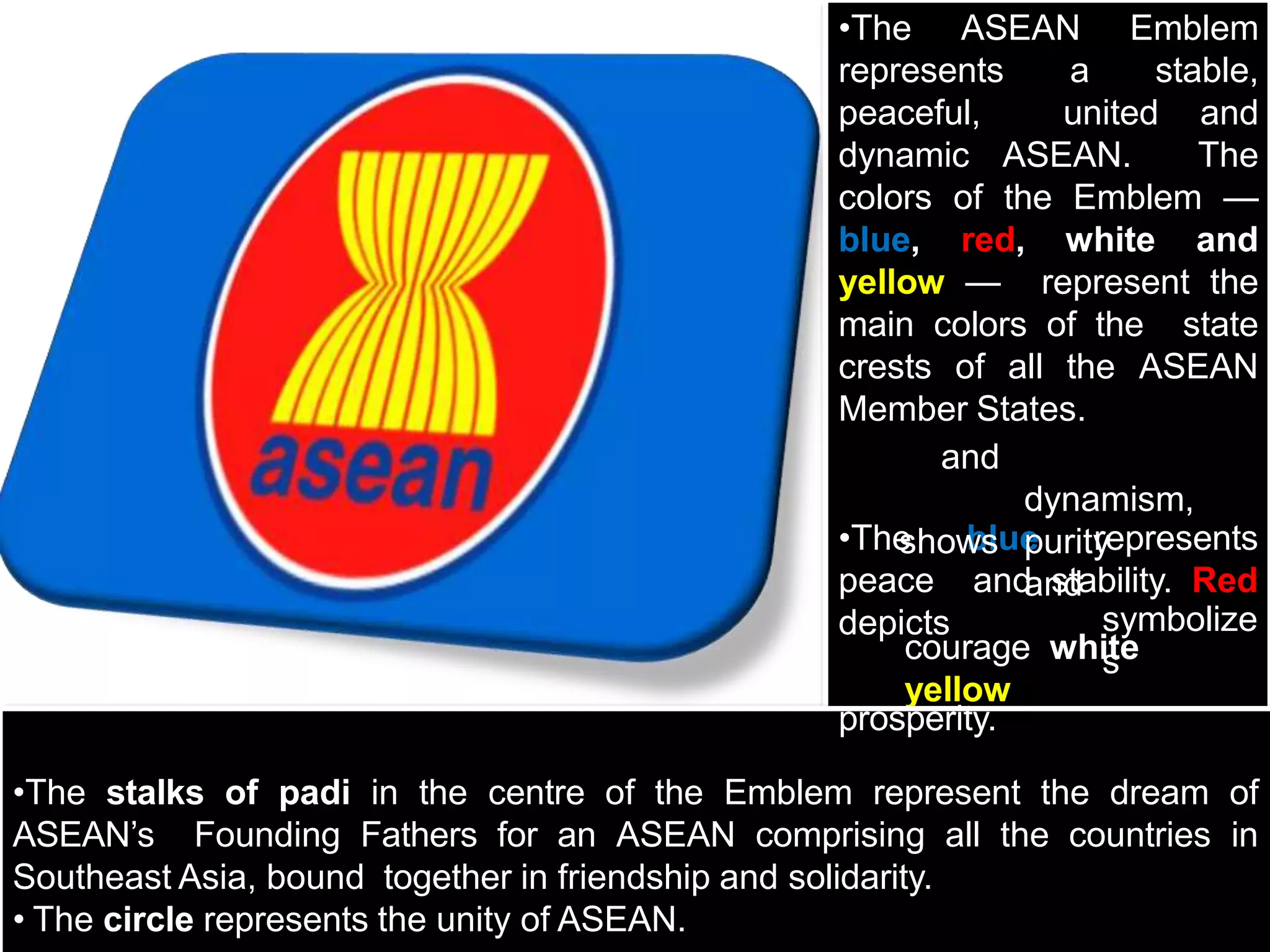
•The ASEAN Emblem
represents a stable,
peaceful, united and
dynamic ASEAN. The
colors of the Emblem —
blue, red, white and
yellow — represent the
main colors of the state
crests of all the ASEAN
Member States.
•The blue represents
peace and stability. Red
depicts
and
dynamism,
shows purity
and
courage white
yellow
symbolize
s
prosperity.
•The stalks of padi in the centre of the Emblem represent the dream of
ASEAN’s Founding Fathers for an ASEAN comprising all the countries in
Southeast Asia, bound together in friendship and solidarity.
• The circle represents the unity of ASEAN.
• Thailand
• Myanmar
• Cambodia
• Laos
• Brunei
• Vietnam
• Malaysia
• Singapore
• Philippines
• Indonesia
• Some of the joint development programs
first undertaken by ASEAN include
projects to:
 increase food production
 promote tourism
 ease travel restrictions, and
mass media through exchanges
enhance cooperation in the field of
of
radio and television programs.
Plans were also put in place to liberalize
trade among members in a bid to
improve intraregional trade.
• Today, ASEAN is considered one of the
most successful intergovernmental
organizations in the developing world.
Since its founding, the grouping has
expanded to include other Southeast
Asian states – Brunei (1984), Vietnam
(1995), Laos (1997), Myanmar (1997) and
Cambodia (1999).
AIMS AND
PURPOSES
As set out in the ASEAN Declaration, the
aims and purposes of ASEAN are:
• To accelerate the economic growth, social
progress and cultural development in the
region through joint endeavors in the spirit of
equality and partnership in order to
strengthen the foundation for a prosperous
and peaceful community of Southeast Asian
Nations.
• T
o promote regional peace and stability
through abiding respect for justice and the
rule of law in the relationship among
countries of the region and adherence to the
principles of the United Nations Charter;
• To promote active collaboration and mutual
assistance on matters of common interest in
the economic, social, cultural, technical,
scientific and administrative fields;
• To provide assistance to each other in the
form of training and research facilities in the
educational, professional, technical and
administrative spheres;
• To collaborate more effectively for the greater
utilization of their agriculture and industries,
the expansion of their trade, including the
study of the problems of international
commodity trade, the improvement of their
transportation and communications facilities
and the raising of the living standards of their
peoples;
• To promote Southeast Asian studies; and
• To maintain close and beneficial cooperation
with existing international and regional
organisations with similar aims and purposes,
and explore all avenues for even closer
cooperation among themselves.
Fundamental Principles
In their relations with one another, the ASEAN Member States
have adopted the following fundamental principles, as
contained in the Treaty of Amity and Cooperation in Southeast
Asia (TAC) of 1976:
• Mutual respect for the
sovereignty, equality, territorial
independence,
integrity, and
national identity of all nations;
• The right of every State to lead its national
existence free from external interference,
subversion or coercion;
• Non-interference in the internal affairs of one
another;
• Settlement of differences or disputes by
peaceful manner;
• Renunciation of the threat or use of force; and
• Effective cooperation among themselves.
Asean
Asean
Asean

Asean

  • 1.
    What is ASEAN? (Association ofSoutheast Asian Nations)
  • 3.
    Association of SoutheastAsian Nation s (ASEAN) • The ASEAN was founded on August 8, 1967. • The Foreign Ministers of Indonesia, Malaysia, the Philippines, Singapore and Thailand – sat down together in the main hall of the Department of Foreign Affairs building in Bangkok, Thailand and signed a document. By virtue of that document, the Association of Southeast Asian Nations (ASEAN) was born.
  • 4.
    • The fiveForeign Ministers who signed it – Adam Malik of Indonesia, Narciso R. Ramos of the Philippines, Tun Abdul Razak of Malaysia, S. Rajaratnam of Singapore, and Thanat Khoman of Thailand – would subsequently be hailed as the Founding Fathers of probably the most successful inter-governmental organization in the developing world today. And the document that they signed would be known as the ASEAN Declaration.
  • 5.
    • ASEAN isa regional grouping that promotes economic, political, and security cooperation among its ten members: Brunei, Cambodia, Indonesia, Laos, Malaysia, Myanmar, the Philippines, Singapore, Thailand, and Vietnam. • In 1976, the members signed the Treaty of Amity and Cooperation, emphasizing ASEAN's promotion of peace, friendship, and cooperation to build solidarity.
  • 6.
    •The ASEAN Emblem representsa stable, peaceful, united and dynamic ASEAN. The colors of the Emblem — blue, red, white and yellow — represent the main colors of the state crests of all the ASEAN Member States. •The blue represents peace and stability. Red depicts and dynamism, shows purity and courage white yellow symbolize s prosperity. •The stalks of padi in the centre of the Emblem represent the dream of ASEAN’s Founding Fathers for an ASEAN comprising all the countries in Southeast Asia, bound together in friendship and solidarity. • The circle represents the unity of ASEAN.
  • 8.
    • Thailand • Myanmar •Cambodia • Laos • Brunei • Vietnam • Malaysia • Singapore • Philippines • Indonesia
  • 9.
    • Some ofthe joint development programs first undertaken by ASEAN include projects to:  increase food production  promote tourism  ease travel restrictions, and mass media through exchanges enhance cooperation in the field of of radio and television programs. Plans were also put in place to liberalize trade among members in a bid to improve intraregional trade.
  • 10.
    • Today, ASEANis considered one of the most successful intergovernmental organizations in the developing world. Since its founding, the grouping has expanded to include other Southeast Asian states – Brunei (1984), Vietnam (1995), Laos (1997), Myanmar (1997) and Cambodia (1999).
  • 11.
    AIMS AND PURPOSES As setout in the ASEAN Declaration, the aims and purposes of ASEAN are: • To accelerate the economic growth, social progress and cultural development in the region through joint endeavors in the spirit of equality and partnership in order to strengthen the foundation for a prosperous and peaceful community of Southeast Asian Nations.
  • 12.
    • T o promoteregional peace and stability through abiding respect for justice and the rule of law in the relationship among countries of the region and adherence to the principles of the United Nations Charter; • To promote active collaboration and mutual assistance on matters of common interest in the economic, social, cultural, technical, scientific and administrative fields; • To provide assistance to each other in the form of training and research facilities in the educational, professional, technical and administrative spheres;
  • 13.
    • To collaboratemore effectively for the greater utilization of their agriculture and industries, the expansion of their trade, including the study of the problems of international commodity trade, the improvement of their transportation and communications facilities and the raising of the living standards of their peoples; • To promote Southeast Asian studies; and • To maintain close and beneficial cooperation with existing international and regional organisations with similar aims and purposes, and explore all avenues for even closer cooperation among themselves.
  • 14.
    Fundamental Principles In theirrelations with one another, the ASEAN Member States have adopted the following fundamental principles, as contained in the Treaty of Amity and Cooperation in Southeast Asia (TAC) of 1976: • Mutual respect for the sovereignty, equality, territorial independence, integrity, and national identity of all nations; • The right of every State to lead its national existence free from external interference, subversion or coercion;
  • 15.
    • Non-interference inthe internal affairs of one another; • Settlement of differences or disputes by peaceful manner; • Renunciation of the threat or use of force; and • Effective cooperation among themselves.