COMPILER DESIGN
BCA 5th
Semester2020
Topic: Lexical Analysis
Sakhi Bandyopadhyay
Department of Computer Science and BCA
Kharagpur College
2.
The role oflexical analyzer
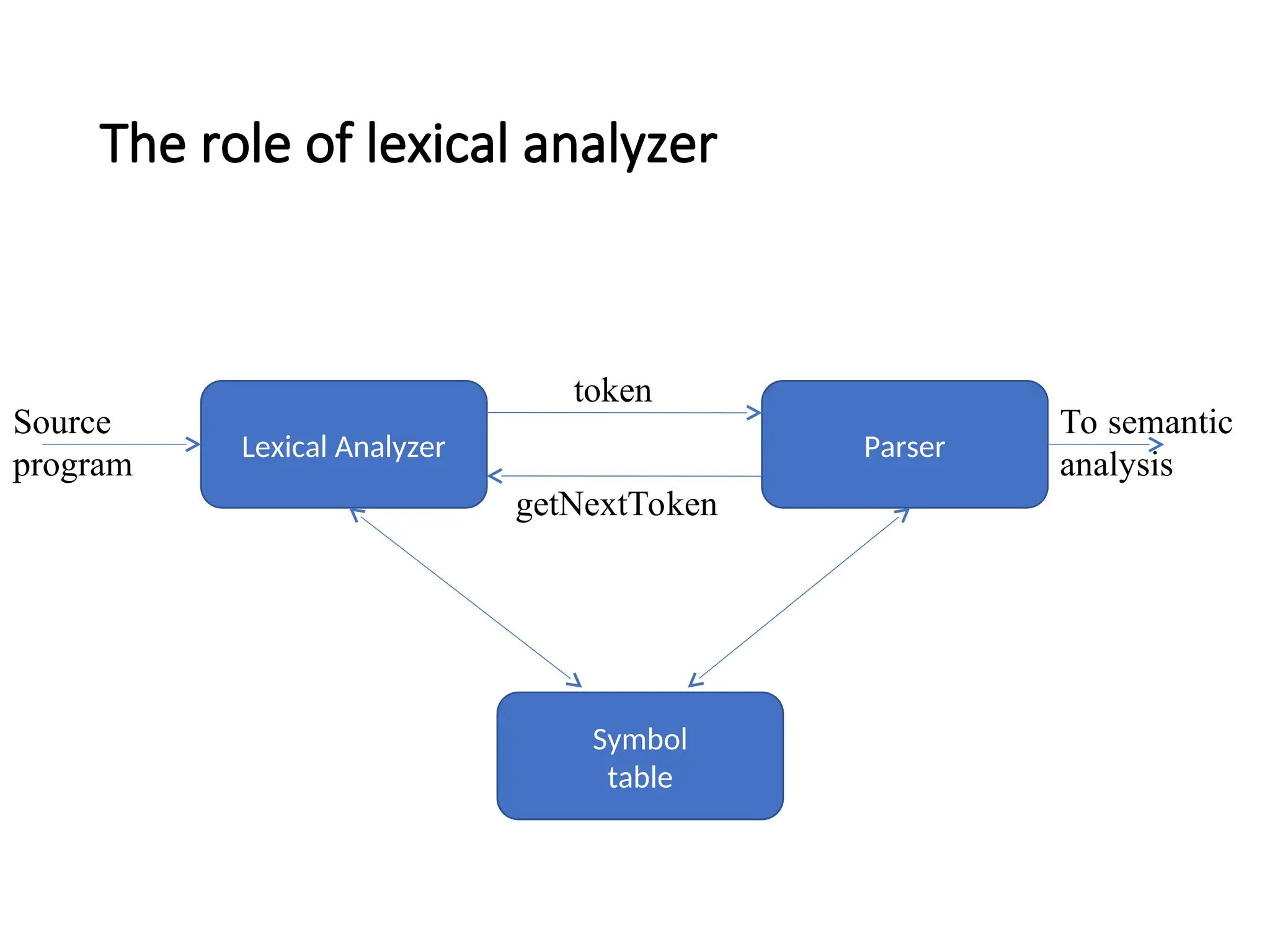
Lexical Analyzer Parser
Source
program
token
getNextToken
Symbol
table
To semantic
analysis
3.
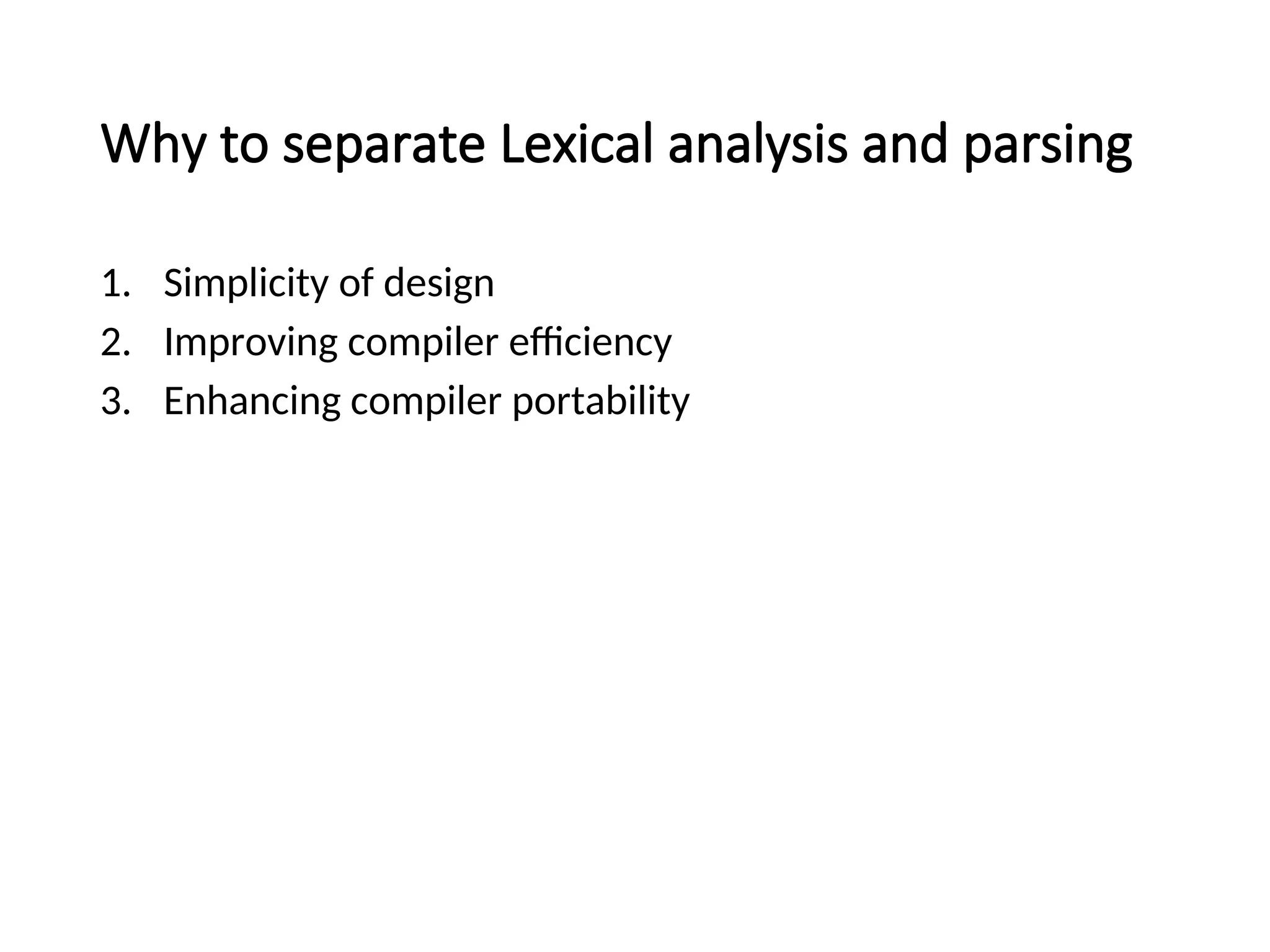
Why to separateLexical analysis and parsing
1. Simplicity of design
2. Improving compiler efficiency
3. Enhancing compiler portability
4.
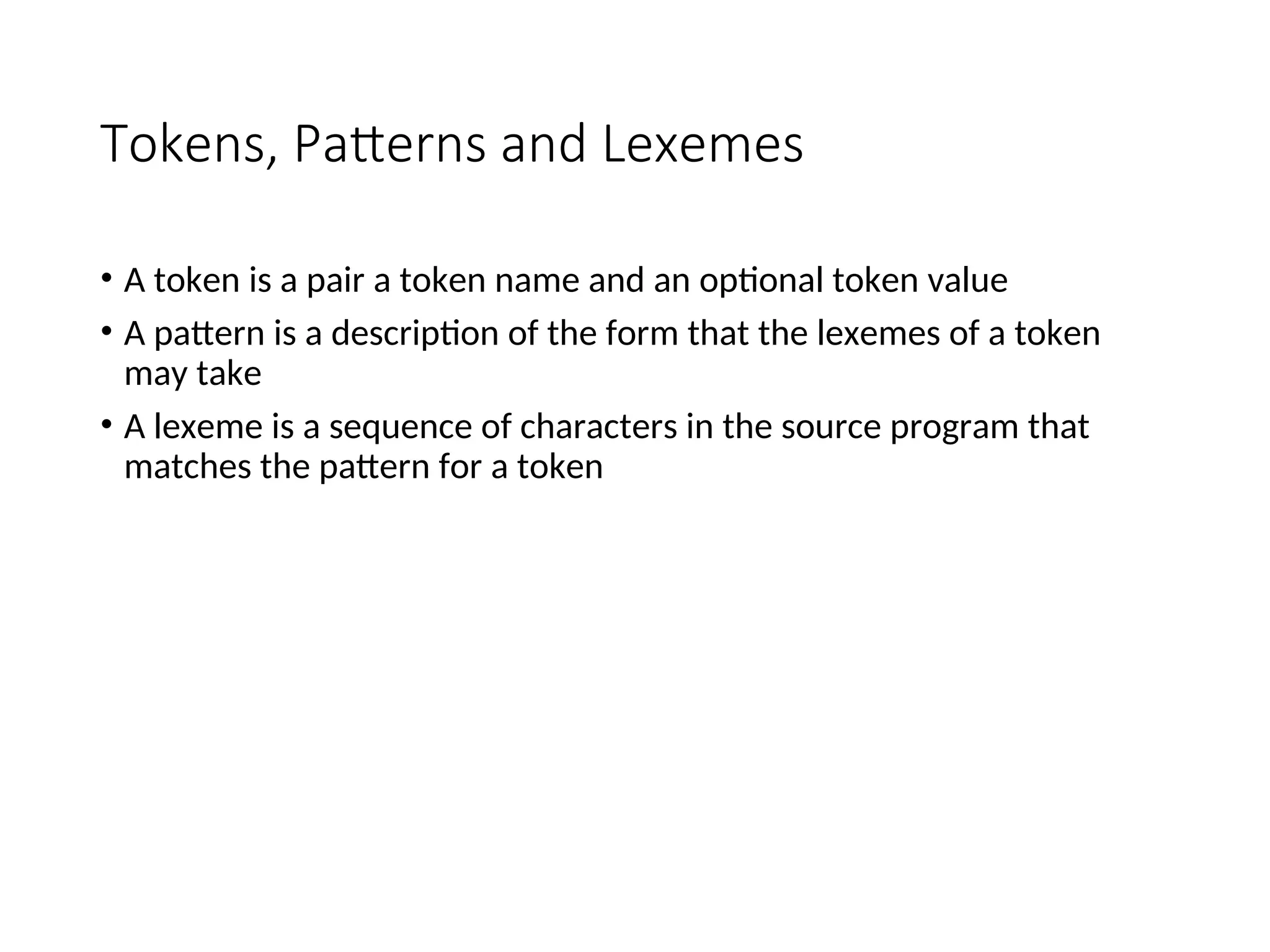
Tokens, Patterns andLexemes
• A token is a pair a token name and an optional token value
• A pattern is a description of the form that the lexemes of a token
may take
• A lexeme is a sequence of characters in the source program that
matches the pattern for a token
5.
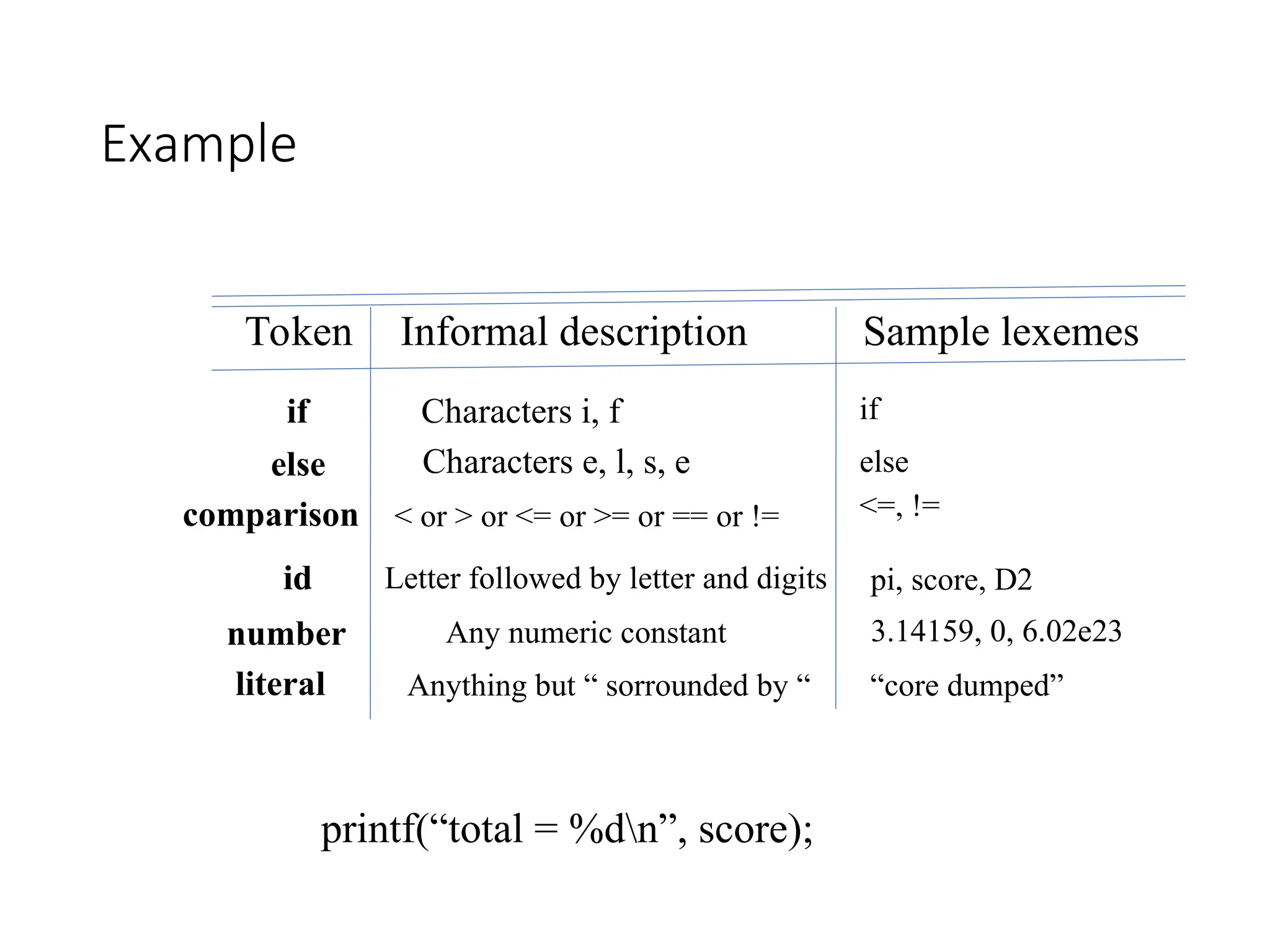
Example
Token Informal descriptionSample lexemes
if
else
comparison
id
number
literal
Characters i, f
Characters e, l, s, e
< or > or <= or >= or == or !=
Letter followed by letter and digits
Any numeric constant
Anything but “ sorrounded by “
if
else
<=, !=
pi, score, D2
3.14159, 0, 6.02e23
“core dumped”
printf(“total = %dn”, score);
6.
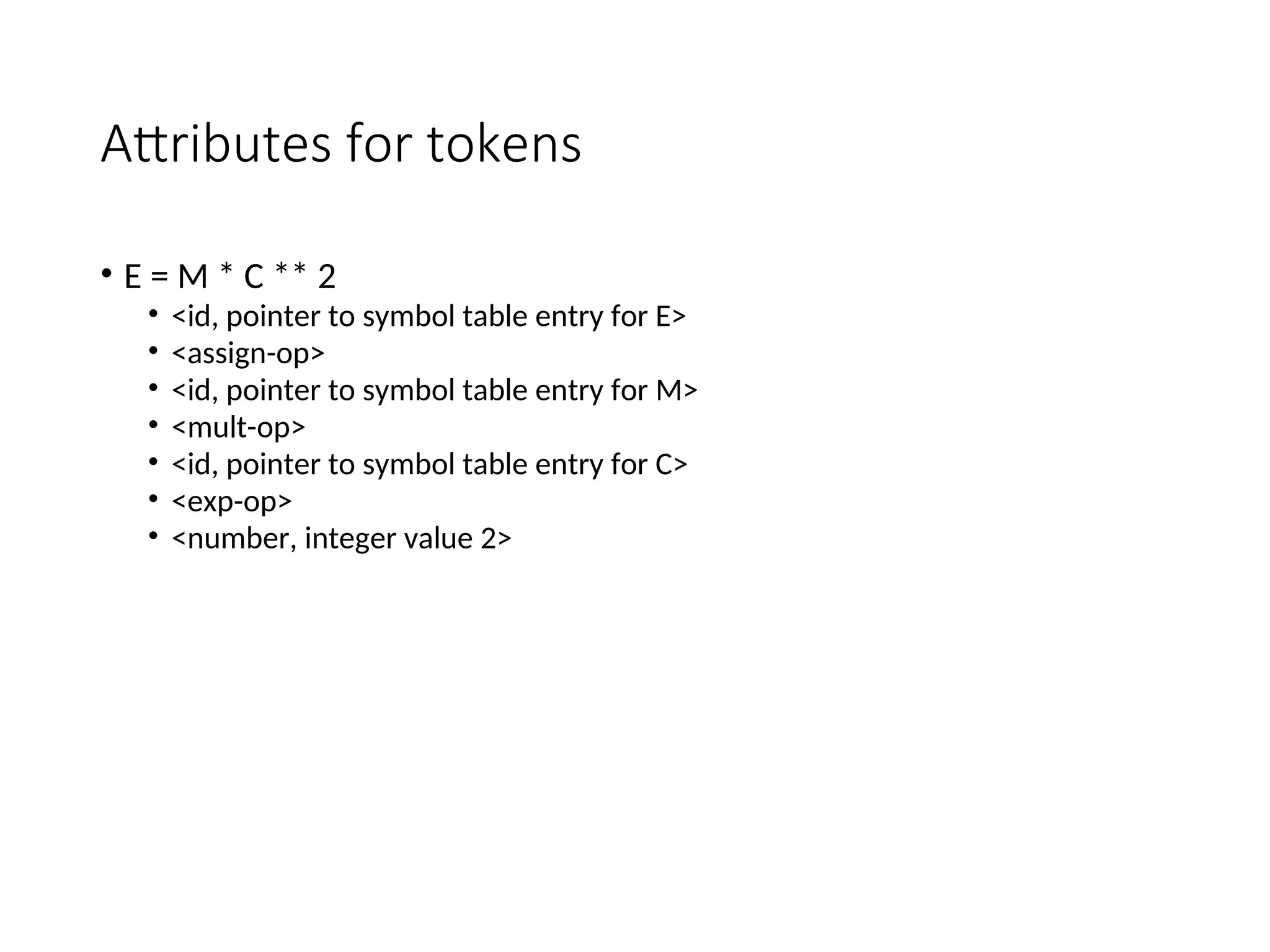
Attributes for tokens
•E = M * C ** 2
• <id, pointer to symbol table entry for E>
• <assign-op>
• <id, pointer to symbol table entry for M>
• <mult-op>
• <id, pointer to symbol table entry for C>
• <exp-op>
• <number, integer value 2>
7.
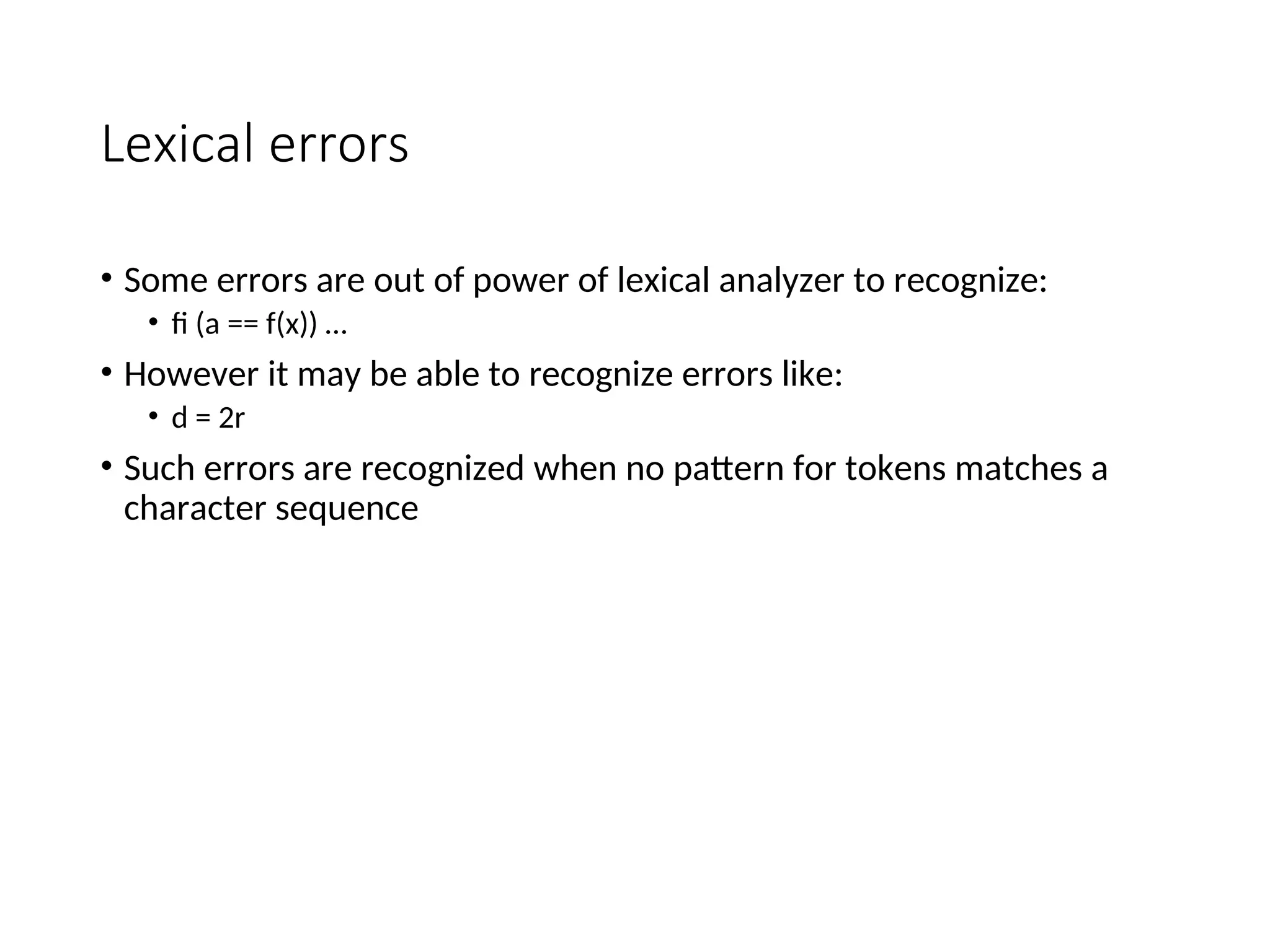
Lexical errors
• Someerrors are out of power of lexical analyzer to recognize:
• fi (a == f(x)) …
• However it may be able to recognize errors like:
• d = 2r
• Such errors are recognized when no pattern for tokens matches a
character sequence
8.
Error recovery
• Panicmode: successive characters are ignored until we reach to a
well formed token
• Delete one character from the remaining input
• Insert a missing character into the remaining input
• Replace a character by another character
• Transpose two adjacent characters
9.
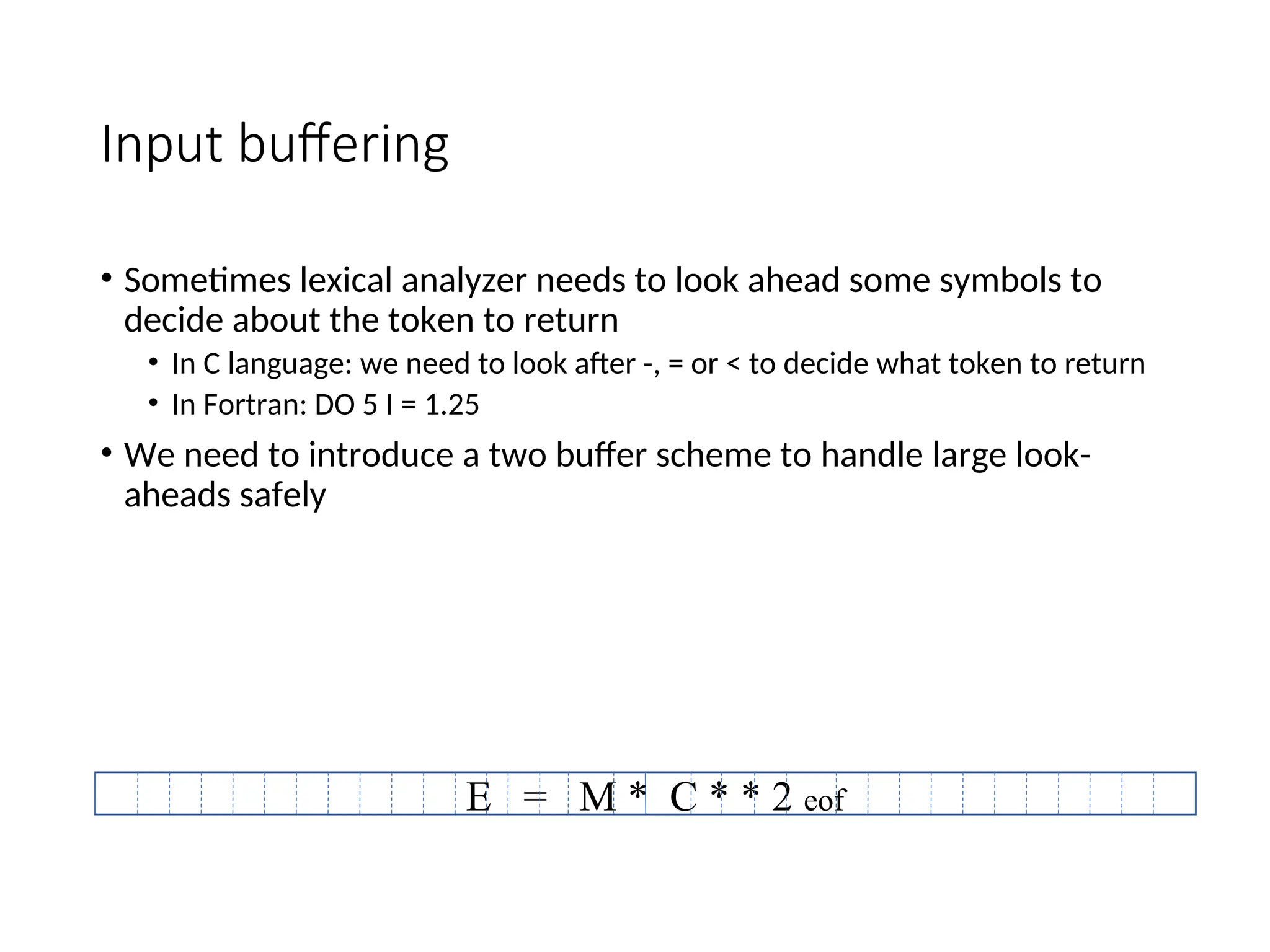
Input buffering
• Sometimeslexical analyzer needs to look ahead some symbols to
decide about the token to return
• In C language: we need to look after -, = or < to decide what token to return
• In Fortran: DO 5 I = 1.25
• We need to introduce a two buffer scheme to handle large look-
aheads safely
E = M * C * * 2 eof
10.
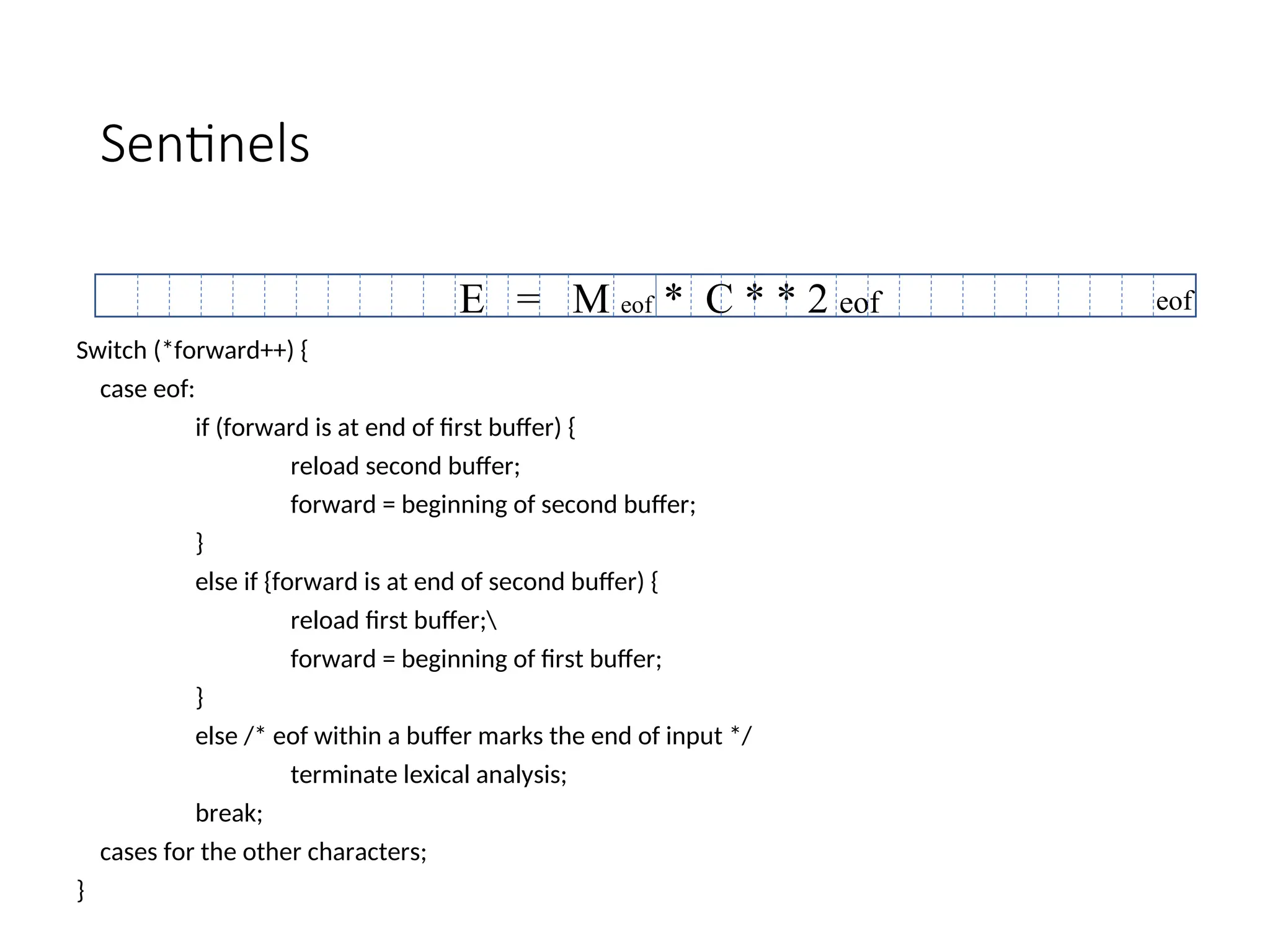
Sentinels
Switch (*forward++) {
caseeof:
if (forward is at end of first buffer) {
reload second buffer;
forward = beginning of second buffer;
}
else if {forward is at end of second buffer) {
reload first buffer;
forward = beginning of first buffer;
}
else /* eof within a buffer marks the end of input */
terminate lexical analysis;
break;
cases for the other characters;
}
E = M eof * C * * 2 eof eof
11.
Specification of tokens
•In theory of compilation regular expressions are used to formalize
the specification of tokens
• Regular expressions are means for specifying regular languages
• Example:
• Letter_(letter_ | digit)*
• Each regular expression is a pattern specifying the form of strings
12.
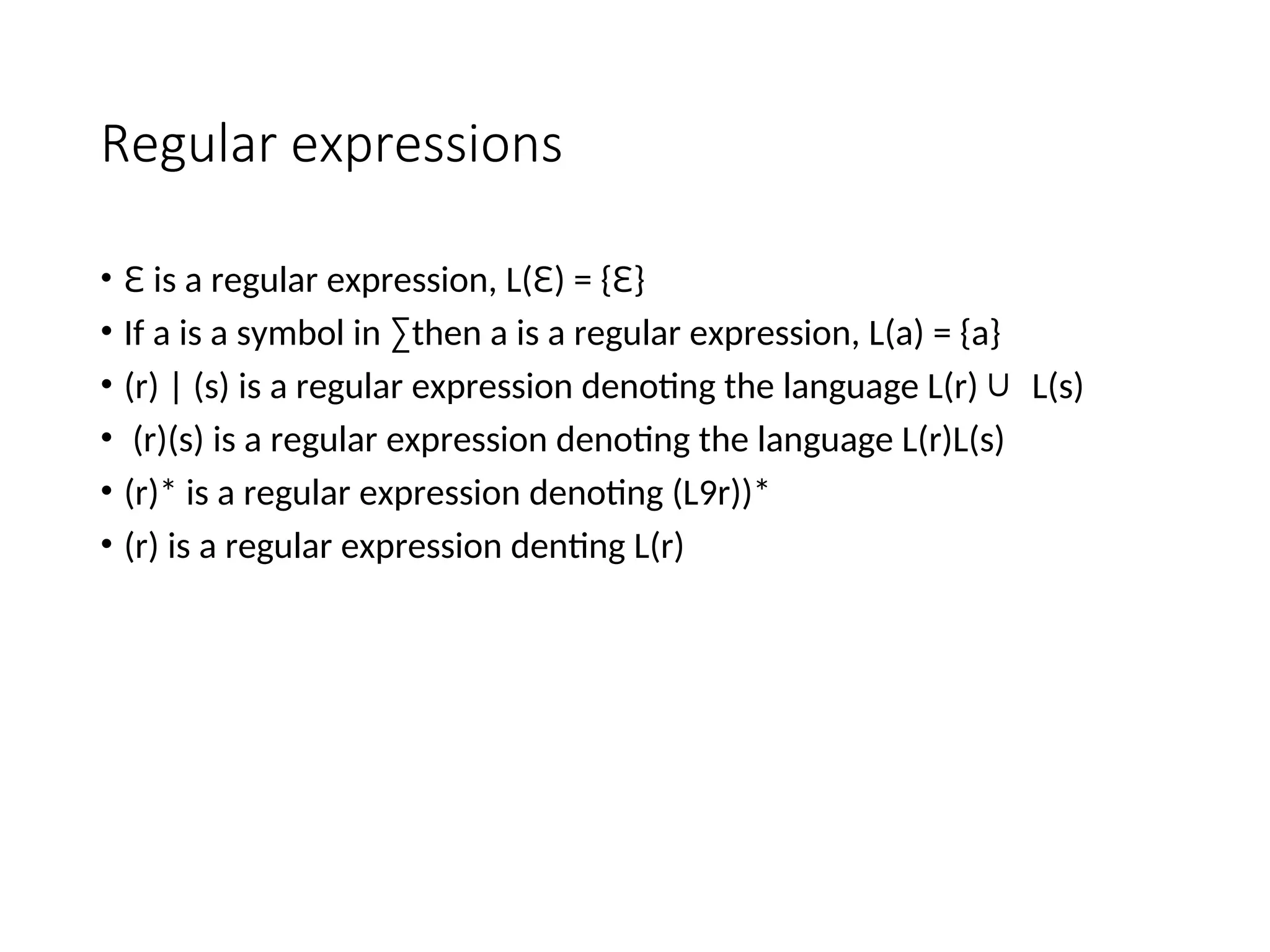
Regular expressions
• Ɛis a regular expression, L(Ɛ) = {Ɛ}
• If a is a symbol in ∑then a is a regular expression, L(a) = {a}
• (r) | (s) is a regular expression denoting the language L(r) ∪ L(s)
• (r)(s) is a regular expression denoting the language L(r)L(s)
• (r)* is a regular expression denoting (L9r))*
• (r) is a regular expression denting L(r)
13.
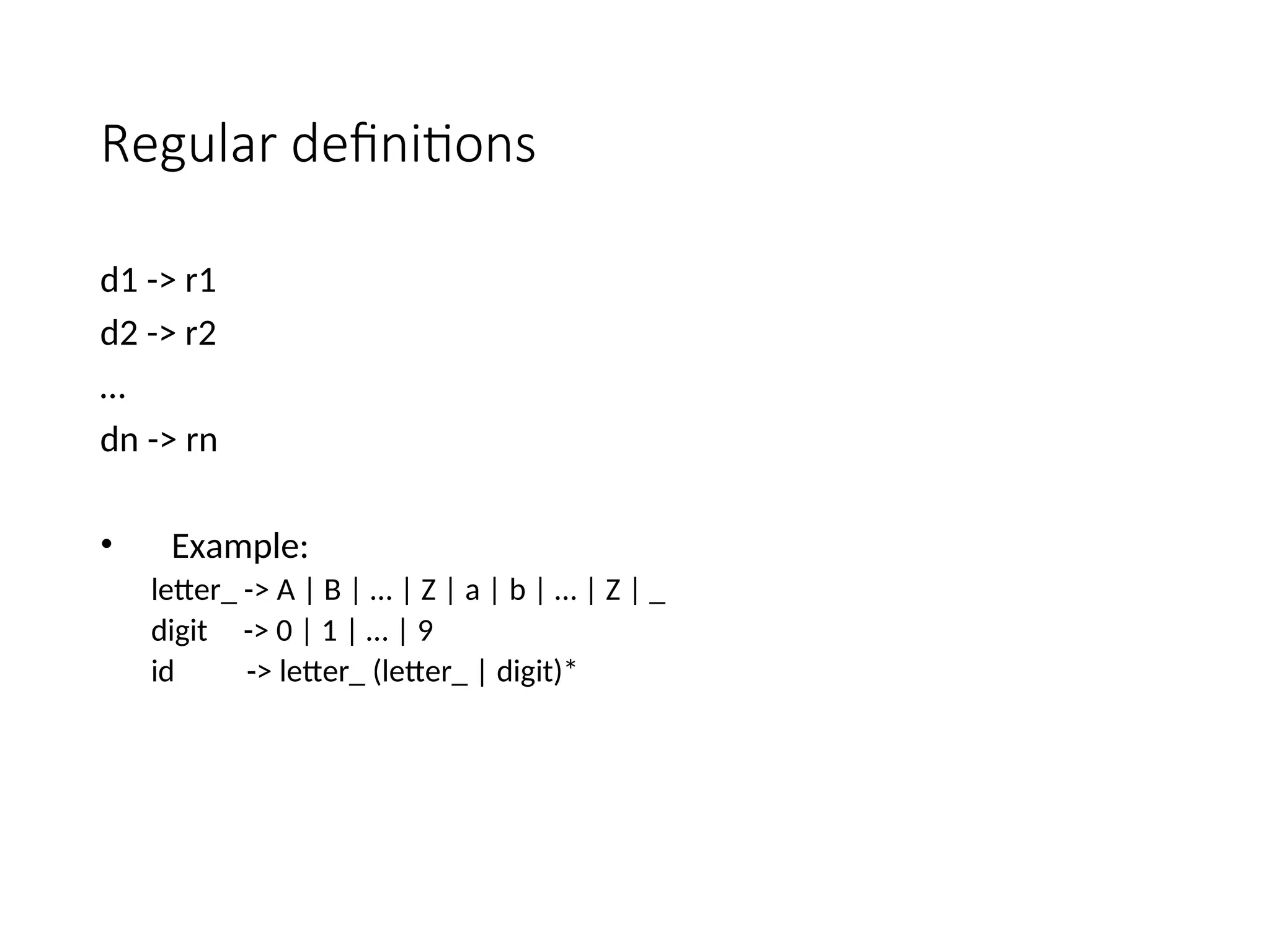
Regular definitions
d1 ->r1
d2 -> r2
…
dn -> rn
• Example:
letter_ -> A | B | … | Z | a | b | … | Z | _
digit -> 0 | 1 | … | 9
id -> letter_ (letter_ | digit)*
14.
Extensions
• One ormore instances: (r)+
• Zero of one instances: r?
• Character classes: [abc]
• Example:
• letter_ -> [A-Za-z_]
• digit -> [0-9]
• id -> letter_(letter|digit)*
15.
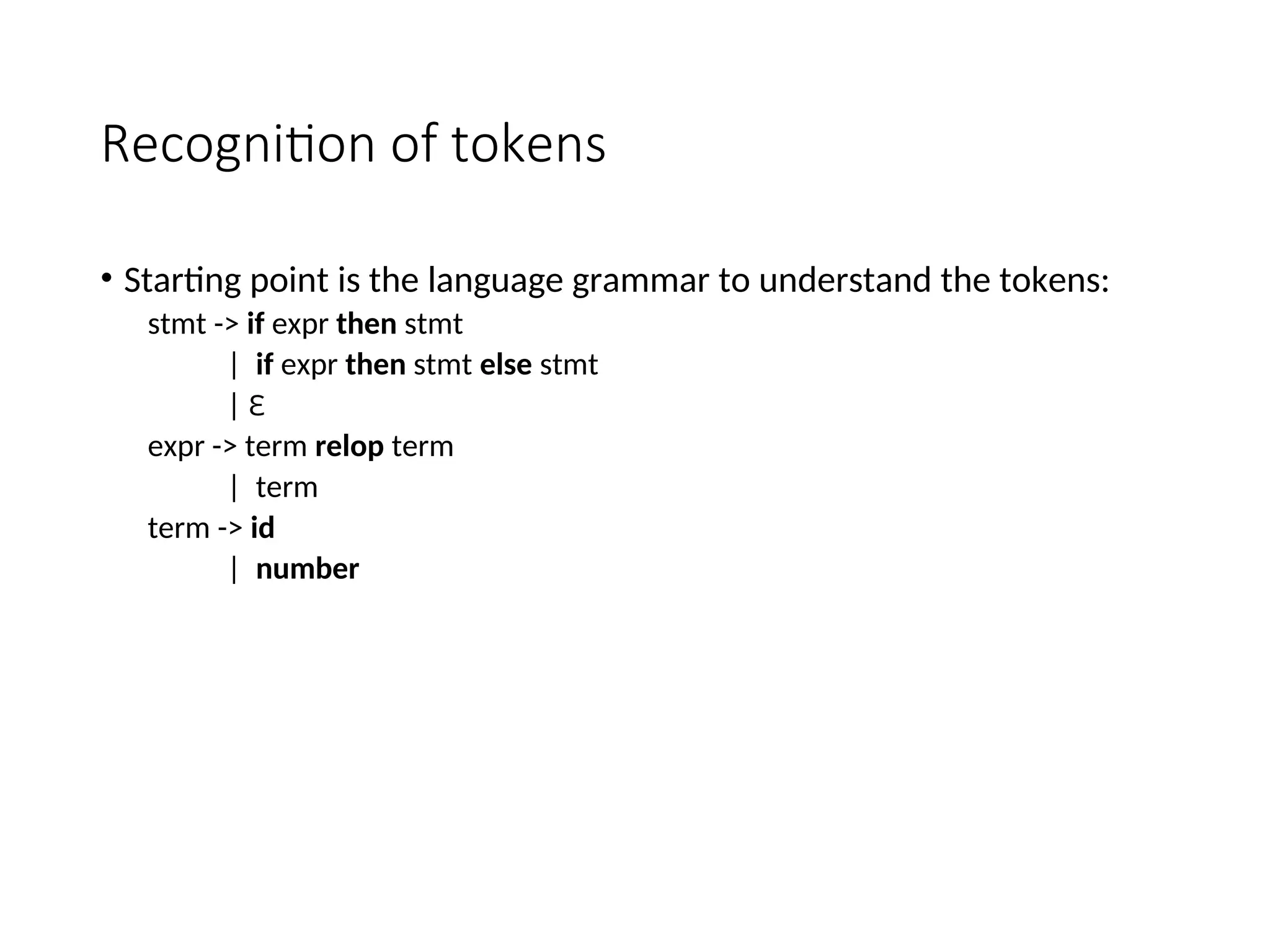
Recognition of tokens
•Starting point is the language grammar to understand the tokens:
stmt -> if expr then stmt
| if expr then stmt else stmt
| Ɛ
expr -> term relop term
| term
term -> id
| number
16.
Recognition of tokens(cont.)
• The next step is to formalize the patterns:
digit -> [0-9]
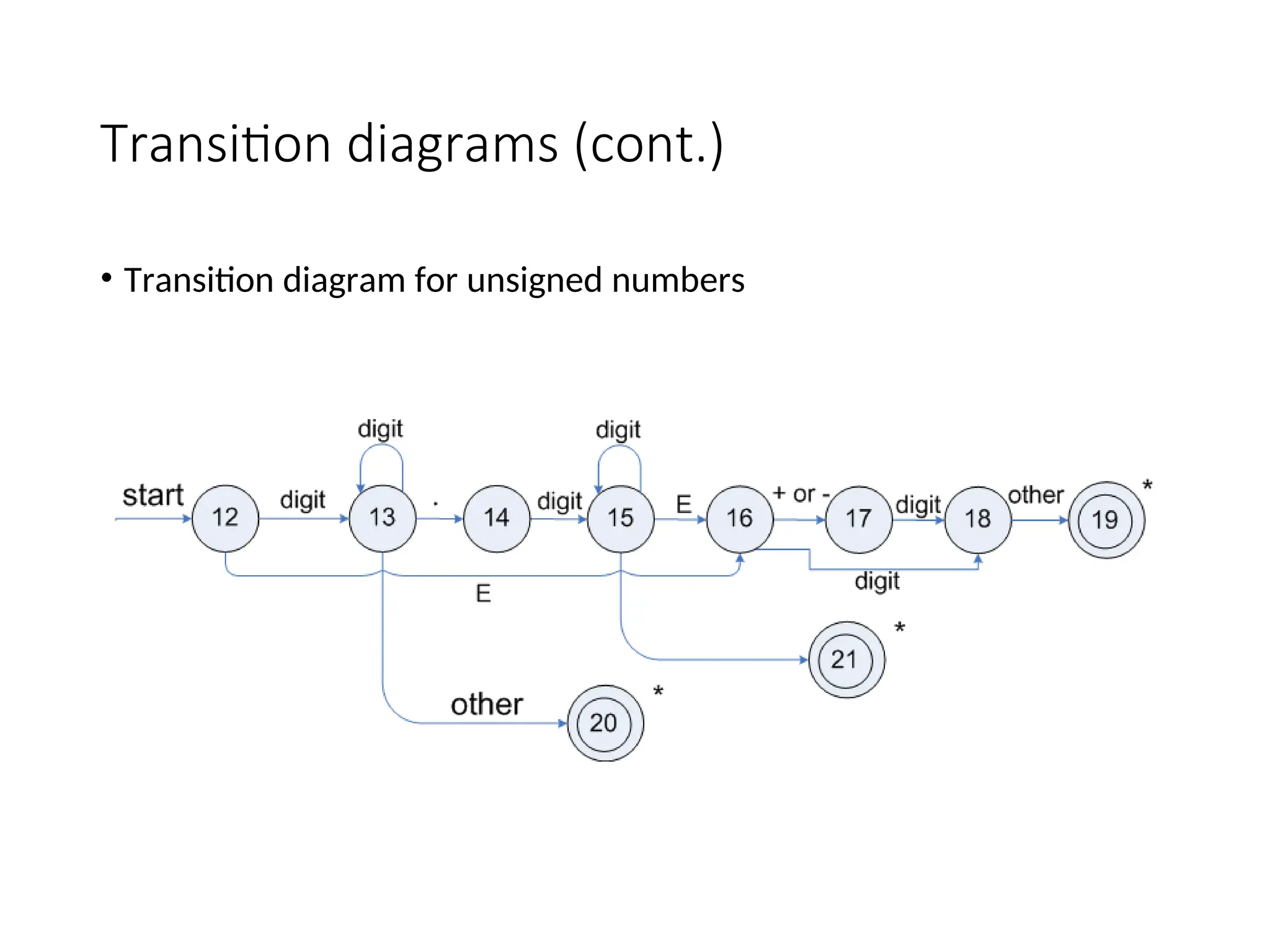
Digits -> digit+
number -> digit(.digits)? (E[+-]? Digit)?
letter -> [A-Za-z_]
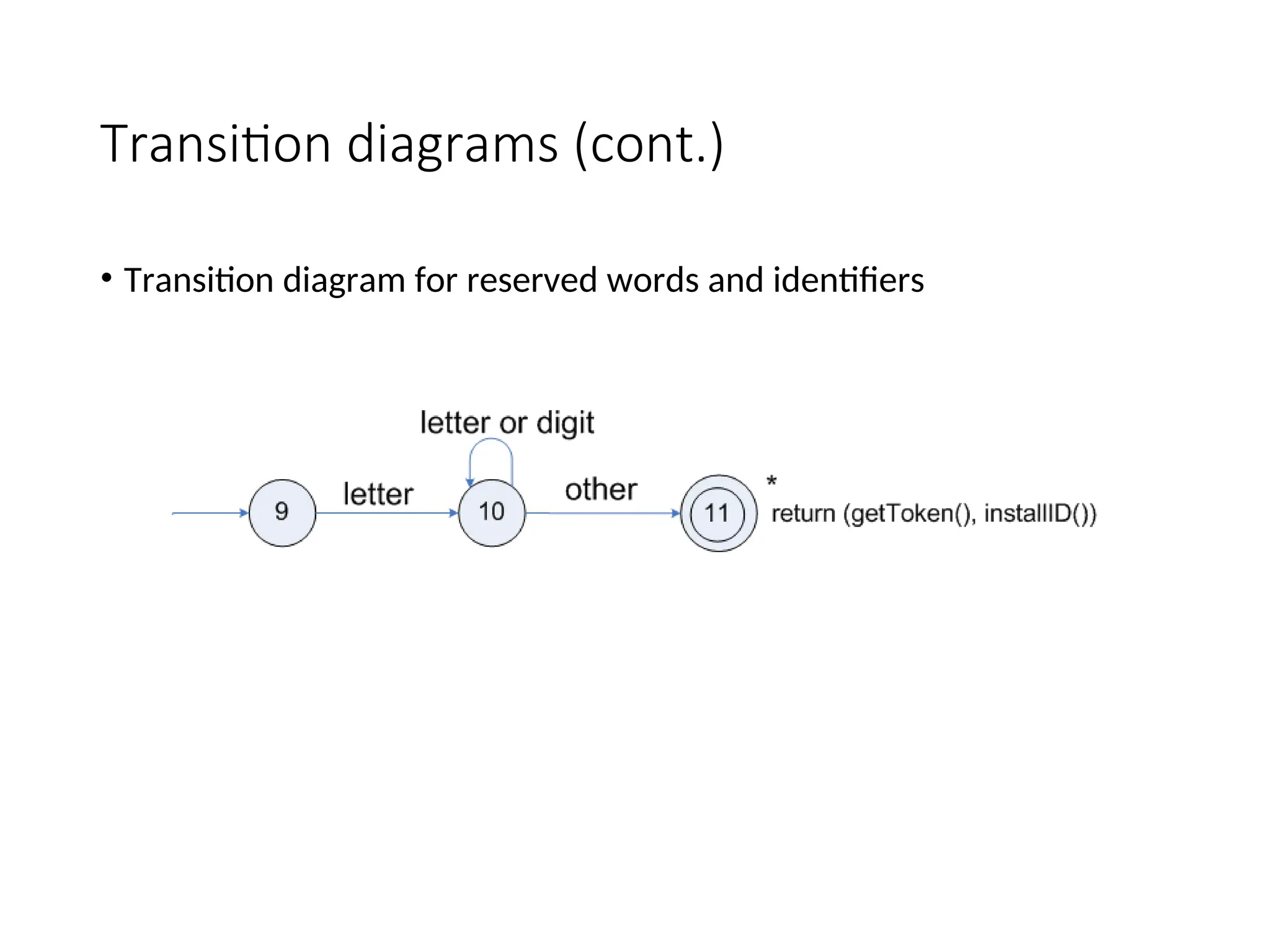
id -> letter (letter|digit)*
If -> if
Then -> then
Else -> else
Relop -> < | > | <= | >= | = | <>
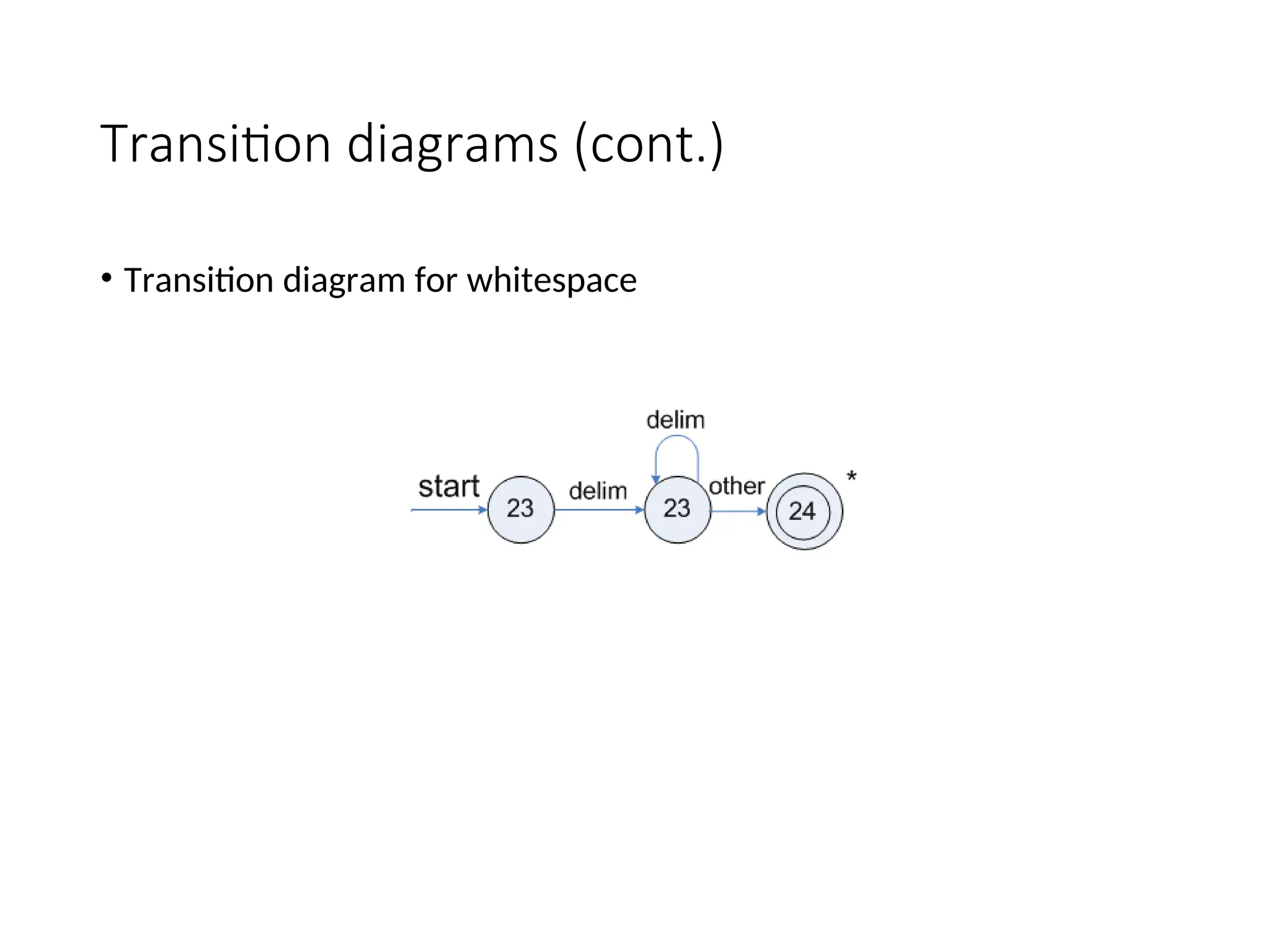
• We also need to handle whitespaces:
ws -> (blank | tab | newline)+
Architecture of atransition-diagram-based
lexical analyzer
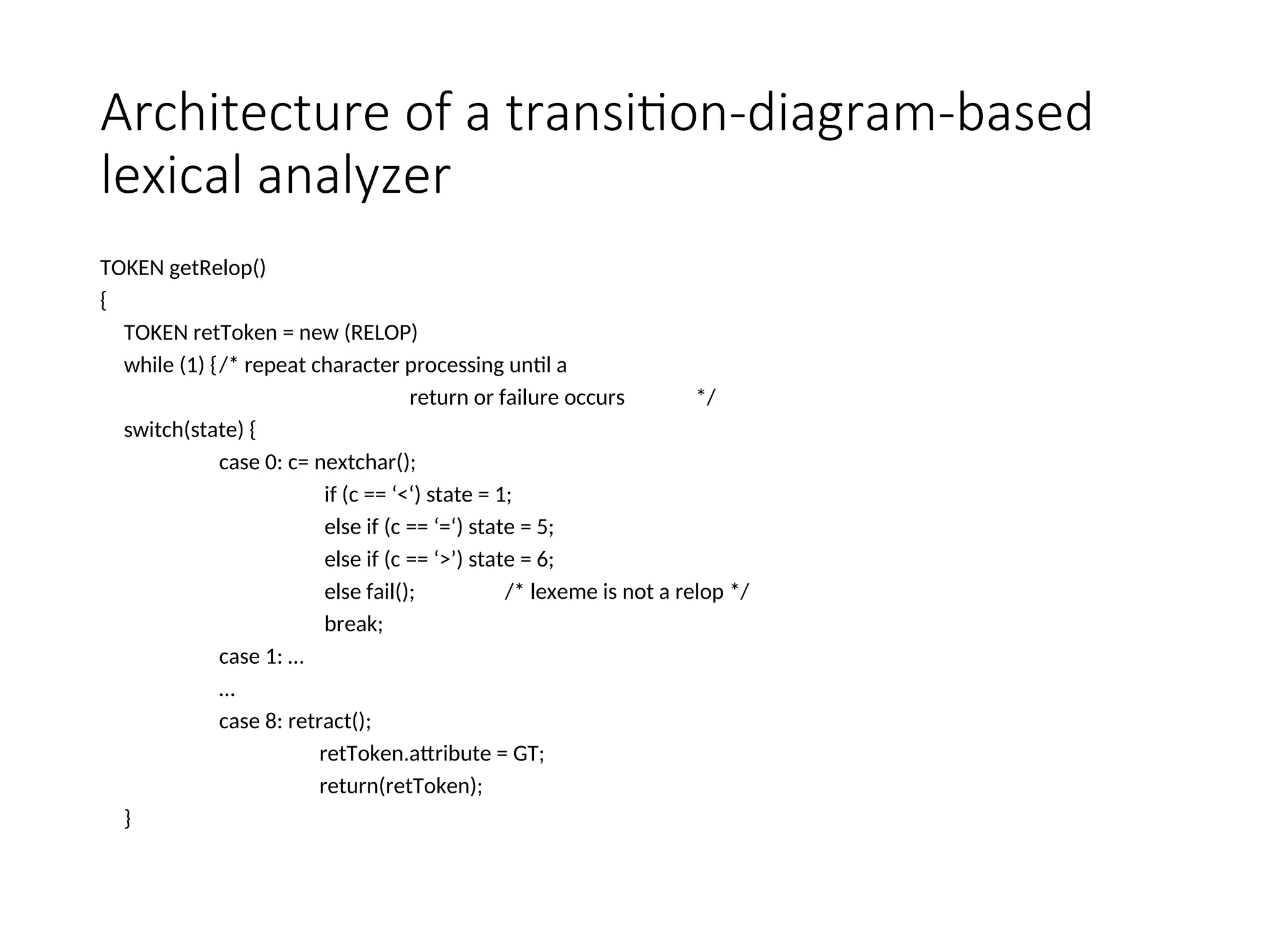
TOKEN getRelop()
{
TOKEN retToken = new (RELOP)
while (1) {/* repeat character processing until a
return or failure occurs */
switch(state) {
case 0: c= nextchar();
if (c == ‘<‘) state = 1;
else if (c == ‘=‘) state = 5;
else if (c == ‘>’) state = 6;
else fail(); /* lexeme is not a relop */
break;
case 1: …
…
case 8: retract();
retToken.attribute = GT;
return(retToken);
}
22.
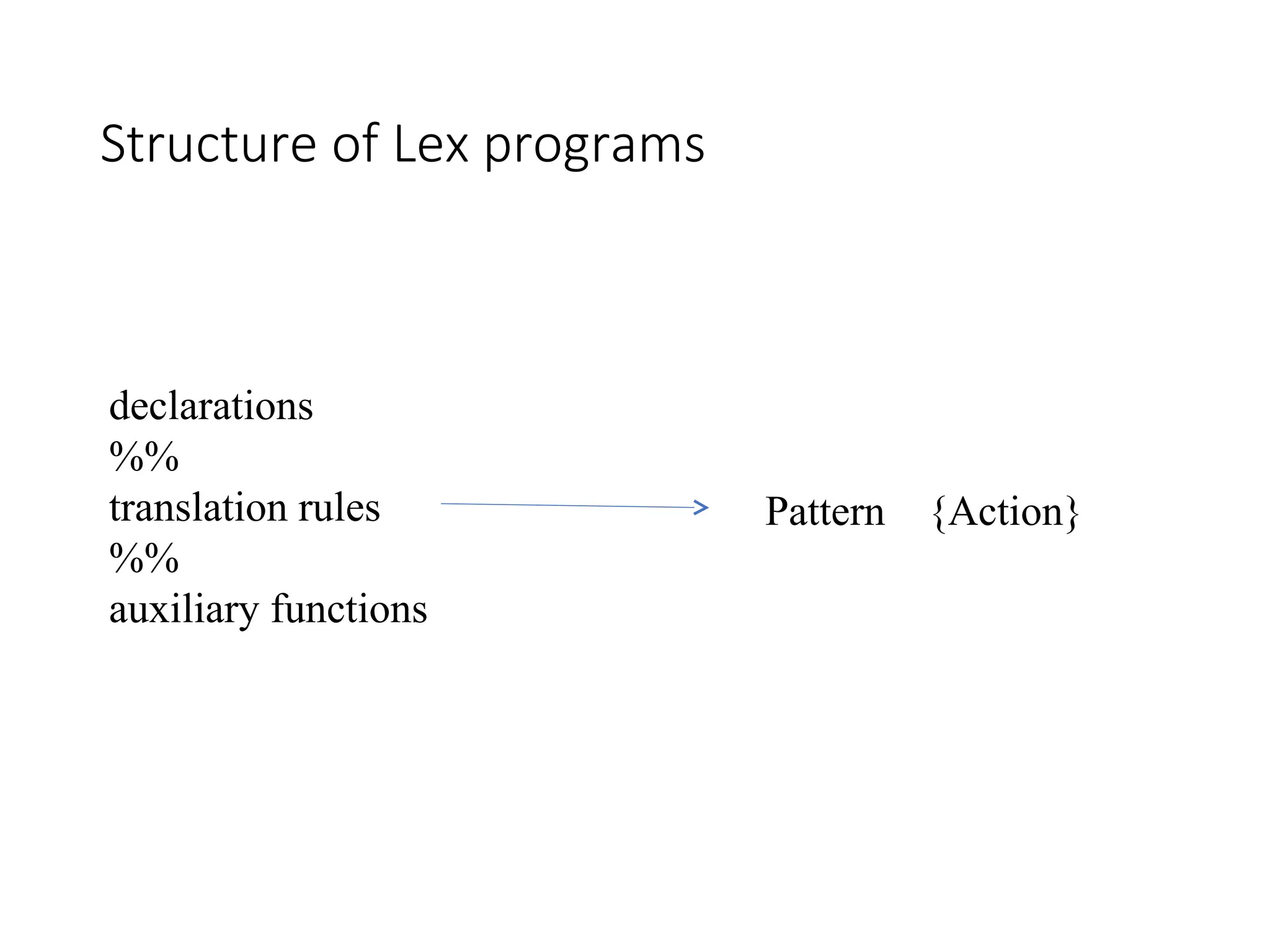
Lexical Analyzer Generator- Lex
Lexical Compiler
Lex Source
program
lex.l
lex.yy.c
C
compiler
lex.yy.c a.out
a.out
Input stream Sequence
of tokens
![Extensions
• One or more instances: (r)+
• Zero of one instances: r?
• Character classes: [abc]
• Example:
• letter_ -> [A-Za-z_]
• digit -> [0-9]
• id -> letter_(letter|digit)*](https://image.slidesharecdn.com/52232-250218020307-5939c042/75/52232-Compiler-Design-Lexical-Analysis-ppt-14-2048.jpg)
![Recognition of tokens (cont.)
• The next step is to formalize the patterns:
digit -> [0-9]
Digits -> digit+
number -> digit(.digits)? (E[+-]? Digit)?
letter -> [A-Za-z_]
id -> letter (letter|digit)*
If -> if
Then -> then
Else -> else
Relop -> < | > | <= | >= | = | <>
• We also need to handle whitespaces:
ws -> (blank | tab | newline)+](https://image.slidesharecdn.com/52232-250218020307-5939c042/75/52232-Compiler-Design-Lexical-Analysis-ppt-16-2048.jpg)