ORGANIZATIONAL BEHAVIOR
                                      S T E P H E N P. R O B B I N S
                                          WWW.PRENHALL.COM/ROBBINS

                                            T    E   N   T   H   E   D   I   T   I   O   N


© 2003 Prentice Hall Inc. All rights reserved.                                           PowerPoint Presentation by Charlie Cook
O B J E C T I V E S
                       AFTER STUDYING THIS CHAPTER,
                       YOU SHOULD BE ABLE TO:

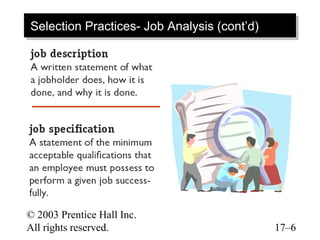
                        1. Contrast job descriptions with job
                           specifications.
                        2. List the advantages of performance simulation
                           tests over written tests.
L E A R N I N G


                        3. Define four skill categories.
                        4. Describe how career planning has changed in
                           the past 20 years.
                        5. Explain the purposes of performance
                           evaluation.
                      © 2003 Prentice Hall Inc.
                      All rights reserved.                           17–2
O B J E C T I V E S (cont’d)
                                AFTER STUDYING THIS CHAPTER,
                                YOU SHOULD BE ABLE TO:

                                 6. Describe actions that can improve the
                                    performance-evaluation process.
                                 7. Clarify how the existence of a union affects
                                    employee behavior.
                                 8. Identify the content in a typical diversity-
                                    training program.
L E A R N I N G


                               © 2003 Prentice Hall Inc.
                               All rights reserved.                                17–3
Selection Practices
Selection Practices


© 2003 Prentice Hall Inc.
All rights reserved.        17–4
Popular Job Analysis Methods


© 2003 Prentice Hall Inc.      EXHIBIT    17-1

All rights reserved.                     17–5
Selection Practices- Job Analysis (cont’d)


© 2003 Prentice Hall Inc.
All rights reserved.                         17–6
Selection Devices
Selection Devices
 Interviews
   – Are the most frequently used selection tool.
   – Carry a great deal of weight in the selection process.
   – Can be biased toward those who “interview well.”
   – Should be structured to ensure against distortion due
     to interviewers’ biases.
   – Are better for assessing applied mental skills,
     conscientiousness, interpersonal skills, and person-
     organization fit of the applicant.


© 2003 Prentice Hall Inc.
All rights reserved.                                     17–7
Selection Devices (cont’d)
 Written Tests
   – Renewed employer interest in testing applicants for:
       •   Intelligence: trainable to do the job?
       •   Aptitude: could do job?
       •   Ability: can do the job?
       •   Interest (attitude): would/will do the job?
       •   Integrity: trust to do the job?
   – Tests must be show validated connection to job-related
     performance requirements.


© 2003 Prentice Hall Inc.
All rights reserved.                                     17–8
Selection Devices (cont’d)
 Performance-Simulation Tests
   – Based on job-related performance requirements
   – Yield validities (correlation with job performance)
     superior to written aptitude and personality tests.


© 2003 Prentice Hall Inc.
All rights reserved.                                       17–9
Training and Development Programs


   Basic Literacy
   Basic Literacy                        Technical Skills
                                         Technical Skills


                            Types of
                            Types of
                            Training
                             Training


  Problem Solving
  Problem Solving                       Interpersonal Skills
                                         Interpersonal Skills

© 2003 Prentice Hall Inc.                                17–
All rights reserved.                                     10
Individualizing Formal Training to Fit the
 Individualizing Formal Training to Fit the
Employee’s Learning Style
 Employee’s Learning Style


    Readings
     Readings                           Lectures
                                         Lectures


                            Learning
                            Learning
                            Methods
                            Methods
 Participation and
  Participation and
   Experiential
    Experiential                       Visual Aids
                                        Visual Aids
    Exercises
      Exercises


© 2003 Prentice Hall Inc.                           17–
All rights reserved.                                11
Career Development Responsibilities
 Organization                 Employees
   – Clearly communicate        – Know yourself.
     organization’s goals       – Manage your reputation.
     and future strategies.     – Build and maintain
   – Create growth                network contacts.
     opportunities.             – Keep current.
   – Offer financial            – Balance your generalist
     assistance.                  and specialist
   – Provide time for             competencies.
     employees to learn.        – Document your
                                  achievement.
                                – Keep your options open.
© 2003 Prentice Hall Inc.                            17–
All rights reserved.                                 12
Performance Evaluation
 Purposes of Performance Evaluation
   – Making general human resource decisions.
       • Promotions, transfers, and terminations
   – Identifying training and development needs.
       • Employee skills and competencies
   – Validating selection and development programs.
       • Employee performance compared to selection
         evaluation and anticipated performance results of
         participation in training.
   – Providing feedback to employees.
       • The organization’s view of their current performance
   – Supplying the basis for rewards allocation decisions.
       • Merit pay increases and other rewards
© 2003 Prentice Hall Inc.                                17–
All rights reserved.                                     13
Performance Evaluation (cont’d)
 Performance Evaluation and Motivation
   – If employees are to be motivated to perform, then:
       •   Performance objectives must be clear.
       •   Performance criteria must be related to the job.
       •   Performance must be accurately evaluated.
       •   Performance must be properly rewarded.


© 2003 Prentice Hall Inc.                                     17–
All rights reserved.                                          14
Performance Evaluation (cont’d)
 What Do We Evaluate?

   Individual Task
    Individual Task                  Behaviors
                                     Behaviors
      Outcomes
      Outcomes


                      Performance
                      Performance
                       Evaluation
                       Evaluation


                            Traits
                            Traits
© 2003 Prentice Hall Inc.                        17–
All rights reserved.                             15
Performance Evaluation (cont’d)
 Who Should Do the Evaluating?

           Immediate
           Supervisor


             Peers


         Self-Evaluation


          Immediate
         Subordinates
© 2003 Prentice Hall Inc.         17–
All rights reserved.              16
360-Degree
                             360-Degree
                            Evaluations
                             Evaluations


© 2003 Prentice Hall Inc.   EXHIBIT   17–
                                      17-3

All rights reserved.                  17
Methods of Performance Evaluation

written essay
A narrative describing an
employee’s strengths,
weaknesses, past
performances, potential, and
suggestions for improvement.


© 2003 Prentice Hall Inc.           17–
All rights reserved.                18
Methods of Performance Evaluation (cont’d)


                             Keeps up with current
                            policies and regulations.
                       1        2       3        4          5

                                                        X
                   Completely                             Fully
                    Unaware                             Informed
© 2003 Prentice Hall Inc.                                   17–
All rights reserved.                                        19
Methods of Performance Evaluation (cont’d)

                            Passes next examination
                            and graduates on time.

                            Pays close attention and
                            regularly takes notes.

                            Alert and takes
                            occasional notes.

                            Stays awake but is
                            inattentive.
                            Get to class on time,
                            but nods off immediately.

                            Oversleeps for class.
© 2003 Prentice Hall Inc.                           17–
All rights reserved.                                20
Methods of Performance Evaluation (cont’d)
 Forced Comparisons
   – Evaluating one individual’s performance relative to the
     performance of another individual or others.


© 2003 Prentice Hall Inc.                                17–
All rights reserved.                                     21
Methods of Performance Evaluation (cont’d)
 Forced Comparisons (cont’d)


© 2003 Prentice Hall Inc.                17–
All rights reserved.                     22
Suggestions for Improving Performance Evaluations

       Emphasize behaviors rather than traits.
       Emphasize behaviors rather than traits.

       Document performance behaviors in a diary.
       Document performance behaviors in a diary.

       Use multiple evaluators to overcome rater biases.
       Use multiple evaluators to overcome rater biases.

       Evaluate selectively based on evaluator competence.
       Evaluate selectively based on evaluator competence.

       Train evaluators to improve rater accuracy.
       Train evaluators to improve rater accuracy.

       Provide employees with due process.
       Provide employees with due process.

© 2003 Prentice Hall Inc.                                  17–
All rights reserved.                                       23
Providing Performance Feedback
 Why Managers Are Reluctant to Give Feedback
   – Uncomfortable discussing performance weaknesses
     directly with employees.
   – Employees tend to become defensive when their
     weaknesses are discussed.
   – Employees tend to have an inflated assessment of
     their own performance.
 Solutions to Improving Feedback
   – Train managers in giving effective feedback.
   – Use performance review as counseling activity rather
     than as a judgment process.


© 2003 Prentice Hall Inc.                              17–
All rights reserved.                                   24
Providing Performance Feedback (cont’d)
 What About Team Performance Evaluations?
   1. Tie the team’s results to the organization’s goals.
   2. Begin with the team’s customers and the work
      process the team follows to satisfy customer needs.
   3. Measure both team and individual performance.
   4. Train the team to create its own measures.


© 2003 Prentice Hall Inc.                              17–
All rights reserved.                                   25
The Union-Management Interface


                              No More Layoffs
                                More Wages
                               Better Working
                                 Conditions
                       Keep
                       Jobs
                       Here


© 2003 Prentice Hall Inc.                       17–
All rights reserved.                            26
The Union’s Impact on Employee Performance
and Job Satisfaction


© 2003 Prentice Hall Inc.         EXHIBIT   17–
                                             17-4

All rights reserved.                        27
International HR Practices: Selected Issues
 International HR Practices: Selected Issues
 Selection
   – Few common procedures, differ by nation.
 Performance Evaluation
   – Not emphasized or considered appropriate in many
     cultures due to differences in:
       •   Individualism versus collectivism.
       •   A person’s relationship to the environment.
       •   Time orientation (long- or short-term).
       •   Focus of responsibility.


© 2003 Prentice Hall Inc.                                17–
All rights reserved.                                     28
Managing Diversity in Organizations


                  Work -Life Conflicts
                  Work -Life Conflicts


  Work                Integration or     Personal
                      Segmentation         Life


© 2003 Prentice Hall Inc.                   17–
All rights reserved.                        29
Work/Life Initiatives


© 2003 Prentice Hall Inc.   EXHIBIT   17–
                                       17-5a

All rights reserved.                  30
Work/Life Initiatives (cont’d)


© 2003 Prentice Hall Inc.        EXHIBIT   17–
                                            17-5b

All rights reserved.                       31
Work/Life Initiatives (cont’d)


© 2003 Prentice Hall Inc.        EXHIBIT   17–
                                            17-5c

All rights reserved.                       32
Managing Diversity in Organizations (cont’)
 Diversity Training
   – Participants learn to value individual differences,
     increase cross-cultural understanding, and confront
     stereotypes.
   – A typical diversity training program:
       • Lasts for half a day to three days.
       • Includes role-playing exercises, lectures,
         discussions, and sharing experiences.


© 2003 Prentice Hall Inc.                              17–
All rights reserved.                                   33

Ch17

  • 1.
    ORGANIZATIONAL BEHAVIOR S T E P H E N P. R O B B I N S WWW.PRENHALL.COM/ROBBINS T E N T H E D I T I O N © 2003 Prentice Hall Inc. All rights reserved. PowerPoint Presentation by Charlie Cook
  • 2.
    O B JE C T I V E S AFTER STUDYING THIS CHAPTER, YOU SHOULD BE ABLE TO: 1. Contrast job descriptions with job specifications. 2. List the advantages of performance simulation tests over written tests. L E A R N I N G 3. Define four skill categories. 4. Describe how career planning has changed in the past 20 years. 5. Explain the purposes of performance evaluation. © 2003 Prentice Hall Inc. All rights reserved. 17–2
  • 3.
    O B JE C T I V E S (cont’d) AFTER STUDYING THIS CHAPTER, YOU SHOULD BE ABLE TO: 6. Describe actions that can improve the performance-evaluation process. 7. Clarify how the existence of a union affects employee behavior. 8. Identify the content in a typical diversity- training program. L E A R N I N G © 2003 Prentice Hall Inc. All rights reserved. 17–3
  • 4.
    Selection Practices Selection Practices ©2003 Prentice Hall Inc. All rights reserved. 17–4
  • 5.
    Popular Job AnalysisMethods Popular Job Analysis Methods © 2003 Prentice Hall Inc. EXHIBIT 17-1 All rights reserved. 17–5
  • 6.
    Selection Practices- JobAnalysis (cont’d) Selection Practices- Job Analysis (cont’d) © 2003 Prentice Hall Inc. All rights reserved. 17–6
  • 7.
    Selection Devices Selection Devices Interviews – Are the most frequently used selection tool. – Carry a great deal of weight in the selection process. – Can be biased toward those who “interview well.” – Should be structured to ensure against distortion due to interviewers’ biases. – Are better for assessing applied mental skills, conscientiousness, interpersonal skills, and person- organization fit of the applicant. © 2003 Prentice Hall Inc. All rights reserved. 17–7
  • 8.
    Selection Devices (cont’d) SelectionDevices (cont’d)  Written Tests – Renewed employer interest in testing applicants for: • Intelligence: trainable to do the job? • Aptitude: could do job? • Ability: can do the job? • Interest (attitude): would/will do the job? • Integrity: trust to do the job? – Tests must be show validated connection to job-related performance requirements. © 2003 Prentice Hall Inc. All rights reserved. 17–8
  • 9.
    Selection Devices (cont’d) SelectionDevices (cont’d)  Performance-Simulation Tests – Based on job-related performance requirements – Yield validities (correlation with job performance) superior to written aptitude and personality tests. © 2003 Prentice Hall Inc. All rights reserved. 17–9
  • 10.
    Training and DevelopmentPrograms Training and Development Programs Basic Literacy Basic Literacy Technical Skills Technical Skills Types of Types of Training Training Problem Solving Problem Solving Interpersonal Skills Interpersonal Skills © 2003 Prentice Hall Inc. 17– All rights reserved. 10
  • 11.
    Individualizing Formal Trainingto Fit the Individualizing Formal Training to Fit the Employee’s Learning Style Employee’s Learning Style Readings Readings Lectures Lectures Learning Learning Methods Methods Participation and Participation and Experiential Experiential Visual Aids Visual Aids Exercises Exercises © 2003 Prentice Hall Inc. 17– All rights reserved. 11
  • 12.
    Career Development Responsibilities CareerDevelopment Responsibilities  Organization  Employees – Clearly communicate – Know yourself. organization’s goals – Manage your reputation. and future strategies. – Build and maintain – Create growth network contacts. opportunities. – Keep current. – Offer financial – Balance your generalist assistance. and specialist – Provide time for competencies. employees to learn. – Document your achievement. – Keep your options open. © 2003 Prentice Hall Inc. 17– All rights reserved. 12
  • 13.
    Performance Evaluation Performance Evaluation Purposes of Performance Evaluation – Making general human resource decisions. • Promotions, transfers, and terminations – Identifying training and development needs. • Employee skills and competencies – Validating selection and development programs. • Employee performance compared to selection evaluation and anticipated performance results of participation in training. – Providing feedback to employees. • The organization’s view of their current performance – Supplying the basis for rewards allocation decisions. • Merit pay increases and other rewards © 2003 Prentice Hall Inc. 17– All rights reserved. 13
  • 14.
    Performance Evaluation (cont’d) PerformanceEvaluation (cont’d)  Performance Evaluation and Motivation – If employees are to be motivated to perform, then: • Performance objectives must be clear. • Performance criteria must be related to the job. • Performance must be accurately evaluated. • Performance must be properly rewarded. © 2003 Prentice Hall Inc. 17– All rights reserved. 14
  • 15.
    Performance Evaluation (cont’d) PerformanceEvaluation (cont’d)  What Do We Evaluate? Individual Task Individual Task Behaviors Behaviors Outcomes Outcomes Performance Performance Evaluation Evaluation Traits Traits © 2003 Prentice Hall Inc. 17– All rights reserved. 15
  • 16.
    Performance Evaluation (cont’d) PerformanceEvaluation (cont’d)  Who Should Do the Evaluating? Immediate Supervisor Peers Self-Evaluation Immediate Subordinates © 2003 Prentice Hall Inc. 17– All rights reserved. 16
  • 17.
    360-Degree 360-Degree Evaluations Evaluations © 2003 Prentice Hall Inc. EXHIBIT 17– 17-3 All rights reserved. 17
  • 18.
    Methods of PerformanceEvaluation Methods of Performance Evaluation written essay A narrative describing an employee’s strengths, weaknesses, past performances, potential, and suggestions for improvement. © 2003 Prentice Hall Inc. 17– All rights reserved. 18
  • 19.
    Methods of PerformanceEvaluation (cont’d) Methods of Performance Evaluation (cont’d) Keeps up with current policies and regulations. 1 2 3 4 5 X Completely Fully Unaware Informed © 2003 Prentice Hall Inc. 17– All rights reserved. 19
  • 20.
    Methods of PerformanceEvaluation (cont’d) Methods of Performance Evaluation (cont’d) Passes next examination and graduates on time. Pays close attention and regularly takes notes. Alert and takes occasional notes. Stays awake but is inattentive. Get to class on time, but nods off immediately. Oversleeps for class. © 2003 Prentice Hall Inc. 17– All rights reserved. 20
  • 21.
    Methods of PerformanceEvaluation (cont’d) Methods of Performance Evaluation (cont’d)  Forced Comparisons – Evaluating one individual’s performance relative to the performance of another individual or others. © 2003 Prentice Hall Inc. 17– All rights reserved. 21
  • 22.
    Methods of PerformanceEvaluation (cont’d) Methods of Performance Evaluation (cont’d)  Forced Comparisons (cont’d) © 2003 Prentice Hall Inc. 17– All rights reserved. 22
  • 23.
    Suggestions for ImprovingPerformance Evaluations Suggestions for Improving Performance Evaluations Emphasize behaviors rather than traits. Emphasize behaviors rather than traits. Document performance behaviors in a diary. Document performance behaviors in a diary. Use multiple evaluators to overcome rater biases. Use multiple evaluators to overcome rater biases. Evaluate selectively based on evaluator competence. Evaluate selectively based on evaluator competence. Train evaluators to improve rater accuracy. Train evaluators to improve rater accuracy. Provide employees with due process. Provide employees with due process. © 2003 Prentice Hall Inc. 17– All rights reserved. 23
  • 24.
    Providing Performance Feedback ProvidingPerformance Feedback  Why Managers Are Reluctant to Give Feedback – Uncomfortable discussing performance weaknesses directly with employees. – Employees tend to become defensive when their weaknesses are discussed. – Employees tend to have an inflated assessment of their own performance.  Solutions to Improving Feedback – Train managers in giving effective feedback. – Use performance review as counseling activity rather than as a judgment process. © 2003 Prentice Hall Inc. 17– All rights reserved. 24
  • 25.
    Providing Performance Feedback(cont’d) Providing Performance Feedback (cont’d)  What About Team Performance Evaluations? 1. Tie the team’s results to the organization’s goals. 2. Begin with the team’s customers and the work process the team follows to satisfy customer needs. 3. Measure both team and individual performance. 4. Train the team to create its own measures. © 2003 Prentice Hall Inc. 17– All rights reserved. 25
  • 26.
    The Union-Management Interface TheUnion-Management Interface No More Layoffs More Wages Better Working Conditions Keep Jobs Here © 2003 Prentice Hall Inc. 17– All rights reserved. 26
  • 27.
    The Union’s Impacton Employee Performance The Union’s Impact on Employee Performance and Job Satisfaction and Job Satisfaction © 2003 Prentice Hall Inc. EXHIBIT 17– 17-4 All rights reserved. 27
  • 28.
    International HR Practices:Selected Issues International HR Practices: Selected Issues  Selection – Few common procedures, differ by nation.  Performance Evaluation – Not emphasized or considered appropriate in many cultures due to differences in: • Individualism versus collectivism. • A person’s relationship to the environment. • Time orientation (long- or short-term). • Focus of responsibility. © 2003 Prentice Hall Inc. 17– All rights reserved. 28
  • 29.
    Managing Diversity inOrganizations Managing Diversity in Organizations Work -Life Conflicts Work -Life Conflicts Work Integration or Personal Segmentation Life © 2003 Prentice Hall Inc. 17– All rights reserved. 29
  • 30.
    Work/Life Initiatives Work/Life Initiatives ©2003 Prentice Hall Inc. EXHIBIT 17– 17-5a All rights reserved. 30
  • 31.
    Work/Life Initiatives (cont’d) Work/LifeInitiatives (cont’d) © 2003 Prentice Hall Inc. EXHIBIT 17– 17-5b All rights reserved. 31
  • 32.
    Work/Life Initiatives (cont’d) Work/LifeInitiatives (cont’d) © 2003 Prentice Hall Inc. EXHIBIT 17– 17-5c All rights reserved. 32
  • 33.
    Managing Diversity inOrganizations (cont’) Managing Diversity in Organizations (cont’)  Diversity Training – Participants learn to value individual differences, increase cross-cultural understanding, and confront stereotypes. – A typical diversity training program: • Lasts for half a day to three days. • Includes role-playing exercises, lectures, discussions, and sharing experiences. © 2003 Prentice Hall Inc. 17– All rights reserved. 33