
Human Resource
Policies and
Practices
Chapter 17
ELMI RAKHMA AALIN
LEARNING OBJECTIVES
 Define initial selection, and identify the most useful
methods
 Define substantive selection, and identify the most useful
methods
 Define contingent selection, and contrast the arguments for
and against drug testing
 Compare the four main types of training
 Contrast on-the-job and off-the-job training
 Describe the purposes of performance evaluation, and list
the methods by which it can be done
 Show how managers can improve performance evaluations
 Describe how organizations can manage work-family
conflict
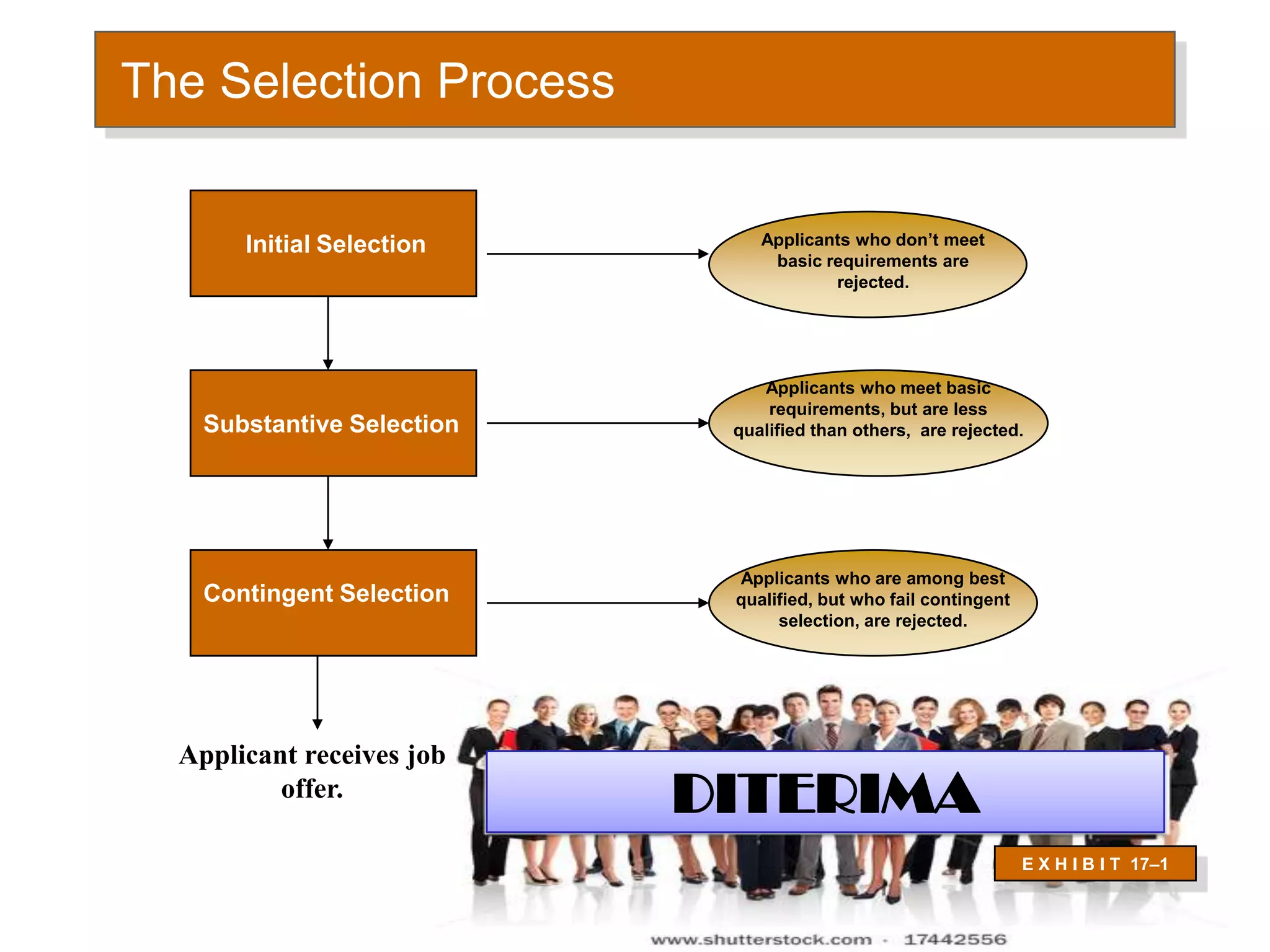
The Selection Process
Initial Selection
Substantive Selection
Contingent Selection
Applicants who don’t meet
basic requirements are
rejected.
Applicants who meet basic
requirements, but are less
qualified than others, are rejected.
Applicants who are among best
qualified, but who fail contingent
selection, are rejected.
Applicant receives job
offer.
E X H I B I T 17–1
DITERIMA
Selection Devices (cont’d)
 Written Tests
– Intelligence or cognitive ability tests
– Personality tests
– Integrity tests
– Interest inventories
Selection Devices (cont’d)
 Performance-Simulation Tests
– Work samples
– Assessment centers
– Situational judgment tests.
 Interview
Contingent Selection
 Contingent selection is phase when applicants
pass the substantive selection method and
they’re ready to be hired. One common
contingent method is a drug test.
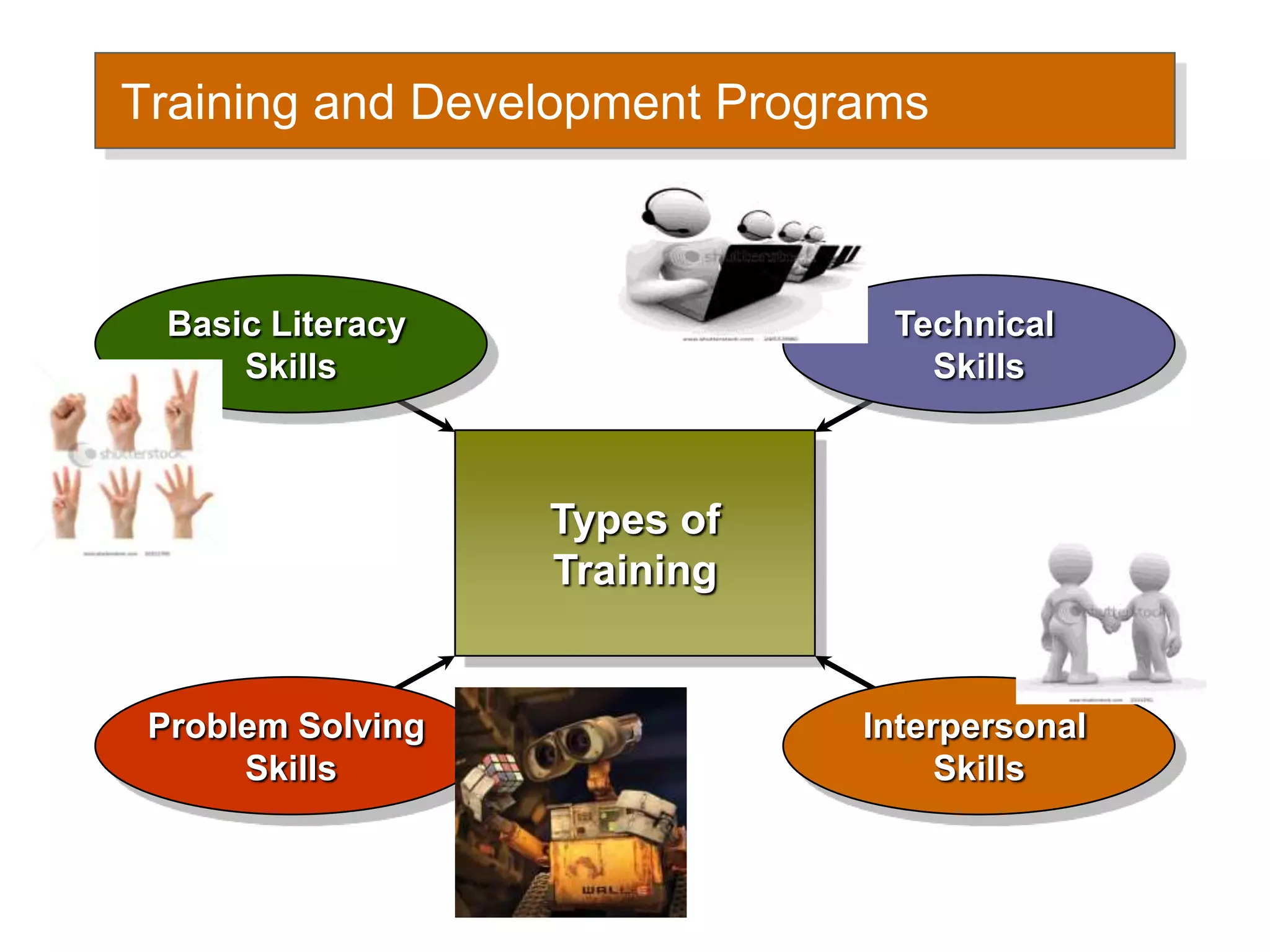
Training and Development Programs
Types of
Training
Basic Literacy
Skills
Technical
Skills
Interpersonal
Skills
Problem Solving
Skills
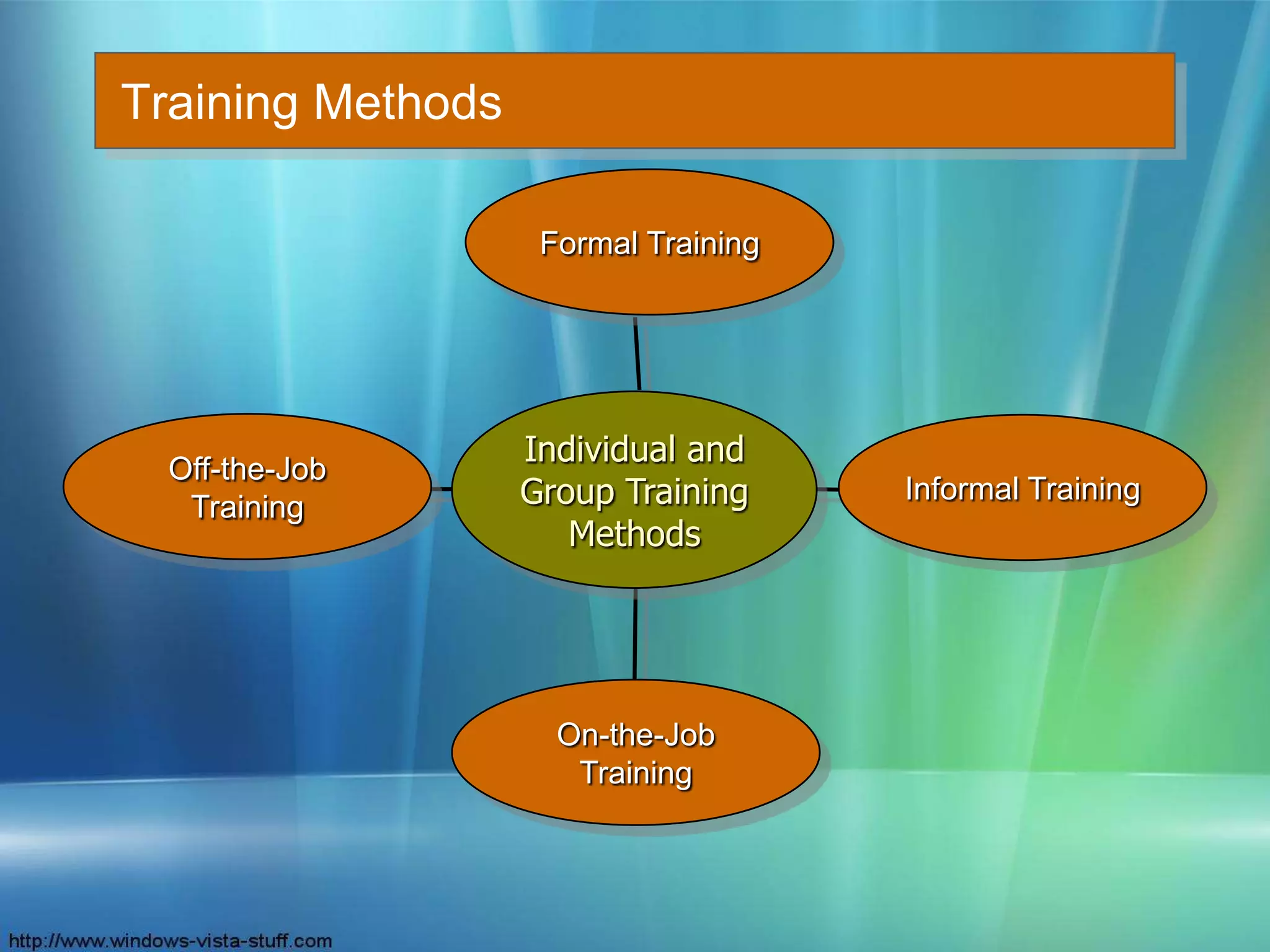
Training Methods
Individual and
Group Training
Methods
Formal Training
Informal Training
On-the-Job
Training
Off-the-Job
Training
Performance Evaluation
 Purposes of Performance Evaluation
– Making general human resource decisions.
• Promotions, transfers, and terminations
– Identifying training and development needs.
• Employee skills and competencies
– Validating selection and development programs.
• Employee performance compared to selection evaluation
and anticipated performance results of participation in
training
– Providing feedback to employees.
• The organization’s view of their current performance
– Supplying the basis for rewards allocation decisions.
• Merit pay increases and other rewards
Performance Evaluation (cont’d)
 Performance Evaluation and Motivation
– If employees are to be motivated to perform, then:
• Performance objectives must be clear.
• Performance criteria must be related to the job.
• Performance must be accurately evaluated.
• Performance must be properly rewarded.
Methods of Performance Evaluation
Written Essay
A narrative describing an employee’s
strengths, weaknesses, past
performances, potential, and suggestions for
improvement.
Critical Incidents
Evaluating the behaviors that are key in making the
difference between executing a job effectively and
executing it ineffectively.
Methods of Performance Evaluation (cont’d)
Keeps up with current
policies and regulations.
1 2 3 4 5
Completely
Unaware
Fully
Informed
XX
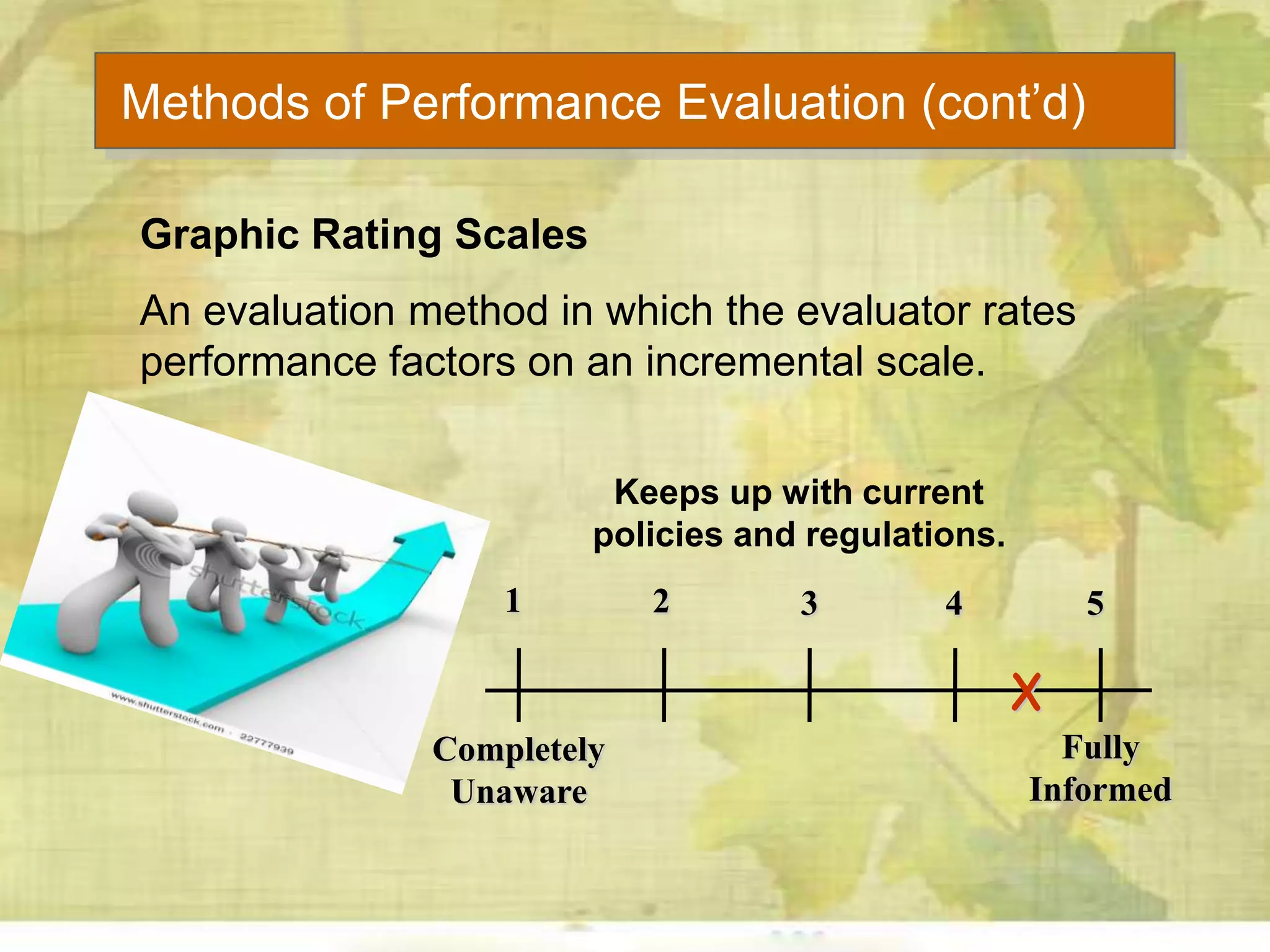
Graphic Rating Scales
An evaluation method in which the evaluator rates
performance factors on an incremental scale.
Methods of Performance Evaluation (cont’d)
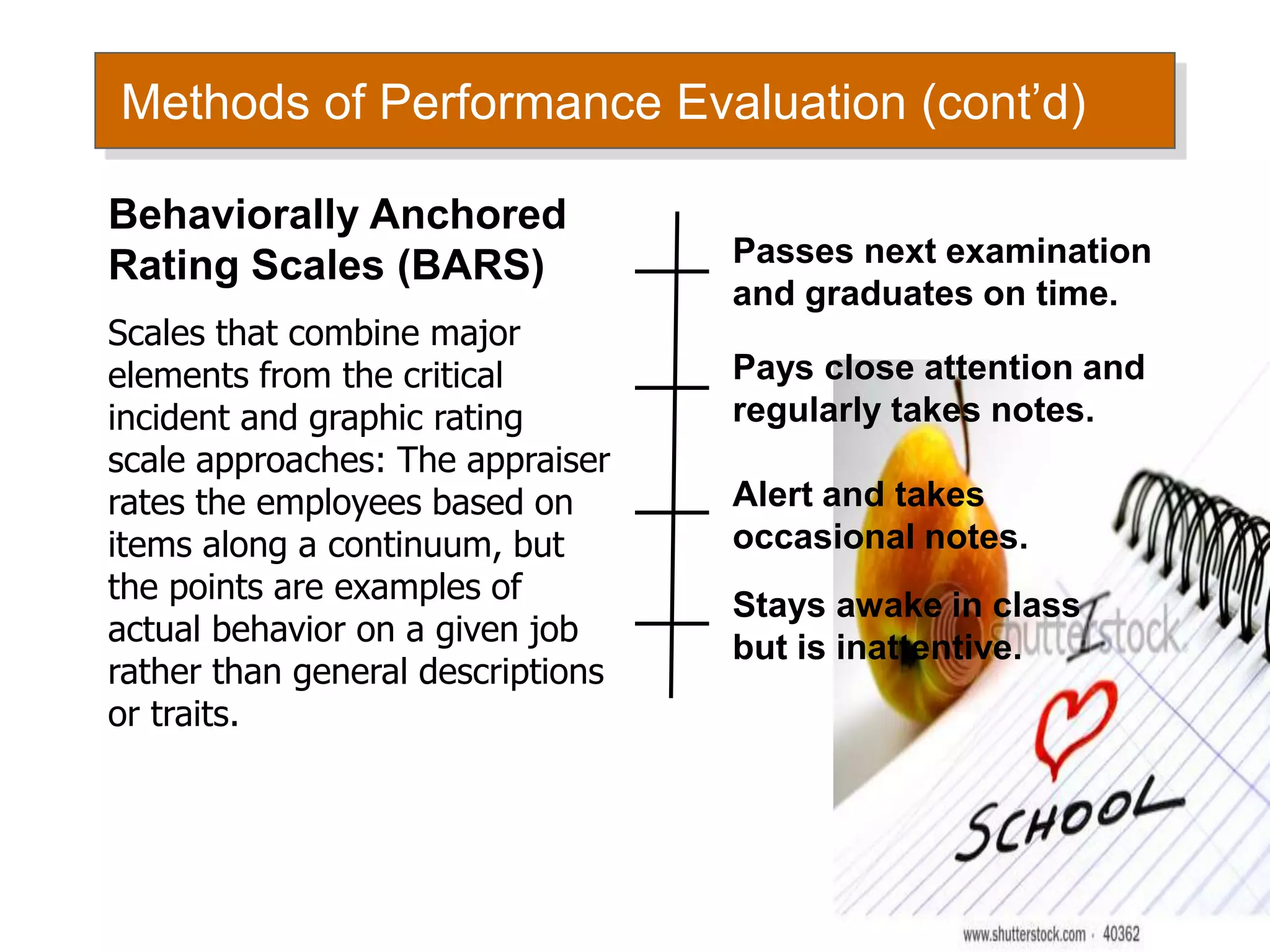
Stays awake in class
but is inattentive.
Alert and takes
occasional notes.
Pays close attention and
regularly takes notes.
Passes next examination
and graduates on time.
Behaviorally Anchored
Rating Scales (BARS)
Scales that combine major
elements from the critical
incident and graphic rating
scale approaches: The appraiser
rates the employees based on
items along a continuum, but
the points are examples of
actual behavior on a given job
rather than general descriptions
or traits.
© 2007 Prentice Hall Inc. All rights reserved.
Methods of Performance Evaluation (cont’d)
 Forced Comparisons
– Evaluating one individual’s performance relative
to the performance of another individual or
others.
Group Order Ranking
An evaluation method that places employees into a
particular classification, such as quartiles.
Individual Ranking
An evaluation method that rank-orders employees
from best to worse.
© 2007 Prentice Hall Inc. All rights reserved.
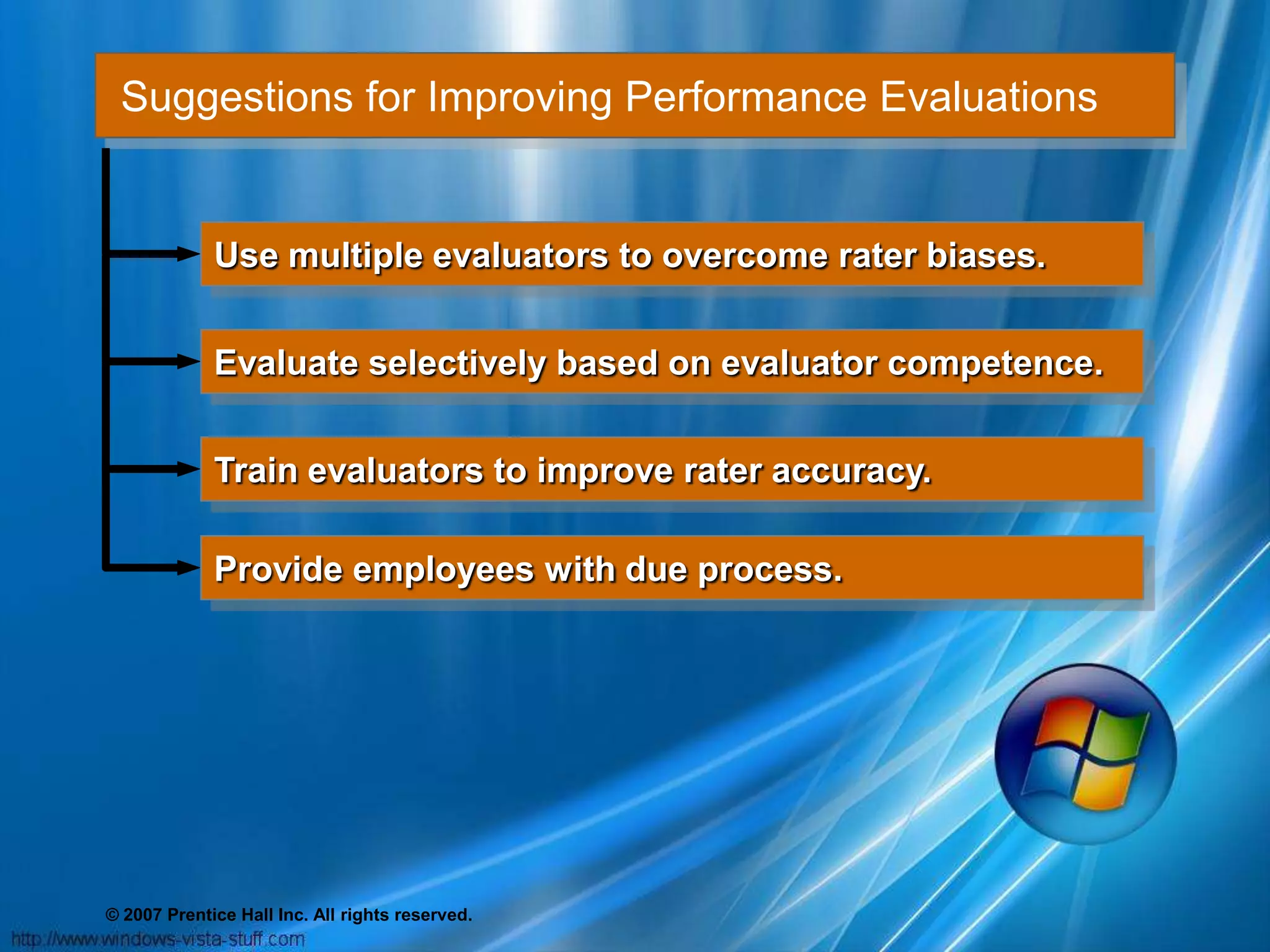
Suggestions for Improving Performance Evaluations
Use multiple evaluators to overcome rater biases.
Evaluate selectively based on evaluator competence.
Train evaluators to improve rater accuracy.
Provide employees with due process.
© 2007 Prentice Hall Inc. All rights reserved.
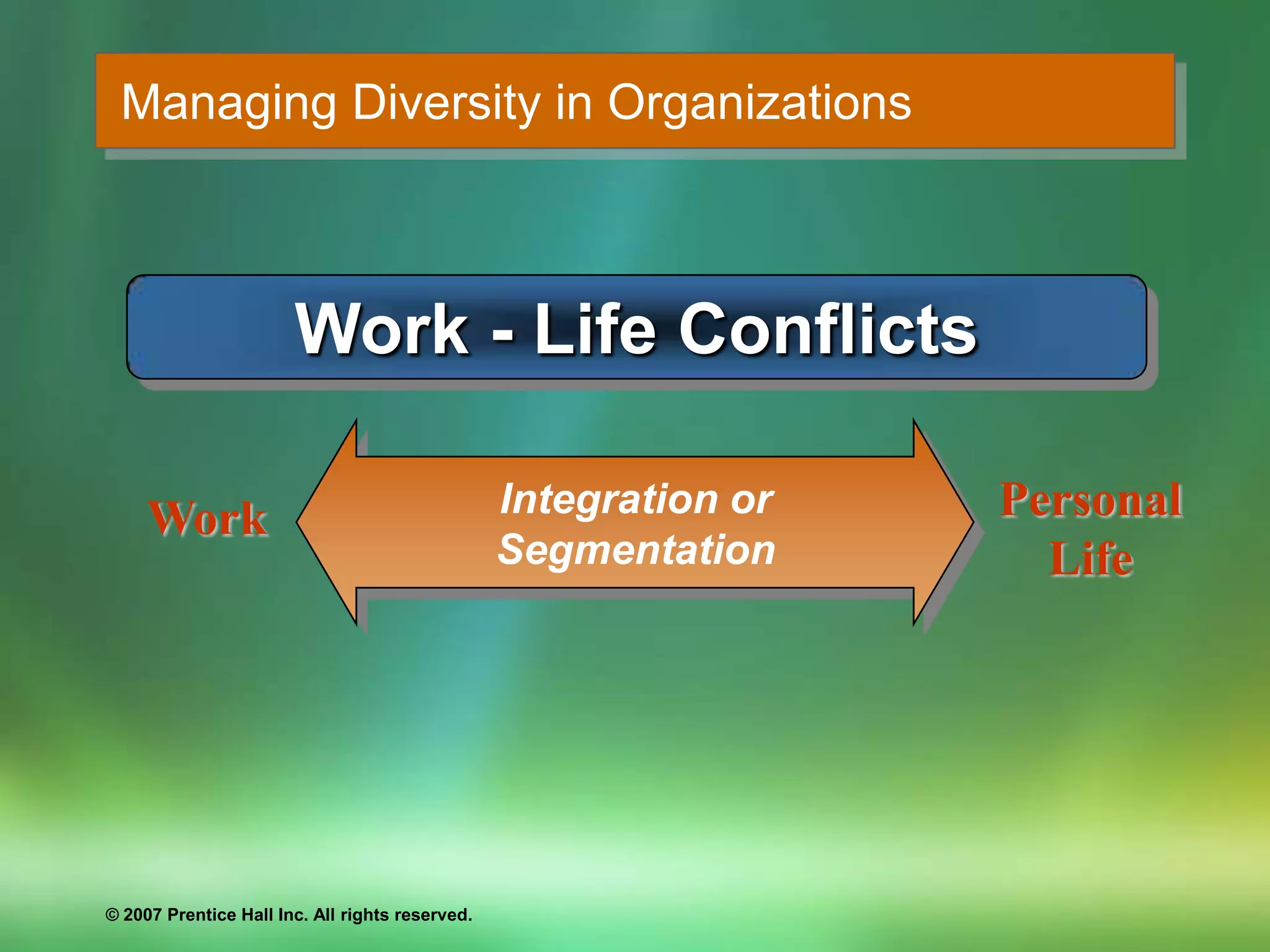
Managing Diversity in Organizations
Work Personal
Life
Integration or
Segmentation
Work - Life Conflicts
© 2007 Prentice Hall Inc. All rights reserved.
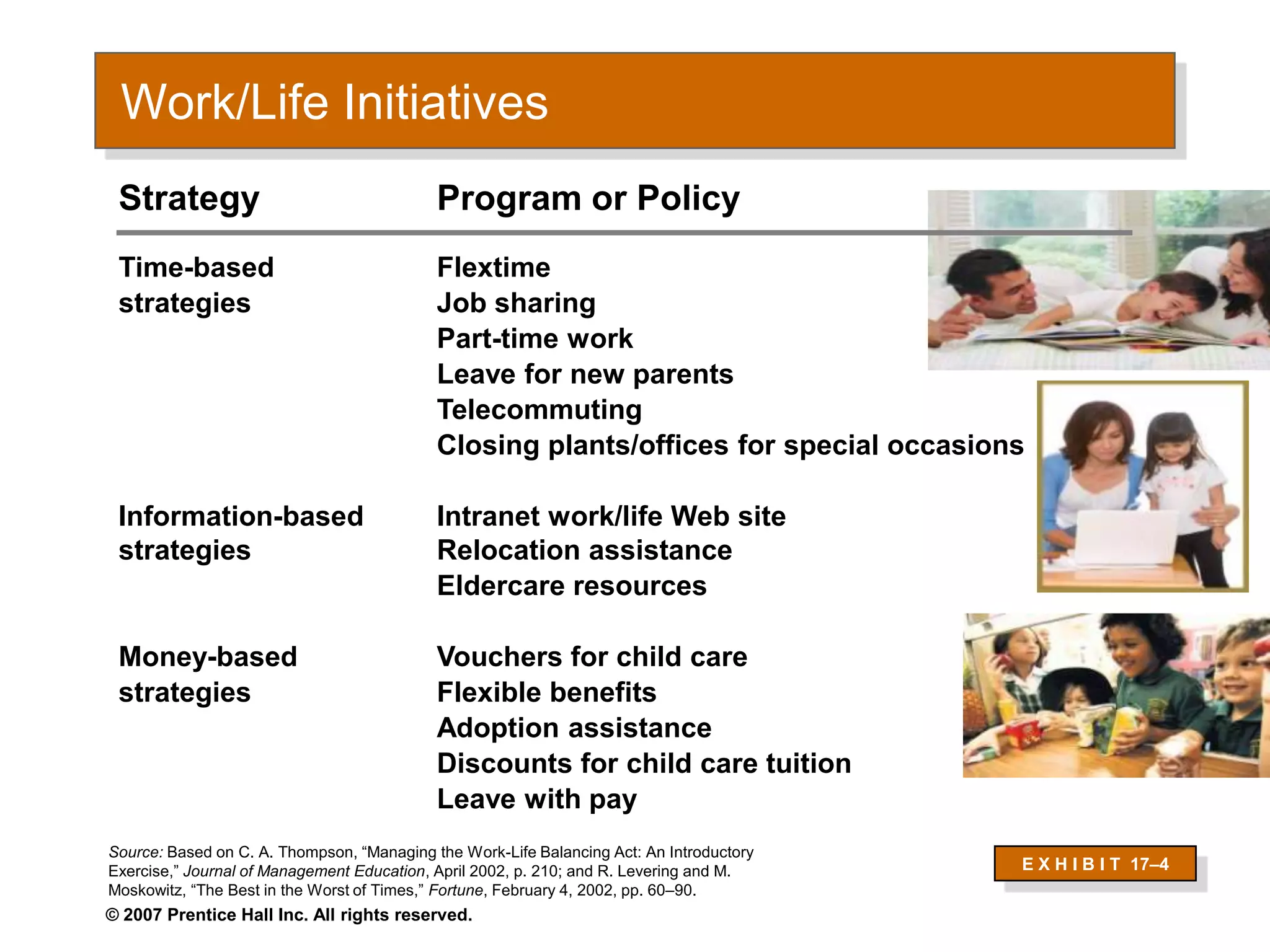
Work/Life Initiatives
E X H I B I T 17–4
Strategy Program or Policy
Time-based Flextime
strategies Job sharing
Part-time work
Leave for new parents
Telecommuting
Closing plants/offices for special occasions
Information-based Intranet work/life Web site
strategies Relocation assistance
Eldercare resources
Money-based Vouchers for child care
strategies Flexible benefits
Adoption assistance
Discounts for child care tuition
Leave with pay
Source: Based on C. A. Thompson, “Managing the Work-Life Balancing Act: An Introductory
Exercise,” Journal of Management Education, April 2002, p. 210; and R. Levering and M.
Moskowitz, “The Best in the Worst of Times,” Fortune, February 4, 2002, pp. 60–90.
© 2007 Prentice Hall Inc. All rights reserved.
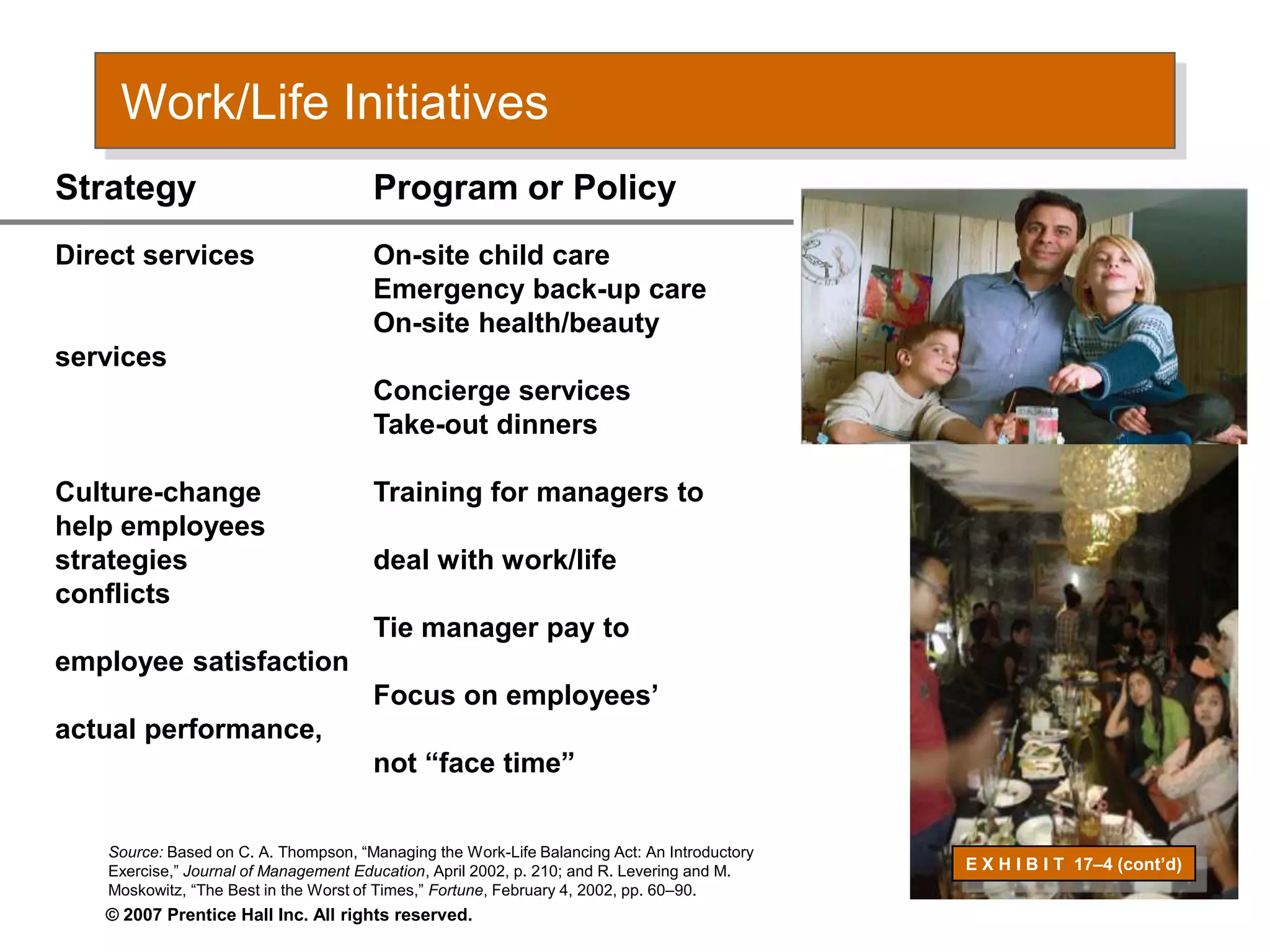
Work/Life Initiatives
E X H I B I T 17–4 (cont’d)
Strategy Program or Policy
Direct services On-site child care
Emergency back-up care
On-site health/beauty
services
Concierge services
Take-out dinners
Culture-change Training for managers to
help employees
strategies deal with work/life
conflicts
Tie manager pay to
employee satisfaction
Focus on employees’
actual performance,
not “face time”
Source: Based on C. A. Thompson, “Managing the Work-Life Balancing Act: An Introductory
Exercise,” Journal of Management Education, April 2002, p. 210; and R. Levering and M.
Moskowitz, “The Best in the Worst of Times,” Fortune, February 4, 2002, pp. 60–90.
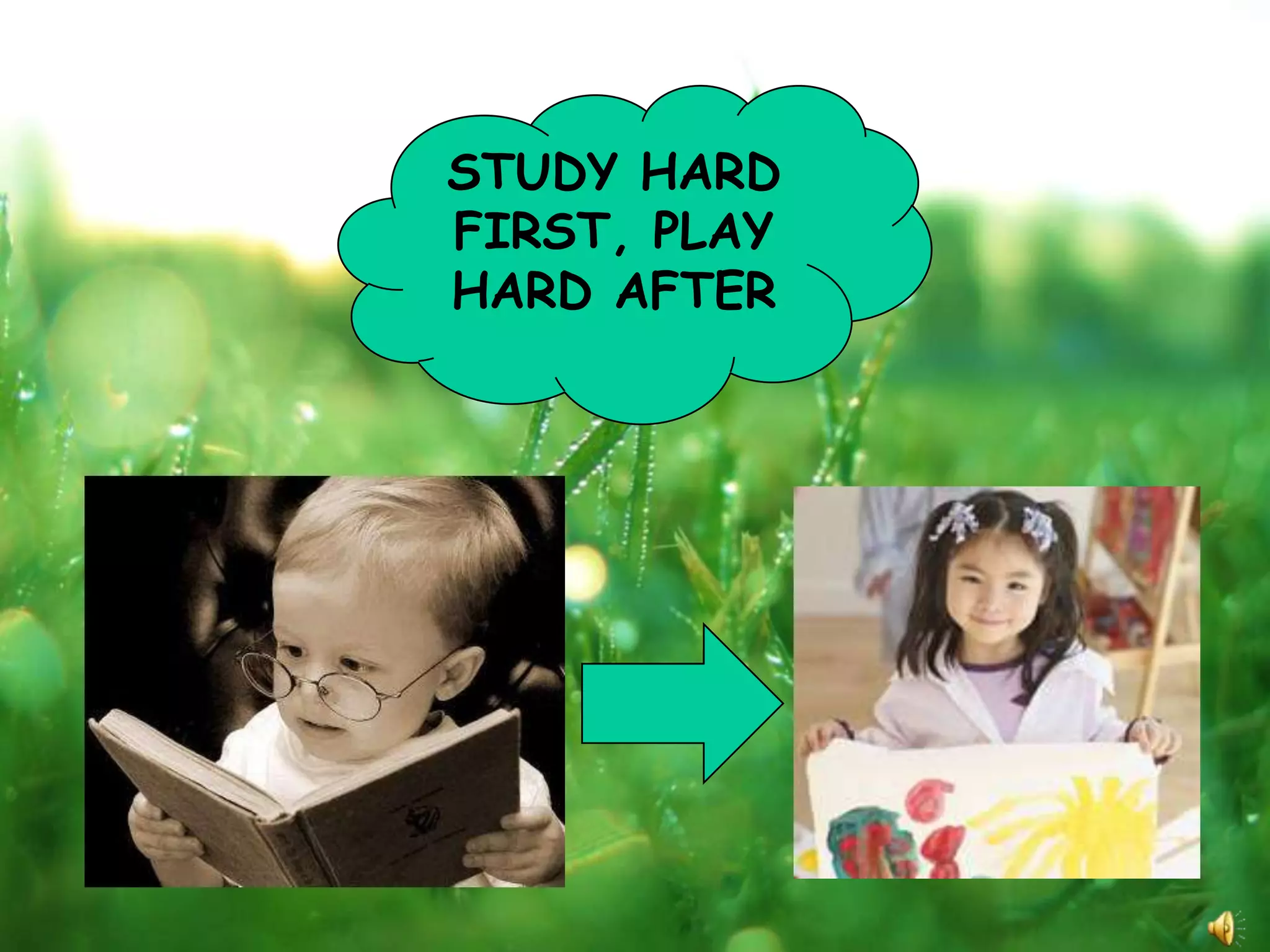
STUDY HARD
FIRST, PLAY
HARD AFTER
© 2007 Prentice Hall Inc. All rights reserved.

Ch17_OrganizationalBehavior_byRobbins

  • 1.
  • 2.
    LEARNING OBJECTIVES  Defineinitial selection, and identify the most useful methods  Define substantive selection, and identify the most useful methods  Define contingent selection, and contrast the arguments for and against drug testing  Compare the four main types of training  Contrast on-the-job and off-the-job training  Describe the purposes of performance evaluation, and list the methods by which it can be done  Show how managers can improve performance evaluations  Describe how organizations can manage work-family conflict
  • 3.
    The Selection Process InitialSelection Substantive Selection Contingent Selection Applicants who don’t meet basic requirements are rejected. Applicants who meet basic requirements, but are less qualified than others, are rejected. Applicants who are among best qualified, but who fail contingent selection, are rejected. Applicant receives job offer. E X H I B I T 17–1 DITERIMA
  • 4.
    Selection Devices (cont’d) Written Tests – Intelligence or cognitive ability tests – Personality tests – Integrity tests – Interest inventories
  • 5.
    Selection Devices (cont’d) Performance-Simulation Tests – Work samples – Assessment centers – Situational judgment tests.  Interview
  • 6.
    Contingent Selection  Contingentselection is phase when applicants pass the substantive selection method and they’re ready to be hired. One common contingent method is a drug test.
  • 7.
    Training and DevelopmentPrograms Types of Training Basic Literacy Skills Technical Skills Interpersonal Skills Problem Solving Skills
  • 8.
    Training Methods Individual and GroupTraining Methods Formal Training Informal Training On-the-Job Training Off-the-Job Training
  • 9.
    Performance Evaluation  Purposesof Performance Evaluation – Making general human resource decisions. • Promotions, transfers, and terminations – Identifying training and development needs. • Employee skills and competencies – Validating selection and development programs. • Employee performance compared to selection evaluation and anticipated performance results of participation in training – Providing feedback to employees. • The organization’s view of their current performance – Supplying the basis for rewards allocation decisions. • Merit pay increases and other rewards
  • 10.
    Performance Evaluation (cont’d) Performance Evaluation and Motivation – If employees are to be motivated to perform, then: • Performance objectives must be clear. • Performance criteria must be related to the job. • Performance must be accurately evaluated. • Performance must be properly rewarded.
  • 11.
    Methods of PerformanceEvaluation Written Essay A narrative describing an employee’s strengths, weaknesses, past performances, potential, and suggestions for improvement. Critical Incidents Evaluating the behaviors that are key in making the difference between executing a job effectively and executing it ineffectively.
  • 12.
    Methods of PerformanceEvaluation (cont’d) Keeps up with current policies and regulations. 1 2 3 4 5 Completely Unaware Fully Informed XX Graphic Rating Scales An evaluation method in which the evaluator rates performance factors on an incremental scale.
  • 13.
    Methods of PerformanceEvaluation (cont’d) Stays awake in class but is inattentive. Alert and takes occasional notes. Pays close attention and regularly takes notes. Passes next examination and graduates on time. Behaviorally Anchored Rating Scales (BARS) Scales that combine major elements from the critical incident and graphic rating scale approaches: The appraiser rates the employees based on items along a continuum, but the points are examples of actual behavior on a given job rather than general descriptions or traits.
  • 14.
    © 2007 PrenticeHall Inc. All rights reserved. Methods of Performance Evaluation (cont’d)  Forced Comparisons – Evaluating one individual’s performance relative to the performance of another individual or others. Group Order Ranking An evaluation method that places employees into a particular classification, such as quartiles. Individual Ranking An evaluation method that rank-orders employees from best to worse.
  • 15.
    © 2007 PrenticeHall Inc. All rights reserved. Suggestions for Improving Performance Evaluations Use multiple evaluators to overcome rater biases. Evaluate selectively based on evaluator competence. Train evaluators to improve rater accuracy. Provide employees with due process.
  • 16.
    © 2007 PrenticeHall Inc. All rights reserved. Managing Diversity in Organizations Work Personal Life Integration or Segmentation Work - Life Conflicts
  • 17.
    © 2007 PrenticeHall Inc. All rights reserved. Work/Life Initiatives E X H I B I T 17–4 Strategy Program or Policy Time-based Flextime strategies Job sharing Part-time work Leave for new parents Telecommuting Closing plants/offices for special occasions Information-based Intranet work/life Web site strategies Relocation assistance Eldercare resources Money-based Vouchers for child care strategies Flexible benefits Adoption assistance Discounts for child care tuition Leave with pay Source: Based on C. A. Thompson, “Managing the Work-Life Balancing Act: An Introductory Exercise,” Journal of Management Education, April 2002, p. 210; and R. Levering and M. Moskowitz, “The Best in the Worst of Times,” Fortune, February 4, 2002, pp. 60–90.
  • 18.
    © 2007 PrenticeHall Inc. All rights reserved. Work/Life Initiatives E X H I B I T 17–4 (cont’d) Strategy Program or Policy Direct services On-site child care Emergency back-up care On-site health/beauty services Concierge services Take-out dinners Culture-change Training for managers to help employees strategies deal with work/life conflicts Tie manager pay to employee satisfaction Focus on employees’ actual performance, not “face time” Source: Based on C. A. Thompson, “Managing the Work-Life Balancing Act: An Introductory Exercise,” Journal of Management Education, April 2002, p. 210; and R. Levering and M. Moskowitz, “The Best in the Worst of Times,” Fortune, February 4, 2002, pp. 60–90.
  • 19.
  • 20.
    © 2007 PrenticeHall Inc. All rights reserved.