

Chapter 10
                 Fundamentals of Organization
                          Design


© SB InstitutE
10.1


                   Learning Objectives
    After reading this chapter, you should be able to:
      Explain several of the main ingredients of organization design
      Outline the features of four basic types of departmentalization
      Describe three of the principles for achieving coordination within
      and between departments
      Discuss the fundamental concepts of authority in organization
      design


© SB InstitutE
10.2


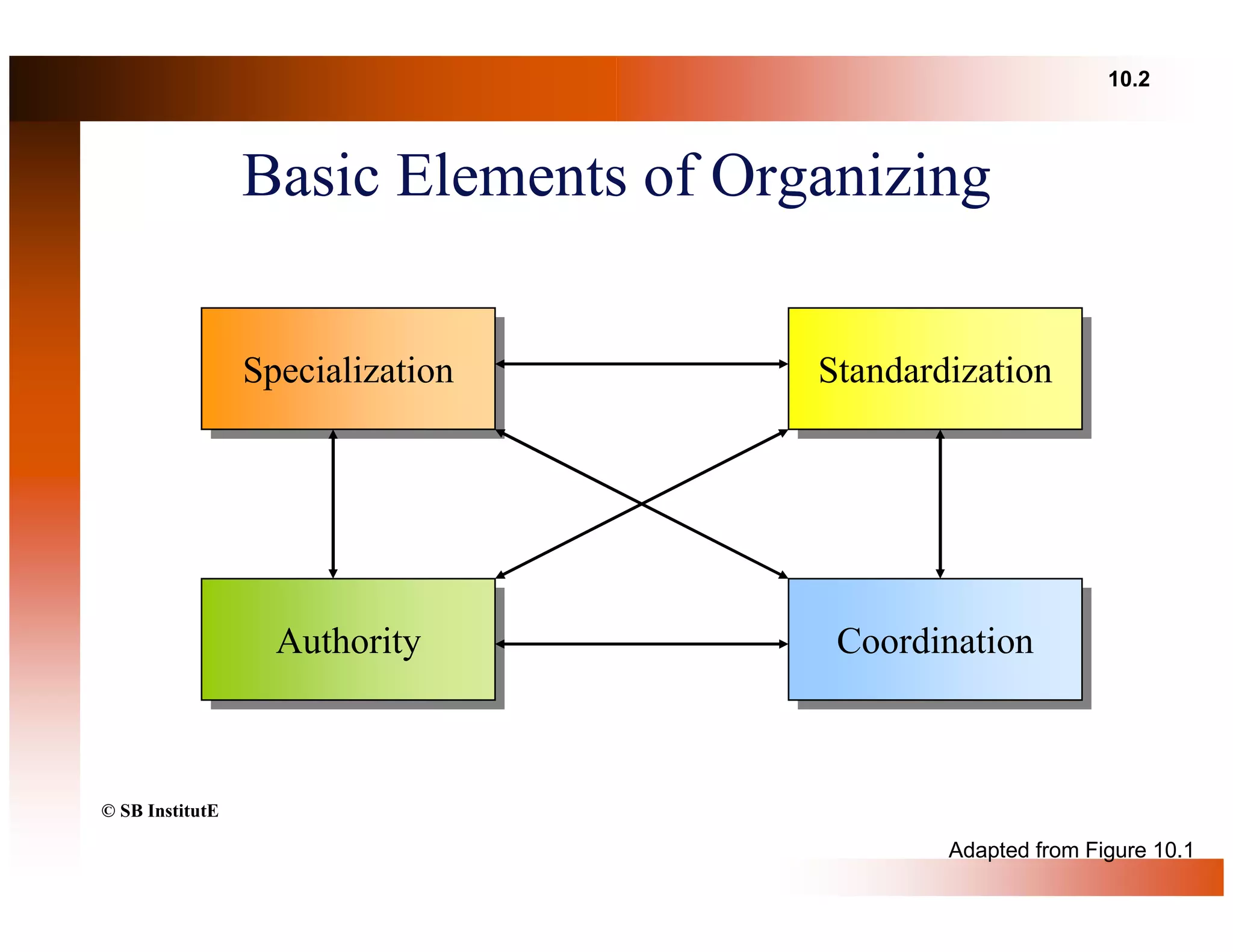
                 Basic Elements of Organizing


                 Specialization
                 Specialization       Standardization
                                      Standardization


                   Authority
                   Authority           Coordination
                                       Coordination


© SB InstitutE

                                              Adapted from Figure 10.1
10.3


    Potential Benefits of Functional Departmentalization
   Supports skill specialization
   Reduces duplication of resources and increases coordination
   within the functional area
   Enhances career development and training within the
   department
   Allows superiors and subordinates
   to share common expertise

   Promotes high-quality technical decision making


© SB InstitutE
10.4


        Potential Pitfalls of Functional Departmentalization

   Inadequate communication between departments
   May create conflict over product priorities
   Difficulty with interdepartmental coordination
   Focuses on departmental rather than organizational issues and
   goals
   Develops managers who are experts in narrow fields


© SB InstitutE
10.5


   Potential Benefits of Place Departmentalization
   Equipment used for products is all in one place, saving time and
   costs


   Develop expertise in solving problems unique to one location
   Gaining an understanding of customers’ problems and desires
   Getting production closer to raw materials and suppliers


© SB InstitutE
10.6


       Potential Pitfalls of Place Departmentalization

   Duplication of functions at each regional or individual unit
   location
   May cause conflicts between each location’s goals and
   organization goals
   Adds levels of management and extensive use of rules and
   regulations to coordinate and ensure uniformity of quality
   among locations


© SB InstitutE
10.7


    Potential Benefits of Product Departmentalization
   Permits fast changes in a product
   Allows greater product visibility
   Fosters a concern for customer demand
   Clearly defines responsibilities
   Develops managers who can think across functional lines


© SB InstitutE
10.8


        Potential Pitfalls of Product Departmentalization

   Poor utilization of skills and resources
   Doesn’t foster coordination of activities across product lines
   Fosters politics and conflicts in resource allocation across
   product lines
   Limits career mobility for personnel outside
   their product line


© SB InstitutE
10.9


  Potential Benefits of Customer Departmentalization
   Encourages greater customer focus

   Clearly identifies key customers

   Enables understanding of customer need

   Develops managers and employees who become customer

   advocates


© SB InstitutE
10.10


       Potential Pitfalls of Customer Departmentalization
   Doesn’t foster coordination between divisions organized by
   customer group
   Fosters politics and conflicts in resource allocation between
   divisions
   Employees feel pressure
   from customer
   to give them privileges


   Restricts problem solving to single type of customer
© SB InstitutE
10.11


                 Principles of Coordination
      Unity of command principle
       • An employee should have only one manager


      Scalar principle
       • A clear, unbroken chain of command should link every employee with
         someone at a higher level


      Span of control principle
       • Limited number of people reporting to any one manager


© SB InstitutE
10.12


                  Effective Delegation
       Establish goals and standards
       Ensure clarity
       Involvement
       Expect completed work
       Provide training
       Timely feedback


© SB InstitutE

Ch10

  • 1.
    Chapter 10 Fundamentals of Organization Design © SB InstitutE
  • 2.
    10.1 Learning Objectives After reading this chapter, you should be able to: Explain several of the main ingredients of organization design Outline the features of four basic types of departmentalization Describe three of the principles for achieving coordination within and between departments Discuss the fundamental concepts of authority in organization design © SB InstitutE
  • 3.
    10.2 Basic Elements of Organizing Specialization Specialization Standardization Standardization Authority Authority Coordination Coordination © SB InstitutE Adapted from Figure 10.1
  • 4.
    10.3 Potential Benefits of Functional Departmentalization Supports skill specialization Reduces duplication of resources and increases coordination within the functional area Enhances career development and training within the department Allows superiors and subordinates to share common expertise Promotes high-quality technical decision making © SB InstitutE
  • 5.
    10.4 Potential Pitfalls of Functional Departmentalization Inadequate communication between departments May create conflict over product priorities Difficulty with interdepartmental coordination Focuses on departmental rather than organizational issues and goals Develops managers who are experts in narrow fields © SB InstitutE
  • 6.
    10.5 Potential Benefits of Place Departmentalization Equipment used for products is all in one place, saving time and costs Develop expertise in solving problems unique to one location Gaining an understanding of customers’ problems and desires Getting production closer to raw materials and suppliers © SB InstitutE
  • 7.
    10.6 Potential Pitfalls of Place Departmentalization Duplication of functions at each regional or individual unit location May cause conflicts between each location’s goals and organization goals Adds levels of management and extensive use of rules and regulations to coordinate and ensure uniformity of quality among locations © SB InstitutE
  • 8.
    10.7 Potential Benefits of Product Departmentalization Permits fast changes in a product Allows greater product visibility Fosters a concern for customer demand Clearly defines responsibilities Develops managers who can think across functional lines © SB InstitutE
  • 9.
    10.8 Potential Pitfalls of Product Departmentalization Poor utilization of skills and resources Doesn’t foster coordination of activities across product lines Fosters politics and conflicts in resource allocation across product lines Limits career mobility for personnel outside their product line © SB InstitutE
  • 10.
    10.9 PotentialBenefits of Customer Departmentalization Encourages greater customer focus Clearly identifies key customers Enables understanding of customer need Develops managers and employees who become customer advocates © SB InstitutE
  • 11.
    10.10 Potential Pitfalls of Customer Departmentalization Doesn’t foster coordination between divisions organized by customer group Fosters politics and conflicts in resource allocation between divisions Employees feel pressure from customer to give them privileges Restricts problem solving to single type of customer © SB InstitutE
  • 12.
    10.11 Principles of Coordination Unity of command principle • An employee should have only one manager Scalar principle • A clear, unbroken chain of command should link every employee with someone at a higher level Span of control principle • Limited number of people reporting to any one manager © SB InstitutE
  • 13.
    10.12 Effective Delegation Establish goals and standards Ensure clarity Involvement Expect completed work Provide training Timely feedback © SB InstitutE