ORGANIZATIONAL BEHAVIOR
                                      S T E P H E N P. R O B B I N S
                                          WWW.PRENHALL.COM/ROBBINS

                                            T    E   N   T   H   E   D   I   T   I   O   N


© 2003 Prentice Hall Inc. All rights reserved.                                           PowerPoint Presentation by Charlie Cook
O B J E C T I V E S
                       AFTER STUDYING THIS CHAPTER,
                       YOU SHOULD BE ABLE TO:

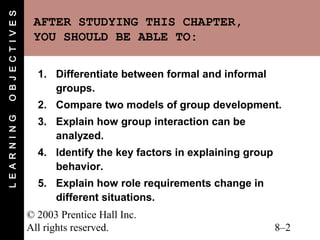
                        1. Differentiate between formal and informal
                           groups.
                        2. Compare two models of group development.
L E A R N I N G


                        3. Explain how group interaction can be
                           analyzed.
                        4. Identify the key factors in explaining group
                           behavior.
                        5. Explain how role requirements change in
                           different situations.
                      © 2003 Prentice Hall Inc.
                      All rights reserved.                                8–2
O B J E C T I V E S (cont’d)
                                AFTER STUDYING THIS CHAPTER,
                                YOU SHOULD BE ABLE TO:

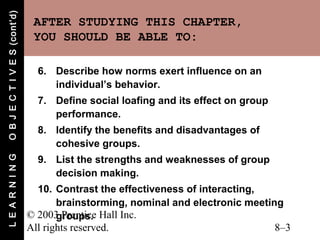
                                 6. Describe how norms exert influence on an
                                    individual’s behavior.
                                 7. Define social loafing and its effect on group
                                    performance.
                                 8. Identify the benefits and disadvantages of
                                    cohesive groups.
                                 9. List the strengths and weaknesses of group
L E A R N I N G


                                    decision making.
                                 10. Contrast the effectiveness of interacting,
                                      brainstorming, nominal and electronic meeting
                               © 2003 Prentice Hall Inc.
                                      groups.
                               All rights reserved.                               8–3
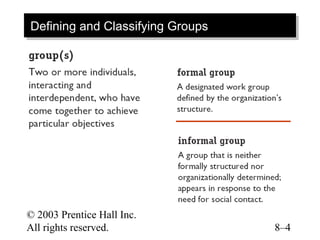
Defining and Classifying Groups


© 2003 Prentice Hall Inc.
All rights reserved.              8–4
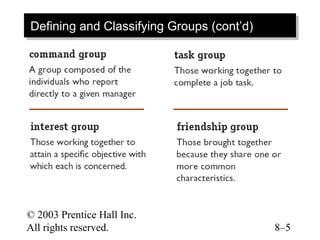
Defining and Classifying Groups (cont’d)


© 2003 Prentice Hall Inc.
All rights reserved.                       8–5
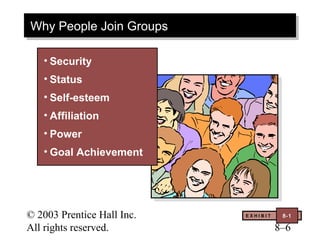
Why People Join Groups

   • Security
   • Status
   • Self-esteem
   • Affiliation
   • Power
   • Goal Achievement


© 2003 Prentice Hall Inc.   EXHIBIT    8-1

All rights reserved.                  8–6
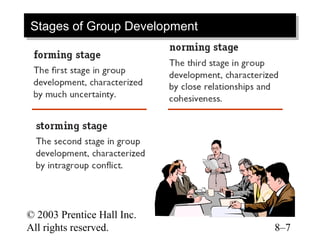
Stages of Group Development


© 2003 Prentice Hall Inc.
All rights reserved.          8–7
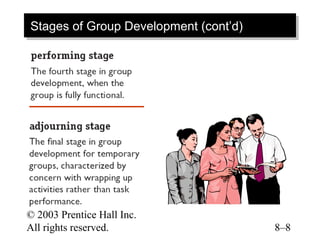
Stages of Group Development (cont’d)


© 2003 Prentice Hall Inc.
All rights reserved.                   8–8
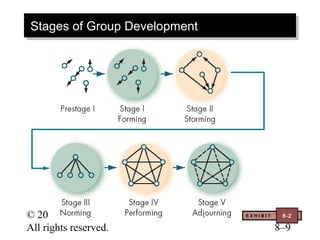
Stages of Group Development


© 2003 Prentice Hall Inc.     EXHIBIT    8-2

All rights reserved.                    8–9
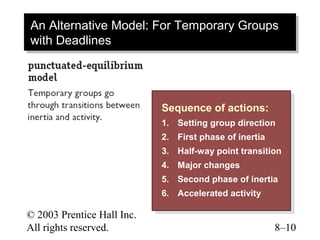
An Alternative Model: For Temporary Groups
with Deadlines
with Deadlines


                            Sequence of actions:
                             Sequence of actions:
                            1.
                             1.   Setting group direction
                                   Setting group direction
                            2.
                             2.   First phase of inertia
                                   First phase of inertia
                            3.
                             3.   Half-way point transition
                                   Half-way point transition
                            4.
                             4.   Major changes
                                   Major changes
                            5.
                             5.   Second phase of inertia
                                   Second phase of inertia
                            6.
                             6.   Accelerated activity
                                   Accelerated activity

© 2003 Prentice Hall Inc.
All rights reserved.                                     8–10
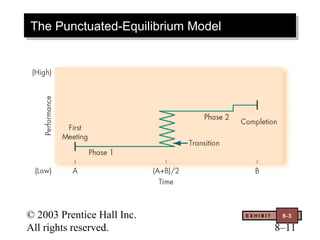
The Punctuated-Equilibrium Model


© 2003 Prentice Hall Inc.          EXHIBIT    8-3

All rights reserved.                         8–11
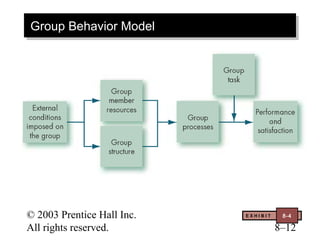
Group Behavior Model


© 2003 Prentice Hall Inc.   EXHIBIT    8-4

All rights reserved.                  8–12
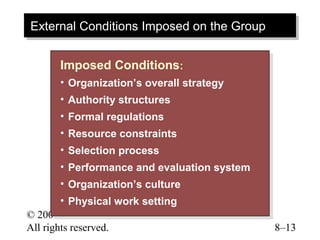
External Conditions Imposed on the Group

       Imposed Conditions::
        Imposed Conditions
       •• Organization’s overall strategy
          Organization’s overall strategy
       •• Authority structures
          Authority structures
       •• Formal regulations
           Formal regulations
       •• Resource constraints
           Resource constraints
       •• Selection process
           Selection process
       •• Performance and evaluation system
           Performance and evaluation system
        •• Organization’s culture
            Organization’s culture
        •• Physical work setting
            Physical work setting
© 2003 Prentice Hall Inc.
All rights reserved.                           8–13
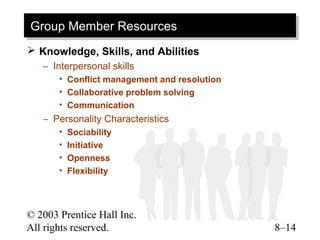
Group Member Resources
 Knowledge, Skills, and Abilities
   – Interpersonal skills
       • Conflict management and resolution
       • Collaborative problem solving
       • Communication
   – Personality Characteristics
       •   Sociability
       •   Initiative
       •   Openness
       •   Flexibility


© 2003 Prentice Hall Inc.
All rights reserved.                          8–14
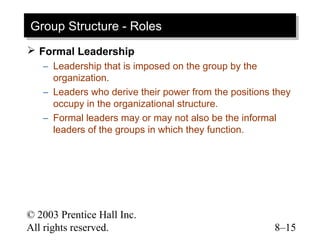
Group Structure -- Roles
Group Structure Roles
 Formal Leadership
   – Leadership that is imposed on the group by the
     organization.
   – Leaders who derive their power from the positions they
     occupy in the organizational structure.
   – Formal leaders may or may not also be the informal
     leaders of the groups in which they function.


© 2003 Prentice Hall Inc.
All rights reserved.                                   8–15
Group Structure -- Roles (cont’d)
Group Structure Roles (cont’d)


© 2003 Prentice Hall Inc.
All rights reserved.                8–16
Group Structure -- Roles (cont’d)
Group Structure Roles (cont’d)


© 2003 Prentice Hall Inc.
All rights reserved.                8–17
Group Structure -- Norms
Group Structure Norms


                     Classes of Norms:
                     Classes of Norms:
                     •• Performance norms
                         Performance norms
                     •• Appearance norms
                         Appearance norms
                       •• Social arrangement norms
                           Social arrangement norms
                       •• Allocation of resources
                           Allocation of resources
                          norms
                           norms
© 2003 Prentice Hall Inc.
All rights reserved.                               8–18
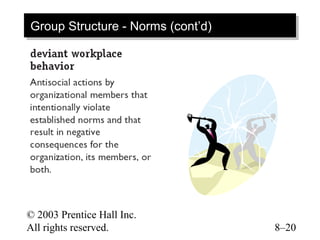
Group Structure -- Norms (cont’d)
Group Structure Norms (cont’d)


© 2003 Prentice Hall Inc.
All rights reserved.                8–19
Group Structure -- Norms (cont’d)
Group Structure Norms (cont’d)


© 2003 Prentice Hall Inc.
All rights reserved.                8–20
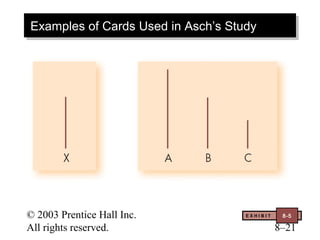
Examples of Cards Used in Asch’s Study


© 2003 Prentice Hall Inc.          EXHIBIT    8-5

All rights reserved.                         8–21
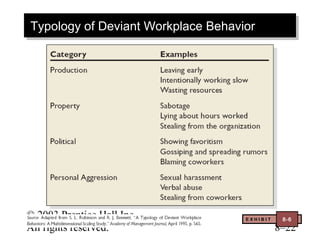
Typology of Deviant Workplace Behavior


© 2003 Prentice Hall Inc.           EXHIBIT    8-6
All rights reserved.                          8–22
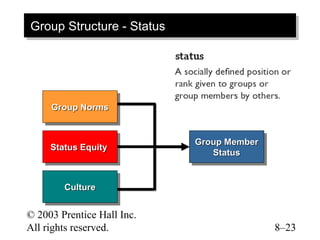
Group Structure -- Status
Group Structure Status


     Group Norms
     Group Norms


                            Group Member
                            Group Member
     Status Equity
     Status Equity             Status
                                Status


        Culture
        Culture

© 2003 Prentice Hall Inc.
All rights reserved.                       8–23
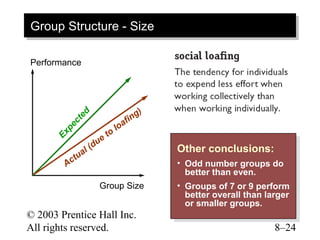
Group Structure -- Size
Group Structure Size

Performance


                                        )
                                      ng
              d


                                   fi
             te


                               a
        ec


                             lo
         p


                         o
                       et
      Ex


                      u
                    (d                      Other conclusions:
               al                           Other conclusions:
             tu
        Ac                                  • • Odd number groups do
                                                 Odd number groups do
                                                better than even.
                                                 better than even.
                      Group Size            • • Groups of 77or 99perform
                                                 Groups of or perform
                                                better overall than larger
                                                 better overall than larger
                                                or smaller groups.
                                                 or smaller groups.
© 2003 Prentice Hall Inc.
All rights reserved.                                                  8–24
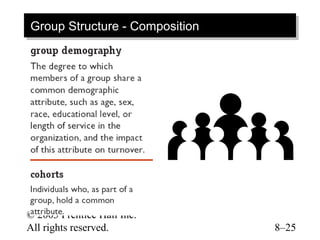
Group Structure -- Composition
Group Structure Composition


© 2003 Prentice Hall Inc.
All rights reserved.             8–25
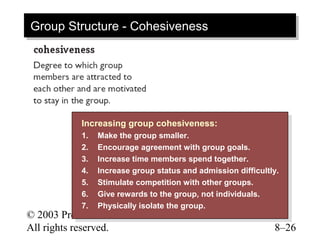
Group Structure -- Cohesiveness
Group Structure Cohesiveness


            Increasing group cohesiveness:
             Increasing group cohesiveness:
            1.
             1.   Make the group smaller.
                   Make the group smaller.
            2.
             2.   Encourage agreement with group goals.
                   Encourage agreement with group goals.
            3.
             3.   Increase time members spend together.
                   Increase time members spend together.
            4.
             4.   Increase group status and admission difficultly.
                   Increase group status and admission difficultly.
            5.
             5.   Stimulate competition with other groups.
                   Stimulate competition with other groups.
            6.
             6.   Give rewards to the group, not individuals.
                   Give rewards to the group, not individuals.
            7.
             7.   Physically isolate the group.
                   Physically isolate the group.
© 2003 Prentice Hall Inc.
All rights reserved.                                            8–26
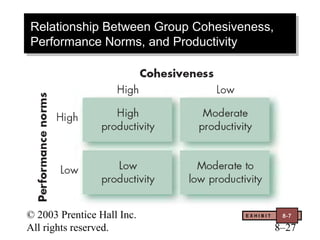
Relationship Between Group Cohesiveness,
Performance Norms, and Productivity


© 2003 Prentice Hall Inc.          EXHIBIT    8-7

All rights reserved.                         8–27
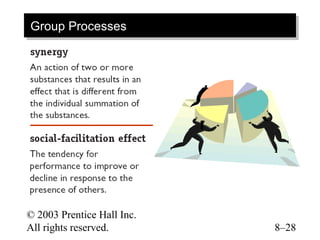
Group Processes
Group Processes


© 2003 Prentice Hall Inc.
All rights reserved.        8–28
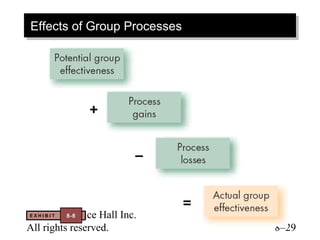
Effects of Group Processes


              +


                         –


                             =
©X 2003 Prentice Hall Inc.
E HIBIT   8-8

All rights reserved.             8–29
Group Tasks
Group Tasks
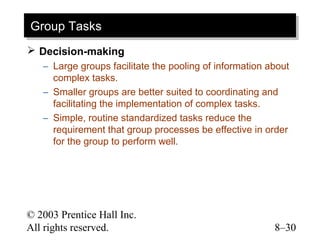
 Decision-making
   – Large groups facilitate the pooling of information about
     complex tasks.
   – Smaller groups are better suited to coordinating and
     facilitating the implementation of complex tasks.
   – Simple, routine standardized tasks reduce the
     requirement that group processes be effective in order
     for the group to perform well.


© 2003 Prentice Hall Inc.
All rights reserved.                                     8–30
Group Decision Making
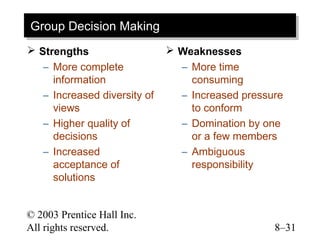
 Strengths                    Weaknesses
   – More complete              – More time
     information                  consuming
   – Increased diversity of     – Increased pressure
     views                        to conform
   – Higher quality of          – Domination by one
     decisions                    or a few members
   – Increased                  – Ambiguous
     acceptance of                responsibility
     solutions


© 2003 Prentice Hall Inc.
All rights reserved.                              8–31
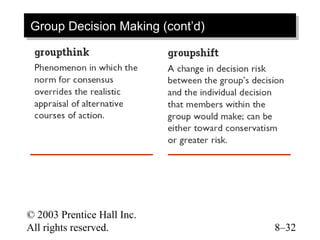
Group Decision Making (cont’d)


© 2003 Prentice Hall Inc.
All rights reserved.             8–32
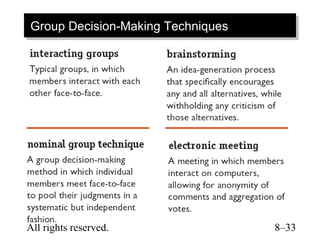
Group Decision-Making Techniques


© 2003 Prentice Hall Inc.
All rights reserved.               8–33
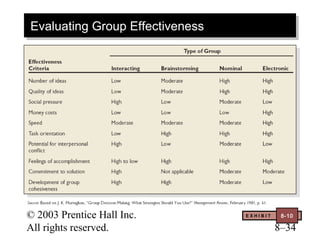
Evaluating Group Effectiveness


© 2003 Prentice Hall Inc.        EXHIBIT    8-10

All rights reserved.                       8–34

Ch08

  • 1.
    ORGANIZATIONAL BEHAVIOR S T E P H E N P. R O B B I N S WWW.PRENHALL.COM/ROBBINS T E N T H E D I T I O N © 2003 Prentice Hall Inc. All rights reserved. PowerPoint Presentation by Charlie Cook
  • 2.
    O B JE C T I V E S AFTER STUDYING THIS CHAPTER, YOU SHOULD BE ABLE TO: 1. Differentiate between formal and informal groups. 2. Compare two models of group development. L E A R N I N G 3. Explain how group interaction can be analyzed. 4. Identify the key factors in explaining group behavior. 5. Explain how role requirements change in different situations. © 2003 Prentice Hall Inc. All rights reserved. 8–2
  • 3.
    O B JE C T I V E S (cont’d) AFTER STUDYING THIS CHAPTER, YOU SHOULD BE ABLE TO: 6. Describe how norms exert influence on an individual’s behavior. 7. Define social loafing and its effect on group performance. 8. Identify the benefits and disadvantages of cohesive groups. 9. List the strengths and weaknesses of group L E A R N I N G decision making. 10. Contrast the effectiveness of interacting, brainstorming, nominal and electronic meeting © 2003 Prentice Hall Inc. groups. All rights reserved. 8–3
  • 4.
    Defining and ClassifyingGroups Defining and Classifying Groups © 2003 Prentice Hall Inc. All rights reserved. 8–4
  • 5.
    Defining and ClassifyingGroups (cont’d) Defining and Classifying Groups (cont’d) © 2003 Prentice Hall Inc. All rights reserved. 8–5
  • 6.
    Why People JoinGroups Why People Join Groups • Security • Status • Self-esteem • Affiliation • Power • Goal Achievement © 2003 Prentice Hall Inc. EXHIBIT 8-1 All rights reserved. 8–6
  • 7.
    Stages of GroupDevelopment Stages of Group Development © 2003 Prentice Hall Inc. All rights reserved. 8–7
  • 8.
    Stages of GroupDevelopment (cont’d) Stages of Group Development (cont’d) © 2003 Prentice Hall Inc. All rights reserved. 8–8
  • 9.
    Stages of GroupDevelopment Stages of Group Development © 2003 Prentice Hall Inc. EXHIBIT 8-2 All rights reserved. 8–9
  • 10.
    An Alternative Model:For Temporary Groups An Alternative Model: For Temporary Groups with Deadlines with Deadlines Sequence of actions: Sequence of actions: 1. 1. Setting group direction Setting group direction 2. 2. First phase of inertia First phase of inertia 3. 3. Half-way point transition Half-way point transition 4. 4. Major changes Major changes 5. 5. Second phase of inertia Second phase of inertia 6. 6. Accelerated activity Accelerated activity © 2003 Prentice Hall Inc. All rights reserved. 8–10
  • 11.
    The Punctuated-Equilibrium Model ThePunctuated-Equilibrium Model © 2003 Prentice Hall Inc. EXHIBIT 8-3 All rights reserved. 8–11
  • 12.
    Group Behavior Model GroupBehavior Model © 2003 Prentice Hall Inc. EXHIBIT 8-4 All rights reserved. 8–12
  • 13.
    External Conditions Imposedon the Group External Conditions Imposed on the Group Imposed Conditions:: Imposed Conditions •• Organization’s overall strategy Organization’s overall strategy •• Authority structures Authority structures •• Formal regulations Formal regulations •• Resource constraints Resource constraints •• Selection process Selection process •• Performance and evaluation system Performance and evaluation system •• Organization’s culture Organization’s culture •• Physical work setting Physical work setting © 2003 Prentice Hall Inc. All rights reserved. 8–13
  • 14.
    Group Member Resources GroupMember Resources  Knowledge, Skills, and Abilities – Interpersonal skills • Conflict management and resolution • Collaborative problem solving • Communication – Personality Characteristics • Sociability • Initiative • Openness • Flexibility © 2003 Prentice Hall Inc. All rights reserved. 8–14
  • 15.
    Group Structure --Roles Group Structure Roles  Formal Leadership – Leadership that is imposed on the group by the organization. – Leaders who derive their power from the positions they occupy in the organizational structure. – Formal leaders may or may not also be the informal leaders of the groups in which they function. © 2003 Prentice Hall Inc. All rights reserved. 8–15
  • 16.
    Group Structure --Roles (cont’d) Group Structure Roles (cont’d) © 2003 Prentice Hall Inc. All rights reserved. 8–16
  • 17.
    Group Structure --Roles (cont’d) Group Structure Roles (cont’d) © 2003 Prentice Hall Inc. All rights reserved. 8–17
  • 18.
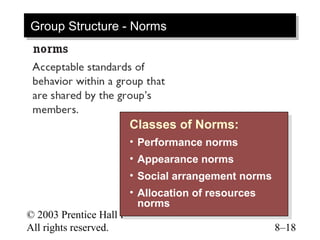
    Group Structure --Norms Group Structure Norms Classes of Norms: Classes of Norms: •• Performance norms Performance norms •• Appearance norms Appearance norms •• Social arrangement norms Social arrangement norms •• Allocation of resources Allocation of resources norms norms © 2003 Prentice Hall Inc. All rights reserved. 8–18
  • 19.
    Group Structure --Norms (cont’d) Group Structure Norms (cont’d) © 2003 Prentice Hall Inc. All rights reserved. 8–19
  • 20.
    Group Structure --Norms (cont’d) Group Structure Norms (cont’d) © 2003 Prentice Hall Inc. All rights reserved. 8–20
  • 21.
    Examples of CardsUsed in Asch’s Study Examples of Cards Used in Asch’s Study © 2003 Prentice Hall Inc. EXHIBIT 8-5 All rights reserved. 8–21
  • 22.
    Typology of DeviantWorkplace Behavior Typology of Deviant Workplace Behavior © 2003 Prentice Hall Inc. EXHIBIT 8-6 All rights reserved. 8–22
  • 23.
    Group Structure --Status Group Structure Status Group Norms Group Norms Group Member Group Member Status Equity Status Equity Status Status Culture Culture © 2003 Prentice Hall Inc. All rights reserved. 8–23
  • 24.
    Group Structure --Size Group Structure Size Performance ) ng d fi te a ec lo p o et Ex u (d Other conclusions: al Other conclusions: tu Ac • • Odd number groups do Odd number groups do better than even. better than even. Group Size • • Groups of 77or 99perform Groups of or perform better overall than larger better overall than larger or smaller groups. or smaller groups. © 2003 Prentice Hall Inc. All rights reserved. 8–24
  • 25.
    Group Structure --Composition Group Structure Composition © 2003 Prentice Hall Inc. All rights reserved. 8–25
  • 26.
    Group Structure --Cohesiveness Group Structure Cohesiveness Increasing group cohesiveness: Increasing group cohesiveness: 1. 1. Make the group smaller. Make the group smaller. 2. 2. Encourage agreement with group goals. Encourage agreement with group goals. 3. 3. Increase time members spend together. Increase time members spend together. 4. 4. Increase group status and admission difficultly. Increase group status and admission difficultly. 5. 5. Stimulate competition with other groups. Stimulate competition with other groups. 6. 6. Give rewards to the group, not individuals. Give rewards to the group, not individuals. 7. 7. Physically isolate the group. Physically isolate the group. © 2003 Prentice Hall Inc. All rights reserved. 8–26
  • 27.
    Relationship Between GroupCohesiveness, Relationship Between Group Cohesiveness, Performance Norms, and Productivity Performance Norms, and Productivity © 2003 Prentice Hall Inc. EXHIBIT 8-7 All rights reserved. 8–27
  • 28.
    Group Processes Group Processes ©2003 Prentice Hall Inc. All rights reserved. 8–28
  • 29.
    Effects of GroupProcesses Effects of Group Processes + – = ©X 2003 Prentice Hall Inc. E HIBIT 8-8 All rights reserved. 8–29
  • 30.
    Group Tasks Group Tasks Decision-making – Large groups facilitate the pooling of information about complex tasks. – Smaller groups are better suited to coordinating and facilitating the implementation of complex tasks. – Simple, routine standardized tasks reduce the requirement that group processes be effective in order for the group to perform well. © 2003 Prentice Hall Inc. All rights reserved. 8–30
  • 31.
    Group Decision Making GroupDecision Making  Strengths  Weaknesses – More complete – More time information consuming – Increased diversity of – Increased pressure views to conform – Higher quality of – Domination by one decisions or a few members – Increased – Ambiguous acceptance of responsibility solutions © 2003 Prentice Hall Inc. All rights reserved. 8–31
  • 32.
    Group Decision Making(cont’d) Group Decision Making (cont’d) © 2003 Prentice Hall Inc. All rights reserved. 8–32
  • 33.
    Group Decision-Making Techniques GroupDecision-Making Techniques © 2003 Prentice Hall Inc. All rights reserved. 8–33
  • 34.
    Evaluating Group Effectiveness EvaluatingGroup Effectiveness © 2003 Prentice Hall Inc. EXHIBIT 8-10 All rights reserved. 8–34