ORGANIZATIONAL BEHAVIOR
S T E P H E N P. R O B B I N S
E L E V E N T H E D I T I O N
W W W . P R E N H A L L . C O M / R O B B I N S© 2005 Prentice Hall Inc.
All rights reserved.
PowerPoint Presentation
by Charlie Cook
Foundations of
Group Behavior
© 2005 Prentice Hall Inc. All rights reserved. 8–2
Defining and Classifying Groups
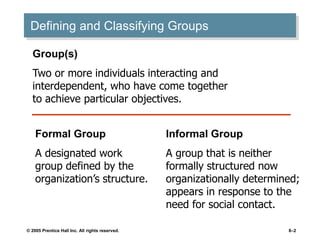
Group(s)
Two or more individuals interacting and
interdependent, who have come together
to achieve particular objectives.
Formal Group
A designated work
group defined by the
organization’s structure.
Informal Group
A group that is neither
formally structured now
organizationally determined;
appears in response to the
need for social contact.
© 2005 Prentice Hall Inc. All rights reserved. 8–3
Defining and Classifying Groups (cont’d)
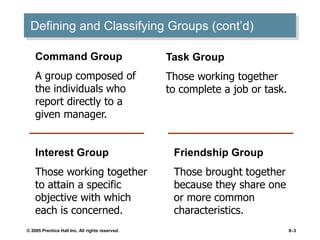
Command Group
A group composed of
the individuals who
report directly to a
given manager.
Task Group
Those working together
to complete a job or task.
Interest Group
Those working together
to attain a specific
objective with which
each is concerned.
Friendship Group
Those brought together
because they share one
or more common
characteristics.
© 2005 Prentice Hall Inc. All rights reserved. 8–4
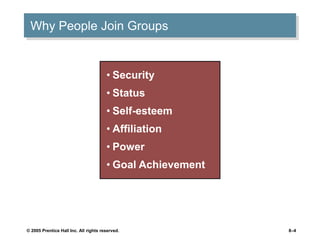
Why People Join Groups
• Security
• Status
• Self-esteem
• Affiliation
• Power
• Goal Achievement
© 2005 Prentice Hall Inc. All rights reserved. 8–5
The Five-Stage Model of Group Development
Forming Stage
The first stage in group development, characterized
by much uncertainty.
Storming Stage
The second stage in group development,
characterized by intragroup conflict.
Norming Stage
The third stage in group development, characterized
by close relationships and cohesiveness.
© 2005 Prentice Hall Inc. All rights reserved. 8–6
…Group Development (cont’d)
Performing Stage
The fourth stage in group development, when the
group is fully functional.
Adjourning Stage
The final stage in group development for temporary
groups, characterized by concern with wrapping up
activities rather than performance.
© 2005 Prentice Hall Inc. All rights reserved. 8–7
Group Structure - Roles (cont’d)
Role(s)
A set of expected behavior patterns attributed to
someone occupying a given position in a social unit.
Role Identity
Certain attitudes and behaviors consistent with a
role.
Role Perception
An individual’s view of how he or she is supposed to
act in a given situation.
© 2005 Prentice Hall Inc. All rights reserved. 8–8
Group Structure - Roles (cont’d)
Role Expectations
How others believe a person should act in a given
situation.
Role Conflict
A situation in which an individual is confronted by
divergent role expectations.
Psychological Contract
An unwritten agreement that sets out what
management expects from the employee and vice
versa.
© 2005 Prentice Hall Inc. All rights reserved. 8–9
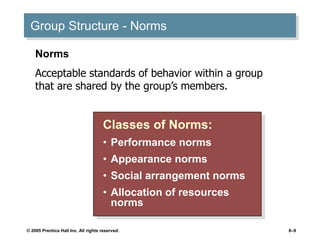
Group Structure - Norms
Classes of Norms:
• Performance norms
• Appearance norms
• Social arrangement norms
• Allocation of resources
norms
Norms
Acceptable standards of behavior within a group
that are shared by the group’s members.
© 2005 Prentice Hall Inc. All rights reserved. 8–10
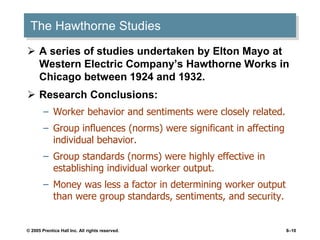
The Hawthorne Studies
 A series of studies undertaken by Elton Mayo at
Western Electric Company’s Hawthorne Works in
Chicago between 1924 and 1932.
 Research Conclusions:
– Worker behavior and sentiments were closely related.
– Group influences (norms) were significant in affecting
individual behavior.
– Group standards (norms) were highly effective in
establishing individual worker output.
– Money was less a factor in determining worker output
than were group standards, sentiments, and security.
© 2005 Prentice Hall Inc. All rights reserved. 8–11
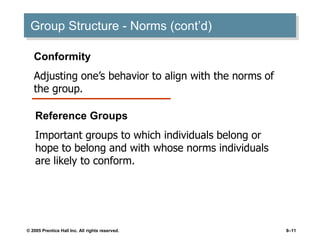
Group Structure - Norms (cont’d)
Conformity
Adjusting one’s behavior to align with the norms of
the group.
Reference Groups
Important groups to which individuals belong or
hope to belong and with whose norms individuals
are likely to conform.
© 2005 Prentice Hall Inc. All rights reserved. 8–12
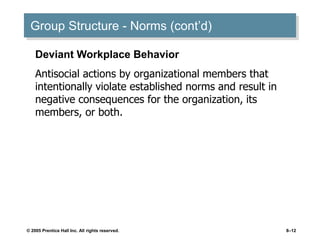
Group Structure - Norms (cont’d)
Deviant Workplace Behavior
Antisocial actions by organizational members that
intentionally violate established norms and result in
negative consequences for the organization, its
members, or both.
© 2005 Prentice Hall Inc. All rights reserved. 8–13
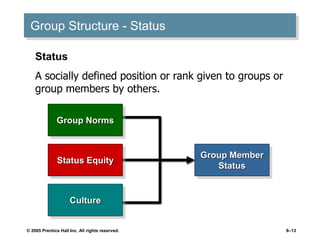
Group Structure - Status
Group Norms
Status Equity
Culture
Group Member
Status
Status
A socially defined position or rank given to groups or
group members by others.
© 2005 Prentice Hall Inc. All rights reserved. 8–14
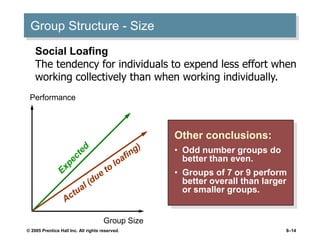
Group Structure - Size
Group Size
Performance
Other conclusions:
• Odd number groups do
better than even.
• Groups of 7 or 9 perform
better overall than larger
or smaller groups.
Social Loafing
The tendency for individuals to expend less effort when
working collectively than when working individually.
© 2005 Prentice Hall Inc. All rights reserved. 8–15
Group Structure - Composition
Group Demography
The degree to which members of a group share a
common demographic attribute, such as age, sex,
race, educational level, or length of service in the
organization, and the impact of this attribute on
turnover.
© 2005 Prentice Hall Inc. All rights reserved. 8–16
Group Structure - Cohesiveness
Increasing group cohesiveness:
1. Make the group smaller.
2. Encourage agreement with group goals.
3. Increase time members spend together.
4. Increase group status and admission difficultly.
5. Stimulate competition with other groups.
6. Give rewards to the group, not individuals.
7. Physically isolate the group.
Cohesiveness
Degree to which group members are attracted to
each other and are motivated to stay in the group.
© 2005 Prentice Hall Inc. All rights reserved. 8–17
Group Tasks
 Decision-making
– Large groups facilitate the pooling of information about
complex tasks.
– Smaller groups are better suited to coordinating and
facilitating the implementation of complex tasks.
– Simple, routine standardized tasks reduce the
requirement that group processes be effective in order
for the group to perform well.
© 2005 Prentice Hall Inc. All rights reserved. 8–18
Group Decision Making
 Strengths
– More complete
information
– Increased diversity
of views
– Higher quality of
decisions (more
accuracy)
– Increased
acceptance of
solutions
 Weaknesses
– More time
consuming (slower)
– Increased pressure
to conform
– Domination by one
or a few members
– Ambiguous
responsibility
© 2005 Prentice Hall Inc. All rights reserved. 8–19
Group Decision Making (cont’d)
Groupthink
Phenomenon in which the norm for consensus
overrides the realistic appraisal of alternative course
of action.
Groupshift
A change in decision risk between the group’s
decision and the individual decision that member
within the group would make; can be either toward
conservatism or greater risk.
© 2005 Prentice Hall Inc. All rights reserved. 8–20
Symptoms Of The Groupthink Phenomenon
 Group members rationalize any resistance to the
assumptions they have made.
 Members apply direct pressures on those who
express doubts about shared views or who
question the alternative favored by the majority.
 Members who have doubts or differing points of
view keep silent about misgivings.
 There appears to be an illusion of unanimity.
© 2005 Prentice Hall Inc. All rights reserved. 8–21
Group Decision-Making Techniques
Interacting Groups
Typical groups, in which the members interact with
each other face-to-face.
Nominal Group Technique
A group decision-making method in which individual
members meet face-to-face to pool their judgments
in a systematic but independent fashion.
© 2005 Prentice Hall Inc. All rights reserved. 8–22
Group Decision-Making Techniques
Electronic Meeting
A meeting in which members interact on computers,
allowing for anonymity of comments and
aggregation of votes.
Brainstorming
An idea-generation process that specifically
encourages any and all alternatives, while
withholding any criticism of those alternatives.

Chapter 8-groups1

  • 1.
    ORGANIZATIONAL BEHAVIOR S TE P H E N P. R O B B I N S E L E V E N T H E D I T I O N W W W . P R E N H A L L . C O M / R O B B I N S© 2005 Prentice Hall Inc. All rights reserved. PowerPoint Presentation by Charlie Cook Foundations of Group Behavior
  • 2.
    © 2005 PrenticeHall Inc. All rights reserved. 8–2 Defining and Classifying Groups Group(s) Two or more individuals interacting and interdependent, who have come together to achieve particular objectives. Formal Group A designated work group defined by the organization’s structure. Informal Group A group that is neither formally structured now organizationally determined; appears in response to the need for social contact.
  • 3.
    © 2005 PrenticeHall Inc. All rights reserved. 8–3 Defining and Classifying Groups (cont’d) Command Group A group composed of the individuals who report directly to a given manager. Task Group Those working together to complete a job or task. Interest Group Those working together to attain a specific objective with which each is concerned. Friendship Group Those brought together because they share one or more common characteristics.
  • 4.
    © 2005 PrenticeHall Inc. All rights reserved. 8–4 Why People Join Groups • Security • Status • Self-esteem • Affiliation • Power • Goal Achievement
  • 5.
    © 2005 PrenticeHall Inc. All rights reserved. 8–5 The Five-Stage Model of Group Development Forming Stage The first stage in group development, characterized by much uncertainty. Storming Stage The second stage in group development, characterized by intragroup conflict. Norming Stage The third stage in group development, characterized by close relationships and cohesiveness.
  • 6.
    © 2005 PrenticeHall Inc. All rights reserved. 8–6 …Group Development (cont’d) Performing Stage The fourth stage in group development, when the group is fully functional. Adjourning Stage The final stage in group development for temporary groups, characterized by concern with wrapping up activities rather than performance.
  • 7.
    © 2005 PrenticeHall Inc. All rights reserved. 8–7 Group Structure - Roles (cont’d) Role(s) A set of expected behavior patterns attributed to someone occupying a given position in a social unit. Role Identity Certain attitudes and behaviors consistent with a role. Role Perception An individual’s view of how he or she is supposed to act in a given situation.
  • 8.
    © 2005 PrenticeHall Inc. All rights reserved. 8–8 Group Structure - Roles (cont’d) Role Expectations How others believe a person should act in a given situation. Role Conflict A situation in which an individual is confronted by divergent role expectations. Psychological Contract An unwritten agreement that sets out what management expects from the employee and vice versa.
  • 9.
    © 2005 PrenticeHall Inc. All rights reserved. 8–9 Group Structure - Norms Classes of Norms: • Performance norms • Appearance norms • Social arrangement norms • Allocation of resources norms Norms Acceptable standards of behavior within a group that are shared by the group’s members.
  • 10.
    © 2005 PrenticeHall Inc. All rights reserved. 8–10 The Hawthorne Studies  A series of studies undertaken by Elton Mayo at Western Electric Company’s Hawthorne Works in Chicago between 1924 and 1932.  Research Conclusions: – Worker behavior and sentiments were closely related. – Group influences (norms) were significant in affecting individual behavior. – Group standards (norms) were highly effective in establishing individual worker output. – Money was less a factor in determining worker output than were group standards, sentiments, and security.
  • 11.
    © 2005 PrenticeHall Inc. All rights reserved. 8–11 Group Structure - Norms (cont’d) Conformity Adjusting one’s behavior to align with the norms of the group. Reference Groups Important groups to which individuals belong or hope to belong and with whose norms individuals are likely to conform.
  • 12.
    © 2005 PrenticeHall Inc. All rights reserved. 8–12 Group Structure - Norms (cont’d) Deviant Workplace Behavior Antisocial actions by organizational members that intentionally violate established norms and result in negative consequences for the organization, its members, or both.
  • 13.
    © 2005 PrenticeHall Inc. All rights reserved. 8–13 Group Structure - Status Group Norms Status Equity Culture Group Member Status Status A socially defined position or rank given to groups or group members by others.
  • 14.
    © 2005 PrenticeHall Inc. All rights reserved. 8–14 Group Structure - Size Group Size Performance Other conclusions: • Odd number groups do better than even. • Groups of 7 or 9 perform better overall than larger or smaller groups. Social Loafing The tendency for individuals to expend less effort when working collectively than when working individually.
  • 15.
    © 2005 PrenticeHall Inc. All rights reserved. 8–15 Group Structure - Composition Group Demography The degree to which members of a group share a common demographic attribute, such as age, sex, race, educational level, or length of service in the organization, and the impact of this attribute on turnover.
  • 16.
    © 2005 PrenticeHall Inc. All rights reserved. 8–16 Group Structure - Cohesiveness Increasing group cohesiveness: 1. Make the group smaller. 2. Encourage agreement with group goals. 3. Increase time members spend together. 4. Increase group status and admission difficultly. 5. Stimulate competition with other groups. 6. Give rewards to the group, not individuals. 7. Physically isolate the group. Cohesiveness Degree to which group members are attracted to each other and are motivated to stay in the group.
  • 17.
    © 2005 PrenticeHall Inc. All rights reserved. 8–17 Group Tasks  Decision-making – Large groups facilitate the pooling of information about complex tasks. – Smaller groups are better suited to coordinating and facilitating the implementation of complex tasks. – Simple, routine standardized tasks reduce the requirement that group processes be effective in order for the group to perform well.
  • 18.
    © 2005 PrenticeHall Inc. All rights reserved. 8–18 Group Decision Making  Strengths – More complete information – Increased diversity of views – Higher quality of decisions (more accuracy) – Increased acceptance of solutions  Weaknesses – More time consuming (slower) – Increased pressure to conform – Domination by one or a few members – Ambiguous responsibility
  • 19.
    © 2005 PrenticeHall Inc. All rights reserved. 8–19 Group Decision Making (cont’d) Groupthink Phenomenon in which the norm for consensus overrides the realistic appraisal of alternative course of action. Groupshift A change in decision risk between the group’s decision and the individual decision that member within the group would make; can be either toward conservatism or greater risk.
  • 20.
    © 2005 PrenticeHall Inc. All rights reserved. 8–20 Symptoms Of The Groupthink Phenomenon  Group members rationalize any resistance to the assumptions they have made.  Members apply direct pressures on those who express doubts about shared views or who question the alternative favored by the majority.  Members who have doubts or differing points of view keep silent about misgivings.  There appears to be an illusion of unanimity.
  • 21.
    © 2005 PrenticeHall Inc. All rights reserved. 8–21 Group Decision-Making Techniques Interacting Groups Typical groups, in which the members interact with each other face-to-face. Nominal Group Technique A group decision-making method in which individual members meet face-to-face to pool their judgments in a systematic but independent fashion.
  • 22.
    © 2005 PrenticeHall Inc. All rights reserved. 8–22 Group Decision-Making Techniques Electronic Meeting A meeting in which members interact on computers, allowing for anonymity of comments and aggregation of votes. Brainstorming An idea-generation process that specifically encourages any and all alternatives, while withholding any criticism of those alternatives.