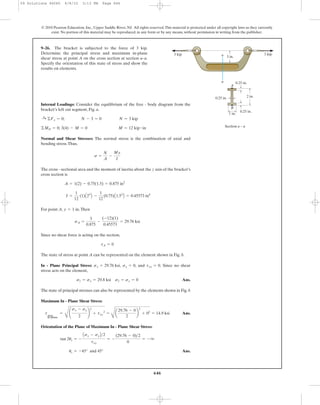
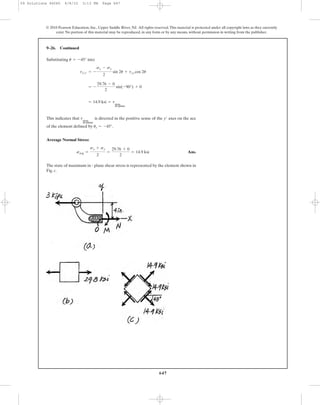
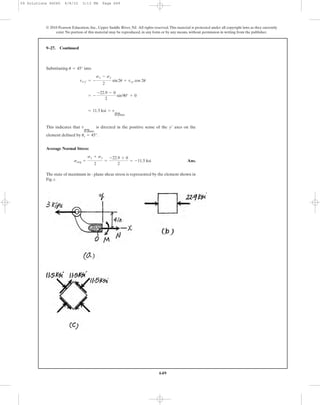
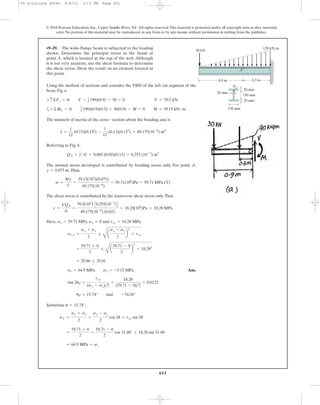
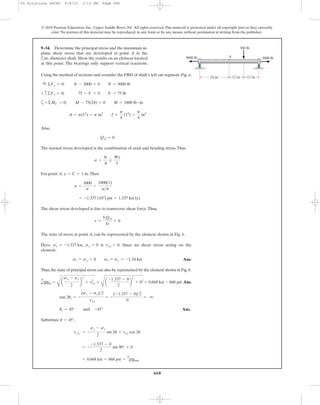
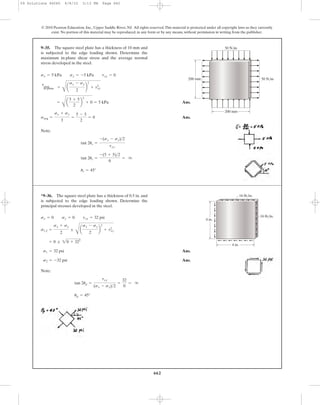
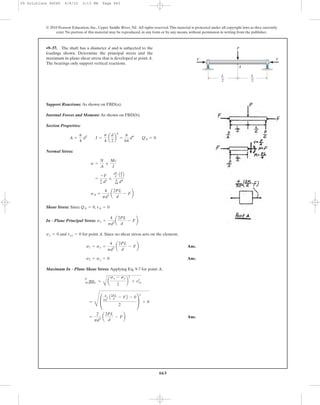
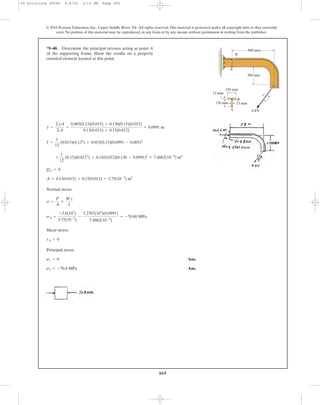
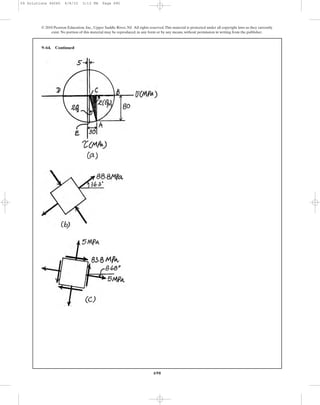
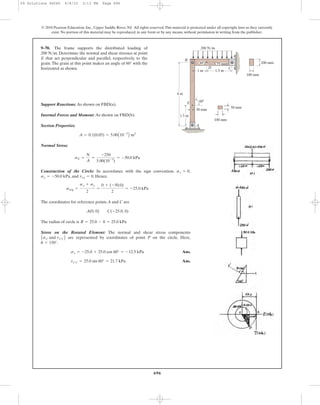
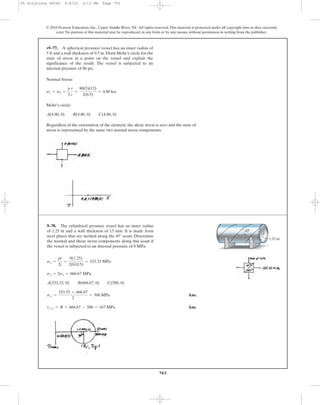
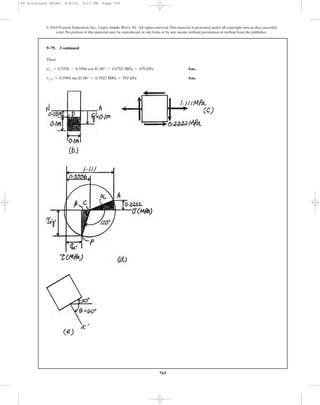
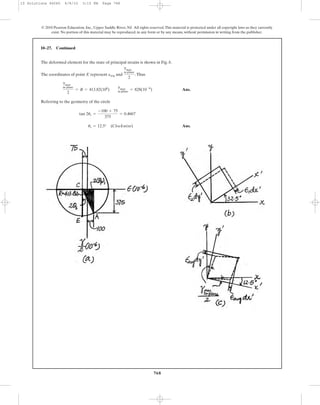
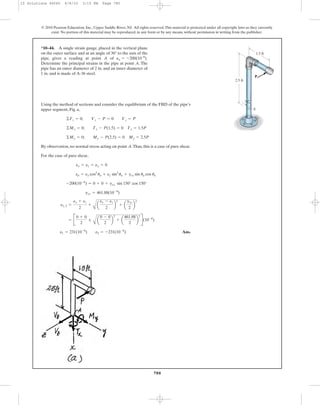
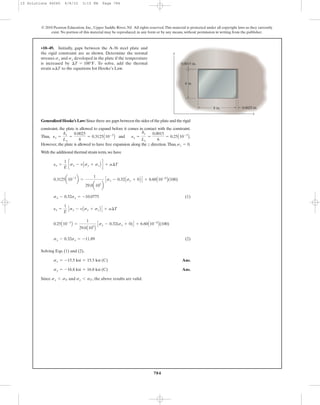
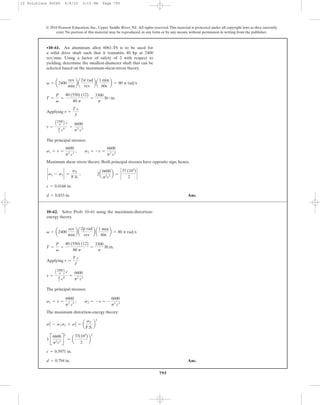
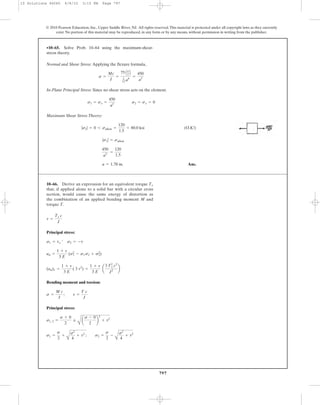
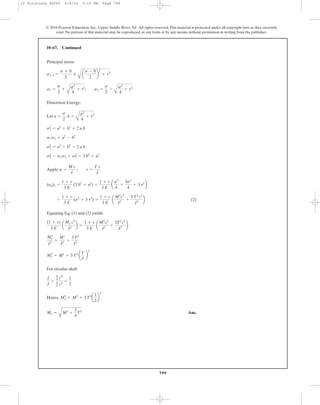
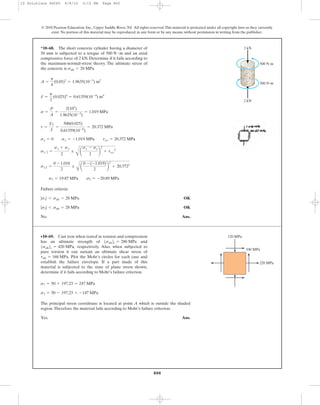
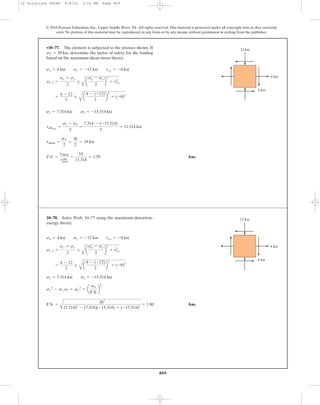
To the Instructor iv
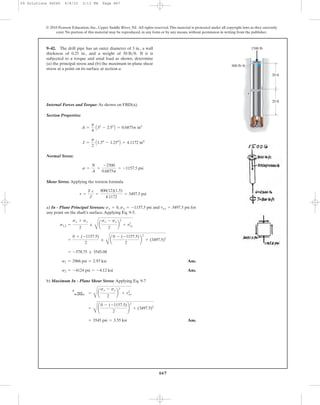
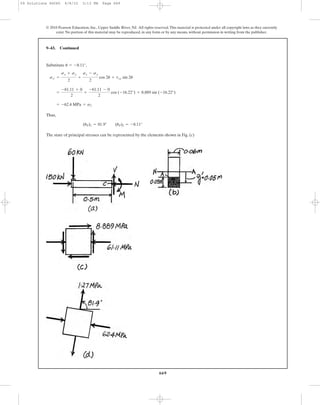
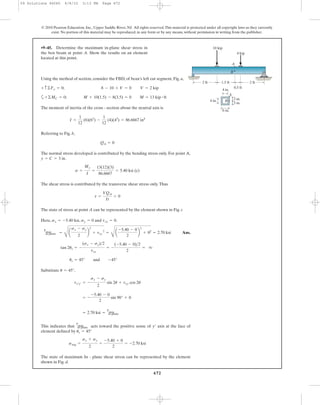
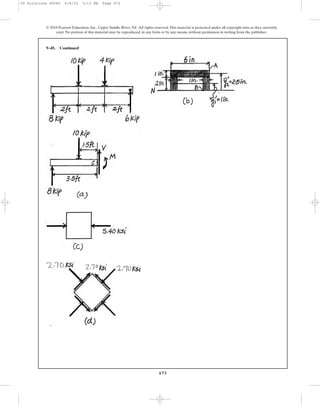
1 Stress 1
2 Strain 73
3 Mechanical Properties of Materials 92
4 Axial Load 122
5 Torsion 214
6 Bending 329
7 Transverse Shear 472
8 Combined Loadings 532
9 Stress Transformation 619
10 Strain Transformation 738
11 Design of Beams and Shafts 830
12 Deflection of Beams and Shafts 883
13 Buckling of Columns 1038
14 Energy Methods 1159
CONTENTS
FM_TOC 46060 6/22/10 11:26 AM Page iii
532
© 2010 Pearson Education, Inc., Upper Saddle River, NJ. All rights reserved.This material is protected under all copyright laws as they currently
exist. No portion of this material may be reproduced, in any form or by any means, without permission in writing from the publisher.
Ans.t = 0.0188 m = 18.8 mm
sallow =
p r
2 t
; 12(106
) =
300(103
)(1.5)
2 t
8–1. A spherical gas tank has an inner radius of
If it is subjected to an internal pressure of
determine its required thickness if the maximum normal
stress is not to exceed 12 MPa.
p = 300 kPa,
r = 1.5 m.
Ans.ro = 75 in. + 0.5 in. = 75.5 in.
ri = 75 in.
sallow =
p r
2 t
; 15(103
) =
200 ri
2(0.5)
8–2. A pressurized spherical tank is to be made of
0.5-in.-thick steel. If it is subjected to an internal pressure
of determine its outer radius if the maximum
normal stress is not to exceed 15 ksi.
p = 200 psi,
Case (a):
Ans.
Ans.
Case (b):
Ans.
Ans.s2 =
pr
2t
; s2 =
65(4)
2(0.25)
= 520 psi
s1 =
pr
t
; s1 =
65(4)
0.25
= 1.04 ksi
s2 = 0
s1 =
pr
t
; s1 =
65(4)
0.25
= 1.04 ksi
8–3. The thin-walled cylinder can be supported in one of
two ways as shown. Determine the state of stress in the wall
of the cylinder for both cases if the piston P causes the
internal pressure to be 65 psi. The wall has a thickness of
0.25 in. and the inner diameter of the cylinder is 8 in.
P
(a) (b)
P
8 in. 8 in.
08 Solutions 46060 5/28/10 8:34 AM Page 532
533
© 2010 Pearson Education, Inc., Upper Saddle River, NJ. All rights reserved.This material is protected under all copyright laws as they currently
exist. No portion of this material may be reproduced, in any form or by any means, without permission in writing from the publisher.
Normal Stress: Since , thin-wall analysis is valid. For the
spherical tank’s wall,
Ans.
Referring to the free-body diagram shown in Fig. a,
.Thus,
The normal stress developed in each bolt is then
Ans.sb =
Pb
Ab
=
35.56A103
Bp
p
4
A0.0252
B
= 228 MPa
Pb = 35.56A103
Bp N
+ c ©Fy = 0; 32pA106
B - 450Pb - 450Pb = 0
P = pA = 2A106
B c
p
4
A82
B d = 32pA106
B N
s =
pr
2t
=
2(4)
2(0.03)
= 133 MPa
r
t
=
4
0.03
= 133.33 7 10
•8–5. Thesphericalgastankisfabricatedbyboltingtogether
two hemispherical thin shells of thickness 30 mm. If the gas
contained in the tank is under a gauge pressure of 2 MPa,
determine the normal stress developed in the wall of the tank
and in each of the bolts.The tank has an inner diameter of 8 m
and is sealed with 900 bolts each 25 mm in diameter.
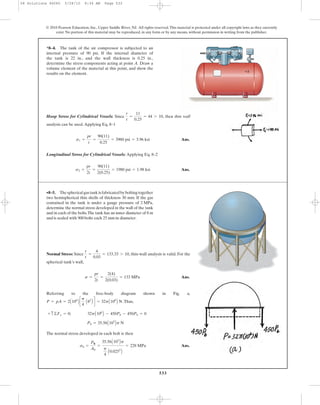
Hoop Stress for Cylindrical Vessels: Since , then thin wall
analysis can be used.Applying Eq. 8–1
Ans.
Longitudinal Stress for Cylindrical Vessels: Applying Eq. 8–2
Ans.s2 =
pr
2t
=
90(11)
2(0.25)
= 1980 psi = 1.98 ksi
s1 =
pr
t
=
90(11)
0.25
= 3960 psi = 3.96 ksi
r
t
=
11
0.25
= 44 7 10
*8–4. The tank of the air compressor is subjected to an
internal pressure of 90 psi. If the internal diameter of
the tank is 22 in., and the wall thickness is 0.25 in.,
determine the stress components acting at point A. Draw a
volume element of the material at this point, and show the
results on the element. A
08 Solutions 46060 5/28/10 8:34 AM Page 533
534
© 2010 Pearson Education, Inc., Upper Saddle River, NJ. All rights reserved.This material is protected under all copyright laws as they currently
exist. No portion of this material may be reproduced, in any form or by any means, without permission in writing from the publisher.
Normal Stress: For the spherical tank’s wall,
Ans.
Since , thin-wall analysis is valid.
Referring to the free-body diagram shown in Fig. a,
.Thus,
(1)
The allowable tensile force for each bolt is
Substituting this result into Eq. (1),
Ans.n =
32pA106
B
39.0625pA103
B
= 819.2 = 820
(Pb)allow = sallowAb = 250A106
B c
p
4
A0.0252
B d = 39.0625A103
BpN
n =
32pA106
B
(Pb)allow
+ c ©Fy = 0; 32pA106
B -
n
2
(Pb)allow -
n
2
(Pb)allow = 0
P = pA = 2A106
B c
p
4
A82
B d = 32pA106
B N
r
t
=
4
0.02667
= 150 7 10
t = 0.02667 m = 26.7 mm
150A106
B =
2A106
B(4)
2t
sallow =
pr
2t
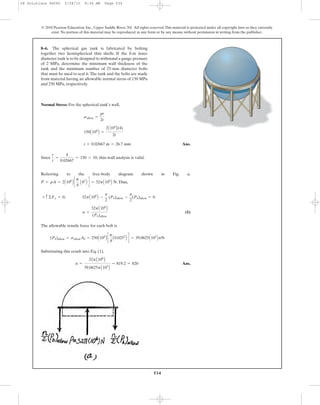
8–6. The spherical gas tank is fabricated by bolting
together two hemispherical thin shells. If the 8-m inner
diameter tank is to be designed to withstand a gauge pressure
of 2 MPa, determine the minimum wall thickness of the
tank and the minimum number of 25-mm diameter bolts
that must be used to seal it.The tank and the bolts are made
from material having an allowable normal stress of 150 MPa
and 250 MPa, respectively.
08 Solutions 46060 5/28/10 8:34 AM Page 534
535
© 2010 Pearson Education, Inc., Upper Saddle River, NJ. All rights reserved.This material is protected under all copyright laws as they currently
exist. No portion of this material may be reproduced, in any form or by any means, without permission in writing from the publisher.
a) Ans.
b)
Ans.
c) From FBD(a)
Ans.(tavg)b =
Fb
A
-
25312.5
p
4(0.01)2
= 322 MPa
Fb = 25.3 kN
+ c ©Fy = 0; Fb - 79.1(106
)[(0.008)(0.04)] = 0
s1¿ = 79.1MPa
126.56 (106
)(0.05)(0.008) = s1¿(2)(0.04)(0.008)
s1 =
pr
t
=
1.35(106
)(0.75)
0.008
= 126.56(106
) = 127 MPa
8–7. A boiler is constructed of 8-mm thick steel plates that
are fastened together at their ends using a butt joint
consisting of two 8-mm cover plates and rivets having a
diameter of 10 mm and spaced 50 mm apart as shown. If the
steam pressure in the boiler is 1.35 MPa, determine (a) the
circumferential stress in the boiler’s plate apart from
the seam,(b) the circumferential stress in the outer cover plate
along the rivet line a–a,and (c) the shear stress in the rivets.
a
8 mm
50 mm a
0.75 m
08 Solutions 46060 5/28/10 8:34 AM Page 535
536
© 2010 Pearson Education, Inc., Upper Saddle River, NJ. All rights reserved.This material is protected under all copyright laws as they currently
exist. No portion of this material may be reproduced, in any form or by any means, without permission in writing from the publisher.
Normal Stress: For the cylindrical portion of the tank, the hoop stress is twice as
large as the longitudinal stress.
Ans.
For the hemispherical cap,
Ans.
Since , thin-wall analysis is valid.
Referring to the free-body diagram of the per meter length of the cylindrical
portion, Fig. a, where , we have
(1)
The allowable tensile force for each bolt is
Substituting this result into Eq. (1),
Ans.nc = 48.89 = 49 bolts>meter
(Pb)allow = sallowAb = 250A106
B c
p
4
A0.0252
B d = 122.72A103
B N
nc =
6A106
B
(Pb)allow
+ c ©Fy = 0; 12A106
B - nc(Pb)allow - nc(Pb)allow = 0
P = pA = 3A106
B[4(1)] = 12A106
B N
r
t
6 10
ts = 0.02m = 20 mm
sallow =
pr
t
; 150A106
B =
3A106
B(2)
2ts
tc = 0.04m = 40mm
sallow =
pr
t
; 150A106
B =
3A106
B(2)
tc
*8–8. The gas storage tank is fabricated by bolting together
two half cylindrical thin shells and two hemispherical shells
as shown. If the tank is designed to withstand a pressure
of 3 MPa, determine the required minimum thickness of
the cylindrical and hemispherical shells and the minimum
required number of longitudinal bolts per meter length at
each side of the cylindrical shell. The tank and the 25 mm
diameter bolts are made from material having an allowable
normal stress of 150 MPa and 250 MPa, respectively. The
tank has an inner diameter of 4 m.
08 Solutions 46060 5/28/10 8:34 AM Page 536
537
© 2010 Pearson Education, Inc., Upper Saddle River, NJ. All rights reserved.This material is protected under all copyright laws as they currently
exist. No portion of this material may be reproduced, in any form or by any means, without permission in writing from the publisher.
Normal Stress: For the cylindrical portion of the tank, the hoop stress is twice as
large as the longitudinal stress.
Ans.
For the hemispherical cap,
Ans.
Since , thin-wall analysis is valid.
The allowable tensile force for each bolt is
Referring to the free-body diagram of the hemispherical cap, Fig. b, where
,
(1)
Substituting this result into Eq. (1),
Ans.ns = 307.2 = 308 bolts
ns =
12pA106
B
(Pb)allow
:+ ©Fx = 0; 12pA106
B -
ns
2
(Pb)allow -
ns
2
(Pb)allow = 0
P = pA = 3A106
B c
p
4
A42
B d = 12pA106
B N
(Pb)allow = sallowAb = 250A106
B c
p
4
A0.0252
B d = 122.72A103
B N
r
t
6 10
ts = 0.02 m = 20 mm
sallow =
pr
t
; 150A106
B =
3A106
B(2)
2ts
tc = 0.04 m = 40 mm
sallow =
pr
t
; 150A106
B =
3A106
B(2)
tc
•8–9. The gas storage tank is fabricated by bolting together
two half cylindrical thin shells and two hemispherical shells
as shown. If the tank is designed to withstand a pressure of
3 MPa, determine the required minimum thickness of the
cylindrical and hemispherical shells and the minimum
required number of bolts for each hemispherical cap. The
tank and the 25 mm diameter bolts are made from material
having an allowable normal stress of 150 MPa and 250 MPa,
respectively.The tank has an inner diameter of 4 m.
08 Solutions 46060 5/28/10 8:34 AM Page 537
538
© 2010 Pearson Education, Inc., Upper Saddle River, NJ. All rights reserved.This material is protected under all copyright laws as they currently
exist. No portion of this material may be reproduced, in any form or by any means, without permission in writing from the publisher.
Ans.
Ans.sb =
F
Ab
=
432
p
4
(0.25)2
= 8801 psi = 8.80 ksi
sh =
F
Ah
=
432
0.5(2)
= 432 psi
©F = 0; 864 - 2F = 0; F = 432 lb
FR = 2(36)(12) = 864 lb
8–11. The staves or vertical members of the wooden tank
are held together using semicircular hoops having a
thickness of 0.5 in. and a width of 2 in. Determine the normal
stress in hoop AB if the tank is subjected to an internal
gauge pressure of 2 psi and this loading is transmitted
directly to the hoops.Also, if 0.25-in.-diameter bolts are used
to connect each hoop together, determine the tensile stress
in each bolt at A and B. Assume hoop AB supports the
pressure loading within a 12-in. length of the tank as shown.
Equilibrium for the steel Hoop: From the FBD
Hoop Stress for the Steel Hoop:
Ans.s = 33.3 in.
12(103
) =
72.0s
0.2
s1 = sallow =
P
A
:+ ©Fx = 0; 2P - 4(36s) = 0 P = 72.0s
8–10. A wood pipe having an inner diameter of 3 ft is
bound together using steel hoops each having a cross-
sectional area of If the allowable stress for the hoops
is determine their maximum spacing s along
the section of pipe so that the pipe can resist an internal
gauge pressure of 4 psi. Assume each hoop supports the
pressure loading acting along the length s of the pipe.
sallow = 12 ksi,
0.2 in2
.
s
s s
4 psi4 psi
6 in.
12 in.
18 in.
12 in.
6 in.
A B
08 Solutions 46060 5/28/10 8:34 AM Page 538
539
© 2010 Pearson Education, Inc., Upper Saddle River, NJ. All rights reserved.This material is protected under all copyright laws as they currently
exist. No portion of this material may be reproduced, in any form or by any means, without permission in writing from the publisher.
Compatibility: Since the band is fixed to a rigid cylinder (it does not deform under
load), then
Ans.= 10(9.60)A10-6
B 28.0A103
B = 2.69 ksi
sc = 10aE
2p
E
sc = 10a
L
2p
0
(1 - cos 2u)du
2pr
E
a
P
A
b = 20ar
L
2p
0
sin2
udu however,
P
A
= sc
P(2pr)
AE
-
L
2p
0
a¢Trdu = 0
dF - dT = 0
•8–13. The 304 stainless steel band initially fits snugly around
the smooth rigid cylinder. If the band is then subjected to a
nonlinear temperature drop of where is
in radians, determine the circumferential stress in the band.
u¢T = 20 sin2
u °F,
Normal Pressure: Vertical force equilibrium for FBD(a).
The Friction Force: Applying friction formula
a) The Required Torque: In order to initiate rotation of the two hemispheres
relative to each other, the torque must overcome the moment produced by the
friction force about the center of the sphere.
Ans.
b) The Required Vertical Force: In order to just pull the two hemispheres apart, the
vertical force P must overcome the normal force.
Ans.
c) The Required Horizontal Force: In order to just cause the two hemispheres to
slide relative to each other, the horizontal force F must overcome the friction force.
Ans.F = Ff = 2880p = 9048 lb = 9.05 kip
P = N = 5760p = 18096 lb = 18.1 kip
T = Ffr = 2880p(2 + 0.125>12) = 18190 lb # ft = 18.2 kip # ft
Ff = msN = 0.5(5760p) = 2880p lb
+ c©Fy = 0; 10Cp(242
)D - N = 0 N = 5760p lb
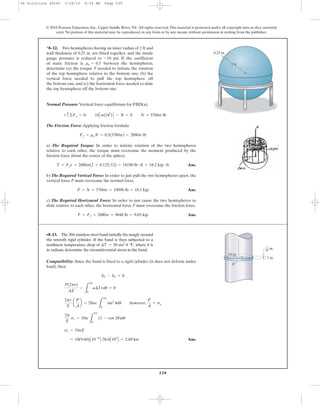
*8–12. Two hemispheres having an inner radius of 2 ft and
wall thickness of 0.25 in. are fitted together, and the inside
gauge pressure is reduced to psi. If the coefficient
of static friction is between the hemispheres,
determine (a) the torque T needed to initiate the rotation
of the top hemisphere relative to the bottom one, (b) the
vertical force needed to pull the top hemisphere off
the bottom one, and (c) the horizontal force needed to slide
the top hemisphere off the bottom one.
ms = 0.5
-10
2 ft
0.25 in.
10 in.
u
in.
1 in.
1
64
08 Solutions 46060 5/28/10 8:34 AM Page 539
540
© 2010 Pearson Education, Inc., Upper Saddle River, NJ. All rights reserved.This material is protected under all copyright laws as they currently
exist. No portion of this material may be reproduced, in any form or by any means, without permission in writing from the publisher.
Equilibrium for the Ring: Form the FBD
Hoop Stress and Strain for the Ring:
Using Hooke’s Law
[1]
However, .
Then, from Eq. [1]
Ans.dri =
pri
2
E(rs - ri)
dri
ri
=
pri
E(rs - ri)
e1 =
2p(ri)1 - 2pri
2pr
=
(ri)1 - ri
ri
=
dri
ri
e1 =
s1
E
=
pri
E(rs - ri)
s1 =
P
A
=
priw
(rs - ri)w
=
pri
rs - ri
:+ ©Fx = 0; 2P - 2pri w = 0 P = pri w
8–14. The ring, having the dimensions shown, is placed
over a flexible membrane which is pumped up with a
pressure p. Determine the change in the internal radius of
the ring after this pressure is applied. The modulus of
elasticity for the ring is E.
p
ro
w
ri
08 Solutions 46060 5/28/10 8:34 AM Page 540
541
© 2010 Pearson Education, Inc., Upper Saddle River, NJ. All rights reserved.This material is protected under all copyright laws as they currently
exist. No portion of this material may be reproduced, in any form or by any means, without permission in writing from the publisher.
Equilibrium for the Ring: From the FBD
Hoop Stress and Strain for the Ring:
Using Hooke’s law
[1]
However, .
Then, from Eq. [1]
Compatibility: The pressure between the rings requires
[2]
From the result obtained above
Substitute into Eq. [2]
Ans.p =
E(r2 - r3)
r2
2
r2 - r1
+
r3
2
r4 - r3
pr2
2
E(r2 - r1)
+
pr3
2
E(r4 - r3)
= r2 - r3
dr2 =
pr2
2
E(r2 - r1)
dr3 =
pr3
2
E(r4 - r3)
dr2 + dr3 = r2 - r3
dri =
pri
2
E(ro - ri)
dri
ri
=
pri
E(ro - ri)
e1 =
2p(ri)1 - 2pri
2pr
=
(ri)1 - ri
ri
=
dri
ri
e1 =
s1
E
=
pri
E(ro - ri)
s1 =
P
A
=
priw
(ro - ri)w
=
pri
ro - ri
:+ ©Fx = 0; 2P - 2priw = 0 P = priw
8–15. The inner ring A has an inner radius and outer
radius . Before heating, the outer ring B has an inner
radius and an outer radius , and . If the outer ring
is heated and then fitted over the inner ring, determine the
pressure between the two rings when ring B reaches the
temperature of the inner ring.The material has a modulus of
elasticity of E and a coefficient of thermal expansion of .a
r2 7 r3r4r3
r2
r1
r1
r2
r3
A
B
r4
08 Solutions 46060 5/28/10 8:34 AM Page 541
542
© 2010 Pearson Education, Inc., Upper Saddle River, NJ. All rights reserved.This material is protected under all copyright laws as they currently
exist. No portion of this material may be reproduced, in any form or by any means, without permission in writing from the publisher.
Normal Stress:
Equilibrium: We will consider the triangular element cut from the strip
shown in Fig. a. Here,
sl = s2 =
pr
2t
=
p(d>2)
2t
=
pd
4t
sh = s1 =
pr
t
=
p(d>2)
t
=
pd
2t
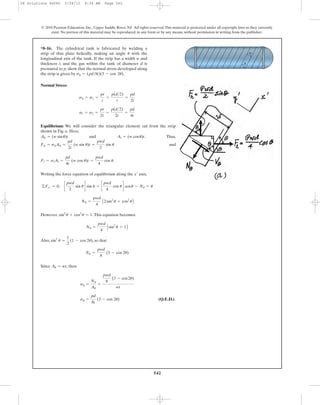
*8–16. The cylindrical tank is fabricated by welding a
strip of thin plate helically, making an angle with the
longitudinal axis of the tank. If the strip has a width w and
thickness t, and the gas within the tank of diameter d is
pressured to p, show that the normal stress developed along
the strip is given by .su = (pd>8t)(3 - cos 2u)
u w
u
and . Thus,
and
.
Writing the force equation of equilibrium along the axis,
However, .This equation becomes
Also, , so that
Since , then
(Q.E.D.)su =
pd
8t
(3 - cos 2u)
su =
Nu
Au
=
pwd
8
(3 - cos2u)
wt
Au = wt
Nu =
pwd
8
(3 - cos 2u)
sin2
u =
1
2
(1 - cos 2u)
Nu =
pwd
4
Asin2
u + 1B
sin2
u + cos2
u = 1
Nu =
pwd
4
A2sin2
u + cos2
uB
©Fx¿ = 0; c
pwd
2
sin u d sin u + c
pwd
4
cos u d cosu - Nu = u
x¿
Fl = slAl =
pd
4t
(w cos u)t =
pwd
4
cos u
Fh = shAh =
pd
2t
(w sin u)t =
pwd
2
sin u
Al = (w cosu)tAh = (w sinu)t
08 Solutions 46060 5/28/10 8:34 AM Page 542
543
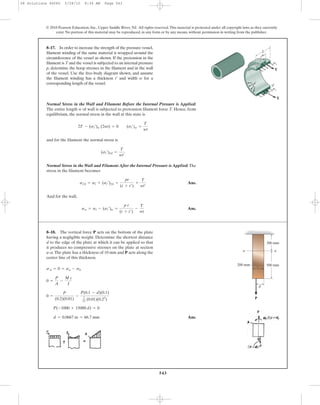
© 2010 Pearson Education, Inc., Upper Saddle River, NJ. All rights reserved.This material is protected under all copyright laws as they currently
exist. No portion of this material may be reproduced, in any form or by any means, without permission in writing from the publisher.
Normal Stress in the Wall and Filament Before the Internal Pressure is Applied:
The entire length w of wall is subjected to pretension filament force T. Hence, from
equilibrium, the normal stress in the wall at this state is
and for the filament the normal stress is
Normal Stress in the Wall and Filament After the Internal Pressure is Applied: The
stress in the filament becomes
Ans.
And for the wall,
Ans.sw = sl - (sl¿)w =
p r
(t + t¿)
-
T
wt
sfil = sl + (sl¿)fil =
pr
(t + t¿)
+
T
wt¿
(sl¿)fil =
T
wt¿
2T - (sl¿)w (2wt) = 0 (sl¿)w =
T
wt
8–17. In order to increase the strength of the pressure vessel,
filament winding of the same material is wrapped around the
circumference of the vessel as shown. If the pretension in the
filament is T and the vessel is subjected to an internal pressure
p, determine the hoop stresses in the filament and in the wall
of the vessel. Use the free-body diagram shown, and assume
the filament winding has a thickness tЈ and width w for a
corresponding length of the vessel.
T
p
w
t¿
L
t
T
s1
s1
Ans.d = 0.0667 m = 66.7 mm
P(-1000 + 15000 d) = 0
0 =
P
(0.2)(0.01)
-
P(0.1 - d)(0.1)
1
12 (0.01)(0.23
)
0 =
P
A
-
M c
I
sA = 0 = sa - sb
8–18. The vertical force P acts on the bottom of the plate
having a negligible weight. Determine the shortest distance
d to the edge of the plate at which it can be applied so that
it produces no compressive stresses on the plate at section
a–a. The plate has a thickness of 10 mm and P acts along the
center line of this thickness.
a
500 mm
P
a
300 mm
200 mm
d
08 Solutions 46060 5/28/10 8:34 AM Page 543
544
© 2010 Pearson Education, Inc., Upper Saddle River, NJ. All rights reserved.This material is protected under all copyright laws as they currently
exist. No portion of this material may be reproduced, in any form or by any means, without permission in writing from the publisher.
Consider the equilibrium of the FBD of the top cut segment in Fig. a,
a
The normal stress developed is the combination of axial and bending stress.Thus,
For the left edge fiber, .Then
Ans.
For the right edge fiber, .Then
Ans.sR = -
100 (103
)
0.006
+
10(103
)(0.1)
20.0(10-6
)
= 33.3 MPa (T)
y = 0.1 m
= -66.67(106
) Pa = 66.7 MPa (C) (Max)
sL = -
100(103
)
0.006
-
10(103
)(0.1)
20.0(10-6
)
y = C = 0.1 m
s =
N
A
;
My
I
A = 0.2(0.03) = 0.006 m2
I =
1
12
(0.03)(0.23
) = 20.0(10-6
) m4
+©MC = 0; 100(0.1) - M = 0 M = 10 kN # m
+ c ©Fy = 0; N - 100 = 0 N = 100 kN
8–19. Determine the maximum and minimum normal
stress in the bracket at section a–a when the load is applied
at x = 0.
100 kN
x
200 mm
150 mm
15 mm
15 mm
aa
08 Solutions 46060 5/28/10 8:34 AM Page 544
545
© 2010 Pearson Education, Inc., Upper Saddle River, NJ. All rights reserved.This material is protected under all copyright laws as they currently
exist. No portion of this material may be reproduced, in any form or by any means, without permission in writing from the publisher.
Consider the equilibrium of the FBD of the top cut segment in Fig. a,
a
The normal stress developed is the combination of axial and bending stress.Thus,
For the left edge fiber, .Then
Ans.
For the right edge fiber, .Thus
Ans.= 117 MPa
sR = -
100(103
)
0.006
-
20.0(103
)(0.1)
20.0(10-6
)
y = C = 0.1 m
= 83.33(106
) Pa = 83.3 MPa (T)(Min)
sC = -
100(103
)
0.006
+
20.0(103
)(0.1)
20.0(10-6
)
y = C = 0.1 m
s =
N
A
;
My
I
A = 0.2 (0.03) = 0.006 m2
I =
1
12
(0.03)(0.23
) = 20.0(10-6
) m4
+©MC = 0; M - 100(0.2) = 0 M = 20 kN # m
+ c ©Fy = 0; N - 100 = 0 N = 100 kN
*8–20. Determine the maximum and minimum normal
stress in the bracket at section a–a when the load is applied
at x = 300 mm.
100 kN
x
200 mm
150 mm
15 mm
15 mm
aa
08 Solutions 46060 5/28/10 8:34 AM Page 545
Ans.
Ans.sB =
Mc
I
=
2(0.004)
1
12 (0.003)(0.008)3
= 62.5 MPa
sA = -
P
A
+
Mc
I
= -
40
(0.008)(0.003)
+
4(0.004)
1
12(0.003)(0.008)3
= 123 MPa
•8–21. The coping saw has an adjustable blade that is
tightened with a tension of 40 N. Determine the state of
stress in the frame at points A and B.
546
© 2010 Pearson Education, Inc., Upper Saddle River, NJ. All rights reserved.This material is protected under all copyright laws as they currently
exist. No portion of this material may be reproduced, in any form or by any means, without permission in writing from the publisher.
75 mm
50 mm
8 mm
3 mm
3 mm
8 mm
A
B100 mm
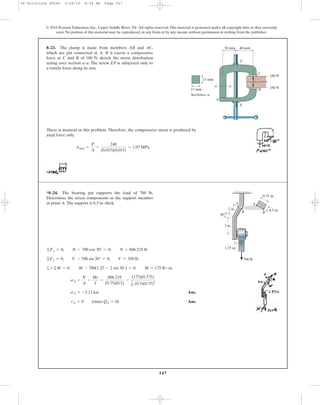
There is no moment in this problem. Therefore, the compressive stress is produced
by axial force only.
Ans.smax =
P
A
=
240
(0.015)(0.015)
= 1.07 MPa
8–22. The clamp is made from members AB and AC,
which are pin connected at A. If it exerts a compressive
force at C and B of 180 N, determine the maximum
compressive stress in the clamp at section a–a.The screw EF
is subjected only to a tensile force along its axis.
180 N
180 NB
C
F
E
A
a a
30 mm 40 mm
15 mm
15 mm
Sectiona–a
08 Solutions 46060 5/28/10 8:34 AM Page 546
547
© 2010 Pearson Education, Inc., Upper Saddle River, NJ. All rights reserved.This material is protected under all copyright laws as they currently
exist. No portion of this material may be reproduced, in any form or by any means, without permission in writing from the publisher.
There is moment in this problem. Therefore, the compressive stress is produced by
axial force only.
smax =
P
A
=
240
(0.015)(0.015)
= 1.07 MPa
8–23. The clamp is made from members AB and AC,
which are pin connected at A. If it exerts a compressive
force at C and B of 180 N, sketch the stress distribution
acting over section a–a. The screw EF is subjected only to
a tensile force along its axis.
180 N
180 NB
C
F
E
A
a a
30 mm 40 mm
15 mm
15 mm
Sectiona–a
a
Ans.
Ans.tA = 0 (since QA = 0)
sA = -2.12 ksi
sA =
N
A
-
Mc
I
=
606.218
(0.75)(0.5)
-
(175)(0.375)
1
12 (0.5)(0.75)3
+©M = 0; M - 700(1.25 - 2 sin 30°) = 0; M = 175 lb # in.
©Fy = 0; V - 700 sin 30° = 0; V = 350 lb
©Fx = 0; N - 700 cos 30° = 0; N = 606.218 lb
*8–24. The bearing pin supports the load of 700 lb.
Determine the stress components in the support member
at point A. The support is 0.5 in. thick.
30Њ
2 in.
A A
B B
3 in.
1.25 in.
700 lb
0.75 in.
0.5 in.
08 Solutions 46060 5/28/10 8:34 AM Page 547
548
© 2010 Pearson Education, Inc., Upper Saddle River, NJ. All rights reserved.This material is protected under all copyright laws as they currently
exist. No portion of this material may be reproduced, in any form or by any means, without permission in writing from the publisher.
a
Ans.
Ans.tB = 0 (since QB = 0)
sB = 5.35 ksi
sB =
N
A
+
Mc
I
=
606.218
(0.75)(0.5)
+
175(0.375)
1
12 (0.5)(0.75)3
+©M = 0; M - 700(1.25 - 2 sin 30°) = 0; M = 175 lb # in.
©Fy = 0; V - 700 sin 30° = 0; V = 350 lb
©Fx = 0; N - 700 cos 30° = 0; N = 606.218 lb
•8–25. The bearing pin supports the load of 700 lb.
Determine the stress components in the support member
at point B. The support is 0.5 in. thick.
30Њ
2 in.
A A
B B
3 in.
1.25 in.
700 lb
0.75 in.
0.5 in.
due to axial force:
due to bending:
Ans.w = 0.0797 m = 79.7 mm
73 w2
- 3 w - 0.225 = 0
73 w2
= 0.75 w + 0.225 + 2.25 w
73(106
) =
750(103
)
w
+
4500(103
)(0.05 + w
2 )
w2
smax = sallow = sa + sb
=
4500 (103
)(0.05 + w
2 )
w2
sb =
Mc
I
=
30(103
)(0.05 + w
2 )(w
2 )
1
12(0.04)(w)3
s
sa =
P
A
=
30(103
)
(w)(0.04)
=
750(103
)
w
s
8–26. The offset link supports the loading of
Determine its required width w if the allowable normal
stress is The link has a thickness of 40 mm.sallow = 73 MPa.
P = 30 kN.
P
P
w
50 mm
08 Solutions 46060 5/28/10 8:34 AM Page 548
549
© 2010 Pearson Education, Inc., Upper Saddle River, NJ. All rights reserved.This material is protected under all copyright laws as they currently
exist. No portion of this material may be reproduced, in any form or by any means, without permission in writing from the publisher.
Ans.P = 109 kN
75(106
) =
P
0.008
+
0.150 P(0.1)
26.6667(10-6
)
s =
P
A
+
Mc
I
I =
1
12
(0.04)(0.2)3
= 26.6667(10-6
) m4
A = 0.2(0.04) = 0.008 m2
8–27. The offset link has a width of and a
thickness of 40 mm. If the allowable normal stress is
determine the maximum load P that can
be applied to the cables.
sallow = 75 MPa,
w = 200 mm
P
P
w
50 mm
due to axial force:
due to bending:
Ans.
Ans.
y = 0.267 in.
y
1.28
=
(0.5 - y)
1.12
(smax)c = 1200 - 80 = 1120 psi = 1.12 ksi
(smax)t = 80 + 1200 = 1280 psi = 1.28 ksi
s =
Mc
I
=
100(0.25)
1
12(2)(0.5)3
= 1200 psi
s
s =
P
A
=
80
(0.5)(2)
= 80 psi
s
*8–28. The joint is subjected to a force of P ϭ 80 lb and
F ϭ 0. Sketch the normal-stress distribution acting over
section a–a if the member has a rectangular cross-sectional
area of width 2 in. and thickness 0.5 in.
a
2 in.
aA
P
F
1.25 in.
0.5 in.
B
08 Solutions 46060 5/28/10 8:34 AM Page 549
550
© 2010 Pearson Education, Inc., Upper Saddle River, NJ. All rights reserved.This material is protected under all copyright laws as they currently
exist. No portion of this material may be reproduced, in any form or by any means, without permission in writing from the publisher.
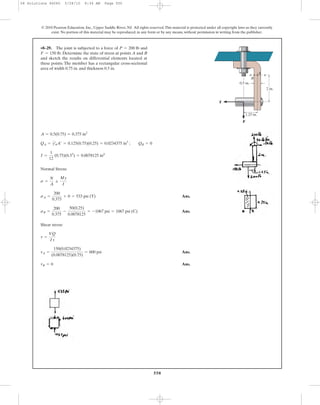
Normal Stress:
Ans.
Ans.
Shear stress:
Ans.
Ans.tB = 0
tA =
150(0.0234375)
(0.0078125)(0.75)
= 600 psi
t =
VQ
I t
sB =
200
0.375
-
50(0.25)
0.0078125
= -1067 psi = 1067 psi (C)
sA =
200
0.375
+ 0 = 533 psi (T)
s =
N
A
;
My
I
I =
1
12
(0.75)(0.53
) = 0.0078125 in4
QA = yA
œ
A¿ = 0.125(0.75)(0.25) = 0.0234375 in3
; QB = 0
A = 0.5(0.75) = 0.375 in2
•8–29. The joint is subjected to a force of and
. Determine the state of stress at points A and B
and sketch the results on differential elements located at
these points. The member has a rectangular cross-sectional
area of width 0.75 in. and thickness 0.5 in.
F = 150 lb
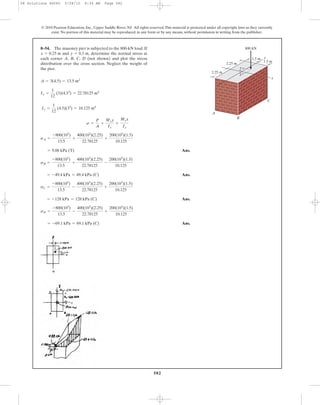
P = 200 lb
a
2 in.
aA
P
F
1.25 in.
0.5 in.
B
08 Solutions 46060 5/28/10 8:34 AM Page 550
551
© 2010 Pearson Education, Inc., Upper Saddle River, NJ. All rights reserved.This material is protected under all copyright laws as they currently
exist. No portion of this material may be reproduced, in any form or by any means, without permission in writing from the publisher.
Support Reactions: Referring to the free-body diagram of the entire plank, Fig. a,
a
Internal Loadings: Consider the equilibrium of the free-body diagram of the plank’s
lower segment, Fig. b,
a
Section Properties: The cross-sectional area and the moment of inertia about the
centroidal axis of the plank’s cross section are
Referring to Fig. c, QA is
Normal Stress: The normal stress is the combination of axial and bending stress.
Thus,
For point A, .Then
Ans.= -503.94 kPa = 504 kPa (C)
sA =
-781.73
0.03
-
238.94(0.0125)
6.25A10-6
B
y = 0.0125 m
s =
N
A
;
My
I
QA = y¿A¿ = 0.01875(0.0125)(0.6) = 0.140625A10-3
B m3
I =
1
12
(0.6)A0.053
B = 6.25A10-6
Bm4
A = 0.6(0.05) = 0.03 m2
M = 238.94 N # mM - 398.24(0.6) = 0+©MO = 0;
©Fy¿ = 0; 398.24 - V = 0 V = 398.24 N
©Fx¿ = 0; 781.73 - N = 0 N = 781.73 N
By¿ = 398.24 N
©Fy¿ = 0; By¿ + 477.88 sin 30° - 75(9.81) cos 30° = 0
Bx¿ = 781.73 N
©Fx¿ = 0; Bx¿ - 75(9.81) sin 30° - 477.88 cos 30° = 0
FC = 477.88 N
+©MB = 0; FC sin 30°(2.4) - 75(9.81) cos 30°(0.9) = 0
8–30. If the 75-kg man stands in the position shown,
determine the state of stress at point A on the cross section
of the plank at section a–a.The center of gravity of the man
is at G.Assume that the contact point at C is smooth.
Section a – a and b – b
G
a
a
C
B
600 mm
50 mm
12.5 mm
A
300 mm
600 mm
30Њ
1.5 m
08 Solutions 46060 5/28/10 8:34 AM Page 551
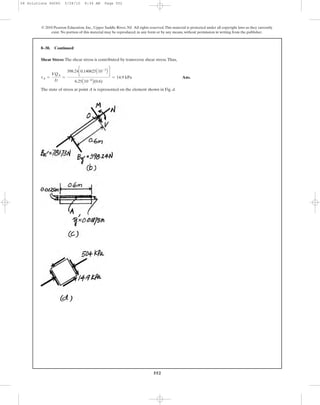
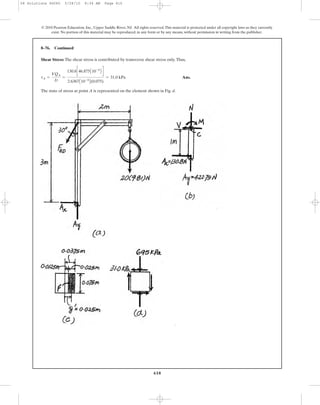
Shear Stress: The shear stress is contributed by transverse shear stress.Thus,
Ans.
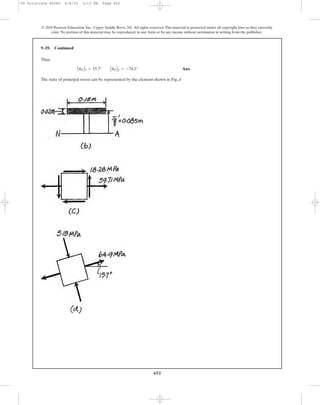
The state of stress at point A is represented on the element shown in Fig. d.
tA =
VQA
It
=
398.24c0.140625A10-3
B d
6.25A10-6
B(0.6)
= 14.9 kPa
8–30. Continued
552
© 2010 Pearson Education, Inc., Upper Saddle River, NJ. All rights reserved.This material is protected under all copyright laws as they currently
exist. No portion of this material may be reproduced, in any form or by any means, without permission in writing from the publisher.
08 Solutions 46060 5/28/10 8:34 AM Page 552
553
© 2010 Pearson Education, Inc., Upper Saddle River, NJ. All rights reserved.This material is protected under all copyright laws as they currently
exist. No portion of this material may be reproduced, in any form or by any means, without permission in writing from the publisher.
Consider the equilibrium of the FBD of the left cut segment in Fig. a,
a
The normal stress developed is the combination of axial and bending stress.Thus
Since no compressive stress is desired, the normal stress at the top edge fiber must
be equal to zero.Thus,
Ans.d = 0.06667 m = 66.7 mm
0 = 250 P - 7500 P (0.1 - d)
0 =
P
0.004
;
P(0.1 - d)(0.1)
13.3333 (10-6
)
s =
N
A
;
My
I
A = 0.2 (0.02) = 0.004 m4
I =
1
12
(0.02)(0.23
) = 13.3333(10-6
) m4
+©MC = 0; M - P(0.1 - d) = 0 M = P(0.1 - d)
:
+
©Fx = 0; N - P = 0 N = P
8–31. Determine the smallest distance d to the edge of the
plate at which the force P can be applied so that it produces
no compressive stresses in the plate at section a–a. The
plate has a thickness of 20 mm and P acts along the
centerline of this thickness.
a
P
a
200 mm
300 mm
d
08 Solutions 46060 5/28/10 8:34 AM Page 553
554
© 2010 Pearson Education, Inc., Upper Saddle River, NJ. All rights reserved.This material is protected under all copyright laws as they currently
exist. No portion of this material may be reproduced, in any form or by any means, without permission in writing from the publisher.
Consider the equilibrium of the FBD of the left cut segment in Fig. a,
a
The normal stress developed is the combination of axial and bending stress.Thus,
At point A, .Then
At point B, .Then
The location of neutral axis can be determined using the similar triangles.
= 100 (106
) Pa = 100 MPa (T)
sB =
80(103
)
0.002
+
4.00(103
)(0.1)
6.667(10-6
)
y = 0.1 m
= -20.0(106
) Pa = 20.0 Mpa (C)
sA =
80(103
)
0.002
-
4.00(103
)(0.1)
6.667(10-6
)
y = 0.1 m
s =
N
A
;
My
I
A = 0.01(0.2) = 0.002 m2
I =
1
12
(0.01)(0.23
) = 6.667(10-6
) m4
+©MC = 0; M - 80(0.05) = 0 M = 4.00 kN # m
:
+
©Fx = 0; N - 80 = 0 N = 80 kN
*8–32. The horizontal force of acts at the end
of the plate. The plate has a thickness of 10 mm and P acts
along the centerline of this thickness such that
Plot the distribution of normal stress acting along
section a–a.
d = 50 mm.
P = 80 kN
a
P
a
200 mm
300 mm
d
08 Solutions 46060 5/28/10 8:34 AM Page 554
555
© 2010 Pearson Education, Inc., Upper Saddle River, NJ. All rights reserved.This material is protected under all copyright laws as they currently
exist. No portion of this material may be reproduced, in any form or by any means, without permission in writing from the publisher.
a
Point B:
Ans.
Ans.
Point C:
Ans.
Shear Stress :
Ans.tC =
VQ
I t
=
8.660(4)(10-3
)
1.0667(10-3
)(0.2)
= 162 psi
sC =
N
A
+
My
I
=
-5.0
0.08
+ 0 = -62.5 psi = 62.5 psi(C)
tB =
VQ
I t
= 0
sB =
N
A
+
My
I
=
-5.0
0.08
+
30(0.2)
1.0667(10-3
)
= 5.56 ksi(T)
QC = y¿A¿ = 0.1(0.2)(0.2) = 4(10-3
) in3
QB = 0
I =
1
12
(0.2)(0.43
) = 1.0667(10-3
) in4
A = 0.2(0.4) = 0.08 in2
+©MC = 0; M - 10(3) = 0 M = 30 lb # in.
a+
©Fy = 0; V - 10 cos 30° = 0; V = 8.660 lb
+
Q ©Fx = 0; N - 10 sin 30° = 0; N = 5.0 lb
•8–33. The pliers are made from two steel parts pinned
together at A. If a smooth bolt is held in the jaws and a
gripping force of 10 lb is applied at the handles, determine
the state of stress developed in the pliers at points B and C.
Here the cross section is rectangular, having the dimensions
shown in the figure.
4 in.2.5 in.
10 lb
10 lb
30Њ
3 in.
B
C
A
0.2 in.
0.2 in.
B
C
0.2 in.
D
E
D
E
0.18 in.
0.2 in.
1.75 in.
0.1 in.
08 Solutions 46060 5/28/10 8:34 AM Page 555
556
© 2010 Pearson Education, Inc., Upper Saddle River, NJ. All rights reserved.This material is protected under all copyright laws as they currently
exist. No portion of this material may be reproduced, in any form or by any means, without permission in writing from the publisher.
a
Point D:
Ans.
Ans.
Point E:
Ans.
Ans.tE = 0
sE =
My
I
=
28(0.1)
1
12 (0.18)(0.2)3
= 23.3 ksi (T)
tD =
VQ
It
=
16(0.05)(0.1)(0.18)
[ 1
12 (0.18)(0.2)3
](0.18)
= 667 psi
sD = 0
+©MA = 0; -F(2.5) + 4(10) = 0; F = 16 lb
8–34. Solve Prob. 8–33 for points D and E.
4 in.2.5 in.
10 lb
10 lb
30Њ
3 in.
B
C
A
0.2 in.
0.2 in.
B
C
0.2 in.
D
E
D
E
0.18 in.
0.2 in.
1.75 in.
0.1 in.
08 Solutions 46060 5/28/10 8:34 AM Page 556
557
© 2010 Pearson Education, Inc., Upper Saddle River, NJ. All rights reserved.This material is protected under all copyright laws as they currently
exist. No portion of this material may be reproduced, in any form or by any means, without permission in writing from the publisher.
Ans.
Ans.
Ans.
Ans.tB =
VQB
I t
=
2625(8.5)
51.33(0.5)
= 0.869 ksi
sB =
My
I
=
11500(12)(1)
51.33
= 2.69 ksi
tA = 0
sA =
-Mc
I
=
-11500 (12)(3.5)
51.33
= -9.41 ksi
QA = 0
QB = ©y¿A¿ = 3.25(4)(0.5) + 2(2)(0.5) = 8.5 in3
A = 2(0.5)(4) + 6(0.5) = 7 in2
I =
1
12
(4)(73
) -
1
12
(3.5)(63
) = 51.33 in4
8–35. The wide-flange beam is subjected to the loading
shown. Determine the stress components at points A and B
and show the results on a volume element at each of these
points. Use the shear formula to compute the shear stress.
6 ft4 ft
2 ft2 ft2 ft
500 lb
2500 lb 3000 lb
A
B
4 in.
4 in.
0.5 in.
0.5 in.
2 in.
0.5 in.
B
A
08 Solutions 46060 5/28/10 8:34 AM Page 557
558
© 2010 Pearson Education, Inc., Upper Saddle River, NJ. All rights reserved.This material is protected under all copyright laws as they currently
exist. No portion of this material may be reproduced, in any form or by any means, without permission in writing from the publisher.
Internal Loadings: Consider the equilibrium of the free-body diagram of the drill’s
right cut segment, Fig. a,
Section Properties: The cross-sectional area, the moment of inertia about the z axis,
and the polar moment of inertia of the drill’s cross section are
Referring to Fig. b, QA is
Normal Stress: The normal stress is a combination of axial and bending stress.Thus,
For point A, .Then
Ans.sA =
-120
25pA10-6
B
-
21(0.005)
0.15625pA10-9
B
= -215.43 MPa = 215 MPa (C)
y = 0.005 m
s =
N
A
-
Mzy
Iz
QA = 0
J =
p
2
A0.0054
B = 0.3125pA10-9
B m4
Iz =
p
4
A0.0054
B = 0.15625pA10-9
B m4
A = pA0.0052
B = 25pA10-6
B m2
Mz = 21N # m
©Mz = 0; -150a
3
5
b(0.4) + 150a
4
5
b(0.125) + Mz = 0
©Mx = 0; 20 - T = 0 T = 20N # m
©Fy = 0; 150a
3
5
b - Vy = 0 Vy = 90N
©Fx = 0; N - 150a
4
5
b = 0 N = 120N
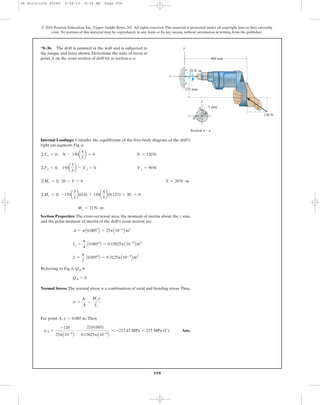
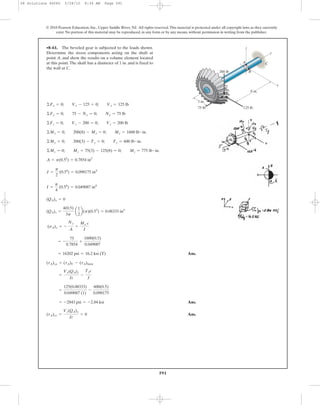
*8–36. The drill is jammed in the wall and is subjected to
the torque and force shown. Determine the state of stress at
point A on the cross section of drill bit at section a–a.
150 N
3
4
5
125 mm
20 N·m
400 mm
a
a
5 mm
B
A
Section a – a
z
x
y
y
08 Solutions 46060 5/28/10 8:34 AM Page 558
559
© 2010 Pearson Education, Inc., Upper Saddle River, NJ. All rights reserved.This material is protected under all copyright laws as they currently
exist. No portion of this material may be reproduced, in any form or by any means, without permission in writing from the publisher.
Shear Stress: The transverse shear stress developed at point A is
Ans.
The torsional shear stress developed at point A is
Thus,
Ans.
Ans.
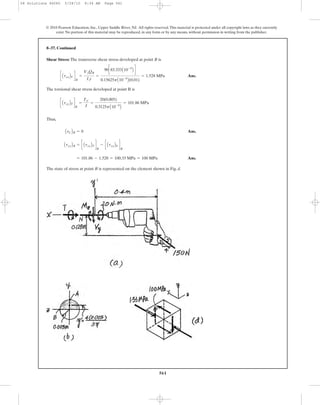
The state of stress at point A is represented on the element shown in Fig c.
AtxzBA = c AtxzBT d
A
= 102 MPa
AtxyBA = 0
C(txz)TDA =
Tc
J
=
20(0.005)
0.3125pA10-9
B
= 101.86 MPa
c AtxyBV d
A
=
VyQA
Izt
= 0
8–36. Continued
08 Solutions 46060 5/28/10 8:34 AM Page 559
560
Internal Loadings: Consider the equilibrium of the free-body diagram of the drill’s
right cut segment, Fig. a,
©Fy = 0; 150a
3
5
b - Vy = 0 Vy = 90N
©Fx = 0; N - 150a
4
5
b = 0 N = 120N
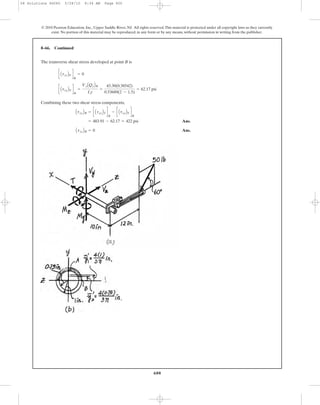
•8–37. The drill is jammed in the wall and is subjected to
the torque and force shown. Determine the state of stress at
point B on the cross section of drill bit at section a–a.
© 2010 Pearson Education, Inc., Upper Saddle River, NJ. All rights reserved.This material is protected under all copyright laws as they currently
exist. No portion of this material may be reproduced, in any form or by any means, without permission in writing from the publisher.
150 N
3
4
5
125 mm
20 N·m
400 mm
a
a
5 mm
B
A
Section a – a
z
x
y
y
©Mx = 0; 20 - T = 0 T = 20N # m
Section Properties: The cross-sectional area, the moment of inertia about the z axis,
and the polar moment of inertia of the drill’s cross section are
Referring to Fig. b, QB is
Normal Stress: The normal stress is a combination of axial and bending stress.Thus,
For point B, .Then
Ans.sB =
-120
25pA10-6
B
- 0 = -1.528 MPa = 1.53 MPa(C)
y = 0
s =
N
A
-
Mzy
Iz
QB = y¿A¿ =
4(0.005)
3p
c
p
2
A0.0052
B d = 83.333A10-9
B m3
J =
p
2
A0.0054
B = 0.3125pA10-9
B m4
Iz =
p
4
A0.0054
B = 0.15625pA10-9
B m4
A = pA0.0052
B = 25pA10-6
B m2
Mz = 21 N # m
©Mz = 0; -150a
3
5
b(0.4) + 150a
4
5
b(0.125) + Mz = 0
08 Solutions 46060 5/28/10 8:34 AM Page 560
561
© 2010 Pearson Education, Inc., Upper Saddle River, NJ. All rights reserved.This material is protected under all copyright laws as they currently
exist. No portion of this material may be reproduced, in any form or by any means, without permission in writing from the publisher.
Shear Stress: The transverse shear stress developed at point B is
Ans.
The torsional shear stress developed at point B is
Thus,
Ans.
Ans.
The state of stress at point B is represented on the element shown in Fig. d.
= 101.86 - 1.528 = 100.33 MPa = 100 MPa
AtxyBB = c AtxyBT d
B
- c AtxyBV d
B
AtCBB = 0
c AtxyBT d
B
=
TC
J
=
20(0.005)
0.3125pA10-9
B
= 101.86 MPa
c AtxyBV d
B
=
VyQB
Izt
=
90c83.333A10-9
B d
0.15625pA10-9
B(0.01)
= 1.528 MPa
8–37. Continued
08 Solutions 46060 5/28/10 8:34 AM Page 561
562
© 2010 Pearson Education, Inc., Upper Saddle River, NJ. All rights reserved.This material is protected under all copyright laws as they currently
exist. No portion of this material may be reproduced, in any form or by any means, without permission in writing from the publisher.
Support Reactions: As shown on FBD.
Internal Force and Moment:
a
Section Properties:
Normal Stress: Requires
Ans.T = 2160 lb = 2.16 kip
0 =
-T
216
+
(21600 - 7T)(9)
5832
sA = 0 =
N
A
+
Mc
I
sA = 0
I =
1
12
(12)A183
B = 5832 in4
A = 18(12) = 216 in2
M = 21600 - 7T
+©Mo = 0; M + T(7) - 900(24) = 0
:
+
©Fx = 0; T - N = 0 N = T
8–38. Since concrete can support little or no tension, this
problem can be avoided by using wires or rods to prestress
the concrete once it is formed. Consider the simply
supported beam shown, which has a rectangular cross
section of 18 in. by 12 in. If concrete has a specific weight of
determine the required tension in rod AB, which
runs through the beam so that no tensile stress is developed
in the concrete at its center section a–a. Neglect the size of
the rod and any deflection of the beam.
150 lb>ft3
,
16 in.
4 ft 4 ft
a
a
A B
18 in.
6 in. 6 in.
2 in.
08 Solutions 46060 5/28/10 8:34 AM Page 562
563
© 2010 Pearson Education, Inc., Upper Saddle River, NJ. All rights reserved.This material is protected under all copyright laws as they currently
exist. No portion of this material may be reproduced, in any form or by any means, without permission in writing from the publisher.
Support Reactions: As shown on FBD.
Section Properties:
Internal Force and Moment:
a
Normal Stress: Requires
Ans.T = 2163.08 lb = 2.16 kip
0 =
-T
217.3854
+
(21600 - 6.9554T)(8.9554)
5899.45
sA = 0 =
N
A
+
Mc
I
sA = 0
M = 21600 - 6.9554T
+©Mo = 0; M + T(6.9554) - 900(24) = 0
:
+
©Fx = 0; T - N = 0 N = T
= 5899.45 in4
I =
1
12
(12)A183
B + 12(18)(9.04461 - 9)2
+ 1.3854(16 - 9.04461)2
y =
©yA
©A
=
9(18)(12) + 16(1.3854)
217.3854
= 9.04461 in.
A = 18(12) + 1.3854 = 217.3854 in2
Acon = (n - 1)Aat = (8.0556 - 1)a
p
4
b A0.52
B = 1.3854 in2
n =
Est
Econ
=
29(103
)
3.6(103
)
= 8.0556
8–39. Solve Prob. 8–38 if the rod has a diameter of 0.5 in.
Use the transformed area method discussed in Sec. 6.6.
Ec = 3.601103
2 ksi.Est = 291103
2 ksi, 16 in.
4 ft 4 ft
a
a
A B
18 in.
6 in. 6 in.
2 in.
08 Solutions 46060 5/28/10 8:34 AM Page 563
564
© 2010 Pearson Education, Inc., Upper Saddle River, NJ. All rights reserved.This material is protected under all copyright laws as they currently
exist. No portion of this material may be reproduced, in any form or by any means, without permission in writing from the publisher.
Support Reactions:
a
Internal Forces and Moment:
a
Section Properties:
Normal Stress:
Ans.
Shear Stress: Applying shear formula.
Ans.=
0.6667(103
)C0.405(10-3
)D
82.8(10-6
)(0.015)
= 0.217 MPa
tA =
VQA
It
= 0.444 MPa (T)
sA =
4.00(103
)
9.00(10-3
)
+
0.6667(103
)(0)
82.8(10-6
)
s =
N
A
;
My
I
= 0.405A10-3
B m3
QA = ©y¿A¿ = 0.11(0.15)(0.02) + 0.05(0.1)(0.015)
I =
1
12
(0.15)A0.243
B -
1
12
(0.135)A0.23
B = 82.8A10-6
B m4
A = 0.24(0.15) - 0.2(0.135) = 9.00A10-3
B m2
+©Mo = 0; M - 0.6667(1) = 0 M = 0.6667 kN # m
+ c ©Fy = 0; V - 0.6667 = 0 V = 0.6667 kN
:
+
©Fx = 0; 4.00 - N = 0 N = 4.00 kN
:
+
©Fx = 0; Cx - 4 = 0 Cx = 4.00 kN
Cy = 0.6667 kN
+©MD = 0; 4(0.625) - Cy (3.75) = 0
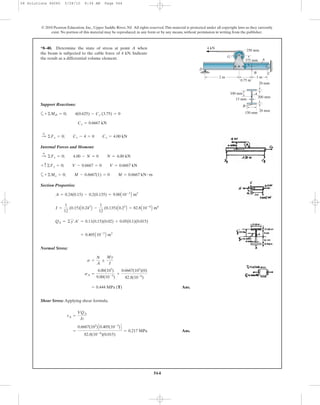
*8–40. Determine the state of stress at point A when
the beam is subjected to the cable force of 4 kN. Indicate
the result as a differential volume element.
2 m
0.75 m
1 m
4 kN
G
250 mm
375 mm
B C
D
A
200 mm
20 mm
20 mm
150 mm
15 mm
A
B
100 mm
08 Solutions 46060 5/28/10 8:34 AM Page 564
565
© 2010 Pearson Education, Inc., Upper Saddle River, NJ. All rights reserved.This material is protected under all copyright laws as they currently
exist. No portion of this material may be reproduced, in any form or by any means, without permission in writing from the publisher.
Support Reactions:
a
Internal Forces and Moment:
a
Section Properties:
Normal Stress:
Ans.
Shear Stress: Since , then
Ans.tB = 0
QB = 0
= -0.522 MPa = 0.522 MPa (C)
sB =
4.00(103
)
9.00(10-3
)
-
0.6667(103
)(0.12)
82.8(10-6
)
s =
N
A
;
My
I
QB = 0
I =
1
12
(0.15)A0.243
B -
1
12
(0.135)A0.23
B = 82.8A10-6
B m
A = 0.24(0.15) - 0.2(0.135) = 9.00A10-3
B m2
+©Mo = 0; M - 0.6667(1) = 0 M = 0.6667 kN # m
+ c ©Fy = 0; V - 0.6667 = 0 V = 0.6667 kN
:
+
©Fx = 0; 4.00 - N = 0 N = 4.00 kN
:
+
©Fx = 0; Cx - 4 = 0 Cx = 4.00 kN
Cy = 0.6667 kN
+©MD = 0; 4(0.625) - Cy (3.75) = 0
•8–41. Determine the state of stress at point B when
the beam is subjected to the cable force of 4 kN. Indicate
the result as a differential volume element.
2 m
0.75 m
1 m
4 kN
G
250 mm
375 mm
B C
D
A
200 mm
20 mm
20 mm
150 mm
15 mm
A
B
100 mm
08 Solutions 46060 5/28/10 8:34 AM Page 565
566
© 2010 Pearson Education, Inc., Upper Saddle River, NJ. All rights reserved.This material is protected under all copyright laws as they currently
exist. No portion of this material may be reproduced, in any form or by any means, without permission in writing from the publisher.
Consider the equilibrium of the FBD of bar’s left cut segment shown in Fig. a,
Referring to Fig. b,
The normal stress is contributed by bending stress only.Thus,
For point A, and .Then
Ans.
The transverse shear stress developed at point A is
Ans.
Ans.
The state of stress for point A can be represented by the volume element shown in
Fig. c,
= 1.061(106
) Pa = 1.06 MPa
AtxzBv =
Vz(Qz)A
Iy t
=
4(103
)C42.67(10-6
)D
0.64(10-6
)p (0.08)
AtxyBv =
Vy(Qy)A
Iz t
= 0
s = -
-0.9(103
)(-0.04)
0.64(10-6
)p
+ 0 = -17.90(106
)Pa = 17.9 MPa (C)
z = 0y = -0.04 m
s = -
Mzy
Iz
+
Myz
Iy
(Qz)A = z¿A¿ =
4(0.04)
3p
c
p
2
(0.042
)d = 42.67(10-6
) m3
(Qy)A = 0
Iy = It =
p
4
(0.044
) = 0.64(10-6
)p m4
©Mz = 0; Mz + 5a
3
5
b(0.3) = 0 Mz = -0.9 kN # m
©My = 0; My + 5a
4
5
b(0.3) = 0 My = -1.2 kN # m
©Fz = 0; Vz + 5a
4
5
b = 0 Vz = -4 kN
©Fy = 0; Vy - 5a
3
5
b = 0 Vy = 3 kN
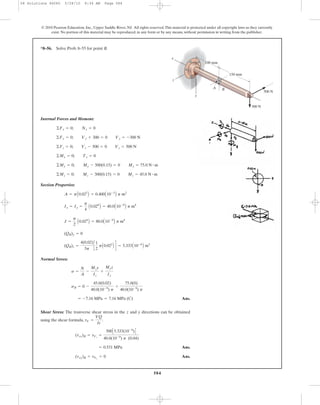
8–42. The bar has a diameter of 80 mm. Determine the
stress components that act at point A and show the results
on a volume element located at this point.
300 mm
200 mm
B
A
5 kN
4
3 5
08 Solutions 46060 5/28/10 8:34 AM Page 566
567
© 2010 Pearson Education, Inc., Upper Saddle River, NJ. All rights reserved.This material is protected under all copyright laws as they currently
exist. No portion of this material may be reproduced, in any form or by any means, without permission in writing from the publisher.
8–42. Continued
08 Solutions 46060 5/28/10 8:34 AM Page 567
568
Consider the equilibrium of the FBD of bar’s left cut segment shown in Fig. a,
Referring to Fig. b,
The normal stress is contributed by bending stress only.Thus,
For point B, and .Then
Ans.
The transverse shear stress developed at point B is
Ans.= 0.7958(106
) MPa = 0.796 MPa
AtxyBv =
Vy(Qy)B
Iz t
=
3(103
)C42.67(10-6
)D
0.64(10-6
)p (0.08)
= -23.87(106
) Pa = 23.9 MPa (C)
s = -0 +
-1.2(103
)(0.04)
0.64(10-6
)p
z = 0.04my = 0
s = -
Mzy
Iz
+
Myz
Iy
AQzBB = 0
AQyBB = y¿A¿ = c
4(0.04)
3p
d c
p
2
(0.042
)d = 42.67(10-6
) m3
Iy = Iz =
p
4
(0.044
) = 0.64(10-6
)p m4
©Mz = 0; Mz + 5a
3
5
b(0.3) = 0 Mz = -0.9 kN # m
©My = 0; My + 5a
4
5
b(0.3) = 0 My = -1.2 kN # m
©Fz = 0; Vz + 5a
4
5
b = 0 Vz = -4 kN
©Fy = 0; Vy - 5a
3
5
b = 0 Vy = 3 kN
8–43. The bar has a diameter of 80 mm. Determine the
stress components that act at point B and show the results
on a volume element located at this point.
© 2010 Pearson Education, Inc., Upper Saddle River, NJ. All rights reserved.This material is protected under all copyright laws as they currently
exist. No portion of this material may be reproduced, in any form or by any means, without permission in writing from the publisher.
300 mm
200 mm
B
A
5 kN
4
3 5
08 Solutions 46060 5/28/10 8:34 AM Page 568
569
© 2010 Pearson Education, Inc., Upper Saddle River, NJ. All rights reserved.This material is protected under all copyright laws as they currently
exist. No portion of this material may be reproduced, in any form or by any means, without permission in writing from the publisher.
Ans.
The state of stress for point B can be represented by the volume element shown in
Fig. c
AtxzBv =
Vz (Qz)B
Iy t
= 0
8–43. Continued
08 Solutions 46060 5/28/10 8:34 AM Page 569
570
© 2010 Pearson Education, Inc., Upper Saddle River, NJ. All rights reserved.This material is protected under all copyright laws as they currently
exist. No portion of this material may be reproduced, in any form or by any means, without permission in writing from the publisher.
*8–44. Determine the normal stress developed at points
A and B. Neglect the weight of the block.
a
a
6 in.
6 kip
12 kip3 in.
A B
Referring to Fig. a,
The cross-sectional area and moment of inertia about the y and z axes of the cross-
section are
The normal stress developed is the combination of axial and bending stress.Thus,
For point A, . and .
Ans.
For point B, and .
Ans.= -3.00 ksi = 3.00 ksi (C)
sB =
-18.0
18.0
-
18.0(3)
54
+
-9.00(1.5)
13.5
z = 1.5 iny = 3 in
= -1.00 ksi = 1.00 ksi (C)
sA =
-18.0
18.0
-
18.0(3)
54.0
+
-9.00(-1.5)
13.5
z = -1.5 iny = 3 in
s =
F
A
-
Mz y
Iz
+
My z
Iy
Iz =
1
12
(3)(63
) = 54.0 in4
Iy =
1
12
(6)(3)3
= 13.5 in4
A = 6(3) = 18 in2
©Mz = (MR)z; 12(3) - 6(3) = Mz Mz = 18.0 kip # in
©My = (MR)y; 6(1.5) - 12(1.5) = My My = -9.00 kip # in
©Fx = (FR)x; -6 - 12 = F F = -18.0 kip
08 Solutions 46060 5/28/10 8:34 AM Page 570
571
© 2010 Pearson Education, Inc., Upper Saddle River, NJ. All rights reserved.This material is protected under all copyright laws as they currently
exist. No portion of this material may be reproduced, in any form or by any means, without permission in writing from the publisher.
Referring to Fig. a,
The cross-sectional area and the moment of inertia about the y and z axes of the
cross-section are
The normal stress developed is the combination of axial and bending stress.Thus,
For point A, . and .
For point B, . and .
= -3.00 ksi = 3.00 ksi (C)
sB =
-18.0
18.0
-
18.0(3)
54.0
+
-9.00(1.5)
13.5
z = 1.5 iny = 3 in
= -1.00 ksi = 1.00 ksi (C)
sA =
-18.0
18.0
-
18.0(3)
54.0
+
-9.00(-1.5)
13.5
z = -1.5 iny = 3 in
s =
F
A
-
Mzy
Iz
+
Myz
Iy
Iz =
1
12
(3)(63
) = 54.0 in4
Iy =
1
12
(6)(33
) = 13.5 in4
A = 3 (6) = 18.0 in2
©Mz = (MR)z; 12(3) - 6(3) = Mz Mz = 18.0 kip # in
©My = (MR)y; 6(1.5) - 12(1.5) = My My = -9.00 kip # in
©Fx = (FR)x; -6 - 12 = F F = -18.0 kip
•8–45. Sketch the normal stress distribution acting over the
cross section at section a–a. Neglect the weight of the block.
a
a
6 in.
6 kip
12 kip3 in.
A B
08 Solutions 46060 5/28/10 8:34 AM Page 571
572
For point C, and .
For point D, . and .
The normal stress distribution over the cross-section is shown in Fig. b
= 1.00 ksi (T)
sD =
-18.0
18.0
-
18.0(-3)
54.0
+
-9.00(-1.5)
13.5
z = -1.5 iny = -3 in
= -1.00 ksi = 1.00 ksi (C)
sC =
-18.0
18.0
-
18.0(-3)
54.0
+
-9.00(1.5)
13.5
z = 1.5 iny = -3 in.
8–45. Continued
© 2010 Pearson Education, Inc., Upper Saddle River, NJ. All rights reserved.This material is protected under all copyright laws as they currently
exist. No portion of this material may be reproduced, in any form or by any means, without permission in writing from the publisher.
08 Solutions 46060 5/28/10 8:34 AM Page 572
573
© 2010 Pearson Education, Inc., Upper Saddle River, NJ. All rights reserved.This material is protected under all copyright laws as they currently
exist. No portion of this material may be reproduced, in any form or by any means, without permission in writing from the publisher.
Section Properties:
Internal Forces and Moment: As shown on FBD.
Normal Stress:
[1]
[2]
In order to have maximum normal stress, .
Since , then
2a - 4x = 0 x = 0.500a
P
a(a + x)3
Z 0
-
P
a(a + x)3
(2a - 4x) = 0
dsA
dx
= -
P
a
B
(a + x)2
(4) - (4x + a)(2)(a + x)(1)
(a + x)4 R = 0
dsA
dx
= 0
=
P
a
B
2x - a
(a + x)2 R
sB =
P
a
B
-1
a + x
+
3x
(a + x)2 R
= -
P
a
B
4x + a
(a + x)2 R
sA = -
P
a
B
1
a + x
+
3x
(a + x)2 R
=
P
a
B
-1
a + x
;
3x
(a + x)2 R
=
-P
a(a + x)
;
0.5PxC1
2 (a + x)D
a
12 (a + x)3
s =
N
A
;
Mc
I
I =
1
12
(a) (a + x)3
=
a
12
(a + x)3
A = a(a + x)
w = a + x
8–46. The support is subjected to the compressive load P.
Determine the absolute maximum and minimum normal
stress acting in the material.
P
a—
2
a—
2
a—
2
a—
2
08 Solutions 46060 5/28/10 8:34 AM Page 573
574
Substituting the result into Eq. [1] yields
Ans.
In order to have minimum normal stress, .
Since , then
Substituting the result into Eq. [2] yields
Ans.smin =
P
a
B
2(2a) - a
(a + 2a)2 R =
P
3a2
(T)
4a - 2x = 0 x = 2a
P
a(a + x)3
Z 0
P
a(a + x)3
(4a - 2x) = 0
dsB
dx
=
P
a
B
(a + x)2
(2) - (2x - a)(2)(a + x)(1)
(a + x)4 R = 0
dsB
dx
= 0
= -
1.33P
a2
=
1.33P
a2
(C)
smax = -
P
a
B
4(0.500a) + a
(a + 0.5a)2 R
8–46. Continued
© 2010 Pearson Education, Inc., Upper Saddle River, NJ. All rights reserved.This material is protected under all copyright laws as they currently
exist. No portion of this material may be reproduced, in any form or by any means, without permission in writing from the publisher.
08 Solutions 46060 5/28/10 8:34 AM Page 574
575
© 2010 Pearson Education, Inc., Upper Saddle River, NJ. All rights reserved.This material is protected under all copyright laws as they currently
exist. No portion of this material may be reproduced, in any form or by any means, without permission in writing from the publisher.
r
P
Section Properties:
Internal Force and Moment: As shown on FBD.
Normal Stress:
[1]
[2]
In order to have maximum normal stress, .
Since , then
Substituting the result into Eq. [1] yields
Ans.= -
0.368P
r2
=
0.368P
r2
(C)
smax = -
P
p
B
r + 2.5(0.400r)
[r + 0.5(0.400r)]3 R
r - 2.5x = 0 x = 0.400r
P
p(r + 0.5x)4
Z 0
-
P
p(r + 0.5x)4
(r - 2.5x) = 0
dsA
dx
= -
P
p
B
(r + 0.5x)3
(2.5) - (r + 2.5x)(3)(r + 0.5x)2
(0.5)
(r + 0.5x)6
R = 0
dsA
dx
= 0
=
P
p
B
1.5x - r
(r + 0.5x)3 R
sB =
P
p
B
–1
(r + 0.5x)2
+
2x
(r + 0.5x)3 R
= -
P
p
B
r + 2.5x
(r + 0.5x)3 R
sA = -
P
p
B
1
(r + 0.5x)2
+
2x
(r + 0.5x)3 R
=
P
p
B
–1
(r + 0.5x)2
;
2x
(r + 0.5x)3 R
=
–P
p(r + 0.5x)2
;
0.5Px(r + 0.5x)
p
4 (r + 0.5)4
s =
N
A
;
Mc
I
I =
p
4
(r + 0.5x)4
A = p(r + 0.5x)2
d¿ = 2r + x
8–47. The support is subjected to the compressive load P.
Determine the maximum and minimum normal stress acting
in the material.All horizontal cross sections are circular.
08 Solutions 46060 5/28/10 8:34 AM Page 575
576
8–47. Continued
© 2010 Pearson Education, Inc., Upper Saddle River, NJ. All rights reserved.This material is protected under all copyright laws as they currently
exist. No portion of this material may be reproduced, in any form or by any means, without permission in writing from the publisher.
In order to have minimum normal stress, .
Since , then
Substituting the result into Eq. [2] yields
Ans.smin =
P
p
B
1.5(2.00r) - r
[r + 0.5(2.00r)]3 R =
0.0796P
r2
(T)
3r - 1.5x = 0 x = 2.00r
P
p(r + 0.5x)4
Z 0
P
p(r + 0.5x)4
(3r - 1.5x) = 0
dsB
dx
=
P
p
B
(r + 0.5x)3
(1.5) - (1.5x - r)(3)(r + 0.5x)2
(0.5)
(r + 0.5x)6
R = 0
dsB
dx
= 0
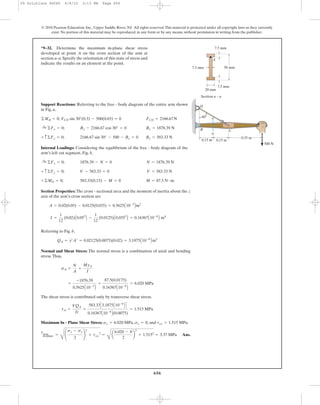
*8–48. The post has a circular cross section of radius c.
Determine the maximum radius e at which the load can be
applied so that no part of the post experiences a tensile
stress. Neglect the weight of the post.
P
c
e
Require
Ans.e =
c
4
sA = 0 =
P
A
+
Mc
I
; 0 =
-P
p c2
+
(Pe)c
p
4 c4
sA = 0
08 Solutions 46060 5/28/10 8:34 AM Page 576
577
© 2010 Pearson Education, Inc., Upper Saddle River, NJ. All rights reserved.This material is protected under all copyright laws as they currently
exist. No portion of this material may be reproduced, in any form or by any means, without permission in writing from the publisher.
Section Properties: The location of the neutral surface from the center of
curvature of the rod, Fig. a, can be determined from
where A = pA0.0062
B = 36pA10-6
B m2
R =
A
©
LA
dA
r
•8–49. If the baby has a mass of 5 kg and his center of
mass is at G, determine the normal stress at points A and B
on the cross section of the rod at section a–a.There are two
rods, one on each side of the cradle.
Section a–a
75 mm
6 mm
G
500 mm
15Њ
a
A Ba
©
LA
dA
r
= 2p¢r - 2r2
- c2
≤ = 2p¢0.081 - 20.0812
- 0.0062
≤ = 1.398184A10-3
Bm
Thus,
Then
Internal Loadings: Consider the equilibrium of the free-body diagram of the
cradle’s upper segment, Fig. b,
a
Normal Stress: The normal stress is the combination of axial and bending stress.
Thus,
Here, (negative) since it tends to increase the curvature of the
rod. For point A, .Then,
Ans.
For point B, .Then,
Ans.
LA
dA
r
= 0.25 ln
5
4
= 0.055786
= 79.3 kPa (T)
sB =
-24.525
36pA10-6
B
+
-14.2463(0.080889 - 0.087)
36pA10-6
B(0.111264)A10-3
B(0.087)
r = rB = 0.087 m
= -89.1 MPa = 89.1 MPa (C)
sA =
-24.525
36pA10-6
B
+
-14.2463(0.080889 - 0.075)
36pA10-6
B(0.111264)A10-3
B(0.075)
r = rA = 0.075m
M = -14.1747
s =
N
A
+
M(R - r)
Aer
+©MO = 0; 5(9.81)(0.5+ 0.080889) - 2M = 0 M = 14.2463 N # m
N = -24.525 N-5(9.81) - 2N = 0+ c ©Fy = 0;
e = r - R = 0.081 - 0.080889 = 0.111264A10-3
B m
R =
36pA10-6
B
1.398184A10-3
B
= 0.080889 m
08 Solutions 46060 5/28/10 8:34 AM Page 577
578
© 2010 Pearson Education, Inc., Upper Saddle River, NJ. All rights reserved.This material is protected under all copyright laws as they currently
exist. No portion of this material may be reproduced, in any form or by any means, without permission in writing from the publisher.
Ans.
(sc)max =
317.4205(4.48142 - 5)
1(0.25)(5)(4.5 - 4.48142)
+
35.3429
(1)(0.25)
= -6.95 ksi
(st)max =
317.4205(4.48142 - 4)
(1)(0.25)(4)(4.5 - 4.48142)
+
35.3429
(1)(0.25)
= 8.37 ksi
s =
M(R - r)
Ar(r - R)
+
P
A
M = 35.3429(8.98142) = 317.4205 lb # in.
P = sbA = 80p(0.375)2
= 35.3429 lb
R =
A
1
dA
r
=
1(0.25)
0.055786
= 4.48142
8–50. The C-clamp applies a compressive stress on the
cylindrical block of 80 psi. Determine the maximum normal
stress developed in the clamp.
0.75 in.
4 in.
1 in.
4.5 in.
0.25 in.
08 Solutions 46060 5/28/10 8:34 AM Page 578
579
© 2010 Pearson Education, Inc., Upper Saddle River, NJ. All rights reserved.This material is protected under all copyright laws as they currently
exist. No portion of this material may be reproduced, in any form or by any means, without permission in writing from the publisher.
Equivalent Force System: As shown on FBD.
Section Properties:
Normal Stress:
At point A where and , we require .
Ans.
When
When
Repeat the same procedures for point B, C and D. The region where P can be
applied without creating tensile stress at points A, B, C and D is shown shaded in the
diagram.
ey = 0, ez 6
5
18
a
ez = 0, ey 6
5
6
a
6ey + 18ez 6 5a
0 7 -5a+ 6ey + 18ez
0 7
P
30a4 C -5a2
- 6(-a) ey + 18(a)ezD
sA 6 0z = ay = -a
=
P
30a4 A -5a2
- 6eyy + 18ez zB
=
-P
6a2
-
Peyy
5a4
+
Pezz
5
3 a4
s =
N
A
-
Mzy
Iz
+
My z
Iy
=
5
3
a4
Iy =
1
12
(2a)(2a)3
+ 2B
1
36
(2a)a3
+
1
2
(2a)aa
a
3
b
2
R
= 5a4
Iz =
1
12
(2a)(2a)3
+ 2B
1
36
(2a)a3
+
1
2
(2a)aaa +
a
3
b
2
R
A = 2a(2a) + 2B
1
2
(2a)aR = 6a2
8–51. A post having the dimensions shown is subjected to
the bearing load P. Specify the region to which this load can
be applied without causing tensile stress to be developed at
points A, B, C, and D.
x
y
z
A
a a a a
a
a
D
ez
ey
B
C
P
08 Solutions 46060 5/28/10 8:34 AM Page 579
580
© 2010 Pearson Education, Inc., Upper Saddle River, NJ. All rights reserved.This material is protected under all copyright laws as they currently
exist. No portion of this material may be reproduced, in any form or by any means, without permission in writing from the publisher.
Section Properties:
Internal Force and Moment: As shown on FBD. The internal moment must be
computed about the neutral axis. . is positive since it tends to
increase the beam’s radius of curvature.
Normal Stress: Applying the curved-beam formula.
For tensile stress
Ans.
For compressive stress,
Ans.= -9308 psi = 9.31 ksi (C)
=
600
0.25p
+
1180.95(1.968246 - 2.5)
0.25p(2.5)(0.031754)
(sc)max =
N
A
+
M(R - r2)
Ar2 (r - R)
= 15546 psi = 15.5 ksi (T)
=
600
0.25p
+
1180.95(1.968246 - 1.5)
0.25p(1.5)(0.031754)
(st)max =
N
A
+
M(R - r1)
Ar1 (r - R)
M = 1180.95 lb # in
r - R = 2 - 1.968246 = 0.031754 in.
R =
A
1A
dA
r
=
0.25p
0.399035
= 1.968246 in.
A = pA0.52
B = 0.25p in2
= 0.399035 in.
= 2pA2.00 - 22.002
- 0.52
B
LA
dA
r
= 2pAr - 2r2
- c2
B
r = 1.5 + 0.5 = 2.00 in.
*8–52. The hook is used to lift the force of 600 lb.
Determine the maximum tensile and compressive stresses
at section a–a. The cross section is circular and has a
diameter of 1 in. Use the curved-beam formula to compute
the bending stress.
aa
2.5 in.
1.5 in.
300 lb 300 lb
600 lb
08 Solutions 46060 5/28/10 8:34 AM Page 580
581
© 2010 Pearson Education, Inc., Upper Saddle River, NJ. All rights reserved.This material is protected under all copyright laws as they currently
exist. No portion of this material may be reproduced, in any form or by any means, without permission in writing from the publisher.
Normal Stress: Require
Ans.y = 0.75 - 1.5 x
0 = 0.148x + 0.0988y - 0.0741
0 =
-800(103
)
13.5
+
800(103
)y(2.25)
22.78125
+
800(103
)x(1.5)
10.125
sA =
P
A
+
Mxy
Ix
+
Myx
Iy
sA = 0
Iy =
1
12
(4.5)(33
) = 10.125 m4
Ix =
1
12
(3)(4.53
) = 22.78125 m4
A = 3(4.5) = 13.5 m2
•8–53. The masonry pier is subjected to the 800-kN load.
Determine the equation of the line along which
the load can be placed without causing a tensile stress in the
pier. Neglect the weight of the pier.
y = f1x2
2.25 m
2.25 m
1.5 m
1.5 m
A
B
C
y
x
x
y
800 kN
08 Solutions 46060 5/28/10 8:34 AM Page 581
582
© 2010 Pearson Education, Inc., Upper Saddle River, NJ. All rights reserved.This material is protected under all copyright laws as they currently
exist. No portion of this material may be reproduced, in any form or by any means, without permission in writing from the publisher.
Ans.
Ans.
Ans.
Ans.= -69.1 kPa = 69.1 kPa (C)
sD =
-800(103
)
13.5
-
400(103
)(2.25)
22.78125
+
200(103
)(1.5)
10.125
= -128 kPa = 128 kPa (C)
sC =
-800(103
)
13.5
-
400(103
)(2.25)
22.78125
+
200(103
)(1.5)
10.125
= -49.4 kPa = 49.4 kPa (C)
sB =
-800(103
)
13.5
+
400(103
)(2.25)
22.78125
-
200(103
)(1.5)
10.125
= 9.88 kPa (T)
sA =
-800(103
)
13.5
+
400(103
)(2.25)
22.78125
+
200(103
)(1.5)
10.125
s =
P
A
+
Mxy
Ix
+
Myx
Iy
Iy =
1
12
(4.5)(33
) = 10.125 m4
Ix =
1
12
(3)(4.53
) = 22.78125 m4
A = 3(4.5) = 13.5 m2
8–54. The masonry pier is subjected to the 800-kN load. If
and determine the normal stress at
each corner A, B, C, D (not shown) and plot the stress
distribution over the cross section. Neglect the weight of
the pier.
y = 0.5 m,x = 0.25 m
2.25 m
2.25 m
1.5 m
1.5 m
A
B
C
y
x
x
y
800 kN
08 Solutions 46060 5/28/10 8:34 AM Page 582
583
© 2010 Pearson Education, Inc., Upper Saddle River, NJ. All rights reserved.This material is protected under all copyright laws as they currently
exist. No portion of this material may be reproduced, in any form or by any means, without permission in writing from the publisher.
Internal Forces and Moment:
Section Properties:
Normal Stress:
Ans.
Shear Stress: The tranverse shear stress in the z and y directions can be obtained
using the shear formula, .
Ans.
Ans.(txz)A = tVz
= 0
= -0.318 MPa
(txy)A = -tVy
= -
300C5.333(10-6
)D
40.0(10-9
)p (0.04)
tV =
VQ
It
= 11.9 MPa (T)
sA = 0 -
45.0(0)
40.0(10-9
)p
+
75.0(0.02)
40.0(10-9
)p
s =
N
A
-
Mzy
Iz
+
Myz
Iy
(QA)y =
4(0.02)
3p
c
1
2
pA0.022
B d = 5.333A10-6
B m3
(QA)z = 0
J =
p
2
A0.024
B = 80.0A10-9
B p m4
Ix = Iy =
p
4
A0.024
B = 40.0A10-9
B p m4
A = pA0.022
B = 0.400A10-3
B p m2
©Mz = 0; Mz - 300(0.15) = 0 Mz = 45.0 N # m
©My = 0; My - 500(0.15) = 0 My = 75.0 N # m
©Mx = 0; Tx = 0
©Fz = 0; Vz - 500 = 0 Vz = 500 N
©Fy = 0; Vy + 300 = 0 Vy = -300 N
©Fx = 0; Nx = 0
8–55. The bar has a diameter of 40 mm. If it is subjected to
the two force components at its end as shown, determine
the state of stress at point A and show the results on a
differential volume element located at this point. 100 mm
150 mm
y
x
z
BA
300 N
500 N
08 Solutions 46060 5/28/10 8:34 AM Page 583
584
© 2010 Pearson Education, Inc., Upper Saddle River, NJ. All rights reserved.This material is protected under all copyright laws as they currently
exist. No portion of this material may be reproduced, in any form or by any means, without permission in writing from the publisher.
Internal Forces and Moment:
Section Properties:
Normal Strees:
Ans.
Shear Stress: The tranverse shear stress in the z and y directions can be obtained
using the shear formula, .
Ans.
Ans.(txy)B = tVy
= 0
= 0.531 MPa
(txz)B = tVz
=
500C5.333(10-6
)D
40.0(10-9
) p (0.04)
tV =
VQ
It
= -7.16 MPa = 7.16 MPa (C)
sB = 0 -
45.0(0.02)
40.0(10-9
) p
+
75.0(0)
40.0(10-9
) p
s =
N
A
-
Mzy
Iz
+
Myz
Iy
(QB)z =
4(0.02)
3p
c
1
2
pA0.022
B d = 5.333A10-6
B m3
(QB)y = 0
J =
p
2
A0.024
B = 80.0A10-9
B p m4
Ix = Iy =
p
4
A0.024
B = 40.0A10-9
B p m4
A = pA0.022
B = 0.400A10-3
B p m2
©Mz = 0; Mz - 300(0.15) = 0 Mz = 45.0 N # m
©My = 0; My - 500(0.15) = 0 My = 75.0 N # m
©Mx = 0; Tx = 0
©Fz = 0; Vz - 500 = 0 Vz = 500 N
©Fy = 0; Vy + 300 = 0 Vy = -300 N
©Fx = 0; Nx = 0
*8–56. Solve Prob. 8–55 for point B.
100 mm
150 mm
y
x
z
BA
300 N
500 N
08 Solutions 46060 5/28/10 8:34 AM Page 584
585
© 2010 Pearson Education, Inc., Upper Saddle River, NJ. All rights reserved.This material is protected under all copyright laws as they currently
exist. No portion of this material may be reproduced, in any form or by any means, without permission in writing from the publisher.
Consider the equilibrium of the FBD of the right cut segment, Fig. a,
Referring to Fig. b,
The normal stress is contributed by axial and bending stress.Thus,
For point A, and
Ans.
The torsional shear stress developed at point A is
The transverse shear stress developed at point A is.
(txy)g =
Vx(Qx)A
Izt
=
500(0)
p
4
(2)
= 0
(tyz)g =
Vz(Qz)A
Ixt
=
600(0.6667)
p
4
(2)
= 254.64 psi = 0.2546 ksi T
(tyz)T =
TyC
J
=
7200(1)
p>2
= 4.584(103
) psi = 4.584 ksi T
= 17.57(103
) psi = 17.6 ksi (T)
s =
800
p
-
4800(0)
p>4
-
-13600(1)
p>4
x = 1 in.z = 0
s =
N
A
+
Mxz
Ix
-
Mzx
Iz
(Qx)A = 0 (Qz)A = y¿A¿ =
4(1)
3p
c
p
2
(12
)d = 0.6667 in3
J =
p
2
(14
) =
p
2
in4
Ix = Iz =
p
4
(14
) =
p
4
in4
A = p(12
) = p in2
©Mx = 0 ; Mx + 600(8) = 0 Mx = -4800 lb # in
©Mz = 0 ; Mz + 800(12) + 500(8) = 0 Mz = -13600 lb # in
©My = 0 ; Ty - 600(12) = 0 Ty = 7200 lb # in
©Fx = 0 ; Vx - 500 = 0 Vx = 500 lb
©Fz = 0 ; Vz + 600 = 0 Vz = -600 lb
©Fy = 0 ; Ny + 800 = 0 Ny = -800 lb
•8–57. The 2-in.-diameter rod is subjected to the loads
shown. Determine the state of stress at point A, and show the
results on a differential element located at this point.
B
A
z
y
x
500 lb
12 in.
8 in.
800 lb
600 lb
08 Solutions 46060 5/28/10 8:34 AM Page 585
586
© 2010 Pearson Education, Inc., Upper Saddle River, NJ. All rights reserved.This material is protected under all copyright laws as they currently
exist. No portion of this material may be reproduced, in any form or by any means, without permission in writing from the publisher.
8–57. Continued
Combining these two shear stress components,
Ans.
Ans.
The state of stress of point A can be represented by the volume element shown in
Fig. c.
txy = 0
= 4.838 ksi = 4.84 ksi
= 4.584 + 0.2546
tyz = AtyzBT + AtyzBg
08 Solutions 46060 5/28/10 8:34 AM Page 586
587
© 2010 Pearson Education, Inc., Upper Saddle River, NJ. All rights reserved.This material is protected under all copyright laws as they currently
exist. No portion of this material may be reproduced, in any form or by any means, without permission in writing from the publisher.
Consider the equilibrium of the FBD of the right cut segment, Fig. a,
The cross-sectional area the moment of inertia about x and Z axes and polar
moment of inertia of the rod are
Referring to Fig. b,
The normal stress is contributed by axial and bending stress.Thus,
For point B, and
The torsional shear stress developed at point B is
The transverse shear stress developed at point B is.
(tyz)v =
Vz(Qz)B
Ixt
=
600 (0)
p
4
(2)
= 0
(txy)v =
Vx(Qx)B
Izt
=
500 (0.6667)
p
4
(2)
= 212.21 psi = 0.2122 ksi :
(txy)T =
TyC
J
=
7200(1)
p>2
= 4.584(103
) psi = 4.584 ksi :
= 5.86 ksi (C)
s =
800
p
-
4800 (1)
p>4
+
13600 (0)
p>4
z = 1 in.x = 0
s =
N
A
+
Mxz
Ix
-
Mzx
Iz
(Qz)B = 0 (Qx)B = z¿A¿ =
4(1)
3p
c
p
2
(12
)d = 0.6667 in4
A = p(12
) = p in2
Ix
¿
= Iz =
p
4
(14
) =
p
4
in4
J =
p
2
(14
) =
p
2
in4
©Mx = 0; Mx + 600(8) = 0 Mx = -4800 lb # in.
©Mz = 0; Mz + 800(12) + 500(8) = 0 Mz = -13600 lb # in
©My = 0; Ty - 600(12) = 0 Ty = 7200 lb # in
©Fx = 0; Vx - 500 = 0 Vx = 500 lb
©Fz = 0; Vz + 600 = 0 Vz = -600 lb
©Fy = 0; Ny + 800 = 0 Ny = -800 lb
8–58. The 2-in.-diameter rod is subjected to the loads
shown. Determine the state of stress at point B, and show
the results on a differential element located at this point.
B
A
z
y
x
500 lb
12 in.
8 in.
800 lb
600 lb
08 Solutions 46060 5/28/10 8:34 AM Page 587
588
© 2010 Pearson Education, Inc., Upper Saddle River, NJ. All rights reserved.This material is protected under all copyright laws as they currently
exist. No portion of this material may be reproduced, in any form or by any means, without permission in writing from the publisher.
Combining these two shear stress components,
Ans.
Ans.
The state of stress of point B can be represented by the volume element shown in
Fig. c.
tyz = 0
= 4.796 ksi = 4.80 ksi
= 4.584 + 0.2122
txy = (txy)T + (txy)v
8–58. Continued
08 Solutions 46060 5/28/10 8:34 AM Page 588
589
© 2010 Pearson Education, Inc., Upper Saddle River, NJ. All rights reserved.This material is protected under all copyright laws as they currently
exist. No portion of this material may be reproduced, in any form or by any means, without permission in writing from the publisher.
8–59. If determine the maximum normal
stress developed on the cross section of the column.
P = 60 kN,
100 mm
15 mm
15 mm
15 mm
75 mm
150 mm
150 mm
100 mm
100 mm
P
2P
Equivalent Force System: Referring to Fig. a,
Section Properties: The cross-sectional area and the moment of inertia about the y
and z axes of the cross section are
Normal Stress: The normal stress is the combination of axial and bending stress.
Here, F is negative since it is a compressive force. Also, My and Mz are negative
since they are directed towards the negative sense of their respective axes. By
inspection, point A is subjected to a maximum normal stress.Thus,
Ans.= -71.0 MPa = 71.0 MPa(C)
smax = sA =
-180A103
B
0.01005
-
C -30A103
B D(-0.15)
0.14655A10-3
B
+
C -4.5A103
B D(0.1)
20.0759A10-6
B
s =
N
A
-
Mzy
Iz
+
Myz
Iy
Iy = 2c
1
12
(0.015)A0.23
B d +
1
12
(0.27)A0.0153
B = 20.0759A10-6
Bm4
Iz =
1
12
(0.2)A0.33
B -
1
12
(0.185)A0.273
B = 0.14655A10-3
B m4
A = 0.2(0.3) - 0.185(0.27) = 0.01005 m2
©Mz = (MR)z; -120(0.25) = -Mz Mz = 30kN # m
©My = (MR)y; -60(0.075) = -My My = 4.5kN # m
+ c©Fx = AFRBx; -60 - 120 = -F F = 180 kN
08 Solutions 46060 5/28/10 8:34 AM Page 589
590
© 2010 Pearson Education, Inc., Upper Saddle River, NJ. All rights reserved.This material is protected under all copyright laws as they currently
exist. No portion of this material may be reproduced, in any form or by any means, without permission in writing from the publisher.
*8–60. Determine the maximum allowable force P, if the
column is made from material having an allowable normal
stress of sallow = 100 MPa.
100 mm
15 mm
15 mm
15 mm
75 mm
150 mm
150 mm
100 mm
100 mm
P
2P
Equivalent Force System: Referring to Fig. a,
Section Properties: The cross-sectional area and the moment of inertia about the y
and z axes of the cross section are
Normal Stress: The normal stress is the combination of axial and bending stress.
Here, F is negative since it is a compressive force. Also, My and Mz are negative
since they are directed towards the negative sense of their respective axes. By
inspection, point A is subjected to a maximum normal stress, which is in
compression.Thus,
Iy = 2c
1
12
(0.15)A0.23
B d +
1
12
(0.27)A0.0153
B = 20.0759A10-6
B m4
Iz =
1
12
(0.2)A0.33
B -
1
12
(0.185)A0.273
B = 0.14655A10-3
B m4
A = 0.2(0.3) - 0.185(0.27) = 0.01005 m2
Mz = 0.5P
©Mz = (MR)z; -2P(0.25) = -Mz
My = 0.075 P
©My = (MR)y; -P(0.075) = -My
F = 3P
+ c ©Fx = (FR)x; -P - 2P = -F
Ans.P = 84470.40 N = 84.5 kN
-100A106
B = -
3P
0.01005
-
(-0.5P)(-0.15)
0.14655A10-3
B
+
-0.075P(0.1)
20.0759A10-6
B
s =
N
A
-
Mzy
Iz
+
Myz
Iy
08 Solutions 46060 5/28/10 8:34 AM Page 590
591
© 2010 Pearson Education, Inc., Upper Saddle River, NJ. All rights reserved.This material is protected under all copyright laws as they currently
exist. No portion of this material may be reproduced, in any form or by any means, without permission in writing from the publisher.
Ans.
Ans.
Ans.(tA)yz =
Vz(QA)x
It
= 0
= -2843 psi = -2.84 ksi
=
125(0.08333)
0.049087 (1)
-
600(0.5)
0.098175
=
Vx(QA)z
It
-
Tyc
J
(tA)yx = (tA)V - (tA)twist
= 16202 psi = 16.2 ksi (T)
= -
75
0.7854
+
1600(0.5)
0.049087
(sA)y = -
Ny
A
+
Mx c
I
(QA)z =
4(0.5)
3p
a
1
2
b(p)(0.52
) = 0.08333 in3
(QA)x = 0
I =
p
4
(0.54
) = 0.049087 in4
J =
p
2
(0.54
) = 0.098175 in4
A = p(0.52
) = 0.7854 in2
©Mz = 0; Mz + 75(3) - 125(8) = 0; Mz = 775 lb # in.
©My = 0; 200(3) - Ty = 0; Ty = 600 lb # in.
©Mx = 0; 200(8) - Mx = 0; Mx = 1600 lb # in.
©Fz = 0; Vz - 200 = 0; Vz = 200 lb
©Fy = 0; 75 - Ny = 0; Ny = 75 lb
©Fx = 0; Vx - 125 = 0; Vx = 125 lb
•8–61. The beveled gear is subjected to the loads shown.
Determine the stress components acting on the shaft at
point A, and show the results on a volume element located
at this point.The shaft has a diameter of 1 in. and is fixed to
the wall at C.
C
B
x
z
y
A
200 lb
125 lb75 lb
8 in.
3 in.
08 Solutions 46060 5/28/10 8:34 AM Page 591
592
© 2010 Pearson Education, Inc., Upper Saddle River, NJ. All rights reserved.This material is protected under all copyright laws as they currently
exist. No portion of this material may be reproduced, in any form or by any means, without permission in writing from the publisher.
Ans.
Ans.
Ans.(tB)yx =
Vx (QB)z
It
= 0
= 3395 psi = 3.40 ksi
=
200(0.08333)
0.049087 (1)
+
600(0.5)
0.098175
=
Vz(QB)x
It
+
Ty c
J
(tB)yz = (tB)V + (tB)twist
= 7.80 ksi (T)
= -
75
0.7854
+
775(0.5)
0.049087
(sB)y = -
Ny
A
+
Mz c
I
(QB)x =
4(0.5)
3p
a
1
2
b(p)(0.52
) = 0.08333 in3
(QB)z = 0
I =
p
4
(0.54
) = 0.049087 in4
J =
p
2
(0.54
) = 0.098175 in4
A = p(0.52
) = 0.7854 in2
©Mz = 0; Mz + 75(3) - 125(8) = 0; Mz = 775 lb # in.
©My = 0; 200(3) - Ty = 0; Ty = 600 lb # in.
©Mx = 0; 200(8) - Mx = 0; Mx = 1600 lb # in.
©Fz = 0; Vz - 200 = 0; Vz = 200 lb
©Fy = 0; 75 - Ny = 0; Ny = 75 lb
©Fx = 0; Vx - 125 = 0; Vx = 125 lb
8–62. The beveled gear is subjected to the loads shown.
Determine the stress components acting on the shaft at
point B, and show the results on a volume element located
at this point.The shaft has a diameter of 1 in. and is fixed to
the wall at C.
C
B
x
z
y
A
200 lb
125 lb75 lb
8 in.
3 in.
08 Solutions 46060 5/28/10 8:34 AM Page 592
593
© 2010 Pearson Education, Inc., Upper Saddle River, NJ. All rights reserved.This material is protected under all copyright laws as they currently
exist. No portion of this material may be reproduced, in any form or by any means, without permission in writing from the publisher.
Section Properties:
Normal Stress:
Ans.
Ans.
Shear Stress: The tranverse shear stress in the z and y directions and the torsional
shear stress can be obtained using the shear formula and the torsion formula,
and , respectively.
Ans.
Ans.(txy)D = tVy
= 0
(txz)D = ttwist =
64.8(12)(3)
37.3984
= 62.4 ksi
ttwist =
Tr
J
tV =
VQ
It
= 124 ksi (T)
sD =
-1.50
1.4375p
-
(-64.8)(12)(3)
18.6992
+
9.00(12)(0)
18.6992
= 15.6 ksi (T)
sC =
-1.50
1.4375p
-
(-64.8)(12)(0)
18.6992
+
9.00(12)(2.75)
18.6992
s =
N
A
-
Mz y
Iz
+
My z
Iy
J =
p
2
A34
- 2.754
B = 37.3984 in4
= 4.13542 in3
(QC)y = (QD)z =
4(3)
3p
c
1
2
(p)A32
B d -
4(2.75)
3p
c
1
2
(p)A2.752
B d
(QC)z = (QD)y = 0
Iy = Iz =
p
4
A34
- 2.754
B = 18.6992 in4
A = pA32
- 2.752
B = 1.4375p in2
8–63. The uniform sign has a weight of 1500 lb and
is supported by the pipe AB, which has an inner radius of
2.75 in. and an outer radius of 3.00 in. If the face of the sign
is subjected to a uniform wind pressure of
determine the state of stress at points C and D. Show the
results on a differential volume element located at each of
these points. Neglect the thickness of the sign, and assume
that it is supported along the outside edge of the pipe.
p = 150 lb>ft2
,
3 ft
6 ft
12 ft
B
A
y
x
z
150 lb/ft2
C
D
FE
08 Solutions 46060 5/28/10 8:34 AM Page 593
594
Ans.
Ans.
Internal Forces and Moments: As shown on FBD.
Mz = -64.8 kip # ft©Mz = 0; 10.8(6) + Mz = 0
My = 9.00 kip # ft©My = 0; My - 1.50(6) = 0
Tx = 64.8 kip # ft©Mx = 0; Tx - 10.8(6) = 0
©Fz = 0; Vz = 0
Vy = 10.8 kip©Fy = 0; Vy - 10.8 = 0
©Fx = 0; 1.50 + Nx = 0 Nx = -15.0 kip
(txz)C = tVz
= 0
= -52.4 ksi
=
10.8(4.13542)
18.6992(2)(0.25)
-
64.8(12)(2.75)
37.3984
(txy)C = tVy
- ttwist
8–63. Continued
© 2010 Pearson Education, Inc., Upper Saddle River, NJ. All rights reserved.This material is protected under all copyright laws as they currently
exist. No portion of this material may be reproduced, in any form or by any means, without permission in writing from the publisher.
08 Solutions 46060 5/28/10 8:34 AM Page 594
595
© 2010 Pearson Education, Inc., Upper Saddle River, NJ. All rights reserved.This material is protected under all copyright laws as they currently
exist. No portion of this material may be reproduced, in any form or by any means, without permission in writing from the publisher.
Internal Forces and Moments: As shown on FBD.
Section Properties:
Normal Stress:
Ans.
Ans.= -125 ksi = 125 ksi (C)
sE =
-1.50
1.4375p
-
(-64.8)(12)(-3)
18.6992
+
9.00(12)(0)
18.6992
= -17.7 ksi = 17.7 ksi (C)
sF =
-1.50
1.4375p
-
(-64.8)(12)(0)
18.6992
+
9.00(12)(-3)
18.6992
s =
N
A
-
Mzy
Iz
+
Myz
Iy
J =
p
2
A34
- 2.754
B = 37.3984 in4
= 4.13542 in3
(QC)y = (QD)z =
4(3)
3p
c
1
2
(p)A32
B d -
4(2.75)
3p
c
1
2
(p)A2.752
B d
(QC)z = (QD)y = 0
Iy = Iz =
p
4
A34
- 2.754
B = 18.6992 in4
A = pA32
- 2.752
B = 1.4375p in2
Mz = -64.8 kip # ft©Mz = 0; 10.8(6) + Mz = 0
©My = 0; My - 1.50(6) = 0 My = 9.00 kip # ft
Tx = 64.8 kip # ft©Mx = 0; Tx - 10.8(6) = 0
©Fz = 0; Vz = 0
Vy = 10.8 kip©Fy = 0; Vy - 10.8 = 0
©Fx = 0; 1.50 + Nx = 0 Nx = -1.50 kip
*8–64. Solve Prob. 8–63 for points E and F.
3 ft
6 ft
12 ft
B
A
y
x
z
150 lb/ft2
C
D
FE
08 Solutions 46060 5/28/10 8:34 AM Page 595
Shear Stress: The tranverse shear stress in the z and y directions and the torsional
shear stress can be obtained using the shear formula and the torsion formula,
and , respectively.
Ans.
Ans.
Ans.
Ans.(txy)F = tVy
= 0
= 67.2 ksi
=
10.8(4.13542)
18.6992(2)(0.25)
+
64.8(12)(3)
37.3984
(txy)F = tVy
+ ttwist
(txy)E = tVy
= 0
(txz)E = -ttwist = -
64.8(12)(3)
37.3984
= -62.4 ksi
ttwist =
Tr
J
tV =
VQ
It
8–64. Continued
596
© 2010 Pearson Education, Inc., Upper Saddle River, NJ. All rights reserved.This material is protected under all copyright laws as they currently
exist. No portion of this material may be reproduced, in any form or by any means, without permission in writing from the publisher.
08 Solutions 46060 5/28/10 8:34 AM Page 596
597
© 2010 Pearson Education, Inc., Upper Saddle River, NJ. All rights reserved.This material is protected under all copyright laws as they currently
exist. No portion of this material may be reproduced, in any form or by any means, without permission in writing from the publisher.
Internal Loadings: Referring to the free - body diagram of the pipe’s right segment,
Fig. a,
Section Properties: The moment of inertia about the y and z axes and the polar
moment of inertia of the pipe are
Referring to Fig. b,
Normal Stress: The normal stress is contributed by bending stress only.Thus,
For point A, in and .Then
Ans.
Shear Stress:The torsional shear stress developed at point A is
c AtxzBT d
A
=
TrA
J
=
519.62(0.75)
1.07379
= 362.93 psi
sA =
-433.01(0.75)
0.53689
+ 0 = 604.89 psi = 605 psi (T)
z = 0y = 0.75
s = -
Mzy
Iz
+
Myz
Iy
AQzBA = y1
œ
A1
œ
- y2
œ
A2
œ
=
4(1)
3p
c
p
2
A12
B d -
4(0.75)
3p
c
p
2
A0.752
B d = 0.38542 in3
AQyBA = 0
J =
p
2
A14
- 0.754
B = 1.07379 in4
Iy = Iz =
p
4
A14
- 0.754
B = 0.53689 in4
Mz = -433.01 lb # in©Mz = 0; Mz + 50 sin60°(10) = 0
My = 250 lb # in©My = 0; My - 50 cos60°(10) = 0
T = -519.62 lb # in©Mx = 0; T + 50sin60°(12) = 0
©Fz = 0; Vz - 50cos60° = 0 Vz = 25 lb
©Fy = 0; Vy - 50sin60° = 0 Vy = 43.30 lb
•8–65. Determine the state of stress at point A on the
cross section of the pipe at section a–a.
50 lb
B
A
12 in.10 in.
a
a
60°
0.75 in.
1 in.
Section a–a
z
x
y
08 Solutions 46060 5/28/10 8:34 AM Page 597
598
The transverse shear stress developed at point A is
Combining these two shear stress components,
Ans.
Ans.= 362.93 - 35.89 = 327 psi
AtxzBA = c AtxzBT d
A
- c AtxzBV d
A
AtxyBA = 0
c AtxzBV d
A
=
VzAQzBA
Iyt
=
25(0.38542)
0.53689(2 - 1.5)
= 35.89 psi
c AtxyBV d
A
= 0
8–65. Continued
© 2010 Pearson Education, Inc., Upper Saddle River, NJ. All rights reserved.This material is protected under all copyright laws as they currently
exist. No portion of this material may be reproduced, in any form or by any means, without permission in writing from the publisher.
08 Solutions 46060 5/28/10 8:34 AM Page 598
599
© 2010 Pearson Education, Inc., Upper Saddle River, NJ. All rights reserved.This material is protected under all copyright laws as they currently
exist. No portion of this material may be reproduced, in any form or by any means, without permission in writing from the publisher.
Internal Loadings: Referring to the free - body diagram of the pipe’s right segment,
Fig. a,
Vz = 25 lb©Fz = 0; Vz - 50cos60° = 0
Vy = 43.30 lb©Fy = 0; Vy - 50sin60° = 0
8–66. Determine the state of stress at point B on the cross
section of the pipe at section a–a.
50 lb
B
A
12 in.10 in.
a
a
60°
0.75 in.
1 in.
Section a–a
z
x
y
T = -519.62 lb # in©Mx = 0; T + 50sin60°(12) = 0
Section Properties: The moment of inertia about the y and z axes and the polar
moment of inertia of the pipe are
Referring to Fig. b,
Normal Stress: The normal stress is contributed by bending stress only.Thus,
For point B, and .Then
Ans.
Shear Stress:The torsional shear stress developed at point B is
c AtxyBT d
B
=
TrC
J
=
519.62(1)
1.07379
= 483.91 psi
sB = -0 +
250(1)
0.53689
= -465.64 psi = 466 psi (C)
z = -1y = 0
s = -
Mzy
Iz
+
Myz
Iy
AQyBB = y1
œ
A1
œ
- y2
œ
A2
œ
=
4(1)
3p
c
p
2
A12
B d -
4(0.75)
3p
c
p
2
A0.752
B d = 0.38542 in3
AQzBB = 0
J =
p
2
A14
- 0.754
B = 1.07379 in4
Iy = Iz =
p
4
A14
- 0.754
B = 0.53689 in4
Mz = -433.01 lb # in©Mz = 0; Mz + 50sin60°(10) = 0
My = 250 lb # in©My = 0; My - 50cos60°(10) = 0
08 Solutions 46060 5/28/10 8:34 AM Page 599
The transverse shear stress developed at point B is
Combining these two shear stress components,
Ans.
Ans.AtxzBB = 0
= 483.91 - 62.17 = 422 psi
AtxyBB = c AtxyBT d
B
- c AtxyBV d
B
c AtxyBV d
B
=
VyAQyBB
Izt
=
43.30(0.38542)
0.53689(2 - 1.5)
= 62.17 psi
c AtxzBV d
B
= 0
8–66. Continued
600
© 2010 Pearson Education, Inc., Upper Saddle River, NJ. All rights reserved.This material is protected under all copyright laws as they currently
exist. No portion of this material may be reproduced, in any form or by any means, without permission in writing from the publisher.
08 Solutions 46060 5/28/10 8:34 AM Page 600
601
© 2010 Pearson Education, Inc., Upper Saddle River, NJ. All rights reserved.This material is protected under all copyright laws as they currently
exist. No portion of this material may be reproduced, in any form or by any means, without permission in writing from the publisher.
Internal Loadings: As shown on the free - body diagram, Fig. a.
Section Properties: The cross-sectional area and moment of inertia about the z axis
of the triangular concrete support are
Normal Stress: The normal stress is the combination of axial and bending stress.
Thus,
(1)
Here, it is required that and . For point A, ,Then. Eq. (1) gives
For Point B, .Then. Eq. (1) gives
Thus, in order that no tensile stress be developed in the concrete support, ey must be
in the range of
Ans.-
h
6
… ey …
h
12
ey …
h
12
0 … h2
- 12hey
0 Ú -
2P
bh3
ch2
+ 18ey a -
2
3
hb d
y = -
2
3
h
ey Ú -
h
6
0 … h2
+ 6hey
0 Ú -
2P
bh3
ch2
+ 18ey a
h
3
b d
y =
h
3
sB … 0sA … 0
s = -
2P
bh3 Ah2
+ 18eyyB
s =
-P
1
2
bh
-
APeyBy
1
36
bh3
s =
N
A
-
Mzy
Iz
A =
1
2
bh Iz =
1
36
bh3
•8–67. The eccentric force P is applied at a distance from
the centroid on the concrete support shown. Determine the
range along the y axis where P can be applied on the cross
section so that no tensile stress is developed in the material.
ey
2
ey
P
3
h
3
b
2
b
2
h
z
x
y
08 Solutions 46060 5/28/10 8:34 AM Page 601
602
© 2010 Pearson Education, Inc., Upper Saddle River, NJ. All rights reserved.This material is protected under all copyright laws as they currently
exist. No portion of this material may be reproduced, in any form or by any means, without permission in writing from the publisher.
Ans.
Ans.tA =
VQA
I t
=
692.82 (5.3333)(10-6
)
0.1256637 (10-6
)(0.04)
= 0.735 MPa
=
400
1.256637(10-3
)
+ 0 = 0.318 MPa
sA =
P
A
+
Mz
I
QA = y¿A¿ = a
4 (0.02)
3p
b a
p (0.02)2
2
b = 5.3333 (10-6
)m3
A = p r2
= p(0.022
) = 1.256637(10-3
)m2
I =
1
4
p r4
=
1
4
(p)(0.024
) = 0.1256637 (10-6
)m4
*8–68. The bar has a diameter of 40 mm. If it is subjected
to a force of 800 N as shown,determine the stress components
that act at point A and show the results on a volume element
located at this point. 150 mm
200 mm z
yx
BA
800 N
30Њ
Ans.
Ans.tB = 0
sB =
P
A
-
Mc
I
=
400
1.256637 (10-3
)
-
138.56 (0.02)
0.1256637 (10-6
)
= -21.7 MPa
QB = 0
A = p r2
= p(0.022
) = 1.256637 (10-3
)m2
I =
1
4
p r4
=
1
4
(p)(0.024
) = 0.1256637 (10-6
)m4
•8–69. Solve Prob. 8–68 for point B.
150 mm
200 mm z
yx
BA
800 N
30Њ
08 Solutions 46060 5/28/10 8:34 AM Page 602
603
© 2010 Pearson Education, Inc., Upper Saddle River, NJ. All rights reserved.This material is protected under all copyright laws as they currently
exist. No portion of this material may be reproduced, in any form or by any means, without permission in writing from the publisher.
Ans.
Ans.tB =
VzQB
I t
=
125(0.035156)
0.015531(0.75)
= 0.377 ksi
sB = 0
QB = y¿A¿ =
4(0.375)
3p
a
1
2
b(p)(0.3752
) = 0.035156 in3
I =
p
4
(0.3754
) = 0.015531 in4
A =
p
4
(0.752
) = 0.44179 in2
8–71. Solve Prob. 8–70 for the stress components at point B.
Ans.
Ans.sA =
My c
I
=
-1250(0.375)
0.015531
= -30.2 ksi = 30.2 ksi (C)
tA = 0
QA = 0
I =
p
4
(0.3754
) = 0.015531 in4
A =
p
4
(0.752
) = 0.44179 in2
8–70. The shaft is subjected to the loading
shown. Determine the stress components at point A. Sketch
the results on a volume element located at this point. The
journal bearing at C can exert only force components
and on the shaft, and the thrust bearing at D can exert
force components and on the shaft.DzDy,Dx,
Cz
Cy
3
4-in.-diameter
x
C
A
B
125 lb
2 in.
8 in.
8 in.
125 lb
D
20 in.
20 in.
10 in.
z
y
2 in.
x
C
A
B
125 lb
2 in.
8 in.
8 in.
125 lb
D
20 in.
20 in.
10 in.
z
y
2 in.
08 Solutions 46060 5/28/10 8:34 AM Page 603
604
© 2010 Pearson Education, Inc., Upper Saddle River, NJ. All rights reserved.This material is protected under all copyright laws as they currently
exist. No portion of this material may be reproduced, in any form or by any means, without permission in writing from the publisher.
The location of the neutral surface from the center of curvature of the hook, Fig. a,
can be determined from
where
Thus,
Then
Referring to Fig. b, I and QA are
Consider the equilibrium of the FBD of the hook’s cut segment, Fig. c,
a
The normal stress developed is the combination of axial and bending stress.Thus,
Here, since it tends to reduce the curvature of the hook. For point
A, .Then
Ans.
The shear stress in contributed by the transverse shear stress only.Thus
Ans.
The state of strees of point A can be represented by the element shown in Fig. d.
t =
VQA
It
= 0
= 9.269(103
) psi = 9.27 ksi (T)
s =
56.57
0.0625p
+
(98.49)(1.74103 - 1.5)
0.0625p(0.0089746)(1.5)
r = 1.5 in
M = 98.49 lb # in
s =
N
A
+
M(R - r)
Ae r
+©Mo = 0; M - 80cos45°(1.74103) = 0 M = 98.49 lb # in
+ c ©Fy = 0; 80sin45° - V = 0 V = 56.57 lb
;+ ©Fx = 0; N - 80cos45° = 0 N = 56.57 lb
QA = 0
I =
p
4
(0.254
) = 0.9765625(10-3
)p in4
e = r - R = 1.75 - 1.74103 = 0.0089746 in.
R =
0.0625p
0.11278
= 1.74103 in.
©
LA
dA
r
= 2pAr - 2r2
- c2
B = 2pA1.75 - 21.752
- 0.252
B = 0.11278 in.
A = p(0.252
) = 0.0625p in2
R =
A
©
LA
dA
r
*8–72. The hook is subjected to the force of 80 lb.
Determine the state of stress at point A at section a–a. The
cross section is circular and has a diameter of 0.5 in. Use the
curved-beam formula to compute the bending stress.
a
a
80 lb
1.5 in.
A A
B
B
45Њ
08 Solutions 46060 5/28/10 8:34 AM Page 604
605
© 2010 Pearson Education, Inc., Upper Saddle River, NJ. All rights reserved.This material is protected under all copyright laws as they currently
exist. No portion of this material may be reproduced, in any form or by any means, without permission in writing from the publisher.
The location of the neutral surface from the center of curvature of the the hook,
Fig. a, can be determined from
Where
Thus,
Then
Referring to Fig. b, I and QB are computed as
Consider the equilibrium of the FBD of the hook’s cut segment, Fig. c,
a
The normal stress developed is the combination of axial and bending stress.Thus,
Here, since it tends to reduce. the curvature of the hook. For point
B, .Then
Ans.
The shear stress is contributed by the transverse shear stress only.Thus,
Ans.
The state of stress of point B can be represented by the element shown in Fig. d.
t =
VQB
It
=
56.57 (0.0104167)
0.9765625(10-3
)p (0.5)
= 3.84 psi
= 1.62 psi (T)
s =
56.57
0.0625p
+
(98.49)(1.74103 - 1.75)
0.0625p (0.0089746)(1.75)
r = 1.75 in
M = 98.49 lb # in
s =
N
A
+
M(R - r)
Aer
+©Mo = 0; M - 80cos45° (1.74103) = 0 M = 98.49 lb # in
+ c©Fy = 0; 80sin45° - V = 0 V = 56.57 lb
;+ ©Fx = 0; N - 80cos45° = 0 N = 56.57 lb
QB = y¿A¿ =
4(0.25)
3p
c
p
2
(0.252
)d = 0.0104167 in3
I =
p
4
(0.254
) = 0.9765625(10-3
)p in4
e = r - R = 1.75 - 1.74103 = 0.0089746 in
R =
0.0625p
0.11278
= 1.74103 in
©
LA
dA
r
= 2p Ar - 2r2
- c2
B = 2p A1.75 - 21.752
- 0.252
B = 0.11278 in.
A = p(0.252
) = 0.0625p in2
R =
A
©
LA
dA
r
•8–73. The hook is subjected to the force of 80 lb.
Determine the state of stress at point B at section a–a. The
cross section has a diameter of 0.5 in. Use the curved-beam
formula to compute the bending stress.
a
a
80 lb
1.5 in.
A A
B
B
45Њ
08 Solutions 46060 5/28/10 8:34 AM Page 605
606
© 2010 Pearson Education, Inc., Upper Saddle River, NJ. All rights reserved.This material is protected under all copyright laws as they currently
exist. No portion of this material may be reproduced, in any form or by any means, without permission in writing from the publisher.
Ans.
Ans.= -12.2 psi
sB = -
400
64
-
700(2)
181.33
+
-200 (-6.5)
741.33
= -21.3 psi
sA = -
400
64
-
700(4)
181.33
+
-200 (-1.5)
741.33
s =
P
A
-
My x
Iy
+
Mx y
Ix
A = 4(13) + 2(2)(3) = 64 in2
Iy =
1
12
(3)(83
) + 2a
1
12
b(5)(43
) = 181.33 in4
Ix =
1
12
(4)(133
) + 2a
1
12
b(2)(33
) = 741.33 in4
My = 250(4) + 50(2) - 100(4) = 700 lb # in.
Mx = -250(1.5) - 100(1.5) + 50(6.5) = -200 lb # in.
8–74. The block is subjected to the three axial loads
shown. Determine the normal stress developed at points A
and B. Neglect the weight of the block.
4 in.2 in.
2 in.
5 in.
5 in.
3 in.
50 lb
100 lb
250 lb
B
A
08 Solutions 46060 5/28/10 8:34 AM Page 606
607
© 2010 Pearson Education, Inc., Upper Saddle River, NJ. All rights reserved.This material is protected under all copyright laws as they currently
exist. No portion of this material may be reproduced, in any form or by any means, without permission in writing from the publisher.
Support Reactions: Referring to the free-body diagram of member BC
shown in Fig. a,
a
Internal Loadings: Consider the equilibrium of the free - body diagram of
the right segment shown in Fig. b.
By = 196.2N554.94 sin45° - 20(9.81) - By = 0+ c ©Fy = 0;
Bx = 392.4N554.94 cos45° - Bx = 0:+ ©Fx = 0;
F = 554.94NF sin45°(1) - 20(9.81)(2) = 0+©MB = 0;
8–75. The 20-kg drum is suspended from the hook
mounted on the wooden frame. Determine the state of
stress at point E on the cross section of the frame at
section a–a. Indicate the results on an element.
1 m
1 m
1 m
b
a
a
b
C
B
A
30Њ
1 m
0.5 m0.5 m
50 mm
75 mm
25 mm
Section a – a
E
75 mm
75 mm
25 mm
Section b – b
FD
a M = 98.1N # m196.2(0.5) - M = 0+©MC = 0;
V = 196.2NV - 196.2 = 0+ c©Fy = 0;
N = 392.4NN - 392.4 = 0:+ ©Fx = 0;
Section Properties: The cross -sectional area and the moment of inertia of the cross
section are
Referring to Fig. c, QE is
Normal Stress: The normal stress is the combination of axial and bending stress.
Thus,
For point A, .Then
Ans.
Shear Stress: The shear stress is contributed by transverse shear stress only.Thus,
Ans.
The state of stress at point E is represented on the element shown in Fig. d.
tE =
VQA
It
=
196.2C31.25A10-6
B D
1.7578A10-6
B(0.05)
= 69.8 kPa
sE =
392.4
3.75A10-3
B
+
98.1(0.0125)
1.7578A10-6
B
= 802 kPa
y = 0.0375 - 0.025 = 0.0125m
s =
N
A
;
My
I
QE = y¿A¿ = 0.025(0.025)(0.05) = 3.125A10-6
B m3
I =
1
12
(0.05)A0.0753
B = 1.7578A10-6
B m4
A = 0.05(0.075) = 3.75A10-3
B m2
08 Solutions 46060 5/28/10 8:34 AM Page 607
608
8–75. Continued
© 2010 Pearson Education, Inc., Upper Saddle River, NJ. All rights reserved.This material is protected under all copyright laws as they currently
exist. No portion of this material may be reproduced, in any form or by any means, without permission in writing from the publisher.
08 Solutions 46060 5/28/10 8:34 AM Page 608
609
© 2010 Pearson Education, Inc., Upper Saddle River, NJ. All rights reserved.This material is protected under all copyright laws as they currently
exist. No portion of this material may be reproduced, in any form or by any means, without permission in writing from the publisher.
Support Reactions: Referring to the free-body diagram of the entire frame
shown in Fig. a,
a
Ay = 422.75NAy - 261.6cos30° - 20(9.81) = 0+ c ©Fy = 0;
FBD = 261.6NFBD sin30°(3) - 20(9.81)(2) = 0+©MA = 0;
*8–76. The 20-kg drum is suspended from the hook
mounted on the wooden frame. Determine the state of
stress at point F on the cross section of the frame at
section b–b. Indicate the results on an element.
1 m
1 m
1 m
b
a
a
b
C
B
A
30Њ
1 m
0.5 m0.5 m
50 mm
75 mm
25 mm
Section a – a
E
75 mm
75 mm
25 mm
Section b – b
FD
Ax = 130.8NAx - 261.6sin30° = 0:+ ©Fx = 0;
Internal Loadings: Consider the equilibrium of the free - body diagram of the lower
cut segment, Fig. b,
a M = 130.8N # m130.8(1) - M = 0+©MC = 0;
N = 422.75N422.75 - N = 0+ c ©Fy = 0;
V = 130.8N130.8 - V = 0:+ ©Fx = 0;
Section Properties: The cross -sectional area and the moment of inertia about the
centroidal axis of the cross section are
Referring to Fig. c, QE is
Normal Stress: The normal stress is the combination of axial and bending stress.
Thus,
For point F, .Then
Ans.= -695.24 kPa = 695 kPa (C)
sF =
-422.75
5.625A10-3
B
-
130.8(0.0125)
2.6367A10-6
B
y = 0.0375 - 0.025 = 0.0125 m
s =
N
A
;
My
I
QF = y¿A¿ = 0.025(0.025)(0.075) = 46.875A10-6
B m3
I =
1
12
(0.075)A0.0753
B = 2.6367A10-6
B m4
A = 0.075(0.075) = 5.625A10-3
B m2
08 Solutions 46060 5/28/10 8:34 AM Page 609
Shear Stress: The shear stress is contributed by transverse shear stress only.Thus,
Ans.
The state of stress at point A is represented on the element shown in Fig. d.
tA =
VQA
It
=
130.8c46.875A10-6
B d
2.6367A10-6
B(0.075)
= 31.0 kPa
8–76. Continued
610
© 2010 Pearson Education, Inc., Upper Saddle River, NJ. All rights reserved.This material is protected under all copyright laws as they currently
exist. No portion of this material may be reproduced, in any form or by any means, without permission in writing from the publisher.
08 Solutions 46060 5/28/10 8:34 AM Page 610
611
© 2010 Pearson Education, Inc., Upper Saddle River, NJ. All rights reserved.This material is protected under all copyright laws as they currently
exist. No portion of this material may be reproduced, in any form or by any means, without permission in writing from the publisher.
Section Properties:
Internal Force and Moment: As shown on FBD. The internal moment must be
computed about the neutral axis. is positive since it tends to
increase the beam’s radius of curvature.
Normal Stress: Applying the curved - beam formula, For tensile stress
Ans.
For compressive stress
Ans.= -40826 psi = 40.8 ksi (C)
=
50.0
0.049087
+
68.608(1.372153 - 1.50)
0.049087(1.50)(0.002847)
(sc)max =
N
A
+
M(R - r2)
Ar2(r - R)
= 48996 psi = 49.0 ksi (T)
=
50.0
0.049087
+
68.608(1.372153 - 1.25)
0.049087(1.25)(0.002847)
(st)max =
N
A
+
M(Rr1)
Ar1(r - R)
M = 68.608 lb # in
r - R = 1.375 - 1.372153 = 0.002847 in.
R =
A
1A
dA
r
=
0.049087
0.035774
= 1.372153 in.
A = pA0.1252
B = 0.049087 in2
= 0.035774 in.
= 2pA1.375 - 21.3752
- 0.1252
B
LA
dA
r
= 2p Ar - 2r2
- c2
B
r = 1.25 +
0.25
2
= 1.375 in.
•8–77. The eye is subjected to the force of 50 lb. Determine
the maximum tensile and compressive stresses at section
The cross section is circular and has a diameter of 0.25 in.Use
the curved-beam formula to compute the bending stress.
a-a.
1.25 in.
aa
50 lb
0.25 in.
08 Solutions 46060 5/28/10 8:34 AM Page 611
612
© 2010 Pearson Education, Inc., Upper Saddle River, NJ. All rights reserved.This material is protected under all copyright laws as they currently
exist. No portion of this material may be reproduced, in any form or by any means, without permission in writing from the publisher.
Section Properties:
Internal Force and Moment: As shown on FBD. The internal moment must be
computed about the neutral axis. is positive since it tends to
increase the beam’s radius of curvature.
Normal Stress: Applying the curved -beam formula, For tensile stress
Ans.
For Compressive stress
Ans.= -24011 psi = 24.0 ksi (C)
=
50.0
0.0625
+
68.560(1.371204 - 1.5)
0.0625(1.5)(0.003796)
(sc)max =
N
A
+
M(R - r2)
Ar2(r - R)
= 28818 psi = 28.8 ksi (T)
=
50.0
0.0625
+
68.560(1.371204 - 1.25)
0.0625(1.25)(0.003796)
(st)max =
N
A
+
M(R - r1)
Ar1(r - R)
M = 68.560 lb # in.
r - R = 1.375 - 1.371204 = 0.003796 in.
R =
A
1 A
dA
r
=
0.0625
0.045580
= 1.371204 in.
A = 0.25(0.25) = 0.0625 in2
LA
dA
r
= bln
r2
r1
= 0.25 ln
1.5
1.25
= 0.45580 in.
r = 1.25 +
0.25
2
= 1.375 in.
8–78. Solve Prob. 8–77 if the cross section is square, having
dimensions of 0.25 in. by 0.25 in.
1.25 in.
aa
50 lb
0.25 in.
08 Solutions 46060 5/28/10 8:34 AM Page 612
613
© 2010 Pearson Education, Inc., Upper Saddle River, NJ. All rights reserved.This material is protected under all copyright laws as they currently
exist. No portion of this material may be reproduced, in any form or by any means, without permission in writing from the publisher.
Internal Loadings: Considering the equilibrium for the free-body diagram of the
femur’s upper segment, Fig. a,
N = 75lbN - 75 = 0+ c ©Fy = 0;
8–79. If the cross section of the femur at section a–a can
be approximated as a circular tube as shown, determine the
maximum normal stress developed on the cross section at
section a–a due to the load of 75 lb.
a a
2 in.
75 lb
M
F
1 in.
0.5 in.
Section a – a
a M = 150 lb # inM - 75(2) = 0+©MO = 0;
Section Properties: The cross-sectional area, the moment of inertia about the
centroidal axis of the femur’s cross section are
Normal Stress: The normal stress is a combination of axial and bending stress.Thus,
By inspection, the maximum normal stress is in compression.
Ans.smax =
-75
0.75p
-
150(1)
0.234375p
= -236 psi = 236 psi (C)
s =
N
A
+
My
I
I =
p
4
A14
- 0.54
B = 0.234375p in4
A = pA12
- 0.52
B = 0.75p in2
08 Solutions 46060 5/28/10 8:34 AM Page 613
614
© 2010 Pearson Education, Inc., Upper Saddle River, NJ. All rights reserved.This material is protected under all copyright laws as they currently
exist. No portion of this material may be reproduced, in any form or by any means, without permission in writing from the publisher.
Equation of Equilibrium: The absolute pressure developed in the hydraulic
cylinder can be determined by considering the equilibrium of the free-body
diagram of the piston shown in Fig. a.The resultant force of the pressure on the
piston is .Thus,
Normal Stress: For the cylinder, the hoop stress is twice as large as the
longitudinal stress,
Ans.
Since , thin -wall analysis is valid.
r
t
=
50
4.24
= 11.78 7 10
t = 4.24 mm
sallow =
pr
t
; 150A106
B =
12.732A106
B(50)
t
p = 12.732A106
B Pa
©Fx¿ = 0; 0.0025pp - 100A103
B = 0
F = pA = pc
p
4
A0.12
B d = 0.0025pp
*8–80. The hydraulic cylinder is required to support a
force of If the cylinder has an inner diameter
of 100 mm and is made from a material having an allowable
normal stress of determine the required
minimum thickness t of the wall of the cylinder.
sallow = 150 MPa,
P = 100 kN.
t
100 mm
P
08 Solutions 46060 5/28/10 8:34 AM Page 614
615
© 2010 Pearson Education, Inc., Upper Saddle River, NJ. All rights reserved.This material is protected under all copyright laws as they currently
exist. No portion of this material may be reproduced, in any form or by any means, without permission in writing from the publisher.
Normal Stress: For the hydraulic cylinder, the hoop stress is twice as large as the
longitudinal stress.
Since , thin-wall analysis can be used.
Ans.
Equation of Equilibrium: The resultant force on the piston is
. Referring to the free-body diagram of
the piston shown in Fig. a,
Ans.P = 94.247A103
BN = 94.2 kN
©Fx¿ = 0; 30A103
Bp - P = 0
F = pA = 12A106
B c
p
4
A0.12
B d = 30A103
Bp
p = 12A106
B MPa
sallow =
pr
t
; 150A106
B =
p(50)
4
r
t
=
50
4
= 12.5 7 10
•8–81. The hydraulic cylinder has an inner diameter of
100 mm and wall thickness of If it is made from
a material having an allowable normal stress of
MPa, determine the maximum allowable force P.150
sallow =
t = 4 mm.
t
100 mm
P
08 Solutions 46060 5/28/10 8:34 AM Page 615
616
© 2010 Pearson Education, Inc., Upper Saddle River, NJ. All rights reserved.This material is protected under all copyright laws as they currently
exist. No portion of this material may be reproduced, in any form or by any means, without permission in writing from the publisher.
Internal Force and Moment: As shown on FBD.
Section Properties:
Maximum Normal Stress: Maximum normal stress occurs at point A.
Ans.= 44000 psi = 44.0 ksi (T)
=
500
0.375
+
2000(0.375)
0.017578
smax = sA =
N
A
+
Mc
I
I =
1
12
(0.5)A0.753
B = 0.017578 in4
A = 0.5(0.75) = 0.375 in2
8–82. The screw of the clamp exerts a compressive force
of 500 lb on the wood blocks. Determine the maximum
normal stress developed along section The cross
section there is rectangular, 0.75 in. by 0.50 in.
a-a.
4 in.
0.75 in.
a
a
Ans.
Ans.
The pressure P is supported by the surface of the pistons in the longitudinal
direction.
s2 = 0
s1 =
p r
t
=
314 380.13(0.045)
0.002
= 7.07 MPa
p =
P
A
=
2(103
)
p(0.0452
)
= 314 380.13 Pa
8–83. Air pressure in the cylinder is increased by exerting
forces on the two pistons, each having a radius
of 45 mm. If the cylinder has a wall thickness of 2 mm,
determine the state of stress in the wall of the cylinder.
P = 2 kN
47 mm
P
P
Ans.
Ans.P = pA = 133.3A103
B (p)(0.045)2
= 848 N
P = 133.3 kPa
s =
p r
t
; 3(106
) =
p(0.045)
0.002
*8–84. Determine the maximum force P that can be
exerted on each of the two pistons so that the circumferential
stress component in the cylinder does not exceed 3 MPa.
Each piston has a radius of 45 mm and the cylinder has a
wall thickness of 2 mm.
47 mm
P
P
08 Solutions 46060 5/28/10 8:34 AM Page 616
617
© 2010 Pearson Education, Inc., Upper Saddle River, NJ. All rights reserved.This material is protected under all copyright laws as they currently
exist. No portion of this material may be reproduced, in any form or by any means, without permission in writing from the publisher.
Hoop Stress for Cylindrical Tank: Since , then thin wall
analysis can be used.Applying Eq. 8–1
Ans.
Force Equilibrium for the Cap:
Allowable Normal Stress for Bolts:
Use Ans.n = 113 bolts
n = 112.5
180A106
B =
6.3617(106
)
nCp
4 (0.022
)D
(sallow)b =
P
A
Fb = 6.3617A106
B N
+ c©Fy = 0; 3.60A106
B CpA0.752
B D - Fb = 0
p = 3.60 MPa
150A106
B =
p(750)
18
s1 = sallow =
pr
t
r
t
=
750
18
= 41.7 7 10
•8–85. The cap on the cylindrical tank is bolted to the tank
along the flanges. The tank has an inner diameter of 1.5 m
and a wall thickness of 18 mm. If the largest normal stress is
not to exceed 150 MPa, determine the maximum pressure
the tank can sustain. Also, compute the number of bolts
required to attach the cap to the tank if each bolt has a
diameter of 20 mm. The allowable stress for the bolts is
1sallow2b = 180 MPa.
08 Solutions 46060 5/28/10 8:34 AM Page 617
618
© 2010 Pearson Education, Inc., Upper Saddle River, NJ. All rights reserved.This material is protected under all copyright laws as they currently
exist. No portion of this material may be reproduced, in any form or by any means, without permission in writing from the publisher.
Hoop Stress for Cylindrical Tank: Since , then thin wall
analysis can be used.Applying Eq. 8–1
Ans.
Longitudinal Stress for Cylindrical Tank:
Ans.
Force Equilibrium for the Cap:
Ans.Fb = 132536 N = 133 kN
+ c©Fy = 0; 1.20A106
B CpA0.752
B D - 16Fb = 0
s2 =
pr
2t
=
1.20(106
)(750)
2(18)
= 25.0 MPa
s1 =
pr
t
=
1.20(106
)(750)
18
= 50.0 MPa
r
t
=
750
18
= 41.7 7 10
8–86. The cap on the cylindrical tank is bolted to the tank
along the flanges. The tank has an inner diameter of 1.5 m
and a wall thickness of 18 mm. If the pressure in the tank is
determine the force in each of the 16 bolts
that are used to attach the cap to the tank. Also, specify the
state of stress in the wall of the tank.
p = 1.20 MPa,
08 Solutions 46060 5/28/10 8:34 AM Page 618
619
Stress Transformation Equations:Applying Eqs. 9-1 and 9-3 of the text.
(Q.E.D.)sx¿ + sy¿ = sx + sy
+
sx + sy
2
-
sx - sy
2
cos 2u - txy sin 2u
sx¿ + sy¿ =
sx + sy
2
+
sx - sy
2
cos 2u + txy sin 2u
9–1. Prove that the sum of the normal stresses
is constant. See Figs. 9–2a and 9–2b.sx + sy = sx¿ + sy¿
© 2010 Pearson Education, Inc., Upper Saddle River, NJ. All rights reserved.This material is protected under all copyright laws as they currently
exist. No portion of this material may be reproduced, in any form or by any means, without permission in writing from the publisher.
09 Solutions 46060 6/8/10 3:13 PM Page 619
620
© 2010 Pearson Education, Inc., Upper Saddle River, NJ. All rights reserved.This material is protected under all copyright laws as they currently
exist. No portion of this material may be reproduced, in any form or by any means, without permission in writing from the publisher.
Referring to Fig a, if we assume that the areas of the inclined plane AB is , then
the area of the horizontal and vertical of the triangular element are and
respectively. The forces act acting on these two faces indicated on the
FBD of the triangular element, Fig. b.
¢Asin 60°
¢Acos 60°
¢A
9–2. The state of stress at a point in a member is shown on
the element. Determine the stress components acting on
the inclined plane AB. Solve the problem using the method
of equilibrium described in Sec. 9.1.
60Њ
B
A
5 ksi
8 ksi
2 ksi
From the definition,
Ans.
Ans.
The negative sign indicates that , is a compressive stress.sx¿
tx¿y¿ = lim¢A:0
¢Fy¿
¢A
= 4.63 ksi
sx¿ = lim¢A:0
¢Fx¿
¢A
= -3.48 ksi
¢Fy¿ = 4.629 ¢A
- 8¢Acos60° sin 60° - 2¢Acos 60° cos 60° = 0
+a©Fy¿ = 0; ¢Fy¿ + 2¢Asin 60° sin 60° - 5¢ Asin 60° cos 60°
¢Fx¿ = -3.482 ¢A
+ 2¢A cos60° sin60° - 8¢Acos60° cos60° = 0
+Q©Fx¿ = 0; ¢Fx¿ + 2¢Asin 60° cos 60° + 5¢ Asin 60° sin60°
09 Solutions 46060 6/8/10 3:13 PM Page 620
621
Referring to Fig. a, if we assume that the area of the inclined plane AB is , then
the areas of the horizontal and vertical surfaces of the triangular element are
and respectively. The force acting on these two faces are
indicated on the FBD of the triangular element, Fig. b
¢Acos 60°¢Asin 60°
¢A
© 2010 Pearson Education, Inc., Upper Saddle River, NJ. All rights reserved.This material is protected under all copyright laws as they currently
exist. No portion of this material may be reproduced, in any form or by any means, without permission in writing from the publisher.
9–3. The state of stress at a point in a member is shown on
the element. Determine the stress components acting on
the inclined plane AB. Solve the problem using the method
of equilibrium described in Sec. 9.1.
60Њ
B
A
500 psi
350 psi
From the definition
Ans.
Ans.
The negative sign indicates that , is a compressive stress.sx¿
tx¿y¿ = lim¢A:0
¢Fy¿
¢A
= 41.5 psi
sx¿ = lim¢A:0
¢Fx¿
¢A
= -6.78 psi
¢Fy¿ = 41.51 ¢A
-350¢Acos60° cos 60° = 0
+Q©Fy¿ = 0; ¢Fy¿ + 350¢Asin60° sin 60° - 500¢Asin60° cos 60°
¢Fx¿ = -678.11 ¢A
+350¢A cos60° sin60° = 0
+R©Fx¿ = 0; ¢Fx¿ + 500 ¢Asin 60° sin 60° + 350¢Asin 60° cos60°
09 Solutions 46060 6/8/10 3:13 PM Page 621
Ans.
The negative sign indicates , is a compressive stress.
Ans.= - a
-650 - 400
2
bsin 60° = 455 psi
tx¿y¿ = -
sx - sy
2
sin 2u + txy cos 2u
sx¿
=
-650 + 400
2
+
-650 - 400
2
cos 60° + 0 = -388 psi
sx¿ =
sx + sy
2
+
sx - sy
2
cos 2u + txysin 2u
sx = -650 psi sy = 400 psi txy = 0 u = 30°
•9–5. Solve Prob. 9–4 using the stress-transformation
equations developed in Sec. 9.2.
622
Ans.
Ans.
The negative sign indicates that the sense of , is opposite to that shown on FBD.sx¿
sx¿y¿ = lim¢A:0
¢Fy¿
¢A
= 455 psi
sx¿ = lim¢A:0
¢Fx¿
¢A
= -388 psi
¢Fy¿ = 455 ¢A
a+©Fy¿ = 0 ¢Fy¿ - 650(¢Asin 60°)sin 30° - 400(¢ A cos 60°)sin 60° = 0
¢Fx¿ = -387.5¢A
Q+©Fx¿ = 0 ¢Fx¿ - 400(¢Acos 60°)cos 60° + 650(¢ A sin 60°)cos 30° = 0
*9–4. The state of stress at a point in a member is shown
on the element. Determine the stress components acting on
the inclined plane AB. Solve the problem using the method
of equilibrium described in Sec. 9.1.
© 2010 Pearson Education, Inc., Upper Saddle River, NJ. All rights reserved.This material is protected under all copyright laws as they currently
exist. No portion of this material may be reproduced, in any form or by any means, without permission in writing from the publisher.
60Њ
B
A 400 psi
650 psi
60Њ
B
A 400 psi
650 psi
09 Solutions 46060 6/8/10 3:13 PM Page 622
623
© 2010 Pearson Education, Inc., Upper Saddle River, NJ. All rights reserved.This material is protected under all copyright laws as they currently
exist. No portion of this material may be reproduced, in any form or by any means, without permission in writing from the publisher.
Ans.
Ans.
The negative sign indicates acts in direction.-y¿tx¿y¿
= - a
90 - 50
2
bsin(-300°) + (-35) cos (-300°) = -34.8 MPa
tx¿y¿ = -
sx - sy
2
sin 2u + txy cos 2u
= 49.7 MPa
=
90 + 50
2
+
90 - 50
2
cos(-300°) + (-35) sin (-300°)
sx¿ =
sx + sy
2
+
sx - sy
2
cos 2u + txysin 2u
sx = 90 MPa sy = 50 MPa txy = -35 MPa u = -150°
9–7. Solve Prob. 9–6 using the stress-transformation
equations developed in Sec. 9.2. Show the result on a sketch.
Ans.
Ans.
The negative signs indicate that the sense of , and are opposite to the shown
on FBD.
tx¿y¿sx¿
tx¿y¿ = lim¢A:0
¢Fy¿
¢A
= -34.8 MPa
sx¿ = lim¢A:0
¢Fx¿
¢A
= 49.7 MPa
¢Fx¿ = 49.69 ¢A
-90¢A cos 30° cos 30° + 35¢A cos 30° cos 60° = 0
b+©Fx¿ = 0 ¢Fx¿ - 50¢A sin 30° sin 30° + 35¢A sin 30° sin 60°
¢Fy¿ = -34.82¢A
90¢A cos 30° sin 30° + 35¢A cos 30° sin 60° = 0
R+©Fy¿ = 0 ¢Fy¿ - 50¢A sin 30° cos 30° - 35¢A sin 30° cos 60° +
9–6. The state of stress at a point in a member is shown on
the element. Determine the stress components acting on
the inclined plane AB. Solve the problem using the method
of equilibrium described in Sec. 9.1.
30Њ
B
A
90 MPa
60Њ
50 MPa
35 MPa
30Њ
B
A
90 MPa
60Њ
50 MPa
35 MPa
09 Solutions 46060 6/8/10 3:13 PM Page 623
624
Force Equllibrium: Referring to Fig. a, if we assume that the area of the inclined
plane AB is , then the area of the vertical and horizontal faces of the triangular
sectioned element are and , respectively. The forces acting on
the free-body diagram of the triangular sectioned element, Fig. b, are
¢A cos45°¢A sin45°
¢A
*9–8. Determine the normal stress and shear stress acting
on the inclined plane AB. Solve the problem using the
method of equilibrium described in Sec. 9.1.
© 2010 Pearson Education, Inc., Upper Saddle River, NJ. All rights reserved.This material is protected under all copyright laws as they currently
exist. No portion of this material may be reproduced, in any form or by any means, without permission in writing from the publisher.
80 MPa
45 MPa
A
B
45Њ
Normal and Shear Stress: From the definition of normal and shear stress,
Ans.
Ans.
The negative sign indicates that is a compressive stress.sx¿
tx¿y¿ = lim¢A:0
¢Fy¿
¢A
= 40 MPa
sx¿ = lim¢A:0
¢Fx¿
¢A
= -5 MPa
¢Fy¿ = 40A106
B¢A
- c80A106
B¢ A sin 45°dsin 45° = 0
©Fy¿ = 0; ¢Fy¿ + c45A106
B¢Acos 45° dcos 45°- c45A106
B¢Asin 45° dsin 45°
¢Fx¿ = -5A106
B¢A
- c80A106
B¢A sin 45°dcos 45° = 0
©Fx¿ = 0; ¢Fx¿ + c45A106
B¢Asin 45° dcos 45° + c45A106
B¢Acos 45° dsin 45°
09 Solutions 46060 6/8/10 3:13 PM Page 624
625
Stress Transformation Equations:
we obtain,
Ans.
Ans.
The negative sign indicates that is a compressive stress. These results are
indicated on the triangular element shown in Fig. b.
sx¿
= 40 MPa
= -
80 - 0
2
sin270° + 45 cos 270°
tx¿y¿ = -
sx - sy
2
sinu + txy cos 2u
= -5 MPa
=
80 + 0
2
+
80 - 0
2
cos270 + 45sin 270°
sx¿ =
sx + sy
2
+
sx - sy
2
cosu + txysin 2u
u = +135° (Fig. a) sx = 80 MPa sy = 0 txy = 45 MPa
•9–9. Determine the normal stress and shear stress acting
on the inclined plane AB. Solve the problem using the
stress transformation equations. Show the result on the
sectioned element.
© 2010 Pearson Education, Inc., Upper Saddle River, NJ. All rights reserved.This material is protected under all copyright laws as they currently
exist. No portion of this material may be reproduced, in any form or by any means, without permission in writing from the publisher.
80 MPa
45 MPa
A
B
45Њ
09 Solutions 46060 6/8/10 3:13 PM Page 625
Normal and Shear Stress: In accordance with the established sign convention,
Stress Transformation Equations:Applying Eqs. 9-1 and 9-2.
Ans.
Ans.
Negative sign indicates , is a compressive stresssx¿
= 4.17 ksi
= -
-3 - 2
2
sin120° + (-4 cos 120°)
tx¿y¿ = -
sx - sy
2
sin 2u + txy cos 2u
= -2.71 ksi
=
-3 + 2
2
+
-3 - 2
2
cos120° + (-4 sin 120°)
sx¿ =
sx + sy
2
+
sx - sy
2
cos2u + txy sin 2u
u = +60° sx = -3 ksi sy = 2 ksi txy = -4 ksi
9–11. Solve Prob. 9–10 using the stress-transformation
equations developed in Sec. 9.2. Show the result on a sketch.
626
Force Equllibrium: For the sectioned element,
Normal and Shear Stress: For the inclined plane.
Ans.
Ans.
Negative sign indicates that the sense of , is opposite to that shown on FBD.sx¿
tx¿y¿ = lim¢A:0
¢Fy¿
¢A
= 4.17 ksi
sx = lim¢A:0
¢Fx¿
¢A
= -2.71 ksi
¢Fx¿ = -2.714 ¢A
-2(¢A cos 30°)cos 30° + 4(¢A cos 30°) cos 60° = 0
Q+©Fx¿ = 0; ¢Fx¿ + 3(¢A sin 30°)cos 60° + 4(¢ A sin 30°)cos 30°
¢Fy¿ = 4.165 ¢A
-2(¢A cos 30°)sin 30° - 4(¢A cos 30°) sin 60° = 0
a+©Fy¿ = 0; ¢Fy¿ - 3(¢A sin 30°)sin 60° + 4(¢ A sin 30°)sin 30°
9–10. The state of stress at a point in a member is shown
on the element. Determine the stress components acting on
the inclined plane AB. Solve the problem using the method
of equilibrium described in Sec. 9.1.
© 2010 Pearson Education, Inc., Upper Saddle River, NJ. All rights reserved.This material is protected under all copyright laws as they currently
exist. No portion of this material may be reproduced, in any form or by any means, without permission in writing from the publisher.
30Њ
B
A
2 ksi
4 ksi
3 ksi
30Њ
B
A
2 ksi
4 ksi
3 ksi
09 Solutions 46060 6/8/10 3:13 PM Page 626
627
© 2010 Pearson Education, Inc., Upper Saddle River, NJ. All rights reserved.This material is protected under all copyright laws as they currently
exist. No portion of this material may be reproduced, in any form or by any means, without permission in writing from the publisher.
Ans.
Ans.
Ans.=
-10 + 0
2
- a
-10 - 0
2
bcos 100° - (-16)sin 100° = 9.89 ksi
sy¿ =
sx + sy
2
-
sx - sy
2
cos 2u - txy sin 2u
= - a
-10 - 0
2
b sin 100° + (-16)cos 100° = 7.70 ksi
tx¿y¿ = - a
sx - sy
2
b sin 2u + txy cos 2u
=
-10 + 0
2
+
-10 - 0
2
cos 100° + (-16)sin 100° = -19.9 ksi
sx¿ =
sx + sy
2
+
sx - sy
2
cos 2u + txy sin 2u
u = +50°
sx = -10 ksi sy = 0 txy = -16 ksi
*9–12. Determine the equivalent state of stress on an
element if it is oriented 50° counterclockwise from the
element shown. Use the stress-transformation equations.
16 ksi
10 ksi
09 Solutions 46060 6/8/10 3:13 PM Page 627
In accordance to the established sign covention,
Applying Eqs 9-1, 9-2 and 9-3,
Ans.
Ans.
Ans.
Negative sign indicates that is a compressive stress. These result, can be
represented by the element shown in Fig. b.
sx¿
= 200.66 psi = 201 psi
= -
200 - (-350)
2
sin (-120°) + 75 cos (-120°)
tx¿y¿ = -
sx - sy
2
sin 2u + txy cos 2u
= 127.45 psi = 127 psi
=
200 + (-350)
2
-
200 - (-350)
2
cos (-120°) - 75 sin (-120°)
sy¿ =
sx + sy
2
-
sx - sy
2
cos 2u - txy sin 2u
= -277.45 psi = -277 psi
=
200 + (-350)
2
+
200 - (-350)
2
cos (-120°) + 75 sin (-120°)
sx¿ =
sx + sy
2
+
sx - sy
2
cos 2u + txy sin 2u
u = -60° (Fig. a) sx = 200 psi sy = -350 psi txy = 75 psi
•9–13. Determine the equivalent state of stress on an
element if the element is oriented 60° clockwise from the
element shown. Show the result on a sketch.
628
© 2010 Pearson Education, Inc., Upper Saddle River, NJ. All rights reserved.This material is protected under all copyright laws as they currently
exist. No portion of this material may be reproduced, in any form or by any means, without permission in writing from the publisher.
200 psi
350 psi
75 psi
09 Solutions 46060 6/8/10 3:13 PM Page 628
629
© 2010 Pearson Education, Inc., Upper Saddle River, NJ. All rights reserved.This material is protected under all copyright laws as they currently
exist. No portion of this material may be reproduced, in any form or by any means, without permission in writing from the publisher.
a)
Ans.
Ans.
Orientation of principal stress:
Use Eq. 9-1 to determine the principal plane of and .
Therefore Ans.
and Ans.
b)
Ans.
Ans.
Orientation of max, in - plane shear stress:
Ans.
By observation, in order to preserve equllibrium along AB, has to act in the
direction shown in the figure.
tmax
uP = -25.2° and 64.3°
tan 2uP =
-(sx - sy)>2
txy
=
-(-30 - 0)>2
-12
= -1.25
savg =
sx + sy
2
=
-30 + 0
2
= -15 ksi
tmaxin-plane
=
C
a
sx - sy
2
b
2
+ txy
2
=
C
a
-30 - 0
2
b
2
+ (-12)2
= 19.2 ksi
uP1
= -70.7°
uP2
= 19.3°
sx¿ =
-30 + 0
2
+
-30 - 0
2
cos 2(19.33°) + (-12)sin 2(19.33°) = -34.2 ksi
u = 19.33°
sx¿ =
sx + sy
2
+
sx - sy
2
cos 2u + txy sin 2u
s2s1
uP = 19.33° and -70.67°
tan 2uP =
txy
(sx - sy)>2
=
-12
(-30-0)>2
= 0.8
s2 = -34.2 ksi
s1 = 4.21 ksi
s1, 2 =
sx + sy
2
;
C
a
sx - sy
2
b
2
+ txy
2
=
-30 + 0
2
;
C
a
-30 - 0
2
b
2
+ (-12)2
sx = -30 ksi sy = 0 txy = -12 ksi
9–14. The state of stress at a point is shown on the element.
Determine (a) the principal stress and (b) the maximum
in-plane shear stress and average normal stress at the point.
Specify the orientation of the element in each case. Show
the results on each element.
30 ksi
12 ksi
09 Solutions 46060 6/8/10 3:13 PM Page 629
In accordance to the established sign convention,
Ans.
Substitute into Eq. 9-1,
Thus,
Ans.
The element that represents the state of principal stress is shown in Fig. a.
Ans.
Ans.
By Inspection, has to act in the sense shown in Fig. b to maintain
equilibrium.
The element that represents the state of maximum in - plane shear stress is shown in
Fig. c.
savg =
sx + sy
2
=
-60 + (-80)
2
= -70 MPa
tmax
in-plane
uS = -5.65° and 84.3°
tan 2uS =
-(sx - sy)>2
txy
=
-[-60 - (-80)]>2
50
= -0.2
tmax
in-plane
=
C
a
sx - sy
2
b
2
+ txy
2
=
C
c
-60 - (-80)
2
d
2
+ 502
= 51.0 MPa
(uP)1 = 39.3° (uP)2 = -50.7°
= -19.0 MPa = s1
=
-60 + (-80)
2
+
-60 - (-80)
2
cos 78.69° + 50 sin 78.69°
sx¿ =
sx + sy
2
+
sx - sy
2
cos 2u + txy sin 2u
u = 39.34°
uP = 39.34° and -50.65°
tan 2uP =
txy
(sx - sy)>2
=
50
[-60 - (-80)]>2
= 5
s1 = -19.0 MPa s2 = -121 MPa
= -70 ; 22600
=
-60 + (-80)
2
;
C
c
-60 - (-80)
2
d
2
+ 502
s1, 2 =
sx + sy
2
;
C
a
sx - sy
2
b
2
+ txy
2
sx = -60 MPa sy = -80 MPa txy = 50 MPa
9–15. The state of stress at a point is shown on the element.
Determine (a) the principal stress and (b) the maximum
in-plane shear stress and average normal stress at the point.
Specify the orientation of the element in each case. Show
the results on each element.
630
© 2010 Pearson Education, Inc., Upper Saddle River, NJ. All rights reserved.This material is protected under all copyright laws as they currently
exist. No portion of this material may be reproduced, in any form or by any means, without permission in writing from the publisher.
80 MPa
60 MPa
50 MPa
09 Solutions 46060 6/8/10 3:13 PM Page 630
631
© 2010 Pearson Education, Inc., Upper Saddle River, NJ. All rights reserved.This material is protected under all copyright laws as they currently
exist. No portion of this material may be reproduced, in any form or by any means, without permission in writing from the publisher.
9–15. Continued
09 Solutions 46060 6/8/10 3:13 PM Page 631
632
© 2010 Pearson Education, Inc., Upper Saddle River, NJ. All rights reserved.This material is protected under all copyright laws as they currently
exist. No portion of this material may be reproduced, in any form or by any means, without permission in writing from the publisher.
a)
Ans.
Ans.
Orientation of principal stress:
Use Eq. 9-1 to determine the principal plane of and :
Therefore Ans.
and Ans.
b)
Ans.
Ans.
Orientation of maximum in - plane shear stress:
Ans.
and
Ans.
By observation, in order to preserve equilibrium along AB, has to act in the
direction shown.
tmax
uS = 59.9°
uS = -30.1°
tan 2uS =
-(sx - sy)>2
txy
=
-(45 - (-60))>2
30
= -1.75
savg =
sx - sy
2
=
45 + (-60)
2
= -7.50 MPa
tmaxin-plane
=
C
a
sx - sy
2
b
2
+ txy
2
=
C
a
45 - (-60)
2
b
2
+ 302
= 60.5 MPa
uP2 = -75.1°
uP1 = 14.9°
=
45 + (-60)
2
+
45 - (-60)
2
cos 29.74° + 30 sin 29.74° = 53.0 MPa
sx¿ =
sx + sy
2
+
sx - sy
2
cos 2u + txy sin2u, where u = 14.87°
s2s1
uP = 14.87, -75.13
tan 2uP =
txy
(sx - sy)>2
=
30
(45 - (-60))>2
= 0.5714
s2 = -68.0 MPa
s1 = 53.0 MPa
=
45 - 60
2
;
C
a
45 - (-60)
2
b
2
+ (30)2
s1, 2 =
sx + sy
2
;
C
a
sx - sy
2
b
2
+ txy
2
sx = 45 MPa sy = -60 MPa txy = 30 MPa
*9–16. The state of stress at a point is shown on the
element. Determine (a) the principal stress and (b) the
maximum in-plane shear stress and average normal stress at
the point.Specify the orientation of the element in each case.
Sketch the results on each element.
60 MPa
45 MPa
30 MPa
09 Solutions 46060 6/8/10 3:13 PM Page 632
633
© 2010 Pearson Education, Inc., Upper Saddle River, NJ. All rights reserved.This material is protected under all copyright laws as they currently
exist. No portion of this material may be reproduced, in any form or by any means, without permission in writing from the publisher.
Normal and Shear Stress:
In - Plane Principal Stresses:
Ans.
Orientation of Principal Plane:
Substitute into
Thus,
Ans.
The element that represents the state of principal stress is shown in Fig. a.
Maximum In - Plane Shear Stress:
Ans.
Orientation of the Plane of Maximum In - Plane Shear Stress:
us = 31.7° and 122°
tan 2us = -
Asx - syB>2
txy
= -
A125 - (-75)B>2
-50
= 2
tmax
in-plane
=
C
¢
sx - sy
2
≤
2
+ txy
2
=
B
a
-100 - 0
2
b
2
+ 252
= 112 MPa
125 - (-75)>(-50)
AupB1 = -13.3° and AupB2 = 76.7°
= 137 MPa = s1
=
125 + (-75)
2
+
125 - (-75)
2
cos(-26.57°)+(-50)sin(-26.57°)
sx¿ =
sx + sy
2
+
sx - sy
2
cos 2u + txy sin 2u
u = -13.28°
up = -13.28° and 76.72°
tan 2uP =
txy
Asx - syB>2
=
-50
A125-(-75)B>2
= -0.5
s1 = 137 MPa s2 = -86.8 MPa
= 25; 212500
=
125 + (-75)
2
;
B
a
125 - (-75)
2
b
2
+ (-50)2
s1,2 =
sx - sy
2
;
B
a
sx - sy
2
b
2
+ txy
2
sx = 125 MPa sy = -75 MPa txy = -50 MPa
•9–17. Determine the equivalent state of stress on an
element at the same point which represents (a) the principal
stress, and (b) the maximum in-plane shear stress and the
associated average normal stress. Also, for each case,
determine the corresponding orientation of the element
with respect to the element shown. Sketch the results on
each element.
50 MPa
125 MPa
75 MPa
09 Solutions 46060 6/8/10 3:13 PM Page 633
634
© 2010 Pearson Education, Inc., Upper Saddle River, NJ. All rights reserved.This material is protected under all copyright laws as they currently
exist. No portion of this material may be reproduced, in any form or by any means, without permission in writing from the publisher.
9–17. Continued
By inspection, has to act in the same sense shown in Fig. b to maintain
equilibrium.
Average Normal Stress:
Ans.
The element that represents the state of maximum in - plane shear stress is shown in
Fig. c.
savg =
sx + sy
2
=
125 + (-75)
2
= 25 MPa
tmax
in-plane
09 Solutions 46060 6/8/10 3:13 PM Page 634
635
© 2010 Pearson Education, Inc., Upper Saddle River, NJ. All rights reserved.This material is protected under all copyright laws as they currently
exist. No portion of this material may be reproduced, in any form or by any means, without permission in writing from the publisher.
Stress Transformation Equations: Applying Eqs. 9-1, 9-2, and 9-3
to element (a) with , ,
and .
For element (b), , and .
Combining the stress components of two elements yields
Ans.
Ans.
Ans.txy = AtxyBa + AtxyBb = 64.95 + 37.28 = 102 MPa
sy = AsyBa + AsyBb = -312.5 - 44.43 = -357 MPa
ss = (sx)a + (sx)b = -237.5 + 44.43 = -193 MPa
= 37.28 MPa
= -0 + 58 cos 50°
AtxyBb = -
sx¿ - sy¿
2
sin 2u + tx¿y¿ cos 2u
= -44.43 MPa
= 0 - 0 - 58 sin 50°
AsyBb =
sx¿ + sy¿
2
-
sx¿ - sy¿
2
cos 2u - tx¿y¿ sin 2u
= 44.43 MPa
= 0 + 0 + 58 sin 50°
(sx)b =
sx¿ + sy¿
2
+
sx¿ - sy¿
2
cos 2u + tx¿y¿ sin 2u
sx¿y¿ = 58 MPasx¿ = sy¿ = 0u = 25°
= 64.95 MPa
= -
-200 - (-350)
2
sin (-60°) + 0
AtxyBa = -
sx¿ - sy¿
2
sin 2u + tx¿y¿ cos 2u
= -312.5 MPa
=
-200 + (-350)
2
-
-200 - (-350)
2
cos (-60°) - 0
AsyBa =
sx¿ + sy¿
2
-
sx¿ - sy¿
2
cos 2u - tx¿y¿ sin 2u
= -237.5 MPa
=
-200 + (-350)
2
+
-200 - (-350)
2
cos (-60°) + 0
(sx)a =
sx¿ + sy¿
2
+
sx¿ - sy¿
2
cos 2u + tx¿y¿ sin 2u
tx¿y¿ = 0sy¿ = -350 MPa
sx¿ = -200 MPau = -30°
9–18. A point on a thin plate is subjected to the two
successive states of stress shown. Determine the resultant
state of stress represented on the element oriented as
shown on the right.
؉ ‫؍‬
25Њ
sy
sx
txy
350 MPa
58 MPa200 MPa
60Њ
09 Solutions 46060 6/8/10 3:13 PM Page 635
636
© 2010 Pearson Education, Inc., Upper Saddle River, NJ. All rights reserved.This material is protected under all copyright laws as they currently
exist. No portion of this material may be reproduced, in any form or by any means, without permission in writing from the publisher.
In accordance to the established sign Convention,
Ans.
Substitute into Eq. 9-1,
Thus,
Ans.
The element that represents the state of principal stress is shown in Fig. a
Ans.
Ans.
By inspection, has to act in the sense shown in Fig. b to maintain
equilibrium.
Ans.
The element that represents the state of Maximum in - plane shear stress is shown in
Fig. (c)
savg =
sx + sy
2
=
0 + 160
2
= 80 MPa
tmax
in-plane
us = -16.8° and 73.2°
tan 2us =
-(sx - sy)>2
txy
=
-(0 - 160)>2
-120
= -0.6667
tmax
in-plane =
B
a
sx - sy
2
b
2
+ txy
2
=
B
a
0 - 160
2
b
2
+ (-120)2
= 144 MPa
(up)1 = -61.8° (up)2 = 28.2°
= -64.22 = s2
=
0 + 160
2
+
0 - 160
2
cos 56.31° + (-120) sin 56.31°
sx¿ =
sx + sy
2
+
sx - sy
2
cos 2u + txy sin 2u
u = 28.15°
up = 28.15° and -61.85°
tan 2up =
txy
(sx - sy)>2
=
-120
(0 - 160)>2
= 1.5
s1 = 224 MPa s2 = -64.2 MPa
= 80 ; 220800
=
0 + 160
2
;
B
a
0 - 160
2
b
2
+ (-120)2
s1, 2 =
sx + sy
2
;
B
a
sx - sy
2
b
2
+ txy
2
sx = 0 sy = 160 MPa txy = -120 MPa
9–19. The state of stress at a point is shown on the element.
Determine (a) the principal stress and (b) the maximum
in-plane shear stress and average normal stress at the point.
Specify the orientation of the element in each case. Sketch
the results on each element.
120 MPa
160 MPa
09 Solutions 46060 6/8/10 3:13 PM Page 636
637
© 2010 Pearson Education, Inc., Upper Saddle River, NJ. All rights reserved.This material is protected under all copyright laws as they currently
exist. No portion of this material may be reproduced, in any form or by any means, without permission in writing from the publisher.
9–19. Continued
09 Solutions 46060 6/8/10 3:13 PM Page 637
638
© 2010 Pearson Education, Inc., Upper Saddle River, NJ. All rights reserved.This material is protected under all copyright laws as they currently
exist. No portion of this material may be reproduced, in any form or by any means, without permission in writing from the publisher.
Stress Transformation Equations: Applying Eqs. 9-2 and 9-1 with ,
, , , and .,
Ans.
In - Plane Principal Stress: Applying Eq. 9-5.
Ans.s1 = 8.29 ksi s2 = 2.64 ksi
= 5.464 ; 2.828
=
7.464 + 3.464
2
;
B
a
7.464 - 3.464
2
b
2
+ 22
s1, 2 =
sx + sy
2
;
B
a
sx - sy
2
b
2
+ txy
2
= 7.46 ksi
sy =
7.464 + 3.464
2
+
7.464 - 3.464
2
cos (-270°) + 2sin (-270°)
sx¿ =
sx - sy
2
+
sx - sy
2
cos 2u + txy sin 2u
sx = 7.464 ksi
-2 = -
sx - 3.464
2
sin (-270°) + 2cos (-270°)
tx¿y¿ = -
sx - sy
2
sin 2u + txy cos 2u
sx¿ = sb¿tx¿y¿ = -2 ksitxy = 2.00 ksisy = 3.464 ksi
u = -135°
*9–20. The stress acting on two planes at a point is
indicated. Determine the normal stress and the principal
stresses at the point.
sb
2 ksi
4 ksi
45Њ
60Њ
b b
a
a
sb
09 Solutions 46060 6/8/10 3:13 PM Page 638
639
© 2010 Pearson Education, Inc., Upper Saddle River, NJ. All rights reserved.This material is protected under all copyright laws as they currently
exist. No portion of this material may be reproduced, in any form or by any means, without permission in writing from the publisher.
Ans.
Ans.
Ans.s2 = 19.9 ksi
s1 = 80.1 ksi
=
51.962 + 48.038
2
;
C
a
51.962 - 48.038
2
b
2
+ (30)2
s1, 2 =
sx + sy
2
;
C
a
sx - sy
2
b
2
+ t2
xy
ta = -1.96 ksi
= - a
51.962 - 48.038
2
bsin (90°) + 30 cos (90°)
ta = - a
sx - sy
2
bsin 2u + txy cos u
sy = 48.038 ksi
80 =
51.962 + sy
2
+
51.962 - sy
2
cos (90°) + 30 sin (90°)
sa =
sx + sy
2
+
sx - sy
2
cos 2u + txy sin 2u
txy = 60 cos 60° = 30 ksi
sx = 60 sin 60° = 51.962 ksi
•9–21. The stress acting on two planes at a point is
indicated. Determine the shear stress on plane a–a and the
principal stresses at the point.
80 ksi
60 ksi
90Њ
45Њ
60Њ
b
a
a
b
ta
09 Solutions 46060 6/8/10 3:13 PM Page 639
640
The location of the centroid c of the T cross-section, Fig. a, is
Referring to Fig. b,
Using the method of sections and considering the FBD of the left cut segment of the
beam, Fig. c,
a
The normal stress developed is contributed by bending stress only. For point A,
.Thus
The shear stress is contributed by the transverse shear stress only.Thus,
The state of stress of point A can be represented by the element shown in Fig. c.
Here, , and .
Ans.s1 = 4.93 MPa s2 = -111 MPa
= -53.10 ; 58.02
=
-106.19 + 0
2
;
B
a
-106.19 - 0
2
b
2
+ 23.402
s1, 2 =
sx + sy
2
;
B
a
sx - sy
2
b
2
+ txy
2
txy = 23.40 MPasy = 0sx = -106.19 MPa
t =
VQA
It
=
100(103
)[0.17625(10-3
)]
37.6667(10-6
) (0.02)
= 23.40(106
)Pa = 23.40 MPa
s =
My
I
=
50(103
) (0.08)
37.6667(10-6
)
= 106 MPa
y = 0.155 - 0.075 = 0.08 m
+©MC = 0; 100(1)(0.5) - M = 0 M = 50 kN # m
+ c ©Fy = 0; V - 100(1) = 0 V = 100 kN
QA = y¿A¿ = 0.1175(0.075)(0.02) = 0.17625(10-3
) m3
= 37.6667(10-6
) m4
+
1
12
(0.2)(0.023
) + 0.2(0.02)(0.21 - 0.155)2
I =
1
12
(0.02)(0.23
) + 0.02(0.2)(0.155 - 0.1)2
y =
©y
'
A
©A
=
0.1(0.2)(0.02) + 0.21(0.02)(0.2)
0.2(0.02) + 0.02(0.2)
= 0.155 m
9–22. The T-beam is subjected to the distributed loading
that is applied along its centerline. Determine the principal
stress at point A and show the results on an element located
at this point.
© 2010 Pearson Education, Inc., Upper Saddle River, NJ. All rights reserved.This material is protected under all copyright laws as they currently
exist. No portion of this material may be reproduced, in any form or by any means, without permission in writing from the publisher.
0.5 m1 m
A
200 mm
200 mm
20 mm
20 mm
100 kN/m
A
75 mm
09 Solutions 46060 6/8/10 3:13 PM Page 640
641
Substitute ,
Thus,
Ans.
The state of principal stress can be represented by the element shown in Fig. e.
(up)1 = 78.1° (up)2 = -11.9°
= -111.12 MPa = s2
=
-106.19 + 0
2
+
-106.19 - 0
2
cos (-23.78°) + 23.40 5m (-23.78°)
sx¿ =
sx + sy
2
+
sx - sy
2
cos 2u + txy sin 2u
u = -11.89°
up = -11.89° ans 78.11°
tan 2up =
txy
(sx - sy)>2
=
23.40
(-106.19 - 0)>2
= -0.4406
9–22. Continued
© 2010 Pearson Education, Inc., Upper Saddle River, NJ. All rights reserved.This material is protected under all copyright laws as they currently
exist. No portion of this material may be reproduced, in any form or by any means, without permission in writing from the publisher.
09 Solutions 46060 6/8/10 3:13 PM Page 641
642
© 2010 Pearson Education, Inc., Upper Saddle River, NJ. All rights reserved.This material is protected under all copyright laws as they currently
exist. No portion of this material may be reproduced, in any form or by any means, without permission in writing from the publisher.
Ans.
Ans.= 0.958 MPa
= - a
2.2857 - 0
2
bsin 230° + (-0.1286)cos 230°
tx¿y¿ = -
sx - sy
2
sin 2u + txy cos 2u
= 0.507 MPa
sx¿ =
2.2857 + 0
2
+
2.2857 - 0
2
cos 230° + (-0.1286)sin 230°
sx¿ =
sx + sy
2
+
sx - sy
2
cos 2u + txy sin 2u
sx = 2.2857 MPa sy = 0 txy = -0.1286 MPa u = 115°
tA =
VQA
It
=
6.875(103
)(1.6875)(10-3
)
0.45(10-3
)(0.2)
= 0.1286 MPa
sA =
MyA
I
=
13.714(103
)(0.075)
0.45(10-3
)
= 2.2857 MPa (T)
QA = yA¿ = 0.1125(0.2)(0.075) = 1.6875(10-3
) m3
I =
1
12
(0.2)(0.3)3
= 0.45(10-3
) m4
•9–23. The wood beam is subjected to a load of 12 kN. If a
grain of wood in the beam at point A makes an angle of 25°
with the horizontal as shown, determine the normal and
shear stress that act perpendicular and parallel to the grain
due to the loading.
2 m 4 m1 m
12 kN
25Њ
75 mm
300 mm
200 mm
A
09 Solutions 46060 6/8/10 3:13 PM Page 642
643
© 2010 Pearson Education, Inc., Upper Saddle River, NJ. All rights reserved.This material is protected under all copyright laws as they currently
exist. No portion of this material may be reproduced, in any form or by any means, without permission in writing from the publisher.
Ans.
Ans.
Check direction of principal stress:
= 2.29 MPa
=
2.2857 + 0
2
+
2.2857 - 0
2
cos (-6.42°) - 0.1285 sin (-6.42)
sx¿ =
sx + sy
2
+
sx - sy
2
cos 2u + txysin 2u
up = -3.21°
tan 2up =
txy
(sx - sy)>2
=
-0.1286
(2.2857 - 0)>2
s2 = -7.20 kPa
s1 = 2.29 MPa
=
2.2857 + 0
2
;
C
a
2.2857 - 0
2
b
2
+ (-0.1286)2
s1, 2 =
sx + sy
2
;
C
a
sx - sy
2
b
2
+ t2
xy
sx = 2.2857 MPa sy = 0 txy = -0.1286 MPa
tA =
VQA
It
=
6.875(103
)(1.6875)(10-3
)
0.45(10-3
)(0.2)
= 0.1286 MPa
sA =
MyA
I
=
13.714(103
)(0.075)
0.45(10-3
)
= 2.2857 MPa (T)
QA = yA¿ = 0.1125(0.2)(0.075) = 1.6875(10-3
) m3
I =
1
12
(0.2)(0.3)3
= 0.45(10-3
) m4
*9–24. The wood beam is subjected to a load of 12 kN.
Determine the principal stress at point A and specify the
orientation of the element.
2 m 4 m1 m
12 kN
25Њ
75 mm
300 mm
200 mm
A
09 Solutions 46060 6/8/10 3:13 PM Page 643
Using the method of sections and consider the FBD of the rod’s left cut segment,
Fig. a.
a
The normal stress developed is the combination of axial and bending stress.Thus,
For point A, .
Since no torque and transverse shear acting on the cross - section,
The state of stress at point A can be represented by the element shown in Fig. b
Here, , and . Since no shear stress acting on the
element
Ans.
Thus,the state of principal stress can also be represented by the element shown in Fig.b.
Ans.
= 63.0 =
tmax
in-plane
= -
-126.05 - 0
2
sin 90° + 0 cos 90°
tx¿y¿ = -
sx - sy
2
sin 2u + txy cos 2u
us = 45° and -45°
tan 2us = -
(sx - sy)>2
txy
= -
(-126.05 - 0)>2
0
= q
tmax
in-plane =
B
a
sx - sy
2
b
2
+ txy
2
=
B
a
-126.05 - 0
2
b
2
+ 02
= 63.0 MPa
s1 = sy = 0 s2 = sx = -126 MPa
txy = 0sy = 0sx = -126.05 MPa
t = 0
= -126.05 (106
)Pa = 126.05 MPa (C)
s =
400
0.1(10-3
)p
-
100(0.01)
2.5(10-9
)p
y = C = 0.01 m
s =
N
A
;
My
I
I =
p
4
(0.014
) = 2.5(10-9
)p m4
A = p(0.012
) = 0.1(10-3
) p m2
+©MC = 0; 400(0.25) - M = 0 M = 100 N # m
:+ ©Fx = 0; N - 400 = 0 N = 400 N
•9–25. The bent rod has a diameter of 20 mm and is
subjected to the force of 400 N. Determine the principal
stress and the maximum in-plane shear stress that is
developed at point A. Show the results on a properly
oriented element located at this point.
644
© 2010 Pearson Education, Inc., Upper Saddle River, NJ. All rights reserved.This material is protected under all copyright laws as they currently
exist. No portion of this material may be reproduced, in any form or by any means, without permission in writing from the publisher.
250 mm
400 N400 N
100 mm 150 mm
A
09 Solutions 46060 6/8/10 3:13 PM Page 644
645
© 2010 Pearson Education, Inc., Upper Saddle River, NJ. All rights reserved.This material is protected under all copyright laws as they currently
exist. No portion of this material may be reproduced, in any form or by any means, without permission in writing from the publisher.
9–25. Continued
This indicates that acts toward the positive sense of axis at the face of
element defined by
Ans.
The state of maximum In - plane shear stress can be represented by the element
shown in Fig. c
savg =
sx + sy
2
=
-126.05 + 0
2
= -63.0 MPa
us = 45°
y¿
tmax
in-plane
09 Solutions 46060 6/8/10 3:13 PM Page 645
646
Internal Loadings: Consider the equilibrium of the free - body diagram from the
bracket’s left cut segment, Fig. a.
Normal and Shear Stresses: The normal stress is the combination of axial and
bending stress.Thus,
The cross - sectional area and the moment of inertia about the z axis of the bracket’s
cross section is
For point A, .Then
Since no shear force is acting on the section,
The state of stress at point A can be represented on the element shown in Fig. b.
In - Plane Principal Stress: , , and . Since no shear
stress acts on the element,
Ans.
The state of principal stresses can also be represented by the elements shown in Fig. b
Maximum In - Plane Shear Stress:
Ans.
Orientation of the Plane of Maximum In - Plane Shear Stress:
Ans.us = -45° and 45°
tan 2us = -
Asx - syB>2
txy
= -
(29.76 - 0)>2
0
= - q
tmax
in-plane
=
C
¢
sx - sy
2
≤
2
+ txy
2
=
B
a
29.76 - 0
2
b
2
+ 02
= 14.9 ksi
s1 = sx = 29.8 ksi s2 = sy = 0
txy = 0sy = 0sx = 29.76 ksi
tA = 0
sA =
3
0.875
-
(-12)(1)
0.45573
= 29.76 ksi
y = 1 in
I =
1
12
(1)A23
B -
1
12
(0.75)A1.53
B = 0.45573 in4
A = 1(2) - 0.75(1.5) = 0.875 in2
s =
N
A
-
My
I
©MO = 0; 3(4) - M = 0 M = 12 kip # in
:+ ©Fx = 0; N - 3 = 0 N = 3 kip
9–26. The bracket is subjected to the force of 3 kip.
Determine the principal stress and maximum in-plane
shear stress at point A on the cross section at section a–a.
Specify the orientation of this state of stress and show the
results on elements.
© 2010 Pearson Education, Inc., Upper Saddle River, NJ. All rights reserved.This material is protected under all copyright laws as they currently
exist. No portion of this material may be reproduced, in any form or by any means, without permission in writing from the publisher.
a
a 3 in.
3 kip3 kip
A
B
2 in.
1 in.
0.25 in.
0.25 in.
0.25 in.
Section a – a
09 Solutions 46060 6/8/10 3:13 PM Page 646
647
Substituting into
This indicates that is directed in the positive sense of the axes on the ace
of the element defined by .
Average Normal Stress:
Ans.
The state of maximum in - plane shear stress is represented by the element shown in
Fig. c.
savg =
sx + sy
2
=
29.76 + 0
2
= 14.9 ksi
us = -45°
y¿tmax
in-plane
= 14.9 ksi = tmax
in-plane
= -
29.76 - 0
2
sin(-90°) + 0
tx¿y¿ = -
sx - sy
2
sin 2u + txy cos 2u
u = -45°
9–26. Continued
© 2010 Pearson Education, Inc., Upper Saddle River, NJ. All rights reserved.This material is protected under all copyright laws as they currently
exist. No portion of this material may be reproduced, in any form or by any means, without permission in writing from the publisher.
09 Solutions 46060 6/8/10 3:13 PM Page 647
648
© 2010 Pearson Education, Inc., Upper Saddle River, NJ. All rights reserved.This material is protected under all copyright laws as they currently
exist. No portion of this material may be reproduced, in any form or by any means, without permission in writing from the publisher.
Internal Loadings: Consider the equilibrium of the free - body diagram of the
bracket’s left cut segment, Fig. a.
Normal and Shear Stresses: The normal stress is the combination of axial and
bending stress.Thus,
The cross - sectional area and the moment of inertia about the z axis of the bracket’s
cross section is
For point B, .Then
Since no shear force is acting on the section,
The state of stress at point A can be represented on the element shown in Fig. b.
In - Plane Principal Stress: , , and . Since no shear
stress acts on the element,
Ans.
The state of principal stresses can also be represented by the elements shown in Fig. b.
Maximum In - Plane Shear Stress:
Ans.
Orientation of the Plane of Maximum In - Plane Shear Stress:
Ans.us = 45° and 135°
tan 2us = -
Asx - syB>2
txy
= -
(-22.9 - 0)>2
0
= - q
tmax
in-plane
=
C
¢
sx - sy
2
≤
2
+ txy
2
=
B
a
-22.90 - 0
2
b
2
+ 02
= 11.5 ksi
s1 = sy = 0 s2 = sx = -22.90 ksi
txy = 0sy = 0sx = -22.90 ksi
tB = 0
sB =
3
0.875
-
(-12)(-1)
0.45573
= -22.90 ksi
y = -1 in
I =
1
12
(1)A23
B -
1
12
(0.75)A1.53
B = 0.45573 in4
A = 1(2) - 0.75(1.5) = 0.875 in2
s =
N
A
-
My
I
©MO = 0; 3(4) - M = 0 M = 12 kip # in
:+ ©Fx = 0; N - 3 = 0 N = 3kip
9–27. The bracket is subjected to the force of 3 kip.
Determine the principal stress and maximum in-plane
shear stress at point B on the cross section at section a–a.
Specify the orientation of this state of stress and show the
results on elements.
a
a 3 in.
3 kip3 kip
A
B
2 in.
1 in.
0.25 in.
0.25 in.
0.25 in.
Section a – a
09 Solutions 46060 6/8/10 3:13 PM Page 648
649
© 2010 Pearson Education, Inc., Upper Saddle River, NJ. All rights reserved.This material is protected under all copyright laws as they currently
exist. No portion of this material may be reproduced, in any form or by any means, without permission in writing from the publisher.
9–27. Continued
Substituting into
This indicates that is directed in the positive sense of the axes on the
element defined by .
Average Normal Stress:
Ans.
The state of maximum in - plane shear stress is represented by the element shown in
Fig. c.
savg =
sx + sy
2
=
-22.9 + 0
2
= -11.5 ksi
us = 45°
y¿tmax
in-plane
= 11.5 ksi = tmax
in-plane
= -
-22.9 - 0
2
sin90° + 0
tx¿y¿ = -
sx - sy
2
sin2u + txy cos 2u
u = 45°
09 Solutions 46060 6/8/10 3:13 PM Page 649
650
Internal Forces and Moment: As shown on FBD(a).
Section Properties:
Normal Stress:
Shear Stress: Applying the shear formula .
In - Plane Principal Stress: , , and for
point A.Applying Eq. 9-5.
Ans.
, , and for point B.Applying Eq. 9-5.
Ans.s1 = 1.60 MPa s2 = -143 MPa
= -70.538 ; 72.134
=
-141.1 + 0
2
;
C
a
(-141.1) - 0
2
b
2
+ (-15.09)2
s1, 2 =
sx + sy
2
;
C
a
sx - sy
2
b
2
+ t2
xy
txy = -15.09 MPasy = 0sx = -141.1 MPa
s1 = 150 MPa s2 = -1.52 MPa
= 74.147 ; 75.666
=
148.3 + 0
2
;
C
a
148.3 - 0
2
b
2
+ (-15.09)2
s1, 2 =
sx + sy
2
;
C
a
sx - sy
2
b
2
+ txy
2
txy = -15.09 MPasy = 0sx = 148.3 MPa
tA = tB =
36.5(103
)C0.210(10-3
)D
50.8(10-6
)(0.01)
= 15.09 MPa
t =
VQ
It
sB = 3.608 - 144.685 = -141.1 MPa
sA = 3.608 + 144.685 = 148.3 MPa
=
21.65(103
)
6.00(10-3
)
;
73.5(103
)(0.1)
50.8(10-6
)
s =
N
A
;
My
I
QA = QB = y¿A¿ = 0.105(0.01)(0.2) = 0.210A10-3
B m3
I =
1
12
(0.2)A0.223
B -
1
12
(0.19)A0.22
B = 50.8A10-6
B m4
A = 0.2(0.22) - 0.19(0.2) = 6.00A10-3
B m2
*9–28. The wide-flange beam is subjected to the loading
shown. Determine the principal stress in the beam at point A
and at point B. These points are located at the top and
bottom of the web, respectively. Although it is not very
accurate, use the shear formula to determine the shear stress.
© 2010 Pearson Education, Inc., Upper Saddle River, NJ. All rights reserved.This material is protected under all copyright laws as they currently
exist. No portion of this material may be reproduced, in any form or by any means, without permission in writing from the publisher.
B
A
1 m 3 m
25 kNA
B
10 mm
10 mm
200 mm
10 mm
200 mm
30Њ
110 mm
8 kN/m
09 Solutions 46060 6/8/10 3:13 PM Page 650
651
Using the method of sections and consider the FBD of the left cut segment of the
bean, Fig. a
a
The moment of inertia of the cross - section about the bending axis is
Referring to Fig. b,
The normal stress developed is contributed by bending stress only. For point A,
.Thus,
The shear stress is contributed by the transverse shear stress only.Thus
Here, , and .
Ans.
Substitute ,
= 64.9 MPa = s1
=
59.71 + 0
2
+
59.71 - 0
2
cos 31.48° + 18.28 sin 31.48°
sx¿ =
sx + sy
2
+
sx - sy
2
cos 2u + txy sin 2u
u = 15.74°
uP = 15.74° and -74.26°
tan 2uP =
txy
(sx - sy)>2
=
18.28
(59.71 - 0)>2
= 0.6122
s1 = 64.9 MPa s2 = -5.15 MPa
= 29.86 ; 35.01
=
59.71 + 0
2
;
C
a
59.71 - 0
2
b
2
+ 18.282
s1, 2 =
sx + sy
2
;
C
a
sx - sy
2
b
2
+ txy
txy = 18.28 MPasy = 0sx = 59.71 MPa
t =
VQA
It
=
70.5(103
) C0.255(10-3
)D
49.175(10-6
) (0.02)
= 18.28(106
)Pa = 18.28 MPa
s =
My
I
=
39.15(103
)(0.075)
49.175(10-6
)
= 59.71(106
)Pa = 59.71 MPa (T)
y = 0.075 m
QA = y¿A¿ = 0.085 (0.02)(0.15) = 0.255 (10-3
) m3
I =
1
12
(0.15)(0.193
) -
1
12
(0.13)(0.153
) = 49.175(10-6
) m4
+©MC = 0; 1
2 (90)(0.9)(0.3) + 30(0.9) - M = 0 M = 39.15 kN # m
V = 70.5 kN+ c ©Fy = 0; V - 1
2 (90)(0.9) - 30 = 0
•9–29. The wide-flange beam is subjected to the loading
shown. Determine the principal stress in the beam at
point A, which is located at the top of the web. Although
it is not very accurate, use the shear formula to determine
the shear stress. Show the result on an element located at
this point.
© 2010 Pearson Education, Inc., Upper Saddle River, NJ. All rights reserved.This material is protected under all copyright laws as they currently
exist. No portion of this material may be reproduced, in any form or by any means, without permission in writing from the publisher.
A
30 kN
120 kN/m
A
20 mm
20 mm
150 mm
20 mm
150 mm
0.9 m 0.3 m
09 Solutions 46060 6/8/10 3:13 PM Page 651
652
Thus,
Ans.
The state of principal stress can be represented by the element shown in Fig. d
AuPB1 = 15.7° AuPB2 = -74.3°
9–29. Continued
© 2010 Pearson Education, Inc., Upper Saddle River, NJ. All rights reserved.This material is protected under all copyright laws as they currently
exist. No portion of this material may be reproduced, in any form or by any means, without permission in writing from the publisher.
09 Solutions 46060 6/8/10 3:13 PM Page 652
653
© 2010 Pearson Education, Inc., Upper Saddle River, NJ. All rights reserved.This material is protected under all copyright laws as they currently
exist. No portion of this material may be reproduced, in any form or by any means, without permission in writing from the publisher.
Point A:
Ans.
Ans.
Point B:
Ans.
Ans.s2 = -0.683 ksi
s1 = 0.0723 ksi
=
-0.611 + 0
2
;
C
a
-0.6111 - 0
2
b
2
+ 0.2222
s1, 2 =
sx + sy
2
;
C
a
sx - sy
2
b
2
+ txy
2
sx = -0.6111 ksi sy = 0 txy = 0.2222 ksi
tB =
Vz QB
It
=
3(12)
54(3)
= 0.2222 ksi
sB =
P
A
-
Mxz
I
=
4
18
-
45(1)
54
= -0.6111 ksi
s2 = -0.0235 ksi
s1 = 1.50 ksi
=
1.472 + 0
2
;
C
a
1.472 - 0
2
b
2
+ 0.18752
s1, 2 =
sx + sy
2
;
C
a
sx - sy
2
b
2
+ txy
2
sx = 1.472 ksi sy = 0 txy = 0.1875 ksi
tA =
Vz QA
It
=
3(10.125)
54(3)
= 0.1875 ksi
sA =
P
A
+
Mxz
I
=
4
18
+
45(1.5)
54
= 1.472 ksi
QA = 2.25(1.5)(3) = 10.125 in3
QB = 2(2)(3) = 12 in3
I =
1
12
(3)(63
) = 54 in4
A = (6)(3) = 18 in2
9–30. The cantilevered rectangular bar is subjected to the
force of 5 kip. Determine the principal stress at points A
and B.
5
3 in.
3 in.
4
5 kip
1.5 in.
1.5 in.1.5 in.
1.5 in.
1 in.
1 in.
15 in.
B
A
3
09 Solutions 46060 6/8/10 3:13 PM Page 653
Support Reactions: Referring to the free - body diagram of the entire arm shown
in Fig. a,
Internal Loadings: Consider the equilibrium of the free - body diagram of the
arm’s left segment, Fig. b.
Section Properties: The cross - sectional area and the moment of inertia about the z
axis of the arm’s cross section are
Referring to Fig. b,
Normal and Shear Stress: The normal stress is a combination of axial and bending
stress.Thus,
The shear stress is caused by transverse shear stress.
The share of stress at point A can be represented on the element shown in Fig. d.
In - Plane Principal Stress: , , and .We have
Ans.s1 = 6.38 MPa s2 = -0.360 MPa
=
6.020 + 0
2
;
C
a
6.020 - 0
2
b
2
+ 1.5152
s1,2 =
sx + sy
2
;
C
¢
sx - sy
2
≤
2
+ txy
2
txy = 1.515 MPasy = 0sx = 6.020 MPa
tA =
VQA
It
=
583.33C3.1875A10-6
B D
0.16367A10-6
B(0.0075)
= 1.515 MPa
=
-1876.39
0.5625A10-3
B
+
87.5(0.0175)
0.16367A10-6
B
= 6.020 MPa
sA =
N
A
+
MyA
I
QA = y¿A¿ = 0.02125(0.0075)(0.02) = 3.1875A10-6
B m3
I =
1
12
(0.02)A0.053
B -
1
12
(0.0125)A0.0353
B = 0.16367A10-6
B m4
A = 0.02(0.05) - 0.0125(0.035) = 0.5625A10-3
Bm2
M = 87.5N # m583.33(0.15) - M = 0+©MO = 0;
V = 583.33 NV - 583.33 = 0+ c ©Fy = 0;
N = 1876.39N1876.39 - N = 0:+ ©Fx = 0;
By = 583.33N2166.67 sin 30° - 500 - By = 0+ c ©Fy = 0;
Bx = 1876.39NBx - 2166.67 cos 30° = 0:+ ©Fx = 0;
©MB = 0; FCD sin 30°(0.3) - 500(0.65) = 0 FCD = 2166.67N
9–31. Determine the principal stress at point A on the
cross section of the arm at section a–a. Specify the
orientation of this state of stress and indicate the results on
an element at the point.
654
© 2010 Pearson Education, Inc., Upper Saddle River, NJ. All rights reserved.This material is protected under all copyright laws as they currently
exist. No portion of this material may be reproduced, in any form or by any means, without permission in writing from the publisher.
Section a – a
a
a
A
D
B C
500 N
60Њ
50 mm
7.5 mm
7.5 mm
7.5 mm
20 mm
0.15 m 0.15 m
0.35 m
09 Solutions 46060 6/8/10 3:13 PM Page 654
655
© 2010 Pearson Education, Inc., Upper Saddle River, NJ. All rights reserved.This material is protected under all copyright laws as they currently
exist. No portion of this material may be reproduced, in any form or by any means, without permission in writing from the publisher.
9–31. Continued
Orientation of the Principal Plane:
Substituting into
Thus, Ans.
The state of principal stresses is represented by the element shown in Fig. e.
AuPB1 = 13.4 and AuPB2 = 26.71°
= 6.38 MPa = s1
=
6.020 - 0
2
+
6.020 + 0
2
cos 26.71° + 1.515 sin 26.71°
sx¿ =
sx + sy
2
+
sx - sy
2
cos 2u + txy sin 2u
u = 13.36°
up = 13.36° and 26.71°
tan 2uP =
txy
Asx - syB>2
=
1.515
(6.020 - 0)>2
= 0.5032
09 Solutions 46060 6/8/10 3:13 PM Page 655
656
Support Reactions: Referring to the free - body diagram of the entire arm shown
in Fig. a,
Internal Loadings: Considering the equilibrium of the free - body diagram of the
arm’s left cut segment, Fig. b,
Section Properties: The cross - sectional area and the moment of inertia about the z
axis of the arm’s cross section are
Referring to Fig. b,
Normal and Shear Stress: The normal stress is a combination of axial and bending
stress.Thus,
The shear stress is contributed only by transverse shear stress.
Maximum In - Plane Shear Stress: , , and .
Ans.
tmax
in-plane =
C
¢
sx - sy
2
≤
2
+ txy
2
=
B
a
6.020 - 0
2
b
2
+ 1.5152
= 3.37 MPa
txy = 1.515 MPasy = 0sx = 6.020 MPa
tA =
VQA
It
=
583.33C3.1875A10-6
B D
0.16367A10-6
B(0.0075)
= 1.515 MPa
=
-1876.39
0.5625A10-3
B
+
87.5(0.0175)
0.16367A10-6
B
= 6.020 MPa
sA =
N
A
+
MyA
I
QA = y¿A¿ = 0.02125(0.0075)(0.02) = 3.1875A10-6
B m3
I =
1
12
(0.02)A0.053
B -
1
12
(0.0125)A0.0353
B = 0.16367A10-6
B m4
A = 0.02(0.05) - 0.0125(0.035) = 0.5625A10-3
Bm2
M = 87.5 N # m583.33(0.15) - M = 0+©MO = 0;
V = 583.33 NV - 583.33 = 0+ c ©Fy = 0;
N = 1876.39 N1876.39 - N = 0:+ ©Fx = 0;
By = 583.33 N2166.67 sin 30° - 500 - By = 0+ c ©Fy = 0;
Bx = 1876.39 NBx - 2166.67 cos 30° = 0:+ ©Fx = 0;
©MB = 0; FCD sin 30°(0.3) - 500(0.65) = 0 FCD = 2166.67N
*9–32. Determine the maximum in-plane shear stress
developed at point A on the cross section of the arm at
section a–a. Specify the orientation of this state of stress and
indicate the results on an element at the point.
© 2010 Pearson Education, Inc., Upper Saddle River, NJ. All rights reserved.This material is protected under all copyright laws as they currently
exist. No portion of this material may be reproduced, in any form or by any means, without permission in writing from the publisher.
Section a – a
a
a
A
D
B C
500 N
60Њ
50 mm
7.5 mm
7.5 mm
7.5 mm
20 mm
0.15 m 0.15 m
0.35 m
09 Solutions 46060 6/8/10 3:13 PM Page 656
657
Orientation of the Plane of Maximum In - Plane Shear Stress:
Ans.
Substituting into
This indicates that is directed in the positive sense of the axis on the face
of the element defined by .
Average Normal Stress:
Ans.
The state of maximum in - plane shear stress is represented on the element shown in
Fig. e.
savg =
sx + sy
2
=
6.020 + 0
2
= 3.01 MPa
us = -31.6°
y¿tmax
in-plane
= 3.37 MPa = tmax
in-plane
= -
6.020 - 0
2
sin(-63.29°) + 1.515 cos(-63.29°)
tx¿y¿ = -
sx - sy
2
sin 2u + txy cos 2u
u = -31.6°
us = -31.6° and 58.4°
tan 2us = -
Asx - syB>2
txy
= -
(6.020 - 0)>2
1.515
= -1.9871
9–32. Continued
© 2010 Pearson Education, Inc., Upper Saddle River, NJ. All rights reserved.This material is protected under all copyright laws as they currently
exist. No portion of this material may be reproduced, in any form or by any means, without permission in writing from the publisher.
09 Solutions 46060 6/8/10 3:13 PM Page 657
658
© 2010 Pearson Education, Inc., Upper Saddle River, NJ. All rights reserved.This material is protected under all copyright laws as they currently
exist. No portion of this material may be reproduced, in any form or by any means, without permission in writing from the publisher.
Support Reactions: As shown on FBD(a).
Internal Forces and Moment: As shown on FBD(b).
Section Properties:
Normal Stress: Applying the flexure formula .
Shear Stress: Applying the shear formula
In - Plane Principal Stresses: , , and for point A.
Since no shear stress acts on the element.
Ans.
Ans.
and for point B.Applying Eq. 9-5
Ans.s1 = 24.0 s2 = -24.0 MPa
= 0 ; 24.0
= 0 ; 20 + (-24.0)2
s1,2 =
sx + sy
2
;
C
a
sx - sy
2
b
2
+ t2
xy
txy = -24.0 MPasx = sy = 0
s2 = sy = -192 MPa
s1 = sx = 0
txy = 0sy = -192 MPasx = 0
tB =
24.0(103
)C9.375(10-6
)D
0.3125(10-6
)(0.03)
= 24.0 MPa
tA =
24.0(103
)(0)
0.3125(10-6
)(0.03)
= 0
t =
VQ
It
sB = -
2.40(103
)(0)
0.3125(10-6
)
= 0
sA = -
2.40(103
)(0.025)
0.3125(10-6
)
= -192 MPa
s = -
My
I
QB = y¿A¿ = 0.0125(0.025)(0.03) = 9.375A10-6
B m3
QA = 0
I =
1
12
(0.03) A0.053
B = 0.3125 A10-6
B m4
•9–33. The clamp bears down on the smooth surface at E
by tightening the bolt. If the tensile force in the bolt is 40
kN, determine the principal stress at points A and B and
show the results on elements located at each of these
points. The cross-sectional area at A and B is shown in the
adjacent figure.
100 mm
50 mm
A
E
B
B
A
50 mm
30 mm
25 mm
100 mm
300 mm
09 Solutions 46060 6/8/10 3:13 PM Page 658
659
© 2010 Pearson Education, Inc., Upper Saddle River, NJ. All rights reserved.This material is protected under all copyright laws as they currently
exist. No portion of this material may be reproduced, in any form or by any means, without permission in writing from the publisher.
9–33. Continued
Orientation of Principal Plane: Applying Eq. 9-4 for point B.
Subsututing the results into Eq. 9-1 with yields
Hence,
Ans.up1 = -45.0° up2 = 45.0°
= 24.0 MPa = s1
= 0 + 0 + [-24.0 sin (-90.0°)]
sx¿ =
sx + sy
2
+
sx - sy
2
cos 2u + txy sin 2u
u = -45.0°
up = -45.0° and 45.0°
tan 2up =
txy
Asx - syB>2
=
-24.0
0
= - q
09 Solutions 46060 6/8/10 3:13 PM Page 659
660
Using the method of sections and consider the FBD of shaft’s left cut segment, Fig. a,
a
Also,
The normal stress developed is the combination of axial and bending stress.Thus
For point A, .Then
The shear stress developed is due to transverse shear force.Thus,
The state of stress at point A, can be represented by the element shown in Fig. b.
Here, , is . Since no shear stress acting on the
element,
Ans.
Thus,the state of principal stress can also be represented by the element shown in Fig.b.
Ans.
Ans.
Substitute ,
= 0.668 ksi = 668 psi =
tmax
in-plane
= -
-1.337 - 0
2
sin 90° + 0
tx¿y¿ = -
sx - sy
2
sin 2u + txy cos 2u
u = 45°
us = 45° and -45°
tan 2us = -
(sx - sy)>2
txy
= -
(-1.337 - 0)>2
0
= q
tmax
in-plane =
C
a
sx - sy
2
b
2
+ txy
2
=
C
a
-1.337 - 0
2
b
2
+ 02
= 0.668 ksi - 668 psi
s1 = sy = 0 s2 = sx = -1.34 ksi
txy = 0sy = 0sx = -1.337 ksi
t =
VQA
It
= 0
= -1.337 (103
) psi = 1.337 ksi (c)
s =
3000
p
-
1800(1)
p>4
y = C = 1 in
s =
N
A
;
My
I
QA = 0
A = p(12
) = p in2
I =
p
4
(14
) =
p
4
in4
+©MC = 0; M - 75(24) = 0 M = 1800 lb # in
V = 75 lb75 - V = 0+ c ©Fy = 0;
N = 3000 lbN - 3000 = 0:+ ©Fx = 0;
9–34. Determine the principal stress and the maximum in-
plane shear stress that are developed at point A in the
2-in.-diameter shaft. Show the results on an element located
at this point. The bearings only support vertical reactions.
© 2010 Pearson Education, Inc., Upper Saddle River, NJ. All rights reserved.This material is protected under all copyright laws as they currently
exist. No portion of this material may be reproduced, in any form or by any means, without permission in writing from the publisher.
A
24 in. 12 in. 12 in.
300 lb
3000 lb3000 lb
09 Solutions 46060 6/8/10 3:13 PM Page 660
661
This indicates that acts toward the positive sense of axis at the face of the
element defined by .
Average Normal Stress.
The state of maximum in - plane shear stress can be represented by the element
shown in Fig. c.
us = 45°
y¿
tmax
in-plane
9–34. Continued
© 2010 Pearson Education, Inc., Upper Saddle River, NJ. All rights reserved.This material is protected under all copyright laws as they currently
exist. No portion of this material may be reproduced, in any form or by any means, without permission in writing from the publisher.
09 Solutions 46060 6/8/10 3:13 PM Page 661
662
© 2010 Pearson Education, Inc., Upper Saddle River, NJ. All rights reserved.This material is protected under all copyright laws as they currently
exist. No portion of this material may be reproduced, in any form or by any means, without permission in writing from the publisher.
Ans.
Ans.
Note:
us = 45°
tan 2us =
-(5 + 5)>2
0
= q
tan 2us =
-(sx - sy)>2
txy
savg =
sx + sy
3
=
5 - 5
2
= 0
=
C
a
5 + 5
2
b
2
+ 0 = 5 kPa
tmax
in-plane =
C
a
sx - sy
2
b
2
+ txy
2
sx = 5 kPa sy = -5 kPa txy = 0
9–35. The square steel plate has a thickness of 10 mm and
is subjected to the edge loading shown. Determine the
maximum in-plane shear stress and the average normal
stress developed in the steel.
200 mm
200 mm
50 N/m
50 N/m
Ans.
Ans.
Note:
up = 45°
tan 2up =
txy
(sx - sy)>2
=
32
0
= q
s2 = -32 psi
s1 = 32 psi
= 0 ; 20 + 322
s1,2 =
sx + sy
2
;
C
a
sx - sy
2
b
2
+ txy
2
sx = 0 sy = 0 txy = 32 psi
*9–36. The square steel plate has a thickness of 0.5 in. and
is subjected to the edge loading shown. Determine the
principal stresses developed in the steel.
4 in.
4 in.
16 lb/in.
16 lb/in.
09 Solutions 46060 6/8/10 3:13 PM Page 662
663
© 2010 Pearson Education, Inc., Upper Saddle River, NJ. All rights reserved.This material is protected under all copyright laws as they currently
exist. No portion of this material may be reproduced, in any form or by any means, without permission in writing from the publisher.
Support Reactions: As shown on FBD(a).
Internal Forces and Moment: As shown on FBD(b).
Section Properties:
Normal Stress:
Shear Stress: Since ,
In - Plane Principal Stress: .
and for point A. Since no shear stress acts on the element,
Ans.
Ans.
Maximum In - Plane Shear Stress: Applying Eq. 9-7 for point A,
Ans.=
2
pd2
a
2PL
d
- Fb
=
Q
£
4
pd
2 A2PL
d - FB - 0
2
≥
2
+ 0
t max
in-plane =
B
a
sx - sy
2
b
2
+ txy
2
s2 = sy = 0
s1 = sx =
4
pd2
a
2PL
d
- Fb
txy = 0sy = 0
sx =
4
pd2
a
2PL
d
- Fb
tA = 0QA = 0
sA =
4
pd2
a
2PL
d
- Fb
=
-F
p
4 d2
;
pL
4 Ad
2 B
p
64 d4
s =
N
A
;
Mc
I
A =
p
4
d2
I =
p
4
a
d
2
b
4
=
p
64
d4
QA = 0
•9–37. The shaft has a diameter d and is subjected to the
loadings shown. Determine the principal stress and the
maximum in-plane shear stress that is developed at point A.
The bearings only support vertical reactions.
A
F F
P
L
2
L
2
09 Solutions 46060 6/8/10 3:13 PM Page 663
664
© 2010 Pearson Education, Inc., Upper Saddle River, NJ. All rights reserved.This material is protected under all copyright laws as they currently
exist. No portion of this material may be reproduced, in any form or by any means, without permission in writing from the publisher.
Ans.= -
106.76 - 0
2
sin 60° + 0 = -47.5 kPa
tx¿y¿ = -
sx - sy
2
sin 2u + txy cos 2u
sx = 109.76 kPa sy = 0 txy = 0 u = 30°
s =
P
A
=
10
p
4 (0.032
- 0.0282
)
= 109.76 kPa
9–38. A paper tube is formed by rolling a paper strip in
a spiral and then gluing the edges together as shown.
Determine the shear stress acting along the seam, which is
at 30° from the vertical, when the tube is subjected to an
axial force of 10 N.The paper is 1 mm thick and the tube has
an outer diameter of 30 mm.
10 N 10 N
30Њ
30 mm
Ans.=
109.76 + 0
2
+
109.76 - 0
2
cos (60°) + 0 = 82.3 kPa
sn =
sx + sy
2
+
sx - sy
2
cos 2u + txy sin 2u
s =
P
A
=
10
p
4 (0.032
- 0.0282
)
= 109.76 kPa
9–39. Solve Prob. 9–38 for the normal stress acting
perpendicular to the seam.
10 N 10 N
30Њ
30 mm
09 Solutions 46060 6/8/10 3:13 PM Page 664
665
© 2010 Pearson Education, Inc., Upper Saddle River, NJ. All rights reserved.This material is protected under all copyright laws as they currently
exist. No portion of this material may be reproduced, in any form or by any means, without permission in writing from the publisher.
Normal stress:
Shear stress:
Principal stress:
Ans.
Ans.s2 = -70.8 MPa
s1 = 0
tA = 0
sA =
-3.6(103
)
3.75(10-3
)
-
5.2767(103
)(0.0991)
7.4862(10-6
)
= -70.80 MPa
s =
P
A
+
M c
I
A = 0.13(0.015) + 0.15(0.012) = 3.75(10-3
) m2
QA = 0
+
1
12
(0.15)(0.0123
) + 0.15(0.012)(0.136 - 0.0991)2
= 7.4862(10-6
) m4
I =
1
12
(0.015)(0.133
) + 0.015(0.13)(0.0991 - 0.065)2
y =
©yA
©A
=
0.065(0.13)(0.015) + 0.136(0.15)(0.012)
0.13(0.015) + 0.15(0.012)
= 0.0991 m
*9–40. Determine the principal stresses acting at point A
of the supporting frame. Show the results on a properly
oriented element located at this point.
800 mm
150 mm
300 mm
15 mm
12 mm
130 mm
A
A 6 kN
3
45
B
B
09 Solutions 46060 6/8/10 3:13 PM Page 665
666
© 2010 Pearson Education, Inc., Upper Saddle River, NJ. All rights reserved.This material is protected under all copyright laws as they currently
exist. No portion of this material may be reproduced, in any form or by any means, without permission in writing from the publisher.
Normal stress:
Shear stress:
Principal stress:
Ans.
Ans.
Ans.up = -7.63°
tan 2up =
-2.84
A20.834 - 0
2 B
s2 = -0.380 MPa
s1 = 21.2 MPa
s1,2 = a
20.834 + 0
2
b ;
C
a
20.834 - 0
2
b
2
+ (-2.84)2
tB =
VQ
I t
=
-4.8(103
)(0.0369)(0.15)(0.012)
7.4862(10-6
)(0.015)
= -2.84 MPa
sB = -
3.6(103
)
3.75(10-3
)
+
5.2767(103
)(0.130 - 0.0991)
7.4862(10-6
)
= 20.834 MPa
s =
P
A
+
M c
I
A = 0.13(0.015) + 0.15(0.012) = 3.75(10-3
) m2
+
1
12
(0.15)(0.0123
) + 0.15(0.012)(0.136 - 0.0991)2
= 7.4862(10-6
) m4
I =
1
12
(0.015)(0.133
) + 0.015(0.13)(0.0991 - 0.065)2
y =
©yA
©A
=
0.065(0.13)(0.015) + 0.136(0.15)(0.012)
0.13(0.015) + 0.15(0.012)
= 0.0991 m
•9–41. Determine the principal stress acting at point B,
which is located just on the web, below the horizontal
segment on the cross section. Show the results on a properly
oriented element located at this point.Although it is not very
accurate, use the shear formula to calculate the shear stress.
800 mm
150 mm
300 mm
15 mm
12 mm
130 mm
A
A 6 kN
3
45
B
B
09 Solutions 46060 6/8/10 3:13 PM Page 666
667
© 2010 Pearson Education, Inc., Upper Saddle River, NJ. All rights reserved.This material is protected under all copyright laws as they currently
exist. No portion of this material may be reproduced, in any form or by any means, without permission in writing from the publisher.
Internal Forces and Torque: As shown on FBD(a).
Section Properties:
Normal Stress:
Shear Stress: Applying the torsion formula.
a) In - Plane Principal Stresses: , and for
any point on the shaft’s surface.Applying Eq. 9-5.
Ans.
Ans.
b) Maximum In - Plane Shear Stress: Applying Eq. 9-7
Ans.= 3545 psi = 3.55 ksi
=
C
¢
0 - (-1157.5)
2
≤
2
+ (3497.5)2
t max
in-plane =
C
a
sx - sy
2
b
2
+ txy
2
s2 = -4124 psi = -4.12 ksi
s1 = 2966 psi = 2.97 ksi
= -578.75 ; 3545.08
=
0 + (-1157.5)
2
;
C
a
0 - (-1157.5)
2
b
2
+ (3497.5)2
s1,2 =
sx + sy
2
;
C
a
sx - sy
2
b
2
+ txy
2
txy = 3497.5 psisy = -1157.5 psisx = 0
t =
T c
J
=
800(12)(1.5)
4.1172
= 3497.5 psi
s =
N
A
=
-2500
0.6875p
= -1157.5 psi
J =
p
2
A1.54
- 1.254
B = 4.1172 in4
A =
p
4
A32
- 2.52
B = 0.6875p in2
9–42. The drill pipe has an outer diameter of 3 in., a wall
thickness of 0.25 in., and a weight of If it is
subjected to a torque and axial load as shown, determine
(a) the principal stress and (b) the maximum in-plane shear
stress at a point on its surface at section a.
50 lb>ft.
800 lbиft
20 ft
20 ft
1500 lb
a
09 Solutions 46060 6/8/10 3:13 PM Page 667
668
© 2010 Pearson Education, Inc., Upper Saddle River, NJ. All rights reserved.This material is protected under all copyright laws as they currently
exist. No portion of this material may be reproduced, in any form or by any means, without permission in writing from the publisher.
Using the method of sections and consider the FBD of the beam’s left cut segment,
Fig. a,
a
Referring to Fig. b,
The normal stress developed is the combination of axial and bending stress.Thus
For point A, .Then
The shear stress developed is due to the transverse shear,Thus,
Here, , and ,
Ans.
uP = -8.11° and 81.89°
tan 2uP =
txy
(sx - sy)>2
=
8.889
(-61.11 - 0)>2
= -0.2909
s1 = 1.27 MPa s2 = -62.4 MPa
= -30.56 ; 31.82
=
-61.11 + 0
2
;
C
a
-61.11 - 0
2
b
2
+ 8.8892
s1, 2 =
sx + sy
2
;
C
a
sx - sy
2
b
2
+ txy
2
txy = 8.889 MPasy = 0sx = -61.11 MPa
t =
VQA
It
=
60(103
)C0.15(10-3
)D
16.875(10-6
) (0.06)
= 8.889 MPa
= -61.11(106
) Pa = 61.11 MPa (c)
s =
-150(103
)
0.009
-
30(103
)(0.025)
16.875(10-6
)
y = 0.075 - 0.05 = 0.025 m
s =
N
A
;
My
I
QA = y¿A¿ = 0.05 (0.05)(0.06) = 0.15(10-3
) m3
I =
1
12
(0.06)(0.153
) = 16.875(10-6
) m4
A = 0.06(0.15) = 0.009 m2
M = 30 kN # m60(0.5) - M = 0+©MC = 0;
V = 60 kNV - 60 = 0+ c ©Fy = 0;
:+ ©Fx = 0; 150 - N = 0 N = 150 kN
9–43. Determine the principal stress in the beam at
point A.
0.5 m 0.25 m
60 mm
150 mm
150 kN
50 mm
60 kN
AA
09 Solutions 46060 6/8/10 3:13 PM Page 668
669
© 2010 Pearson Education, Inc., Upper Saddle River, NJ. All rights reserved.This material is protected under all copyright laws as they currently
exist. No portion of this material may be reproduced, in any form or by any means, without permission in writing from the publisher.
9–43. Continued
Substitute ,
Thus,
The state of principal stresses can be represented by the elements shown in Fig. (c)
(uP)1 = 81.9° (uP)2 = -8.11°
= -62.4 MPa = s2
=
-61.11 + 0
2
+
-61.11 - 0
2
cos (-16.22°) + 8.889 sin (-16.22°)
sx¿ =
sx + sy
2
+
sx - sy
2
cos 2u + txy sin 2u
u = -8.11°
09 Solutions 46060 6/8/10 3:13 PM Page 669
670
© 2010 Pearson Education, Inc., Upper Saddle River, NJ. All rights reserved.This material is protected under all copyright laws as they currently
exist. No portion of this material may be reproduced, in any form or by any means, without permission in writing from the publisher.
Using the method of sections, consider the FBD of the bean’s left cut segment, Fig. a,
a
Referring to Fig. b
The normal stress developed is due to bending only. For point A, .Then
The shear stress developed is due to the transverse shear.Thus,
Here, , And .
Ans.
Substitute ,
Thus,
Ans.
The state of principal stresses can be represented by the element shown in Fig. d.
(uP)1 = 61.2° (uP)2 = -28.8°
= 6.53 MPa = s1
=
-15.09 + 0
2
+
-15.09 - 0
2
cos 122.42° + 11.88 sin 122.42°
sx¿ =
sx + sy
2
+
sx - sy
2
cos 2u + txy sin 2u
u = 61.21°
uP = -28.79° and 61.21°
tan 2uP =
txy
(sx - sy)>2
=
11.88
(-15.09 - 0)>2
= -1.575
s1 = 6.53 MPa s2 = -21.6 MPa
= -7.544 ; 14.074
=
-15.09 + 0
2
;
C
a
-15.09 - 0
2
b
2
+ 11.882
s1, 2 =
sx + sy
2
;
C
a
sx - sy
2
b
2
+ txy
2
txy = 11.88 MPasy = 0sx = -15.09 MPa
t =
VQA
It
=
30(103
)C0.1575(10-3
)D
39.7667(10-6
)(0.01)
= 11.88(106
)Pa = 11.88 MPa
s =
My
I
=
6(103
)(0.1)
39.7667(10-6
)
= 15.09(106
)Pa = 15.09 MPa (c)
y = 0.1 m
QA = y¿A¿ = 0.105 (0.01)(0.15) = 0.1575(10-3
) m3
I =
1
12
(0.15)(0.223
) -
1
12
(0.14)(0.23
) = 39.7667(10-6
) m4
+©MC = 0;
1
2
(100)(0.6)(0.2) - M = 0 M = 6 kN # m
V = 30 kN+ c ©Fy = 0; V -
1
2
(100)(0.6) = 0
*9–44. Determine the principal stress at point A which is
located at the bottom of the web. Show the results on an
element located at this point.
0.3 m0.6 m
A
10 mm
10 mm
200 mm
10 mm
150 mm
A
150 kN/m
09 Solutions 46060 6/8/10 3:13 PM Page 670
671
© 2010 Pearson Education, Inc., Upper Saddle River, NJ. All rights reserved.This material is protected under all copyright laws as they currently
exist. No portion of this material may be reproduced, in any form or by any means, without permission in writing from the publisher.
9–44. Continued
09 Solutions 46060 6/8/10 3:13 PM Page 671
Using the method of section, consider the FBD, of bean’s left cut segment, Fig. a,
a
The moment of inertia of the cross - section about the neutral axis is
Referring to Fig. b,
The normal stress developed is contributed by the bending stress only. For point A,
.
The shear stress is contributed by the transverse shear stress only.Thus
The state of stress at point A can be represented by the element shown in Fig. c
Here, , and .
Ans.
Substitute ,
This indicates that acts toward the positive sense of axis at the face of
element defined by
The state of maximum In - plane shear stress can be represented by the element
shown in Fig. d.
savg =
sx + sy
2
=
-5.40 + 0
2
= -2.70 ksi
us = 45°
y¿
tmax
in-plane
= 2.70 ksi =
tmax
in-plane
= -
-5.40 - 0
2
sin 90° + 0
tx¿y¿ = -
sx - sy
2
sin 2u + txy cos 2u
u = 45°
us = 45° and -45°
tan 2us = -
(sx - sy)>2
txy
= -
(-5.40 - 0)>2
2
= q
tmax
in-plane =
C
a
sx - sy
2
b
2
+ txy
2
=
C
a
-5.40 - 0
2
b
2
+ 02
= 2.70 ksi
txy = 0sy = 0sx = -5.40 ksi
t =
VQA
It
= 0
s =
My
I
=
13(12)(3)
86.6667
= 5.40 ksi (c)
y = C = 3 in
QA = 0
I =
1
12
(6)(63
) -
1
12
(4)(43
) = 86.6667 in4
+©MC = 0; M + 10(1.5) - 8(3.5) = 0 M = 13 kip # ft
V = 2 kip8 - 10 + V = 0+ c ©Fy = 0;
•9–45. Determine the maximum in-plane shear stress in
the box beam at point A. Show the results on an element
located at this point.
672
© 2010 Pearson Education, Inc., Upper Saddle River, NJ. All rights reserved.This material is protected under all copyright laws as they currently
exist. No portion of this material may be reproduced, in any form or by any means, without permission in writing from the publisher.
2 ft 2 ft1.5 ft
0.5 ft
A
B
4 kip
10 kip
4 in.
A
B4 in. 3 in.
3 in.
6 in.
09 Solutions 46060 6/8/10 3:13 PM Page 672
673
© 2010 Pearson Education, Inc., Upper Saddle River, NJ. All rights reserved.This material is protected under all copyright laws as they currently
exist. No portion of this material may be reproduced, in any form or by any means, without permission in writing from the publisher.
9–45. Continued
09 Solutions 46060 6/8/10 3:13 PM Page 673
674
Using the method of sections, consider the FBD of bean’s left cut segment, Fig. a,
a
Referring to Fig. b,
The normal stress developed is contributed by the bending stress only. For point B,
.
The shear stress is contributed by the transverse shear stress only.Thus
The state of stress at point B can be represented by the element shown in Fig. c
Here, and .
Ans.
Substitute ,
Thus,
Ans.
The state of principal stress can be represented by the element shown in Fig. d.
(uP)1 = 45° (uP)2 = -45°
= 219 psi = s1
= 0 + 0 + 219.23 sin 90°
sx¿ =
sx + sy
2
+
sx - sy
2
cos 2u + txy sin 2u
u = 45°
uP = 45° and -45°
tan 2uP =
txy
(sx - sy)>2
=
219.23
0
= q
s1 = 219 psi s2 = -219 psi
= 0 ; 20 + 219.232
s1, 2 =
sx + sy
2
;
C
a
sx - sy
2
b
2
+ txy
2
txy = 219.23 psisx = sy = 0
t =
VQB
It
=
2(103
)(19)
86.6667(2)
= 219.23 psi
s =
My
I
= 0
y = 0
QB = 2y1
œ
A1
œ
+ y2
œ
A2
œ
= 2C1(2)(1)D + 2.5(1)(6) = 19 in3
I =
1
12
(6)(63
) -
1
12
(4)(43
) = 86.6667 in4
+©MC = 0; M + 10(1.5) - 8(3.5) = 0 M = 13 kip # ft
+ c ©Fy = 0; 8 - 10 + V = 0 V = 2 kip
9–46. Determine the principal stress in the box beam at
point B. Show the results on an element located at this point.
© 2010 Pearson Education, Inc., Upper Saddle River, NJ. All rights reserved.This material is protected under all copyright laws as they currently
exist. No portion of this material may be reproduced, in any form or by any means, without permission in writing from the publisher.
2 ft 2 ft1.5 ft
0.5 ft
A
B
4 kip
10 kip
4 in.
A
B4 in. 3 in.
3 in.
6 in.
09 Solutions 46060 6/8/10 3:13 PM Page 674
675
9–46. Continued
© 2010 Pearson Education, Inc., Upper Saddle River, NJ. All rights reserved.This material is protected under all copyright laws as they currently
exist. No portion of this material may be reproduced, in any form or by any means, without permission in writing from the publisher.
09 Solutions 46060 6/8/10 3:13 PM Page 675
676
© 2010 Pearson Education, Inc., Upper Saddle River, NJ. All rights reserved.This material is protected under all copyright laws as they currently
exist. No portion of this material may be reproduced, in any form or by any means, without permission in writing from the publisher.
Ans.
Ans.s2 = -0.611 MPa
s1 = 5.50 MPa
=
4.889 + 0
2
;
C
a
4.889 - 0
2
b
2
+ (-1.833)2
s1, 2 =
sx + sy
2
;
C
a
sx - sy
2
b
2
+ txy
2
sx = 4.889 MPa sy = 0 txy = -1.833 MPa
tA =
Ty c
J
=
45(0.025)
0.613592(10-6
)
= 1.833 MPa
sA =
Mx c
I
=
60(0.025)
0.306796(10-6
)
= 4.889 MPa
QA = 0
J =
p
2
(0.025)4
= 0.613592(10-6
) m4
Ix = Iy =
p
4
(0.025)4
= 0.306796(10-6
) m4
9–47. The solid shaft is subjected to a torque, bending
moment, and shear force as shown. Determine the principal
stresses acting at point A.
450 mm
300 Nиm
45 Nиm
800 N
A
B
25 mm
Ans.
Ans.s2 = -1.29 MPa
s1 = 1.29 MPa
= 0 ; 2(0)2
+ (-1.290)2
s1, 2 =
sx + sy
2
;
C
a
sx - sy
2
b
2
+ txy
2
sx = 0 sy = 0 txy = -1.290 MPa
tB =
VzQB
It
-
Ty c
J
=
800(10.4167)(10-6
)
0.306796(10-6
)(0.05)
-
45(0.025)
0.61359(10-6
)
= -1.290 MPa
sB = 0
QB = yA¿ =
4(0.025)
3p
a
1
2
bp (0.0252
) = 10.4167(10-6
) m3
J =
p
2
(0.025)4
= 0.613592(10-6
) m4
Ix = Iy =
p
4
(0.025)4
= 0.306796(10-6
) m4
*9–48. Solve Prob. 9–47 for point B.
450 mm
300 Nиm
45 Nиm
800 N
A
B
25 mm
09 Solutions 46060 6/8/10 3:13 PM Page 676
677
© 2010 Pearson Education, Inc., Upper Saddle River, NJ. All rights reserved.This material is protected under all copyright laws as they currently
exist. No portion of this material may be reproduced, in any form or by any means, without permission in writing from the publisher.
Section Properties:
Normal Stress:
Shear Stress: Since .
In - Plane Principal Stresses: . . and for point A.
Since no shear stress acts on the element.
Ans.
Ans.
Maximum In-Plane Shear Stress: Applying Eq. 9–7.
Ans.= 38.7 MPa
=
C
a
-77.45 - 0
2
b
2
+ 0
t max
in-plane =
C
a
sx - sy
2
b
2
+ txy
2
s2 = sz = -77.4 MPa
s1 = sy = 0
txy = 0sy = 0sx = -77.45 MPa
(QA)y = 0, tA = 0
= -77.45 MPa
sA =
-500(103
)
0.030
-
40(103
)(0.15)
0.350(10-3
)
+
-30(103
)(0.1)
68.75(10-6
)
s =
N
A
-
Mzy
Iz
+
Myz
Iy
(QA)y = 0
Iy =
1
12
(0.1)A0.23
B +
1
12
(0.2)A0.053
B = 68.75A10-6
B m4
Iz =
1
12
(0.2)A0.33
B -
1
12
(0.15)A0.23
B = 0.350A10-3
B m4
A = 0.2(0.3) - 0.15(0.2) = 0.030 m4
•9–49. The internal loadings at a section of the beam are
shown. Determine the principal stress at point A. Also
compute the maximum in-plane shear stress at this point.
200 mm
50 mm
50 mm
x
y
z
A
50 mm
200 mm
800 kN
40 kNиm 500 kN
30 kNиm
09 Solutions 46060 6/8/10 3:13 PM Page 677
678
© 2010 Pearson Education, Inc., Upper Saddle River, NJ. All rights reserved.This material is protected under all copyright laws as they currently
exist. No portion of this material may be reproduced, in any form or by any means, without permission in writing from the publisher.
Here, the principal stresses are
Ans.
Ans.
Ans.=
C
a
-20 - 0
2
b
2
+ 0 = 10 kPa
t max
in-plane=
C
a
sx - sy
2
b
2
+ txy
2
s2 = sx = -20 kPa
s1 = sy = 0
tA = 0
sA =
P
A
-
Mz
Ix
=
500
(0.1)(0.2)
-
30(0.1)
66.67(10-6
)
= -20 kPa
QA = 0
Ix =
1
12
(0.1)(0.2)3
= 66.67(10-6
) in4
9–50. The internal loadings at a section of the beam
consist of an axial force of 500 N, a shear force of 800 N,
and two moment components of and
Determine the principal stress at point A.Also calculate the
maximum in-plane shear stress at this point.
40 N # m.30 N # m
200 mm
50 mm
50 mm
100 mm
A
B
C
800 N
500 N30 Nиm
40 Nиm
Ans.
Ans.tx¿y¿ = 525 sin 60° = 455 psi
sx¿ = -125 - 525 cos 60° = -388 psi
R = CA = = 650 - 125 = 525
A(-650, 0) B(400, 0) C(-125, 0)
sx + sy
2
=
-650 + 400
2
= -125
9–51. Solve Prob. 9–4 using Mohr’s circle.
60Њ
B
A 400 psi
650 psi
09 Solutions 46060 6/8/10 3:13 PM Page 678
679
© 2010 Pearson Education, Inc., Upper Saddle River, NJ. All rights reserved.This material is protected under all copyright laws as they currently
exist. No portion of this material may be reproduced, in any form or by any means, without permission in writing from the publisher.
Coordinates of point B:
Ans.
Ans.tx¿ = -40.311 sin 59.745° = -34.8 MPa
sx¿ = 70 - 40.311 cos 59.745° = 49.7 MPa
c = 300° - 180° - 60.255° = 59.745°
f = tan-1
a
35
20
b = 60.255°
R = 2(90 - 70)2
+ (35)2
= 40.311
sx + sy
2
=
90 + 50
2
= 70
sx = 90 MPa sy = 50 MPa txy = -35 MPa A(90, -35)
*9–52. Solve Prob. 9–6 using Mohr’s circle.
30Њ
B
A
90 MPa
60Њ
50 MPa
35 MPa
09 Solutions 46060 6/8/10 3:13 PM Page 679
680
© 2010 Pearson Education, Inc., Upper Saddle River, NJ. All rights reserved.This material is protected under all copyright laws as they currently
exist. No portion of this material may be reproduced, in any form or by any means, without permission in writing from the publisher.
Ans.
Ans.
Ans.
Ans.
Ans.
Ans.2uP2 = tan-1 12
(30 - 15)
+ 90°; us = 64.3°
savg = -15 ksi
tmax
in-plane = R = 19.2 ksi
2uP2 = tan-1 12
(30 - 15)
; uP2 = 19.3°
s2 = -19.21 - 15 = -34.2 ksi
s1 = 19.21 - 15 = 4.21 ksi
R = 2(30 - 15)2
+ (12)2
= 19.21 ksi
sx + sy
2
=
-30 + 0
2
= -15
•9–53. Solve Prob. 9–14 using Mohr’s circle.
30 ksi
12 ksi
09 Solutions 46060 6/8/10 3:13 PM Page 680
681
© 2010 Pearson Education, Inc., Upper Saddle River, NJ. All rights reserved.This material is protected under all copyright laws as they currently
exist. No portion of this material may be reproduced, in any form or by any means, without permission in writing from the publisher.
Ans.
Ans.
Ans.
Ans.
Ans.
Ans.us1 = 30.1° clockwise
2uP1 = 90° - tan-1 30
(45 + 7.5)
savg = -7.50 MPa
tmax
in-plane = 60.5 MPa
uP1 = 14.9° counterclockwise
2uP1 = tan-1 30
(45 + 7.5)
s2 = -60.467 - 7.5 = -68.0 MPa
s1 = 60.467 - 7.5 = 53.0 MPa
R = 2(45 + 7.5)2
+ (30)2
= 60.467 MPa
sx + sy
2
=
45 - 60
2
= -7.5 MPa
9–54. Solve Prob. 9–16 using Mohr’s circle.
200 psi
350 psi
75 psi
09 Solutions 46060 6/8/10 3:13 PM Page 681
682
© 2010 Pearson Education, Inc., Upper Saddle River, NJ. All rights reserved.This material is protected under all copyright laws as they currently
exist. No portion of this material may be reproduced, in any form or by any means, without permission in writing from the publisher.
9–55. Solve Prob. 9–12 using Mohr’s circle.
16 ksi
10 ksi
Construction of the Circle: In accordance with the sign convention, ,
, and . Hence,
The coordinates for reference point A and C are
The radius of circle is
Stress on the Inclined Plane: The normal and shear stress components
are represented by the coordinates of point P on the circle.
Ans.
Ans.tx¿y¿ = 4.717 sin 62.01° = 4.17 ksi
sx¿ = -0.500 - 4.717 cos 62.01° = -2.71 ksi
Asx¿ and tx¿y¿ B
R = 2(3 - 0.5)2
+ 42
= 4.717 ksi
A(-3, -4) C(-0.500, 0)
savg =
sx + sy
2
=
-3 + 2
2
= -0.500 ksi
txy = -4 ksisy = 2 ksi
sx = -3 ksi
*9–56. Solve Prob. 9–11 using Mohr’s circle.
30Њ
B
A
2 ksi
4 ksi
3 ksi
Ans.
Ans.
sy¿ = 16.763 cos 27.354° - 5 = 9.89 ksi
tx¿y¿ = 16.763 sin 27.354° = 7.70 ksi
sx¿ = -5 - 16.763 cos 27.354° = -19.9 ksi
a = 100 - 72.646 = 27.354°
f = tan-1 16
(10 - 5)
= 72.646°
R = 2(10 - 5)2
+ (16)2
= 16.763 ksi
sx + sy
2
=
-10 + 0
2
= -5 ksi
09 Solutions 46060 6/8/10 3:13 PM Page 682
683
© 2010 Pearson Education, Inc., Upper Saddle River, NJ. All rights reserved.This material is protected under all copyright laws as they currently
exist. No portion of this material may be reproduced, in any form or by any means, without permission in writing from the publisher.
(1)
(2)
From the circle:
(3)
(4)
Substitute Eq. (2), (3) and into Eq. (1)
QED
(5)
(6)
Substitute Eq. (3), (4), (6) into Eq. (5),
QEDtx¿y¿ = -
sx - sy
2
sin 2u + txy cos 2u
= sin 2uP cos 2u - sin 2u cos 2uP
sin u¿ = sin (2uP - 2u)
tx¿y¿ =
C
a
sx - sy
2
b
2
+ txy
2
sin u¿
sx¿ =
sx + sy
2
+
sx - sy
2
cos 2u + txy sin 2u
sin 2uP =
txy
4A
sx
- sy
2 B2
+ txy
2
cos 2uP =
sx -
sx
+ sy
2
4A
sx
- sy
2 B2
+ txy
2
cos (2uP - 2u) = cos 2uP cos 2u + sin 2up sin 2u
u¿ = 2uP - 2u
sx
œ
=
sx + sy
2
+
C
a
sx - sy
2
b
2
+ txy
2
cos u¿
R =
C
csx - a
sx + sy
2
b d
2
+ txy
2
=
C
a
sx - sy
2
b
2
+ txy
2
A(sx, txy) B(sy, -txy) Ca a
sx + sy
2
b, 0b
9–57. Mohr’s circle for the state of stress in Fig. 9–15a is
shown in Fig. 9–15b. Show that finding the coordinates of
point on the circle gives the same value as the
stress-transformation Eqs. 9–1 and 9–2.
P1sx¿ , tx¿y¿2
09 Solutions 46060 6/8/10 3:13 PM Page 683
Construction of the Circle: In accordance with the sign convention, ,
, and . Hence,
The coordinates for reference points A and C are
The radius of the circle is
Stress on the Rotated Element: The normal and shear stress components
are represented by the coordinate of point P on the circle, , can be
determined by calculating the coordinates of point Q on the circle.
Ans.
Ans.
Ans.sy¿ = 0.500 - 4.717 cos 17.99° = -3.99 ksi
tx¿y¿ = -4.717 sin 17.99° = -1.46 ksi
sx¿ = 0.500 + 4.717cos 17.99° = 4.99 ksi
sy¿Asx¿ and tx¿y¿ B
R = 2(3 - 0.500)2
+ 42
= 4.717 ksi
A(3, -4) C(0.500, 0)
savg =
sx + sy
2
=
3 + (-2)
2
= 0.500 ksi
tx¿y¿ = -4 ksisy = -2 ksi
sx = 3 ksi
9–59. Determine the equivalent state of stress if an
element is oriented 20° clockwise from the element shown.
684
Ans.
Ans.
Ans.sy¿ = 550 sin 50° = 421 MPa
tx¿y¿ = -550 cos 50° = -354 MPa
sx¿ = -550 sin 50° = -421 MPa
R = CA = CB = 550
A(0, -550) B(0, 550) C(0, 0)
9–58. Determine the equivalent state of stress if an element
is oriented 25° counterclockwise from the element shown.
© 2010 Pearson Education, Inc., Upper Saddle River, NJ. All rights reserved.This material is protected under all copyright laws as they currently
exist. No portion of this material may be reproduced, in any form or by any means, without permission in writing from the publisher.
550 MPa
2 ksi
3 ksi
4 ksi
09 Solutions 46060 6/8/10 3:13 PM Page 684
685
© 2010 Pearson Education, Inc., Upper Saddle River, NJ. All rights reserved.This material is protected under all copyright laws as they currently
exist. No portion of this material may be reproduced, in any form or by any means, without permission in writing from the publisher.
In accordance to the established sign convention, , and
.Thus,
Then, the coordinates of reference point A and C are
The radius of the circle is
Using these results, the circle shown in Fig. a can be constructed.
Referring to the geometry of the circle, Fig. a,
Then,
Ans.
Ans.
The results are shown in Fig. b.
sy¿ = 8.71 ksi
tx¿y¿ = -8.5 sin 31.95° = -4.50 ksi
sx¿ = 1.5 - 8.50 cos 31.93° = -5.71 ksi
a = tan-1
a
4
6 + 1.5
b = 28.07° b = 60° - 28.07° = 31.93°
R = CA = 2(-6 - 1.5)2
+ 42
= 8.50 ksi
A(-6, 4) C(1.5, 0)
savg =
sx + sy
2
=
-6 + 9
2
= 1.50 ksi
txy = 4 ksi
sy = 9 ksisx = -6 ksi
*9–60. Determine the equivalent state of stress if an
element is oriented 30° clockwise from the element shown.
Show the result on the element.
9 ksi
4 ksi
6 ksi
09 Solutions 46060 6/8/10 3:13 PM Page 685
•9–61. Determine the equivalent state of stress for an
element oriented 60° counterclockwise from the element
shown. Show the result on the element.
686
© 2010 Pearson Education, Inc., Upper Saddle River, NJ. All rights reserved.This material is protected under all copyright laws as they currently
exist. No portion of this material may be reproduced, in any form or by any means, without permission in writing from the publisher.
250 MPa
400 MPa
560 MPa
In accordance to the established sign convention, ,
and .Thus,
Then, the coordinate of reference points A and C are
The radius of the circle is
Using these results, the circle shown in Fig. a can be constructed.
Referring to the geometry of the circle, Fig. a
Then,
Ans.
Ans.
Ans.
The results are shown in Fig. b.
sy¿ = -155 + 569.23 cos 75.36° = -11.1 MPa
tx¿y¿ = 569.23 sin 75.36° = 551 MPa
sx¿ = -155 - 569.23 cos 75.36° = -299 MPa
a = tan-1
a
400
560 - 155
b = 44.64° b = 120° - 44.64° = 75.36°
R = CA = 3C -560 - (-155)D2
+ (-400)2
= 569.23 MPa
A(-560, -400) C(-155, 0)
savg =
sx + sy
2
=
-560 + 250
2
= -155 MPa
txy = -400 MPa
sy = 250 MPasx = -560 MPa
09 Solutions 46060 6/8/10 3:13 PM Page 686
687
© 2010 Pearson Education, Inc., Upper Saddle River, NJ. All rights reserved.This material is protected under all copyright laws as they currently
exist. No portion of this material may be reproduced, in any form or by any means, without permission in writing from the publisher.
9–62. Determine the equivalent state of stress for an
element oriented 30° clockwise from the element shown.
Show the result on the element.
2 ksi
5 ksi
In accordance to the established sign convention, , and
.Thus,
Then, the coordinate of reference points A and C are
The radius of the circle is
Using these results, the circle shown in Fig. a can be constructed.
Referring to the geometry of the circle, Fig. a,
Then,
Ans.
Ans.
Ans.
The results are shown in Fig b.
sy¿ = -3.25 ksi
tx¿y¿ = 3.50 sin 60° = 3.03 ksi
sx¿ = -1.50 + 3.50 cos 60° - 0.250 ksi
b = 60°
R = CA = 3C2 - (-1.5)D2
+ 02
= 3.50 ksi
A(2, 0) C(-1.5, 0)
savg =
sx + sy
2
=
2 + (-5)
2
= -1.50 ksi
txy = 0
sy = -5 ksisx = 2 ksi
09 Solutions 46060 6/8/10 3:13 PM Page 687
Construction of the Circle: In accordance with the sign convention, ,
and . Hence,
Ans.
The coordinates for reference point A and C are
The radius of the circle is
a)
In - Plane Principal Stress: The coordinates of points B and D represent and
, respectively.
Ans.
Ans.
Orientation of Principal Plane: From the circle
Ans.
b)
Maximum In - Plane Shear Stress: Represented by the coordinates of point E on
the circle.
Ans.
Orientation of the Plane for Maximum In - Plane Shear Stress: From the circle
Ans.us = 28.2° (Counterclockwise)
tan 2us =
15 - 7.50
5
= 1.500
tmax
in-plane = -R = -9.01 ksi
uP1 = 16.8° (Clockwise)
tan 2uP1 =
5
15 - 7.50
= 0.6667
s2 = 7.50 - 9.014 = -1.51 ksi
s1 = 7.50 + 9.014 = 16.5 ksi
s2
s1
R = 2(15 - 7.50)2
+ 52
= 9.014 ksi
A(15, -5) C(7.50, 0)
savg =
sx + sy
2
=
15 + 0
2
= 7.50 ksi
txy = -5 ksisy = 0
sx = 15 ksi
9–63. Determine the principal stress, the maximum in-plane
shear stress,and average normal stress.Specify the orientation
of the element in each case.
688
© 2010 Pearson Education, Inc., Upper Saddle River, NJ. All rights reserved.This material is protected under all copyright laws as they currently
exist. No portion of this material may be reproduced, in any form or by any means, without permission in writing from the publisher.
5 ksi
15 ksi
09 Solutions 46060 6/8/10 3:13 PM Page 688
689
© 2010 Pearson Education, Inc., Upper Saddle River, NJ. All rights reserved.This material is protected under all copyright laws as they currently
exist. No portion of this material may be reproduced, in any form or by any means, without permission in writing from the publisher.
In accordance to the established sign convention, , and
.Thus,
Then, the coordinates of reference point A and the center C of the circle is
Thus, the radius of circle is given by
Using these results, the circle shown in Fig. a, can be constructed.
The coordinates of points B and D represent and respectively.Thus
Ans.
Ans.
Referring to the geometry of the circle, Fig. a
Ans.
The state of maximum in - plane shear stress is represented by the coordinate of
point E.Thus
Ans.
From the geometry of the circle, Fig. a,
Ans.
The state of maximum in - plane shear stress is represented by the element in Fig. c
us = 8.68° (Clockwise)
tan 2us =
30 - 5
80
= 0.3125
tmax
in-plane = R = 83.8 MPa
uP = 36.3° (Counterclockwise)
tan 2(uP)1 =
80
30 - 5
= 3.20
s2 = 5 - 83.815 = -78.8 MPa
s1 = 5 + 83.815 = 88.8 MPa
s2s1
R = CA = 2(30 - 5)2
+ (80 - 0)2
= 83.815 MPa
A(30, 80) C(5, 0)
savg =
sx + sy
2
=
30 + (-20)
2
= 5 MPa
txy = 80 MPa
sy = -20 MPasx = 30 MPa
*9–64. Determine the principal stress, the maximum
in-plane shear stress, and average normal stress. Specify the
orientation of the element in each case.
20 MPa
30 MPa
80 MPa
09 Solutions 46060 6/8/10 3:13 PM Page 689
9–64. Continued
690
© 2010 Pearson Education, Inc., Upper Saddle River, NJ. All rights reserved.This material is protected under all copyright laws as they currently
exist. No portion of this material may be reproduced, in any form or by any means, without permission in writing from the publisher.
09 Solutions 46060 6/8/10 3:13 PM Page 690
691
© 2010 Pearson Education, Inc., Upper Saddle River, NJ. All rights reserved.This material is protected under all copyright laws as they currently
exist. No portion of this material may be reproduced, in any form or by any means, without permission in writing from the publisher.
Ans.
Ans.
Ans.
Ans.
Ans.
Ans.us = -25.7°
tan 2us =
300 - 150
120
= 1.25
tmax
in-plane = 192 psi
savg = 150 psi
uP1
= 19.3° Counterclockwise
tan 2uP =
120
300 - 150
= 0.8
s2 = 150 - 192.094 = -42.1 psi
s1 = 150 + 192.094 = 342 psi
R = 2(300 - 150)2
+ 1202
= 192.094
A(300, 120) B(0, -120) C(150, 0)
•9–65. Determine the principal stress, the maximum in-
plane shear stress, and average normal stress. Specify the
orientation of the element in each case.
300 psi
120 psi
a)
Ans.
Ans.
b)
Ans.
Ans.
Ans.us = 4.27°
2us = 90 - 2uP
savg = 37.5 MPa
t max
in-plane = R = 50.6 MPa
tan 2uP =
50
7.5
2uP = 81.47° uP = -40.7°
s2 = 37.5 - 50.56 = -13.1 MPa
s1 = 37.5 + 50.56 = 88.1 MPa
R = CA = CB = 27.52
+ 502
= 50.56
A(45, -50) B(30, 50) C(37.5, 0)
9–66. Determine the principal stress, the maximum in-plane
shear stress,and average normal stress.Specify the orientation
of the element in each case.
30 MPa
45 MPa
50 MPa
09 Solutions 46060 6/8/10 3:13 PM Page 691
Construction of the Circle: In accordance with the sign convention, ,
, and . Hence,
Ans.
The coordinates for reference point A and C are
The radius of the circle is
a)
In - Plane Principal Stresses: The coordinate of points B and D represent and
respectively.
Ans.
Ans.
Orientaion of Principal Plane: From the circle
Ans.
b)
Maximum In - Plane Shear Stress: Represented by the coordinates of point E on
the circle.
Ans.
Orientation of the Plane for Maximum In - Plane Shear Stress: From the circle
Ans.us = 14.4° (Clockwise)
tan 2us =
350 - 75.0
500
= 0.55
t max
in-plane = R = 571 MPa
uP1 = 30.6° (Counterclockwise)
tan 2uP1 =
500
350 - 75.0
= 1.82
s2 = 75.0 - 570.64 = -496 MPa
s1 = 75.0 + 570.64 = 646 MPa
s2s1
R = 2(350 - 75.0)2
+ 5002
= 570.64 MPa
A(350, 500) C(75.0, 0)
savg =
sx + sy
2
=
350 + (-200)
2
= 75.0 MPa
txy = 500 MPasy = -200 MPa
sx = 350 MPa
9–67. Determine the principal stress, the maximum in-plane
shear stress,and average normal stress.Specify the orientation
of the element in each case.
692
© 2010 Pearson Education, Inc., Upper Saddle River, NJ. All rights reserved.This material is protected under all copyright laws as they currently
exist. No portion of this material may be reproduced, in any form or by any means, without permission in writing from the publisher.
200 MPa
500 MPa
350 MPa
09 Solutions 46060 6/8/10 3:13 PM Page 692
693
© 2010 Pearson Education, Inc., Upper Saddle River, NJ. All rights reserved.This material is protected under all copyright laws as they currently
exist. No portion of this material may be reproduced, in any form or by any means, without permission in writing from the publisher.
a) Here, , and .Thus,
Thus, the coordinate of reference point A and center of circle are
Then the radius of the circle is
The Mohr’s circle represents this state of stress is shown in Fig. a.
b) Here, , and .Thus,
Thus, the coordinate of reference point A and center of circle are
Then the radius of the circle is
c) Here, and .Thus,
Thus, the coordinate of reference point A and the center of circle are
Then, the radius of the circle is
The Mohr’s circle represents this state of stress shown in Fig. c
R = CA = 40 MPa
A(0, -40) C(0, 0)
savg =
sx + sy
2
= 0
txy = -40 MPasx = sy = 0
R = CA = 2 - 0 = 2 psi
A(0, 0) C(2, 0)
savg =
sx + sy
2
=
0 + 4
2
= 2 ksi
txy = 0sy = 4 ksisx = 0
R = CA = 650 - 600 = 50 psi
A(600, 0) C(650, 0)
savg =
sx + sy
2
=
600 + 700
2
= 650 psi
txy = 0sy = 700 psisx = 600 psi
*9–68. Draw Mohr’s circle that describes each of the
following states of stress.
700 psi
600 psi
(a) (b) (c)
4 ksi
40 MPa
09 Solutions 46060 6/8/10 3:13 PM Page 693
694
© 2010 Pearson Education, Inc., Upper Saddle River, NJ. All rights reserved.This material is protected under all copyright laws as they currently
exist. No portion of this material may be reproduced, in any form or by any means, without permission in writing from the publisher.
9–68. Continued
09 Solutions 46060 6/8/10 3:13 PM Page 694
695
Support Reactions: As shown on FBD(a).
Internal Forces and Moment: As shown on FBD(b).
Section Properties:
Normal Stress: Applying the flexure formula.
Shear Stress: Applying the shear formula.
Construction of the Circle: In accordance to the established sign convention,
, and . Hence.
The coordinates for reference point A and C are
The radius of the circle is
Stresses on The Rotated Element: The normal and shear stress components
are represented by the coordinates of point P on the circle. Here,
.
Ans.
Ans.tx¿y¿ = -28.3439 sin 52.875° = -22.6 kPa
sx¿ = 28.125 - 28.3439 cos 52.875° = 11.0 kPa
u = 60°
Asx¿ and tx¿y¿ B
R = 2(56.25 - 28.125)2
+ 3.5162
= 28.3439 kPa
A(56.25, -3.516) C(28.125, 0)
savg =
sx + sy
2
=
56.25 + 0
2
= 28.125 kPa
txy = -3.516 kPasy = 0sx = 56.25 kPa
tD =
VQD
It
=
50.0C0.46875(10-3
)D
66.667(10-6
)(0.1)
= 3.516 kPa
sD = -
My
I
= -
150(-0.025)
66.667(10-6
)
= 56.25 kPa
QD = y¿A¿ = 0.0625(0.075)(0.1) = 0.46875A10-3
B m3
I =
1
12
(0.1)A0.23
B = 66.667A10-6
B m4
9–69. The frame supports the distributed loading of
200 N͞m. Determine the normal and shear stresses at point
D that act perpendicular and parallel, respectively, to the
grain.The grain at this point makes an angle of 30° with the
horizontal as shown.
© 2010 Pearson Education, Inc., Upper Saddle River, NJ. All rights reserved.This material is protected under all copyright laws as they currently
exist. No portion of this material may be reproduced, in any form or by any means, without permission in writing from the publisher.
4 m
1 m 1.5 m
1.5 m
200 N/m
B
CD
100 mm
200 mm
100 mm
50 mm
30Њ 75 mm
E
30 mm
60Њ
A
09 Solutions 46060 6/8/10 3:13 PM Page 695
696
Support Reactions: As shown on FBD(a).
Internal Forces and Moment: As shown on FBD(b).
Section Properties:
Normal Stress:
Construction of the Circle: In accordance with the sign convention. ,
, and . Hence.
The coordinates for reference points A and C are
The radius of circle is
Stress on the Rotated Element: The normal and shear stress components
are represented by coordinates of point P on the circle. Here,
.
Ans.
Ans.tx¿y¿ = 25.0 sin 60° = 21.7 kPa
sx = -25.0 + 25.0 cos 60° = -12.5 kPa
u = 150°
Asx¿ and tx¿y¿ B
R = 25.0 - 0 = 25.0 kPa
A(0, 0) C(-25.0, 0)
savg =
sx + sy
2
=
0 + (-50.0)
2
= -25.0 kPa
txy = 0sy = -50.0 kPa
sx = 0
sE =
N
A
=
-250
5.00(10-3
)
= -50.0 kPa
A = 0.1(0.05) = 5.00A10-3
B m2
9–70. The frame supports the distributed loading of
200 N͞m. Determine the normal and shear stresses at point
E that act perpendicular and parallel, respectively, to the
grain.The grain at this point makes an angle of 60° with the
horizontal as shown.
© 2010 Pearson Education, Inc., Upper Saddle River, NJ. All rights reserved.This material is protected under all copyright laws as they currently
exist. No portion of this material may be reproduced, in any form or by any means, without permission in writing from the publisher.
4 m
1 m 1.5 m
1.5 m
200 N/m
B
CD
100 mm
200 mm
100 mm
50 mm
30Њ 75 mm
E
30 mm
60Њ
A
09 Solutions 46060 6/8/10 3:13 PM Page 696
697
Support Reactions: As shown on FBD (a).
Internal Forces and Moment: As shown on FBD (b).
Section Properties:
Normal Stress:
Shear Stress: Applying the shear formula .
Construction of the Circle: In accordance with the sign convention, ,
, and . Hence,
The coordinates for reference points A and C are
The radius of the circle is
In - Plane Principal Stress: The coordinates of point B and D represent and ,
respectively.
Ans.
Ans.s2 = -68.63 - 137.26 = -206 psi
s1 = -68.63 + 137.26 = 68.6 psi
s2s1
R = 2(68.63 - 0)2
+ 118.872
= 137.26 psi
A(0, 118.87) C(-68.63, 0)
savg =
sx + sy
2
=
0 + (-137.26)
2
= -68.63 psi
txy = 118.87 psisy = -137.26 psi
sx = 0
tC =
79.25(0.250)
0.3333(0.5)
= 118.87 psi
t =
VQ
It
sC =
-137.26
1.00
+
475.48(0)
0.3333
= -137.26 psi
s =
N
A
;
My
I
QB = y¿A¿ = 0.5(1)(0.5) = 0.250 in3
I =
1
12
(0.5)A23
B = 0.3333 in4
A = 2(0.5) = 1.00 in2
9–71. The stair tread of the escalator is supported on two
of its sides by the moving pin at A and the roller at B. If a
man having a weight of 300 lb stands in the center of the
tread, determine the principal stresses developed in the
supporting truck on the cross section at point C. The stairs
move at constant velocity.
© 2010 Pearson Education, Inc., Upper Saddle River, NJ. All rights reserved.This material is protected under all copyright laws as they currently
exist. No portion of this material may be reproduced, in any form or by any means, without permission in writing from the publisher.
A
B
30Њ
30Њ1.5 ft
0.5 ft
0.5 ft
C
2 in.
0.5 in.
C
1 in.
1.25ft
09 Solutions 46060 6/8/10 3:13 PM Page 697
698
Section Properties:
Normal Stress: Since , thin wall analysis is valid.
Shear Stress: Applying the torsion formula,
Construction of the Circle: In accordance with the sign convention ,
, and . Hence,
The coordinates for reference points A and C are
The radius of the circle is
In - Plane Principal Stress: The coordinates of point B and D represent and ,
respectively.
Ans.
Ans.s2 = 6.175 - 23.2065 = -17.0 ksi
s1 = 6.175 + 23.2065 = 29.4 ksi
s2s1
R = 2(7.350 - 6.175)2
+ 23.182
= 23.2065 ksi
A(7.350, -23.18) C(6.175, 0)
savg =
sx + sy
2
=
7.350 + 5.00
2
= 6.175 ksi
txy = -23.18 ksisy = 5.00 ksi
sx = 7.350 ksi
t =
Tc
J
=
20(12)(0.275)
2.84768(10-3
)
= 23.18 ksi
shoop =
pr
t
=
500(0.25)
0.025
= 5.00 ksi
slong =
N
A
+
pr
2t
=
200
0.013125p
+
500(0.25)
2(0.025)
= 7.350 ksi
r
t
=
0.25
0.025
= 10
J =
p
2
A0.2754
- 0.254
B = 2.84768A10-3
B in4
A = pA0.2752
- 0.252
B = 0.013125p in2
*9–72. The thin-walled pipe has an inner diameter of
0.5 in. and a thickness of 0.025 in. If it is subjected to an
internal pressure of 500 psi and the axial tension and
torsional loadings shown, determine the principal stress at a
point on the surface of the pipe.
© 2010 Pearson Education, Inc., Upper Saddle River, NJ. All rights reserved.This material is protected under all copyright laws as they currently
exist. No portion of this material may be reproduced, in any form or by any means, without permission in writing from the publisher.
20 lbиft 20 lbиft
200 lb200 lb
09 Solutions 46060 6/8/10 3:13 PM Page 698
699
Internal Forces and Moment: As shown on FBD.
Section Properties:
Normal Stress:
Shear Stress: Applying the shear formula .
Construction of the Circle: In accordance with the sign convention, ,
, and . Hence,
The coordinates for reference points A and C are
The radius of the circle is
In - Plane Principal Stress: The coordinates of point B and D represent and ,
respectively.
Ans.
Ans.s2 = 0.7361 - 0.7596 = -0.0235 ksi
s1 = 0.7361 + 0.7596 = 1.50 ksi
s2s1
R = 2(1.4722 - 0.7361)2
+ 0.18752
= 0.7596 ksi
A(1.4722, -0.1875) C(0.7361, 0)
savg =
sx + sy
2
=
1.472 + 0
2
= 0.7361 ksi
txy = -0.1875 ksisy = 0
sx = 1.4722 ksi
tA =
3.00(10.125)
54.0(3)
= 0.1875 ksi
t =
VQ
It
sA =
4.00
18.0
+
45.0(1.5)
54.0
= 1.4722 ksi
s =
N
A
;
My
I
QA = y¿A¿ = 2.25(1.5)(3) = 10.125 in3
I =
1
12
(3)A63
B = 54.0 in4
A = 3(6) = 18.0 in2
•9–73. The cantilevered rectangular bar is subjected to the
force of 5 kip. Determine the principal stress at point A.
© 2010 Pearson Education, Inc., Upper Saddle River, NJ. All rights reserved.This material is protected under all copyright laws as they currently
exist. No portion of this material may be reproduced, in any form or by any means, without permission in writing from the publisher.
5
3 in.
3 in.
4
5 kip
1.5 in.
1.5 in.1.5 in.
1.5 in.
1 in.
1 in.
15 in.
B
A
3
09 Solutions 46060 6/8/10 3:13 PM Page 699
700
Internal Forces and Moment: As shown on FBD.
Section Properties:
Normal Stress:
Shear Stress: Applying the shear formula .
Construction of the Circle: In accordance with the sign convention,
, , and . Hence.
The coordinates for reference points A and C are
The radius of the circle is
In - Plane Principal Stress: The coordinates of point B and D represent and ,
respectively.
Ans.
Ans.s2 = -0.3055 - 0.3778 = -0.683 ksi
s1 = -0.3055 + 0.3778 = 0.0723 ksi
s2s1
R = 2(0.6111 - 0.3055)2
+ 0.22222
= 0.3778 ksi
A(-0.6111, -0.2222) C(-0.3055, 0)
savg =
sx + sy
2
=
-0.6111 + 0
2
= -0.3055 ksi
txy = -0.2222 ksisy = 0sx = -0.6111 ksi
tB =
3.00(12.0)
54.0(3)
= 0.2222 ksi
t =
VQ
It
sB =
4.00
18.0
-
45.0(1)
54.0
= -0.6111 ksi
s =
N
A
;
My
I
QB = y¿A¿ = 2(2)(3) = 12.0 in3
I =
1
12
(3)A63
B = 54.0 in4
A = 3(6) = 18.0 in2
9–74. Solve Prob. 9–73 for the principal stress at point B.
© 2010 Pearson Education, Inc., Upper Saddle River, NJ. All rights reserved.This material is protected under all copyright laws as they currently
exist. No portion of this material may be reproduced, in any form or by any means, without permission in writing from the publisher.
5
3 in.
3 in.
4
5 kip
1.5 in.
1.5 in.1.5 in.
1.5 in.
1 in.
1 in.
15 in.
B
A
3
09 Solutions 46060 6/8/10 3:13 PM Page 700
701
Ans.
Ans.
Ans.= 2.79 ksi
=
A
(
3.183 - 0
2
)2
+ (2.292)2
t max
in-plane =
A
(
sx - sy
2
)2
+ txy
2
s2 = -1.20 ksi
s1 = 4.38 ksi
=
3.183 + 0
2
;
A
(
3.183 - 0
2
)2
+ (2.292)2
s1, 2 =
sx + sy
2
;
A
(
sx - sy
2
)2
+ txy
2
t =
Tc
J
=
300(12)(1)
p
2 (1)4
= 2.292 ksi
s =
P
A
=
10 000
p(1)2
= 3.183 ksi
9–75. The 2-in.-diameter drive shaft AB on the helicopter
is subjected to an axial tension of 10 000 lb and a torque
of Determine the principal stress and the
maximum in-plane shear stress that act at a point on the
surface of the shaft.
300 lb # ft.
© 2010 Pearson Education, Inc., Upper Saddle River, NJ. All rights reserved.This material is protected under all copyright laws as they currently
exist. No portion of this material may be reproduced, in any form or by any means, without permission in writing from the publisher.
A
B
09 Solutions 46060 6/8/10 3:13 PM Page 701
702
Internal Forces and Moment: As shown on FBD
Section Properties:
Normal Stress: Applying the flexure formula.
Shear Stress: Applying the shear formula.
Construction of the Circle: In accordance with the sign convention, ,
, and . Hence,
The coordinates for reference points A and C are
The radius of the circle is
In - Plane Principal Stress: The coordinates of point B and D represent and ,
respectively.
Ans.
Ans.s2 = 2.34375 - 2.3670 = -0.0262 ksi
s1 = 2.34375 + 2.3670 = 4.71 ksi
s2s1
R = 2(4.6875 - 2.34375)2
+ 0.35162
= 2.3670 ksi
A(4.6875, 0.3516) C(2.34375, 0)
savg =
sx + sy
2
=
4.6875 + 0
2
= 2.34375 ksi
txy = 0.3516 ksisy = 0
sx = 4.6875 ksi
tC =
VQC
It
=
75.0(0.0180)
0.0128(0.3)
= 351.6 psi = 0.3516 ksi
sC = -
My
I
= -
-300(0.2)
0.0128
= 4687.5 psi = 4.6875 ksi
QC = y¿A¿ = 0.3(0.2)(0.3) = 0.0180 in3
I =
1
12
(0.3)A0.83
B = 0.0128 in3
*9–76. The pedal crank for a bicycle has the cross section
shown. If it is fixed to the gear at B and does not rotate
while subjected to a force of 75 lb, determine the principal
stress in the material on the cross section at point C.
© 2010 Pearson Education, Inc., Upper Saddle River, NJ. All rights reserved.This material is protected under all copyright laws as they currently
exist. No portion of this material may be reproduced, in any form or by any means, without permission in writing from the publisher.
B A
75 lb75 lb
4 in.
0.3 in.
0.2 in.
0.4 in.
0.4 in.
C
3 in.
09 Solutions 46060 6/8/10 3:13 PM Page 702
703
Normal Stress:
Mohr’s circle:
Regardless of the orientation of the element, the shear stress is zero and the state of
stress is represented by the same two normal stress components.
A(4.80, 0) B(4.80, 0) C(4.80, 0)
s1 = s2 =
p r
2 t
=
80(5)(12)
2(0.5)
= 4.80 ksi
•9–77. A spherical pressure vessel has an inner radius of
5 ft and a wall thickness of 0.5 in. Draw Mohr’s circle for the
state of stress at a point on the vessel and explain the
significance of the result. The vessel is subjected to an
internal pressure of 80 psi.
© 2010 Pearson Education, Inc., Upper Saddle River, NJ. All rights reserved.This material is protected under all copyright laws as they currently
exist. No portion of this material may be reproduced, in any form or by any means, without permission in writing from the publisher.
Ans.
Ans.tx¿y¿ = R = 666.67 - 500 = 167 MPa
sx¿ =
333.33 + 666.67
2
= 500 MPa
A(333.33, 0) B(666.67, 0) C(500, 0)
sy = 2sx = 666.67 MPa
sx =
pr
2t
=
8(1.25)
2(0.015)
= 333.33 MPa
9–78. The cylindrical pressure vessel has an inner radius
of 1.25 m and a wall thickness of 15 mm. It is made from
steel plates that are welded along the 45° seam. Determine
the normal and shear stress components along this seam if
the vessel is subjected to an internal pressure of 8 MPa.
1.25 m
45Њ
09 Solutions 46060 6/8/10 3:13 PM Page 703
Using the method of section and consider the FBD of the left cut segment, Fig. a
a
The moment of inertia of the rectangular cross - section about the neutral axis is
Referring to Fig. b,
The normal stress developed is contributed by bending stress only. For point D,
.Then
The shear stress is contributed by the transverse shear stress only.Thus,
The state of stress at point D can be represented by the element shown in Fig. c
In accordance to the established sign convention, , and
,Thus.
Then, the coordinate of reference point A and the center C of the circle are
Thus, the radius of the circle is given by
Using these results, the circle shown in Fig. d can be constructed.
Referring to the geometry of the circle, Fig. d,
a = tan-1
a
0.2222
1.111 - 0.5556
b = 21.80° b = 180° - (120° - 21.80°) = 81.80°
R = 2(1.111 - 0.5556)2
+ (-0.2222)2
= 0.5984 MPa
A(1.111, -0.2222) C(0.5556, 0)
savg =
sx + sy
2
=
1.111 + 0
2
= 0.5556 MPa
txy = -0.2222 MPa
sy = 0sx = 1.111 MPa
t =
VQD
It
=
5(103
)(0.001)
0.225(10-3
)(0.1)
= 0.2222 MPa
s =
My
I
=
5(103
)(0.05)
0.225(10-3
)
= 1.111 MPa (T)
y = 0.05 m
QD = y¿A¿ = 0.1(0.1)(0.1) = 0.001 m3
I =
1
12
(0.1)(0.33
) = 0.225(10-3
) m4
+©MC = 0; M - 5(1) = 0 M = 5 kN # m
+ c ©Fy = 0; 5 - V = 0 V = 5 kN
•9–79. Determine the normal and shear stresses at point
D that act perpendicular and parallel, respectively, to the
grains. The grains at this point make an angle of 30° with
the horizontal as shown. Point D is located just to the left of
the 10-kN force.
704
© 2010 Pearson Education, Inc., Upper Saddle River, NJ. All rights reserved.This material is protected under all copyright laws as they currently
exist. No portion of this material may be reproduced, in any form or by any means, without permission in writing from the publisher.
2 m1 m 1 m
B
C
100 mm
300 mm
A
D
D
100 mm
100 mm 30Њ
10 kN
09 Solutions 46060 6/8/10 3:13 PM Page 704
705
© 2010 Pearson Education, Inc., Upper Saddle River, NJ. All rights reserved.This material is protected under all copyright laws as they currently
exist. No portion of this material may be reproduced, in any form or by any means, without permission in writing from the publisher.
Then
Ans.
Ans.tx¿y¿ = 0.5984 sin 81.80° = 0.5922 MPa = 592 kPa
sx¿ = 0.5556 - 0.5984 cos 81.80° = 0.4702 MPa = 470 kPa
9–79. Continued
09 Solutions 46060 6/8/10 3:13 PM Page 705
706
© 2010 Pearson Education, Inc., Upper Saddle River, NJ. All rights reserved.This material is protected under all copyright laws as they currently
exist. No portion of this material may be reproduced, in any form or by any means, without permission in writing from the publisher.
Using the method of section and consider the FBD of the left cut segment, Fig. a,
a
Referring to Fig. b,
The normal stress developed is contributed by bending stress only. For point D,
The shear stress is contributed by the transverse shear stress only.Thus,
The state of stress at point D can be represented by the element shown in Fig. c.
In accordance to the established sign convention, , , and
.Thus,
Then, the coordinate of reference point A and center C of the circle are
Thus, the radius of the circle is
Using these results, the circle shown in Fig. d.
In-Plane Principal Stresses. The coordinates of points B and D represent and ,
respectively.Thus,
Ans.
Ans.s2 = 0.5556 - 0.5984 = -0.0428 MPa
s1 = 0.5556 + 0.5984 = 1.15 MPa
s2s1
R = CA = 2(1.111 - 0.5556)2
+ (-0.2222)2
= 0.5984 MPa
A(1.111, -0.2222) C(0.5556, 0)
savg =
sx + sy
2
=
1.111 + 0
2
= 0.5556 MPa
txy = -0.2222 MPa
sy = 0sx = 1.111 MPa
t =
VQD
It
=
5(103
)(0.001)
0.225(10-3
)(0.1)
= 0.2222 MPa
s =
My
I
=
5(103
)(0.05)
0.225(10-3
)
= 1.111 MPa (T)
y = 0.05 m
QD = y¿A¿ = 0.1(0.1)(0.1) = 0.001 m3
I =
1
12
(0.1)(0.33
) = 0.225(10-3
) m4
+©MC = 0; M - 5(1) = 0 M = 5 kN # m
+ c ©Fy = 0; 5 - V = 0 V = 5 kN
*9–80. Determine the principal stress at point D, which is
located just to the left of the 10-kN force.
2 m1 m 1 m
B
C
100 mm
300 mm
A
D
D
100 mm
100 mm 30Њ
10 kN
09 Solutions 46060 6/8/10 3:13 PM Page 706
707
© 2010 Pearson Education, Inc., Upper Saddle River, NJ. All rights reserved.This material is protected under all copyright laws as they currently
exist. No portion of this material may be reproduced, in any form or by any means, without permission in writing from the publisher.
9–80. Continued
Referring to the geometry of the circle, Fig. d,
Ans.
The state of principal stresses is represented by the element show in Fig. e.
(uP)1 = 10.9° (Clockwise)
tan (2uP)1 =
0.2222
1.111 - 0.5556
= 0.4
09 Solutions 46060 6/8/10 3:13 PM Page 707
Internal Loadings: Considering the equilibrium of the free - body diagram of the
hanger’s left cut segment, Fig. a,
a
Section Properties: The cross - sectional area and the moment of inertia about the
centroidal axis of the hanger’s cross section are
Referring to Fig. b,
Normal and Shear Stress: The normal stress is a combination of axial and bending
stresses.Thus,
The shear stress is caused by the transverse shear stress.
The state of stress at point A is represented by the element shown in Fig. c.
Construction of the Circle: , , and .Thus,
The coordinates of reference points A and the center C of the circle are
Thus, the radius of the circle is
Using these results, the circle is shown in Fig. d.
R = CA = 2(9.074 - 4.537)2
+ 0.97822
= 4.641 MPa
A(9.074, 0.9782) C(4.537, 0)
savg =
sx + sy
2
=
9.074 + 0
2
= 4.537 MPa
txy = 0.9782 MPasy = 0sx = 9.074 MPa
tA =
VQA
It
=
900C18.875A10-6
B D
1.7367A10-6
B(0.01)
= 0.9782 MPa
sA =
N
A
+
MyA
I
= -
900
1.4A10-3
B
+
675(0.025)
1.7367A10-6
B
= 9.074 MPa
= 18.875A10-6
B m3
QA = 2y1
œ
A1
œ
+ y2
œ
A2
œ
= 2[0.0375(0.025)(0.005)] + 0.0475(0.005)(0.04)
I =
1
12
(0.05)A0.13
B -
1
12
(0.04)A0.093
B = 1.7367A10-6
Bm4
A = 0.05(0.1) - 0.04(0.09) = 1.4A10-3
Bm2
M = 675N # m900(1) - 900(0.25) - M = 0+©MO = 0;
V = 900NV - 900 = 0+ c ©Fy = 0;
N = 900N900 - N = 0:+ ©Fx = 0;
•9–81. Determine the principal stress at point A on the
cross section of the hanger at section a–a. Specify the
orientation of this state of stress and indicate the result on
an element at the point.
708
© 2010 Pearson Education, Inc., Upper Saddle River, NJ. All rights reserved.This material is protected under all copyright laws as they currently
exist. No portion of this material may be reproduced, in any form or by any means, without permission in writing from the publisher.
a b
ba
0.75 m 0.75 m
250 mm250 mm
0.5 m
900 N900 N
50 mm
25 mm
100 mm
5 mm
5 mm
5 mm
Sections a – a
and b – b
A
09 Solutions 46060 6/8/10 3:13 PM Page 708
709
© 2010 Pearson Education, Inc., Upper Saddle River, NJ. All rights reserved.This material is protected under all copyright laws as they currently
exist. No portion of this material may be reproduced, in any form or by any means, without permission in writing from the publisher.
In - Plane Principal Stress: The coordinates of point B and D represent and ,
respectively.
Ans.
Ans.
Orientaion of Principal Plane: Referring to the geometry of the circle, Fig. d,
Ans.
The state of principal stresses is represented on the element shown in Fig. e.
AuPB1 = 6.08° (counterclockwise)
tan 2AuPB1 =
0.9782
9.074 - 4.537
= 0.2156
s2 = 4.537 - 4.641 = -0.104 MPa
s1 = 4.537 + 4.641 = 9.18 MPa
s2s1
9–81. Continued
09 Solutions 46060 6/8/10 3:13 PM Page 709
710
© 2010 Pearson Education, Inc., Upper Saddle River, NJ. All rights reserved.This material is protected under all copyright laws as they currently
exist. No portion of this material may be reproduced, in any form or by any means, without permission in writing from the publisher.
Internal Loadings: Considering the equilibrium of the free - body diagram of the
hanger’s left cut segment, Fig. a,
a
Section Properties: The cross - sectional area and the moment of inertia about the
centroidal axis of the hanger’s cross section are
Referring to Fig. b.
Normal and Shear Stress: The normal stress is contributed by the bending stress
only.
The shear stress is contributed by the transverse shear stress only.
The state stress at point A is represented by the element shown in Fig. c.
Construction of the Circle: , , and .Thus,
The coordinates of reference point A and the center C of the circle are
Thus, the radius of the circle is
Using these results, the cricle is shown in Fig. d.
R = CA = 2(32.39 - 16.19)2
+ 1.9562
= 16.313 MPa
A(32.39, 1.956) C(16.19, 0)
savg =
sx + sy
2
=
32.39 + 0
2
= 16.19 MPa
txy = 1.956 MPasy = 0sx = 32.39 MPa
tA =
VQA
It
=
1800C18.875A10-6
B D
1.7367A10-6
B(0.01)
= 1.956 MPa
sA =
MyA
I
=
2250(0.025)
1.7367A10-6
B
= 32.39 MPa
= 18.875A10-6
B m3
QA = 2y1
œ
A1
œ
+ y2
œ
A2
œ
= 2[0.0375(0.025)(0.005)] + 0.0475(0.005)(0.04)
I =
1
12
(0.05)A0.13
B -
1
12
(0.04)A0.093
B = 1.7367A10-6
Bm4
A = 0.05(0.1) - 0.04(0.09) = 1.4A10-3
Bm2
+©MO = 0; 900(2.25) + 900(0.25) - M = 0 M = 2250N # m
+ c©Fy = 0; V - 900 - 900 = 0 V = 1800N
9–82. Determine the principal stress at point A on the
cross section of the hanger at section b–b. Specify the
orientation of the state of stress and indicate the results on
an element at the point.
a b
ba
0.75 m 0.75 m
250 mm250 mm
0.5 m
900 N900 N
50 mm
25 mm
100 mm
5 mm
5 mm
5 mm
Sections a – a
and b – b
A
09 Solutions 46060 6/8/10 3:13 PM Page 710
711
© 2010 Pearson Education, Inc., Upper Saddle River, NJ. All rights reserved.This material is protected under all copyright laws as they currently
exist. No portion of this material may be reproduced, in any form or by any means, without permission in writing from the publisher.
9–82. Continued
In - Plane Principal Stresses: The coordinates of reference point B and D represent
and , respectively.
Ans.
Ans.
Orientaion of Principal Plane: Referring to the geometry of the circle, Fig. d,
Ans.
The state of principal stresses is represented on the element shown in Fig. e.
AuPB1 = 3.44° (counterclockwise)
tan 2AuPB1 =
1.956
32.39 - 16.19
= 0.1208
s2 = 16.19 - 16.313 = -0.118 MPa
s1 = 16.19 + 16.313 = 32.5 MPa
s2s1
09 Solutions 46060 6/8/10 3:13 PM Page 711
Using the method of sections and consider the FBD of the member’s upper cut
segment, Fig. a,
a
The normal stress is the combination of axial and bending stress.Thus,
For point A, .
Since no transverse shear and torque is acting on the cross - section
The state of stress at point A can be represented by the element shown in Fig. b.
In accordance to the established sign convention , and
.Thus
Then, the coordinates of reference point A and the center C of the circle are
Thus, the radius of the circle is
Using this results, the circle shown in Fig. c can be constructed. Since no shear stress
acts on the element,
Ans.
The state of principal stresses can also be represented by the element shown in Fig. b.
The state of maximum in - plane shear stress is represented by point B on the circle,
Fig. c.Thus.
Ans.
tmax
in-plane = R = 3.76 MPa
s1 = sy = 7.52 MPa s2 = sx = 0
R = CA = 3.760 MPa
A(0, 0) C(3.760, 0)
savg =
sx + sy
2
=
0 + 7.520
2
= 3.760 MPa
txy = 0
sy = 7.520 MPasx = 0
t = 0
s =
450
0.4(10-3
)p
+
45 (0.02)
40(10-9
)p
= 7.520 MPa
y = C = 0.02 m
s =
N
A
+
My
I
I =
p
4
(0.024
) = 40(10-9
)p m4
A = p(0.022
) = 0.4(10-3
)p m2
+©MC = 0; 450(0.1) - M = 0 M = 45 N # m
+ c ©Fy = 0; 450 - N = 0 N = 450 N
9–83. Determine the principal stresses and the maximum
in-plane shear stress that are developed at point A. Show
the results on an element located at this point.The rod has a
diameter of 40 mm.
712
© 2010 Pearson Education, Inc., Upper Saddle River, NJ. All rights reserved.This material is protected under all copyright laws as they currently
exist. No portion of this material may be reproduced, in any form or by any means, without permission in writing from the publisher.
450 N
450 N
100 mm
A
B
150 mm
150 mm
09 Solutions 46060 6/8/10 3:13 PM Page 712
713
© 2010 Pearson Education, Inc., Upper Saddle River, NJ. All rights reserved.This material is protected under all copyright laws as they currently
exist. No portion of this material may be reproduced, in any form or by any means, without permission in writing from the publisher.
9–83. Continued
From the circle,
Ans.
The state of maximum In - Plane shear stress can be represented by the element
shown in Fig. d.
us = 45° (counter clockwise)
2us = 90°
09 Solutions 46060 6/8/10 3:13 PM Page 713
Here, , and .The three Mohr’s circle for this
state of stress is shown in Fig. a.
smax = 400 psisint = 0smin = -300 psi
•9–85. Draw the three Mohr’s circles that describe the
following state of stress.
714
(a) Here, , and . The three Mohr’s circle
of this state of stress are shown in Fig. a
(b) Here, , and . The three
Mohr’s circle of this state of stress are shown in Fig. b
smax = 180 MPasint = 140 MPasmin = 0
smax = 5 ksisint = 3 ksismin = 0
*9–84. Draw the three Mohr’s circles that describe each of
the following states of stress.
© 2010 Pearson Education, Inc., Upper Saddle River, NJ. All rights reserved.This material is protected under all copyright laws as they currently
exist. No portion of this material may be reproduced, in any form or by any means, without permission in writing from the publisher.
5 ksi
3 ksi
(a)
180 MPa
(b)
140 MPa
400 psi
300 psi
09 Solutions 46060 6/8/10 3:13 PM Page 714
715
© 2010 Pearson Education, Inc., Upper Saddle River, NJ. All rights reserved.This material is protected under all copyright laws as they currently
exist. No portion of this material may be reproduced, in any form or by any means, without permission in writing from the publisher.
For y – z plane:
Thus,
Ans.
Ans.
Ans.
Ans.
tabs
max =
smax - smin
2
=
136.79 - (-46.79)
2
= 91.8 MPa
s3 = -46.8 MPa
s2 = 137 MPa
s1 = 0
s2 = 45 - 91.79 = -46.79 MPa
s1 = 45 + 91.79 = 136.79 MPa
R = 2452
+ 802
= 91.79
A(0, -80) B(90, 80) C(45, 0)
9–86. The stress at a point is shown on the element.
Determine the principal stress and the absolute maximum
shear stress.
90 MPa
z
yx
80 MPa
09 Solutions 46060 6/8/10 3:13 PM Page 715
9–87. The stress at a point is shown on the element.
Determine the principal stress and the absolute maximum
shear stress.
716
© 2010 Pearson Education, Inc., Upper Saddle River, NJ. All rights reserved.This material is protected under all copyright laws as they currently
exist. No portion of this material may be reproduced, in any form or by any means, without permission in writing from the publisher.
30 psi
70 psi
z
yx 120 psi
Mohr’s circle for the element in y - 7 plane, Fig. a, will be drawn first. In accordance
to the established sign convention, , and .Thus
Thus the coordinates of reference point A and the center C of the circle are
Thus, the radius of the circle is
Using these results, the circle shown in Fig. b.
The coordinates of point B and D represent the principal stresses
From the results,
Ans.
Using these results, the three Mohr’s circle are shown in Fig. c,
From the geometry of the three circles,
Ans.
tabs
max =
smax - smin
2
=
158.22 - (-8.22)
2
= 83.22 psi
smax = 158 psi smin = -8.22 psi sint = 0 psi
R = CA = 2(75 - 30)2
+ 702
= 83.217 psi
A(30, 70) C(75, 0)
savg =
sy + sz
2
=
30 + 120
2
= 75 psi
tyz = 70 psisz = 120 psisy = 30 psi
09 Solutions 46060 6/8/10 3:13 PM Page 716
717
© 2010 Pearson Education, Inc., Upper Saddle River, NJ. All rights reserved.This material is protected under all copyright laws as they currently
exist. No portion of this material may be reproduced, in any form or by any means, without permission in writing from the publisher.
Mohr’s circle for the element in x - z plane, Fig. a, will be drawn first. In accordance
to the established sign convention, , and .Thus
Thus, the coordinates of reference point A and the center C of the circle are
Thus, the radius of the circle is
Using these results, the circle in shown in Fig. b,
The coordinates of points B and D represent and , respectively.
From the results obtained,
Ans.
Using these results, the three Mohr’s circles are shown in Fig, c.
From the geometry of the cricle,
Ans.
tabs
max =
smax - smin
2
=
7.06 - (-9.06)
2
= 8.06 ksi
sint = 0 ksi smax = 7.06 ksi smin = -9.06 ksi
smin = -9.06 ksi
sint = 0
smax = 7.06 ksi
s = -1 + 265 = 7.062 ksi
s2s1
R = CA = 2[-2 - (-1)]2
+ 82
= 265 ksi
A(-2, 8) C(-1, 0)
savg =
sx + sz
2
=
-2 + 0
2
= -1 ksi
txz = 8 ksisz = 0sx = -2 ksi
*9–88. The stress at a point is shown on the element.
Determine the principal stress and the absolute maximum
shear stress.
z
yx
2 ksi
8 ksi
09 Solutions 46060 6/8/10 3:13 PM Page 717
For x – y plane:
Ans.
Ans.
tabs
max =
smax - smin
2
=
221.55 - (-101.55)
2
= 162 MPa
s1 = 222 MPa s2 = 0 MPa s3 = -102 MPa
s2 = 60 - 161.55 = -101.55 MPa
s1 = 60 + 161.55 = 221.55 MPa
R = CA = 2(120 - 60)2
+ 1502
= 161.55
•9–89. The stress at a point is shown on the element.
Determine the principal stress and the absolute maximum
shear stress.
718
© 2010 Pearson Education, Inc., Upper Saddle River, NJ. All rights reserved.This material is protected under all copyright laws as they currently
exist. No portion of this material may be reproduced, in any form or by any means, without permission in writing from the publisher.
z
yx
120 MPa
150 MPa
For y - z plane:
Thus,
Ans.
Ans.
Ans.
Ans.
tabs
max =
smax - smin
2
=
6.73 - (-4.23)
2
= 5.48 ksi
savg =
6.73 + (-4.23)
2
= 1.25 ksi
s3 = -4.23 ksi
s2 = 0
s1 = 6.73 ksi
s2 = 1.25 - 5.483 = -4.233 ksi
s1 = 1.25 + 5.483 = 6.733 ksi
R = 23.752
+ 42
= 5.483
A(5, -4) B(-2.5, 4) C(1.25, 0)
9–90. The state of stress at a point is shown on the
element. Determine the principal stress and the absolute
maximum shear stress.
2.5 ksi
z
yx
4 ksi
5 ksi
09 Solutions 46060 6/8/10 3:13 PM Page 718
719
© 2010 Pearson Education, Inc., Upper Saddle River, NJ. All rights reserved.This material is protected under all copyright laws as they currently
exist. No portion of this material may be reproduced, in any form or by any means, without permission in writing from the publisher.
Internal Forces and Moment: As shown on FBD.
Section Properties:
Normal stress: Applying the flexure formula.
Shear Stress: Applying the torsion formula for point A,
The transverse shear stress in the y direction and the torsional shear stress can be
obtained using shear formula and torsion formula. and ,
respectively.
Construction of the Circle: , , and for
point A. Hence,
The coordinates for reference points A and C are A (4.889, –1.833) and C(2.445, 0).
savg =
sx + sz
2
=
4.889 + 0
2
= 2.445 MPa
txz = -1.833 MPasz = 0sx = 4.889 MPa
=
800C10.417(10-6
)D
0.306796(10-6
)(0.05)
-
45.0(0.025)
0.613592(10-6
)
= -1.290 MPa
tB = (tv)y - ttwist
ttwist =
Tr
J
tv =
VQ
It
tA =
Tc
J
=
45.0(0.025)
0.613592(10-6
)
= 1.833 MPa
sB = -
-60.0(0)
0.306796(10-6
)
= 0
sA = -
-60.0(0.025)
0.306796(10-6
)
= 4.889 MPa
s = -
Mzy
Iz
=
4(0.025)
3p
c
1
2
(p) A0.0252
B d = 10.417 A10-6
B m3
(QB)y = y¿A¿
(QA)x = 0
J =
p
2
A0.0254
B = 0.613592 A10-6
B m4
Iz =
p
4
A0.0254
B = 0.306796 A10-6
B m4
*9–92. The solid shaft is subjected to a torque, bending
moment, and shear force as shown. Determine the principal
stress acting at points A and B and the absolute maximum
shear stress. 450 mm
300 Nиm
45 Nиm
800 N
A
B
25 mm
09 Solutions 46060 6/8/10 3:13 PM Page 719
720
© 2010 Pearson Education, Inc., Upper Saddle River, NJ. All rights reserved.This material is protected under all copyright laws as they currently
exist. No portion of this material may be reproduced, in any form or by any means, without permission in writing from the publisher.
9–92. Continued
The radius of the circle is
and for point B. Hence,
The coordinates for reference points A and C are A(0. ‚–1.290) and C(0,0).
The radius of the circle is
In - Plane Principal Stresses: The coordinates of point B and D represent and ,
respectively. For point A
For point B
Three Mohr’s Circles: From the results obtaired above, the principal stresses for
point A are
Ans.
And for point B
Ans.
Absolute Maximum Shear Stress: For point A,
Ans.
For point B,
Ans.
tabs
max =
smax - smin
2
=
1.29 - (-1.29)
2
= 1.29 MPa
tabs
max =
smax - smin
2
=
5.50 - (-0.611)
2
= 3.06 MPa
smax = 1.29 MPa sint = 0 smin = -1.29 MPa
smax = 5.50 MPa sint = 0 smin = -0.611 MPa
s2 = 0 - 1.290 = -1.290 MPa
s1 = 0 + 1.290 = 1.29 MPa
s2 = 2.445 - 3.506 = -0.611 MPa
s1 = 2.445 + 3.056 = 5.50 MPa
s2s1
R = 1.290 MPa
savg =
sx + sz
2
= 0
txy = -1.290 MPasx = sy = 0
R = 2(4.889 - 2.445)2
+ 1.8332
= 3.056 MPa
09 Solutions 46060 6/8/10 3:13 PM Page 720
721
© 2010 Pearson Education, Inc., Upper Saddle River, NJ. All rights reserved.This material is protected under all copyright laws as they currently
exist. No portion of this material may be reproduced, in any form or by any means, without permission in writing from the publisher.
Normal Stress: Since , thin - wall analysis can be used.We have
The state of stress of any point on the wall of the tank can be represented on the
element shown in Fig. a
Construction of Three Mohr’s Circles: Referring to the element,
Using these results, the three Mohr’s circles are shown in Fig. b.
Absolute Maximum Shear Stress: From the geometry of three circles,
Ans.
tabs
max =
smax - smin
2
=
100 - 0
2
= 50 MPa
smax = 100 MPa sint = 50 MPa smin = 0
s2 =
pr
2t
=
2(750)
2(15)
= 50 MPa
s1 =
pr
t
=
2(750)
15
= 100 MPa
r
t
=
750
15
= 50 7 10
•9–93. The propane gas tank has an inner diameter of
1500 mm and wall thickness of 15 mm. If the tank is
pressurized to 2 MPa, determine the absolute maximum
shear stress in the wall of the tank.
09 Solutions 46060 6/8/10 3:13 PM Page 721
722
© 2010 Pearson Education, Inc., Upper Saddle River, NJ. All rights reserved.This material is protected under all copyright laws as they currently
exist. No portion of this material may be reproduced, in any form or by any means, without permission in writing from the publisher.
Internal Loadings: Considering the equilibrium of the free - body diagram of the
bracket’s upper cut segment, Fig. a,
Section Properties: The cross - sectional area and the moment of inertia of the
bracket’s cross section are
Referring to Fig. b.
Normal and Shear Stress: The normal stress is
The shear stress is contributed by the transverse shear stress.
The state of stress at point A is represented by the element shown in Fig. c.
Construction of the Circle: , , and .Thus,
The coordinates of reference point A and the center C of the circle are
Thus, the radius of the circle is
R = CA = 2[0 - (-171.43)]2
+ 734.852
= 754.58 psi
A(0, 734.85) C(-171.43, 0)
savg =
sx + sy
2
=
0 + (-342.86)
2
= -171.43 psi
txy = 734.85sy = -342.86 psisx = 0
tA =
VQA
It
=
400(0.3672)
0.79948(0.25)
= 734.85 psi
sA =
N
A
= -
300
0.875
= -342.86 psi
QA = x1
œ
A1
œ
+ x2
œ
A2
œ
= 0.625(1.25)(0.25) + 1.375(0.25)(0.5) = 0.3672 in3
I =
1
12
(0.5)A33
B -
1
12
(0.25)A2.53
B = 0.79948 in4
A = 0.5(3) - 0.25(2.5) = 0.875 in2
©MO = 0; M - 500a
3
5
b(12) - 500a
4
5
b(6) = 0 M = 6000 lb # in
;+ ©Fx = 0; V - 500a
4
5
b = 0 V = 400 lb
+ c ©Fy = 0; N - 500a
3
5
b = 0 N = 300 lb
9–94. Determine the principal stress and absolute
maximum shear stress developed at point A on the cross
section of the bracket at section a–a.
6 in.
12 in.
500 lb
1.5 in.1.5 in.
0.25 in.0.25 in.
0.5 in. 0.25 in.
aa
3
4
5
A
B
Section a – a
09 Solutions 46060 6/8/10 3:13 PM Page 722
723
© 2010 Pearson Education, Inc., Upper Saddle River, NJ. All rights reserved.This material is protected under all copyright laws as they currently
exist. No portion of this material may be reproduced, in any form or by any means, without permission in writing from the publisher.
9–94. Continued
Using these results, the cricle is shown in Fig. d.
In - Plane Principal Stresses: The coordinates of reference point B and D represent
and , respectively.
Three Mohr’s Circles: Using these results,
Ans.
Absolute Maximum Shear Stress:
Ans.
tabs
max =
smax - smin
2
=
583.2 - (-926.0)
2
- 755 psi
smax = 583 psi sint = 0 smin = -926 psi
s2 = -171.43 - 754.58 = -926.0 psi
s1 = -171.43 + 754.58 = 583.2 psi
s2s1
09 Solutions 46060 6/8/10 3:13 PM Page 723
9–95. Determine the principal stress and absolute
maximum shear stress developed at point B on the cross
section of the bracket at section a–a.
724
© 2010 Pearson Education, Inc., Upper Saddle River, NJ. All rights reserved.This material is protected under all copyright laws as they currently
exist. No portion of this material may be reproduced, in any form or by any means, without permission in writing from the publisher.
6 in.
12 in.
500 lb
1.5 in.1.5 in.
0.25 in.0.25 in.
0.5 in. 0.25 in.
aa
3
4
5
A
B
Section a – a
Internal Loadings: Considering the equilibrium of the free - body diagram of the
bracket’s upper cut segment, Fig. a,
Section Properties: The cross - sectional area and the moment of inertia about the
centroidal axis of the bracket’s cross section are
Referring to Fig. b,
Normal and Shear Stress: The normal stress is a combination of axial and bending
stress.
Since , . The state of stress at point B is represented on the element
shown in Fig. c.
In - Plane Principal Stresses: Since no shear stress acts on the element,
Three Mohr’s Circles: Using these results,
Ans.
Absolute Maximum Shear Stress:
Ans.
tabs
max =
smax - smin
2
=
10.91 - 0
2
= 5.46 ksi
smax = 10.91 ksi sint = smin = 0
s1 = 10.91 ksi s2 = 0
tB = 0QB = 0
sB =
N
A
+
MxB
I
= -
300
0.875
+
6000(1.5)
0.79948
= 10.9 ksi
QB = 0
I =
1
12
(0.5)A33
B -
1
12
(0.25)A2.53
B = 0.79948 in4
A = 0.5(3) - 0.25(2.5) = 0.875 in2
©MO = 0; M - 500a
3
5
b(12) - 500a
4
5
b(6) = 0 M = 6000 lb # in
;+ ©Fx = 0; V - 500a
4
5
b = 0 V = 400 lb
+ c ©Fy = 0; N - 500a
3
5
b = 0 N = 300 lb
09 Solutions 46060 6/8/10 3:13 PM Page 724
725
© 2010 Pearson Education, Inc., Upper Saddle River, NJ. All rights reserved.This material is protected under all copyright laws as they currently
exist. No portion of this material may be reproduced, in any form or by any means, without permission in writing from the publisher.
Power Transmission: Using the formula developed in Chapter 5,
Internal Torque and Force: As shown on FBD.
Section Properties:
Normal Stress:
Shear Stress: Applying the torsion formula,
In - Plane Principal Stresses: , and for
any point on the shaft’s surface.Applying Eq. 9-5,
Ans.s1 = 10.7 MPa s2 = -35.8 MPa
= -12.53 ; 23.23
=
-25.06 + 0
2
;
C
a
-25.06 - 0
2
b
2
+ (19.56)2
s1,2 =
sx + sy
2
;
C
a
sx - sy
2
b
2
+ txy
2
txy = 19.56 MPasy = 0sx = -25.06 MPa
t =
Tc
J
=
60.0(103
) (0.125)
0.3835(10-3
)
= 19.56 MPa
s =
N
A
=
-1.23(106
)
0.015625p
= -25.06 MPa
J =
p
2
A0.1254
B = 0.3835 A10-3
B m4
A =
p
4
A0.252
B = 0.015625p m2
T0 =
P
v
=
0.900(106
)
15
= 60.0A103
B N # m
P = 900 kW = 0.900 A106
B N # m>s
*9–96. The solid propeller shaft on a ship extends outward
from the hull. During operation it turns at
when the engine develops 900 kW of power. This causes a
thrust of on the shaft. If the shaft has an outer
diameter of 250 mm, determine the principal stresses at any
point located on the surface of the shaft.
F = 1.23 MN
v = 15 rad>s
T
0.75 m
A
0.75 m
A
F
09 Solutions 46060 6/8/10 3:13 PM Page 725
Power Transmission: Using the formula developed in Chapter 5,
Internal Torque and Force: As shown on FBD.
Section Properties:
Normal Stress:
Shear Stress: Applying the torsion formula.
Maximum In - Plane Principal Shear Stress: , , and
for any point on the shaft’s surface.Applying Eq. 9-7,
Ans.= 23.2 MPa
=
C
a
-25.06 - 0
2
b
2
+ (19.56)2
t max
in-plane =
C
a
sx - sy
2
b
2
+ txy
2
txy = 19.56 MPa
sy = 0sx = -25.06 MPa
t =
Tc
J
=
60.0(103
) (0.125)
0.3835 (10-3
)
= 19.56 MPa
s =
N
A
=
-1.23(106
)
0.015625p
= -25.06 MPa
J =
p
2
A0.1254
B = 0.3835A10-3
B m4
A =
p
4
A0.252
B = 0.015625p m2
T0 =
P
v
=
0.900(106
)
15
= 60.0A103
B N # m
P = 900 kW = 0.900A106
B N # m>s
•9–97. The solid propeller shaft on a ship extends outward
from the hull. During operation it turns at
when the engine develops 900 kW of power. This causes a
thrust of on the shaft. If the shaft has a
diameter of 250 mm, determine the maximum in-plane shear
stress at any point located on the surface of the shaft.
F = 1.23 MN
v = 15 rad>s
726
© 2010 Pearson Education, Inc., Upper Saddle River, NJ. All rights reserved.This material is protected under all copyright laws as they currently
exist. No portion of this material may be reproduced, in any form or by any means, without permission in writing from the publisher.
T
0.75 m
A
0.75 m
A
F
09 Solutions 46060 6/8/10 3:13 PM Page 726
727
© 2010 Pearson Education, Inc., Upper Saddle River, NJ. All rights reserved.This material is protected under all copyright laws as they currently
exist. No portion of this material may be reproduced, in any form or by any means, without permission in writing from the publisher.
Internal Forces, Torque and Moment: As shown on FBD.
Section Properties:
Normal Stress: Applying the flexure formula ,
Shear Stress: The transverse shear stress in the z direction and the torsional shear
stress can be obtained using shear formula and torsion formula, and
, respectively.
In - Plane Principal Stress: , and for point A.
Applying Eq. 9-5
Ans.s1 = 119 psi s2 = -119 psi
= 0 ; 20 + (-118.6)2
s1,2 =
sx + sz
2
;
C
a
sx - sz
2
b
2
+ txz
2
txz = -118.6 psisz = 0sx = 0
= -118.6 psi
=
20.0(0.51693)
1.1687(2)(0.125)
-
240(1.5)
2.3374
tA = (tv)z - ttwist
ttwist =
Tr
J
tv =
VQ
It
sA =
200(0)
1.1687
= 0
s =
My z
Iy
= 0.51693 in3
=
4(1.5)
3p
c
1
2
p A1.52
B d -
4(1.375)
3p
c
1
2
p A1.3752
B d
(QA)z = ©y¿A¿
J =
p
2
A1.54
- 1.3754
B = 2.3374 in4
I =
p
4
A1.54
- 1.3754
B = 1.1687 in4
9–98. The steel pipe has an inner diameter of 2.75 in. and
an outer diameter of 3 in. If it is fixed at C and subjected to
the horizontal 20-lb force acting on the handle of the pipe
wrench at its end, determine the principal stresses in the
pipe at point A, which is located on the surface of the pipe.
10 in.
20 lb
12 in.
A
C
y
z
x
B
09 Solutions 46060 6/8/10 3:13 PM Page 727
Internal Forces, Torque and Moment: As shown on FBD.
Section Properties:
Normal Stress: Applying the flexure formula ,
Shear Stress: Torsional shear stress can be obtained using torsion formula,
.
In - Plane Prinicipal Stress: , ,and for point B.
Applying Eq. 9-5
Ans.s1 = 329 psi s2 = -72.1 psi
= 128.35 ; 200.49
=
256.7 + 0
2
;
C
a
256.7 - 0
2
b
2
+ (-154.0)2
s1,2 =
sx + sy
2
;
C
a
sx - sy
2
b
2
+ txy
2
txy = -154.0 psisy = 0sx = 256.7 psi
tB = ttwist =
240(1.5)
2.3374
= 154.0 psi
ttwist =
Tr
J
sB =
200(1.5)
1.1687
= 256.7 psi
s =
My z
Iv
(QB)z = 0
J =
p
2
A1.54
- 1.3754
B = 2.3374 in4
I =
p
4
A1.54
- 1.3754
B = 1.1687 in4
9–99. Solve Prob. 9–98 for point B, which is located on the
surface of the pipe.
728
© 2010 Pearson Education, Inc., Upper Saddle River, NJ. All rights reserved.This material is protected under all copyright laws as they currently
exist. No portion of this material may be reproduced, in any form or by any means, without permission in writing from the publisher.
10 in.
20 lb
12 in.
A
C
y
z
x
B
09 Solutions 46060 6/8/10 3:13 PM Page 728
729
© 2010 Pearson Education, Inc., Upper Saddle River, NJ. All rights reserved.This material is protected under all copyright laws as they currently
exist. No portion of this material may be reproduced, in any form or by any means, without permission in writing from the publisher.
Support Reactions: FBD(a).
a Ans.
Ans.
Internal Forces and Moment: As shown on FBD(b).
Section Properties:
Normal Stress: Applying the flexure formula ,
Shear Stress: Applying the shear formula ,
In - Plane Principal Stress: , and for point E. Since no
shear stress acts upon the element.
Ans.
Ans.
, , and for point F.Applying Eq. 9-5
Ans.s1 = 356 psi s2 = -88.9 psi
= 133.33 ; 222.22
=
266.67 + 0
2
;
C
a
266.67 - 0
2
b
2
+ 177.782
s1,2 =
sx + sy
2
;
C
a
sx - sy
2
b
2
+ txy
2
txy = 177.78 psisy = 0sx = 266.67 psi
s2 = sy = 0
s1 = sx = 800 psi
txy = 0sy = 0sx = 800 psi
tF =
200(0.250)
0.28125(1)
= 177.78 psi
tE =
200(0)
0.28125(1)
= 0
t =
VQ
It
sF = -
-300(0.25)
0.28125
= 266.67 psi
sE = -
-300(0.75)
0.28125
= 800 psi
s = -
My
I
QF = y¿A¿ = 0.5(0.5)(1) = 0.250 in3
QE = 0
I =
1
12
(1)A1.53
B = 0.28125 in4
+ c ©Fy = 0; 350 - 150 - FAB = 0 FAB = 200 lb
+©MB = 0; FCD(3) - 150(7) = 0 FCD = 350 lb
*9–100. The clamp exerts a force of 150 lb on the boards
at G. Determine the axial force in each screw, AB and CD,
and then compute the principal stresses at points E and F.
Show the results on properly oriented elements located at
these points. The section through EF is rectangular and is
1 in. wide.
A C
G
E
B D
0.5 in.
150 lb
150 lb
4 in.
1.5 in.1.5 in.
F
09 Solutions 46060 6/8/10 3:13 PM Page 729
730
© 2010 Pearson Education, Inc., Upper Saddle River, NJ. All rights reserved.This material is protected under all copyright laws as they currently
exist. No portion of this material may be reproduced, in any form or by any means, without permission in writing from the publisher.
9–100. Continued
Orientation of Principal Plane: Applying Eq. 9-4 for point F,
Substituting the results into Eq. 9-1 with yields
Hence,
Ans.up1 = 26.6° up2 = -63.4°
= 356 psi = s1
=
266.67 + 0
2
+
266.67 - 0
2
cos 53.13° + 177.78 sin 53.13°
sx¿ =
sx + sy
2
+
sx - sy
2
cos 2u + txy sin 2u
u = 26.57°
up = 26.57° and -63.43°
tan 2up =
txy
Asx - syB>2
=
177.78
(266.67 - 0)>2
= 1.3333
09 Solutions 46060 6/8/10 3:13 PM Page 730
731
Internal Forces and Torque: As shown on FBD(b).
Section Properties:
Normal Stress:
Shear Stress: Applying the shear torsion formula,
In - Plane Principal Stress: , , and for any point on
the shaft’s surface.Applying Eq. 9-5,
Ans.
Ans.
Maximum In - Plane Shear Stress: Applying Eq. 9-7,
Ans.=
2
pd2 C
F2
+
64T0
2
d2
=
D
¢
- 4F
pd
2 - 0
2
≤
2
+ a -
16T0
pd3
b
2
t max
in-plane =
C
a
sx - sy
2
b
2
+ txy
2
s2 = -
2
pd2 ¢F +
C
F2
+
64T0
2
d2 ≤
s1 =
2
pd2 ¢ -F +
C
F2
+
64T0
2
d2 ≤
=
2
pd2 ¢ -F ;
C
F2
+
64T0
2
d2 ≤
=
- 4F
pd
2 + 0
2
;
D
¢
- 4F
pd
2 - 0
2
≤
2
+ a -
16T0
pd3
b
2
s1,2 =
sx + sy
2
;
C
a
sx - sy
2
b
2
+ txy
2
txy = -
16T0
pd3
sy = 0sx = -
4F
pd2
t =
Tc
J
=
T0Ad
2 B
p
32 d4
=
16T0
pd3
s =
N
A
=
-F
p
4 d2
= -
4F
pd2
A =
p
4
d2
J =
p
2
a
d
2
b
4
=
p
32
d4
9–101. The shaft has a diameter d and is subjected to the
loadings shown. Determine the principal stress and
the maximum in-plane shear stress that is developed
anywhere on the surface of the shaft.
© 2010 Pearson Education, Inc., Upper Saddle River, NJ. All rights reserved.This material is protected under all copyright laws as they currently
exist. No portion of this material may be reproduced, in any form or by any means, without permission in writing from the publisher.
F
F
T0
T0
09 Solutions 46060 6/8/10 3:13 PM Page 731
732
Construction of the Circle: In accordance with the sign convention, ,
, and . Hence,
The coordinates for reference points A and C are A(–50, –28) and C(–75.0, 0).
The radius of the circle is .
Stress on the Rotated Element: The normal and shear stress components
are represented by the coordinates of point P on the circle
Ans.
Ans.tx¿y¿ = 37.54 sin 71.76° = 35.7 MPa
sx¿ = -75.0 + 37.54 cos 71.76° = -63.3 MPa
Asx¿ and tx¿y¿ B
R = 2(75.0 - 50)2
+ 282
= 37.54 MPa
savg =
sx + sy
2
=
-50 + (-100)
2
= -75.0 MPa
txy = -28 MPasy = -100 MPa
sx = -50 MPa
9–102. The state of stress at a point in a member is shown
on the element. Determine the stress components acting on
the plane AB.
© 2010 Pearson Education, Inc., Upper Saddle River, NJ. All rights reserved.This material is protected under all copyright laws as they currently
exist. No portion of this material may be reproduced, in any form or by any means, without permission in writing from the publisher.
50 MPa
30Њ
28 MPa
A
B
100 MPa
09 Solutions 46060 6/8/10 3:13 PM Page 732
733
Internal Loadings: Considering the equilibrium of the free - body diagram of the
propeller shaft’s right segment, Fig. a,
Section Properties: The cross - sectional area and the polar moment of inertia of the
propeller shaft’s cross section are
Normal and Shear Stress: The normal stress is a contributed by axial stress only.
The shear stress is contributed by the torsional shear stress only.
The state of stress at point A is represented by the element shown in Fig. b.
Construction of the Circle: , , and
Thus,
The coordinates of reference point A and the center C of the circle are
Thus, the radius of the circle is
Using these results, the circle is shown is Fig. c.
In - Plane Principal Stress: The coordinates of reference points B and D represent
and , respectively.
Ans.
Ans.s2 = -0.5093 - 3.795 = -4.30 MPa
s1 = -0.5093 + 3.795 = 3.29 MPa
s2s1
R = CA = 2[-1.019 - (-0.5093)]2
+ (-3.761)2
= 3.795 MPa
A(-1.019, -3.761) C(-0.5093, 0)
savg =
sx + sy
2
=
-1.019 + 0
2
= -0.5093 MPa
txy = -3.761 MPa.sy = 0sx = -1.019 MPa
tA =
Tc
J
=
2A103
B(0.075)
12.6953125pA10-6
B
= 3.761 MPa
sA =
N
A
= -
10A103
B
3.125pA10-3
B
= -1.019 MPa
J =
p
2
A0.0754
- 0.054
B = 12.6953125pA10-6
B m4
A = pA0.0752
- 0.052
B = 3.125pA10-3
B m2
©Mx = 0; T - 2 = 0 T = 2 kN # m
©Fx = 0; 10 - N = 0 N = 10 kN
9–103. The propeller shaft of the tugboat is subjected to
the compressive force and torque shown. If the shaft has an
inner diameter of 100 mm and an outer diameter of 150 mm,
determine the principal stress at a point A located on the
outer surface.
© 2010 Pearson Education, Inc., Upper Saddle River, NJ. All rights reserved.This material is protected under all copyright laws as they currently
exist. No portion of this material may be reproduced, in any form or by any means, without permission in writing from the publisher.
A
2 kN·m
10 kN
09 Solutions 46060 6/8/10 3:13 PM Page 733
734
Orientation of the Principal Plane: Referring to the geometry of the circle, Fig. d,
Ans.
The state of principal stresses is represented on the element shown in Fig. d.
AupB2 = 41.1° (clockwise)
tan 2AupB2 =
3.761
1.019 - 0.5093
= 7.3846
9–103. Continued
© 2010 Pearson Education, Inc., Upper Saddle River, NJ. All rights reserved.This material is protected under all copyright laws as they currently
exist. No portion of this material may be reproduced, in any form or by any means, without permission in writing from the publisher.
09 Solutions 46060 6/8/10 3:13 PM Page 734
735
© 2010 Pearson Education, Inc., Upper Saddle River, NJ. All rights reserved.This material is protected under all copyright laws as they currently
exist. No portion of this material may be reproduced, in any form or by any means, without permission in writing from the publisher.
Support Reactions: As shown on FBD(a).
Internal Forces and Moment: As shown on FBD(b).
Section Properties:
Normal Stress: Applying the flexure formula.
Shear Stress: Since , then .
In - Plane Principal Stress: , , and for point A. Since
no shear stress acts on the element,
Ans.
Ans.
, , and for point B. Since no shear stress acts on the
element,
Ans.
Ans.s2 = sx = -46.3 psi
s1 = sy = 0
txy = 0sy = 0sx = -46.29 psi
s2 = sy = 0
s1 = sx = 61.7 psi
txy = 0sy = 0sx = 61.71 psi
tA = tB = 0QA = QB = 0
sB = -
-300(12)(-3)
233.33
= -46.29 psi
sA = -
-300(12)(4)
233.33
= 61.71 psi
s = -
My
I
QA = QB = 0
I =
1
12
(8)A83
B -
1
12
(6)A63
B = 233.33 in4
*9–104. The box beam is subjected to the loading shown.
Determine the principal stress in the beam at points A and B.
3 ft 2.5 ft 5 ft2.5 ft
A
B
800 lb
1200 lb
6 in.
A
B6 in. 8 in.
8 in.
09 Solutions 46060 6/8/10 3:13 PM Page 735
Normal stress:
Shear stress:
Principal stress:
Ans.
Orientation of principal stress:
Use Eq. 9-1 to determine the principal plane of and
Therefore, Ans.up1
= -45°; up2
= 45°
sx¿ = 0 + 0 + (-26.4) sin(-90°) = 26.4 kPa
u = up = -45°
sx¿ =
sx + sy
2
+
sx - sy
2
cos 2u + txy sin 2u
s2s1
up = +45° and -45°
tan 2up =
txy
(sx - sy)
2
= - q
s1 = 26.4 kPa ; s2 = -26.4 kPa
= 0 ; 20 + (26.4)2
s1,2 =
sx + sy
2
;
C
a
sx - sy
2
b
2
+ t2
xy
sx = sy = 0; txy = -26.4 kPa
t =
VQC
It
=
44(31.25)(10-6
)
2.0833(10-6
)(0.025)
= 26.4 kPa
sC = 0
I =
1
12
(0.025)(0.13
) = 2.0833(10-6
) m4
QC = y¿A¿ = 0.025(0.05)(0.025) = 31.25(10-6
) m3
•9–105. The wooden strut is subjected to the loading
shown. Determine the principal stresses that act at point C
and specify the orientation of the element at this point.
The strut is supported by a bolt (pin) at B and smooth
support at A.
736
© 2010 Pearson Education, Inc., Upper Saddle River, NJ. All rights reserved.This material is protected under all copyright laws as they currently
exist. No portion of this material may be reproduced, in any form or by any means, without permission in writing from the publisher.
50 N 50 N 40 N 40 N
100 mm
B
A
60Њ
C
25 mm
200 mm
100 mm
200 mm 200 mm 200 mm
50 mm
100 mm
09 Solutions 46060 6/8/10 3:13 PM Page 736
737
© 2010 Pearson Education, Inc., Upper Saddle River, NJ. All rights reserved.This material is protected under all copyright laws as they currently
exist. No portion of this material may be reproduced, in any form or by any means, without permission in writing from the publisher.
Normal stress:
Shear stress:
Stress transformation:
Ans.
Ans.= -0 + (-26.4) cos 60° = -13.2 kPa
tx¿y¿ = -
sx - sy
2
sin 2u + txy cos 2u
= 0 + 0 + (-26.4) sin 60° = -22.9 kPa
sx¿ =
sx + sy
2
+
sx - sy
2
cos 2u + txy sin 2u
sx = sy = 0; txy = -26.4 kPa; u = 30°
t =
VQC
I t
=
44(31.25)(10-6
)
2.0833(10-6
)(0.025)
= 26.4 kPa
sC = 0
I =
1
12
(0.025)(0.13
) = 2.0833(10-6
) m4
QC = y¿A¿ = 0.025(0.05)(0.025) = 31.25(10-6
) m3
9–106. The wooden strut is subjected to the loading shown.
If grains of wood in the strut at point C make an angle of 60°
with the horizontal as shown, determine the normal and
shear stresses that act perpendicular and parallel to the
grains, respectively, due to the loading.The strut is supported
by a bolt (pin) at B and smooth support at A.
50 N 50 N 40 N 40 N
100 mm
B
A
60Њ
C
25 mm
200 mm
100 mm
200 mm 200 mm 200 mm
50 mm
100 mm
09 Solutions 46060 6/8/10 3:13 PM Page 737
738
© 2010 Pearson Education, Inc., Upper Saddle River, NJ. All rights reserved.This material is protected under all copyright laws as they currently
exist. No portion of this material may be reproduced, in any form or by any means, without permission in writing from the publisher.
(1)
(2)
Adding Eq. (1) and Eq. (2) yields:
QEDex¿ + ey¿ = ex + ey = constant
ey¿ =
ex + ey
2
-
ex - ey
2
cos 2u -
gxy
2
sin 2u
ex¿ =
ex + ey
2
+
ex - ey
2
cos 2u +
gxy
2
sin 2u
10–1. Prove that the sum of the normal strains in
perpendicular directions is constant.
10 Solutions 46060 6/8/10 3:15 PM Page 738
739
© 2010 Pearson Education, Inc., Upper Saddle River, NJ. All rights reserved.This material is protected under all copyright laws as they currently
exist. No portion of this material may be reproduced, in any form or by any means, without permission in writing from the publisher.
In accordance to the established sign convention,
Ans.
Ans.
Ans.
The deformed element of this equivalent state of strain is shown in Fig. a
= -348(10-6
)
= c
200 + (-300)
2
-
200 - (-300)
2
cos 60° -
400
2
sin 60°d(10-6
)
ey¿ =
ex + ey
2
-
ex - ey
2
cos 2u -
gxy
2
sin 2u
= -233(10-6
)
gx¿y¿ = e - C200 - (-300)D sin 60° + 400 cos 60°f(10-6
)
gx¿y¿
2
= - a
ex - ey
2
b sin2u +
gxy
2
cos 2u
= 248 (10-6
)
= c
200 + (-300)
2
+
200 - (-300)
2
cos 60° +
400
2
sin 60°d(10-6
)
ex¿ =
ex + ey
2
+
ex - ey
2
cos 2u +
gxy
2
sin 2u
ex = 200(10-6
), ey = -300(10-6
) gxy = 400(10-6
) u = 30°
10–2. The state of strain at the point has components
of and
Use the strain-transformation equations to determine the
equivalent in-plane strains on an element oriented at an
angle of counterclockwise from the original position.
Sketch the deformed element due to these strains within the
x–y plane.
30°
gxy = 400(10-6
2.Py = -300110-6
2,Px = 200110-6
2, y
x
10 Solutions 46060 6/8/10 3:15 PM Page 739
Ans.P = Tv = 0.332.5 (184.307) = 61.3 kips # ft>s = 111 hp
T = 3.99 kip # in = 332.5 lb # ft
t =
Tc
J
; 20.323 =
T(0.5)
p
2 (0.5)4
;
t = G gxy = 11(103
)(1.848)(10-3
) = 20.323 ksi
gxy = 1.848(10-3
) rad
800(10-6
) = 0 + 0 +
gxy
2
sin 120°
ex¿ =
ex + ey
2
+
ex - ey
2
cos 2u +
gxy
2
sin 2u
ex = ey = 0
v = (1760 rev>min)a
1 min
60 sec
b a
2p rad
1 rev
b = 184.307 rad>s
10–3. A strain gauge is mounted on the 1-in.-diameter
A-36 steel shaft in the manner shown. When the shaft is
rotating with an angular velocity of , the
reading on the strain gauge is Determine
the power output of the motor. Assume the shaft is only
subjected to a torque.
P = 800110-6
2.
v = 1760 rev>min
740
© 2010 Pearson Education, Inc., Upper Saddle River, NJ. All rights reserved.This material is protected under all copyright laws as they currently
exist. No portion of this material may be reproduced, in any form or by any means, without permission in writing from the publisher.
60Њ
10 Solutions 46060 6/8/10 3:15 PM Page 740
741
© 2010 Pearson Education, Inc., Upper Saddle River, NJ. All rights reserved.This material is protected under all copyright laws as they currently
exist. No portion of this material may be reproduced, in any form or by any means, without permission in writing from the publisher.
a)
Ans.
Orientation of and
and
Use Eq. 10.5 to determine the direction of and
Therefore Ans.
b)
Ans.
Ans.
Orientation of
Ans.
Use Eq. 10–6 to determine the sign of
gx¿y¿ = 2c -
120 - (-180)
2
sin (-63.4°) +
150
2
cos (-63.4°)d10-6
= 335(10-6
)
u = us = -31.7°
gx¿y¿
2
= -
ex - ey
2
sin 2u +
gxy
2
cos 2u
gmax
in-plane
us = -31.7° and 58.3°
tan 2us =
-(ex - ey)
gxy
=
-[120 - (-180)]
150
= -2.0
gmax
eavg =
ex + ey
2
= c
120 + (-180)
2
d 10-6
= -30.0(10-6
)
gmax
in-plane
= 2c
A
a
120 - (-180)
2
b
2
+ a
150
2
b
2
d10-6
= 335 (10-6
)
gmax
in-plane
2
=
A
a
ex - ey
2
b
2
+ a
gxy
2
b
2
up1
= 13.3° ; up2
= -76.7°
= 138 (10-6
) = e1
ex¿ = c
120 + (-180)
2
+
120 - (-180)
2
cos (26.56°) +
150
2
sin 26.56°d 10-6
u = up = 13.28°
ex¿ =
ex + ey
2
+
ex - ey
2
cos 2u +
gxy
2
sin 2u
e2e1
-76.72°up = 13.28°
tan 2up =
gxy
ex - ey
=
150
[120 - (-180)]
= 0.5
e2e1
e1 = 138(10-6
); e2 = -198(10-6
)
= c
120 + (-180)
2
;
A
a
120 - (-180)
2
b
2
+ a
150
2
b
2
d 10-6
e1, 2 =
ex + ey
2
;
A
a
Ex - Ey
2
b
2
+ a
gxy
2
b
2
ex = 120(10-6
) ey = -180(10-6
) gxy = 150(10-6
)
*10–4. The state of strain at a point on a wrench
has components
Use the strain-transformation equations to
determine (a) the in-plane principal strains and (b) the
maximum in-plane shear strain and average normal strain.
In each case specify the orientation of the element and show
how the strains deform the element within the x–y plane.
150110-6
2.
gxy =Py = -180110-6
2,Px = 120110-6
2,
10 Solutions 46060 6/8/10 3:15 PM Page 741
a)
Ans.
Ans.
Orientation of and :
Use Eq. 10–5 to determine the direction of and :
u = up = -24.84°
ex¿ =
ex + ey
2
+
ex - ey
2
cos 2u +
gxy
2
sin 2u
e2e1
up = -24.84° and up = 65.16°
tan 2up =
gxy
ex - ey
=
-825
250 - (-450)
e2e1
e2 = -641(10-6
)
e1 = 441(10-6
)
= c
250 - 450
2
;
A
a
250 - (-450)
2
b
2
+ a
-825
2
b
2
d(10-6
)
e1, 2 =
ex + ey
2
;
A
a
ex - ey
2
b
2
+ a
gxy
2
b
2
ex = 250(10-6
) ey = -450(10-6
) gxy = -825(10-6
)
742
© 2010 Pearson Education, Inc., Upper Saddle River, NJ. All rights reserved.This material is protected under all copyright laws as they currently
exist. No portion of this material may be reproduced, in any form or by any means, without permission in writing from the publisher.
10–5. The state of strain at the point on the arm
has components
Use the strain-transformation equations to
determine (a) the in-plane principal strains and (b) the
maximum in-plane shear strain and average normal strain.
In each case specify the orientation of the element and show
how the strains deform the element within the x–y plane.
-825110-6
2.
gxy =Py = -450110-6
2,Px = 250110-6
2,
y
x
ex¿ = c
250 - 450
2
+
250 - (-450)
2
cos (-49.69°) +
-825
2
sin (-49.69°)d(10-6
) = 441(10-6
)
Therefore, Ans.
Ans.
b)
Ans.
Ans.eavg =
ex + ey
2
= a
250 - 450
2
b(10-6
) = -100(10-6
)
gmax
in-plane
= 2c
A
a
250 - (-450)
2
b
2
+ a
-825
2
b
2
d(10-6
) = 1.08(10-3
)
gmax
in-plane
2
=
A
a
ex - ey
2
b
2
+ a
gxy
2
b
2
up2 = 65.2°
up1 = -24.8°
10 Solutions 46060 6/8/10 3:15 PM Page 742
743
© 2010 Pearson Education, Inc., Upper Saddle River, NJ. All rights reserved.This material is protected under all copyright laws as they currently
exist. No portion of this material may be reproduced, in any form or by any means, without permission in writing from the publisher.
In accordance to the established sign convention,
Ans.
Ans.
Ans.
The deformed element of this equivalent state of strain is shown in Fig. a
= 155 (10-6
)
= c
-100 + 400
2
-
-100 - 400
2
cos 120° -
-300
2
sin 120°d(10-6
)
ey¿ =
ex + ey
2
-
ex - ey
2
cos 2u -
gxy
2
sin 2u
= 583(10-6
)
gx¿y¿ = c -(-100 - 400) sin 120° + (-300) cos 120°d(10-6
)
gx¿y¿
2
= - a
ex - ey
2
b sin 2u +
gxy
2
cos 2u
= 145(10-6
)
= c
-100 + 400
2
+
-100 - 400
2
cos 120° +
-300
2
sin 120°d(10-6
)
ex¿ =
ex + ey
2
+
ex - ey
2
cos 2u +
gxy
2
sin 2u
ex = -100(10-6
) ey = 400(10-6
) gxy = -300(10-6
) u = 60°
10–6. The state of strain at the point has components of
and
Use the strain-transformation equations to determine the
equivalent in-plane strains on an element oriented at an
angle of counterclockwise from the original position.
Sketch the deformed element due to these strains within
the x–y plane.
60°
gxy = -300110-6
2.Py = 400110-6
2,Px = -100110-6
2,
x
y
10 Solutions 46060 6/8/10 3:15 PM Page 743
In accordance to the established sign convention,
Ans.
Ans.
Ans.
The deformed element of this equivalent state of strain is shown in Fig. a
= 185(10-6
)
= c
100 + 300
2
-
100 - 300
2
cos (-60°) -
-150
2
sin (-60°)d (10-6
)
ey¿ =
ex + ey
2
-
ex - ey
2
cos 2u -
gxy
2
sin 2u
= -248 (10-6
)
gx¿y¿ = c -(100 - 300) sin (-60°) + (-150) cos (-60°)d(10-6
)
gx¿y¿
2
= - a
ex - ey
2
b sin 2u +
gxy
2
cos 2u
= 215(10-6
)
= c
100 + 300
2
+
100 - 300
2
cos (-60°) +
-150
2
sin (-60°)d (10-6
)
ex¿ =
ex + ey
2
+
ex - ey
2
cos 2u +
gxy
2
sin 2u
ex = 100(10-6
) ey = 300(10-6
) gxy = -150(10-6
) u = -30°
10–7. The state of strain at the point has components of
and
Use the strain-transformation equations to determine the
equivalent in-plane strains on an element oriented
clockwise. Sketch the deformed element due to these
strains within the x–y plane.
u = 30°
gxy = -150110-6
2.Py = 300110-6
2,Px = 100110-6
2,
744
© 2010 Pearson Education, Inc., Upper Saddle River, NJ. All rights reserved.This material is protected under all copyright laws as they currently
exist. No portion of this material may be reproduced, in any form or by any means, without permission in writing from the publisher.
x
y
10 Solutions 46060 6/8/10 3:15 PM Page 744
745
© 2010 Pearson Education, Inc., Upper Saddle River, NJ. All rights reserved.This material is protected under all copyright laws as they currently
exist. No portion of this material may be reproduced, in any form or by any means, without permission in writing from the publisher.
Ans.
Ans.
Ans.= -423(10-6
)
gx¿y¿ = [-(-200 - (-650)) sin (40°) + (-175) cos (40°)](10-6
)
gx¿y¿
2
= -
ex - ey
2
sin 2u +
gxy
2
cos 2u
= -541(10-6
)
= c
-200 + (-650)
2
-
-200 - (-650)
2
cos (40°) -
(-175)
2
sin (40°)d(10-6
)
ey¿ =
ex + ey
2
-
ex - ey
2
cos 2u -
gxy
2
sin 2u
= -309(10-6
)
= c
-200 + (-650)
2
+
(-200) - (-650)
2
cos (40°) +
(-175)
2
sin (40°)d(10-6
)
ex¿ =
ex + ey
2
+
ex - ey
2
cos 2u +
gxy
2
sin 2u
ex = -200(10-6
) ey = -650(10-6
) gxy = -175(10-6
) u = 20°
*10–8. The state of strain at the point on the bracket
has components ϭ
Use the strain-transformation equations to
determine the equivalent in-plane strains on an element
oriented at an angle of counterclockwise from the
original position. Sketch the deformed element due to these
strains within the x–y plane.
u = 20°
-175110-6
2.
gxyPy = -650110-6
2,Px = -200110-6
2,
y
x
10 Solutions 46060 6/8/10 3:15 PM Page 745
10–9. The state of strain at the point has components of
and
Use the strain-transformation equations to determine (a)
the in-plane principal strains and (b) the maximum in-plane
shear strain and average normal strain. In each case specify
the orientation of the element and show how the strains
deform the element within the x–y plane.
gxy = -100110-6
2.Py = -120110-6
2,Px = 180110-6
2,
746
© 2010 Pearson Education, Inc., Upper Saddle River, NJ. All rights reserved.This material is protected under all copyright laws as they currently
exist. No portion of this material may be reproduced, in any form or by any means, without permission in writing from the publisher.
x
y
a) In accordance to the established sign convention, ,
and .
Ans.
Substitute ,
Thus,
Ans.
The deformed element is shown in Fig (a).
b)
Ans.
Ans.us = 35.78° = 35.8° and -54.22° = -54.2°
tan 2us = - a
ex - ey
gxy
b = - c
C180 - (-120)D(10-6
)
-100(10-6
)
s = 3
gmax
in-plane = b2
A
c
180 - (-120)
2
d
2
+ a
-100
2
b
2
r(10-6
) = 316 A10-6
B
gmax
in-plane
2
=
A
a
ex - ey
2
b
2
+ a
gxy
2
b
2
(uP)1 = -9.22° (uP)2 = 80.8°
= 188(10-6
) = e1
= c
180 + (-120)
2
+
180 - (-120)
2
cos (-18.43°) +
-100
2
sin (-18.43)d(10-6
)
ex¿ =
ex + ey
2
+
ex - ey
2
cos 2u +
gxy
2
sin 2u
u = -9.217°
uP = -9.217° and 80.78°
tan 2uP =
gxy
ex - ey
=
-100(10-6
)
C180 - (-120)D(10-6
)
= -0.3333
e1 = 188(10-6
) e2 = -128(10-6
)
= A30 ; 158.11B(10-6
)
= b
180 + (-120)
2
;
A
c
180 - (-120)
2
d
2
+ a
-100
2
b
2
r (10-6
)
e1, 2 =
ex + ey
2
;
A
a
ex - ey
2
b
2
+ a
gxy
2
b
2
gxy = -100(10-6
)ey = -120(10-6
)
ex = 180(10-6
)
10 Solutions 46060 6/8/10 3:15 PM Page 746
747
© 2010 Pearson Education, Inc., Upper Saddle River, NJ. All rights reserved.This material is protected under all copyright laws as they currently
exist. No portion of this material may be reproduced, in any form or by any means, without permission in writing from the publisher.
The algebraic sign for when .
Ans.
The deformed element for the state of maximum In-plane shear strain is shown is
shown in Fig. b
eavg =
ex + ey
2
= c
180 + (-120)
2
d(10-6
) = 30(10-6
)
= -316(10-6
)
gx¿y¿ = e - C180 - (-120)D sin 71.56° + (-100) cos 71.56°f(10-6
)
gx¿y¿
2
= - a
ex - ey
2
b sin 2u +
gxy
2
cos 2u
u = 35.78°
gmax
in-plane
10–9. Continued
10 Solutions 46060 6/8/10 3:15 PM Page 747
748
© 2010 Pearson Education, Inc., Upper Saddle River, NJ. All rights reserved.This material is protected under all copyright laws as they currently
exist. No portion of this material may be reproduced, in any form or by any means, without permission in writing from the publisher.
10–10. The state of strain at the point on the bracket
has components ϭ
Use the strain-transformation equations to
determine the equivalent in-plane strains on an element
oriented at an angle of clockwise from the original
position. Sketch the deformed element due to these strains
within the x–y plane.
u = 30°
310110-6
2.
gxyPy = -250110-6
2,Px = 400110-6
2,
y
x
Ans.
Ans.
Ans.gx¿y¿ = [-(400 - (-250)) sin (-60°) + 310 cos (-60°)](10-6
) = 718(10-6
)
gx¿y¿
2
= -
ex - ey
2
sin 2u +
gxy
2
cos 2u
= 46.7(10-6
)
= c
400 + (-250)
2
-
400 - (-250)
2
cos (60°) -
310
2
sin (-60°)d(10-6
)
ey¿ =
ex + ey
2
-
ex - ey
2
cos 2u -
gxy
2
sin 2u
= 103(10-6
)
= c
400 + (-250)
2
+
400 - (-250)
2
cos (-60°) + a
310
2
b sin (-60°)d(10-6
)
ex¿ =
ex + ey
2
+
ex - ey
2
cos 2u +
gxy
2
sin 2u
ex = 400(10-6
) ey = -250(10-6
) gxy = 310(10-6
) u = -30°
10 Solutions 46060 6/8/10 3:15 PM Page 748
749
© 2010 Pearson Education, Inc., Upper Saddle River, NJ. All rights reserved.This material is protected under all copyright laws as they currently
exist. No portion of this material may be reproduced, in any form or by any means, without permission in writing from the publisher.
In accordance to the established sign convention, ,
and .
Ans.
Substitute ,
Thus,
Ans.
The deformed element of the state of principal strain is shown in Fig. a
Ans.
Ans.
The algebraic sign for when .
Ans.
The deformed element for the state of maximum In-plane shear strain is shown in
Fig. b.
eavg =
ex + ey
2
= c
-100 + (-200)
2
d(10-6
) = -150(10-6
)
= 141(10-6
)
gx¿y¿ = - C -100 - (-200)D sin(-45°) + 100 cos(-45°)
gx¿y¿
2
= - a
ex - ey
2
b sin 2u +
gxy
2
cos 2u
u = -22.5°
gmax
in-plane
us = -22.5° and 67.5°
tan 2us = - a
ex - ey
gxy
b = - c
C -100 - (-200)D(10-6
)
100(10-6
)
s = -1
gmax
in-plane
= b2
A
c
-100 - (-200)
2
d
2
+ a
100
2
b
2
r(10-6
) = 141(10-6
)
gmax
in-plane
2
=
A
a
ex - ey
2
b
2
+ a
gxy
2
b
2
(uP)1 = 22.5° (uP)2 = -67.5°
= -79.3(10-6
) = e1
= c
-100 + (-200)
2
+
-100 - (-200)
2
cos 45° +
100
2
sin 45°d(10-6
)
ex¿ =
ex + ey
2
+
ex - ey
2
cos 2u +
gxy
2
sin 2u
u = 22.5
uP = 22.5° and -67.5°
tan 2uP =
gxy
ex - ey
=
100(10-6
)
C -100 - (-200)D(10-6
)
= 1
e1 = -79.3(10-6
) e2 = -221(10-6
)
= A -150 ; 70.71B(10-6
)
= b
-100 + (-200)
2
;
A
c
-100 - (-200)
2
d
2
+ a
100
2
b
2
r (10-6
)
e1, 2 =
ex + ey
2
;
A
a
ex - ey
2
b
2
+ a
gxy
2
b
2
gxy = 100(10-6
)ey = -200(10-6
)
ex = -100(10-6
)
10–11. The state of strain at the point has components of
and
Use the strain-transformation equations to determine (a)
the in-plane principal strains and (b) the maximum in-plane
shear strain and average normal strain. In each case specify
the orientation of the element and show how the strains
deform the element within the x–y plane.
gxy = 100110-6
2.Py = -200110-6
2,Px = -100110-6
2,
x
y
10 Solutions 46060 6/8/10 3:15 PM Page 749
750
© 2010 Pearson Education, Inc., Upper Saddle River, NJ. All rights reserved.This material is protected under all copyright laws as they currently
exist. No portion of this material may be reproduced, in any form or by any means, without permission in writing from the publisher.
10–11. Continued
Strain Transformation Equations:
We obtain
Ans.
Ans.
Ans.
The deformed element for this state of strain is shown in Fig. a.
= 300A10-6
B
= c
500 + 300
2
-
500 - 300
2
cos (-90°) - a
-200
2
b sin (-90°)d A10-6
B
ey¿ =
ex + ey
2
-
ex - ey
2
cos 2u -
gxy
2
sin 2u
= 200A10-6
B
gx¿y¿ = [-(500 - 300) sin (-90°) + (-200) cos (-90°)]A10-6
B
gx¿y¿
2
= - a
ex - ey
2
b sin 2u +
gxy
2
cos 2u
= 500A10-6
B
= c
500 + 300
2
+
500 - 300
2
cos (-90°) + a
-200
2
b sin (-90°)d A10-6
B
ex¿ =
ex + ey
2
+
ex - ey
2
cos 2u +
gxy
2
sin 2u
ex = 500A10-6
B ey = 300A10-6
B gxy = -200A10-6
B u = -45°
*10–12. The state of plane strain on an element is given by
and
Determine the equivalent state of strain on an element at
the same point oriented 45° clockwise with respect to the
original element.
gxy = -200110-6
2.Py = 300110-6
2,Px = 500110-6
2,
y
x
dx
dy
Pydy
Pxdx
gxy
2
gxy
2
10 Solutions 46060 6/8/10 3:15 PM Page 750
751
© 2010 Pearson Education, Inc., Upper Saddle River, NJ. All rights reserved.This material is protected under all copyright laws as they currently
exist. No portion of this material may be reproduced, in any form or by any means, without permission in writing from the publisher.
In-Plane Principal Strains: , , and . We
obtain
Ans.
Orientation of Principal Strain:
Substituting into Eq. 9-1,
Thus,
Ans.
The deformed element of this state of strain is shown in Fig. a.
Maximum In-Plane Shear Strain:
Ans.
Orientation of the Maximum In-Plane Shear Strain:
Ans.us = 31.7° and 122°
tan 2us = - ¢
ex - ey
gxy
≤ = - C
(-300 - 0)A10-6
B
150A10-6
B
S = 2
gmax
in-plane
= B2
A
a
-300 - 0
2
b
2
+ a
150
2
b
2
R A10-6
B = 335A10-6
B
gmax
in-plane
2
=
C
¢
ex - ey
2
≤
2
+ ¢
gxy
2
≤
2
AuPB1 = 76.7° and AuPB2 = -13.3°
= -318A10-6
B = e2
= c
-300 + 0
2
+
-300 - 0
2
cos (-26.57°) +
150
2
sin (-26.57°)d A10-6
B
ex¿ =
ex + ey
2
+
ex - ey
2
cos 2u +
gxy
2
sin 2u
u = -13.28°
uP = -13.28° and 76.72°
tan 2up =
gxy
ex - ey
=
150A10-6
B
(-300 - 0)A10-6
B
= -0.5
e1 = 17.7A10-6
B e2 = -318A10-6
B
= (-150 ; 167.71)A10-6
B
= C
-300 + 0
2
;
C
¢
-300 - 0
2
≤
2
+ ¢
150
2
≤
2
S A10-6
B
e1, 2 =
ex + ey
2
;
C
¢
ex - ey
2
≤
2
+ ¢
gxy
2
≤
2
gxy = 150A10-6
Bey = 0ex = -300A10-6
B
10–13. The state of plane strain on an element is
and Determine
the equivalent state of strain which represents (a) the
principal strains, and (b) the maximum in-plane shear strain
and the associated average normal strain. Specify the
orientation of the corresponding elements for these states
of strain with respect to the original element.
gxy = 150110-6
2.Py = 0,Px = -300110-6
2,
y
x
dx
dy
Pxdx
gxy
2
gxy
2
10 Solutions 46060 6/8/10 3:15 PM Page 751
752
© 2010 Pearson Education, Inc., Upper Saddle River, NJ. All rights reserved.This material is protected under all copyright laws as they currently
exist. No portion of this material may be reproduced, in any form or by any means, without permission in writing from the publisher.
The algebraic sign for when can be obtained using
Average Normal Strain:
Ans.
The deformed element for this state of strain is shown in Fig. b.
eavg =
ex + ey
2
= a
-300 + 0
2
b A10-6
B = -150A10-6
B
= 335A10-6
B
gx¿y¿ = [-(-300 - 0) sin 63.43° + 150 cos 63.43°]A10-6
B
gx¿y¿
2
= - ¢
ex - ey
2
≤ sin 2u +
gxy
2
cos 2u
u = us = 31.7°
gmax
in-plane
10–13. Continued
10 Solutions 46060 6/8/10 3:15 PM Page 752
753
© 2010 Pearson Education, Inc., Upper Saddle River, NJ. All rights reserved.This material is protected under all copyright laws as they currently
exist. No portion of this material may be reproduced, in any form or by any means, without permission in writing from the publisher.
10–14. The state of strain at the point on a boom of an
hydraulic engine crane has components of
and Use the strain-
transformation equations to determine (a) the in-plane
principal strains and (b) the maximum in-plane shear strain
and average normal strain. In each case, specify the
orientation of the element and show how the strains deform
the element within the x–y plane.
gxy = -180110-6
2.Py = 300110-6
2,
Px = 250110-6
2, y x
a)
In-Plane Principal Strain: Applying Eq. 10–9,
Ans.
Orientation of Principal Strain: Applying Eq. 10–8,
Use Eq. 10–5 to determine which principal strain deforms the element in the
direction with .
Hence,
Ans.
b)
Maximum In-Plane Shear Strain: Applying Eq. 10–11,
Ans.= 187A10-6
B
g max
in-plane
= 2B
A
a
250 - 300
2
b
2
+ a
-180
2
b
2
R A10-6
B
g max
in-plane
2
=
A
a
ex - ey
2
b
2
+ a
gxy
2
b
2
uP1 = -52.8° and uP2 = 37.2°
= 182A10-6
B = e2
= c
250 + 300
2
+
250 - 300
2
cos 74.48° +
-180
2
sin 74.48°d A10-6
B
ex¿ =
ex + ey
2
+
ex - ey
2
cos 2u +
gxy
2
sin 2u
u = 37.24°
x¿
uP = 37.24° and -52.76°
tan 2uP =
gxy
ex - ey
=
-180(10-6
)
(250 - 300)(10-6
)
= 3.600
e1 = 368A10-6
B e2 = 182A10-6
B
= 275 ; 93.41
= B
250 + 300
2
;
A
a
250 - 300
2
b
2
+ a
-180
2
b
2
R A10-6
B
e1, 2 =
ex + ey
2
;
A
a
ex - ey
2
b
2
+ a
gxy
2
b
2
10 Solutions 46060 6/8/10 3:15 PM Page 753
754
© 2010 Pearson Education, Inc., Upper Saddle River, NJ. All rights reserved.This material is protected under all copyright laws as they currently
exist. No portion of this material may be reproduced, in any form or by any means, without permission in writing from the publisher.
Orientation of the Maximum In-Plane Shear Strain: Applying Eq. 10–10,
Ans.
The proper sign of can be determined by substituting into Eq.10–6.
Normal Strain and Shear strain: In accordance with the sign convention,
Average Normal Strain: Applying Eq. 10–12,
Ans.eavg =
ex + ey
2
= c
250 + 300
2
d A10-6
B = 275A10-6
B
ex = 250A10-6
B ey = 300A10-6
B gxy = -180A10-6
B
= -187A10-6
B
gx¿y¿ = {-[250 - 300] sin (-15.52°) + (-180) cos (-15.52°)}A10-6
B
gx¿y¿
2
= -
ex - ey
2
sin 2u +
gxy
2
cos 2u
u = -7.76°
g max
in-plane
us = -7.76° and 82.2°
tan 2us = -
ex - ey
gxy
= -
250 - 300
-180
= -0.2778
10–14. Continued
10 Solutions 46060 6/8/10 3:15 PM Page 754
755
© 2010 Pearson Education, Inc., Upper Saddle River, NJ. All rights reserved.This material is protected under all copyright laws as they currently
exist. No portion of this material may be reproduced, in any form or by any means, without permission in writing from the publisher.
a)
Ans.
Ans.
Ans.
b)
Ans.
Ans.
Ans.us = -2.12°
tan 2us =
-(ex - ey)
gxy
=
350 - 400
675
eavg =
ex + ey
2
=
350 + 400
2
= 375(10-6
)
(gx¿y¿)max = 677(10-6
)
(gx¿y¿)max
2
=
A
a
350 - 400
2
b
2
+ a
-675
2
b
2
(gx¿y¿)max
2
=
A
a
ex - ey
2
b
2
+ a
gxy
2
b
2
uP = 42.9°
tan 2uP =
gxy
ex - ey
=
-675
(350 - 400)
e2 = 36.6(10-6
)
e1 = 713(10-6
)
=
350 + 400
2
;
A
a
350 - 400
2
b
2
+ a
-675
2
b
2
e1, 2 =
ex + ey
2
;
B
a
ex-ey
2
b
2
+ a
gxy
2
b
2
*10–16. The state of strain at a point on a support
has components of
Use the strain-transformation equations
to determine (a) the in-plane principal strains and (b) the
maximum in-plane shear strain and average normal strain.
In each case specify the orientation of the element and show
how the strains deform the element within the x–y plane.
gxy = -675110-6
2.
Py = 400110-6
2,Px = 350110-6
2,
10 Solutions 46060 6/8/10 3:15 PM Page 755
756
© 2010 Pearson Education, Inc., Upper Saddle River, NJ. All rights reserved.This material is protected under all copyright laws as they currently
exist. No portion of this material may be reproduced, in any form or by any means, without permission in writing from the publisher.
Ans.
Ans.
Ans.tan 2uP = a
75
30 + 120
b, uP = 13.3°
e2 = (-30 - 167.71)(10-6
) = -198(10-6
)
e1 = (-30 + 167.71)(10-6
) = 138(10-6
)
= 167.71 (10-6
)
R = C 2[120 - (-30)]2
+ (75)2
D(10-6
)
A (120, 75)(10-6
) C (-30, 0)(10-6
)
ex = 120(10-6
) ey = -180(10-6
) gxy = 150(10-6
)
•10–17. Solve part (a) of Prob. 10–4 using Mohr’s circle.
10 Solutions 46060 6/8/10 3:15 PM Page 756
757
© 2010 Pearson Education, Inc., Upper Saddle River, NJ. All rights reserved.This material is protected under all copyright laws as they currently
exist. No portion of this material may be reproduced, in any form or by any means, without permission in writing from the publisher.
Ans.
Ans.
Ans.tan 2us =
120 + 30
75
us = -31.7°
eavg = -30 (10-6
)
gxy max
in-plane
= 335(10-6
)
gxy
2 max
in-plane
= R = 167.7(10-6
)
= 167.71 (10-6
)
R = C 2[120 - (-30)]2
+ (75)2
D(10-6
)
A (120, 75)(10-6
) C (-30, 0)(10-6
)
ex = 120(10-6
) ey = -180(10-6
) gxy = 150(10-6
)
10–18. Solve part (b) of Prob. 10–4 using Mohr’s circle.
10 Solutions 46060 6/8/10 3:15 PM Page 757
758
© 2010 Pearson Education, Inc., Upper Saddle River, NJ. All rights reserved.This material is protected under all copyright laws as they currently
exist. No portion of this material may be reproduced, in any form or by any means, without permission in writing from the publisher.
10–19. Solve Prob. 10–8 using Mohr’s circle.
Ans.
Ans.
Ans.gx¿y¿ = -423(10-6
)
-gx¿y¿
2
= 241.41(10-6
) sin 61.25°
ey¿ = (-425 - 241.41 cos 61.25°)(10-6
) = -541(10-6
)
ex¿ = (-425 + 241.41 cos 61.25°)(10-6
) = -309(10-6
)
f = 40 + 21.25 = 61.25°
tan a =
87.5
-200 - (-425)
; a = 21.25°
R = [2(-200 - (-425))2
+ 87.52
](10-6
) = 241.41(10-6
)
A(-200, -87.5)(10-6
) C(-425, 0)(10-6
)
u = 20°, 2u = 40°
ex = -200(10-6
) ey = -650(10-6
) gxy = -175(10-6
)
gxy
2
= -87.5(10-6
)
10 Solutions 46060 6/8/10 3:15 PM Page 758
759
© 2010 Pearson Education, Inc., Upper Saddle River, NJ. All rights reserved.This material is protected under all copyright laws as they currently
exist. No portion of this material may be reproduced, in any form or by any means, without permission in writing from the publisher.
Ans.
Ans.
Ans.gx¿y¿ = 718(10-6
)
gx¿y¿
2
= (360.1 sin 85.5°)(10-6
)
ey¿ = (75 - 360.1 cos 85.5°)(10-6
) = 46.7(10-6
)
ex¿ = (75 + 360.1 cos 85.5°)(10-6
) = 103(10-6
)
f = 60 + 25.50 = 85.5°
tan a =
155
400 - 75
; a = 25.50°
R = [2(400 - 75)2
+ 1552
](10-6
) = 360.1(10-6
)
A(400, 155)(10-6
) C(75, 0)(10-6
)
ex = 400(10-6
) ey = -250(10-6
) gxy = 310(10-6
)
gxy
2
= 155(10-6
) u = 30°
*10–20. Solve Prob. 10–10 using Mohr’s circle.
10 Solutions 46060 6/8/10 3:15 PM Page 759
760
© 2010 Pearson Education, Inc., Upper Saddle River, NJ. All rights reserved.This material is protected under all copyright laws as they currently
exist. No portion of this material may be reproduced, in any form or by any means, without permission in writing from the publisher.
Construction of the Circle: In accordance with the sign convention, ,
, and . Hence,
Ans.
The coordinates for reference points A and C are
The radius of the circle is
In-Plane Principal Strain: The coordinates of points B and D represent and ,
respectively.
Ans.
Ans.
Orientation of Principal Strain: From the circle,
Ans.
Maximum In-Plane Shear Strain: Represented by the coordinates of point E on
the circle.
Ans.
Orientation of the Maximum In-Plane Shear Strain: From the circle,
Ans.us = 7.76° (Clockwise)
tan 2us =
275 - 250
90
= 0.2778
g max
in-plane = -187A10-6
B
g max
in-plane
2
= -R = -93.408A10-6
B
uP1
=
180° - 74.78°
2
= 52.8° (Clockwise)
2uP1
= 180° - 2uP2
tan 2uP2
=
90
275 - 250
= 3.600 2uP2
= 74.48°
e2 = (275 - 93.408)A10-6
B = 182A10-6
B
e1 = (275 + 93.408)A10-6
B = 368A10-6
B
e2e1
R = a 2(275 - 250)2
+ 902
b A10-6
B = 93.408
A(250, -90)A10-6
B C(275, 0)A10-6
B
eavg =
ex + ey
2
= a
250 + 300
2
b A10-6
B = 275A10-6
B
gxy
2
= -90A10-6
Bey = 300A10-6
B
ex = 250A10-6
B
•10–21. Solve Prob. 10–14 using Mohr’s circle.
10 Solutions 46060 6/8/10 3:15 PM Page 760
761
© 2010 Pearson Education, Inc., Upper Saddle River, NJ. All rights reserved.This material is protected under all copyright laws as they currently
exist. No portion of this material may be reproduced, in any form or by any means, without permission in writing from the publisher.
a)
Ans.
Ans.
b)
Ans.
c)
Ans.
gabs
max
2
=
773(10-6
)
2
;
gabs
max = 773(10-6
)
gmax
in-plane = 2R = 2(348.2)(10-6
) = 696(10-6
)
e2 = (425 - 348.2)(10-6
) = 76.8(10-6
)
e1 = (425 + 348.2)(10-6
) = 773(10-6
)
R = C 2(425 - 300)2
+ (-325)2
D10-6
= 348.2(10-6
)
A(300, -325)10-6
C(425, 0)10-6
ex = 300(10-6
) ey = 550(10-6
) gxy = -650(10-6
)
gxy
2
= -325(10-6
)
10–22. The strain at point A on the bracket has
components
Determine (a) the principal strains at A in the
plane, (b) the maximum shear strain in the x–y plane,
and (c) the absolute maximum shear strain.
x–y
-650110-6
2.
gxy =Py = 550110-6
2,Px = 300110-6
2,
y
xA
a)
Ans.
Ans.
(b, c)
Ans.
gabs
max =
gmax
in-plane = 2R = 2(171.77)(10-6
) = 344(10-6
)
e2 = (20 - 171.77)(10-6
) = -152(10-6
)
e1 = (20 + 171.77)(10-6
) = 192(10-6
)
R = A 2(20 - (-140))2
+ (-62.5)2
B10-6
= 171.77(10-6
)
A(-140, -62.5)10-6
C(20, 0)10-6
ex = -140(10-6
) ey = 180(10-6
) gxy = -125(10-6
)
gxy
2
= -62.5(10-6
)
10–23. The strain at point A on the leg of the angle has
components
Determine (a) the principal strains at A in the
plane, (b) the maximum shear strain in the x–y plane,
and (c) the absolute maximum shear strain.
x–y
-125110-6
2.
gxy =Py = 180110-6
2,Px = -140110-6
2,
A
10 Solutions 46060 6/8/10 3:15 PM Page 761
762
© 2010 Pearson Education, Inc., Upper Saddle River, NJ. All rights reserved.This material is protected under all copyright laws as they currently
exist. No portion of this material may be reproduced, in any form or by any means, without permission in writing from the publisher.
a)
Ans.
Ans.
b)
Ans.
c)
Ans.
gabs
max
2
=
946(10-6
)
2
;
gabs
max = 946(10-6
)
gmax
in-plane = 2R = 2(346.44)10-6
= 693(10-6
)
e2 = (600 - 346.44)10-6
= 254(10-6
)
e1 = (600 + 346.44)10-6
= 946(10-6
)
R = (2(600 - 480)2
+ 3252
)10-6
= 346.44(10-6
)
A(480, 325)10-6
C(600, 0)10-6
ex = 480(10-6
) ey = 720(10-6
) gxy = 650(10-6
)
gxy
2
= 325(10-6
)
*10–24. The strain at point A on the pressure-vessel wall
has components
Determine (a) the principal strains at A, in the
plane, (b) the maximum shear strain in the x–y plane,
and (c) the absolute maximum shear strain.
x–y
650110-6
2.
gxy =Py = 720110-6
2,Px = 480110-6
2,
y
xA
10 Solutions 46060 6/8/10 3:15 PM Page 762
763
© 2010 Pearson Education, Inc., Upper Saddle River, NJ. All rights reserved.This material is protected under all copyright laws as they currently
exist. No portion of this material may be reproduced, in any form or by any means, without permission in writing from the publisher.
This is a strain rosette Thus,
In accordance to the established sign convention, ,
and .
Thus,
Ans.
Then, the coordinates of reference point A and Center C of the circle are
Thus, the radius of the circle is
Using these result, the circle is shown in Fig. a.
The coordinates of points B and D represent and respectively.
Ans.
Ans.
Referring to the geometry of the circle,
Ans.
The deformed element for the state of principal strain is shown in Fig. b.
AuPB2 = 8.05° (Clockwise)
tan 2(uP)2 =
57.74(10-6
)
(100 + 100)(10-6
)
= 0.2887
e2 = (100 - 208.17)(10-6
) = -108(10-6
)
e1 = (100 + 208.17)(10-6
) = 308(10-6
)
e2e1
R = CA = a 2(-100 - 100)2
+ 208.16b(10-6
) = 208.17(10-6
)
A(-100, 57.74)(10-6
) C(100, 0)(10-6
)
eavg =
ex + ey
2
= a
-100 + 300
2
b(10-6
) = 100(10-6
)
gxy
2
= 57.74(10-6
)
ey = 300(10-6
)ex = -100(10-6
)
gxy =
2
23
(eb - ec) =
2
23
(250 - 150)(10-6
) = 115.47(10-6
)
= 300(10-6
)
=
1
3
C2(250) + 2(150) - (-100)D(10-6
)
ey =
1
3
A2eb + 2ec - eaB
ex = ea = -100(10-6
)
60°
•10–25. The 60° strain rosette is mounted on the bracket.
The following readings are obtained for each gauge:
and
Determine (a) the principal strains and (b) the maximum in-
plane shear strain and associated average normal strain. In
each case show the deformed element due to these strains.
Pc = 150110-6
2.Pb = 250110-6
2,Pa = -100110-6
2,
60Њ
60Њ
a
b
c
10 Solutions 46060 6/8/10 3:15 PM Page 763
764
© 2010 Pearson Education, Inc., Upper Saddle River, NJ. All rights reserved.This material is protected under all copyright laws as they currently
exist. No portion of this material may be reproduced, in any form or by any means, without permission in writing from the publisher.
The coordinates for point E represent and .Thus,
Ans.
Referring to the geometry of the circle,
Ans.
The deformed element for the state of maximum In-plane shear strain is shown in
Fig. c.
us = 36.9° (Counter Clockwise)
tan 2us =
100 + 100
57.74
gmax
in-plane
= 416(10-6
)
gmax
in-plane
2
= R = 208.17(10-6
)
gmax
in-plane
2
eavg
10–25. Continued
10 Solutions 46060 6/8/10 3:15 PM Page 764
765
© 2010 Pearson Education, Inc., Upper Saddle River, NJ. All rights reserved.This material is protected under all copyright laws as they currently
exist. No portion of this material may be reproduced, in any form or by any means, without permission in writing from the publisher.
With , and ,
(1)
(2)
Substitute this result into Eqs. (1) and (2) and solve them,
In accordance to the established sign convention, , ,
and ,Thus,
Ans.
Then, the coordinates of the reference point A and center C of the circle are
Thus, the radius of the circle is
Using these results, the circle is shown in Fig. a.
The coordinates for points B and D represent and , respectively.Thus,
Ans.
Referring to the geometry of the circle,
Ans.
The deformed element for the state of principal strains is shown in Fig. b.
(uP)1 = 28.2° (Counter Clockwise)
tan 2(uP)1 =
375.28
250
= 1.5011
e1 = 451(10-6
) e2 = -451(10-6
)
e2e1
R = CA = A 2(250 - 0)2
+ 375.282
B(10-6
) = 450.92(10-6
)
A(250, 375.28)(10-6
) C(0, 0)
eavg =
ex + ey
2
= c
250 + (-250)
2
d(10-6
) = 0
gxy
2
= 375.28(10-6
)
ey = -250(10-6
)ex = 250(10-6
)
ey = -250 (10-6
) gxy = 750.56 (10-6
)
ex = 250(10-6
)
250(10-6
) = ex cos2
180° + ey sin2
180° + gxy sin 180° cos 180°
ec = ex cos2
uc + ey sin2
uc + gxy sin uc cos uc
0.25ex + 0.75ey - 0.4330 gxy = -450(10-6
)
-450(10-6
) = ex cos2
120° + ey sin2
120° + gxy sin 120° cos 120°
eb = ex cos2
ub + ey sin2
ub + gxy sin ub cos ub
0.25ex + 0.75ey + 0.4330 gxy = 200(10-6
)
200(10-6
) = ex cos2
60° + ey sin2
60° + gxy sin 60° cos 60°
ea = ex cos2
ua + ey sin2
ua + gxy sin ua cos ua
uc = 180°ub = 120°ua = 60°
10–26. The 60° strain rosette is mounted on a beam.
The following readings are obtained for each gauge:
and
Determine (a) the in-plane principal strains and (b) the
maximum in-plane shear strain and average normal strain.
In each case show the deformed element due to these strains.
Pc = 250110-6
2.Pb = - 450110-6
2,Pa = 200110-6
2,
60Њ
30Њ 30Њ
a
b
c
10 Solutions 46060 6/8/10 3:15 PM Page 765
766
© 2010 Pearson Education, Inc., Upper Saddle River, NJ. All rights reserved.This material is protected under all copyright laws as they currently
exist. No portion of this material may be reproduced, in any form or by any means, without permission in writing from the publisher.
The coordinates of point E represent and .Thus,
Ans.
Referring to the geometry of the circle,
Ans.us = 16.8° (Clockwise)
tan 2us =
250
375.28
= 0.6662
gmax
in-plane
2
= R = 450.92(10-6
)
gmax
in-plane
= 902(10-6
)
gmax
in-plane
2
eavg
10–26. Continued
10 Solutions 46060 6/8/10 3:15 PM Page 766
767
© 2010 Pearson Education, Inc., Upper Saddle River, NJ. All rights reserved.This material is protected under all copyright laws as they currently
exist. No portion of this material may be reproduced, in any form or by any means, without permission in writing from the publisher.
With , and ,
(1)
(2)
Substitute the result of into Eq. (1) and (2) and solve them
In accordance to the established sign convention, ,
and .Thus,
Ans.
Then, the coordinates of the reference point A and the center C of the circle are
Thus, the radius of the circle is
Using these results, the circle is shown in Fig. a.
The Coordinates of points B and D represent and , respectively.Thus,
Ans.
Ans.
Referring to the geometry of the circle
Ans.(uP)1 = 32.5° (Counter Clockwise)
tan 2(uP)1 =
375
100 + 75
= 2.1429
e2 = A -75 - 413.82B(10-6
) = -489(10-6
)
e1 = A -75 + 413.82B(10-6
) = 339(10-6
)
e2e1
R = CA = a 2C100 - (-75)D2
+ 3752
b(10-6
) = 413.82(10-6
)
A(100, 375)(10-6
) C(-75, 0)(10-6
)
eavg =
ex + ey
2
= c
100 + (-250)
2
d(10-6
) = -75(10-6
)
gxy
2
= 375(10-6
)
ey = -250(10-6
)ex = 100(10-6
)
ex = 100(10-6
) gxy = 750(10-6
)
ey
ex + ey - gxy = -900(10-6
)
-450(10-6
) = ex cos2
135° + ey sin2
135° + gxy sin 135° cos 135°
ec = ex cos2
uc + ey sin2
uc + gxy sinuc cosuc
ey = -250(10-6
)
-250(10-6
) = ex cos2
90° + ey sin2
90° + gxy sin 90° cos 90°
eb = ex cos2
ub + ey sin2
ub + gxy sin ub cos ub
ex + ey + gxy = 600(10-6
)
300(10-6
) = ex cos2
45° + ey sin2
45° + gxy sin 45° cos 45°
ea = ex cos2
ua + ey sin2
ua + gxy sin ua cos ua
uc = 135°ub = 90°ua = 45°
10–27. The 45° strain rosette is mounted on a steel shaft.
The following readings are obtained from each gauge:
and
Determine (a) the in-plane principal strains and (b) the
maximum in-plane shear strain and average normal strain.
In each case show the deformed element due to these strains.
Pc = -450110-6
2.Pb = -250110-6
2,Pa = 300110-6
2,
45Њ 45Њ
a
b
c
10 Solutions 46060 6/8/10 3:15 PM Page 767
768
© 2010 Pearson Education, Inc., Upper Saddle River, NJ. All rights reserved.This material is protected under all copyright laws as they currently
exist. No portion of this material may be reproduced, in any form or by any means, without permission in writing from the publisher.
The deformed element for the state of principal strains is shown in Fig. b.
The coordinates of point E represent and .Thus
Ans.
Referring to the geometry of the circle
Ans.us = 12.5° (Clockwise)
tan 2us =
-100 + 75
375
= 0.4667
gmax
in-plane
2
= R = 413.82(106
)
gmax
in-plane
= 828(10-6
)
gmax
in-plane
2
eavg
10–27. Continued
10 Solutions 46060 6/8/10 3:15 PM Page 768
769
© 2010 Pearson Education, Inc., Upper Saddle River, NJ. All rights reserved.This material is protected under all copyright laws as they currently
exist. No portion of this material may be reproduced, in any form or by any means, without permission in writing from the publisher.
Applying Eq. 10–16,
ey = 480 (10-6
)
480 (10-6
) = ex cos2
(270°) + ey sin2
(270°) + gxy sin (270°) cos (270°)
ex = 650 (10-6
)
650(10-6
) = ex cos2
(180°) + ey sin2
(180°) + gxy sin (180°) cos (180°)
e = ex cos2
u + ey sin2
u + gxy sinucosu
ua = 180°; ub = 225° uc = 270°
ea = 650(10-6
); eb = -300(10-6
); ec = 480(10-6
)
*10–28. The strain rosette is mounted on the link of
the backhoe. The following readings are obtained from
each gauge:
Determine (a) the in-plane principal strains and (b) the
maximum in-plane shear strain and associated average
normal strain.
Pc = 480110-6
2.Pb = -300110-6
2,Pa = 650110-6
2,
45°
45Њ
a
b
c
45Њ
gxy = -1730 (10-6
)
-300 (10-6
) = 650 (10-6
) cos2
(225°) + 480 (10-6
) sin2
(225°) + gxy sin (225°) cos (225°)
Therefore,
Mohr’s circle:
(a) Ans.
Ans.
(b) Ans.
Ans.eavg = 565(10-6
)
gmax
in-plane
= 2 R = 2(869.17) (10-6
) = 1738 (10-6
)
e2 = [565 - 869.17]10-6
= -304 (10-6
)
e1 = [565 + 869.17]10-6
= 1434 (10-6
)
R = CA = C 2(650 - 565)2
+ 8652
D10-6
= 869.17 (10-6
)
A(650, -865) 10-6
C(565, 0) 10-6
gxy
2
= -865 (10-6
)
ex = 650 (10-6
) ey = 480 (10-6
) gxy = -1730 (10-6
)
10 Solutions 46060 6/8/10 3:15 PM Page 769
770
© 2010 Pearson Education, Inc., Upper Saddle River, NJ. All rights reserved.This material is protected under all copyright laws as they currently
exist. No portion of this material may be reproduced, in any form or by any means, without permission in writing from the publisher.
Generalized Hooke’s Law: For plane stress, .Applying Eq. 10–18,
[1]
[2]
Adding Eq [1] and Eq.[2] yields.
(Q.E.D.)
Substituting into Eq. [2]
(Q.E.D.)=
E
1 - v2
(ex + v ey)
=
E v ex + E ey - E ey + Eey v2
v(1 - v2
)
sx =
E Av ex + eyB
v (1 - v2
)
-
Eey
v
E ey = -vsx +
E
1 - v2 Av ex + eyB
sy
sy =
E
1 - v2 Avex + eyB
vE ex - E ey = sy - v2
sy
Eey = -v sx + sy
ey =
1
E
(sy - v sx)
vEex = v sx - v2
sy
vEex = Asx - v syB v
ex =
1
E
Asx - vsyB
sz = 0
10–30. For the case of plane stress, show that Hooke’s law
can be written as
sx =
E
11 - n2
2
1Px + nPy2, sy =
E
11 - n2
2
1Py + nPx2
10 Solutions 46060 6/8/10 3:15 PM Page 770
771
© 2010 Pearson Education, Inc., Upper Saddle River, NJ. All rights reserved.This material is protected under all copyright laws as they currently
exist. No portion of this material may be reproduced, in any form or by any means, without permission in writing from the publisher.
Stress transformation equations:
(1)
(2)
(3)
Hooke’s Law:
(4)
(5)
(6)
(7)
From Eqs. (4) and (5)
(8)
(9)
From Eqs. (6) and (7)
(10)
From Eq. (4)
(11)
Substitute Eqs. (1) and (3) into Eq. (11)
(12)
By using Eqs. (8), (9) and (10) and substitute into Eq. (12),
QEDex¿ =
ex + ey
2
+
ex - ey
2
cos 2u +
gxy
2
sin 2u
ex¿ =
(1 - v)(sx - sy)
2 E
+
(1 + v)(sx - sy)
2 E
cos 2u +
(1 + v)txy sin 2u
E
ex¿ =
sx¿
E
-
v sy¿
E
txy =
E
2 (1 + v)
gxy
ex - ey =
(1 + v)(sx - sy)
E
ex + ey =
(1 - v)(sx + sy)
E
G =
E
2 (1 + v)
txy = G gxy
ey =
-v sx
E
+
sy
E
ex =
sx
E
-
v sy
E
sy¿ =
sx + sy
2
-
sx - sy
2
cos 2u - txy sin 2u
tx¿y¿ =
sx - sy
2
sin 2u + txy cos 2u
sx¿ =
sx + sy
2
+
sx - sy
2
cos 2u + txy sin 2u
10–31. Use Hooke’s law, Eq. 10–18, to develop the strain-
transformation equations, Eqs. 10–5 and 10–6, from the
stress-transformation equations, Eqs. 9–1 and 9–2.
10 Solutions 46060 6/8/10 3:15 PM Page 771
772
© 2010 Pearson Education, Inc., Upper Saddle River, NJ. All rights reserved.This material is protected under all copyright laws as they currently
exist. No portion of this material may be reproduced, in any form or by any means, without permission in writing from the publisher.
From Eq. (6).
(13)
Substitute Eqs. (13), (6) and (9) into Eq. (2),
QED
gx¿y¿
2
= -
(ex - ey)
2
sin 2u +
gxy
2
cos 2u
E
2 (1 + v)
gx¿y¿ = -
E (ex - ey)
2 (1 + v)
sin 2u +
E
2 (1 + v)
gxy cos 2u
gx¿y¿ = G gx¿y¿ =
E
2 (1 + v)
gx¿y¿
10–31. Continued
Ans.
Ans.ecu =
1 - 2v
E
(sx + sy + sz) =
1 - 2(0.35)
14.9(103
)
(14 + 0 + 0) = 0.282(10-3
)
Ecu = 14.9(103
) ksi
940(10-6
) =
1
Ecu
[14(103
) - 0.35(0 + 0)]
ex =
1
E
[sx - v(sy + sz)]
*10–32. A bar of copper alloy is loaded in a tension
machine and it is determined that and
Determine the modulus of
elasticity, and the dilatation, of the copper.
ncu = 0.35.
ecu,Ecu,
sz = 0.sy = 0,sx = 14 ksi,
Px = 940110-6
2
Plane stress,
See Prob 10-30,
Ans.
Ans.=
10(103
)
1 - 0.332
(400(10-6
) + 0.33(780)(10-6
)) = 7.38 ksi
s2 =
E
1 - v2
(e2 + ve1)
=
10(103
)
1 - 0.332
(780(10-6
) + 0.33(400)(10-6
)) = 10.2 ksi
s1 =
E
1 - v2
(e1 + ve2)
s3 = 0
•10–33. The principal strains at a point on the aluminum
fuselage of a jet aircraft are and
Determine the associated principal stresses at
the point in the same plane.
Hint: See Prob. 10–30.
nal = 0.33.Eal = 101103
2 ksi,
400110-6
2.
P2 =P1 = 780110-6
2
10 Solutions 46060 6/8/10 3:15 PM Page 772
773
© 2010 Pearson Education, Inc., Upper Saddle River, NJ. All rights reserved.This material is protected under all copyright laws as they currently
exist. No portion of this material may be reproduced, in any form or by any means, without permission in writing from the publisher.
Normal Stress: For uniaxial loading, .
Normal Strain: Applying the generalized Hooke’s Law.
Therefore.
Absolute Maximum Shear Strain:
Ans.= [30.48 - (-10.67)]A10-6
B = 41.1A10-6
B
gabs
max = emax - emin
emax = 30.48A10-6
B emin = -10.67A10-6
B
= -10.67A10-6
B
=
1
73.1(109
)
C0 - 0.35A2.228A106
B + 0B D
ez =
1
E
Csz - vAsx + syB D
= -10.67A10-6
B
=
1
73.1(109
)
C0 - 0.35A2.228A106
B + 0B D
ey =
1
E
Csy - v(sx + sz)D
= 30.48A10-6
B
=
1
73.1(109
)
C2.228A106
B - 0D
ex =
1
E
Csx - vAsy + szB D
sx =
P
A
=
700
p
4 (0.022
)
= 2.228 MPa
sy = sz = 0
10–34. The rod is made of aluminum 2014-T6. If it is
subjected to the tensile load of 700 N and has a diameter of
20 mm, determine the absolute maximum shear strain in the
rod at a point on its surface.
700 N700 N
10 Solutions 46060 6/8/10 3:15 PM Page 773
774
© 2010 Pearson Education, Inc., Upper Saddle River, NJ. All rights reserved.This material is protected under all copyright laws as they currently
exist. No portion of this material may be reproduced, in any form or by any means, without permission in writing from the publisher.
Normal Stress: For uniaxial loading, .
Normal Strains: Applying the generalized Hooke’s Law.
Principal Strains: From the results obtained above,
Ans.emax = 30.5A10-6
B eint = emin = -10.7A10-6
B
= -10.67A10-6
B
=
1
73.1(109
)
C0 - 0.35A2.228A106
B + 0B D
ez =
1
E
Csz - vAsx + syB D
= -10.67A10-6
B
=
1
73.1(109
)
C0 - 0.35A2.228A106
B + 0B D
ey =
1
E
Csy - v(sx + sz)D
= 30.48A10-6
B
=
1
73.1(109
)
C2.228A106
B - 0D
ex =
1
E
Csx - vAsy + szB D
sx =
P
A
=
700
p
4 (0.022
)
= 2.228 MPa
sy = sz = 0
10–35. The rod is made of aluminum 2014-T6. If it is
subjected to the tensile load of 700 N and has a diameter of
20 mm, determine the principal strains at a point on the
surface of the rod.
700 N700 N
10 Solutions 46060 6/8/10 3:15 PM Page 774
775
© 2010 Pearson Education, Inc., Upper Saddle River, NJ. All rights reserved.This material is protected under all copyright laws as they currently
exist. No portion of this material may be reproduced, in any form or by any means, without permission in writing from the publisher.
Pure shear
Ans.
Ans.
Also,
Ans.T =
tJ
c
=
12.308(106
)A
p
2
B(0.015)4
0.015
= 65.2 N # m
t = Gg = 76.923(109
)(160)(10-6
) = 12.308(106
) Pa
G =
E
2(1 + V)
=
200(109
)
2(1 + 0.3)
= 76.923(109
)
gxy = -160(10-6
)
80(10-6
) = 0 + 0 + g sin 135° cos 135°
u = 135°
gxy = -160(10-6
)
-80(10-6
) = 0 + 0 + gxy sin 45° cos 45°
u = 45°
ex¿ = ex cos2
u + ey sin2
u + gxy sin u cos u
ex = ey = 0
ex¿ = -80(10-6
) ey¿ = 80(10-6
)
*10–36. The steel shaft has a radius of 15 mm. Determine
the torque T in the shaft if the two strain gauges, attached to
the surface of the shaft, report strains of
and Also, compute the strains acting in the x
and y directions. nst = 0.3.Est = 200 GPa,
Py¿ = 80110-6
2.
Px¿ = -80110-6
2
45Њ
y
x
x¿y¿
T
T
a) For rubber:
Ans.
b) For glass:
Ans.Kg =
Eg
3 (1 - 2 vg)
=
8(103
)
3[1 - 2(0.24)]
= 5.13 (103
) ksi
Kr =
Er
3 (1 - 2 vr)
=
0.4
3[1 - 2(0.48)]
= 3.33 ksi
10–37. Determine the bulk modulus for each of the
following materials: (a) rubber, and
(b) glass, ng = 0.24.Eg = 81103
2 ksi,
nr = 0.48,Er = 0.4 ksi,
10 Solutions 46060 6/8/10 3:15 PM Page 775
776
© 2010 Pearson Education, Inc., Upper Saddle River, NJ. All rights reserved.This material is protected under all copyright laws as they currently
exist. No portion of this material may be reproduced, in any form or by any means, without permission in writing from the publisher.
Ans.emax = 546 (10-6
) eint = 346 (10-6
) emin = -910 (10-6
)
e3 =
1
E
Cs3 - v(s1 + s2)D =
1
29.0(103
)
C -20 - 0.32(12 + 8)D = -910 (10-6
)
e2 =
1
E
Cs2 - v(s1 + s3)D =
1
29.0(103
)
e8 - 0.32C12 + (-20)D f = 364 (10-6
)
e1 =
1
E
Cs1 - v(s2 + s3)D =
1
29.0(103
)
e12 - 0.32C8 + (-20)D f = 546 (10-6
)
10–38. The principal stresses at a point are shown in the
figure. If the material is A-36 steel, determine the
principal strains.
Normal Stresses: Since , the thin wall analysis is valid to
determine the normal stress in the wall of the spherical vessel. This is a plane stress
problem where since there is no load acting on the outer surface of the wall.
[1]
Normal Strains: Applying the generalized Hooke’s Law with
Ans.
From Eq.[1]
Maximum In-Plane Shear (Sphere’s Surface): Mohr’s circle is simply a dot. As the
result, the state of stress is the same consisting of two normal stresses with zero
shear stress regardless of the orientation of the element.
Ans.
Absolute Maximum Shear Stress:
Ans.
tabs
max =
smax - smin
2
=
171.43 - 0
2
= 85.7MPa
t max
in-plane = 0
smax = slat = 50.0(3.4286) = 171.43 MPa
p = 3.4286 MPa = 3.43 MPa
0.600A10-3
B =
1
200(104
)
[50.0p - 0.3(50.0p + 0)]
emax =
1
E
Csmax - V (slat + smin)D
emax = elat =
0.012
20
= 0.600A10-3
B mm>mm
smax = slat =
pr
2t
=
p(1000)
2(10)
= 50.0p
smin = 0
r
t
=
1000
10
= 100 7 10
10–39. The spherical pressure vessel has an inner
diameter of 2 m and a thickness of 10 mm. A strain gauge
having a length of 20 mm is attached to it, and it is observed
to increase in length by 0.012 mm when the vessel
is pressurized. Determine the pressure causing this
deformation, and find the maximum in-plane shear stress,
and the absolute maximum shear stress at a point on the
outer surface of the vessel. The material is steel, for which
and nst = 0.3.Est = 200 GPa
12 ksi
20 ksi
8 ksi
20 mm
10 Solutions 46060 6/8/10 3:15 PM Page 776
777
© 2010 Pearson Education, Inc., Upper Saddle River, NJ. All rights reserved.This material is protected under all copyright laws as they currently
exist. No portion of this material may be reproduced, in any form or by any means, without permission in writing from the publisher.
Ans.
Ans.gxy =
txy
G
=
1.739
11.154(103
)
= 0.156(10-3
) rad
G =
E
2(1 + v)
=
29(103
)
2(1 + 0.3)
= 11.154(103
) ksi
tA =
VQ
It
=
0.5(13.945)(16.1875)
129.833(0.5)
= 1.739 ksi
P = 13.945 = 13.9 kip
s =
My
I
, 2.90 =
1.5P(12)(1.5)
129.833
s = Eex = 29(103
)(100)(10-6
) = 2.90 ksi
QA = (4.25)(0.5)(6) + (2.75)(0.5)(2.5) = 16.1875 in3
Ix =
1
12
(6)(9)3
-
1
12
(5.5)(83
) = 129.833 in4
*10–40. The strain in the x direction at point A on the
steel beam is measured and found to be
Determine the applied load P. What is the shear strain
at point A? nst = 0.3.Est = 291103
2 ksi,
gxy
Px = -100110-6
2.
3 ft 4 ft 7 ft
3 in.
y
x
P
A
10 Solutions 46060 6/8/10 3:15 PM Page 777
778
© 2010 Pearson Education, Inc., Upper Saddle River, NJ. All rights reserved.This material is protected under all copyright laws as they currently
exist. No portion of this material may be reproduced, in any form or by any means, without permission in writing from the publisher.
Ans.
Ans.
Ans.ez =
1
E
(sz - v(sx + sy)) =
1
10(103
)
(-26 - 0.33(10 - 15)) = -2.44(10-3
)
ey =
1
E
(sy - v(sx + sz)) =
1
10(103
)
(-15 - 0.33)(10 - 26)) = -0.972(10-3
)
ex =
1
E
(sx - v(sy + sz)) =
1
10(103
)
(10 - 0.33(-15 - 26)) = 2.35(10-3
)
10–42. The principal stresses at a point are shown in
the figure. If the material is aluminum for which
and determine the principal
strains.
nal = 0.33,Eal = 101103
2 ksi
h
b
A
B
D
C
M
For line AB,
Ans.
For line CD,
Ans.=
6 v M
E h2
¢LCD = ex LCD =
6 v M
E b h2
(b)
ex = -
v sz
E
=
6 v M
E b h2
sz = -
Mc
I
= -
M h
2
1
12 b h3
= -
6M
bh2
=
3 v M
2 E b h
¢LAB =
L
h
2
0
ey dy =
12 v M
E b h3
L
h
2
0
y dy
ey = -
v sz
E
=
12 v My
E b h3
sz = -
My
I
=
My
1
12 b h3
= -
12My
b h3
•10–41. The cross section of the rectangular beam is
subjected to the bending moment M. Determine an
expression for the increase in length of lines AB and CD.
The material has a modulus of elasticity E and Poisson’s
ratio is n.
26 ksi
15 ksi
10 ksi
10 Solutions 46060 6/8/10 3:15 PM Page 778
779
© 2010 Pearson Education, Inc., Upper Saddle River, NJ. All rights reserved.This material is protected under all copyright laws as they currently
exist. No portion of this material may be reproduced, in any form or by any means, without permission in writing from the publisher.
Using the method of section and consider the equilibrium of the FBD of the pipe’s
upper segment, Fig. a,
The normal strees is due to bending only. For point A, .Thus
The shear stress is the combination of torsional shear stress and transverse shear
stress. Here, .Thus, for point A
Referring to Fig. b,
Combine these two shear stress components,
Since no normal stress acting on point A, it is subjected to pure shear which can be
represented by the element shown in Fig. c.
For pure shear, ,
Applying the Hooke’s Law for shear,
Ans.P = 0.3904 kip = 390 lb
40.8889P
p
= 11.0(103
)C461.88(10-6
)D
txz = G gxz
gxz = 461.88(10-6
)
-200(10-6
) = 0 + 0 + gxz sin 150° cos 150°
ea = ex cos3
ua + ez sin2
ua + gxz sin ua cos ua
ex = ez = 0
t = tt + tv =
38.4P
p
+
2.4889P
p
=
40.8889P
p
Iy = p
4 (14
- 0.54
) = 0.234375 p in4
= 0.5833 in3
(QA)z = y1
œ
A1
œ
- y2
œ
A2
œ
=
4 (1)
3p
c
p
2
(12
)d -
4(0.5)
3p
c
p
2
(0.52
)d
tt =
Txc
J
=
1.5p(12)(1)
0.46875p
=
38.4 p
p
J = p
2 (14
- 0.54
) = 0.46875 p in4
sx =
My z
Iy
= 0
z = 0
©My = 0; My - p(2.5) = 0 My = 2.5p
©Mx = 0; Tx - p(1.5) = 0 Tx = 1.5p
©Fz = 0; Vz - p = 0 Vz = p
10–43. A single strain gauge, placed on the outer surface
and at an angle of 30° to the axis of the pipe, gives a reading
at point A of Determine the horizontal
force P if the pipe has an outer diameter of 2 in. and an
inner diameter of 1 in.The pipe is made of A-36 steel.
Pa = -200(10-6
).
30Њ
1.5 ft
2.5 ft
A
P
10 Solutions 46060 6/8/10 3:15 PM Page 779
780
© 2010 Pearson Education, Inc., Upper Saddle River, NJ. All rights reserved.This material is protected under all copyright laws as they currently
exist. No portion of this material may be reproduced, in any form or by any means, without permission in writing from the publisher.
Using the method of sections and consider the equilibrium of the FBD of the pipe’s
upper segment, Fig. a,
By observation, no normal stress acting on point A.Thus, this is a case of pure shear.
For the case of pure shear,
Ans.e1 = 231(10-6
) e2 = -231(10-6
)
= B
0 + 0
2
;
A
a
0 - 0
2
b
2
+ a
461.88
2
b
2
R(10-6
)
e1, 2 =
ex + ez
2
+
A
a
ex - ez
2
b
2
+ a
gxz
2
b
2
gxz = 461.88(10-6
)
-200(10-6
) = 0 + 0 + gxz sin 150° cos 150°
ea = ex cos2
ua + ez sin2
ua + gxz sin ua cos ua
ex = ez = ey = 0
©My = 0; My - P(2.5) = 0 My = 2.5P
©Mx = 0; Tx - P(1.5) = 0 Tx = 1.5P
©Fz = 0; Vz - P = 0 Vz = P
*10–44. A single strain gauge, placed in the vertical plane
on the outer surface and at an angle of 30° to the axis of the
pipe, gives a reading at point A of
Determine the principal strains in the pipe at point A. The
pipe has an outer diameter of 2 in. and an inner diameter of
1 in. and is made of A-36 steel.
Pa = -200(10-6
).
30Њ
1.5 ft
2.5 ft
A
P
10 Solutions 46060 6/8/10 3:15 PM Page 780
781
© 2010 Pearson Education, Inc., Upper Saddle River, NJ. All rights reserved.This material is protected under all copyright laws as they currently
exist. No portion of this material may be reproduced, in any form or by any means, without permission in writing from the publisher.
For cylindrical vessel:
(1)
For hemispherical end caps:
(2)
Equate Eqs. (1) and (2):
QED
Ans.th =
(1 - v) tc
2 - v
=
(1 - 0.3) (0.5)
2 - 0.3
= 0.206 in.
tc
th
=
2 (1 - 1
2 v)
1 - v
=
2 - v
1 - v
p r2
E tc
a1 -
1
2
vb =
p r2
2 E th
(1 - v)
d r = e1 r =
p r2
2 E th
(1 - v)
=
1
E
a
p r
2 th
-
v p r
2 th
b =
p r
2 E th
(1 - v)
e1 =
1
E
[s1 - v (s2 + s3)] ; s3 = 0
s1 = s2 =
p r
2 th
d r = e1 r =
p r2
E tc
a1 -
1
2
vb
=
1
E
a
p r
tc
-
v p r
2 tc
b =
p r
E tc
a1 -
1
2
vb
e1 =
1
E
[s1 - v (s2 + s3)] s3 = 0
s1 =
p r
tc
; s2 =
p r
2 tc
10–45. The cylindrical pressure vessel is fabricated using
hemispherical end caps in order to reduce the bending stress
that would occur if flat ends were used.The bending stresses
at the seam where the caps are attached can be eliminated
by proper choice of the thickness and of the caps and
cylinder, respectively. This requires the radial expansion to
be the same for both the hemispheres and cylinder. Show
that this ratio is Assume that the
vessel is made of the same material and both the cylinder
and hemispheres have the same inner radius. If the cylinder
is to have a thickness of 0.5 in.,what is the required thickness
of the hemispheres? Take n = 0.3.
tc>th = 12 - n2>11 - n2.
tcth
tc
th
r
10 Solutions 46060 6/8/10 3:15 PM Page 781
782
© 2010 Pearson Education, Inc., Upper Saddle River, NJ. All rights reserved.This material is protected under all copyright laws as they currently
exist. No portion of this material may be reproduced, in any form or by any means, without permission in writing from the publisher.
Normal Stresses: For plane stress, .
Normal Strains: Applying the generalized Hooke’s Law.
[1]
[2]
Solving Eqs.[1] and [2] yields:
Ans.s1 = 8.37 ksi s2 = 6.26 ksi
3.50 = s2 - 0.33s1
350A10-6
B =
1
10(103
)
Cs2 - 0.33(s1 + 0)D
e2 =
1
E
Cs2 - v (s1 + s3)D
6.30 = s1 - 0.33s2
630A10-6
B =
1
10(103
)
[s1 - 0.33(s2 + 0)]
e1 =
1
E
Cs1 - v (s2 + s3)D
s3 = 0
10–46. The principal strains in a plane, measured
experimentally at a point on the aluminum fuselage of a jet
aircraft, are and If this is
a case of plane stress, determine the associated principal
stresses at the point in the same plane. ksi
and nal = 0.33.
Eal = 10(103
)
P2 = 350(10-6
).P1 = 630(10-6
)
Using these results,
e1 = 833(10-6
) e2 = 168(10-6
) e3 = -763(10-6
)
e3 =
1
E
Cs3 - v(s1 + s2)D =
1
10(103
)
C -4 - 0.33(8 + 3)D = -763 (10-6
)
e2 =
1
E
Cs2 - v(s1 + s3)D =
1
10(103
)
e3 - 0.33C8 + (-4)D f = 168 (10-6
)
e1 =
1
E
Cs1 - v(s2 + s3)D =
1
10(103
)
e8 - 0.33C3 + (-4)D f = 833 (10-6
)
10–47. The principal stresses at a point are shown in
the figure. If the material is aluminum for which
and determine the principal
strains.
nal = 0.33,Eal = 101103
2 ksi
3 ksi
4 ksi
8 ksi
10 Solutions 46060 6/8/10 3:15 PM Page 782
783
© 2010 Pearson Education, Inc., Upper Saddle River, NJ. All rights reserved.This material is protected under all copyright laws as they currently
exist. No portion of this material may be reproduced, in any form or by any means, without permission in writing from the publisher.
Generalized Hooke’s Law: Since the sides of the aluminum plate are confined in the
rigid constraint along the x and y directions, . However, the plate is
allowed to have free expansion along the z direction. Thus, . With the
additional thermal strain term, we have
(1)
(2)
Solving Eqs. (1) and (2),
Ans.
Since and , the above results are valid.sy 6 sYsx = sy
sx = sy = -127.2 MPa = 127.2 MPa (C)
sy - 0.35sx = -82.68A106
B
0 =
1
68.9a109
b
Csy - 0.35(sx + 0)D + 24A10-6
B(50)
ey =
1
E
Csy - vAsx + szB D + a¢T
sx - 0.35sy = -82.68A106
B
0 =
1
68.9A109
B
csx - 0.35Asy + 0B d + 24a10-6
b(50)
ex =
1
E
csx - vAsy + szB d + a¢T
sz = 0
ex = ey = 0
*10–48. The 6061-T6 aluminum alloy plate fits snugly into
the rigid constraint. Determine the normal stresses and
developed in the plate if the temperature is increased by
To solve, add the thermal strain to the
equations for Hooke’s Law.
a¢T¢T = 50°C.
sy
sx
300 mm
400 mmy
x
10 Solutions 46060 6/8/10 3:15 PM Page 783
784
© 2010 Pearson Education, Inc., Upper Saddle River, NJ. All rights reserved.This material is protected under all copyright laws as they currently
exist. No portion of this material may be reproduced, in any form or by any means, without permission in writing from the publisher.
•10–49. Initially, gaps between the A-36 steel plate and
the rigid constraint are as shown. Determine the normal
stresses and developed in the plate if the temperature
is increased by To solve, add the thermal
strain to the equations for Hooke’s Law.a¢T
¢T = 100°F.
sysx
6 in.
0.0015 in.
8 in. 0.0025 in.
y
x
Generalized Hooke’s Law: Since there are gaps between the sides of the plate and the rigid
constraint, the plate is allowed to expand before it comes in contact with the constraint.
Thus, and .
However, the plate is allowed to have free expansion along the z direction.Thus, .
With the additional thermal strain term,we have
(1)
(2)
Solving Eqs. (1) and (2),
Ans.
Ans.
Since and , the above results are valid.sy 6 sYsx 6 sY
sy = -16.8 ksi = 16.8 ksi (C)
sx = -15.5 ksi = 15.5 ksi (C)
sy - 0.32sx = -11.89
0.25A10-3
B =
1
29.0A103
B
Csy - 0.32(sx + 0)D + 6.60A10-6
B(100)
ey =
1
E
Csy - vAsx + szB D + a¢T
sx - 0.32sy = -10.0775
0.3125a10-3
b =
1
29.0a103
b
Csx - 0.32Asy + 0B D + 6.60A10-6
B(100)
ex =
1
E
csx - vAsy + szB d + a¢T
sz = 0
ey =
dy
Ly
=
0.0015
6
= 0.25A10-3
Bex =
dx
Lx
=
0.0025
8
= 0.3125A10-3
B
10 Solutions 46060 6/8/10 3:15 PM Page 784
785
© 2010 Pearson Education, Inc., Upper Saddle River, NJ. All rights reserved.This material is protected under all copyright laws as they currently
exist. No portion of this material may be reproduced, in any form or by any means, without permission in writing from the publisher.
Normal Strain: Since no shear force acts on the plane along the x and y axes, .
With and , we have
Generalized Hooke’s Law: This is a case of plane stress.Thus, .
(1)
(2)
Solving Eqs. (1) and (2),
Then,
Ans.
Ans.wx = sxt = 28.917A106
B(0.025) = 723 N>m
wy = syt = -7.379A106
B(0.025) = -184 N>m
sy = -7.379A106
BN>m2
sx = 28.917A106
BN>m2
sy - 0.35sx = -17.5A106
B
-250A10-6
B =
1
70A109
B
Csy - 0.35Asy + 0B D
ey =
1
E
Csy - vAsx + szB D
sx - 0.35sy = 31.5A106
B
450A10-6
B =
1
70A109
B
Csy - 0.35Asy + 0B D
ex =
1
E
Csx - vAsy + szB D
sz = 0
ey = -250A10-6
B
100A10-6
B = 450A10-6
B cos2
45° + ey sin2
45° + 0
eb = ex cos2
ub + ey sin2
ub + gxy sin ub cos ub
ex = 450A10-6
B
450A10-6
B = ex cos2
0° + ey sin2
0°+0
ea = ex cos2
ua + ey sin2
ua + gxy sin ua cos ua
ub = 45°ua = 0
gxy = 0
10–50. Two strain gauges a and b are attached to a plate
made from a material having a modulus of elasticity of
GPa and Poisson’s ratio If the gauges give
a reading of and determine
the intensities of the uniform distributed load and
acting on the plate.The thickness of the plate is 25 mm.
wywx
Pb = 100110-6
2,Pa = 450110-6
2
n = 0.35.E = 70
y
z x
a
b
45Њ
wy
wx
10 Solutions 46060 6/8/10 3:15 PM Page 785
786
© 2010 Pearson Education, Inc., Upper Saddle River, NJ. All rights reserved.This material is protected under all copyright laws as they currently
exist. No portion of this material may be reproduced, in any form or by any means, without permission in writing from the publisher.
Normal Stress and Strain: The normal stresses along the x, y, and z axes are
Since no shear force acts on the plane along the x and y axes, .With
and , we have
Generalized Hooke’s Law:
(1)
(2)
Solving Eqs. (1) and (2),
Ans.
Ans.
Using the above results,
Ans.= 25.0A109
B N>m2
= 25.0 GPa
G =
E
2(1 + v)
=
67.74A109
B
2(1 + 0.3548)
v = 0.3548 = 0.355
E = 67.74A109
B N>m2
= 67.7 GPa
250A10-6
BE - 28A106
Bv = 7A106
B
-250A10-6
B =
1
E
b -7A106
B - vC28A106
B + 0D r
ey =
1
E
[sy - v(sx + sz)]
450A10-6
BE - 7A106
Bv = 28A106
B
450A10-6
B =
1
E
B28A106
B - vC -7A106
B + 0D R
ex =
1
E
Csx - vAsy + szB D
ey = -250A10-6
B
100A10-6
B = 450A10-6
B cos2
45°+ ey sin2
45° + 0
eb = ex cos2
ub + ey sin2
ub + gxy sin ub cos ub
ex = 450A10-6
B
450A10-6
B = ex cos2
0° + ey sin2
0° + 0
ea = ex cos2
ua + ey sin2
ua + gxy sin ua cos ua
ub = 45°
ua = 0°gxy = 0
sz = 0 (plane stress)
sy = -
175A103
B
0.025
= -7A106
B N>m2
sx =
700A103
B
0.025
= 28A106
B N>m2
10–51. Two strain gauges a and b are attached to the
surface of the plate which is subjected to the uniform
distributed load and
If the gauges give a reading of and
determine the modulus of elasticity E,
shear modulus G, and Poisson’s ratio for the material.n
Pb = 100110-6
2,
Pa = 450110-6
2
wy = -175 kN>m.wx = 700 kN>m
y
z x
a
b
45Њ
wy
wx
10 Solutions 46060 6/8/10 3:15 PM Page 786
787
© 2010 Pearson Education, Inc., Upper Saddle River, NJ. All rights reserved.This material is protected under all copyright laws as they currently
exist. No portion of this material may be reproduced, in any form or by any means, without permission in writing from the publisher.
Normal Strain: Since the aluminum is confined along the y direction by the rigid
frame, then and . Applying the generalized Hooke’s Law with
the additional thermal strain,
Construction of the Circle: In accordance with the sign convention. ,
and . Hence.
The coordinates for reference points A and C are A (0, 0) and .
The radius of the circle is
Stress on The inclined plane: The shear stress components , are represented by
the coordinates of point P on the circle.
Allowable Shear Stress:
Ans.¢T = 67.7 °F
2 = 0.02954¢T
tallow = tx¿y¿
tx¿y¿ = 0.03¢T sin 80° = 0.02954¢T
tx¿y¿
R = 2(0 - 0.03¢T)2
+ 0 = 0.03¢T
C(-0.03¢T, 0)
savg =
sx + sy
2
=
0 + (-0.06¢T)
2
= -0.03¢T
txy = 0sy = -0.06¢T
sx = 0
sy = -0.06¢T
0 =
1
10.0(103
)
Csy - 0.2(0 + 0)D + 6.0A10-6
B (¢T)
ey =
1
E
Csy - v(sx + sz)D + a¢T
sx = sz = 0ey = 0
*10–52. The block is fitted between the fixed supports.If the
glued joint can resist a maximum shear stress of
determine the temperature rise that will cause the joint to fail.
Take ksi, and Hint: Use Eq.10–18 with
an additional strain term of (Eq. 4–4).a¢T
n = 0.2,E = 10 (103
)
tallow = 2 ksi,
40Њ
10 Solutions 46060 6/8/10 3:15 PM Page 787
788
© 2010 Pearson Education, Inc., Upper Saddle River, NJ. All rights reserved.This material is protected under all copyright laws as they currently
exist. No portion of this material may be reproduced, in any form or by any means, without permission in writing from the publisher.
•10–53. The smooth rigid-body cavity is filled with liquid
6061-T6 aluminum. When cooled it is 0.012 in. from the top
of the cavity. If the top of the cavity is covered and the
temperature is increased by 200°F, determine the stress
components and in the aluminum. Hint: Use
Eqs. 10–18 with an additional strain term of (Eq. 4–4).a¢T
szsy,sx,
4 in.
4 in.
6 in.
0.012 in.
x
y
z
Normal Strains: Since the aluminum is confined at its sides by a rigid container and
allowed to expand in the z direction, ; whereas .
Applying the generalized Hooke’s Law with the additional thermal strain,
[1]
[2]
[3]
Solving Eqs.[1], [2] and [3] yields:
Ans.sx = sy = -70.0 ksi sz = -55.2 ksi
0 = sz - 0.35sx - 0.35sy + 6.20
0.002 =
1
10.0(103
)
Csz - 0.35Asx + syB D + 13.1A10-6
B (200)
ez =
1
E
Csz - vAsx + syB D + a¢T
0 = sy - 0.35sx - 0.35sz + 26.2
0 =
1
10.0(103
)
Csy - 0.35(sx + sz)D + 13.1A10-6
B (200)
ey =
1
E
Csy - v(sx + sz) + a¢T
0 = sx - 0.35sy - 0.35sz + 26.2
0 =
1
10.0(103
)
Csx - 0.35Asy + szB D + 13.1A10-6
B (200)
ex =
1
E
Csx - v(sy + sz)D + a¢T
ez =
0.012
6
= 0.002ex = ey = 0
10 Solutions 46060 6/8/10 3:15 PM Page 788
789
© 2010 Pearson Education, Inc., Upper Saddle River, NJ. All rights reserved.This material is protected under all copyright laws as they currently
exist. No portion of this material may be reproduced, in any form or by any means, without permission in writing from the publisher.
10–54. The smooth rigid-body cavity is filled with liquid
6061-T6 aluminum. When cooled it is 0.012 in. from the top
of the cavity. If the top of the cavity is not covered and the
temperature is increased by 200°F, determine the strain
components and in the aluminum. Hint: Use
Eqs. 10–18 with an additional strain term of (Eq. 4–4).a¢T
PzPy,Px,
4 in.
4 in.
6 in.
0.012 in.
x
y
z
Normal Strains: Since the aluminum is confined at its sides by a rigid container,
then
Ans.
and since it is not restrained in z direction, . Applying the generalized
Hooke’s Law with the additional thermal strain,
[1]
[2]
Solving Eqs. [1] and [2] yields:
Ans.= 5.44A10-3
B
=
1
10.0(103
)
{0 - 0.35[-40.31 + (-40.31)]} + 13.1A10-6
B (200)
ez =
1
E
Csz - vAsx + syB D + a¢T
sx = sy = -40.31 ksi
0 = sy - 0.35sx + 26.2
0 =
1
10.0(103
)
Csy - 0.35(sx + 0)D + 13.1A10-6
B (200)
ey =
1
E
Csy - v(sx + sz)D + a¢T
0 = sx - 0.35sy + 26.2
0 =
1
10.0(103
)
Csx - 0.35Asy + 0B D + 13.1A10-6
B (200)
ex =
1
E
Csx - vAsy + szB D + a¢T
sz = 0
ex = ey = 0
10 Solutions 46060 6/8/10 3:15 PM Page 789
790
© 2010 Pearson Education, Inc., Upper Saddle River, NJ. All rights reserved.This material is protected under all copyright laws as they currently
exist. No portion of this material may be reproduced, in any form or by any means, without permission in writing from the publisher.
where ,
Since
QED¢V = VeVol =
2pp r4
E t
(1 - v)
eVol = 3e1 =
3pr
2t E
(1 - v)
e1 = e2 =
2p(r + ¢r) - 2pr
2pr
=
¢r
r
eVol =
¢V
V
= 3a
¢r
r
b
V + ¢V -
4pr3
3
a1 + 3
¢r
r
b
¢r V r¢V V V
V + ¢V =
4p
3
(r + ¢r)3
=
4pr3
3
(1 +
¢r
r
)3
V =
4pr3
3
e3 = -
v pr
t E
e3 =
1
E
(-v(s1 + s2))
e1 = e2 =
pr
2t E
(1 - v)
e1 = e2 =
1
E
(s1 - vs2)
s3 = 0
s1 = s2 =
pr
2t
10–55. A thin-walled spherical pressure vessel having an
inner radius r and thickness t is subjected to an internal
pressure p. Show that the increase in the volume within
the vessel is Use a small-strain
analysis.
¢V = 12ppr4
>Et211 - n2.
10 Solutions 46060 6/8/10 3:15 PM Page 790
791
© 2010 Pearson Education, Inc., Upper Saddle River, NJ. All rights reserved.This material is protected under all copyright laws as they currently
exist. No portion of this material may be reproduced, in any form or by any means, without permission in writing from the publisher.
Normal stress:
Normal strain:Applying Hooke’s law
QED
QED
QED
neglect term
neglect term
QED=
pr
Et
(2.5 - 2 v)
=
p r
E t
a
1
2
- vb +
2pr
E t
a1 -
1
2
vb
dV
V
= 1 + e2 + 2 e1 - 1 = e2 + 2 e1
e1e2(1 + e1)2
(1 + e2) = (1 + 2 e1)(1 + e2) = 1 + e2 + 2 e1
e1
2
(1 + e1)2
= 1 + 2 e1
dV = V¿ - V = pr2
(1 + e1)2
(1 + e2)L - pr2
L
V¿ = p(r + e1 r)2
(L + e2L) ; V = pr2
L
¢L = e2 L =
p L r
E t
a
1
2
- vb
=
1
E
a
p r
2 t
-
vpr
t
b =
p r
E t
a
1
2
- vb
e2 =
1
E
[s2 - v(s1 + s3)], s3 = 0
d r = et r =
p r2
E t
a1 -
1
2
vb
=
1
E
a
p r
t
-
vpr
2 t
b =
p r
E t
a1 -
1
2
vb
e1 =
1
E
[s1 - v(s2 + s3)], s3 = 0
s1 =
p r
t
; s2 =
p r
2 t
*10–56. A thin-walled cylindrical pressure vessel has an
inner radius r, thickness t, and length L. If it is subjected
to an internal pressure p, show that the increase in
its inner radius is and the
increase in its length is Using these
results, show that the change in internal volume becomes
Since and are
small quantities, show further that the change in volume
per unit volume, called volumetric strain, can be written as
dV>V = pr12.5 - 2n2>Et.
P2P1dV = pr2
11 + P122
11 + P22L - pr2
L.
¢L = pLr11
2 - n2>Et.
dr = rP1 = pr2
11 - 1
2 n2>Et
10 Solutions 46060 6/8/10 3:15 PM Page 791
792
© 2010 Pearson Education, Inc., Upper Saddle River, NJ. All rights reserved.This material is protected under all copyright laws as they currently
exist. No portion of this material may be reproduced, in any form or by any means, without permission in writing from the publisher.
Generalized Hooke’s Law: Under this confined condition, and . We
have
(1)
(2)
Substituting Eq. (1) into Eq. (2),
The effective modulus of elasticity of the rubber block under the confined condition
can be determined by considering the rubber block as unconfined but rather
undergoing the same normal strain of when it is subjected to the same normal
stress ,Thus,
Ans.Eeff =
sz
ez
=
sz
sz
E
A1 - v2
B
=
E
1 - v2
sz = Eeff ez
sz
ez
ez =
sz
E
A1 - v2
B
ez =
1
E
(sz - vsx)
ez =
1
E
[sz - v(sx + 0)]
ez =
1
E
Csz - vAsx + syB D
sx = vsz
0 =
1
E
(sx - vsz)
ex =
1
E
Csx - vAsy + szB D
sy = 0ex = 0
10–57. The rubber block is confined in the U-shape
smooth rigid block. If the rubber has a modulus of elasticity
E and Poisson’s ratio , determine the effective modulus of
elasticity of the rubber under the confined condition.
n
P
10 Solutions 46060 6/8/10 3:15 PM Page 792
793
© 2010 Pearson Education, Inc., Upper Saddle River, NJ. All rights reserved.This material is protected under all copyright laws as they currently
exist. No portion of this material may be reproduced, in any form or by any means, without permission in writing from the publisher.
Normal Strain: Since the material is confined in a rigid cylinder. .
Applying the generalized Hooke’s Law,
[1]
[2]
Solving Eqs.[1] and [2] yields:
Thus,
Thus, when the material is not being confined and undergoes the same normal strain
of , then the requtred modulus of elasticity is
Ans.= 1.35
=
1 - 0.3
[1 - 2(0.3)](1 + 0.3)
The increased factor is k =
E¿
E
=
1 - v
(1 - 2v)(1 + v)
E¿ =
sz
ez
=
1 - v
(1 - 2v)(1 + v)
E
ez
=
sz
E
c
(1 + v)(1 - 2v
1 - v
d
=
sz
E
c
1 - v - 2v2
1 - v
d
=
sz
E
c1 -
2v2
1 - v
d
=
1
E
csz - va
v
1 - v
sz +
v
1 - v
szb d
ez =
1
E
Csz - v(sx + sy)D
sx = sy =
v
1 - v
sz
0 = sy - v(sx + sz)
ey =
1
E
Csy - v(sx + sz)D
0 = sx - v(sy + sz)
ex =
1
E
Csz - v(sy + sx)D
ex = ey = 0
10–58. A soft material is placed within the confines of a
rigid cylinder which rests on a rigid support. Assuming that
and determine the factor by which the
modulus of elasticity will be increased when a load is
applied if for the material.n = 0.3
Py = 0,Px = 0 P
y
z
x
10 Solutions 46060 6/8/10 3:15 PM Page 793
794
© 2010 Pearson Education, Inc., Upper Saddle River, NJ. All rights reserved.This material is protected under all copyright laws as they currently
exist. No portion of this material may be reproduced, in any form or by any means, without permission in writing from the publisher.
Maximum distortion energy theory:
(1)
Let and
From Eq. (1)
Ans.s2
x + s2
y - sxsy + 3 t2
xy = s2
Y
(sx + sy)2
4
+ 3
(sx - sy)2
4
+ 3 t2
xy = s2
Y
(a2
+ 3 b2
) = s2
Y
(a2
+ b2
+ 2 a b - a2
+ b2
+ a2
+ b2
- 2 a b) = s2
y
s1 s2 = a2
- b2
s2
1 = a2
+ b2
+ 2 a b; s2
2 = a2
+ b2
- 2 a b
s1 = a + b; s2 = a - b
b =
A
a
sx - sy
2
b
2
+ t2
xya =
sx + sy
2
s1,2 =
sx + sy
2
;
A
a
sx - sy
2
b
2
+ t2
xy
(s1
2
- s1 s2 + s2
2
) = s2
Y
10–59. A material is subjected to plane stress. Express
the distortion-energy theory of failure in terms of
and txy.
sy,sx,
Maximum shear stress theory:
(1)
From Eq. (1)
Ans.(sx - sy)
2
+ 4 t2
xy = s2
Y
4 c a
sx - sy
2
b
2
+ t2
xy d = s2
Y
` s1 - s2 ` = 2
A
a
sx - sy
2
b
2
+ t2
xy
s1,2 =
sx + sy
2
;
A
a
sx - sy
2
b
2
+ t2
xy
|s1 - s2| = sY
*10–60. A material is subjected to plane stress. Express
the maximum-shear-stress theory of failure in terms of
and Assume that the principal stresses are of
different algebraic signs.
txy.sy,
sx,
10 Solutions 46060 6/8/10 3:15 PM Page 794
795
© 2010 Pearson Education, Inc., Upper Saddle River, NJ. All rights reserved.This material is protected under all copyright laws as they currently
exist. No portion of this material may be reproduced, in any form or by any means, without permission in writing from the publisher.
Applying
The principal stresses:
Maximum shear stress theory: Both principal stresses have opposite sign, hence,
Ans.d = 0.833 in.
c = 0.4166 in.
` s1 - s2 ` =
sY
F.S.
; 2a
6600
p2
c3
b = `
37 (103
)
2
`
s1 = t =
6600
p2
c3
; s2 = -t =
6600
p2
c3
t =
A3300
p B c
p
2 c4
=
6600
p3
c3
t =
T c
J
T =
P
v
=
40 (550) (12)
80 p
=
3300
p
lb # in.
v = a2400
rev
min
b a
2p rad
rev
b a
1 min
60s
b = 80 p rad>s
•10–61. An aluminum alloy 6061-T6 is to be used for
a solid drive shaft such that it transmits 40 hp at 2400
Using a factor of safety of 2 with respect to
yielding, determine the smallest-diameter shaft that can be
selected based on the maximum-shear-stress theory.
rev>min.
Applying
The principal stresses:
The maximum distortion-energy theory:
Ans.d = 0.794 in.
c = 0.3971 in.
3 B
6600
p2
c3 R
2
= a
37(103
)
2
b
2
s2
1 - s1 s2 + s2
2 = a
sY
F.S.
b
2
s1 = t =
6600
p2
c3
; s2 = - t = -
6600
p2
c3
t =
A3300
p B c
p
2 c4
=
6600
p2
c3
t =
T c
J
T =
P
v
=
40 (550) (12)
80 p
=
3300
p
lb.in.
v = a2400
rev
min
b a
2p rad
rev
b a
1 min
60s
b = 80 p rad>s
10–62. Solve Prob. 10–61 using the maximum-distortion-
energy theory.
10 Solutions 46060 6/8/10 3:15 PM Page 795
796
© 2010 Pearson Education, Inc., Upper Saddle River, NJ. All rights reserved.This material is protected under all copyright laws as they currently
exist. No portion of this material may be reproduced, in any form or by any means, without permission in writing from the publisher.
Ans.d = 1.88 in.
c = 0.9388 in.
3a
6600
p2
c3
b
2
= a
3.5(103
)
2.5
b
2
s1
2
- s1 s2 + s2
2 = a
sY
F.S.
b
2
s1 =
6600
p2
c3
s2 =
-6600
p2
c3
t =
3300
p c
p
2 c4
=
6600
p2
c3
t =
Tc
J
, J =
p
2
c4
T =
25(550)(12)
50p
=
3300
p
T =
P
v
v =
1500(2p)
60
= 50p
10–63. An aluminum alloy is to be used for a drive shaft
such that it transmits 25 hp at 1500 Using a factor
of safety of 2.5 with respect to yielding, determine the
smallest-diameter shaft that can be selected based on the
maximum-distortion-energy theory. sY = 3.5 ksi.
rev>min.
Normal and Shear Stress: Applying the flexure formula,
In-Plane Principal Stress: Since no shear stress acts on the element
Maximum Distortion Energy Theory:
Ans.a = 1.78 in.
a
450
a3
b
2
- 0 + 0 = a
120
1.5
b
2
s2
1 - s1 s2 + s2
2
= s2
allow
s1 = sx =
450
a3
s2 = sy = 0
s =
Mc
I
=
75 Aa
2 B
1
12 a4
=
450
a3
*10–64. A bar with a square cross-sectional area is made
of a material having a yield stress of If the bar
is subjected to a bending moment of determine
the required size of the bar according to the maximum-
distortion-energy theory. Use a factor of safety of 1.5 with
respect to yielding.
75 kip # in.,
sY = 120 ksi.
10 Solutions 46060 6/8/10 3:15 PM Page 796
797
© 2010 Pearson Education, Inc., Upper Saddle River, NJ. All rights reserved.This material is protected under all copyright laws as they currently
exist. No portion of this material may be reproduced, in any form or by any means, without permission in writing from the publisher.
Normal and Shear Stress: Applying the flexure formula,
In-Plane Principal Stress: Since no shear stress acts on the element.
Maximum Shear Stress Theory:
(O.K!)
Ans.a = 1.78 in.
450
a3
=
120
1.5
|s1| = sallow
|s2| = 0 6 sallow =
120
1.5
= 80.0 ksi
s1 = sx =
450
a3
s2 = sx = 0
s =
Mc
I
=
75 Aa
2 B
1
12 a4
=
450
a3
•10–65. Solve Prob. 10–64 using the maximum-shear-
stress theory.
10–66. Derive an expression for an equivalent torque
that, if applied alone to a solid bar with a circular cross
section, would cause the same energy of distortion as
the combination of an applied bending moment M and
torque T.
Te
Principal stress:
Bending moment and torsion:
Principal stress:
s1 =
s
2
+
A
s2
4
+ t2
; s2 =
s
2
-
A
s2
4
+ t2
s1, 2 =
s + 0
2
;
A
a
s - 0
2
b
2
+ t2
s =
M c
I
; t =
T c
J
(ud)1 =
1 + v
3 E
( 3 t2
) =
1 + v
3 E
a
3 Tx
2
c2
J2
b
ud =
1 + v
3 E
(s2
1 - s1 s2 + s2
2)
s1 = tx ¿ s2 = -t
t =
Te c
J
10 Solutions 46060 6/8/10 3:15 PM Page 797
798
© 2010 Pearson Education, Inc., Upper Saddle River, NJ. All rights reserved.This material is protected under all copyright laws as they currently
exist. No portion of this material may be reproduced, in any form or by any means, without permission in writing from the publisher.
10–66. Continued
Let
For circular shaft
Ans.Te =
A
4
3
M2
+ T2
Te =
A
J2
I2
M2
3
+ T2
J
I
=
p
3 c4
p
4 c4
= 2
c3
(1 + v)
3 E
3 Tx
2
J2
=
c2
(1 + v)
3 E
a
M2
I2
+
3 T2
J2
b
(ud)1 = (ud)2
=
1 + v
3 E
(s2
+ 3 t2
) =
c2
(1 + v)
3 E
a
M2
I2
+
3 T2
J2
b
(ud)2 =
1 + v
3 E
(3 b2
+ a2
) =
1 + v
3 E
a
3 s2
4
+ 3t2
+
s2
4
b
ud =
1 + v
3 E
(s2
1 - s1 s2 + s2
2)
s1
2
- s1 s2 + s2
2
= 3 b2
+ a2
s2
2 = a2
+ b2
- 2 a b
s1 s2 = a2
- b2
s2
1 = a2
+ b2
+ 2 a b
a =
s
2
b =
A
s2
4
+ t2
10–67. Derive an expression for an equivalent bending
moment that, if applied alone to a solid bar with a
circular cross section, would cause the same energy of
distortion as the combination of an applied bending
moment M and torque T.
Me
Principal stresses:
(1)(ud)1 =
1 + v
3 E
a
Me
2
c2
I2
b
ud =
1 + v
3 E
(s2
1 - s1 s2 + s2
2
)
s1 =
Me c
I
; s2 = 0
10 Solutions 46060 6/8/10 3:15 PM Page 798
799
© 2010 Pearson Education, Inc., Upper Saddle River, NJ. All rights reserved.This material is protected under all copyright laws as they currently
exist. No portion of this material may be reproduced, in any form or by any means, without permission in writing from the publisher.
Principal stress:
Distortion Energy:
Let ,
Apply
(2)
Equating Eq. (1) and (2) yields:
For circular shaft
Hence,
Ans.Me =
A
M2
+
3
4
T2
Me
2
= M2
+ 3 T2
a
1
2
b
2
I
J
=
p
4 c4
p
2 c4
=
1
2
Me
2
= M1
+ 3 T2
a
I
J
b
2
Me
2
I2
=
M1
I2
+
3 T2
J2
(1 + v)
3 E
a
Me c2
I2
b =
1 + v
3 E
a
M2
c2
I2
+
3T2
c2
J2
b
=
1 + v
3 E
(s2
+ 3 t2
) =
1 + v
3 E
a
M2
c2
I2
+
3 T2
c2
J2
b
(ud)2 =
1 + v
3 E
(3 b2
+ a2
) =
1 + v
3 E
a
s2
4
+
3s2
4
+ 3 t2
b
s =
M c
I
; t =
T c
J
s2
2 - s1 s2 + s2
2 = 3 b2
+ a2
s2
2 = a2
+ b2
- 2 a b
s1 s2 = a2
- b2
s1
2
= a2
+ b2
+ 2 a b
b =
A
s2
4
+ t2
a =
s
2
s1 =
s
2
+
A
s2
4
+ t2
; s2 =
s
2
-
A
s2
4
+ t2
s1, 2 =
s + 0
2
;
A
a
s - 0
2
b
2
+ t3
10–67. Continued
10 Solutions 46060 6/8/10 3:15 PM Page 799
800
© 2010 Pearson Education, Inc., Upper Saddle River, NJ. All rights reserved.This material is protected under all copyright laws as they currently
exist. No portion of this material may be reproduced, in any form or by any means, without permission in writing from the publisher.
Failure criteria:
OK
OK
No. Ans.
|s2| 6 salt = 28 MPa
|s1| 6 salt = 28 MPa
s1 = 19.87 MPa s2 = -20.89 MPa
s1,2 =
0 - 1.018
2
;
A
a
0 - (-1.019)
2
b
2
+ 20.3722
s1, 2 =
sx + sy
2
;
A
a
sx - sy
2
b
2
+ txy
2
sx = 0 sy = -1.019 MPa txy = 20.372 MPa
t =
Tc
J
=
500(0.025)
0.61359(10-6
)
= 20.372 MPa
s =
P
A
=
2(103
)
1.9635(10-3
)
= 1.019 MPa
J =
p
2
(0.025)4
= 0.61359(10-4
) m4
A =
p
4
(0.05)2
= 1.9635(10-3
) m2
*10–68. The short concrete cylinder having a diameter of
50 mm is subjected to a torque of and an axial
compressive force of 2 kN. Determine if it fails according to
the maximum-normal-stress theory. The ultimate stress of
the concrete is sult = 28 MPa.
500 N # m
500 Nиm
500 Nиm
2 kN
2 kN
The principal stress coordinate is located at point A which is outside the shaded
region.Therefore the material fails according to Mohr’s failure criterion.
Yes. Ans.
s2 = 50 - 197.23 = -147 MPa
s1 = 50 + 197.23 = 247 MPa
•10–69. Cast iron when tested in tension and compression
has an ultimate strength of and
respectively. Also, when subjected to
pure torsion it can sustain an ultimate shear stress of
Plot the Mohr’s circles for each case and
establish the failure envelope. If a part made of this
material is subjected to the state of plane stress shown,
determine if it fails according to Mohr’s failure criterion.
tult = 168 MPa.
1sult2c = 420 MPa,
1sult2t = 280 MPa
120 MPa
220 MPa
100 MPa
10 Solutions 46060 6/8/10 3:15 PM Page 800
801
© 2010 Pearson Education, Inc., Upper Saddle River, NJ. All rights reserved.This material is protected under all copyright laws as they currently
exist. No portion of this material may be reproduced, in any form or by any means, without permission in writing from the publisher.
10–69. Continued
Bending and Torsion:
The principal stresses:
(1)
Pure bending:
(2)
Equating Eq. (1) and (2) yields:
Ans.Me = 2M2
+ T2
4
p c3
2M2
+ T2
=
4 Me
p c3
tabs
max = s1 - s2 =
4 Me
p c3
s1 =
M c
I
=
Me c
p
4 c4
=
4 Me
p c3
; s2 = 0
tabs
max = s1 - s2 = 2c
2
p c3
2M2
+ T2
d
=
2 M
p c3
;
2
p c3
2M2
+ T2
s1, 2 =
sx + sy
2
;
A
a
sx - sy
2
b
2
+ t2
xy =
4 M
pc3 + 0
2
;
Q
¢
4 M
p c3 - 0
2
≤
2
+ a
2T
p c
3
b
2
s =
M c
I
=
M c
p
4 c4
=
4 M
p c3
; t =
T c
J
=
T c
p
2c4
=
2 T
p c3
10–70. Derive an expression for an equivalent bending
moment that, if applied alone to a solid bar with a
circular cross section, would cause the same maximum
shear stress as the combination of an applied moment M
and torque T. Assume that the principal stresses are of
opposite algebraic signs.
Me
10 Solutions 46060 6/8/10 3:15 PM Page 801
802
© 2010 Pearson Education, Inc., Upper Saddle River, NJ. All rights reserved.This material is protected under all copyright laws as they currently
exist. No portion of this material may be reproduced, in any form or by any means, without permission in writing from the publisher.
In accordance to the established sign convention, , and
.
In this case, and have opposite sign.Thus,
Based on this result, the steel shell does not yield according to the maximum shear
stress theory.
|s1 - s2| = |81.32 - (-71.32)| = 152.64 MPa 6 sy = 250 MPa
s2s1
s1 = 81.32 MPa s2 = -71.32 MPa
= 5 ; 25825
=
70 + (-60)
2
;
A
c
70 - (-60)
2
d
2
+ 402
s1, 2 =
sx + sy
2
;
A
a
sx - sy
2
b
2
+ txy
2
txy = 40 MPa
sy = -60 MPasx = 70 MPa
10–71. The components of plane stress at a critical point
on an A-36 steel shell are shown. Determine if failure
(yielding) has occurred on the basis of the maximum-shear-
stress theory.
60 MPa
70 MPa
40 MPa
In accordance to the established sign convention, , and
.
s1 = 81.32 MPa s2 = -71.32 MPa
= 5 ; 25825
=
70 + (-60)
2
;
A
c
70 - (-60)
2
d
2
+ 402
s1, 2 =
sx + sy
2
;
A
a
sx - sy
2
b
2
+ txy
2
txy = 40 MPa
sy = -60 MPasx = 70 MPa
*10–72. The components of plane stress at a critical point
on an A-36 steel shell are shown. Determine if failure
(yielding) has occurred on the basis of the maximum-
distortion-energy theory.
60 MPa
70 MPa
40 MPa
s1
2
- s1 s2 + s2
2
= 81.322
- 81.32(-71.32) + (-71.32)2
= 17,500 6 sy
2
= 62500
Based on this result, the steel shell does not yield according to the maximum
distortion energy theory.
10 Solutions 46060 6/8/10 3:15 PM Page 802
803
© 2010 Pearson Education, Inc., Upper Saddle River, NJ. All rights reserved.This material is protected under all copyright laws as they currently
exist. No portion of this material may be reproduced, in any form or by any means, without permission in writing from the publisher.
Normal Stress and Shear Stresses. The cross-sectional area and polar moment of
inertia of the shaft’s cross-section are
The normal stress is caused by axial stress.
The shear stress is contributed by torsional shear stress.
The state of stress at the points on the surface of the shaft is represented on the
element shown in Fig. a.
In-Plane Principal Stress. , and .We have
Maximum Normal-Stress Theory.
(O.K.)
(N.G.)
Based on these results, the material fails according to the maximum normal-stress
theory.
|s2| = 35.70 ksi 7 sallow = 33.33 ksi
|s1| = 26.15 ksi 6 sallow = 33.33 ksi
sallow =
sult
F.S.
=
50
1.5
= 33.33 ksi
s1 = 26.15 ksi s2 = -35.70ksi
= (-4.775 ; 30.929) ksi
=
-9.549 + 0
2
;
A
a
-9.549 - 0
2
b
2
+ (-30.56)2
s1, 2 =
sx + sy
2
;
A
a
sx - sy
2
b
2
+ txy
2
txy = -30.56 ksisy = 0sx = -9.549 ksi
t =
Tc
J
=
4(12)(1)
p
2
= 30.56 ksi
s =
N
A
= -
30
p
= -9.549 ksi
A = pA12
B = pin2
J =
p
2
A14
B =
p
2
in4
•10–73. If the 2-in. diameter shaft is made from brittle
material having an ultimate strength of for
both tension and compression, determine if the shaft fails
according to the maximum-normal-stress theory. Use a
factor of safety of 1.5 against rupture.
sult = 50 ksi
30 kip
4 kip · ft
10 Solutions 46060 6/8/10 3:15 PM Page 803
804
© 2010 Pearson Education, Inc., Upper Saddle River, NJ. All rights reserved.This material is protected under all copyright laws as they currently
exist. No portion of this material may be reproduced, in any form or by any means, without permission in writing from the publisher.
10–74. If the 2-in. diameter shaft is made from cast
iron having tensile and compressive ultimate strengths
of and respectively,
determine if the shaft fails in accordance with Mohr’s
failure criterion.
1sult2c = 75 ksi,1sult2t = 50 ksi
30 kip
4 kip · ft
Normal Stress and Shear Stresses. The cross-sectional area and polar moment of
inertia of the shaft’s cross-section are
The normal stress is contributed by axial stress.
The shear stress is contributed by torsional shear stress.
The state of stress at the points on the surface of the shaft is represented on the
element shown in Fig. a.
In-Plane Principal Stress. , , and .We have
Mohr’s Failure Criteria. As shown in Fig. b, the coordinates of point A, which
represent the principal stresses, are located inside the shaded region. Therefore, the
material does not fail according to Mohr’s failure criteria.
s1 = 26.15 ksi s2 = -35.70ksi
= (-4.775 ; 30.929) ksi
=
-9.549 + 0
2
;
A
a
-9.549 - 0
2
b
2
+ (-30.56)2
s1, 2 =
sx + sy
2
;
A
a
sx - sy
2
b
2
+ txy
2
txy = -30.56 ksisy = 0sx = -9.549 ksi
t =
Tc
J
=
4(12)(1)
p
2
= 30.56 ksi
s =
N
A
= -
30
p
= -9.549 ksi
A = pA12
B = p in2
J =
p
2
A14
B =
p
2
in4
10 Solutions 46060 6/8/10 3:15 PM Page 804
805
© 2010 Pearson Education, Inc., Upper Saddle River, NJ. All rights reserved.This material is protected under all copyright laws as they currently
exist. No portion of this material may be reproduced, in any form or by any means, without permission in writing from the publisher.
Internal Loadings. Considering the equilibrium of the free - body diagram of the
post’s right cut segment Fig. a,
Section Properties. The moment of inertia about the z axis and the polar moment of
inertia of the pipe’s cross section are
Normal Stress and Shear Stress. The normal stress is contributed by bending stress.
Thus,
The shear stress is contributed by torsional shear stress.
The state of stress at point A is represented by the two - dimensional element shown
in Fig. b.
In - Plane Principal Stress. , and .We have
s1 = 66.07 MPa s2 = -108.38 MPa
= (-21.16 ; 87.23) MPa
=
-42.31 + 0
2
;
A
a
-42.31 - 0
2
b
2
+ 84.622
s1, 2 =
sx + sz
2
;
A
a
sx - sz
2
b
2
+ txz
2
txz = 84.62 MPasz = 0sx = -42.31 MPa
t =
Tc
J
=
360(0.015)
20.3125pA10-9
B
= 84.62 MPa
sY = -
MyA
Iz
= -
90(0.015)
10.15625pA10-9
B
= -42.31MPa
J =
p
2
A0.0154
- 0.014
B = 20.3125pA10-9
B m4
Iz =
p
4
A0.0154
- 0.014
B = 10.15625pA10-9
B m4
©Mz = 0; Mz + 900(0.15) - 900(0.25) = 0 Mz = 90N # m
©Mx = 0; T + 900(0.4) = 0 T = -360N # m
©Fy = 0; Vy + 900 - 900 = 0 Vy = 0
10–75. If the A-36 steel pipe has outer and inner
diameters of 30 mm and 20 mm, respectively, determine the
factor of safety against yielding of the material at point A
according to the maximum-shear-stress theory. 150 mm
100 mm
200 mm
200 mm
900 N
900 N
A
10 Solutions 46060 6/8/10 3:15 PM Page 805
806
© 2010 Pearson Education, Inc., Upper Saddle River, NJ. All rights reserved.This material is protected under all copyright laws as they currently
exist. No portion of this material may be reproduced, in any form or by any means, without permission in writing from the publisher.
Maximum Shear Stress Theory. and have opposite signs.This requires
The factor of safety is
Ans.F.S. =
sY
sallow
=
250
174.45
= 1.43
sallow = 174.45 MPa
66.07 - (-108.38) = sallow
|s1 - s2| = sallow
s2s1
10–75. Continued
10 Solutions 46060 6/8/10 3:15 PM Page 806
807
© 2010 Pearson Education, Inc., Upper Saddle River, NJ. All rights reserved.This material is protected under all copyright laws as they currently
exist. No portion of this material may be reproduced, in any form or by any means, without permission in writing from the publisher.
Internal Loadings: Considering the equilibrium of the free - body diagram of the
pipe’s right cut segment Fig. a,
Section Properties. The moment of inertia about the z axis and the polar moment of
inertia of the pipe’s cross section are
Normal Stress and Shear Stress. The normal stress is caused by bending stress.Thus,
The shear stress is caused by torsional stress.
The state of stress at point A is represented by the two -dimensional element shown
in Fig. b.
In - Plane Principal Stress. , and .We have
s1 = 66.07 MPa s2 = -108.38 MPa
= (-21.16 ; 87.23) MPa
=
-42.31 + 0
2
;
A
a
-42.31 - 0
2
b
2
+ 84.622
s1, 2 =
sx + sz
2
;
A
a
sx - sz
2
b
2
+ txz
2
txz = 84.62 MPasz = 0sx = -42.31 MPa
t =
Tc
J
=
360(0.015)
20.3125pA10-9
B
= 84.62 MPa
sY = -
MyA
Iz
= -
90(0.015)
10.15625pA10-9
B
= -42.31MPa
J =
p
2
A0.0154
- 0.014
B = 20.3125pA10-9
B m4
Iz =
p
4
A0.0154
- 0.014
B = 10.15625pA10-9
B m4
©Mz = 0; Mz + 900(0.15) - 900(0.25) = 0 Mz = 90N # m
©Mx = 0; T + 900(0.4) = 0 T = -360N # m
©Fy = 0; Vy + 900 - 900 = 0 Vy = 0
*10–76. If the A-36 steel pipe has an outer and inner
diameter of 30 mm and 20 mm, respectively, determine the
factor of safety against yielding of the material at point A
according to the maximum-distortion-energy theory.
150 mm
100 mm
200 mm
200 mm
900 N
900 N
A
10 Solutions 46060 6/8/10 3:15 PM Page 807
808
© 2010 Pearson Education, Inc., Upper Saddle River, NJ. All rights reserved.This material is protected under all copyright laws as they currently
exist. No portion of this material may be reproduced, in any form or by any means, without permission in writing from the publisher.
Maximum Distortion Energy Theory.
Thus, the factor of safety is
Ans.F.S. =
sY
sallow
=
250
152.55
= 1.64
sallow = 152.55 MPa
66.072
- 66.07(-108.38) + (-108.38)2
= sallow
2
s1
2
- s1s2 + s2
2
= sallow
2
10–76. Continued
10 Solutions 46060 6/8/10 3:15 PM Page 808
809
© 2010 Pearson Education, Inc., Upper Saddle River, NJ. All rights reserved.This material is protected under all copyright laws as they currently
exist. No portion of this material may be reproduced, in any form or by any means, without permission in writing from the publisher.
Ans.F.S. =
tallow
tabs
max
=
18
11.314
= 1.59
tallow =
sY
2
=
36
2
= 18 ksi
tabsmax
=
s1 - s2
2
=
7.314 - (-15.314)
2
= 11.314 ksi
s1 = 7.314 ksi s2 = -15.314 ksi
=
4 - 12
2
;
A
a
4 - (-12)
2
b
2
+ (-8)2
s1, 2 =
sx + sy
2
;
A
a
sx - sy
2
b
2
+ t2
xy
sx = 4 ksi sy = -12 ksi txy = -8 ksi
•10–77. The element is subjected to the stresses shown. If
determine the factor of safety for the loading
based on the maximum-shear-stress theory.
sY = 36 ksi,
12 ksi
4 ksi
8 ksi
10–78. Solve Prob. 10–77 using the maximum-distortion-
energy theory.
12 ksi
4 ksi
8 ksi
Ans.F.S. =
A
362
(7.314)2
- (7.314)(-15.314) + (-15.314)2
= 1.80
s1
2
- s1 s2 + s2
2
= a
sY
F.S.
b
2
s1 = 7.314 ksi s2 = -15.314 ksi
=
4 - 12
2
;
A
a
4 - (-12)
2
b
2
+ (-8)2
s1, 2 =
sx + sy
2
;
A
a
sx - sy
2
b
2
+ t2
xy
sx = 4 ksi sy = -12 ksi txy = -8 ksi
10 Solutions 46060 6/8/10 3:15 PM Page 809
810
© 2010 Pearson Education, Inc., Upper Saddle River, NJ. All rights reserved.This material is protected under all copyright laws as they currently
exist. No portion of this material may be reproduced, in any form or by any means, without permission in writing from the publisher.
Maximum Distortion Energy Theory : With ,
Choose the smaller root, Ans.s2 = 38.9 ksi
= 72.5 ; 33.634
s2 =
-(-145) ; 2(-145)2
- 4(1)(4125)
2(1)
s2
2
- 145s2 + 4125 = 0
1452
- 145s2 + s2
2
= 1302
s1
2
- s1 s2 + s2
2
= s2
Y
s1 = 145 ksi
10–79. The yield stress for heat-treated beryllium copper
is ksi. If this material is subjected to plane stress
and elastic failure occurs when one principal stress is 145 ksi,
what is the smallest magnitude of the other principal stress?
Use the maximum-distortion-energy theory.
sY = 130
*10–80. The plate is made of hard copper, which yields at
Using the maximum-shear-stress theory,
determine the tensile stress that can be applied to the
plate if a tensile stress is also applied.sy = 0.5sx
sx
sY = 105 ksi.
sy ϭ 0.5sx
sx
Ans.sx = 105 ksi
|s1| = sY
s1 = sx s2 =
1
2
sx
•10–81. Solve Prob. 10–80 using the maximum-distortion-
energy theory.
sy ϭ 0.5sx
sx
Ans.sx = 121 ksi
sx
2
-
sx
2
2
+
s2
x
4
= (105)2
s1
2
- s1 s2 + s2
2 = s2
Y
s2 =
sx
2
s1 = sx
10 Solutions 46060 6/8/10 3:15 PM Page 810
811
© 2010 Pearson Education, Inc., Upper Saddle River, NJ. All rights reserved.This material is protected under all copyright laws as they currently
exist. No portion of this material may be reproduced, in any form or by any means, without permission in writing from the publisher.
10–82. The state of stress acting at a critical point on the
seat frame of an automobile during a crash is shown in the
figure. Determine the smallest yield stress for a steel that
can be selected for the member, based on the maximum-
shear-stress theory.
Normal and Shear Stress: In accordance with the sign convention.
In - Plane Principal Stress: Applying Eq. 9-5.
Maximum Shear Stress Theory: and have opposite signs so
Ans.sY = 94.3 ksi
|87.170 - (-7.170)| = sY
|s1 - s2| = sY
s2s1
s1 = 87.170 ksi s2 = -7.170 ksi
= 40 ; 47.170
=
80 + 0
2
;
A
a
80 - 0
2
b
2
+ 252
s1,2 =
sx + sy
2
;
A
a
sx - sy
2
b
2
+ txy
2
sx = 80 ksi sy = 0 txy = 25 ksi
25 ksi
80 ksi
Normal and Shear Stress: In accordance with the sign convention.
In - Plane Principal Stress: Applying Eq. 9-5.
Maximum Distortion Energy Theory:
Ans.sY = 91.0 ksi
87.1702
- 87.170(-7.170) + (-7.170)2
= sY
2
s1
2
- s1s2 + s2
2
= sY
2
s1 = 87.170 ksi s2 = -7.170 ksi
= 40 ; 47.170
=
80 + 0
2
;
A
a
80 - 0
2
b
2
+ 252
s1,2 =
sx + sy
2
;
A
a
sx - s
2
b
2
+ txy
2
sx = 80 ksi sy = 0 txy = 25 ksi
10–83. Solve Prob. 10–82 using the maximum-distortion-
energy theory.
25 ksi
80 ksi
10 Solutions 46060 6/8/10 3:15 PM Page 811
812
© 2010 Pearson Education, Inc., Upper Saddle River, NJ. All rights reserved.This material is protected under all copyright laws as they currently
exist. No portion of this material may be reproduced, in any form or by any means, without permission in writing from the publisher.
Normal and Shear Stresses: Applying the flexure and torsion formulas.
The critical state of stress is shown in Fig. (a) or (b), where
In - Plane Principal Stresses : Applying Eq. 9-5,
Maximum Distortion Energy Theory :
Ans.d = 2.30 in.
a
1912.47
pd3
b
2
- a
1912.47
pd3
b a -
120.47
pd3
b + a -
120.47
pd3
b
2
= a
150
2
b
2
s1
2
- s1s2 + s2
2
= s2
allow
s1 =
1912.47
pd3
s2 = -
120.47
pd3
=
896
pd3
;
1016.47
pd3
=
1792
pd
3 + 0
2
;
D
¢
1792
pd
3 - 0
2
≤
2
+ a
480
pd3
b
2
s1,2 =
sx + sy
2
;
A
a
sx - sy
2
b
2
+ txy
2
sx =
1792
pd3
sy = 0 txy =
480
pd3
t =
Tc
J
=
30Ad
2 B
p
2 Ad
2 B4
=
480
pd3
s =
Mc
I
=
56Ad
2 B
p
4 Ad
2 B4
=
1792
pd3
*10–84. A bar with a circular cross-sectional area is made
of SAE 1045 carbon steel having a yield stress of
If the bar is subjected to a torque of
30 and a bending moment of 56 determine
the required diameter of the bar according to the
maximum-distortion-energy theory. Use a factor of safety
of 2 with respect to yielding.
kip # in.,kip # in.
sY = 150 ksi.
10 Solutions 46060 6/8/10 3:15 PM Page 812
813
© 2010 Pearson Education, Inc., Upper Saddle River, NJ. All rights reserved.This material is protected under all copyright laws as they currently
exist. No portion of this material may be reproduced, in any form or by any means, without permission in writing from the publisher.
The Principal stresses:
Maximum shear stress theory: Both principal stresses have opposite sign. hence,
Ans.sY = 19.7 ksi
|s1 - s2| = sY 8.8489 - (-10.8489) = sY
s1 = 8.8489 ksi s2 = -10.8489 ksi
=
8 - 10
2
;
A
a
8 - (-10)
2
b
2
+ 42
s1,2 =
sx + sy
2
;
A
a
sx - sy
2
b
2
+ txy
2
•10–85. The state of stress acting at a critical point on a
machine element is shown in the figure. Determine the
smallest yield stress for a steel that might be selected for the
part, based on the maximum-shear-stress theory.
8 ksi
4 ksi
10 ksi
a) Maximum Shear Stress Theory: and have the same signs, then
Ans.
b) Maximum Distortion Energy Theory :
Ans.p =
2t
23r
sg
a
pr
t
b
2
- a
pr
t
b a
pr
2t
b + a
pr
2t
b
2
= s2
g
s1
2
- s1s2 + s2
2
= sg
2
|s1| = sg
2
pr
t
2 = sg p =
t
r
sg (Controls!)
|s2| = sg
2
pr
2t
2 = sg p =
2t
r
sg
s2s1
10–86. The principal stresses acting at a point on a thin-
walled cylindrical pressure vessel are
and If the yield stress is determine the maximum
value of p based on (a) the maximum-shear-stress theory and
(b) the maximum-distortion-energy theory.
sY,s3 = 0.
s2 = pr>2t,s1 = pr>t,
10 Solutions 46060 6/8/10 3:15 PM Page 813
814
© 2010 Pearson Education, Inc., Upper Saddle River, NJ. All rights reserved.This material is protected under all copyright laws as they currently
exist. No portion of this material may be reproduced, in any form or by any means, without permission in writing from the publisher.
Section properties :
Thus,
The principal stresses :
Assume and have opposite sign, hence,
QEDtallow =
s1 - s2
2
=
2C 16
pd
3 2M2
+ T2
D
2
=
16
pd3
2M2
+ T2
s2s1
=
16 M
p d3
;
A
a
16 M
p d3 b
2
+ a
16 T
p d3 b
2
=
16 M
pd3
;
16
p d3
2M2
+ T2
s1,2 =
sx + sy
2
;
A
a
sx - sy
2
b
2
+ txy
2
t =
T c
J
=
T (d
2)
p d4
32
=
16 T
pd3
s =
Mc
I
=
M(d
2)
p d4
64
=
32 M
pd3
I =
p
4
a
d
2
b
4
=
pd4
64
; J =
p
2
a
d
2
b
4
=
pd4
32
10–87. If a solid shaft having a diameter d is subjected to
a torque T and moment M, show that by the maximum-
shear-stress theory the maximum allowable shear stress is
Assume the principal stresses
to be of opposite algebraic signs.
tallow = 116>pd3
22M2
+ T2
.
T T
MM
Section properties :
Stress components :
The principal stresses :
Maximum normal stress theory.Assume
QED=
16
p d3
[M + 2M2
+ T2
]
sallow = s1 =
16 M
p d3
+
16
p d3
2M2
+ T2
s1 7 s2
=
16 M
p d3
;
16
p d3
2M2
+ T2
s1,2 =
sx + sy
2
;
A
a
sx - sy
2
b
2
+ txy
2
=
32 M
p d
3 + 0
2
;
D
¢
32 M
p d
3 - 0
2
≤
2
+ a
16 T
p d3
b
2
s =
M c
I
=
M (d
2)
p
64 d4
=
32 M
p d3
; t =
T c
J
=
T(d
2)
p
32 d4
=
16 T
p d3
I =
p d4
64
; J =
p d4
32
*10–88. If a solid shaft having a diameter d is subjected to a
torque T and moment M,show that by the maximum-normal-
stress theory the maximum allowable principal stress is
sallow = 116>pd3
21M + 2M2
+ T2
2.
T T
MM
10 Solutions 46060 6/8/10 3:15 PM Page 814
815
© 2010 Pearson Education, Inc., Upper Saddle River, NJ. All rights reserved.This material is protected under all copyright laws as they currently
exist. No portion of this material may be reproduced, in any form or by any means, without permission in writing from the publisher.
Shear Stress: This is a case of pure shear, and the shear stress is contributed by
torsion. For the hollow segment, .Thus,
For the solid segment, .Thus,
By comparision, the points on the surface of the solid segment are critical and their
state of stress is represented on the element shown in Fig. a.
In - Plane Principal Stress. and .We have
Maximum Shear Stress Theory.
Since and have opposite sings,
Ans.T = 8377.58 N # m = 8.38 kN # m
9947.18T - (-9947.18T) = 166.67A106
B
|s1 - s2| = sallow
s2s1
sallow =
sY
F.S.
=
250
1.5
= 166.67 MPa
s1 = 9947.18T s2 = -9947.18T
=
0 + 0
2
;
C
¢
0 - 0
2
≤
2
+ (9947.18T)2
s1,2 =
sx + sy
2
;
C
¢
sx - sy
2
≤
2
+ txy
2
txy = 9947.18Tsx = sy = 0
(tmax)s =
Tcs
Js
=
T(0.04)
1.28pA10-6
B
= 9947.18T
Js =
p
2
A0.044
B = 1.28pA10-6
B m4
(tmax)h =
Tch
Jh
=
T(0.05)
1.845pA10-6
B
= 8626.28T
Jh =
p
2
A0.054
- 0.044
B = 1.845pA10-6
B m4
•10–89. The shaft consists of a solid segment AB and a
hollow segment BC, which are rigidly joined by the
coupling at B. If the shaft is made from A-36 steel,
determine the maximum torque T that can be applied
according to the maximum-shear-stress theory. Use a factor
of safety of 1.5 against yielding.
T
T
A
B
C
80 mm
100 mm
80 mm
10 Solutions 46060 6/8/10 3:15 PM Page 815
816
© 2010 Pearson Education, Inc., Upper Saddle River, NJ. All rights reserved.This material is protected under all copyright laws as they currently
exist. No portion of this material may be reproduced, in any form or by any means, without permission in writing from the publisher.
Shear Stress. This is a case of pure shear, and the shear stress is contributed by
torsion. For the hollow segment, .Thus,
For the solid segment, .Thus,
By comparision, the points on the surface of the solid segment are critical and their
state of stress is represented on the element shown in Fig. a.
In - Plane Principal Stress. and .We have
Maximum Distortion Energy Theory.
Then,
Ans.T = 9673.60 N # m = 9.67 kN # m
(9947.18T)2
- (9947.18T)(-9947.18T) + (-9947.18T)2
= C166.67A106
B D2
s1
2
- s1s2 + s2
2
= sallow
2
sallow =
sY
F.S.
=
250
1.5
= 166.67 MPa
s1 = 9947.18T s2 = -9947.18T
=
0 + 0
2
;
C
¢
0 - 0
2
≤
2
+ (9947.18T)2
s1,2 =
sx + sy
2
;
C
¢
sx - sy
2
≤
2
+ txy
2
txy = 9947.18Tsx = sy = 0
(tmax)s =
Tcs
Js
=
T(0.04)
1.28pA10-6
B
= 9947.18T
Js =
p
2
A0.044
B = 1.28pA10-6
B m4
(tmax)h =
Tch
Jh
=
T(0.05)
1.845pA10-6
B
= 8626.28T
Jh =
p
2
A0.054
- 0.044
B = 1.845pA10-6
B m4
10–90. The shaft consists of a solid segment AB and a
hollow segment BC, which are rigidly joined by the
coupling at B. If the shaft is made from A-36 steel,
determine the maximum torque T that can be applied
according to the maximum-distortion-energy theory. Use a
factor of safety of 1.5 against yielding.
T
T
A
B
C
80 mm
100 mm
80 mm
10 Solutions 46060 6/8/10 3:15 PM Page 816
817
© 2010 Pearson Education, Inc., Upper Saddle River, NJ. All rights reserved.This material is protected under all copyright laws as they currently
exist. No portion of this material may be reproduced, in any form or by any means, without permission in writing from the publisher.
(1)
Assume and have opposite signs:
By trial and error:
Substitute c into Eq. (1):
and are of opposite signs OK
Therefore,
Ans.d = 1.50 in.
s2s1
s1 = 22 193 psi s2 = -77 807 psi
c = 0.750 57 in.
6.25c2
+ 360c + 17372.16 - 10 000p2
c6
= 0
(2500c + 72000)2
+ 1104002
= 10 000(106
)p2
c6
2
A
a
2500c + 72 000
2p c3 b
2
+ a
55 200
p c3 b
2
= 100(103
)
|s1 - s2| = sg
s2s1
= - a
2500 c + 72 000
2p c3
b ;
A
a
2500c + 72 000
2p c3 b
2
+ a
55200
p c3 b
2
s1,2 =
sx + sy
2
;
A
a
sx - sy
2
b
2
+ txy
2
tA =
Tc
J
=
2300(12)(c)
p c4
2
=
55 200
p c3
sA =
P
A
+
Mc
I
= - a
2500
p c2
+
1500(12)(c)
pc4
4
b = - a
2500
p c2
+
72 000
p c3
b
A = p c2
I =
p
4
c4
J =
p
2
c4
10–91. The internal loadings at a critical section along the
steel drive shaft of a ship are calculated to be a torque of
a bending moment of and an axial
thrust of 2500 lb. If the yield points for tension and shear are
and respectively, determine the
required diameter of the shaft using the maximum-shear-
stress theory.
tY = 50 ksi,sY = 100 ksi
1500 lb # ft,2300 lb # ft,
2500 lb
2300 lbиft
1500 lbиft
10 Solutions 46060 6/8/10 3:15 PM Page 817
818
© 2010 Pearson Education, Inc., Upper Saddle River, NJ. All rights reserved.This material is protected under all copyright laws as they currently
exist. No portion of this material may be reproduced, in any form or by any means, without permission in writing from the publisher.
(a) Normal Stress. Since ,thin - wall analysis can be used.We have
Maximum Shear Stress Theory. and have the sign.Thus,
The factor of safety is
Ans.
(b) Maximum Distortion Energy Theory.
The factor of safety is
Ans.F.S. =
sY
sallow
=
250
129.90
= 1.92
sallow = 129.90 MPa
1502
- 150(75) + 752
= sallow
2
s1
2
- s1s2 + s2
2
= sallow
2
F.S. =
sY
sallow
=
250
150
= 1.67
sallow = 150 MPa
|s1| = sallow
s2s1
s2 = slong =
pr
2t
=
5(0.75)
2(0.025)
= 75 MPa
s1 = sh =
pr
t
=
5(0.75)
0.025
= 150 MPa
r
t
=
0.75
0.025
= 30 7 10
*10–92. The gas tank has an inner diameter of 1.50 m and
a wall thickness of 25 mm. If it is made from A-36 steel and
the tank is pressured to 5 MPa, determine the factor of
safety against yielding using (a) the maximum-shear-stress
theory, and (b) the maximum-distortion-energy theory.
10 Solutions 46060 6/8/10 3:15 PM Page 818
819
© 2010 Pearson Education, Inc., Upper Saddle River, NJ. All rights reserved.This material is protected under all copyright laws as they currently
exist. No portion of this material may be reproduced, in any form or by any means, without permission in writing from the publisher.
(a) Normal Stress. Assuming that thin - wall analysis is valid, we have
Maximum Shear Stress Theory.
and have the same sign.Thus,
Ans.
Since , thin - wall analysis is valid.
(b) Maximum Distortion Energy Theory.
Thus,
Ans.
Since , thin - wall analysis is valid.
r
t
=
0.75
0.01949
= 38.5 7 10
t = 0.01949 m = 19.5 mm
3.2476A106
B
t
= 166.67A106
B
C
3.75A106
B
t
S
2
- C
3.75A106
B
t
S C
1.875A106
B
t
S + C
1.875A106
B
t
S
2
= c166.67A106
B d
2
s1
2
- s1s2 + s2
2
= sallow
2
sallow =
sY
F.S.
=
250A106
B
1.5
= 166.67A106
BPa
r
t
=
0.75
0.0225
= 33.3 7 10
t = 0.0225 m = 22.5 mm
3.75A106
B
t
= 166.67A106
B
|s1| = sallow
s2s1
sallow =
sY
FS.
=
250A106
B
1.5
= 166.67A106
BPa
s2 = slong =
pr
2t
=
5A106
B(0.75)
2t
=
1.875A106
B
t
s1 = sh =
pr
t
=
5A106
B(0.75)
t
=
3.75A106
B
t
•10–93. The gas tank is made from A-36 steel and
has an inner diameter of 1.50 m. If the tank is designed
to withstand a pressure of 5 MPa, determine the required
minimum wall thickness to the nearest millimeter using
(a) the maximum-shear-stress theory, and (b) maximum-
distortion-energy theory. Apply a factor of safety of 1.5
against yielding.
10 Solutions 46060 6/8/10 3:15 PM Page 819
820
© 2010 Pearson Education, Inc., Upper Saddle River, NJ. All rights reserved.This material is protected under all copyright laws as they currently
exist. No portion of this material may be reproduced, in any form or by any means, without permission in writing from the publisher.
Ans.e =
1 - v
E
s =
1 - v
E
a
pr
2t
b =
pr
2Et
(1 - v)
e1 = e2 = e =
1
E
(s - vs)
s1 = s2 =
pr
2t
10–94. A thin-walled spherical pressure vessel has an
inner radius r, thickness t, and is subjected to an internal
pressure p. If the material constants are E and , determine
the strain in the circumferential direction in terms of the
stated parameters.
n
y
x
A
a)
Ans.
Ans.
b)
Ans.
c)
Ans.
gabs
max = 482(10-6
)
gabs
max
2
=
482(10-6
)
2
g max
in-plane
= 2R = 2(156.62)(10-6
) = 313(10-6
)
e2 = (325 - 156.62)10-6
= 168(10-6
)
e1 = (325 + 156.62)10-6
= 482(10-6
)
R = a 2(325 - 250)2
+ (137.5)2
b10-6
= 156.62(10-6
)
A(250, 137.5)10-6
C(325, 0)10-6
ex = 250(10-6
) ey = 400(10-6
) gxy = 275(10-6
)
gxy
2
= 137.5(10-6
)
10–95. The strain at point A on the shell has components
.
Determine (a) the principal strains at A, (b) the maximum
shear strain in the x–y plane, and (c) the absolute maximum
shear strain.
Pz = 0gxy = 275(10-6
),Py = 400(10-6
),Px = 250(10-6
),
10 Solutions 46060 6/8/10 3:15 PM Page 820
821
© 2010 Pearson Education, Inc., Upper Saddle River, NJ. All rights reserved.This material is protected under all copyright laws as they currently
exist. No portion of this material may be reproduced, in any form or by any means, without permission in writing from the publisher.
Have, the in plane principal stresses are
Since and have same sign,
Ans.F.S =
sy
|s1 - s2|
=
500
|100 - (-150)|
= 2
s2s1
s1 = sy = 100 MPa s2 = sx = -150 MPa
*10–96. The principal plane stresses acting at a point are
shown in the figure. If the material is machine steel having a
yield stress of determine the factor of
safety with respect to yielding if the maximum-shear-stress
theory is considered.
sY = 500 MPa,
100 MPa
150 MPa
OK
No. Ans.
= 150 000 6 sY
2
= 422 500
(s1
2
- s1s2 + s2 ) = [350.422
- 350.42(-65.42) + (-65.42)2
]
s1 = 350.42 MPa s2 = -65.42 MPa
=
-55 + 340
2
;
A
a
-55 - 340
2
b
2
+ 652
s1, 2 =
sx + sy
2
;
A
a
sx - sy
2
b
2
+ txy
2
sx = -55 MPa sy = 340 MPa txy = 65 MPa
•10–97. The components of plane stress at a critical point
on a thin steel shell are shown. Determine if failure
(yielding) has occurred on the basis of the maximum-
distortion-energy theory. The yield stress for the steel is
.sY = 650 MPa
340 MPa
55 MPa
65 MPa
10 Solutions 46060 6/8/10 3:15 PM Page 821
822
© 2010 Pearson Education, Inc., Upper Saddle River, NJ. All rights reserved.This material is protected under all copyright laws as they currently
exist. No portion of this material may be reproduced, in any form or by any means, without permission in writing from the publisher.
10–98. The 60° strain rosette is mounted on a beam.
The following readings are obtained for each gauge:
and
Determine (a) the in-plane principal strains and (b) the
maximum in-plane shear strain and average normal strain. In
each case show the deformed element due to these strains.
Pc = 350110-6
2.Pb = -700110-6
2,Pa = 600110-6
2,
60Њ
a
b
c
60Њ
60Њ
[2]-787.5A10-6
B = 0.75ex + 0.4330 gxy
-700A10-6
B = ex cos2
(-150°) + 350A10-6
B sin2
(-150°) + gxy sin (-150°) cos (-150°)
Solving Eq. [1] and [2] yields
Construction of she Circle: With , , and
.
Ans.
The coordinates for reference points A and C are
The radius of the circle is
a)
In-plane Principal Strain: The coordinates of points B and D represent and ,
respectively.
Ans.
Ans.
Orientation of Principal Strain: From the circle,
Ans.uP =
180° - 70.44°
2
= 54.8° (Clockwise)
2uP1 = 180° - 2uP2
tan 2uP1 =
750.56
183.33 + 83.33
= 2.8145 2uP2 = 70.44°
e2 = (83.33 - 796.52)A10-6
B = -713A10-6
B
e1 = (83.33 + 796.52)A10-6
B = 880A10-6
B
e2e1
R = a 2(183.33 + 83.33)2
+ 750.562
b A10-6
B = 796.52A10-6
B
A(-183.33, -750.56)A10-6
B C(83.33, 0)A10-6
B
eavg =
ex + ey
2
= a
-183.33 + 350
2
b A10-6
B = 83.3A10-6
B
gxy
2
= -750.56A10-6
B
ey = 350A10-6
Bex = -183.33A10-6
B
ex = -183.33A10-6
B gxy = -1501.11A10-6
B
Strain Rosettes (60º): Applying Eq. 10-15 with ,
, , , and ,
[1]512.5A10-6
B = 0.75 ex - 0.4330 gxy
600A10-6
B = ex cos2
150° + 350A10-6
B sin2
150° + gxy sin 150° cos 150°
ey = 350A10-6
B
350A10-6
B = ex cos2
(-90°) + ey sin2
(-90°) + gxy sin (-90°) cos (-90°)
uc = -90°ub = -150°ua = 150°ec = 350A10-6
Beb = -700A10-6
B
ex = 600A10-6
B
10 Solutions 46060 6/8/10 3:15 PM Page 822
823
© 2010 Pearson Education, Inc., Upper Saddle River, NJ. All rights reserved.This material is protected under all copyright laws as they currently
exist. No portion of this material may be reproduced, in any form or by any means, without permission in writing from the publisher.
b)
Maximum In - Plane Shear Strain: Represented by the coordinates of point E on
the circle.
Ans.
Orientation of Maximum In-Plane Shear Strain: From the circle.
Ans.uP = 9.78° (Clockwise)
tan 2uP =
183.33 + 83.33
750.56
= 0.3553
g max
in-plane = -1593A10-6
B
g max
in-plane
2
= -R = -796.52A10-6
B
10–98. Continued
Shear Stress. This is a case of pure shear, and the shear stress developed is
contributed by torsional shear stress. Here, .
Then
The state of stress at points on the surface of the shaft can be represented by the
element shown in Fig. a.
Shear Strain: For pure shear .We obtain,
Shear Stress and Strain Relation: Applying Hooke’s Law for shear,
Ans.T = 736 N # m
-
0.128A106
BT
p
= 75A109
B C -400A10-6
B D
txy = Ggxy
gxy = -400A10-6
B
-200A10-6
B = 0 + 0 + gxy sin45° cos45°
ea = ex cos2
ua + ey sin2
ua + gxysinua cosua
ex = ey = 0
t =
Tc
J
=
T(0.025)
0.1953125pA10-6
B
=
0.128A106
BT
p
J =
p
2
A0.0254
B = 0.1953125pA10-6
B m4
10–99. A strain gauge forms an angle of 45° with the axis
of the 50-mm diameter shaft. If it gives a reading of
when the torque T is applied to the shaft,
determine the magnitude of T. The shaft is made from
A-36 steel.
P = -200110-6
2
45Њ
T
T
10 Solutions 46060 6/8/10 3:15 PM Page 823
824
© 2010 Pearson Education, Inc., Upper Saddle River, NJ. All rights reserved.This material is protected under all copyright laws as they currently
exist. No portion of this material may be reproduced, in any form or by any means, without permission in writing from the publisher.
*10–100. The A-36 steel post is subjected to the forces
shown. If the strain gauges a and b at point A give readings
of and determine the
magnitudes of and P2.P1
Pb = 175110-6
2,Pa = 300110-6
2
c c
2 ft
1 in.
2 in.
1 in.
4 in.
a
b 45Њ
AA
P2
P1
A
Section c– c
Internal Loadings: Considering the equilibrium of the free - body diagram of the
post’s segment, Fig. a,
a
Section Properties: The cross - sectional area and the moment of inertia about the
bending axis of the post’s cross - section are
Referring to Fig. b,
Normal and Shear Stress: The normal stress is a combination of axial and bending
stress.
The shear stress is caused by transverse shear stress.
Thus, the state of stress at point A is represented on the element shown in Fig. c.
Normal and Shear Strain: With and , we have
(1)ex + gxy = 50A10-6
B
175A10-6
B = ex cos2
45° + 300A10-6
Bsin2
45° + gxy sin 45°cos 45°
eb = ex cos2
ub + ey sin2
ub + gxysinub cosubey = 300A10-6
B
300A10-6
B = ex cos2
90° + ey sin2
90° + gxysin90° cos90°
ea = ex cos2
ua + ey sin2
ua + gxysinua cosua
ub = 45°ua = 90°
tA =
VQA
It
=
P2(3)
10.667(2)
= 0.140625P2
sA =
N
A
+
MxA
I
= -
P1
8
+
2P2(12)(1)
10.667
= 2.25P2 - 0.125P1
AQyBA = x¿A¿ = 1.5(1)(2) = 3 in3
I =
1
12
(2)A43
B = 10.667 in4
A = 4(2) = 8 in2
+©MO = 0; M + P2(2) = 0 M = 2P2
+ c ©Fy = 0; N - P1 = 0 N = P1
:+ ©Fx = 0; P2 - V = 0 V = P2
10 Solutions 46060 6/8/10 3:15 PM Page 824
825
© 2010 Pearson Education, Inc., Upper Saddle River, NJ. All rights reserved.This material is protected under all copyright laws as they currently
exist. No portion of this material may be reproduced, in any form or by any means, without permission in writing from the publisher.
Since ,
Then Eq. (1) gives
Stress and Strain Relation: Hooke’s Law for shear gives
Ans.
Since , Hooke’s Law gives
Ans.P1 = 136 kip
2.25(11.42) - 0.125P1 = 29.0A103
B C300A10-6
B D
sy = Eey
sy = sz = 0
P2 = 11.42 kip = 11.4 kip
0.140625P2 = 11.0A103
B C146A10-6
B D
tx = Ggxy
gxy = 146A10-6
B
ex = -vey = -0.32(300)A10-6
B = -96A10-6
Bsy = sz = 0
10–100. Continued
10 Solutions 46060 6/8/10 3:15 PM Page 825
826
© 2010 Pearson Education, Inc., Upper Saddle River, NJ. All rights reserved.This material is protected under all copyright laws as they currently
exist. No portion of this material may be reproduced, in any form or by any means, without permission in writing from the publisher.
Ans.
Ans.
Orientation of and :
Use Eq. 10.5 to determine the direction of and .
u = uP = -15.76°
ex¿ =
ex + ey
2
+
ex - ey
2
cos 2u +
gxy
2
sin 2u
e2e1
uP = -15.76°, 74.24°
tan 2uP =
gxy
ex - ey
=
-325
950 - 420
e2e1
e2 = 374(10-6
)
e1 = 996(10-6
)
= c
950 + 420
2
;
A
a
950 - 420
2
b
2
+ a
-325
2
b
2
d(10-6
)
e1, 2 =
ex + ey
2
;
A
a
ex - ey
2
b
2
+ gxy
2
10–101. A differential element is subjected to plane strain
that has the following components:
Use the strain-transformation
equations and determine (a) the principal strains and (b) the
maximum in-plane shear strain and the associated average
strain. In each case specify the orientation of the element
and show how the strains deform the element.
gxy = -325110-6
2.420110-6
2,
Py =Px = 950110-6
2,
ex¿ = b
950 + 420
2
+
950 - 420
2
cos (-31.52°) +
(-325)
2
sin (-31.52°)r(10-6
) = 996(10-6
)
Ans.
Ans.
b)
Ans.
Ans.eavg =
ex + ey
2
= a
950 + 420
2
b(10-6
) = 685(10-6
)
gmax
in-plane
= 2c
A
a
950 - 420
2
b
2
+ a
-325
2
b
2
d(10-6
) = 622(10-6
)
gmax
in-plane
2
=
A
a
ex - ey
2
b
2
+ a
gxy
2
b
2
uP2 = 74.2°
uP1 = -15.8°
10 Solutions 46060 6/8/10 3:15 PM Page 826
827
© 2010 Pearson Education, Inc., Upper Saddle River, NJ. All rights reserved.This material is protected under all copyright laws as they currently
exist. No portion of this material may be reproduced, in any form or by any means, without permission in writing from the publisher.
Orientation of :
Ans.
Use Eq. 10.6 to determine the sign of :
gxy = -622(10-6
)
gx¿y¿ = 2c
-(950 - 420)
2
sin (58.4°) +
-325
2
cos (58.4°)d(10-6
)
u = uP = 29.2°
gx¿y¿
2
= -
ex - ey
2
sin 2u +
gxy
2
cos 2u
g max
in-plane
uP = 29.2° and uP = 119°
tan 2uP =
-(ex - ey)
gxy
=
-(950 - 420)
-325
gmax
10–101. Continued
Stress Transformation Equations:
We obtain,
Ans.
Ans.
Ans.= 120A10-6
B
= B
400 + 200
2
-
400 - 200
2
cos (-60°) - a
-300
2
b sin (-60°)R A10-6
B
ey¿ =
ex + ey
2
-
ex - ey
2
cos 2u -
gxy
2
sin 2u
= 23.2A10-6
B
gx¿y¿ = [-(400 - 200) sin (-60°) + (-300) cos (-60°)]A10-6
B
gx¿y¿
2
= - ¢
ex - ey
2
≤ sin 2u +
gxy
2
cos 2u
= 480A10-6
B
= B
400 + 200
2
+
400 - 200
2
cos (-60°) + a
-300
2
b sin (-60°)R A10-6
B
ex¿ =
ex + ey
2
+
ex - ey
2
cos 2u +
gxy
2
sin 2u
ex = 400A10-6
B ey = 200A10-6
B gxy = -300A10-6
B u = -30°
10–102. The state of plane strain on an element is
and
Determine the equivalent state of strain on an element at
the same point oriented 30° clockwise with respect to the
original element. Sketch the results on the element.
gxy = -300110-6
2.Py = 200110-6
2,Px = 400110-6
2,
y
x
dy
dx
Pydy
Pxdx
gxy
2
gxy
2
10 Solutions 46060 6/8/10 3:15 PM Page 827
828
© 2010 Pearson Education, Inc., Upper Saddle River, NJ. All rights reserved.This material is protected under all copyright laws as they currently
exist. No portion of this material may be reproduced, in any form or by any means, without permission in writing from the publisher.
Construction of the Circle: , , and .
Thus,
Ans.
The coordinates for reference points A and the center C of the circle are
The radius of the circle is
Using these results, the circle is shown in Fig. a.
In - Plane Principal Stresses: The coordinates of points B and D represent and ,
respectively.Thus,
Ans.
Ans.
Orientation of Principal Plane: Referring to the geometry of the circle,
Ans.
The deformed element for the state of principal strains is shown in Fig. b.
Maximum In - Plane Shear Stress: The coordinates of point E represent and
.Thus
Ans.
Orientation of the Plane of Maximum In - Plane Shear Strain: Referring to the
geometry of the circle,
Ans.
The deformed element for the state of maximum in - plane shear strain is shown in
Fig. c.
uS = 16.8° (counterclockwise)
tan 2us =
400 - 300
150
= 0.6667
gmax
in-plane = -361A10-6
B
gmax
in-plane
2
= -R = -180.28A10-6
B
gmax
in-plane
eavg
AupB1 = 28.2° (clockwise)
tan 2AupB1 =
150
400 - 300
= 1.5
e2 = (300 - 180.28)A10-6
B = 120A10-6
B
e1 = (300 + 180.28)A10-6
B = 480A10-6
B
e2e1
R = CA = 2(400 - 300)2
+ (-150)2
= 180.28A10-6
B
A(400, -150)A10-6
B C(300, 0)A10-6
B
eavg =
ex + ey
2
= a
400 + 200
2
b A10-6
B = 300A10-6
B
gxy
2
= -150A10-6
Bey = 200A10-6
Bex = 400A10-6
B
10–103. The state of plane strain on an element is
and
Determine the equivalent state of strain, which represents
(a) the principal strains, and (b) the maximum in-plane
shear strain and the associated average normal strain.
Specify the orientation of the corresponding element at the
point with respect to the original element. Sketch the results
on the element.
-300110-6
2.gxy =Py = 200110-6
2,Px = 400110-6
2,
y
x
dy
dx
Pydy
Pxdx
gxy
2
gxy
2
10 Solutions 46060 6/8/10 3:15 PM Page 828
829
© 2010 Pearson Education, Inc., Upper Saddle River, NJ. All rights reserved.This material is protected under all copyright laws as they currently
exist. No portion of this material may be reproduced, in any form or by any means, without permission in writing from the publisher.
10–103. Continued
10 Solutions 46060 6/8/10 3:15 PM Page 829

Ch08 10 combined loads transformations

  • 1.
    To the Instructoriv 1 Stress 1 2 Strain 73 3 Mechanical Properties of Materials 92 4 Axial Load 122 5 Torsion 214 6 Bending 329 7 Transverse Shear 472 8 Combined Loadings 532 9 Stress Transformation 619 10 Strain Transformation 738 11 Design of Beams and Shafts 830 12 Deflection of Beams and Shafts 883 13 Buckling of Columns 1038 14 Energy Methods 1159 CONTENTS FM_TOC 46060 6/22/10 11:26 AM Page iii
  • 2.
    532 © 2010 PearsonEducation, Inc., Upper Saddle River, NJ. All rights reserved.This material is protected under all copyright laws as they currently exist. No portion of this material may be reproduced, in any form or by any means, without permission in writing from the publisher. Ans.t = 0.0188 m = 18.8 mm sallow = p r 2 t ; 12(106 ) = 300(103 )(1.5) 2 t 8–1. A spherical gas tank has an inner radius of If it is subjected to an internal pressure of determine its required thickness if the maximum normal stress is not to exceed 12 MPa. p = 300 kPa, r = 1.5 m. Ans.ro = 75 in. + 0.5 in. = 75.5 in. ri = 75 in. sallow = p r 2 t ; 15(103 ) = 200 ri 2(0.5) 8–2. A pressurized spherical tank is to be made of 0.5-in.-thick steel. If it is subjected to an internal pressure of determine its outer radius if the maximum normal stress is not to exceed 15 ksi. p = 200 psi, Case (a): Ans. Ans. Case (b): Ans. Ans.s2 = pr 2t ; s2 = 65(4) 2(0.25) = 520 psi s1 = pr t ; s1 = 65(4) 0.25 = 1.04 ksi s2 = 0 s1 = pr t ; s1 = 65(4) 0.25 = 1.04 ksi 8–3. The thin-walled cylinder can be supported in one of two ways as shown. Determine the state of stress in the wall of the cylinder for both cases if the piston P causes the internal pressure to be 65 psi. The wall has a thickness of 0.25 in. and the inner diameter of the cylinder is 8 in. P (a) (b) P 8 in. 8 in. 08 Solutions 46060 5/28/10 8:34 AM Page 532
  • 3.
    533 © 2010 PearsonEducation, Inc., Upper Saddle River, NJ. All rights reserved.This material is protected under all copyright laws as they currently exist. No portion of this material may be reproduced, in any form or by any means, without permission in writing from the publisher. Normal Stress: Since , thin-wall analysis is valid. For the spherical tank’s wall, Ans. Referring to the free-body diagram shown in Fig. a, .Thus, The normal stress developed in each bolt is then Ans.sb = Pb Ab = 35.56A103 Bp p 4 A0.0252 B = 228 MPa Pb = 35.56A103 Bp N + c ©Fy = 0; 32pA106 B - 450Pb - 450Pb = 0 P = pA = 2A106 B c p 4 A82 B d = 32pA106 B N s = pr 2t = 2(4) 2(0.03) = 133 MPa r t = 4 0.03 = 133.33 7 10 •8–5. Thesphericalgastankisfabricatedbyboltingtogether two hemispherical thin shells of thickness 30 mm. If the gas contained in the tank is under a gauge pressure of 2 MPa, determine the normal stress developed in the wall of the tank and in each of the bolts.The tank has an inner diameter of 8 m and is sealed with 900 bolts each 25 mm in diameter. Hoop Stress for Cylindrical Vessels: Since , then thin wall analysis can be used.Applying Eq. 8–1 Ans. Longitudinal Stress for Cylindrical Vessels: Applying Eq. 8–2 Ans.s2 = pr 2t = 90(11) 2(0.25) = 1980 psi = 1.98 ksi s1 = pr t = 90(11) 0.25 = 3960 psi = 3.96 ksi r t = 11 0.25 = 44 7 10 *8–4. The tank of the air compressor is subjected to an internal pressure of 90 psi. If the internal diameter of the tank is 22 in., and the wall thickness is 0.25 in., determine the stress components acting at point A. Draw a volume element of the material at this point, and show the results on the element. A 08 Solutions 46060 5/28/10 8:34 AM Page 533
  • 4.
    534 © 2010 PearsonEducation, Inc., Upper Saddle River, NJ. All rights reserved.This material is protected under all copyright laws as they currently exist. No portion of this material may be reproduced, in any form or by any means, without permission in writing from the publisher. Normal Stress: For the spherical tank’s wall, Ans. Since , thin-wall analysis is valid. Referring to the free-body diagram shown in Fig. a, .Thus, (1) The allowable tensile force for each bolt is Substituting this result into Eq. (1), Ans.n = 32pA106 B 39.0625pA103 B = 819.2 = 820 (Pb)allow = sallowAb = 250A106 B c p 4 A0.0252 B d = 39.0625A103 BpN n = 32pA106 B (Pb)allow + c ©Fy = 0; 32pA106 B - n 2 (Pb)allow - n 2 (Pb)allow = 0 P = pA = 2A106 B c p 4 A82 B d = 32pA106 B N r t = 4 0.02667 = 150 7 10 t = 0.02667 m = 26.7 mm 150A106 B = 2A106 B(4) 2t sallow = pr 2t 8–6. The spherical gas tank is fabricated by bolting together two hemispherical thin shells. If the 8-m inner diameter tank is to be designed to withstand a gauge pressure of 2 MPa, determine the minimum wall thickness of the tank and the minimum number of 25-mm diameter bolts that must be used to seal it.The tank and the bolts are made from material having an allowable normal stress of 150 MPa and 250 MPa, respectively. 08 Solutions 46060 5/28/10 8:34 AM Page 534
  • 5.
    535 © 2010 PearsonEducation, Inc., Upper Saddle River, NJ. All rights reserved.This material is protected under all copyright laws as they currently exist. No portion of this material may be reproduced, in any form or by any means, without permission in writing from the publisher. a) Ans. b) Ans. c) From FBD(a) Ans.(tavg)b = Fb A - 25312.5 p 4(0.01)2 = 322 MPa Fb = 25.3 kN + c ©Fy = 0; Fb - 79.1(106 )[(0.008)(0.04)] = 0 s1¿ = 79.1MPa 126.56 (106 )(0.05)(0.008) = s1¿(2)(0.04)(0.008) s1 = pr t = 1.35(106 )(0.75) 0.008 = 126.56(106 ) = 127 MPa 8–7. A boiler is constructed of 8-mm thick steel plates that are fastened together at their ends using a butt joint consisting of two 8-mm cover plates and rivets having a diameter of 10 mm and spaced 50 mm apart as shown. If the steam pressure in the boiler is 1.35 MPa, determine (a) the circumferential stress in the boiler’s plate apart from the seam,(b) the circumferential stress in the outer cover plate along the rivet line a–a,and (c) the shear stress in the rivets. a 8 mm 50 mm a 0.75 m 08 Solutions 46060 5/28/10 8:34 AM Page 535
  • 6.
    536 © 2010 PearsonEducation, Inc., Upper Saddle River, NJ. All rights reserved.This material is protected under all copyright laws as they currently exist. No portion of this material may be reproduced, in any form or by any means, without permission in writing from the publisher. Normal Stress: For the cylindrical portion of the tank, the hoop stress is twice as large as the longitudinal stress. Ans. For the hemispherical cap, Ans. Since , thin-wall analysis is valid. Referring to the free-body diagram of the per meter length of the cylindrical portion, Fig. a, where , we have (1) The allowable tensile force for each bolt is Substituting this result into Eq. (1), Ans.nc = 48.89 = 49 bolts>meter (Pb)allow = sallowAb = 250A106 B c p 4 A0.0252 B d = 122.72A103 B N nc = 6A106 B (Pb)allow + c ©Fy = 0; 12A106 B - nc(Pb)allow - nc(Pb)allow = 0 P = pA = 3A106 B[4(1)] = 12A106 B N r t 6 10 ts = 0.02m = 20 mm sallow = pr t ; 150A106 B = 3A106 B(2) 2ts tc = 0.04m = 40mm sallow = pr t ; 150A106 B = 3A106 B(2) tc *8–8. The gas storage tank is fabricated by bolting together two half cylindrical thin shells and two hemispherical shells as shown. If the tank is designed to withstand a pressure of 3 MPa, determine the required minimum thickness of the cylindrical and hemispherical shells and the minimum required number of longitudinal bolts per meter length at each side of the cylindrical shell. The tank and the 25 mm diameter bolts are made from material having an allowable normal stress of 150 MPa and 250 MPa, respectively. The tank has an inner diameter of 4 m. 08 Solutions 46060 5/28/10 8:34 AM Page 536
  • 7.
    537 © 2010 PearsonEducation, Inc., Upper Saddle River, NJ. All rights reserved.This material is protected under all copyright laws as they currently exist. No portion of this material may be reproduced, in any form or by any means, without permission in writing from the publisher. Normal Stress: For the cylindrical portion of the tank, the hoop stress is twice as large as the longitudinal stress. Ans. For the hemispherical cap, Ans. Since , thin-wall analysis is valid. The allowable tensile force for each bolt is Referring to the free-body diagram of the hemispherical cap, Fig. b, where , (1) Substituting this result into Eq. (1), Ans.ns = 307.2 = 308 bolts ns = 12pA106 B (Pb)allow :+ ©Fx = 0; 12pA106 B - ns 2 (Pb)allow - ns 2 (Pb)allow = 0 P = pA = 3A106 B c p 4 A42 B d = 12pA106 B N (Pb)allow = sallowAb = 250A106 B c p 4 A0.0252 B d = 122.72A103 B N r t 6 10 ts = 0.02 m = 20 mm sallow = pr t ; 150A106 B = 3A106 B(2) 2ts tc = 0.04 m = 40 mm sallow = pr t ; 150A106 B = 3A106 B(2) tc •8–9. The gas storage tank is fabricated by bolting together two half cylindrical thin shells and two hemispherical shells as shown. If the tank is designed to withstand a pressure of 3 MPa, determine the required minimum thickness of the cylindrical and hemispherical shells and the minimum required number of bolts for each hemispherical cap. The tank and the 25 mm diameter bolts are made from material having an allowable normal stress of 150 MPa and 250 MPa, respectively.The tank has an inner diameter of 4 m. 08 Solutions 46060 5/28/10 8:34 AM Page 537
  • 8.
    538 © 2010 PearsonEducation, Inc., Upper Saddle River, NJ. All rights reserved.This material is protected under all copyright laws as they currently exist. No portion of this material may be reproduced, in any form or by any means, without permission in writing from the publisher. Ans. Ans.sb = F Ab = 432 p 4 (0.25)2 = 8801 psi = 8.80 ksi sh = F Ah = 432 0.5(2) = 432 psi ©F = 0; 864 - 2F = 0; F = 432 lb FR = 2(36)(12) = 864 lb 8–11. The staves or vertical members of the wooden tank are held together using semicircular hoops having a thickness of 0.5 in. and a width of 2 in. Determine the normal stress in hoop AB if the tank is subjected to an internal gauge pressure of 2 psi and this loading is transmitted directly to the hoops.Also, if 0.25-in.-diameter bolts are used to connect each hoop together, determine the tensile stress in each bolt at A and B. Assume hoop AB supports the pressure loading within a 12-in. length of the tank as shown. Equilibrium for the steel Hoop: From the FBD Hoop Stress for the Steel Hoop: Ans.s = 33.3 in. 12(103 ) = 72.0s 0.2 s1 = sallow = P A :+ ©Fx = 0; 2P - 4(36s) = 0 P = 72.0s 8–10. A wood pipe having an inner diameter of 3 ft is bound together using steel hoops each having a cross- sectional area of If the allowable stress for the hoops is determine their maximum spacing s along the section of pipe so that the pipe can resist an internal gauge pressure of 4 psi. Assume each hoop supports the pressure loading acting along the length s of the pipe. sallow = 12 ksi, 0.2 in2 . s s s 4 psi4 psi 6 in. 12 in. 18 in. 12 in. 6 in. A B 08 Solutions 46060 5/28/10 8:34 AM Page 538
  • 9.
    539 © 2010 PearsonEducation, Inc., Upper Saddle River, NJ. All rights reserved.This material is protected under all copyright laws as they currently exist. No portion of this material may be reproduced, in any form or by any means, without permission in writing from the publisher. Compatibility: Since the band is fixed to a rigid cylinder (it does not deform under load), then Ans.= 10(9.60)A10-6 B 28.0A103 B = 2.69 ksi sc = 10aE 2p E sc = 10a L 2p 0 (1 - cos 2u)du 2pr E a P A b = 20ar L 2p 0 sin2 udu however, P A = sc P(2pr) AE - L 2p 0 a¢Trdu = 0 dF - dT = 0 •8–13. The 304 stainless steel band initially fits snugly around the smooth rigid cylinder. If the band is then subjected to a nonlinear temperature drop of where is in radians, determine the circumferential stress in the band. u¢T = 20 sin2 u °F, Normal Pressure: Vertical force equilibrium for FBD(a). The Friction Force: Applying friction formula a) The Required Torque: In order to initiate rotation of the two hemispheres relative to each other, the torque must overcome the moment produced by the friction force about the center of the sphere. Ans. b) The Required Vertical Force: In order to just pull the two hemispheres apart, the vertical force P must overcome the normal force. Ans. c) The Required Horizontal Force: In order to just cause the two hemispheres to slide relative to each other, the horizontal force F must overcome the friction force. Ans.F = Ff = 2880p = 9048 lb = 9.05 kip P = N = 5760p = 18096 lb = 18.1 kip T = Ffr = 2880p(2 + 0.125>12) = 18190 lb # ft = 18.2 kip # ft Ff = msN = 0.5(5760p) = 2880p lb + c©Fy = 0; 10Cp(242 )D - N = 0 N = 5760p lb *8–12. Two hemispheres having an inner radius of 2 ft and wall thickness of 0.25 in. are fitted together, and the inside gauge pressure is reduced to psi. If the coefficient of static friction is between the hemispheres, determine (a) the torque T needed to initiate the rotation of the top hemisphere relative to the bottom one, (b) the vertical force needed to pull the top hemisphere off the bottom one, and (c) the horizontal force needed to slide the top hemisphere off the bottom one. ms = 0.5 -10 2 ft 0.25 in. 10 in. u in. 1 in. 1 64 08 Solutions 46060 5/28/10 8:34 AM Page 539
  • 10.
    540 © 2010 PearsonEducation, Inc., Upper Saddle River, NJ. All rights reserved.This material is protected under all copyright laws as they currently exist. No portion of this material may be reproduced, in any form or by any means, without permission in writing from the publisher. Equilibrium for the Ring: Form the FBD Hoop Stress and Strain for the Ring: Using Hooke’s Law [1] However, . Then, from Eq. [1] Ans.dri = pri 2 E(rs - ri) dri ri = pri E(rs - ri) e1 = 2p(ri)1 - 2pri 2pr = (ri)1 - ri ri = dri ri e1 = s1 E = pri E(rs - ri) s1 = P A = priw (rs - ri)w = pri rs - ri :+ ©Fx = 0; 2P - 2pri w = 0 P = pri w 8–14. The ring, having the dimensions shown, is placed over a flexible membrane which is pumped up with a pressure p. Determine the change in the internal radius of the ring after this pressure is applied. The modulus of elasticity for the ring is E. p ro w ri 08 Solutions 46060 5/28/10 8:34 AM Page 540
  • 11.
    541 © 2010 PearsonEducation, Inc., Upper Saddle River, NJ. All rights reserved.This material is protected under all copyright laws as they currently exist. No portion of this material may be reproduced, in any form or by any means, without permission in writing from the publisher. Equilibrium for the Ring: From the FBD Hoop Stress and Strain for the Ring: Using Hooke’s law [1] However, . Then, from Eq. [1] Compatibility: The pressure between the rings requires [2] From the result obtained above Substitute into Eq. [2] Ans.p = E(r2 - r3) r2 2 r2 - r1 + r3 2 r4 - r3 pr2 2 E(r2 - r1) + pr3 2 E(r4 - r3) = r2 - r3 dr2 = pr2 2 E(r2 - r1) dr3 = pr3 2 E(r4 - r3) dr2 + dr3 = r2 - r3 dri = pri 2 E(ro - ri) dri ri = pri E(ro - ri) e1 = 2p(ri)1 - 2pri 2pr = (ri)1 - ri ri = dri ri e1 = s1 E = pri E(ro - ri) s1 = P A = priw (ro - ri)w = pri ro - ri :+ ©Fx = 0; 2P - 2priw = 0 P = priw 8–15. The inner ring A has an inner radius and outer radius . Before heating, the outer ring B has an inner radius and an outer radius , and . If the outer ring is heated and then fitted over the inner ring, determine the pressure between the two rings when ring B reaches the temperature of the inner ring.The material has a modulus of elasticity of E and a coefficient of thermal expansion of .a r2 7 r3r4r3 r2 r1 r1 r2 r3 A B r4 08 Solutions 46060 5/28/10 8:34 AM Page 541
  • 12.
    542 © 2010 PearsonEducation, Inc., Upper Saddle River, NJ. All rights reserved.This material is protected under all copyright laws as they currently exist. No portion of this material may be reproduced, in any form or by any means, without permission in writing from the publisher. Normal Stress: Equilibrium: We will consider the triangular element cut from the strip shown in Fig. a. Here, sl = s2 = pr 2t = p(d>2) 2t = pd 4t sh = s1 = pr t = p(d>2) t = pd 2t *8–16. The cylindrical tank is fabricated by welding a strip of thin plate helically, making an angle with the longitudinal axis of the tank. If the strip has a width w and thickness t, and the gas within the tank of diameter d is pressured to p, show that the normal stress developed along the strip is given by .su = (pd>8t)(3 - cos 2u) u w u and . Thus, and . Writing the force equation of equilibrium along the axis, However, .This equation becomes Also, , so that Since , then (Q.E.D.)su = pd 8t (3 - cos 2u) su = Nu Au = pwd 8 (3 - cos2u) wt Au = wt Nu = pwd 8 (3 - cos 2u) sin2 u = 1 2 (1 - cos 2u) Nu = pwd 4 Asin2 u + 1B sin2 u + cos2 u = 1 Nu = pwd 4 A2sin2 u + cos2 uB ©Fx¿ = 0; c pwd 2 sin u d sin u + c pwd 4 cos u d cosu - Nu = u x¿ Fl = slAl = pd 4t (w cos u)t = pwd 4 cos u Fh = shAh = pd 2t (w sin u)t = pwd 2 sin u Al = (w cosu)tAh = (w sinu)t 08 Solutions 46060 5/28/10 8:34 AM Page 542
  • 13.
    543 © 2010 PearsonEducation, Inc., Upper Saddle River, NJ. All rights reserved.This material is protected under all copyright laws as they currently exist. No portion of this material may be reproduced, in any form or by any means, without permission in writing from the publisher. Normal Stress in the Wall and Filament Before the Internal Pressure is Applied: The entire length w of wall is subjected to pretension filament force T. Hence, from equilibrium, the normal stress in the wall at this state is and for the filament the normal stress is Normal Stress in the Wall and Filament After the Internal Pressure is Applied: The stress in the filament becomes Ans. And for the wall, Ans.sw = sl - (sl¿)w = p r (t + t¿) - T wt sfil = sl + (sl¿)fil = pr (t + t¿) + T wt¿ (sl¿)fil = T wt¿ 2T - (sl¿)w (2wt) = 0 (sl¿)w = T wt 8–17. In order to increase the strength of the pressure vessel, filament winding of the same material is wrapped around the circumference of the vessel as shown. If the pretension in the filament is T and the vessel is subjected to an internal pressure p, determine the hoop stresses in the filament and in the wall of the vessel. Use the free-body diagram shown, and assume the filament winding has a thickness tЈ and width w for a corresponding length of the vessel. T p w t¿ L t T s1 s1 Ans.d = 0.0667 m = 66.7 mm P(-1000 + 15000 d) = 0 0 = P (0.2)(0.01) - P(0.1 - d)(0.1) 1 12 (0.01)(0.23 ) 0 = P A - M c I sA = 0 = sa - sb 8–18. The vertical force P acts on the bottom of the plate having a negligible weight. Determine the shortest distance d to the edge of the plate at which it can be applied so that it produces no compressive stresses on the plate at section a–a. The plate has a thickness of 10 mm and P acts along the center line of this thickness. a 500 mm P a 300 mm 200 mm d 08 Solutions 46060 5/28/10 8:34 AM Page 543
  • 14.
    544 © 2010 PearsonEducation, Inc., Upper Saddle River, NJ. All rights reserved.This material is protected under all copyright laws as they currently exist. No portion of this material may be reproduced, in any form or by any means, without permission in writing from the publisher. Consider the equilibrium of the FBD of the top cut segment in Fig. a, a The normal stress developed is the combination of axial and bending stress.Thus, For the left edge fiber, .Then Ans. For the right edge fiber, .Then Ans.sR = - 100 (103 ) 0.006 + 10(103 )(0.1) 20.0(10-6 ) = 33.3 MPa (T) y = 0.1 m = -66.67(106 ) Pa = 66.7 MPa (C) (Max) sL = - 100(103 ) 0.006 - 10(103 )(0.1) 20.0(10-6 ) y = C = 0.1 m s = N A ; My I A = 0.2(0.03) = 0.006 m2 I = 1 12 (0.03)(0.23 ) = 20.0(10-6 ) m4 +©MC = 0; 100(0.1) - M = 0 M = 10 kN # m + c ©Fy = 0; N - 100 = 0 N = 100 kN 8–19. Determine the maximum and minimum normal stress in the bracket at section a–a when the load is applied at x = 0. 100 kN x 200 mm 150 mm 15 mm 15 mm aa 08 Solutions 46060 5/28/10 8:34 AM Page 544
  • 15.
    545 © 2010 PearsonEducation, Inc., Upper Saddle River, NJ. All rights reserved.This material is protected under all copyright laws as they currently exist. No portion of this material may be reproduced, in any form or by any means, without permission in writing from the publisher. Consider the equilibrium of the FBD of the top cut segment in Fig. a, a The normal stress developed is the combination of axial and bending stress.Thus, For the left edge fiber, .Then Ans. For the right edge fiber, .Thus Ans.= 117 MPa sR = - 100(103 ) 0.006 - 20.0(103 )(0.1) 20.0(10-6 ) y = C = 0.1 m = 83.33(106 ) Pa = 83.3 MPa (T)(Min) sC = - 100(103 ) 0.006 + 20.0(103 )(0.1) 20.0(10-6 ) y = C = 0.1 m s = N A ; My I A = 0.2 (0.03) = 0.006 m2 I = 1 12 (0.03)(0.23 ) = 20.0(10-6 ) m4 +©MC = 0; M - 100(0.2) = 0 M = 20 kN # m + c ©Fy = 0; N - 100 = 0 N = 100 kN *8–20. Determine the maximum and minimum normal stress in the bracket at section a–a when the load is applied at x = 300 mm. 100 kN x 200 mm 150 mm 15 mm 15 mm aa 08 Solutions 46060 5/28/10 8:34 AM Page 545
  • 16.
    Ans. Ans.sB = Mc I = 2(0.004) 1 12 (0.003)(0.008)3 =62.5 MPa sA = - P A + Mc I = - 40 (0.008)(0.003) + 4(0.004) 1 12(0.003)(0.008)3 = 123 MPa •8–21. The coping saw has an adjustable blade that is tightened with a tension of 40 N. Determine the state of stress in the frame at points A and B. 546 © 2010 Pearson Education, Inc., Upper Saddle River, NJ. All rights reserved.This material is protected under all copyright laws as they currently exist. No portion of this material may be reproduced, in any form or by any means, without permission in writing from the publisher. 75 mm 50 mm 8 mm 3 mm 3 mm 8 mm A B100 mm There is no moment in this problem. Therefore, the compressive stress is produced by axial force only. Ans.smax = P A = 240 (0.015)(0.015) = 1.07 MPa 8–22. The clamp is made from members AB and AC, which are pin connected at A. If it exerts a compressive force at C and B of 180 N, determine the maximum compressive stress in the clamp at section a–a.The screw EF is subjected only to a tensile force along its axis. 180 N 180 NB C F E A a a 30 mm 40 mm 15 mm 15 mm Sectiona–a 08 Solutions 46060 5/28/10 8:34 AM Page 546
  • 17.
    547 © 2010 PearsonEducation, Inc., Upper Saddle River, NJ. All rights reserved.This material is protected under all copyright laws as they currently exist. No portion of this material may be reproduced, in any form or by any means, without permission in writing from the publisher. There is moment in this problem. Therefore, the compressive stress is produced by axial force only. smax = P A = 240 (0.015)(0.015) = 1.07 MPa 8–23. The clamp is made from members AB and AC, which are pin connected at A. If it exerts a compressive force at C and B of 180 N, sketch the stress distribution acting over section a–a. The screw EF is subjected only to a tensile force along its axis. 180 N 180 NB C F E A a a 30 mm 40 mm 15 mm 15 mm Sectiona–a a Ans. Ans.tA = 0 (since QA = 0) sA = -2.12 ksi sA = N A - Mc I = 606.218 (0.75)(0.5) - (175)(0.375) 1 12 (0.5)(0.75)3 +©M = 0; M - 700(1.25 - 2 sin 30°) = 0; M = 175 lb # in. ©Fy = 0; V - 700 sin 30° = 0; V = 350 lb ©Fx = 0; N - 700 cos 30° = 0; N = 606.218 lb *8–24. The bearing pin supports the load of 700 lb. Determine the stress components in the support member at point A. The support is 0.5 in. thick. 30Њ 2 in. A A B B 3 in. 1.25 in. 700 lb 0.75 in. 0.5 in. 08 Solutions 46060 5/28/10 8:34 AM Page 547
  • 18.
    548 © 2010 PearsonEducation, Inc., Upper Saddle River, NJ. All rights reserved.This material is protected under all copyright laws as they currently exist. No portion of this material may be reproduced, in any form or by any means, without permission in writing from the publisher. a Ans. Ans.tB = 0 (since QB = 0) sB = 5.35 ksi sB = N A + Mc I = 606.218 (0.75)(0.5) + 175(0.375) 1 12 (0.5)(0.75)3 +©M = 0; M - 700(1.25 - 2 sin 30°) = 0; M = 175 lb # in. ©Fy = 0; V - 700 sin 30° = 0; V = 350 lb ©Fx = 0; N - 700 cos 30° = 0; N = 606.218 lb •8–25. The bearing pin supports the load of 700 lb. Determine the stress components in the support member at point B. The support is 0.5 in. thick. 30Њ 2 in. A A B B 3 in. 1.25 in. 700 lb 0.75 in. 0.5 in. due to axial force: due to bending: Ans.w = 0.0797 m = 79.7 mm 73 w2 - 3 w - 0.225 = 0 73 w2 = 0.75 w + 0.225 + 2.25 w 73(106 ) = 750(103 ) w + 4500(103 )(0.05 + w 2 ) w2 smax = sallow = sa + sb = 4500 (103 )(0.05 + w 2 ) w2 sb = Mc I = 30(103 )(0.05 + w 2 )(w 2 ) 1 12(0.04)(w)3 s sa = P A = 30(103 ) (w)(0.04) = 750(103 ) w s 8–26. The offset link supports the loading of Determine its required width w if the allowable normal stress is The link has a thickness of 40 mm.sallow = 73 MPa. P = 30 kN. P P w 50 mm 08 Solutions 46060 5/28/10 8:34 AM Page 548
  • 19.
    549 © 2010 PearsonEducation, Inc., Upper Saddle River, NJ. All rights reserved.This material is protected under all copyright laws as they currently exist. No portion of this material may be reproduced, in any form or by any means, without permission in writing from the publisher. Ans.P = 109 kN 75(106 ) = P 0.008 + 0.150 P(0.1) 26.6667(10-6 ) s = P A + Mc I I = 1 12 (0.04)(0.2)3 = 26.6667(10-6 ) m4 A = 0.2(0.04) = 0.008 m2 8–27. The offset link has a width of and a thickness of 40 mm. If the allowable normal stress is determine the maximum load P that can be applied to the cables. sallow = 75 MPa, w = 200 mm P P w 50 mm due to axial force: due to bending: Ans. Ans. y = 0.267 in. y 1.28 = (0.5 - y) 1.12 (smax)c = 1200 - 80 = 1120 psi = 1.12 ksi (smax)t = 80 + 1200 = 1280 psi = 1.28 ksi s = Mc I = 100(0.25) 1 12(2)(0.5)3 = 1200 psi s s = P A = 80 (0.5)(2) = 80 psi s *8–28. The joint is subjected to a force of P ϭ 80 lb and F ϭ 0. Sketch the normal-stress distribution acting over section a–a if the member has a rectangular cross-sectional area of width 2 in. and thickness 0.5 in. a 2 in. aA P F 1.25 in. 0.5 in. B 08 Solutions 46060 5/28/10 8:34 AM Page 549
  • 20.
    550 © 2010 PearsonEducation, Inc., Upper Saddle River, NJ. All rights reserved.This material is protected under all copyright laws as they currently exist. No portion of this material may be reproduced, in any form or by any means, without permission in writing from the publisher. Normal Stress: Ans. Ans. Shear stress: Ans. Ans.tB = 0 tA = 150(0.0234375) (0.0078125)(0.75) = 600 psi t = VQ I t sB = 200 0.375 - 50(0.25) 0.0078125 = -1067 psi = 1067 psi (C) sA = 200 0.375 + 0 = 533 psi (T) s = N A ; My I I = 1 12 (0.75)(0.53 ) = 0.0078125 in4 QA = yA œ A¿ = 0.125(0.75)(0.25) = 0.0234375 in3 ; QB = 0 A = 0.5(0.75) = 0.375 in2 •8–29. The joint is subjected to a force of and . Determine the state of stress at points A and B and sketch the results on differential elements located at these points. The member has a rectangular cross-sectional area of width 0.75 in. and thickness 0.5 in. F = 150 lb P = 200 lb a 2 in. aA P F 1.25 in. 0.5 in. B 08 Solutions 46060 5/28/10 8:34 AM Page 550
  • 21.
    551 © 2010 PearsonEducation, Inc., Upper Saddle River, NJ. All rights reserved.This material is protected under all copyright laws as they currently exist. No portion of this material may be reproduced, in any form or by any means, without permission in writing from the publisher. Support Reactions: Referring to the free-body diagram of the entire plank, Fig. a, a Internal Loadings: Consider the equilibrium of the free-body diagram of the plank’s lower segment, Fig. b, a Section Properties: The cross-sectional area and the moment of inertia about the centroidal axis of the plank’s cross section are Referring to Fig. c, QA is Normal Stress: The normal stress is the combination of axial and bending stress. Thus, For point A, .Then Ans.= -503.94 kPa = 504 kPa (C) sA = -781.73 0.03 - 238.94(0.0125) 6.25A10-6 B y = 0.0125 m s = N A ; My I QA = y¿A¿ = 0.01875(0.0125)(0.6) = 0.140625A10-3 B m3 I = 1 12 (0.6)A0.053 B = 6.25A10-6 Bm4 A = 0.6(0.05) = 0.03 m2 M = 238.94 N # mM - 398.24(0.6) = 0+©MO = 0; ©Fy¿ = 0; 398.24 - V = 0 V = 398.24 N ©Fx¿ = 0; 781.73 - N = 0 N = 781.73 N By¿ = 398.24 N ©Fy¿ = 0; By¿ + 477.88 sin 30° - 75(9.81) cos 30° = 0 Bx¿ = 781.73 N ©Fx¿ = 0; Bx¿ - 75(9.81) sin 30° - 477.88 cos 30° = 0 FC = 477.88 N +©MB = 0; FC sin 30°(2.4) - 75(9.81) cos 30°(0.9) = 0 8–30. If the 75-kg man stands in the position shown, determine the state of stress at point A on the cross section of the plank at section a–a.The center of gravity of the man is at G.Assume that the contact point at C is smooth. Section a – a and b – b G a a C B 600 mm 50 mm 12.5 mm A 300 mm 600 mm 30Њ 1.5 m 08 Solutions 46060 5/28/10 8:34 AM Page 551
  • 22.
    Shear Stress: Theshear stress is contributed by transverse shear stress.Thus, Ans. The state of stress at point A is represented on the element shown in Fig. d. tA = VQA It = 398.24c0.140625A10-3 B d 6.25A10-6 B(0.6) = 14.9 kPa 8–30. Continued 552 © 2010 Pearson Education, Inc., Upper Saddle River, NJ. All rights reserved.This material is protected under all copyright laws as they currently exist. No portion of this material may be reproduced, in any form or by any means, without permission in writing from the publisher. 08 Solutions 46060 5/28/10 8:34 AM Page 552
  • 23.
    553 © 2010 PearsonEducation, Inc., Upper Saddle River, NJ. All rights reserved.This material is protected under all copyright laws as they currently exist. No portion of this material may be reproduced, in any form or by any means, without permission in writing from the publisher. Consider the equilibrium of the FBD of the left cut segment in Fig. a, a The normal stress developed is the combination of axial and bending stress.Thus Since no compressive stress is desired, the normal stress at the top edge fiber must be equal to zero.Thus, Ans.d = 0.06667 m = 66.7 mm 0 = 250 P - 7500 P (0.1 - d) 0 = P 0.004 ; P(0.1 - d)(0.1) 13.3333 (10-6 ) s = N A ; My I A = 0.2 (0.02) = 0.004 m4 I = 1 12 (0.02)(0.23 ) = 13.3333(10-6 ) m4 +©MC = 0; M - P(0.1 - d) = 0 M = P(0.1 - d) : + ©Fx = 0; N - P = 0 N = P 8–31. Determine the smallest distance d to the edge of the plate at which the force P can be applied so that it produces no compressive stresses in the plate at section a–a. The plate has a thickness of 20 mm and P acts along the centerline of this thickness. a P a 200 mm 300 mm d 08 Solutions 46060 5/28/10 8:34 AM Page 553
  • 24.
    554 © 2010 PearsonEducation, Inc., Upper Saddle River, NJ. All rights reserved.This material is protected under all copyright laws as they currently exist. No portion of this material may be reproduced, in any form or by any means, without permission in writing from the publisher. Consider the equilibrium of the FBD of the left cut segment in Fig. a, a The normal stress developed is the combination of axial and bending stress.Thus, At point A, .Then At point B, .Then The location of neutral axis can be determined using the similar triangles. = 100 (106 ) Pa = 100 MPa (T) sB = 80(103 ) 0.002 + 4.00(103 )(0.1) 6.667(10-6 ) y = 0.1 m = -20.0(106 ) Pa = 20.0 Mpa (C) sA = 80(103 ) 0.002 - 4.00(103 )(0.1) 6.667(10-6 ) y = 0.1 m s = N A ; My I A = 0.01(0.2) = 0.002 m2 I = 1 12 (0.01)(0.23 ) = 6.667(10-6 ) m4 +©MC = 0; M - 80(0.05) = 0 M = 4.00 kN # m : + ©Fx = 0; N - 80 = 0 N = 80 kN *8–32. The horizontal force of acts at the end of the plate. The plate has a thickness of 10 mm and P acts along the centerline of this thickness such that Plot the distribution of normal stress acting along section a–a. d = 50 mm. P = 80 kN a P a 200 mm 300 mm d 08 Solutions 46060 5/28/10 8:34 AM Page 554
  • 25.
    555 © 2010 PearsonEducation, Inc., Upper Saddle River, NJ. All rights reserved.This material is protected under all copyright laws as they currently exist. No portion of this material may be reproduced, in any form or by any means, without permission in writing from the publisher. a Point B: Ans. Ans. Point C: Ans. Shear Stress : Ans.tC = VQ I t = 8.660(4)(10-3 ) 1.0667(10-3 )(0.2) = 162 psi sC = N A + My I = -5.0 0.08 + 0 = -62.5 psi = 62.5 psi(C) tB = VQ I t = 0 sB = N A + My I = -5.0 0.08 + 30(0.2) 1.0667(10-3 ) = 5.56 ksi(T) QC = y¿A¿ = 0.1(0.2)(0.2) = 4(10-3 ) in3 QB = 0 I = 1 12 (0.2)(0.43 ) = 1.0667(10-3 ) in4 A = 0.2(0.4) = 0.08 in2 +©MC = 0; M - 10(3) = 0 M = 30 lb # in. a+ ©Fy = 0; V - 10 cos 30° = 0; V = 8.660 lb + Q ©Fx = 0; N - 10 sin 30° = 0; N = 5.0 lb •8–33. The pliers are made from two steel parts pinned together at A. If a smooth bolt is held in the jaws and a gripping force of 10 lb is applied at the handles, determine the state of stress developed in the pliers at points B and C. Here the cross section is rectangular, having the dimensions shown in the figure. 4 in.2.5 in. 10 lb 10 lb 30Њ 3 in. B C A 0.2 in. 0.2 in. B C 0.2 in. D E D E 0.18 in. 0.2 in. 1.75 in. 0.1 in. 08 Solutions 46060 5/28/10 8:34 AM Page 555
  • 26.
    556 © 2010 PearsonEducation, Inc., Upper Saddle River, NJ. All rights reserved.This material is protected under all copyright laws as they currently exist. No portion of this material may be reproduced, in any form or by any means, without permission in writing from the publisher. a Point D: Ans. Ans. Point E: Ans. Ans.tE = 0 sE = My I = 28(0.1) 1 12 (0.18)(0.2)3 = 23.3 ksi (T) tD = VQ It = 16(0.05)(0.1)(0.18) [ 1 12 (0.18)(0.2)3 ](0.18) = 667 psi sD = 0 +©MA = 0; -F(2.5) + 4(10) = 0; F = 16 lb 8–34. Solve Prob. 8–33 for points D and E. 4 in.2.5 in. 10 lb 10 lb 30Њ 3 in. B C A 0.2 in. 0.2 in. B C 0.2 in. D E D E 0.18 in. 0.2 in. 1.75 in. 0.1 in. 08 Solutions 46060 5/28/10 8:34 AM Page 556
  • 27.
    557 © 2010 PearsonEducation, Inc., Upper Saddle River, NJ. All rights reserved.This material is protected under all copyright laws as they currently exist. No portion of this material may be reproduced, in any form or by any means, without permission in writing from the publisher. Ans. Ans. Ans. Ans.tB = VQB I t = 2625(8.5) 51.33(0.5) = 0.869 ksi sB = My I = 11500(12)(1) 51.33 = 2.69 ksi tA = 0 sA = -Mc I = -11500 (12)(3.5) 51.33 = -9.41 ksi QA = 0 QB = ©y¿A¿ = 3.25(4)(0.5) + 2(2)(0.5) = 8.5 in3 A = 2(0.5)(4) + 6(0.5) = 7 in2 I = 1 12 (4)(73 ) - 1 12 (3.5)(63 ) = 51.33 in4 8–35. The wide-flange beam is subjected to the loading shown. Determine the stress components at points A and B and show the results on a volume element at each of these points. Use the shear formula to compute the shear stress. 6 ft4 ft 2 ft2 ft2 ft 500 lb 2500 lb 3000 lb A B 4 in. 4 in. 0.5 in. 0.5 in. 2 in. 0.5 in. B A 08 Solutions 46060 5/28/10 8:34 AM Page 557
  • 28.
    558 © 2010 PearsonEducation, Inc., Upper Saddle River, NJ. All rights reserved.This material is protected under all copyright laws as they currently exist. No portion of this material may be reproduced, in any form or by any means, without permission in writing from the publisher. Internal Loadings: Consider the equilibrium of the free-body diagram of the drill’s right cut segment, Fig. a, Section Properties: The cross-sectional area, the moment of inertia about the z axis, and the polar moment of inertia of the drill’s cross section are Referring to Fig. b, QA is Normal Stress: The normal stress is a combination of axial and bending stress.Thus, For point A, .Then Ans.sA = -120 25pA10-6 B - 21(0.005) 0.15625pA10-9 B = -215.43 MPa = 215 MPa (C) y = 0.005 m s = N A - Mzy Iz QA = 0 J = p 2 A0.0054 B = 0.3125pA10-9 B m4 Iz = p 4 A0.0054 B = 0.15625pA10-9 B m4 A = pA0.0052 B = 25pA10-6 B m2 Mz = 21N # m ©Mz = 0; -150a 3 5 b(0.4) + 150a 4 5 b(0.125) + Mz = 0 ©Mx = 0; 20 - T = 0 T = 20N # m ©Fy = 0; 150a 3 5 b - Vy = 0 Vy = 90N ©Fx = 0; N - 150a 4 5 b = 0 N = 120N *8–36. The drill is jammed in the wall and is subjected to the torque and force shown. Determine the state of stress at point A on the cross section of drill bit at section a–a. 150 N 3 4 5 125 mm 20 N·m 400 mm a a 5 mm B A Section a – a z x y y 08 Solutions 46060 5/28/10 8:34 AM Page 558
  • 29.
    559 © 2010 PearsonEducation, Inc., Upper Saddle River, NJ. All rights reserved.This material is protected under all copyright laws as they currently exist. No portion of this material may be reproduced, in any form or by any means, without permission in writing from the publisher. Shear Stress: The transverse shear stress developed at point A is Ans. The torsional shear stress developed at point A is Thus, Ans. Ans. The state of stress at point A is represented on the element shown in Fig c. AtxzBA = c AtxzBT d A = 102 MPa AtxyBA = 0 C(txz)TDA = Tc J = 20(0.005) 0.3125pA10-9 B = 101.86 MPa c AtxyBV d A = VyQA Izt = 0 8–36. Continued 08 Solutions 46060 5/28/10 8:34 AM Page 559
  • 30.
    560 Internal Loadings: Considerthe equilibrium of the free-body diagram of the drill’s right cut segment, Fig. a, ©Fy = 0; 150a 3 5 b - Vy = 0 Vy = 90N ©Fx = 0; N - 150a 4 5 b = 0 N = 120N •8–37. The drill is jammed in the wall and is subjected to the torque and force shown. Determine the state of stress at point B on the cross section of drill bit at section a–a. © 2010 Pearson Education, Inc., Upper Saddle River, NJ. All rights reserved.This material is protected under all copyright laws as they currently exist. No portion of this material may be reproduced, in any form or by any means, without permission in writing from the publisher. 150 N 3 4 5 125 mm 20 N·m 400 mm a a 5 mm B A Section a – a z x y y ©Mx = 0; 20 - T = 0 T = 20N # m Section Properties: The cross-sectional area, the moment of inertia about the z axis, and the polar moment of inertia of the drill’s cross section are Referring to Fig. b, QB is Normal Stress: The normal stress is a combination of axial and bending stress.Thus, For point B, .Then Ans.sB = -120 25pA10-6 B - 0 = -1.528 MPa = 1.53 MPa(C) y = 0 s = N A - Mzy Iz QB = y¿A¿ = 4(0.005) 3p c p 2 A0.0052 B d = 83.333A10-9 B m3 J = p 2 A0.0054 B = 0.3125pA10-9 B m4 Iz = p 4 A0.0054 B = 0.15625pA10-9 B m4 A = pA0.0052 B = 25pA10-6 B m2 Mz = 21 N # m ©Mz = 0; -150a 3 5 b(0.4) + 150a 4 5 b(0.125) + Mz = 0 08 Solutions 46060 5/28/10 8:34 AM Page 560
  • 31.
    561 © 2010 PearsonEducation, Inc., Upper Saddle River, NJ. All rights reserved.This material is protected under all copyright laws as they currently exist. No portion of this material may be reproduced, in any form or by any means, without permission in writing from the publisher. Shear Stress: The transverse shear stress developed at point B is Ans. The torsional shear stress developed at point B is Thus, Ans. Ans. The state of stress at point B is represented on the element shown in Fig. d. = 101.86 - 1.528 = 100.33 MPa = 100 MPa AtxyBB = c AtxyBT d B - c AtxyBV d B AtCBB = 0 c AtxyBT d B = TC J = 20(0.005) 0.3125pA10-9 B = 101.86 MPa c AtxyBV d B = VyQB Izt = 90c83.333A10-9 B d 0.15625pA10-9 B(0.01) = 1.528 MPa 8–37. Continued 08 Solutions 46060 5/28/10 8:34 AM Page 561
  • 32.
    562 © 2010 PearsonEducation, Inc., Upper Saddle River, NJ. All rights reserved.This material is protected under all copyright laws as they currently exist. No portion of this material may be reproduced, in any form or by any means, without permission in writing from the publisher. Support Reactions: As shown on FBD. Internal Force and Moment: a Section Properties: Normal Stress: Requires Ans.T = 2160 lb = 2.16 kip 0 = -T 216 + (21600 - 7T)(9) 5832 sA = 0 = N A + Mc I sA = 0 I = 1 12 (12)A183 B = 5832 in4 A = 18(12) = 216 in2 M = 21600 - 7T +©Mo = 0; M + T(7) - 900(24) = 0 : + ©Fx = 0; T - N = 0 N = T 8–38. Since concrete can support little or no tension, this problem can be avoided by using wires or rods to prestress the concrete once it is formed. Consider the simply supported beam shown, which has a rectangular cross section of 18 in. by 12 in. If concrete has a specific weight of determine the required tension in rod AB, which runs through the beam so that no tensile stress is developed in the concrete at its center section a–a. Neglect the size of the rod and any deflection of the beam. 150 lb>ft3 , 16 in. 4 ft 4 ft a a A B 18 in. 6 in. 6 in. 2 in. 08 Solutions 46060 5/28/10 8:34 AM Page 562
  • 33.
    563 © 2010 PearsonEducation, Inc., Upper Saddle River, NJ. All rights reserved.This material is protected under all copyright laws as they currently exist. No portion of this material may be reproduced, in any form or by any means, without permission in writing from the publisher. Support Reactions: As shown on FBD. Section Properties: Internal Force and Moment: a Normal Stress: Requires Ans.T = 2163.08 lb = 2.16 kip 0 = -T 217.3854 + (21600 - 6.9554T)(8.9554) 5899.45 sA = 0 = N A + Mc I sA = 0 M = 21600 - 6.9554T +©Mo = 0; M + T(6.9554) - 900(24) = 0 : + ©Fx = 0; T - N = 0 N = T = 5899.45 in4 I = 1 12 (12)A183 B + 12(18)(9.04461 - 9)2 + 1.3854(16 - 9.04461)2 y = ©yA ©A = 9(18)(12) + 16(1.3854) 217.3854 = 9.04461 in. A = 18(12) + 1.3854 = 217.3854 in2 Acon = (n - 1)Aat = (8.0556 - 1)a p 4 b A0.52 B = 1.3854 in2 n = Est Econ = 29(103 ) 3.6(103 ) = 8.0556 8–39. Solve Prob. 8–38 if the rod has a diameter of 0.5 in. Use the transformed area method discussed in Sec. 6.6. Ec = 3.601103 2 ksi.Est = 291103 2 ksi, 16 in. 4 ft 4 ft a a A B 18 in. 6 in. 6 in. 2 in. 08 Solutions 46060 5/28/10 8:34 AM Page 563
  • 34.
    564 © 2010 PearsonEducation, Inc., Upper Saddle River, NJ. All rights reserved.This material is protected under all copyright laws as they currently exist. No portion of this material may be reproduced, in any form or by any means, without permission in writing from the publisher. Support Reactions: a Internal Forces and Moment: a Section Properties: Normal Stress: Ans. Shear Stress: Applying shear formula. Ans.= 0.6667(103 )C0.405(10-3 )D 82.8(10-6 )(0.015) = 0.217 MPa tA = VQA It = 0.444 MPa (T) sA = 4.00(103 ) 9.00(10-3 ) + 0.6667(103 )(0) 82.8(10-6 ) s = N A ; My I = 0.405A10-3 B m3 QA = ©y¿A¿ = 0.11(0.15)(0.02) + 0.05(0.1)(0.015) I = 1 12 (0.15)A0.243 B - 1 12 (0.135)A0.23 B = 82.8A10-6 B m4 A = 0.24(0.15) - 0.2(0.135) = 9.00A10-3 B m2 +©Mo = 0; M - 0.6667(1) = 0 M = 0.6667 kN # m + c ©Fy = 0; V - 0.6667 = 0 V = 0.6667 kN : + ©Fx = 0; 4.00 - N = 0 N = 4.00 kN : + ©Fx = 0; Cx - 4 = 0 Cx = 4.00 kN Cy = 0.6667 kN +©MD = 0; 4(0.625) - Cy (3.75) = 0 *8–40. Determine the state of stress at point A when the beam is subjected to the cable force of 4 kN. Indicate the result as a differential volume element. 2 m 0.75 m 1 m 4 kN G 250 mm 375 mm B C D A 200 mm 20 mm 20 mm 150 mm 15 mm A B 100 mm 08 Solutions 46060 5/28/10 8:34 AM Page 564
  • 35.
    565 © 2010 PearsonEducation, Inc., Upper Saddle River, NJ. All rights reserved.This material is protected under all copyright laws as they currently exist. No portion of this material may be reproduced, in any form or by any means, without permission in writing from the publisher. Support Reactions: a Internal Forces and Moment: a Section Properties: Normal Stress: Ans. Shear Stress: Since , then Ans.tB = 0 QB = 0 = -0.522 MPa = 0.522 MPa (C) sB = 4.00(103 ) 9.00(10-3 ) - 0.6667(103 )(0.12) 82.8(10-6 ) s = N A ; My I QB = 0 I = 1 12 (0.15)A0.243 B - 1 12 (0.135)A0.23 B = 82.8A10-6 B m A = 0.24(0.15) - 0.2(0.135) = 9.00A10-3 B m2 +©Mo = 0; M - 0.6667(1) = 0 M = 0.6667 kN # m + c ©Fy = 0; V - 0.6667 = 0 V = 0.6667 kN : + ©Fx = 0; 4.00 - N = 0 N = 4.00 kN : + ©Fx = 0; Cx - 4 = 0 Cx = 4.00 kN Cy = 0.6667 kN +©MD = 0; 4(0.625) - Cy (3.75) = 0 •8–41. Determine the state of stress at point B when the beam is subjected to the cable force of 4 kN. Indicate the result as a differential volume element. 2 m 0.75 m 1 m 4 kN G 250 mm 375 mm B C D A 200 mm 20 mm 20 mm 150 mm 15 mm A B 100 mm 08 Solutions 46060 5/28/10 8:34 AM Page 565
  • 36.
    566 © 2010 PearsonEducation, Inc., Upper Saddle River, NJ. All rights reserved.This material is protected under all copyright laws as they currently exist. No portion of this material may be reproduced, in any form or by any means, without permission in writing from the publisher. Consider the equilibrium of the FBD of bar’s left cut segment shown in Fig. a, Referring to Fig. b, The normal stress is contributed by bending stress only.Thus, For point A, and .Then Ans. The transverse shear stress developed at point A is Ans. Ans. The state of stress for point A can be represented by the volume element shown in Fig. c, = 1.061(106 ) Pa = 1.06 MPa AtxzBv = Vz(Qz)A Iy t = 4(103 )C42.67(10-6 )D 0.64(10-6 )p (0.08) AtxyBv = Vy(Qy)A Iz t = 0 s = - -0.9(103 )(-0.04) 0.64(10-6 )p + 0 = -17.90(106 )Pa = 17.9 MPa (C) z = 0y = -0.04 m s = - Mzy Iz + Myz Iy (Qz)A = z¿A¿ = 4(0.04) 3p c p 2 (0.042 )d = 42.67(10-6 ) m3 (Qy)A = 0 Iy = It = p 4 (0.044 ) = 0.64(10-6 )p m4 ©Mz = 0; Mz + 5a 3 5 b(0.3) = 0 Mz = -0.9 kN # m ©My = 0; My + 5a 4 5 b(0.3) = 0 My = -1.2 kN # m ©Fz = 0; Vz + 5a 4 5 b = 0 Vz = -4 kN ©Fy = 0; Vy - 5a 3 5 b = 0 Vy = 3 kN 8–42. The bar has a diameter of 80 mm. Determine the stress components that act at point A and show the results on a volume element located at this point. 300 mm 200 mm B A 5 kN 4 3 5 08 Solutions 46060 5/28/10 8:34 AM Page 566
  • 37.
    567 © 2010 PearsonEducation, Inc., Upper Saddle River, NJ. All rights reserved.This material is protected under all copyright laws as they currently exist. No portion of this material may be reproduced, in any form or by any means, without permission in writing from the publisher. 8–42. Continued 08 Solutions 46060 5/28/10 8:34 AM Page 567
  • 38.
    568 Consider the equilibriumof the FBD of bar’s left cut segment shown in Fig. a, Referring to Fig. b, The normal stress is contributed by bending stress only.Thus, For point B, and .Then Ans. The transverse shear stress developed at point B is Ans.= 0.7958(106 ) MPa = 0.796 MPa AtxyBv = Vy(Qy)B Iz t = 3(103 )C42.67(10-6 )D 0.64(10-6 )p (0.08) = -23.87(106 ) Pa = 23.9 MPa (C) s = -0 + -1.2(103 )(0.04) 0.64(10-6 )p z = 0.04my = 0 s = - Mzy Iz + Myz Iy AQzBB = 0 AQyBB = y¿A¿ = c 4(0.04) 3p d c p 2 (0.042 )d = 42.67(10-6 ) m3 Iy = Iz = p 4 (0.044 ) = 0.64(10-6 )p m4 ©Mz = 0; Mz + 5a 3 5 b(0.3) = 0 Mz = -0.9 kN # m ©My = 0; My + 5a 4 5 b(0.3) = 0 My = -1.2 kN # m ©Fz = 0; Vz + 5a 4 5 b = 0 Vz = -4 kN ©Fy = 0; Vy - 5a 3 5 b = 0 Vy = 3 kN 8–43. The bar has a diameter of 80 mm. Determine the stress components that act at point B and show the results on a volume element located at this point. © 2010 Pearson Education, Inc., Upper Saddle River, NJ. All rights reserved.This material is protected under all copyright laws as they currently exist. No portion of this material may be reproduced, in any form or by any means, without permission in writing from the publisher. 300 mm 200 mm B A 5 kN 4 3 5 08 Solutions 46060 5/28/10 8:34 AM Page 568
  • 39.
    569 © 2010 PearsonEducation, Inc., Upper Saddle River, NJ. All rights reserved.This material is protected under all copyright laws as they currently exist. No portion of this material may be reproduced, in any form or by any means, without permission in writing from the publisher. Ans. The state of stress for point B can be represented by the volume element shown in Fig. c AtxzBv = Vz (Qz)B Iy t = 0 8–43. Continued 08 Solutions 46060 5/28/10 8:34 AM Page 569
  • 40.
    570 © 2010 PearsonEducation, Inc., Upper Saddle River, NJ. All rights reserved.This material is protected under all copyright laws as they currently exist. No portion of this material may be reproduced, in any form or by any means, without permission in writing from the publisher. *8–44. Determine the normal stress developed at points A and B. Neglect the weight of the block. a a 6 in. 6 kip 12 kip3 in. A B Referring to Fig. a, The cross-sectional area and moment of inertia about the y and z axes of the cross- section are The normal stress developed is the combination of axial and bending stress.Thus, For point A, . and . Ans. For point B, and . Ans.= -3.00 ksi = 3.00 ksi (C) sB = -18.0 18.0 - 18.0(3) 54 + -9.00(1.5) 13.5 z = 1.5 iny = 3 in = -1.00 ksi = 1.00 ksi (C) sA = -18.0 18.0 - 18.0(3) 54.0 + -9.00(-1.5) 13.5 z = -1.5 iny = 3 in s = F A - Mz y Iz + My z Iy Iz = 1 12 (3)(63 ) = 54.0 in4 Iy = 1 12 (6)(3)3 = 13.5 in4 A = 6(3) = 18 in2 ©Mz = (MR)z; 12(3) - 6(3) = Mz Mz = 18.0 kip # in ©My = (MR)y; 6(1.5) - 12(1.5) = My My = -9.00 kip # in ©Fx = (FR)x; -6 - 12 = F F = -18.0 kip 08 Solutions 46060 5/28/10 8:34 AM Page 570
  • 41.
    571 © 2010 PearsonEducation, Inc., Upper Saddle River, NJ. All rights reserved.This material is protected under all copyright laws as they currently exist. No portion of this material may be reproduced, in any form or by any means, without permission in writing from the publisher. Referring to Fig. a, The cross-sectional area and the moment of inertia about the y and z axes of the cross-section are The normal stress developed is the combination of axial and bending stress.Thus, For point A, . and . For point B, . and . = -3.00 ksi = 3.00 ksi (C) sB = -18.0 18.0 - 18.0(3) 54.0 + -9.00(1.5) 13.5 z = 1.5 iny = 3 in = -1.00 ksi = 1.00 ksi (C) sA = -18.0 18.0 - 18.0(3) 54.0 + -9.00(-1.5) 13.5 z = -1.5 iny = 3 in s = F A - Mzy Iz + Myz Iy Iz = 1 12 (3)(63 ) = 54.0 in4 Iy = 1 12 (6)(33 ) = 13.5 in4 A = 3 (6) = 18.0 in2 ©Mz = (MR)z; 12(3) - 6(3) = Mz Mz = 18.0 kip # in ©My = (MR)y; 6(1.5) - 12(1.5) = My My = -9.00 kip # in ©Fx = (FR)x; -6 - 12 = F F = -18.0 kip •8–45. Sketch the normal stress distribution acting over the cross section at section a–a. Neglect the weight of the block. a a 6 in. 6 kip 12 kip3 in. A B 08 Solutions 46060 5/28/10 8:34 AM Page 571
  • 42.
    572 For point C,and . For point D, . and . The normal stress distribution over the cross-section is shown in Fig. b = 1.00 ksi (T) sD = -18.0 18.0 - 18.0(-3) 54.0 + -9.00(-1.5) 13.5 z = -1.5 iny = -3 in = -1.00 ksi = 1.00 ksi (C) sC = -18.0 18.0 - 18.0(-3) 54.0 + -9.00(1.5) 13.5 z = 1.5 iny = -3 in. 8–45. Continued © 2010 Pearson Education, Inc., Upper Saddle River, NJ. All rights reserved.This material is protected under all copyright laws as they currently exist. No portion of this material may be reproduced, in any form or by any means, without permission in writing from the publisher. 08 Solutions 46060 5/28/10 8:34 AM Page 572
  • 43.
    573 © 2010 PearsonEducation, Inc., Upper Saddle River, NJ. All rights reserved.This material is protected under all copyright laws as they currently exist. No portion of this material may be reproduced, in any form or by any means, without permission in writing from the publisher. Section Properties: Internal Forces and Moment: As shown on FBD. Normal Stress: [1] [2] In order to have maximum normal stress, . Since , then 2a - 4x = 0 x = 0.500a P a(a + x)3 Z 0 - P a(a + x)3 (2a - 4x) = 0 dsA dx = - P a B (a + x)2 (4) - (4x + a)(2)(a + x)(1) (a + x)4 R = 0 dsA dx = 0 = P a B 2x - a (a + x)2 R sB = P a B -1 a + x + 3x (a + x)2 R = - P a B 4x + a (a + x)2 R sA = - P a B 1 a + x + 3x (a + x)2 R = P a B -1 a + x ; 3x (a + x)2 R = -P a(a + x) ; 0.5PxC1 2 (a + x)D a 12 (a + x)3 s = N A ; Mc I I = 1 12 (a) (a + x)3 = a 12 (a + x)3 A = a(a + x) w = a + x 8–46. The support is subjected to the compressive load P. Determine the absolute maximum and minimum normal stress acting in the material. P a— 2 a— 2 a— 2 a— 2 08 Solutions 46060 5/28/10 8:34 AM Page 573
  • 44.
    574 Substituting the resultinto Eq. [1] yields Ans. In order to have minimum normal stress, . Since , then Substituting the result into Eq. [2] yields Ans.smin = P a B 2(2a) - a (a + 2a)2 R = P 3a2 (T) 4a - 2x = 0 x = 2a P a(a + x)3 Z 0 P a(a + x)3 (4a - 2x) = 0 dsB dx = P a B (a + x)2 (2) - (2x - a)(2)(a + x)(1) (a + x)4 R = 0 dsB dx = 0 = - 1.33P a2 = 1.33P a2 (C) smax = - P a B 4(0.500a) + a (a + 0.5a)2 R 8–46. Continued © 2010 Pearson Education, Inc., Upper Saddle River, NJ. All rights reserved.This material is protected under all copyright laws as they currently exist. No portion of this material may be reproduced, in any form or by any means, without permission in writing from the publisher. 08 Solutions 46060 5/28/10 8:34 AM Page 574
  • 45.
    575 © 2010 PearsonEducation, Inc., Upper Saddle River, NJ. All rights reserved.This material is protected under all copyright laws as they currently exist. No portion of this material may be reproduced, in any form or by any means, without permission in writing from the publisher. r P Section Properties: Internal Force and Moment: As shown on FBD. Normal Stress: [1] [2] In order to have maximum normal stress, . Since , then Substituting the result into Eq. [1] yields Ans.= - 0.368P r2 = 0.368P r2 (C) smax = - P p B r + 2.5(0.400r) [r + 0.5(0.400r)]3 R r - 2.5x = 0 x = 0.400r P p(r + 0.5x)4 Z 0 - P p(r + 0.5x)4 (r - 2.5x) = 0 dsA dx = - P p B (r + 0.5x)3 (2.5) - (r + 2.5x)(3)(r + 0.5x)2 (0.5) (r + 0.5x)6 R = 0 dsA dx = 0 = P p B 1.5x - r (r + 0.5x)3 R sB = P p B –1 (r + 0.5x)2 + 2x (r + 0.5x)3 R = - P p B r + 2.5x (r + 0.5x)3 R sA = - P p B 1 (r + 0.5x)2 + 2x (r + 0.5x)3 R = P p B –1 (r + 0.5x)2 ; 2x (r + 0.5x)3 R = –P p(r + 0.5x)2 ; 0.5Px(r + 0.5x) p 4 (r + 0.5)4 s = N A ; Mc I I = p 4 (r + 0.5x)4 A = p(r + 0.5x)2 d¿ = 2r + x 8–47. The support is subjected to the compressive load P. Determine the maximum and minimum normal stress acting in the material.All horizontal cross sections are circular. 08 Solutions 46060 5/28/10 8:34 AM Page 575
  • 46.
    576 8–47. Continued © 2010Pearson Education, Inc., Upper Saddle River, NJ. All rights reserved.This material is protected under all copyright laws as they currently exist. No portion of this material may be reproduced, in any form or by any means, without permission in writing from the publisher. In order to have minimum normal stress, . Since , then Substituting the result into Eq. [2] yields Ans.smin = P p B 1.5(2.00r) - r [r + 0.5(2.00r)]3 R = 0.0796P r2 (T) 3r - 1.5x = 0 x = 2.00r P p(r + 0.5x)4 Z 0 P p(r + 0.5x)4 (3r - 1.5x) = 0 dsB dx = P p B (r + 0.5x)3 (1.5) - (1.5x - r)(3)(r + 0.5x)2 (0.5) (r + 0.5x)6 R = 0 dsB dx = 0 *8–48. The post has a circular cross section of radius c. Determine the maximum radius e at which the load can be applied so that no part of the post experiences a tensile stress. Neglect the weight of the post. P c e Require Ans.e = c 4 sA = 0 = P A + Mc I ; 0 = -P p c2 + (Pe)c p 4 c4 sA = 0 08 Solutions 46060 5/28/10 8:34 AM Page 576
  • 47.
    577 © 2010 PearsonEducation, Inc., Upper Saddle River, NJ. All rights reserved.This material is protected under all copyright laws as they currently exist. No portion of this material may be reproduced, in any form or by any means, without permission in writing from the publisher. Section Properties: The location of the neutral surface from the center of curvature of the rod, Fig. a, can be determined from where A = pA0.0062 B = 36pA10-6 B m2 R = A © LA dA r •8–49. If the baby has a mass of 5 kg and his center of mass is at G, determine the normal stress at points A and B on the cross section of the rod at section a–a.There are two rods, one on each side of the cradle. Section a–a 75 mm 6 mm G 500 mm 15Њ a A Ba © LA dA r = 2p¢r - 2r2 - c2 ≤ = 2p¢0.081 - 20.0812 - 0.0062 ≤ = 1.398184A10-3 Bm Thus, Then Internal Loadings: Consider the equilibrium of the free-body diagram of the cradle’s upper segment, Fig. b, a Normal Stress: The normal stress is the combination of axial and bending stress. Thus, Here, (negative) since it tends to increase the curvature of the rod. For point A, .Then, Ans. For point B, .Then, Ans. LA dA r = 0.25 ln 5 4 = 0.055786 = 79.3 kPa (T) sB = -24.525 36pA10-6 B + -14.2463(0.080889 - 0.087) 36pA10-6 B(0.111264)A10-3 B(0.087) r = rB = 0.087 m = -89.1 MPa = 89.1 MPa (C) sA = -24.525 36pA10-6 B + -14.2463(0.080889 - 0.075) 36pA10-6 B(0.111264)A10-3 B(0.075) r = rA = 0.075m M = -14.1747 s = N A + M(R - r) Aer +©MO = 0; 5(9.81)(0.5+ 0.080889) - 2M = 0 M = 14.2463 N # m N = -24.525 N-5(9.81) - 2N = 0+ c ©Fy = 0; e = r - R = 0.081 - 0.080889 = 0.111264A10-3 B m R = 36pA10-6 B 1.398184A10-3 B = 0.080889 m 08 Solutions 46060 5/28/10 8:34 AM Page 577
  • 48.
    578 © 2010 PearsonEducation, Inc., Upper Saddle River, NJ. All rights reserved.This material is protected under all copyright laws as they currently exist. No portion of this material may be reproduced, in any form or by any means, without permission in writing from the publisher. Ans. (sc)max = 317.4205(4.48142 - 5) 1(0.25)(5)(4.5 - 4.48142) + 35.3429 (1)(0.25) = -6.95 ksi (st)max = 317.4205(4.48142 - 4) (1)(0.25)(4)(4.5 - 4.48142) + 35.3429 (1)(0.25) = 8.37 ksi s = M(R - r) Ar(r - R) + P A M = 35.3429(8.98142) = 317.4205 lb # in. P = sbA = 80p(0.375)2 = 35.3429 lb R = A 1 dA r = 1(0.25) 0.055786 = 4.48142 8–50. The C-clamp applies a compressive stress on the cylindrical block of 80 psi. Determine the maximum normal stress developed in the clamp. 0.75 in. 4 in. 1 in. 4.5 in. 0.25 in. 08 Solutions 46060 5/28/10 8:34 AM Page 578
  • 49.
    579 © 2010 PearsonEducation, Inc., Upper Saddle River, NJ. All rights reserved.This material is protected under all copyright laws as they currently exist. No portion of this material may be reproduced, in any form or by any means, without permission in writing from the publisher. Equivalent Force System: As shown on FBD. Section Properties: Normal Stress: At point A where and , we require . Ans. When When Repeat the same procedures for point B, C and D. The region where P can be applied without creating tensile stress at points A, B, C and D is shown shaded in the diagram. ey = 0, ez 6 5 18 a ez = 0, ey 6 5 6 a 6ey + 18ez 6 5a 0 7 -5a+ 6ey + 18ez 0 7 P 30a4 C -5a2 - 6(-a) ey + 18(a)ezD sA 6 0z = ay = -a = P 30a4 A -5a2 - 6eyy + 18ez zB = -P 6a2 - Peyy 5a4 + Pezz 5 3 a4 s = N A - Mzy Iz + My z Iy = 5 3 a4 Iy = 1 12 (2a)(2a)3 + 2B 1 36 (2a)a3 + 1 2 (2a)aa a 3 b 2 R = 5a4 Iz = 1 12 (2a)(2a)3 + 2B 1 36 (2a)a3 + 1 2 (2a)aaa + a 3 b 2 R A = 2a(2a) + 2B 1 2 (2a)aR = 6a2 8–51. A post having the dimensions shown is subjected to the bearing load P. Specify the region to which this load can be applied without causing tensile stress to be developed at points A, B, C, and D. x y z A a a a a a a D ez ey B C P 08 Solutions 46060 5/28/10 8:34 AM Page 579
  • 50.
    580 © 2010 PearsonEducation, Inc., Upper Saddle River, NJ. All rights reserved.This material is protected under all copyright laws as they currently exist. No portion of this material may be reproduced, in any form or by any means, without permission in writing from the publisher. Section Properties: Internal Force and Moment: As shown on FBD. The internal moment must be computed about the neutral axis. . is positive since it tends to increase the beam’s radius of curvature. Normal Stress: Applying the curved-beam formula. For tensile stress Ans. For compressive stress, Ans.= -9308 psi = 9.31 ksi (C) = 600 0.25p + 1180.95(1.968246 - 2.5) 0.25p(2.5)(0.031754) (sc)max = N A + M(R - r2) Ar2 (r - R) = 15546 psi = 15.5 ksi (T) = 600 0.25p + 1180.95(1.968246 - 1.5) 0.25p(1.5)(0.031754) (st)max = N A + M(R - r1) Ar1 (r - R) M = 1180.95 lb # in r - R = 2 - 1.968246 = 0.031754 in. R = A 1A dA r = 0.25p 0.399035 = 1.968246 in. A = pA0.52 B = 0.25p in2 = 0.399035 in. = 2pA2.00 - 22.002 - 0.52 B LA dA r = 2pAr - 2r2 - c2 B r = 1.5 + 0.5 = 2.00 in. *8–52. The hook is used to lift the force of 600 lb. Determine the maximum tensile and compressive stresses at section a–a. The cross section is circular and has a diameter of 1 in. Use the curved-beam formula to compute the bending stress. aa 2.5 in. 1.5 in. 300 lb 300 lb 600 lb 08 Solutions 46060 5/28/10 8:34 AM Page 580
  • 51.
    581 © 2010 PearsonEducation, Inc., Upper Saddle River, NJ. All rights reserved.This material is protected under all copyright laws as they currently exist. No portion of this material may be reproduced, in any form or by any means, without permission in writing from the publisher. Normal Stress: Require Ans.y = 0.75 - 1.5 x 0 = 0.148x + 0.0988y - 0.0741 0 = -800(103 ) 13.5 + 800(103 )y(2.25) 22.78125 + 800(103 )x(1.5) 10.125 sA = P A + Mxy Ix + Myx Iy sA = 0 Iy = 1 12 (4.5)(33 ) = 10.125 m4 Ix = 1 12 (3)(4.53 ) = 22.78125 m4 A = 3(4.5) = 13.5 m2 •8–53. The masonry pier is subjected to the 800-kN load. Determine the equation of the line along which the load can be placed without causing a tensile stress in the pier. Neglect the weight of the pier. y = f1x2 2.25 m 2.25 m 1.5 m 1.5 m A B C y x x y 800 kN 08 Solutions 46060 5/28/10 8:34 AM Page 581
  • 52.
    582 © 2010 PearsonEducation, Inc., Upper Saddle River, NJ. All rights reserved.This material is protected under all copyright laws as they currently exist. No portion of this material may be reproduced, in any form or by any means, without permission in writing from the publisher. Ans. Ans. Ans. Ans.= -69.1 kPa = 69.1 kPa (C) sD = -800(103 ) 13.5 - 400(103 )(2.25) 22.78125 + 200(103 )(1.5) 10.125 = -128 kPa = 128 kPa (C) sC = -800(103 ) 13.5 - 400(103 )(2.25) 22.78125 + 200(103 )(1.5) 10.125 = -49.4 kPa = 49.4 kPa (C) sB = -800(103 ) 13.5 + 400(103 )(2.25) 22.78125 - 200(103 )(1.5) 10.125 = 9.88 kPa (T) sA = -800(103 ) 13.5 + 400(103 )(2.25) 22.78125 + 200(103 )(1.5) 10.125 s = P A + Mxy Ix + Myx Iy Iy = 1 12 (4.5)(33 ) = 10.125 m4 Ix = 1 12 (3)(4.53 ) = 22.78125 m4 A = 3(4.5) = 13.5 m2 8–54. The masonry pier is subjected to the 800-kN load. If and determine the normal stress at each corner A, B, C, D (not shown) and plot the stress distribution over the cross section. Neglect the weight of the pier. y = 0.5 m,x = 0.25 m 2.25 m 2.25 m 1.5 m 1.5 m A B C y x x y 800 kN 08 Solutions 46060 5/28/10 8:34 AM Page 582
  • 53.
    583 © 2010 PearsonEducation, Inc., Upper Saddle River, NJ. All rights reserved.This material is protected under all copyright laws as they currently exist. No portion of this material may be reproduced, in any form or by any means, without permission in writing from the publisher. Internal Forces and Moment: Section Properties: Normal Stress: Ans. Shear Stress: The tranverse shear stress in the z and y directions can be obtained using the shear formula, . Ans. Ans.(txz)A = tVz = 0 = -0.318 MPa (txy)A = -tVy = - 300C5.333(10-6 )D 40.0(10-9 )p (0.04) tV = VQ It = 11.9 MPa (T) sA = 0 - 45.0(0) 40.0(10-9 )p + 75.0(0.02) 40.0(10-9 )p s = N A - Mzy Iz + Myz Iy (QA)y = 4(0.02) 3p c 1 2 pA0.022 B d = 5.333A10-6 B m3 (QA)z = 0 J = p 2 A0.024 B = 80.0A10-9 B p m4 Ix = Iy = p 4 A0.024 B = 40.0A10-9 B p m4 A = pA0.022 B = 0.400A10-3 B p m2 ©Mz = 0; Mz - 300(0.15) = 0 Mz = 45.0 N # m ©My = 0; My - 500(0.15) = 0 My = 75.0 N # m ©Mx = 0; Tx = 0 ©Fz = 0; Vz - 500 = 0 Vz = 500 N ©Fy = 0; Vy + 300 = 0 Vy = -300 N ©Fx = 0; Nx = 0 8–55. The bar has a diameter of 40 mm. If it is subjected to the two force components at its end as shown, determine the state of stress at point A and show the results on a differential volume element located at this point. 100 mm 150 mm y x z BA 300 N 500 N 08 Solutions 46060 5/28/10 8:34 AM Page 583
  • 54.
    584 © 2010 PearsonEducation, Inc., Upper Saddle River, NJ. All rights reserved.This material is protected under all copyright laws as they currently exist. No portion of this material may be reproduced, in any form or by any means, without permission in writing from the publisher. Internal Forces and Moment: Section Properties: Normal Strees: Ans. Shear Stress: The tranverse shear stress in the z and y directions can be obtained using the shear formula, . Ans. Ans.(txy)B = tVy = 0 = 0.531 MPa (txz)B = tVz = 500C5.333(10-6 )D 40.0(10-9 ) p (0.04) tV = VQ It = -7.16 MPa = 7.16 MPa (C) sB = 0 - 45.0(0.02) 40.0(10-9 ) p + 75.0(0) 40.0(10-9 ) p s = N A - Mzy Iz + Myz Iy (QB)z = 4(0.02) 3p c 1 2 pA0.022 B d = 5.333A10-6 B m3 (QB)y = 0 J = p 2 A0.024 B = 80.0A10-9 B p m4 Ix = Iy = p 4 A0.024 B = 40.0A10-9 B p m4 A = pA0.022 B = 0.400A10-3 B p m2 ©Mz = 0; Mz - 300(0.15) = 0 Mz = 45.0 N # m ©My = 0; My - 500(0.15) = 0 My = 75.0 N # m ©Mx = 0; Tx = 0 ©Fz = 0; Vz - 500 = 0 Vz = 500 N ©Fy = 0; Vy + 300 = 0 Vy = -300 N ©Fx = 0; Nx = 0 *8–56. Solve Prob. 8–55 for point B. 100 mm 150 mm y x z BA 300 N 500 N 08 Solutions 46060 5/28/10 8:34 AM Page 584
  • 55.
    585 © 2010 PearsonEducation, Inc., Upper Saddle River, NJ. All rights reserved.This material is protected under all copyright laws as they currently exist. No portion of this material may be reproduced, in any form or by any means, without permission in writing from the publisher. Consider the equilibrium of the FBD of the right cut segment, Fig. a, Referring to Fig. b, The normal stress is contributed by axial and bending stress.Thus, For point A, and Ans. The torsional shear stress developed at point A is The transverse shear stress developed at point A is. (txy)g = Vx(Qx)A Izt = 500(0) p 4 (2) = 0 (tyz)g = Vz(Qz)A Ixt = 600(0.6667) p 4 (2) = 254.64 psi = 0.2546 ksi T (tyz)T = TyC J = 7200(1) p>2 = 4.584(103 ) psi = 4.584 ksi T = 17.57(103 ) psi = 17.6 ksi (T) s = 800 p - 4800(0) p>4 - -13600(1) p>4 x = 1 in.z = 0 s = N A + Mxz Ix - Mzx Iz (Qx)A = 0 (Qz)A = y¿A¿ = 4(1) 3p c p 2 (12 )d = 0.6667 in3 J = p 2 (14 ) = p 2 in4 Ix = Iz = p 4 (14 ) = p 4 in4 A = p(12 ) = p in2 ©Mx = 0 ; Mx + 600(8) = 0 Mx = -4800 lb # in ©Mz = 0 ; Mz + 800(12) + 500(8) = 0 Mz = -13600 lb # in ©My = 0 ; Ty - 600(12) = 0 Ty = 7200 lb # in ©Fx = 0 ; Vx - 500 = 0 Vx = 500 lb ©Fz = 0 ; Vz + 600 = 0 Vz = -600 lb ©Fy = 0 ; Ny + 800 = 0 Ny = -800 lb •8–57. The 2-in.-diameter rod is subjected to the loads shown. Determine the state of stress at point A, and show the results on a differential element located at this point. B A z y x 500 lb 12 in. 8 in. 800 lb 600 lb 08 Solutions 46060 5/28/10 8:34 AM Page 585
  • 56.
    586 © 2010 PearsonEducation, Inc., Upper Saddle River, NJ. All rights reserved.This material is protected under all copyright laws as they currently exist. No portion of this material may be reproduced, in any form or by any means, without permission in writing from the publisher. 8–57. Continued Combining these two shear stress components, Ans. Ans. The state of stress of point A can be represented by the volume element shown in Fig. c. txy = 0 = 4.838 ksi = 4.84 ksi = 4.584 + 0.2546 tyz = AtyzBT + AtyzBg 08 Solutions 46060 5/28/10 8:34 AM Page 586
  • 57.
    587 © 2010 PearsonEducation, Inc., Upper Saddle River, NJ. All rights reserved.This material is protected under all copyright laws as they currently exist. No portion of this material may be reproduced, in any form or by any means, without permission in writing from the publisher. Consider the equilibrium of the FBD of the right cut segment, Fig. a, The cross-sectional area the moment of inertia about x and Z axes and polar moment of inertia of the rod are Referring to Fig. b, The normal stress is contributed by axial and bending stress.Thus, For point B, and The torsional shear stress developed at point B is The transverse shear stress developed at point B is. (tyz)v = Vz(Qz)B Ixt = 600 (0) p 4 (2) = 0 (txy)v = Vx(Qx)B Izt = 500 (0.6667) p 4 (2) = 212.21 psi = 0.2122 ksi : (txy)T = TyC J = 7200(1) p>2 = 4.584(103 ) psi = 4.584 ksi : = 5.86 ksi (C) s = 800 p - 4800 (1) p>4 + 13600 (0) p>4 z = 1 in.x = 0 s = N A + Mxz Ix - Mzx Iz (Qz)B = 0 (Qx)B = z¿A¿ = 4(1) 3p c p 2 (12 )d = 0.6667 in4 A = p(12 ) = p in2 Ix ¿ = Iz = p 4 (14 ) = p 4 in4 J = p 2 (14 ) = p 2 in4 ©Mx = 0; Mx + 600(8) = 0 Mx = -4800 lb # in. ©Mz = 0; Mz + 800(12) + 500(8) = 0 Mz = -13600 lb # in ©My = 0; Ty - 600(12) = 0 Ty = 7200 lb # in ©Fx = 0; Vx - 500 = 0 Vx = 500 lb ©Fz = 0; Vz + 600 = 0 Vz = -600 lb ©Fy = 0; Ny + 800 = 0 Ny = -800 lb 8–58. The 2-in.-diameter rod is subjected to the loads shown. Determine the state of stress at point B, and show the results on a differential element located at this point. B A z y x 500 lb 12 in. 8 in. 800 lb 600 lb 08 Solutions 46060 5/28/10 8:34 AM Page 587
  • 58.
    588 © 2010 PearsonEducation, Inc., Upper Saddle River, NJ. All rights reserved.This material is protected under all copyright laws as they currently exist. No portion of this material may be reproduced, in any form or by any means, without permission in writing from the publisher. Combining these two shear stress components, Ans. Ans. The state of stress of point B can be represented by the volume element shown in Fig. c. tyz = 0 = 4.796 ksi = 4.80 ksi = 4.584 + 0.2122 txy = (txy)T + (txy)v 8–58. Continued 08 Solutions 46060 5/28/10 8:34 AM Page 588
  • 59.
    589 © 2010 PearsonEducation, Inc., Upper Saddle River, NJ. All rights reserved.This material is protected under all copyright laws as they currently exist. No portion of this material may be reproduced, in any form or by any means, without permission in writing from the publisher. 8–59. If determine the maximum normal stress developed on the cross section of the column. P = 60 kN, 100 mm 15 mm 15 mm 15 mm 75 mm 150 mm 150 mm 100 mm 100 mm P 2P Equivalent Force System: Referring to Fig. a, Section Properties: The cross-sectional area and the moment of inertia about the y and z axes of the cross section are Normal Stress: The normal stress is the combination of axial and bending stress. Here, F is negative since it is a compressive force. Also, My and Mz are negative since they are directed towards the negative sense of their respective axes. By inspection, point A is subjected to a maximum normal stress.Thus, Ans.= -71.0 MPa = 71.0 MPa(C) smax = sA = -180A103 B 0.01005 - C -30A103 B D(-0.15) 0.14655A10-3 B + C -4.5A103 B D(0.1) 20.0759A10-6 B s = N A - Mzy Iz + Myz Iy Iy = 2c 1 12 (0.015)A0.23 B d + 1 12 (0.27)A0.0153 B = 20.0759A10-6 Bm4 Iz = 1 12 (0.2)A0.33 B - 1 12 (0.185)A0.273 B = 0.14655A10-3 B m4 A = 0.2(0.3) - 0.185(0.27) = 0.01005 m2 ©Mz = (MR)z; -120(0.25) = -Mz Mz = 30kN # m ©My = (MR)y; -60(0.075) = -My My = 4.5kN # m + c©Fx = AFRBx; -60 - 120 = -F F = 180 kN 08 Solutions 46060 5/28/10 8:34 AM Page 589
  • 60.
    590 © 2010 PearsonEducation, Inc., Upper Saddle River, NJ. All rights reserved.This material is protected under all copyright laws as they currently exist. No portion of this material may be reproduced, in any form or by any means, without permission in writing from the publisher. *8–60. Determine the maximum allowable force P, if the column is made from material having an allowable normal stress of sallow = 100 MPa. 100 mm 15 mm 15 mm 15 mm 75 mm 150 mm 150 mm 100 mm 100 mm P 2P Equivalent Force System: Referring to Fig. a, Section Properties: The cross-sectional area and the moment of inertia about the y and z axes of the cross section are Normal Stress: The normal stress is the combination of axial and bending stress. Here, F is negative since it is a compressive force. Also, My and Mz are negative since they are directed towards the negative sense of their respective axes. By inspection, point A is subjected to a maximum normal stress, which is in compression.Thus, Iy = 2c 1 12 (0.15)A0.23 B d + 1 12 (0.27)A0.0153 B = 20.0759A10-6 B m4 Iz = 1 12 (0.2)A0.33 B - 1 12 (0.185)A0.273 B = 0.14655A10-3 B m4 A = 0.2(0.3) - 0.185(0.27) = 0.01005 m2 Mz = 0.5P ©Mz = (MR)z; -2P(0.25) = -Mz My = 0.075 P ©My = (MR)y; -P(0.075) = -My F = 3P + c ©Fx = (FR)x; -P - 2P = -F Ans.P = 84470.40 N = 84.5 kN -100A106 B = - 3P 0.01005 - (-0.5P)(-0.15) 0.14655A10-3 B + -0.075P(0.1) 20.0759A10-6 B s = N A - Mzy Iz + Myz Iy 08 Solutions 46060 5/28/10 8:34 AM Page 590
  • 61.
    591 © 2010 PearsonEducation, Inc., Upper Saddle River, NJ. All rights reserved.This material is protected under all copyright laws as they currently exist. No portion of this material may be reproduced, in any form or by any means, without permission in writing from the publisher. Ans. Ans. Ans.(tA)yz = Vz(QA)x It = 0 = -2843 psi = -2.84 ksi = 125(0.08333) 0.049087 (1) - 600(0.5) 0.098175 = Vx(QA)z It - Tyc J (tA)yx = (tA)V - (tA)twist = 16202 psi = 16.2 ksi (T) = - 75 0.7854 + 1600(0.5) 0.049087 (sA)y = - Ny A + Mx c I (QA)z = 4(0.5) 3p a 1 2 b(p)(0.52 ) = 0.08333 in3 (QA)x = 0 I = p 4 (0.54 ) = 0.049087 in4 J = p 2 (0.54 ) = 0.098175 in4 A = p(0.52 ) = 0.7854 in2 ©Mz = 0; Mz + 75(3) - 125(8) = 0; Mz = 775 lb # in. ©My = 0; 200(3) - Ty = 0; Ty = 600 lb # in. ©Mx = 0; 200(8) - Mx = 0; Mx = 1600 lb # in. ©Fz = 0; Vz - 200 = 0; Vz = 200 lb ©Fy = 0; 75 - Ny = 0; Ny = 75 lb ©Fx = 0; Vx - 125 = 0; Vx = 125 lb •8–61. The beveled gear is subjected to the loads shown. Determine the stress components acting on the shaft at point A, and show the results on a volume element located at this point.The shaft has a diameter of 1 in. and is fixed to the wall at C. C B x z y A 200 lb 125 lb75 lb 8 in. 3 in. 08 Solutions 46060 5/28/10 8:34 AM Page 591
  • 62.
    592 © 2010 PearsonEducation, Inc., Upper Saddle River, NJ. All rights reserved.This material is protected under all copyright laws as they currently exist. No portion of this material may be reproduced, in any form or by any means, without permission in writing from the publisher. Ans. Ans. Ans.(tB)yx = Vx (QB)z It = 0 = 3395 psi = 3.40 ksi = 200(0.08333) 0.049087 (1) + 600(0.5) 0.098175 = Vz(QB)x It + Ty c J (tB)yz = (tB)V + (tB)twist = 7.80 ksi (T) = - 75 0.7854 + 775(0.5) 0.049087 (sB)y = - Ny A + Mz c I (QB)x = 4(0.5) 3p a 1 2 b(p)(0.52 ) = 0.08333 in3 (QB)z = 0 I = p 4 (0.54 ) = 0.049087 in4 J = p 2 (0.54 ) = 0.098175 in4 A = p(0.52 ) = 0.7854 in2 ©Mz = 0; Mz + 75(3) - 125(8) = 0; Mz = 775 lb # in. ©My = 0; 200(3) - Ty = 0; Ty = 600 lb # in. ©Mx = 0; 200(8) - Mx = 0; Mx = 1600 lb # in. ©Fz = 0; Vz - 200 = 0; Vz = 200 lb ©Fy = 0; 75 - Ny = 0; Ny = 75 lb ©Fx = 0; Vx - 125 = 0; Vx = 125 lb 8–62. The beveled gear is subjected to the loads shown. Determine the stress components acting on the shaft at point B, and show the results on a volume element located at this point.The shaft has a diameter of 1 in. and is fixed to the wall at C. C B x z y A 200 lb 125 lb75 lb 8 in. 3 in. 08 Solutions 46060 5/28/10 8:34 AM Page 592
  • 63.
    593 © 2010 PearsonEducation, Inc., Upper Saddle River, NJ. All rights reserved.This material is protected under all copyright laws as they currently exist. No portion of this material may be reproduced, in any form or by any means, without permission in writing from the publisher. Section Properties: Normal Stress: Ans. Ans. Shear Stress: The tranverse shear stress in the z and y directions and the torsional shear stress can be obtained using the shear formula and the torsion formula, and , respectively. Ans. Ans.(txy)D = tVy = 0 (txz)D = ttwist = 64.8(12)(3) 37.3984 = 62.4 ksi ttwist = Tr J tV = VQ It = 124 ksi (T) sD = -1.50 1.4375p - (-64.8)(12)(3) 18.6992 + 9.00(12)(0) 18.6992 = 15.6 ksi (T) sC = -1.50 1.4375p - (-64.8)(12)(0) 18.6992 + 9.00(12)(2.75) 18.6992 s = N A - Mz y Iz + My z Iy J = p 2 A34 - 2.754 B = 37.3984 in4 = 4.13542 in3 (QC)y = (QD)z = 4(3) 3p c 1 2 (p)A32 B d - 4(2.75) 3p c 1 2 (p)A2.752 B d (QC)z = (QD)y = 0 Iy = Iz = p 4 A34 - 2.754 B = 18.6992 in4 A = pA32 - 2.752 B = 1.4375p in2 8–63. The uniform sign has a weight of 1500 lb and is supported by the pipe AB, which has an inner radius of 2.75 in. and an outer radius of 3.00 in. If the face of the sign is subjected to a uniform wind pressure of determine the state of stress at points C and D. Show the results on a differential volume element located at each of these points. Neglect the thickness of the sign, and assume that it is supported along the outside edge of the pipe. p = 150 lb>ft2 , 3 ft 6 ft 12 ft B A y x z 150 lb/ft2 C D FE 08 Solutions 46060 5/28/10 8:34 AM Page 593
  • 64.
    594 Ans. Ans. Internal Forces andMoments: As shown on FBD. Mz = -64.8 kip # ft©Mz = 0; 10.8(6) + Mz = 0 My = 9.00 kip # ft©My = 0; My - 1.50(6) = 0 Tx = 64.8 kip # ft©Mx = 0; Tx - 10.8(6) = 0 ©Fz = 0; Vz = 0 Vy = 10.8 kip©Fy = 0; Vy - 10.8 = 0 ©Fx = 0; 1.50 + Nx = 0 Nx = -15.0 kip (txz)C = tVz = 0 = -52.4 ksi = 10.8(4.13542) 18.6992(2)(0.25) - 64.8(12)(2.75) 37.3984 (txy)C = tVy - ttwist 8–63. Continued © 2010 Pearson Education, Inc., Upper Saddle River, NJ. All rights reserved.This material is protected under all copyright laws as they currently exist. No portion of this material may be reproduced, in any form or by any means, without permission in writing from the publisher. 08 Solutions 46060 5/28/10 8:34 AM Page 594
  • 65.
    595 © 2010 PearsonEducation, Inc., Upper Saddle River, NJ. All rights reserved.This material is protected under all copyright laws as they currently exist. No portion of this material may be reproduced, in any form or by any means, without permission in writing from the publisher. Internal Forces and Moments: As shown on FBD. Section Properties: Normal Stress: Ans. Ans.= -125 ksi = 125 ksi (C) sE = -1.50 1.4375p - (-64.8)(12)(-3) 18.6992 + 9.00(12)(0) 18.6992 = -17.7 ksi = 17.7 ksi (C) sF = -1.50 1.4375p - (-64.8)(12)(0) 18.6992 + 9.00(12)(-3) 18.6992 s = N A - Mzy Iz + Myz Iy J = p 2 A34 - 2.754 B = 37.3984 in4 = 4.13542 in3 (QC)y = (QD)z = 4(3) 3p c 1 2 (p)A32 B d - 4(2.75) 3p c 1 2 (p)A2.752 B d (QC)z = (QD)y = 0 Iy = Iz = p 4 A34 - 2.754 B = 18.6992 in4 A = pA32 - 2.752 B = 1.4375p in2 Mz = -64.8 kip # ft©Mz = 0; 10.8(6) + Mz = 0 ©My = 0; My - 1.50(6) = 0 My = 9.00 kip # ft Tx = 64.8 kip # ft©Mx = 0; Tx - 10.8(6) = 0 ©Fz = 0; Vz = 0 Vy = 10.8 kip©Fy = 0; Vy - 10.8 = 0 ©Fx = 0; 1.50 + Nx = 0 Nx = -1.50 kip *8–64. Solve Prob. 8–63 for points E and F. 3 ft 6 ft 12 ft B A y x z 150 lb/ft2 C D FE 08 Solutions 46060 5/28/10 8:34 AM Page 595
  • 66.
    Shear Stress: Thetranverse shear stress in the z and y directions and the torsional shear stress can be obtained using the shear formula and the torsion formula, and , respectively. Ans. Ans. Ans. Ans.(txy)F = tVy = 0 = 67.2 ksi = 10.8(4.13542) 18.6992(2)(0.25) + 64.8(12)(3) 37.3984 (txy)F = tVy + ttwist (txy)E = tVy = 0 (txz)E = -ttwist = - 64.8(12)(3) 37.3984 = -62.4 ksi ttwist = Tr J tV = VQ It 8–64. Continued 596 © 2010 Pearson Education, Inc., Upper Saddle River, NJ. All rights reserved.This material is protected under all copyright laws as they currently exist. No portion of this material may be reproduced, in any form or by any means, without permission in writing from the publisher. 08 Solutions 46060 5/28/10 8:34 AM Page 596
  • 67.
    597 © 2010 PearsonEducation, Inc., Upper Saddle River, NJ. All rights reserved.This material is protected under all copyright laws as they currently exist. No portion of this material may be reproduced, in any form or by any means, without permission in writing from the publisher. Internal Loadings: Referring to the free - body diagram of the pipe’s right segment, Fig. a, Section Properties: The moment of inertia about the y and z axes and the polar moment of inertia of the pipe are Referring to Fig. b, Normal Stress: The normal stress is contributed by bending stress only.Thus, For point A, in and .Then Ans. Shear Stress:The torsional shear stress developed at point A is c AtxzBT d A = TrA J = 519.62(0.75) 1.07379 = 362.93 psi sA = -433.01(0.75) 0.53689 + 0 = 604.89 psi = 605 psi (T) z = 0y = 0.75 s = - Mzy Iz + Myz Iy AQzBA = y1 œ A1 œ - y2 œ A2 œ = 4(1) 3p c p 2 A12 B d - 4(0.75) 3p c p 2 A0.752 B d = 0.38542 in3 AQyBA = 0 J = p 2 A14 - 0.754 B = 1.07379 in4 Iy = Iz = p 4 A14 - 0.754 B = 0.53689 in4 Mz = -433.01 lb # in©Mz = 0; Mz + 50 sin60°(10) = 0 My = 250 lb # in©My = 0; My - 50 cos60°(10) = 0 T = -519.62 lb # in©Mx = 0; T + 50sin60°(12) = 0 ©Fz = 0; Vz - 50cos60° = 0 Vz = 25 lb ©Fy = 0; Vy - 50sin60° = 0 Vy = 43.30 lb •8–65. Determine the state of stress at point A on the cross section of the pipe at section a–a. 50 lb B A 12 in.10 in. a a 60° 0.75 in. 1 in. Section a–a z x y 08 Solutions 46060 5/28/10 8:34 AM Page 597
  • 68.
    598 The transverse shearstress developed at point A is Combining these two shear stress components, Ans. Ans.= 362.93 - 35.89 = 327 psi AtxzBA = c AtxzBT d A - c AtxzBV d A AtxyBA = 0 c AtxzBV d A = VzAQzBA Iyt = 25(0.38542) 0.53689(2 - 1.5) = 35.89 psi c AtxyBV d A = 0 8–65. Continued © 2010 Pearson Education, Inc., Upper Saddle River, NJ. All rights reserved.This material is protected under all copyright laws as they currently exist. No portion of this material may be reproduced, in any form or by any means, without permission in writing from the publisher. 08 Solutions 46060 5/28/10 8:34 AM Page 598
  • 69.
    599 © 2010 PearsonEducation, Inc., Upper Saddle River, NJ. All rights reserved.This material is protected under all copyright laws as they currently exist. No portion of this material may be reproduced, in any form or by any means, without permission in writing from the publisher. Internal Loadings: Referring to the free - body diagram of the pipe’s right segment, Fig. a, Vz = 25 lb©Fz = 0; Vz - 50cos60° = 0 Vy = 43.30 lb©Fy = 0; Vy - 50sin60° = 0 8–66. Determine the state of stress at point B on the cross section of the pipe at section a–a. 50 lb B A 12 in.10 in. a a 60° 0.75 in. 1 in. Section a–a z x y T = -519.62 lb # in©Mx = 0; T + 50sin60°(12) = 0 Section Properties: The moment of inertia about the y and z axes and the polar moment of inertia of the pipe are Referring to Fig. b, Normal Stress: The normal stress is contributed by bending stress only.Thus, For point B, and .Then Ans. Shear Stress:The torsional shear stress developed at point B is c AtxyBT d B = TrC J = 519.62(1) 1.07379 = 483.91 psi sB = -0 + 250(1) 0.53689 = -465.64 psi = 466 psi (C) z = -1y = 0 s = - Mzy Iz + Myz Iy AQyBB = y1 œ A1 œ - y2 œ A2 œ = 4(1) 3p c p 2 A12 B d - 4(0.75) 3p c p 2 A0.752 B d = 0.38542 in3 AQzBB = 0 J = p 2 A14 - 0.754 B = 1.07379 in4 Iy = Iz = p 4 A14 - 0.754 B = 0.53689 in4 Mz = -433.01 lb # in©Mz = 0; Mz + 50sin60°(10) = 0 My = 250 lb # in©My = 0; My - 50cos60°(10) = 0 08 Solutions 46060 5/28/10 8:34 AM Page 599
  • 70.
    The transverse shearstress developed at point B is Combining these two shear stress components, Ans. Ans.AtxzBB = 0 = 483.91 - 62.17 = 422 psi AtxyBB = c AtxyBT d B - c AtxyBV d B c AtxyBV d B = VyAQyBB Izt = 43.30(0.38542) 0.53689(2 - 1.5) = 62.17 psi c AtxzBV d B = 0 8–66. Continued 600 © 2010 Pearson Education, Inc., Upper Saddle River, NJ. All rights reserved.This material is protected under all copyright laws as they currently exist. No portion of this material may be reproduced, in any form or by any means, without permission in writing from the publisher. 08 Solutions 46060 5/28/10 8:34 AM Page 600
  • 71.
    601 © 2010 PearsonEducation, Inc., Upper Saddle River, NJ. All rights reserved.This material is protected under all copyright laws as they currently exist. No portion of this material may be reproduced, in any form or by any means, without permission in writing from the publisher. Internal Loadings: As shown on the free - body diagram, Fig. a. Section Properties: The cross-sectional area and moment of inertia about the z axis of the triangular concrete support are Normal Stress: The normal stress is the combination of axial and bending stress. Thus, (1) Here, it is required that and . For point A, ,Then. Eq. (1) gives For Point B, .Then. Eq. (1) gives Thus, in order that no tensile stress be developed in the concrete support, ey must be in the range of Ans.- h 6 … ey … h 12 ey … h 12 0 … h2 - 12hey 0 Ú - 2P bh3 ch2 + 18ey a - 2 3 hb d y = - 2 3 h ey Ú - h 6 0 … h2 + 6hey 0 Ú - 2P bh3 ch2 + 18ey a h 3 b d y = h 3 sB … 0sA … 0 s = - 2P bh3 Ah2 + 18eyyB s = -P 1 2 bh - APeyBy 1 36 bh3 s = N A - Mzy Iz A = 1 2 bh Iz = 1 36 bh3 •8–67. The eccentric force P is applied at a distance from the centroid on the concrete support shown. Determine the range along the y axis where P can be applied on the cross section so that no tensile stress is developed in the material. ey 2 ey P 3 h 3 b 2 b 2 h z x y 08 Solutions 46060 5/28/10 8:34 AM Page 601
  • 72.
    602 © 2010 PearsonEducation, Inc., Upper Saddle River, NJ. All rights reserved.This material is protected under all copyright laws as they currently exist. No portion of this material may be reproduced, in any form or by any means, without permission in writing from the publisher. Ans. Ans.tA = VQA I t = 692.82 (5.3333)(10-6 ) 0.1256637 (10-6 )(0.04) = 0.735 MPa = 400 1.256637(10-3 ) + 0 = 0.318 MPa sA = P A + Mz I QA = y¿A¿ = a 4 (0.02) 3p b a p (0.02)2 2 b = 5.3333 (10-6 )m3 A = p r2 = p(0.022 ) = 1.256637(10-3 )m2 I = 1 4 p r4 = 1 4 (p)(0.024 ) = 0.1256637 (10-6 )m4 *8–68. The bar has a diameter of 40 mm. If it is subjected to a force of 800 N as shown,determine the stress components that act at point A and show the results on a volume element located at this point. 150 mm 200 mm z yx BA 800 N 30Њ Ans. Ans.tB = 0 sB = P A - Mc I = 400 1.256637 (10-3 ) - 138.56 (0.02) 0.1256637 (10-6 ) = -21.7 MPa QB = 0 A = p r2 = p(0.022 ) = 1.256637 (10-3 )m2 I = 1 4 p r4 = 1 4 (p)(0.024 ) = 0.1256637 (10-6 )m4 •8–69. Solve Prob. 8–68 for point B. 150 mm 200 mm z yx BA 800 N 30Њ 08 Solutions 46060 5/28/10 8:34 AM Page 602
  • 73.
    603 © 2010 PearsonEducation, Inc., Upper Saddle River, NJ. All rights reserved.This material is protected under all copyright laws as they currently exist. No portion of this material may be reproduced, in any form or by any means, without permission in writing from the publisher. Ans. Ans.tB = VzQB I t = 125(0.035156) 0.015531(0.75) = 0.377 ksi sB = 0 QB = y¿A¿ = 4(0.375) 3p a 1 2 b(p)(0.3752 ) = 0.035156 in3 I = p 4 (0.3754 ) = 0.015531 in4 A = p 4 (0.752 ) = 0.44179 in2 8–71. Solve Prob. 8–70 for the stress components at point B. Ans. Ans.sA = My c I = -1250(0.375) 0.015531 = -30.2 ksi = 30.2 ksi (C) tA = 0 QA = 0 I = p 4 (0.3754 ) = 0.015531 in4 A = p 4 (0.752 ) = 0.44179 in2 8–70. The shaft is subjected to the loading shown. Determine the stress components at point A. Sketch the results on a volume element located at this point. The journal bearing at C can exert only force components and on the shaft, and the thrust bearing at D can exert force components and on the shaft.DzDy,Dx, Cz Cy 3 4-in.-diameter x C A B 125 lb 2 in. 8 in. 8 in. 125 lb D 20 in. 20 in. 10 in. z y 2 in. x C A B 125 lb 2 in. 8 in. 8 in. 125 lb D 20 in. 20 in. 10 in. z y 2 in. 08 Solutions 46060 5/28/10 8:34 AM Page 603
  • 74.
    604 © 2010 PearsonEducation, Inc., Upper Saddle River, NJ. All rights reserved.This material is protected under all copyright laws as they currently exist. No portion of this material may be reproduced, in any form or by any means, without permission in writing from the publisher. The location of the neutral surface from the center of curvature of the hook, Fig. a, can be determined from where Thus, Then Referring to Fig. b, I and QA are Consider the equilibrium of the FBD of the hook’s cut segment, Fig. c, a The normal stress developed is the combination of axial and bending stress.Thus, Here, since it tends to reduce the curvature of the hook. For point A, .Then Ans. The shear stress in contributed by the transverse shear stress only.Thus Ans. The state of strees of point A can be represented by the element shown in Fig. d. t = VQA It = 0 = 9.269(103 ) psi = 9.27 ksi (T) s = 56.57 0.0625p + (98.49)(1.74103 - 1.5) 0.0625p(0.0089746)(1.5) r = 1.5 in M = 98.49 lb # in s = N A + M(R - r) Ae r +©Mo = 0; M - 80cos45°(1.74103) = 0 M = 98.49 lb # in + c ©Fy = 0; 80sin45° - V = 0 V = 56.57 lb ;+ ©Fx = 0; N - 80cos45° = 0 N = 56.57 lb QA = 0 I = p 4 (0.254 ) = 0.9765625(10-3 )p in4 e = r - R = 1.75 - 1.74103 = 0.0089746 in. R = 0.0625p 0.11278 = 1.74103 in. © LA dA r = 2pAr - 2r2 - c2 B = 2pA1.75 - 21.752 - 0.252 B = 0.11278 in. A = p(0.252 ) = 0.0625p in2 R = A © LA dA r *8–72. The hook is subjected to the force of 80 lb. Determine the state of stress at point A at section a–a. The cross section is circular and has a diameter of 0.5 in. Use the curved-beam formula to compute the bending stress. a a 80 lb 1.5 in. A A B B 45Њ 08 Solutions 46060 5/28/10 8:34 AM Page 604
  • 75.
    605 © 2010 PearsonEducation, Inc., Upper Saddle River, NJ. All rights reserved.This material is protected under all copyright laws as they currently exist. No portion of this material may be reproduced, in any form or by any means, without permission in writing from the publisher. The location of the neutral surface from the center of curvature of the the hook, Fig. a, can be determined from Where Thus, Then Referring to Fig. b, I and QB are computed as Consider the equilibrium of the FBD of the hook’s cut segment, Fig. c, a The normal stress developed is the combination of axial and bending stress.Thus, Here, since it tends to reduce. the curvature of the hook. For point B, .Then Ans. The shear stress is contributed by the transverse shear stress only.Thus, Ans. The state of stress of point B can be represented by the element shown in Fig. d. t = VQB It = 56.57 (0.0104167) 0.9765625(10-3 )p (0.5) = 3.84 psi = 1.62 psi (T) s = 56.57 0.0625p + (98.49)(1.74103 - 1.75) 0.0625p (0.0089746)(1.75) r = 1.75 in M = 98.49 lb # in s = N A + M(R - r) Aer +©Mo = 0; M - 80cos45° (1.74103) = 0 M = 98.49 lb # in + c©Fy = 0; 80sin45° - V = 0 V = 56.57 lb ;+ ©Fx = 0; N - 80cos45° = 0 N = 56.57 lb QB = y¿A¿ = 4(0.25) 3p c p 2 (0.252 )d = 0.0104167 in3 I = p 4 (0.254 ) = 0.9765625(10-3 )p in4 e = r - R = 1.75 - 1.74103 = 0.0089746 in R = 0.0625p 0.11278 = 1.74103 in © LA dA r = 2p Ar - 2r2 - c2 B = 2p A1.75 - 21.752 - 0.252 B = 0.11278 in. A = p(0.252 ) = 0.0625p in2 R = A © LA dA r •8–73. The hook is subjected to the force of 80 lb. Determine the state of stress at point B at section a–a. The cross section has a diameter of 0.5 in. Use the curved-beam formula to compute the bending stress. a a 80 lb 1.5 in. A A B B 45Њ 08 Solutions 46060 5/28/10 8:34 AM Page 605
  • 76.
    606 © 2010 PearsonEducation, Inc., Upper Saddle River, NJ. All rights reserved.This material is protected under all copyright laws as they currently exist. No portion of this material may be reproduced, in any form or by any means, without permission in writing from the publisher. Ans. Ans.= -12.2 psi sB = - 400 64 - 700(2) 181.33 + -200 (-6.5) 741.33 = -21.3 psi sA = - 400 64 - 700(4) 181.33 + -200 (-1.5) 741.33 s = P A - My x Iy + Mx y Ix A = 4(13) + 2(2)(3) = 64 in2 Iy = 1 12 (3)(83 ) + 2a 1 12 b(5)(43 ) = 181.33 in4 Ix = 1 12 (4)(133 ) + 2a 1 12 b(2)(33 ) = 741.33 in4 My = 250(4) + 50(2) - 100(4) = 700 lb # in. Mx = -250(1.5) - 100(1.5) + 50(6.5) = -200 lb # in. 8–74. The block is subjected to the three axial loads shown. Determine the normal stress developed at points A and B. Neglect the weight of the block. 4 in.2 in. 2 in. 5 in. 5 in. 3 in. 50 lb 100 lb 250 lb B A 08 Solutions 46060 5/28/10 8:34 AM Page 606
  • 77.
    607 © 2010 PearsonEducation, Inc., Upper Saddle River, NJ. All rights reserved.This material is protected under all copyright laws as they currently exist. No portion of this material may be reproduced, in any form or by any means, without permission in writing from the publisher. Support Reactions: Referring to the free-body diagram of member BC shown in Fig. a, a Internal Loadings: Consider the equilibrium of the free - body diagram of the right segment shown in Fig. b. By = 196.2N554.94 sin45° - 20(9.81) - By = 0+ c ©Fy = 0; Bx = 392.4N554.94 cos45° - Bx = 0:+ ©Fx = 0; F = 554.94NF sin45°(1) - 20(9.81)(2) = 0+©MB = 0; 8–75. The 20-kg drum is suspended from the hook mounted on the wooden frame. Determine the state of stress at point E on the cross section of the frame at section a–a. Indicate the results on an element. 1 m 1 m 1 m b a a b C B A 30Њ 1 m 0.5 m0.5 m 50 mm 75 mm 25 mm Section a – a E 75 mm 75 mm 25 mm Section b – b FD a M = 98.1N # m196.2(0.5) - M = 0+©MC = 0; V = 196.2NV - 196.2 = 0+ c©Fy = 0; N = 392.4NN - 392.4 = 0:+ ©Fx = 0; Section Properties: The cross -sectional area and the moment of inertia of the cross section are Referring to Fig. c, QE is Normal Stress: The normal stress is the combination of axial and bending stress. Thus, For point A, .Then Ans. Shear Stress: The shear stress is contributed by transverse shear stress only.Thus, Ans. The state of stress at point E is represented on the element shown in Fig. d. tE = VQA It = 196.2C31.25A10-6 B D 1.7578A10-6 B(0.05) = 69.8 kPa sE = 392.4 3.75A10-3 B + 98.1(0.0125) 1.7578A10-6 B = 802 kPa y = 0.0375 - 0.025 = 0.0125m s = N A ; My I QE = y¿A¿ = 0.025(0.025)(0.05) = 3.125A10-6 B m3 I = 1 12 (0.05)A0.0753 B = 1.7578A10-6 B m4 A = 0.05(0.075) = 3.75A10-3 B m2 08 Solutions 46060 5/28/10 8:34 AM Page 607
  • 78.
    608 8–75. Continued © 2010Pearson Education, Inc., Upper Saddle River, NJ. All rights reserved.This material is protected under all copyright laws as they currently exist. No portion of this material may be reproduced, in any form or by any means, without permission in writing from the publisher. 08 Solutions 46060 5/28/10 8:34 AM Page 608
  • 79.
    609 © 2010 PearsonEducation, Inc., Upper Saddle River, NJ. All rights reserved.This material is protected under all copyright laws as they currently exist. No portion of this material may be reproduced, in any form or by any means, without permission in writing from the publisher. Support Reactions: Referring to the free-body diagram of the entire frame shown in Fig. a, a Ay = 422.75NAy - 261.6cos30° - 20(9.81) = 0+ c ©Fy = 0; FBD = 261.6NFBD sin30°(3) - 20(9.81)(2) = 0+©MA = 0; *8–76. The 20-kg drum is suspended from the hook mounted on the wooden frame. Determine the state of stress at point F on the cross section of the frame at section b–b. Indicate the results on an element. 1 m 1 m 1 m b a a b C B A 30Њ 1 m 0.5 m0.5 m 50 mm 75 mm 25 mm Section a – a E 75 mm 75 mm 25 mm Section b – b FD Ax = 130.8NAx - 261.6sin30° = 0:+ ©Fx = 0; Internal Loadings: Consider the equilibrium of the free - body diagram of the lower cut segment, Fig. b, a M = 130.8N # m130.8(1) - M = 0+©MC = 0; N = 422.75N422.75 - N = 0+ c ©Fy = 0; V = 130.8N130.8 - V = 0:+ ©Fx = 0; Section Properties: The cross -sectional area and the moment of inertia about the centroidal axis of the cross section are Referring to Fig. c, QE is Normal Stress: The normal stress is the combination of axial and bending stress. Thus, For point F, .Then Ans.= -695.24 kPa = 695 kPa (C) sF = -422.75 5.625A10-3 B - 130.8(0.0125) 2.6367A10-6 B y = 0.0375 - 0.025 = 0.0125 m s = N A ; My I QF = y¿A¿ = 0.025(0.025)(0.075) = 46.875A10-6 B m3 I = 1 12 (0.075)A0.0753 B = 2.6367A10-6 B m4 A = 0.075(0.075) = 5.625A10-3 B m2 08 Solutions 46060 5/28/10 8:34 AM Page 609
  • 80.
    Shear Stress: Theshear stress is contributed by transverse shear stress only.Thus, Ans. The state of stress at point A is represented on the element shown in Fig. d. tA = VQA It = 130.8c46.875A10-6 B d 2.6367A10-6 B(0.075) = 31.0 kPa 8–76. Continued 610 © 2010 Pearson Education, Inc., Upper Saddle River, NJ. All rights reserved.This material is protected under all copyright laws as they currently exist. No portion of this material may be reproduced, in any form or by any means, without permission in writing from the publisher. 08 Solutions 46060 5/28/10 8:34 AM Page 610
  • 81.
    611 © 2010 PearsonEducation, Inc., Upper Saddle River, NJ. All rights reserved.This material is protected under all copyright laws as they currently exist. No portion of this material may be reproduced, in any form or by any means, without permission in writing from the publisher. Section Properties: Internal Force and Moment: As shown on FBD. The internal moment must be computed about the neutral axis. is positive since it tends to increase the beam’s radius of curvature. Normal Stress: Applying the curved - beam formula, For tensile stress Ans. For compressive stress Ans.= -40826 psi = 40.8 ksi (C) = 50.0 0.049087 + 68.608(1.372153 - 1.50) 0.049087(1.50)(0.002847) (sc)max = N A + M(R - r2) Ar2(r - R) = 48996 psi = 49.0 ksi (T) = 50.0 0.049087 + 68.608(1.372153 - 1.25) 0.049087(1.25)(0.002847) (st)max = N A + M(Rr1) Ar1(r - R) M = 68.608 lb # in r - R = 1.375 - 1.372153 = 0.002847 in. R = A 1A dA r = 0.049087 0.035774 = 1.372153 in. A = pA0.1252 B = 0.049087 in2 = 0.035774 in. = 2pA1.375 - 21.3752 - 0.1252 B LA dA r = 2p Ar - 2r2 - c2 B r = 1.25 + 0.25 2 = 1.375 in. •8–77. The eye is subjected to the force of 50 lb. Determine the maximum tensile and compressive stresses at section The cross section is circular and has a diameter of 0.25 in.Use the curved-beam formula to compute the bending stress. a-a. 1.25 in. aa 50 lb 0.25 in. 08 Solutions 46060 5/28/10 8:34 AM Page 611
  • 82.
    612 © 2010 PearsonEducation, Inc., Upper Saddle River, NJ. All rights reserved.This material is protected under all copyright laws as they currently exist. No portion of this material may be reproduced, in any form or by any means, without permission in writing from the publisher. Section Properties: Internal Force and Moment: As shown on FBD. The internal moment must be computed about the neutral axis. is positive since it tends to increase the beam’s radius of curvature. Normal Stress: Applying the curved -beam formula, For tensile stress Ans. For Compressive stress Ans.= -24011 psi = 24.0 ksi (C) = 50.0 0.0625 + 68.560(1.371204 - 1.5) 0.0625(1.5)(0.003796) (sc)max = N A + M(R - r2) Ar2(r - R) = 28818 psi = 28.8 ksi (T) = 50.0 0.0625 + 68.560(1.371204 - 1.25) 0.0625(1.25)(0.003796) (st)max = N A + M(R - r1) Ar1(r - R) M = 68.560 lb # in. r - R = 1.375 - 1.371204 = 0.003796 in. R = A 1 A dA r = 0.0625 0.045580 = 1.371204 in. A = 0.25(0.25) = 0.0625 in2 LA dA r = bln r2 r1 = 0.25 ln 1.5 1.25 = 0.45580 in. r = 1.25 + 0.25 2 = 1.375 in. 8–78. Solve Prob. 8–77 if the cross section is square, having dimensions of 0.25 in. by 0.25 in. 1.25 in. aa 50 lb 0.25 in. 08 Solutions 46060 5/28/10 8:34 AM Page 612
  • 83.
    613 © 2010 PearsonEducation, Inc., Upper Saddle River, NJ. All rights reserved.This material is protected under all copyright laws as they currently exist. No portion of this material may be reproduced, in any form or by any means, without permission in writing from the publisher. Internal Loadings: Considering the equilibrium for the free-body diagram of the femur’s upper segment, Fig. a, N = 75lbN - 75 = 0+ c ©Fy = 0; 8–79. If the cross section of the femur at section a–a can be approximated as a circular tube as shown, determine the maximum normal stress developed on the cross section at section a–a due to the load of 75 lb. a a 2 in. 75 lb M F 1 in. 0.5 in. Section a – a a M = 150 lb # inM - 75(2) = 0+©MO = 0; Section Properties: The cross-sectional area, the moment of inertia about the centroidal axis of the femur’s cross section are Normal Stress: The normal stress is a combination of axial and bending stress.Thus, By inspection, the maximum normal stress is in compression. Ans.smax = -75 0.75p - 150(1) 0.234375p = -236 psi = 236 psi (C) s = N A + My I I = p 4 A14 - 0.54 B = 0.234375p in4 A = pA12 - 0.52 B = 0.75p in2 08 Solutions 46060 5/28/10 8:34 AM Page 613
  • 84.
    614 © 2010 PearsonEducation, Inc., Upper Saddle River, NJ. All rights reserved.This material is protected under all copyright laws as they currently exist. No portion of this material may be reproduced, in any form or by any means, without permission in writing from the publisher. Equation of Equilibrium: The absolute pressure developed in the hydraulic cylinder can be determined by considering the equilibrium of the free-body diagram of the piston shown in Fig. a.The resultant force of the pressure on the piston is .Thus, Normal Stress: For the cylinder, the hoop stress is twice as large as the longitudinal stress, Ans. Since , thin -wall analysis is valid. r t = 50 4.24 = 11.78 7 10 t = 4.24 mm sallow = pr t ; 150A106 B = 12.732A106 B(50) t p = 12.732A106 B Pa ©Fx¿ = 0; 0.0025pp - 100A103 B = 0 F = pA = pc p 4 A0.12 B d = 0.0025pp *8–80. The hydraulic cylinder is required to support a force of If the cylinder has an inner diameter of 100 mm and is made from a material having an allowable normal stress of determine the required minimum thickness t of the wall of the cylinder. sallow = 150 MPa, P = 100 kN. t 100 mm P 08 Solutions 46060 5/28/10 8:34 AM Page 614
  • 85.
    615 © 2010 PearsonEducation, Inc., Upper Saddle River, NJ. All rights reserved.This material is protected under all copyright laws as they currently exist. No portion of this material may be reproduced, in any form or by any means, without permission in writing from the publisher. Normal Stress: For the hydraulic cylinder, the hoop stress is twice as large as the longitudinal stress. Since , thin-wall analysis can be used. Ans. Equation of Equilibrium: The resultant force on the piston is . Referring to the free-body diagram of the piston shown in Fig. a, Ans.P = 94.247A103 BN = 94.2 kN ©Fx¿ = 0; 30A103 Bp - P = 0 F = pA = 12A106 B c p 4 A0.12 B d = 30A103 Bp p = 12A106 B MPa sallow = pr t ; 150A106 B = p(50) 4 r t = 50 4 = 12.5 7 10 •8–81. The hydraulic cylinder has an inner diameter of 100 mm and wall thickness of If it is made from a material having an allowable normal stress of MPa, determine the maximum allowable force P.150 sallow = t = 4 mm. t 100 mm P 08 Solutions 46060 5/28/10 8:34 AM Page 615
  • 86.
    616 © 2010 PearsonEducation, Inc., Upper Saddle River, NJ. All rights reserved.This material is protected under all copyright laws as they currently exist. No portion of this material may be reproduced, in any form or by any means, without permission in writing from the publisher. Internal Force and Moment: As shown on FBD. Section Properties: Maximum Normal Stress: Maximum normal stress occurs at point A. Ans.= 44000 psi = 44.0 ksi (T) = 500 0.375 + 2000(0.375) 0.017578 smax = sA = N A + Mc I I = 1 12 (0.5)A0.753 B = 0.017578 in4 A = 0.5(0.75) = 0.375 in2 8–82. The screw of the clamp exerts a compressive force of 500 lb on the wood blocks. Determine the maximum normal stress developed along section The cross section there is rectangular, 0.75 in. by 0.50 in. a-a. 4 in. 0.75 in. a a Ans. Ans. The pressure P is supported by the surface of the pistons in the longitudinal direction. s2 = 0 s1 = p r t = 314 380.13(0.045) 0.002 = 7.07 MPa p = P A = 2(103 ) p(0.0452 ) = 314 380.13 Pa 8–83. Air pressure in the cylinder is increased by exerting forces on the two pistons, each having a radius of 45 mm. If the cylinder has a wall thickness of 2 mm, determine the state of stress in the wall of the cylinder. P = 2 kN 47 mm P P Ans. Ans.P = pA = 133.3A103 B (p)(0.045)2 = 848 N P = 133.3 kPa s = p r t ; 3(106 ) = p(0.045) 0.002 *8–84. Determine the maximum force P that can be exerted on each of the two pistons so that the circumferential stress component in the cylinder does not exceed 3 MPa. Each piston has a radius of 45 mm and the cylinder has a wall thickness of 2 mm. 47 mm P P 08 Solutions 46060 5/28/10 8:34 AM Page 616
  • 87.
    617 © 2010 PearsonEducation, Inc., Upper Saddle River, NJ. All rights reserved.This material is protected under all copyright laws as they currently exist. No portion of this material may be reproduced, in any form or by any means, without permission in writing from the publisher. Hoop Stress for Cylindrical Tank: Since , then thin wall analysis can be used.Applying Eq. 8–1 Ans. Force Equilibrium for the Cap: Allowable Normal Stress for Bolts: Use Ans.n = 113 bolts n = 112.5 180A106 B = 6.3617(106 ) nCp 4 (0.022 )D (sallow)b = P A Fb = 6.3617A106 B N + c©Fy = 0; 3.60A106 B CpA0.752 B D - Fb = 0 p = 3.60 MPa 150A106 B = p(750) 18 s1 = sallow = pr t r t = 750 18 = 41.7 7 10 •8–85. The cap on the cylindrical tank is bolted to the tank along the flanges. The tank has an inner diameter of 1.5 m and a wall thickness of 18 mm. If the largest normal stress is not to exceed 150 MPa, determine the maximum pressure the tank can sustain. Also, compute the number of bolts required to attach the cap to the tank if each bolt has a diameter of 20 mm. The allowable stress for the bolts is 1sallow2b = 180 MPa. 08 Solutions 46060 5/28/10 8:34 AM Page 617
  • 88.
    618 © 2010 PearsonEducation, Inc., Upper Saddle River, NJ. All rights reserved.This material is protected under all copyright laws as they currently exist. No portion of this material may be reproduced, in any form or by any means, without permission in writing from the publisher. Hoop Stress for Cylindrical Tank: Since , then thin wall analysis can be used.Applying Eq. 8–1 Ans. Longitudinal Stress for Cylindrical Tank: Ans. Force Equilibrium for the Cap: Ans.Fb = 132536 N = 133 kN + c©Fy = 0; 1.20A106 B CpA0.752 B D - 16Fb = 0 s2 = pr 2t = 1.20(106 )(750) 2(18) = 25.0 MPa s1 = pr t = 1.20(106 )(750) 18 = 50.0 MPa r t = 750 18 = 41.7 7 10 8–86. The cap on the cylindrical tank is bolted to the tank along the flanges. The tank has an inner diameter of 1.5 m and a wall thickness of 18 mm. If the pressure in the tank is determine the force in each of the 16 bolts that are used to attach the cap to the tank. Also, specify the state of stress in the wall of the tank. p = 1.20 MPa, 08 Solutions 46060 5/28/10 8:34 AM Page 618
  • 89.
    619 Stress Transformation Equations:ApplyingEqs. 9-1 and 9-3 of the text. (Q.E.D.)sx¿ + sy¿ = sx + sy + sx + sy 2 - sx - sy 2 cos 2u - txy sin 2u sx¿ + sy¿ = sx + sy 2 + sx - sy 2 cos 2u + txy sin 2u 9–1. Prove that the sum of the normal stresses is constant. See Figs. 9–2a and 9–2b.sx + sy = sx¿ + sy¿ © 2010 Pearson Education, Inc., Upper Saddle River, NJ. All rights reserved.This material is protected under all copyright laws as they currently exist. No portion of this material may be reproduced, in any form or by any means, without permission in writing from the publisher. 09 Solutions 46060 6/8/10 3:13 PM Page 619
  • 90.
    620 © 2010 PearsonEducation, Inc., Upper Saddle River, NJ. All rights reserved.This material is protected under all copyright laws as they currently exist. No portion of this material may be reproduced, in any form or by any means, without permission in writing from the publisher. Referring to Fig a, if we assume that the areas of the inclined plane AB is , then the area of the horizontal and vertical of the triangular element are and respectively. The forces act acting on these two faces indicated on the FBD of the triangular element, Fig. b. ¢Asin 60° ¢Acos 60° ¢A 9–2. The state of stress at a point in a member is shown on the element. Determine the stress components acting on the inclined plane AB. Solve the problem using the method of equilibrium described in Sec. 9.1. 60Њ B A 5 ksi 8 ksi 2 ksi From the definition, Ans. Ans. The negative sign indicates that , is a compressive stress.sx¿ tx¿y¿ = lim¢A:0 ¢Fy¿ ¢A = 4.63 ksi sx¿ = lim¢A:0 ¢Fx¿ ¢A = -3.48 ksi ¢Fy¿ = 4.629 ¢A - 8¢Acos60° sin 60° - 2¢Acos 60° cos 60° = 0 +a©Fy¿ = 0; ¢Fy¿ + 2¢Asin 60° sin 60° - 5¢ Asin 60° cos 60° ¢Fx¿ = -3.482 ¢A + 2¢A cos60° sin60° - 8¢Acos60° cos60° = 0 +Q©Fx¿ = 0; ¢Fx¿ + 2¢Asin 60° cos 60° + 5¢ Asin 60° sin60° 09 Solutions 46060 6/8/10 3:13 PM Page 620
  • 91.
    621 Referring to Fig.a, if we assume that the area of the inclined plane AB is , then the areas of the horizontal and vertical surfaces of the triangular element are and respectively. The force acting on these two faces are indicated on the FBD of the triangular element, Fig. b ¢Acos 60°¢Asin 60° ¢A © 2010 Pearson Education, Inc., Upper Saddle River, NJ. All rights reserved.This material is protected under all copyright laws as they currently exist. No portion of this material may be reproduced, in any form or by any means, without permission in writing from the publisher. 9–3. The state of stress at a point in a member is shown on the element. Determine the stress components acting on the inclined plane AB. Solve the problem using the method of equilibrium described in Sec. 9.1. 60Њ B A 500 psi 350 psi From the definition Ans. Ans. The negative sign indicates that , is a compressive stress.sx¿ tx¿y¿ = lim¢A:0 ¢Fy¿ ¢A = 41.5 psi sx¿ = lim¢A:0 ¢Fx¿ ¢A = -6.78 psi ¢Fy¿ = 41.51 ¢A -350¢Acos60° cos 60° = 0 +Q©Fy¿ = 0; ¢Fy¿ + 350¢Asin60° sin 60° - 500¢Asin60° cos 60° ¢Fx¿ = -678.11 ¢A +350¢A cos60° sin60° = 0 +R©Fx¿ = 0; ¢Fx¿ + 500 ¢Asin 60° sin 60° + 350¢Asin 60° cos60° 09 Solutions 46060 6/8/10 3:13 PM Page 621
  • 92.
    Ans. The negative signindicates , is a compressive stress. Ans.= - a -650 - 400 2 bsin 60° = 455 psi tx¿y¿ = - sx - sy 2 sin 2u + txy cos 2u sx¿ = -650 + 400 2 + -650 - 400 2 cos 60° + 0 = -388 psi sx¿ = sx + sy 2 + sx - sy 2 cos 2u + txysin 2u sx = -650 psi sy = 400 psi txy = 0 u = 30° •9–5. Solve Prob. 9–4 using the stress-transformation equations developed in Sec. 9.2. 622 Ans. Ans. The negative sign indicates that the sense of , is opposite to that shown on FBD.sx¿ sx¿y¿ = lim¢A:0 ¢Fy¿ ¢A = 455 psi sx¿ = lim¢A:0 ¢Fx¿ ¢A = -388 psi ¢Fy¿ = 455 ¢A a+©Fy¿ = 0 ¢Fy¿ - 650(¢Asin 60°)sin 30° - 400(¢ A cos 60°)sin 60° = 0 ¢Fx¿ = -387.5¢A Q+©Fx¿ = 0 ¢Fx¿ - 400(¢Acos 60°)cos 60° + 650(¢ A sin 60°)cos 30° = 0 *9–4. The state of stress at a point in a member is shown on the element. Determine the stress components acting on the inclined plane AB. Solve the problem using the method of equilibrium described in Sec. 9.1. © 2010 Pearson Education, Inc., Upper Saddle River, NJ. All rights reserved.This material is protected under all copyright laws as they currently exist. No portion of this material may be reproduced, in any form or by any means, without permission in writing from the publisher. 60Њ B A 400 psi 650 psi 60Њ B A 400 psi 650 psi 09 Solutions 46060 6/8/10 3:13 PM Page 622
  • 93.
    623 © 2010 PearsonEducation, Inc., Upper Saddle River, NJ. All rights reserved.This material is protected under all copyright laws as they currently exist. No portion of this material may be reproduced, in any form or by any means, without permission in writing from the publisher. Ans. Ans. The negative sign indicates acts in direction.-y¿tx¿y¿ = - a 90 - 50 2 bsin(-300°) + (-35) cos (-300°) = -34.8 MPa tx¿y¿ = - sx - sy 2 sin 2u + txy cos 2u = 49.7 MPa = 90 + 50 2 + 90 - 50 2 cos(-300°) + (-35) sin (-300°) sx¿ = sx + sy 2 + sx - sy 2 cos 2u + txysin 2u sx = 90 MPa sy = 50 MPa txy = -35 MPa u = -150° 9–7. Solve Prob. 9–6 using the stress-transformation equations developed in Sec. 9.2. Show the result on a sketch. Ans. Ans. The negative signs indicate that the sense of , and are opposite to the shown on FBD. tx¿y¿sx¿ tx¿y¿ = lim¢A:0 ¢Fy¿ ¢A = -34.8 MPa sx¿ = lim¢A:0 ¢Fx¿ ¢A = 49.7 MPa ¢Fx¿ = 49.69 ¢A -90¢A cos 30° cos 30° + 35¢A cos 30° cos 60° = 0 b+©Fx¿ = 0 ¢Fx¿ - 50¢A sin 30° sin 30° + 35¢A sin 30° sin 60° ¢Fy¿ = -34.82¢A 90¢A cos 30° sin 30° + 35¢A cos 30° sin 60° = 0 R+©Fy¿ = 0 ¢Fy¿ - 50¢A sin 30° cos 30° - 35¢A sin 30° cos 60° + 9–6. The state of stress at a point in a member is shown on the element. Determine the stress components acting on the inclined plane AB. Solve the problem using the method of equilibrium described in Sec. 9.1. 30Њ B A 90 MPa 60Њ 50 MPa 35 MPa 30Њ B A 90 MPa 60Њ 50 MPa 35 MPa 09 Solutions 46060 6/8/10 3:13 PM Page 623
  • 94.
    624 Force Equllibrium: Referringto Fig. a, if we assume that the area of the inclined plane AB is , then the area of the vertical and horizontal faces of the triangular sectioned element are and , respectively. The forces acting on the free-body diagram of the triangular sectioned element, Fig. b, are ¢A cos45°¢A sin45° ¢A *9–8. Determine the normal stress and shear stress acting on the inclined plane AB. Solve the problem using the method of equilibrium described in Sec. 9.1. © 2010 Pearson Education, Inc., Upper Saddle River, NJ. All rights reserved.This material is protected under all copyright laws as they currently exist. No portion of this material may be reproduced, in any form or by any means, without permission in writing from the publisher. 80 MPa 45 MPa A B 45Њ Normal and Shear Stress: From the definition of normal and shear stress, Ans. Ans. The negative sign indicates that is a compressive stress.sx¿ tx¿y¿ = lim¢A:0 ¢Fy¿ ¢A = 40 MPa sx¿ = lim¢A:0 ¢Fx¿ ¢A = -5 MPa ¢Fy¿ = 40A106 B¢A - c80A106 B¢ A sin 45°dsin 45° = 0 ©Fy¿ = 0; ¢Fy¿ + c45A106 B¢Acos 45° dcos 45°- c45A106 B¢Asin 45° dsin 45° ¢Fx¿ = -5A106 B¢A - c80A106 B¢A sin 45°dcos 45° = 0 ©Fx¿ = 0; ¢Fx¿ + c45A106 B¢Asin 45° dcos 45° + c45A106 B¢Acos 45° dsin 45° 09 Solutions 46060 6/8/10 3:13 PM Page 624
  • 95.
    625 Stress Transformation Equations: weobtain, Ans. Ans. The negative sign indicates that is a compressive stress. These results are indicated on the triangular element shown in Fig. b. sx¿ = 40 MPa = - 80 - 0 2 sin270° + 45 cos 270° tx¿y¿ = - sx - sy 2 sinu + txy cos 2u = -5 MPa = 80 + 0 2 + 80 - 0 2 cos270 + 45sin 270° sx¿ = sx + sy 2 + sx - sy 2 cosu + txysin 2u u = +135° (Fig. a) sx = 80 MPa sy = 0 txy = 45 MPa •9–9. Determine the normal stress and shear stress acting on the inclined plane AB. Solve the problem using the stress transformation equations. Show the result on the sectioned element. © 2010 Pearson Education, Inc., Upper Saddle River, NJ. All rights reserved.This material is protected under all copyright laws as they currently exist. No portion of this material may be reproduced, in any form or by any means, without permission in writing from the publisher. 80 MPa 45 MPa A B 45Њ 09 Solutions 46060 6/8/10 3:13 PM Page 625
  • 96.
    Normal and ShearStress: In accordance with the established sign convention, Stress Transformation Equations:Applying Eqs. 9-1 and 9-2. Ans. Ans. Negative sign indicates , is a compressive stresssx¿ = 4.17 ksi = - -3 - 2 2 sin120° + (-4 cos 120°) tx¿y¿ = - sx - sy 2 sin 2u + txy cos 2u = -2.71 ksi = -3 + 2 2 + -3 - 2 2 cos120° + (-4 sin 120°) sx¿ = sx + sy 2 + sx - sy 2 cos2u + txy sin 2u u = +60° sx = -3 ksi sy = 2 ksi txy = -4 ksi 9–11. Solve Prob. 9–10 using the stress-transformation equations developed in Sec. 9.2. Show the result on a sketch. 626 Force Equllibrium: For the sectioned element, Normal and Shear Stress: For the inclined plane. Ans. Ans. Negative sign indicates that the sense of , is opposite to that shown on FBD.sx¿ tx¿y¿ = lim¢A:0 ¢Fy¿ ¢A = 4.17 ksi sx = lim¢A:0 ¢Fx¿ ¢A = -2.71 ksi ¢Fx¿ = -2.714 ¢A -2(¢A cos 30°)cos 30° + 4(¢A cos 30°) cos 60° = 0 Q+©Fx¿ = 0; ¢Fx¿ + 3(¢A sin 30°)cos 60° + 4(¢ A sin 30°)cos 30° ¢Fy¿ = 4.165 ¢A -2(¢A cos 30°)sin 30° - 4(¢A cos 30°) sin 60° = 0 a+©Fy¿ = 0; ¢Fy¿ - 3(¢A sin 30°)sin 60° + 4(¢ A sin 30°)sin 30° 9–10. The state of stress at a point in a member is shown on the element. Determine the stress components acting on the inclined plane AB. Solve the problem using the method of equilibrium described in Sec. 9.1. © 2010 Pearson Education, Inc., Upper Saddle River, NJ. All rights reserved.This material is protected under all copyright laws as they currently exist. No portion of this material may be reproduced, in any form or by any means, without permission in writing from the publisher. 30Њ B A 2 ksi 4 ksi 3 ksi 30Њ B A 2 ksi 4 ksi 3 ksi 09 Solutions 46060 6/8/10 3:13 PM Page 626
  • 97.
    627 © 2010 PearsonEducation, Inc., Upper Saddle River, NJ. All rights reserved.This material is protected under all copyright laws as they currently exist. No portion of this material may be reproduced, in any form or by any means, without permission in writing from the publisher. Ans. Ans. Ans.= -10 + 0 2 - a -10 - 0 2 bcos 100° - (-16)sin 100° = 9.89 ksi sy¿ = sx + sy 2 - sx - sy 2 cos 2u - txy sin 2u = - a -10 - 0 2 b sin 100° + (-16)cos 100° = 7.70 ksi tx¿y¿ = - a sx - sy 2 b sin 2u + txy cos 2u = -10 + 0 2 + -10 - 0 2 cos 100° + (-16)sin 100° = -19.9 ksi sx¿ = sx + sy 2 + sx - sy 2 cos 2u + txy sin 2u u = +50° sx = -10 ksi sy = 0 txy = -16 ksi *9–12. Determine the equivalent state of stress on an element if it is oriented 50° counterclockwise from the element shown. Use the stress-transformation equations. 16 ksi 10 ksi 09 Solutions 46060 6/8/10 3:13 PM Page 627
  • 98.
    In accordance tothe established sign covention, Applying Eqs 9-1, 9-2 and 9-3, Ans. Ans. Ans. Negative sign indicates that is a compressive stress. These result, can be represented by the element shown in Fig. b. sx¿ = 200.66 psi = 201 psi = - 200 - (-350) 2 sin (-120°) + 75 cos (-120°) tx¿y¿ = - sx - sy 2 sin 2u + txy cos 2u = 127.45 psi = 127 psi = 200 + (-350) 2 - 200 - (-350) 2 cos (-120°) - 75 sin (-120°) sy¿ = sx + sy 2 - sx - sy 2 cos 2u - txy sin 2u = -277.45 psi = -277 psi = 200 + (-350) 2 + 200 - (-350) 2 cos (-120°) + 75 sin (-120°) sx¿ = sx + sy 2 + sx - sy 2 cos 2u + txy sin 2u u = -60° (Fig. a) sx = 200 psi sy = -350 psi txy = 75 psi •9–13. Determine the equivalent state of stress on an element if the element is oriented 60° clockwise from the element shown. Show the result on a sketch. 628 © 2010 Pearson Education, Inc., Upper Saddle River, NJ. All rights reserved.This material is protected under all copyright laws as they currently exist. No portion of this material may be reproduced, in any form or by any means, without permission in writing from the publisher. 200 psi 350 psi 75 psi 09 Solutions 46060 6/8/10 3:13 PM Page 628
  • 99.
    629 © 2010 PearsonEducation, Inc., Upper Saddle River, NJ. All rights reserved.This material is protected under all copyright laws as they currently exist. No portion of this material may be reproduced, in any form or by any means, without permission in writing from the publisher. a) Ans. Ans. Orientation of principal stress: Use Eq. 9-1 to determine the principal plane of and . Therefore Ans. and Ans. b) Ans. Ans. Orientation of max, in - plane shear stress: Ans. By observation, in order to preserve equllibrium along AB, has to act in the direction shown in the figure. tmax uP = -25.2° and 64.3° tan 2uP = -(sx - sy)>2 txy = -(-30 - 0)>2 -12 = -1.25 savg = sx + sy 2 = -30 + 0 2 = -15 ksi tmaxin-plane = C a sx - sy 2 b 2 + txy 2 = C a -30 - 0 2 b 2 + (-12)2 = 19.2 ksi uP1 = -70.7° uP2 = 19.3° sx¿ = -30 + 0 2 + -30 - 0 2 cos 2(19.33°) + (-12)sin 2(19.33°) = -34.2 ksi u = 19.33° sx¿ = sx + sy 2 + sx - sy 2 cos 2u + txy sin 2u s2s1 uP = 19.33° and -70.67° tan 2uP = txy (sx - sy)>2 = -12 (-30-0)>2 = 0.8 s2 = -34.2 ksi s1 = 4.21 ksi s1, 2 = sx + sy 2 ; C a sx - sy 2 b 2 + txy 2 = -30 + 0 2 ; C a -30 - 0 2 b 2 + (-12)2 sx = -30 ksi sy = 0 txy = -12 ksi 9–14. The state of stress at a point is shown on the element. Determine (a) the principal stress and (b) the maximum in-plane shear stress and average normal stress at the point. Specify the orientation of the element in each case. Show the results on each element. 30 ksi 12 ksi 09 Solutions 46060 6/8/10 3:13 PM Page 629
  • 100.
    In accordance tothe established sign convention, Ans. Substitute into Eq. 9-1, Thus, Ans. The element that represents the state of principal stress is shown in Fig. a. Ans. Ans. By Inspection, has to act in the sense shown in Fig. b to maintain equilibrium. The element that represents the state of maximum in - plane shear stress is shown in Fig. c. savg = sx + sy 2 = -60 + (-80) 2 = -70 MPa tmax in-plane uS = -5.65° and 84.3° tan 2uS = -(sx - sy)>2 txy = -[-60 - (-80)]>2 50 = -0.2 tmax in-plane = C a sx - sy 2 b 2 + txy 2 = C c -60 - (-80) 2 d 2 + 502 = 51.0 MPa (uP)1 = 39.3° (uP)2 = -50.7° = -19.0 MPa = s1 = -60 + (-80) 2 + -60 - (-80) 2 cos 78.69° + 50 sin 78.69° sx¿ = sx + sy 2 + sx - sy 2 cos 2u + txy sin 2u u = 39.34° uP = 39.34° and -50.65° tan 2uP = txy (sx - sy)>2 = 50 [-60 - (-80)]>2 = 5 s1 = -19.0 MPa s2 = -121 MPa = -70 ; 22600 = -60 + (-80) 2 ; C c -60 - (-80) 2 d 2 + 502 s1, 2 = sx + sy 2 ; C a sx - sy 2 b 2 + txy 2 sx = -60 MPa sy = -80 MPa txy = 50 MPa 9–15. The state of stress at a point is shown on the element. Determine (a) the principal stress and (b) the maximum in-plane shear stress and average normal stress at the point. Specify the orientation of the element in each case. Show the results on each element. 630 © 2010 Pearson Education, Inc., Upper Saddle River, NJ. All rights reserved.This material is protected under all copyright laws as they currently exist. No portion of this material may be reproduced, in any form or by any means, without permission in writing from the publisher. 80 MPa 60 MPa 50 MPa 09 Solutions 46060 6/8/10 3:13 PM Page 630
  • 101.
    631 © 2010 PearsonEducation, Inc., Upper Saddle River, NJ. All rights reserved.This material is protected under all copyright laws as they currently exist. No portion of this material may be reproduced, in any form or by any means, without permission in writing from the publisher. 9–15. Continued 09 Solutions 46060 6/8/10 3:13 PM Page 631
  • 102.
    632 © 2010 PearsonEducation, Inc., Upper Saddle River, NJ. All rights reserved.This material is protected under all copyright laws as they currently exist. No portion of this material may be reproduced, in any form or by any means, without permission in writing from the publisher. a) Ans. Ans. Orientation of principal stress: Use Eq. 9-1 to determine the principal plane of and : Therefore Ans. and Ans. b) Ans. Ans. Orientation of maximum in - plane shear stress: Ans. and Ans. By observation, in order to preserve equilibrium along AB, has to act in the direction shown. tmax uS = 59.9° uS = -30.1° tan 2uS = -(sx - sy)>2 txy = -(45 - (-60))>2 30 = -1.75 savg = sx - sy 2 = 45 + (-60) 2 = -7.50 MPa tmaxin-plane = C a sx - sy 2 b 2 + txy 2 = C a 45 - (-60) 2 b 2 + 302 = 60.5 MPa uP2 = -75.1° uP1 = 14.9° = 45 + (-60) 2 + 45 - (-60) 2 cos 29.74° + 30 sin 29.74° = 53.0 MPa sx¿ = sx + sy 2 + sx - sy 2 cos 2u + txy sin2u, where u = 14.87° s2s1 uP = 14.87, -75.13 tan 2uP = txy (sx - sy)>2 = 30 (45 - (-60))>2 = 0.5714 s2 = -68.0 MPa s1 = 53.0 MPa = 45 - 60 2 ; C a 45 - (-60) 2 b 2 + (30)2 s1, 2 = sx + sy 2 ; C a sx - sy 2 b 2 + txy 2 sx = 45 MPa sy = -60 MPa txy = 30 MPa *9–16. The state of stress at a point is shown on the element. Determine (a) the principal stress and (b) the maximum in-plane shear stress and average normal stress at the point.Specify the orientation of the element in each case. Sketch the results on each element. 60 MPa 45 MPa 30 MPa 09 Solutions 46060 6/8/10 3:13 PM Page 632
  • 103.
    633 © 2010 PearsonEducation, Inc., Upper Saddle River, NJ. All rights reserved.This material is protected under all copyright laws as they currently exist. No portion of this material may be reproduced, in any form or by any means, without permission in writing from the publisher. Normal and Shear Stress: In - Plane Principal Stresses: Ans. Orientation of Principal Plane: Substitute into Thus, Ans. The element that represents the state of principal stress is shown in Fig. a. Maximum In - Plane Shear Stress: Ans. Orientation of the Plane of Maximum In - Plane Shear Stress: us = 31.7° and 122° tan 2us = - Asx - syB>2 txy = - A125 - (-75)B>2 -50 = 2 tmax in-plane = C ¢ sx - sy 2 ≤ 2 + txy 2 = B a -100 - 0 2 b 2 + 252 = 112 MPa 125 - (-75)>(-50) AupB1 = -13.3° and AupB2 = 76.7° = 137 MPa = s1 = 125 + (-75) 2 + 125 - (-75) 2 cos(-26.57°)+(-50)sin(-26.57°) sx¿ = sx + sy 2 + sx - sy 2 cos 2u + txy sin 2u u = -13.28° up = -13.28° and 76.72° tan 2uP = txy Asx - syB>2 = -50 A125-(-75)B>2 = -0.5 s1 = 137 MPa s2 = -86.8 MPa = 25; 212500 = 125 + (-75) 2 ; B a 125 - (-75) 2 b 2 + (-50)2 s1,2 = sx - sy 2 ; B a sx - sy 2 b 2 + txy 2 sx = 125 MPa sy = -75 MPa txy = -50 MPa •9–17. Determine the equivalent state of stress on an element at the same point which represents (a) the principal stress, and (b) the maximum in-plane shear stress and the associated average normal stress. Also, for each case, determine the corresponding orientation of the element with respect to the element shown. Sketch the results on each element. 50 MPa 125 MPa 75 MPa 09 Solutions 46060 6/8/10 3:13 PM Page 633
  • 104.
    634 © 2010 PearsonEducation, Inc., Upper Saddle River, NJ. All rights reserved.This material is protected under all copyright laws as they currently exist. No portion of this material may be reproduced, in any form or by any means, without permission in writing from the publisher. 9–17. Continued By inspection, has to act in the same sense shown in Fig. b to maintain equilibrium. Average Normal Stress: Ans. The element that represents the state of maximum in - plane shear stress is shown in Fig. c. savg = sx + sy 2 = 125 + (-75) 2 = 25 MPa tmax in-plane 09 Solutions 46060 6/8/10 3:13 PM Page 634
  • 105.
    635 © 2010 PearsonEducation, Inc., Upper Saddle River, NJ. All rights reserved.This material is protected under all copyright laws as they currently exist. No portion of this material may be reproduced, in any form or by any means, without permission in writing from the publisher. Stress Transformation Equations: Applying Eqs. 9-1, 9-2, and 9-3 to element (a) with , , and . For element (b), , and . Combining the stress components of two elements yields Ans. Ans. Ans.txy = AtxyBa + AtxyBb = 64.95 + 37.28 = 102 MPa sy = AsyBa + AsyBb = -312.5 - 44.43 = -357 MPa ss = (sx)a + (sx)b = -237.5 + 44.43 = -193 MPa = 37.28 MPa = -0 + 58 cos 50° AtxyBb = - sx¿ - sy¿ 2 sin 2u + tx¿y¿ cos 2u = -44.43 MPa = 0 - 0 - 58 sin 50° AsyBb = sx¿ + sy¿ 2 - sx¿ - sy¿ 2 cos 2u - tx¿y¿ sin 2u = 44.43 MPa = 0 + 0 + 58 sin 50° (sx)b = sx¿ + sy¿ 2 + sx¿ - sy¿ 2 cos 2u + tx¿y¿ sin 2u sx¿y¿ = 58 MPasx¿ = sy¿ = 0u = 25° = 64.95 MPa = - -200 - (-350) 2 sin (-60°) + 0 AtxyBa = - sx¿ - sy¿ 2 sin 2u + tx¿y¿ cos 2u = -312.5 MPa = -200 + (-350) 2 - -200 - (-350) 2 cos (-60°) - 0 AsyBa = sx¿ + sy¿ 2 - sx¿ - sy¿ 2 cos 2u - tx¿y¿ sin 2u = -237.5 MPa = -200 + (-350) 2 + -200 - (-350) 2 cos (-60°) + 0 (sx)a = sx¿ + sy¿ 2 + sx¿ - sy¿ 2 cos 2u + tx¿y¿ sin 2u tx¿y¿ = 0sy¿ = -350 MPa sx¿ = -200 MPau = -30° 9–18. A point on a thin plate is subjected to the two successive states of stress shown. Determine the resultant state of stress represented on the element oriented as shown on the right. ؉ ‫؍‬ 25Њ sy sx txy 350 MPa 58 MPa200 MPa 60Њ 09 Solutions 46060 6/8/10 3:13 PM Page 635
  • 106.
    636 © 2010 PearsonEducation, Inc., Upper Saddle River, NJ. All rights reserved.This material is protected under all copyright laws as they currently exist. No portion of this material may be reproduced, in any form or by any means, without permission in writing from the publisher. In accordance to the established sign Convention, Ans. Substitute into Eq. 9-1, Thus, Ans. The element that represents the state of principal stress is shown in Fig. a Ans. Ans. By inspection, has to act in the sense shown in Fig. b to maintain equilibrium. Ans. The element that represents the state of Maximum in - plane shear stress is shown in Fig. (c) savg = sx + sy 2 = 0 + 160 2 = 80 MPa tmax in-plane us = -16.8° and 73.2° tan 2us = -(sx - sy)>2 txy = -(0 - 160)>2 -120 = -0.6667 tmax in-plane = B a sx - sy 2 b 2 + txy 2 = B a 0 - 160 2 b 2 + (-120)2 = 144 MPa (up)1 = -61.8° (up)2 = 28.2° = -64.22 = s2 = 0 + 160 2 + 0 - 160 2 cos 56.31° + (-120) sin 56.31° sx¿ = sx + sy 2 + sx - sy 2 cos 2u + txy sin 2u u = 28.15° up = 28.15° and -61.85° tan 2up = txy (sx - sy)>2 = -120 (0 - 160)>2 = 1.5 s1 = 224 MPa s2 = -64.2 MPa = 80 ; 220800 = 0 + 160 2 ; B a 0 - 160 2 b 2 + (-120)2 s1, 2 = sx + sy 2 ; B a sx - sy 2 b 2 + txy 2 sx = 0 sy = 160 MPa txy = -120 MPa 9–19. The state of stress at a point is shown on the element. Determine (a) the principal stress and (b) the maximum in-plane shear stress and average normal stress at the point. Specify the orientation of the element in each case. Sketch the results on each element. 120 MPa 160 MPa 09 Solutions 46060 6/8/10 3:13 PM Page 636
  • 107.
    637 © 2010 PearsonEducation, Inc., Upper Saddle River, NJ. All rights reserved.This material is protected under all copyright laws as they currently exist. No portion of this material may be reproduced, in any form or by any means, without permission in writing from the publisher. 9–19. Continued 09 Solutions 46060 6/8/10 3:13 PM Page 637
  • 108.
    638 © 2010 PearsonEducation, Inc., Upper Saddle River, NJ. All rights reserved.This material is protected under all copyright laws as they currently exist. No portion of this material may be reproduced, in any form or by any means, without permission in writing from the publisher. Stress Transformation Equations: Applying Eqs. 9-2 and 9-1 with , , , , and ., Ans. In - Plane Principal Stress: Applying Eq. 9-5. Ans.s1 = 8.29 ksi s2 = 2.64 ksi = 5.464 ; 2.828 = 7.464 + 3.464 2 ; B a 7.464 - 3.464 2 b 2 + 22 s1, 2 = sx + sy 2 ; B a sx - sy 2 b 2 + txy 2 = 7.46 ksi sy = 7.464 + 3.464 2 + 7.464 - 3.464 2 cos (-270°) + 2sin (-270°) sx¿ = sx - sy 2 + sx - sy 2 cos 2u + txy sin 2u sx = 7.464 ksi -2 = - sx - 3.464 2 sin (-270°) + 2cos (-270°) tx¿y¿ = - sx - sy 2 sin 2u + txy cos 2u sx¿ = sb¿tx¿y¿ = -2 ksitxy = 2.00 ksisy = 3.464 ksi u = -135° *9–20. The stress acting on two planes at a point is indicated. Determine the normal stress and the principal stresses at the point. sb 2 ksi 4 ksi 45Њ 60Њ b b a a sb 09 Solutions 46060 6/8/10 3:13 PM Page 638
  • 109.
    639 © 2010 PearsonEducation, Inc., Upper Saddle River, NJ. All rights reserved.This material is protected under all copyright laws as they currently exist. No portion of this material may be reproduced, in any form or by any means, without permission in writing from the publisher. Ans. Ans. Ans.s2 = 19.9 ksi s1 = 80.1 ksi = 51.962 + 48.038 2 ; C a 51.962 - 48.038 2 b 2 + (30)2 s1, 2 = sx + sy 2 ; C a sx - sy 2 b 2 + t2 xy ta = -1.96 ksi = - a 51.962 - 48.038 2 bsin (90°) + 30 cos (90°) ta = - a sx - sy 2 bsin 2u + txy cos u sy = 48.038 ksi 80 = 51.962 + sy 2 + 51.962 - sy 2 cos (90°) + 30 sin (90°) sa = sx + sy 2 + sx - sy 2 cos 2u + txy sin 2u txy = 60 cos 60° = 30 ksi sx = 60 sin 60° = 51.962 ksi •9–21. The stress acting on two planes at a point is indicated. Determine the shear stress on plane a–a and the principal stresses at the point. 80 ksi 60 ksi 90Њ 45Њ 60Њ b a a b ta 09 Solutions 46060 6/8/10 3:13 PM Page 639
  • 110.
    640 The location ofthe centroid c of the T cross-section, Fig. a, is Referring to Fig. b, Using the method of sections and considering the FBD of the left cut segment of the beam, Fig. c, a The normal stress developed is contributed by bending stress only. For point A, .Thus The shear stress is contributed by the transverse shear stress only.Thus, The state of stress of point A can be represented by the element shown in Fig. c. Here, , and . Ans.s1 = 4.93 MPa s2 = -111 MPa = -53.10 ; 58.02 = -106.19 + 0 2 ; B a -106.19 - 0 2 b 2 + 23.402 s1, 2 = sx + sy 2 ; B a sx - sy 2 b 2 + txy 2 txy = 23.40 MPasy = 0sx = -106.19 MPa t = VQA It = 100(103 )[0.17625(10-3 )] 37.6667(10-6 ) (0.02) = 23.40(106 )Pa = 23.40 MPa s = My I = 50(103 ) (0.08) 37.6667(10-6 ) = 106 MPa y = 0.155 - 0.075 = 0.08 m +©MC = 0; 100(1)(0.5) - M = 0 M = 50 kN # m + c ©Fy = 0; V - 100(1) = 0 V = 100 kN QA = y¿A¿ = 0.1175(0.075)(0.02) = 0.17625(10-3 ) m3 = 37.6667(10-6 ) m4 + 1 12 (0.2)(0.023 ) + 0.2(0.02)(0.21 - 0.155)2 I = 1 12 (0.02)(0.23 ) + 0.02(0.2)(0.155 - 0.1)2 y = ©y ' A ©A = 0.1(0.2)(0.02) + 0.21(0.02)(0.2) 0.2(0.02) + 0.02(0.2) = 0.155 m 9–22. The T-beam is subjected to the distributed loading that is applied along its centerline. Determine the principal stress at point A and show the results on an element located at this point. © 2010 Pearson Education, Inc., Upper Saddle River, NJ. All rights reserved.This material is protected under all copyright laws as they currently exist. No portion of this material may be reproduced, in any form or by any means, without permission in writing from the publisher. 0.5 m1 m A 200 mm 200 mm 20 mm 20 mm 100 kN/m A 75 mm 09 Solutions 46060 6/8/10 3:13 PM Page 640
  • 111.
    641 Substitute , Thus, Ans. The stateof principal stress can be represented by the element shown in Fig. e. (up)1 = 78.1° (up)2 = -11.9° = -111.12 MPa = s2 = -106.19 + 0 2 + -106.19 - 0 2 cos (-23.78°) + 23.40 5m (-23.78°) sx¿ = sx + sy 2 + sx - sy 2 cos 2u + txy sin 2u u = -11.89° up = -11.89° ans 78.11° tan 2up = txy (sx - sy)>2 = 23.40 (-106.19 - 0)>2 = -0.4406 9–22. Continued © 2010 Pearson Education, Inc., Upper Saddle River, NJ. All rights reserved.This material is protected under all copyright laws as they currently exist. No portion of this material may be reproduced, in any form or by any means, without permission in writing from the publisher. 09 Solutions 46060 6/8/10 3:13 PM Page 641
  • 112.
    642 © 2010 PearsonEducation, Inc., Upper Saddle River, NJ. All rights reserved.This material is protected under all copyright laws as they currently exist. No portion of this material may be reproduced, in any form or by any means, without permission in writing from the publisher. Ans. Ans.= 0.958 MPa = - a 2.2857 - 0 2 bsin 230° + (-0.1286)cos 230° tx¿y¿ = - sx - sy 2 sin 2u + txy cos 2u = 0.507 MPa sx¿ = 2.2857 + 0 2 + 2.2857 - 0 2 cos 230° + (-0.1286)sin 230° sx¿ = sx + sy 2 + sx - sy 2 cos 2u + txy sin 2u sx = 2.2857 MPa sy = 0 txy = -0.1286 MPa u = 115° tA = VQA It = 6.875(103 )(1.6875)(10-3 ) 0.45(10-3 )(0.2) = 0.1286 MPa sA = MyA I = 13.714(103 )(0.075) 0.45(10-3 ) = 2.2857 MPa (T) QA = yA¿ = 0.1125(0.2)(0.075) = 1.6875(10-3 ) m3 I = 1 12 (0.2)(0.3)3 = 0.45(10-3 ) m4 •9–23. The wood beam is subjected to a load of 12 kN. If a grain of wood in the beam at point A makes an angle of 25° with the horizontal as shown, determine the normal and shear stress that act perpendicular and parallel to the grain due to the loading. 2 m 4 m1 m 12 kN 25Њ 75 mm 300 mm 200 mm A 09 Solutions 46060 6/8/10 3:13 PM Page 642
  • 113.
    643 © 2010 PearsonEducation, Inc., Upper Saddle River, NJ. All rights reserved.This material is protected under all copyright laws as they currently exist. No portion of this material may be reproduced, in any form or by any means, without permission in writing from the publisher. Ans. Ans. Check direction of principal stress: = 2.29 MPa = 2.2857 + 0 2 + 2.2857 - 0 2 cos (-6.42°) - 0.1285 sin (-6.42) sx¿ = sx + sy 2 + sx - sy 2 cos 2u + txysin 2u up = -3.21° tan 2up = txy (sx - sy)>2 = -0.1286 (2.2857 - 0)>2 s2 = -7.20 kPa s1 = 2.29 MPa = 2.2857 + 0 2 ; C a 2.2857 - 0 2 b 2 + (-0.1286)2 s1, 2 = sx + sy 2 ; C a sx - sy 2 b 2 + t2 xy sx = 2.2857 MPa sy = 0 txy = -0.1286 MPa tA = VQA It = 6.875(103 )(1.6875)(10-3 ) 0.45(10-3 )(0.2) = 0.1286 MPa sA = MyA I = 13.714(103 )(0.075) 0.45(10-3 ) = 2.2857 MPa (T) QA = yA¿ = 0.1125(0.2)(0.075) = 1.6875(10-3 ) m3 I = 1 12 (0.2)(0.3)3 = 0.45(10-3 ) m4 *9–24. The wood beam is subjected to a load of 12 kN. Determine the principal stress at point A and specify the orientation of the element. 2 m 4 m1 m 12 kN 25Њ 75 mm 300 mm 200 mm A 09 Solutions 46060 6/8/10 3:13 PM Page 643
  • 114.
    Using the methodof sections and consider the FBD of the rod’s left cut segment, Fig. a. a The normal stress developed is the combination of axial and bending stress.Thus, For point A, . Since no torque and transverse shear acting on the cross - section, The state of stress at point A can be represented by the element shown in Fig. b Here, , and . Since no shear stress acting on the element Ans. Thus,the state of principal stress can also be represented by the element shown in Fig.b. Ans. = 63.0 = tmax in-plane = - -126.05 - 0 2 sin 90° + 0 cos 90° tx¿y¿ = - sx - sy 2 sin 2u + txy cos 2u us = 45° and -45° tan 2us = - (sx - sy)>2 txy = - (-126.05 - 0)>2 0 = q tmax in-plane = B a sx - sy 2 b 2 + txy 2 = B a -126.05 - 0 2 b 2 + 02 = 63.0 MPa s1 = sy = 0 s2 = sx = -126 MPa txy = 0sy = 0sx = -126.05 MPa t = 0 = -126.05 (106 )Pa = 126.05 MPa (C) s = 400 0.1(10-3 )p - 100(0.01) 2.5(10-9 )p y = C = 0.01 m s = N A ; My I I = p 4 (0.014 ) = 2.5(10-9 )p m4 A = p(0.012 ) = 0.1(10-3 ) p m2 +©MC = 0; 400(0.25) - M = 0 M = 100 N # m :+ ©Fx = 0; N - 400 = 0 N = 400 N •9–25. The bent rod has a diameter of 20 mm and is subjected to the force of 400 N. Determine the principal stress and the maximum in-plane shear stress that is developed at point A. Show the results on a properly oriented element located at this point. 644 © 2010 Pearson Education, Inc., Upper Saddle River, NJ. All rights reserved.This material is protected under all copyright laws as they currently exist. No portion of this material may be reproduced, in any form or by any means, without permission in writing from the publisher. 250 mm 400 N400 N 100 mm 150 mm A 09 Solutions 46060 6/8/10 3:13 PM Page 644
  • 115.
    645 © 2010 PearsonEducation, Inc., Upper Saddle River, NJ. All rights reserved.This material is protected under all copyright laws as they currently exist. No portion of this material may be reproduced, in any form or by any means, without permission in writing from the publisher. 9–25. Continued This indicates that acts toward the positive sense of axis at the face of element defined by Ans. The state of maximum In - plane shear stress can be represented by the element shown in Fig. c savg = sx + sy 2 = -126.05 + 0 2 = -63.0 MPa us = 45° y¿ tmax in-plane 09 Solutions 46060 6/8/10 3:13 PM Page 645
  • 116.
    646 Internal Loadings: Considerthe equilibrium of the free - body diagram from the bracket’s left cut segment, Fig. a. Normal and Shear Stresses: The normal stress is the combination of axial and bending stress.Thus, The cross - sectional area and the moment of inertia about the z axis of the bracket’s cross section is For point A, .Then Since no shear force is acting on the section, The state of stress at point A can be represented on the element shown in Fig. b. In - Plane Principal Stress: , , and . Since no shear stress acts on the element, Ans. The state of principal stresses can also be represented by the elements shown in Fig. b Maximum In - Plane Shear Stress: Ans. Orientation of the Plane of Maximum In - Plane Shear Stress: Ans.us = -45° and 45° tan 2us = - Asx - syB>2 txy = - (29.76 - 0)>2 0 = - q tmax in-plane = C ¢ sx - sy 2 ≤ 2 + txy 2 = B a 29.76 - 0 2 b 2 + 02 = 14.9 ksi s1 = sx = 29.8 ksi s2 = sy = 0 txy = 0sy = 0sx = 29.76 ksi tA = 0 sA = 3 0.875 - (-12)(1) 0.45573 = 29.76 ksi y = 1 in I = 1 12 (1)A23 B - 1 12 (0.75)A1.53 B = 0.45573 in4 A = 1(2) - 0.75(1.5) = 0.875 in2 s = N A - My I ©MO = 0; 3(4) - M = 0 M = 12 kip # in :+ ©Fx = 0; N - 3 = 0 N = 3 kip 9–26. The bracket is subjected to the force of 3 kip. Determine the principal stress and maximum in-plane shear stress at point A on the cross section at section a–a. Specify the orientation of this state of stress and show the results on elements. © 2010 Pearson Education, Inc., Upper Saddle River, NJ. All rights reserved.This material is protected under all copyright laws as they currently exist. No portion of this material may be reproduced, in any form or by any means, without permission in writing from the publisher. a a 3 in. 3 kip3 kip A B 2 in. 1 in. 0.25 in. 0.25 in. 0.25 in. Section a – a 09 Solutions 46060 6/8/10 3:13 PM Page 646
  • 117.
    647 Substituting into This indicatesthat is directed in the positive sense of the axes on the ace of the element defined by . Average Normal Stress: Ans. The state of maximum in - plane shear stress is represented by the element shown in Fig. c. savg = sx + sy 2 = 29.76 + 0 2 = 14.9 ksi us = -45° y¿tmax in-plane = 14.9 ksi = tmax in-plane = - 29.76 - 0 2 sin(-90°) + 0 tx¿y¿ = - sx - sy 2 sin 2u + txy cos 2u u = -45° 9–26. Continued © 2010 Pearson Education, Inc., Upper Saddle River, NJ. All rights reserved.This material is protected under all copyright laws as they currently exist. No portion of this material may be reproduced, in any form or by any means, without permission in writing from the publisher. 09 Solutions 46060 6/8/10 3:13 PM Page 647
  • 118.
    648 © 2010 PearsonEducation, Inc., Upper Saddle River, NJ. All rights reserved.This material is protected under all copyright laws as they currently exist. No portion of this material may be reproduced, in any form or by any means, without permission in writing from the publisher. Internal Loadings: Consider the equilibrium of the free - body diagram of the bracket’s left cut segment, Fig. a. Normal and Shear Stresses: The normal stress is the combination of axial and bending stress.Thus, The cross - sectional area and the moment of inertia about the z axis of the bracket’s cross section is For point B, .Then Since no shear force is acting on the section, The state of stress at point A can be represented on the element shown in Fig. b. In - Plane Principal Stress: , , and . Since no shear stress acts on the element, Ans. The state of principal stresses can also be represented by the elements shown in Fig. b. Maximum In - Plane Shear Stress: Ans. Orientation of the Plane of Maximum In - Plane Shear Stress: Ans.us = 45° and 135° tan 2us = - Asx - syB>2 txy = - (-22.9 - 0)>2 0 = - q tmax in-plane = C ¢ sx - sy 2 ≤ 2 + txy 2 = B a -22.90 - 0 2 b 2 + 02 = 11.5 ksi s1 = sy = 0 s2 = sx = -22.90 ksi txy = 0sy = 0sx = -22.90 ksi tB = 0 sB = 3 0.875 - (-12)(-1) 0.45573 = -22.90 ksi y = -1 in I = 1 12 (1)A23 B - 1 12 (0.75)A1.53 B = 0.45573 in4 A = 1(2) - 0.75(1.5) = 0.875 in2 s = N A - My I ©MO = 0; 3(4) - M = 0 M = 12 kip # in :+ ©Fx = 0; N - 3 = 0 N = 3kip 9–27. The bracket is subjected to the force of 3 kip. Determine the principal stress and maximum in-plane shear stress at point B on the cross section at section a–a. Specify the orientation of this state of stress and show the results on elements. a a 3 in. 3 kip3 kip A B 2 in. 1 in. 0.25 in. 0.25 in. 0.25 in. Section a – a 09 Solutions 46060 6/8/10 3:13 PM Page 648
  • 119.
    649 © 2010 PearsonEducation, Inc., Upper Saddle River, NJ. All rights reserved.This material is protected under all copyright laws as they currently exist. No portion of this material may be reproduced, in any form or by any means, without permission in writing from the publisher. 9–27. Continued Substituting into This indicates that is directed in the positive sense of the axes on the element defined by . Average Normal Stress: Ans. The state of maximum in - plane shear stress is represented by the element shown in Fig. c. savg = sx + sy 2 = -22.9 + 0 2 = -11.5 ksi us = 45° y¿tmax in-plane = 11.5 ksi = tmax in-plane = - -22.9 - 0 2 sin90° + 0 tx¿y¿ = - sx - sy 2 sin2u + txy cos 2u u = 45° 09 Solutions 46060 6/8/10 3:13 PM Page 649
  • 120.
    650 Internal Forces andMoment: As shown on FBD(a). Section Properties: Normal Stress: Shear Stress: Applying the shear formula . In - Plane Principal Stress: , , and for point A.Applying Eq. 9-5. Ans. , , and for point B.Applying Eq. 9-5. Ans.s1 = 1.60 MPa s2 = -143 MPa = -70.538 ; 72.134 = -141.1 + 0 2 ; C a (-141.1) - 0 2 b 2 + (-15.09)2 s1, 2 = sx + sy 2 ; C a sx - sy 2 b 2 + t2 xy txy = -15.09 MPasy = 0sx = -141.1 MPa s1 = 150 MPa s2 = -1.52 MPa = 74.147 ; 75.666 = 148.3 + 0 2 ; C a 148.3 - 0 2 b 2 + (-15.09)2 s1, 2 = sx + sy 2 ; C a sx - sy 2 b 2 + txy 2 txy = -15.09 MPasy = 0sx = 148.3 MPa tA = tB = 36.5(103 )C0.210(10-3 )D 50.8(10-6 )(0.01) = 15.09 MPa t = VQ It sB = 3.608 - 144.685 = -141.1 MPa sA = 3.608 + 144.685 = 148.3 MPa = 21.65(103 ) 6.00(10-3 ) ; 73.5(103 )(0.1) 50.8(10-6 ) s = N A ; My I QA = QB = y¿A¿ = 0.105(0.01)(0.2) = 0.210A10-3 B m3 I = 1 12 (0.2)A0.223 B - 1 12 (0.19)A0.22 B = 50.8A10-6 B m4 A = 0.2(0.22) - 0.19(0.2) = 6.00A10-3 B m2 *9–28. The wide-flange beam is subjected to the loading shown. Determine the principal stress in the beam at point A and at point B. These points are located at the top and bottom of the web, respectively. Although it is not very accurate, use the shear formula to determine the shear stress. © 2010 Pearson Education, Inc., Upper Saddle River, NJ. All rights reserved.This material is protected under all copyright laws as they currently exist. No portion of this material may be reproduced, in any form or by any means, without permission in writing from the publisher. B A 1 m 3 m 25 kNA B 10 mm 10 mm 200 mm 10 mm 200 mm 30Њ 110 mm 8 kN/m 09 Solutions 46060 6/8/10 3:13 PM Page 650
  • 121.
    651 Using the methodof sections and consider the FBD of the left cut segment of the bean, Fig. a a The moment of inertia of the cross - section about the bending axis is Referring to Fig. b, The normal stress developed is contributed by bending stress only. For point A, .Thus, The shear stress is contributed by the transverse shear stress only.Thus Here, , and . Ans. Substitute , = 64.9 MPa = s1 = 59.71 + 0 2 + 59.71 - 0 2 cos 31.48° + 18.28 sin 31.48° sx¿ = sx + sy 2 + sx - sy 2 cos 2u + txy sin 2u u = 15.74° uP = 15.74° and -74.26° tan 2uP = txy (sx - sy)>2 = 18.28 (59.71 - 0)>2 = 0.6122 s1 = 64.9 MPa s2 = -5.15 MPa = 29.86 ; 35.01 = 59.71 + 0 2 ; C a 59.71 - 0 2 b 2 + 18.282 s1, 2 = sx + sy 2 ; C a sx - sy 2 b 2 + txy txy = 18.28 MPasy = 0sx = 59.71 MPa t = VQA It = 70.5(103 ) C0.255(10-3 )D 49.175(10-6 ) (0.02) = 18.28(106 )Pa = 18.28 MPa s = My I = 39.15(103 )(0.075) 49.175(10-6 ) = 59.71(106 )Pa = 59.71 MPa (T) y = 0.075 m QA = y¿A¿ = 0.085 (0.02)(0.15) = 0.255 (10-3 ) m3 I = 1 12 (0.15)(0.193 ) - 1 12 (0.13)(0.153 ) = 49.175(10-6 ) m4 +©MC = 0; 1 2 (90)(0.9)(0.3) + 30(0.9) - M = 0 M = 39.15 kN # m V = 70.5 kN+ c ©Fy = 0; V - 1 2 (90)(0.9) - 30 = 0 •9–29. The wide-flange beam is subjected to the loading shown. Determine the principal stress in the beam at point A, which is located at the top of the web. Although it is not very accurate, use the shear formula to determine the shear stress. Show the result on an element located at this point. © 2010 Pearson Education, Inc., Upper Saddle River, NJ. All rights reserved.This material is protected under all copyright laws as they currently exist. No portion of this material may be reproduced, in any form or by any means, without permission in writing from the publisher. A 30 kN 120 kN/m A 20 mm 20 mm 150 mm 20 mm 150 mm 0.9 m 0.3 m 09 Solutions 46060 6/8/10 3:13 PM Page 651
  • 122.
    652 Thus, Ans. The state ofprincipal stress can be represented by the element shown in Fig. d AuPB1 = 15.7° AuPB2 = -74.3° 9–29. Continued © 2010 Pearson Education, Inc., Upper Saddle River, NJ. All rights reserved.This material is protected under all copyright laws as they currently exist. No portion of this material may be reproduced, in any form or by any means, without permission in writing from the publisher. 09 Solutions 46060 6/8/10 3:13 PM Page 652
  • 123.
    653 © 2010 PearsonEducation, Inc., Upper Saddle River, NJ. All rights reserved.This material is protected under all copyright laws as they currently exist. No portion of this material may be reproduced, in any form or by any means, without permission in writing from the publisher. Point A: Ans. Ans. Point B: Ans. Ans.s2 = -0.683 ksi s1 = 0.0723 ksi = -0.611 + 0 2 ; C a -0.6111 - 0 2 b 2 + 0.2222 s1, 2 = sx + sy 2 ; C a sx - sy 2 b 2 + txy 2 sx = -0.6111 ksi sy = 0 txy = 0.2222 ksi tB = Vz QB It = 3(12) 54(3) = 0.2222 ksi sB = P A - Mxz I = 4 18 - 45(1) 54 = -0.6111 ksi s2 = -0.0235 ksi s1 = 1.50 ksi = 1.472 + 0 2 ; C a 1.472 - 0 2 b 2 + 0.18752 s1, 2 = sx + sy 2 ; C a sx - sy 2 b 2 + txy 2 sx = 1.472 ksi sy = 0 txy = 0.1875 ksi tA = Vz QA It = 3(10.125) 54(3) = 0.1875 ksi sA = P A + Mxz I = 4 18 + 45(1.5) 54 = 1.472 ksi QA = 2.25(1.5)(3) = 10.125 in3 QB = 2(2)(3) = 12 in3 I = 1 12 (3)(63 ) = 54 in4 A = (6)(3) = 18 in2 9–30. The cantilevered rectangular bar is subjected to the force of 5 kip. Determine the principal stress at points A and B. 5 3 in. 3 in. 4 5 kip 1.5 in. 1.5 in.1.5 in. 1.5 in. 1 in. 1 in. 15 in. B A 3 09 Solutions 46060 6/8/10 3:13 PM Page 653
  • 124.
    Support Reactions: Referringto the free - body diagram of the entire arm shown in Fig. a, Internal Loadings: Consider the equilibrium of the free - body diagram of the arm’s left segment, Fig. b. Section Properties: The cross - sectional area and the moment of inertia about the z axis of the arm’s cross section are Referring to Fig. b, Normal and Shear Stress: The normal stress is a combination of axial and bending stress.Thus, The shear stress is caused by transverse shear stress. The share of stress at point A can be represented on the element shown in Fig. d. In - Plane Principal Stress: , , and .We have Ans.s1 = 6.38 MPa s2 = -0.360 MPa = 6.020 + 0 2 ; C a 6.020 - 0 2 b 2 + 1.5152 s1,2 = sx + sy 2 ; C ¢ sx - sy 2 ≤ 2 + txy 2 txy = 1.515 MPasy = 0sx = 6.020 MPa tA = VQA It = 583.33C3.1875A10-6 B D 0.16367A10-6 B(0.0075) = 1.515 MPa = -1876.39 0.5625A10-3 B + 87.5(0.0175) 0.16367A10-6 B = 6.020 MPa sA = N A + MyA I QA = y¿A¿ = 0.02125(0.0075)(0.02) = 3.1875A10-6 B m3 I = 1 12 (0.02)A0.053 B - 1 12 (0.0125)A0.0353 B = 0.16367A10-6 B m4 A = 0.02(0.05) - 0.0125(0.035) = 0.5625A10-3 Bm2 M = 87.5N # m583.33(0.15) - M = 0+©MO = 0; V = 583.33 NV - 583.33 = 0+ c ©Fy = 0; N = 1876.39N1876.39 - N = 0:+ ©Fx = 0; By = 583.33N2166.67 sin 30° - 500 - By = 0+ c ©Fy = 0; Bx = 1876.39NBx - 2166.67 cos 30° = 0:+ ©Fx = 0; ©MB = 0; FCD sin 30°(0.3) - 500(0.65) = 0 FCD = 2166.67N 9–31. Determine the principal stress at point A on the cross section of the arm at section a–a. Specify the orientation of this state of stress and indicate the results on an element at the point. 654 © 2010 Pearson Education, Inc., Upper Saddle River, NJ. All rights reserved.This material is protected under all copyright laws as they currently exist. No portion of this material may be reproduced, in any form or by any means, without permission in writing from the publisher. Section a – a a a A D B C 500 N 60Њ 50 mm 7.5 mm 7.5 mm 7.5 mm 20 mm 0.15 m 0.15 m 0.35 m 09 Solutions 46060 6/8/10 3:13 PM Page 654
  • 125.
    655 © 2010 PearsonEducation, Inc., Upper Saddle River, NJ. All rights reserved.This material is protected under all copyright laws as they currently exist. No portion of this material may be reproduced, in any form or by any means, without permission in writing from the publisher. 9–31. Continued Orientation of the Principal Plane: Substituting into Thus, Ans. The state of principal stresses is represented by the element shown in Fig. e. AuPB1 = 13.4 and AuPB2 = 26.71° = 6.38 MPa = s1 = 6.020 - 0 2 + 6.020 + 0 2 cos 26.71° + 1.515 sin 26.71° sx¿ = sx + sy 2 + sx - sy 2 cos 2u + txy sin 2u u = 13.36° up = 13.36° and 26.71° tan 2uP = txy Asx - syB>2 = 1.515 (6.020 - 0)>2 = 0.5032 09 Solutions 46060 6/8/10 3:13 PM Page 655
  • 126.
    656 Support Reactions: Referringto the free - body diagram of the entire arm shown in Fig. a, Internal Loadings: Considering the equilibrium of the free - body diagram of the arm’s left cut segment, Fig. b, Section Properties: The cross - sectional area and the moment of inertia about the z axis of the arm’s cross section are Referring to Fig. b, Normal and Shear Stress: The normal stress is a combination of axial and bending stress.Thus, The shear stress is contributed only by transverse shear stress. Maximum In - Plane Shear Stress: , , and . Ans. tmax in-plane = C ¢ sx - sy 2 ≤ 2 + txy 2 = B a 6.020 - 0 2 b 2 + 1.5152 = 3.37 MPa txy = 1.515 MPasy = 0sx = 6.020 MPa tA = VQA It = 583.33C3.1875A10-6 B D 0.16367A10-6 B(0.0075) = 1.515 MPa = -1876.39 0.5625A10-3 B + 87.5(0.0175) 0.16367A10-6 B = 6.020 MPa sA = N A + MyA I QA = y¿A¿ = 0.02125(0.0075)(0.02) = 3.1875A10-6 B m3 I = 1 12 (0.02)A0.053 B - 1 12 (0.0125)A0.0353 B = 0.16367A10-6 B m4 A = 0.02(0.05) - 0.0125(0.035) = 0.5625A10-3 Bm2 M = 87.5 N # m583.33(0.15) - M = 0+©MO = 0; V = 583.33 NV - 583.33 = 0+ c ©Fy = 0; N = 1876.39 N1876.39 - N = 0:+ ©Fx = 0; By = 583.33 N2166.67 sin 30° - 500 - By = 0+ c ©Fy = 0; Bx = 1876.39 NBx - 2166.67 cos 30° = 0:+ ©Fx = 0; ©MB = 0; FCD sin 30°(0.3) - 500(0.65) = 0 FCD = 2166.67N *9–32. Determine the maximum in-plane shear stress developed at point A on the cross section of the arm at section a–a. Specify the orientation of this state of stress and indicate the results on an element at the point. © 2010 Pearson Education, Inc., Upper Saddle River, NJ. All rights reserved.This material is protected under all copyright laws as they currently exist. No portion of this material may be reproduced, in any form or by any means, without permission in writing from the publisher. Section a – a a a A D B C 500 N 60Њ 50 mm 7.5 mm 7.5 mm 7.5 mm 20 mm 0.15 m 0.15 m 0.35 m 09 Solutions 46060 6/8/10 3:13 PM Page 656
  • 127.
    657 Orientation of thePlane of Maximum In - Plane Shear Stress: Ans. Substituting into This indicates that is directed in the positive sense of the axis on the face of the element defined by . Average Normal Stress: Ans. The state of maximum in - plane shear stress is represented on the element shown in Fig. e. savg = sx + sy 2 = 6.020 + 0 2 = 3.01 MPa us = -31.6° y¿tmax in-plane = 3.37 MPa = tmax in-plane = - 6.020 - 0 2 sin(-63.29°) + 1.515 cos(-63.29°) tx¿y¿ = - sx - sy 2 sin 2u + txy cos 2u u = -31.6° us = -31.6° and 58.4° tan 2us = - Asx - syB>2 txy = - (6.020 - 0)>2 1.515 = -1.9871 9–32. Continued © 2010 Pearson Education, Inc., Upper Saddle River, NJ. All rights reserved.This material is protected under all copyright laws as they currently exist. No portion of this material may be reproduced, in any form or by any means, without permission in writing from the publisher. 09 Solutions 46060 6/8/10 3:13 PM Page 657
  • 128.
    658 © 2010 PearsonEducation, Inc., Upper Saddle River, NJ. All rights reserved.This material is protected under all copyright laws as they currently exist. No portion of this material may be reproduced, in any form or by any means, without permission in writing from the publisher. Support Reactions: As shown on FBD(a). Internal Forces and Moment: As shown on FBD(b). Section Properties: Normal Stress: Applying the flexure formula . Shear Stress: Applying the shear formula In - Plane Principal Stresses: , , and for point A. Since no shear stress acts on the element. Ans. Ans. and for point B.Applying Eq. 9-5 Ans.s1 = 24.0 s2 = -24.0 MPa = 0 ; 24.0 = 0 ; 20 + (-24.0)2 s1,2 = sx + sy 2 ; C a sx - sy 2 b 2 + t2 xy txy = -24.0 MPasx = sy = 0 s2 = sy = -192 MPa s1 = sx = 0 txy = 0sy = -192 MPasx = 0 tB = 24.0(103 )C9.375(10-6 )D 0.3125(10-6 )(0.03) = 24.0 MPa tA = 24.0(103 )(0) 0.3125(10-6 )(0.03) = 0 t = VQ It sB = - 2.40(103 )(0) 0.3125(10-6 ) = 0 sA = - 2.40(103 )(0.025) 0.3125(10-6 ) = -192 MPa s = - My I QB = y¿A¿ = 0.0125(0.025)(0.03) = 9.375A10-6 B m3 QA = 0 I = 1 12 (0.03) A0.053 B = 0.3125 A10-6 B m4 •9–33. The clamp bears down on the smooth surface at E by tightening the bolt. If the tensile force in the bolt is 40 kN, determine the principal stress at points A and B and show the results on elements located at each of these points. The cross-sectional area at A and B is shown in the adjacent figure. 100 mm 50 mm A E B B A 50 mm 30 mm 25 mm 100 mm 300 mm 09 Solutions 46060 6/8/10 3:13 PM Page 658
  • 129.
    659 © 2010 PearsonEducation, Inc., Upper Saddle River, NJ. All rights reserved.This material is protected under all copyright laws as they currently exist. No portion of this material may be reproduced, in any form or by any means, without permission in writing from the publisher. 9–33. Continued Orientation of Principal Plane: Applying Eq. 9-4 for point B. Subsututing the results into Eq. 9-1 with yields Hence, Ans.up1 = -45.0° up2 = 45.0° = 24.0 MPa = s1 = 0 + 0 + [-24.0 sin (-90.0°)] sx¿ = sx + sy 2 + sx - sy 2 cos 2u + txy sin 2u u = -45.0° up = -45.0° and 45.0° tan 2up = txy Asx - syB>2 = -24.0 0 = - q 09 Solutions 46060 6/8/10 3:13 PM Page 659
  • 130.
    660 Using the methodof sections and consider the FBD of shaft’s left cut segment, Fig. a, a Also, The normal stress developed is the combination of axial and bending stress.Thus For point A, .Then The shear stress developed is due to transverse shear force.Thus, The state of stress at point A, can be represented by the element shown in Fig. b. Here, , is . Since no shear stress acting on the element, Ans. Thus,the state of principal stress can also be represented by the element shown in Fig.b. Ans. Ans. Substitute , = 0.668 ksi = 668 psi = tmax in-plane = - -1.337 - 0 2 sin 90° + 0 tx¿y¿ = - sx - sy 2 sin 2u + txy cos 2u u = 45° us = 45° and -45° tan 2us = - (sx - sy)>2 txy = - (-1.337 - 0)>2 0 = q tmax in-plane = C a sx - sy 2 b 2 + txy 2 = C a -1.337 - 0 2 b 2 + 02 = 0.668 ksi - 668 psi s1 = sy = 0 s2 = sx = -1.34 ksi txy = 0sy = 0sx = -1.337 ksi t = VQA It = 0 = -1.337 (103 ) psi = 1.337 ksi (c) s = 3000 p - 1800(1) p>4 y = C = 1 in s = N A ; My I QA = 0 A = p(12 ) = p in2 I = p 4 (14 ) = p 4 in4 +©MC = 0; M - 75(24) = 0 M = 1800 lb # in V = 75 lb75 - V = 0+ c ©Fy = 0; N = 3000 lbN - 3000 = 0:+ ©Fx = 0; 9–34. Determine the principal stress and the maximum in- plane shear stress that are developed at point A in the 2-in.-diameter shaft. Show the results on an element located at this point. The bearings only support vertical reactions. © 2010 Pearson Education, Inc., Upper Saddle River, NJ. All rights reserved.This material is protected under all copyright laws as they currently exist. No portion of this material may be reproduced, in any form or by any means, without permission in writing from the publisher. A 24 in. 12 in. 12 in. 300 lb 3000 lb3000 lb 09 Solutions 46060 6/8/10 3:13 PM Page 660
  • 131.
    661 This indicates thatacts toward the positive sense of axis at the face of the element defined by . Average Normal Stress. The state of maximum in - plane shear stress can be represented by the element shown in Fig. c. us = 45° y¿ tmax in-plane 9–34. Continued © 2010 Pearson Education, Inc., Upper Saddle River, NJ. All rights reserved.This material is protected under all copyright laws as they currently exist. No portion of this material may be reproduced, in any form or by any means, without permission in writing from the publisher. 09 Solutions 46060 6/8/10 3:13 PM Page 661
  • 132.
    662 © 2010 PearsonEducation, Inc., Upper Saddle River, NJ. All rights reserved.This material is protected under all copyright laws as they currently exist. No portion of this material may be reproduced, in any form or by any means, without permission in writing from the publisher. Ans. Ans. Note: us = 45° tan 2us = -(5 + 5)>2 0 = q tan 2us = -(sx - sy)>2 txy savg = sx + sy 3 = 5 - 5 2 = 0 = C a 5 + 5 2 b 2 + 0 = 5 kPa tmax in-plane = C a sx - sy 2 b 2 + txy 2 sx = 5 kPa sy = -5 kPa txy = 0 9–35. The square steel plate has a thickness of 10 mm and is subjected to the edge loading shown. Determine the maximum in-plane shear stress and the average normal stress developed in the steel. 200 mm 200 mm 50 N/m 50 N/m Ans. Ans. Note: up = 45° tan 2up = txy (sx - sy)>2 = 32 0 = q s2 = -32 psi s1 = 32 psi = 0 ; 20 + 322 s1,2 = sx + sy 2 ; C a sx - sy 2 b 2 + txy 2 sx = 0 sy = 0 txy = 32 psi *9–36. The square steel plate has a thickness of 0.5 in. and is subjected to the edge loading shown. Determine the principal stresses developed in the steel. 4 in. 4 in. 16 lb/in. 16 lb/in. 09 Solutions 46060 6/8/10 3:13 PM Page 662
  • 133.
    663 © 2010 PearsonEducation, Inc., Upper Saddle River, NJ. All rights reserved.This material is protected under all copyright laws as they currently exist. No portion of this material may be reproduced, in any form or by any means, without permission in writing from the publisher. Support Reactions: As shown on FBD(a). Internal Forces and Moment: As shown on FBD(b). Section Properties: Normal Stress: Shear Stress: Since , In - Plane Principal Stress: . and for point A. Since no shear stress acts on the element, Ans. Ans. Maximum In - Plane Shear Stress: Applying Eq. 9-7 for point A, Ans.= 2 pd2 a 2PL d - Fb = Q £ 4 pd 2 A2PL d - FB - 0 2 ≥ 2 + 0 t max in-plane = B a sx - sy 2 b 2 + txy 2 s2 = sy = 0 s1 = sx = 4 pd2 a 2PL d - Fb txy = 0sy = 0 sx = 4 pd2 a 2PL d - Fb tA = 0QA = 0 sA = 4 pd2 a 2PL d - Fb = -F p 4 d2 ; pL 4 Ad 2 B p 64 d4 s = N A ; Mc I A = p 4 d2 I = p 4 a d 2 b 4 = p 64 d4 QA = 0 •9–37. The shaft has a diameter d and is subjected to the loadings shown. Determine the principal stress and the maximum in-plane shear stress that is developed at point A. The bearings only support vertical reactions. A F F P L 2 L 2 09 Solutions 46060 6/8/10 3:13 PM Page 663
  • 134.
    664 © 2010 PearsonEducation, Inc., Upper Saddle River, NJ. All rights reserved.This material is protected under all copyright laws as they currently exist. No portion of this material may be reproduced, in any form or by any means, without permission in writing from the publisher. Ans.= - 106.76 - 0 2 sin 60° + 0 = -47.5 kPa tx¿y¿ = - sx - sy 2 sin 2u + txy cos 2u sx = 109.76 kPa sy = 0 txy = 0 u = 30° s = P A = 10 p 4 (0.032 - 0.0282 ) = 109.76 kPa 9–38. A paper tube is formed by rolling a paper strip in a spiral and then gluing the edges together as shown. Determine the shear stress acting along the seam, which is at 30° from the vertical, when the tube is subjected to an axial force of 10 N.The paper is 1 mm thick and the tube has an outer diameter of 30 mm. 10 N 10 N 30Њ 30 mm Ans.= 109.76 + 0 2 + 109.76 - 0 2 cos (60°) + 0 = 82.3 kPa sn = sx + sy 2 + sx - sy 2 cos 2u + txy sin 2u s = P A = 10 p 4 (0.032 - 0.0282 ) = 109.76 kPa 9–39. Solve Prob. 9–38 for the normal stress acting perpendicular to the seam. 10 N 10 N 30Њ 30 mm 09 Solutions 46060 6/8/10 3:13 PM Page 664
  • 135.
    665 © 2010 PearsonEducation, Inc., Upper Saddle River, NJ. All rights reserved.This material is protected under all copyright laws as they currently exist. No portion of this material may be reproduced, in any form or by any means, without permission in writing from the publisher. Normal stress: Shear stress: Principal stress: Ans. Ans.s2 = -70.8 MPa s1 = 0 tA = 0 sA = -3.6(103 ) 3.75(10-3 ) - 5.2767(103 )(0.0991) 7.4862(10-6 ) = -70.80 MPa s = P A + M c I A = 0.13(0.015) + 0.15(0.012) = 3.75(10-3 ) m2 QA = 0 + 1 12 (0.15)(0.0123 ) + 0.15(0.012)(0.136 - 0.0991)2 = 7.4862(10-6 ) m4 I = 1 12 (0.015)(0.133 ) + 0.015(0.13)(0.0991 - 0.065)2 y = ©yA ©A = 0.065(0.13)(0.015) + 0.136(0.15)(0.012) 0.13(0.015) + 0.15(0.012) = 0.0991 m *9–40. Determine the principal stresses acting at point A of the supporting frame. Show the results on a properly oriented element located at this point. 800 mm 150 mm 300 mm 15 mm 12 mm 130 mm A A 6 kN 3 45 B B 09 Solutions 46060 6/8/10 3:13 PM Page 665
  • 136.
    666 © 2010 PearsonEducation, Inc., Upper Saddle River, NJ. All rights reserved.This material is protected under all copyright laws as they currently exist. No portion of this material may be reproduced, in any form or by any means, without permission in writing from the publisher. Normal stress: Shear stress: Principal stress: Ans. Ans. Ans.up = -7.63° tan 2up = -2.84 A20.834 - 0 2 B s2 = -0.380 MPa s1 = 21.2 MPa s1,2 = a 20.834 + 0 2 b ; C a 20.834 - 0 2 b 2 + (-2.84)2 tB = VQ I t = -4.8(103 )(0.0369)(0.15)(0.012) 7.4862(10-6 )(0.015) = -2.84 MPa sB = - 3.6(103 ) 3.75(10-3 ) + 5.2767(103 )(0.130 - 0.0991) 7.4862(10-6 ) = 20.834 MPa s = P A + M c I A = 0.13(0.015) + 0.15(0.012) = 3.75(10-3 ) m2 + 1 12 (0.15)(0.0123 ) + 0.15(0.012)(0.136 - 0.0991)2 = 7.4862(10-6 ) m4 I = 1 12 (0.015)(0.133 ) + 0.015(0.13)(0.0991 - 0.065)2 y = ©yA ©A = 0.065(0.13)(0.015) + 0.136(0.15)(0.012) 0.13(0.015) + 0.15(0.012) = 0.0991 m •9–41. Determine the principal stress acting at point B, which is located just on the web, below the horizontal segment on the cross section. Show the results on a properly oriented element located at this point.Although it is not very accurate, use the shear formula to calculate the shear stress. 800 mm 150 mm 300 mm 15 mm 12 mm 130 mm A A 6 kN 3 45 B B 09 Solutions 46060 6/8/10 3:13 PM Page 666
  • 137.
    667 © 2010 PearsonEducation, Inc., Upper Saddle River, NJ. All rights reserved.This material is protected under all copyright laws as they currently exist. No portion of this material may be reproduced, in any form or by any means, without permission in writing from the publisher. Internal Forces and Torque: As shown on FBD(a). Section Properties: Normal Stress: Shear Stress: Applying the torsion formula. a) In - Plane Principal Stresses: , and for any point on the shaft’s surface.Applying Eq. 9-5. Ans. Ans. b) Maximum In - Plane Shear Stress: Applying Eq. 9-7 Ans.= 3545 psi = 3.55 ksi = C ¢ 0 - (-1157.5) 2 ≤ 2 + (3497.5)2 t max in-plane = C a sx - sy 2 b 2 + txy 2 s2 = -4124 psi = -4.12 ksi s1 = 2966 psi = 2.97 ksi = -578.75 ; 3545.08 = 0 + (-1157.5) 2 ; C a 0 - (-1157.5) 2 b 2 + (3497.5)2 s1,2 = sx + sy 2 ; C a sx - sy 2 b 2 + txy 2 txy = 3497.5 psisy = -1157.5 psisx = 0 t = T c J = 800(12)(1.5) 4.1172 = 3497.5 psi s = N A = -2500 0.6875p = -1157.5 psi J = p 2 A1.54 - 1.254 B = 4.1172 in4 A = p 4 A32 - 2.52 B = 0.6875p in2 9–42. The drill pipe has an outer diameter of 3 in., a wall thickness of 0.25 in., and a weight of If it is subjected to a torque and axial load as shown, determine (a) the principal stress and (b) the maximum in-plane shear stress at a point on its surface at section a. 50 lb>ft. 800 lbиft 20 ft 20 ft 1500 lb a 09 Solutions 46060 6/8/10 3:13 PM Page 667
  • 138.
    668 © 2010 PearsonEducation, Inc., Upper Saddle River, NJ. All rights reserved.This material is protected under all copyright laws as they currently exist. No portion of this material may be reproduced, in any form or by any means, without permission in writing from the publisher. Using the method of sections and consider the FBD of the beam’s left cut segment, Fig. a, a Referring to Fig. b, The normal stress developed is the combination of axial and bending stress.Thus For point A, .Then The shear stress developed is due to the transverse shear,Thus, Here, , and , Ans. uP = -8.11° and 81.89° tan 2uP = txy (sx - sy)>2 = 8.889 (-61.11 - 0)>2 = -0.2909 s1 = 1.27 MPa s2 = -62.4 MPa = -30.56 ; 31.82 = -61.11 + 0 2 ; C a -61.11 - 0 2 b 2 + 8.8892 s1, 2 = sx + sy 2 ; C a sx - sy 2 b 2 + txy 2 txy = 8.889 MPasy = 0sx = -61.11 MPa t = VQA It = 60(103 )C0.15(10-3 )D 16.875(10-6 ) (0.06) = 8.889 MPa = -61.11(106 ) Pa = 61.11 MPa (c) s = -150(103 ) 0.009 - 30(103 )(0.025) 16.875(10-6 ) y = 0.075 - 0.05 = 0.025 m s = N A ; My I QA = y¿A¿ = 0.05 (0.05)(0.06) = 0.15(10-3 ) m3 I = 1 12 (0.06)(0.153 ) = 16.875(10-6 ) m4 A = 0.06(0.15) = 0.009 m2 M = 30 kN # m60(0.5) - M = 0+©MC = 0; V = 60 kNV - 60 = 0+ c ©Fy = 0; :+ ©Fx = 0; 150 - N = 0 N = 150 kN 9–43. Determine the principal stress in the beam at point A. 0.5 m 0.25 m 60 mm 150 mm 150 kN 50 mm 60 kN AA 09 Solutions 46060 6/8/10 3:13 PM Page 668
  • 139.
    669 © 2010 PearsonEducation, Inc., Upper Saddle River, NJ. All rights reserved.This material is protected under all copyright laws as they currently exist. No portion of this material may be reproduced, in any form or by any means, without permission in writing from the publisher. 9–43. Continued Substitute , Thus, The state of principal stresses can be represented by the elements shown in Fig. (c) (uP)1 = 81.9° (uP)2 = -8.11° = -62.4 MPa = s2 = -61.11 + 0 2 + -61.11 - 0 2 cos (-16.22°) + 8.889 sin (-16.22°) sx¿ = sx + sy 2 + sx - sy 2 cos 2u + txy sin 2u u = -8.11° 09 Solutions 46060 6/8/10 3:13 PM Page 669
  • 140.
    670 © 2010 PearsonEducation, Inc., Upper Saddle River, NJ. All rights reserved.This material is protected under all copyright laws as they currently exist. No portion of this material may be reproduced, in any form or by any means, without permission in writing from the publisher. Using the method of sections, consider the FBD of the bean’s left cut segment, Fig. a, a Referring to Fig. b The normal stress developed is due to bending only. For point A, .Then The shear stress developed is due to the transverse shear.Thus, Here, , And . Ans. Substitute , Thus, Ans. The state of principal stresses can be represented by the element shown in Fig. d. (uP)1 = 61.2° (uP)2 = -28.8° = 6.53 MPa = s1 = -15.09 + 0 2 + -15.09 - 0 2 cos 122.42° + 11.88 sin 122.42° sx¿ = sx + sy 2 + sx - sy 2 cos 2u + txy sin 2u u = 61.21° uP = -28.79° and 61.21° tan 2uP = txy (sx - sy)>2 = 11.88 (-15.09 - 0)>2 = -1.575 s1 = 6.53 MPa s2 = -21.6 MPa = -7.544 ; 14.074 = -15.09 + 0 2 ; C a -15.09 - 0 2 b 2 + 11.882 s1, 2 = sx + sy 2 ; C a sx - sy 2 b 2 + txy 2 txy = 11.88 MPasy = 0sx = -15.09 MPa t = VQA It = 30(103 )C0.1575(10-3 )D 39.7667(10-6 )(0.01) = 11.88(106 )Pa = 11.88 MPa s = My I = 6(103 )(0.1) 39.7667(10-6 ) = 15.09(106 )Pa = 15.09 MPa (c) y = 0.1 m QA = y¿A¿ = 0.105 (0.01)(0.15) = 0.1575(10-3 ) m3 I = 1 12 (0.15)(0.223 ) - 1 12 (0.14)(0.23 ) = 39.7667(10-6 ) m4 +©MC = 0; 1 2 (100)(0.6)(0.2) - M = 0 M = 6 kN # m V = 30 kN+ c ©Fy = 0; V - 1 2 (100)(0.6) = 0 *9–44. Determine the principal stress at point A which is located at the bottom of the web. Show the results on an element located at this point. 0.3 m0.6 m A 10 mm 10 mm 200 mm 10 mm 150 mm A 150 kN/m 09 Solutions 46060 6/8/10 3:13 PM Page 670
  • 141.
    671 © 2010 PearsonEducation, Inc., Upper Saddle River, NJ. All rights reserved.This material is protected under all copyright laws as they currently exist. No portion of this material may be reproduced, in any form or by any means, without permission in writing from the publisher. 9–44. Continued 09 Solutions 46060 6/8/10 3:13 PM Page 671
  • 142.
    Using the methodof section, consider the FBD, of bean’s left cut segment, Fig. a, a The moment of inertia of the cross - section about the neutral axis is Referring to Fig. b, The normal stress developed is contributed by the bending stress only. For point A, . The shear stress is contributed by the transverse shear stress only.Thus The state of stress at point A can be represented by the element shown in Fig. c Here, , and . Ans. Substitute , This indicates that acts toward the positive sense of axis at the face of element defined by The state of maximum In - plane shear stress can be represented by the element shown in Fig. d. savg = sx + sy 2 = -5.40 + 0 2 = -2.70 ksi us = 45° y¿ tmax in-plane = 2.70 ksi = tmax in-plane = - -5.40 - 0 2 sin 90° + 0 tx¿y¿ = - sx - sy 2 sin 2u + txy cos 2u u = 45° us = 45° and -45° tan 2us = - (sx - sy)>2 txy = - (-5.40 - 0)>2 2 = q tmax in-plane = C a sx - sy 2 b 2 + txy 2 = C a -5.40 - 0 2 b 2 + 02 = 2.70 ksi txy = 0sy = 0sx = -5.40 ksi t = VQA It = 0 s = My I = 13(12)(3) 86.6667 = 5.40 ksi (c) y = C = 3 in QA = 0 I = 1 12 (6)(63 ) - 1 12 (4)(43 ) = 86.6667 in4 +©MC = 0; M + 10(1.5) - 8(3.5) = 0 M = 13 kip # ft V = 2 kip8 - 10 + V = 0+ c ©Fy = 0; •9–45. Determine the maximum in-plane shear stress in the box beam at point A. Show the results on an element located at this point. 672 © 2010 Pearson Education, Inc., Upper Saddle River, NJ. All rights reserved.This material is protected under all copyright laws as they currently exist. No portion of this material may be reproduced, in any form or by any means, without permission in writing from the publisher. 2 ft 2 ft1.5 ft 0.5 ft A B 4 kip 10 kip 4 in. A B4 in. 3 in. 3 in. 6 in. 09 Solutions 46060 6/8/10 3:13 PM Page 672
  • 143.
    673 © 2010 PearsonEducation, Inc., Upper Saddle River, NJ. All rights reserved.This material is protected under all copyright laws as they currently exist. No portion of this material may be reproduced, in any form or by any means, without permission in writing from the publisher. 9–45. Continued 09 Solutions 46060 6/8/10 3:13 PM Page 673
  • 144.
    674 Using the methodof sections, consider the FBD of bean’s left cut segment, Fig. a, a Referring to Fig. b, The normal stress developed is contributed by the bending stress only. For point B, . The shear stress is contributed by the transverse shear stress only.Thus The state of stress at point B can be represented by the element shown in Fig. c Here, and . Ans. Substitute , Thus, Ans. The state of principal stress can be represented by the element shown in Fig. d. (uP)1 = 45° (uP)2 = -45° = 219 psi = s1 = 0 + 0 + 219.23 sin 90° sx¿ = sx + sy 2 + sx - sy 2 cos 2u + txy sin 2u u = 45° uP = 45° and -45° tan 2uP = txy (sx - sy)>2 = 219.23 0 = q s1 = 219 psi s2 = -219 psi = 0 ; 20 + 219.232 s1, 2 = sx + sy 2 ; C a sx - sy 2 b 2 + txy 2 txy = 219.23 psisx = sy = 0 t = VQB It = 2(103 )(19) 86.6667(2) = 219.23 psi s = My I = 0 y = 0 QB = 2y1 œ A1 œ + y2 œ A2 œ = 2C1(2)(1)D + 2.5(1)(6) = 19 in3 I = 1 12 (6)(63 ) - 1 12 (4)(43 ) = 86.6667 in4 +©MC = 0; M + 10(1.5) - 8(3.5) = 0 M = 13 kip # ft + c ©Fy = 0; 8 - 10 + V = 0 V = 2 kip 9–46. Determine the principal stress in the box beam at point B. Show the results on an element located at this point. © 2010 Pearson Education, Inc., Upper Saddle River, NJ. All rights reserved.This material is protected under all copyright laws as they currently exist. No portion of this material may be reproduced, in any form or by any means, without permission in writing from the publisher. 2 ft 2 ft1.5 ft 0.5 ft A B 4 kip 10 kip 4 in. A B4 in. 3 in. 3 in. 6 in. 09 Solutions 46060 6/8/10 3:13 PM Page 674
  • 145.
    675 9–46. Continued © 2010Pearson Education, Inc., Upper Saddle River, NJ. All rights reserved.This material is protected under all copyright laws as they currently exist. No portion of this material may be reproduced, in any form or by any means, without permission in writing from the publisher. 09 Solutions 46060 6/8/10 3:13 PM Page 675
  • 146.
    676 © 2010 PearsonEducation, Inc., Upper Saddle River, NJ. All rights reserved.This material is protected under all copyright laws as they currently exist. No portion of this material may be reproduced, in any form or by any means, without permission in writing from the publisher. Ans. Ans.s2 = -0.611 MPa s1 = 5.50 MPa = 4.889 + 0 2 ; C a 4.889 - 0 2 b 2 + (-1.833)2 s1, 2 = sx + sy 2 ; C a sx - sy 2 b 2 + txy 2 sx = 4.889 MPa sy = 0 txy = -1.833 MPa tA = Ty c J = 45(0.025) 0.613592(10-6 ) = 1.833 MPa sA = Mx c I = 60(0.025) 0.306796(10-6 ) = 4.889 MPa QA = 0 J = p 2 (0.025)4 = 0.613592(10-6 ) m4 Ix = Iy = p 4 (0.025)4 = 0.306796(10-6 ) m4 9–47. The solid shaft is subjected to a torque, bending moment, and shear force as shown. Determine the principal stresses acting at point A. 450 mm 300 Nиm 45 Nиm 800 N A B 25 mm Ans. Ans.s2 = -1.29 MPa s1 = 1.29 MPa = 0 ; 2(0)2 + (-1.290)2 s1, 2 = sx + sy 2 ; C a sx - sy 2 b 2 + txy 2 sx = 0 sy = 0 txy = -1.290 MPa tB = VzQB It - Ty c J = 800(10.4167)(10-6 ) 0.306796(10-6 )(0.05) - 45(0.025) 0.61359(10-6 ) = -1.290 MPa sB = 0 QB = yA¿ = 4(0.025) 3p a 1 2 bp (0.0252 ) = 10.4167(10-6 ) m3 J = p 2 (0.025)4 = 0.613592(10-6 ) m4 Ix = Iy = p 4 (0.025)4 = 0.306796(10-6 ) m4 *9–48. Solve Prob. 9–47 for point B. 450 mm 300 Nиm 45 Nиm 800 N A B 25 mm 09 Solutions 46060 6/8/10 3:13 PM Page 676
  • 147.
    677 © 2010 PearsonEducation, Inc., Upper Saddle River, NJ. All rights reserved.This material is protected under all copyright laws as they currently exist. No portion of this material may be reproduced, in any form or by any means, without permission in writing from the publisher. Section Properties: Normal Stress: Shear Stress: Since . In - Plane Principal Stresses: . . and for point A. Since no shear stress acts on the element. Ans. Ans. Maximum In-Plane Shear Stress: Applying Eq. 9–7. Ans.= 38.7 MPa = C a -77.45 - 0 2 b 2 + 0 t max in-plane = C a sx - sy 2 b 2 + txy 2 s2 = sz = -77.4 MPa s1 = sy = 0 txy = 0sy = 0sx = -77.45 MPa (QA)y = 0, tA = 0 = -77.45 MPa sA = -500(103 ) 0.030 - 40(103 )(0.15) 0.350(10-3 ) + -30(103 )(0.1) 68.75(10-6 ) s = N A - Mzy Iz + Myz Iy (QA)y = 0 Iy = 1 12 (0.1)A0.23 B + 1 12 (0.2)A0.053 B = 68.75A10-6 B m4 Iz = 1 12 (0.2)A0.33 B - 1 12 (0.15)A0.23 B = 0.350A10-3 B m4 A = 0.2(0.3) - 0.15(0.2) = 0.030 m4 •9–49. The internal loadings at a section of the beam are shown. Determine the principal stress at point A. Also compute the maximum in-plane shear stress at this point. 200 mm 50 mm 50 mm x y z A 50 mm 200 mm 800 kN 40 kNиm 500 kN 30 kNиm 09 Solutions 46060 6/8/10 3:13 PM Page 677
  • 148.
    678 © 2010 PearsonEducation, Inc., Upper Saddle River, NJ. All rights reserved.This material is protected under all copyright laws as they currently exist. No portion of this material may be reproduced, in any form or by any means, without permission in writing from the publisher. Here, the principal stresses are Ans. Ans. Ans.= C a -20 - 0 2 b 2 + 0 = 10 kPa t max in-plane= C a sx - sy 2 b 2 + txy 2 s2 = sx = -20 kPa s1 = sy = 0 tA = 0 sA = P A - Mz Ix = 500 (0.1)(0.2) - 30(0.1) 66.67(10-6 ) = -20 kPa QA = 0 Ix = 1 12 (0.1)(0.2)3 = 66.67(10-6 ) in4 9–50. The internal loadings at a section of the beam consist of an axial force of 500 N, a shear force of 800 N, and two moment components of and Determine the principal stress at point A.Also calculate the maximum in-plane shear stress at this point. 40 N # m.30 N # m 200 mm 50 mm 50 mm 100 mm A B C 800 N 500 N30 Nиm 40 Nиm Ans. Ans.tx¿y¿ = 525 sin 60° = 455 psi sx¿ = -125 - 525 cos 60° = -388 psi R = CA = = 650 - 125 = 525 A(-650, 0) B(400, 0) C(-125, 0) sx + sy 2 = -650 + 400 2 = -125 9–51. Solve Prob. 9–4 using Mohr’s circle. 60Њ B A 400 psi 650 psi 09 Solutions 46060 6/8/10 3:13 PM Page 678
  • 149.
    679 © 2010 PearsonEducation, Inc., Upper Saddle River, NJ. All rights reserved.This material is protected under all copyright laws as they currently exist. No portion of this material may be reproduced, in any form or by any means, without permission in writing from the publisher. Coordinates of point B: Ans. Ans.tx¿ = -40.311 sin 59.745° = -34.8 MPa sx¿ = 70 - 40.311 cos 59.745° = 49.7 MPa c = 300° - 180° - 60.255° = 59.745° f = tan-1 a 35 20 b = 60.255° R = 2(90 - 70)2 + (35)2 = 40.311 sx + sy 2 = 90 + 50 2 = 70 sx = 90 MPa sy = 50 MPa txy = -35 MPa A(90, -35) *9–52. Solve Prob. 9–6 using Mohr’s circle. 30Њ B A 90 MPa 60Њ 50 MPa 35 MPa 09 Solutions 46060 6/8/10 3:13 PM Page 679
  • 150.
    680 © 2010 PearsonEducation, Inc., Upper Saddle River, NJ. All rights reserved.This material is protected under all copyright laws as they currently exist. No portion of this material may be reproduced, in any form or by any means, without permission in writing from the publisher. Ans. Ans. Ans. Ans. Ans. Ans.2uP2 = tan-1 12 (30 - 15) + 90°; us = 64.3° savg = -15 ksi tmax in-plane = R = 19.2 ksi 2uP2 = tan-1 12 (30 - 15) ; uP2 = 19.3° s2 = -19.21 - 15 = -34.2 ksi s1 = 19.21 - 15 = 4.21 ksi R = 2(30 - 15)2 + (12)2 = 19.21 ksi sx + sy 2 = -30 + 0 2 = -15 •9–53. Solve Prob. 9–14 using Mohr’s circle. 30 ksi 12 ksi 09 Solutions 46060 6/8/10 3:13 PM Page 680
  • 151.
    681 © 2010 PearsonEducation, Inc., Upper Saddle River, NJ. All rights reserved.This material is protected under all copyright laws as they currently exist. No portion of this material may be reproduced, in any form or by any means, without permission in writing from the publisher. Ans. Ans. Ans. Ans. Ans. Ans.us1 = 30.1° clockwise 2uP1 = 90° - tan-1 30 (45 + 7.5) savg = -7.50 MPa tmax in-plane = 60.5 MPa uP1 = 14.9° counterclockwise 2uP1 = tan-1 30 (45 + 7.5) s2 = -60.467 - 7.5 = -68.0 MPa s1 = 60.467 - 7.5 = 53.0 MPa R = 2(45 + 7.5)2 + (30)2 = 60.467 MPa sx + sy 2 = 45 - 60 2 = -7.5 MPa 9–54. Solve Prob. 9–16 using Mohr’s circle. 200 psi 350 psi 75 psi 09 Solutions 46060 6/8/10 3:13 PM Page 681
  • 152.
    682 © 2010 PearsonEducation, Inc., Upper Saddle River, NJ. All rights reserved.This material is protected under all copyright laws as they currently exist. No portion of this material may be reproduced, in any form or by any means, without permission in writing from the publisher. 9–55. Solve Prob. 9–12 using Mohr’s circle. 16 ksi 10 ksi Construction of the Circle: In accordance with the sign convention, , , and . Hence, The coordinates for reference point A and C are The radius of circle is Stress on the Inclined Plane: The normal and shear stress components are represented by the coordinates of point P on the circle. Ans. Ans.tx¿y¿ = 4.717 sin 62.01° = 4.17 ksi sx¿ = -0.500 - 4.717 cos 62.01° = -2.71 ksi Asx¿ and tx¿y¿ B R = 2(3 - 0.5)2 + 42 = 4.717 ksi A(-3, -4) C(-0.500, 0) savg = sx + sy 2 = -3 + 2 2 = -0.500 ksi txy = -4 ksisy = 2 ksi sx = -3 ksi *9–56. Solve Prob. 9–11 using Mohr’s circle. 30Њ B A 2 ksi 4 ksi 3 ksi Ans. Ans. sy¿ = 16.763 cos 27.354° - 5 = 9.89 ksi tx¿y¿ = 16.763 sin 27.354° = 7.70 ksi sx¿ = -5 - 16.763 cos 27.354° = -19.9 ksi a = 100 - 72.646 = 27.354° f = tan-1 16 (10 - 5) = 72.646° R = 2(10 - 5)2 + (16)2 = 16.763 ksi sx + sy 2 = -10 + 0 2 = -5 ksi 09 Solutions 46060 6/8/10 3:13 PM Page 682
  • 153.
    683 © 2010 PearsonEducation, Inc., Upper Saddle River, NJ. All rights reserved.This material is protected under all copyright laws as they currently exist. No portion of this material may be reproduced, in any form or by any means, without permission in writing from the publisher. (1) (2) From the circle: (3) (4) Substitute Eq. (2), (3) and into Eq. (1) QED (5) (6) Substitute Eq. (3), (4), (6) into Eq. (5), QEDtx¿y¿ = - sx - sy 2 sin 2u + txy cos 2u = sin 2uP cos 2u - sin 2u cos 2uP sin u¿ = sin (2uP - 2u) tx¿y¿ = C a sx - sy 2 b 2 + txy 2 sin u¿ sx¿ = sx + sy 2 + sx - sy 2 cos 2u + txy sin 2u sin 2uP = txy 4A sx - sy 2 B2 + txy 2 cos 2uP = sx - sx + sy 2 4A sx - sy 2 B2 + txy 2 cos (2uP - 2u) = cos 2uP cos 2u + sin 2up sin 2u u¿ = 2uP - 2u sx œ = sx + sy 2 + C a sx - sy 2 b 2 + txy 2 cos u¿ R = C csx - a sx + sy 2 b d 2 + txy 2 = C a sx - sy 2 b 2 + txy 2 A(sx, txy) B(sy, -txy) Ca a sx + sy 2 b, 0b 9–57. Mohr’s circle for the state of stress in Fig. 9–15a is shown in Fig. 9–15b. Show that finding the coordinates of point on the circle gives the same value as the stress-transformation Eqs. 9–1 and 9–2. P1sx¿ , tx¿y¿2 09 Solutions 46060 6/8/10 3:13 PM Page 683
  • 154.
    Construction of theCircle: In accordance with the sign convention, , , and . Hence, The coordinates for reference points A and C are The radius of the circle is Stress on the Rotated Element: The normal and shear stress components are represented by the coordinate of point P on the circle, , can be determined by calculating the coordinates of point Q on the circle. Ans. Ans. Ans.sy¿ = 0.500 - 4.717 cos 17.99° = -3.99 ksi tx¿y¿ = -4.717 sin 17.99° = -1.46 ksi sx¿ = 0.500 + 4.717cos 17.99° = 4.99 ksi sy¿Asx¿ and tx¿y¿ B R = 2(3 - 0.500)2 + 42 = 4.717 ksi A(3, -4) C(0.500, 0) savg = sx + sy 2 = 3 + (-2) 2 = 0.500 ksi tx¿y¿ = -4 ksisy = -2 ksi sx = 3 ksi 9–59. Determine the equivalent state of stress if an element is oriented 20° clockwise from the element shown. 684 Ans. Ans. Ans.sy¿ = 550 sin 50° = 421 MPa tx¿y¿ = -550 cos 50° = -354 MPa sx¿ = -550 sin 50° = -421 MPa R = CA = CB = 550 A(0, -550) B(0, 550) C(0, 0) 9–58. Determine the equivalent state of stress if an element is oriented 25° counterclockwise from the element shown. © 2010 Pearson Education, Inc., Upper Saddle River, NJ. All rights reserved.This material is protected under all copyright laws as they currently exist. No portion of this material may be reproduced, in any form or by any means, without permission in writing from the publisher. 550 MPa 2 ksi 3 ksi 4 ksi 09 Solutions 46060 6/8/10 3:13 PM Page 684
  • 155.
    685 © 2010 PearsonEducation, Inc., Upper Saddle River, NJ. All rights reserved.This material is protected under all copyright laws as they currently exist. No portion of this material may be reproduced, in any form or by any means, without permission in writing from the publisher. In accordance to the established sign convention, , and .Thus, Then, the coordinates of reference point A and C are The radius of the circle is Using these results, the circle shown in Fig. a can be constructed. Referring to the geometry of the circle, Fig. a, Then, Ans. Ans. The results are shown in Fig. b. sy¿ = 8.71 ksi tx¿y¿ = -8.5 sin 31.95° = -4.50 ksi sx¿ = 1.5 - 8.50 cos 31.93° = -5.71 ksi a = tan-1 a 4 6 + 1.5 b = 28.07° b = 60° - 28.07° = 31.93° R = CA = 2(-6 - 1.5)2 + 42 = 8.50 ksi A(-6, 4) C(1.5, 0) savg = sx + sy 2 = -6 + 9 2 = 1.50 ksi txy = 4 ksi sy = 9 ksisx = -6 ksi *9–60. Determine the equivalent state of stress if an element is oriented 30° clockwise from the element shown. Show the result on the element. 9 ksi 4 ksi 6 ksi 09 Solutions 46060 6/8/10 3:13 PM Page 685
  • 156.
    •9–61. Determine theequivalent state of stress for an element oriented 60° counterclockwise from the element shown. Show the result on the element. 686 © 2010 Pearson Education, Inc., Upper Saddle River, NJ. All rights reserved.This material is protected under all copyright laws as they currently exist. No portion of this material may be reproduced, in any form or by any means, without permission in writing from the publisher. 250 MPa 400 MPa 560 MPa In accordance to the established sign convention, , and .Thus, Then, the coordinate of reference points A and C are The radius of the circle is Using these results, the circle shown in Fig. a can be constructed. Referring to the geometry of the circle, Fig. a Then, Ans. Ans. Ans. The results are shown in Fig. b. sy¿ = -155 + 569.23 cos 75.36° = -11.1 MPa tx¿y¿ = 569.23 sin 75.36° = 551 MPa sx¿ = -155 - 569.23 cos 75.36° = -299 MPa a = tan-1 a 400 560 - 155 b = 44.64° b = 120° - 44.64° = 75.36° R = CA = 3C -560 - (-155)D2 + (-400)2 = 569.23 MPa A(-560, -400) C(-155, 0) savg = sx + sy 2 = -560 + 250 2 = -155 MPa txy = -400 MPa sy = 250 MPasx = -560 MPa 09 Solutions 46060 6/8/10 3:13 PM Page 686
  • 157.
    687 © 2010 PearsonEducation, Inc., Upper Saddle River, NJ. All rights reserved.This material is protected under all copyright laws as they currently exist. No portion of this material may be reproduced, in any form or by any means, without permission in writing from the publisher. 9–62. Determine the equivalent state of stress for an element oriented 30° clockwise from the element shown. Show the result on the element. 2 ksi 5 ksi In accordance to the established sign convention, , and .Thus, Then, the coordinate of reference points A and C are The radius of the circle is Using these results, the circle shown in Fig. a can be constructed. Referring to the geometry of the circle, Fig. a, Then, Ans. Ans. Ans. The results are shown in Fig b. sy¿ = -3.25 ksi tx¿y¿ = 3.50 sin 60° = 3.03 ksi sx¿ = -1.50 + 3.50 cos 60° - 0.250 ksi b = 60° R = CA = 3C2 - (-1.5)D2 + 02 = 3.50 ksi A(2, 0) C(-1.5, 0) savg = sx + sy 2 = 2 + (-5) 2 = -1.50 ksi txy = 0 sy = -5 ksisx = 2 ksi 09 Solutions 46060 6/8/10 3:13 PM Page 687
  • 158.
    Construction of theCircle: In accordance with the sign convention, , and . Hence, Ans. The coordinates for reference point A and C are The radius of the circle is a) In - Plane Principal Stress: The coordinates of points B and D represent and , respectively. Ans. Ans. Orientation of Principal Plane: From the circle Ans. b) Maximum In - Plane Shear Stress: Represented by the coordinates of point E on the circle. Ans. Orientation of the Plane for Maximum In - Plane Shear Stress: From the circle Ans.us = 28.2° (Counterclockwise) tan 2us = 15 - 7.50 5 = 1.500 tmax in-plane = -R = -9.01 ksi uP1 = 16.8° (Clockwise) tan 2uP1 = 5 15 - 7.50 = 0.6667 s2 = 7.50 - 9.014 = -1.51 ksi s1 = 7.50 + 9.014 = 16.5 ksi s2 s1 R = 2(15 - 7.50)2 + 52 = 9.014 ksi A(15, -5) C(7.50, 0) savg = sx + sy 2 = 15 + 0 2 = 7.50 ksi txy = -5 ksisy = 0 sx = 15 ksi 9–63. Determine the principal stress, the maximum in-plane shear stress,and average normal stress.Specify the orientation of the element in each case. 688 © 2010 Pearson Education, Inc., Upper Saddle River, NJ. All rights reserved.This material is protected under all copyright laws as they currently exist. No portion of this material may be reproduced, in any form or by any means, without permission in writing from the publisher. 5 ksi 15 ksi 09 Solutions 46060 6/8/10 3:13 PM Page 688
  • 159.
    689 © 2010 PearsonEducation, Inc., Upper Saddle River, NJ. All rights reserved.This material is protected under all copyright laws as they currently exist. No portion of this material may be reproduced, in any form or by any means, without permission in writing from the publisher. In accordance to the established sign convention, , and .Thus, Then, the coordinates of reference point A and the center C of the circle is Thus, the radius of circle is given by Using these results, the circle shown in Fig. a, can be constructed. The coordinates of points B and D represent and respectively.Thus Ans. Ans. Referring to the geometry of the circle, Fig. a Ans. The state of maximum in - plane shear stress is represented by the coordinate of point E.Thus Ans. From the geometry of the circle, Fig. a, Ans. The state of maximum in - plane shear stress is represented by the element in Fig. c us = 8.68° (Clockwise) tan 2us = 30 - 5 80 = 0.3125 tmax in-plane = R = 83.8 MPa uP = 36.3° (Counterclockwise) tan 2(uP)1 = 80 30 - 5 = 3.20 s2 = 5 - 83.815 = -78.8 MPa s1 = 5 + 83.815 = 88.8 MPa s2s1 R = CA = 2(30 - 5)2 + (80 - 0)2 = 83.815 MPa A(30, 80) C(5, 0) savg = sx + sy 2 = 30 + (-20) 2 = 5 MPa txy = 80 MPa sy = -20 MPasx = 30 MPa *9–64. Determine the principal stress, the maximum in-plane shear stress, and average normal stress. Specify the orientation of the element in each case. 20 MPa 30 MPa 80 MPa 09 Solutions 46060 6/8/10 3:13 PM Page 689
  • 160.
    9–64. Continued 690 © 2010Pearson Education, Inc., Upper Saddle River, NJ. All rights reserved.This material is protected under all copyright laws as they currently exist. No portion of this material may be reproduced, in any form or by any means, without permission in writing from the publisher. 09 Solutions 46060 6/8/10 3:13 PM Page 690
  • 161.
    691 © 2010 PearsonEducation, Inc., Upper Saddle River, NJ. All rights reserved.This material is protected under all copyright laws as they currently exist. No portion of this material may be reproduced, in any form or by any means, without permission in writing from the publisher. Ans. Ans. Ans. Ans. Ans. Ans.us = -25.7° tan 2us = 300 - 150 120 = 1.25 tmax in-plane = 192 psi savg = 150 psi uP1 = 19.3° Counterclockwise tan 2uP = 120 300 - 150 = 0.8 s2 = 150 - 192.094 = -42.1 psi s1 = 150 + 192.094 = 342 psi R = 2(300 - 150)2 + 1202 = 192.094 A(300, 120) B(0, -120) C(150, 0) •9–65. Determine the principal stress, the maximum in- plane shear stress, and average normal stress. Specify the orientation of the element in each case. 300 psi 120 psi a) Ans. Ans. b) Ans. Ans. Ans.us = 4.27° 2us = 90 - 2uP savg = 37.5 MPa t max in-plane = R = 50.6 MPa tan 2uP = 50 7.5 2uP = 81.47° uP = -40.7° s2 = 37.5 - 50.56 = -13.1 MPa s1 = 37.5 + 50.56 = 88.1 MPa R = CA = CB = 27.52 + 502 = 50.56 A(45, -50) B(30, 50) C(37.5, 0) 9–66. Determine the principal stress, the maximum in-plane shear stress,and average normal stress.Specify the orientation of the element in each case. 30 MPa 45 MPa 50 MPa 09 Solutions 46060 6/8/10 3:13 PM Page 691
  • 162.
    Construction of theCircle: In accordance with the sign convention, , , and . Hence, Ans. The coordinates for reference point A and C are The radius of the circle is a) In - Plane Principal Stresses: The coordinate of points B and D represent and respectively. Ans. Ans. Orientaion of Principal Plane: From the circle Ans. b) Maximum In - Plane Shear Stress: Represented by the coordinates of point E on the circle. Ans. Orientation of the Plane for Maximum In - Plane Shear Stress: From the circle Ans.us = 14.4° (Clockwise) tan 2us = 350 - 75.0 500 = 0.55 t max in-plane = R = 571 MPa uP1 = 30.6° (Counterclockwise) tan 2uP1 = 500 350 - 75.0 = 1.82 s2 = 75.0 - 570.64 = -496 MPa s1 = 75.0 + 570.64 = 646 MPa s2s1 R = 2(350 - 75.0)2 + 5002 = 570.64 MPa A(350, 500) C(75.0, 0) savg = sx + sy 2 = 350 + (-200) 2 = 75.0 MPa txy = 500 MPasy = -200 MPa sx = 350 MPa 9–67. Determine the principal stress, the maximum in-plane shear stress,and average normal stress.Specify the orientation of the element in each case. 692 © 2010 Pearson Education, Inc., Upper Saddle River, NJ. All rights reserved.This material is protected under all copyright laws as they currently exist. No portion of this material may be reproduced, in any form or by any means, without permission in writing from the publisher. 200 MPa 500 MPa 350 MPa 09 Solutions 46060 6/8/10 3:13 PM Page 692
  • 163.
    693 © 2010 PearsonEducation, Inc., Upper Saddle River, NJ. All rights reserved.This material is protected under all copyright laws as they currently exist. No portion of this material may be reproduced, in any form or by any means, without permission in writing from the publisher. a) Here, , and .Thus, Thus, the coordinate of reference point A and center of circle are Then the radius of the circle is The Mohr’s circle represents this state of stress is shown in Fig. a. b) Here, , and .Thus, Thus, the coordinate of reference point A and center of circle are Then the radius of the circle is c) Here, and .Thus, Thus, the coordinate of reference point A and the center of circle are Then, the radius of the circle is The Mohr’s circle represents this state of stress shown in Fig. c R = CA = 40 MPa A(0, -40) C(0, 0) savg = sx + sy 2 = 0 txy = -40 MPasx = sy = 0 R = CA = 2 - 0 = 2 psi A(0, 0) C(2, 0) savg = sx + sy 2 = 0 + 4 2 = 2 ksi txy = 0sy = 4 ksisx = 0 R = CA = 650 - 600 = 50 psi A(600, 0) C(650, 0) savg = sx + sy 2 = 600 + 700 2 = 650 psi txy = 0sy = 700 psisx = 600 psi *9–68. Draw Mohr’s circle that describes each of the following states of stress. 700 psi 600 psi (a) (b) (c) 4 ksi 40 MPa 09 Solutions 46060 6/8/10 3:13 PM Page 693
  • 164.
    694 © 2010 PearsonEducation, Inc., Upper Saddle River, NJ. All rights reserved.This material is protected under all copyright laws as they currently exist. No portion of this material may be reproduced, in any form or by any means, without permission in writing from the publisher. 9–68. Continued 09 Solutions 46060 6/8/10 3:13 PM Page 694
  • 165.
    695 Support Reactions: Asshown on FBD(a). Internal Forces and Moment: As shown on FBD(b). Section Properties: Normal Stress: Applying the flexure formula. Shear Stress: Applying the shear formula. Construction of the Circle: In accordance to the established sign convention, , and . Hence. The coordinates for reference point A and C are The radius of the circle is Stresses on The Rotated Element: The normal and shear stress components are represented by the coordinates of point P on the circle. Here, . Ans. Ans.tx¿y¿ = -28.3439 sin 52.875° = -22.6 kPa sx¿ = 28.125 - 28.3439 cos 52.875° = 11.0 kPa u = 60° Asx¿ and tx¿y¿ B R = 2(56.25 - 28.125)2 + 3.5162 = 28.3439 kPa A(56.25, -3.516) C(28.125, 0) savg = sx + sy 2 = 56.25 + 0 2 = 28.125 kPa txy = -3.516 kPasy = 0sx = 56.25 kPa tD = VQD It = 50.0C0.46875(10-3 )D 66.667(10-6 )(0.1) = 3.516 kPa sD = - My I = - 150(-0.025) 66.667(10-6 ) = 56.25 kPa QD = y¿A¿ = 0.0625(0.075)(0.1) = 0.46875A10-3 B m3 I = 1 12 (0.1)A0.23 B = 66.667A10-6 B m4 9–69. The frame supports the distributed loading of 200 N͞m. Determine the normal and shear stresses at point D that act perpendicular and parallel, respectively, to the grain.The grain at this point makes an angle of 30° with the horizontal as shown. © 2010 Pearson Education, Inc., Upper Saddle River, NJ. All rights reserved.This material is protected under all copyright laws as they currently exist. No portion of this material may be reproduced, in any form or by any means, without permission in writing from the publisher. 4 m 1 m 1.5 m 1.5 m 200 N/m B CD 100 mm 200 mm 100 mm 50 mm 30Њ 75 mm E 30 mm 60Њ A 09 Solutions 46060 6/8/10 3:13 PM Page 695
  • 166.
    696 Support Reactions: Asshown on FBD(a). Internal Forces and Moment: As shown on FBD(b). Section Properties: Normal Stress: Construction of the Circle: In accordance with the sign convention. , , and . Hence. The coordinates for reference points A and C are The radius of circle is Stress on the Rotated Element: The normal and shear stress components are represented by coordinates of point P on the circle. Here, . Ans. Ans.tx¿y¿ = 25.0 sin 60° = 21.7 kPa sx = -25.0 + 25.0 cos 60° = -12.5 kPa u = 150° Asx¿ and tx¿y¿ B R = 25.0 - 0 = 25.0 kPa A(0, 0) C(-25.0, 0) savg = sx + sy 2 = 0 + (-50.0) 2 = -25.0 kPa txy = 0sy = -50.0 kPa sx = 0 sE = N A = -250 5.00(10-3 ) = -50.0 kPa A = 0.1(0.05) = 5.00A10-3 B m2 9–70. The frame supports the distributed loading of 200 N͞m. Determine the normal and shear stresses at point E that act perpendicular and parallel, respectively, to the grain.The grain at this point makes an angle of 60° with the horizontal as shown. © 2010 Pearson Education, Inc., Upper Saddle River, NJ. All rights reserved.This material is protected under all copyright laws as they currently exist. No portion of this material may be reproduced, in any form or by any means, without permission in writing from the publisher. 4 m 1 m 1.5 m 1.5 m 200 N/m B CD 100 mm 200 mm 100 mm 50 mm 30Њ 75 mm E 30 mm 60Њ A 09 Solutions 46060 6/8/10 3:13 PM Page 696
  • 167.
    697 Support Reactions: Asshown on FBD (a). Internal Forces and Moment: As shown on FBD (b). Section Properties: Normal Stress: Shear Stress: Applying the shear formula . Construction of the Circle: In accordance with the sign convention, , , and . Hence, The coordinates for reference points A and C are The radius of the circle is In - Plane Principal Stress: The coordinates of point B and D represent and , respectively. Ans. Ans.s2 = -68.63 - 137.26 = -206 psi s1 = -68.63 + 137.26 = 68.6 psi s2s1 R = 2(68.63 - 0)2 + 118.872 = 137.26 psi A(0, 118.87) C(-68.63, 0) savg = sx + sy 2 = 0 + (-137.26) 2 = -68.63 psi txy = 118.87 psisy = -137.26 psi sx = 0 tC = 79.25(0.250) 0.3333(0.5) = 118.87 psi t = VQ It sC = -137.26 1.00 + 475.48(0) 0.3333 = -137.26 psi s = N A ; My I QB = y¿A¿ = 0.5(1)(0.5) = 0.250 in3 I = 1 12 (0.5)A23 B = 0.3333 in4 A = 2(0.5) = 1.00 in2 9–71. The stair tread of the escalator is supported on two of its sides by the moving pin at A and the roller at B. If a man having a weight of 300 lb stands in the center of the tread, determine the principal stresses developed in the supporting truck on the cross section at point C. The stairs move at constant velocity. © 2010 Pearson Education, Inc., Upper Saddle River, NJ. All rights reserved.This material is protected under all copyright laws as they currently exist. No portion of this material may be reproduced, in any form or by any means, without permission in writing from the publisher. A B 30Њ 30Њ1.5 ft 0.5 ft 0.5 ft C 2 in. 0.5 in. C 1 in. 1.25ft 09 Solutions 46060 6/8/10 3:13 PM Page 697
  • 168.
    698 Section Properties: Normal Stress:Since , thin wall analysis is valid. Shear Stress: Applying the torsion formula, Construction of the Circle: In accordance with the sign convention , , and . Hence, The coordinates for reference points A and C are The radius of the circle is In - Plane Principal Stress: The coordinates of point B and D represent and , respectively. Ans. Ans.s2 = 6.175 - 23.2065 = -17.0 ksi s1 = 6.175 + 23.2065 = 29.4 ksi s2s1 R = 2(7.350 - 6.175)2 + 23.182 = 23.2065 ksi A(7.350, -23.18) C(6.175, 0) savg = sx + sy 2 = 7.350 + 5.00 2 = 6.175 ksi txy = -23.18 ksisy = 5.00 ksi sx = 7.350 ksi t = Tc J = 20(12)(0.275) 2.84768(10-3 ) = 23.18 ksi shoop = pr t = 500(0.25) 0.025 = 5.00 ksi slong = N A + pr 2t = 200 0.013125p + 500(0.25) 2(0.025) = 7.350 ksi r t = 0.25 0.025 = 10 J = p 2 A0.2754 - 0.254 B = 2.84768A10-3 B in4 A = pA0.2752 - 0.252 B = 0.013125p in2 *9–72. The thin-walled pipe has an inner diameter of 0.5 in. and a thickness of 0.025 in. If it is subjected to an internal pressure of 500 psi and the axial tension and torsional loadings shown, determine the principal stress at a point on the surface of the pipe. © 2010 Pearson Education, Inc., Upper Saddle River, NJ. All rights reserved.This material is protected under all copyright laws as they currently exist. No portion of this material may be reproduced, in any form or by any means, without permission in writing from the publisher. 20 lbиft 20 lbиft 200 lb200 lb 09 Solutions 46060 6/8/10 3:13 PM Page 698
  • 169.
    699 Internal Forces andMoment: As shown on FBD. Section Properties: Normal Stress: Shear Stress: Applying the shear formula . Construction of the Circle: In accordance with the sign convention, , , and . Hence, The coordinates for reference points A and C are The radius of the circle is In - Plane Principal Stress: The coordinates of point B and D represent and , respectively. Ans. Ans.s2 = 0.7361 - 0.7596 = -0.0235 ksi s1 = 0.7361 + 0.7596 = 1.50 ksi s2s1 R = 2(1.4722 - 0.7361)2 + 0.18752 = 0.7596 ksi A(1.4722, -0.1875) C(0.7361, 0) savg = sx + sy 2 = 1.472 + 0 2 = 0.7361 ksi txy = -0.1875 ksisy = 0 sx = 1.4722 ksi tA = 3.00(10.125) 54.0(3) = 0.1875 ksi t = VQ It sA = 4.00 18.0 + 45.0(1.5) 54.0 = 1.4722 ksi s = N A ; My I QA = y¿A¿ = 2.25(1.5)(3) = 10.125 in3 I = 1 12 (3)A63 B = 54.0 in4 A = 3(6) = 18.0 in2 •9–73. The cantilevered rectangular bar is subjected to the force of 5 kip. Determine the principal stress at point A. © 2010 Pearson Education, Inc., Upper Saddle River, NJ. All rights reserved.This material is protected under all copyright laws as they currently exist. No portion of this material may be reproduced, in any form or by any means, without permission in writing from the publisher. 5 3 in. 3 in. 4 5 kip 1.5 in. 1.5 in.1.5 in. 1.5 in. 1 in. 1 in. 15 in. B A 3 09 Solutions 46060 6/8/10 3:13 PM Page 699
  • 170.
    700 Internal Forces andMoment: As shown on FBD. Section Properties: Normal Stress: Shear Stress: Applying the shear formula . Construction of the Circle: In accordance with the sign convention, , , and . Hence. The coordinates for reference points A and C are The radius of the circle is In - Plane Principal Stress: The coordinates of point B and D represent and , respectively. Ans. Ans.s2 = -0.3055 - 0.3778 = -0.683 ksi s1 = -0.3055 + 0.3778 = 0.0723 ksi s2s1 R = 2(0.6111 - 0.3055)2 + 0.22222 = 0.3778 ksi A(-0.6111, -0.2222) C(-0.3055, 0) savg = sx + sy 2 = -0.6111 + 0 2 = -0.3055 ksi txy = -0.2222 ksisy = 0sx = -0.6111 ksi tB = 3.00(12.0) 54.0(3) = 0.2222 ksi t = VQ It sB = 4.00 18.0 - 45.0(1) 54.0 = -0.6111 ksi s = N A ; My I QB = y¿A¿ = 2(2)(3) = 12.0 in3 I = 1 12 (3)A63 B = 54.0 in4 A = 3(6) = 18.0 in2 9–74. Solve Prob. 9–73 for the principal stress at point B. © 2010 Pearson Education, Inc., Upper Saddle River, NJ. All rights reserved.This material is protected under all copyright laws as they currently exist. No portion of this material may be reproduced, in any form or by any means, without permission in writing from the publisher. 5 3 in. 3 in. 4 5 kip 1.5 in. 1.5 in.1.5 in. 1.5 in. 1 in. 1 in. 15 in. B A 3 09 Solutions 46060 6/8/10 3:13 PM Page 700
  • 171.
    701 Ans. Ans. Ans.= 2.79 ksi = A ( 3.183- 0 2 )2 + (2.292)2 t max in-plane = A ( sx - sy 2 )2 + txy 2 s2 = -1.20 ksi s1 = 4.38 ksi = 3.183 + 0 2 ; A ( 3.183 - 0 2 )2 + (2.292)2 s1, 2 = sx + sy 2 ; A ( sx - sy 2 )2 + txy 2 t = Tc J = 300(12)(1) p 2 (1)4 = 2.292 ksi s = P A = 10 000 p(1)2 = 3.183 ksi 9–75. The 2-in.-diameter drive shaft AB on the helicopter is subjected to an axial tension of 10 000 lb and a torque of Determine the principal stress and the maximum in-plane shear stress that act at a point on the surface of the shaft. 300 lb # ft. © 2010 Pearson Education, Inc., Upper Saddle River, NJ. All rights reserved.This material is protected under all copyright laws as they currently exist. No portion of this material may be reproduced, in any form or by any means, without permission in writing from the publisher. A B 09 Solutions 46060 6/8/10 3:13 PM Page 701
  • 172.
    702 Internal Forces andMoment: As shown on FBD Section Properties: Normal Stress: Applying the flexure formula. Shear Stress: Applying the shear formula. Construction of the Circle: In accordance with the sign convention, , , and . Hence, The coordinates for reference points A and C are The radius of the circle is In - Plane Principal Stress: The coordinates of point B and D represent and , respectively. Ans. Ans.s2 = 2.34375 - 2.3670 = -0.0262 ksi s1 = 2.34375 + 2.3670 = 4.71 ksi s2s1 R = 2(4.6875 - 2.34375)2 + 0.35162 = 2.3670 ksi A(4.6875, 0.3516) C(2.34375, 0) savg = sx + sy 2 = 4.6875 + 0 2 = 2.34375 ksi txy = 0.3516 ksisy = 0 sx = 4.6875 ksi tC = VQC It = 75.0(0.0180) 0.0128(0.3) = 351.6 psi = 0.3516 ksi sC = - My I = - -300(0.2) 0.0128 = 4687.5 psi = 4.6875 ksi QC = y¿A¿ = 0.3(0.2)(0.3) = 0.0180 in3 I = 1 12 (0.3)A0.83 B = 0.0128 in3 *9–76. The pedal crank for a bicycle has the cross section shown. If it is fixed to the gear at B and does not rotate while subjected to a force of 75 lb, determine the principal stress in the material on the cross section at point C. © 2010 Pearson Education, Inc., Upper Saddle River, NJ. All rights reserved.This material is protected under all copyright laws as they currently exist. No portion of this material may be reproduced, in any form or by any means, without permission in writing from the publisher. B A 75 lb75 lb 4 in. 0.3 in. 0.2 in. 0.4 in. 0.4 in. C 3 in. 09 Solutions 46060 6/8/10 3:13 PM Page 702
  • 173.
    703 Normal Stress: Mohr’s circle: Regardlessof the orientation of the element, the shear stress is zero and the state of stress is represented by the same two normal stress components. A(4.80, 0) B(4.80, 0) C(4.80, 0) s1 = s2 = p r 2 t = 80(5)(12) 2(0.5) = 4.80 ksi •9–77. A spherical pressure vessel has an inner radius of 5 ft and a wall thickness of 0.5 in. Draw Mohr’s circle for the state of stress at a point on the vessel and explain the significance of the result. The vessel is subjected to an internal pressure of 80 psi. © 2010 Pearson Education, Inc., Upper Saddle River, NJ. All rights reserved.This material is protected under all copyright laws as they currently exist. No portion of this material may be reproduced, in any form or by any means, without permission in writing from the publisher. Ans. Ans.tx¿y¿ = R = 666.67 - 500 = 167 MPa sx¿ = 333.33 + 666.67 2 = 500 MPa A(333.33, 0) B(666.67, 0) C(500, 0) sy = 2sx = 666.67 MPa sx = pr 2t = 8(1.25) 2(0.015) = 333.33 MPa 9–78. The cylindrical pressure vessel has an inner radius of 1.25 m and a wall thickness of 15 mm. It is made from steel plates that are welded along the 45° seam. Determine the normal and shear stress components along this seam if the vessel is subjected to an internal pressure of 8 MPa. 1.25 m 45Њ 09 Solutions 46060 6/8/10 3:13 PM Page 703
  • 174.
    Using the methodof section and consider the FBD of the left cut segment, Fig. a a The moment of inertia of the rectangular cross - section about the neutral axis is Referring to Fig. b, The normal stress developed is contributed by bending stress only. For point D, .Then The shear stress is contributed by the transverse shear stress only.Thus, The state of stress at point D can be represented by the element shown in Fig. c In accordance to the established sign convention, , and ,Thus. Then, the coordinate of reference point A and the center C of the circle are Thus, the radius of the circle is given by Using these results, the circle shown in Fig. d can be constructed. Referring to the geometry of the circle, Fig. d, a = tan-1 a 0.2222 1.111 - 0.5556 b = 21.80° b = 180° - (120° - 21.80°) = 81.80° R = 2(1.111 - 0.5556)2 + (-0.2222)2 = 0.5984 MPa A(1.111, -0.2222) C(0.5556, 0) savg = sx + sy 2 = 1.111 + 0 2 = 0.5556 MPa txy = -0.2222 MPa sy = 0sx = 1.111 MPa t = VQD It = 5(103 )(0.001) 0.225(10-3 )(0.1) = 0.2222 MPa s = My I = 5(103 )(0.05) 0.225(10-3 ) = 1.111 MPa (T) y = 0.05 m QD = y¿A¿ = 0.1(0.1)(0.1) = 0.001 m3 I = 1 12 (0.1)(0.33 ) = 0.225(10-3 ) m4 +©MC = 0; M - 5(1) = 0 M = 5 kN # m + c ©Fy = 0; 5 - V = 0 V = 5 kN •9–79. Determine the normal and shear stresses at point D that act perpendicular and parallel, respectively, to the grains. The grains at this point make an angle of 30° with the horizontal as shown. Point D is located just to the left of the 10-kN force. 704 © 2010 Pearson Education, Inc., Upper Saddle River, NJ. All rights reserved.This material is protected under all copyright laws as they currently exist. No portion of this material may be reproduced, in any form or by any means, without permission in writing from the publisher. 2 m1 m 1 m B C 100 mm 300 mm A D D 100 mm 100 mm 30Њ 10 kN 09 Solutions 46060 6/8/10 3:13 PM Page 704
  • 175.
    705 © 2010 PearsonEducation, Inc., Upper Saddle River, NJ. All rights reserved.This material is protected under all copyright laws as they currently exist. No portion of this material may be reproduced, in any form or by any means, without permission in writing from the publisher. Then Ans. Ans.tx¿y¿ = 0.5984 sin 81.80° = 0.5922 MPa = 592 kPa sx¿ = 0.5556 - 0.5984 cos 81.80° = 0.4702 MPa = 470 kPa 9–79. Continued 09 Solutions 46060 6/8/10 3:13 PM Page 705
  • 176.
    706 © 2010 PearsonEducation, Inc., Upper Saddle River, NJ. All rights reserved.This material is protected under all copyright laws as they currently exist. No portion of this material may be reproduced, in any form or by any means, without permission in writing from the publisher. Using the method of section and consider the FBD of the left cut segment, Fig. a, a Referring to Fig. b, The normal stress developed is contributed by bending stress only. For point D, The shear stress is contributed by the transverse shear stress only.Thus, The state of stress at point D can be represented by the element shown in Fig. c. In accordance to the established sign convention, , , and .Thus, Then, the coordinate of reference point A and center C of the circle are Thus, the radius of the circle is Using these results, the circle shown in Fig. d. In-Plane Principal Stresses. The coordinates of points B and D represent and , respectively.Thus, Ans. Ans.s2 = 0.5556 - 0.5984 = -0.0428 MPa s1 = 0.5556 + 0.5984 = 1.15 MPa s2s1 R = CA = 2(1.111 - 0.5556)2 + (-0.2222)2 = 0.5984 MPa A(1.111, -0.2222) C(0.5556, 0) savg = sx + sy 2 = 1.111 + 0 2 = 0.5556 MPa txy = -0.2222 MPa sy = 0sx = 1.111 MPa t = VQD It = 5(103 )(0.001) 0.225(10-3 )(0.1) = 0.2222 MPa s = My I = 5(103 )(0.05) 0.225(10-3 ) = 1.111 MPa (T) y = 0.05 m QD = y¿A¿ = 0.1(0.1)(0.1) = 0.001 m3 I = 1 12 (0.1)(0.33 ) = 0.225(10-3 ) m4 +©MC = 0; M - 5(1) = 0 M = 5 kN # m + c ©Fy = 0; 5 - V = 0 V = 5 kN *9–80. Determine the principal stress at point D, which is located just to the left of the 10-kN force. 2 m1 m 1 m B C 100 mm 300 mm A D D 100 mm 100 mm 30Њ 10 kN 09 Solutions 46060 6/8/10 3:13 PM Page 706
  • 177.
    707 © 2010 PearsonEducation, Inc., Upper Saddle River, NJ. All rights reserved.This material is protected under all copyright laws as they currently exist. No portion of this material may be reproduced, in any form or by any means, without permission in writing from the publisher. 9–80. Continued Referring to the geometry of the circle, Fig. d, Ans. The state of principal stresses is represented by the element show in Fig. e. (uP)1 = 10.9° (Clockwise) tan (2uP)1 = 0.2222 1.111 - 0.5556 = 0.4 09 Solutions 46060 6/8/10 3:13 PM Page 707
  • 178.
    Internal Loadings: Consideringthe equilibrium of the free - body diagram of the hanger’s left cut segment, Fig. a, a Section Properties: The cross - sectional area and the moment of inertia about the centroidal axis of the hanger’s cross section are Referring to Fig. b, Normal and Shear Stress: The normal stress is a combination of axial and bending stresses.Thus, The shear stress is caused by the transverse shear stress. The state of stress at point A is represented by the element shown in Fig. c. Construction of the Circle: , , and .Thus, The coordinates of reference points A and the center C of the circle are Thus, the radius of the circle is Using these results, the circle is shown in Fig. d. R = CA = 2(9.074 - 4.537)2 + 0.97822 = 4.641 MPa A(9.074, 0.9782) C(4.537, 0) savg = sx + sy 2 = 9.074 + 0 2 = 4.537 MPa txy = 0.9782 MPasy = 0sx = 9.074 MPa tA = VQA It = 900C18.875A10-6 B D 1.7367A10-6 B(0.01) = 0.9782 MPa sA = N A + MyA I = - 900 1.4A10-3 B + 675(0.025) 1.7367A10-6 B = 9.074 MPa = 18.875A10-6 B m3 QA = 2y1 œ A1 œ + y2 œ A2 œ = 2[0.0375(0.025)(0.005)] + 0.0475(0.005)(0.04) I = 1 12 (0.05)A0.13 B - 1 12 (0.04)A0.093 B = 1.7367A10-6 Bm4 A = 0.05(0.1) - 0.04(0.09) = 1.4A10-3 Bm2 M = 675N # m900(1) - 900(0.25) - M = 0+©MO = 0; V = 900NV - 900 = 0+ c ©Fy = 0; N = 900N900 - N = 0:+ ©Fx = 0; •9–81. Determine the principal stress at point A on the cross section of the hanger at section a–a. Specify the orientation of this state of stress and indicate the result on an element at the point. 708 © 2010 Pearson Education, Inc., Upper Saddle River, NJ. All rights reserved.This material is protected under all copyright laws as they currently exist. No portion of this material may be reproduced, in any form or by any means, without permission in writing from the publisher. a b ba 0.75 m 0.75 m 250 mm250 mm 0.5 m 900 N900 N 50 mm 25 mm 100 mm 5 mm 5 mm 5 mm Sections a – a and b – b A 09 Solutions 46060 6/8/10 3:13 PM Page 708
  • 179.
    709 © 2010 PearsonEducation, Inc., Upper Saddle River, NJ. All rights reserved.This material is protected under all copyright laws as they currently exist. No portion of this material may be reproduced, in any form or by any means, without permission in writing from the publisher. In - Plane Principal Stress: The coordinates of point B and D represent and , respectively. Ans. Ans. Orientaion of Principal Plane: Referring to the geometry of the circle, Fig. d, Ans. The state of principal stresses is represented on the element shown in Fig. e. AuPB1 = 6.08° (counterclockwise) tan 2AuPB1 = 0.9782 9.074 - 4.537 = 0.2156 s2 = 4.537 - 4.641 = -0.104 MPa s1 = 4.537 + 4.641 = 9.18 MPa s2s1 9–81. Continued 09 Solutions 46060 6/8/10 3:13 PM Page 709
  • 180.
    710 © 2010 PearsonEducation, Inc., Upper Saddle River, NJ. All rights reserved.This material is protected under all copyright laws as they currently exist. No portion of this material may be reproduced, in any form or by any means, without permission in writing from the publisher. Internal Loadings: Considering the equilibrium of the free - body diagram of the hanger’s left cut segment, Fig. a, a Section Properties: The cross - sectional area and the moment of inertia about the centroidal axis of the hanger’s cross section are Referring to Fig. b. Normal and Shear Stress: The normal stress is contributed by the bending stress only. The shear stress is contributed by the transverse shear stress only. The state stress at point A is represented by the element shown in Fig. c. Construction of the Circle: , , and .Thus, The coordinates of reference point A and the center C of the circle are Thus, the radius of the circle is Using these results, the cricle is shown in Fig. d. R = CA = 2(32.39 - 16.19)2 + 1.9562 = 16.313 MPa A(32.39, 1.956) C(16.19, 0) savg = sx + sy 2 = 32.39 + 0 2 = 16.19 MPa txy = 1.956 MPasy = 0sx = 32.39 MPa tA = VQA It = 1800C18.875A10-6 B D 1.7367A10-6 B(0.01) = 1.956 MPa sA = MyA I = 2250(0.025) 1.7367A10-6 B = 32.39 MPa = 18.875A10-6 B m3 QA = 2y1 œ A1 œ + y2 œ A2 œ = 2[0.0375(0.025)(0.005)] + 0.0475(0.005)(0.04) I = 1 12 (0.05)A0.13 B - 1 12 (0.04)A0.093 B = 1.7367A10-6 Bm4 A = 0.05(0.1) - 0.04(0.09) = 1.4A10-3 Bm2 +©MO = 0; 900(2.25) + 900(0.25) - M = 0 M = 2250N # m + c©Fy = 0; V - 900 - 900 = 0 V = 1800N 9–82. Determine the principal stress at point A on the cross section of the hanger at section b–b. Specify the orientation of the state of stress and indicate the results on an element at the point. a b ba 0.75 m 0.75 m 250 mm250 mm 0.5 m 900 N900 N 50 mm 25 mm 100 mm 5 mm 5 mm 5 mm Sections a – a and b – b A 09 Solutions 46060 6/8/10 3:13 PM Page 710
  • 181.
    711 © 2010 PearsonEducation, Inc., Upper Saddle River, NJ. All rights reserved.This material is protected under all copyright laws as they currently exist. No portion of this material may be reproduced, in any form or by any means, without permission in writing from the publisher. 9–82. Continued In - Plane Principal Stresses: The coordinates of reference point B and D represent and , respectively. Ans. Ans. Orientaion of Principal Plane: Referring to the geometry of the circle, Fig. d, Ans. The state of principal stresses is represented on the element shown in Fig. e. AuPB1 = 3.44° (counterclockwise) tan 2AuPB1 = 1.956 32.39 - 16.19 = 0.1208 s2 = 16.19 - 16.313 = -0.118 MPa s1 = 16.19 + 16.313 = 32.5 MPa s2s1 09 Solutions 46060 6/8/10 3:13 PM Page 711
  • 182.
    Using the methodof sections and consider the FBD of the member’s upper cut segment, Fig. a, a The normal stress is the combination of axial and bending stress.Thus, For point A, . Since no transverse shear and torque is acting on the cross - section The state of stress at point A can be represented by the element shown in Fig. b. In accordance to the established sign convention , and .Thus Then, the coordinates of reference point A and the center C of the circle are Thus, the radius of the circle is Using this results, the circle shown in Fig. c can be constructed. Since no shear stress acts on the element, Ans. The state of principal stresses can also be represented by the element shown in Fig. b. The state of maximum in - plane shear stress is represented by point B on the circle, Fig. c.Thus. Ans. tmax in-plane = R = 3.76 MPa s1 = sy = 7.52 MPa s2 = sx = 0 R = CA = 3.760 MPa A(0, 0) C(3.760, 0) savg = sx + sy 2 = 0 + 7.520 2 = 3.760 MPa txy = 0 sy = 7.520 MPasx = 0 t = 0 s = 450 0.4(10-3 )p + 45 (0.02) 40(10-9 )p = 7.520 MPa y = C = 0.02 m s = N A + My I I = p 4 (0.024 ) = 40(10-9 )p m4 A = p(0.022 ) = 0.4(10-3 )p m2 +©MC = 0; 450(0.1) - M = 0 M = 45 N # m + c ©Fy = 0; 450 - N = 0 N = 450 N 9–83. Determine the principal stresses and the maximum in-plane shear stress that are developed at point A. Show the results on an element located at this point.The rod has a diameter of 40 mm. 712 © 2010 Pearson Education, Inc., Upper Saddle River, NJ. All rights reserved.This material is protected under all copyright laws as they currently exist. No portion of this material may be reproduced, in any form or by any means, without permission in writing from the publisher. 450 N 450 N 100 mm A B 150 mm 150 mm 09 Solutions 46060 6/8/10 3:13 PM Page 712
  • 183.
    713 © 2010 PearsonEducation, Inc., Upper Saddle River, NJ. All rights reserved.This material is protected under all copyright laws as they currently exist. No portion of this material may be reproduced, in any form or by any means, without permission in writing from the publisher. 9–83. Continued From the circle, Ans. The state of maximum In - Plane shear stress can be represented by the element shown in Fig. d. us = 45° (counter clockwise) 2us = 90° 09 Solutions 46060 6/8/10 3:13 PM Page 713
  • 184.
    Here, , and.The three Mohr’s circle for this state of stress is shown in Fig. a. smax = 400 psisint = 0smin = -300 psi •9–85. Draw the three Mohr’s circles that describe the following state of stress. 714 (a) Here, , and . The three Mohr’s circle of this state of stress are shown in Fig. a (b) Here, , and . The three Mohr’s circle of this state of stress are shown in Fig. b smax = 180 MPasint = 140 MPasmin = 0 smax = 5 ksisint = 3 ksismin = 0 *9–84. Draw the three Mohr’s circles that describe each of the following states of stress. © 2010 Pearson Education, Inc., Upper Saddle River, NJ. All rights reserved.This material is protected under all copyright laws as they currently exist. No portion of this material may be reproduced, in any form or by any means, without permission in writing from the publisher. 5 ksi 3 ksi (a) 180 MPa (b) 140 MPa 400 psi 300 psi 09 Solutions 46060 6/8/10 3:13 PM Page 714
  • 185.
    715 © 2010 PearsonEducation, Inc., Upper Saddle River, NJ. All rights reserved.This material is protected under all copyright laws as they currently exist. No portion of this material may be reproduced, in any form or by any means, without permission in writing from the publisher. For y – z plane: Thus, Ans. Ans. Ans. Ans. tabs max = smax - smin 2 = 136.79 - (-46.79) 2 = 91.8 MPa s3 = -46.8 MPa s2 = 137 MPa s1 = 0 s2 = 45 - 91.79 = -46.79 MPa s1 = 45 + 91.79 = 136.79 MPa R = 2452 + 802 = 91.79 A(0, -80) B(90, 80) C(45, 0) 9–86. The stress at a point is shown on the element. Determine the principal stress and the absolute maximum shear stress. 90 MPa z yx 80 MPa 09 Solutions 46060 6/8/10 3:13 PM Page 715
  • 186.
    9–87. The stressat a point is shown on the element. Determine the principal stress and the absolute maximum shear stress. 716 © 2010 Pearson Education, Inc., Upper Saddle River, NJ. All rights reserved.This material is protected under all copyright laws as they currently exist. No portion of this material may be reproduced, in any form or by any means, without permission in writing from the publisher. 30 psi 70 psi z yx 120 psi Mohr’s circle for the element in y - 7 plane, Fig. a, will be drawn first. In accordance to the established sign convention, , and .Thus Thus the coordinates of reference point A and the center C of the circle are Thus, the radius of the circle is Using these results, the circle shown in Fig. b. The coordinates of point B and D represent the principal stresses From the results, Ans. Using these results, the three Mohr’s circle are shown in Fig. c, From the geometry of the three circles, Ans. tabs max = smax - smin 2 = 158.22 - (-8.22) 2 = 83.22 psi smax = 158 psi smin = -8.22 psi sint = 0 psi R = CA = 2(75 - 30)2 + 702 = 83.217 psi A(30, 70) C(75, 0) savg = sy + sz 2 = 30 + 120 2 = 75 psi tyz = 70 psisz = 120 psisy = 30 psi 09 Solutions 46060 6/8/10 3:13 PM Page 716
  • 187.
    717 © 2010 PearsonEducation, Inc., Upper Saddle River, NJ. All rights reserved.This material is protected under all copyright laws as they currently exist. No portion of this material may be reproduced, in any form or by any means, without permission in writing from the publisher. Mohr’s circle for the element in x - z plane, Fig. a, will be drawn first. In accordance to the established sign convention, , and .Thus Thus, the coordinates of reference point A and the center C of the circle are Thus, the radius of the circle is Using these results, the circle in shown in Fig. b, The coordinates of points B and D represent and , respectively. From the results obtained, Ans. Using these results, the three Mohr’s circles are shown in Fig, c. From the geometry of the cricle, Ans. tabs max = smax - smin 2 = 7.06 - (-9.06) 2 = 8.06 ksi sint = 0 ksi smax = 7.06 ksi smin = -9.06 ksi smin = -9.06 ksi sint = 0 smax = 7.06 ksi s = -1 + 265 = 7.062 ksi s2s1 R = CA = 2[-2 - (-1)]2 + 82 = 265 ksi A(-2, 8) C(-1, 0) savg = sx + sz 2 = -2 + 0 2 = -1 ksi txz = 8 ksisz = 0sx = -2 ksi *9–88. The stress at a point is shown on the element. Determine the principal stress and the absolute maximum shear stress. z yx 2 ksi 8 ksi 09 Solutions 46060 6/8/10 3:13 PM Page 717
  • 188.
    For x –y plane: Ans. Ans. tabs max = smax - smin 2 = 221.55 - (-101.55) 2 = 162 MPa s1 = 222 MPa s2 = 0 MPa s3 = -102 MPa s2 = 60 - 161.55 = -101.55 MPa s1 = 60 + 161.55 = 221.55 MPa R = CA = 2(120 - 60)2 + 1502 = 161.55 •9–89. The stress at a point is shown on the element. Determine the principal stress and the absolute maximum shear stress. 718 © 2010 Pearson Education, Inc., Upper Saddle River, NJ. All rights reserved.This material is protected under all copyright laws as they currently exist. No portion of this material may be reproduced, in any form or by any means, without permission in writing from the publisher. z yx 120 MPa 150 MPa For y - z plane: Thus, Ans. Ans. Ans. Ans. tabs max = smax - smin 2 = 6.73 - (-4.23) 2 = 5.48 ksi savg = 6.73 + (-4.23) 2 = 1.25 ksi s3 = -4.23 ksi s2 = 0 s1 = 6.73 ksi s2 = 1.25 - 5.483 = -4.233 ksi s1 = 1.25 + 5.483 = 6.733 ksi R = 23.752 + 42 = 5.483 A(5, -4) B(-2.5, 4) C(1.25, 0) 9–90. The state of stress at a point is shown on the element. Determine the principal stress and the absolute maximum shear stress. 2.5 ksi z yx 4 ksi 5 ksi 09 Solutions 46060 6/8/10 3:13 PM Page 718
  • 189.
    719 © 2010 PearsonEducation, Inc., Upper Saddle River, NJ. All rights reserved.This material is protected under all copyright laws as they currently exist. No portion of this material may be reproduced, in any form or by any means, without permission in writing from the publisher. Internal Forces and Moment: As shown on FBD. Section Properties: Normal stress: Applying the flexure formula. Shear Stress: Applying the torsion formula for point A, The transverse shear stress in the y direction and the torsional shear stress can be obtained using shear formula and torsion formula. and , respectively. Construction of the Circle: , , and for point A. Hence, The coordinates for reference points A and C are A (4.889, –1.833) and C(2.445, 0). savg = sx + sz 2 = 4.889 + 0 2 = 2.445 MPa txz = -1.833 MPasz = 0sx = 4.889 MPa = 800C10.417(10-6 )D 0.306796(10-6 )(0.05) - 45.0(0.025) 0.613592(10-6 ) = -1.290 MPa tB = (tv)y - ttwist ttwist = Tr J tv = VQ It tA = Tc J = 45.0(0.025) 0.613592(10-6 ) = 1.833 MPa sB = - -60.0(0) 0.306796(10-6 ) = 0 sA = - -60.0(0.025) 0.306796(10-6 ) = 4.889 MPa s = - Mzy Iz = 4(0.025) 3p c 1 2 (p) A0.0252 B d = 10.417 A10-6 B m3 (QB)y = y¿A¿ (QA)x = 0 J = p 2 A0.0254 B = 0.613592 A10-6 B m4 Iz = p 4 A0.0254 B = 0.306796 A10-6 B m4 *9–92. The solid shaft is subjected to a torque, bending moment, and shear force as shown. Determine the principal stress acting at points A and B and the absolute maximum shear stress. 450 mm 300 Nиm 45 Nиm 800 N A B 25 mm 09 Solutions 46060 6/8/10 3:13 PM Page 719
  • 190.
    720 © 2010 PearsonEducation, Inc., Upper Saddle River, NJ. All rights reserved.This material is protected under all copyright laws as they currently exist. No portion of this material may be reproduced, in any form or by any means, without permission in writing from the publisher. 9–92. Continued The radius of the circle is and for point B. Hence, The coordinates for reference points A and C are A(0. ‚–1.290) and C(0,0). The radius of the circle is In - Plane Principal Stresses: The coordinates of point B and D represent and , respectively. For point A For point B Three Mohr’s Circles: From the results obtaired above, the principal stresses for point A are Ans. And for point B Ans. Absolute Maximum Shear Stress: For point A, Ans. For point B, Ans. tabs max = smax - smin 2 = 1.29 - (-1.29) 2 = 1.29 MPa tabs max = smax - smin 2 = 5.50 - (-0.611) 2 = 3.06 MPa smax = 1.29 MPa sint = 0 smin = -1.29 MPa smax = 5.50 MPa sint = 0 smin = -0.611 MPa s2 = 0 - 1.290 = -1.290 MPa s1 = 0 + 1.290 = 1.29 MPa s2 = 2.445 - 3.506 = -0.611 MPa s1 = 2.445 + 3.056 = 5.50 MPa s2s1 R = 1.290 MPa savg = sx + sz 2 = 0 txy = -1.290 MPasx = sy = 0 R = 2(4.889 - 2.445)2 + 1.8332 = 3.056 MPa 09 Solutions 46060 6/8/10 3:13 PM Page 720
  • 191.
    721 © 2010 PearsonEducation, Inc., Upper Saddle River, NJ. All rights reserved.This material is protected under all copyright laws as they currently exist. No portion of this material may be reproduced, in any form or by any means, without permission in writing from the publisher. Normal Stress: Since , thin - wall analysis can be used.We have The state of stress of any point on the wall of the tank can be represented on the element shown in Fig. a Construction of Three Mohr’s Circles: Referring to the element, Using these results, the three Mohr’s circles are shown in Fig. b. Absolute Maximum Shear Stress: From the geometry of three circles, Ans. tabs max = smax - smin 2 = 100 - 0 2 = 50 MPa smax = 100 MPa sint = 50 MPa smin = 0 s2 = pr 2t = 2(750) 2(15) = 50 MPa s1 = pr t = 2(750) 15 = 100 MPa r t = 750 15 = 50 7 10 •9–93. The propane gas tank has an inner diameter of 1500 mm and wall thickness of 15 mm. If the tank is pressurized to 2 MPa, determine the absolute maximum shear stress in the wall of the tank. 09 Solutions 46060 6/8/10 3:13 PM Page 721
  • 192.
    722 © 2010 PearsonEducation, Inc., Upper Saddle River, NJ. All rights reserved.This material is protected under all copyright laws as they currently exist. No portion of this material may be reproduced, in any form or by any means, without permission in writing from the publisher. Internal Loadings: Considering the equilibrium of the free - body diagram of the bracket’s upper cut segment, Fig. a, Section Properties: The cross - sectional area and the moment of inertia of the bracket’s cross section are Referring to Fig. b. Normal and Shear Stress: The normal stress is The shear stress is contributed by the transverse shear stress. The state of stress at point A is represented by the element shown in Fig. c. Construction of the Circle: , , and .Thus, The coordinates of reference point A and the center C of the circle are Thus, the radius of the circle is R = CA = 2[0 - (-171.43)]2 + 734.852 = 754.58 psi A(0, 734.85) C(-171.43, 0) savg = sx + sy 2 = 0 + (-342.86) 2 = -171.43 psi txy = 734.85sy = -342.86 psisx = 0 tA = VQA It = 400(0.3672) 0.79948(0.25) = 734.85 psi sA = N A = - 300 0.875 = -342.86 psi QA = x1 œ A1 œ + x2 œ A2 œ = 0.625(1.25)(0.25) + 1.375(0.25)(0.5) = 0.3672 in3 I = 1 12 (0.5)A33 B - 1 12 (0.25)A2.53 B = 0.79948 in4 A = 0.5(3) - 0.25(2.5) = 0.875 in2 ©MO = 0; M - 500a 3 5 b(12) - 500a 4 5 b(6) = 0 M = 6000 lb # in ;+ ©Fx = 0; V - 500a 4 5 b = 0 V = 400 lb + c ©Fy = 0; N - 500a 3 5 b = 0 N = 300 lb 9–94. Determine the principal stress and absolute maximum shear stress developed at point A on the cross section of the bracket at section a–a. 6 in. 12 in. 500 lb 1.5 in.1.5 in. 0.25 in.0.25 in. 0.5 in. 0.25 in. aa 3 4 5 A B Section a – a 09 Solutions 46060 6/8/10 3:13 PM Page 722
  • 193.
    723 © 2010 PearsonEducation, Inc., Upper Saddle River, NJ. All rights reserved.This material is protected under all copyright laws as they currently exist. No portion of this material may be reproduced, in any form or by any means, without permission in writing from the publisher. 9–94. Continued Using these results, the cricle is shown in Fig. d. In - Plane Principal Stresses: The coordinates of reference point B and D represent and , respectively. Three Mohr’s Circles: Using these results, Ans. Absolute Maximum Shear Stress: Ans. tabs max = smax - smin 2 = 583.2 - (-926.0) 2 - 755 psi smax = 583 psi sint = 0 smin = -926 psi s2 = -171.43 - 754.58 = -926.0 psi s1 = -171.43 + 754.58 = 583.2 psi s2s1 09 Solutions 46060 6/8/10 3:13 PM Page 723
  • 194.
    9–95. Determine theprincipal stress and absolute maximum shear stress developed at point B on the cross section of the bracket at section a–a. 724 © 2010 Pearson Education, Inc., Upper Saddle River, NJ. All rights reserved.This material is protected under all copyright laws as they currently exist. No portion of this material may be reproduced, in any form or by any means, without permission in writing from the publisher. 6 in. 12 in. 500 lb 1.5 in.1.5 in. 0.25 in.0.25 in. 0.5 in. 0.25 in. aa 3 4 5 A B Section a – a Internal Loadings: Considering the equilibrium of the free - body diagram of the bracket’s upper cut segment, Fig. a, Section Properties: The cross - sectional area and the moment of inertia about the centroidal axis of the bracket’s cross section are Referring to Fig. b, Normal and Shear Stress: The normal stress is a combination of axial and bending stress. Since , . The state of stress at point B is represented on the element shown in Fig. c. In - Plane Principal Stresses: Since no shear stress acts on the element, Three Mohr’s Circles: Using these results, Ans. Absolute Maximum Shear Stress: Ans. tabs max = smax - smin 2 = 10.91 - 0 2 = 5.46 ksi smax = 10.91 ksi sint = smin = 0 s1 = 10.91 ksi s2 = 0 tB = 0QB = 0 sB = N A + MxB I = - 300 0.875 + 6000(1.5) 0.79948 = 10.9 ksi QB = 0 I = 1 12 (0.5)A33 B - 1 12 (0.25)A2.53 B = 0.79948 in4 A = 0.5(3) - 0.25(2.5) = 0.875 in2 ©MO = 0; M - 500a 3 5 b(12) - 500a 4 5 b(6) = 0 M = 6000 lb # in ;+ ©Fx = 0; V - 500a 4 5 b = 0 V = 400 lb + c ©Fy = 0; N - 500a 3 5 b = 0 N = 300 lb 09 Solutions 46060 6/8/10 3:13 PM Page 724
  • 195.
    725 © 2010 PearsonEducation, Inc., Upper Saddle River, NJ. All rights reserved.This material is protected under all copyright laws as they currently exist. No portion of this material may be reproduced, in any form or by any means, without permission in writing from the publisher. Power Transmission: Using the formula developed in Chapter 5, Internal Torque and Force: As shown on FBD. Section Properties: Normal Stress: Shear Stress: Applying the torsion formula, In - Plane Principal Stresses: , and for any point on the shaft’s surface.Applying Eq. 9-5, Ans.s1 = 10.7 MPa s2 = -35.8 MPa = -12.53 ; 23.23 = -25.06 + 0 2 ; C a -25.06 - 0 2 b 2 + (19.56)2 s1,2 = sx + sy 2 ; C a sx - sy 2 b 2 + txy 2 txy = 19.56 MPasy = 0sx = -25.06 MPa t = Tc J = 60.0(103 ) (0.125) 0.3835(10-3 ) = 19.56 MPa s = N A = -1.23(106 ) 0.015625p = -25.06 MPa J = p 2 A0.1254 B = 0.3835 A10-3 B m4 A = p 4 A0.252 B = 0.015625p m2 T0 = P v = 0.900(106 ) 15 = 60.0A103 B N # m P = 900 kW = 0.900 A106 B N # m>s *9–96. The solid propeller shaft on a ship extends outward from the hull. During operation it turns at when the engine develops 900 kW of power. This causes a thrust of on the shaft. If the shaft has an outer diameter of 250 mm, determine the principal stresses at any point located on the surface of the shaft. F = 1.23 MN v = 15 rad>s T 0.75 m A 0.75 m A F 09 Solutions 46060 6/8/10 3:13 PM Page 725
  • 196.
    Power Transmission: Usingthe formula developed in Chapter 5, Internal Torque and Force: As shown on FBD. Section Properties: Normal Stress: Shear Stress: Applying the torsion formula. Maximum In - Plane Principal Shear Stress: , , and for any point on the shaft’s surface.Applying Eq. 9-7, Ans.= 23.2 MPa = C a -25.06 - 0 2 b 2 + (19.56)2 t max in-plane = C a sx - sy 2 b 2 + txy 2 txy = 19.56 MPa sy = 0sx = -25.06 MPa t = Tc J = 60.0(103 ) (0.125) 0.3835 (10-3 ) = 19.56 MPa s = N A = -1.23(106 ) 0.015625p = -25.06 MPa J = p 2 A0.1254 B = 0.3835A10-3 B m4 A = p 4 A0.252 B = 0.015625p m2 T0 = P v = 0.900(106 ) 15 = 60.0A103 B N # m P = 900 kW = 0.900A106 B N # m>s •9–97. The solid propeller shaft on a ship extends outward from the hull. During operation it turns at when the engine develops 900 kW of power. This causes a thrust of on the shaft. If the shaft has a diameter of 250 mm, determine the maximum in-plane shear stress at any point located on the surface of the shaft. F = 1.23 MN v = 15 rad>s 726 © 2010 Pearson Education, Inc., Upper Saddle River, NJ. All rights reserved.This material is protected under all copyright laws as they currently exist. No portion of this material may be reproduced, in any form or by any means, without permission in writing from the publisher. T 0.75 m A 0.75 m A F 09 Solutions 46060 6/8/10 3:13 PM Page 726
  • 197.
    727 © 2010 PearsonEducation, Inc., Upper Saddle River, NJ. All rights reserved.This material is protected under all copyright laws as they currently exist. No portion of this material may be reproduced, in any form or by any means, without permission in writing from the publisher. Internal Forces, Torque and Moment: As shown on FBD. Section Properties: Normal Stress: Applying the flexure formula , Shear Stress: The transverse shear stress in the z direction and the torsional shear stress can be obtained using shear formula and torsion formula, and , respectively. In - Plane Principal Stress: , and for point A. Applying Eq. 9-5 Ans.s1 = 119 psi s2 = -119 psi = 0 ; 20 + (-118.6)2 s1,2 = sx + sz 2 ; C a sx - sz 2 b 2 + txz 2 txz = -118.6 psisz = 0sx = 0 = -118.6 psi = 20.0(0.51693) 1.1687(2)(0.125) - 240(1.5) 2.3374 tA = (tv)z - ttwist ttwist = Tr J tv = VQ It sA = 200(0) 1.1687 = 0 s = My z Iy = 0.51693 in3 = 4(1.5) 3p c 1 2 p A1.52 B d - 4(1.375) 3p c 1 2 p A1.3752 B d (QA)z = ©y¿A¿ J = p 2 A1.54 - 1.3754 B = 2.3374 in4 I = p 4 A1.54 - 1.3754 B = 1.1687 in4 9–98. The steel pipe has an inner diameter of 2.75 in. and an outer diameter of 3 in. If it is fixed at C and subjected to the horizontal 20-lb force acting on the handle of the pipe wrench at its end, determine the principal stresses in the pipe at point A, which is located on the surface of the pipe. 10 in. 20 lb 12 in. A C y z x B 09 Solutions 46060 6/8/10 3:13 PM Page 727
  • 198.
    Internal Forces, Torqueand Moment: As shown on FBD. Section Properties: Normal Stress: Applying the flexure formula , Shear Stress: Torsional shear stress can be obtained using torsion formula, . In - Plane Prinicipal Stress: , ,and for point B. Applying Eq. 9-5 Ans.s1 = 329 psi s2 = -72.1 psi = 128.35 ; 200.49 = 256.7 + 0 2 ; C a 256.7 - 0 2 b 2 + (-154.0)2 s1,2 = sx + sy 2 ; C a sx - sy 2 b 2 + txy 2 txy = -154.0 psisy = 0sx = 256.7 psi tB = ttwist = 240(1.5) 2.3374 = 154.0 psi ttwist = Tr J sB = 200(1.5) 1.1687 = 256.7 psi s = My z Iv (QB)z = 0 J = p 2 A1.54 - 1.3754 B = 2.3374 in4 I = p 4 A1.54 - 1.3754 B = 1.1687 in4 9–99. Solve Prob. 9–98 for point B, which is located on the surface of the pipe. 728 © 2010 Pearson Education, Inc., Upper Saddle River, NJ. All rights reserved.This material is protected under all copyright laws as they currently exist. No portion of this material may be reproduced, in any form or by any means, without permission in writing from the publisher. 10 in. 20 lb 12 in. A C y z x B 09 Solutions 46060 6/8/10 3:13 PM Page 728
  • 199.
    729 © 2010 PearsonEducation, Inc., Upper Saddle River, NJ. All rights reserved.This material is protected under all copyright laws as they currently exist. No portion of this material may be reproduced, in any form or by any means, without permission in writing from the publisher. Support Reactions: FBD(a). a Ans. Ans. Internal Forces and Moment: As shown on FBD(b). Section Properties: Normal Stress: Applying the flexure formula , Shear Stress: Applying the shear formula , In - Plane Principal Stress: , and for point E. Since no shear stress acts upon the element. Ans. Ans. , , and for point F.Applying Eq. 9-5 Ans.s1 = 356 psi s2 = -88.9 psi = 133.33 ; 222.22 = 266.67 + 0 2 ; C a 266.67 - 0 2 b 2 + 177.782 s1,2 = sx + sy 2 ; C a sx - sy 2 b 2 + txy 2 txy = 177.78 psisy = 0sx = 266.67 psi s2 = sy = 0 s1 = sx = 800 psi txy = 0sy = 0sx = 800 psi tF = 200(0.250) 0.28125(1) = 177.78 psi tE = 200(0) 0.28125(1) = 0 t = VQ It sF = - -300(0.25) 0.28125 = 266.67 psi sE = - -300(0.75) 0.28125 = 800 psi s = - My I QF = y¿A¿ = 0.5(0.5)(1) = 0.250 in3 QE = 0 I = 1 12 (1)A1.53 B = 0.28125 in4 + c ©Fy = 0; 350 - 150 - FAB = 0 FAB = 200 lb +©MB = 0; FCD(3) - 150(7) = 0 FCD = 350 lb *9–100. The clamp exerts a force of 150 lb on the boards at G. Determine the axial force in each screw, AB and CD, and then compute the principal stresses at points E and F. Show the results on properly oriented elements located at these points. The section through EF is rectangular and is 1 in. wide. A C G E B D 0.5 in. 150 lb 150 lb 4 in. 1.5 in.1.5 in. F 09 Solutions 46060 6/8/10 3:13 PM Page 729
  • 200.
    730 © 2010 PearsonEducation, Inc., Upper Saddle River, NJ. All rights reserved.This material is protected under all copyright laws as they currently exist. No portion of this material may be reproduced, in any form or by any means, without permission in writing from the publisher. 9–100. Continued Orientation of Principal Plane: Applying Eq. 9-4 for point F, Substituting the results into Eq. 9-1 with yields Hence, Ans.up1 = 26.6° up2 = -63.4° = 356 psi = s1 = 266.67 + 0 2 + 266.67 - 0 2 cos 53.13° + 177.78 sin 53.13° sx¿ = sx + sy 2 + sx - sy 2 cos 2u + txy sin 2u u = 26.57° up = 26.57° and -63.43° tan 2up = txy Asx - syB>2 = 177.78 (266.67 - 0)>2 = 1.3333 09 Solutions 46060 6/8/10 3:13 PM Page 730
  • 201.
    731 Internal Forces andTorque: As shown on FBD(b). Section Properties: Normal Stress: Shear Stress: Applying the shear torsion formula, In - Plane Principal Stress: , , and for any point on the shaft’s surface.Applying Eq. 9-5, Ans. Ans. Maximum In - Plane Shear Stress: Applying Eq. 9-7, Ans.= 2 pd2 C F2 + 64T0 2 d2 = D ¢ - 4F pd 2 - 0 2 ≤ 2 + a - 16T0 pd3 b 2 t max in-plane = C a sx - sy 2 b 2 + txy 2 s2 = - 2 pd2 ¢F + C F2 + 64T0 2 d2 ≤ s1 = 2 pd2 ¢ -F + C F2 + 64T0 2 d2 ≤ = 2 pd2 ¢ -F ; C F2 + 64T0 2 d2 ≤ = - 4F pd 2 + 0 2 ; D ¢ - 4F pd 2 - 0 2 ≤ 2 + a - 16T0 pd3 b 2 s1,2 = sx + sy 2 ; C a sx - sy 2 b 2 + txy 2 txy = - 16T0 pd3 sy = 0sx = - 4F pd2 t = Tc J = T0Ad 2 B p 32 d4 = 16T0 pd3 s = N A = -F p 4 d2 = - 4F pd2 A = p 4 d2 J = p 2 a d 2 b 4 = p 32 d4 9–101. The shaft has a diameter d and is subjected to the loadings shown. Determine the principal stress and the maximum in-plane shear stress that is developed anywhere on the surface of the shaft. © 2010 Pearson Education, Inc., Upper Saddle River, NJ. All rights reserved.This material is protected under all copyright laws as they currently exist. No portion of this material may be reproduced, in any form or by any means, without permission in writing from the publisher. F F T0 T0 09 Solutions 46060 6/8/10 3:13 PM Page 731
  • 202.
    732 Construction of theCircle: In accordance with the sign convention, , , and . Hence, The coordinates for reference points A and C are A(–50, –28) and C(–75.0, 0). The radius of the circle is . Stress on the Rotated Element: The normal and shear stress components are represented by the coordinates of point P on the circle Ans. Ans.tx¿y¿ = 37.54 sin 71.76° = 35.7 MPa sx¿ = -75.0 + 37.54 cos 71.76° = -63.3 MPa Asx¿ and tx¿y¿ B R = 2(75.0 - 50)2 + 282 = 37.54 MPa savg = sx + sy 2 = -50 + (-100) 2 = -75.0 MPa txy = -28 MPasy = -100 MPa sx = -50 MPa 9–102. The state of stress at a point in a member is shown on the element. Determine the stress components acting on the plane AB. © 2010 Pearson Education, Inc., Upper Saddle River, NJ. All rights reserved.This material is protected under all copyright laws as they currently exist. No portion of this material may be reproduced, in any form or by any means, without permission in writing from the publisher. 50 MPa 30Њ 28 MPa A B 100 MPa 09 Solutions 46060 6/8/10 3:13 PM Page 732
  • 203.
    733 Internal Loadings: Consideringthe equilibrium of the free - body diagram of the propeller shaft’s right segment, Fig. a, Section Properties: The cross - sectional area and the polar moment of inertia of the propeller shaft’s cross section are Normal and Shear Stress: The normal stress is a contributed by axial stress only. The shear stress is contributed by the torsional shear stress only. The state of stress at point A is represented by the element shown in Fig. b. Construction of the Circle: , , and Thus, The coordinates of reference point A and the center C of the circle are Thus, the radius of the circle is Using these results, the circle is shown is Fig. c. In - Plane Principal Stress: The coordinates of reference points B and D represent and , respectively. Ans. Ans.s2 = -0.5093 - 3.795 = -4.30 MPa s1 = -0.5093 + 3.795 = 3.29 MPa s2s1 R = CA = 2[-1.019 - (-0.5093)]2 + (-3.761)2 = 3.795 MPa A(-1.019, -3.761) C(-0.5093, 0) savg = sx + sy 2 = -1.019 + 0 2 = -0.5093 MPa txy = -3.761 MPa.sy = 0sx = -1.019 MPa tA = Tc J = 2A103 B(0.075) 12.6953125pA10-6 B = 3.761 MPa sA = N A = - 10A103 B 3.125pA10-3 B = -1.019 MPa J = p 2 A0.0754 - 0.054 B = 12.6953125pA10-6 B m4 A = pA0.0752 - 0.052 B = 3.125pA10-3 B m2 ©Mx = 0; T - 2 = 0 T = 2 kN # m ©Fx = 0; 10 - N = 0 N = 10 kN 9–103. The propeller shaft of the tugboat is subjected to the compressive force and torque shown. If the shaft has an inner diameter of 100 mm and an outer diameter of 150 mm, determine the principal stress at a point A located on the outer surface. © 2010 Pearson Education, Inc., Upper Saddle River, NJ. All rights reserved.This material is protected under all copyright laws as they currently exist. No portion of this material may be reproduced, in any form or by any means, without permission in writing from the publisher. A 2 kN·m 10 kN 09 Solutions 46060 6/8/10 3:13 PM Page 733
  • 204.
    734 Orientation of thePrincipal Plane: Referring to the geometry of the circle, Fig. d, Ans. The state of principal stresses is represented on the element shown in Fig. d. AupB2 = 41.1° (clockwise) tan 2AupB2 = 3.761 1.019 - 0.5093 = 7.3846 9–103. Continued © 2010 Pearson Education, Inc., Upper Saddle River, NJ. All rights reserved.This material is protected under all copyright laws as they currently exist. No portion of this material may be reproduced, in any form or by any means, without permission in writing from the publisher. 09 Solutions 46060 6/8/10 3:13 PM Page 734
  • 205.
    735 © 2010 PearsonEducation, Inc., Upper Saddle River, NJ. All rights reserved.This material is protected under all copyright laws as they currently exist. No portion of this material may be reproduced, in any form or by any means, without permission in writing from the publisher. Support Reactions: As shown on FBD(a). Internal Forces and Moment: As shown on FBD(b). Section Properties: Normal Stress: Applying the flexure formula. Shear Stress: Since , then . In - Plane Principal Stress: , , and for point A. Since no shear stress acts on the element, Ans. Ans. , , and for point B. Since no shear stress acts on the element, Ans. Ans.s2 = sx = -46.3 psi s1 = sy = 0 txy = 0sy = 0sx = -46.29 psi s2 = sy = 0 s1 = sx = 61.7 psi txy = 0sy = 0sx = 61.71 psi tA = tB = 0QA = QB = 0 sB = - -300(12)(-3) 233.33 = -46.29 psi sA = - -300(12)(4) 233.33 = 61.71 psi s = - My I QA = QB = 0 I = 1 12 (8)A83 B - 1 12 (6)A63 B = 233.33 in4 *9–104. The box beam is subjected to the loading shown. Determine the principal stress in the beam at points A and B. 3 ft 2.5 ft 5 ft2.5 ft A B 800 lb 1200 lb 6 in. A B6 in. 8 in. 8 in. 09 Solutions 46060 6/8/10 3:13 PM Page 735
  • 206.
    Normal stress: Shear stress: Principalstress: Ans. Orientation of principal stress: Use Eq. 9-1 to determine the principal plane of and Therefore, Ans.up1 = -45°; up2 = 45° sx¿ = 0 + 0 + (-26.4) sin(-90°) = 26.4 kPa u = up = -45° sx¿ = sx + sy 2 + sx - sy 2 cos 2u + txy sin 2u s2s1 up = +45° and -45° tan 2up = txy (sx - sy) 2 = - q s1 = 26.4 kPa ; s2 = -26.4 kPa = 0 ; 20 + (26.4)2 s1,2 = sx + sy 2 ; C a sx - sy 2 b 2 + t2 xy sx = sy = 0; txy = -26.4 kPa t = VQC It = 44(31.25)(10-6 ) 2.0833(10-6 )(0.025) = 26.4 kPa sC = 0 I = 1 12 (0.025)(0.13 ) = 2.0833(10-6 ) m4 QC = y¿A¿ = 0.025(0.05)(0.025) = 31.25(10-6 ) m3 •9–105. The wooden strut is subjected to the loading shown. Determine the principal stresses that act at point C and specify the orientation of the element at this point. The strut is supported by a bolt (pin) at B and smooth support at A. 736 © 2010 Pearson Education, Inc., Upper Saddle River, NJ. All rights reserved.This material is protected under all copyright laws as they currently exist. No portion of this material may be reproduced, in any form or by any means, without permission in writing from the publisher. 50 N 50 N 40 N 40 N 100 mm B A 60Њ C 25 mm 200 mm 100 mm 200 mm 200 mm 200 mm 50 mm 100 mm 09 Solutions 46060 6/8/10 3:13 PM Page 736
  • 207.
    737 © 2010 PearsonEducation, Inc., Upper Saddle River, NJ. All rights reserved.This material is protected under all copyright laws as they currently exist. No portion of this material may be reproduced, in any form or by any means, without permission in writing from the publisher. Normal stress: Shear stress: Stress transformation: Ans. Ans.= -0 + (-26.4) cos 60° = -13.2 kPa tx¿y¿ = - sx - sy 2 sin 2u + txy cos 2u = 0 + 0 + (-26.4) sin 60° = -22.9 kPa sx¿ = sx + sy 2 + sx - sy 2 cos 2u + txy sin 2u sx = sy = 0; txy = -26.4 kPa; u = 30° t = VQC I t = 44(31.25)(10-6 ) 2.0833(10-6 )(0.025) = 26.4 kPa sC = 0 I = 1 12 (0.025)(0.13 ) = 2.0833(10-6 ) m4 QC = y¿A¿ = 0.025(0.05)(0.025) = 31.25(10-6 ) m3 9–106. The wooden strut is subjected to the loading shown. If grains of wood in the strut at point C make an angle of 60° with the horizontal as shown, determine the normal and shear stresses that act perpendicular and parallel to the grains, respectively, due to the loading.The strut is supported by a bolt (pin) at B and smooth support at A. 50 N 50 N 40 N 40 N 100 mm B A 60Њ C 25 mm 200 mm 100 mm 200 mm 200 mm 200 mm 50 mm 100 mm 09 Solutions 46060 6/8/10 3:13 PM Page 737
  • 208.
    738 © 2010 PearsonEducation, Inc., Upper Saddle River, NJ. All rights reserved.This material is protected under all copyright laws as they currently exist. No portion of this material may be reproduced, in any form or by any means, without permission in writing from the publisher. (1) (2) Adding Eq. (1) and Eq. (2) yields: QEDex¿ + ey¿ = ex + ey = constant ey¿ = ex + ey 2 - ex - ey 2 cos 2u - gxy 2 sin 2u ex¿ = ex + ey 2 + ex - ey 2 cos 2u + gxy 2 sin 2u 10–1. Prove that the sum of the normal strains in perpendicular directions is constant. 10 Solutions 46060 6/8/10 3:15 PM Page 738
  • 209.
    739 © 2010 PearsonEducation, Inc., Upper Saddle River, NJ. All rights reserved.This material is protected under all copyright laws as they currently exist. No portion of this material may be reproduced, in any form or by any means, without permission in writing from the publisher. In accordance to the established sign convention, Ans. Ans. Ans. The deformed element of this equivalent state of strain is shown in Fig. a = -348(10-6 ) = c 200 + (-300) 2 - 200 - (-300) 2 cos 60° - 400 2 sin 60°d(10-6 ) ey¿ = ex + ey 2 - ex - ey 2 cos 2u - gxy 2 sin 2u = -233(10-6 ) gx¿y¿ = e - C200 - (-300)D sin 60° + 400 cos 60°f(10-6 ) gx¿y¿ 2 = - a ex - ey 2 b sin2u + gxy 2 cos 2u = 248 (10-6 ) = c 200 + (-300) 2 + 200 - (-300) 2 cos 60° + 400 2 sin 60°d(10-6 ) ex¿ = ex + ey 2 + ex - ey 2 cos 2u + gxy 2 sin 2u ex = 200(10-6 ), ey = -300(10-6 ) gxy = 400(10-6 ) u = 30° 10–2. The state of strain at the point has components of and Use the strain-transformation equations to determine the equivalent in-plane strains on an element oriented at an angle of counterclockwise from the original position. Sketch the deformed element due to these strains within the x–y plane. 30° gxy = 400(10-6 2.Py = -300110-6 2,Px = 200110-6 2, y x 10 Solutions 46060 6/8/10 3:15 PM Page 739
  • 210.
    Ans.P = Tv= 0.332.5 (184.307) = 61.3 kips # ft>s = 111 hp T = 3.99 kip # in = 332.5 lb # ft t = Tc J ; 20.323 = T(0.5) p 2 (0.5)4 ; t = G gxy = 11(103 )(1.848)(10-3 ) = 20.323 ksi gxy = 1.848(10-3 ) rad 800(10-6 ) = 0 + 0 + gxy 2 sin 120° ex¿ = ex + ey 2 + ex - ey 2 cos 2u + gxy 2 sin 2u ex = ey = 0 v = (1760 rev>min)a 1 min 60 sec b a 2p rad 1 rev b = 184.307 rad>s 10–3. A strain gauge is mounted on the 1-in.-diameter A-36 steel shaft in the manner shown. When the shaft is rotating with an angular velocity of , the reading on the strain gauge is Determine the power output of the motor. Assume the shaft is only subjected to a torque. P = 800110-6 2. v = 1760 rev>min 740 © 2010 Pearson Education, Inc., Upper Saddle River, NJ. All rights reserved.This material is protected under all copyright laws as they currently exist. No portion of this material may be reproduced, in any form or by any means, without permission in writing from the publisher. 60Њ 10 Solutions 46060 6/8/10 3:15 PM Page 740
  • 211.
    741 © 2010 PearsonEducation, Inc., Upper Saddle River, NJ. All rights reserved.This material is protected under all copyright laws as they currently exist. No portion of this material may be reproduced, in any form or by any means, without permission in writing from the publisher. a) Ans. Orientation of and and Use Eq. 10.5 to determine the direction of and Therefore Ans. b) Ans. Ans. Orientation of Ans. Use Eq. 10–6 to determine the sign of gx¿y¿ = 2c - 120 - (-180) 2 sin (-63.4°) + 150 2 cos (-63.4°)d10-6 = 335(10-6 ) u = us = -31.7° gx¿y¿ 2 = - ex - ey 2 sin 2u + gxy 2 cos 2u gmax in-plane us = -31.7° and 58.3° tan 2us = -(ex - ey) gxy = -[120 - (-180)] 150 = -2.0 gmax eavg = ex + ey 2 = c 120 + (-180) 2 d 10-6 = -30.0(10-6 ) gmax in-plane = 2c A a 120 - (-180) 2 b 2 + a 150 2 b 2 d10-6 = 335 (10-6 ) gmax in-plane 2 = A a ex - ey 2 b 2 + a gxy 2 b 2 up1 = 13.3° ; up2 = -76.7° = 138 (10-6 ) = e1 ex¿ = c 120 + (-180) 2 + 120 - (-180) 2 cos (26.56°) + 150 2 sin 26.56°d 10-6 u = up = 13.28° ex¿ = ex + ey 2 + ex - ey 2 cos 2u + gxy 2 sin 2u e2e1 -76.72°up = 13.28° tan 2up = gxy ex - ey = 150 [120 - (-180)] = 0.5 e2e1 e1 = 138(10-6 ); e2 = -198(10-6 ) = c 120 + (-180) 2 ; A a 120 - (-180) 2 b 2 + a 150 2 b 2 d 10-6 e1, 2 = ex + ey 2 ; A a Ex - Ey 2 b 2 + a gxy 2 b 2 ex = 120(10-6 ) ey = -180(10-6 ) gxy = 150(10-6 ) *10–4. The state of strain at a point on a wrench has components Use the strain-transformation equations to determine (a) the in-plane principal strains and (b) the maximum in-plane shear strain and average normal strain. In each case specify the orientation of the element and show how the strains deform the element within the x–y plane. 150110-6 2. gxy =Py = -180110-6 2,Px = 120110-6 2, 10 Solutions 46060 6/8/10 3:15 PM Page 741
  • 212.
    a) Ans. Ans. Orientation of and: Use Eq. 10–5 to determine the direction of and : u = up = -24.84° ex¿ = ex + ey 2 + ex - ey 2 cos 2u + gxy 2 sin 2u e2e1 up = -24.84° and up = 65.16° tan 2up = gxy ex - ey = -825 250 - (-450) e2e1 e2 = -641(10-6 ) e1 = 441(10-6 ) = c 250 - 450 2 ; A a 250 - (-450) 2 b 2 + a -825 2 b 2 d(10-6 ) e1, 2 = ex + ey 2 ; A a ex - ey 2 b 2 + a gxy 2 b 2 ex = 250(10-6 ) ey = -450(10-6 ) gxy = -825(10-6 ) 742 © 2010 Pearson Education, Inc., Upper Saddle River, NJ. All rights reserved.This material is protected under all copyright laws as they currently exist. No portion of this material may be reproduced, in any form or by any means, without permission in writing from the publisher. 10–5. The state of strain at the point on the arm has components Use the strain-transformation equations to determine (a) the in-plane principal strains and (b) the maximum in-plane shear strain and average normal strain. In each case specify the orientation of the element and show how the strains deform the element within the x–y plane. -825110-6 2. gxy =Py = -450110-6 2,Px = 250110-6 2, y x ex¿ = c 250 - 450 2 + 250 - (-450) 2 cos (-49.69°) + -825 2 sin (-49.69°)d(10-6 ) = 441(10-6 ) Therefore, Ans. Ans. b) Ans. Ans.eavg = ex + ey 2 = a 250 - 450 2 b(10-6 ) = -100(10-6 ) gmax in-plane = 2c A a 250 - (-450) 2 b 2 + a -825 2 b 2 d(10-6 ) = 1.08(10-3 ) gmax in-plane 2 = A a ex - ey 2 b 2 + a gxy 2 b 2 up2 = 65.2° up1 = -24.8° 10 Solutions 46060 6/8/10 3:15 PM Page 742
  • 213.
    743 © 2010 PearsonEducation, Inc., Upper Saddle River, NJ. All rights reserved.This material is protected under all copyright laws as they currently exist. No portion of this material may be reproduced, in any form or by any means, without permission in writing from the publisher. In accordance to the established sign convention, Ans. Ans. Ans. The deformed element of this equivalent state of strain is shown in Fig. a = 155 (10-6 ) = c -100 + 400 2 - -100 - 400 2 cos 120° - -300 2 sin 120°d(10-6 ) ey¿ = ex + ey 2 - ex - ey 2 cos 2u - gxy 2 sin 2u = 583(10-6 ) gx¿y¿ = c -(-100 - 400) sin 120° + (-300) cos 120°d(10-6 ) gx¿y¿ 2 = - a ex - ey 2 b sin 2u + gxy 2 cos 2u = 145(10-6 ) = c -100 + 400 2 + -100 - 400 2 cos 120° + -300 2 sin 120°d(10-6 ) ex¿ = ex + ey 2 + ex - ey 2 cos 2u + gxy 2 sin 2u ex = -100(10-6 ) ey = 400(10-6 ) gxy = -300(10-6 ) u = 60° 10–6. The state of strain at the point has components of and Use the strain-transformation equations to determine the equivalent in-plane strains on an element oriented at an angle of counterclockwise from the original position. Sketch the deformed element due to these strains within the x–y plane. 60° gxy = -300110-6 2.Py = 400110-6 2,Px = -100110-6 2, x y 10 Solutions 46060 6/8/10 3:15 PM Page 743
  • 214.
    In accordance tothe established sign convention, Ans. Ans. Ans. The deformed element of this equivalent state of strain is shown in Fig. a = 185(10-6 ) = c 100 + 300 2 - 100 - 300 2 cos (-60°) - -150 2 sin (-60°)d (10-6 ) ey¿ = ex + ey 2 - ex - ey 2 cos 2u - gxy 2 sin 2u = -248 (10-6 ) gx¿y¿ = c -(100 - 300) sin (-60°) + (-150) cos (-60°)d(10-6 ) gx¿y¿ 2 = - a ex - ey 2 b sin 2u + gxy 2 cos 2u = 215(10-6 ) = c 100 + 300 2 + 100 - 300 2 cos (-60°) + -150 2 sin (-60°)d (10-6 ) ex¿ = ex + ey 2 + ex - ey 2 cos 2u + gxy 2 sin 2u ex = 100(10-6 ) ey = 300(10-6 ) gxy = -150(10-6 ) u = -30° 10–7. The state of strain at the point has components of and Use the strain-transformation equations to determine the equivalent in-plane strains on an element oriented clockwise. Sketch the deformed element due to these strains within the x–y plane. u = 30° gxy = -150110-6 2.Py = 300110-6 2,Px = 100110-6 2, 744 © 2010 Pearson Education, Inc., Upper Saddle River, NJ. All rights reserved.This material is protected under all copyright laws as they currently exist. No portion of this material may be reproduced, in any form or by any means, without permission in writing from the publisher. x y 10 Solutions 46060 6/8/10 3:15 PM Page 744
  • 215.
    745 © 2010 PearsonEducation, Inc., Upper Saddle River, NJ. All rights reserved.This material is protected under all copyright laws as they currently exist. No portion of this material may be reproduced, in any form or by any means, without permission in writing from the publisher. Ans. Ans. Ans.= -423(10-6 ) gx¿y¿ = [-(-200 - (-650)) sin (40°) + (-175) cos (40°)](10-6 ) gx¿y¿ 2 = - ex - ey 2 sin 2u + gxy 2 cos 2u = -541(10-6 ) = c -200 + (-650) 2 - -200 - (-650) 2 cos (40°) - (-175) 2 sin (40°)d(10-6 ) ey¿ = ex + ey 2 - ex - ey 2 cos 2u - gxy 2 sin 2u = -309(10-6 ) = c -200 + (-650) 2 + (-200) - (-650) 2 cos (40°) + (-175) 2 sin (40°)d(10-6 ) ex¿ = ex + ey 2 + ex - ey 2 cos 2u + gxy 2 sin 2u ex = -200(10-6 ) ey = -650(10-6 ) gxy = -175(10-6 ) u = 20° *10–8. The state of strain at the point on the bracket has components ϭ Use the strain-transformation equations to determine the equivalent in-plane strains on an element oriented at an angle of counterclockwise from the original position. Sketch the deformed element due to these strains within the x–y plane. u = 20° -175110-6 2. gxyPy = -650110-6 2,Px = -200110-6 2, y x 10 Solutions 46060 6/8/10 3:15 PM Page 745
  • 216.
    10–9. The stateof strain at the point has components of and Use the strain-transformation equations to determine (a) the in-plane principal strains and (b) the maximum in-plane shear strain and average normal strain. In each case specify the orientation of the element and show how the strains deform the element within the x–y plane. gxy = -100110-6 2.Py = -120110-6 2,Px = 180110-6 2, 746 © 2010 Pearson Education, Inc., Upper Saddle River, NJ. All rights reserved.This material is protected under all copyright laws as they currently exist. No portion of this material may be reproduced, in any form or by any means, without permission in writing from the publisher. x y a) In accordance to the established sign convention, , and . Ans. Substitute , Thus, Ans. The deformed element is shown in Fig (a). b) Ans. Ans.us = 35.78° = 35.8° and -54.22° = -54.2° tan 2us = - a ex - ey gxy b = - c C180 - (-120)D(10-6 ) -100(10-6 ) s = 3 gmax in-plane = b2 A c 180 - (-120) 2 d 2 + a -100 2 b 2 r(10-6 ) = 316 A10-6 B gmax in-plane 2 = A a ex - ey 2 b 2 + a gxy 2 b 2 (uP)1 = -9.22° (uP)2 = 80.8° = 188(10-6 ) = e1 = c 180 + (-120) 2 + 180 - (-120) 2 cos (-18.43°) + -100 2 sin (-18.43)d(10-6 ) ex¿ = ex + ey 2 + ex - ey 2 cos 2u + gxy 2 sin 2u u = -9.217° uP = -9.217° and 80.78° tan 2uP = gxy ex - ey = -100(10-6 ) C180 - (-120)D(10-6 ) = -0.3333 e1 = 188(10-6 ) e2 = -128(10-6 ) = A30 ; 158.11B(10-6 ) = b 180 + (-120) 2 ; A c 180 - (-120) 2 d 2 + a -100 2 b 2 r (10-6 ) e1, 2 = ex + ey 2 ; A a ex - ey 2 b 2 + a gxy 2 b 2 gxy = -100(10-6 )ey = -120(10-6 ) ex = 180(10-6 ) 10 Solutions 46060 6/8/10 3:15 PM Page 746
  • 217.
    747 © 2010 PearsonEducation, Inc., Upper Saddle River, NJ. All rights reserved.This material is protected under all copyright laws as they currently exist. No portion of this material may be reproduced, in any form or by any means, without permission in writing from the publisher. The algebraic sign for when . Ans. The deformed element for the state of maximum In-plane shear strain is shown is shown in Fig. b eavg = ex + ey 2 = c 180 + (-120) 2 d(10-6 ) = 30(10-6 ) = -316(10-6 ) gx¿y¿ = e - C180 - (-120)D sin 71.56° + (-100) cos 71.56°f(10-6 ) gx¿y¿ 2 = - a ex - ey 2 b sin 2u + gxy 2 cos 2u u = 35.78° gmax in-plane 10–9. Continued 10 Solutions 46060 6/8/10 3:15 PM Page 747
  • 218.
    748 © 2010 PearsonEducation, Inc., Upper Saddle River, NJ. All rights reserved.This material is protected under all copyright laws as they currently exist. No portion of this material may be reproduced, in any form or by any means, without permission in writing from the publisher. 10–10. The state of strain at the point on the bracket has components ϭ Use the strain-transformation equations to determine the equivalent in-plane strains on an element oriented at an angle of clockwise from the original position. Sketch the deformed element due to these strains within the x–y plane. u = 30° 310110-6 2. gxyPy = -250110-6 2,Px = 400110-6 2, y x Ans. Ans. Ans.gx¿y¿ = [-(400 - (-250)) sin (-60°) + 310 cos (-60°)](10-6 ) = 718(10-6 ) gx¿y¿ 2 = - ex - ey 2 sin 2u + gxy 2 cos 2u = 46.7(10-6 ) = c 400 + (-250) 2 - 400 - (-250) 2 cos (60°) - 310 2 sin (-60°)d(10-6 ) ey¿ = ex + ey 2 - ex - ey 2 cos 2u - gxy 2 sin 2u = 103(10-6 ) = c 400 + (-250) 2 + 400 - (-250) 2 cos (-60°) + a 310 2 b sin (-60°)d(10-6 ) ex¿ = ex + ey 2 + ex - ey 2 cos 2u + gxy 2 sin 2u ex = 400(10-6 ) ey = -250(10-6 ) gxy = 310(10-6 ) u = -30° 10 Solutions 46060 6/8/10 3:15 PM Page 748
  • 219.
    749 © 2010 PearsonEducation, Inc., Upper Saddle River, NJ. All rights reserved.This material is protected under all copyright laws as they currently exist. No portion of this material may be reproduced, in any form or by any means, without permission in writing from the publisher. In accordance to the established sign convention, , and . Ans. Substitute , Thus, Ans. The deformed element of the state of principal strain is shown in Fig. a Ans. Ans. The algebraic sign for when . Ans. The deformed element for the state of maximum In-plane shear strain is shown in Fig. b. eavg = ex + ey 2 = c -100 + (-200) 2 d(10-6 ) = -150(10-6 ) = 141(10-6 ) gx¿y¿ = - C -100 - (-200)D sin(-45°) + 100 cos(-45°) gx¿y¿ 2 = - a ex - ey 2 b sin 2u + gxy 2 cos 2u u = -22.5° gmax in-plane us = -22.5° and 67.5° tan 2us = - a ex - ey gxy b = - c C -100 - (-200)D(10-6 ) 100(10-6 ) s = -1 gmax in-plane = b2 A c -100 - (-200) 2 d 2 + a 100 2 b 2 r(10-6 ) = 141(10-6 ) gmax in-plane 2 = A a ex - ey 2 b 2 + a gxy 2 b 2 (uP)1 = 22.5° (uP)2 = -67.5° = -79.3(10-6 ) = e1 = c -100 + (-200) 2 + -100 - (-200) 2 cos 45° + 100 2 sin 45°d(10-6 ) ex¿ = ex + ey 2 + ex - ey 2 cos 2u + gxy 2 sin 2u u = 22.5 uP = 22.5° and -67.5° tan 2uP = gxy ex - ey = 100(10-6 ) C -100 - (-200)D(10-6 ) = 1 e1 = -79.3(10-6 ) e2 = -221(10-6 ) = A -150 ; 70.71B(10-6 ) = b -100 + (-200) 2 ; A c -100 - (-200) 2 d 2 + a 100 2 b 2 r (10-6 ) e1, 2 = ex + ey 2 ; A a ex - ey 2 b 2 + a gxy 2 b 2 gxy = 100(10-6 )ey = -200(10-6 ) ex = -100(10-6 ) 10–11. The state of strain at the point has components of and Use the strain-transformation equations to determine (a) the in-plane principal strains and (b) the maximum in-plane shear strain and average normal strain. In each case specify the orientation of the element and show how the strains deform the element within the x–y plane. gxy = 100110-6 2.Py = -200110-6 2,Px = -100110-6 2, x y 10 Solutions 46060 6/8/10 3:15 PM Page 749
  • 220.
    750 © 2010 PearsonEducation, Inc., Upper Saddle River, NJ. All rights reserved.This material is protected under all copyright laws as they currently exist. No portion of this material may be reproduced, in any form or by any means, without permission in writing from the publisher. 10–11. Continued Strain Transformation Equations: We obtain Ans. Ans. Ans. The deformed element for this state of strain is shown in Fig. a. = 300A10-6 B = c 500 + 300 2 - 500 - 300 2 cos (-90°) - a -200 2 b sin (-90°)d A10-6 B ey¿ = ex + ey 2 - ex - ey 2 cos 2u - gxy 2 sin 2u = 200A10-6 B gx¿y¿ = [-(500 - 300) sin (-90°) + (-200) cos (-90°)]A10-6 B gx¿y¿ 2 = - a ex - ey 2 b sin 2u + gxy 2 cos 2u = 500A10-6 B = c 500 + 300 2 + 500 - 300 2 cos (-90°) + a -200 2 b sin (-90°)d A10-6 B ex¿ = ex + ey 2 + ex - ey 2 cos 2u + gxy 2 sin 2u ex = 500A10-6 B ey = 300A10-6 B gxy = -200A10-6 B u = -45° *10–12. The state of plane strain on an element is given by and Determine the equivalent state of strain on an element at the same point oriented 45° clockwise with respect to the original element. gxy = -200110-6 2.Py = 300110-6 2,Px = 500110-6 2, y x dx dy Pydy Pxdx gxy 2 gxy 2 10 Solutions 46060 6/8/10 3:15 PM Page 750
  • 221.
    751 © 2010 PearsonEducation, Inc., Upper Saddle River, NJ. All rights reserved.This material is protected under all copyright laws as they currently exist. No portion of this material may be reproduced, in any form or by any means, without permission in writing from the publisher. In-Plane Principal Strains: , , and . We obtain Ans. Orientation of Principal Strain: Substituting into Eq. 9-1, Thus, Ans. The deformed element of this state of strain is shown in Fig. a. Maximum In-Plane Shear Strain: Ans. Orientation of the Maximum In-Plane Shear Strain: Ans.us = 31.7° and 122° tan 2us = - ¢ ex - ey gxy ≤ = - C (-300 - 0)A10-6 B 150A10-6 B S = 2 gmax in-plane = B2 A a -300 - 0 2 b 2 + a 150 2 b 2 R A10-6 B = 335A10-6 B gmax in-plane 2 = C ¢ ex - ey 2 ≤ 2 + ¢ gxy 2 ≤ 2 AuPB1 = 76.7° and AuPB2 = -13.3° = -318A10-6 B = e2 = c -300 + 0 2 + -300 - 0 2 cos (-26.57°) + 150 2 sin (-26.57°)d A10-6 B ex¿ = ex + ey 2 + ex - ey 2 cos 2u + gxy 2 sin 2u u = -13.28° uP = -13.28° and 76.72° tan 2up = gxy ex - ey = 150A10-6 B (-300 - 0)A10-6 B = -0.5 e1 = 17.7A10-6 B e2 = -318A10-6 B = (-150 ; 167.71)A10-6 B = C -300 + 0 2 ; C ¢ -300 - 0 2 ≤ 2 + ¢ 150 2 ≤ 2 S A10-6 B e1, 2 = ex + ey 2 ; C ¢ ex - ey 2 ≤ 2 + ¢ gxy 2 ≤ 2 gxy = 150A10-6 Bey = 0ex = -300A10-6 B 10–13. The state of plane strain on an element is and Determine the equivalent state of strain which represents (a) the principal strains, and (b) the maximum in-plane shear strain and the associated average normal strain. Specify the orientation of the corresponding elements for these states of strain with respect to the original element. gxy = 150110-6 2.Py = 0,Px = -300110-6 2, y x dx dy Pxdx gxy 2 gxy 2 10 Solutions 46060 6/8/10 3:15 PM Page 751
  • 222.
    752 © 2010 PearsonEducation, Inc., Upper Saddle River, NJ. All rights reserved.This material is protected under all copyright laws as they currently exist. No portion of this material may be reproduced, in any form or by any means, without permission in writing from the publisher. The algebraic sign for when can be obtained using Average Normal Strain: Ans. The deformed element for this state of strain is shown in Fig. b. eavg = ex + ey 2 = a -300 + 0 2 b A10-6 B = -150A10-6 B = 335A10-6 B gx¿y¿ = [-(-300 - 0) sin 63.43° + 150 cos 63.43°]A10-6 B gx¿y¿ 2 = - ¢ ex - ey 2 ≤ sin 2u + gxy 2 cos 2u u = us = 31.7° gmax in-plane 10–13. Continued 10 Solutions 46060 6/8/10 3:15 PM Page 752
  • 223.
    753 © 2010 PearsonEducation, Inc., Upper Saddle River, NJ. All rights reserved.This material is protected under all copyright laws as they currently exist. No portion of this material may be reproduced, in any form or by any means, without permission in writing from the publisher. 10–14. The state of strain at the point on a boom of an hydraulic engine crane has components of and Use the strain- transformation equations to determine (a) the in-plane principal strains and (b) the maximum in-plane shear strain and average normal strain. In each case, specify the orientation of the element and show how the strains deform the element within the x–y plane. gxy = -180110-6 2.Py = 300110-6 2, Px = 250110-6 2, y x a) In-Plane Principal Strain: Applying Eq. 10–9, Ans. Orientation of Principal Strain: Applying Eq. 10–8, Use Eq. 10–5 to determine which principal strain deforms the element in the direction with . Hence, Ans. b) Maximum In-Plane Shear Strain: Applying Eq. 10–11, Ans.= 187A10-6 B g max in-plane = 2B A a 250 - 300 2 b 2 + a -180 2 b 2 R A10-6 B g max in-plane 2 = A a ex - ey 2 b 2 + a gxy 2 b 2 uP1 = -52.8° and uP2 = 37.2° = 182A10-6 B = e2 = c 250 + 300 2 + 250 - 300 2 cos 74.48° + -180 2 sin 74.48°d A10-6 B ex¿ = ex + ey 2 + ex - ey 2 cos 2u + gxy 2 sin 2u u = 37.24° x¿ uP = 37.24° and -52.76° tan 2uP = gxy ex - ey = -180(10-6 ) (250 - 300)(10-6 ) = 3.600 e1 = 368A10-6 B e2 = 182A10-6 B = 275 ; 93.41 = B 250 + 300 2 ; A a 250 - 300 2 b 2 + a -180 2 b 2 R A10-6 B e1, 2 = ex + ey 2 ; A a ex - ey 2 b 2 + a gxy 2 b 2 10 Solutions 46060 6/8/10 3:15 PM Page 753
  • 224.
    754 © 2010 PearsonEducation, Inc., Upper Saddle River, NJ. All rights reserved.This material is protected under all copyright laws as they currently exist. No portion of this material may be reproduced, in any form or by any means, without permission in writing from the publisher. Orientation of the Maximum In-Plane Shear Strain: Applying Eq. 10–10, Ans. The proper sign of can be determined by substituting into Eq.10–6. Normal Strain and Shear strain: In accordance with the sign convention, Average Normal Strain: Applying Eq. 10–12, Ans.eavg = ex + ey 2 = c 250 + 300 2 d A10-6 B = 275A10-6 B ex = 250A10-6 B ey = 300A10-6 B gxy = -180A10-6 B = -187A10-6 B gx¿y¿ = {-[250 - 300] sin (-15.52°) + (-180) cos (-15.52°)}A10-6 B gx¿y¿ 2 = - ex - ey 2 sin 2u + gxy 2 cos 2u u = -7.76° g max in-plane us = -7.76° and 82.2° tan 2us = - ex - ey gxy = - 250 - 300 -180 = -0.2778 10–14. Continued 10 Solutions 46060 6/8/10 3:15 PM Page 754
  • 225.
    755 © 2010 PearsonEducation, Inc., Upper Saddle River, NJ. All rights reserved.This material is protected under all copyright laws as they currently exist. No portion of this material may be reproduced, in any form or by any means, without permission in writing from the publisher. a) Ans. Ans. Ans. b) Ans. Ans. Ans.us = -2.12° tan 2us = -(ex - ey) gxy = 350 - 400 675 eavg = ex + ey 2 = 350 + 400 2 = 375(10-6 ) (gx¿y¿)max = 677(10-6 ) (gx¿y¿)max 2 = A a 350 - 400 2 b 2 + a -675 2 b 2 (gx¿y¿)max 2 = A a ex - ey 2 b 2 + a gxy 2 b 2 uP = 42.9° tan 2uP = gxy ex - ey = -675 (350 - 400) e2 = 36.6(10-6 ) e1 = 713(10-6 ) = 350 + 400 2 ; A a 350 - 400 2 b 2 + a -675 2 b 2 e1, 2 = ex + ey 2 ; B a ex-ey 2 b 2 + a gxy 2 b 2 *10–16. The state of strain at a point on a support has components of Use the strain-transformation equations to determine (a) the in-plane principal strains and (b) the maximum in-plane shear strain and average normal strain. In each case specify the orientation of the element and show how the strains deform the element within the x–y plane. gxy = -675110-6 2. Py = 400110-6 2,Px = 350110-6 2, 10 Solutions 46060 6/8/10 3:15 PM Page 755
  • 226.
    756 © 2010 PearsonEducation, Inc., Upper Saddle River, NJ. All rights reserved.This material is protected under all copyright laws as they currently exist. No portion of this material may be reproduced, in any form or by any means, without permission in writing from the publisher. Ans. Ans. Ans.tan 2uP = a 75 30 + 120 b, uP = 13.3° e2 = (-30 - 167.71)(10-6 ) = -198(10-6 ) e1 = (-30 + 167.71)(10-6 ) = 138(10-6 ) = 167.71 (10-6 ) R = C 2[120 - (-30)]2 + (75)2 D(10-6 ) A (120, 75)(10-6 ) C (-30, 0)(10-6 ) ex = 120(10-6 ) ey = -180(10-6 ) gxy = 150(10-6 ) •10–17. Solve part (a) of Prob. 10–4 using Mohr’s circle. 10 Solutions 46060 6/8/10 3:15 PM Page 756
  • 227.
    757 © 2010 PearsonEducation, Inc., Upper Saddle River, NJ. All rights reserved.This material is protected under all copyright laws as they currently exist. No portion of this material may be reproduced, in any form or by any means, without permission in writing from the publisher. Ans. Ans. Ans.tan 2us = 120 + 30 75 us = -31.7° eavg = -30 (10-6 ) gxy max in-plane = 335(10-6 ) gxy 2 max in-plane = R = 167.7(10-6 ) = 167.71 (10-6 ) R = C 2[120 - (-30)]2 + (75)2 D(10-6 ) A (120, 75)(10-6 ) C (-30, 0)(10-6 ) ex = 120(10-6 ) ey = -180(10-6 ) gxy = 150(10-6 ) 10–18. Solve part (b) of Prob. 10–4 using Mohr’s circle. 10 Solutions 46060 6/8/10 3:15 PM Page 757
  • 228.
    758 © 2010 PearsonEducation, Inc., Upper Saddle River, NJ. All rights reserved.This material is protected under all copyright laws as they currently exist. No portion of this material may be reproduced, in any form or by any means, without permission in writing from the publisher. 10–19. Solve Prob. 10–8 using Mohr’s circle. Ans. Ans. Ans.gx¿y¿ = -423(10-6 ) -gx¿y¿ 2 = 241.41(10-6 ) sin 61.25° ey¿ = (-425 - 241.41 cos 61.25°)(10-6 ) = -541(10-6 ) ex¿ = (-425 + 241.41 cos 61.25°)(10-6 ) = -309(10-6 ) f = 40 + 21.25 = 61.25° tan a = 87.5 -200 - (-425) ; a = 21.25° R = [2(-200 - (-425))2 + 87.52 ](10-6 ) = 241.41(10-6 ) A(-200, -87.5)(10-6 ) C(-425, 0)(10-6 ) u = 20°, 2u = 40° ex = -200(10-6 ) ey = -650(10-6 ) gxy = -175(10-6 ) gxy 2 = -87.5(10-6 ) 10 Solutions 46060 6/8/10 3:15 PM Page 758
  • 229.
    759 © 2010 PearsonEducation, Inc., Upper Saddle River, NJ. All rights reserved.This material is protected under all copyright laws as they currently exist. No portion of this material may be reproduced, in any form or by any means, without permission in writing from the publisher. Ans. Ans. Ans.gx¿y¿ = 718(10-6 ) gx¿y¿ 2 = (360.1 sin 85.5°)(10-6 ) ey¿ = (75 - 360.1 cos 85.5°)(10-6 ) = 46.7(10-6 ) ex¿ = (75 + 360.1 cos 85.5°)(10-6 ) = 103(10-6 ) f = 60 + 25.50 = 85.5° tan a = 155 400 - 75 ; a = 25.50° R = [2(400 - 75)2 + 1552 ](10-6 ) = 360.1(10-6 ) A(400, 155)(10-6 ) C(75, 0)(10-6 ) ex = 400(10-6 ) ey = -250(10-6 ) gxy = 310(10-6 ) gxy 2 = 155(10-6 ) u = 30° *10–20. Solve Prob. 10–10 using Mohr’s circle. 10 Solutions 46060 6/8/10 3:15 PM Page 759
  • 230.
    760 © 2010 PearsonEducation, Inc., Upper Saddle River, NJ. All rights reserved.This material is protected under all copyright laws as they currently exist. No portion of this material may be reproduced, in any form or by any means, without permission in writing from the publisher. Construction of the Circle: In accordance with the sign convention, , , and . Hence, Ans. The coordinates for reference points A and C are The radius of the circle is In-Plane Principal Strain: The coordinates of points B and D represent and , respectively. Ans. Ans. Orientation of Principal Strain: From the circle, Ans. Maximum In-Plane Shear Strain: Represented by the coordinates of point E on the circle. Ans. Orientation of the Maximum In-Plane Shear Strain: From the circle, Ans.us = 7.76° (Clockwise) tan 2us = 275 - 250 90 = 0.2778 g max in-plane = -187A10-6 B g max in-plane 2 = -R = -93.408A10-6 B uP1 = 180° - 74.78° 2 = 52.8° (Clockwise) 2uP1 = 180° - 2uP2 tan 2uP2 = 90 275 - 250 = 3.600 2uP2 = 74.48° e2 = (275 - 93.408)A10-6 B = 182A10-6 B e1 = (275 + 93.408)A10-6 B = 368A10-6 B e2e1 R = a 2(275 - 250)2 + 902 b A10-6 B = 93.408 A(250, -90)A10-6 B C(275, 0)A10-6 B eavg = ex + ey 2 = a 250 + 300 2 b A10-6 B = 275A10-6 B gxy 2 = -90A10-6 Bey = 300A10-6 B ex = 250A10-6 B •10–21. Solve Prob. 10–14 using Mohr’s circle. 10 Solutions 46060 6/8/10 3:15 PM Page 760
  • 231.
    761 © 2010 PearsonEducation, Inc., Upper Saddle River, NJ. All rights reserved.This material is protected under all copyright laws as they currently exist. No portion of this material may be reproduced, in any form or by any means, without permission in writing from the publisher. a) Ans. Ans. b) Ans. c) Ans. gabs max 2 = 773(10-6 ) 2 ; gabs max = 773(10-6 ) gmax in-plane = 2R = 2(348.2)(10-6 ) = 696(10-6 ) e2 = (425 - 348.2)(10-6 ) = 76.8(10-6 ) e1 = (425 + 348.2)(10-6 ) = 773(10-6 ) R = C 2(425 - 300)2 + (-325)2 D10-6 = 348.2(10-6 ) A(300, -325)10-6 C(425, 0)10-6 ex = 300(10-6 ) ey = 550(10-6 ) gxy = -650(10-6 ) gxy 2 = -325(10-6 ) 10–22. The strain at point A on the bracket has components Determine (a) the principal strains at A in the plane, (b) the maximum shear strain in the x–y plane, and (c) the absolute maximum shear strain. x–y -650110-6 2. gxy =Py = 550110-6 2,Px = 300110-6 2, y xA a) Ans. Ans. (b, c) Ans. gabs max = gmax in-plane = 2R = 2(171.77)(10-6 ) = 344(10-6 ) e2 = (20 - 171.77)(10-6 ) = -152(10-6 ) e1 = (20 + 171.77)(10-6 ) = 192(10-6 ) R = A 2(20 - (-140))2 + (-62.5)2 B10-6 = 171.77(10-6 ) A(-140, -62.5)10-6 C(20, 0)10-6 ex = -140(10-6 ) ey = 180(10-6 ) gxy = -125(10-6 ) gxy 2 = -62.5(10-6 ) 10–23. The strain at point A on the leg of the angle has components Determine (a) the principal strains at A in the plane, (b) the maximum shear strain in the x–y plane, and (c) the absolute maximum shear strain. x–y -125110-6 2. gxy =Py = 180110-6 2,Px = -140110-6 2, A 10 Solutions 46060 6/8/10 3:15 PM Page 761
  • 232.
    762 © 2010 PearsonEducation, Inc., Upper Saddle River, NJ. All rights reserved.This material is protected under all copyright laws as they currently exist. No portion of this material may be reproduced, in any form or by any means, without permission in writing from the publisher. a) Ans. Ans. b) Ans. c) Ans. gabs max 2 = 946(10-6 ) 2 ; gabs max = 946(10-6 ) gmax in-plane = 2R = 2(346.44)10-6 = 693(10-6 ) e2 = (600 - 346.44)10-6 = 254(10-6 ) e1 = (600 + 346.44)10-6 = 946(10-6 ) R = (2(600 - 480)2 + 3252 )10-6 = 346.44(10-6 ) A(480, 325)10-6 C(600, 0)10-6 ex = 480(10-6 ) ey = 720(10-6 ) gxy = 650(10-6 ) gxy 2 = 325(10-6 ) *10–24. The strain at point A on the pressure-vessel wall has components Determine (a) the principal strains at A, in the plane, (b) the maximum shear strain in the x–y plane, and (c) the absolute maximum shear strain. x–y 650110-6 2. gxy =Py = 720110-6 2,Px = 480110-6 2, y xA 10 Solutions 46060 6/8/10 3:15 PM Page 762
  • 233.
    763 © 2010 PearsonEducation, Inc., Upper Saddle River, NJ. All rights reserved.This material is protected under all copyright laws as they currently exist. No portion of this material may be reproduced, in any form or by any means, without permission in writing from the publisher. This is a strain rosette Thus, In accordance to the established sign convention, , and . Thus, Ans. Then, the coordinates of reference point A and Center C of the circle are Thus, the radius of the circle is Using these result, the circle is shown in Fig. a. The coordinates of points B and D represent and respectively. Ans. Ans. Referring to the geometry of the circle, Ans. The deformed element for the state of principal strain is shown in Fig. b. AuPB2 = 8.05° (Clockwise) tan 2(uP)2 = 57.74(10-6 ) (100 + 100)(10-6 ) = 0.2887 e2 = (100 - 208.17)(10-6 ) = -108(10-6 ) e1 = (100 + 208.17)(10-6 ) = 308(10-6 ) e2e1 R = CA = a 2(-100 - 100)2 + 208.16b(10-6 ) = 208.17(10-6 ) A(-100, 57.74)(10-6 ) C(100, 0)(10-6 ) eavg = ex + ey 2 = a -100 + 300 2 b(10-6 ) = 100(10-6 ) gxy 2 = 57.74(10-6 ) ey = 300(10-6 )ex = -100(10-6 ) gxy = 2 23 (eb - ec) = 2 23 (250 - 150)(10-6 ) = 115.47(10-6 ) = 300(10-6 ) = 1 3 C2(250) + 2(150) - (-100)D(10-6 ) ey = 1 3 A2eb + 2ec - eaB ex = ea = -100(10-6 ) 60° •10–25. The 60° strain rosette is mounted on the bracket. The following readings are obtained for each gauge: and Determine (a) the principal strains and (b) the maximum in- plane shear strain and associated average normal strain. In each case show the deformed element due to these strains. Pc = 150110-6 2.Pb = 250110-6 2,Pa = -100110-6 2, 60Њ 60Њ a b c 10 Solutions 46060 6/8/10 3:15 PM Page 763
  • 234.
    764 © 2010 PearsonEducation, Inc., Upper Saddle River, NJ. All rights reserved.This material is protected under all copyright laws as they currently exist. No portion of this material may be reproduced, in any form or by any means, without permission in writing from the publisher. The coordinates for point E represent and .Thus, Ans. Referring to the geometry of the circle, Ans. The deformed element for the state of maximum In-plane shear strain is shown in Fig. c. us = 36.9° (Counter Clockwise) tan 2us = 100 + 100 57.74 gmax in-plane = 416(10-6 ) gmax in-plane 2 = R = 208.17(10-6 ) gmax in-plane 2 eavg 10–25. Continued 10 Solutions 46060 6/8/10 3:15 PM Page 764
  • 235.
    765 © 2010 PearsonEducation, Inc., Upper Saddle River, NJ. All rights reserved.This material is protected under all copyright laws as they currently exist. No portion of this material may be reproduced, in any form or by any means, without permission in writing from the publisher. With , and , (1) (2) Substitute this result into Eqs. (1) and (2) and solve them, In accordance to the established sign convention, , , and ,Thus, Ans. Then, the coordinates of the reference point A and center C of the circle are Thus, the radius of the circle is Using these results, the circle is shown in Fig. a. The coordinates for points B and D represent and , respectively.Thus, Ans. Referring to the geometry of the circle, Ans. The deformed element for the state of principal strains is shown in Fig. b. (uP)1 = 28.2° (Counter Clockwise) tan 2(uP)1 = 375.28 250 = 1.5011 e1 = 451(10-6 ) e2 = -451(10-6 ) e2e1 R = CA = A 2(250 - 0)2 + 375.282 B(10-6 ) = 450.92(10-6 ) A(250, 375.28)(10-6 ) C(0, 0) eavg = ex + ey 2 = c 250 + (-250) 2 d(10-6 ) = 0 gxy 2 = 375.28(10-6 ) ey = -250(10-6 )ex = 250(10-6 ) ey = -250 (10-6 ) gxy = 750.56 (10-6 ) ex = 250(10-6 ) 250(10-6 ) = ex cos2 180° + ey sin2 180° + gxy sin 180° cos 180° ec = ex cos2 uc + ey sin2 uc + gxy sin uc cos uc 0.25ex + 0.75ey - 0.4330 gxy = -450(10-6 ) -450(10-6 ) = ex cos2 120° + ey sin2 120° + gxy sin 120° cos 120° eb = ex cos2 ub + ey sin2 ub + gxy sin ub cos ub 0.25ex + 0.75ey + 0.4330 gxy = 200(10-6 ) 200(10-6 ) = ex cos2 60° + ey sin2 60° + gxy sin 60° cos 60° ea = ex cos2 ua + ey sin2 ua + gxy sin ua cos ua uc = 180°ub = 120°ua = 60° 10–26. The 60° strain rosette is mounted on a beam. The following readings are obtained for each gauge: and Determine (a) the in-plane principal strains and (b) the maximum in-plane shear strain and average normal strain. In each case show the deformed element due to these strains. Pc = 250110-6 2.Pb = - 450110-6 2,Pa = 200110-6 2, 60Њ 30Њ 30Њ a b c 10 Solutions 46060 6/8/10 3:15 PM Page 765
  • 236.
    766 © 2010 PearsonEducation, Inc., Upper Saddle River, NJ. All rights reserved.This material is protected under all copyright laws as they currently exist. No portion of this material may be reproduced, in any form or by any means, without permission in writing from the publisher. The coordinates of point E represent and .Thus, Ans. Referring to the geometry of the circle, Ans.us = 16.8° (Clockwise) tan 2us = 250 375.28 = 0.6662 gmax in-plane 2 = R = 450.92(10-6 ) gmax in-plane = 902(10-6 ) gmax in-plane 2 eavg 10–26. Continued 10 Solutions 46060 6/8/10 3:15 PM Page 766
  • 237.
    767 © 2010 PearsonEducation, Inc., Upper Saddle River, NJ. All rights reserved.This material is protected under all copyright laws as they currently exist. No portion of this material may be reproduced, in any form or by any means, without permission in writing from the publisher. With , and , (1) (2) Substitute the result of into Eq. (1) and (2) and solve them In accordance to the established sign convention, , and .Thus, Ans. Then, the coordinates of the reference point A and the center C of the circle are Thus, the radius of the circle is Using these results, the circle is shown in Fig. a. The Coordinates of points B and D represent and , respectively.Thus, Ans. Ans. Referring to the geometry of the circle Ans.(uP)1 = 32.5° (Counter Clockwise) tan 2(uP)1 = 375 100 + 75 = 2.1429 e2 = A -75 - 413.82B(10-6 ) = -489(10-6 ) e1 = A -75 + 413.82B(10-6 ) = 339(10-6 ) e2e1 R = CA = a 2C100 - (-75)D2 + 3752 b(10-6 ) = 413.82(10-6 ) A(100, 375)(10-6 ) C(-75, 0)(10-6 ) eavg = ex + ey 2 = c 100 + (-250) 2 d(10-6 ) = -75(10-6 ) gxy 2 = 375(10-6 ) ey = -250(10-6 )ex = 100(10-6 ) ex = 100(10-6 ) gxy = 750(10-6 ) ey ex + ey - gxy = -900(10-6 ) -450(10-6 ) = ex cos2 135° + ey sin2 135° + gxy sin 135° cos 135° ec = ex cos2 uc + ey sin2 uc + gxy sinuc cosuc ey = -250(10-6 ) -250(10-6 ) = ex cos2 90° + ey sin2 90° + gxy sin 90° cos 90° eb = ex cos2 ub + ey sin2 ub + gxy sin ub cos ub ex + ey + gxy = 600(10-6 ) 300(10-6 ) = ex cos2 45° + ey sin2 45° + gxy sin 45° cos 45° ea = ex cos2 ua + ey sin2 ua + gxy sin ua cos ua uc = 135°ub = 90°ua = 45° 10–27. The 45° strain rosette is mounted on a steel shaft. The following readings are obtained from each gauge: and Determine (a) the in-plane principal strains and (b) the maximum in-plane shear strain and average normal strain. In each case show the deformed element due to these strains. Pc = -450110-6 2.Pb = -250110-6 2,Pa = 300110-6 2, 45Њ 45Њ a b c 10 Solutions 46060 6/8/10 3:15 PM Page 767
  • 238.
    768 © 2010 PearsonEducation, Inc., Upper Saddle River, NJ. All rights reserved.This material is protected under all copyright laws as they currently exist. No portion of this material may be reproduced, in any form or by any means, without permission in writing from the publisher. The deformed element for the state of principal strains is shown in Fig. b. The coordinates of point E represent and .Thus Ans. Referring to the geometry of the circle Ans.us = 12.5° (Clockwise) tan 2us = -100 + 75 375 = 0.4667 gmax in-plane 2 = R = 413.82(106 ) gmax in-plane = 828(10-6 ) gmax in-plane 2 eavg 10–27. Continued 10 Solutions 46060 6/8/10 3:15 PM Page 768
  • 239.
    769 © 2010 PearsonEducation, Inc., Upper Saddle River, NJ. All rights reserved.This material is protected under all copyright laws as they currently exist. No portion of this material may be reproduced, in any form or by any means, without permission in writing from the publisher. Applying Eq. 10–16, ey = 480 (10-6 ) 480 (10-6 ) = ex cos2 (270°) + ey sin2 (270°) + gxy sin (270°) cos (270°) ex = 650 (10-6 ) 650(10-6 ) = ex cos2 (180°) + ey sin2 (180°) + gxy sin (180°) cos (180°) e = ex cos2 u + ey sin2 u + gxy sinucosu ua = 180°; ub = 225° uc = 270° ea = 650(10-6 ); eb = -300(10-6 ); ec = 480(10-6 ) *10–28. The strain rosette is mounted on the link of the backhoe. The following readings are obtained from each gauge: Determine (a) the in-plane principal strains and (b) the maximum in-plane shear strain and associated average normal strain. Pc = 480110-6 2.Pb = -300110-6 2,Pa = 650110-6 2, 45° 45Њ a b c 45Њ gxy = -1730 (10-6 ) -300 (10-6 ) = 650 (10-6 ) cos2 (225°) + 480 (10-6 ) sin2 (225°) + gxy sin (225°) cos (225°) Therefore, Mohr’s circle: (a) Ans. Ans. (b) Ans. Ans.eavg = 565(10-6 ) gmax in-plane = 2 R = 2(869.17) (10-6 ) = 1738 (10-6 ) e2 = [565 - 869.17]10-6 = -304 (10-6 ) e1 = [565 + 869.17]10-6 = 1434 (10-6 ) R = CA = C 2(650 - 565)2 + 8652 D10-6 = 869.17 (10-6 ) A(650, -865) 10-6 C(565, 0) 10-6 gxy 2 = -865 (10-6 ) ex = 650 (10-6 ) ey = 480 (10-6 ) gxy = -1730 (10-6 ) 10 Solutions 46060 6/8/10 3:15 PM Page 769
  • 240.
    770 © 2010 PearsonEducation, Inc., Upper Saddle River, NJ. All rights reserved.This material is protected under all copyright laws as they currently exist. No portion of this material may be reproduced, in any form or by any means, without permission in writing from the publisher. Generalized Hooke’s Law: For plane stress, .Applying Eq. 10–18, [1] [2] Adding Eq [1] and Eq.[2] yields. (Q.E.D.) Substituting into Eq. [2] (Q.E.D.)= E 1 - v2 (ex + v ey) = E v ex + E ey - E ey + Eey v2 v(1 - v2 ) sx = E Av ex + eyB v (1 - v2 ) - Eey v E ey = -vsx + E 1 - v2 Av ex + eyB sy sy = E 1 - v2 Avex + eyB vE ex - E ey = sy - v2 sy Eey = -v sx + sy ey = 1 E (sy - v sx) vEex = v sx - v2 sy vEex = Asx - v syB v ex = 1 E Asx - vsyB sz = 0 10–30. For the case of plane stress, show that Hooke’s law can be written as sx = E 11 - n2 2 1Px + nPy2, sy = E 11 - n2 2 1Py + nPx2 10 Solutions 46060 6/8/10 3:15 PM Page 770
  • 241.
    771 © 2010 PearsonEducation, Inc., Upper Saddle River, NJ. All rights reserved.This material is protected under all copyright laws as they currently exist. No portion of this material may be reproduced, in any form or by any means, without permission in writing from the publisher. Stress transformation equations: (1) (2) (3) Hooke’s Law: (4) (5) (6) (7) From Eqs. (4) and (5) (8) (9) From Eqs. (6) and (7) (10) From Eq. (4) (11) Substitute Eqs. (1) and (3) into Eq. (11) (12) By using Eqs. (8), (9) and (10) and substitute into Eq. (12), QEDex¿ = ex + ey 2 + ex - ey 2 cos 2u + gxy 2 sin 2u ex¿ = (1 - v)(sx - sy) 2 E + (1 + v)(sx - sy) 2 E cos 2u + (1 + v)txy sin 2u E ex¿ = sx¿ E - v sy¿ E txy = E 2 (1 + v) gxy ex - ey = (1 + v)(sx - sy) E ex + ey = (1 - v)(sx + sy) E G = E 2 (1 + v) txy = G gxy ey = -v sx E + sy E ex = sx E - v sy E sy¿ = sx + sy 2 - sx - sy 2 cos 2u - txy sin 2u tx¿y¿ = sx - sy 2 sin 2u + txy cos 2u sx¿ = sx + sy 2 + sx - sy 2 cos 2u + txy sin 2u 10–31. Use Hooke’s law, Eq. 10–18, to develop the strain- transformation equations, Eqs. 10–5 and 10–6, from the stress-transformation equations, Eqs. 9–1 and 9–2. 10 Solutions 46060 6/8/10 3:15 PM Page 771
  • 242.
    772 © 2010 PearsonEducation, Inc., Upper Saddle River, NJ. All rights reserved.This material is protected under all copyright laws as they currently exist. No portion of this material may be reproduced, in any form or by any means, without permission in writing from the publisher. From Eq. (6). (13) Substitute Eqs. (13), (6) and (9) into Eq. (2), QED gx¿y¿ 2 = - (ex - ey) 2 sin 2u + gxy 2 cos 2u E 2 (1 + v) gx¿y¿ = - E (ex - ey) 2 (1 + v) sin 2u + E 2 (1 + v) gxy cos 2u gx¿y¿ = G gx¿y¿ = E 2 (1 + v) gx¿y¿ 10–31. Continued Ans. Ans.ecu = 1 - 2v E (sx + sy + sz) = 1 - 2(0.35) 14.9(103 ) (14 + 0 + 0) = 0.282(10-3 ) Ecu = 14.9(103 ) ksi 940(10-6 ) = 1 Ecu [14(103 ) - 0.35(0 + 0)] ex = 1 E [sx - v(sy + sz)] *10–32. A bar of copper alloy is loaded in a tension machine and it is determined that and Determine the modulus of elasticity, and the dilatation, of the copper. ncu = 0.35. ecu,Ecu, sz = 0.sy = 0,sx = 14 ksi, Px = 940110-6 2 Plane stress, See Prob 10-30, Ans. Ans.= 10(103 ) 1 - 0.332 (400(10-6 ) + 0.33(780)(10-6 )) = 7.38 ksi s2 = E 1 - v2 (e2 + ve1) = 10(103 ) 1 - 0.332 (780(10-6 ) + 0.33(400)(10-6 )) = 10.2 ksi s1 = E 1 - v2 (e1 + ve2) s3 = 0 •10–33. The principal strains at a point on the aluminum fuselage of a jet aircraft are and Determine the associated principal stresses at the point in the same plane. Hint: See Prob. 10–30. nal = 0.33.Eal = 101103 2 ksi, 400110-6 2. P2 =P1 = 780110-6 2 10 Solutions 46060 6/8/10 3:15 PM Page 772
  • 243.
    773 © 2010 PearsonEducation, Inc., Upper Saddle River, NJ. All rights reserved.This material is protected under all copyright laws as they currently exist. No portion of this material may be reproduced, in any form or by any means, without permission in writing from the publisher. Normal Stress: For uniaxial loading, . Normal Strain: Applying the generalized Hooke’s Law. Therefore. Absolute Maximum Shear Strain: Ans.= [30.48 - (-10.67)]A10-6 B = 41.1A10-6 B gabs max = emax - emin emax = 30.48A10-6 B emin = -10.67A10-6 B = -10.67A10-6 B = 1 73.1(109 ) C0 - 0.35A2.228A106 B + 0B D ez = 1 E Csz - vAsx + syB D = -10.67A10-6 B = 1 73.1(109 ) C0 - 0.35A2.228A106 B + 0B D ey = 1 E Csy - v(sx + sz)D = 30.48A10-6 B = 1 73.1(109 ) C2.228A106 B - 0D ex = 1 E Csx - vAsy + szB D sx = P A = 700 p 4 (0.022 ) = 2.228 MPa sy = sz = 0 10–34. The rod is made of aluminum 2014-T6. If it is subjected to the tensile load of 700 N and has a diameter of 20 mm, determine the absolute maximum shear strain in the rod at a point on its surface. 700 N700 N 10 Solutions 46060 6/8/10 3:15 PM Page 773
  • 244.
    774 © 2010 PearsonEducation, Inc., Upper Saddle River, NJ. All rights reserved.This material is protected under all copyright laws as they currently exist. No portion of this material may be reproduced, in any form or by any means, without permission in writing from the publisher. Normal Stress: For uniaxial loading, . Normal Strains: Applying the generalized Hooke’s Law. Principal Strains: From the results obtained above, Ans.emax = 30.5A10-6 B eint = emin = -10.7A10-6 B = -10.67A10-6 B = 1 73.1(109 ) C0 - 0.35A2.228A106 B + 0B D ez = 1 E Csz - vAsx + syB D = -10.67A10-6 B = 1 73.1(109 ) C0 - 0.35A2.228A106 B + 0B D ey = 1 E Csy - v(sx + sz)D = 30.48A10-6 B = 1 73.1(109 ) C2.228A106 B - 0D ex = 1 E Csx - vAsy + szB D sx = P A = 700 p 4 (0.022 ) = 2.228 MPa sy = sz = 0 10–35. The rod is made of aluminum 2014-T6. If it is subjected to the tensile load of 700 N and has a diameter of 20 mm, determine the principal strains at a point on the surface of the rod. 700 N700 N 10 Solutions 46060 6/8/10 3:15 PM Page 774
  • 245.
    775 © 2010 PearsonEducation, Inc., Upper Saddle River, NJ. All rights reserved.This material is protected under all copyright laws as they currently exist. No portion of this material may be reproduced, in any form or by any means, without permission in writing from the publisher. Pure shear Ans. Ans. Also, Ans.T = tJ c = 12.308(106 )A p 2 B(0.015)4 0.015 = 65.2 N # m t = Gg = 76.923(109 )(160)(10-6 ) = 12.308(106 ) Pa G = E 2(1 + V) = 200(109 ) 2(1 + 0.3) = 76.923(109 ) gxy = -160(10-6 ) 80(10-6 ) = 0 + 0 + g sin 135° cos 135° u = 135° gxy = -160(10-6 ) -80(10-6 ) = 0 + 0 + gxy sin 45° cos 45° u = 45° ex¿ = ex cos2 u + ey sin2 u + gxy sin u cos u ex = ey = 0 ex¿ = -80(10-6 ) ey¿ = 80(10-6 ) *10–36. The steel shaft has a radius of 15 mm. Determine the torque T in the shaft if the two strain gauges, attached to the surface of the shaft, report strains of and Also, compute the strains acting in the x and y directions. nst = 0.3.Est = 200 GPa, Py¿ = 80110-6 2. Px¿ = -80110-6 2 45Њ y x x¿y¿ T T a) For rubber: Ans. b) For glass: Ans.Kg = Eg 3 (1 - 2 vg) = 8(103 ) 3[1 - 2(0.24)] = 5.13 (103 ) ksi Kr = Er 3 (1 - 2 vr) = 0.4 3[1 - 2(0.48)] = 3.33 ksi 10–37. Determine the bulk modulus for each of the following materials: (a) rubber, and (b) glass, ng = 0.24.Eg = 81103 2 ksi, nr = 0.48,Er = 0.4 ksi, 10 Solutions 46060 6/8/10 3:15 PM Page 775
  • 246.
    776 © 2010 PearsonEducation, Inc., Upper Saddle River, NJ. All rights reserved.This material is protected under all copyright laws as they currently exist. No portion of this material may be reproduced, in any form or by any means, without permission in writing from the publisher. Ans.emax = 546 (10-6 ) eint = 346 (10-6 ) emin = -910 (10-6 ) e3 = 1 E Cs3 - v(s1 + s2)D = 1 29.0(103 ) C -20 - 0.32(12 + 8)D = -910 (10-6 ) e2 = 1 E Cs2 - v(s1 + s3)D = 1 29.0(103 ) e8 - 0.32C12 + (-20)D f = 364 (10-6 ) e1 = 1 E Cs1 - v(s2 + s3)D = 1 29.0(103 ) e12 - 0.32C8 + (-20)D f = 546 (10-6 ) 10–38. The principal stresses at a point are shown in the figure. If the material is A-36 steel, determine the principal strains. Normal Stresses: Since , the thin wall analysis is valid to determine the normal stress in the wall of the spherical vessel. This is a plane stress problem where since there is no load acting on the outer surface of the wall. [1] Normal Strains: Applying the generalized Hooke’s Law with Ans. From Eq.[1] Maximum In-Plane Shear (Sphere’s Surface): Mohr’s circle is simply a dot. As the result, the state of stress is the same consisting of two normal stresses with zero shear stress regardless of the orientation of the element. Ans. Absolute Maximum Shear Stress: Ans. tabs max = smax - smin 2 = 171.43 - 0 2 = 85.7MPa t max in-plane = 0 smax = slat = 50.0(3.4286) = 171.43 MPa p = 3.4286 MPa = 3.43 MPa 0.600A10-3 B = 1 200(104 ) [50.0p - 0.3(50.0p + 0)] emax = 1 E Csmax - V (slat + smin)D emax = elat = 0.012 20 = 0.600A10-3 B mm>mm smax = slat = pr 2t = p(1000) 2(10) = 50.0p smin = 0 r t = 1000 10 = 100 7 10 10–39. The spherical pressure vessel has an inner diameter of 2 m and a thickness of 10 mm. A strain gauge having a length of 20 mm is attached to it, and it is observed to increase in length by 0.012 mm when the vessel is pressurized. Determine the pressure causing this deformation, and find the maximum in-plane shear stress, and the absolute maximum shear stress at a point on the outer surface of the vessel. The material is steel, for which and nst = 0.3.Est = 200 GPa 12 ksi 20 ksi 8 ksi 20 mm 10 Solutions 46060 6/8/10 3:15 PM Page 776
  • 247.
    777 © 2010 PearsonEducation, Inc., Upper Saddle River, NJ. All rights reserved.This material is protected under all copyright laws as they currently exist. No portion of this material may be reproduced, in any form or by any means, without permission in writing from the publisher. Ans. Ans.gxy = txy G = 1.739 11.154(103 ) = 0.156(10-3 ) rad G = E 2(1 + v) = 29(103 ) 2(1 + 0.3) = 11.154(103 ) ksi tA = VQ It = 0.5(13.945)(16.1875) 129.833(0.5) = 1.739 ksi P = 13.945 = 13.9 kip s = My I , 2.90 = 1.5P(12)(1.5) 129.833 s = Eex = 29(103 )(100)(10-6 ) = 2.90 ksi QA = (4.25)(0.5)(6) + (2.75)(0.5)(2.5) = 16.1875 in3 Ix = 1 12 (6)(9)3 - 1 12 (5.5)(83 ) = 129.833 in4 *10–40. The strain in the x direction at point A on the steel beam is measured and found to be Determine the applied load P. What is the shear strain at point A? nst = 0.3.Est = 291103 2 ksi, gxy Px = -100110-6 2. 3 ft 4 ft 7 ft 3 in. y x P A 10 Solutions 46060 6/8/10 3:15 PM Page 777
  • 248.
    778 © 2010 PearsonEducation, Inc., Upper Saddle River, NJ. All rights reserved.This material is protected under all copyright laws as they currently exist. No portion of this material may be reproduced, in any form or by any means, without permission in writing from the publisher. Ans. Ans. Ans.ez = 1 E (sz - v(sx + sy)) = 1 10(103 ) (-26 - 0.33(10 - 15)) = -2.44(10-3 ) ey = 1 E (sy - v(sx + sz)) = 1 10(103 ) (-15 - 0.33)(10 - 26)) = -0.972(10-3 ) ex = 1 E (sx - v(sy + sz)) = 1 10(103 ) (10 - 0.33(-15 - 26)) = 2.35(10-3 ) 10–42. The principal stresses at a point are shown in the figure. If the material is aluminum for which and determine the principal strains. nal = 0.33,Eal = 101103 2 ksi h b A B D C M For line AB, Ans. For line CD, Ans.= 6 v M E h2 ¢LCD = ex LCD = 6 v M E b h2 (b) ex = - v sz E = 6 v M E b h2 sz = - Mc I = - M h 2 1 12 b h3 = - 6M bh2 = 3 v M 2 E b h ¢LAB = L h 2 0 ey dy = 12 v M E b h3 L h 2 0 y dy ey = - v sz E = 12 v My E b h3 sz = - My I = My 1 12 b h3 = - 12My b h3 •10–41. The cross section of the rectangular beam is subjected to the bending moment M. Determine an expression for the increase in length of lines AB and CD. The material has a modulus of elasticity E and Poisson’s ratio is n. 26 ksi 15 ksi 10 ksi 10 Solutions 46060 6/8/10 3:15 PM Page 778
  • 249.
    779 © 2010 PearsonEducation, Inc., Upper Saddle River, NJ. All rights reserved.This material is protected under all copyright laws as they currently exist. No portion of this material may be reproduced, in any form or by any means, without permission in writing from the publisher. Using the method of section and consider the equilibrium of the FBD of the pipe’s upper segment, Fig. a, The normal strees is due to bending only. For point A, .Thus The shear stress is the combination of torsional shear stress and transverse shear stress. Here, .Thus, for point A Referring to Fig. b, Combine these two shear stress components, Since no normal stress acting on point A, it is subjected to pure shear which can be represented by the element shown in Fig. c. For pure shear, , Applying the Hooke’s Law for shear, Ans.P = 0.3904 kip = 390 lb 40.8889P p = 11.0(103 )C461.88(10-6 )D txz = G gxz gxz = 461.88(10-6 ) -200(10-6 ) = 0 + 0 + gxz sin 150° cos 150° ea = ex cos3 ua + ez sin2 ua + gxz sin ua cos ua ex = ez = 0 t = tt + tv = 38.4P p + 2.4889P p = 40.8889P p Iy = p 4 (14 - 0.54 ) = 0.234375 p in4 = 0.5833 in3 (QA)z = y1 œ A1 œ - y2 œ A2 œ = 4 (1) 3p c p 2 (12 )d - 4(0.5) 3p c p 2 (0.52 )d tt = Txc J = 1.5p(12)(1) 0.46875p = 38.4 p p J = p 2 (14 - 0.54 ) = 0.46875 p in4 sx = My z Iy = 0 z = 0 ©My = 0; My - p(2.5) = 0 My = 2.5p ©Mx = 0; Tx - p(1.5) = 0 Tx = 1.5p ©Fz = 0; Vz - p = 0 Vz = p 10–43. A single strain gauge, placed on the outer surface and at an angle of 30° to the axis of the pipe, gives a reading at point A of Determine the horizontal force P if the pipe has an outer diameter of 2 in. and an inner diameter of 1 in.The pipe is made of A-36 steel. Pa = -200(10-6 ). 30Њ 1.5 ft 2.5 ft A P 10 Solutions 46060 6/8/10 3:15 PM Page 779
  • 250.
    780 © 2010 PearsonEducation, Inc., Upper Saddle River, NJ. All rights reserved.This material is protected under all copyright laws as they currently exist. No portion of this material may be reproduced, in any form or by any means, without permission in writing from the publisher. Using the method of sections and consider the equilibrium of the FBD of the pipe’s upper segment, Fig. a, By observation, no normal stress acting on point A.Thus, this is a case of pure shear. For the case of pure shear, Ans.e1 = 231(10-6 ) e2 = -231(10-6 ) = B 0 + 0 2 ; A a 0 - 0 2 b 2 + a 461.88 2 b 2 R(10-6 ) e1, 2 = ex + ez 2 + A a ex - ez 2 b 2 + a gxz 2 b 2 gxz = 461.88(10-6 ) -200(10-6 ) = 0 + 0 + gxz sin 150° cos 150° ea = ex cos2 ua + ez sin2 ua + gxz sin ua cos ua ex = ez = ey = 0 ©My = 0; My - P(2.5) = 0 My = 2.5P ©Mx = 0; Tx - P(1.5) = 0 Tx = 1.5P ©Fz = 0; Vz - P = 0 Vz = P *10–44. A single strain gauge, placed in the vertical plane on the outer surface and at an angle of 30° to the axis of the pipe, gives a reading at point A of Determine the principal strains in the pipe at point A. The pipe has an outer diameter of 2 in. and an inner diameter of 1 in. and is made of A-36 steel. Pa = -200(10-6 ). 30Њ 1.5 ft 2.5 ft A P 10 Solutions 46060 6/8/10 3:15 PM Page 780
  • 251.
    781 © 2010 PearsonEducation, Inc., Upper Saddle River, NJ. All rights reserved.This material is protected under all copyright laws as they currently exist. No portion of this material may be reproduced, in any form or by any means, without permission in writing from the publisher. For cylindrical vessel: (1) For hemispherical end caps: (2) Equate Eqs. (1) and (2): QED Ans.th = (1 - v) tc 2 - v = (1 - 0.3) (0.5) 2 - 0.3 = 0.206 in. tc th = 2 (1 - 1 2 v) 1 - v = 2 - v 1 - v p r2 E tc a1 - 1 2 vb = p r2 2 E th (1 - v) d r = e1 r = p r2 2 E th (1 - v) = 1 E a p r 2 th - v p r 2 th b = p r 2 E th (1 - v) e1 = 1 E [s1 - v (s2 + s3)] ; s3 = 0 s1 = s2 = p r 2 th d r = e1 r = p r2 E tc a1 - 1 2 vb = 1 E a p r tc - v p r 2 tc b = p r E tc a1 - 1 2 vb e1 = 1 E [s1 - v (s2 + s3)] s3 = 0 s1 = p r tc ; s2 = p r 2 tc 10–45. The cylindrical pressure vessel is fabricated using hemispherical end caps in order to reduce the bending stress that would occur if flat ends were used.The bending stresses at the seam where the caps are attached can be eliminated by proper choice of the thickness and of the caps and cylinder, respectively. This requires the radial expansion to be the same for both the hemispheres and cylinder. Show that this ratio is Assume that the vessel is made of the same material and both the cylinder and hemispheres have the same inner radius. If the cylinder is to have a thickness of 0.5 in.,what is the required thickness of the hemispheres? Take n = 0.3. tc>th = 12 - n2>11 - n2. tcth tc th r 10 Solutions 46060 6/8/10 3:15 PM Page 781
  • 252.
    782 © 2010 PearsonEducation, Inc., Upper Saddle River, NJ. All rights reserved.This material is protected under all copyright laws as they currently exist. No portion of this material may be reproduced, in any form or by any means, without permission in writing from the publisher. Normal Stresses: For plane stress, . Normal Strains: Applying the generalized Hooke’s Law. [1] [2] Solving Eqs.[1] and [2] yields: Ans.s1 = 8.37 ksi s2 = 6.26 ksi 3.50 = s2 - 0.33s1 350A10-6 B = 1 10(103 ) Cs2 - 0.33(s1 + 0)D e2 = 1 E Cs2 - v (s1 + s3)D 6.30 = s1 - 0.33s2 630A10-6 B = 1 10(103 ) [s1 - 0.33(s2 + 0)] e1 = 1 E Cs1 - v (s2 + s3)D s3 = 0 10–46. The principal strains in a plane, measured experimentally at a point on the aluminum fuselage of a jet aircraft, are and If this is a case of plane stress, determine the associated principal stresses at the point in the same plane. ksi and nal = 0.33. Eal = 10(103 ) P2 = 350(10-6 ).P1 = 630(10-6 ) Using these results, e1 = 833(10-6 ) e2 = 168(10-6 ) e3 = -763(10-6 ) e3 = 1 E Cs3 - v(s1 + s2)D = 1 10(103 ) C -4 - 0.33(8 + 3)D = -763 (10-6 ) e2 = 1 E Cs2 - v(s1 + s3)D = 1 10(103 ) e3 - 0.33C8 + (-4)D f = 168 (10-6 ) e1 = 1 E Cs1 - v(s2 + s3)D = 1 10(103 ) e8 - 0.33C3 + (-4)D f = 833 (10-6 ) 10–47. The principal stresses at a point are shown in the figure. If the material is aluminum for which and determine the principal strains. nal = 0.33,Eal = 101103 2 ksi 3 ksi 4 ksi 8 ksi 10 Solutions 46060 6/8/10 3:15 PM Page 782
  • 253.
    783 © 2010 PearsonEducation, Inc., Upper Saddle River, NJ. All rights reserved.This material is protected under all copyright laws as they currently exist. No portion of this material may be reproduced, in any form or by any means, without permission in writing from the publisher. Generalized Hooke’s Law: Since the sides of the aluminum plate are confined in the rigid constraint along the x and y directions, . However, the plate is allowed to have free expansion along the z direction. Thus, . With the additional thermal strain term, we have (1) (2) Solving Eqs. (1) and (2), Ans. Since and , the above results are valid.sy 6 sYsx = sy sx = sy = -127.2 MPa = 127.2 MPa (C) sy - 0.35sx = -82.68A106 B 0 = 1 68.9a109 b Csy - 0.35(sx + 0)D + 24A10-6 B(50) ey = 1 E Csy - vAsx + szB D + a¢T sx - 0.35sy = -82.68A106 B 0 = 1 68.9A109 B csx - 0.35Asy + 0B d + 24a10-6 b(50) ex = 1 E csx - vAsy + szB d + a¢T sz = 0 ex = ey = 0 *10–48. The 6061-T6 aluminum alloy plate fits snugly into the rigid constraint. Determine the normal stresses and developed in the plate if the temperature is increased by To solve, add the thermal strain to the equations for Hooke’s Law. a¢T¢T = 50°C. sy sx 300 mm 400 mmy x 10 Solutions 46060 6/8/10 3:15 PM Page 783
  • 254.
    784 © 2010 PearsonEducation, Inc., Upper Saddle River, NJ. All rights reserved.This material is protected under all copyright laws as they currently exist. No portion of this material may be reproduced, in any form or by any means, without permission in writing from the publisher. •10–49. Initially, gaps between the A-36 steel plate and the rigid constraint are as shown. Determine the normal stresses and developed in the plate if the temperature is increased by To solve, add the thermal strain to the equations for Hooke’s Law.a¢T ¢T = 100°F. sysx 6 in. 0.0015 in. 8 in. 0.0025 in. y x Generalized Hooke’s Law: Since there are gaps between the sides of the plate and the rigid constraint, the plate is allowed to expand before it comes in contact with the constraint. Thus, and . However, the plate is allowed to have free expansion along the z direction.Thus, . With the additional thermal strain term,we have (1) (2) Solving Eqs. (1) and (2), Ans. Ans. Since and , the above results are valid.sy 6 sYsx 6 sY sy = -16.8 ksi = 16.8 ksi (C) sx = -15.5 ksi = 15.5 ksi (C) sy - 0.32sx = -11.89 0.25A10-3 B = 1 29.0A103 B Csy - 0.32(sx + 0)D + 6.60A10-6 B(100) ey = 1 E Csy - vAsx + szB D + a¢T sx - 0.32sy = -10.0775 0.3125a10-3 b = 1 29.0a103 b Csx - 0.32Asy + 0B D + 6.60A10-6 B(100) ex = 1 E csx - vAsy + szB d + a¢T sz = 0 ey = dy Ly = 0.0015 6 = 0.25A10-3 Bex = dx Lx = 0.0025 8 = 0.3125A10-3 B 10 Solutions 46060 6/8/10 3:15 PM Page 784
  • 255.
    785 © 2010 PearsonEducation, Inc., Upper Saddle River, NJ. All rights reserved.This material is protected under all copyright laws as they currently exist. No portion of this material may be reproduced, in any form or by any means, without permission in writing from the publisher. Normal Strain: Since no shear force acts on the plane along the x and y axes, . With and , we have Generalized Hooke’s Law: This is a case of plane stress.Thus, . (1) (2) Solving Eqs. (1) and (2), Then, Ans. Ans.wx = sxt = 28.917A106 B(0.025) = 723 N>m wy = syt = -7.379A106 B(0.025) = -184 N>m sy = -7.379A106 BN>m2 sx = 28.917A106 BN>m2 sy - 0.35sx = -17.5A106 B -250A10-6 B = 1 70A109 B Csy - 0.35Asy + 0B D ey = 1 E Csy - vAsx + szB D sx - 0.35sy = 31.5A106 B 450A10-6 B = 1 70A109 B Csy - 0.35Asy + 0B D ex = 1 E Csx - vAsy + szB D sz = 0 ey = -250A10-6 B 100A10-6 B = 450A10-6 B cos2 45° + ey sin2 45° + 0 eb = ex cos2 ub + ey sin2 ub + gxy sin ub cos ub ex = 450A10-6 B 450A10-6 B = ex cos2 0° + ey sin2 0°+0 ea = ex cos2 ua + ey sin2 ua + gxy sin ua cos ua ub = 45°ua = 0 gxy = 0 10–50. Two strain gauges a and b are attached to a plate made from a material having a modulus of elasticity of GPa and Poisson’s ratio If the gauges give a reading of and determine the intensities of the uniform distributed load and acting on the plate.The thickness of the plate is 25 mm. wywx Pb = 100110-6 2,Pa = 450110-6 2 n = 0.35.E = 70 y z x a b 45Њ wy wx 10 Solutions 46060 6/8/10 3:15 PM Page 785
  • 256.
    786 © 2010 PearsonEducation, Inc., Upper Saddle River, NJ. All rights reserved.This material is protected under all copyright laws as they currently exist. No portion of this material may be reproduced, in any form or by any means, without permission in writing from the publisher. Normal Stress and Strain: The normal stresses along the x, y, and z axes are Since no shear force acts on the plane along the x and y axes, .With and , we have Generalized Hooke’s Law: (1) (2) Solving Eqs. (1) and (2), Ans. Ans. Using the above results, Ans.= 25.0A109 B N>m2 = 25.0 GPa G = E 2(1 + v) = 67.74A109 B 2(1 + 0.3548) v = 0.3548 = 0.355 E = 67.74A109 B N>m2 = 67.7 GPa 250A10-6 BE - 28A106 Bv = 7A106 B -250A10-6 B = 1 E b -7A106 B - vC28A106 B + 0D r ey = 1 E [sy - v(sx + sz)] 450A10-6 BE - 7A106 Bv = 28A106 B 450A10-6 B = 1 E B28A106 B - vC -7A106 B + 0D R ex = 1 E Csx - vAsy + szB D ey = -250A10-6 B 100A10-6 B = 450A10-6 B cos2 45°+ ey sin2 45° + 0 eb = ex cos2 ub + ey sin2 ub + gxy sin ub cos ub ex = 450A10-6 B 450A10-6 B = ex cos2 0° + ey sin2 0° + 0 ea = ex cos2 ua + ey sin2 ua + gxy sin ua cos ua ub = 45° ua = 0°gxy = 0 sz = 0 (plane stress) sy = - 175A103 B 0.025 = -7A106 B N>m2 sx = 700A103 B 0.025 = 28A106 B N>m2 10–51. Two strain gauges a and b are attached to the surface of the plate which is subjected to the uniform distributed load and If the gauges give a reading of and determine the modulus of elasticity E, shear modulus G, and Poisson’s ratio for the material.n Pb = 100110-6 2, Pa = 450110-6 2 wy = -175 kN>m.wx = 700 kN>m y z x a b 45Њ wy wx 10 Solutions 46060 6/8/10 3:15 PM Page 786
  • 257.
    787 © 2010 PearsonEducation, Inc., Upper Saddle River, NJ. All rights reserved.This material is protected under all copyright laws as they currently exist. No portion of this material may be reproduced, in any form or by any means, without permission in writing from the publisher. Normal Strain: Since the aluminum is confined along the y direction by the rigid frame, then and . Applying the generalized Hooke’s Law with the additional thermal strain, Construction of the Circle: In accordance with the sign convention. , and . Hence. The coordinates for reference points A and C are A (0, 0) and . The radius of the circle is Stress on The inclined plane: The shear stress components , are represented by the coordinates of point P on the circle. Allowable Shear Stress: Ans.¢T = 67.7 °F 2 = 0.02954¢T tallow = tx¿y¿ tx¿y¿ = 0.03¢T sin 80° = 0.02954¢T tx¿y¿ R = 2(0 - 0.03¢T)2 + 0 = 0.03¢T C(-0.03¢T, 0) savg = sx + sy 2 = 0 + (-0.06¢T) 2 = -0.03¢T txy = 0sy = -0.06¢T sx = 0 sy = -0.06¢T 0 = 1 10.0(103 ) Csy - 0.2(0 + 0)D + 6.0A10-6 B (¢T) ey = 1 E Csy - v(sx + sz)D + a¢T sx = sz = 0ey = 0 *10–52. The block is fitted between the fixed supports.If the glued joint can resist a maximum shear stress of determine the temperature rise that will cause the joint to fail. Take ksi, and Hint: Use Eq.10–18 with an additional strain term of (Eq. 4–4).a¢T n = 0.2,E = 10 (103 ) tallow = 2 ksi, 40Њ 10 Solutions 46060 6/8/10 3:15 PM Page 787
  • 258.
    788 © 2010 PearsonEducation, Inc., Upper Saddle River, NJ. All rights reserved.This material is protected under all copyright laws as they currently exist. No portion of this material may be reproduced, in any form or by any means, without permission in writing from the publisher. •10–53. The smooth rigid-body cavity is filled with liquid 6061-T6 aluminum. When cooled it is 0.012 in. from the top of the cavity. If the top of the cavity is covered and the temperature is increased by 200°F, determine the stress components and in the aluminum. Hint: Use Eqs. 10–18 with an additional strain term of (Eq. 4–4).a¢T szsy,sx, 4 in. 4 in. 6 in. 0.012 in. x y z Normal Strains: Since the aluminum is confined at its sides by a rigid container and allowed to expand in the z direction, ; whereas . Applying the generalized Hooke’s Law with the additional thermal strain, [1] [2] [3] Solving Eqs.[1], [2] and [3] yields: Ans.sx = sy = -70.0 ksi sz = -55.2 ksi 0 = sz - 0.35sx - 0.35sy + 6.20 0.002 = 1 10.0(103 ) Csz - 0.35Asx + syB D + 13.1A10-6 B (200) ez = 1 E Csz - vAsx + syB D + a¢T 0 = sy - 0.35sx - 0.35sz + 26.2 0 = 1 10.0(103 ) Csy - 0.35(sx + sz)D + 13.1A10-6 B (200) ey = 1 E Csy - v(sx + sz) + a¢T 0 = sx - 0.35sy - 0.35sz + 26.2 0 = 1 10.0(103 ) Csx - 0.35Asy + szB D + 13.1A10-6 B (200) ex = 1 E Csx - v(sy + sz)D + a¢T ez = 0.012 6 = 0.002ex = ey = 0 10 Solutions 46060 6/8/10 3:15 PM Page 788
  • 259.
    789 © 2010 PearsonEducation, Inc., Upper Saddle River, NJ. All rights reserved.This material is protected under all copyright laws as they currently exist. No portion of this material may be reproduced, in any form or by any means, without permission in writing from the publisher. 10–54. The smooth rigid-body cavity is filled with liquid 6061-T6 aluminum. When cooled it is 0.012 in. from the top of the cavity. If the top of the cavity is not covered and the temperature is increased by 200°F, determine the strain components and in the aluminum. Hint: Use Eqs. 10–18 with an additional strain term of (Eq. 4–4).a¢T PzPy,Px, 4 in. 4 in. 6 in. 0.012 in. x y z Normal Strains: Since the aluminum is confined at its sides by a rigid container, then Ans. and since it is not restrained in z direction, . Applying the generalized Hooke’s Law with the additional thermal strain, [1] [2] Solving Eqs. [1] and [2] yields: Ans.= 5.44A10-3 B = 1 10.0(103 ) {0 - 0.35[-40.31 + (-40.31)]} + 13.1A10-6 B (200) ez = 1 E Csz - vAsx + syB D + a¢T sx = sy = -40.31 ksi 0 = sy - 0.35sx + 26.2 0 = 1 10.0(103 ) Csy - 0.35(sx + 0)D + 13.1A10-6 B (200) ey = 1 E Csy - v(sx + sz)D + a¢T 0 = sx - 0.35sy + 26.2 0 = 1 10.0(103 ) Csx - 0.35Asy + 0B D + 13.1A10-6 B (200) ex = 1 E Csx - vAsy + szB D + a¢T sz = 0 ex = ey = 0 10 Solutions 46060 6/8/10 3:15 PM Page 789
  • 260.
    790 © 2010 PearsonEducation, Inc., Upper Saddle River, NJ. All rights reserved.This material is protected under all copyright laws as they currently exist. No portion of this material may be reproduced, in any form or by any means, without permission in writing from the publisher. where , Since QED¢V = VeVol = 2pp r4 E t (1 - v) eVol = 3e1 = 3pr 2t E (1 - v) e1 = e2 = 2p(r + ¢r) - 2pr 2pr = ¢r r eVol = ¢V V = 3a ¢r r b V + ¢V - 4pr3 3 a1 + 3 ¢r r b ¢r V r¢V V V V + ¢V = 4p 3 (r + ¢r)3 = 4pr3 3 (1 + ¢r r )3 V = 4pr3 3 e3 = - v pr t E e3 = 1 E (-v(s1 + s2)) e1 = e2 = pr 2t E (1 - v) e1 = e2 = 1 E (s1 - vs2) s3 = 0 s1 = s2 = pr 2t 10–55. A thin-walled spherical pressure vessel having an inner radius r and thickness t is subjected to an internal pressure p. Show that the increase in the volume within the vessel is Use a small-strain analysis. ¢V = 12ppr4 >Et211 - n2. 10 Solutions 46060 6/8/10 3:15 PM Page 790
  • 261.
    791 © 2010 PearsonEducation, Inc., Upper Saddle River, NJ. All rights reserved.This material is protected under all copyright laws as they currently exist. No portion of this material may be reproduced, in any form or by any means, without permission in writing from the publisher. Normal stress: Normal strain:Applying Hooke’s law QED QED QED neglect term neglect term QED= pr Et (2.5 - 2 v) = p r E t a 1 2 - vb + 2pr E t a1 - 1 2 vb dV V = 1 + e2 + 2 e1 - 1 = e2 + 2 e1 e1e2(1 + e1)2 (1 + e2) = (1 + 2 e1)(1 + e2) = 1 + e2 + 2 e1 e1 2 (1 + e1)2 = 1 + 2 e1 dV = V¿ - V = pr2 (1 + e1)2 (1 + e2)L - pr2 L V¿ = p(r + e1 r)2 (L + e2L) ; V = pr2 L ¢L = e2 L = p L r E t a 1 2 - vb = 1 E a p r 2 t - vpr t b = p r E t a 1 2 - vb e2 = 1 E [s2 - v(s1 + s3)], s3 = 0 d r = et r = p r2 E t a1 - 1 2 vb = 1 E a p r t - vpr 2 t b = p r E t a1 - 1 2 vb e1 = 1 E [s1 - v(s2 + s3)], s3 = 0 s1 = p r t ; s2 = p r 2 t *10–56. A thin-walled cylindrical pressure vessel has an inner radius r, thickness t, and length L. If it is subjected to an internal pressure p, show that the increase in its inner radius is and the increase in its length is Using these results, show that the change in internal volume becomes Since and are small quantities, show further that the change in volume per unit volume, called volumetric strain, can be written as dV>V = pr12.5 - 2n2>Et. P2P1dV = pr2 11 + P122 11 + P22L - pr2 L. ¢L = pLr11 2 - n2>Et. dr = rP1 = pr2 11 - 1 2 n2>Et 10 Solutions 46060 6/8/10 3:15 PM Page 791
  • 262.
    792 © 2010 PearsonEducation, Inc., Upper Saddle River, NJ. All rights reserved.This material is protected under all copyright laws as they currently exist. No portion of this material may be reproduced, in any form or by any means, without permission in writing from the publisher. Generalized Hooke’s Law: Under this confined condition, and . We have (1) (2) Substituting Eq. (1) into Eq. (2), The effective modulus of elasticity of the rubber block under the confined condition can be determined by considering the rubber block as unconfined but rather undergoing the same normal strain of when it is subjected to the same normal stress ,Thus, Ans.Eeff = sz ez = sz sz E A1 - v2 B = E 1 - v2 sz = Eeff ez sz ez ez = sz E A1 - v2 B ez = 1 E (sz - vsx) ez = 1 E [sz - v(sx + 0)] ez = 1 E Csz - vAsx + syB D sx = vsz 0 = 1 E (sx - vsz) ex = 1 E Csx - vAsy + szB D sy = 0ex = 0 10–57. The rubber block is confined in the U-shape smooth rigid block. If the rubber has a modulus of elasticity E and Poisson’s ratio , determine the effective modulus of elasticity of the rubber under the confined condition. n P 10 Solutions 46060 6/8/10 3:15 PM Page 792
  • 263.
    793 © 2010 PearsonEducation, Inc., Upper Saddle River, NJ. All rights reserved.This material is protected under all copyright laws as they currently exist. No portion of this material may be reproduced, in any form or by any means, without permission in writing from the publisher. Normal Strain: Since the material is confined in a rigid cylinder. . Applying the generalized Hooke’s Law, [1] [2] Solving Eqs.[1] and [2] yields: Thus, Thus, when the material is not being confined and undergoes the same normal strain of , then the requtred modulus of elasticity is Ans.= 1.35 = 1 - 0.3 [1 - 2(0.3)](1 + 0.3) The increased factor is k = E¿ E = 1 - v (1 - 2v)(1 + v) E¿ = sz ez = 1 - v (1 - 2v)(1 + v) E ez = sz E c (1 + v)(1 - 2v 1 - v d = sz E c 1 - v - 2v2 1 - v d = sz E c1 - 2v2 1 - v d = 1 E csz - va v 1 - v sz + v 1 - v szb d ez = 1 E Csz - v(sx + sy)D sx = sy = v 1 - v sz 0 = sy - v(sx + sz) ey = 1 E Csy - v(sx + sz)D 0 = sx - v(sy + sz) ex = 1 E Csz - v(sy + sx)D ex = ey = 0 10–58. A soft material is placed within the confines of a rigid cylinder which rests on a rigid support. Assuming that and determine the factor by which the modulus of elasticity will be increased when a load is applied if for the material.n = 0.3 Py = 0,Px = 0 P y z x 10 Solutions 46060 6/8/10 3:15 PM Page 793
  • 264.
    794 © 2010 PearsonEducation, Inc., Upper Saddle River, NJ. All rights reserved.This material is protected under all copyright laws as they currently exist. No portion of this material may be reproduced, in any form or by any means, without permission in writing from the publisher. Maximum distortion energy theory: (1) Let and From Eq. (1) Ans.s2 x + s2 y - sxsy + 3 t2 xy = s2 Y (sx + sy)2 4 + 3 (sx - sy)2 4 + 3 t2 xy = s2 Y (a2 + 3 b2 ) = s2 Y (a2 + b2 + 2 a b - a2 + b2 + a2 + b2 - 2 a b) = s2 y s1 s2 = a2 - b2 s2 1 = a2 + b2 + 2 a b; s2 2 = a2 + b2 - 2 a b s1 = a + b; s2 = a - b b = A a sx - sy 2 b 2 + t2 xya = sx + sy 2 s1,2 = sx + sy 2 ; A a sx - sy 2 b 2 + t2 xy (s1 2 - s1 s2 + s2 2 ) = s2 Y 10–59. A material is subjected to plane stress. Express the distortion-energy theory of failure in terms of and txy. sy,sx, Maximum shear stress theory: (1) From Eq. (1) Ans.(sx - sy) 2 + 4 t2 xy = s2 Y 4 c a sx - sy 2 b 2 + t2 xy d = s2 Y ` s1 - s2 ` = 2 A a sx - sy 2 b 2 + t2 xy s1,2 = sx + sy 2 ; A a sx - sy 2 b 2 + t2 xy |s1 - s2| = sY *10–60. A material is subjected to plane stress. Express the maximum-shear-stress theory of failure in terms of and Assume that the principal stresses are of different algebraic signs. txy.sy, sx, 10 Solutions 46060 6/8/10 3:15 PM Page 794
  • 265.
    795 © 2010 PearsonEducation, Inc., Upper Saddle River, NJ. All rights reserved.This material is protected under all copyright laws as they currently exist. No portion of this material may be reproduced, in any form or by any means, without permission in writing from the publisher. Applying The principal stresses: Maximum shear stress theory: Both principal stresses have opposite sign, hence, Ans.d = 0.833 in. c = 0.4166 in. ` s1 - s2 ` = sY F.S. ; 2a 6600 p2 c3 b = ` 37 (103 ) 2 ` s1 = t = 6600 p2 c3 ; s2 = -t = 6600 p2 c3 t = A3300 p B c p 2 c4 = 6600 p3 c3 t = T c J T = P v = 40 (550) (12) 80 p = 3300 p lb # in. v = a2400 rev min b a 2p rad rev b a 1 min 60s b = 80 p rad>s •10–61. An aluminum alloy 6061-T6 is to be used for a solid drive shaft such that it transmits 40 hp at 2400 Using a factor of safety of 2 with respect to yielding, determine the smallest-diameter shaft that can be selected based on the maximum-shear-stress theory. rev>min. Applying The principal stresses: The maximum distortion-energy theory: Ans.d = 0.794 in. c = 0.3971 in. 3 B 6600 p2 c3 R 2 = a 37(103 ) 2 b 2 s2 1 - s1 s2 + s2 2 = a sY F.S. b 2 s1 = t = 6600 p2 c3 ; s2 = - t = - 6600 p2 c3 t = A3300 p B c p 2 c4 = 6600 p2 c3 t = T c J T = P v = 40 (550) (12) 80 p = 3300 p lb.in. v = a2400 rev min b a 2p rad rev b a 1 min 60s b = 80 p rad>s 10–62. Solve Prob. 10–61 using the maximum-distortion- energy theory. 10 Solutions 46060 6/8/10 3:15 PM Page 795
  • 266.
    796 © 2010 PearsonEducation, Inc., Upper Saddle River, NJ. All rights reserved.This material is protected under all copyright laws as they currently exist. No portion of this material may be reproduced, in any form or by any means, without permission in writing from the publisher. Ans.d = 1.88 in. c = 0.9388 in. 3a 6600 p2 c3 b 2 = a 3.5(103 ) 2.5 b 2 s1 2 - s1 s2 + s2 2 = a sY F.S. b 2 s1 = 6600 p2 c3 s2 = -6600 p2 c3 t = 3300 p c p 2 c4 = 6600 p2 c3 t = Tc J , J = p 2 c4 T = 25(550)(12) 50p = 3300 p T = P v v = 1500(2p) 60 = 50p 10–63. An aluminum alloy is to be used for a drive shaft such that it transmits 25 hp at 1500 Using a factor of safety of 2.5 with respect to yielding, determine the smallest-diameter shaft that can be selected based on the maximum-distortion-energy theory. sY = 3.5 ksi. rev>min. Normal and Shear Stress: Applying the flexure formula, In-Plane Principal Stress: Since no shear stress acts on the element Maximum Distortion Energy Theory: Ans.a = 1.78 in. a 450 a3 b 2 - 0 + 0 = a 120 1.5 b 2 s2 1 - s1 s2 + s2 2 = s2 allow s1 = sx = 450 a3 s2 = sy = 0 s = Mc I = 75 Aa 2 B 1 12 a4 = 450 a3 *10–64. A bar with a square cross-sectional area is made of a material having a yield stress of If the bar is subjected to a bending moment of determine the required size of the bar according to the maximum- distortion-energy theory. Use a factor of safety of 1.5 with respect to yielding. 75 kip # in., sY = 120 ksi. 10 Solutions 46060 6/8/10 3:15 PM Page 796
  • 267.
    797 © 2010 PearsonEducation, Inc., Upper Saddle River, NJ. All rights reserved.This material is protected under all copyright laws as they currently exist. No portion of this material may be reproduced, in any form or by any means, without permission in writing from the publisher. Normal and Shear Stress: Applying the flexure formula, In-Plane Principal Stress: Since no shear stress acts on the element. Maximum Shear Stress Theory: (O.K!) Ans.a = 1.78 in. 450 a3 = 120 1.5 |s1| = sallow |s2| = 0 6 sallow = 120 1.5 = 80.0 ksi s1 = sx = 450 a3 s2 = sx = 0 s = Mc I = 75 Aa 2 B 1 12 a4 = 450 a3 •10–65. Solve Prob. 10–64 using the maximum-shear- stress theory. 10–66. Derive an expression for an equivalent torque that, if applied alone to a solid bar with a circular cross section, would cause the same energy of distortion as the combination of an applied bending moment M and torque T. Te Principal stress: Bending moment and torsion: Principal stress: s1 = s 2 + A s2 4 + t2 ; s2 = s 2 - A s2 4 + t2 s1, 2 = s + 0 2 ; A a s - 0 2 b 2 + t2 s = M c I ; t = T c J (ud)1 = 1 + v 3 E ( 3 t2 ) = 1 + v 3 E a 3 Tx 2 c2 J2 b ud = 1 + v 3 E (s2 1 - s1 s2 + s2 2) s1 = tx ¿ s2 = -t t = Te c J 10 Solutions 46060 6/8/10 3:15 PM Page 797
  • 268.
    798 © 2010 PearsonEducation, Inc., Upper Saddle River, NJ. All rights reserved.This material is protected under all copyright laws as they currently exist. No portion of this material may be reproduced, in any form or by any means, without permission in writing from the publisher. 10–66. Continued Let For circular shaft Ans.Te = A 4 3 M2 + T2 Te = A J2 I2 M2 3 + T2 J I = p 3 c4 p 4 c4 = 2 c3 (1 + v) 3 E 3 Tx 2 J2 = c2 (1 + v) 3 E a M2 I2 + 3 T2 J2 b (ud)1 = (ud)2 = 1 + v 3 E (s2 + 3 t2 ) = c2 (1 + v) 3 E a M2 I2 + 3 T2 J2 b (ud)2 = 1 + v 3 E (3 b2 + a2 ) = 1 + v 3 E a 3 s2 4 + 3t2 + s2 4 b ud = 1 + v 3 E (s2 1 - s1 s2 + s2 2) s1 2 - s1 s2 + s2 2 = 3 b2 + a2 s2 2 = a2 + b2 - 2 a b s1 s2 = a2 - b2 s2 1 = a2 + b2 + 2 a b a = s 2 b = A s2 4 + t2 10–67. Derive an expression for an equivalent bending moment that, if applied alone to a solid bar with a circular cross section, would cause the same energy of distortion as the combination of an applied bending moment M and torque T. Me Principal stresses: (1)(ud)1 = 1 + v 3 E a Me 2 c2 I2 b ud = 1 + v 3 E (s2 1 - s1 s2 + s2 2 ) s1 = Me c I ; s2 = 0 10 Solutions 46060 6/8/10 3:15 PM Page 798
  • 269.
    799 © 2010 PearsonEducation, Inc., Upper Saddle River, NJ. All rights reserved.This material is protected under all copyright laws as they currently exist. No portion of this material may be reproduced, in any form or by any means, without permission in writing from the publisher. Principal stress: Distortion Energy: Let , Apply (2) Equating Eq. (1) and (2) yields: For circular shaft Hence, Ans.Me = A M2 + 3 4 T2 Me 2 = M2 + 3 T2 a 1 2 b 2 I J = p 4 c4 p 2 c4 = 1 2 Me 2 = M1 + 3 T2 a I J b 2 Me 2 I2 = M1 I2 + 3 T2 J2 (1 + v) 3 E a Me c2 I2 b = 1 + v 3 E a M2 c2 I2 + 3T2 c2 J2 b = 1 + v 3 E (s2 + 3 t2 ) = 1 + v 3 E a M2 c2 I2 + 3 T2 c2 J2 b (ud)2 = 1 + v 3 E (3 b2 + a2 ) = 1 + v 3 E a s2 4 + 3s2 4 + 3 t2 b s = M c I ; t = T c J s2 2 - s1 s2 + s2 2 = 3 b2 + a2 s2 2 = a2 + b2 - 2 a b s1 s2 = a2 - b2 s1 2 = a2 + b2 + 2 a b b = A s2 4 + t2 a = s 2 s1 = s 2 + A s2 4 + t2 ; s2 = s 2 - A s2 4 + t2 s1, 2 = s + 0 2 ; A a s - 0 2 b 2 + t3 10–67. Continued 10 Solutions 46060 6/8/10 3:15 PM Page 799
  • 270.
    800 © 2010 PearsonEducation, Inc., Upper Saddle River, NJ. All rights reserved.This material is protected under all copyright laws as they currently exist. No portion of this material may be reproduced, in any form or by any means, without permission in writing from the publisher. Failure criteria: OK OK No. Ans. |s2| 6 salt = 28 MPa |s1| 6 salt = 28 MPa s1 = 19.87 MPa s2 = -20.89 MPa s1,2 = 0 - 1.018 2 ; A a 0 - (-1.019) 2 b 2 + 20.3722 s1, 2 = sx + sy 2 ; A a sx - sy 2 b 2 + txy 2 sx = 0 sy = -1.019 MPa txy = 20.372 MPa t = Tc J = 500(0.025) 0.61359(10-6 ) = 20.372 MPa s = P A = 2(103 ) 1.9635(10-3 ) = 1.019 MPa J = p 2 (0.025)4 = 0.61359(10-4 ) m4 A = p 4 (0.05)2 = 1.9635(10-3 ) m2 *10–68. The short concrete cylinder having a diameter of 50 mm is subjected to a torque of and an axial compressive force of 2 kN. Determine if it fails according to the maximum-normal-stress theory. The ultimate stress of the concrete is sult = 28 MPa. 500 N # m 500 Nиm 500 Nиm 2 kN 2 kN The principal stress coordinate is located at point A which is outside the shaded region.Therefore the material fails according to Mohr’s failure criterion. Yes. Ans. s2 = 50 - 197.23 = -147 MPa s1 = 50 + 197.23 = 247 MPa •10–69. Cast iron when tested in tension and compression has an ultimate strength of and respectively. Also, when subjected to pure torsion it can sustain an ultimate shear stress of Plot the Mohr’s circles for each case and establish the failure envelope. If a part made of this material is subjected to the state of plane stress shown, determine if it fails according to Mohr’s failure criterion. tult = 168 MPa. 1sult2c = 420 MPa, 1sult2t = 280 MPa 120 MPa 220 MPa 100 MPa 10 Solutions 46060 6/8/10 3:15 PM Page 800
  • 271.
    801 © 2010 PearsonEducation, Inc., Upper Saddle River, NJ. All rights reserved.This material is protected under all copyright laws as they currently exist. No portion of this material may be reproduced, in any form or by any means, without permission in writing from the publisher. 10–69. Continued Bending and Torsion: The principal stresses: (1) Pure bending: (2) Equating Eq. (1) and (2) yields: Ans.Me = 2M2 + T2 4 p c3 2M2 + T2 = 4 Me p c3 tabs max = s1 - s2 = 4 Me p c3 s1 = M c I = Me c p 4 c4 = 4 Me p c3 ; s2 = 0 tabs max = s1 - s2 = 2c 2 p c3 2M2 + T2 d = 2 M p c3 ; 2 p c3 2M2 + T2 s1, 2 = sx + sy 2 ; A a sx - sy 2 b 2 + t2 xy = 4 M pc3 + 0 2 ; Q ¢ 4 M p c3 - 0 2 ≤ 2 + a 2T p c 3 b 2 s = M c I = M c p 4 c4 = 4 M p c3 ; t = T c J = T c p 2c4 = 2 T p c3 10–70. Derive an expression for an equivalent bending moment that, if applied alone to a solid bar with a circular cross section, would cause the same maximum shear stress as the combination of an applied moment M and torque T. Assume that the principal stresses are of opposite algebraic signs. Me 10 Solutions 46060 6/8/10 3:15 PM Page 801
  • 272.
    802 © 2010 PearsonEducation, Inc., Upper Saddle River, NJ. All rights reserved.This material is protected under all copyright laws as they currently exist. No portion of this material may be reproduced, in any form or by any means, without permission in writing from the publisher. In accordance to the established sign convention, , and . In this case, and have opposite sign.Thus, Based on this result, the steel shell does not yield according to the maximum shear stress theory. |s1 - s2| = |81.32 - (-71.32)| = 152.64 MPa 6 sy = 250 MPa s2s1 s1 = 81.32 MPa s2 = -71.32 MPa = 5 ; 25825 = 70 + (-60) 2 ; A c 70 - (-60) 2 d 2 + 402 s1, 2 = sx + sy 2 ; A a sx - sy 2 b 2 + txy 2 txy = 40 MPa sy = -60 MPasx = 70 MPa 10–71. The components of plane stress at a critical point on an A-36 steel shell are shown. Determine if failure (yielding) has occurred on the basis of the maximum-shear- stress theory. 60 MPa 70 MPa 40 MPa In accordance to the established sign convention, , and . s1 = 81.32 MPa s2 = -71.32 MPa = 5 ; 25825 = 70 + (-60) 2 ; A c 70 - (-60) 2 d 2 + 402 s1, 2 = sx + sy 2 ; A a sx - sy 2 b 2 + txy 2 txy = 40 MPa sy = -60 MPasx = 70 MPa *10–72. The components of plane stress at a critical point on an A-36 steel shell are shown. Determine if failure (yielding) has occurred on the basis of the maximum- distortion-energy theory. 60 MPa 70 MPa 40 MPa s1 2 - s1 s2 + s2 2 = 81.322 - 81.32(-71.32) + (-71.32)2 = 17,500 6 sy 2 = 62500 Based on this result, the steel shell does not yield according to the maximum distortion energy theory. 10 Solutions 46060 6/8/10 3:15 PM Page 802
  • 273.
    803 © 2010 PearsonEducation, Inc., Upper Saddle River, NJ. All rights reserved.This material is protected under all copyright laws as they currently exist. No portion of this material may be reproduced, in any form or by any means, without permission in writing from the publisher. Normal Stress and Shear Stresses. The cross-sectional area and polar moment of inertia of the shaft’s cross-section are The normal stress is caused by axial stress. The shear stress is contributed by torsional shear stress. The state of stress at the points on the surface of the shaft is represented on the element shown in Fig. a. In-Plane Principal Stress. , and .We have Maximum Normal-Stress Theory. (O.K.) (N.G.) Based on these results, the material fails according to the maximum normal-stress theory. |s2| = 35.70 ksi 7 sallow = 33.33 ksi |s1| = 26.15 ksi 6 sallow = 33.33 ksi sallow = sult F.S. = 50 1.5 = 33.33 ksi s1 = 26.15 ksi s2 = -35.70ksi = (-4.775 ; 30.929) ksi = -9.549 + 0 2 ; A a -9.549 - 0 2 b 2 + (-30.56)2 s1, 2 = sx + sy 2 ; A a sx - sy 2 b 2 + txy 2 txy = -30.56 ksisy = 0sx = -9.549 ksi t = Tc J = 4(12)(1) p 2 = 30.56 ksi s = N A = - 30 p = -9.549 ksi A = pA12 B = pin2 J = p 2 A14 B = p 2 in4 •10–73. If the 2-in. diameter shaft is made from brittle material having an ultimate strength of for both tension and compression, determine if the shaft fails according to the maximum-normal-stress theory. Use a factor of safety of 1.5 against rupture. sult = 50 ksi 30 kip 4 kip · ft 10 Solutions 46060 6/8/10 3:15 PM Page 803
  • 274.
    804 © 2010 PearsonEducation, Inc., Upper Saddle River, NJ. All rights reserved.This material is protected under all copyright laws as they currently exist. No portion of this material may be reproduced, in any form or by any means, without permission in writing from the publisher. 10–74. If the 2-in. diameter shaft is made from cast iron having tensile and compressive ultimate strengths of and respectively, determine if the shaft fails in accordance with Mohr’s failure criterion. 1sult2c = 75 ksi,1sult2t = 50 ksi 30 kip 4 kip · ft Normal Stress and Shear Stresses. The cross-sectional area and polar moment of inertia of the shaft’s cross-section are The normal stress is contributed by axial stress. The shear stress is contributed by torsional shear stress. The state of stress at the points on the surface of the shaft is represented on the element shown in Fig. a. In-Plane Principal Stress. , , and .We have Mohr’s Failure Criteria. As shown in Fig. b, the coordinates of point A, which represent the principal stresses, are located inside the shaded region. Therefore, the material does not fail according to Mohr’s failure criteria. s1 = 26.15 ksi s2 = -35.70ksi = (-4.775 ; 30.929) ksi = -9.549 + 0 2 ; A a -9.549 - 0 2 b 2 + (-30.56)2 s1, 2 = sx + sy 2 ; A a sx - sy 2 b 2 + txy 2 txy = -30.56 ksisy = 0sx = -9.549 ksi t = Tc J = 4(12)(1) p 2 = 30.56 ksi s = N A = - 30 p = -9.549 ksi A = pA12 B = p in2 J = p 2 A14 B = p 2 in4 10 Solutions 46060 6/8/10 3:15 PM Page 804
  • 275.
    805 © 2010 PearsonEducation, Inc., Upper Saddle River, NJ. All rights reserved.This material is protected under all copyright laws as they currently exist. No portion of this material may be reproduced, in any form or by any means, without permission in writing from the publisher. Internal Loadings. Considering the equilibrium of the free - body diagram of the post’s right cut segment Fig. a, Section Properties. The moment of inertia about the z axis and the polar moment of inertia of the pipe’s cross section are Normal Stress and Shear Stress. The normal stress is contributed by bending stress. Thus, The shear stress is contributed by torsional shear stress. The state of stress at point A is represented by the two - dimensional element shown in Fig. b. In - Plane Principal Stress. , and .We have s1 = 66.07 MPa s2 = -108.38 MPa = (-21.16 ; 87.23) MPa = -42.31 + 0 2 ; A a -42.31 - 0 2 b 2 + 84.622 s1, 2 = sx + sz 2 ; A a sx - sz 2 b 2 + txz 2 txz = 84.62 MPasz = 0sx = -42.31 MPa t = Tc J = 360(0.015) 20.3125pA10-9 B = 84.62 MPa sY = - MyA Iz = - 90(0.015) 10.15625pA10-9 B = -42.31MPa J = p 2 A0.0154 - 0.014 B = 20.3125pA10-9 B m4 Iz = p 4 A0.0154 - 0.014 B = 10.15625pA10-9 B m4 ©Mz = 0; Mz + 900(0.15) - 900(0.25) = 0 Mz = 90N # m ©Mx = 0; T + 900(0.4) = 0 T = -360N # m ©Fy = 0; Vy + 900 - 900 = 0 Vy = 0 10–75. If the A-36 steel pipe has outer and inner diameters of 30 mm and 20 mm, respectively, determine the factor of safety against yielding of the material at point A according to the maximum-shear-stress theory. 150 mm 100 mm 200 mm 200 mm 900 N 900 N A 10 Solutions 46060 6/8/10 3:15 PM Page 805
  • 276.
    806 © 2010 PearsonEducation, Inc., Upper Saddle River, NJ. All rights reserved.This material is protected under all copyright laws as they currently exist. No portion of this material may be reproduced, in any form or by any means, without permission in writing from the publisher. Maximum Shear Stress Theory. and have opposite signs.This requires The factor of safety is Ans.F.S. = sY sallow = 250 174.45 = 1.43 sallow = 174.45 MPa 66.07 - (-108.38) = sallow |s1 - s2| = sallow s2s1 10–75. Continued 10 Solutions 46060 6/8/10 3:15 PM Page 806
  • 277.
    807 © 2010 PearsonEducation, Inc., Upper Saddle River, NJ. All rights reserved.This material is protected under all copyright laws as they currently exist. No portion of this material may be reproduced, in any form or by any means, without permission in writing from the publisher. Internal Loadings: Considering the equilibrium of the free - body diagram of the pipe’s right cut segment Fig. a, Section Properties. The moment of inertia about the z axis and the polar moment of inertia of the pipe’s cross section are Normal Stress and Shear Stress. The normal stress is caused by bending stress.Thus, The shear stress is caused by torsional stress. The state of stress at point A is represented by the two -dimensional element shown in Fig. b. In - Plane Principal Stress. , and .We have s1 = 66.07 MPa s2 = -108.38 MPa = (-21.16 ; 87.23) MPa = -42.31 + 0 2 ; A a -42.31 - 0 2 b 2 + 84.622 s1, 2 = sx + sz 2 ; A a sx - sz 2 b 2 + txz 2 txz = 84.62 MPasz = 0sx = -42.31 MPa t = Tc J = 360(0.015) 20.3125pA10-9 B = 84.62 MPa sY = - MyA Iz = - 90(0.015) 10.15625pA10-9 B = -42.31MPa J = p 2 A0.0154 - 0.014 B = 20.3125pA10-9 B m4 Iz = p 4 A0.0154 - 0.014 B = 10.15625pA10-9 B m4 ©Mz = 0; Mz + 900(0.15) - 900(0.25) = 0 Mz = 90N # m ©Mx = 0; T + 900(0.4) = 0 T = -360N # m ©Fy = 0; Vy + 900 - 900 = 0 Vy = 0 *10–76. If the A-36 steel pipe has an outer and inner diameter of 30 mm and 20 mm, respectively, determine the factor of safety against yielding of the material at point A according to the maximum-distortion-energy theory. 150 mm 100 mm 200 mm 200 mm 900 N 900 N A 10 Solutions 46060 6/8/10 3:15 PM Page 807
  • 278.
    808 © 2010 PearsonEducation, Inc., Upper Saddle River, NJ. All rights reserved.This material is protected under all copyright laws as they currently exist. No portion of this material may be reproduced, in any form or by any means, without permission in writing from the publisher. Maximum Distortion Energy Theory. Thus, the factor of safety is Ans.F.S. = sY sallow = 250 152.55 = 1.64 sallow = 152.55 MPa 66.072 - 66.07(-108.38) + (-108.38)2 = sallow 2 s1 2 - s1s2 + s2 2 = sallow 2 10–76. Continued 10 Solutions 46060 6/8/10 3:15 PM Page 808
  • 279.
    809 © 2010 PearsonEducation, Inc., Upper Saddle River, NJ. All rights reserved.This material is protected under all copyright laws as they currently exist. No portion of this material may be reproduced, in any form or by any means, without permission in writing from the publisher. Ans.F.S. = tallow tabs max = 18 11.314 = 1.59 tallow = sY 2 = 36 2 = 18 ksi tabsmax = s1 - s2 2 = 7.314 - (-15.314) 2 = 11.314 ksi s1 = 7.314 ksi s2 = -15.314 ksi = 4 - 12 2 ; A a 4 - (-12) 2 b 2 + (-8)2 s1, 2 = sx + sy 2 ; A a sx - sy 2 b 2 + t2 xy sx = 4 ksi sy = -12 ksi txy = -8 ksi •10–77. The element is subjected to the stresses shown. If determine the factor of safety for the loading based on the maximum-shear-stress theory. sY = 36 ksi, 12 ksi 4 ksi 8 ksi 10–78. Solve Prob. 10–77 using the maximum-distortion- energy theory. 12 ksi 4 ksi 8 ksi Ans.F.S. = A 362 (7.314)2 - (7.314)(-15.314) + (-15.314)2 = 1.80 s1 2 - s1 s2 + s2 2 = a sY F.S. b 2 s1 = 7.314 ksi s2 = -15.314 ksi = 4 - 12 2 ; A a 4 - (-12) 2 b 2 + (-8)2 s1, 2 = sx + sy 2 ; A a sx - sy 2 b 2 + t2 xy sx = 4 ksi sy = -12 ksi txy = -8 ksi 10 Solutions 46060 6/8/10 3:15 PM Page 809
  • 280.
    810 © 2010 PearsonEducation, Inc., Upper Saddle River, NJ. All rights reserved.This material is protected under all copyright laws as they currently exist. No portion of this material may be reproduced, in any form or by any means, without permission in writing from the publisher. Maximum Distortion Energy Theory : With , Choose the smaller root, Ans.s2 = 38.9 ksi = 72.5 ; 33.634 s2 = -(-145) ; 2(-145)2 - 4(1)(4125) 2(1) s2 2 - 145s2 + 4125 = 0 1452 - 145s2 + s2 2 = 1302 s1 2 - s1 s2 + s2 2 = s2 Y s1 = 145 ksi 10–79. The yield stress for heat-treated beryllium copper is ksi. If this material is subjected to plane stress and elastic failure occurs when one principal stress is 145 ksi, what is the smallest magnitude of the other principal stress? Use the maximum-distortion-energy theory. sY = 130 *10–80. The plate is made of hard copper, which yields at Using the maximum-shear-stress theory, determine the tensile stress that can be applied to the plate if a tensile stress is also applied.sy = 0.5sx sx sY = 105 ksi. sy ϭ 0.5sx sx Ans.sx = 105 ksi |s1| = sY s1 = sx s2 = 1 2 sx •10–81. Solve Prob. 10–80 using the maximum-distortion- energy theory. sy ϭ 0.5sx sx Ans.sx = 121 ksi sx 2 - sx 2 2 + s2 x 4 = (105)2 s1 2 - s1 s2 + s2 2 = s2 Y s2 = sx 2 s1 = sx 10 Solutions 46060 6/8/10 3:15 PM Page 810
  • 281.
    811 © 2010 PearsonEducation, Inc., Upper Saddle River, NJ. All rights reserved.This material is protected under all copyright laws as they currently exist. No portion of this material may be reproduced, in any form or by any means, without permission in writing from the publisher. 10–82. The state of stress acting at a critical point on the seat frame of an automobile during a crash is shown in the figure. Determine the smallest yield stress for a steel that can be selected for the member, based on the maximum- shear-stress theory. Normal and Shear Stress: In accordance with the sign convention. In - Plane Principal Stress: Applying Eq. 9-5. Maximum Shear Stress Theory: and have opposite signs so Ans.sY = 94.3 ksi |87.170 - (-7.170)| = sY |s1 - s2| = sY s2s1 s1 = 87.170 ksi s2 = -7.170 ksi = 40 ; 47.170 = 80 + 0 2 ; A a 80 - 0 2 b 2 + 252 s1,2 = sx + sy 2 ; A a sx - sy 2 b 2 + txy 2 sx = 80 ksi sy = 0 txy = 25 ksi 25 ksi 80 ksi Normal and Shear Stress: In accordance with the sign convention. In - Plane Principal Stress: Applying Eq. 9-5. Maximum Distortion Energy Theory: Ans.sY = 91.0 ksi 87.1702 - 87.170(-7.170) + (-7.170)2 = sY 2 s1 2 - s1s2 + s2 2 = sY 2 s1 = 87.170 ksi s2 = -7.170 ksi = 40 ; 47.170 = 80 + 0 2 ; A a 80 - 0 2 b 2 + 252 s1,2 = sx + sy 2 ; A a sx - s 2 b 2 + txy 2 sx = 80 ksi sy = 0 txy = 25 ksi 10–83. Solve Prob. 10–82 using the maximum-distortion- energy theory. 25 ksi 80 ksi 10 Solutions 46060 6/8/10 3:15 PM Page 811
  • 282.
    812 © 2010 PearsonEducation, Inc., Upper Saddle River, NJ. All rights reserved.This material is protected under all copyright laws as they currently exist. No portion of this material may be reproduced, in any form or by any means, without permission in writing from the publisher. Normal and Shear Stresses: Applying the flexure and torsion formulas. The critical state of stress is shown in Fig. (a) or (b), where In - Plane Principal Stresses : Applying Eq. 9-5, Maximum Distortion Energy Theory : Ans.d = 2.30 in. a 1912.47 pd3 b 2 - a 1912.47 pd3 b a - 120.47 pd3 b + a - 120.47 pd3 b 2 = a 150 2 b 2 s1 2 - s1s2 + s2 2 = s2 allow s1 = 1912.47 pd3 s2 = - 120.47 pd3 = 896 pd3 ; 1016.47 pd3 = 1792 pd 3 + 0 2 ; D ¢ 1792 pd 3 - 0 2 ≤ 2 + a 480 pd3 b 2 s1,2 = sx + sy 2 ; A a sx - sy 2 b 2 + txy 2 sx = 1792 pd3 sy = 0 txy = 480 pd3 t = Tc J = 30Ad 2 B p 2 Ad 2 B4 = 480 pd3 s = Mc I = 56Ad 2 B p 4 Ad 2 B4 = 1792 pd3 *10–84. A bar with a circular cross-sectional area is made of SAE 1045 carbon steel having a yield stress of If the bar is subjected to a torque of 30 and a bending moment of 56 determine the required diameter of the bar according to the maximum-distortion-energy theory. Use a factor of safety of 2 with respect to yielding. kip # in.,kip # in. sY = 150 ksi. 10 Solutions 46060 6/8/10 3:15 PM Page 812
  • 283.
    813 © 2010 PearsonEducation, Inc., Upper Saddle River, NJ. All rights reserved.This material is protected under all copyright laws as they currently exist. No portion of this material may be reproduced, in any form or by any means, without permission in writing from the publisher. The Principal stresses: Maximum shear stress theory: Both principal stresses have opposite sign. hence, Ans.sY = 19.7 ksi |s1 - s2| = sY 8.8489 - (-10.8489) = sY s1 = 8.8489 ksi s2 = -10.8489 ksi = 8 - 10 2 ; A a 8 - (-10) 2 b 2 + 42 s1,2 = sx + sy 2 ; A a sx - sy 2 b 2 + txy 2 •10–85. The state of stress acting at a critical point on a machine element is shown in the figure. Determine the smallest yield stress for a steel that might be selected for the part, based on the maximum-shear-stress theory. 8 ksi 4 ksi 10 ksi a) Maximum Shear Stress Theory: and have the same signs, then Ans. b) Maximum Distortion Energy Theory : Ans.p = 2t 23r sg a pr t b 2 - a pr t b a pr 2t b + a pr 2t b 2 = s2 g s1 2 - s1s2 + s2 2 = sg 2 |s1| = sg 2 pr t 2 = sg p = t r sg (Controls!) |s2| = sg 2 pr 2t 2 = sg p = 2t r sg s2s1 10–86. The principal stresses acting at a point on a thin- walled cylindrical pressure vessel are and If the yield stress is determine the maximum value of p based on (a) the maximum-shear-stress theory and (b) the maximum-distortion-energy theory. sY,s3 = 0. s2 = pr>2t,s1 = pr>t, 10 Solutions 46060 6/8/10 3:15 PM Page 813
  • 284.
    814 © 2010 PearsonEducation, Inc., Upper Saddle River, NJ. All rights reserved.This material is protected under all copyright laws as they currently exist. No portion of this material may be reproduced, in any form or by any means, without permission in writing from the publisher. Section properties : Thus, The principal stresses : Assume and have opposite sign, hence, QEDtallow = s1 - s2 2 = 2C 16 pd 3 2M2 + T2 D 2 = 16 pd3 2M2 + T2 s2s1 = 16 M p d3 ; A a 16 M p d3 b 2 + a 16 T p d3 b 2 = 16 M pd3 ; 16 p d3 2M2 + T2 s1,2 = sx + sy 2 ; A a sx - sy 2 b 2 + txy 2 t = T c J = T (d 2) p d4 32 = 16 T pd3 s = Mc I = M(d 2) p d4 64 = 32 M pd3 I = p 4 a d 2 b 4 = pd4 64 ; J = p 2 a d 2 b 4 = pd4 32 10–87. If a solid shaft having a diameter d is subjected to a torque T and moment M, show that by the maximum- shear-stress theory the maximum allowable shear stress is Assume the principal stresses to be of opposite algebraic signs. tallow = 116>pd3 22M2 + T2 . T T MM Section properties : Stress components : The principal stresses : Maximum normal stress theory.Assume QED= 16 p d3 [M + 2M2 + T2 ] sallow = s1 = 16 M p d3 + 16 p d3 2M2 + T2 s1 7 s2 = 16 M p d3 ; 16 p d3 2M2 + T2 s1,2 = sx + sy 2 ; A a sx - sy 2 b 2 + txy 2 = 32 M p d 3 + 0 2 ; D ¢ 32 M p d 3 - 0 2 ≤ 2 + a 16 T p d3 b 2 s = M c I = M (d 2) p 64 d4 = 32 M p d3 ; t = T c J = T(d 2) p 32 d4 = 16 T p d3 I = p d4 64 ; J = p d4 32 *10–88. If a solid shaft having a diameter d is subjected to a torque T and moment M,show that by the maximum-normal- stress theory the maximum allowable principal stress is sallow = 116>pd3 21M + 2M2 + T2 2. T T MM 10 Solutions 46060 6/8/10 3:15 PM Page 814
  • 285.
    815 © 2010 PearsonEducation, Inc., Upper Saddle River, NJ. All rights reserved.This material is protected under all copyright laws as they currently exist. No portion of this material may be reproduced, in any form or by any means, without permission in writing from the publisher. Shear Stress: This is a case of pure shear, and the shear stress is contributed by torsion. For the hollow segment, .Thus, For the solid segment, .Thus, By comparision, the points on the surface of the solid segment are critical and their state of stress is represented on the element shown in Fig. a. In - Plane Principal Stress. and .We have Maximum Shear Stress Theory. Since and have opposite sings, Ans.T = 8377.58 N # m = 8.38 kN # m 9947.18T - (-9947.18T) = 166.67A106 B |s1 - s2| = sallow s2s1 sallow = sY F.S. = 250 1.5 = 166.67 MPa s1 = 9947.18T s2 = -9947.18T = 0 + 0 2 ; C ¢ 0 - 0 2 ≤ 2 + (9947.18T)2 s1,2 = sx + sy 2 ; C ¢ sx - sy 2 ≤ 2 + txy 2 txy = 9947.18Tsx = sy = 0 (tmax)s = Tcs Js = T(0.04) 1.28pA10-6 B = 9947.18T Js = p 2 A0.044 B = 1.28pA10-6 B m4 (tmax)h = Tch Jh = T(0.05) 1.845pA10-6 B = 8626.28T Jh = p 2 A0.054 - 0.044 B = 1.845pA10-6 B m4 •10–89. The shaft consists of a solid segment AB and a hollow segment BC, which are rigidly joined by the coupling at B. If the shaft is made from A-36 steel, determine the maximum torque T that can be applied according to the maximum-shear-stress theory. Use a factor of safety of 1.5 against yielding. T T A B C 80 mm 100 mm 80 mm 10 Solutions 46060 6/8/10 3:15 PM Page 815
  • 286.
    816 © 2010 PearsonEducation, Inc., Upper Saddle River, NJ. All rights reserved.This material is protected under all copyright laws as they currently exist. No portion of this material may be reproduced, in any form or by any means, without permission in writing from the publisher. Shear Stress. This is a case of pure shear, and the shear stress is contributed by torsion. For the hollow segment, .Thus, For the solid segment, .Thus, By comparision, the points on the surface of the solid segment are critical and their state of stress is represented on the element shown in Fig. a. In - Plane Principal Stress. and .We have Maximum Distortion Energy Theory. Then, Ans.T = 9673.60 N # m = 9.67 kN # m (9947.18T)2 - (9947.18T)(-9947.18T) + (-9947.18T)2 = C166.67A106 B D2 s1 2 - s1s2 + s2 2 = sallow 2 sallow = sY F.S. = 250 1.5 = 166.67 MPa s1 = 9947.18T s2 = -9947.18T = 0 + 0 2 ; C ¢ 0 - 0 2 ≤ 2 + (9947.18T)2 s1,2 = sx + sy 2 ; C ¢ sx - sy 2 ≤ 2 + txy 2 txy = 9947.18Tsx = sy = 0 (tmax)s = Tcs Js = T(0.04) 1.28pA10-6 B = 9947.18T Js = p 2 A0.044 B = 1.28pA10-6 B m4 (tmax)h = Tch Jh = T(0.05) 1.845pA10-6 B = 8626.28T Jh = p 2 A0.054 - 0.044 B = 1.845pA10-6 B m4 10–90. The shaft consists of a solid segment AB and a hollow segment BC, which are rigidly joined by the coupling at B. If the shaft is made from A-36 steel, determine the maximum torque T that can be applied according to the maximum-distortion-energy theory. Use a factor of safety of 1.5 against yielding. T T A B C 80 mm 100 mm 80 mm 10 Solutions 46060 6/8/10 3:15 PM Page 816
  • 287.
    817 © 2010 PearsonEducation, Inc., Upper Saddle River, NJ. All rights reserved.This material is protected under all copyright laws as they currently exist. No portion of this material may be reproduced, in any form or by any means, without permission in writing from the publisher. (1) Assume and have opposite signs: By trial and error: Substitute c into Eq. (1): and are of opposite signs OK Therefore, Ans.d = 1.50 in. s2s1 s1 = 22 193 psi s2 = -77 807 psi c = 0.750 57 in. 6.25c2 + 360c + 17372.16 - 10 000p2 c6 = 0 (2500c + 72000)2 + 1104002 = 10 000(106 )p2 c6 2 A a 2500c + 72 000 2p c3 b 2 + a 55 200 p c3 b 2 = 100(103 ) |s1 - s2| = sg s2s1 = - a 2500 c + 72 000 2p c3 b ; A a 2500c + 72 000 2p c3 b 2 + a 55200 p c3 b 2 s1,2 = sx + sy 2 ; A a sx - sy 2 b 2 + txy 2 tA = Tc J = 2300(12)(c) p c4 2 = 55 200 p c3 sA = P A + Mc I = - a 2500 p c2 + 1500(12)(c) pc4 4 b = - a 2500 p c2 + 72 000 p c3 b A = p c2 I = p 4 c4 J = p 2 c4 10–91. The internal loadings at a critical section along the steel drive shaft of a ship are calculated to be a torque of a bending moment of and an axial thrust of 2500 lb. If the yield points for tension and shear are and respectively, determine the required diameter of the shaft using the maximum-shear- stress theory. tY = 50 ksi,sY = 100 ksi 1500 lb # ft,2300 lb # ft, 2500 lb 2300 lbиft 1500 lbиft 10 Solutions 46060 6/8/10 3:15 PM Page 817
  • 288.
    818 © 2010 PearsonEducation, Inc., Upper Saddle River, NJ. All rights reserved.This material is protected under all copyright laws as they currently exist. No portion of this material may be reproduced, in any form or by any means, without permission in writing from the publisher. (a) Normal Stress. Since ,thin - wall analysis can be used.We have Maximum Shear Stress Theory. and have the sign.Thus, The factor of safety is Ans. (b) Maximum Distortion Energy Theory. The factor of safety is Ans.F.S. = sY sallow = 250 129.90 = 1.92 sallow = 129.90 MPa 1502 - 150(75) + 752 = sallow 2 s1 2 - s1s2 + s2 2 = sallow 2 F.S. = sY sallow = 250 150 = 1.67 sallow = 150 MPa |s1| = sallow s2s1 s2 = slong = pr 2t = 5(0.75) 2(0.025) = 75 MPa s1 = sh = pr t = 5(0.75) 0.025 = 150 MPa r t = 0.75 0.025 = 30 7 10 *10–92. The gas tank has an inner diameter of 1.50 m and a wall thickness of 25 mm. If it is made from A-36 steel and the tank is pressured to 5 MPa, determine the factor of safety against yielding using (a) the maximum-shear-stress theory, and (b) the maximum-distortion-energy theory. 10 Solutions 46060 6/8/10 3:15 PM Page 818
  • 289.
    819 © 2010 PearsonEducation, Inc., Upper Saddle River, NJ. All rights reserved.This material is protected under all copyright laws as they currently exist. No portion of this material may be reproduced, in any form or by any means, without permission in writing from the publisher. (a) Normal Stress. Assuming that thin - wall analysis is valid, we have Maximum Shear Stress Theory. and have the same sign.Thus, Ans. Since , thin - wall analysis is valid. (b) Maximum Distortion Energy Theory. Thus, Ans. Since , thin - wall analysis is valid. r t = 0.75 0.01949 = 38.5 7 10 t = 0.01949 m = 19.5 mm 3.2476A106 B t = 166.67A106 B C 3.75A106 B t S 2 - C 3.75A106 B t S C 1.875A106 B t S + C 1.875A106 B t S 2 = c166.67A106 B d 2 s1 2 - s1s2 + s2 2 = sallow 2 sallow = sY F.S. = 250A106 B 1.5 = 166.67A106 BPa r t = 0.75 0.0225 = 33.3 7 10 t = 0.0225 m = 22.5 mm 3.75A106 B t = 166.67A106 B |s1| = sallow s2s1 sallow = sY FS. = 250A106 B 1.5 = 166.67A106 BPa s2 = slong = pr 2t = 5A106 B(0.75) 2t = 1.875A106 B t s1 = sh = pr t = 5A106 B(0.75) t = 3.75A106 B t •10–93. The gas tank is made from A-36 steel and has an inner diameter of 1.50 m. If the tank is designed to withstand a pressure of 5 MPa, determine the required minimum wall thickness to the nearest millimeter using (a) the maximum-shear-stress theory, and (b) maximum- distortion-energy theory. Apply a factor of safety of 1.5 against yielding. 10 Solutions 46060 6/8/10 3:15 PM Page 819
  • 290.
    820 © 2010 PearsonEducation, Inc., Upper Saddle River, NJ. All rights reserved.This material is protected under all copyright laws as they currently exist. No portion of this material may be reproduced, in any form or by any means, without permission in writing from the publisher. Ans.e = 1 - v E s = 1 - v E a pr 2t b = pr 2Et (1 - v) e1 = e2 = e = 1 E (s - vs) s1 = s2 = pr 2t 10–94. A thin-walled spherical pressure vessel has an inner radius r, thickness t, and is subjected to an internal pressure p. If the material constants are E and , determine the strain in the circumferential direction in terms of the stated parameters. n y x A a) Ans. Ans. b) Ans. c) Ans. gabs max = 482(10-6 ) gabs max 2 = 482(10-6 ) 2 g max in-plane = 2R = 2(156.62)(10-6 ) = 313(10-6 ) e2 = (325 - 156.62)10-6 = 168(10-6 ) e1 = (325 + 156.62)10-6 = 482(10-6 ) R = a 2(325 - 250)2 + (137.5)2 b10-6 = 156.62(10-6 ) A(250, 137.5)10-6 C(325, 0)10-6 ex = 250(10-6 ) ey = 400(10-6 ) gxy = 275(10-6 ) gxy 2 = 137.5(10-6 ) 10–95. The strain at point A on the shell has components . Determine (a) the principal strains at A, (b) the maximum shear strain in the x–y plane, and (c) the absolute maximum shear strain. Pz = 0gxy = 275(10-6 ),Py = 400(10-6 ),Px = 250(10-6 ), 10 Solutions 46060 6/8/10 3:15 PM Page 820
  • 291.
    821 © 2010 PearsonEducation, Inc., Upper Saddle River, NJ. All rights reserved.This material is protected under all copyright laws as they currently exist. No portion of this material may be reproduced, in any form or by any means, without permission in writing from the publisher. Have, the in plane principal stresses are Since and have same sign, Ans.F.S = sy |s1 - s2| = 500 |100 - (-150)| = 2 s2s1 s1 = sy = 100 MPa s2 = sx = -150 MPa *10–96. The principal plane stresses acting at a point are shown in the figure. If the material is machine steel having a yield stress of determine the factor of safety with respect to yielding if the maximum-shear-stress theory is considered. sY = 500 MPa, 100 MPa 150 MPa OK No. Ans. = 150 000 6 sY 2 = 422 500 (s1 2 - s1s2 + s2 ) = [350.422 - 350.42(-65.42) + (-65.42)2 ] s1 = 350.42 MPa s2 = -65.42 MPa = -55 + 340 2 ; A a -55 - 340 2 b 2 + 652 s1, 2 = sx + sy 2 ; A a sx - sy 2 b 2 + txy 2 sx = -55 MPa sy = 340 MPa txy = 65 MPa •10–97. The components of plane stress at a critical point on a thin steel shell are shown. Determine if failure (yielding) has occurred on the basis of the maximum- distortion-energy theory. The yield stress for the steel is .sY = 650 MPa 340 MPa 55 MPa 65 MPa 10 Solutions 46060 6/8/10 3:15 PM Page 821
  • 292.
    822 © 2010 PearsonEducation, Inc., Upper Saddle River, NJ. All rights reserved.This material is protected under all copyright laws as they currently exist. No portion of this material may be reproduced, in any form or by any means, without permission in writing from the publisher. 10–98. The 60° strain rosette is mounted on a beam. The following readings are obtained for each gauge: and Determine (a) the in-plane principal strains and (b) the maximum in-plane shear strain and average normal strain. In each case show the deformed element due to these strains. Pc = 350110-6 2.Pb = -700110-6 2,Pa = 600110-6 2, 60Њ a b c 60Њ 60Њ [2]-787.5A10-6 B = 0.75ex + 0.4330 gxy -700A10-6 B = ex cos2 (-150°) + 350A10-6 B sin2 (-150°) + gxy sin (-150°) cos (-150°) Solving Eq. [1] and [2] yields Construction of she Circle: With , , and . Ans. The coordinates for reference points A and C are The radius of the circle is a) In-plane Principal Strain: The coordinates of points B and D represent and , respectively. Ans. Ans. Orientation of Principal Strain: From the circle, Ans.uP = 180° - 70.44° 2 = 54.8° (Clockwise) 2uP1 = 180° - 2uP2 tan 2uP1 = 750.56 183.33 + 83.33 = 2.8145 2uP2 = 70.44° e2 = (83.33 - 796.52)A10-6 B = -713A10-6 B e1 = (83.33 + 796.52)A10-6 B = 880A10-6 B e2e1 R = a 2(183.33 + 83.33)2 + 750.562 b A10-6 B = 796.52A10-6 B A(-183.33, -750.56)A10-6 B C(83.33, 0)A10-6 B eavg = ex + ey 2 = a -183.33 + 350 2 b A10-6 B = 83.3A10-6 B gxy 2 = -750.56A10-6 B ey = 350A10-6 Bex = -183.33A10-6 B ex = -183.33A10-6 B gxy = -1501.11A10-6 B Strain Rosettes (60º): Applying Eq. 10-15 with , , , , and , [1]512.5A10-6 B = 0.75 ex - 0.4330 gxy 600A10-6 B = ex cos2 150° + 350A10-6 B sin2 150° + gxy sin 150° cos 150° ey = 350A10-6 B 350A10-6 B = ex cos2 (-90°) + ey sin2 (-90°) + gxy sin (-90°) cos (-90°) uc = -90°ub = -150°ua = 150°ec = 350A10-6 Beb = -700A10-6 B ex = 600A10-6 B 10 Solutions 46060 6/8/10 3:15 PM Page 822
  • 293.
    823 © 2010 PearsonEducation, Inc., Upper Saddle River, NJ. All rights reserved.This material is protected under all copyright laws as they currently exist. No portion of this material may be reproduced, in any form or by any means, without permission in writing from the publisher. b) Maximum In - Plane Shear Strain: Represented by the coordinates of point E on the circle. Ans. Orientation of Maximum In-Plane Shear Strain: From the circle. Ans.uP = 9.78° (Clockwise) tan 2uP = 183.33 + 83.33 750.56 = 0.3553 g max in-plane = -1593A10-6 B g max in-plane 2 = -R = -796.52A10-6 B 10–98. Continued Shear Stress. This is a case of pure shear, and the shear stress developed is contributed by torsional shear stress. Here, . Then The state of stress at points on the surface of the shaft can be represented by the element shown in Fig. a. Shear Strain: For pure shear .We obtain, Shear Stress and Strain Relation: Applying Hooke’s Law for shear, Ans.T = 736 N # m - 0.128A106 BT p = 75A109 B C -400A10-6 B D txy = Ggxy gxy = -400A10-6 B -200A10-6 B = 0 + 0 + gxy sin45° cos45° ea = ex cos2 ua + ey sin2 ua + gxysinua cosua ex = ey = 0 t = Tc J = T(0.025) 0.1953125pA10-6 B = 0.128A106 BT p J = p 2 A0.0254 B = 0.1953125pA10-6 B m4 10–99. A strain gauge forms an angle of 45° with the axis of the 50-mm diameter shaft. If it gives a reading of when the torque T is applied to the shaft, determine the magnitude of T. The shaft is made from A-36 steel. P = -200110-6 2 45Њ T T 10 Solutions 46060 6/8/10 3:15 PM Page 823
  • 294.
    824 © 2010 PearsonEducation, Inc., Upper Saddle River, NJ. All rights reserved.This material is protected under all copyright laws as they currently exist. No portion of this material may be reproduced, in any form or by any means, without permission in writing from the publisher. *10–100. The A-36 steel post is subjected to the forces shown. If the strain gauges a and b at point A give readings of and determine the magnitudes of and P2.P1 Pb = 175110-6 2,Pa = 300110-6 2 c c 2 ft 1 in. 2 in. 1 in. 4 in. a b 45Њ AA P2 P1 A Section c– c Internal Loadings: Considering the equilibrium of the free - body diagram of the post’s segment, Fig. a, a Section Properties: The cross - sectional area and the moment of inertia about the bending axis of the post’s cross - section are Referring to Fig. b, Normal and Shear Stress: The normal stress is a combination of axial and bending stress. The shear stress is caused by transverse shear stress. Thus, the state of stress at point A is represented on the element shown in Fig. c. Normal and Shear Strain: With and , we have (1)ex + gxy = 50A10-6 B 175A10-6 B = ex cos2 45° + 300A10-6 Bsin2 45° + gxy sin 45°cos 45° eb = ex cos2 ub + ey sin2 ub + gxysinub cosubey = 300A10-6 B 300A10-6 B = ex cos2 90° + ey sin2 90° + gxysin90° cos90° ea = ex cos2 ua + ey sin2 ua + gxysinua cosua ub = 45°ua = 90° tA = VQA It = P2(3) 10.667(2) = 0.140625P2 sA = N A + MxA I = - P1 8 + 2P2(12)(1) 10.667 = 2.25P2 - 0.125P1 AQyBA = x¿A¿ = 1.5(1)(2) = 3 in3 I = 1 12 (2)A43 B = 10.667 in4 A = 4(2) = 8 in2 +©MO = 0; M + P2(2) = 0 M = 2P2 + c ©Fy = 0; N - P1 = 0 N = P1 :+ ©Fx = 0; P2 - V = 0 V = P2 10 Solutions 46060 6/8/10 3:15 PM Page 824
  • 295.
    825 © 2010 PearsonEducation, Inc., Upper Saddle River, NJ. All rights reserved.This material is protected under all copyright laws as they currently exist. No portion of this material may be reproduced, in any form or by any means, without permission in writing from the publisher. Since , Then Eq. (1) gives Stress and Strain Relation: Hooke’s Law for shear gives Ans. Since , Hooke’s Law gives Ans.P1 = 136 kip 2.25(11.42) - 0.125P1 = 29.0A103 B C300A10-6 B D sy = Eey sy = sz = 0 P2 = 11.42 kip = 11.4 kip 0.140625P2 = 11.0A103 B C146A10-6 B D tx = Ggxy gxy = 146A10-6 B ex = -vey = -0.32(300)A10-6 B = -96A10-6 Bsy = sz = 0 10–100. Continued 10 Solutions 46060 6/8/10 3:15 PM Page 825
  • 296.
    826 © 2010 PearsonEducation, Inc., Upper Saddle River, NJ. All rights reserved.This material is protected under all copyright laws as they currently exist. No portion of this material may be reproduced, in any form or by any means, without permission in writing from the publisher. Ans. Ans. Orientation of and : Use Eq. 10.5 to determine the direction of and . u = uP = -15.76° ex¿ = ex + ey 2 + ex - ey 2 cos 2u + gxy 2 sin 2u e2e1 uP = -15.76°, 74.24° tan 2uP = gxy ex - ey = -325 950 - 420 e2e1 e2 = 374(10-6 ) e1 = 996(10-6 ) = c 950 + 420 2 ; A a 950 - 420 2 b 2 + a -325 2 b 2 d(10-6 ) e1, 2 = ex + ey 2 ; A a ex - ey 2 b 2 + gxy 2 10–101. A differential element is subjected to plane strain that has the following components: Use the strain-transformation equations and determine (a) the principal strains and (b) the maximum in-plane shear strain and the associated average strain. In each case specify the orientation of the element and show how the strains deform the element. gxy = -325110-6 2.420110-6 2, Py =Px = 950110-6 2, ex¿ = b 950 + 420 2 + 950 - 420 2 cos (-31.52°) + (-325) 2 sin (-31.52°)r(10-6 ) = 996(10-6 ) Ans. Ans. b) Ans. Ans.eavg = ex + ey 2 = a 950 + 420 2 b(10-6 ) = 685(10-6 ) gmax in-plane = 2c A a 950 - 420 2 b 2 + a -325 2 b 2 d(10-6 ) = 622(10-6 ) gmax in-plane 2 = A a ex - ey 2 b 2 + a gxy 2 b 2 uP2 = 74.2° uP1 = -15.8° 10 Solutions 46060 6/8/10 3:15 PM Page 826
  • 297.
    827 © 2010 PearsonEducation, Inc., Upper Saddle River, NJ. All rights reserved.This material is protected under all copyright laws as they currently exist. No portion of this material may be reproduced, in any form or by any means, without permission in writing from the publisher. Orientation of : Ans. Use Eq. 10.6 to determine the sign of : gxy = -622(10-6 ) gx¿y¿ = 2c -(950 - 420) 2 sin (58.4°) + -325 2 cos (58.4°)d(10-6 ) u = uP = 29.2° gx¿y¿ 2 = - ex - ey 2 sin 2u + gxy 2 cos 2u g max in-plane uP = 29.2° and uP = 119° tan 2uP = -(ex - ey) gxy = -(950 - 420) -325 gmax 10–101. Continued Stress Transformation Equations: We obtain, Ans. Ans. Ans.= 120A10-6 B = B 400 + 200 2 - 400 - 200 2 cos (-60°) - a -300 2 b sin (-60°)R A10-6 B ey¿ = ex + ey 2 - ex - ey 2 cos 2u - gxy 2 sin 2u = 23.2A10-6 B gx¿y¿ = [-(400 - 200) sin (-60°) + (-300) cos (-60°)]A10-6 B gx¿y¿ 2 = - ¢ ex - ey 2 ≤ sin 2u + gxy 2 cos 2u = 480A10-6 B = B 400 + 200 2 + 400 - 200 2 cos (-60°) + a -300 2 b sin (-60°)R A10-6 B ex¿ = ex + ey 2 + ex - ey 2 cos 2u + gxy 2 sin 2u ex = 400A10-6 B ey = 200A10-6 B gxy = -300A10-6 B u = -30° 10–102. The state of plane strain on an element is and Determine the equivalent state of strain on an element at the same point oriented 30° clockwise with respect to the original element. Sketch the results on the element. gxy = -300110-6 2.Py = 200110-6 2,Px = 400110-6 2, y x dy dx Pydy Pxdx gxy 2 gxy 2 10 Solutions 46060 6/8/10 3:15 PM Page 827
  • 298.
    828 © 2010 PearsonEducation, Inc., Upper Saddle River, NJ. All rights reserved.This material is protected under all copyright laws as they currently exist. No portion of this material may be reproduced, in any form or by any means, without permission in writing from the publisher. Construction of the Circle: , , and . Thus, Ans. The coordinates for reference points A and the center C of the circle are The radius of the circle is Using these results, the circle is shown in Fig. a. In - Plane Principal Stresses: The coordinates of points B and D represent and , respectively.Thus, Ans. Ans. Orientation of Principal Plane: Referring to the geometry of the circle, Ans. The deformed element for the state of principal strains is shown in Fig. b. Maximum In - Plane Shear Stress: The coordinates of point E represent and .Thus Ans. Orientation of the Plane of Maximum In - Plane Shear Strain: Referring to the geometry of the circle, Ans. The deformed element for the state of maximum in - plane shear strain is shown in Fig. c. uS = 16.8° (counterclockwise) tan 2us = 400 - 300 150 = 0.6667 gmax in-plane = -361A10-6 B gmax in-plane 2 = -R = -180.28A10-6 B gmax in-plane eavg AupB1 = 28.2° (clockwise) tan 2AupB1 = 150 400 - 300 = 1.5 e2 = (300 - 180.28)A10-6 B = 120A10-6 B e1 = (300 + 180.28)A10-6 B = 480A10-6 B e2e1 R = CA = 2(400 - 300)2 + (-150)2 = 180.28A10-6 B A(400, -150)A10-6 B C(300, 0)A10-6 B eavg = ex + ey 2 = a 400 + 200 2 b A10-6 B = 300A10-6 B gxy 2 = -150A10-6 Bey = 200A10-6 Bex = 400A10-6 B 10–103. The state of plane strain on an element is and Determine the equivalent state of strain, which represents (a) the principal strains, and (b) the maximum in-plane shear strain and the associated average normal strain. Specify the orientation of the corresponding element at the point with respect to the original element. Sketch the results on the element. -300110-6 2.gxy =Py = 200110-6 2,Px = 400110-6 2, y x dy dx Pydy Pxdx gxy 2 gxy 2 10 Solutions 46060 6/8/10 3:15 PM Page 828
  • 299.
    829 © 2010 PearsonEducation, Inc., Upper Saddle River, NJ. All rights reserved.This material is protected under all copyright laws as they currently exist. No portion of this material may be reproduced, in any form or by any means, without permission in writing from the publisher. 10–103. Continued 10 Solutions 46060 6/8/10 3:15 PM Page 829