A Review of 
Research/Think Tanks 
Related to Spirituality & Religion 
Daniel A. Zepp 
Boston College 
www.DanielZepp.com 
@DannyZepp
Class Outline 
Review of Research/Think-Tanks 
UCLA Spirituality Survey 
Center for Applied Research in the Apostolate (CARA) 
Social Science Research Council (SSRC) 
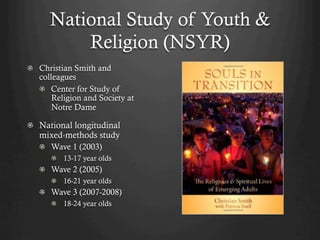
National Study of Youth and Religion (NSYR) 
Baylor Religion Survey 
The Pew Forum on Religion & Public Life 
Discussion & Analysis 
Small Group Activity
Questions to Consider 
1. How does this data challenge our assumptions? 
2. Does this data reflect the experience of our students? 
3. How might this data inform our practice?
UCLA Spirituality Study 
UCLA Higher Education Research 
Institute (HERI) 
http://spirituality.ucla.edu/ 
Seven-year study examining the role 
that college plays in facilitating the 
development of students’ spiritual 
qualities 
Focus on higher education and 
college student experience 
Spirituality is associated with 
enhanced college student outcomes in 
academic performance, psychological 
well-being, leadership development, 
and satisfaction in college 
https://www.youtube.com/watch? 
v=aJswcR0Brwo
Distinguishing 
Spiritual & Religious 
Spiritual 
Equanimity 
Spiritual Quest 
Ethic of Caring 
Charitable Involvement 
Ecumenical Worldview 
Religious 
Religious Commitment 
Religious Engagement 
Religious/Social 
Conservatism 
Religious Skepticism 
Religious Struggle
Center for Applied Research in 
the Apostolate (CARA) 
Georgetown University 
Focus on Catholicism and 
the Catholic Church 
Three major dimensions to 
mission 
To increase Church’s self-understanding 
To serve the applied 
research needs of Church 
decision-makers 
To advance scholarly 
research on religion, 
particularly Catholicism
Catholicism on Campus: 
Stability & Change in Catholic Student 
Faith by College Type 
Focus 
Beliefs and attitudes about social and political issues 
Religious behaviors 
Changes from freshman to juniors years 
UCLA sources 
Cooperative Institutional Research Program (CIRP) – Freshmen 
College Student Beliefs & Values (CSBV) – Juniors 
Catholic vs. other institution types 
No significant secularizing trend among Catholic students 
attending Catholic colleges 
Response to Cardinal Newman Society criticism regarding the 
negative impact of Catholic colleges and universities
Social Science Research Council 
Focusing on informing 
social reform, public 
policy 
The Immanent Frame: 
Secularism, religion, & 
public sphere 
http://blogs.ssrc.org/tif/ 
publications/
National Study of Youth & 
Religion (NSYR) 
Christian Smith and 
colleagues 
Center for Study of 
Religion and Society at 
Notre Dame 
National longitudinal 
mixed-methods study 
Wave 1 (2003) 
13-17 year olds 
Wave 2 (2005) 
16-21 year olds 
Wave 3 (2007-2008) 
18-24 year olds
Moralistic Therapeutic Deism 
1. A god exists who created and ordered the world and 
watches over human life on earth. 
2. God wants people to be good, nice, and fair to each other, as 
taught in the Bible and by most world religions. 
3. The central goal of life is to be happy and to feel good about 
oneself. 
4. God does not need to be particularly involved in one's life 
except when God is needed to resolve a problem. 
5. Good people go to heaven when they die.
Lost in Transition? 
Morality adrift 
Captive to consumerism 
Intoxication’s “Fake 
Feeling of Happiness” 
The Shadow Side of 
Sexual Liberation 
Civic and Political 
Disengagement
Six Major Religious Types 
1. Committed traditionalists (15%) 
2. Selective adherents (30%) 
3. Spiritually open (15%) 
4. Religiously indifferent (25%) 
5. Religiously disconnected (5%) 
6. Irreligious (10%) 
http://youtu.be/Fn_2AuOocRs?t=53m30s
Questions to Consider 
1. How does this data challenge our assumptions? 
2. Does this data reflect the experience of our students? 
3. How might this data inform our practice?
Baylor Religion Survey 
Baylor Institute for Studies of 
Religion 
Multi-year study of religious 
values and behaviors, with a 
specific focus on the consumption 
of religious goods and services 
Focus on religious commitment 
and devoutness 
“Losing My religion? No, Says 
Baylor Religion Survey” 
http://www.baylorisr.org/ 
programs-research/global-studies- 
of-religion/surveys-of-religion/
The “Four Gods” 
Authoritarian God – 31.4% of respondents 
Very judgmental and engaged 
Benevolent God – 25% of respondents 
Not judgmental but engaged 
Distant God – 23% of respondents 
Completely removed 
Critical God – 16% of respondents 
Judgmental but not engaged
The Pew Forum on 
Religion & Public Life 
Pew Research Center 
A nonpartisan fact tank that informs the public about the issues, 
attitudes, and trends shaping America and the world 
Religion & Public Life Project 
Seeks to promote a deeper understanding of issues at the 
intersection of religion and public affairs 
Examines shifting religious composition, influence of religion on 
politics, government and social restrictions on religion, and social 
issues (e.g. abortion, gay marriage, stem cell research, church-state 
controversies) 
Sources 
http://www.pewforum.org/about/ 
https://www.youtube.com/watch?v=Fp8LfFRiU8E
“Nones” on the Rise: One-in-Five 
Adults Have No Religious Affiliation 
(Funk & Smith, 2012, p. 9)
Religion Among the Millennials 
(Pew Research Center, 2010, p. 1)
Questions to Consider 
1. How does this data challenge our assumptions? 
2. Does this data reflect the experience of our students? 
3. How might this data inform our practice?
Discussion & Analysis 
What narratives about spirituality and religion do you hear? 
How do these narratives relate to spirituality, religion, and the 
college student experience? 
What is missing from the conversation? 
How could research and analysis of spirituality, religion, and 
the college student experience be improved?
College Student Experience? 
Limited research focusing on spirituality, religion, and the college 
student experience 
UCLA Spirituality Study, CIRP (freshmen), CSBV (juniors) 
CARA study of Catholic student experience based on CIRP and CSBV data 
Limited theological base, distinguishes spiritual and religious 
Others focus on: 
Young/emerging adults & Millennial generation 
NSYR 
Religious commitment and devoutness 
Baylor Religion Survey 
Religion & society 
SSRC 
American religious landscape 
Pew Forum
Spiritual & Religion = Values, 
Attitudes, and Behaviors? 
Majority of research focuses on values, attitudes, and 
behaviors 
Does this adequately capture spirituality, religion, and the 
college student experience? 
Does this data reflect the experience of our students? 
How could research on spirituality and religion be improved?
Small Group Activity 
1. Two colleges/universities in the Boston area 
2. Identify campus initiatives related to spirituality and religion 
Use Promising Practices (Lindholm et al., 2011) as your guide 
3. Programmatic analysis 
4. Institutional analysis 
5. Connect to readings and today’s lecture 
6. Provide recommendations for future growth

A Review of Research/Think Tanks Related to Spirituality & Religion

  • 1.
    A Review of Research/Think Tanks Related to Spirituality & Religion Daniel A. Zepp Boston College www.DanielZepp.com @DannyZepp
  • 2.
    Class Outline Reviewof Research/Think-Tanks UCLA Spirituality Survey Center for Applied Research in the Apostolate (CARA) Social Science Research Council (SSRC) National Study of Youth and Religion (NSYR) Baylor Religion Survey The Pew Forum on Religion & Public Life Discussion & Analysis Small Group Activity
  • 3.
    Questions to Consider 1. How does this data challenge our assumptions? 2. Does this data reflect the experience of our students? 3. How might this data inform our practice?
  • 4.
    UCLA Spirituality Study UCLA Higher Education Research Institute (HERI) http://spirituality.ucla.edu/ Seven-year study examining the role that college plays in facilitating the development of students’ spiritual qualities Focus on higher education and college student experience Spirituality is associated with enhanced college student outcomes in academic performance, psychological well-being, leadership development, and satisfaction in college https://www.youtube.com/watch? v=aJswcR0Brwo
  • 5.
    Distinguishing Spiritual &Religious Spiritual Equanimity Spiritual Quest Ethic of Caring Charitable Involvement Ecumenical Worldview Religious Religious Commitment Religious Engagement Religious/Social Conservatism Religious Skepticism Religious Struggle
  • 6.
    Center for AppliedResearch in the Apostolate (CARA) Georgetown University Focus on Catholicism and the Catholic Church Three major dimensions to mission To increase Church’s self-understanding To serve the applied research needs of Church decision-makers To advance scholarly research on religion, particularly Catholicism
  • 7.
    Catholicism on Campus: Stability & Change in Catholic Student Faith by College Type Focus Beliefs and attitudes about social and political issues Religious behaviors Changes from freshman to juniors years UCLA sources Cooperative Institutional Research Program (CIRP) – Freshmen College Student Beliefs & Values (CSBV) – Juniors Catholic vs. other institution types No significant secularizing trend among Catholic students attending Catholic colleges Response to Cardinal Newman Society criticism regarding the negative impact of Catholic colleges and universities
  • 8.
    Social Science ResearchCouncil Focusing on informing social reform, public policy The Immanent Frame: Secularism, religion, & public sphere http://blogs.ssrc.org/tif/ http://blogs.ssrc.org/tif/ publications/
  • 9.
    National Study ofYouth & Religion (NSYR) Christian Smith and colleagues Center for Study of Religion and Society at Notre Dame National longitudinal mixed-methods study Wave 1 (2003) 13-17 year olds Wave 2 (2005) 16-21 year olds Wave 3 (2007-2008) 18-24 year olds
  • 10.
    Moralistic Therapeutic Deism 1. A god exists who created and ordered the world and watches over human life on earth. 2. God wants people to be good, nice, and fair to each other, as taught in the Bible and by most world religions. 3. The central goal of life is to be happy and to feel good about oneself. 4. God does not need to be particularly involved in one's life except when God is needed to resolve a problem. 5. Good people go to heaven when they die.
  • 11.
    Lost in Transition? Morality adrift Captive to consumerism Intoxication’s “Fake Feeling of Happiness” The Shadow Side of Sexual Liberation Civic and Political Disengagement
  • 12.
    Six Major ReligiousTypes 1. Committed traditionalists (15%) 2. Selective adherents (30%) 3. Spiritually open (15%) 4. Religiously indifferent (25%) 5. Religiously disconnected (5%) 6. Irreligious (10%) http://youtu.be/Fn_2AuOocRs?t=53m30s
  • 13.
    Questions to Consider 1. How does this data challenge our assumptions? 2. Does this data reflect the experience of our students? 3. How might this data inform our practice?
  • 14.
    Baylor Religion Survey Baylor Institute for Studies of Religion Multi-year study of religious values and behaviors, with a specific focus on the consumption of religious goods and services Focus on religious commitment and devoutness “Losing My religion? No, Says Baylor Religion Survey” http://www.baylorisr.org/ programs-research/global-studies- of-religion/surveys-of-religion/
  • 15.
    The “Four Gods” Authoritarian God – 31.4% of respondents Very judgmental and engaged Benevolent God – 25% of respondents Not judgmental but engaged Distant God – 23% of respondents Completely removed Critical God – 16% of respondents Judgmental but not engaged
  • 16.
    The Pew Forumon Religion & Public Life Pew Research Center A nonpartisan fact tank that informs the public about the issues, attitudes, and trends shaping America and the world Religion & Public Life Project Seeks to promote a deeper understanding of issues at the intersection of religion and public affairs Examines shifting religious composition, influence of religion on politics, government and social restrictions on religion, and social issues (e.g. abortion, gay marriage, stem cell research, church-state controversies) Sources http://www.pewforum.org/about/ https://www.youtube.com/watch?v=Fp8LfFRiU8E
  • 17.
    “Nones” on theRise: One-in-Five Adults Have No Religious Affiliation (Funk & Smith, 2012, p. 9)
  • 18.
    Religion Among theMillennials (Pew Research Center, 2010, p. 1)
  • 19.
    Questions to Consider 1. How does this data challenge our assumptions? 2. Does this data reflect the experience of our students? 3. How might this data inform our practice?
  • 20.
    Discussion & Analysis What narratives about spirituality and religion do you hear? How do these narratives relate to spirituality, religion, and the college student experience? What is missing from the conversation? How could research and analysis of spirituality, religion, and the college student experience be improved?
  • 21.
    College Student Experience? Limited research focusing on spirituality, religion, and the college student experience UCLA Spirituality Study, CIRP (freshmen), CSBV (juniors) CARA study of Catholic student experience based on CIRP and CSBV data Limited theological base, distinguishes spiritual and religious Others focus on: Young/emerging adults & Millennial generation NSYR Religious commitment and devoutness Baylor Religion Survey Religion & society SSRC American religious landscape Pew Forum
  • 22.
    Spiritual & Religion= Values, Attitudes, and Behaviors? Majority of research focuses on values, attitudes, and behaviors Does this adequately capture spirituality, religion, and the college student experience? Does this data reflect the experience of our students? How could research on spirituality and religion be improved?
  • 23.
    Small Group Activity 1. Two colleges/universities in the Boston area 2. Identify campus initiatives related to spirituality and religion Use Promising Practices (Lindholm et al., 2011) as your guide 3. Programmatic analysis 4. Institutional analysis 5. Connect to readings and today’s lecture 6. Provide recommendations for future growth