Chapter 4 The Future of the Financial System and the Money and Capital Markets
  Learning Objectives   To explore the economic, demographic, social, and technological forces reshaping the financial system today. To learn about recent trends in the financial system and how they may affect us in the future. To understand how the problems the financial system faces today may affect its future, leading to a new financial marketplace.
Introduction Powerful forces are reshaping financial institutions and financial services today. These forces for change include powerful new trends within the financial sector itself, major changes in the structure and functioning of the economy, and  new social and demographic trends that are altering the public’s need for new financial services.
Financial Forces Reshaping the Money and Capital Markets Today Financial innovation  - the development of many new financial services and instruments Service proliferation  - the expansion of the menu of financial services offered Competition  - the intense struggle for the customer’s business Consolidation  -  mergers and acquisitions  have created financial giants out of numerous smaller financial-service providers
Financial Forces Reshaping the Money and Capital Markets Today Deregulation  - the lightening or elimination of government rules brought about by a strategy of  privatization  of the financial sector   Convergence  - the blurring of the traditional distinctions among different types of financial-service institutions Homogenization  - the growing similarity in the service menus offered by financial institutions
Financial Forces Reshaping the Money and Capital Markets Today Globalization  - the global expansion of operations and the falling of geographical barriers Market broadening  - the expansion of traditionally local markets to become regional, national, or even international in scope   Securitization  -  the pooling of loans and the issuance of securities as claims against the loan pool
Social, Economic, & Demographic Forces Reshaping the Financial System Aging population  - there is a greater need for retirement, tax and estate planning Changing basic family unit  - the rise in the proportion of single-parent households, parents and children living apart, immigrants, and well-educated working women will increase the demand for new forms of housing, daycare facilities, flexible work schedules, and less expensive medical care
Social, Economic, & Demographic Forces Reshaping the Financial System Displacement of manufacturing industries by service industries in more developed economies Technological innovation  - the dissemination and storage of information today is broader, cheaper, faster, and more accurate Internationalization of markets  - such as the emergence of the European Union
Forces Affecting the Financial System of the Future
Dealing with Risk in the Financial System: The Challenges and Opportunities The money and capital markets and the financial institutions that operate within them depend heavily on  public confidence . Loss of public confidence not only produces adverse consequences for individual financial institutions but also damages the efficiency of financial market processes.
Dealing with Risk in the Financial System: The Challenges and Opportunities The strength and viability of financial institutions, and hence public confidence, can be promoted through: government insurance systems Federal Deposit Insurance Corporation (FDIC) Pension Benefit Guaranty Corporation (PBGC) regulation of capital  equity capital requirements private responses  market discipline developing better risk-management tools
Risk in the Financial System: The Challenges and Opportunities However, the efforts made at promoting public confidence are limited by the information problem - capital market investors can only  approximately  price the securities of institutions that do not fully disclose their financial condition and prospects.
New Technology : The Challenges and Opportunities The technological revolution in information analysis, storage, and transfer is moving at an accelerating pace. Global integrated electronic networks are changing the design and delivery of financial services: Internet or World Wide Web Cellular telephones and hand-held computers Smart cards
New Technology : The Challenges and Opportunities However, the adjustment of the public to the unfolding technological revolution will probably be slower than the revolution itself. The areas to watch include: friendliness of the user interface operating costs and service prices ease of technological upgrades data integrity and system security
The Changing Mix of Financial-Service Suppliers: Challenges and Opportunities Financial-service firms will face increasingly intense competition and price-sensitive customers. Financial institutions with extensive service delivery systems will have a competitive advantage.
The Changing Mix of Financial-Service Suppliers: Challenges and Opportunities The unfolding new markets will require new financial institutions and instruments, such as credit risk derivatives and additional secondary markets for loans. New institutions will also be needed to facilitate the continuing trend towards securitization of many of the credit-related assets held by lending institutions and other corporations.
Consolidations and Convergences: The Challenges and Opportunities Proponents argue that: The elimination of duplication will bring about substantial savings in operational costs. The broadening of services and customer segments will accelerate the growth in revenue. The greater diversification will reduce overall risk. The combination of expertise will result in higher-quality products and services.
Consolidations and Convergences: The Challenges and Opportunities Proponents argue that: The greater economies of scale will increase the affordability of the latest technologies. The greater efficiency in joint marketing and cross-selling will help tie in customers.
Consolidations and Convergences: The Challenges and Opportunities Opponents point out that: The greater complexities of the firm may increase its operating costs. The public’s demand for “one stop” financial shopping may have been overestimated. Smaller financial-service companies may have their own competitive advantage. Smaller financial-service companies may compete effectively in terms of the range of services available by outsourcing part of their operations.
Financial Services Regulation The growing consolidation and convergence of financial-service companies poses major new challenges for the regulatory agencies charged with maintaining a competitive, yet safe and stable, financial system. This dual concern has led to the development of several different regulatory approaches.
Financial Services Regulation Financial Holding Company Model Financial Holding Company Insurance Companies, Underwriters and Agents Security Brokers, Dealers and Underwriters Banking Firms Other Financial- Service Companies
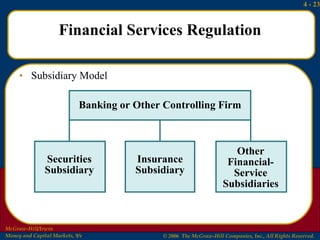
Financial Services Regulation Subsidiary Model Banking or Other Controlling Firm Securities Subsidiary Insurance Subsidiary Other Financial-Service Subsidiaries
Financial Services Regulation Single Regulator Model Holding Company or Parent Firm Affiliated and/or Subsidiary Companies One Regulatory Agency Supervises the Operations of the Whole Financial Service Firm
Financial Services Regulation Functional Regulator Model Holding Company or Parent Firm Securities Firm Insurance Company Bank Holding Company Regulator Securities Regulator Insurance Regulator Bank Regulator
Financial Services Regulation The difficulties of coordination and control in larger and more diversified financial institutions call for: employees who are well trained in coordination and control skills, strong internal auditing procedures and management information systems, and continual evaluation of subsidiary firms, profit centers, and service functions for their contributions to the goals of the financial firm.
The Future of the Payments System Tomorrow’s economy and financial marketplace will depend crucially upon the continuing ability of the world’s payments system to function efficiently, speedily, and accurately. In the U.S., the retail payments system lags behind the wholesale payments system in converting from expensive paper transactions to electronic systems.
The Future Need for Regulation of Financial Institutions The recent trend toward deregulation is likely to continue, leading to: reduced barriers to geographic diversification, reduced restrictions on the portfolio choices made by financial institutions, reorganization of regulatory agencies, reduced barriers to product-line diversification, and greater reliance on firms’ self-assessments of financial risks.
The Future Need for Regulation of Financial Institutions However, there are some regulations which will be maintained or even re-emphasized: financial disclosure regulations, privacy protection regulations, regulations pertaining to social responsibility, and regulations that promote a level playing field.
Markets on the Net American Bankers Association at  www.aba.com/Industry+Issues Consumer Law at  www.consumerlaw.org Federal Deposit Insurance Corporation at  www.fdic.gov Federal Reserve System at  www.federalreserve.gov Federal Trade Commission at  www.ftc.gov
Markets on the Net FinPipe at  www.finpipe.com/derivglossary.htm New York Stock Exchange at  www.nyse.com Pension Benefit Guaranty Corporation at  www.pbgc.gov Quote.com at  www.quote.com U.S. Bureau of the Census at  www.census.gov
Chapter Review Introduction: The Financial Markets in Change Financial Forces Reshaping the Money and Capital Markets Today Social, Economic, and Demographic Forces Reshaping the Financial System
Chapter Review The Challenges and Opportunities Presented by Recent Trends Dealing with Risk in the Financial System: Ensuring the Strength and Viability of Financial Institutions and Increasing Public Confidence The Effect of New Technology on the Design and Delivery of Financial Services The Changing Mix of Financial-Service Suppliers  Consolidations and Convergences within the Financial System
Chapter Review A New Role for Financial-Services Regulation in an Age of Financial-Services Consolidation and Convergence The Future of the Payments System The Future Need for Regulation of Financial Institutions Regulations That Could Grow

Ch04

  • 1.
  • 2.
    Chapter 4 TheFuture of the Financial System and the Money and Capital Markets
  • 3.
     LearningObjectives  To explore the economic, demographic, social, and technological forces reshaping the financial system today. To learn about recent trends in the financial system and how they may affect us in the future. To understand how the problems the financial system faces today may affect its future, leading to a new financial marketplace.
  • 4.
    Introduction Powerful forcesare reshaping financial institutions and financial services today. These forces for change include powerful new trends within the financial sector itself, major changes in the structure and functioning of the economy, and new social and demographic trends that are altering the public’s need for new financial services.
  • 5.
    Financial Forces Reshapingthe Money and Capital Markets Today Financial innovation - the development of many new financial services and instruments Service proliferation - the expansion of the menu of financial services offered Competition - the intense struggle for the customer’s business Consolidation - mergers and acquisitions have created financial giants out of numerous smaller financial-service providers
  • 6.
    Financial Forces Reshapingthe Money and Capital Markets Today Deregulation - the lightening or elimination of government rules brought about by a strategy of privatization of the financial sector Convergence - the blurring of the traditional distinctions among different types of financial-service institutions Homogenization - the growing similarity in the service menus offered by financial institutions
  • 7.
    Financial Forces Reshapingthe Money and Capital Markets Today Globalization - the global expansion of operations and the falling of geographical barriers Market broadening - the expansion of traditionally local markets to become regional, national, or even international in scope Securitization - the pooling of loans and the issuance of securities as claims against the loan pool
  • 8.
    Social, Economic, &Demographic Forces Reshaping the Financial System Aging population - there is a greater need for retirement, tax and estate planning Changing basic family unit - the rise in the proportion of single-parent households, parents and children living apart, immigrants, and well-educated working women will increase the demand for new forms of housing, daycare facilities, flexible work schedules, and less expensive medical care
  • 9.
    Social, Economic, &Demographic Forces Reshaping the Financial System Displacement of manufacturing industries by service industries in more developed economies Technological innovation - the dissemination and storage of information today is broader, cheaper, faster, and more accurate Internationalization of markets - such as the emergence of the European Union
  • 10.
    Forces Affecting theFinancial System of the Future
  • 11.
    Dealing with Riskin the Financial System: The Challenges and Opportunities The money and capital markets and the financial institutions that operate within them depend heavily on public confidence . Loss of public confidence not only produces adverse consequences for individual financial institutions but also damages the efficiency of financial market processes.
  • 12.
    Dealing with Riskin the Financial System: The Challenges and Opportunities The strength and viability of financial institutions, and hence public confidence, can be promoted through: government insurance systems Federal Deposit Insurance Corporation (FDIC) Pension Benefit Guaranty Corporation (PBGC) regulation of capital equity capital requirements private responses market discipline developing better risk-management tools
  • 13.
    Risk in theFinancial System: The Challenges and Opportunities However, the efforts made at promoting public confidence are limited by the information problem - capital market investors can only approximately price the securities of institutions that do not fully disclose their financial condition and prospects.
  • 14.
    New Technology :The Challenges and Opportunities The technological revolution in information analysis, storage, and transfer is moving at an accelerating pace. Global integrated electronic networks are changing the design and delivery of financial services: Internet or World Wide Web Cellular telephones and hand-held computers Smart cards
  • 15.
    New Technology :The Challenges and Opportunities However, the adjustment of the public to the unfolding technological revolution will probably be slower than the revolution itself. The areas to watch include: friendliness of the user interface operating costs and service prices ease of technological upgrades data integrity and system security
  • 16.
    The Changing Mixof Financial-Service Suppliers: Challenges and Opportunities Financial-service firms will face increasingly intense competition and price-sensitive customers. Financial institutions with extensive service delivery systems will have a competitive advantage.
  • 17.
    The Changing Mixof Financial-Service Suppliers: Challenges and Opportunities The unfolding new markets will require new financial institutions and instruments, such as credit risk derivatives and additional secondary markets for loans. New institutions will also be needed to facilitate the continuing trend towards securitization of many of the credit-related assets held by lending institutions and other corporations.
  • 18.
    Consolidations and Convergences:The Challenges and Opportunities Proponents argue that: The elimination of duplication will bring about substantial savings in operational costs. The broadening of services and customer segments will accelerate the growth in revenue. The greater diversification will reduce overall risk. The combination of expertise will result in higher-quality products and services.
  • 19.
    Consolidations and Convergences:The Challenges and Opportunities Proponents argue that: The greater economies of scale will increase the affordability of the latest technologies. The greater efficiency in joint marketing and cross-selling will help tie in customers.
  • 20.
    Consolidations and Convergences:The Challenges and Opportunities Opponents point out that: The greater complexities of the firm may increase its operating costs. The public’s demand for “one stop” financial shopping may have been overestimated. Smaller financial-service companies may have their own competitive advantage. Smaller financial-service companies may compete effectively in terms of the range of services available by outsourcing part of their operations.
  • 21.
    Financial Services RegulationThe growing consolidation and convergence of financial-service companies poses major new challenges for the regulatory agencies charged with maintaining a competitive, yet safe and stable, financial system. This dual concern has led to the development of several different regulatory approaches.
  • 22.
    Financial Services RegulationFinancial Holding Company Model Financial Holding Company Insurance Companies, Underwriters and Agents Security Brokers, Dealers and Underwriters Banking Firms Other Financial- Service Companies
  • 23.
    Financial Services RegulationSubsidiary Model Banking or Other Controlling Firm Securities Subsidiary Insurance Subsidiary Other Financial-Service Subsidiaries
  • 24.
    Financial Services RegulationSingle Regulator Model Holding Company or Parent Firm Affiliated and/or Subsidiary Companies One Regulatory Agency Supervises the Operations of the Whole Financial Service Firm
  • 25.
    Financial Services RegulationFunctional Regulator Model Holding Company or Parent Firm Securities Firm Insurance Company Bank Holding Company Regulator Securities Regulator Insurance Regulator Bank Regulator
  • 26.
    Financial Services RegulationThe difficulties of coordination and control in larger and more diversified financial institutions call for: employees who are well trained in coordination and control skills, strong internal auditing procedures and management information systems, and continual evaluation of subsidiary firms, profit centers, and service functions for their contributions to the goals of the financial firm.
  • 27.
    The Future ofthe Payments System Tomorrow’s economy and financial marketplace will depend crucially upon the continuing ability of the world’s payments system to function efficiently, speedily, and accurately. In the U.S., the retail payments system lags behind the wholesale payments system in converting from expensive paper transactions to electronic systems.
  • 28.
    The Future Needfor Regulation of Financial Institutions The recent trend toward deregulation is likely to continue, leading to: reduced barriers to geographic diversification, reduced restrictions on the portfolio choices made by financial institutions, reorganization of regulatory agencies, reduced barriers to product-line diversification, and greater reliance on firms’ self-assessments of financial risks.
  • 29.
    The Future Needfor Regulation of Financial Institutions However, there are some regulations which will be maintained or even re-emphasized: financial disclosure regulations, privacy protection regulations, regulations pertaining to social responsibility, and regulations that promote a level playing field.
  • 30.
    Markets on theNet American Bankers Association at www.aba.com/Industry+Issues Consumer Law at www.consumerlaw.org Federal Deposit Insurance Corporation at www.fdic.gov Federal Reserve System at www.federalreserve.gov Federal Trade Commission at www.ftc.gov
  • 31.
    Markets on theNet FinPipe at www.finpipe.com/derivglossary.htm New York Stock Exchange at www.nyse.com Pension Benefit Guaranty Corporation at www.pbgc.gov Quote.com at www.quote.com U.S. Bureau of the Census at www.census.gov
  • 32.
    Chapter Review Introduction:The Financial Markets in Change Financial Forces Reshaping the Money and Capital Markets Today Social, Economic, and Demographic Forces Reshaping the Financial System
  • 33.
    Chapter Review TheChallenges and Opportunities Presented by Recent Trends Dealing with Risk in the Financial System: Ensuring the Strength and Viability of Financial Institutions and Increasing Public Confidence The Effect of New Technology on the Design and Delivery of Financial Services The Changing Mix of Financial-Service Suppliers Consolidations and Convergences within the Financial System
  • 34.
    Chapter Review ANew Role for Financial-Services Regulation in an Age of Financial-Services Consolidation and Convergence The Future of the Payments System The Future Need for Regulation of Financial Institutions Regulations That Could Grow