SECURITIES
REGULATION CODE
R.A. 8799
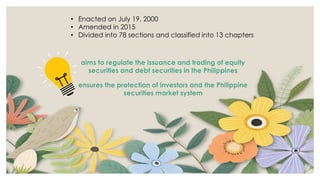
• Enacted on July 19, 2000
• Amended in 2015
• Divided into 78 sections and classified into 13 chapters
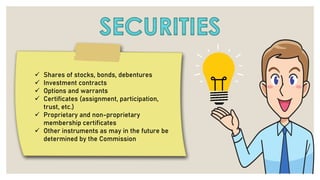
✓ Shares of stocks, bonds, debentures
✓ Investment contracts
✓ Options and warrants
✓ Certificates (assignment, participation,
trust, etc.)
✓ Proprietary and non-proprietary
membership certificates
✓ Other instruments as may in the future be
determined by the Commission
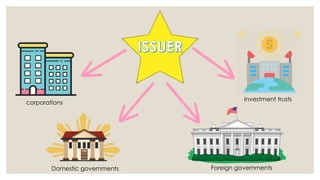
corporations
Domestic governments Foreign governments
Investment trusts
BROKERS DEALERS
agents who
buy and
sell
securities
for others
buy and sell
securities
for
themselves
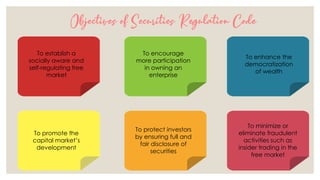
Objectives of Securities Regulation Code
To establish a
socially aware and
self-regulating free
market
To encourage
more participation
in owning an
enterprise
To enhance the
democratization
of wealth
To promote the
capital market’s
development
To protect investors
by ensuring full and
fair disclosure of
securities
To minimize or
eliminate fraudulent
activities such as
insider trading in the
free market
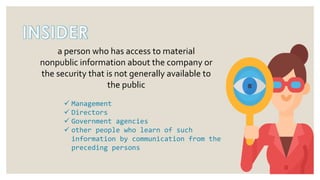
a person who has access to material
nonpublic information about the company or
the security that is not generally available to
the public
✓ Management
✓ Directors
✓ Government agencies
✓ other people who learn of such
information by communication from the
preceding persons
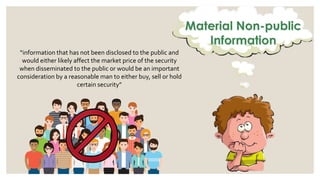
“information that has not been disclosed to the public and
would either likely affect the market price of the security
when disseminated to the public or would be an important
consideration by a reasonable man to either buy, sell or hold
certain security”
“trading security with the knowledge
of nonpublic material information.”
An insider may still trade if:
✓ he proves that the information was not
gained from his connection or function
✓ he proves that the person he transacts
with is aware of the non-material
information
It is unlawful for any person:
❖To create false or misleading appearance of
active trade on any listed security in an
Exchange or any other market:
• By effecting any transaction in such security which
involves no change in the beneficial ownership
• By participating in the sale or purchase of such
security with the insider knowledge of other involved
parties
• By performing similar acts where there is no change in
beneficial ownership
❖To circulate information that the price of any security listed
in an Exchange will or is likely to rise or fall because of
manipulative market operations
❖To effect a series of transactions in securities:
• Raises their price to induce the purchase of security
• Depresses their price to induce the sale of a security
❖To make false or misleading statements with respect to
any material fact to induce the purchase or sale of any
security
• Employ any device, scheme, or artifice to defraud;
• Obtain money or property by means of any untrue
statement of a material fact of any omission to state
a material fact necessary in order to make the
statements made, in the light of the circumstances
under which they were made, not misleading; or
• Engage in any act, transaction, practice or course of
business which operates or would operate as a fraud
or deceit upon any person.
❑ Painting the tape
❑ Marking the close
❑ Improper matched orders
❑ Wash sales
❑ Squeezing the float
❑ Hype and dump
❑ Short and distort
❑ Disseminating false or misleading market information through
media, including the internet, or any other means to move the
price of a security in a direction that is favorable to a position held
or a transaction
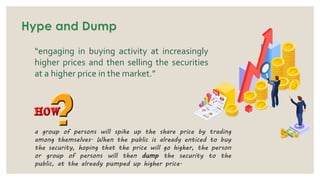
“engaging in buying activity at increasingly
higher prices and then selling the securities
at a higher price in the market.”
a group of persons will spike up the share price by trading
among themselves. When the public is already enticed to buy
the security, hoping that the price will go higher, the person
or group of persons will then dump the security to the
public, at the already pumped up higher price.
• fine of not less than P50,000 nor more than
P5 million
• imprisonment of not less than seven years
nor more than 21 years, or both, for every
violation.
Shall not be sold or offered for sale or distribution within the
Philippines, without a registration statement duly filed with
and approved by the Commission. Prior to such sale,
information on security made available to each prospective
purchaser.
A primary means of protecting the investing public is the
disclosure of the important financial information through
the registration of securities which enables investors to
make informed judgments.
All companies, listed or applying for listing, are
required to divulge truthfully and accurately, all
material information about themselves and the
securities they sell for the protection of the investing
public pain of administrative, criminal and civil
sanctions
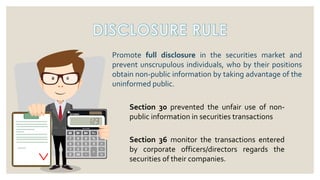
Section 30 prevented the unfair use of non-
public information in securities transactions
Section 36 monitor the transactions entered
by corporate officers/directors regards the
securities of their companies.
Promote full disclosure in the securities market and
prevent unscrupulous individuals, who by their positions
obtain non-public information by taking advantage of the
uninformed public.
1) False registration statement
2) In violation of registration requirements
3) Fraud in connection with securities transaction
4) Manipulation of security prices
5) Commodity futures contracts and pre-need plans
6) By mean of prospectus or communication with untrue statement
7) Insider trading
Securities Regulation Code of the Philippines

Securities Regulation Code of the Philippines

  • 1.
  • 2.
    • Enacted onJuly 19, 2000 • Amended in 2015 • Divided into 78 sections and classified into 13 chapters
  • 3.
    ✓ Shares ofstocks, bonds, debentures ✓ Investment contracts ✓ Options and warrants ✓ Certificates (assignment, participation, trust, etc.) ✓ Proprietary and non-proprietary membership certificates ✓ Other instruments as may in the future be determined by the Commission
  • 4.
    corporations Domestic governments Foreigngovernments Investment trusts
  • 5.
    BROKERS DEALERS agents who buyand sell securities for others buy and sell securities for themselves
  • 7.
    Objectives of SecuritiesRegulation Code To establish a socially aware and self-regulating free market To encourage more participation in owning an enterprise To enhance the democratization of wealth To promote the capital market’s development To protect investors by ensuring full and fair disclosure of securities To minimize or eliminate fraudulent activities such as insider trading in the free market
  • 9.
    a person whohas access to material nonpublic information about the company or the security that is not generally available to the public ✓ Management ✓ Directors ✓ Government agencies ✓ other people who learn of such information by communication from the preceding persons
  • 10.
    “information that hasnot been disclosed to the public and would either likely affect the market price of the security when disseminated to the public or would be an important consideration by a reasonable man to either buy, sell or hold certain security”
  • 11.
    “trading security withthe knowledge of nonpublic material information.” An insider may still trade if: ✓ he proves that the information was not gained from his connection or function ✓ he proves that the person he transacts with is aware of the non-material information
  • 12.
    It is unlawfulfor any person: ❖To create false or misleading appearance of active trade on any listed security in an Exchange or any other market: • By effecting any transaction in such security which involves no change in the beneficial ownership • By participating in the sale or purchase of such security with the insider knowledge of other involved parties • By performing similar acts where there is no change in beneficial ownership
  • 13.
    ❖To circulate informationthat the price of any security listed in an Exchange will or is likely to rise or fall because of manipulative market operations ❖To effect a series of transactions in securities: • Raises their price to induce the purchase of security • Depresses their price to induce the sale of a security ❖To make false or misleading statements with respect to any material fact to induce the purchase or sale of any security
  • 14.
    • Employ anydevice, scheme, or artifice to defraud; • Obtain money or property by means of any untrue statement of a material fact of any omission to state a material fact necessary in order to make the statements made, in the light of the circumstances under which they were made, not misleading; or • Engage in any act, transaction, practice or course of business which operates or would operate as a fraud or deceit upon any person.
  • 15.
    ❑ Painting thetape ❑ Marking the close ❑ Improper matched orders ❑ Wash sales ❑ Squeezing the float ❑ Hype and dump ❑ Short and distort ❑ Disseminating false or misleading market information through media, including the internet, or any other means to move the price of a security in a direction that is favorable to a position held or a transaction
  • 16.
    “engaging in buyingactivity at increasingly higher prices and then selling the securities at a higher price in the market.” a group of persons will spike up the share price by trading among themselves. When the public is already enticed to buy the security, hoping that the price will go higher, the person or group of persons will then dump the security to the public, at the already pumped up higher price.
  • 17.
    • fine ofnot less than P50,000 nor more than P5 million • imprisonment of not less than seven years nor more than 21 years, or both, for every violation.
  • 19.
    Shall not besold or offered for sale or distribution within the Philippines, without a registration statement duly filed with and approved by the Commission. Prior to such sale, information on security made available to each prospective purchaser. A primary means of protecting the investing public is the disclosure of the important financial information through the registration of securities which enables investors to make informed judgments.
  • 20.
    All companies, listedor applying for listing, are required to divulge truthfully and accurately, all material information about themselves and the securities they sell for the protection of the investing public pain of administrative, criminal and civil sanctions
  • 21.
    Section 30 preventedthe unfair use of non- public information in securities transactions Section 36 monitor the transactions entered by corporate officers/directors regards the securities of their companies. Promote full disclosure in the securities market and prevent unscrupulous individuals, who by their positions obtain non-public information by taking advantage of the uninformed public.
  • 23.
    1) False registrationstatement 2) In violation of registration requirements 3) Fraud in connection with securities transaction 4) Manipulation of security prices 5) Commodity futures contracts and pre-need plans 6) By mean of prospectus or communication with untrue statement 7) Insider trading