COMPARATIVE
DEVELOPMENT
EXPERIENCES OF INDIA
&
its Neighbours(Pakistan,China)
BIJU P MPGT ECONOMICS KV 2 ,KOCHI
INTRODUCTION
• The economic transformation that is taking place
in different countries across the world partly because of the process
of Globalization.
SAARC
Nations are forming regional and Global economic groupings such
as SAARC( South Asian Association for regional Co-operation)
Bangladesh,Bhutan,India,Maldives,Pak,Nepal,
Srilanka and Afghanistan.
ASEAN
( Association of south east Asian nations)
Thailand,Indonesia,Malasia,Singapore,Phillippines,Brunei,Myanmar,
Cambodia, vietnam , Darussalem,laos
G-8
The eight consisting of Canada France, Germany, Italy, Japan,Britain,&
Northern Ireland,The USA and Russian federation.
G-20
Group of developing countries Established to focus on issues relating
to trade & Agriculture in the world Trade organization.
The group includes-
Argeentina,Bolivia,Brazil, Chile,China,Cuba,Egypt,
Guatemala,India,Indonesia, Maxico, Nigeria,Pak,Paraguay,
Phillippines,South Africa,Thailand, Tanzania,
Venezuela,and Zimbabwe)
Developmental Path -A Snapshot View
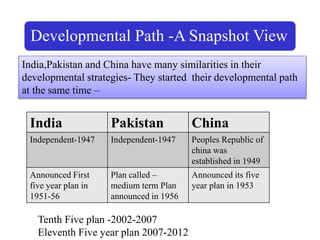
India,Pakistan and China have many similarities in their
developmental strategies- They started their developmental path
at the same time –
India Pakistan China
Independent-1947 Independent-1947 Peoples Republic of
china was
established in 1949
Announced First
five year plan in
1951-56
Plan called –
medium term Plan
announced in 1956
Announced its five
year plan in 1953
Tenth Five plan -2002-2007
Eleventh Five year plan 2007-2012
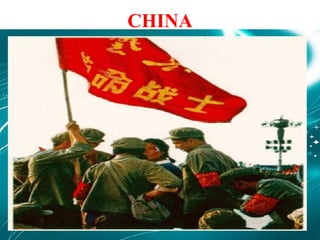
CHINA
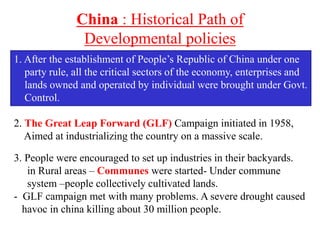
China : Historical Path of
Developmental policies
1. After the establishment of People’s Republic of China under one
party rule, all the critical sectors of the economy, enterprises and
lands owned and operated by individual were brought under Govt.
Control.
2. The Great Leap Forward (GLF) Campaign initiated in 1958,
Aimed at industrializing the country on a massive scale.
3. People were encouraged to set up industries in their backyards.
in Rural areas – Communes were started- Under commune
system –people collectively cultivated lands.
- GLF campaign met with many problems. A severe drought caused
havoc in china killing about 30 million people.
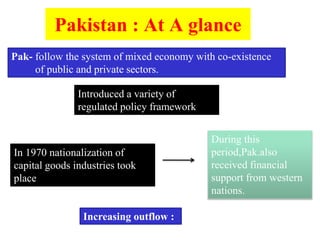
Pakistan : At A glance
Pak- follow the system of mixed economy with co-existence
of public and private sectors.
Introduced a variety of
regulated policy framework
In 1970 nationalization of
capital goods industries took
place
During this
period,Pak.also
received financial
support from western
nations.
Increasing outflow :
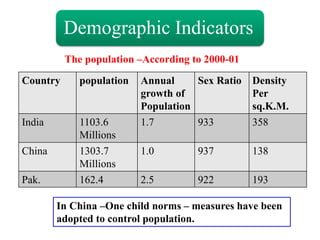
Demographic Indicators
Country population Annual
growth of
Population
Sex Ratio Density
Per
sq.K.M.
India 1103.6
Millions
1.7 933 358
China 1303.7
Millions
1.0 937 138
Pak. 162.4 2.5 922 193
The population –According to 2000-01
In China –One child norms – measures have been
adopted to control population.
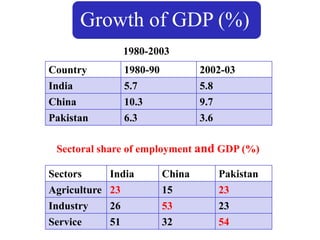
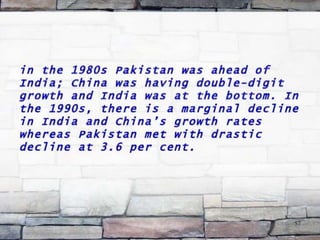
Growth of GDP (%)
1980-2003
Country 1980-90 2002-03
India 5.7 5.8
China 10.3 9.7
Pakistan 6.3 3.6
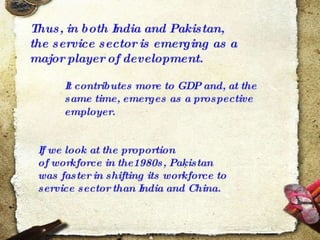
Sectors India China Pakistan
Agriculture 23 15 23
Industry 26 53 23
Service 51 32 54
Sectoral share of employment and GDP (%)
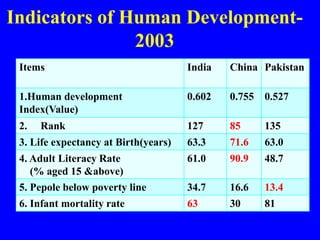
Indicators of Human Development-
2003
Items India China Pakistan
1.Human development
Index(Value)
0.602 0.755 0.527
2. Rank 127 85 135
3. Life expectancy at Birth(years) 63.3 71.6 63.0
4. Adult Literacy Rate
(% aged 15 &above)
61.0 90.9 48.7
5. Pepole below poverty line 34.7 16.6 13.4
6. Infant mortality rate 63 30 81
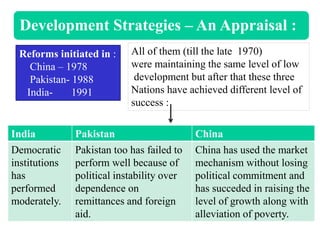
Development Strategies – An Appraisal :
Reforms initiated in :
China – 1978
Pakistan- 1988
India- 1991
All of them (till the late 1970)
were maintaining the same level of low
development but after that these three
Nations have achieved different level of
success :
India Pakistan China
Democratic
institutions
has
performed
moderately.
Pakistan too has failed to
perform well because of
political instability over
dependence on
remittances and foreign
aid.
China has used the market
mechanism without losing
political commitment and
has succeded in raising the
level of growth along with
alleviation of poverty.
ch 8 INDIAN ECONOMIC DEVELOPMENT PPT  VOLUME

ch 8 INDIAN ECONOMIC DEVELOPMENT PPT VOLUME

  • 1.
    COMPARATIVE DEVELOPMENT EXPERIENCES OF INDIA & itsNeighbours(Pakistan,China) BIJU P MPGT ECONOMICS KV 2 ,KOCHI
  • 3.
    INTRODUCTION • The economictransformation that is taking place in different countries across the world partly because of the process of Globalization. SAARC Nations are forming regional and Global economic groupings such as SAARC( South Asian Association for regional Co-operation) Bangladesh,Bhutan,India,Maldives,Pak,Nepal, Srilanka and Afghanistan. ASEAN ( Association of south east Asian nations) Thailand,Indonesia,Malasia,Singapore,Phillippines,Brunei,Myanmar, Cambodia, vietnam , Darussalem,laos
  • 4.
    G-8 The eight consistingof Canada France, Germany, Italy, Japan,Britain,& Northern Ireland,The USA and Russian federation. G-20 Group of developing countries Established to focus on issues relating to trade & Agriculture in the world Trade organization. The group includes- Argeentina,Bolivia,Brazil, Chile,China,Cuba,Egypt, Guatemala,India,Indonesia, Maxico, Nigeria,Pak,Paraguay, Phillippines,South Africa,Thailand, Tanzania, Venezuela,and Zimbabwe)
  • 5.
    Developmental Path -ASnapshot View India,Pakistan and China have many similarities in their developmental strategies- They started their developmental path at the same time – India Pakistan China Independent-1947 Independent-1947 Peoples Republic of china was established in 1949 Announced First five year plan in 1951-56 Plan called – medium term Plan announced in 1956 Announced its five year plan in 1953 Tenth Five plan -2002-2007 Eleventh Five year plan 2007-2012
  • 6.
  • 7.
    China : HistoricalPath of Developmental policies 1. After the establishment of People’s Republic of China under one party rule, all the critical sectors of the economy, enterprises and lands owned and operated by individual were brought under Govt. Control. 2. The Great Leap Forward (GLF) Campaign initiated in 1958, Aimed at industrializing the country on a massive scale. 3. People were encouraged to set up industries in their backyards. in Rural areas – Communes were started- Under commune system –people collectively cultivated lands. - GLF campaign met with many problems. A severe drought caused havoc in china killing about 30 million people.
  • 14.
    Pakistan : AtA glance Pak- follow the system of mixed economy with co-existence of public and private sectors. Introduced a variety of regulated policy framework In 1970 nationalization of capital goods industries took place During this period,Pak.also received financial support from western nations. Increasing outflow :
  • 18.
    Demographic Indicators Country populationAnnual growth of Population Sex Ratio Density Per sq.K.M. India 1103.6 Millions 1.7 933 358 China 1303.7 Millions 1.0 937 138 Pak. 162.4 2.5 922 193 The population –According to 2000-01 In China –One child norms – measures have been adopted to control population.
  • 19.
    Growth of GDP(%) 1980-2003 Country 1980-90 2002-03 India 5.7 5.8 China 10.3 9.7 Pakistan 6.3 3.6 Sectors India China Pakistan Agriculture 23 15 23 Industry 26 53 23 Service 51 32 54 Sectoral share of employment and GDP (%)
  • 22.
    Indicators of HumanDevelopment- 2003 Items India China Pakistan 1.Human development Index(Value) 0.602 0.755 0.527 2. Rank 127 85 135 3. Life expectancy at Birth(years) 63.3 71.6 63.0 4. Adult Literacy Rate (% aged 15 &above) 61.0 90.9 48.7 5. Pepole below poverty line 34.7 16.6 13.4 6. Infant mortality rate 63 30 81
  • 26.
    Development Strategies –An Appraisal : Reforms initiated in : China – 1978 Pakistan- 1988 India- 1991 All of them (till the late 1970) were maintaining the same level of low development but after that these three Nations have achieved different level of success : India Pakistan China Democratic institutions has performed moderately. Pakistan too has failed to perform well because of political instability over dependence on remittances and foreign aid. China has used the market mechanism without losing political commitment and has succeded in raising the level of growth along with alleviation of poverty.