DEVELOPMENT EXPERIENCES OF INDIA: A COMPARISON
WITH NEIGHBOURS
KRISHNAKUMAR C S
PGT ECONOMICS
DAV-BHEL SCHOOL, RANIPET
REGIONAL ECONOMIC GROUPS
• Economic and regional groups like SAARC,
European Union, ASEAN, G – 8, G – 20, BRICS
have been formed to promote international trade.
• They promote economic co-operation among
member countries.
• They are also aimed at strengthening the economies
of member countries.
Steps taken by Nations for their economic
progress
• Formation of Economic and Regional Groups like
SAARC, European Union, ASEAN, G – 8, G – 20,
BRICS etc.
• Promote international co-operation.
• Promote foreign trade.
• Analyse the development strategy of neighbours.
• Evaluate their own strengths and weakness and
decide policies.
• Liberalisation
• Globalisation
• Similarities in developmental strategies of India,
Pakistan and China
• All the three countries started their journey
towards development at the same time. India
and Pakistan got freedom in 1947. Communist
Party came to power in China in 1949.
• All the three countries adopted Economic
Planning to achieve development.
• India and Pakistan adopted Mixed Economy.
China adopted a Socialist system.
• Public sector is give greater role in the
economies of all the three countries.
• Till 1980, all the three countries had similar
economic growth rates and per-capita incomes.
• All the three adopted liberalisation, privatisation
and globalisation in order to achieve faster
economic development
PEOPLE’S REPUBLIC OF CHINA
CHINA
• People’s Republic of China was established in 1949.
• China went under one party rule.
• China adopted Socialism as its economic system.
• All important sectors, enterprises, lands were
brought under Government control.
GREAT LEAP FORWARD
The Great Leap Forward (GLF)
• This campaign was started in 1958.
• It aimed at industrialising the country on a
large scale.
• People were encouraged to set up industries in
their backyards.
• In rural areas, communes were started.
• Under the Commune system, people
collectively cultivated lands.
• In 1958, there were 26,000 communes
covering almost all the farm population.
• Problems faced by GLF campaign
• A severe drought caused damages in China 30
million people lost their lives.
• Conflicts started between Russia and China.
• Russsia withdrew its professionals who had earlier
been sent to China to help in the industrialisation
process.
• In 1965, Mao introduced the Great Proletarian
Cultural Revolution (1966–76) under which
students and professionals were sent to work and
learn from the countryside.
ECONOMIC REFORMS IN CHINA
• Economic Reforms
• In 1978, China introduced Economic Reforms.
• Reforms resulted in rapid industrial and economic
development.
• Economic reforms were introduced in phases.
• In the first phase, reforms were introduced in
agriculture, foreign trade and investment
sectors.
• In the later phase, reforms were introduced in
the industrial sector.
• Reforms in Agriculture in China
• Commune lands were divided into small plots.
These lands were given to individual families to
cultivate.
• Farmers were allowed to keep all income from
the land after paying taxes.
Reforms in Industrial Sector
• Private sector was allowed to produce industrial
goods.
• Villages enterprises owned by local collectives were
promoted.
• State owned enterprises were made to compete
with private firms.
• Dual pricing was introduced. 50% of agricultural and
industrial goods had to be bought and sold at the
Government fixed prices. Remaining could be
bought and sold at the market fixed prices.
• Special Economic Zones were set up to attract
foreign investment.
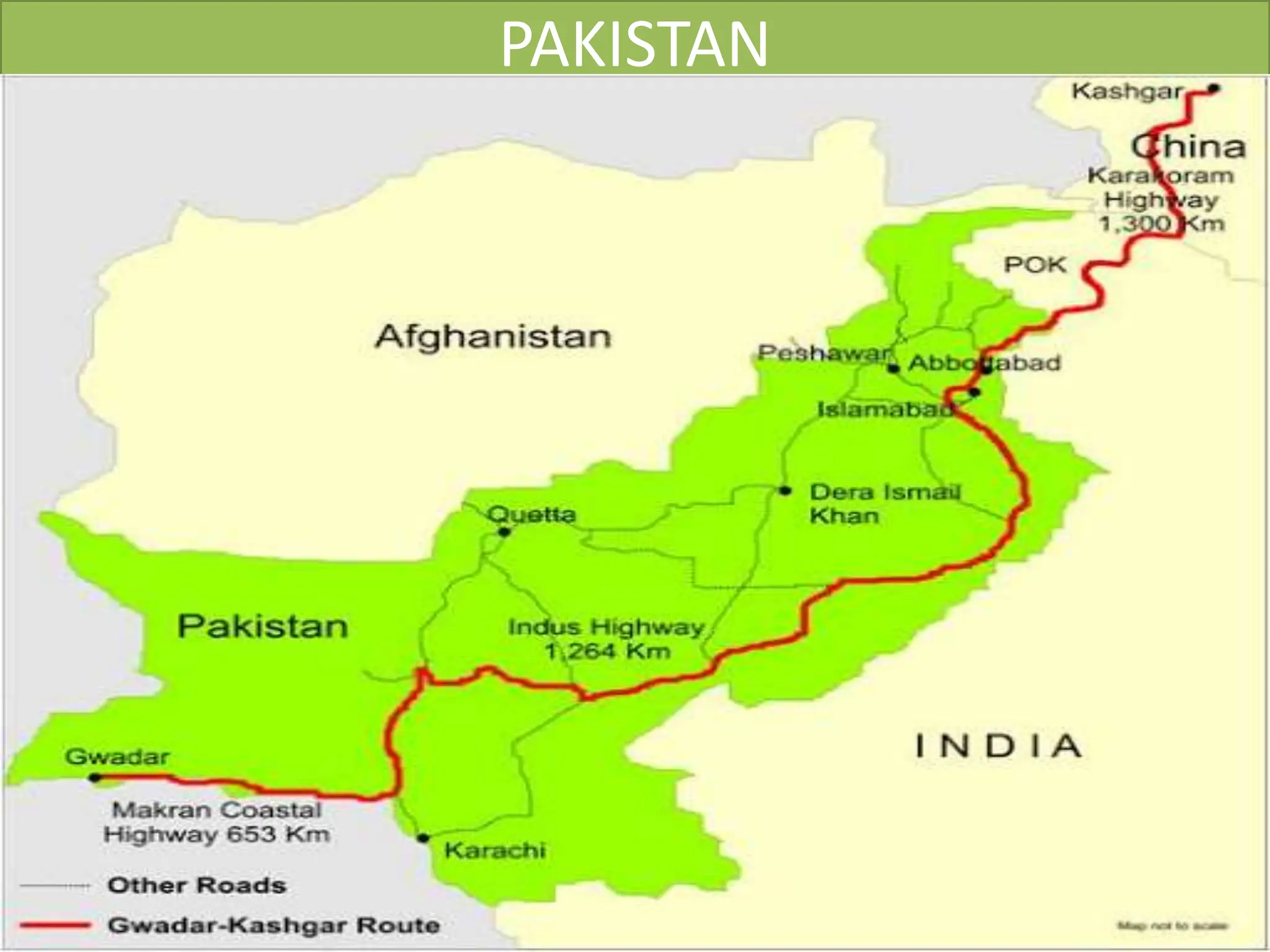
PAKISTAN
• PAKISTAN
• Pakistan follows mixed economy.
• Late 1950s and 1960s, Pakistan introduced
regulated policy framework (for import
substitution-based industrialisation).
• Tariff protection was introduced.
• Restrictions on imports like quota and licensing
were introduced.
• Green Revolution resulted in increased agricultural
output.
• In 1970’s capital goods industries were nationalised.
• In late 1970’s and 1980’s there was a major policy
change. De-nationalisation and encouragement of
private sector started.
• Pakistan received financial support from western
countries.
• Remittances from Pakistanis working in middle east
also helped in economic growth.
• In 1988, economic reforms were introduced.
DEMOGRAPHIC COMPARISON OF INDIA,
PAKISTAN AND CHINA
COMPARISON OF DEMOGRAPHIC SITUATION
• Out of every six persons living in this world, one
is an Indian and another a Chinese.
• The population of Pakistan is very small and
accounts for roughly about one-tenth of China
or India.
• One child norm introduced in China in the late
1970s is the major reason for low population
growth.
• One child norm led to a decline in the sex ratio.
• One child norm and the fall in the growth of
population have other implications.
• For instance, after a few decades, in China,
there will be more elderly people in proportion
to young people.
• This led China to allow couples to have two
children.
COMPARISON OF GDP AND CONTRIBUTION OF
EACH SECTOR TO GDP
• GROSS DOMESTIC PRODUCT AND
SECTORS
• China has the second largest GDP (PPP) of $22.5
trillion in the world.
• India’s GDP (PPP) is $9.03 trillion.
• Pakistan’s GDP is $ 0.94 trillion, roughly about 11
per cent of India’s GDP.
• India’s GDP is about 41 per cent of China’s GDP.
• Reform processes introduced in Pakistan and
political instability over a long period are the
reasons behind the declining growth rate in
Pakistan.
• Area suitable agriculture in China is just 10% of its
total land.
• China’s agricultural land is just 40% of India’s
agricultural area.
• Till 1980, nealy 80% of China’s population was
engaged in agriculture.
• The Government encouraged farmers to shift to
other occupations like handicrafts, trade and
transport.
• 2018 – 19 only 27% of its population was in
agriculture.
• In all the three countries the service sector is
emerging as a major player of development. It
contributes more to GVA and, at the same time,
emerges as a prospective employer
COMPARISON OF HUMAN DEVELOPMENT
Factors that are not included while calculating
HDI
• ‘People’s participation in social and political
decision-making’
• ‘Liberty indicators’ like Constitutional protection
given to rights of citizens’ or Independence of the
Judiciary and the Rule of Law’ have not even been
introduce.
• In the above factors India stands ahead of her
Why did China introduce structural reforms in
1978?
• Slow economic growth
• Lack of modernisation
• Maoist vision of economic development based
on decentralisation, self sufficiency and
rejection of foreign technology, goods and
capital had failed.
• Despite extensive land reforms, collectivisation,
the Great Leap Forward and other initiatives,
the per capita grain output in 1978 was the
same as it was in the mid-1950s.
Reforms benefited China in the following ways:
• Development of educational and health infrastructure,
land reforms, decentralised planning and the
development of small enterprises resulted in rapid
economic growth.
• Reforms were introduced in smaller level and then
extended on a massive scale.
• Distribution of commune lands to individual families
helped in the economic condition of farmers.
• These policies also led to the growth of rural industries.
Pakistan and Economic Reforms
• Growth rate of GDP and the contribution of all the
three sectors to GDP decreased in Pakistan after the
Economic Reforms were introduced.
• Poverty also started increasing in Pakistan in the
recent period.
• Increase in agricultural output was due to good
harvest not because of technological and
institutional changes. Food scarcity emerged during
the periods of bad harvest.
• Pakistan has taken huge amounts as loans from IMF
and World Bank. Repayment of loans is a heavy
burden on the economy.
• Recent developments in Pakistan
• In the last few years, Pakistan started making
progress.
• GDP growth rate increased to 5.5% in 2017 - 18
• Industrial sector grew at the rate of 4.9.
• Service sector grew at the rate of 6.2 %.
• INDIA
• India’s performance in economic development has
been moderate.
• Lack of sufficient infrastructure has been a factor
that prevents India’s growth.
• One-fourth of the population is still living under
poverty line.
• India guarantees democratic rights and freedoms to
her citizens.
• PAKISTAN
• Following factors are responsible for poor
performance of Pakistan:
• Political Instability
• Over dependence on foreign aid and remittances
from abroad.
• Poor condition of agriculture.
• However, in the recent years, Pakistan has shown
better growth rate.
CHINA
• In China lack of political freedom and violation of
human rights are serious issues.
• Economic reforms helped them to achieve rapid
economic growth rate.
• Reforms under a committed Government also
resulted in the reduction of poverty.
• They maintained collective ownership of land and at
the same time allowed individual families to
cultivate.
• Government introduced several social security
measures to improve the living standard of the
people.
COMPARISON BETWEEN INDIA, PAKISTAN AND CHINA.pptx

COMPARISON BETWEEN INDIA, PAKISTAN AND CHINA.pptx

  • 1.
    DEVELOPMENT EXPERIENCES OFINDIA: A COMPARISON WITH NEIGHBOURS KRISHNAKUMAR C S PGT ECONOMICS DAV-BHEL SCHOOL, RANIPET
  • 2.
  • 3.
    • Economic andregional groups like SAARC, European Union, ASEAN, G – 8, G – 20, BRICS have been formed to promote international trade. • They promote economic co-operation among member countries. • They are also aimed at strengthening the economies of member countries.
  • 4.
    Steps taken byNations for their economic progress • Formation of Economic and Regional Groups like SAARC, European Union, ASEAN, G – 8, G – 20, BRICS etc. • Promote international co-operation. • Promote foreign trade. • Analyse the development strategy of neighbours. • Evaluate their own strengths and weakness and decide policies. • Liberalisation • Globalisation
  • 5.
    • Similarities indevelopmental strategies of India, Pakistan and China • All the three countries started their journey towards development at the same time. India and Pakistan got freedom in 1947. Communist Party came to power in China in 1949. • All the three countries adopted Economic Planning to achieve development.
  • 6.
    • India andPakistan adopted Mixed Economy. China adopted a Socialist system. • Public sector is give greater role in the economies of all the three countries. • Till 1980, all the three countries had similar economic growth rates and per-capita incomes. • All the three adopted liberalisation, privatisation and globalisation in order to achieve faster economic development
  • 7.
  • 8.
    CHINA • People’s Republicof China was established in 1949. • China went under one party rule. • China adopted Socialism as its economic system. • All important sectors, enterprises, lands were brought under Government control.
  • 9.
  • 10.
    The Great LeapForward (GLF) • This campaign was started in 1958. • It aimed at industrialising the country on a large scale. • People were encouraged to set up industries in their backyards. • In rural areas, communes were started. • Under the Commune system, people collectively cultivated lands. • In 1958, there were 26,000 communes covering almost all the farm population.
  • 11.
    • Problems facedby GLF campaign • A severe drought caused damages in China 30 million people lost their lives. • Conflicts started between Russia and China. • Russsia withdrew its professionals who had earlier been sent to China to help in the industrialisation process. • In 1965, Mao introduced the Great Proletarian Cultural Revolution (1966–76) under which students and professionals were sent to work and learn from the countryside.
  • 12.
  • 13.
    • Economic Reforms •In 1978, China introduced Economic Reforms. • Reforms resulted in rapid industrial and economic development. • Economic reforms were introduced in phases. • In the first phase, reforms were introduced in agriculture, foreign trade and investment sectors. • In the later phase, reforms were introduced in the industrial sector.
  • 14.
    • Reforms inAgriculture in China • Commune lands were divided into small plots. These lands were given to individual families to cultivate. • Farmers were allowed to keep all income from the land after paying taxes.
  • 15.
    Reforms in IndustrialSector • Private sector was allowed to produce industrial goods. • Villages enterprises owned by local collectives were promoted. • State owned enterprises were made to compete with private firms. • Dual pricing was introduced. 50% of agricultural and industrial goods had to be bought and sold at the Government fixed prices. Remaining could be bought and sold at the market fixed prices. • Special Economic Zones were set up to attract foreign investment.
  • 16.
  • 17.
    • PAKISTAN • Pakistanfollows mixed economy. • Late 1950s and 1960s, Pakistan introduced regulated policy framework (for import substitution-based industrialisation). • Tariff protection was introduced. • Restrictions on imports like quota and licensing were introduced. • Green Revolution resulted in increased agricultural output. • In 1970’s capital goods industries were nationalised.
  • 18.
    • In late1970’s and 1980’s there was a major policy change. De-nationalisation and encouragement of private sector started. • Pakistan received financial support from western countries. • Remittances from Pakistanis working in middle east also helped in economic growth. • In 1988, economic reforms were introduced.
  • 19.
    DEMOGRAPHIC COMPARISON OFINDIA, PAKISTAN AND CHINA
  • 20.
    COMPARISON OF DEMOGRAPHICSITUATION • Out of every six persons living in this world, one is an Indian and another a Chinese. • The population of Pakistan is very small and accounts for roughly about one-tenth of China or India.
  • 22.
    • One childnorm introduced in China in the late 1970s is the major reason for low population growth. • One child norm led to a decline in the sex ratio. • One child norm and the fall in the growth of population have other implications. • For instance, after a few decades, in China, there will be more elderly people in proportion to young people. • This led China to allow couples to have two children.
  • 23.
    COMPARISON OF GDPAND CONTRIBUTION OF EACH SECTOR TO GDP
  • 24.
    • GROSS DOMESTICPRODUCT AND SECTORS • China has the second largest GDP (PPP) of $22.5 trillion in the world. • India’s GDP (PPP) is $9.03 trillion. • Pakistan’s GDP is $ 0.94 trillion, roughly about 11 per cent of India’s GDP. • India’s GDP is about 41 per cent of China’s GDP.
  • 26.
    • Reform processesintroduced in Pakistan and political instability over a long period are the reasons behind the declining growth rate in Pakistan.
  • 28.
    • Area suitableagriculture in China is just 10% of its total land. • China’s agricultural land is just 40% of India’s agricultural area. • Till 1980, nealy 80% of China’s population was engaged in agriculture. • The Government encouraged farmers to shift to other occupations like handicrafts, trade and transport. • 2018 – 19 only 27% of its population was in agriculture.
  • 30.
    • In allthe three countries the service sector is emerging as a major player of development. It contributes more to GVA and, at the same time, emerges as a prospective employer
  • 32.
  • 34.
    Factors that arenot included while calculating HDI • ‘People’s participation in social and political decision-making’ • ‘Liberty indicators’ like Constitutional protection given to rights of citizens’ or Independence of the Judiciary and the Rule of Law’ have not even been introduce. • In the above factors India stands ahead of her
  • 35.
    Why did Chinaintroduce structural reforms in 1978? • Slow economic growth • Lack of modernisation • Maoist vision of economic development based on decentralisation, self sufficiency and rejection of foreign technology, goods and capital had failed. • Despite extensive land reforms, collectivisation, the Great Leap Forward and other initiatives, the per capita grain output in 1978 was the same as it was in the mid-1950s.
  • 36.
    Reforms benefited Chinain the following ways: • Development of educational and health infrastructure, land reforms, decentralised planning and the development of small enterprises resulted in rapid economic growth. • Reforms were introduced in smaller level and then extended on a massive scale. • Distribution of commune lands to individual families helped in the economic condition of farmers. • These policies also led to the growth of rural industries.
  • 37.
    Pakistan and EconomicReforms • Growth rate of GDP and the contribution of all the three sectors to GDP decreased in Pakistan after the Economic Reforms were introduced. • Poverty also started increasing in Pakistan in the recent period. • Increase in agricultural output was due to good harvest not because of technological and institutional changes. Food scarcity emerged during the periods of bad harvest. • Pakistan has taken huge amounts as loans from IMF and World Bank. Repayment of loans is a heavy burden on the economy.
  • 38.
    • Recent developmentsin Pakistan • In the last few years, Pakistan started making progress. • GDP growth rate increased to 5.5% in 2017 - 18 • Industrial sector grew at the rate of 4.9. • Service sector grew at the rate of 6.2 %.
  • 40.
    • INDIA • India’sperformance in economic development has been moderate. • Lack of sufficient infrastructure has been a factor that prevents India’s growth. • One-fourth of the population is still living under poverty line. • India guarantees democratic rights and freedoms to her citizens.
  • 41.
    • PAKISTAN • Followingfactors are responsible for poor performance of Pakistan: • Political Instability • Over dependence on foreign aid and remittances from abroad. • Poor condition of agriculture. • However, in the recent years, Pakistan has shown better growth rate.
  • 42.
    CHINA • In Chinalack of political freedom and violation of human rights are serious issues. • Economic reforms helped them to achieve rapid economic growth rate. • Reforms under a committed Government also resulted in the reduction of poverty. • They maintained collective ownership of land and at the same time allowed individual families to cultivate. • Government introduced several social security measures to improve the living standard of the people.