Object-Oriented Software Engineering
Conquering Complex and Changing Systems
                              Chapter 2,
                              Modeling with UML
Overview


♦   What is modeling?
♦   What is UML?
♦   Use case diagrams
♦   Class diagrams
♦   Sequence diagrams
♦   Activity diagrams
♦   Summary


Bernd Bruegge & Allen Dutoit   Object-Oriented Software Engineering: Conquering Complex and Changing Systems   2
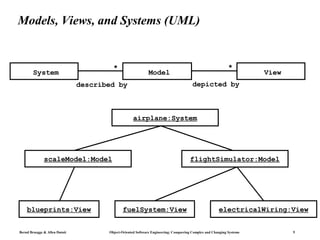
Systems, Models, and Views

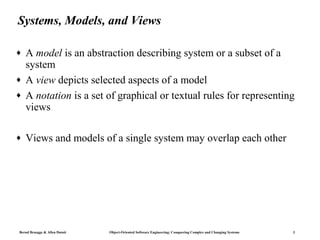
♦   A model is an abstraction describing system or a subset of a
    system
♦   A view depicts selected aspects of a model
♦   A notation is a set of graphical or textual rules for representing
    views

♦   Views and models of a single system may overlap each other


Bernd Bruegge & Allen Dutoit   Object-Oriented Software Engineering: Conquering Complex and Changing Systems   3
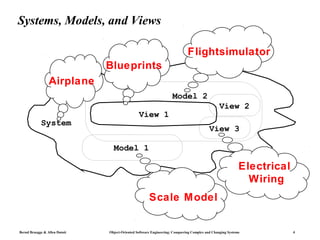
Systems, Models, and Views

                                                                             Flightsimulator
                               Blueprints
                 Airplane
                                                                    Model 2
                                                                                                View 2
                                                View 1
            System
                                                                                          View 3

                                 Model 1

                                                                                                           Electrical
                                                                                                             Wiring
                                                      Scale Model


Bernd Bruegge & Allen Dutoit   Object-Oriented Software Engineering: Conquering Complex and Changing Systems            4
Models, Views, and Systems (UML)


                                        *                                                                   *
        System                                               Model                                                    View
                               described by                                            depicted by


                                                    airplane:System


              scaleModel:Model                                                       flightSimulator:Model


    blueprints:View                          fuelSystem:View                                          electricalWiring:View


Bernd Bruegge & Allen Dutoit          Object-Oriented Software Engineering: Conquering Complex and Changing Systems          5
Why model software?

Software is already an abstraction: why model software?

♦   Software is getting larger, not smaller
        NT 5.0 ~ 40 million lines of code
        A single programmer cannot manage this amount of code in its
         entirety.
♦   Code is often not directly understandable by developers who
    did not participate in the development
♦   We need simpler representations for complex systems
        Modeling is a mean for dealing with complexity


Bernd Bruegge & Allen Dutoit   Object-Oriented Software Engineering: Conquering Complex and Changing Systems   6
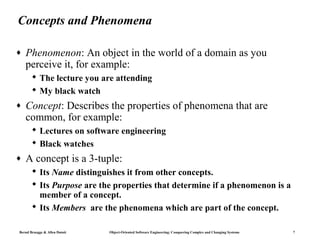
Concepts and Phenomena

♦   Phenomenon: An object in the world of a domain as you
    perceive it, for example:
        The lecture you are attending
        My black watch
♦   Concept: Describes the properties of phenomena that are
    common, for example:
        Lectures on software engineering
        Black watches
♦   A concept is a 3-tuple:
        Its Name distinguishes it from other concepts.
        Its Purpose are the properties that determine if a phenomenon is a
         member of a concept.
        Its Members are the phenomena which are part of the concept.

Bernd Bruegge & Allen Dutoit   Object-Oriented Software Engineering: Conquering Complex and Changing Systems   7
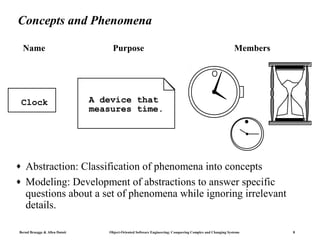
Concepts and Phenomena

    Name                            Purpose                                                                Members


 Clock                         A device that
                               measures time.


♦   Abstraction: Classification of phenomena into concepts
♦   Modeling: Development of abstractions to answer specific
    questions about a set of phenomena while ignoring irrelevant
    details.

Bernd Bruegge & Allen Dutoit      Object-Oriented Software Engineering: Conquering Complex and Changing Systems      8
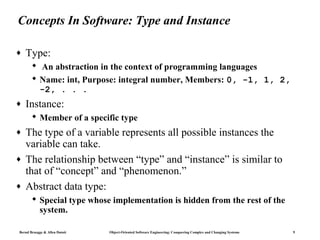
Concepts In Software: Type and Instance

♦   Type:
        An abstraction in the context of programming languages
        Name: int, Purpose: integral number, Members: 0, -1, 1, 2,
         -2, . . .
♦   Instance:
        Member of a specific type
♦   The type of a variable represents all possible instances the
    variable can take.
♦   The relationship between “type” and “instance” is similar to
    that of “concept” and “phenomenon.”
♦   Abstract data type:
        Special type whose implementation is hidden from the rest of the
         system.

Bernd Bruegge & Allen Dutoit   Object-Oriented Software Engineering: Conquering Complex and Changing Systems   9
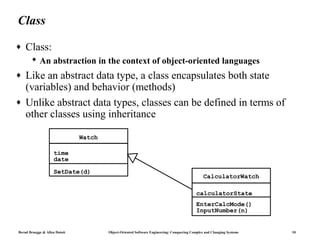
Class
♦   Class:
        An abstraction in the context of object-oriented languages
♦   Like an abstract data type, a class encapsulates both state
    (variables) and behavior (methods)
♦   Unlike abstract data types, classes can be defined in terms of
    other classes using inheritance

                               Watch

                     time
                     date

                     SetDate(d)
                                                                                               CalculatorWatch

                                                                                          calculatorState
                                                                                          EnterCalcMode()
                                                                                          InputNumber(n)


Bernd Bruegge & Allen Dutoit           Object-Oriented Software Engineering: Conquering Complex and Changing Systems   10
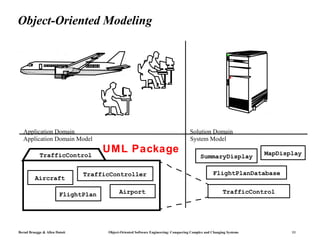
Object-Oriented Modeling


  Application Domain                                                                 Solution Domain
  Application Domain Model                                                           System Model

            TrafficControl
                                     UML Package                                                                     MapDisplay
                                                                                           SummaryDisplay

                               TrafficController                                                  FlightPlanDatabase
         Aircraft

                        FlightPlan         Airport                                                      TrafficControl


Bernd Bruegge & Allen Dutoit         Object-Oriented Software Engineering: Conquering Complex and Changing Systems          11
Application and Solution Domain

♦   Application Domain (Requirements Analysis):
        The environment in which the system is operating


♦   Solution Domain (System Design, Object Design):
        The available technologies to build the system


Bernd Bruegge & Allen Dutoit   Object-Oriented Software Engineering: Conquering Complex and Changing Systems   12
What is UML?

♦   UML (Unified Modeling Language)
        An emerging standard for modeling object-oriented software.
        Resulted from the convergence of notations from three leading
         object-oriented methods:
                     OMT (James Rumbaugh)
                     OOSE (Ivar Jacobson)
                     Booch (Grady Booch)
♦   Reference: “The Unified Modeling Language User Guide”,
    Addison Wesley, 1999.
♦   Supported by several CASE tools
        Rational ROSE
        Together/J
        ...

Bernd Bruegge & Allen Dutoit     Object-Oriented Software Engineering: Conquering Complex and Changing Systems   13
UML and This Course

♦   You can model 80% of most problems by using about 20%
    UML

♦   In this course, we teach you those 20%


Bernd Bruegge & Allen Dutoit   Object-Oriented Software Engineering: Conquering Complex and Changing Systems   14
UML First Pass
♦   Use case diagrams
        Describe the functional behavior of the system as seen by the user.
♦   Class diagrams
        Describe the static structure of the system: Objects, Attributes, and
         Associations.
♦   Sequence diagrams
        Describe the dynamic behavior between actors and the system and
         between objects of the system.
♦   Statechart diagrams
        Describe the dynamic behavior of an individual object as a finite state
         machine.
♦   Activity diagrams
        Model the dynamic behavior of a system, in particular the workflow,
         i.e. a flowchart.

Bernd Bruegge & Allen Dutoit   Object-Oriented Software Engineering: Conquering Complex and Changing Systems   15
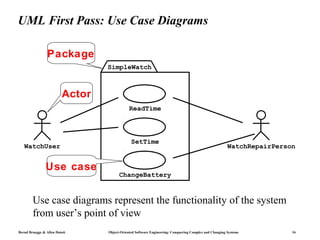
UML First Pass: Use Case Diagrams

                 Package
                                 SimpleWatch


                         Actor
                                             ReadTime


                                              SetTime
   WatchUser                                                                                           WatchRepairPerson


                Use case
                                       ChangeBattery


        Use case diagrams represent the functionality of the system
        from user’s point of view
Bernd Bruegge & Allen Dutoit     Object-Oriented Software Engineering: Conquering Complex and Changing Systems         16
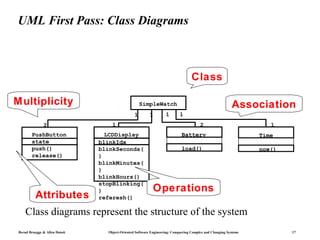
UML First Pass: Class Diagrams


                                                                                   Class

Multiplicity                                         SimpleWatch                                           Association
                                                 1        1         1       1
               2                    1                                                   2                            1
        PushButton                LCDDisplay                                 Battery                              Time
        state                   blinkIdx
        push()                  blinkSeconds(                                load()                               now()
        release()               )
                                blinkMinutes(
                                )
                                blinkHours()
                                stopBlinking(
                                )                           Operations
           Attributes           referesh()

     Class diagrams represent the structure of the system
 Bernd Bruegge & Allen Dutoit     Object-Oriented Software Engineering: Conquering Complex and Changing Systems           17
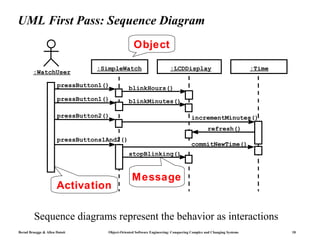
UML First Pass: Sequence Diagram
                                                  Object

                                 :SimpleWatch                           :LCDDisplay                                 :Time
        :WatchUser

                       pressButton1()           blinkHours()
                       pressButton1()           blinkMinutes()

                       pressButton2()                                                incrementMinutes()
                                                                                              refresh()
                       pressButtons1And2()
                                                                                     commitNewTime()
                                                stopBlinking()


                                                 Message
                      Activation

         Sequence diagrams represent the behavior as interactions
Bernd Bruegge & Allen Dutoit        Object-Oriented Software Engineering: Conquering Complex and Changing Systems           18
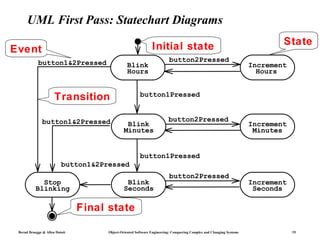
UML First Pass: Statechart Diagrams

                                                                 Initial state                                                  State
Event
            button1&2Pressed                                               button2Pressed
                                                   Blink                                                                Increment
                                                   Hours                                                                  Hours


                      Transition                          button1Pressed


               button1&2Pressed                                            button2Pressed
                                                  Blink                                                                 Increment
                                                 Minutes                                                                 Minutes


                                                          button1Pressed
                          button1&2Pressed
                                                                           button2Pressed
             Stop                                 Blink                                                                 Increment
           Blinking                              Seconds                                                                 Seconds

                                 Final state
                                button1&2Pressed


 Bernd Bruegge & Allen Dutoit           Object-Oriented Software Engineering: Conquering Complex and Changing Systems               19
Other UML Notations

UML provide other notations that we will be introduced in
 subsequent lectures, as needed.

♦   Implementation diagrams
        Component diagrams
        Deployment diagrams
        Introduced in lecture on System Design
♦   Object Constraint Language (OCL)
        Introduced in lecture on Object Design


Bernd Bruegge & Allen Dutoit   Object-Oriented Software Engineering: Conquering Complex and Changing Systems   20
UML Core Conventions

♦   Rectangles are classes or instances
♦   Ovals are functions or use cases
♦   Instances are denoted with an underlined names
        myWatch:SimpleWatch
        Joe:Firefighter
♦   Types are denoted with nonunderlined names
        SimpleWatch
        Firefighter
♦   Diagrams are graphs
        Nodes are entities
        Arcs are relationships between entities


Bernd Bruegge & Allen Dutoit   Object-Oriented Software Engineering: Conquering Complex and Changing Systems   21
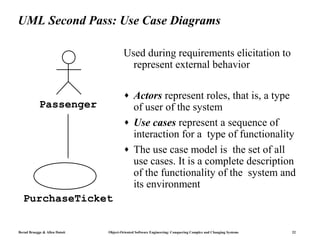
UML Second Pass: Use Case Diagrams

                                       Used during requirements elicitation to
                                         represent external behavior

                                       ♦     Actors represent roles, that is, a type
            Passenger                        of user of the system
                                       ♦     Use cases represent a sequence of
                                             interaction for a type of functionality
                                       ♦     The use case model is the set of all
                                             use cases. It is a complete description
                                             of the functionality of the system and
                                             its environment
  PurchaseTicket

Bernd Bruegge & Allen Dutoit   Object-Oriented Software Engineering: Conquering Complex and Changing Systems   22
Actors

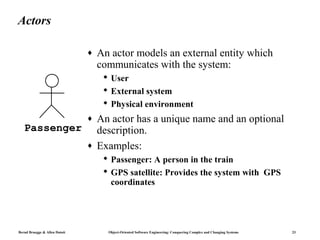
                               ♦   An actor models an external entity which
                                   communicates with the system:
                                     User
                                     External system
                                     Physical environment
                               ♦   An actor has a unique name and an optional
   Passenger                       description.
                               ♦   Examples:
                                     Passenger: A person in the train
                                     GPS satellite: Provides the system with GPS
                                      coordinates


Bernd Bruegge & Allen Dutoit         Object-Oriented Software Engineering: Conquering Complex and Changing Systems   23
Use Case

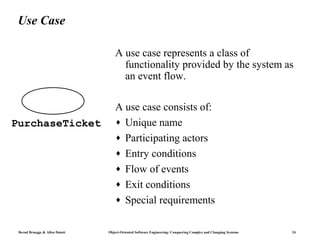
                                   A use case represents a class of
                                     functionality provided by the system as
                                     an event flow.

                                   A use case consists of:
PurchaseTicket                     ♦ Unique name
                                   ♦ Participating actors
                                   ♦ Entry conditions
                                   ♦ Flow of events
                                   ♦ Exit conditions
                                   ♦ Special requirements


 Bernd Bruegge & Allen Dutoit   Object-Oriented Software Engineering: Conquering Complex and Changing Systems   24
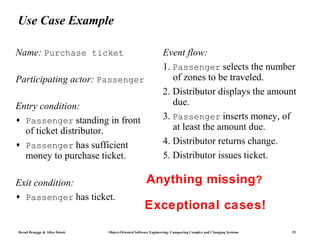
Use Case Example

Name: Purchase ticket                                          Event flow:
                                                               1. Passenger selects the number
Participating actor: Passenger                                    of zones to be traveled.
                                                               2. Distributor displays the amount
Entry condition:                                                  due.
♦ Passenger standing in front                                  3. Passenger inserts money, of
  of ticket distributor.                                          at least the amount due.
♦ Passenger has sufficient                                     4. Distributor returns change.
  money to purchase ticket.                                    5. Distributor issues ticket.

Exit condition:                                      Anything missing?
♦   Passenger has ticket.
                                                    Exceptional cases!
Bernd Bruegge & Allen Dutoit   Object-Oriented Software Engineering: Conquering Complex and Changing Systems   25
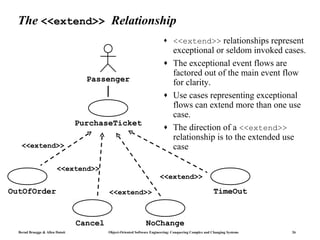
The <<extend>> Relationship
                                                                          ♦     <<extend>> relationships represent
                                                                                exceptional or seldom invoked cases.
                                                                          ♦     The exceptional event flows are
                                                                                factored out of the main event flow
                                   Passenger                                    for clarity.
                                                                          ♦     Use cases representing exceptional
                                                                                flows can extend more than one use
                                                                                case.
                                 PurchaseTicket                           ♦     The direction of a <<extend>>
                                                                                relationship is to the extended use
   <<extend>>                                                                   case

                        <<extend>>
                                                                        <<extend>>

OutOfOrder                                <<extend>>                                                    TimeOut


                                 Cancel                         NoChange
  Bernd Bruegge & Allen Dutoit            Object-Oriented Software Engineering: Conquering Complex and Changing Systems   26
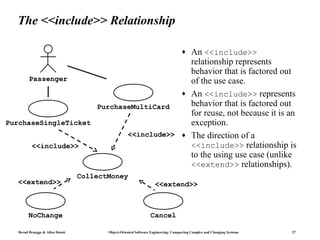
The <<include>> Relationship

                                                                                    ♦     An <<include>>
                                                                                          relationship represents
                                                                                          behavior that is factored out
         Passenger                                                                        of the use case.
                                                                                    ♦     An <<include>> represents
                                      PurchaseMultiCard                                   behavior that is factored out
                                                                                          for reuse, not because it is an
PurchaseSingleTicket                                                                      exception.
                                                    <<include>> ♦                         The direction of a
          <<include>>                                                                     <<include>> relationship is
                                                                                          to the using use case (unlike
                                                                                          <<extend>> relationships).
                                  CollectMoney
  <<extend>>                                                        <<extend>>


         NoChange                                                Cancel

   Bernd Bruegge & Allen Dutoit          Object-Oriented Software Engineering: Conquering Complex and Changing Systems   27
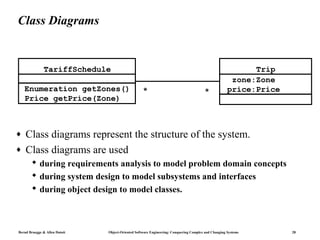
Class Diagrams


               TariffSchedule                                                                              Trip
                                                                                                      zone:Zone
    Enumeration getZones()                                                                           price:Price
                                                   *                                    *
    Price getPrice(Zone)


♦   Class diagrams represent the structure of the system.
♦   Class diagrams are used
        during requirements analysis to model problem domain concepts
        during system design to model subsystems and interfaces
        during object design to model classes.


Bernd Bruegge & Allen Dutoit   Object-Oriented Software Engineering: Conquering Complex and Changing Systems       28
Classes
                                                                                  TariffSchedule
                                                                             Table zone2price
                                                                             Enumeration getZones()
                                              Name                           Price getPrice(Zone)

          TariffSchedule
          zone2price                   Attributes                                                Signature
          getZones()
          getPrice()
                                      Operations                                                    TariffSchedule


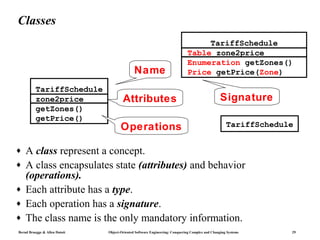
♦   A class represent a concept.
♦   A class encapsulates state (attributes) and behavior
    (operations).
♦   Each attribute has a type.
♦   Each operation has a signature.
♦   The class name is the only mandatory information.
Bernd Bruegge & Allen Dutoit   Object-Oriented Software Engineering: Conquering Complex and Changing Systems     29
Instances


                               tariff_1974:TarifSchedule
                               zone2price = {
                               {‘1’, .20},
                               {‘2’, .40},
                               {‘3’, .60}}


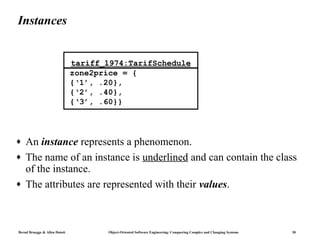
♦   An instance represents a phenomenon.
♦   The name of an instance is underlined and can contain the class
    of the instance.
♦   The attributes are represented with their values.


Bernd Bruegge & Allen Dutoit          Object-Oriented Software Engineering: Conquering Complex and Changing Systems   30
Actor vs. Instances

♦   What is the difference between an actor and a class and an
    instance?
♦   Actor:
        An entity outside the system to be modeled, interacting with the
         system (“Pilot”)
♦   Class:
        An abstraction modeling an entity in the problem domain, inside
         the system to be modeled (“Cockpit”)
♦   Object:
        A specific instance of a class (“Joe, the inspector”).


Bernd Bruegge & Allen Dutoit   Object-Oriented Software Engineering: Conquering Complex and Changing Systems   31
Associations


                 TarifSchedule                                                                                 Trip

    Enumeration getZones()                                                                       price
                                                 *                                         *     zone
    Price getPrice(Zone)


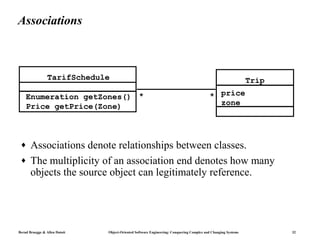
 ♦     Associations denote relationships between classes.
 ♦     The multiplicity of an association end denotes how many
       objects the source object can legitimately reference.


Bernd Bruegge & Allen Dutoit   Object-Oriented Software Engineering: Conquering Complex and Changing Systems          32
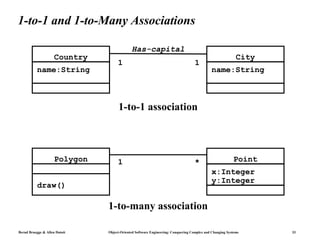
1-to-1 and 1-to-Many Associations

                                            Has-capital
                     Country                                                                              City
                                    1                                             1
           name:String                                                                      name:String


                                    1-to-1 association


                     Polygon        1                                             *                      Point
                                                                                            x:Integer
                                                                                            y:Integer
           draw()

                               1-to-many association

Bernd Bruegge & Allen Dutoit   Object-Oriented Software Engineering: Conquering Complex and Changing Systems     33
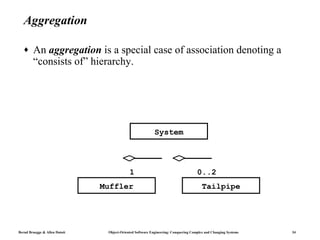
Aggregation

  ♦     An aggregation is a special case of association denoting a
        “consists of” hierarchy.


                                                           System


                                            1                                       0..2
                               Muffler                                                 Tailpipe


Bernd Bruegge & Allen Dutoit    Object-Oriented Software Engineering: Conquering Complex and Changing Systems   34
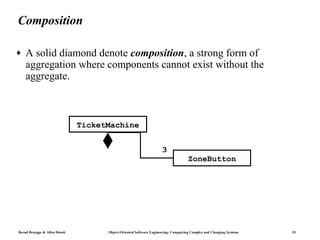
Composition

♦   A solid diamond denote composition, a strong form of
    aggregation where components cannot exist without the
    aggregate.


                               TicketMachine


                                                                    3
                                                                                    ZoneButton


Bernd Bruegge & Allen Dutoit         Object-Oriented Software Engineering: Conquering Complex and Changing Systems   35
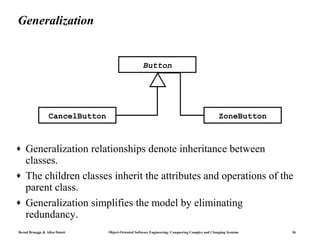
Generalization


                                                    Button


                 CancelButton                                                                    ZoneButton


♦   Generalization relationships denote inheritance between
    classes.
♦   The children classes inherit the attributes and operations of the
    parent class.
♦   Generalization simplifies the model by eliminating
    redundancy.
Bernd Bruegge & Allen Dutoit    Object-Oriented Software Engineering: Conquering Complex and Changing Systems   36
Bernd Bruegge & Allen Dutoit   Object-Oriented Software Engineering: Conquering Complex and Changing Systems   37
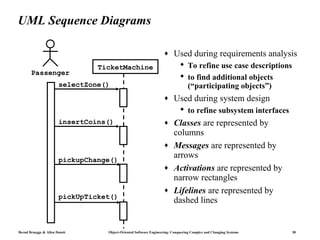
UML Sequence Diagrams

                                                                  ♦     Used during requirements analysis
                                TicketMachine                                To refine use case descriptions
       Passenger
                                                                             to find additional objects
                       selectZone()                                           (“participating objects”)
                                                                  ♦     Used during system design
                                                                             to refine subsystem interfaces
                       insertCoins()                              ♦     Classes are represented by
                                                                        columns
                                                                  ♦     Messages are represented by
                       pickupChange()
                                                                        arrows
                                                                  ♦     Activations are represented by
                                                                        narrow rectangles
                                                                  ♦     Lifelines are represented by
                       pickUpTicket()
                                                                        dashed lines


Bernd Bruegge & Allen Dutoit      Object-Oriented Software Engineering: Conquering Complex and Changing Systems   38
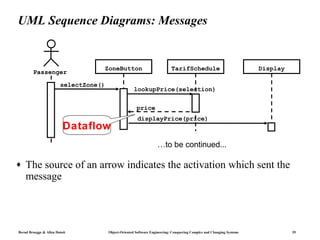
UML Sequence Diagrams: Messages


                                   ZoneButton                               TarifSchedule                              Display
        Passenger

                        selectZone()
                                                      lookupPrice(selection)


                                                       price
                                                        displayPrice(price)
                          Dataflow
                                                                    …to be continued...

♦   The source of an arrow indicates the activation which sent the
    message


Bernd Bruegge & Allen Dutoit           Object-Oriented Software Engineering: Conquering Complex and Changing Systems             39
Sequence Diagram Observations

♦   UML sequence diagram represent behavior in terms of
    interactions.
♦   Complement the class diagrams which represent structure.
♦   Useful to find participating objects.
♦   Time consuming to build but worth the investment.


Bernd Bruegge & Allen Dutoit   Object-Oriented Software Engineering: Conquering Complex and Changing Systems   40
Activity Diagrams

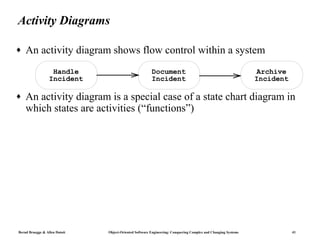
♦   An activity diagram shows flow control within a system
                   Handle                               Document                                                Archive
                  Incident                              Incident                                               Incident

♦   An activity diagram is a special case of a state chart diagram in
    which states are activities (“functions”)


Bernd Bruegge & Allen Dutoit   Object-Oriented Software Engineering: Conquering Complex and Changing Systems              41
Activity Diagram: Modeling Decisions


                                                 [lowPriority]
            Open                                                                                                  Allocate
          Incident                                                                                               Resources

                                                             [fire & highPriority]

              [not fire & highPriority]

                                                                          Notify
                                                                        Fire Chief


                                  Notify
                               Police Chief


Bernd Bruegge & Allen Dutoit     Object-Oriented Software Engineering: Conquering Complex and Changing Systems          42
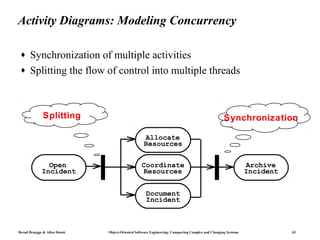
Activity Diagrams: Modeling Concurrency

♦     Synchronization of multiple activities
♦     Splitting the flow of control into multiple threads


              Splitting                                                                            Synchronization

                                                   Allocate
                                                   Resources


               Open                               Coordinate                                                   Archive
             Incident                             Resources                                                    Incident


                                                     Document
                                                     Incident


Bernd Bruegge & Allen Dutoit   Object-Oriented Software Engineering: Conquering Complex and Changing Systems              43
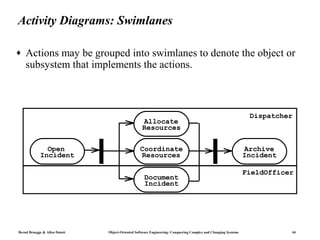
Activity Diagrams: Swimlanes

♦   Actions may be grouped into swimlanes to denote the object or
    subsystem that implements the actions.


                                                                                                                Dispatcher
                                                   Allocate
                                                   Resources


              Open                               Coordinate                                                    Archive
            Incident                             Resources                                                     Incident

                                                                                                               FieldOfficer
                                                    Document
                                                    Incident


Bernd Bruegge & Allen Dutoit   Object-Oriented Software Engineering: Conquering Complex and Changing Systems              44
Summary

♦   UML provides a wide variety of notations for representing
    many aspects of software development
        Powerful, but complex language
        Can be misused to generate unreadable models
        Can be misunderstood when using too many exotic features


♦   We concentrate only on a few notations:
        Functional model: use case diagram
        Object model: class diagram
        Dynamic model: sequence diagrams, statechart and activity
         diagrams


Bernd Bruegge & Allen Dutoit   Object-Oriented Software Engineering: Conquering Complex and Changing Systems   45

Notacion uml

  • 1.
    Object-Oriented Software Engineering ConqueringComplex and Changing Systems Chapter 2, Modeling with UML
  • 2.
    Overview ♦ What is modeling? ♦ What is UML? ♦ Use case diagrams ♦ Class diagrams ♦ Sequence diagrams ♦ Activity diagrams ♦ Summary Bernd Bruegge & Allen Dutoit Object-Oriented Software Engineering: Conquering Complex and Changing Systems 2
  • 3.
    Systems, Models, andViews ♦ A model is an abstraction describing system or a subset of a system ♦ A view depicts selected aspects of a model ♦ A notation is a set of graphical or textual rules for representing views ♦ Views and models of a single system may overlap each other Bernd Bruegge & Allen Dutoit Object-Oriented Software Engineering: Conquering Complex and Changing Systems 3
  • 4.
    Systems, Models, andViews Flightsimulator Blueprints Airplane Model 2 View 2 View 1 System View 3 Model 1 Electrical Wiring Scale Model Bernd Bruegge & Allen Dutoit Object-Oriented Software Engineering: Conquering Complex and Changing Systems 4
  • 5.
    Models, Views, andSystems (UML) * * System Model View described by depicted by airplane:System scaleModel:Model flightSimulator:Model blueprints:View fuelSystem:View electricalWiring:View Bernd Bruegge & Allen Dutoit Object-Oriented Software Engineering: Conquering Complex and Changing Systems 5
  • 6.
    Why model software? Softwareis already an abstraction: why model software? ♦ Software is getting larger, not smaller  NT 5.0 ~ 40 million lines of code  A single programmer cannot manage this amount of code in its entirety. ♦ Code is often not directly understandable by developers who did not participate in the development ♦ We need simpler representations for complex systems  Modeling is a mean for dealing with complexity Bernd Bruegge & Allen Dutoit Object-Oriented Software Engineering: Conquering Complex and Changing Systems 6
  • 7.
    Concepts and Phenomena ♦ Phenomenon: An object in the world of a domain as you perceive it, for example:  The lecture you are attending  My black watch ♦ Concept: Describes the properties of phenomena that are common, for example:  Lectures on software engineering  Black watches ♦ A concept is a 3-tuple:  Its Name distinguishes it from other concepts.  Its Purpose are the properties that determine if a phenomenon is a member of a concept.  Its Members are the phenomena which are part of the concept. Bernd Bruegge & Allen Dutoit Object-Oriented Software Engineering: Conquering Complex and Changing Systems 7
  • 8.
    Concepts and Phenomena Name Purpose Members Clock A device that measures time. ♦ Abstraction: Classification of phenomena into concepts ♦ Modeling: Development of abstractions to answer specific questions about a set of phenomena while ignoring irrelevant details. Bernd Bruegge & Allen Dutoit Object-Oriented Software Engineering: Conquering Complex and Changing Systems 8
  • 9.
    Concepts In Software:Type and Instance ♦ Type:  An abstraction in the context of programming languages  Name: int, Purpose: integral number, Members: 0, -1, 1, 2, -2, . . . ♦ Instance:  Member of a specific type ♦ The type of a variable represents all possible instances the variable can take. ♦ The relationship between “type” and “instance” is similar to that of “concept” and “phenomenon.” ♦ Abstract data type:  Special type whose implementation is hidden from the rest of the system. Bernd Bruegge & Allen Dutoit Object-Oriented Software Engineering: Conquering Complex and Changing Systems 9
  • 10.
    Class ♦ Class:  An abstraction in the context of object-oriented languages ♦ Like an abstract data type, a class encapsulates both state (variables) and behavior (methods) ♦ Unlike abstract data types, classes can be defined in terms of other classes using inheritance Watch time date SetDate(d) CalculatorWatch calculatorState EnterCalcMode() InputNumber(n) Bernd Bruegge & Allen Dutoit Object-Oriented Software Engineering: Conquering Complex and Changing Systems 10
  • 11.
    Object-Oriented Modeling Application Domain Solution Domain Application Domain Model System Model TrafficControl UML Package MapDisplay SummaryDisplay TrafficController FlightPlanDatabase Aircraft FlightPlan Airport TrafficControl Bernd Bruegge & Allen Dutoit Object-Oriented Software Engineering: Conquering Complex and Changing Systems 11
  • 12.
    Application and SolutionDomain ♦ Application Domain (Requirements Analysis):  The environment in which the system is operating ♦ Solution Domain (System Design, Object Design):  The available technologies to build the system Bernd Bruegge & Allen Dutoit Object-Oriented Software Engineering: Conquering Complex and Changing Systems 12
  • 13.
    What is UML? ♦ UML (Unified Modeling Language)  An emerging standard for modeling object-oriented software.  Resulted from the convergence of notations from three leading object-oriented methods:  OMT (James Rumbaugh)  OOSE (Ivar Jacobson)  Booch (Grady Booch) ♦ Reference: “The Unified Modeling Language User Guide”, Addison Wesley, 1999. ♦ Supported by several CASE tools  Rational ROSE  Together/J  ... Bernd Bruegge & Allen Dutoit Object-Oriented Software Engineering: Conquering Complex and Changing Systems 13
  • 14.
    UML and ThisCourse ♦ You can model 80% of most problems by using about 20% UML ♦ In this course, we teach you those 20% Bernd Bruegge & Allen Dutoit Object-Oriented Software Engineering: Conquering Complex and Changing Systems 14
  • 15.
    UML First Pass ♦ Use case diagrams  Describe the functional behavior of the system as seen by the user. ♦ Class diagrams  Describe the static structure of the system: Objects, Attributes, and Associations. ♦ Sequence diagrams  Describe the dynamic behavior between actors and the system and between objects of the system. ♦ Statechart diagrams  Describe the dynamic behavior of an individual object as a finite state machine. ♦ Activity diagrams  Model the dynamic behavior of a system, in particular the workflow, i.e. a flowchart. Bernd Bruegge & Allen Dutoit Object-Oriented Software Engineering: Conquering Complex and Changing Systems 15
  • 16.
    UML First Pass:Use Case Diagrams Package SimpleWatch Actor ReadTime SetTime WatchUser WatchRepairPerson Use case ChangeBattery Use case diagrams represent the functionality of the system from user’s point of view Bernd Bruegge & Allen Dutoit Object-Oriented Software Engineering: Conquering Complex and Changing Systems 16
  • 17.
    UML First Pass:Class Diagrams Class Multiplicity SimpleWatch Association 1 1 1 1 2 1 2 1 PushButton LCDDisplay Battery Time state blinkIdx push() blinkSeconds( load() now() release() ) blinkMinutes( ) blinkHours() stopBlinking( ) Operations Attributes referesh() Class diagrams represent the structure of the system Bernd Bruegge & Allen Dutoit Object-Oriented Software Engineering: Conquering Complex and Changing Systems 17
  • 18.
    UML First Pass:Sequence Diagram Object :SimpleWatch :LCDDisplay :Time :WatchUser pressButton1() blinkHours() pressButton1() blinkMinutes() pressButton2() incrementMinutes() refresh() pressButtons1And2() commitNewTime() stopBlinking() Message Activation Sequence diagrams represent the behavior as interactions Bernd Bruegge & Allen Dutoit Object-Oriented Software Engineering: Conquering Complex and Changing Systems 18
  • 19.
    UML First Pass:Statechart Diagrams Initial state State Event button1&2Pressed button2Pressed Blink Increment Hours Hours Transition button1Pressed button1&2Pressed button2Pressed Blink Increment Minutes Minutes button1Pressed button1&2Pressed button2Pressed Stop Blink Increment Blinking Seconds Seconds Final state button1&2Pressed Bernd Bruegge & Allen Dutoit Object-Oriented Software Engineering: Conquering Complex and Changing Systems 19
  • 20.
    Other UML Notations UMLprovide other notations that we will be introduced in subsequent lectures, as needed. ♦ Implementation diagrams  Component diagrams  Deployment diagrams  Introduced in lecture on System Design ♦ Object Constraint Language (OCL)  Introduced in lecture on Object Design Bernd Bruegge & Allen Dutoit Object-Oriented Software Engineering: Conquering Complex and Changing Systems 20
  • 21.
    UML Core Conventions ♦ Rectangles are classes or instances ♦ Ovals are functions or use cases ♦ Instances are denoted with an underlined names  myWatch:SimpleWatch  Joe:Firefighter ♦ Types are denoted with nonunderlined names  SimpleWatch  Firefighter ♦ Diagrams are graphs  Nodes are entities  Arcs are relationships between entities Bernd Bruegge & Allen Dutoit Object-Oriented Software Engineering: Conquering Complex and Changing Systems 21
  • 22.
    UML Second Pass:Use Case Diagrams Used during requirements elicitation to represent external behavior ♦ Actors represent roles, that is, a type Passenger of user of the system ♦ Use cases represent a sequence of interaction for a type of functionality ♦ The use case model is the set of all use cases. It is a complete description of the functionality of the system and its environment PurchaseTicket Bernd Bruegge & Allen Dutoit Object-Oriented Software Engineering: Conquering Complex and Changing Systems 22
  • 23.
    Actors ♦ An actor models an external entity which communicates with the system:  User  External system  Physical environment ♦ An actor has a unique name and an optional Passenger description. ♦ Examples:  Passenger: A person in the train  GPS satellite: Provides the system with GPS coordinates Bernd Bruegge & Allen Dutoit Object-Oriented Software Engineering: Conquering Complex and Changing Systems 23
  • 24.
    Use Case A use case represents a class of functionality provided by the system as an event flow. A use case consists of: PurchaseTicket ♦ Unique name ♦ Participating actors ♦ Entry conditions ♦ Flow of events ♦ Exit conditions ♦ Special requirements Bernd Bruegge & Allen Dutoit Object-Oriented Software Engineering: Conquering Complex and Changing Systems 24
  • 25.
    Use Case Example Name:Purchase ticket Event flow: 1. Passenger selects the number Participating actor: Passenger of zones to be traveled. 2. Distributor displays the amount Entry condition: due. ♦ Passenger standing in front 3. Passenger inserts money, of of ticket distributor. at least the amount due. ♦ Passenger has sufficient 4. Distributor returns change. money to purchase ticket. 5. Distributor issues ticket. Exit condition: Anything missing? ♦ Passenger has ticket. Exceptional cases! Bernd Bruegge & Allen Dutoit Object-Oriented Software Engineering: Conquering Complex and Changing Systems 25
  • 26.
    The <<extend>> Relationship ♦ <<extend>> relationships represent exceptional or seldom invoked cases. ♦ The exceptional event flows are factored out of the main event flow Passenger for clarity. ♦ Use cases representing exceptional flows can extend more than one use case. PurchaseTicket ♦ The direction of a <<extend>> relationship is to the extended use <<extend>> case <<extend>> <<extend>> OutOfOrder <<extend>> TimeOut Cancel NoChange Bernd Bruegge & Allen Dutoit Object-Oriented Software Engineering: Conquering Complex and Changing Systems 26
  • 27.
    The <<include>> Relationship ♦ An <<include>> relationship represents behavior that is factored out Passenger of the use case. ♦ An <<include>> represents PurchaseMultiCard behavior that is factored out for reuse, not because it is an PurchaseSingleTicket exception. <<include>> ♦ The direction of a <<include>> <<include>> relationship is to the using use case (unlike <<extend>> relationships). CollectMoney <<extend>> <<extend>> NoChange Cancel Bernd Bruegge & Allen Dutoit Object-Oriented Software Engineering: Conquering Complex and Changing Systems 27
  • 28.
    Class Diagrams TariffSchedule Trip zone:Zone Enumeration getZones() price:Price * * Price getPrice(Zone) ♦ Class diagrams represent the structure of the system. ♦ Class diagrams are used  during requirements analysis to model problem domain concepts  during system design to model subsystems and interfaces  during object design to model classes. Bernd Bruegge & Allen Dutoit Object-Oriented Software Engineering: Conquering Complex and Changing Systems 28
  • 29.
    Classes TariffSchedule Table zone2price Enumeration getZones() Name Price getPrice(Zone) TariffSchedule zone2price Attributes Signature getZones() getPrice() Operations TariffSchedule ♦ A class represent a concept. ♦ A class encapsulates state (attributes) and behavior (operations). ♦ Each attribute has a type. ♦ Each operation has a signature. ♦ The class name is the only mandatory information. Bernd Bruegge & Allen Dutoit Object-Oriented Software Engineering: Conquering Complex and Changing Systems 29
  • 30.
    Instances tariff_1974:TarifSchedule zone2price = { {‘1’, .20}, {‘2’, .40}, {‘3’, .60}} ♦ An instance represents a phenomenon. ♦ The name of an instance is underlined and can contain the class of the instance. ♦ The attributes are represented with their values. Bernd Bruegge & Allen Dutoit Object-Oriented Software Engineering: Conquering Complex and Changing Systems 30
  • 31.
    Actor vs. Instances ♦ What is the difference between an actor and a class and an instance? ♦ Actor:  An entity outside the system to be modeled, interacting with the system (“Pilot”) ♦ Class:  An abstraction modeling an entity in the problem domain, inside the system to be modeled (“Cockpit”) ♦ Object:  A specific instance of a class (“Joe, the inspector”). Bernd Bruegge & Allen Dutoit Object-Oriented Software Engineering: Conquering Complex and Changing Systems 31
  • 32.
    Associations TarifSchedule Trip Enumeration getZones() price * * zone Price getPrice(Zone) ♦ Associations denote relationships between classes. ♦ The multiplicity of an association end denotes how many objects the source object can legitimately reference. Bernd Bruegge & Allen Dutoit Object-Oriented Software Engineering: Conquering Complex and Changing Systems 32
  • 33.
    1-to-1 and 1-to-ManyAssociations Has-capital Country City 1 1 name:String name:String 1-to-1 association Polygon 1 * Point x:Integer y:Integer draw() 1-to-many association Bernd Bruegge & Allen Dutoit Object-Oriented Software Engineering: Conquering Complex and Changing Systems 33
  • 34.
    Aggregation ♦ An aggregation is a special case of association denoting a “consists of” hierarchy. System 1 0..2 Muffler Tailpipe Bernd Bruegge & Allen Dutoit Object-Oriented Software Engineering: Conquering Complex and Changing Systems 34
  • 35.
    Composition ♦ A solid diamond denote composition, a strong form of aggregation where components cannot exist without the aggregate. TicketMachine 3 ZoneButton Bernd Bruegge & Allen Dutoit Object-Oriented Software Engineering: Conquering Complex and Changing Systems 35
  • 36.
    Generalization Button CancelButton ZoneButton ♦ Generalization relationships denote inheritance between classes. ♦ The children classes inherit the attributes and operations of the parent class. ♦ Generalization simplifies the model by eliminating redundancy. Bernd Bruegge & Allen Dutoit Object-Oriented Software Engineering: Conquering Complex and Changing Systems 36
  • 37.
    Bernd Bruegge &Allen Dutoit Object-Oriented Software Engineering: Conquering Complex and Changing Systems 37
  • 38.
    UML Sequence Diagrams ♦ Used during requirements analysis TicketMachine  To refine use case descriptions Passenger  to find additional objects selectZone() (“participating objects”) ♦ Used during system design  to refine subsystem interfaces insertCoins() ♦ Classes are represented by columns ♦ Messages are represented by pickupChange() arrows ♦ Activations are represented by narrow rectangles ♦ Lifelines are represented by pickUpTicket() dashed lines Bernd Bruegge & Allen Dutoit Object-Oriented Software Engineering: Conquering Complex and Changing Systems 38
  • 39.
    UML Sequence Diagrams:Messages ZoneButton TarifSchedule Display Passenger selectZone() lookupPrice(selection) price displayPrice(price) Dataflow …to be continued... ♦ The source of an arrow indicates the activation which sent the message Bernd Bruegge & Allen Dutoit Object-Oriented Software Engineering: Conquering Complex and Changing Systems 39
  • 40.
    Sequence Diagram Observations ♦ UML sequence diagram represent behavior in terms of interactions. ♦ Complement the class diagrams which represent structure. ♦ Useful to find participating objects. ♦ Time consuming to build but worth the investment. Bernd Bruegge & Allen Dutoit Object-Oriented Software Engineering: Conquering Complex and Changing Systems 40
  • 41.
    Activity Diagrams ♦ An activity diagram shows flow control within a system Handle Document Archive Incident Incident Incident ♦ An activity diagram is a special case of a state chart diagram in which states are activities (“functions”) Bernd Bruegge & Allen Dutoit Object-Oriented Software Engineering: Conquering Complex and Changing Systems 41
  • 42.
    Activity Diagram: ModelingDecisions [lowPriority] Open Allocate Incident Resources [fire & highPriority] [not fire & highPriority] Notify Fire Chief Notify Police Chief Bernd Bruegge & Allen Dutoit Object-Oriented Software Engineering: Conquering Complex and Changing Systems 42
  • 43.
    Activity Diagrams: ModelingConcurrency ♦ Synchronization of multiple activities ♦ Splitting the flow of control into multiple threads Splitting Synchronization Allocate Resources Open Coordinate Archive Incident Resources Incident Document Incident Bernd Bruegge & Allen Dutoit Object-Oriented Software Engineering: Conquering Complex and Changing Systems 43
  • 44.
    Activity Diagrams: Swimlanes ♦ Actions may be grouped into swimlanes to denote the object or subsystem that implements the actions. Dispatcher Allocate Resources Open Coordinate Archive Incident Resources Incident FieldOfficer Document Incident Bernd Bruegge & Allen Dutoit Object-Oriented Software Engineering: Conquering Complex and Changing Systems 44
  • 45.
    Summary ♦ UML provides a wide variety of notations for representing many aspects of software development  Powerful, but complex language  Can be misused to generate unreadable models  Can be misunderstood when using too many exotic features ♦ We concentrate only on a few notations:  Functional model: use case diagram  Object model: class diagram  Dynamic model: sequence diagrams, statechart and activity diagrams Bernd Bruegge & Allen Dutoit Object-Oriented Software Engineering: Conquering Complex and Changing Systems 45