© IFMATM 2018
CERTIFIED FACILITY MANAGER® (CFM®)
CANDIDATE HANDBOOK
©IFMA™ Page 2 of 49 April 2019 08-3108
CFM Exam Contact Information
To contact the IFMA Credentials Department:
281-974-5632, 281-974-5669
credentials@ifma.org
To access the online Credentials Application and Maintenance Program
(CAMP) in order to complete the CFM Application or the CFM
Recertification Form:
www.ifma.org/my-account/camp
To download the CAMP User’s Guide:
CAMP User’s Guide (.pdf)
©IFMA™ Page 3 of 49 April 2019 08-3108
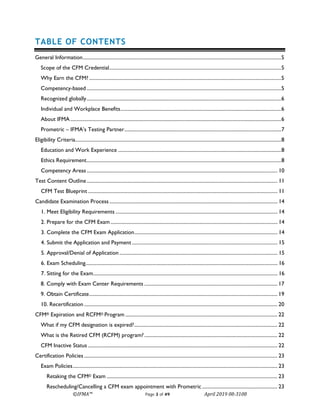
TABLE OF CONTENTS
General Information..............................................................................................................................................................5
Scope of the CFM Credential.........................................................................................................................................5
Why Earn the CFM? .........................................................................................................................................................5
Competency-based...........................................................................................................................................................5
Recognized globally...........................................................................................................................................................6
Individual and Workplace Benefits................................................................................................................................6
About IFMA........................................................................................................................................................................6
Prometric – IFMA’s Testing Partner.............................................................................................................................7
Eligibility Criteria....................................................................................................................................................................8
Education and Work Experience ..................................................................................................................................8
Ethics Requirement...........................................................................................................................................................8
Competency Areas........................................................................................................................................................ 10
Test Content Outline........................................................................................................................................................ 11
CFM Test Blueprint ....................................................................................................................................................... 11
Candidate Examination Process...................................................................................................................................... 14
1. Meet Eligibility Requirements ................................................................................................................................. 14
2. Prepare for the CFM Exam ..................................................................................................................................... 14
3. Complete the CFM Exam Application.................................................................................................................. 14
4. Submit the Application and Payment .................................................................................................................... 15
5. Approval/Denial of Application.............................................................................................................................. 15
6. Exam Scheduling......................................................................................................................................................... 16
7. Sitting for the Exam................................................................................................................................................... 16
8. Comply with Exam Center Requirements .......................................................................................................... 17
9. Obtain Certificate...................................................................................................................................................... 19
10. Recertification .......................................................................................................................................................... 20
CFM® Expiration and RCFM© Program ......................................................................................................................... 22
What if my CFM designation is expired?.................................................................................................................. 22
What is the Retired CFM (RCFM) program?.......................................................................................................... 22
CFM Inactive Status ....................................................................................................................................................... 22
Certification Policies .......................................................................................................................................................... 23
Exam Policies................................................................................................................................................................... 23
Retaking the CFM© Exam ........................................................................................................................................ 23
Rescheduling/Cancelling a CFM exam appointment with Prometric............................................................ 23
©IFMA™ Page 4 of 49 April 2019 08-3108
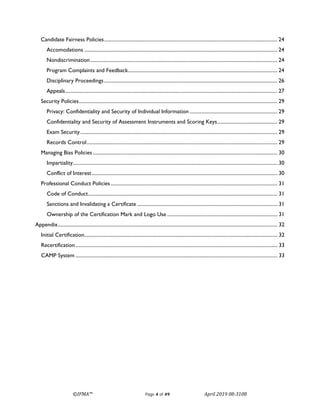
Candidate Fairness Policies.......................................................................................................................................... 24
Accomodations .......................................................................................................................................................... 24
Nondiscrimination..................................................................................................................................................... 24
Program Complaints and Feedback....................................................................................................................... 24
Disciplinary Proceedings.......................................................................................................................................... 26
Appeals......................................................................................................................................................................... 27
Security Policies.............................................................................................................................................................. 29
Privacy: Confidentiality and Security of Individual Information ...................................................................... 29
Confidentiality and Security of Assessment Instruments and Scoring Keys................................................ 29
Exam Security............................................................................................................................................................. 29
Records Control........................................................................................................................................................ 29
Managing Bias Policies ................................................................................................................................................... 30
Impartiality................................................................................................................................................................... 30
Conflict of Interest.................................................................................................................................................... 30
Professional Conduct Policies..................................................................................................................................... 31
Code of Conduct....................................................................................................................................................... 31
Sanctions and Invalidating a Certificate ................................................................................................................ 31
Ownership of the Certification Mark and Logo Use ........................................................................................ 31
Appendix............................................................................................................................................................................... 32
Initial Certification.......................................................................................................................................................... 32
Recertification................................................................................................................................................................. 33
CAMP System ................................................................................................................................................................. 33
©IFMA™ Page 5 of 49 April 2019 08-3108
GENERAL INFORMATION
SCOPE OF THE CFM CREDENTIAL
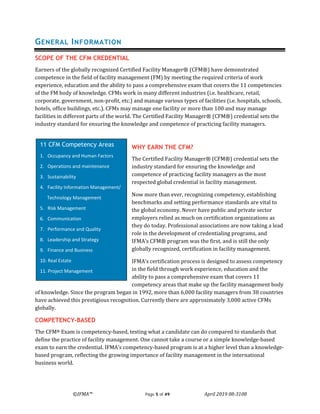
Earners of the globally recognized Certified Facility Manager® (CFM®) have demonstrated
competence in the field of facility management (FM) by meeting the required criteria of work
experience, education and the ability to pass a comprehensive exam that covers the 11 competencies
of the FM body of knowledge. CFMs work in many different industries (i.e. healthcare, retail,
corporate, government, non-profit, etc.) and manage various types of facilities (i.e. hospitals, schools,
hotels, office buildings, etc.). CFMs may manage one facility or more than 100 and may manage
facilities in different parts of the world. The Certified Facility Manager® (CFM®) credential sets the
industry standard for ensuring the knowledge and competence of practicing facility managers.
WHY EARN THE CFM?
The Certified Facility Manager® (CFM®) credential sets the
industry standard for ensuring the knowledge and
competence of practicing facility managers as the most
respected global credential in facility management.
Now more than ever, recognizing competency, establishing
benchmarks and setting performance standards are vital to
the global economy. Never have public and private sector
employers relied as much on certification organizations as
they do today. Professional associations are now taking a lead
role in the development of credentialing programs, and
IFMA’s CFM® program was the first, and is still the only
globally recognized, certification in facility management.
IFMA’s certification process is designed to assess competency
in the field through work experience, education and the
ability to pass a comprehensive exam that covers 11
competency areas that make up the facility management body
of knowledge. Since the program began in 1992, more than 6,000 facility managers from 38 countries
have achieved this prestigious recognition. Currently there are approximately 3,000 active CFMs
globally.
COMPETENCY-BASED
The CFM® Exam is competency-based, testing what a candidate can do compared to standards that
define the practice of facility management. One cannot take a course or a simple knowledge-based
exam to earn the credential. IFMA’s competency-based program is at a higher level than a knowledge-
based program, reflecting the growing importance of facility management in the international
business world.
11 CFM Competency Areas
1. Occupancy and Human Factors
2. Operations and maintenance
3. Sustainability
4. Facility Information Management/
Technology Management
5. Risk Management
6. Communication
7. Performance and Quality
8. Leadership and Strategy
9. Finance and Business
10. Real Estate
11. Project Management
©IFMA™ Page 6 of 49 April 2019 08-3108
RECOGNIZED GLOBALLY
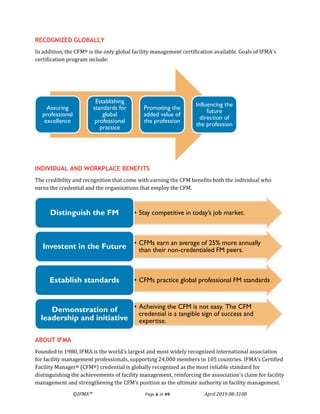
In addition, the CFM® is the only global facility management certification available. Goals of IFMA's
certification program include:
INDIVIDUAL AND WORKPLACE BENEFITS
The credibility and recognition that come with earning the CFM benefits both the individual who
earns the credential and the organizations that employ the CFM.
ABOUT IFMA
Founded in 1980, IFMA is the world's largest and most widely recognized international association
for facility management professionals, supporting 24,000 members in 105 countries. IFMA’s Certified
Facility Manager® (CFM®) credential is globally recognized as the most reliable standard for
distinguishing the achievements of facility management, reinforcing the association’s claim for facility
management and strengthening the CFM’s position as the ultimate authority in facility management.
Assuring
professional
excellence
Establishing
standards for
global
professional
practice
Promoting the
added value of
the profession
Influencing the
future
direction of
the profession
• Stay competitive in today’s job market.Distinguish the FM
• CFMs earn an average of 25% more annually
than their non-credentialed FM peers.Investent in the Future
• CFMs practice global professional FM standardsEstablish standards
• Acheiving the CFM is not easy. The CFM
credential is a tangible sign of success and
expertise.
Demonstration of
leadership and initiative
©IFMA™ Page 7 of 49 April 2019 08-3108
PROMETRIC – IFMA’S TESTING PARTNER
Prometric is a test development and delivery provider that offers a vast network of quality testing
solutions. As a highly trusted test provider, Prometric has around 8,000 testing centers worldwide
allowing for a wide selection of convenient testing dates and locations. Learn more about Prometric
at the Prometric website.
©IFMA™ Page 8 of 49 April 2019 08-3108
ELIGIBILITY CRITERIA
EDUCATION AND WORK EXPERIENCE
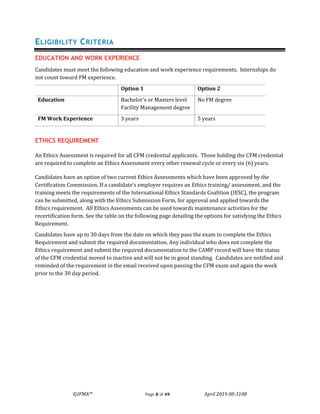
Candidates must meet the following education and work experience requirements. Internships do
not count toward FM experience.
Option 1 Option 2
Education Bachelor’s or Masters level
Facility Management degree
No FM degree
FM Work Experience 3 years 5 years
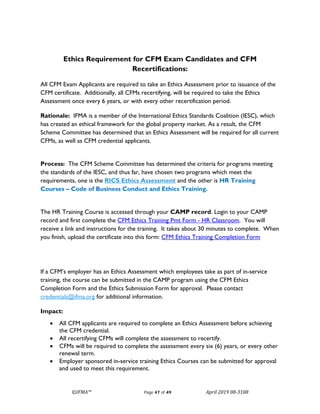
ETHICS REQUIREMENT
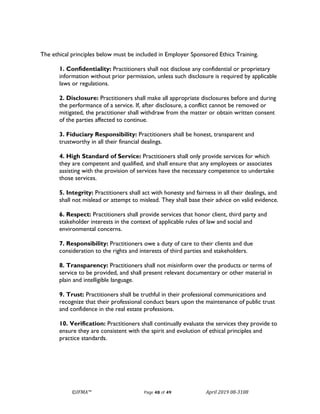
An Ethics Assessment is required for all CFM credential applicants. Those holding the CFM credential
are required to complete an Ethics Assessment every other renewal cycle or every six (6) years.
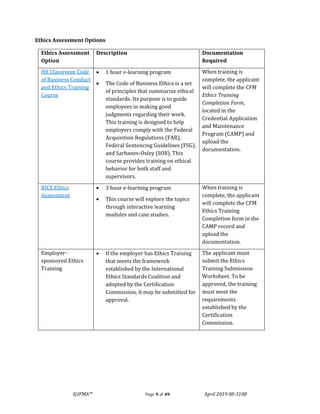
Candidates have an option of two current Ethics Assessments which have been approved by the
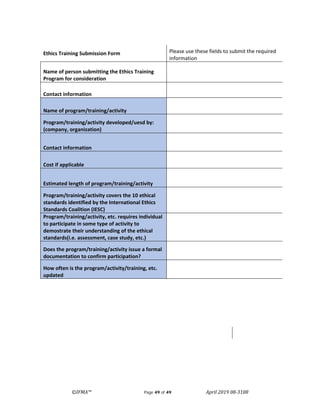
Certification Commission. If a candidate’s employer requires an Ethics training/ assessment, and the
training meets the requirements of the International Ethics Standards Coalition (IESC), the program
can be submitted, along with the Ethics Submission Form, for approval and applied towards the
Ethics requirement. All Ethics Assessments can be used towards maintenance activities for the
recertification form. See the table on the following page detailing the options for satisfying the Ethics
Requirement.
Candidates have up to 30 days from the date on which they pass the exam to complete the Ethics
Requirement and submit the required documentation. Any individual who does not complete the
Ethics requirement and submit the required documentation to the CAMP record will have the status
of the CFM credential moved to inactive and will not be in good standing. Candidates are notified and
reminded of the requirement in the email received upon passing the CFM exam and again the week
prior to the 30 day period.
©IFMA™ Page 9 of 49 April 2019 08-3108
Ethics Assessment Options
Ethics Assessment
Option
Description Documentation
Required
HR Classroom Code
of Business Conduct
and Ethics Training
Course
• 1 hour e-learning program
• The Code of Business Ethics is a set
of principles that summarize ethical
standards. Its purpose is to guide
employees in making good
judgments regarding their work.
This training is designed to help
employers comply with the Federal
Acquisition Regulations (FAR),
Federal Sentencing Guidelines (FSG),
and Sarbanes-Oxley (SOX). This
course provides training on ethical
behavior for both staff and
supervisors.
When training is
complete, the applicant
will complete the CFM
Ethics Training
Completion Form,
located in the
Credential Application
and Maintenance
Program (CAMP) and
upload the
documentation.
RICS Ethics
Assessment
• 3 hour e-learning program
• This course will explore the topics
through interactive learning
modules and case studies.
When training is
complete, the applicant
will complete the CFM
Ethics Training
Completion form in the
CAMP record and
upload the
documentation.
Employer-
sponsored Ethics
Training
• If the employer has Ethics Training
that meets the framework
established by the International
Ethics Standards Coalition and
adopted by the Certification
Commission, it may be submitted for
approval.
The applicant must
submit the Ethics
Training Submission
Worksheet. To be
approved, the training
must meet the
requirements
established by the
Certification
Commission.
©IFMA™ Page 10 of 49 April 2019 08-3108
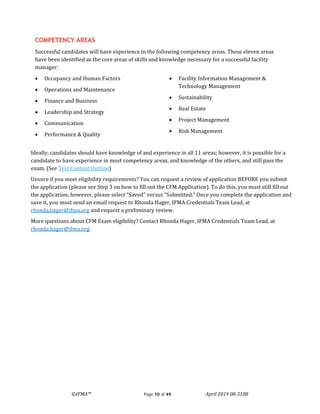
COMPETENCY AREAS
Successful candidates will have experience in the following competency areas. These eleven areas
have been identified as the core areas of skills and knowledge necessary for a successful facility
manager:
• Occupancy and Human Factors
• Operations and Maintenance
• Finance and Business
• Leadership and Strategy
• Communication
• Performance & Quality
• Facility Information Management &
Technology Management
• Sustainability
• Real Estate
• Project Management
• Risk Management
Ideally, candidates should have knowledge of and experience in all 11 areas; however, it is possible for a
candidate to have experience in most competency areas, and knowledge of the others, and still pass the
exam. (See Test Content Outline)
Unsure if you meet eligibility requirements? You can request a review of application BEFORE you submit
the application (please see Step 3 on how to fill out the CFM Application). To do this, you must still fill out
the application; however, please select “Saved” versus “Submitted.” Once you complete the application and
save it, you must send an email request to Rhonda Hager, IFMA Credentials Team Lead, at
rhonda.hager@ifma.org and request a preliminary review.
More questions about CFM Exam eligibility? Contact Rhonda Hager, IFMA Credentials Team Lead, at
rhonda.hager@ifma.org.
©IFMA™ Page 11 of 49 April 2019 08-3108
TEST CONTENT OUTLINE
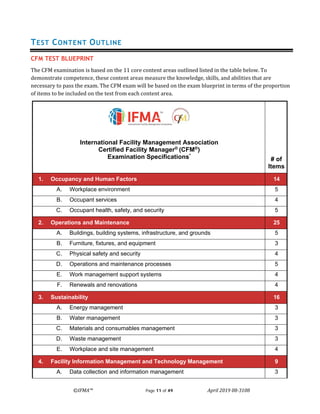
CFM TEST BLUEPRINT
The CFM examination is based on the 11 core content areas outlined listed in the table below. To
demonstrate competence, these content areas measure the knowledge, skills, and abilities that are
necessary to pass the exam. The CFM exam will be based on the exam blueprint in terms of the proportion
of items to be included on the test from each content area.
International Facility Management Association
Certified Facility Manager®
(CFM®
)
Examination Specifications*
# of
Items
1. Occupancy and Human Factors 14
A. Workplace environment 5
B. Occupant services 4
C. Occupant health, safety, and security 5
2. Operations and Maintenance 25
A. Buildings, building systems, infrastructure, and grounds 5
B. Furniture, fixtures, and equipment 3
C. Physical safety and security 4
D. Operations and maintenance processes 5
E. Work management support systems 4
F. Renewals and renovations 4
3. Sustainability 16
A. Energy management 3
B. Water management 3
C. Materials and consumables management 3
D. Waste management 3
E. Workplace and site management 4
4. Facility Information Management and Technology Management 9
A. Data collection and information management 3
©IFMA™ Page 12 of 49 April 2019 08-3108
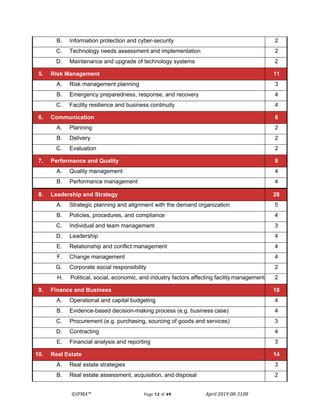
B. Information protection and cyber-security 2
C. Technology needs assessment and implementation 2
D. Maintenance and upgrade of technology systems 2
5. Risk Management 11
A. Risk management planning 3
B. Emergency preparedness, response, and recovery 4
C. Facility resilience and business continuity 4
6. Communication 6
A. Planning 2
B. Delivery 2
C. Evaluation 2
7. Performance and Quality 8
A. Quality management 4
B. Performance management 4
8. Leadership and Strategy 28
A. Strategic planning and alignment with the demand organization 5
B. Policies, procedures, and compliance 4
C. Individual and team management 3
D. Leadership 4
E. Relationship and conflict management 4
F. Change management 4
G. Corporate social responsibility 2
H. Political, social, economic, and industry factors affecting facilitymanagement 2
9. Finance and Business 18
A. Operational and capital budgeting 4
B. Evidence-based decision-making process (e.g. business case) 4
C. Procurement (e.g. purchasing, sourcing of goods and services) 3
D. Contracting 4
E. Financial analysis and reporting 3
10. Real Estate 14
A. Real estate strategies 3
B. Real estate assessment, acquisition, and disposal 2
©IFMA™ Page 13 of 49 April 2019 08-3108
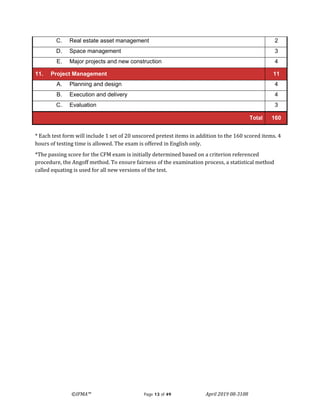
C. Real estate asset management 2
D. Space management 3
E. Major projects and new construction 4
11. Project Management 11
A. Planning and design 4
B. Execution and delivery 4
C. Evaluation 3
Total 160
* Each test form will include 1 set of 20 unscored pretest items in addition to the 160 scored items. 4
hours of testing time is allowed. The exam is offered in English only.
*The passing score for the CFM exam is initially determined based on a criterion referenced
procedure, the Angoff method. To ensure fairness of the examination process, a statistical method
called equating is used for all new versions of the test.
©IFMA™ Page 14 of 49 April 2019 08-3108
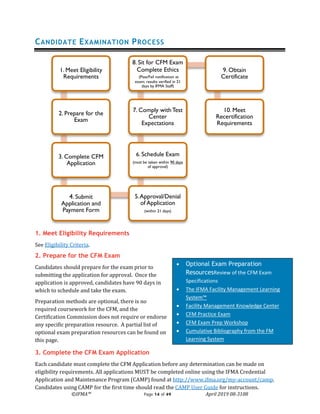
CANDIDATE EXAMINATION PROCESS
1. Meet Eligibility Requirements
See Eligibility Criteria.
2. Prepare for the CFM Exam
Candidates should prepare for the exam prior to
submitting the application for approval. Once the
application is approved, candidates have 90 days in
which to schedule and take the exam.
Preparation methods are optional, there is no
required coursework for the CFM, and the
Certification Commission does not require or endorse
any specific preparation resource. A partial list of
optional exam preparation resources can be found on
this page.
3. Complete the CFM Exam Application
Each candidate must complete the CFM Application before any determination can be made on
eligibility requirements. All applications MUST be completed online using the IFMA Credential
Application and Maintenance Program (CAMP) found at http://www.ifma.org/my-account/camp.
Candidates using CAMP for the first time should read the CAMP User Guide for instructions.
1. Meet Eligibility
Requirements
2. Prepare for the
Exam
3. Complete CFM
Application
4. Submit
Application and
Payment Form
5.Approval/Denial
of Application
(within 21 days)
6. Schedule Exam
(must be taken within 90 days
of approval)
7. Comply withTest
Center
Expectations
8. Sit for CFM Exam
Complete Ethics
(Pass/Fail notification at
exam; results verified in 21
days by IFMA Staff)
9. Obtain
Certificate
10. Meet
Recertification
Requirements
• Optional Exam Preparation
ResourcesReview of the CFM Exam
Specifications
• The IFMA Facility Management Learning
System™
• Facility Management Knowledge Center
• CFM Practice Exam
• CFM Exam Prep Workshop
• Cumulative Bibliography from the FM
Learning System
©IFMA™ Page 15 of 49 April 2019 08-3108
If you are a member of IFMA, a past member of IFMA, OR have ever set-up an IFMA username and
password to purchase something as a nonmember, you should use the same username and
password to log into CAMP. If you do not recall your username and password but believe one was
set-one up in the past, it will be necessary to contact IFMA by calling +1-713-623-4362 or emailing
credentials@ifma.org to obtain the required login information.
If you have never set-up a username or password with IFMA, you can simply go
to http://www.ifma.org/my-account/camp > choose the “CAMP” button in the middle of the page >
and follow the directions for “registration” to create a username and password. If you encounter any
issues, please email credentials@ifma.org for assistance.
See appendix for the CFM® Application.
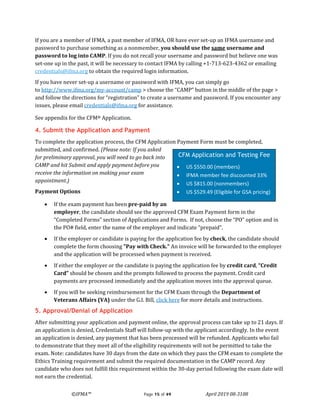
4. Submit the Application and Payment
To complete the application process, the CFM Application Payment Form must be completed,
submitted, and confirmed. (Please note: If you asked
for preliminary approval, you will need to go back into
CAMP and hit Submit and apply payment before you
receive the information on making your exam
appointment.)
Payment Options
• If the exam payment has been pre-paid by an
employer, the candidate should see the approved CFM Exam Payment form in the
“Completed Forms” section of Applications and Forms. If not, choose the “PO” option and in
the PO# field, enter the name of the employer and indicate “prepaid”.
• If the employer or candidate is paying for the application fee by check, the candidate should
complete the form choosing "Pay with Check." An invoice will be forwarded to the employer
and the application will be processed when payment is received.
• If either the employer or the candidate is paying the application fee by credit card, “Credit
Card” should be chosen and the prompts followed to process the payment. Credit card
payments are processed immediately and the application moves into the approval queue.
• If you will be seeking reimbursement for the CFM Exam through the Department of
Veterans Affairs (VA) under the G.I. Bill, click here for more details and instructions.
5. Approval/Denial of Application
After submitting your application and payment online, the approval process can take up to 21 days. If
an application is denied, Credentials Staff will follow-up with the applicant accordingly. In the event
an application is denied, any payment that has been processed will be refunded. Applicants who fail
to demonstrate that they meet all of the eligibility requirements will not be permitted to take the
exam. Note: candidates have 30 days from the date on which they pass the CFM exam to complete the
Ethics Training requirement and submit the required documentation in the CAMP record. Any
candidate who does not fulfill this requirement within the 30-day period following the exam date will
not earn the credential.
CFM Application and Testing Fee
• US $550.00 (members)
• IFMA member fee discounted 33%
• US $815.00 (nonmembers)
• US $529.49 (Eligible for GSA pricing)
©IFMA™ Page 16 of 49 April 2019 08-3108
A portion of applications will be selected for random audit. If selected for audit, the applicant must
provide documentation to 1) verify the applicant’s work experience by providing written
documentation to verify employment history and 2) verify the applicant’s FM degree (if applicable)
by providing an official transcript.
6. Exam Scheduling
If the application is approved,you will receive an email with instructions for scheduling an exam date
at a Prometric Testing Center in a convenient location. Steps on scheduling an exam with Prometric
will be sent via e-mail with the approval notice.
The exam eligibility period is 90 days from the date the application is approved, and there are
policies regarding rescheduling and/or cancelling an exam date. This information will be included in
the scheduling email. The candidate must take the exam during the 90-day period.
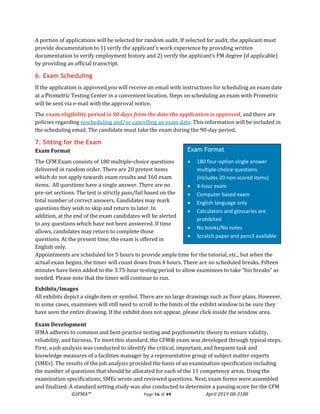
7. Sitting for the Exam
Exam Format
The CFM Exam consists of 180 multiple-choice questions
delivered in random order. There are 20 pretest items
which do not apply towards exam results and 160 exam
items. All questions have a single answer. There are no
pre-set sections. The test is strictly pass/fail based on the
total number of correct answers. Candidates may mark
questions they wish to skip and return to later. In
addition, at the end of the exam candidates will be alerted
to any questions which have not been answered. If time
allows, candidates may return to complete those
questions. At the present time, the exam is offered in
English only.
Appointments are scheduled for 5 hours to provide ample time for the tutorial, etc., but when the
actual exam begins, the timer will count down from 4 hours. There are no scheduled breaks. Fifteen
minutes have been added to the 3.75-hour testing period to allow examinees to take “bio breaks” as
needed. Please note that the timer will continue to run.
Exhibits/Images
All exhibits depict a single item or symbol. There are no large drawings such as floor plans. However,
in some cases, examinees will still need to scroll to the limits of the exhibit window to be sure they
have seen the entire drawing. If the exhibit does not appear, please click inside the window area.
Exam Development
IFMA adheres to common and best-practice testing and psychometric theory to ensure validity,
reliability, and fairness. To meet this standard, the CFM® exam was developed through typical steps.
First, a job analysis was conducted to identify the critical, important, and frequent task and
knowledge measures of a facilities manager by a representative group of subject matter experts
(SMEs). The results of the job analysis provided the basis of an examination specification including
the number of questions that should be allocated for each of the 11 competency areas. Using the
examination specifications, SMEs wrote and reviewed questions. Next, exam forms were assembled
and finalized. A standard setting study was also conducted to determine a passing score for the CFM
Exam Format
• 180 four-option single answer
multiple-choice questions
(includes 20 non-scored items)
• 4-hour exam
• Computer based exam
• English language only
• Calculators and glossaries are
prohibited
• No books/No notes
• Scratch paper and pencil available
©IFMA™ Page 17 of 49 April 2019 08-3108
exam. Prior to the release of the exam, an item analysis was conducted on the previous CFM exam
forms. Items not performing well were flagged and reviewed by SMEs to determine if they were
appropriate to be used on the exam. Finally, all forms developed are equated to ensure that the exams
are equally difficult.
Special Accommodations
The Certification Commission and its testing vendor, Prometric, comply with the Americans with
Disabilities Act (ADA) which requires that the examination is offered in a place and manner that is
accessible to candidates with disabilities. This may require reasonable modifications. Prometric will
provide candidates reasonable auxiliary aids and services, except where it may fundamentally alter
the validity of the exam results. Available accommodations include, but are not limited to, a reader, a
scribe, and extended testing time.
If you are seeking special accommodations, you must indicate this on your application and submit a
request form for accommodations (see appendix). To request accommodations, you and your health
care provider will each need to complete one form, the Candidate Form: Request for Special Exam
Accommodation and the Provider Form: Request for Special Exam Accommodation-Physician
Statement, to document the disability and the need for accommodation. These forms can be found in
the applicant record in CAMP.
There is no additional charge for special accommodations. Each request will be evaluated individually
by IFMA. If approved, IFMA will alert Prometric of the necessary accommodations. Once a candidate
has requested special accommodations, he/she will not be able to schedule an appointment with
Prometric until the request is processed. The candidate will be contacted by email regarding the
approval status of the special testing accommodations request.
8. Comply with Exam Center Requirements
It is recommended that candidates arrive at the test center at least 30 minutes prior to the scheduled
exam appointment. Candidates who arrive at the test site after their scheduled exam times will not be
admitted.
Candidates must provide two forms of identification, with one being a valid, unexpired government-
issued ID with a signature, a photograph that looks like the candidate, and an expiration date.
Acceptable examples of government-issued, photo ID include:
• Driver’s license
• Passport
• Military ID
• Alien ID/Resident Alien Card (*If the ID has picture but no signature, it must be provided with
a form of signature ID (Credit Card) in the same name.)
Unacceptable forms of ID include but are not limited to an expired ID, an ID without an expiration
date, Social Security Card, or an ID with no photo.
©IFMA™ Page 18 of 49 April 2019 08-3108
Additionally, one form of ID with a valid signature is required. A credit card with signature will satisfy
this requirement.
Note: The name on the IDs must match the name used to apply for the exam, or the candidate
will not be allowed to take the exam.
Once the information has been verified at the test center, candidates will be escorted to a workstation
by test center staff. Candidates must remain in the seat during the exam except when authorized to
leave by test center staff. Candidates must raise a hand to notify test center staff if:
• There are problems with the computer
• An error message appears on the computer screen (do not clear the message)
• Candidate needs to take a break (testing time will NOT be suspended)
• Candidate needs the test center staff for any other reason
Any candidate who engages in misconduct or does not comply with the test proctor’s warning to
discontinue inappropriate behavior may be dismissed from the test site, have exam results
invalidated, or be subject to other sanctions. Fraud, deceit, dishonesty, or other irregular behavior in
connection with taking the exam is strictly prohibited.
Enhanced Exam Security – A Stringent Focus on Protecting the Honest Test Taker and Ensuring
a Fair Test Experience
Prometric conducts strict inspections of all eyeglasses, jewelry and other accessories to inspect for
camera devices that could be used to capture exam content. All candidates will be required to remove
their eyeglasses for close visual inspection by the TCAs. These inspections will take a few seconds
and will be done at check-in and again upon return from breaks. In addition:
• Jewelry outside of wedding and engagement rings is prohibited. Candidates should not wear
other jewelry to the test center.
• Hair accessories are subject to inspection. Candidates should refrain from wearing ornate
clips, combs, barrettes, headbands, and other hair accessories as they may be prohibited
from wearing them in to the testing room and asked to store them in their locker.
• If a candidate is caught with a camera device prior to entering the testing room, it will be
confiscated, and the candidate will not be allowed to test.
• If a candidate is caught with a camera device while in the testing room, it will be confiscated,
and the exam will be terminated.
Exam Results
Upon completion of the exam, the candidate is notified immediately regarding pass/fail status. IFMA
Credentials staff will confirm the results within 20 days for those candidates who have completed the
ethics assessment prior to taking the exam. Candidates who have not completed the ethics
requirement prior to taking the exam must do so and submit the required documentation in the
CAMP record within 30 days of the date on which the candidate took the certification exam.
Candidates who have met all requirements for certification should receive certificate packets within
30 days of the successful testing date or completion of the ethics assessment, whichever occurs last.
©IFMA™ Page 19 of 49 April 2019 08-3108
9. Obtain Certificate
A paper certificate shall be issued to all credential holders who pass the exam, and shall include the
following:
• Credential holder’s name
• Credential holder’s ID number and
credential serial number
• Credentials program title
• IFMA as the certification issuer
• Signature of Certification Commission
Chair
• Certificate term of validity
The certificate is the sole property of IFMA and must be returned if certification status is suspended or
revoked.
A secure digital badge will be issued to credential holders as well as instructions for claiming the badge.
Candidates who have earned the CFM® certification must abide by IFMA’s policy concerning the use of the
designation for various purposes including logos and trademarks (See Ownership of the Mark and Logo).
Additionally, all credential holders shall be listed in IFMA’s Public Credentials Registry. If the CFM allows
the credential to cancel due to neglecting to meet recertification requirements, or the CFM credential is
cancelled by the CFM governing body for non-adherence to the CFM Code of Conduct, the candidate will
not use the designation or logo in any way. Violation may be cause for legal action.
©IFMA™ Page 20 of 49 May 2019 08-3108
FM Related
Education
FM Practice Professional
Leadership
Development
of the
Profession
10. Recertification
Recertification through continued study or participation in
industry sponsored events demonstrates that designees are
using the knowledge and skills represented by the certification.
By using the designation, you are promoting your high level of
experience and knowledge. If no program were in place to keep
up with the dynamic changes in facility management, then the
power and prestige of the designation would be
diminished. The CFM is a constant reflection of expertise and
professionalism; thus, worth maintaining.
The CFM Certification is valid through December 31, three (3)
years from the date of the CFM exam or the last recertification
date. To maintain the CFM credential, a list of the activities
performed along with the appropriate supporting
documentation including a processing fee must be submitted to
IFMA credentialing department every three years. CFMs are required to complete at least three activities
ina minimum of two of the following four categories, for a total of six activities within the 3-year
certification period:
Candidates must complete the recertification process below to maintain their credential:
• Complete and submit the CFM® Recertification Form and required supporting documentation. (See
Appendix for link to the Recertification Maintenance Worksheet.)
• Complete and submit the CFM® Recertification Payment Form.
• Meet the Ethics Training requirement every 6 years (every other renewal cycle) by completing an
Ethics Assessment (see Ethics Requirement). Ethics Training may be used towards the FM-related
Education Category.
• IFMA staff will review the submitted documentation and notify the CFM of the recertification
outcome by email within 30 days of submission. Those who successfully recertifiy will receive a
certificate packet following approval.
• IFMA sends out recertification notices, as a courtesy, beginning 6 months prior to the CFM
expiration date for all active CFMs. It is imperative that CFMs keep their contact information
current with IFMA. It remains the responsibility of the CFM to submit the recertification
documents on time.
• Renewal applications will not be accepted from individuals whose certification is in a state of
suspension or has been revoked.
• A portion of applications will be selected for random audit. If selected for audit, the applicant
must provide documentation as requested by the certification program to validate the
information submitted with the application.
Recertification
Fees
• US $290 (member)
• IFMA member fee is discounted
21%)
• US $365 (nonmember)
Requirements
Achieve 6 activities in two areas:
• Practice
• FM Related Education
• Professional Leadership
• Development of the Profession
©IFMA™ Page 21 of 49 May 2019 08-3108
Upon expiration, the CFM term moves into a 3 month “grace period” during which a certified individual
may renew the certification without penalty. After the 3 month grace period, there is a 3 month
“cancellation pending” period during which the CFM can still submit recertification documents, there is,
however, a $100 late fee charged during this period.
See appendix for Recertification Worksheet, CFM® Maintenance Program, and CAMP Access
Instructions.
©IFMA™ Page 22 of 49 May 2019 08-3108
CFM® EXPIRATION AND RCFM© PROGRAM
What if my CFM designation is expired?
After your official CFM® expiration date, there is a three-month grace period in which you may renew
without penalty. If a recertification package is received anywhere from three months and one day to six
months after the expiration date, it will also need to include a late fee of US $100.00. The rules of the
Certification Commission mandate that CFMs who go more than six months past their expiration date
without renewing their CFM, will lose the credential, and must retake the CFM Exam in order to reinstate
it.
Reminder notices are sent out as a courtesy; it is each CFM’s professional obligation to renew their CFM in
a timely manner. It is also the CFM’s responsibility to ensure that address records are kept current.
What is the Retired CFM (RCFM) program?
A Retired CFM category has been established for CFMs who have retired or who have otherwise left the
profession and want to indicate past certification. There are no age or renewal requirements for RCFM,
however the CFM must apply no more than 6 months past the expiration date of the most recent
recertification period. The RCFM application form is available through IFMA's CAMP system. For more
details about RCFM, click here.
See appendix for Retired CFM (RCFM) Program Application.
CFM Inactive Status
It is possible for an active CFM to move to a temporary Inactive Status under the following situations:
• Serious illness of CFM or an immediate family member
• Extended unemployment (longer than 6 months)
• Active Duty Military
• Death of an immediate family member
The inactive period will last for one year from the date prior to the cancellation date of the CFM. During
this time, the CFM can obtain sufficient maintenance activities in order to renew the credential. The
expiration date will be 3 years from the last expiration date of the CFM credential.
©IFMA™ Page 23 of 49 May 2019 08-3108
CERTIFICATION POLICIES
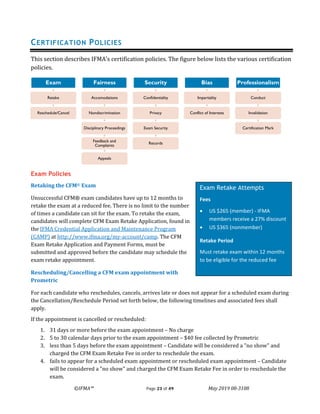
This section describes IFMA’s certification policies. The figure below lists the various certification
policies.
Exam Policies
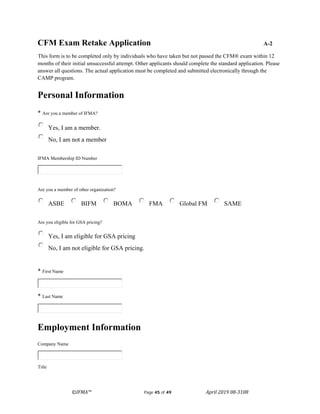
Retaking the CFM© Exam
Unsuccessful CFM® exam candidates have up to 12 months to
retake the exam at a reduced fee. There is no limit to the number
of times a candidate can sit for the exam. To retake the exam,
candidates will complete CFM Exam Retake Application, found in
the IFMA Credential Application and Maintenance Program
(CAMP) at http://www.ifma.org/my-account/camp. The CFM
Exam Retake Application and Payment Forms, must be
submitted and approved before the candidate may schedule the
exam retake appointment.
Rescheduling/Cancelling a CFM exam appointment with
Prometric
For each candidate who reschedules, cancels, arrives late or does not appear for a scheduled exam during
the Cancellation/Reschedule Period set forth below, the following timelines and associated fees shall
apply.
If the appointment is cancelled or rescheduled:
1. 31 days or more before the exam appointment – No charge
2. 5 to 30 calendar days prior to the exam appointment – $40 fee collected by Prometric
3. less than 5 days before the exam appointment – Candidate will be considered a "no show" and
charged the CFM Exam Retake Fee in order to reschedule the exam.
4. fails to appear for a scheduled exam appointment or rescheduled exam appointment – Candidate
will be considered a "no show" and charged the CFM Exam Retake Fee in order to reschedule the
exam.
Exam
Retake
Reschedule/Cancel
Fairness
Accomodations
Nondiscrimination
Disciplinary Proceedings
Feedback and
Complaints
Appeals
Security
Confidentiality
Privacy
Exam Security
Records
Bias
Impartiality
Conflict of Interests
Professionalism
Conduct
Invalidation
Certification Mark
Exam Retake Attempts
Fees
• US $265 (member) - IFMA
members receive a 27% discount
• US $365 (nonmember)
Retake Period
Must retake exam within 12 months
to be eligible for the reduced fee
©IFMA™ Page 24 of 49 May 2019 08-3108
5. presents himself/herself more than fifteen (15) minutes after the scheduled start time for taking
the test and is refused admission – Candidate will be considered a "no show" and charged the CFM
Exam Retake Fee in order to reschedule the exam.
Within the United States and Canada, Candidates must make and confirm all cancellations/changes
through direct contact with Prometric Testing Center personnel through the Website or IVR system.
Leaving a message on a recorder or a voice mail is not sufficient to confirm a cancellation/change. Outside
of the United States and Canada, Candidates must make and confirm all cancellations/changes via the
Website or by direct contact with the Prometric Testing Center. Candidates must retain the cancellation
confirmation number provided by Prometric for use rescheduling the exam and to provide verification of
the cancellation if needed.
Candidate Fairness Policies
Accomodations
The Certification Commission and its testing vendor, Prometric, comply with the Americans with
Disabilities Act (ADA) which requires that the examination is offered in a place and manner that is
accessible to candidates with disabilities. This may require reasonable modifications. Prometric will
provide candidates reasonable auxiliary aids and services, except where it may fundamentally alter the
validity of the exam results. Available accommodations include, but are not limited to, a reader, a scribe,
and extended testing time.
If you are seeking special accommodations, you must indicate this on your application and submit a
request form for accommodations. Specific instructions for requesting exam accommodations are found in
Sitting for the CFM Exam.
Nondiscrimination
IFMA adheres to the principles of fairness and due process, and endorse the principles of equal
opportunity.
IFMA credentials programs shall not discriminate or deny opportunity to anyone on the grounds of
gender, age, religion, national or ethnic origin, marital status, veteran status, sexual orientation or
disability.
It is essential that an equal opportunity for success is provided to every participant in each program, and
that no person or group is given special treatment in the attainment and continuation of any credential.
Program Complaints and Feedback
Complaints Definition
Individuals with feedback regarding the assessment process, personnel or other elements of the
credentials process are encouraged to discuss these with the individuals involved to try to resolve the
matter informally. In some cases, however, informal resolution is not possible, and individuals may wish
to file a formal complaint.
©IFMA™ Page 25 of 49 May 2019 08-3108
A complaint is a formal request pertaining to a grievance in the assessment process, personnel or other
elements of the certification process that is not related to the certification or recertification itself, refer to
Appeals.
First Level of Complaint – Staff Review
A complaint shall be submitted in writing to the credentials staff within 30 days of the incident’s
occurrence. The written submission shall include sufficient objective evidence to substantiate the claims
which will allow for a decision to be made and request the appropriate action to be taken. Dissatisfaction
based on hearsay shall not be considered as a complaint. Anonymous complaints shall not be considered.
The credentials staff shall confirm receipt of the complaint via email upon receipt along with a copy of the
document explaining the process.
Emailed complaints should be submitted to rhonda.hager@ifma.org or credentials@ifma.org.
Mailed complaints should be addressed to:
Credentials Department
c/o IFMA
800 Gessner Road, Suite 900
Houston, Texas 77024-4257
When possible, the credentials staff will seek staff resolution related to the complaint. If action is required,
the credentials staff will refer the matter to an appropriate staff member to resolve if possible. A staff
member who rendered the original decision should not be the same individual responsible for reviewing
the complaint. Any matters of confidentiality, conflict of interest, and impartiality will be taken into
account. The responsible staff member shall take action to resolve the issue and communicate the
resolution to the individual and the credentials staff within 30 calendar days of receipt of the complaint.
If informal resolution cannot be achieved, the Review Committee process below will be followed.
Complaints that cannot be resolved by certification staff to the complainant’s satisfaction within thirty
(30) days of receipt will be forwarded by the credentials staff to the Chair of the Certification Commission
along with any relevant information used in making the initial decision.
Second Level of Complaint – Review Committee
The Chair of the Certification Commission will appoint an ad-hoc Review Committee of three or more
individuals, who may or may not be members of the Commission and who will review the evidence in the
case, and make a determination within sixty (60) days of the original receipt.
Once a decision is reached, the credentials staff shall send the complainant a letter, via email,
communicating the Review Committee’s decision. The decision of the Review Committee will be final.
Submission, review, and resolution of the complaint shall not result in any discriminatory actions against
the complainant.
©IFMA™ Page 26 of 49 May 2019 08-3108
Disciplinary Proceedings
In order to maintain and enhance the credibility of the certification program, the Certification Commission
has adopted the following procedures to allow individuals to bring complaints concerning the conduct of
CFM certificants to the Commission.
In the event of a violation as defined below, the Commission may reprimand or suspend the individual or
may revoke certification.
Grounds for Sanctions and Invalidation
Sanctions may be imposed and/or a certification earned by completing IFMA’s certification requirements
may be invalidated by the Certification Commission when it has been discovered that the certification
should not have been issued in the first place and/or for any of the following reasons:
• Obtaining the certification through the use of fraud or deceit or assisting another person to do so; or
• Unauthorized possession, distribution, or use of any assessment-related materials or assisting
another person to do so; or
• Failure to cooperate reasonably with any disciplinary investigation by the designee or Certification
Commission; or
• Violation of the Code of Conduct for CFMs, Commission certification rules, requirements, and/or
policies.
First Level of Review – Staff Review
Individuals may file a complaint against a certification holder by submitting a written document to the
Credentials Designee which includes the stated complaint and relevant supporting materials. Anonymous
complaints shall not be considered.
Upon receipt of a written complaint, the complaint shall be reviewed by the designee to ascertain if the
criteria for acceptance of a complaint are met. All three (3) of the following acceptance criteria must be
met:
1. Complainant must have personal knowledge of the alleged violation or misbehavior or must be in a
position to supply relevant and reliable documentation.
2. Complainant must demonstrate by documentation and factual evidence that the complaint involves
an issue(s) directly related to the certification program standards or Code of Conduct for CFMs.
Matters of a personal nature or matters not related to the criteria set forth will not be considered.
3. The complaint will not be processed if certification records show that the named person is no
longer a certification holder unless the complaint is related to such person representing him- or
herself as having a current certification.
Accepted complaints will be first processed by the designee within sixty (60) days of receipt for the
purpose of attempting to resolve the complaint informally. A written notice will be sent to the individual
who is the subject of the complaint, who shall have the opportunity to respond to the complaint. The
individual submitting the complaint shall also receive notice that the complaint is being reviewed. If
resolution by the designee is not possible, the situation will be escalated to the Certification Commission
Chair.
©IFMA™ Page 27 of 49 May 2019 08-3108
Details of a complaint shall be confidential throughout the resolution process. Staff, Commission, and
Committee members who hear a complaint shall keep all information confidential, available to others only
on a need-to-knowbasis.
Second Level of Review – Review Committee
The Certification Commission Chair will appoint an ad-hoc Review Committee of three or more
individuals, who may or may not be members of the Commission and who will review the evidence in the
case, including the initial determination, and make a determination within sixty (60) days of the original
receipt. The Review Committee may be assisted in the conduct of its investigation by members of the
Commission, IFMA credentials staff, or legal counsel. The designee exercises general supervision over all
investigations.
Both the individual submitting the complaint and the certificant who is the subject of the investigation
(and his or her employer, if applicable) may be contacted for additional information with respect to the
complaint. The Review Committee, or the Commission on its behalf, may at its discretion contact such
other individuals who may have knowledge of the facts and circumstances surrounding the complaint.
Upon completion of an investigation, the Review Committee makes a determination whether there has
been a violation of Commission policies and rules. The Review Committee will make a recommendation of
its findings to the Commission and recommend a sanction, if it determines a violation has occurred. The
Commission will review the determination and recommended sanction and may elect to accept, reject, or
modify the Review Committee’s recommendation. These sanctions may include, but are not limited to:
written reprimand, suspension, revocation, or permanent revocation.
Once a decision is reached, the designee will notify the certification holder, complainant, and the certificant's
employer (if involved in the investigation) of the written decision.
The certificant may appeal the decision following the procedures outlined in the Appeals Policy.
Submission, investigation and decision on complaints shall not result in any discriminatory actions against
those involved.
Reprimand in the form of a written notice from the designee normally is sent to a certificant who has
received his or her first substantiated complaint. Suspension normally is imposed on a certificant who has
received two substantiated complaints. Termination normally is imposed on a certificant who has received
two substantiated complaints within a two year period, or three or more substantiated complaints. The
Commission may at its discretion, however, impose any of the sanctions, if warranted, in specific cases.
Certificants who have been terminated will have their certification revoked and may not be considered for
IFMA certification in the future. If certification is revoked, any and all certificates or other materials
requested by the Commission must be returned promptly to the Commission.
Appeals
Appeal Definition
An appeal is a formal request for reconsideration of an adverse decision made by the certification program
related to an individual’s achievement of certification or recertification or disciplinary issues.
First Level of Appeal – Staff Review
©IFMA™ Page 28 of 49 May 2019 08-3108
Applicants, candidates, or certificants who are notified of an adverse decision related to certification,
recertification, and/or disciplinary issues may appeal the decision by sending a written notice of the
appeal to the certification program within 30 calendar days of the adverse decision notification. The
appellant shall clearly set forth the reasons he or she believes the decision was improperly decided,
including documentation to support such claim. The designee shall confirm receipt of the letter of appeal
via email upon receipt along with a copy of the document explaining the process.
Emailed appeals should be submitted to rhonda.hager@ifma.org.
Mailed appeals should be addressed to:
Credentials Department
c/o IFMA
800 Gessner Road, Suite 900
Houston, Texas 77024-4257
Appeals that cannot be resolved by certification staff within thirty (30) days of receipt will be forwarded
by the designee to the Chair of the Certification Commission along with any relevant information used in
making the initial decision.
Second Level of Appeal – Appeal Committee
The Chair of the Certification Commission will appoint an ad-hoc Appeal Committee who will review the
evidence in the case, and make a determination within sixty (60) days of the original receipt. No current
members of the Commission or Review Committee may serve on the Appeal Committee; further, no one
with any personal involvement or conflict of interest may serve on the Appeal Committee. Members of the
Appeal Committee may be reimbursed for reasonable expenses incurred in connection with the activities
of the Appeal Committee.
Basis for Appeal
The Appeal Committee may only review whether the determination was inappropriate because of:
• material errors of fact, or
• failure of the Commission or Review Committee to conform to published criteria, policies, or
procedures.
Appeal Procedure
Only facts and conditions up to and including the time of the initial determination are considered during
an appeal. The appeal will not include a hearing or any similar trial-type proceeding. Legal counsel is not
expected to participate in the appeal process, unless requested by the appellant and approved by the
Commission and the Appeal Committee. The Commission and Appeal Committee may consult legal
counsel.
Written appellate submissions and any reply submissions may be made by authorized representatives of
the appellate and of the Commission. Submissions are made according to whatever schedule is reasonably
established by the Appeal Committee. The decision of the Appeal Committee either affirms or overrules
the determination of the Commission, but does not address a sanction imposed by the Commission. The
decision of the Appeal Committee, including a statement of the reasons for the decision, is reported to the
Commission and the IFMA Board of Directors.
©IFMA™ Page 29 of 49 May 2019 08-3108
Once a decision is reached, the designee shall send the appellant a letter, via email, communicating the
Appeal Committee’s decision. The decision of the Appeal Committee will be final and binding upon the
Commission, the certificant who is subject to the termination, and all other persons. Submission,
investigation and decision on appeals shall not result in any discriminatory actions against the appellant.
Security Policies
Privacy: Confidentiality and Security of Individual Information
IFMA shall safeguard the privacy of individuals and shall hold in confidence and in a secure manner the
information obtained in the course of credentials program activities, including those of all volunteers
and contractors acting on its behalf.
Information about an individual shall not be disclosed to a third party by IFMA personnel without the
written consent of the individual. Where the law requires information to be disclosed to a third party,
the individual shall be notified of the information provided.
Requests for verification of progress in attaining credentials shall be provided only to the participant,
unless his/her permission is granted in writing allowing release to others. Progess information shall be
provided in writing and/or electronically.
Requests by any person for verification of an individual’s credential status may be responded to by
phone, online or in writing. Only an indication of whether an individual has a valid credential, the
candidate ID number, and issuance/expiration date shall be provided; the status of in-progress or
unsuccessful participants is not disclosed; even the fact that an application has been submitted shall not
be disclosed.
Confidentiality and Security of Assessment Instruments and Scoring Keys
To ensure the security of the examination, all test materials are confidential and will not be released to
any person or agency. IFMA shall safeguard the assessment instruments and scoring keys/rubrics during
the course of credentials program activities at all levels of the organization, including those of all
volunteers and contractors acting on its behalf. Personnel handling the assessment instruments and
scoring keys shall be provided procedures for the secure handling of exams and shall attest to reading and
understanding them prior to their handling of the materials.
Exam Security
IFMA uses several methods to prevent cheating and to ultimately ensure that the exam items are intact
and individuals are not cheating. The methods include managing and monitoring the test sites and
procedures, monitoring digital communication for exposed items and monitoring psychometrics and
managing item banks such as retiring items that have been frequently used.
All candidates are required to provide identification documents, and individuals who fail to provide valid
identification will be refused admission to test.
Applicants must attest to maintain the confidentiality of exam content when completing the exam
application.
Records Control
Scope of Records Control System
©IFMA™ Page 30 of 49 May 2019 08-3108
A credentials records control system shall be maintained to ensure that credentials program records are
identified, managed, and disposed of in a manner designed to ensure integrity of the program and
confidentiality of the information.
No Retention Required
Documents and other materials (including originals and duplicates) that are not otherwise required to
be retained, are not necessary to the functioning or continuity of IFMA and which have no legal
significance may be destroyed when no longer needed. Examples include draft documents, duplicate
copies of records that are no longer needed, reminder messages, miscellaneous correspondence not
requiring follow-up or action. No specific retention requirements are assigned to these types of
documents.
Security of Records
IFMA shall restrict access to the credentials records maintained in IFMA's database system to those
personnel requiring access to accomplish credentials-related duties. Access to credentials records shall
be by authorization of the department head or designee only.
Managing Bias Policies
Impartiality
IFMA places the utmost importance on integrity and impartiality in carrying out its activities.
It is essential that an equal opportunity for success is provided to every candidate in each program,
just as it is of paramount importance that all policies and procedures contribute to the development,
oversight, evaluation, and maintenance of fair and equitable credentials and assessments which
advance the profession of facility management.
Responsible for ensuring impartiality in all credentials activities, the Certification Commission shall
exercise due diligence in recognizing and acting on threats to impartiality, which include but are not
limited to, self-interest, activities with related bodies, relationships of personnel, financial interests,
favoritism, conflict of interest, familiarity and intimidation.
The Certification Commission shall periodically conduct a threat analysis to determine the potential,
both real and perceived, of an individual or an organization to influence the certification process for
their own gain.
Conflict of Interest
A conflict of interest may be defined as an interest that might affect, or might reasonably appear likely
to affect, the judgment or conduct of an individual associated with the Certification Commission and its
committees.
A conflict of interest may exist when the interests or concerns or potential interests or concerns of any
staff member, contractor or volunteer, or any individual, group or organization to which one of these
people has allegiance, may compete with the interests or concerns of the Certification Commission and
its committees, or may impair these people's independence or loyalty to IFMA’s credential program
and its committees.
The integrity of the Certification Commission and IFMA’s credential programs rest on the fact that
©IFMA™ Page 31 of 49 May 2019 08-3108
stakeholders who have a specific interest do not participate in credential-related decisions from which
they may benefit. This is accomplished by self-declaration of the individual as well as implementation
of policies that define conflicts of interest for the Certification Commission and the personnel
associated with it, whether volunteer, staff or contractors.
The presence of, and potential for, a conflict of interest is reviewed and addressed on an ongoing basis.
Professional Conduct Policies
Code of Conduct
I shall have as my primary goal developing and managing safe, human, and functional work spaces.
I shall integrate the needs of management with the needs of people in the workplace to develop and
manage humane and effective work environments.
I shall have as an achievable goal maintaining objective, professional judgments. I shall not compromise
this judgment by undertaking any activity, accepting any contribution or having any conflict of interest
that would prevent acting in the best interest of my employer, clients, or those people for whom I provide
or maintain workplaces.
I shall practice in a manner that supports the rights of employers, employees and clients, and shall not
discriminate because of race, sex, creed, age, religion, disability, national origin or sexual orientation.
I shall continually seek new information to maintain and upgrade my professional skills relative to the
design, construction, maintenance and management of the built environment as it relates to people and
processes.
Sanctions and Invalidating a Certificate
Sanctions may be imposed and/or a certification earned by completing IFMA’s certification requirements
may be invalidated by the Certification Commission when it has been discovered that the certification
should not have been issued in the first place and/or for any of the following reasons:
• Obtaining the certification through the use of fraud or deceit or assisting another person to do so;
or
• Unauthorized possession, distribution, or use of any assessment-related materials or assisting
another person to do so; or
• Failure to cooperate reasonably with any disciplinary investigation by the designee or
Certification Commission; or
• Violation of the Code of Conduct for CFMs, Commission certification rules, requirements,
and/or policies.
If a CFM credential is invalidated, the person previously holding the credential will cease using the
designation and logo immediately. Violation may be cause for legal action.
Ownership of the Certification Mark and Logo Use
Property
The credential marks and logos are the property of IFMA. Permission to use the credential marks or logos
©IFMA™ Page 32 of 49 May 2019 08-3108
is granted to credentialed persons at the discretion of IFMA for permissible uses only.
Persons Authorized to Use the Marks
Use of the IFMA credential marks and logos is limited to those persons who have been granted a credential
by the Certification Commission and who satisfy all established requirements. Use of the mark and logo by
individuals who have not been granted the credential with a current term of validity is expressly
prohibited. Individuals may not use the credential until they have received specific written notification
that they have successfully completed all requirements, including passing the exam. Certificants must
comply with all recertification requirements to maintain use of the credential.
Non-AssignabilityandNon-Transferability
Permission to use the credential mark is limited to the credential holder, and shall not be transferred to,
assigned to, or otherwise used by any other individual, organization, or entity.
Mark and Logo Use
Those persons who have been granted permission to use a credential mark and logo shall do so pursuant
to the rules and guidelines established by IFMA. Persons granted permission to use a credential mark and
logo must familiarize themselves with the established rules and guidelines for use and must execute
approved agreements setting forth such rules and guidelines for use.
After meeting all eligibility requirements and passing the examination, individuals may use Certified
Facility Management (CFM) credential in all correspondence and professional relations. The credential is
typically used after the certificant’s name following any academic degrees and licensure (e.g. Mary Smith,
MBA, CFM or Mary Smith, CFM).
The IFMA marks and logo may not be revised or altered in any way. They must be displayed in the same
form as produced by IFMA and cannot be reproduced unless such reproduction is identical to the mark
provided by IFMA.
The mark or logo may be used only on business cards, stationary, letterhead and similar documents on
which the name of the individual credentialed is prominently displayed.
The mark or logo may not be used in any manner which could bring IFMA into disrepute or in any way
considered misleading or unauthorized. The mark or logo may not be used in any manner which would
tend to imply a connection between any business and the credential which, in fact, may not exist. This
includes any use of the mark or logo that the public might construe as an endorsement, approval or
sponsorship by IFMA of a credential holder's business or any product or service thereof.
APPENDIX
Initial Certification
CFM Application Page A-1
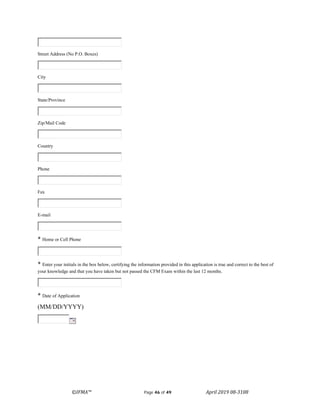
IFMA CFM Re-take Application Page A-2
International Ethics Standards Coalition (IESC) Requirements Page A-3
©IFMA™ Page 33 of 49 May 2019 08-3108
Ethics Submission Form Page A-4
Candidate Form for Special Accommodation Requests
Physician Form for Special Accommodation Requests
CFM Exam Specifications Document [pdf]
The IFMA Facility Management Learning System™
Facility Management Knowledge Center
CFM Practice Exam
CFM Exam Prep Workshop
Cumulative Bibliography from the FM Learning System
FM.Training Online Courses
Recertification
CFM Maintenance Program Worksheet (pdf)
Retired CFM (RCFM) Program (pdf)
CAMP System
CAMP User Guide
CFM FAQs
©IFMA™ Page 34 of 49 April 2019 08-3108
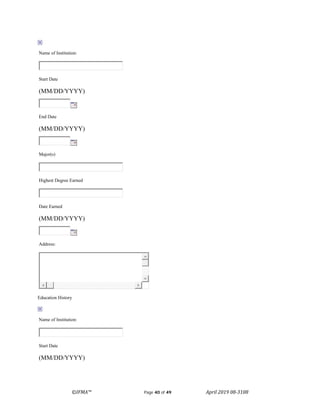
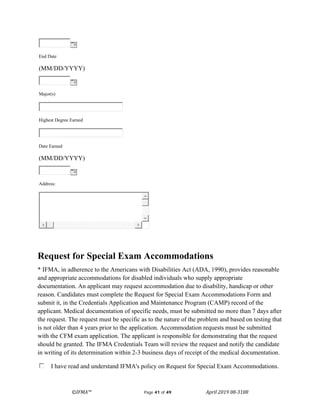
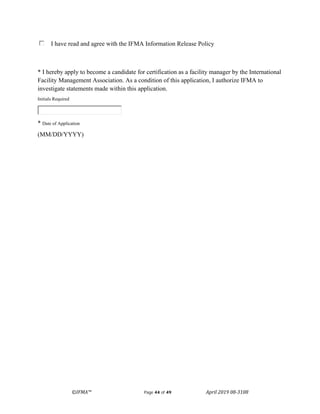
CFM Exam Application A-1
The CFM Application must be completed and submitted electronically in the Credential
Application and Maintenance Program (CAMP). For instructions refer to the CAMP User
Guide. This is for informational purposes only and cannot be used to submit an application for
the CFM exam.
CFMs are required to complete an Ethics Training Module prior to applying to sit for the CFM
exam, and if certified, every six years. Submit the Ethics Training Completion form and upload
documentation in your CAMP record at the time you submit this application. Contact
credentials@ifma.org if you need further information on this requirement.
Welcome to the IFMA Certified Facility Manager® Exam program. This is the first step in
achieving your CFM credential. Please answer all questions thoroughly in order to document
your eligibility. As you complete the application, you should save your work frequently.
Payment must be submitted with application. Your application will not move into the approval
queue until payment is completed. Reminder: this form times out. You will need to save your
work often to prevent loss of the information you have entered. If your form is rejected, you can
check "In Process" forms to see the reason for the decision. If the application is rejected, it can
be resubmitted after corrections are made. If your application is approved, you will have 90 days
to schedule and take the exam. Please note there are restrictions regarding rescheduling the
exam. You will receive these details when you receive your application approval email.
Applications are subject to random audit. In case of audit, IFMA staff will contact you to request
documentation of your compliance with the education and/or work experience claimed within
this application. Failure to respond to the audit or to provide verification of meeting the
eligibility requirements will result in rejection of the application.
Personal Information
* Last Name
* First Name
Work History
Company Name:
©IFMA™ Page 35 of 49 April 2019 08-3108
Start Date
(MM/DD/YYYY)
End Date
(MM/DD/YYYY)
Position
Immediate Supervisor, Name and Title
Address:
Describe your major job activities and responsibilities related to facility management.
Work History
Company Name:
Start Date
(MM/DD/YYYY)
End Date
©IFMA™ Page 36 of 49 April 2019 08-3108
(MM/DD/YYYY)
Position
Immediate Supervisor, Name and Title
Address:
Describe your major job activities and responsibilities related to facility management.
Work History
Company Name:
Start Date
(MM/DD/YYYY)
End Date
(MM/DD/YYYY)
Position
©IFMA™ Page 37 of 49 April 2019 08-3108
Immediate Supervisor, Name and Title
Address:
Describe your major job activities and responsibilities related to facility management.
Work History
Company Name:
Start Date
(MM/DD/YYYY)
End Date
(MM/DD/YYYY)
Position
Immediate Supervisor, Name and Title
Address:
©IFMA™ Page 38 of 49 April 2019 08-3108
Describe your major job activities and responsibilities related to facility management.
Work History
Company Name:
Start Date
(MM/DD/YYYY)
End Date
(MM/DD/YYYY)
Position
Immediate Supervisor, Name and Title
Address:
Describe your major job activities and responsibilities related to facility management.
©IFMA™ Page 39 of 49 April 2019 08-3108
Work History
Company Name:
Start Date
(MM/DD/YYYY)
End Date
(MM/DD/YYYY)
Position
Immediate Supervisor, Name and Title
Address:
Describe your major job activities and responsibilities related to facility management.
Education History
©IFMA™ Page 40 of 49 April 2019 08-3108
Name of Institution:
Start Date
(MM/DD/YYYY)
End Date
(MM/DD/YYYY)
Major(s)
Highest Degree Earned
Date Earned
(MM/DD/YYYY)
Address:
Education History
Name of Institution:
Start Date
(MM/DD/YYYY)
©IFMA™ Page 41 of 49 April 2019 08-3108
End Date
(MM/DD/YYYY)
Major(s)
Highest Degree Earned
Date Earned
(MM/DD/YYYY)
Address:
Request for Special Exam Accommodations
* IFMA, in adherence to the Americans with Disabilities Act (ADA, 1990), provides reasonable
and appropriate accommodations for disabled individuals who supply appropriate
documentation. An applicant may request accommodation due to disability, handicap or other
reason. Candidates must complete the Request for Special Exam Accommodations Form and
submit it, in the Credentials Application and Maintenance Program (CAMP) record of the
applicant. Medical documentation of specific needs, must be submitted no more than 7 days after
the request. The request must be specific as to the nature of the problem and based on testing that
is not older than 4 years prior to the application. Accommodation requests must be submitted
with the CFM exam application. The applicant is responsible for demonstrating that the request
should be granted. The IFMA Credentials Team will review the request and notify the candidate
in writing of its determination within 2-3 business days of receipt of the medical documentation.
I have read and understand IFMA's policy on Request for Special Exam Accommodations.
©IFMA™ Page 42 of 49 April 2019 08-3108
IFMA, in adherence to the Americans with Disabilities Act (ADA, 1990), provides reasonable
and appropriate accommodations for disabled individuals who supply appropriate
documentation. An applicant may request accommodation due to disability, handicap or other
reason. Candidates must complete the Request for Special Exam Accommodations Form and
submit it, in the Credentials Application and Maintenance Program (CAMP) record of the
applicant. Medical documentation of specific needs, must be submitted no more than 7 days after
the request. The request must be specific as to the nature of the problem and based on testing that
is not older than 4 years prior to the application. Accommodation requests must be submitted
with the CFM exam application. The applicant is responsible for demonstrating that the request
should be granted. The IFMA Credentials Team will review the request and notify the candidate
in writing of its determination within 2-3 business days of receipt of the medical documentation.
I am requesting Special Exam Accommodation for the CFM exam and will complete and
submit the Request for Special Exam Accommodation Form
Exam candidates with special needs are encouraged to inform IFMA of these needs using the
process outlined here and in the CFM Candidate Handbook.
Code of Conduct
* I shall have as my primary goal developing and managing safe, human, and functional work
spaces.
I shall integrate the needs of management with the needs of people in the workplace to develop
and manage humane and effective work environments.
I shall have as an achievable goal maintaining objective, professional judgments. I shall not
compromise this judgment by undertaking any activity, accepting any contribution or having any
conflict of interest that would prevent acting in the best interest of my employer, clients, or those
people for whom I provide or maintain workplaces.
I shall practice in a manner that supports the rights of employers, employees and clients, and
shall not discriminate because of race, sex, creed, age, religion, disability or national origin.
I shall continually seek new information to maintain and upgrade my professional skills relative
to the design, construction, maintenance and management of the physical environment as it
relates to people and work processes.
I have read and agree to adhere to the CFM® Code of Conduct and will comply with the
disciplinary and appeals process.
©IFMA™ Page 43 of 49 April 2019 08-3108
Rules and Regulations
* All information in this application is complete and accurate to the best of my knowledge. I
agree to comply with the certification requirements and will inform IFMA, without delay, of any
matter that might affect my ability to continue to fulfil the requirements of certification.
Upon request, I will provide any additional information that may be needed by IFMA to process
this application.
I agree to maintain the confidentiality of the CFM exam content. I will not disclose exam items,
answers, or any confidential exam information during or after the exam. I will not attempt to
remove materials from the testing room, aid other persons taking the exam, or create a
disturbance during the test administration. I understand that any possible or suspected security
violations will be reported promptly to IFMA for investigation and may result in the cancellation
of my exam score and/or eligibility for the CFM credential.
I will not represent myself as a Certified Facility Manager® or use the CFM® logo until such
time as this credential is awarded to me by IFMA. I understand that I must renew my CFM
credential every three years, according to the recertification policies then in effect. If I fail to
renew my CFM by the deadline, it will be revoked.
In the event my certification is revoked or withdrawn, I agree that I will discontinue all claims to
certification, will not use the designation or logo in any way, and will return any certificates
issued by the CFM program. I understand that violation of this agreement may be cause for legal
action.
I have read and understand the CFM Candidate Handbook, and I agree to adhere to all
certification program policies and procedures. I will not use the certification in such a
manner as to bring the certification body into disrepute and will not make any statement
regarding the certification which the certification body considers misleading or
unauthorized.
Release of Information
I understand that IFMA recognizes new credential holders in many ways, including a feature in
each issue of the Facility Management Journal, notices to IFMA chapters, and directories both
online and printed. I hereby authorize IFMA to publish my name, company and location in
recognition of my achievement. I understand that my candidate ID number, and
issuance/expiration date are also published on the IFMA web site and are available to the public
as verification of my credential.
©IFMA™ Page 44 of 49 April 2019 08-3108
I have read and agree with the IFMA Information Release Policy
* I hereby apply to become a candidate for certification as a facility manager by the International
Facility Management Association. As a condition of this application, I authorize IFMA to
investigate statements made within this application.
Initials Required
* Date of Application
(MM/DD/YYYY)
©IFMA™ Page 45 of 49 April 2019 08-3108
CFM Exam Retake Application A-2
This form is to be completed only by individuals who have taken but not passed the CFM® exam within 12
months of their initial unsuccessful attempt. Other applicants should complete the standard application. Please
answer all questions. The actual application must be completed and submitted electronically through the
CAMP program.
Personal Information
* Are you a member of IFMA?
Yes, I am a member.
No, I am not a member
IFMA Membership ID Number
Are you a member of other organization?
ASBE BIFM BOMA FMA Global FM SAME
Are you eligible for GSA pricing?
Yes, I am eligible for GSA pricing
No, I am not eligible for GSA pricing.
* First Name
* Last Name
Employment Information
Company Name
Title
©IFMA™ Page 46 of 49 April 2019 08-3108
Street Address (No P.O. Boxes)
City
State/Province
Zip/Mail Code
Country
Phone
Fax
E-mail
* Home or Cell Phone
* Enter your initials in the box below, certifying the information provided in this application is true and correct to the best of
your knowledge and that you have taken but not passed the CFM Exam within the last 12 months.
* Date of Application
(MM/DD/YYYY)
©IFMA™ Page 47 of 49 April 2019 08-3108
Ethics Requirement for CFM Exam Candidates and CFM
Recertifications:
All CFM Exam Applicants are required to take an Ethics Assessment prior to issuance of the
CFM certificate. Additionally, all CFMs recertifying, will be required to take the Ethics
Assessment once every 6 years, or with every other recertification period.
Rationale: IFMA is a member of the International Ethics Standards Coalition (IESC), which
has created an ethical framework for the global property market. As a result, the CFM
Scheme Committee has determined that an Ethics Assessment will be required for all current
CFMs, as well as CFM credential applicants.
Process: The CFM Scheme Committee has determined the criteria for programs meeting
the standards of the IESC, and thus far, have chosen two programs which meet the
requirements, one is the RICS Ethics Assessment and the other is HR Training
Courses – Code of Business Conduct and Ethics Training.
The HR Training Course is accessed through your CAMP record. Login to your CAMP
record and first complete the CFM Ethics Training Pmt Form - HR Classroom. You will
receive a link and instructions for the training. It takes about 30 minutes to complete. When
you finish, upload the certificate into this form: CFM Ethics Training Completion Form
If a CFM’s employer has an Ethics Assessment which employees take as part of in-service
training, the course can be submitted in the CAMP program using the CFM Ethics
Completion Form and the Ethics Submission Form for approval. Please contact
credentials@ifma.org for additional information.
Impact:
• All CFM applicants are required to complete an Ethics Assessment before achieving
the CFM credential.
• All recertifying CFMs will complete the assessment to recertify.
• CFMs will be required to complete the assessment every six (6) years, or every other
renewal term.
• Employer sponsored in-service training Ethics Courses can be submitted for approval
and used to meet this requirement.
©IFMA™ Page 48 of 49 April 2019 08-3108
The ethical principles below must be included in Employer Sponsored Ethics Training.
1. Confidentiality: Practitioners shall not disclose any confidential or proprietary
information without prior permission, unless such disclosure is required by applicable
laws or regulations.
2. Disclosure: Practitioners shall make all appropriate disclosures before and during
the performance of a service. If, after disclosure, a conflict cannot be removed or
mitigated, the practitioner shall withdraw from the matter or obtain written consent
of the parties affected to continue.
3. Fiduciary Responsibility: Practitioners shall be honest, transparent and
trustworthy in all their financial dealings.
4. High Standard of Service: Practitioners shall only provide services for which
they are competent and qualified, and shall ensure that any employees or associates
assisting with the provision of services have the necessary competence to undertake
those services.
5. Integrity: Practitioners shall act with honesty and fairness in all their dealings, and
shall not mislead or attempt to mislead. They shall base their advice on valid evidence.
6. Respect: Practitioners shall provide services that honor client, third party and
stakeholder interests in the context of applicable rules of law and social and
environmental concerns.
7. Responsibility: Practitioners owe a duty of care to their clients and due
consideration to the rights and interests of third parties and stakeholders.
8. Transparency: Practitioners shall not misinform over the products or terms of
service to be provided, and shall present relevant documentary or other material in
plain and intelligible language.
9. Trust: Practitioners shall be truthful in their professional communications and
recognize that their professional conduct bears upon the maintenance of public trust
and confidence in the real estate professions.
10. Verification: Practitioners shall continually evaluate the services they provide to
ensure they are consistent with the spirit and evolution of ethical principles and
practice standards.
©IFMA™ Page 49 of 49 April 2019 08-3108
Ethics Training Submission Form Please use these fields to submit the required
information
Name of person submitting the Ethics Training
Program for consideration
Contact information
Name of program/training/activity
Program/training/activity developed/uesd by:
(company, organization)
Contact information
Cost if applicable
Estimated length of program/training/activity
Program/training/activity covers the 10 ethical
standards identified by the International Ethics
Standards Coalition (IESC)
Program/training/activity, etc. requires individual
to participate in some type of activity to
demostrate their understanding of the ethical
standards(i.e. assessment, case study, etc.)
Does the program/training/activity issue a formal
documentation to confirm participation?
How often is the program/activity/training, etc.
updated

Cfm ifma candidate-handbook

  • 1.
    © IFMATM 2018 CERTIFIEDFACILITY MANAGER® (CFM®) CANDIDATE HANDBOOK
  • 2.
    ©IFMA™ Page 2of 49 April 2019 08-3108 CFM Exam Contact Information To contact the IFMA Credentials Department: 281-974-5632, 281-974-5669 credentials@ifma.org To access the online Credentials Application and Maintenance Program (CAMP) in order to complete the CFM Application or the CFM Recertification Form: www.ifma.org/my-account/camp To download the CAMP User’s Guide: CAMP User’s Guide (.pdf)
  • 3.
    ©IFMA™ Page 3of 49 April 2019 08-3108 TABLE OF CONTENTS General Information..............................................................................................................................................................5 Scope of the CFM Credential.........................................................................................................................................5 Why Earn the CFM? .........................................................................................................................................................5 Competency-based...........................................................................................................................................................5 Recognized globally...........................................................................................................................................................6 Individual and Workplace Benefits................................................................................................................................6 About IFMA........................................................................................................................................................................6 Prometric – IFMA’s Testing Partner.............................................................................................................................7 Eligibility Criteria....................................................................................................................................................................8 Education and Work Experience ..................................................................................................................................8 Ethics Requirement...........................................................................................................................................................8 Competency Areas........................................................................................................................................................ 10 Test Content Outline........................................................................................................................................................ 11 CFM Test Blueprint ....................................................................................................................................................... 11 Candidate Examination Process...................................................................................................................................... 14 1. Meet Eligibility Requirements ................................................................................................................................. 14 2. Prepare for the CFM Exam ..................................................................................................................................... 14 3. Complete the CFM Exam Application.................................................................................................................. 14 4. Submit the Application and Payment .................................................................................................................... 15 5. Approval/Denial of Application.............................................................................................................................. 15 6. Exam Scheduling......................................................................................................................................................... 16 7. Sitting for the Exam................................................................................................................................................... 16 8. Comply with Exam Center Requirements .......................................................................................................... 17 9. Obtain Certificate...................................................................................................................................................... 19 10. Recertification .......................................................................................................................................................... 20 CFM® Expiration and RCFM© Program ......................................................................................................................... 22 What if my CFM designation is expired?.................................................................................................................. 22 What is the Retired CFM (RCFM) program?.......................................................................................................... 22 CFM Inactive Status ....................................................................................................................................................... 22 Certification Policies .......................................................................................................................................................... 23 Exam Policies................................................................................................................................................................... 23 Retaking the CFM© Exam ........................................................................................................................................ 23 Rescheduling/Cancelling a CFM exam appointment with Prometric............................................................ 23
  • 4.
    ©IFMA™ Page 4of 49 April 2019 08-3108 Candidate Fairness Policies.......................................................................................................................................... 24 Accomodations .......................................................................................................................................................... 24 Nondiscrimination..................................................................................................................................................... 24 Program Complaints and Feedback....................................................................................................................... 24 Disciplinary Proceedings.......................................................................................................................................... 26 Appeals......................................................................................................................................................................... 27 Security Policies.............................................................................................................................................................. 29 Privacy: Confidentiality and Security of Individual Information ...................................................................... 29 Confidentiality and Security of Assessment Instruments and Scoring Keys................................................ 29 Exam Security............................................................................................................................................................. 29 Records Control........................................................................................................................................................ 29 Managing Bias Policies ................................................................................................................................................... 30 Impartiality................................................................................................................................................................... 30 Conflict of Interest.................................................................................................................................................... 30 Professional Conduct Policies..................................................................................................................................... 31 Code of Conduct....................................................................................................................................................... 31 Sanctions and Invalidating a Certificate ................................................................................................................ 31 Ownership of the Certification Mark and Logo Use ........................................................................................ 31 Appendix............................................................................................................................................................................... 32 Initial Certification.......................................................................................................................................................... 32 Recertification................................................................................................................................................................. 33 CAMP System ................................................................................................................................................................. 33
  • 5.
    ©IFMA™ Page 5of 49 April 2019 08-3108 GENERAL INFORMATION SCOPE OF THE CFM CREDENTIAL Earners of the globally recognized Certified Facility Manager® (CFM®) have demonstrated competence in the field of facility management (FM) by meeting the required criteria of work experience, education and the ability to pass a comprehensive exam that covers the 11 competencies of the FM body of knowledge. CFMs work in many different industries (i.e. healthcare, retail, corporate, government, non-profit, etc.) and manage various types of facilities (i.e. hospitals, schools, hotels, office buildings, etc.). CFMs may manage one facility or more than 100 and may manage facilities in different parts of the world. The Certified Facility Manager® (CFM®) credential sets the industry standard for ensuring the knowledge and competence of practicing facility managers. WHY EARN THE CFM? The Certified Facility Manager® (CFM®) credential sets the industry standard for ensuring the knowledge and competence of practicing facility managers as the most respected global credential in facility management. Now more than ever, recognizing competency, establishing benchmarks and setting performance standards are vital to the global economy. Never have public and private sector employers relied as much on certification organizations as they do today. Professional associations are now taking a lead role in the development of credentialing programs, and IFMA’s CFM® program was the first, and is still the only globally recognized, certification in facility management. IFMA’s certification process is designed to assess competency in the field through work experience, education and the ability to pass a comprehensive exam that covers 11 competency areas that make up the facility management body of knowledge. Since the program began in 1992, more than 6,000 facility managers from 38 countries have achieved this prestigious recognition. Currently there are approximately 3,000 active CFMs globally. COMPETENCY-BASED The CFM® Exam is competency-based, testing what a candidate can do compared to standards that define the practice of facility management. One cannot take a course or a simple knowledge-based exam to earn the credential. IFMA’s competency-based program is at a higher level than a knowledge- based program, reflecting the growing importance of facility management in the international business world. 11 CFM Competency Areas 1. Occupancy and Human Factors 2. Operations and maintenance 3. Sustainability 4. Facility Information Management/ Technology Management 5. Risk Management 6. Communication 7. Performance and Quality 8. Leadership and Strategy 9. Finance and Business 10. Real Estate 11. Project Management
  • 6.
    ©IFMA™ Page 6of 49 April 2019 08-3108 RECOGNIZED GLOBALLY In addition, the CFM® is the only global facility management certification available. Goals of IFMA's certification program include: INDIVIDUAL AND WORKPLACE BENEFITS The credibility and recognition that come with earning the CFM benefits both the individual who earns the credential and the organizations that employ the CFM. ABOUT IFMA Founded in 1980, IFMA is the world's largest and most widely recognized international association for facility management professionals, supporting 24,000 members in 105 countries. IFMA’s Certified Facility Manager® (CFM®) credential is globally recognized as the most reliable standard for distinguishing the achievements of facility management, reinforcing the association’s claim for facility management and strengthening the CFM’s position as the ultimate authority in facility management. Assuring professional excellence Establishing standards for global professional practice Promoting the added value of the profession Influencing the future direction of the profession • Stay competitive in today’s job market.Distinguish the FM • CFMs earn an average of 25% more annually than their non-credentialed FM peers.Investent in the Future • CFMs practice global professional FM standardsEstablish standards • Acheiving the CFM is not easy. The CFM credential is a tangible sign of success and expertise. Demonstration of leadership and initiative
  • 7.
    ©IFMA™ Page 7of 49 April 2019 08-3108 PROMETRIC – IFMA’S TESTING PARTNER Prometric is a test development and delivery provider that offers a vast network of quality testing solutions. As a highly trusted test provider, Prometric has around 8,000 testing centers worldwide allowing for a wide selection of convenient testing dates and locations. Learn more about Prometric at the Prometric website.
  • 8.
    ©IFMA™ Page 8of 49 April 2019 08-3108 ELIGIBILITY CRITERIA EDUCATION AND WORK EXPERIENCE Candidates must meet the following education and work experience requirements. Internships do not count toward FM experience. Option 1 Option 2 Education Bachelor’s or Masters level Facility Management degree No FM degree FM Work Experience 3 years 5 years ETHICS REQUIREMENT An Ethics Assessment is required for all CFM credential applicants. Those holding the CFM credential are required to complete an Ethics Assessment every other renewal cycle or every six (6) years. Candidates have an option of two current Ethics Assessments which have been approved by the Certification Commission. If a candidate’s employer requires an Ethics training/ assessment, and the training meets the requirements of the International Ethics Standards Coalition (IESC), the program can be submitted, along with the Ethics Submission Form, for approval and applied towards the Ethics requirement. All Ethics Assessments can be used towards maintenance activities for the recertification form. See the table on the following page detailing the options for satisfying the Ethics Requirement. Candidates have up to 30 days from the date on which they pass the exam to complete the Ethics Requirement and submit the required documentation. Any individual who does not complete the Ethics requirement and submit the required documentation to the CAMP record will have the status of the CFM credential moved to inactive and will not be in good standing. Candidates are notified and reminded of the requirement in the email received upon passing the CFM exam and again the week prior to the 30 day period.
  • 9.
    ©IFMA™ Page 9of 49 April 2019 08-3108 Ethics Assessment Options Ethics Assessment Option Description Documentation Required HR Classroom Code of Business Conduct and Ethics Training Course • 1 hour e-learning program • The Code of Business Ethics is a set of principles that summarize ethical standards. Its purpose is to guide employees in making good judgments regarding their work. This training is designed to help employers comply with the Federal Acquisition Regulations (FAR), Federal Sentencing Guidelines (FSG), and Sarbanes-Oxley (SOX). This course provides training on ethical behavior for both staff and supervisors. When training is complete, the applicant will complete the CFM Ethics Training Completion Form, located in the Credential Application and Maintenance Program (CAMP) and upload the documentation. RICS Ethics Assessment • 3 hour e-learning program • This course will explore the topics through interactive learning modules and case studies. When training is complete, the applicant will complete the CFM Ethics Training Completion form in the CAMP record and upload the documentation. Employer- sponsored Ethics Training • If the employer has Ethics Training that meets the framework established by the International Ethics Standards Coalition and adopted by the Certification Commission, it may be submitted for approval. The applicant must submit the Ethics Training Submission Worksheet. To be approved, the training must meet the requirements established by the Certification Commission.
  • 10.
    ©IFMA™ Page 10of 49 April 2019 08-3108 COMPETENCY AREAS Successful candidates will have experience in the following competency areas. These eleven areas have been identified as the core areas of skills and knowledge necessary for a successful facility manager: • Occupancy and Human Factors • Operations and Maintenance • Finance and Business • Leadership and Strategy • Communication • Performance & Quality • Facility Information Management & Technology Management • Sustainability • Real Estate • Project Management • Risk Management Ideally, candidates should have knowledge of and experience in all 11 areas; however, it is possible for a candidate to have experience in most competency areas, and knowledge of the others, and still pass the exam. (See Test Content Outline) Unsure if you meet eligibility requirements? You can request a review of application BEFORE you submit the application (please see Step 3 on how to fill out the CFM Application). To do this, you must still fill out the application; however, please select “Saved” versus “Submitted.” Once you complete the application and save it, you must send an email request to Rhonda Hager, IFMA Credentials Team Lead, at rhonda.hager@ifma.org and request a preliminary review. More questions about CFM Exam eligibility? Contact Rhonda Hager, IFMA Credentials Team Lead, at rhonda.hager@ifma.org.
  • 11.
    ©IFMA™ Page 11of 49 April 2019 08-3108 TEST CONTENT OUTLINE CFM TEST BLUEPRINT The CFM examination is based on the 11 core content areas outlined listed in the table below. To demonstrate competence, these content areas measure the knowledge, skills, and abilities that are necessary to pass the exam. The CFM exam will be based on the exam blueprint in terms of the proportion of items to be included on the test from each content area. International Facility Management Association Certified Facility Manager® (CFM® ) Examination Specifications* # of Items 1. Occupancy and Human Factors 14 A. Workplace environment 5 B. Occupant services 4 C. Occupant health, safety, and security 5 2. Operations and Maintenance 25 A. Buildings, building systems, infrastructure, and grounds 5 B. Furniture, fixtures, and equipment 3 C. Physical safety and security 4 D. Operations and maintenance processes 5 E. Work management support systems 4 F. Renewals and renovations 4 3. Sustainability 16 A. Energy management 3 B. Water management 3 C. Materials and consumables management 3 D. Waste management 3 E. Workplace and site management 4 4. Facility Information Management and Technology Management 9 A. Data collection and information management 3
  • 12.
    ©IFMA™ Page 12of 49 April 2019 08-3108 B. Information protection and cyber-security 2 C. Technology needs assessment and implementation 2 D. Maintenance and upgrade of technology systems 2 5. Risk Management 11 A. Risk management planning 3 B. Emergency preparedness, response, and recovery 4 C. Facility resilience and business continuity 4 6. Communication 6 A. Planning 2 B. Delivery 2 C. Evaluation 2 7. Performance and Quality 8 A. Quality management 4 B. Performance management 4 8. Leadership and Strategy 28 A. Strategic planning and alignment with the demand organization 5 B. Policies, procedures, and compliance 4 C. Individual and team management 3 D. Leadership 4 E. Relationship and conflict management 4 F. Change management 4 G. Corporate social responsibility 2 H. Political, social, economic, and industry factors affecting facilitymanagement 2 9. Finance and Business 18 A. Operational and capital budgeting 4 B. Evidence-based decision-making process (e.g. business case) 4 C. Procurement (e.g. purchasing, sourcing of goods and services) 3 D. Contracting 4 E. Financial analysis and reporting 3 10. Real Estate 14 A. Real estate strategies 3 B. Real estate assessment, acquisition, and disposal 2
  • 13.
    ©IFMA™ Page 13of 49 April 2019 08-3108 C. Real estate asset management 2 D. Space management 3 E. Major projects and new construction 4 11. Project Management 11 A. Planning and design 4 B. Execution and delivery 4 C. Evaluation 3 Total 160 * Each test form will include 1 set of 20 unscored pretest items in addition to the 160 scored items. 4 hours of testing time is allowed. The exam is offered in English only. *The passing score for the CFM exam is initially determined based on a criterion referenced procedure, the Angoff method. To ensure fairness of the examination process, a statistical method called equating is used for all new versions of the test.
  • 14.
    ©IFMA™ Page 14of 49 April 2019 08-3108 CANDIDATE EXAMINATION PROCESS 1. Meet Eligibility Requirements See Eligibility Criteria. 2. Prepare for the CFM Exam Candidates should prepare for the exam prior to submitting the application for approval. Once the application is approved, candidates have 90 days in which to schedule and take the exam. Preparation methods are optional, there is no required coursework for the CFM, and the Certification Commission does not require or endorse any specific preparation resource. A partial list of optional exam preparation resources can be found on this page. 3. Complete the CFM Exam Application Each candidate must complete the CFM Application before any determination can be made on eligibility requirements. All applications MUST be completed online using the IFMA Credential Application and Maintenance Program (CAMP) found at http://www.ifma.org/my-account/camp. Candidates using CAMP for the first time should read the CAMP User Guide for instructions. 1. Meet Eligibility Requirements 2. Prepare for the Exam 3. Complete CFM Application 4. Submit Application and Payment Form 5.Approval/Denial of Application (within 21 days) 6. Schedule Exam (must be taken within 90 days of approval) 7. Comply withTest Center Expectations 8. Sit for CFM Exam Complete Ethics (Pass/Fail notification at exam; results verified in 21 days by IFMA Staff) 9. Obtain Certificate 10. Meet Recertification Requirements • Optional Exam Preparation ResourcesReview of the CFM Exam Specifications • The IFMA Facility Management Learning System™ • Facility Management Knowledge Center • CFM Practice Exam • CFM Exam Prep Workshop • Cumulative Bibliography from the FM Learning System
  • 15.
    ©IFMA™ Page 15of 49 April 2019 08-3108 If you are a member of IFMA, a past member of IFMA, OR have ever set-up an IFMA username and password to purchase something as a nonmember, you should use the same username and password to log into CAMP. If you do not recall your username and password but believe one was set-one up in the past, it will be necessary to contact IFMA by calling +1-713-623-4362 or emailing credentials@ifma.org to obtain the required login information. If you have never set-up a username or password with IFMA, you can simply go to http://www.ifma.org/my-account/camp > choose the “CAMP” button in the middle of the page > and follow the directions for “registration” to create a username and password. If you encounter any issues, please email credentials@ifma.org for assistance. See appendix for the CFM® Application. 4. Submit the Application and Payment To complete the application process, the CFM Application Payment Form must be completed, submitted, and confirmed. (Please note: If you asked for preliminary approval, you will need to go back into CAMP and hit Submit and apply payment before you receive the information on making your exam appointment.) Payment Options • If the exam payment has been pre-paid by an employer, the candidate should see the approved CFM Exam Payment form in the “Completed Forms” section of Applications and Forms. If not, choose the “PO” option and in the PO# field, enter the name of the employer and indicate “prepaid”. • If the employer or candidate is paying for the application fee by check, the candidate should complete the form choosing "Pay with Check." An invoice will be forwarded to the employer and the application will be processed when payment is received. • If either the employer or the candidate is paying the application fee by credit card, “Credit Card” should be chosen and the prompts followed to process the payment. Credit card payments are processed immediately and the application moves into the approval queue. • If you will be seeking reimbursement for the CFM Exam through the Department of Veterans Affairs (VA) under the G.I. Bill, click here for more details and instructions. 5. Approval/Denial of Application After submitting your application and payment online, the approval process can take up to 21 days. If an application is denied, Credentials Staff will follow-up with the applicant accordingly. In the event an application is denied, any payment that has been processed will be refunded. Applicants who fail to demonstrate that they meet all of the eligibility requirements will not be permitted to take the exam. Note: candidates have 30 days from the date on which they pass the CFM exam to complete the Ethics Training requirement and submit the required documentation in the CAMP record. Any candidate who does not fulfill this requirement within the 30-day period following the exam date will not earn the credential. CFM Application and Testing Fee • US $550.00 (members) • IFMA member fee discounted 33% • US $815.00 (nonmembers) • US $529.49 (Eligible for GSA pricing)
  • 16.
    ©IFMA™ Page 16of 49 April 2019 08-3108 A portion of applications will be selected for random audit. If selected for audit, the applicant must provide documentation to 1) verify the applicant’s work experience by providing written documentation to verify employment history and 2) verify the applicant’s FM degree (if applicable) by providing an official transcript. 6. Exam Scheduling If the application is approved,you will receive an email with instructions for scheduling an exam date at a Prometric Testing Center in a convenient location. Steps on scheduling an exam with Prometric will be sent via e-mail with the approval notice. The exam eligibility period is 90 days from the date the application is approved, and there are policies regarding rescheduling and/or cancelling an exam date. This information will be included in the scheduling email. The candidate must take the exam during the 90-day period. 7. Sitting for the Exam Exam Format The CFM Exam consists of 180 multiple-choice questions delivered in random order. There are 20 pretest items which do not apply towards exam results and 160 exam items. All questions have a single answer. There are no pre-set sections. The test is strictly pass/fail based on the total number of correct answers. Candidates may mark questions they wish to skip and return to later. In addition, at the end of the exam candidates will be alerted to any questions which have not been answered. If time allows, candidates may return to complete those questions. At the present time, the exam is offered in English only. Appointments are scheduled for 5 hours to provide ample time for the tutorial, etc., but when the actual exam begins, the timer will count down from 4 hours. There are no scheduled breaks. Fifteen minutes have been added to the 3.75-hour testing period to allow examinees to take “bio breaks” as needed. Please note that the timer will continue to run. Exhibits/Images All exhibits depict a single item or symbol. There are no large drawings such as floor plans. However, in some cases, examinees will still need to scroll to the limits of the exhibit window to be sure they have seen the entire drawing. If the exhibit does not appear, please click inside the window area. Exam Development IFMA adheres to common and best-practice testing and psychometric theory to ensure validity, reliability, and fairness. To meet this standard, the CFM® exam was developed through typical steps. First, a job analysis was conducted to identify the critical, important, and frequent task and knowledge measures of a facilities manager by a representative group of subject matter experts (SMEs). The results of the job analysis provided the basis of an examination specification including the number of questions that should be allocated for each of the 11 competency areas. Using the examination specifications, SMEs wrote and reviewed questions. Next, exam forms were assembled and finalized. A standard setting study was also conducted to determine a passing score for the CFM Exam Format • 180 four-option single answer multiple-choice questions (includes 20 non-scored items) • 4-hour exam • Computer based exam • English language only • Calculators and glossaries are prohibited • No books/No notes • Scratch paper and pencil available
  • 17.
    ©IFMA™ Page 17of 49 April 2019 08-3108 exam. Prior to the release of the exam, an item analysis was conducted on the previous CFM exam forms. Items not performing well were flagged and reviewed by SMEs to determine if they were appropriate to be used on the exam. Finally, all forms developed are equated to ensure that the exams are equally difficult. Special Accommodations The Certification Commission and its testing vendor, Prometric, comply with the Americans with Disabilities Act (ADA) which requires that the examination is offered in a place and manner that is accessible to candidates with disabilities. This may require reasonable modifications. Prometric will provide candidates reasonable auxiliary aids and services, except where it may fundamentally alter the validity of the exam results. Available accommodations include, but are not limited to, a reader, a scribe, and extended testing time. If you are seeking special accommodations, you must indicate this on your application and submit a request form for accommodations (see appendix). To request accommodations, you and your health care provider will each need to complete one form, the Candidate Form: Request for Special Exam Accommodation and the Provider Form: Request for Special Exam Accommodation-Physician Statement, to document the disability and the need for accommodation. These forms can be found in the applicant record in CAMP. There is no additional charge for special accommodations. Each request will be evaluated individually by IFMA. If approved, IFMA will alert Prometric of the necessary accommodations. Once a candidate has requested special accommodations, he/she will not be able to schedule an appointment with Prometric until the request is processed. The candidate will be contacted by email regarding the approval status of the special testing accommodations request. 8. Comply with Exam Center Requirements It is recommended that candidates arrive at the test center at least 30 minutes prior to the scheduled exam appointment. Candidates who arrive at the test site after their scheduled exam times will not be admitted. Candidates must provide two forms of identification, with one being a valid, unexpired government- issued ID with a signature, a photograph that looks like the candidate, and an expiration date. Acceptable examples of government-issued, photo ID include: • Driver’s license • Passport • Military ID • Alien ID/Resident Alien Card (*If the ID has picture but no signature, it must be provided with a form of signature ID (Credit Card) in the same name.) Unacceptable forms of ID include but are not limited to an expired ID, an ID without an expiration date, Social Security Card, or an ID with no photo.
  • 18.
    ©IFMA™ Page 18of 49 April 2019 08-3108 Additionally, one form of ID with a valid signature is required. A credit card with signature will satisfy this requirement. Note: The name on the IDs must match the name used to apply for the exam, or the candidate will not be allowed to take the exam. Once the information has been verified at the test center, candidates will be escorted to a workstation by test center staff. Candidates must remain in the seat during the exam except when authorized to leave by test center staff. Candidates must raise a hand to notify test center staff if: • There are problems with the computer • An error message appears on the computer screen (do not clear the message) • Candidate needs to take a break (testing time will NOT be suspended) • Candidate needs the test center staff for any other reason Any candidate who engages in misconduct or does not comply with the test proctor’s warning to discontinue inappropriate behavior may be dismissed from the test site, have exam results invalidated, or be subject to other sanctions. Fraud, deceit, dishonesty, or other irregular behavior in connection with taking the exam is strictly prohibited. Enhanced Exam Security – A Stringent Focus on Protecting the Honest Test Taker and Ensuring a Fair Test Experience Prometric conducts strict inspections of all eyeglasses, jewelry and other accessories to inspect for camera devices that could be used to capture exam content. All candidates will be required to remove their eyeglasses for close visual inspection by the TCAs. These inspections will take a few seconds and will be done at check-in and again upon return from breaks. In addition: • Jewelry outside of wedding and engagement rings is prohibited. Candidates should not wear other jewelry to the test center. • Hair accessories are subject to inspection. Candidates should refrain from wearing ornate clips, combs, barrettes, headbands, and other hair accessories as they may be prohibited from wearing them in to the testing room and asked to store them in their locker. • If a candidate is caught with a camera device prior to entering the testing room, it will be confiscated, and the candidate will not be allowed to test. • If a candidate is caught with a camera device while in the testing room, it will be confiscated, and the exam will be terminated. Exam Results Upon completion of the exam, the candidate is notified immediately regarding pass/fail status. IFMA Credentials staff will confirm the results within 20 days for those candidates who have completed the ethics assessment prior to taking the exam. Candidates who have not completed the ethics requirement prior to taking the exam must do so and submit the required documentation in the CAMP record within 30 days of the date on which the candidate took the certification exam. Candidates who have met all requirements for certification should receive certificate packets within 30 days of the successful testing date or completion of the ethics assessment, whichever occurs last.
  • 19.
    ©IFMA™ Page 19of 49 April 2019 08-3108 9. Obtain Certificate A paper certificate shall be issued to all credential holders who pass the exam, and shall include the following: • Credential holder’s name • Credential holder’s ID number and credential serial number • Credentials program title • IFMA as the certification issuer • Signature of Certification Commission Chair • Certificate term of validity The certificate is the sole property of IFMA and must be returned if certification status is suspended or revoked. A secure digital badge will be issued to credential holders as well as instructions for claiming the badge. Candidates who have earned the CFM® certification must abide by IFMA’s policy concerning the use of the designation for various purposes including logos and trademarks (See Ownership of the Mark and Logo). Additionally, all credential holders shall be listed in IFMA’s Public Credentials Registry. If the CFM allows the credential to cancel due to neglecting to meet recertification requirements, or the CFM credential is cancelled by the CFM governing body for non-adherence to the CFM Code of Conduct, the candidate will not use the designation or logo in any way. Violation may be cause for legal action.
  • 20.
    ©IFMA™ Page 20of 49 May 2019 08-3108 FM Related Education FM Practice Professional Leadership Development of the Profession 10. Recertification Recertification through continued study or participation in industry sponsored events demonstrates that designees are using the knowledge and skills represented by the certification. By using the designation, you are promoting your high level of experience and knowledge. If no program were in place to keep up with the dynamic changes in facility management, then the power and prestige of the designation would be diminished. The CFM is a constant reflection of expertise and professionalism; thus, worth maintaining. The CFM Certification is valid through December 31, three (3) years from the date of the CFM exam or the last recertification date. To maintain the CFM credential, a list of the activities performed along with the appropriate supporting documentation including a processing fee must be submitted to IFMA credentialing department every three years. CFMs are required to complete at least three activities ina minimum of two of the following four categories, for a total of six activities within the 3-year certification period: Candidates must complete the recertification process below to maintain their credential: • Complete and submit the CFM® Recertification Form and required supporting documentation. (See Appendix for link to the Recertification Maintenance Worksheet.) • Complete and submit the CFM® Recertification Payment Form. • Meet the Ethics Training requirement every 6 years (every other renewal cycle) by completing an Ethics Assessment (see Ethics Requirement). Ethics Training may be used towards the FM-related Education Category. • IFMA staff will review the submitted documentation and notify the CFM of the recertification outcome by email within 30 days of submission. Those who successfully recertifiy will receive a certificate packet following approval. • IFMA sends out recertification notices, as a courtesy, beginning 6 months prior to the CFM expiration date for all active CFMs. It is imperative that CFMs keep their contact information current with IFMA. It remains the responsibility of the CFM to submit the recertification documents on time. • Renewal applications will not be accepted from individuals whose certification is in a state of suspension or has been revoked. • A portion of applications will be selected for random audit. If selected for audit, the applicant must provide documentation as requested by the certification program to validate the information submitted with the application. Recertification Fees • US $290 (member) • IFMA member fee is discounted 21%) • US $365 (nonmember) Requirements Achieve 6 activities in two areas: • Practice • FM Related Education • Professional Leadership • Development of the Profession
  • 21.
    ©IFMA™ Page 21of 49 May 2019 08-3108 Upon expiration, the CFM term moves into a 3 month “grace period” during which a certified individual may renew the certification without penalty. After the 3 month grace period, there is a 3 month “cancellation pending” period during which the CFM can still submit recertification documents, there is, however, a $100 late fee charged during this period. See appendix for Recertification Worksheet, CFM® Maintenance Program, and CAMP Access Instructions.
  • 22.
    ©IFMA™ Page 22of 49 May 2019 08-3108 CFM® EXPIRATION AND RCFM© PROGRAM What if my CFM designation is expired? After your official CFM® expiration date, there is a three-month grace period in which you may renew without penalty. If a recertification package is received anywhere from three months and one day to six months after the expiration date, it will also need to include a late fee of US $100.00. The rules of the Certification Commission mandate that CFMs who go more than six months past their expiration date without renewing their CFM, will lose the credential, and must retake the CFM Exam in order to reinstate it. Reminder notices are sent out as a courtesy; it is each CFM’s professional obligation to renew their CFM in a timely manner. It is also the CFM’s responsibility to ensure that address records are kept current. What is the Retired CFM (RCFM) program? A Retired CFM category has been established for CFMs who have retired or who have otherwise left the profession and want to indicate past certification. There are no age or renewal requirements for RCFM, however the CFM must apply no more than 6 months past the expiration date of the most recent recertification period. The RCFM application form is available through IFMA's CAMP system. For more details about RCFM, click here. See appendix for Retired CFM (RCFM) Program Application. CFM Inactive Status It is possible for an active CFM to move to a temporary Inactive Status under the following situations: • Serious illness of CFM or an immediate family member • Extended unemployment (longer than 6 months) • Active Duty Military • Death of an immediate family member The inactive period will last for one year from the date prior to the cancellation date of the CFM. During this time, the CFM can obtain sufficient maintenance activities in order to renew the credential. The expiration date will be 3 years from the last expiration date of the CFM credential.
  • 23.
    ©IFMA™ Page 23of 49 May 2019 08-3108 CERTIFICATION POLICIES This section describes IFMA’s certification policies. The figure below lists the various certification policies. Exam Policies Retaking the CFM© Exam Unsuccessful CFM® exam candidates have up to 12 months to retake the exam at a reduced fee. There is no limit to the number of times a candidate can sit for the exam. To retake the exam, candidates will complete CFM Exam Retake Application, found in the IFMA Credential Application and Maintenance Program (CAMP) at http://www.ifma.org/my-account/camp. The CFM Exam Retake Application and Payment Forms, must be submitted and approved before the candidate may schedule the exam retake appointment. Rescheduling/Cancelling a CFM exam appointment with Prometric For each candidate who reschedules, cancels, arrives late or does not appear for a scheduled exam during the Cancellation/Reschedule Period set forth below, the following timelines and associated fees shall apply. If the appointment is cancelled or rescheduled: 1. 31 days or more before the exam appointment – No charge 2. 5 to 30 calendar days prior to the exam appointment – $40 fee collected by Prometric 3. less than 5 days before the exam appointment – Candidate will be considered a "no show" and charged the CFM Exam Retake Fee in order to reschedule the exam. 4. fails to appear for a scheduled exam appointment or rescheduled exam appointment – Candidate will be considered a "no show" and charged the CFM Exam Retake Fee in order to reschedule the exam. Exam Retake Reschedule/Cancel Fairness Accomodations Nondiscrimination Disciplinary Proceedings Feedback and Complaints Appeals Security Confidentiality Privacy Exam Security Records Bias Impartiality Conflict of Interests Professionalism Conduct Invalidation Certification Mark Exam Retake Attempts Fees • US $265 (member) - IFMA members receive a 27% discount • US $365 (nonmember) Retake Period Must retake exam within 12 months to be eligible for the reduced fee
  • 24.
    ©IFMA™ Page 24of 49 May 2019 08-3108 5. presents himself/herself more than fifteen (15) minutes after the scheduled start time for taking the test and is refused admission – Candidate will be considered a "no show" and charged the CFM Exam Retake Fee in order to reschedule the exam. Within the United States and Canada, Candidates must make and confirm all cancellations/changes through direct contact with Prometric Testing Center personnel through the Website or IVR system. Leaving a message on a recorder or a voice mail is not sufficient to confirm a cancellation/change. Outside of the United States and Canada, Candidates must make and confirm all cancellations/changes via the Website or by direct contact with the Prometric Testing Center. Candidates must retain the cancellation confirmation number provided by Prometric for use rescheduling the exam and to provide verification of the cancellation if needed. Candidate Fairness Policies Accomodations The Certification Commission and its testing vendor, Prometric, comply with the Americans with Disabilities Act (ADA) which requires that the examination is offered in a place and manner that is accessible to candidates with disabilities. This may require reasonable modifications. Prometric will provide candidates reasonable auxiliary aids and services, except where it may fundamentally alter the validity of the exam results. Available accommodations include, but are not limited to, a reader, a scribe, and extended testing time. If you are seeking special accommodations, you must indicate this on your application and submit a request form for accommodations. Specific instructions for requesting exam accommodations are found in Sitting for the CFM Exam. Nondiscrimination IFMA adheres to the principles of fairness and due process, and endorse the principles of equal opportunity. IFMA credentials programs shall not discriminate or deny opportunity to anyone on the grounds of gender, age, religion, national or ethnic origin, marital status, veteran status, sexual orientation or disability. It is essential that an equal opportunity for success is provided to every participant in each program, and that no person or group is given special treatment in the attainment and continuation of any credential. Program Complaints and Feedback Complaints Definition Individuals with feedback regarding the assessment process, personnel or other elements of the credentials process are encouraged to discuss these with the individuals involved to try to resolve the matter informally. In some cases, however, informal resolution is not possible, and individuals may wish to file a formal complaint.
  • 25.
    ©IFMA™ Page 25of 49 May 2019 08-3108 A complaint is a formal request pertaining to a grievance in the assessment process, personnel or other elements of the certification process that is not related to the certification or recertification itself, refer to Appeals. First Level of Complaint – Staff Review A complaint shall be submitted in writing to the credentials staff within 30 days of the incident’s occurrence. The written submission shall include sufficient objective evidence to substantiate the claims which will allow for a decision to be made and request the appropriate action to be taken. Dissatisfaction based on hearsay shall not be considered as a complaint. Anonymous complaints shall not be considered. The credentials staff shall confirm receipt of the complaint via email upon receipt along with a copy of the document explaining the process. Emailed complaints should be submitted to rhonda.hager@ifma.org or credentials@ifma.org. Mailed complaints should be addressed to: Credentials Department c/o IFMA 800 Gessner Road, Suite 900 Houston, Texas 77024-4257 When possible, the credentials staff will seek staff resolution related to the complaint. If action is required, the credentials staff will refer the matter to an appropriate staff member to resolve if possible. A staff member who rendered the original decision should not be the same individual responsible for reviewing the complaint. Any matters of confidentiality, conflict of interest, and impartiality will be taken into account. The responsible staff member shall take action to resolve the issue and communicate the resolution to the individual and the credentials staff within 30 calendar days of receipt of the complaint. If informal resolution cannot be achieved, the Review Committee process below will be followed. Complaints that cannot be resolved by certification staff to the complainant’s satisfaction within thirty (30) days of receipt will be forwarded by the credentials staff to the Chair of the Certification Commission along with any relevant information used in making the initial decision. Second Level of Complaint – Review Committee The Chair of the Certification Commission will appoint an ad-hoc Review Committee of three or more individuals, who may or may not be members of the Commission and who will review the evidence in the case, and make a determination within sixty (60) days of the original receipt. Once a decision is reached, the credentials staff shall send the complainant a letter, via email, communicating the Review Committee’s decision. The decision of the Review Committee will be final. Submission, review, and resolution of the complaint shall not result in any discriminatory actions against the complainant.
  • 26.
    ©IFMA™ Page 26of 49 May 2019 08-3108 Disciplinary Proceedings In order to maintain and enhance the credibility of the certification program, the Certification Commission has adopted the following procedures to allow individuals to bring complaints concerning the conduct of CFM certificants to the Commission. In the event of a violation as defined below, the Commission may reprimand or suspend the individual or may revoke certification. Grounds for Sanctions and Invalidation Sanctions may be imposed and/or a certification earned by completing IFMA’s certification requirements may be invalidated by the Certification Commission when it has been discovered that the certification should not have been issued in the first place and/or for any of the following reasons: • Obtaining the certification through the use of fraud or deceit or assisting another person to do so; or • Unauthorized possession, distribution, or use of any assessment-related materials or assisting another person to do so; or • Failure to cooperate reasonably with any disciplinary investigation by the designee or Certification Commission; or • Violation of the Code of Conduct for CFMs, Commission certification rules, requirements, and/or policies. First Level of Review – Staff Review Individuals may file a complaint against a certification holder by submitting a written document to the Credentials Designee which includes the stated complaint and relevant supporting materials. Anonymous complaints shall not be considered. Upon receipt of a written complaint, the complaint shall be reviewed by the designee to ascertain if the criteria for acceptance of a complaint are met. All three (3) of the following acceptance criteria must be met: 1. Complainant must have personal knowledge of the alleged violation or misbehavior or must be in a position to supply relevant and reliable documentation. 2. Complainant must demonstrate by documentation and factual evidence that the complaint involves an issue(s) directly related to the certification program standards or Code of Conduct for CFMs. Matters of a personal nature or matters not related to the criteria set forth will not be considered. 3. The complaint will not be processed if certification records show that the named person is no longer a certification holder unless the complaint is related to such person representing him- or herself as having a current certification. Accepted complaints will be first processed by the designee within sixty (60) days of receipt for the purpose of attempting to resolve the complaint informally. A written notice will be sent to the individual who is the subject of the complaint, who shall have the opportunity to respond to the complaint. The individual submitting the complaint shall also receive notice that the complaint is being reviewed. If resolution by the designee is not possible, the situation will be escalated to the Certification Commission Chair.
  • 27.
    ©IFMA™ Page 27of 49 May 2019 08-3108 Details of a complaint shall be confidential throughout the resolution process. Staff, Commission, and Committee members who hear a complaint shall keep all information confidential, available to others only on a need-to-knowbasis. Second Level of Review – Review Committee The Certification Commission Chair will appoint an ad-hoc Review Committee of three or more individuals, who may or may not be members of the Commission and who will review the evidence in the case, including the initial determination, and make a determination within sixty (60) days of the original receipt. The Review Committee may be assisted in the conduct of its investigation by members of the Commission, IFMA credentials staff, or legal counsel. The designee exercises general supervision over all investigations. Both the individual submitting the complaint and the certificant who is the subject of the investigation (and his or her employer, if applicable) may be contacted for additional information with respect to the complaint. The Review Committee, or the Commission on its behalf, may at its discretion contact such other individuals who may have knowledge of the facts and circumstances surrounding the complaint. Upon completion of an investigation, the Review Committee makes a determination whether there has been a violation of Commission policies and rules. The Review Committee will make a recommendation of its findings to the Commission and recommend a sanction, if it determines a violation has occurred. The Commission will review the determination and recommended sanction and may elect to accept, reject, or modify the Review Committee’s recommendation. These sanctions may include, but are not limited to: written reprimand, suspension, revocation, or permanent revocation. Once a decision is reached, the designee will notify the certification holder, complainant, and the certificant's employer (if involved in the investigation) of the written decision. The certificant may appeal the decision following the procedures outlined in the Appeals Policy. Submission, investigation and decision on complaints shall not result in any discriminatory actions against those involved. Reprimand in the form of a written notice from the designee normally is sent to a certificant who has received his or her first substantiated complaint. Suspension normally is imposed on a certificant who has received two substantiated complaints. Termination normally is imposed on a certificant who has received two substantiated complaints within a two year period, or three or more substantiated complaints. The Commission may at its discretion, however, impose any of the sanctions, if warranted, in specific cases. Certificants who have been terminated will have their certification revoked and may not be considered for IFMA certification in the future. If certification is revoked, any and all certificates or other materials requested by the Commission must be returned promptly to the Commission. Appeals Appeal Definition An appeal is a formal request for reconsideration of an adverse decision made by the certification program related to an individual’s achievement of certification or recertification or disciplinary issues. First Level of Appeal – Staff Review
  • 28.
    ©IFMA™ Page 28of 49 May 2019 08-3108 Applicants, candidates, or certificants who are notified of an adverse decision related to certification, recertification, and/or disciplinary issues may appeal the decision by sending a written notice of the appeal to the certification program within 30 calendar days of the adverse decision notification. The appellant shall clearly set forth the reasons he or she believes the decision was improperly decided, including documentation to support such claim. The designee shall confirm receipt of the letter of appeal via email upon receipt along with a copy of the document explaining the process. Emailed appeals should be submitted to rhonda.hager@ifma.org. Mailed appeals should be addressed to: Credentials Department c/o IFMA 800 Gessner Road, Suite 900 Houston, Texas 77024-4257 Appeals that cannot be resolved by certification staff within thirty (30) days of receipt will be forwarded by the designee to the Chair of the Certification Commission along with any relevant information used in making the initial decision. Second Level of Appeal – Appeal Committee The Chair of the Certification Commission will appoint an ad-hoc Appeal Committee who will review the evidence in the case, and make a determination within sixty (60) days of the original receipt. No current members of the Commission or Review Committee may serve on the Appeal Committee; further, no one with any personal involvement or conflict of interest may serve on the Appeal Committee. Members of the Appeal Committee may be reimbursed for reasonable expenses incurred in connection with the activities of the Appeal Committee. Basis for Appeal The Appeal Committee may only review whether the determination was inappropriate because of: • material errors of fact, or • failure of the Commission or Review Committee to conform to published criteria, policies, or procedures. Appeal Procedure Only facts and conditions up to and including the time of the initial determination are considered during an appeal. The appeal will not include a hearing or any similar trial-type proceeding. Legal counsel is not expected to participate in the appeal process, unless requested by the appellant and approved by the Commission and the Appeal Committee. The Commission and Appeal Committee may consult legal counsel. Written appellate submissions and any reply submissions may be made by authorized representatives of the appellate and of the Commission. Submissions are made according to whatever schedule is reasonably established by the Appeal Committee. The decision of the Appeal Committee either affirms or overrules the determination of the Commission, but does not address a sanction imposed by the Commission. The decision of the Appeal Committee, including a statement of the reasons for the decision, is reported to the Commission and the IFMA Board of Directors.
  • 29.
    ©IFMA™ Page 29of 49 May 2019 08-3108 Once a decision is reached, the designee shall send the appellant a letter, via email, communicating the Appeal Committee’s decision. The decision of the Appeal Committee will be final and binding upon the Commission, the certificant who is subject to the termination, and all other persons. Submission, investigation and decision on appeals shall not result in any discriminatory actions against the appellant. Security Policies Privacy: Confidentiality and Security of Individual Information IFMA shall safeguard the privacy of individuals and shall hold in confidence and in a secure manner the information obtained in the course of credentials program activities, including those of all volunteers and contractors acting on its behalf. Information about an individual shall not be disclosed to a third party by IFMA personnel without the written consent of the individual. Where the law requires information to be disclosed to a third party, the individual shall be notified of the information provided. Requests for verification of progress in attaining credentials shall be provided only to the participant, unless his/her permission is granted in writing allowing release to others. Progess information shall be provided in writing and/or electronically. Requests by any person for verification of an individual’s credential status may be responded to by phone, online or in writing. Only an indication of whether an individual has a valid credential, the candidate ID number, and issuance/expiration date shall be provided; the status of in-progress or unsuccessful participants is not disclosed; even the fact that an application has been submitted shall not be disclosed. Confidentiality and Security of Assessment Instruments and Scoring Keys To ensure the security of the examination, all test materials are confidential and will not be released to any person or agency. IFMA shall safeguard the assessment instruments and scoring keys/rubrics during the course of credentials program activities at all levels of the organization, including those of all volunteers and contractors acting on its behalf. Personnel handling the assessment instruments and scoring keys shall be provided procedures for the secure handling of exams and shall attest to reading and understanding them prior to their handling of the materials. Exam Security IFMA uses several methods to prevent cheating and to ultimately ensure that the exam items are intact and individuals are not cheating. The methods include managing and monitoring the test sites and procedures, monitoring digital communication for exposed items and monitoring psychometrics and managing item banks such as retiring items that have been frequently used. All candidates are required to provide identification documents, and individuals who fail to provide valid identification will be refused admission to test. Applicants must attest to maintain the confidentiality of exam content when completing the exam application. Records Control Scope of Records Control System
  • 30.
    ©IFMA™ Page 30of 49 May 2019 08-3108 A credentials records control system shall be maintained to ensure that credentials program records are identified, managed, and disposed of in a manner designed to ensure integrity of the program and confidentiality of the information. No Retention Required Documents and other materials (including originals and duplicates) that are not otherwise required to be retained, are not necessary to the functioning or continuity of IFMA and which have no legal significance may be destroyed when no longer needed. Examples include draft documents, duplicate copies of records that are no longer needed, reminder messages, miscellaneous correspondence not requiring follow-up or action. No specific retention requirements are assigned to these types of documents. Security of Records IFMA shall restrict access to the credentials records maintained in IFMA's database system to those personnel requiring access to accomplish credentials-related duties. Access to credentials records shall be by authorization of the department head or designee only. Managing Bias Policies Impartiality IFMA places the utmost importance on integrity and impartiality in carrying out its activities. It is essential that an equal opportunity for success is provided to every candidate in each program, just as it is of paramount importance that all policies and procedures contribute to the development, oversight, evaluation, and maintenance of fair and equitable credentials and assessments which advance the profession of facility management. Responsible for ensuring impartiality in all credentials activities, the Certification Commission shall exercise due diligence in recognizing and acting on threats to impartiality, which include but are not limited to, self-interest, activities with related bodies, relationships of personnel, financial interests, favoritism, conflict of interest, familiarity and intimidation. The Certification Commission shall periodically conduct a threat analysis to determine the potential, both real and perceived, of an individual or an organization to influence the certification process for their own gain. Conflict of Interest A conflict of interest may be defined as an interest that might affect, or might reasonably appear likely to affect, the judgment or conduct of an individual associated with the Certification Commission and its committees. A conflict of interest may exist when the interests or concerns or potential interests or concerns of any staff member, contractor or volunteer, or any individual, group or organization to which one of these people has allegiance, may compete with the interests or concerns of the Certification Commission and its committees, or may impair these people's independence or loyalty to IFMA’s credential program and its committees. The integrity of the Certification Commission and IFMA’s credential programs rest on the fact that
  • 31.
    ©IFMA™ Page 31of 49 May 2019 08-3108 stakeholders who have a specific interest do not participate in credential-related decisions from which they may benefit. This is accomplished by self-declaration of the individual as well as implementation of policies that define conflicts of interest for the Certification Commission and the personnel associated with it, whether volunteer, staff or contractors. The presence of, and potential for, a conflict of interest is reviewed and addressed on an ongoing basis. Professional Conduct Policies Code of Conduct I shall have as my primary goal developing and managing safe, human, and functional work spaces. I shall integrate the needs of management with the needs of people in the workplace to develop and manage humane and effective work environments. I shall have as an achievable goal maintaining objective, professional judgments. I shall not compromise this judgment by undertaking any activity, accepting any contribution or having any conflict of interest that would prevent acting in the best interest of my employer, clients, or those people for whom I provide or maintain workplaces. I shall practice in a manner that supports the rights of employers, employees and clients, and shall not discriminate because of race, sex, creed, age, religion, disability, national origin or sexual orientation. I shall continually seek new information to maintain and upgrade my professional skills relative to the design, construction, maintenance and management of the built environment as it relates to people and processes. Sanctions and Invalidating a Certificate Sanctions may be imposed and/or a certification earned by completing IFMA’s certification requirements may be invalidated by the Certification Commission when it has been discovered that the certification should not have been issued in the first place and/or for any of the following reasons: • Obtaining the certification through the use of fraud or deceit or assisting another person to do so; or • Unauthorized possession, distribution, or use of any assessment-related materials or assisting another person to do so; or • Failure to cooperate reasonably with any disciplinary investigation by the designee or Certification Commission; or • Violation of the Code of Conduct for CFMs, Commission certification rules, requirements, and/or policies. If a CFM credential is invalidated, the person previously holding the credential will cease using the designation and logo immediately. Violation may be cause for legal action. Ownership of the Certification Mark and Logo Use Property The credential marks and logos are the property of IFMA. Permission to use the credential marks or logos
  • 32.
    ©IFMA™ Page 32of 49 May 2019 08-3108 is granted to credentialed persons at the discretion of IFMA for permissible uses only. Persons Authorized to Use the Marks Use of the IFMA credential marks and logos is limited to those persons who have been granted a credential by the Certification Commission and who satisfy all established requirements. Use of the mark and logo by individuals who have not been granted the credential with a current term of validity is expressly prohibited. Individuals may not use the credential until they have received specific written notification that they have successfully completed all requirements, including passing the exam. Certificants must comply with all recertification requirements to maintain use of the credential. Non-AssignabilityandNon-Transferability Permission to use the credential mark is limited to the credential holder, and shall not be transferred to, assigned to, or otherwise used by any other individual, organization, or entity. Mark and Logo Use Those persons who have been granted permission to use a credential mark and logo shall do so pursuant to the rules and guidelines established by IFMA. Persons granted permission to use a credential mark and logo must familiarize themselves with the established rules and guidelines for use and must execute approved agreements setting forth such rules and guidelines for use. After meeting all eligibility requirements and passing the examination, individuals may use Certified Facility Management (CFM) credential in all correspondence and professional relations. The credential is typically used after the certificant’s name following any academic degrees and licensure (e.g. Mary Smith, MBA, CFM or Mary Smith, CFM). The IFMA marks and logo may not be revised or altered in any way. They must be displayed in the same form as produced by IFMA and cannot be reproduced unless such reproduction is identical to the mark provided by IFMA. The mark or logo may be used only on business cards, stationary, letterhead and similar documents on which the name of the individual credentialed is prominently displayed. The mark or logo may not be used in any manner which could bring IFMA into disrepute or in any way considered misleading or unauthorized. The mark or logo may not be used in any manner which would tend to imply a connection between any business and the credential which, in fact, may not exist. This includes any use of the mark or logo that the public might construe as an endorsement, approval or sponsorship by IFMA of a credential holder's business or any product or service thereof. APPENDIX Initial Certification CFM Application Page A-1 IFMA CFM Re-take Application Page A-2 International Ethics Standards Coalition (IESC) Requirements Page A-3
  • 33.
    ©IFMA™ Page 33of 49 May 2019 08-3108 Ethics Submission Form Page A-4 Candidate Form for Special Accommodation Requests Physician Form for Special Accommodation Requests CFM Exam Specifications Document [pdf] The IFMA Facility Management Learning System™ Facility Management Knowledge Center CFM Practice Exam CFM Exam Prep Workshop Cumulative Bibliography from the FM Learning System FM.Training Online Courses Recertification CFM Maintenance Program Worksheet (pdf) Retired CFM (RCFM) Program (pdf) CAMP System CAMP User Guide CFM FAQs
  • 34.
    ©IFMA™ Page 34of 49 April 2019 08-3108 CFM Exam Application A-1 The CFM Application must be completed and submitted electronically in the Credential Application and Maintenance Program (CAMP). For instructions refer to the CAMP User Guide. This is for informational purposes only and cannot be used to submit an application for the CFM exam. CFMs are required to complete an Ethics Training Module prior to applying to sit for the CFM exam, and if certified, every six years. Submit the Ethics Training Completion form and upload documentation in your CAMP record at the time you submit this application. Contact credentials@ifma.org if you need further information on this requirement. Welcome to the IFMA Certified Facility Manager® Exam program. This is the first step in achieving your CFM credential. Please answer all questions thoroughly in order to document your eligibility. As you complete the application, you should save your work frequently. Payment must be submitted with application. Your application will not move into the approval queue until payment is completed. Reminder: this form times out. You will need to save your work often to prevent loss of the information you have entered. If your form is rejected, you can check "In Process" forms to see the reason for the decision. If the application is rejected, it can be resubmitted after corrections are made. If your application is approved, you will have 90 days to schedule and take the exam. Please note there are restrictions regarding rescheduling the exam. You will receive these details when you receive your application approval email. Applications are subject to random audit. In case of audit, IFMA staff will contact you to request documentation of your compliance with the education and/or work experience claimed within this application. Failure to respond to the audit or to provide verification of meeting the eligibility requirements will result in rejection of the application. Personal Information * Last Name * First Name Work History Company Name:
  • 35.
    ©IFMA™ Page 35of 49 April 2019 08-3108 Start Date (MM/DD/YYYY) End Date (MM/DD/YYYY) Position Immediate Supervisor, Name and Title Address: Describe your major job activities and responsibilities related to facility management. Work History Company Name: Start Date (MM/DD/YYYY) End Date
  • 36.
    ©IFMA™ Page 36of 49 April 2019 08-3108 (MM/DD/YYYY) Position Immediate Supervisor, Name and Title Address: Describe your major job activities and responsibilities related to facility management. Work History Company Name: Start Date (MM/DD/YYYY) End Date (MM/DD/YYYY) Position
  • 37.
    ©IFMA™ Page 37of 49 April 2019 08-3108 Immediate Supervisor, Name and Title Address: Describe your major job activities and responsibilities related to facility management. Work History Company Name: Start Date (MM/DD/YYYY) End Date (MM/DD/YYYY) Position Immediate Supervisor, Name and Title Address:
  • 38.
    ©IFMA™ Page 38of 49 April 2019 08-3108 Describe your major job activities and responsibilities related to facility management. Work History Company Name: Start Date (MM/DD/YYYY) End Date (MM/DD/YYYY) Position Immediate Supervisor, Name and Title Address: Describe your major job activities and responsibilities related to facility management.
  • 39.
    ©IFMA™ Page 39of 49 April 2019 08-3108 Work History Company Name: Start Date (MM/DD/YYYY) End Date (MM/DD/YYYY) Position Immediate Supervisor, Name and Title Address: Describe your major job activities and responsibilities related to facility management. Education History
  • 40.
    ©IFMA™ Page 40of 49 April 2019 08-3108 Name of Institution: Start Date (MM/DD/YYYY) End Date (MM/DD/YYYY) Major(s) Highest Degree Earned Date Earned (MM/DD/YYYY) Address: Education History Name of Institution: Start Date (MM/DD/YYYY)
  • 41.
    ©IFMA™ Page 41of 49 April 2019 08-3108 End Date (MM/DD/YYYY) Major(s) Highest Degree Earned Date Earned (MM/DD/YYYY) Address: Request for Special Exam Accommodations * IFMA, in adherence to the Americans with Disabilities Act (ADA, 1990), provides reasonable and appropriate accommodations for disabled individuals who supply appropriate documentation. An applicant may request accommodation due to disability, handicap or other reason. Candidates must complete the Request for Special Exam Accommodations Form and submit it, in the Credentials Application and Maintenance Program (CAMP) record of the applicant. Medical documentation of specific needs, must be submitted no more than 7 days after the request. The request must be specific as to the nature of the problem and based on testing that is not older than 4 years prior to the application. Accommodation requests must be submitted with the CFM exam application. The applicant is responsible for demonstrating that the request should be granted. The IFMA Credentials Team will review the request and notify the candidate in writing of its determination within 2-3 business days of receipt of the medical documentation. I have read and understand IFMA's policy on Request for Special Exam Accommodations.
  • 42.
    ©IFMA™ Page 42of 49 April 2019 08-3108 IFMA, in adherence to the Americans with Disabilities Act (ADA, 1990), provides reasonable and appropriate accommodations for disabled individuals who supply appropriate documentation. An applicant may request accommodation due to disability, handicap or other reason. Candidates must complete the Request for Special Exam Accommodations Form and submit it, in the Credentials Application and Maintenance Program (CAMP) record of the applicant. Medical documentation of specific needs, must be submitted no more than 7 days after the request. The request must be specific as to the nature of the problem and based on testing that is not older than 4 years prior to the application. Accommodation requests must be submitted with the CFM exam application. The applicant is responsible for demonstrating that the request should be granted. The IFMA Credentials Team will review the request and notify the candidate in writing of its determination within 2-3 business days of receipt of the medical documentation. I am requesting Special Exam Accommodation for the CFM exam and will complete and submit the Request for Special Exam Accommodation Form Exam candidates with special needs are encouraged to inform IFMA of these needs using the process outlined here and in the CFM Candidate Handbook. Code of Conduct * I shall have as my primary goal developing and managing safe, human, and functional work spaces. I shall integrate the needs of management with the needs of people in the workplace to develop and manage humane and effective work environments. I shall have as an achievable goal maintaining objective, professional judgments. I shall not compromise this judgment by undertaking any activity, accepting any contribution or having any conflict of interest that would prevent acting in the best interest of my employer, clients, or those people for whom I provide or maintain workplaces. I shall practice in a manner that supports the rights of employers, employees and clients, and shall not discriminate because of race, sex, creed, age, religion, disability or national origin. I shall continually seek new information to maintain and upgrade my professional skills relative to the design, construction, maintenance and management of the physical environment as it relates to people and work processes. I have read and agree to adhere to the CFM® Code of Conduct and will comply with the disciplinary and appeals process.
  • 43.
    ©IFMA™ Page 43of 49 April 2019 08-3108 Rules and Regulations * All information in this application is complete and accurate to the best of my knowledge. I agree to comply with the certification requirements and will inform IFMA, without delay, of any matter that might affect my ability to continue to fulfil the requirements of certification. Upon request, I will provide any additional information that may be needed by IFMA to process this application. I agree to maintain the confidentiality of the CFM exam content. I will not disclose exam items, answers, or any confidential exam information during or after the exam. I will not attempt to remove materials from the testing room, aid other persons taking the exam, or create a disturbance during the test administration. I understand that any possible or suspected security violations will be reported promptly to IFMA for investigation and may result in the cancellation of my exam score and/or eligibility for the CFM credential. I will not represent myself as a Certified Facility Manager® or use the CFM® logo until such time as this credential is awarded to me by IFMA. I understand that I must renew my CFM credential every three years, according to the recertification policies then in effect. If I fail to renew my CFM by the deadline, it will be revoked. In the event my certification is revoked or withdrawn, I agree that I will discontinue all claims to certification, will not use the designation or logo in any way, and will return any certificates issued by the CFM program. I understand that violation of this agreement may be cause for legal action. I have read and understand the CFM Candidate Handbook, and I agree to adhere to all certification program policies and procedures. I will not use the certification in such a manner as to bring the certification body into disrepute and will not make any statement regarding the certification which the certification body considers misleading or unauthorized. Release of Information I understand that IFMA recognizes new credential holders in many ways, including a feature in each issue of the Facility Management Journal, notices to IFMA chapters, and directories both online and printed. I hereby authorize IFMA to publish my name, company and location in recognition of my achievement. I understand that my candidate ID number, and issuance/expiration date are also published on the IFMA web site and are available to the public as verification of my credential.
  • 44.
    ©IFMA™ Page 44of 49 April 2019 08-3108 I have read and agree with the IFMA Information Release Policy * I hereby apply to become a candidate for certification as a facility manager by the International Facility Management Association. As a condition of this application, I authorize IFMA to investigate statements made within this application. Initials Required * Date of Application (MM/DD/YYYY)
  • 45.
    ©IFMA™ Page 45of 49 April 2019 08-3108 CFM Exam Retake Application A-2 This form is to be completed only by individuals who have taken but not passed the CFM® exam within 12 months of their initial unsuccessful attempt. Other applicants should complete the standard application. Please answer all questions. The actual application must be completed and submitted electronically through the CAMP program. Personal Information * Are you a member of IFMA? Yes, I am a member. No, I am not a member IFMA Membership ID Number Are you a member of other organization? ASBE BIFM BOMA FMA Global FM SAME Are you eligible for GSA pricing? Yes, I am eligible for GSA pricing No, I am not eligible for GSA pricing. * First Name * Last Name Employment Information Company Name Title
  • 46.
    ©IFMA™ Page 46of 49 April 2019 08-3108 Street Address (No P.O. Boxes) City State/Province Zip/Mail Code Country Phone Fax E-mail * Home or Cell Phone * Enter your initials in the box below, certifying the information provided in this application is true and correct to the best of your knowledge and that you have taken but not passed the CFM Exam within the last 12 months. * Date of Application (MM/DD/YYYY)
  • 47.
    ©IFMA™ Page 47of 49 April 2019 08-3108 Ethics Requirement for CFM Exam Candidates and CFM Recertifications: All CFM Exam Applicants are required to take an Ethics Assessment prior to issuance of the CFM certificate. Additionally, all CFMs recertifying, will be required to take the Ethics Assessment once every 6 years, or with every other recertification period. Rationale: IFMA is a member of the International Ethics Standards Coalition (IESC), which has created an ethical framework for the global property market. As a result, the CFM Scheme Committee has determined that an Ethics Assessment will be required for all current CFMs, as well as CFM credential applicants. Process: The CFM Scheme Committee has determined the criteria for programs meeting the standards of the IESC, and thus far, have chosen two programs which meet the requirements, one is the RICS Ethics Assessment and the other is HR Training Courses – Code of Business Conduct and Ethics Training. The HR Training Course is accessed through your CAMP record. Login to your CAMP record and first complete the CFM Ethics Training Pmt Form - HR Classroom. You will receive a link and instructions for the training. It takes about 30 minutes to complete. When you finish, upload the certificate into this form: CFM Ethics Training Completion Form If a CFM’s employer has an Ethics Assessment which employees take as part of in-service training, the course can be submitted in the CAMP program using the CFM Ethics Completion Form and the Ethics Submission Form for approval. Please contact credentials@ifma.org for additional information. Impact: • All CFM applicants are required to complete an Ethics Assessment before achieving the CFM credential. • All recertifying CFMs will complete the assessment to recertify. • CFMs will be required to complete the assessment every six (6) years, or every other renewal term. • Employer sponsored in-service training Ethics Courses can be submitted for approval and used to meet this requirement.
  • 48.
    ©IFMA™ Page 48of 49 April 2019 08-3108 The ethical principles below must be included in Employer Sponsored Ethics Training. 1. Confidentiality: Practitioners shall not disclose any confidential or proprietary information without prior permission, unless such disclosure is required by applicable laws or regulations. 2. Disclosure: Practitioners shall make all appropriate disclosures before and during the performance of a service. If, after disclosure, a conflict cannot be removed or mitigated, the practitioner shall withdraw from the matter or obtain written consent of the parties affected to continue. 3. Fiduciary Responsibility: Practitioners shall be honest, transparent and trustworthy in all their financial dealings. 4. High Standard of Service: Practitioners shall only provide services for which they are competent and qualified, and shall ensure that any employees or associates assisting with the provision of services have the necessary competence to undertake those services. 5. Integrity: Practitioners shall act with honesty and fairness in all their dealings, and shall not mislead or attempt to mislead. They shall base their advice on valid evidence. 6. Respect: Practitioners shall provide services that honor client, third party and stakeholder interests in the context of applicable rules of law and social and environmental concerns. 7. Responsibility: Practitioners owe a duty of care to their clients and due consideration to the rights and interests of third parties and stakeholders. 8. Transparency: Practitioners shall not misinform over the products or terms of service to be provided, and shall present relevant documentary or other material in plain and intelligible language. 9. Trust: Practitioners shall be truthful in their professional communications and recognize that their professional conduct bears upon the maintenance of public trust and confidence in the real estate professions. 10. Verification: Practitioners shall continually evaluate the services they provide to ensure they are consistent with the spirit and evolution of ethical principles and practice standards.
  • 49.
    ©IFMA™ Page 49of 49 April 2019 08-3108 Ethics Training Submission Form Please use these fields to submit the required information Name of person submitting the Ethics Training Program for consideration Contact information Name of program/training/activity Program/training/activity developed/uesd by: (company, organization) Contact information Cost if applicable Estimated length of program/training/activity Program/training/activity covers the 10 ethical standards identified by the International Ethics Standards Coalition (IESC) Program/training/activity, etc. requires individual to participate in some type of activity to demostrate their understanding of the ethical standards(i.e. assessment, case study, etc.) Does the program/training/activity issue a formal documentation to confirm participation? How often is the program/activity/training, etc. updated