NISOLAMAREPHELLE
NISOLAMAREPHELLE
“Ethics is what
makes us
HUMANS!”
According to Section 37 of RA
6975, “There shall be established a
performance evaluation system which
shall be administered in accordance with
the rules, regulations and standards, and
a CODE OF CONDUCT promulgated by
the Commission for members of the
PNP…”
NAPOLCOM RESOLUTION NO. 92-4
- the resolution issued by the
NAPOLCOM approving the
draft of the PNP Code of
Professional Conduct and
Ethical Standards by the PNP
- approved on 12 March 1992
PURPOSES OF THE CODE
1) To foster individual efficiency,
behavioral discipline and organizational
effectiveness, as well as respect for
constitutional and human rights of
citizens, democratic principles and ideals
and the supremacy of civilian authority
over the military;
2) To set the moral tone and norms of
professional conduct in the police service;
3) To provide moral and ethical guidance to
all PNP members; and
4) To enlighten members of the police service
of what behavior is really acceptable – to
define what is permitted and what is
prohibited.
LAWS RELATED TO THE PNP
CODE OF PROFESSIONAL
CONDUCT AND ETHICAL
STANDARDS
 1)RA 3019 – the Anti-Graft and
Corrupt Practices Act
 2)RA 6713 – Code of Conduct and
Ethical Standards for Public Officials
and Employees
• 3) RA 7080 – Anti- Plunder Act
• 4) People’s Law Enforcement Board
(PLEB) Rules and Regulations
• 5) RA 10589 – the Anti-Corruption
Month Act (December)
Section 2. Declaration of Policies. - It is the
policy of the State to promote a high
standard of ethics in public service. Public
officials and employees shall at all times
be accountable to the people and shall
discharge their duties with utmost
responsibility, integrity, competence, and
loyalty, act with patriotism and justice, lead
modest lives, and uphold public interest
over personal interest.

(a) Commitment to public interest. - Public officials
and employees shall always uphold the public
interest over and above personal interest. All
government resources and powers of their
respective offices must be employed and used
efficiently, effectively, honestly and economically,
particularly to avoid wastage in public funds and
revenues.
(b) Professionalism. - Public officials and
employees shall perform and discharge
their duties with the highest degree of
excellence, professionalism, intelligence
and skill. They shall enter public service
with utmost devotion and dedication to
duty. They shall endeavor to discourage
wrong perceptions of their roles as
dispensers or peddlers of undue
patronage.
 (c) Justness and sincerity. - Public officials and
employees shall remain true to the people at all times.
They must act with justness and sincerity and shall not
discriminate against anyone, especially the poor and the
underprivileged. They shall at all times respect the rights
of others, and shall refrain from doing acts contrary to
law, good morals, good customs, public policy, public
order, public safety and public interest. They shall not
dispense or extend undue favors on account of their
office to their relatives whether by consanguinity or
affinity except with respect to appointments of such
relatives to positions considered strictly confidential or
as members of their personal staff whose terms are
coterminous with theirs.
(d) Political neutrality. - Public
officials and employees shall
provide service to everyone
without unfair discrimination and
regardless of party affiliation or
preference.
1. Commitment to Democracy
- police officers must never forget that
they are public servants and they must at
all times uphold the Constitution and be
loyal to the country, the people and the PNP
organization
2. Commitment to Public Interest
-public interest = for the good of the people
or community
- police officers must always uphold public
interest over and above personal interests
- police officers must respect the
fact that their resources are
funded by taxpayers’ money and
should therefore be used wisely
and economically to avoid
wastage of public funds
3. Non-Partisanship
- police officers must not be identified with
any particular political party or figure
- they must extend their assistance to all
regardless of party affiliation
4. Physical Fitness and Health
- all PNP members shall strive to be
physically fit and in good health at all
times
- they shall undergo regular exercise and
annual medical exam in any PNP hospital
or medical facility
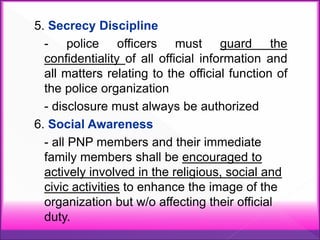
5. Secrecy Discipline
- police officers must guard the
confidentiality of all official information and
all matters relating to the official function of
the police organization
- disclosure must always be authorized
6. Social Awareness
- all PNP members and their immediate
family members shall be encouraged to
actively involved in the religious, social and
civic activities to enhance the image of the
organization but w/o affecting their official
duty.
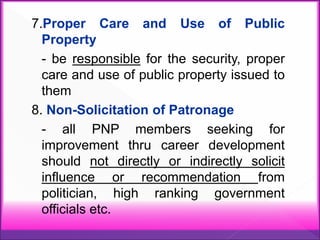
7.Proper Care and Use of Public
Property
- be responsible for the security, proper
care and use of public property issued to
them
8. Non-Solicitation of Patronage
- all PNP members seeking for
improvement thru career development
should not directly or indirectly solicit
influence or recommendation from
politician, high ranking government
officials etc.
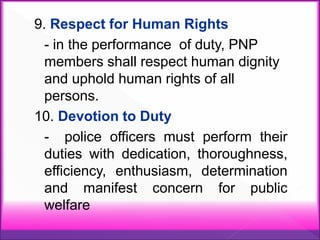
9. Respect for Human Rights
- in the performance of duty, PNP
members shall respect human dignity
and uphold human rights of all
persons.
10. Devotion to Duty
- police officers must perform their
duties with dedication, thoroughness,
efficiency, enthusiasm, determination
and manifest concern for public
welfare
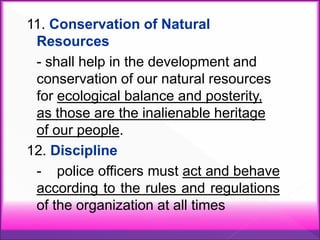
11. Conservation of Natural
Resources
- shall help in the development and
conservation of our natural resources
for ecological balance and posterity,
as those are the inalienable heritage
of our people.
12. Discipline
- police officers must act and behave
according to the rules and regulations
of the organization at all times
13. Loyalty
- police officers must be loyal to the
Constitution and to the police service, as
manifested by their loyalty to their
superiors, peers and subordinates
14. Obedience to Superiors
- police officers must obey LAWFUL
orders of their superiors
- police officers must always be
courteous to superiors and other
appropriate authorities within the chain of
command
 1)Love of God
 2)Respect for Authority
 3)Selfless Love and Service to
People
 4)Sanctity of Marriage and Respect for
Women
 5)Responsible Dominion and
Stewardship over Material Things
 7)Truthfulness
I believe in God, the Supreme
Being, a Great Provider, and the
Creator of all men and everything
dear to me. In return, I cannot
less than love Him above all, seek
His guidance in the performance
of my sworn duties and honor Him
at all times.
I believe that respect for
authority is a duty. I respect and
uphold the Constitution, the laws
of the land and the applicable
rules and regulations. I recognize
the legitimacy and authority of the
leadership, and follow and obey
legal orders of my superior
officers.
I believe in selfless love and service to
people. Towards this end, I commit
myself to the service of my fellowmen
over and above my personal
convenience.
I believe in the sanctity of marriage
and respect for women. I shall set the
example of decency and morality and
shall have high regard for family life and
chastity.
I believe in responsible
dominion and stewardship over
material things. I shall inhibit
myself from ostentatious display of
my property. I shall protect the
environment and conserve nature
to maintain ecological balance. I
shall respect private and public
properties and prevent others from
destroying them.
I believe in the wisdom of
truthfulness. I must be trustworthy
and I shall speak the truth at all
times as required by the
profession.
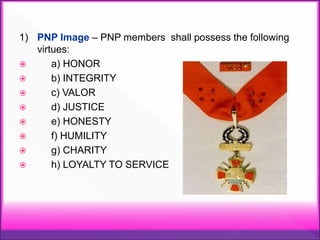
1) PNP Image – PNP members shall possess the following
virtues:
 a) HONOR
 b) INTEGRITY
 c) VALOR
 d) JUSTICE
 e) HONESTY
 f) HUMILITY
 g) CHARITY
 h) LOYALTY TO SERVICE
POLICE PUBLIC
IMAGE
- Refers on how the people of
the community perceive or
regard the police
2. Career Management, the Key to
Professionalism
- the PNP recognizes the need to
have proper and strict policies regarding
recruitment, training, assignment,
promotion, awards, discipline and
retirement to ensure sound
administration and to look after the
welfare of its members
3. Police Management Leadership
- the effectiveness of law
enforcement is reflective of the
managerial capabilities and
competent leadership of the men and
women who run the PNP
organization
4. Delicadeza
-sense of pride and self-worth
-police officers must be able to sacrifice
self-interest in the name of duty
-police officers must not do anything that
would bring dishonor to himself and to the
PNP organization itself
5. Equality in the Service
-all police officers shall have equal
opportunities for improvement and career
advancement based on merit
6. Police Lifestyle
- police officers must live a, simple, yet
credible and dignified life, free from
greed, corruption and exploitation
- police officers must set a good
example
7. Political Patronage
- police officers must NEVER ASK
for recommendations from public
officials in matters pertaining to
promotion, assignment, awards and
others
8. Human Rights
- all PNP must respect and protect
human dignity and men’s inalienable
rights to life, liberty and property.
POLICE
- Group of persons establish,
maintained and organized for
keeping peace and order, safety,
protection of lives and property
and for prevention and detection
of crimes
Civilian populace or public in
general, and shall be used
interchangeably with the terms,
public, citizenry, society and
private sector
Sum total of the dealings between
the police and the people its
serves, and whose goodwill and
cooperation it craves, for the
greatest possible efficiency in the
service
The act of bringing about better
understanding, confidence and
acceptance for an individual or an
organization
Continuing process by which
endeavors are made to obtain the
goodwill and cooperation of the
public for effective enforcement of
the law and accomplishment of
the police purposes.
Consist of fundamental rules both
moral and legal, which govern the
relationship of men in all aspects
of life
PUBLIC INFORMATION PROGRAM
- Designed to bridge any
communication gap between the
police and the public
- The basic ingredient in effective
police community relations.
CIVIC ACTION PROGRAM
- a program that makes the policemen
a friend and partner of the people for
progress as well as their defender.
MASSCOM PROGRAM
- designed to influence the opinions,
emotions, attitudes, and behavior of
the public
The channels through which
information is disseminated to the
public
May be in the form of television,
movies, radio or newspaper and
the like.
The planned used of mass
communication for public purpose
INTEGRATED POLICE ADVISORY
COUNCIL
- A council that involves local officials
and the citizenry in the preservation
of peace and order.
Refers to how the people in the
community perceive or regard the
police
EFFICIENT SERVICE
1. Public Relation- activities directed at creating and
maintaining favorable impressions to the public
2. Community service
- Activities that provide service to the
community
3. Community Participation
- Involvement of the community in the
various social projects particularly in
the area of crime prevention
- Designed to bridge the communication
gap between the police and the public
Forms of media used:
1. Personal media
- Face to face communications
2. Mass media
- Printed matter and audio visual
communications
2. PUBLIC RELATIONS PROGRAM
- Every PNP unit shall have a PRO
- issue press releases from time to time
- the essence of public relations is simply GOOD
SERVICE and making public well informed on the
good work done by the police.
- building a good image thru actual commendable
performance, w/o inefficiency and corruption.
)
3. CIVIC ACTION PROGRAMS
- can range upward from basic individual acts of
courtesy, to disaster relief, to local assistance
programs in the concept of self-help, up to major
engineering projects.
- encourage and actively participate in athletic
competitions to promote youth development
- fund raising campaigns etc.
4. MASS COMMUNICATION PROGRAM
- should be an integral part of police operations because use
of the force alone can never single handedly solve the
problems of lawlessness.
4 General Approaches in Police Community Relations
1. Externally-Oriented Approach – directed towards
the general public
2. Youth-Oriented Approach – directed the majority
of police efforts towards the youth
3. Service-Oriented Approach – emphasis is given
to the alleviation of social problems
4. Internally-Oriented Approach – essential
characteristic is the realization that the officer on
beat creates community relations bec. “Every
officer of the organization is a police-community
relations officer.”
PRINCIPLES OF THE PCR
1. Public Support must be Maintained
- shall appear able and willing to serve all
2. Public Resentment Must be Avoided
- always have in mind the interest of the
public and shall develop friendly relations
3. Public Goodwill must be developed
- must be courteous, fair and quick to assist
individuals
4. Public must be Kept Informed
- must inform the public on the regulations
and policies of the police force.
CRIME PREVENTION
- generally recognized as
an important police function
but the police can do little w/o
community cooperation
assistance.
FIVE CATEGORIES OF PEACE
OFFICERS’ INDIVIDUAL PUBLIC
RELATIONS:
1. Domestic Relations- consist of persons
dealing with his family and immediate
relatives.
2. Neighborhood Relations – persons
dealing with neighbors
3. Community Relations – persons
dealing with the citizens of the
community.
4. Church Relations
5. Government Relations
8 CATEGORIES OF PEACE OFFICERS’
PROFESSIONAL RELATIONS
1. Intra- Departmental Relations-
relations with the officers and men of his
own department
2. Inter-Departmental Relations –
relations with other police agencies
3. Citizen’s Relations
4. Complaint’s Relations-dealing with
complaint
5. Relations with accused persons-
proper treatment of suspects
6. Relations with State Prosecutors
or Fiscals – Preliminary Investigation
7. Judicial Relations-court
8. Government Relations- dealings
with other non-police agencies
INTEGRATED POLICE ADVISORY
COUNCIL (IPAC)
- In order to involve civil officials and the
citizenry in the preservation of peace
and order and the promotion of public
safety, there shall be created an
advisory council in every level of the
command of the PNP.
Professional Conduct and ethics lecture.pptx

Professional Conduct and ethics lecture.pptx

  • 1.
  • 2.
  • 3.
  • 6.
    According to Section37 of RA 6975, “There shall be established a performance evaluation system which shall be administered in accordance with the rules, regulations and standards, and a CODE OF CONDUCT promulgated by the Commission for members of the PNP…”
  • 7.
    NAPOLCOM RESOLUTION NO.92-4 - the resolution issued by the NAPOLCOM approving the draft of the PNP Code of Professional Conduct and Ethical Standards by the PNP - approved on 12 March 1992
  • 8.
    PURPOSES OF THECODE 1) To foster individual efficiency, behavioral discipline and organizational effectiveness, as well as respect for constitutional and human rights of citizens, democratic principles and ideals and the supremacy of civilian authority over the military;
  • 9.
    2) To setthe moral tone and norms of professional conduct in the police service; 3) To provide moral and ethical guidance to all PNP members; and 4) To enlighten members of the police service of what behavior is really acceptable – to define what is permitted and what is prohibited.
  • 10.
    LAWS RELATED TOTHE PNP CODE OF PROFESSIONAL CONDUCT AND ETHICAL STANDARDS  1)RA 3019 – the Anti-Graft and Corrupt Practices Act  2)RA 6713 – Code of Conduct and Ethical Standards for Public Officials and Employees
  • 11.
    • 3) RA7080 – Anti- Plunder Act • 4) People’s Law Enforcement Board (PLEB) Rules and Regulations • 5) RA 10589 – the Anti-Corruption Month Act (December)
  • 13.
    Section 2. Declarationof Policies. - It is the policy of the State to promote a high standard of ethics in public service. Public officials and employees shall at all times be accountable to the people and shall discharge their duties with utmost responsibility, integrity, competence, and loyalty, act with patriotism and justice, lead modest lives, and uphold public interest over personal interest.
  • 14.
    (a) Commitment topublic interest. - Public officials and employees shall always uphold the public interest over and above personal interest. All government resources and powers of their respective offices must be employed and used efficiently, effectively, honestly and economically, particularly to avoid wastage in public funds and revenues.
  • 15.
    (b) Professionalism. -Public officials and employees shall perform and discharge their duties with the highest degree of excellence, professionalism, intelligence and skill. They shall enter public service with utmost devotion and dedication to duty. They shall endeavor to discourage wrong perceptions of their roles as dispensers or peddlers of undue patronage.
  • 16.
     (c) Justnessand sincerity. - Public officials and employees shall remain true to the people at all times. They must act with justness and sincerity and shall not discriminate against anyone, especially the poor and the underprivileged. They shall at all times respect the rights of others, and shall refrain from doing acts contrary to law, good morals, good customs, public policy, public order, public safety and public interest. They shall not dispense or extend undue favors on account of their office to their relatives whether by consanguinity or affinity except with respect to appointments of such relatives to positions considered strictly confidential or as members of their personal staff whose terms are coterminous with theirs.
  • 17.
    (d) Political neutrality.- Public officials and employees shall provide service to everyone without unfair discrimination and regardless of party affiliation or preference.
  • 23.
    1. Commitment toDemocracy - police officers must never forget that they are public servants and they must at all times uphold the Constitution and be loyal to the country, the people and the PNP organization 2. Commitment to Public Interest -public interest = for the good of the people or community - police officers must always uphold public interest over and above personal interests
  • 24.
    - police officersmust respect the fact that their resources are funded by taxpayers’ money and should therefore be used wisely and economically to avoid wastage of public funds
  • 25.
    3. Non-Partisanship - policeofficers must not be identified with any particular political party or figure - they must extend their assistance to all regardless of party affiliation 4. Physical Fitness and Health - all PNP members shall strive to be physically fit and in good health at all times - they shall undergo regular exercise and annual medical exam in any PNP hospital or medical facility
  • 26.
    5. Secrecy Discipline -police officers must guard the confidentiality of all official information and all matters relating to the official function of the police organization - disclosure must always be authorized 6. Social Awareness - all PNP members and their immediate family members shall be encouraged to actively involved in the religious, social and civic activities to enhance the image of the organization but w/o affecting their official duty.
  • 27.
    7.Proper Care andUse of Public Property - be responsible for the security, proper care and use of public property issued to them 8. Non-Solicitation of Patronage - all PNP members seeking for improvement thru career development should not directly or indirectly solicit influence or recommendation from politician, high ranking government officials etc.
  • 28.
    9. Respect forHuman Rights - in the performance of duty, PNP members shall respect human dignity and uphold human rights of all persons. 10. Devotion to Duty - police officers must perform their duties with dedication, thoroughness, efficiency, enthusiasm, determination and manifest concern for public welfare
  • 29.
    11. Conservation ofNatural Resources - shall help in the development and conservation of our natural resources for ecological balance and posterity, as those are the inalienable heritage of our people. 12. Discipline - police officers must act and behave according to the rules and regulations of the organization at all times
  • 30.
    13. Loyalty - policeofficers must be loyal to the Constitution and to the police service, as manifested by their loyalty to their superiors, peers and subordinates 14. Obedience to Superiors - police officers must obey LAWFUL orders of their superiors - police officers must always be courteous to superiors and other appropriate authorities within the chain of command
  • 33.
     1)Love ofGod  2)Respect for Authority  3)Selfless Love and Service to People  4)Sanctity of Marriage and Respect for Women  5)Responsible Dominion and Stewardship over Material Things  7)Truthfulness
  • 35.
    I believe inGod, the Supreme Being, a Great Provider, and the Creator of all men and everything dear to me. In return, I cannot less than love Him above all, seek His guidance in the performance of my sworn duties and honor Him at all times.
  • 36.
    I believe thatrespect for authority is a duty. I respect and uphold the Constitution, the laws of the land and the applicable rules and regulations. I recognize the legitimacy and authority of the leadership, and follow and obey legal orders of my superior officers.
  • 37.
    I believe inselfless love and service to people. Towards this end, I commit myself to the service of my fellowmen over and above my personal convenience. I believe in the sanctity of marriage and respect for women. I shall set the example of decency and morality and shall have high regard for family life and chastity.
  • 38.
    I believe inresponsible dominion and stewardship over material things. I shall inhibit myself from ostentatious display of my property. I shall protect the environment and conserve nature to maintain ecological balance. I shall respect private and public properties and prevent others from destroying them.
  • 39.
    I believe inthe wisdom of truthfulness. I must be trustworthy and I shall speak the truth at all times as required by the profession.
  • 41.
    1) PNP Image– PNP members shall possess the following virtues:  a) HONOR  b) INTEGRITY  c) VALOR  d) JUSTICE  e) HONESTY  f) HUMILITY  g) CHARITY  h) LOYALTY TO SERVICE
  • 42.
    POLICE PUBLIC IMAGE - Referson how the people of the community perceive or regard the police
  • 43.
    2. Career Management,the Key to Professionalism - the PNP recognizes the need to have proper and strict policies regarding recruitment, training, assignment, promotion, awards, discipline and retirement to ensure sound administration and to look after the welfare of its members
  • 44.
    3. Police ManagementLeadership - the effectiveness of law enforcement is reflective of the managerial capabilities and competent leadership of the men and women who run the PNP organization
  • 45.
    4. Delicadeza -sense ofpride and self-worth -police officers must be able to sacrifice self-interest in the name of duty -police officers must not do anything that would bring dishonor to himself and to the PNP organization itself 5. Equality in the Service -all police officers shall have equal opportunities for improvement and career advancement based on merit
  • 46.
    6. Police Lifestyle -police officers must live a, simple, yet credible and dignified life, free from greed, corruption and exploitation - police officers must set a good example
  • 47.
    7. Political Patronage -police officers must NEVER ASK for recommendations from public officials in matters pertaining to promotion, assignment, awards and others 8. Human Rights - all PNP must respect and protect human dignity and men’s inalienable rights to life, liberty and property.
  • 50.
    POLICE - Group ofpersons establish, maintained and organized for keeping peace and order, safety, protection of lives and property and for prevention and detection of crimes
  • 51.
    Civilian populace orpublic in general, and shall be used interchangeably with the terms, public, citizenry, society and private sector
  • 52.
    Sum total ofthe dealings between the police and the people its serves, and whose goodwill and cooperation it craves, for the greatest possible efficiency in the service
  • 53.
    The act ofbringing about better understanding, confidence and acceptance for an individual or an organization
  • 54.
    Continuing process bywhich endeavors are made to obtain the goodwill and cooperation of the public for effective enforcement of the law and accomplishment of the police purposes.
  • 55.
    Consist of fundamentalrules both moral and legal, which govern the relationship of men in all aspects of life
  • 56.
    PUBLIC INFORMATION PROGRAM -Designed to bridge any communication gap between the police and the public - The basic ingredient in effective police community relations.
  • 57.
    CIVIC ACTION PROGRAM -a program that makes the policemen a friend and partner of the people for progress as well as their defender. MASSCOM PROGRAM - designed to influence the opinions, emotions, attitudes, and behavior of the public
  • 58.
    The channels throughwhich information is disseminated to the public May be in the form of television, movies, radio or newspaper and the like.
  • 59.
    The planned usedof mass communication for public purpose INTEGRATED POLICE ADVISORY COUNCIL - A council that involves local officials and the citizenry in the preservation of peace and order.
  • 60.
    Refers to howthe people in the community perceive or regard the police
  • 61.
  • 62.
    1. Public Relation-activities directed at creating and maintaining favorable impressions to the public 2. Community service - Activities that provide service to the community 3. Community Participation - Involvement of the community in the various social projects particularly in the area of crime prevention
  • 64.
    - Designed tobridge the communication gap between the police and the public Forms of media used: 1. Personal media - Face to face communications 2. Mass media - Printed matter and audio visual communications
  • 65.
    2. PUBLIC RELATIONSPROGRAM - Every PNP unit shall have a PRO - issue press releases from time to time - the essence of public relations is simply GOOD SERVICE and making public well informed on the good work done by the police. - building a good image thru actual commendable performance, w/o inefficiency and corruption. )
  • 66.
    3. CIVIC ACTIONPROGRAMS - can range upward from basic individual acts of courtesy, to disaster relief, to local assistance programs in the concept of self-help, up to major engineering projects. - encourage and actively participate in athletic competitions to promote youth development - fund raising campaigns etc.
  • 67.
    4. MASS COMMUNICATIONPROGRAM - should be an integral part of police operations because use of the force alone can never single handedly solve the problems of lawlessness.
  • 68.
    4 General Approachesin Police Community Relations 1. Externally-Oriented Approach – directed towards the general public 2. Youth-Oriented Approach – directed the majority of police efforts towards the youth 3. Service-Oriented Approach – emphasis is given to the alleviation of social problems 4. Internally-Oriented Approach – essential characteristic is the realization that the officer on beat creates community relations bec. “Every officer of the organization is a police-community relations officer.”
  • 69.
    PRINCIPLES OF THEPCR 1. Public Support must be Maintained - shall appear able and willing to serve all 2. Public Resentment Must be Avoided - always have in mind the interest of the public and shall develop friendly relations 3. Public Goodwill must be developed - must be courteous, fair and quick to assist individuals 4. Public must be Kept Informed - must inform the public on the regulations and policies of the police force.
  • 70.
    CRIME PREVENTION - generallyrecognized as an important police function but the police can do little w/o community cooperation assistance.
  • 71.
    FIVE CATEGORIES OFPEACE OFFICERS’ INDIVIDUAL PUBLIC RELATIONS: 1. Domestic Relations- consist of persons dealing with his family and immediate relatives. 2. Neighborhood Relations – persons dealing with neighbors 3. Community Relations – persons dealing with the citizens of the community.
  • 72.
    4. Church Relations 5.Government Relations 8 CATEGORIES OF PEACE OFFICERS’ PROFESSIONAL RELATIONS 1. Intra- Departmental Relations- relations with the officers and men of his own department 2. Inter-Departmental Relations – relations with other police agencies
  • 73.
    3. Citizen’s Relations 4.Complaint’s Relations-dealing with complaint 5. Relations with accused persons- proper treatment of suspects 6. Relations with State Prosecutors or Fiscals – Preliminary Investigation 7. Judicial Relations-court 8. Government Relations- dealings with other non-police agencies
  • 74.
    INTEGRATED POLICE ADVISORY COUNCIL(IPAC) - In order to involve civil officials and the citizenry in the preservation of peace and order and the promotion of public safety, there shall be created an advisory council in every level of the command of the PNP.