Cáncer de colon y recto
(colorectal cancer)
Mauricio Lema Medina MD
Clínica de Oncología Astorga / Clínica SOMA
Medellín
Inspirado en: Michael Bierut, 2013, Logo para Mohawk Fine Papers
Inspirado en: Saul Bass, 1955,, The Man With the Golden Arm
Objetivo
Obtener un conocimiento GENERAL
del enfoque y manejo USUAL de
pacientes con cáncer de colon y
recto, desde la sospecha diagnóstica,
hasta las pautas de seguimiento
post-tratamiento, pasando por los
aspectos más relevantes de
tratamientos con intención curativa.
Epidemiology
Cancer
epidemiology
(World-
Colombia)
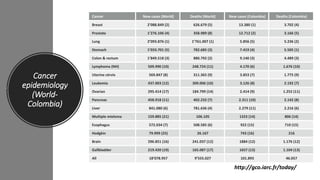
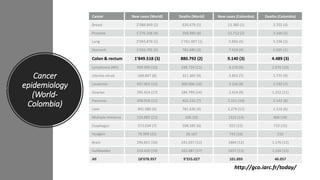
Cancer New cases (World) Deaths (World) New cases (Colombia) Deaths (Colombia)
Breast 2’088.849 (2) 626.679 (5) 13.380 (1) 3.702 (4)
Prostate 1’276.106 (4) 358.989 (8) 12.712 (2) 3.166 (5)
Lung 2’093.876 (1) 1’761.007 (1) 5.856 (5) 5.236 (2)
Stomach 1’033.701 (5) 782.685 (3) 7.419 (4) 5.505 (1)
Colon & rectum 1’849.518 (3) 880.792 (2) 9.140 (3) 4.489 (3)
Lymphoma (NH) 509.990 (10) 248.724 (11) 4.170 (6) 1.676 (10)
Uterine cérvix 569.847 (8) 311.365 (9) 3.853 (7) 1.775 (9)
Leukemia 437.003 (12) 309.006 (10) 3.126 (8) 2.192 (7)
Ovarian 295.414 (17) 184.799 (14) 2.414 (9) 1.252 (11)
Pancreas 458.918 (11) 402.232 (7) 2.311 (10) 2.142 (8)
Liver 841.080 (6) 781.636 (4) 2.279 (11) 2.216 (6)
Multiple mieloma 159.885 (21) 106.105 1323 (14) 806 (14)
Esophagus 572.034 (7) 508.585 (6) 922 (15) 710 (15)
Hodgkin 79.999 (25) 26.167 743 (16) 216
Brain 296.851 (16) 241.037 (12) 1884 (12) 1.176 (12)
Gallbladder 219.420 (19) 165.087 (17) 1657 (13) 1.104 (13)
All 18’078.957 9’555.027 101.893 46.057
http://gco.iarc.fr/today/
Cancer
epidemiology
(World-
Colombia)
Cancer New cases (World) Deaths (World) New cases (Colombia) Deaths (Colombia)
Breast 2’088.849 (2) 626.679 (5) 13.380 (1) 3.702 (4)
Prostate 1’276.106 (4) 358.989 (8) 12.712 (2) 3.166 (5)
Lung 2’093.876 (1) 1’761.007 (1) 5.856 (5) 5.236 (2)
Stomach 1’033.701 (5) 782.685 (3) 7.419 (4) 5.505 (1)
Colon & rectum 1’849.518 (3) 880.792 (2) 9.140 (3) 4.489 (3)
Lymphoma (NH) 509.990 (10) 248.724 (11) 4.170 (6) 1.676 (10)
Uterine cérvix 569.847 (8) 311.365 (9) 3.853 (7) 1.775 (9)
Leukemia 437.003 (12) 309.006 (10) 3.126 (8) 2.192 (7)
Ovarian 295.414 (17) 184.799 (14) 2.414 (9) 1.252 (11)
Pancreas 458.918 (11) 402.232 (7) 2.311 (10) 2.142 (8)
Liver 841.080 (6) 781.636 (4) 2.279 (11) 2.216 (6)
Multiple mieloma 159.885 (21) 106.105 1323 (14) 806 (14)
Esophagus 572.034 (7) 508.585 (6) 922 (15) 710 (15)
Hodgkin 79.999 (25) 26.167 743 (16) 216
Brain 296.851 (16) 241.037 (12) 1884 (12) 1.176 (12)
Gallbladder 219.420 (19) 165.087 (17) 1657 (13) 1.104 (13)
All 18’078.957 9’555.027 101.893 46.057
http://gco.iarc.fr/today/
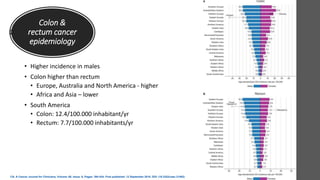
• Higher incidence in males
• Colon higher than rectum
• Europe, Australia and North America - higher
• Africa and Asia – lower
• South America
• Colon: 12.4/100.000 inhabitant/yr
• Rectum: 7.7/100.000 inhabitants/yr
Colon &
rectum cancer
epidemiology
CA: A Cancer Journal for Clinicians, Volume: 68, Issue: 6, Pages: 394-424, First published: 12 September 2018, DOI: (10.3322/caac.21492)
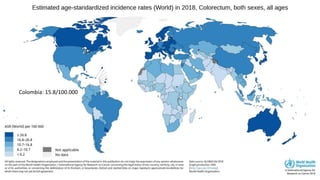
Colombia: 15.8/100.000
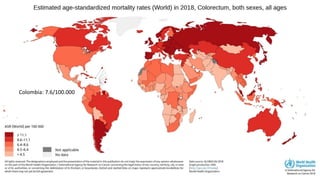
Colombia: 7.6/100.000
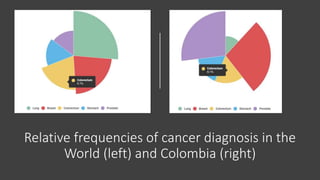
Relative frequencies of cancer diagnosis in the
World (left) and Colombia (right)
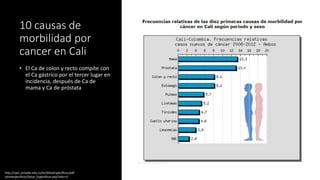
10 causas de
morbilidad por
cancer en Cali
• El Ca de colon y recto compite con
el Ca gástrico por el tercer lugar en
incidencia, después de Ca de
mama y Ca de próstata
http://rpcc.univalle.edu.co/es/SitiosEspecificos/pdf-
sitiosespecificos/Sitios_Especificos.php?sitio=4
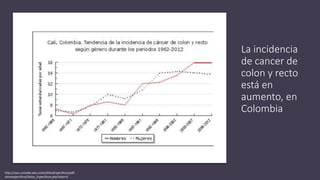
La incidencia
de cancer de
colon y recto
está en
aumento, en
Colombia
http://rpcc.univalle.edu.co/es/SitiosEspecificos/pdf-
sitiosespecificos/Sitios_Especificos.php?sitio=4
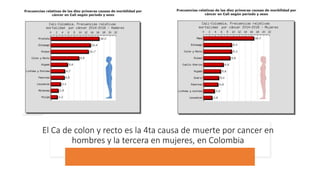
El Ca de colon y recto es la 4ta causa de muerte por cancer en
hombres y la tercera en mujeres, en Colombia
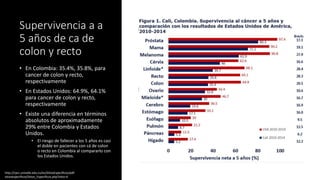
Supervivencia a a
5 años de ca de
colon y recto
• En Colombia: 35.4%, 35.8%, para
cancer de colon y recto,
respectivamente
• En Estados Unidos: 64.9%, 64.1%
para cancer de colon y recto,
respectivamente
• Existe una diferencia en términos
absolutos de aproximadamente
29% entre Colombia y Estados
Unidos.
• El riesgo de fallecer a los 5 años es casi
el doble en pacientes con cá de colon
o recto en Colombia al compararlo con
los Estados Unidos.
http://rpcc.univalle.edu.co/es/SitiosEspecificos/pdf-
sitiosespecificos/Sitios_Especificos.php?sitio=4
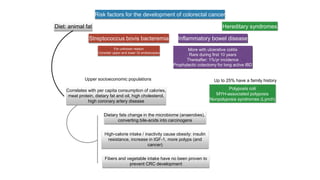
Risk factors
Risk factors for the development of colorectal cancer
Diet: animal fat Hereditary syndromes
Inflammatory bowel diseaseStreptococcus bovis bacteremia
Upper socioeconomic populations
Correlates with per capita consumption of calories,
meat protein, dietary fat and oil, high cholesterol,
high coronary artery disease
Dietary fats change in the microbiome (anaerobes),
converting bile-acids into carcinogens
High-calorie intake / inactivity cause obesity: insulin
resistance, increase in IGF-1, more polyps (and
cancer)
Fibers and vegetable intake have no been proven to
prevent CRC development
Up to 25% have a family history
Polyposis coli
MYH-associated polyposis
Nonpolyposis syndromes (Lynch)
More with ulcerative colitis
Rare during first 10 years
Thereafter: 1%/yr incidence
Prophylactic colectomy for long active IBD
For unknown reason
Consider upper and lower GI endoscopies
Hereditary colo-
rectal cancer
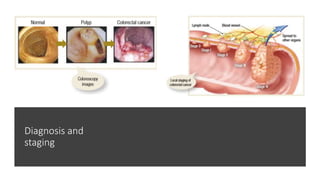
Diagnosis and
staging
Hereditary colon cancer
genes
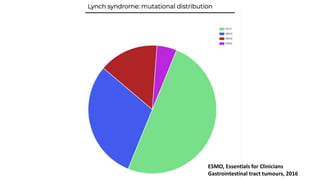
Lynch Syndrome
Hereditary Polyposis Syndrome
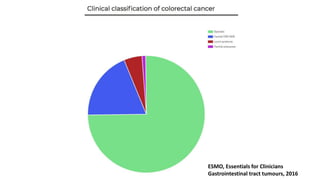
ESMO, Essentials for Clinicians
Gastrointestinal tract tumours, 2016
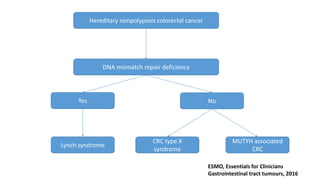
Hereditary nonpolyposis colorectal cancer
DNA mismatch repair deficiency
Yes No
Lynch syndrome
CRC type X
syndrome
MUTYH associated
CRC
ESMO, Essentials for Clinicians
Gastrointestinal tract tumours, 2016
ESMO, Essentials for Clinicians
Gastrointestinal tract tumours, 2016
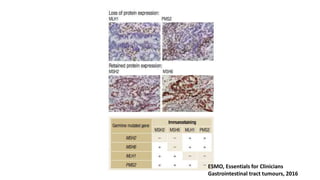
ESMO, Essentials for Clinicians
Gastrointestinal tract tumours, 2016
MMR germline
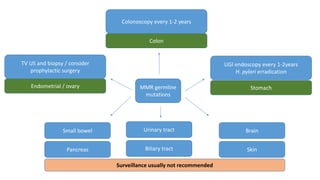
mutations
Colonoscopy every 1-2 years
Colon
TV US and biopsy / consider
prophylactic surgery
Endometrial / ovary
Brain
UGI endoscopy every 1-2years
H. pylori erradication
Stomach
Skin
Small bowel
Pancreas
Urinary tract
Biliary tract
Surveillance usually not recommended
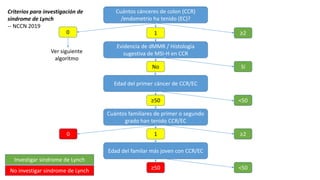
Cuántos cánceres de colon (CCR)
/endometrio ha tenido (EC)?
≥21
Evidencia de dMMR / Histología
sugestiva de MSI-H en CCR
Sí
Edad del primer cáncer de CCR/EC
No
<50≥50
Cuántos familiares de primer o segundo
grado han tenido CCR/EC
≥210
Edad del familar más joven con CCR/EC
<50≥50
0
Ver siguiente
algoritmo
Criterios para investigación de
sindrome de Lynch
-- NCCN 2019
Investigar sindrome de Lynch
No investigar sindrome de Lynch
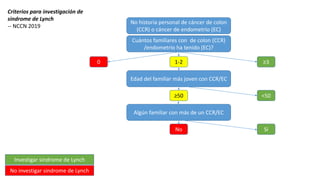
Cuántos familiares con de colon (CCR)
/endometrio ha tenido (EC)?
≥31-2
Edad del familiar más joven con CCR/EC
<50
Algún familiar con más de un CCR/EC
≥50
SíNo
0
Criterios para investigación de
sindrome de Lynch
-- NCCN 2019
Investigar sindrome de Lynch
No investigar sindrome de Lynch
No historia personal de cáncer de colon
(CCR) o cáncer de endometrio (EC)
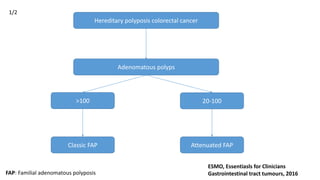
Hereditary polyposis colorectal cancer
Adenomatous polyps
>100 20-100
Classic FAP Attenuated FAP
ESMO, Essentiasls for Clinicians
Gastrointestinal tract tumours, 2016FAP: Familial adenomatous polyposis
1/2
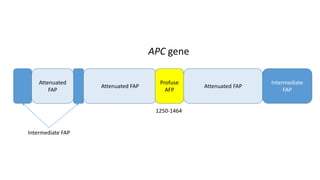
Attenuated
FAP
Attenuated FAP
Intermediate
FAP
Attenuated FAP
Profuse
AFP
APC gene
Intermediate FAP
1250-1464
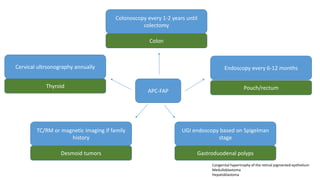
APC-FAP
Colonoscopy every 1-2 years until
colectomy
Colon
Cervical ultrsonography annually
Thyroid
TC/RM or magnetic imaging if family
history
Desmoid tumors
UGI endoscopy based on Spigelman
stage
Gastroduodenal polyps
Endoscopy every 6-12 months
Pouch/rectum
Congenital hypertrophy of the retinal pigmented epithelium
Medulloblastoma
Hepatoblastoma
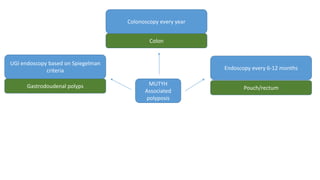
MUTYH
Associated
polyposis
Colonoscopy every year
Colon
UGI endoscopy based on Spiegelman
criteria
Gastrodoudenal polyps
Endoscopy every 6-12 months
Pouch/rectum
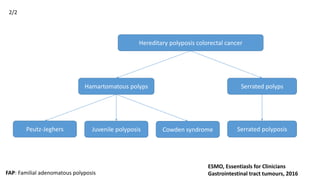
Hereditary polyposis colorectal cancer
Hamartomatous polyps
Peutz-Jeghers Juvenile polyposis Cowden syndrome
ESMO, Essentiasls for Clinicians
Gastrointestinal tract tumours, 2016FAP: Familial adenomatous polyposis
2/2
Serrated polyps
Serrated polyposis
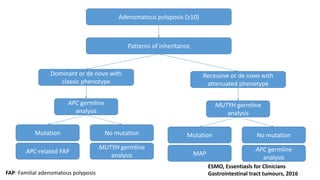
Adenomatous polyposis (≥10)
Patterns of inheritance
Dominant or de novo with
classic phenotype
Mutation
APC germline
analysis
APC-related FAP
ESMO, Essentiasls for Clinicians
Gastrointestinal tract tumours, 2016FAP: Familial adenomatous polyposis
No mutation
MUTYH germline
analysis
Recessive or de novo with
attenuated phenotype
Mutation
MUTYH germline
analysis
MAP
No mutation
APC germline
analysis
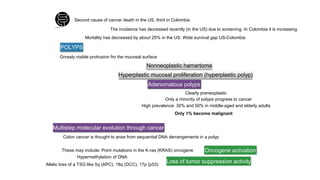
Second cause of cancer death in the US, third in Colombia
The incidence has decreased recently (in the US) due to screening. In Colombia it is increasing
Mortality has decreased by about 25% in the US. Wide survival gap US-Colombia
POLYPS
Grossly visible protrusion fro the mucosal surface
Nonneoplastic hamartoma
Hyperplastic mucosal proliferation (hyperplastic polyp)
Adenomatous polyps
Clearly preneoplastic
Only a minority of polyps progress to cancer
High prevalence: 30% and 50% in middle-aged and elderly adults
Only 1% become malignant
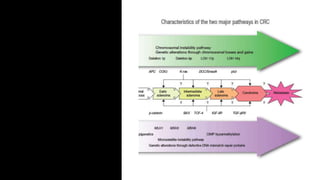
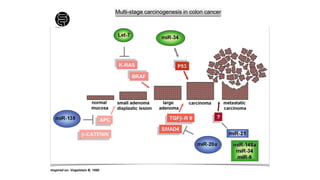
Multistep molecular evolution through cancer
Colon cancer is thought to arise from sequential DNA derrangements in a polyp
These may include: Point mutations in the K-ras (KRAS) oncogene
Hypermethylation of DNA
Allelic loss of a TSG like 5q (APC), 18q (DCC), 17p (p53)
Oncogene activation
Loss of tumor suppression activity
Multi-stage carcinogenesis in colon cancer
Inspired on: Vogelstein B, 1990
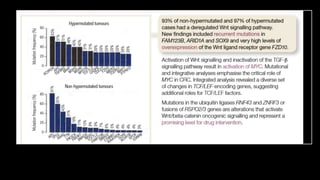
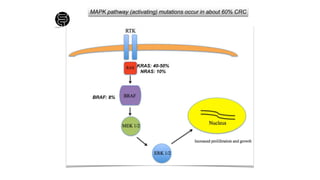
MAPK pathway (activating) mutations occur in about 60% CRC
KRAS: 40-50%
NRAS: 10%
BRAF: 8%
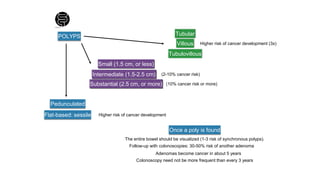
POLYPS
Pedunculated
Flat-based: sessile Higher risk of cancer development
Tubular
Villous
Tubulovillous
Higher risk of cancer development (3x)
Small (1.5 cm, or less)
Intermediate (1.5-2.5 cm)
Substantial (2.5 cm, or more)
(2-10% cancer risk)
(10% cancer risk or more)
The entire bowel should be visualized (1-3 risk of synchronous polyps).
Follow-up with colonoscopies: 30-50% risk of another adenoma
Adenomas become cancer in about 5 years
Colonoscopy need not be more frequent than every 3 years
Once a poly is found
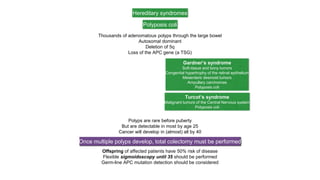
Hereditary syndromes
Polyposis coli
Thousands of adenomatous polyps through the large bowel
Autosomal dominant
Deletion of 5q
Loss of the APC gene (a TSG)
Gardner’s syndrome
Soft-tissue and bony tumors
Congenital hypertrophy of the retinal epithelium
Mesenteric desmoid tumors
Ampullary carcinomas
Polyposis coli
Turcot’s syndrome
Malignant tumors of the Central Nervous system
Polyposis coli
Polyps are rare before puberty
But are detectable in most by age 25
Cancer will develop in (almost) all by 40
Once multiple polyps develop, total colectomy must be performed
Offspring of affected patients have 50% risk of disease
Flexible sigmoidoscopy until 35 should be performed
Germ-line APC mutation detection should be considered
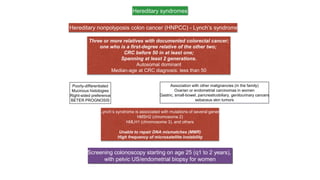
Hereditary syndromes
Hereditary nonpolyposis colon cancer (HNPCC) - Lynch’s syndrome
Three or more relatives with documented colorectal cancer;
one who is a first-degree relative of the other two;
CRC before 50 in at least one;
Spanning at least 2 generations.
Autosomal dominant
Median-age at CRC diagnosis: less than 50
Screening colonoscopy starting on age 25 (q1 to 2 years),
with pelvic US/endometrial biopsy for women
Poorly-differentiated
Mucinous histologies
Right-sided preference
BETER PROGNOSIS
Association with other malignancies (in the family)
Ovarian or endometrial carcinomas in women
Gastric, small-bowel, pancreaticobiliary, genitourinary cancers
sebaceus skin tumors
Lynch’s syndrome is associated with mutations of several genes
hMSH2 (chromosome 2)
hMLH1 (chromosome 3), and others
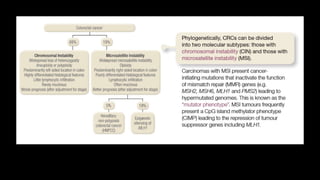
Unable to repair DNA mismatches (MMR)
High frequency of microsatellite instability
Screening
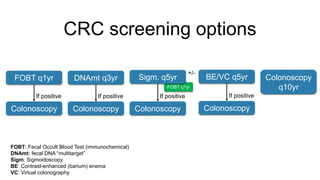
FOBT q1yr
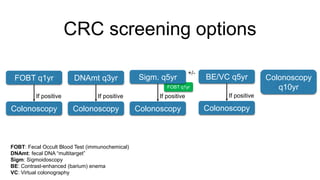
CRC screening options
FOBT q1yr
Colonoscopy
If positive
DNAmt q3yr
Colonoscopy
If positive
Sigm. q5yr
Colonoscopy
If positive
+/-
BE/VC q5yr
Colonoscopy
If positive
Colonoscopy
q10yr
FOBT: Fecal Occult Blood Test (immunochemical)
DNAmt: fecal DNA “multitarget”
Sigm: Sigmoidoscopy
BE: Contrast-enhanced (barium) enema
VC: Virtual colonography
FOBT q1yr
CRC screening options
FOBT q1yr
Colonoscopy
If positive
DNAmt q3yr
Colonoscopy
If positive
Sigm. q5yr
Colonoscopy
If positive
+/-
BE/VC q5yr
Colonoscopy
If positive
Colonoscopy
q10yr
FOBT: Fecal Occult Blood Test (immunochemical)
DNAmt: fecal DNA “multitarget”
Sigm: Sigmoidoscopy
BE: Contrast-enhanced (barium) enema
VC: Virtual colonography
Cribado:
Cáncer de
colon y recto
(ACS)
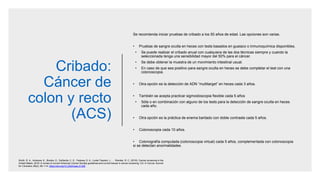
Se recomienda iniciar pruebas de cribado a los 50 años de edad. Las opciones son varias.
• Pruebas de sangre oculta en heces con tests basados en guaiaco o inmunoquímica disponibles.
• Se puede realizar el cribado anual con cualquiera de las dos técnicas siempre y cuando la
seleccionada tenga una sensibilidad mayor del 50% para el cáncer.
• Se debe obtener la muestra de un movimiento intestinal usual.
• En caso de que sea positivo para sangre oculta en heces se debe completar el test con una
colonoscopia.
• Otra opción es la detección de ADN “multitarget” en heces cada 3 años.
• También se acepta practicar sigmoidoscopia flexible cada 5 años
• Sóla o en combinación con alguno de los tests para la detección de sangre oculta en heces
cada año.
• Otra opción es la práctica de enema baritado con doble contraste cada 5 años.
• Colonoscopia cada 10 años.
• Colonografía computada (colonoscopia virtual) cada 5 años, complementada con colonoscopia
si se detectan anormalidades.
Smith, R. A., Andrews, K., Brooks, D., DeSantis, C. E., Fedewa, S. A., Lortet-Tieulent, J., … Wender, R. C. (2016). Cancer screening in the
United States, 2016: A review of current American Cancer Society guidelines and current issues in cancer screening. CA: A Cancer Journal
for Clinicians, 66(2), 95–114. https://doi.org/10.3322/caac.21336
Cribado:
Cáncer de
colon y recto
• Ministerio de Salud de Colombia
• En la guía de práctica clínica del ministerio
de saludo colombiano se sugiere que la
estrategia óptima de tamización para cáncer
colorrectal en la población colombiana a
riesgo promedio sea sangre oculta en
materia fecal inmunoquímica cada dos años
o colonoscopia cada diez años, cuando ésta
se encuentre disponible.
http://gpc.minsalud.gov.co/
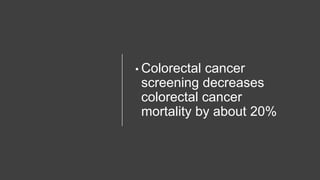
• Colorectal cancer
screening decreases
colorectal cancer
mortality by about 20%
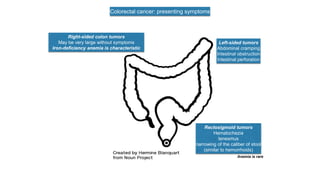
Colorectal cancer: presenting symptoms
Right-sided colon tumors
May be very large without symptoms
Iron-deficiency anemia is characteristic
Left-sided tumors
Abdominal cramping
Intestinal obstruction
Intestinal perforation
Rectosigmoid tumors
Hematochezia
tenesmus
narrowing of the caliber of stool
(similar to hemorrhoids)
Anemia is rare
Dissemination
pattern
TNM & Staging
Colorectal cancer
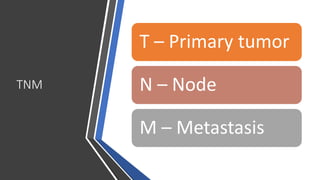
TNM
T – Primary tumor
N – Node
M – Metastasis
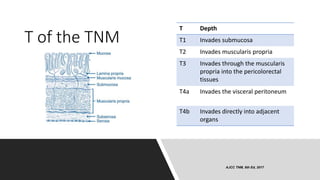
T of the TNM
T Depth
T1 Invades submucosa
T2 Invades muscularis propria
T3 Invades through the muscularis
propria into the pericolorectal
tissues
T4a Invades the visceral peritoneum
T4b Invades directly into adjacent
organs
AJCC TNM, 8th Ed, 2017
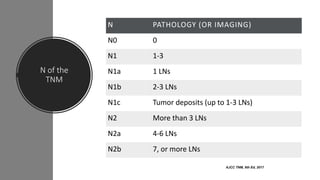
N of the
TNM
N PATHOLOGY (OR IMAGING)
N0 0
N1 1-3
N1a 1 LNs
N1b 2-3 LNs
N1c Tumor deposits (up to 1-3 LNs)
N2 More than 3 LNs
N2a 4-6 LNs
N2b 7, or more LNs
AJCC TNM, 8th Ed, 2017
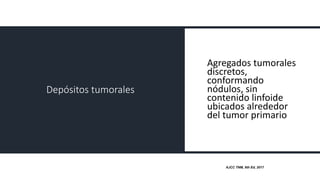
Depósitos tumorales
Agregados tumorales
discretos,
conformando
nódulos, sin
contenido linfoide
ubicados alrededor
del tumor primario
AJCC TNM, 8th Ed, 2017
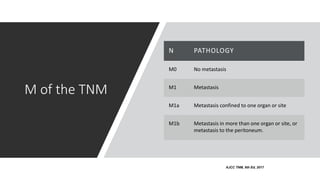
M of the TNM
N PATHOLOGY
M0 No metastasis
M1 Metastasis
M1a Metastasis confined to one organ or site
M1b Metastasis in more than one organ or site, or
metastasis to the peritoneum.
AJCC TNM, 8th Ed, 2017
Principio 1
Los estadíos I y II
son N-
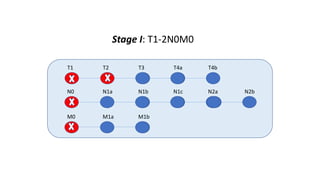
Stage I
T1N0M0, T2N0M0
T1 T2 T3 T4a T4b
N0 N1a N1b N1c N2a N2b
M0 M1a M1b
Stage I: T1-2N0M0
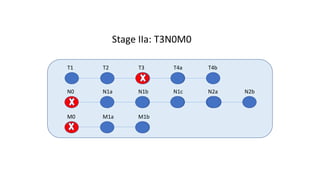
Stage IIa
T3N0M0
T1 T2 T3 T4a T4b
N0 N1a N1b N1c N2a N2b
M0 M1a M1b
Stage IIa: T3N0M0
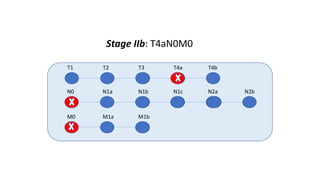
Stage IIb
T4aN0M0
T1 T2 T3 T4a T4b
N0 N1a N1b N1c N2a N2b
M0 M1a M1b
Stage IIb: T4aN0M0
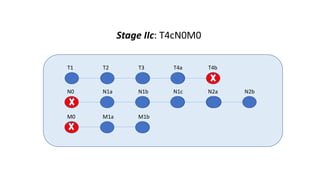
Stage IIc
T4bN0M0
T1 T2 T3 T4a T4b
N0 N1a N1b N1c N2a N2b
M0 M1a M1b
Stage IIc: T4cN0M0
Principio 2
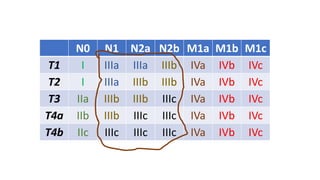
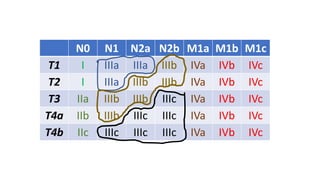
Los N+M0 son
estadío III
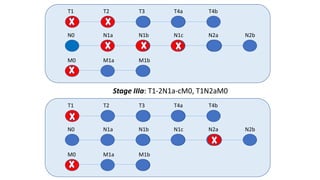
Stage IIIa
T1-2N1a-cM0, T1N2aM0
T1 T2 T3 T4a T4b
N0 N1a N1b N1c N2a N2b
M0 M1a M1b
T1 T2 T3 T4a T4b
N0 N1a N1b N1c N2a N2b
M0 M1a M1b
Stage IIIa: T1-2N1a-cM0, T1N2aM0
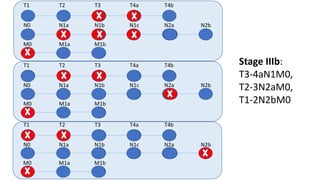
Stage IIIb
T3-4aN1M0, T2N2aM0, T1-2N2bM0
T1 T2 T3 T4a T4b
N0 N1a N1b N1c N2a N2b
M0 M1a M1b
T1 T2 T3 T4a T4b
N0 N1a N1b N1c N2a N2b
M0 M1a M1b
T1 T2 T3 T4a T4b
N0 N1a N1b N1c N2a N2b
M0 M1a M1b
Stage IIIb:
T3-4aN1M0,
T2-3N2aM0,
T1-2N2bM0
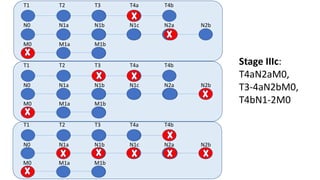
Stage IIIc
T4aN2aM0, T3-4aN2bM0, T4bN1-2M0
T1 T2 T3 T4a T4b
N0 N1a N1b N1c N2a N2b
M0 M1a M1b
T1 T2 T3 T4a T4b
N0 N1a N1b N1c N2a N2b
M0 M1a M1b
T1 T2 T3 T4a T4b
N0 N1a N1b N1c N2a N2b
M0 M1a M1b
Stage IIIc:
T4aN2aM0,
T3-4aN2bM0,
T4bN1-2M0
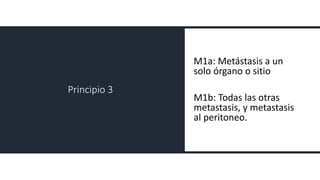
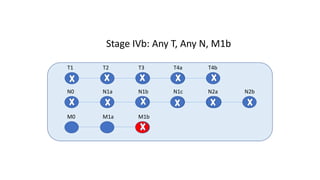
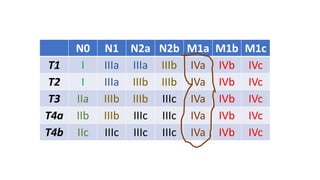
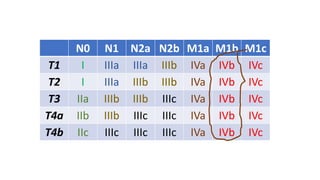
Principio 3
M1a: Metástasis a un
solo órgano o sitio
M1b: Todas las otras
metastasis, y metastasis
al peritoneo.
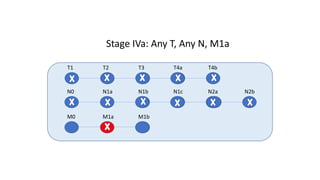
Stage IVa
Any T, Any N, M1a
T1 T2 T3 T4a T4b
N0 N1a N1b N1c N2a N2b
M0 M1a M1b
Stage IVa: Any T, Any N, M1a
Stage IVb
Any T, Any N, M1b
T1 T2 T3 T4a T4b
N0 N1a N1b N1c N2a N2b
M0 M1a M1b
Stage IVb: Any T, Any N, M1b
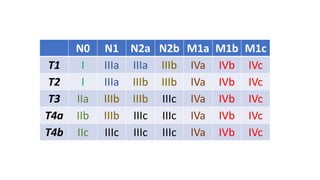
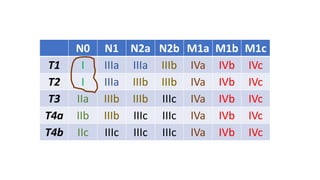
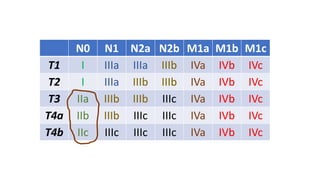
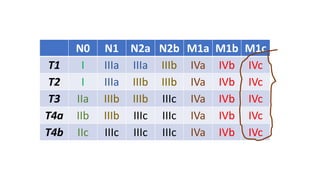
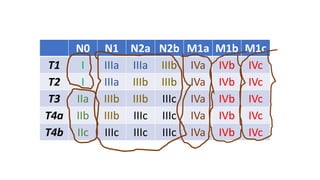
N0 N1 N2a N2b M1a M1b M1c
T1 I IIIa IIIa IIIb IVa IVb IVc
T2 I IIIa IIIb IIIb IVa IVb IVc
T3 IIa IIIb IIIb IIIc IVa IVb IVc
T4a IIb IIIb IIIc IIIc IVa IVb IVc
T4b IIc IIIc IIIc IIIc IVa IVb IVc
N0 N1 N2a N2b M1a M1b M1c
T1 I IIIa IIIa IIIb IVa IVb IVc
T2 I IIIa IIIb IIIb IVa IVb IVc
T3 IIa IIIb IIIb IIIc IVa IVb IVc
T4a IIb IIIb IIIc IIIc IVa IVb IVc
T4b IIc IIIc IIIc IIIc IVa IVb IVc
N0 N1 N2a N2b M1a M1b M1c
T1 I IIIa IIIa IIIb IVa IVb IVc
T2 I IIIa IIIb IIIb IVa IVb IVc
T3 IIa IIIb IIIb IIIc IVa IVb IVc
T4a IIb IIIb IIIc IIIc IVa IVb IVc
T4b IIc IIIc IIIc IIIc IVa IVb IVc
N0 N1 N2a N2b M1a M1b M1c
T1 I IIIa IIIa IIIb IVa IVb IVc
T2 I IIIa IIIb IIIb IVa IVb IVc
T3 IIa IIIb IIIb IIIc IVa IVb IVc
T4a IIb IIIb IIIc IIIc IVa IVb IVc
T4b IIc IIIc IIIc IIIc IVa IVb IVc
N0 N1 N2a N2b M1a M1b M1c
T1 I IIIa IIIa IIIb IVa IVb IVc
T2 I IIIa IIIb IIIb IVa IVb IVc
T3 IIa IIIb IIIb IIIc IVa IVb IVc
T4a IIb IIIb IIIc IIIc IVa IVb IVc
T4b IIc IIIc IIIc IIIc IVa IVb IVc
N0 N1 N2a N2b M1a M1b M1c
T1 I IIIa IIIa IIIb IVa IVb IVc
T2 I IIIa IIIb IIIb IVa IVb IVc
T3 IIa IIIb IIIb IIIc IVa IVb IVc
T4a IIb IIIb IIIc IIIc IVa IVb IVc
T4b IIc IIIc IIIc IIIc IVa IVb IVc
N0 N1 N2a N2b M1a M1b M1c
T1 I IIIa IIIa IIIb IVa IVb IVc
T2 I IIIa IIIb IIIb IVa IVb IVc
T3 IIa IIIb IIIb IIIc IVa IVb IVc
T4a IIb IIIb IIIc IIIc IVa IVb IVc
T4b IIc IIIc IIIc IIIc IVa IVb IVc
N0 N1 N2a N2b M1a M1b M1c
T1 I IIIa IIIa IIIb IVa IVb IVc
T2 I IIIa IIIb IIIb IVa IVb IVc
T3 IIa IIIb IIIb IIIc IVa IVb IVc
T4a IIb IIIb IIIc IIIc IVa IVb IVc
T4b IIc IIIc IIIc IIIc IVa IVb IVc
N0 N1 N2a N2b M1a M1b M1c
T1 I IIIa IIIa IIIb IVa IVb IVc
T2 I IIIa IIIb IIIb IVa IVb IVc
T3 IIa IIIb IIIb IIIc IVa IVb IVc
T4a IIb IIIb IIIc IIIc IVa IVb IVc
T4b IIc IIIc IIIc IIIc IVa IVb IVc
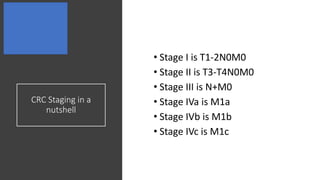
CRC Staging in a
nutshell
• Stage I is T1-2N0M0
• Stage II is T3-T4N0M0
• Stage III is N+M0
• Stage IVa is M1a
• Stage IVb is M1b
• Stage IVc is M1c
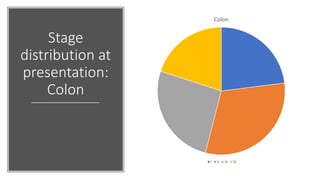
Stage
distribution at
presentation:
Colon
Colon
I II III IV
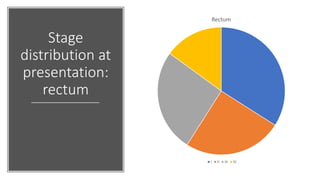
Stage
distribution at
presentation:
rectum
Rectum
I II III IV
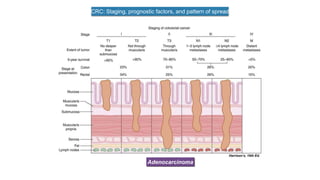
CRC: Staging, prognostic factors, and pattern of spread
Harrison’s, 19th Ed.
Adenocarcinoma
CRC: Staging, prognostic factors, and pattern of spread
Harrison’s, 19th Ed.
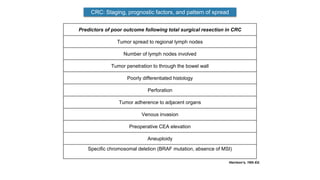
Predictors of poor outcome following total surgical resection in CRC
Tumor spread to regional lymph nodes
Number of lymph nodes involved
Tumor penetration to through the bowel wall
Poorly differentiated histology
Perforation
Tumor adherence to adjacent organs
Venous invasion
Preoperative CEA elevation
Aneuploidy
Specific chromosomal deletion (BRAF mutation, absence of MSI)
CRC: Staging, prognostic factors, and pattern of spread
Harrison’s, 19th Ed.
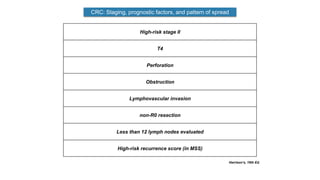
High-risk stage II
T4
Perforation
Obstruction
Lymphovascular invasion
non-R0 resection
Less than 12 lymph nodes evaluated
High-risk recurrence score (in MSS)
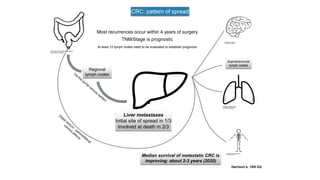
CRC: pattern of spread
Harrison’s, 19th Ed.
Most recurrences occur within 4 years of surgery
At least 12 lymph nodes need to be evaluated to establish prognosis
TNM/Stage is prognostic
Regional
lymph nodes
Supraclavicular
lymph nodes
Liver metastases
Initial site of spread in 1/3
Involved at death in 2/3
Median survival of metastatic CRC is
improving: about 2-3 years (2020)
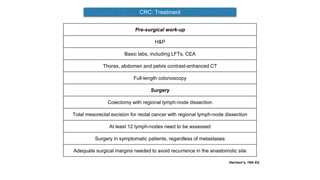
CRC: Treatment
Harrison’s, 19th Ed.
Pre-surgical work-up
H&P
Basic labs, including LFTs, CEA
Thorax, abdomen and pelvis contrast-enhanced CT
Full-length colonoscopy
Surgery
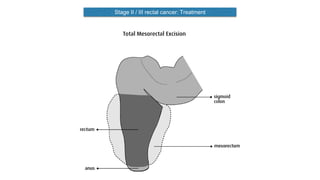
Colectomy with regional lymph-node dissection
Total mesorectal excision for rectal cancer with regional lymph-node dissection
At least 12 lymph-nodes need to be assessed
Surgery in symptomatic patients, regardless of metastases
Adequate surgical margins needed to avoid recurrence in the anastomotic site
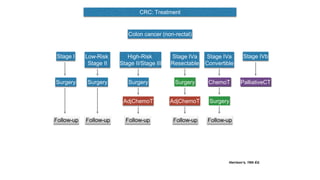
CRC: Treatment
Harrison’s, 19th Ed.
Colon cancer (non-rectal)
Surgery
Stage I
Follow-up
Low-Risk
Stage II
Follow-up
High-Risk
Stage II/Stage III
Stage IVa
Resectable
Stage IVa
Convertible
Stage IVb
Surgery
ChemoT PalliativeCT
Follow-up Follow-up Follow-up
AdjChemoT
Surgery
AdjChemoT
Surgery Surgery
CRC: Treatment
Harrison’s, 19th Ed.
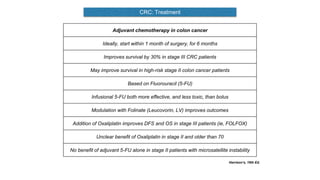
Adjuvant chemotherapy in colon cancer
Ideally, start within 1 month of surgery, for 6 months
Improves survival by 30% in stage III CRC patients
May improve survival in high-risk stage II colon cancer patients
Based on Fluorouracil (5-FU)
Infusional 5-FU both more effective, and less toxic, than bolus
Modulation with Folinate (Leucovorin, LV) improves outcomes
Addition of Oxaliplatin improves DFS and OS in stage III patients (ie, FOLFOX)
Unclear benefit of Oxaliplatin in stage II and older than 70
No benefit of adjuvant 5-FU alone in stage II patients with microsatellite instability
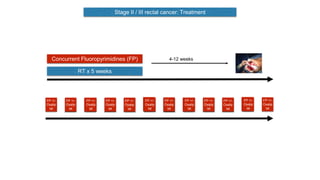
Stage II / III rectal cancer: Treatment
RT x 5 weeks
Concurrent Fluoropyrimidines (FP) 4-12 weeks
FP +/-
Oxalip
lat
FP +/-
Oxalip
lat
FP +/-
Oxalip
lat
FP +/-
Oxalip
lat
FP +/-
Oxalip
lat
FP +/-
Oxalip
lat
FP +/-
Oxalip
lat
FP +/-
Oxalip
lat
FP +/-
Oxalip
lat
FP +/-
Oxalip
lat
FP +/-
Oxalip
lat
FP +/-
Oxalip
lat
FP +/-
Oxalip
lat
FP +/-
Oxalip
lat
FP +/-
Oxalip
lat
FP +/-
Oxalip
lat
FP +/-
Oxalip
lat
FP +/-
Oxalip
lat
FP +/-
Oxalip
lat
FP +/-
Oxalip
lat
FP +/-
Oxalip
lat
FP +/-
Oxalip
lat
FP +/-
Oxalip
lat
FP +/-
Oxalip
lat
Stage II / III rectal cancer: Treatment
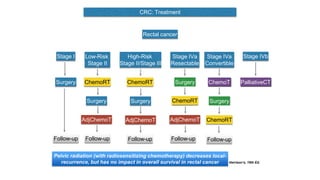
CRC: Treatment
Harrison’s, 19th Ed.
Rectal cancer
Surgery
Stage I
Follow-up
Low-Risk
Stage II
Follow-up
High-Risk
Stage II/Stage III
Stage IVa
Resectable
Stage IVa
Convertible
Stage IVb
Surgery
ChemoT PalliativeCT
Follow-up Follow-up Follow-up
AdjChemoT
Surgery
AdjChemoT
Surgery Surgery
ChemoRT ChemoRT
ChemoRT
ChemoRT
Pelvic radiation (with radiosensitizing chemotherapy) decreases local-
recurrence, but has no impact in overall survival in rectal cancer
AdjChemoT
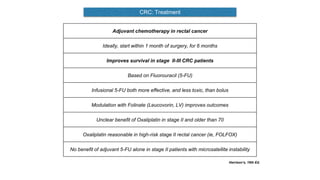
CRC: Treatment
Harrison’s, 19th Ed.
Adjuvant chemotherapy in rectal cancer
Ideally, start within 1 month of surgery, for 6 months
Improves survival in stage II-III CRC patients
Based on Fluorouracil (5-FU)
Infusional 5-FU both more effective, and less toxic, than bolus
Modulation with Folinate (Leucovorin, LV) improves outcomes
Unclear benefit of Oxaliplatin in stage II and older than 70
Oxaliplatin reasonable in high-risk stage II rectal cancer (ie, FOLFOX)
No benefit of adjuvant 5-FU alone in stage II patients with microsatellite instability
CRC: Treatment
Harrison’s, 19th Ed.
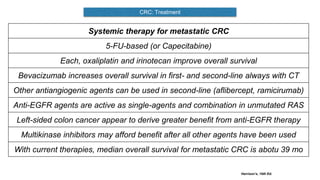
Systemic therapy for metastatic CRC
5-FU-based (or Capecitabine)
Each, oxaliplatin and irinotecan improve overall survival
Bevacizumab increases overall survival in first- and second-line always with CT
Other antiangiogenic agents can be used in second-line (aflibercept, ramicirumab)
Anti-EGFR agents are active as single-agents and combination in unmutated RAS
Left-sided colon cancer appear to derive greater benefit from anti-EGFR therapy
Multikinase inhibitors may afford benefit after all other agents have been used
With current therapies, median overall survival for metastatic CRC is abotu 39 mo
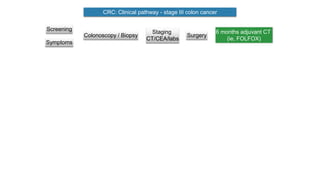
CRC: Clinical pathway - stage III colon cancer
Screening
Symptoms
Colonoscopy / Biopsy
Staging
CT/CEA/labs
Surgery
6 months adjuvant CT
(ie, FOLFOX)
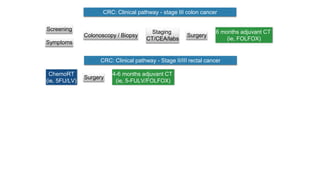
CRC: Clinical pathway - stage III colon cancer
Screening
Symptoms
Colonoscopy / Biopsy
Staging
CT/CEA/labs
Surgery
6 months adjuvant CT
(ie, FOLFOX)
CRC: Clinical pathway - Stage II/III rectal cancer
Surgery
4-6 months adjuvant CT
(ie, 5-FULV/FOLFOX)
ChemoRT
(ie, 5FU/LV)
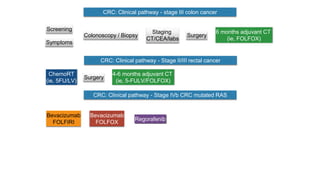
CRC: Clinical pathway - stage III colon cancer
Screening
Symptoms
Colonoscopy / Biopsy
Staging
CT/CEA/labs
Surgery
6 months adjuvant CT
(ie, FOLFOX)
CRC: Clinical pathway - Stage II/III rectal cancer
Surgery
4-6 months adjuvant CT
(ie, 5-FULV/FOLFOX)
ChemoRT
(ie, 5FU/LV)
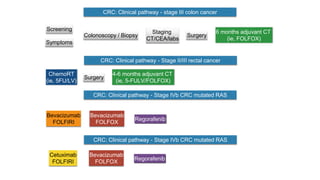
CRC: Clinical pathway - Stage IVb CRC mutated RAS
Bevacizumab
FOLFIRI
Bevacizumab
FOLFOX
Regorafenib
CRC: Clinical pathway - stage III colon cancer
Screening
Symptoms
Colonoscopy / Biopsy
Staging
CT/CEA/labs
Surgery
6 months adjuvant CT
(ie, FOLFOX)
CRC: Clinical pathway - Stage II/III rectal cancer
Surgery
4-6 months adjuvant CT
(ie, 5-FULV/FOLFOX)
ChemoRT
(ie, 5FU/LV)
CRC: Clinical pathway - Stage IVb CRC mutated RAS
Bevacizumab
FOLFIRI
Bevacizumab
FOLFOX
Regorafenib
CRC: Clinical pathway - Stage IVb CRC mutated RAS
Cetuximab
FOLFIRI
Bevacizumab
FOLFOX
Regorafenib
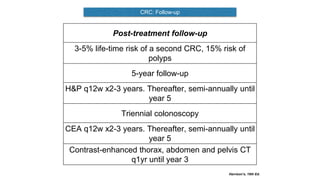
CRC: Follow-up
Harrison’s, 19th Ed.
Post-treatment follow-up
3-5% life-time risk of a second CRC, 15% risk of
polyps
5-year follow-up
H&P q12w x2-3 years. Thereafter, semi-annually until
year 5
Triennial colonoscopy
CEA q12w x2-3 years. Thereafter, semi-annually until
year 5
Contrast-enhanced thorax, abdomen and pelvis CT
q1yr until year 3
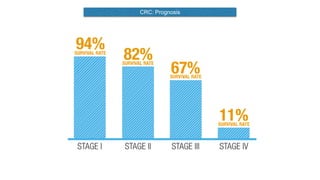
CRC: Prognosis

CES202001_CRC

  • 1.
    Cáncer de colony recto (colorectal cancer)
  • 2.
    Mauricio Lema MedinaMD Clínica de Oncología Astorga / Clínica SOMA Medellín Inspirado en: Michael Bierut, 2013, Logo para Mohawk Fine Papers
  • 5.
    Inspirado en: SaulBass, 1955,, The Man With the Golden Arm
  • 11.
    Objetivo Obtener un conocimientoGENERAL del enfoque y manejo USUAL de pacientes con cáncer de colon y recto, desde la sospecha diagnóstica, hasta las pautas de seguimiento post-tratamiento, pasando por los aspectos más relevantes de tratamientos con intención curativa.
  • 12.
  • 13.
    Cancer epidemiology (World- Colombia) Cancer New cases(World) Deaths (World) New cases (Colombia) Deaths (Colombia) Breast 2’088.849 (2) 626.679 (5) 13.380 (1) 3.702 (4) Prostate 1’276.106 (4) 358.989 (8) 12.712 (2) 3.166 (5) Lung 2’093.876 (1) 1’761.007 (1) 5.856 (5) 5.236 (2) Stomach 1’033.701 (5) 782.685 (3) 7.419 (4) 5.505 (1) Colon & rectum 1’849.518 (3) 880.792 (2) 9.140 (3) 4.489 (3) Lymphoma (NH) 509.990 (10) 248.724 (11) 4.170 (6) 1.676 (10) Uterine cérvix 569.847 (8) 311.365 (9) 3.853 (7) 1.775 (9) Leukemia 437.003 (12) 309.006 (10) 3.126 (8) 2.192 (7) Ovarian 295.414 (17) 184.799 (14) 2.414 (9) 1.252 (11) Pancreas 458.918 (11) 402.232 (7) 2.311 (10) 2.142 (8) Liver 841.080 (6) 781.636 (4) 2.279 (11) 2.216 (6) Multiple mieloma 159.885 (21) 106.105 1323 (14) 806 (14) Esophagus 572.034 (7) 508.585 (6) 922 (15) 710 (15) Hodgkin 79.999 (25) 26.167 743 (16) 216 Brain 296.851 (16) 241.037 (12) 1884 (12) 1.176 (12) Gallbladder 219.420 (19) 165.087 (17) 1657 (13) 1.104 (13) All 18’078.957 9’555.027 101.893 46.057 http://gco.iarc.fr/today/
  • 14.
    Cancer epidemiology (World- Colombia) Cancer New cases(World) Deaths (World) New cases (Colombia) Deaths (Colombia) Breast 2’088.849 (2) 626.679 (5) 13.380 (1) 3.702 (4) Prostate 1’276.106 (4) 358.989 (8) 12.712 (2) 3.166 (5) Lung 2’093.876 (1) 1’761.007 (1) 5.856 (5) 5.236 (2) Stomach 1’033.701 (5) 782.685 (3) 7.419 (4) 5.505 (1) Colon & rectum 1’849.518 (3) 880.792 (2) 9.140 (3) 4.489 (3) Lymphoma (NH) 509.990 (10) 248.724 (11) 4.170 (6) 1.676 (10) Uterine cérvix 569.847 (8) 311.365 (9) 3.853 (7) 1.775 (9) Leukemia 437.003 (12) 309.006 (10) 3.126 (8) 2.192 (7) Ovarian 295.414 (17) 184.799 (14) 2.414 (9) 1.252 (11) Pancreas 458.918 (11) 402.232 (7) 2.311 (10) 2.142 (8) Liver 841.080 (6) 781.636 (4) 2.279 (11) 2.216 (6) Multiple mieloma 159.885 (21) 106.105 1323 (14) 806 (14) Esophagus 572.034 (7) 508.585 (6) 922 (15) 710 (15) Hodgkin 79.999 (25) 26.167 743 (16) 216 Brain 296.851 (16) 241.037 (12) 1884 (12) 1.176 (12) Gallbladder 219.420 (19) 165.087 (17) 1657 (13) 1.104 (13) All 18’078.957 9’555.027 101.893 46.057 http://gco.iarc.fr/today/
  • 15.
    • Higher incidencein males • Colon higher than rectum • Europe, Australia and North America - higher • Africa and Asia – lower • South America • Colon: 12.4/100.000 inhabitant/yr • Rectum: 7.7/100.000 inhabitants/yr Colon & rectum cancer epidemiology CA: A Cancer Journal for Clinicians, Volume: 68, Issue: 6, Pages: 394-424, First published: 12 September 2018, DOI: (10.3322/caac.21492)
  • 16.
  • 17.
  • 18.
    Relative frequencies ofcancer diagnosis in the World (left) and Colombia (right)
  • 19.
    10 causas de morbilidadpor cancer en Cali • El Ca de colon y recto compite con el Ca gástrico por el tercer lugar en incidencia, después de Ca de mama y Ca de próstata http://rpcc.univalle.edu.co/es/SitiosEspecificos/pdf- sitiosespecificos/Sitios_Especificos.php?sitio=4
  • 20.
    La incidencia de cancerde colon y recto está en aumento, en Colombia http://rpcc.univalle.edu.co/es/SitiosEspecificos/pdf- sitiosespecificos/Sitios_Especificos.php?sitio=4
  • 21.
    El Ca decolon y recto es la 4ta causa de muerte por cancer en hombres y la tercera en mujeres, en Colombia
  • 22.
    Supervivencia a a 5años de ca de colon y recto • En Colombia: 35.4%, 35.8%, para cancer de colon y recto, respectivamente • En Estados Unidos: 64.9%, 64.1% para cancer de colon y recto, respectivamente • Existe una diferencia en términos absolutos de aproximadamente 29% entre Colombia y Estados Unidos. • El riesgo de fallecer a los 5 años es casi el doble en pacientes con cá de colon o recto en Colombia al compararlo con los Estados Unidos. http://rpcc.univalle.edu.co/es/SitiosEspecificos/pdf- sitiosespecificos/Sitios_Especificos.php?sitio=4
  • 23.
  • 24.
    Risk factors forthe development of colorectal cancer Diet: animal fat Hereditary syndromes Inflammatory bowel diseaseStreptococcus bovis bacteremia Upper socioeconomic populations Correlates with per capita consumption of calories, meat protein, dietary fat and oil, high cholesterol, high coronary artery disease Dietary fats change in the microbiome (anaerobes), converting bile-acids into carcinogens High-calorie intake / inactivity cause obesity: insulin resistance, increase in IGF-1, more polyps (and cancer) Fibers and vegetable intake have no been proven to prevent CRC development Up to 25% have a family history Polyposis coli MYH-associated polyposis Nonpolyposis syndromes (Lynch) More with ulcerative colitis Rare during first 10 years Thereafter: 1%/yr incidence Prophylactic colectomy for long active IBD For unknown reason Consider upper and lower GI endoscopies
  • 25.
  • 29.
  • 30.
    Hereditary colon cancer genes LynchSyndrome Hereditary Polyposis Syndrome
  • 31.
    ESMO, Essentials forClinicians Gastrointestinal tract tumours, 2016
  • 32.
    Hereditary nonpolyposis colorectalcancer DNA mismatch repair deficiency Yes No Lynch syndrome CRC type X syndrome MUTYH associated CRC ESMO, Essentials for Clinicians Gastrointestinal tract tumours, 2016
  • 33.
    ESMO, Essentials forClinicians Gastrointestinal tract tumours, 2016
  • 34.
    ESMO, Essentials forClinicians Gastrointestinal tract tumours, 2016
  • 35.
    MMR germline mutations Colonoscopy every1-2 years Colon TV US and biopsy / consider prophylactic surgery Endometrial / ovary Brain UGI endoscopy every 1-2years H. pylori erradication Stomach Skin Small bowel Pancreas Urinary tract Biliary tract Surveillance usually not recommended
  • 36.
    Cuántos cánceres decolon (CCR) /endometrio ha tenido (EC)? ≥21 Evidencia de dMMR / Histología sugestiva de MSI-H en CCR Sí Edad del primer cáncer de CCR/EC No <50≥50 Cuántos familiares de primer o segundo grado han tenido CCR/EC ≥210 Edad del familar más joven con CCR/EC <50≥50 0 Ver siguiente algoritmo Criterios para investigación de sindrome de Lynch -- NCCN 2019 Investigar sindrome de Lynch No investigar sindrome de Lynch
  • 37.
    Cuántos familiares conde colon (CCR) /endometrio ha tenido (EC)? ≥31-2 Edad del familiar más joven con CCR/EC <50 Algún familiar con más de un CCR/EC ≥50 SíNo 0 Criterios para investigación de sindrome de Lynch -- NCCN 2019 Investigar sindrome de Lynch No investigar sindrome de Lynch No historia personal de cáncer de colon (CCR) o cáncer de endometrio (EC)
  • 38.
    Hereditary polyposis colorectalcancer Adenomatous polyps >100 20-100 Classic FAP Attenuated FAP ESMO, Essentiasls for Clinicians Gastrointestinal tract tumours, 2016FAP: Familial adenomatous polyposis 1/2
  • 39.
  • 40.
    APC-FAP Colonoscopy every 1-2years until colectomy Colon Cervical ultrsonography annually Thyroid TC/RM or magnetic imaging if family history Desmoid tumors UGI endoscopy based on Spigelman stage Gastroduodenal polyps Endoscopy every 6-12 months Pouch/rectum Congenital hypertrophy of the retinal pigmented epithelium Medulloblastoma Hepatoblastoma
  • 41.
    MUTYH Associated polyposis Colonoscopy every year Colon UGIendoscopy based on Spiegelman criteria Gastrodoudenal polyps Endoscopy every 6-12 months Pouch/rectum
  • 42.
    Hereditary polyposis colorectalcancer Hamartomatous polyps Peutz-Jeghers Juvenile polyposis Cowden syndrome ESMO, Essentiasls for Clinicians Gastrointestinal tract tumours, 2016FAP: Familial adenomatous polyposis 2/2 Serrated polyps Serrated polyposis
  • 43.
    Adenomatous polyposis (≥10) Patternsof inheritance Dominant or de novo with classic phenotype Mutation APC germline analysis APC-related FAP ESMO, Essentiasls for Clinicians Gastrointestinal tract tumours, 2016FAP: Familial adenomatous polyposis No mutation MUTYH germline analysis Recessive or de novo with attenuated phenotype Mutation MUTYH germline analysis MAP No mutation APC germline analysis
  • 44.
    Second cause ofcancer death in the US, third in Colombia The incidence has decreased recently (in the US) due to screening. In Colombia it is increasing Mortality has decreased by about 25% in the US. Wide survival gap US-Colombia POLYPS Grossly visible protrusion fro the mucosal surface Nonneoplastic hamartoma Hyperplastic mucosal proliferation (hyperplastic polyp) Adenomatous polyps Clearly preneoplastic Only a minority of polyps progress to cancer High prevalence: 30% and 50% in middle-aged and elderly adults Only 1% become malignant Multistep molecular evolution through cancer Colon cancer is thought to arise from sequential DNA derrangements in a polyp These may include: Point mutations in the K-ras (KRAS) oncogene Hypermethylation of DNA Allelic loss of a TSG like 5q (APC), 18q (DCC), 17p (p53) Oncogene activation Loss of tumor suppression activity
  • 46.
    Multi-stage carcinogenesis incolon cancer Inspired on: Vogelstein B, 1990
  • 47.
    MAPK pathway (activating)mutations occur in about 60% CRC KRAS: 40-50% NRAS: 10% BRAF: 8%
  • 48.
    POLYPS Pedunculated Flat-based: sessile Higherrisk of cancer development Tubular Villous Tubulovillous Higher risk of cancer development (3x) Small (1.5 cm, or less) Intermediate (1.5-2.5 cm) Substantial (2.5 cm, or more) (2-10% cancer risk) (10% cancer risk or more) The entire bowel should be visualized (1-3 risk of synchronous polyps). Follow-up with colonoscopies: 30-50% risk of another adenoma Adenomas become cancer in about 5 years Colonoscopy need not be more frequent than every 3 years Once a poly is found
  • 49.
    Hereditary syndromes Polyposis coli Thousandsof adenomatous polyps through the large bowel Autosomal dominant Deletion of 5q Loss of the APC gene (a TSG) Gardner’s syndrome Soft-tissue and bony tumors Congenital hypertrophy of the retinal epithelium Mesenteric desmoid tumors Ampullary carcinomas Polyposis coli Turcot’s syndrome Malignant tumors of the Central Nervous system Polyposis coli Polyps are rare before puberty But are detectable in most by age 25 Cancer will develop in (almost) all by 40 Once multiple polyps develop, total colectomy must be performed Offspring of affected patients have 50% risk of disease Flexible sigmoidoscopy until 35 should be performed Germ-line APC mutation detection should be considered
  • 50.
    Hereditary syndromes Hereditary nonpolyposiscolon cancer (HNPCC) - Lynch’s syndrome Three or more relatives with documented colorectal cancer; one who is a first-degree relative of the other two; CRC before 50 in at least one; Spanning at least 2 generations. Autosomal dominant Median-age at CRC diagnosis: less than 50 Screening colonoscopy starting on age 25 (q1 to 2 years), with pelvic US/endometrial biopsy for women Poorly-differentiated Mucinous histologies Right-sided preference BETER PROGNOSIS Association with other malignancies (in the family) Ovarian or endometrial carcinomas in women Gastric, small-bowel, pancreaticobiliary, genitourinary cancers sebaceus skin tumors Lynch’s syndrome is associated with mutations of several genes hMSH2 (chromosome 2) hMLH1 (chromosome 3), and others Unable to repair DNA mismatches (MMR) High frequency of microsatellite instability
  • 51.
  • 52.
    FOBT q1yr CRC screeningoptions FOBT q1yr Colonoscopy If positive DNAmt q3yr Colonoscopy If positive Sigm. q5yr Colonoscopy If positive +/- BE/VC q5yr Colonoscopy If positive Colonoscopy q10yr FOBT: Fecal Occult Blood Test (immunochemical) DNAmt: fecal DNA “multitarget” Sigm: Sigmoidoscopy BE: Contrast-enhanced (barium) enema VC: Virtual colonography
  • 53.
    FOBT q1yr CRC screeningoptions FOBT q1yr Colonoscopy If positive DNAmt q3yr Colonoscopy If positive Sigm. q5yr Colonoscopy If positive +/- BE/VC q5yr Colonoscopy If positive Colonoscopy q10yr FOBT: Fecal Occult Blood Test (immunochemical) DNAmt: fecal DNA “multitarget” Sigm: Sigmoidoscopy BE: Contrast-enhanced (barium) enema VC: Virtual colonography
  • 54.
    Cribado: Cáncer de colon yrecto (ACS) Se recomienda iniciar pruebas de cribado a los 50 años de edad. Las opciones son varias. • Pruebas de sangre oculta en heces con tests basados en guaiaco o inmunoquímica disponibles. • Se puede realizar el cribado anual con cualquiera de las dos técnicas siempre y cuando la seleccionada tenga una sensibilidad mayor del 50% para el cáncer. • Se debe obtener la muestra de un movimiento intestinal usual. • En caso de que sea positivo para sangre oculta en heces se debe completar el test con una colonoscopia. • Otra opción es la detección de ADN “multitarget” en heces cada 3 años. • También se acepta practicar sigmoidoscopia flexible cada 5 años • Sóla o en combinación con alguno de los tests para la detección de sangre oculta en heces cada año. • Otra opción es la práctica de enema baritado con doble contraste cada 5 años. • Colonoscopia cada 10 años. • Colonografía computada (colonoscopia virtual) cada 5 años, complementada con colonoscopia si se detectan anormalidades. Smith, R. A., Andrews, K., Brooks, D., DeSantis, C. E., Fedewa, S. A., Lortet-Tieulent, J., … Wender, R. C. (2016). Cancer screening in the United States, 2016: A review of current American Cancer Society guidelines and current issues in cancer screening. CA: A Cancer Journal for Clinicians, 66(2), 95–114. https://doi.org/10.3322/caac.21336
  • 55.
    Cribado: Cáncer de colon yrecto • Ministerio de Salud de Colombia • En la guía de práctica clínica del ministerio de saludo colombiano se sugiere que la estrategia óptima de tamización para cáncer colorrectal en la población colombiana a riesgo promedio sea sangre oculta en materia fecal inmunoquímica cada dos años o colonoscopia cada diez años, cuando ésta se encuentre disponible. http://gpc.minsalud.gov.co/
  • 56.
    • Colorectal cancer screeningdecreases colorectal cancer mortality by about 20%
  • 57.
    Colorectal cancer: presentingsymptoms Right-sided colon tumors May be very large without symptoms Iron-deficiency anemia is characteristic Left-sided tumors Abdominal cramping Intestinal obstruction Intestinal perforation Rectosigmoid tumors Hematochezia tenesmus narrowing of the caliber of stool (similar to hemorrhoids) Anemia is rare
  • 58.
  • 59.
  • 60.
    TNM T – Primarytumor N – Node M – Metastasis
  • 61.
    T of theTNM T Depth T1 Invades submucosa T2 Invades muscularis propria T3 Invades through the muscularis propria into the pericolorectal tissues T4a Invades the visceral peritoneum T4b Invades directly into adjacent organs AJCC TNM, 8th Ed, 2017
  • 62.
    N of the TNM NPATHOLOGY (OR IMAGING) N0 0 N1 1-3 N1a 1 LNs N1b 2-3 LNs N1c Tumor deposits (up to 1-3 LNs) N2 More than 3 LNs N2a 4-6 LNs N2b 7, or more LNs AJCC TNM, 8th Ed, 2017
  • 63.
    Depósitos tumorales Agregados tumorales discretos, conformando nódulos,sin contenido linfoide ubicados alrededor del tumor primario AJCC TNM, 8th Ed, 2017
  • 64.
    M of theTNM N PATHOLOGY M0 No metastasis M1 Metastasis M1a Metastasis confined to one organ or site M1b Metastasis in more than one organ or site, or metastasis to the peritoneum. AJCC TNM, 8th Ed, 2017
  • 65.
  • 66.
  • 67.
    T1 T2 T3T4a T4b N0 N1a N1b N1c N2a N2b M0 M1a M1b Stage I: T1-2N0M0
  • 68.
  • 69.
    T1 T2 T3T4a T4b N0 N1a N1b N1c N2a N2b M0 M1a M1b Stage IIa: T3N0M0
  • 70.
  • 71.
    T1 T2 T3T4a T4b N0 N1a N1b N1c N2a N2b M0 M1a M1b Stage IIb: T4aN0M0
  • 72.
  • 73.
    T1 T2 T3T4a T4b N0 N1a N1b N1c N2a N2b M0 M1a M1b Stage IIc: T4cN0M0
  • 74.
    Principio 2 Los N+M0son estadío III
  • 75.
  • 76.
    T1 T2 T3T4a T4b N0 N1a N1b N1c N2a N2b M0 M1a M1b T1 T2 T3 T4a T4b N0 N1a N1b N1c N2a N2b M0 M1a M1b Stage IIIa: T1-2N1a-cM0, T1N2aM0
  • 77.
  • 78.
    T1 T2 T3T4a T4b N0 N1a N1b N1c N2a N2b M0 M1a M1b T1 T2 T3 T4a T4b N0 N1a N1b N1c N2a N2b M0 M1a M1b T1 T2 T3 T4a T4b N0 N1a N1b N1c N2a N2b M0 M1a M1b Stage IIIb: T3-4aN1M0, T2-3N2aM0, T1-2N2bM0
  • 79.
  • 80.
    T1 T2 T3T4a T4b N0 N1a N1b N1c N2a N2b M0 M1a M1b T1 T2 T3 T4a T4b N0 N1a N1b N1c N2a N2b M0 M1a M1b T1 T2 T3 T4a T4b N0 N1a N1b N1c N2a N2b M0 M1a M1b Stage IIIc: T4aN2aM0, T3-4aN2bM0, T4bN1-2M0
  • 81.
    Principio 3 M1a: Metástasisa un solo órgano o sitio M1b: Todas las otras metastasis, y metastasis al peritoneo.
  • 82.
    Stage IVa Any T,Any N, M1a
  • 83.
    T1 T2 T3T4a T4b N0 N1a N1b N1c N2a N2b M0 M1a M1b Stage IVa: Any T, Any N, M1a
  • 84.
    Stage IVb Any T,Any N, M1b
  • 85.
    T1 T2 T3T4a T4b N0 N1a N1b N1c N2a N2b M0 M1a M1b Stage IVb: Any T, Any N, M1b
  • 86.
    N0 N1 N2aN2b M1a M1b M1c T1 I IIIa IIIa IIIb IVa IVb IVc T2 I IIIa IIIb IIIb IVa IVb IVc T3 IIa IIIb IIIb IIIc IVa IVb IVc T4a IIb IIIb IIIc IIIc IVa IVb IVc T4b IIc IIIc IIIc IIIc IVa IVb IVc
  • 87.
    N0 N1 N2aN2b M1a M1b M1c T1 I IIIa IIIa IIIb IVa IVb IVc T2 I IIIa IIIb IIIb IVa IVb IVc T3 IIa IIIb IIIb IIIc IVa IVb IVc T4a IIb IIIb IIIc IIIc IVa IVb IVc T4b IIc IIIc IIIc IIIc IVa IVb IVc
  • 88.
    N0 N1 N2aN2b M1a M1b M1c T1 I IIIa IIIa IIIb IVa IVb IVc T2 I IIIa IIIb IIIb IVa IVb IVc T3 IIa IIIb IIIb IIIc IVa IVb IVc T4a IIb IIIb IIIc IIIc IVa IVb IVc T4b IIc IIIc IIIc IIIc IVa IVb IVc
  • 89.
    N0 N1 N2aN2b M1a M1b M1c T1 I IIIa IIIa IIIb IVa IVb IVc T2 I IIIa IIIb IIIb IVa IVb IVc T3 IIa IIIb IIIb IIIc IVa IVb IVc T4a IIb IIIb IIIc IIIc IVa IVb IVc T4b IIc IIIc IIIc IIIc IVa IVb IVc
  • 90.
    N0 N1 N2aN2b M1a M1b M1c T1 I IIIa IIIa IIIb IVa IVb IVc T2 I IIIa IIIb IIIb IVa IVb IVc T3 IIa IIIb IIIb IIIc IVa IVb IVc T4a IIb IIIb IIIc IIIc IVa IVb IVc T4b IIc IIIc IIIc IIIc IVa IVb IVc
  • 91.
    N0 N1 N2aN2b M1a M1b M1c T1 I IIIa IIIa IIIb IVa IVb IVc T2 I IIIa IIIb IIIb IVa IVb IVc T3 IIa IIIb IIIb IIIc IVa IVb IVc T4a IIb IIIb IIIc IIIc IVa IVb IVc T4b IIc IIIc IIIc IIIc IVa IVb IVc
  • 92.
    N0 N1 N2aN2b M1a M1b M1c T1 I IIIa IIIa IIIb IVa IVb IVc T2 I IIIa IIIb IIIb IVa IVb IVc T3 IIa IIIb IIIb IIIc IVa IVb IVc T4a IIb IIIb IIIc IIIc IVa IVb IVc T4b IIc IIIc IIIc IIIc IVa IVb IVc
  • 93.
    N0 N1 N2aN2b M1a M1b M1c T1 I IIIa IIIa IIIb IVa IVb IVc T2 I IIIa IIIb IIIb IVa IVb IVc T3 IIa IIIb IIIb IIIc IVa IVb IVc T4a IIb IIIb IIIc IIIc IVa IVb IVc T4b IIc IIIc IIIc IIIc IVa IVb IVc
  • 94.
    N0 N1 N2aN2b M1a M1b M1c T1 I IIIa IIIa IIIb IVa IVb IVc T2 I IIIa IIIb IIIb IVa IVb IVc T3 IIa IIIb IIIb IIIc IVa IVb IVc T4a IIb IIIb IIIc IIIc IVa IVb IVc T4b IIc IIIc IIIc IIIc IVa IVb IVc
  • 95.
    CRC Staging ina nutshell • Stage I is T1-2N0M0 • Stage II is T3-T4N0M0 • Stage III is N+M0 • Stage IVa is M1a • Stage IVb is M1b • Stage IVc is M1c
  • 96.
  • 97.
  • 98.
    CRC: Staging, prognosticfactors, and pattern of spread Harrison’s, 19th Ed. Adenocarcinoma
  • 99.
    CRC: Staging, prognosticfactors, and pattern of spread Harrison’s, 19th Ed. Predictors of poor outcome following total surgical resection in CRC Tumor spread to regional lymph nodes Number of lymph nodes involved Tumor penetration to through the bowel wall Poorly differentiated histology Perforation Tumor adherence to adjacent organs Venous invasion Preoperative CEA elevation Aneuploidy Specific chromosomal deletion (BRAF mutation, absence of MSI)
  • 100.
    CRC: Staging, prognosticfactors, and pattern of spread Harrison’s, 19th Ed. High-risk stage II T4 Perforation Obstruction Lymphovascular invasion non-R0 resection Less than 12 lymph nodes evaluated High-risk recurrence score (in MSS)
  • 101.
    CRC: pattern ofspread Harrison’s, 19th Ed. Most recurrences occur within 4 years of surgery At least 12 lymph nodes need to be evaluated to establish prognosis TNM/Stage is prognostic Regional lymph nodes Supraclavicular lymph nodes Liver metastases Initial site of spread in 1/3 Involved at death in 2/3 Median survival of metastatic CRC is improving: about 2-3 years (2020)
  • 102.
    CRC: Treatment Harrison’s, 19thEd. Pre-surgical work-up H&P Basic labs, including LFTs, CEA Thorax, abdomen and pelvis contrast-enhanced CT Full-length colonoscopy Surgery Colectomy with regional lymph-node dissection Total mesorectal excision for rectal cancer with regional lymph-node dissection At least 12 lymph-nodes need to be assessed Surgery in symptomatic patients, regardless of metastases Adequate surgical margins needed to avoid recurrence in the anastomotic site
  • 103.
    CRC: Treatment Harrison’s, 19thEd. Colon cancer (non-rectal) Surgery Stage I Follow-up Low-Risk Stage II Follow-up High-Risk Stage II/Stage III Stage IVa Resectable Stage IVa Convertible Stage IVb Surgery ChemoT PalliativeCT Follow-up Follow-up Follow-up AdjChemoT Surgery AdjChemoT Surgery Surgery
  • 104.
    CRC: Treatment Harrison’s, 19thEd. Adjuvant chemotherapy in colon cancer Ideally, start within 1 month of surgery, for 6 months Improves survival by 30% in stage III CRC patients May improve survival in high-risk stage II colon cancer patients Based on Fluorouracil (5-FU) Infusional 5-FU both more effective, and less toxic, than bolus Modulation with Folinate (Leucovorin, LV) improves outcomes Addition of Oxaliplatin improves DFS and OS in stage III patients (ie, FOLFOX) Unclear benefit of Oxaliplatin in stage II and older than 70 No benefit of adjuvant 5-FU alone in stage II patients with microsatellite instability
  • 105.
    Stage II /III rectal cancer: Treatment RT x 5 weeks Concurrent Fluoropyrimidines (FP) 4-12 weeks FP +/- Oxalip lat FP +/- Oxalip lat FP +/- Oxalip lat FP +/- Oxalip lat FP +/- Oxalip lat FP +/- Oxalip lat FP +/- Oxalip lat FP +/- Oxalip lat FP +/- Oxalip lat FP +/- Oxalip lat FP +/- Oxalip lat FP +/- Oxalip lat FP +/- Oxalip lat FP +/- Oxalip lat FP +/- Oxalip lat FP +/- Oxalip lat FP +/- Oxalip lat FP +/- Oxalip lat FP +/- Oxalip lat FP +/- Oxalip lat FP +/- Oxalip lat FP +/- Oxalip lat FP +/- Oxalip lat FP +/- Oxalip lat
  • 106.
    Stage II /III rectal cancer: Treatment
  • 107.
    CRC: Treatment Harrison’s, 19thEd. Rectal cancer Surgery Stage I Follow-up Low-Risk Stage II Follow-up High-Risk Stage II/Stage III Stage IVa Resectable Stage IVa Convertible Stage IVb Surgery ChemoT PalliativeCT Follow-up Follow-up Follow-up AdjChemoT Surgery AdjChemoT Surgery Surgery ChemoRT ChemoRT ChemoRT ChemoRT Pelvic radiation (with radiosensitizing chemotherapy) decreases local- recurrence, but has no impact in overall survival in rectal cancer AdjChemoT
  • 108.
    CRC: Treatment Harrison’s, 19thEd. Adjuvant chemotherapy in rectal cancer Ideally, start within 1 month of surgery, for 6 months Improves survival in stage II-III CRC patients Based on Fluorouracil (5-FU) Infusional 5-FU both more effective, and less toxic, than bolus Modulation with Folinate (Leucovorin, LV) improves outcomes Unclear benefit of Oxaliplatin in stage II and older than 70 Oxaliplatin reasonable in high-risk stage II rectal cancer (ie, FOLFOX) No benefit of adjuvant 5-FU alone in stage II patients with microsatellite instability
  • 109.
    CRC: Treatment Harrison’s, 19thEd. Systemic therapy for metastatic CRC 5-FU-based (or Capecitabine) Each, oxaliplatin and irinotecan improve overall survival Bevacizumab increases overall survival in first- and second-line always with CT Other antiangiogenic agents can be used in second-line (aflibercept, ramicirumab) Anti-EGFR agents are active as single-agents and combination in unmutated RAS Left-sided colon cancer appear to derive greater benefit from anti-EGFR therapy Multikinase inhibitors may afford benefit after all other agents have been used With current therapies, median overall survival for metastatic CRC is abotu 39 mo
  • 110.
    CRC: Clinical pathway- stage III colon cancer Screening Symptoms Colonoscopy / Biopsy Staging CT/CEA/labs Surgery 6 months adjuvant CT (ie, FOLFOX)
  • 111.
    CRC: Clinical pathway- stage III colon cancer Screening Symptoms Colonoscopy / Biopsy Staging CT/CEA/labs Surgery 6 months adjuvant CT (ie, FOLFOX) CRC: Clinical pathway - Stage II/III rectal cancer Surgery 4-6 months adjuvant CT (ie, 5-FULV/FOLFOX) ChemoRT (ie, 5FU/LV)
  • 112.
    CRC: Clinical pathway- stage III colon cancer Screening Symptoms Colonoscopy / Biopsy Staging CT/CEA/labs Surgery 6 months adjuvant CT (ie, FOLFOX) CRC: Clinical pathway - Stage II/III rectal cancer Surgery 4-6 months adjuvant CT (ie, 5-FULV/FOLFOX) ChemoRT (ie, 5FU/LV) CRC: Clinical pathway - Stage IVb CRC mutated RAS Bevacizumab FOLFIRI Bevacizumab FOLFOX Regorafenib
  • 113.
    CRC: Clinical pathway- stage III colon cancer Screening Symptoms Colonoscopy / Biopsy Staging CT/CEA/labs Surgery 6 months adjuvant CT (ie, FOLFOX) CRC: Clinical pathway - Stage II/III rectal cancer Surgery 4-6 months adjuvant CT (ie, 5-FULV/FOLFOX) ChemoRT (ie, 5FU/LV) CRC: Clinical pathway - Stage IVb CRC mutated RAS Bevacizumab FOLFIRI Bevacizumab FOLFOX Regorafenib CRC: Clinical pathway - Stage IVb CRC mutated RAS Cetuximab FOLFIRI Bevacizumab FOLFOX Regorafenib
  • 114.
    CRC: Follow-up Harrison’s, 19thEd. Post-treatment follow-up 3-5% life-time risk of a second CRC, 15% risk of polyps 5-year follow-up H&P q12w x2-3 years. Thereafter, semi-annually until year 5 Triennial colonoscopy CEA q12w x2-3 years. Thereafter, semi-annually until year 5 Contrast-enhanced thorax, abdomen and pelvis CT q1yr until year 3
  • 115.