





Curso de Oncología para estudiantes
de medicina – CES 2017.01
Mauricio Lema Medina MD
@onconerd
Page  3
Sobre el cáncer, en general…
Curable en casi 2/3 de los pacientes
Evento catastrófico para el paciente y su entorno
Cambio en la imagen propia, familiar y social
Todo el cuerpo está enfermo – es una traición…
Nada nunca será igual
1
2
3
4
5
Algunas notas
Creado por: Mauricio Lema Medina - LemaTeachFiles© - 2004
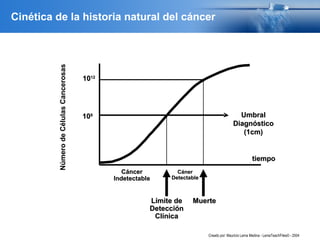
10101212
101099
tiempotiempo
UmbralUmbral
DiagnósticoDiagnóstico
(1cm)(1cm)
CáncerCáncer
IndetectableIndetectable
CánerCáner
DetectableDetectable
Límite deLímite de
DetecciónDetección
ClínicaClínica
MuerteMuerte
NúmerodeCélulasCancerosas
Creado por: Mauricio Lema Medina - LemaTeachFiles© - 2004
Cinética de la historia natural del cáncer
Adapted from Greenlee RT, et al. CA Cancer J Clin. 2000:50;22.
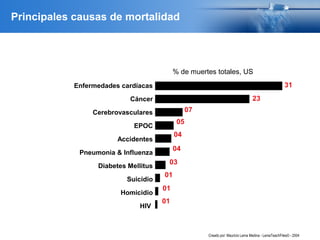
% de muertes totales, US
Enfermedades cardíacas
Cáncer
Cerebrovasculares
EPOC
Accidentes
Pneumonia & Influenza
Diabetes Mellitus
Suicidio
Homicidio
HIV
Creado por: Mauricio Lema Medina - LemaTeachFiles© - 2004
Principales causas de mortalidad
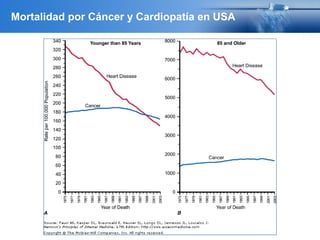
Mortalidad por Cáncer y Cardiopatía en USA
Page  8
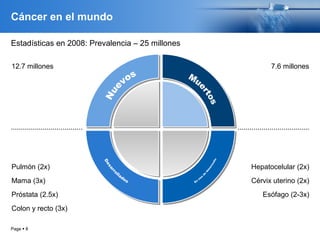
Cáncer en el mundo
7.6 millones
Hepatocelular (2x)
Cérvix uterino (2x)
Esófago (2-3x)
12.7 millones
Pulmón (2x)
Mama (3x)
Próstata (2.5x)
Colon y recto (3x)
Estadísticas en 2008: Prevalencia – 25 millones
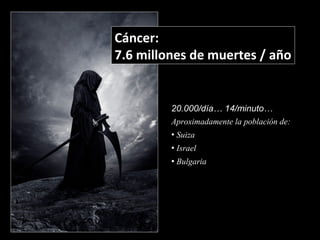
Cáncer:
7.6 millones de muertes / año
20.000/día… 14/minuto…
Aproximadamente la población de:
• Suiza
• Israel
• Bulgaria
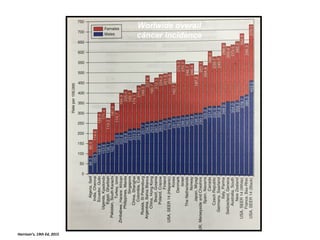
Worlwide overall
cáncer incidence
Harrison’s, 19th Ed, 2015
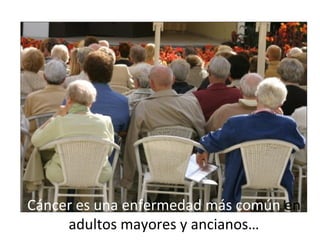
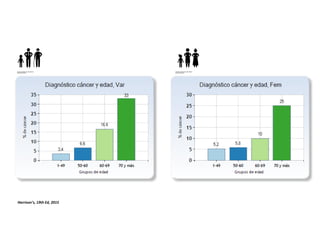
Cáncer es una enfermedad más común en
adultos mayores y ancianos…
Harrison’s, 19th Ed, 2015
Lifetime risk: 44% Lifetime risk: 38%
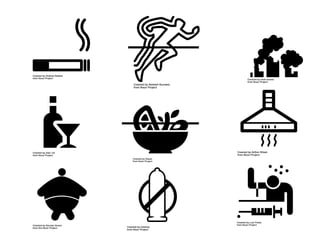
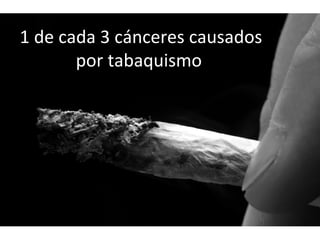
1 de cada 3 cánceres causados
por tabaquismo
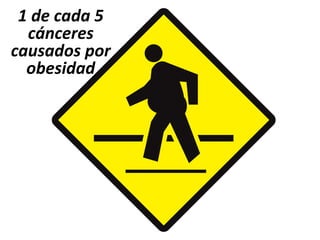
1 de cada 5
cánceres
causados por
obesidad
1 de cada 6
cánceres
causados por
infecciones
1 de cada 6
cánceres
causados por
infecciones
1 de cada 20
cánceres
causados por
alcohol
Page  19
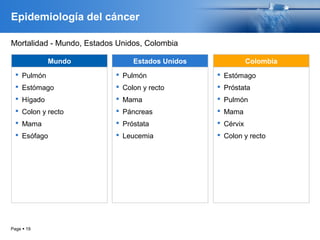
Epidemiología del cáncer
 Pulmón
 Estómago
 Hígado
 Colon y recto
 Mama
 Esófago
Mundo
 Pulmón
 Colon y recto
 Mama
 Páncreas
 Próstata
 Leucemia
Estados Unidos
 Estómago
 Próstata
 Pulmón
 Mama
 Cérvix
 Colon y recto
Colombia
Mortalidad - Mundo, Estados Unidos, Colombia
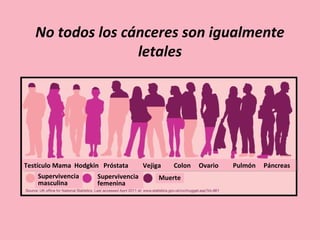
Testículo Mama Hodgkin Próstata Vejiga Colon Ovario Pulmón Páncreas
Supervivencia
masculina
Supervivencia
femenina
Muerte
No todos los cánceres son igualmente
letales
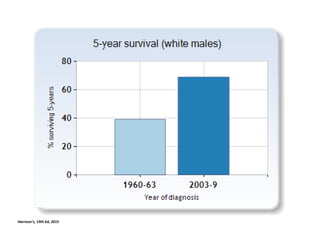
Harrison’s, 19th Ed, 2015
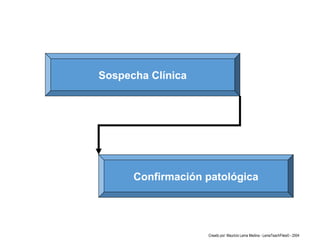
Sospecha Clínica
Confirmación patológica
Creado por: Mauricio Lema Medina - LemaTeachFiles© - 2004
SIN DIAGNÓSTICO
INCONTROVERTIBLE
(PATOLOGÍA)
NO ES POSIBLE FORMULAR
UN PLAN DE MANEJO
ONCOLÓGICO
ADECUADO
Creado por: Mauricio Lema Medina - LemaTeachFiles© - 2004
Page  24
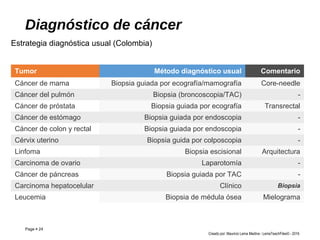
Diagnóstico de cáncer
Tumor Método diagnóstico usual Comentario
Cáncer de mama Biopsia guiada por ecografía/mamografía Core-needle
Cáncer del pulmón Biopsia (broncoscopia/TAC) -
Cáncer de próstata Biopsia guiada por ecografía Transrectal
Cáncer de estómago Biopsia guiada por endoscopia -
Cáncer de colon y rectal Biopsia guiada por endoscopia -
Cérvix uterino Biopsia guida por colposcopia -
Linfoma Biopsia escisional Arquitectura
Carcinoma de ovario Laparotomía -
Cáncer de páncreas Biopsia guiada por TAC -
Carcinoma hepatocelular Clínico Biopsia
Leucemia Biopsia de médula ósea Mielograma
Estrategia diagnóstica usual (Colombia)
Creado por: Mauricio Lema Medina - LemaTeachFiles© - 2016
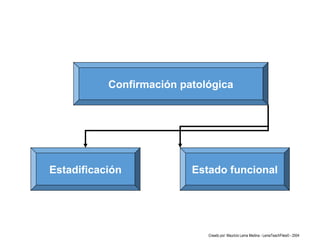
Confirmación patológica
Estadificación Estado funcional
Creado por: Mauricio Lema Medina - LemaTeachFiles© - 2004
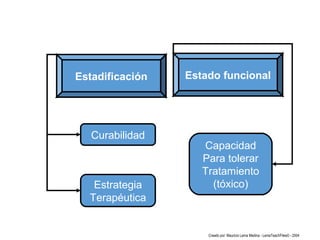
Estadificación Estado funcional
Curabilidad
Estrategia
Terapéutica
Capacidad
Para tolerar
Tratamiento
(tóxico)
Creado por: Mauricio Lema Medina - LemaTeachFiles© - 2004
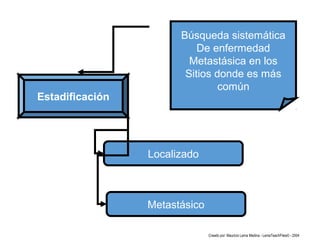
Estadificación
Localizado
Metastásico
Búsqueda sistemática
De enfermedad
Metastásica en los
Sitios donde es más
común
Creado por: Mauricio Lema Medina - LemaTeachFiles© - 2004
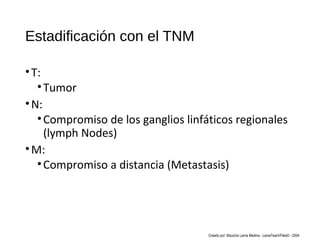
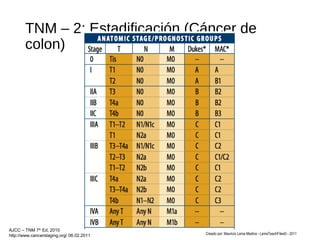
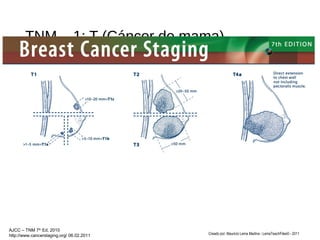
Estadificación con el TNM
•T:
•Tumor
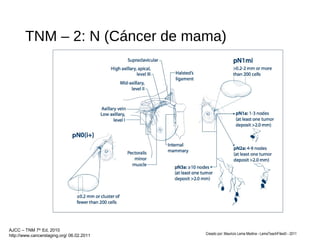
•N:
•Compromiso de los ganglios linfáticos regionales
(lymph Nodes)
•M:
•Compromiso a distancia (Metastasis)
Creado por: Mauricio Lema Medina - LemaTeachFiles© - 2004
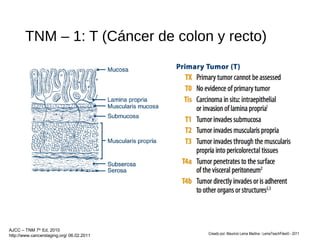
TNM – 1: T (Cáncer de colon y recto)
Creado por: Mauricio Lema Medina - LemaTeachFiles© - 2011
AJCC – TNM 7th
Ed, 2010
http://www.cancerstaging.org/ 06.02.2011
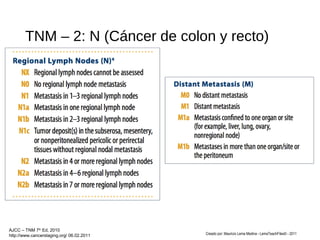
TNM – 2: N (Cáncer de colon y recto)
Creado por: Mauricio Lema Medina - LemaTeachFiles© - 2011
AJCC – TNM 7th
Ed, 2010
http://www.cancerstaging.org/ 06.02.2011
TNM – 2: Estadificación (Cáncer de
colon)
Creado por: Mauricio Lema Medina - LemaTeachFiles© - 2011
AJCC – TNM 7th
Ed, 2010
http://www.cancerstaging.org/ 06.02.2011
TNM – 1: T (Cáncer de mama)
Creado por: Mauricio Lema Medina - LemaTeachFiles© - 2011
AJCC – TNM 7th
Ed, 2010
http://www.cancerstaging.org/ 06.02.2011
TNM – 2: N (Cáncer de mama)
Creado por: Mauricio Lema Medina - LemaTeachFiles© - 2011
AJCC – TNM 7th
Ed, 2010
http://www.cancerstaging.org/ 06.02.2011
Page  34
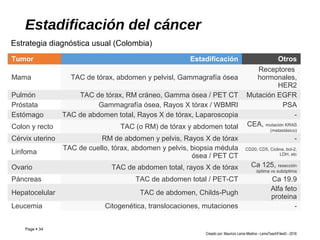
Estadificación del cáncer
Tumor Estadificación Otros
Mama TAC de tórax, abdomen y pelvisl, Gammagrafía ósea
Receptores
hormonales,
HER2
Pulmón TAC de tórax, RM cráneo, Gamma ósea / PET CT Mutación EGFR
Próstata Gammagrafía ósea, Rayos X tórax / WBMRI PSA
Estómago TAC de abdomen total, Rayos X de tórax, Laparoscopia -
Colon y recto TAC (o RM) de tórax y abdomen total CEA, mutación KRAS
(metastásico)
Cérvix uterino RM de abdomen y pelvis, Rayos X de tórax -
Linfoma
TAC de cuello, tórax, abdomen y pelvis, biopsia médula
ósea / PET CT
CD20, CD5, Ciclina, bcl-2,
LDH, etc
Ovario TAC de abdomen total, rayos X de tórax Ca 125, resección
óptima vs subóptima
Páncreas TAC de abdomen total / PET-CT Ca 19.9
Hepatocelular TAC de abdomen, Childs-Pugh
Alfa feto
proteina
Leucemia Citogenética, translocaciones, mutaciones -
Estrategia diagnóstica usual (Colombia)
Creado por: Mauricio Lema Medina - LemaTeachFiles© - 2016
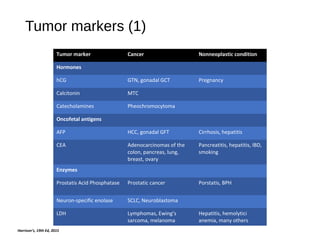
Tumor markers (1)
Tumor marker Cancer Nonneoplastic condition
Hormones
hCG GTN, gonadal GCT Pregnancy
Calcitonin MTC
Catecholamines Pheochromocytoma
Oncofetal antigens
AFP HCC, gonadal GFT Cirrhosis, hepatitis
CEA Adenocarcinomas of the
colon, pancreas, lung,
breast, ovary
Pancreatitis, hepatitis, IBD,
smoking
Enzymes
Prostatis Acid Phosphatase Prostatic cancer Porstatis, BPH
Neuron-specific enolase SCLC, Neuroblastoma
LDH Lymphomas, Ewing’s
sarcoma, melanoma
Hepatitis, hemolytici
anemia, many others
Harrison’s, 19th Ed, 2015
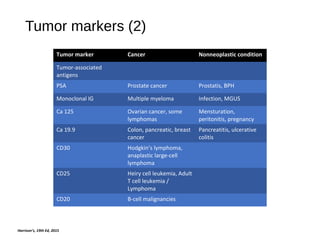
Tumor markers (2)
Tumor marker Cancer Nonneoplastic condition
Tumor-associated
antigens
PSA Prostate cancer Prostatis, BPH
Monoclonal IG Multiple myeloma Infection, MGUS
Ca 125 Ovarian cancer, some
lymphomas
Mensturation,
peritonitis, pregnancy
Ca 19.9 Colon, pancreatic, breast
cancer
Pancreatitis, ulcerative
colitis
CD30 Hodgkin’s lymphoma,
anaplastic large-cell
lymphoma
CD25 Heiry cell leukemia, Adult
T cell leukemia /
Lymphoma
CD20 B-cell malignancies
Harrison’s, 19th Ed, 2015
Page  37
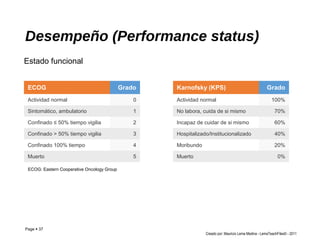
Desempeño (Performance status)
ECOG Grado
Actividad normal 0
Sintomático, ambulatorio 1
Confinado ≤ 50% tiempo vigilia 2
Confinado > 50% tiempo vigilia 3
Confinado 100% tiempo 4
Muerto 5
Estado funcional
ECOG: Eastern Cooperative Oncology Group
Karnofsky (KPS) Grado
Actividad normal 100%
No labora, cuida de si mismo 70%
Incapaz de cuidar de si mismo 60%
Hospitalizado/Institucionalizado 40%
Moribundo 20%
Muerto 0%
Creado por: Mauricio Lema Medina - LemaTeachFiles© - 2011
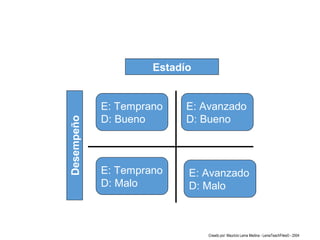
Estadío
Desempeño
E: Temprano
D: Bueno
E: Avanzado
D: Bueno
E: Temprano
D: Malo
E: Avanzado
D: Malo
Creado por: Mauricio Lema Medina - LemaTeachFiles© - 2004
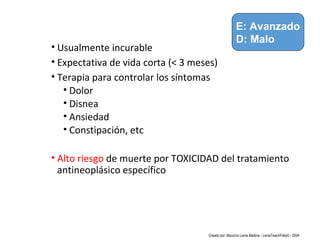
• Usualmente incurable
• Expectativa de vida corta (< 3 meses)
• Terapia para controlar los síntomas
• Dolor
• Disnea
• Ansiedad
• Constipación, etc
• Alto riesgo de muerte por TOXICIDAD del tratamiento
antineoplásico específico
E: Avanzado
D: Malo
Creado por: Mauricio Lema Medina - LemaTeachFiles© - 2004
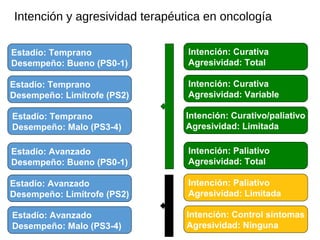
Intención y agresividad terapéutica en oncología
Estadío: Temprano
Desempeño: Bueno (PS0-1)
Estadío: Temprano
Desempeño: Limítrofe (PS2)
Estadío: Temprano
Desempeño: Malo (PS3-4)
Estadío: Avanzado
Desempeño: Bueno (PS0-1)
Estadío: Avanzado
Desempeño: Limítrofe (PS2)
Estadío: Avanzado
Desempeño: Malo (PS3-4)
Intención: Curativa
Agresividad: Total
Intención: Curativa
Agresividad: Variable
Intención: Curativo/paliativo
Agresividad: Limitada
Intención: Paliativo
Agresividad: Total
Intención: Paliativo
Agresividad: Limitada
Intención: Control síntomas
Agresividad: Ninguna
ONCOLOGÍAC.PALIATIVO
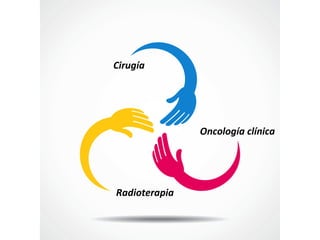
Cirugía
Radioterapia
Oncología clínica
Supportive care
“To cure
sometimes, to
extend life often,
and to confort
always”
Pain
Setting Prevalence
Diagnosis 25-30%
Treatment associated 20%
Progressive disease 75%
Mechanism
By the tumor 70%
Caused by treatment 20%
Unrelated to cancer 10%
Treatment options
Pharmacologic intervention Will help in 85%
Antitumor therapy
Neurostimulation
Regional analgesia
Neuroablative
Refractory to all measures About 3%
Harrison’s, 19th Ed, 2015
Depression
Dysphoria
Sleep disturbances
Appetite change
Fatigue
Lack of
concentrati
on
Worthlessn
ess
Guilt
Guilt
Psychomot
or
retardatio
n or
agitation
25%
3 or more
Anhedonia
Depression
25%
Fluoxetine
Sertraline
Paroxetine
Amitriptyline
Desipramine
Allow 4-6 weeks
Continue for 6 months
83% in 1982 – 13% in 2016
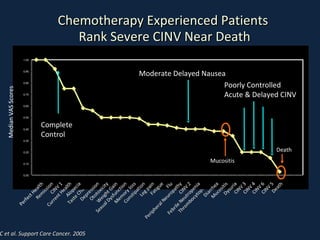
CINV
Taste
Change
Taste
Change
C et al. Support Care Cancer. 2005C et al. Support Care Cancer. 2005
Throm
bocytopenia
Throm
bocytopenia
MedianVASScores
Rem
ission
Rem
issionCINV
1
CINV
1
CurrentHealth
CurrentHealthAlopecia
Alopecia
Depression
Depression
Ototoxicity
Ototoxicity
W
eightGain
W
eightGain
SexualDysfunction
SexualDysfunction
M
em
oryloss
M
em
oryloss
Constipation
ConstipationLeg
pain
Leg
painFatigue
Fatigue
Flu
Flu
PeripheralNeuropathy
Diarrhea
Diarrhea
Dysuria
Dysuria
CINV
4
CINV
4CINV
6
CINV
6CINV
5
CINV
5Death
Death
PerfectHealth
CINV
2
CINV
2
M
ucositis
M
ucositis
CINV
3
CINV
3
Febrile
Neutropenia
Febrile
Neutropenia
CompleteComplete
ControlControl
Mucositis
Death
Moderate Delayed NauseaModerate Delayed Nausea
Poorly ControlledPoorly Controlled
Acute & Delayed CINVAcute & Delayed CINV
Chemotherapy Experienced PatientsChemotherapy Experienced Patients
Rank Severe CINV Near DeathRank Severe CINV Near Death
49
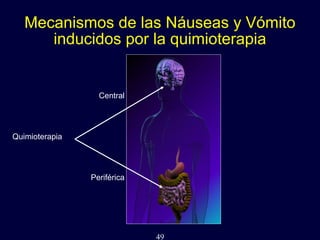
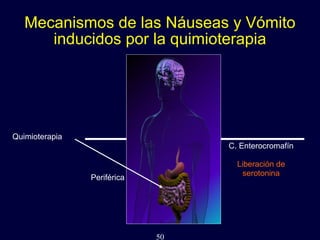
Mecanismos de las Náuseas y Vómito
inducidos por la quimioterapia
Quimioterapia
Central
Periférica
50
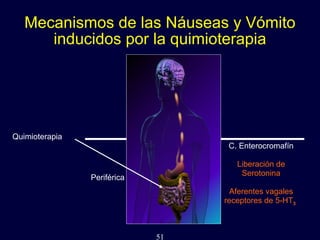
Mecanismos de las Náuseas y Vómito
inducidos por la quimioterapia
C. Enterocromafín
Liberación de
serotonina
Quimioterapia
Periférica
51
Mecanismos de las Náuseas y Vómito
inducidos por la quimioterapia
C. Enterocromafín
Liberación de
Serotonina
Aferentes vagales
receptores de 5-HT3
Quimioterapia
Periférica
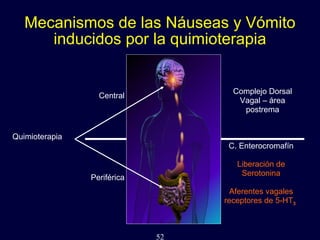
52
Quimioterapia
Mecanismos de las Náuseas y Vómito
inducidos por la quimioterapia
Complejo Dorsal
Vagal – área
postrema
Periférica
Central
C. Enterocromafín
Liberación de
Serotonina
Aferentes vagales
receptores de 5-HT3
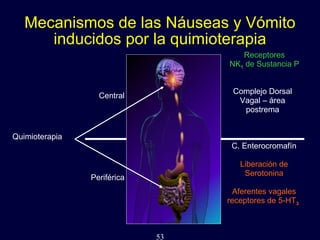
53
Quimioterapia
Mecanismos de las Náuseas y Vómito
inducidos por la quimioterapia
Receptores
NK1 de Sustancia P
Periférica
Central
Complejo Dorsal
Vagal – área
postrema
C. Enterocromafín
Liberación de
Serotonina
Aferentes vagales
receptores de 5-HT3
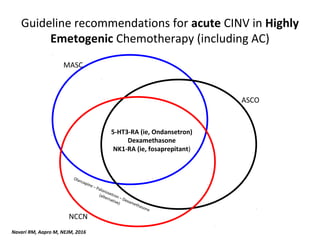
MASC
ASCO
NCCN
5-HT3-RA (ie, Ondansetron)
Dexamethasone
NK1-RA (ie, fosaprepitant)
Guideline recommendations for acute CINV in Highly
Emetogenic Chemotherapy (including AC)
Olanzapine – Palonosetron – Dexamethasone
(alternative)
Navari RM, Aapro M, NEJM, 2016
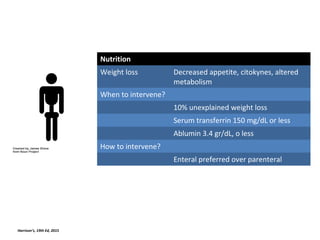
Nutrition
Weight loss Decreased appetite, citokynes, altered
metabolism
When to intervene?
10% unexplained weight loss
Serum transferrin 150 mg/dL or less
Ablumin 3.4 gr/dL, o less
How to intervene?
Enteral preferred over parenteral
Harrison’s, 19th Ed, 2015
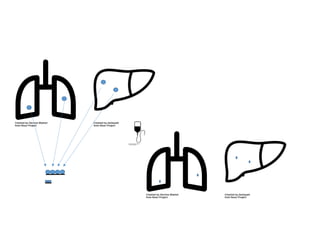
RECIST: Response Evaluation Criteria In Solid Tumors
Change in the sum of the longest diameters
↑20% (or new lesion): Progressive disease
↓30%: partial response (PR)
↓100%: unconfirmed complete response (uCR)
↓100% + Negative biopsy: complete response (CR)
Education and healthful habits
Tobacco Comments
Risk factor Cardiovascular disease, pulmonary
diseasse and cancer
Tobacco-related death 1/3 of smokers
Cancers Lung, laryng, oropharynx, esophagus,
kidney, bladder, pancreas, and stomach
Risk after quitting 30-50% lower 10-yr lung cancer
mortality
Second-hand smoke also harmful
Early adoption 80% smokers begin befor age 18
Cigars also increase cancer risk Oral and esophageal cancer
Smokeless tobacco also increases
cancer risk
Oral cancer
Benefits of e-cigarettes unclear
Harrison’s, 19th Ed, 2015
Physical inactivity Comments
Risk factor Colon and breast cancer
Some biases may obscure this relationship
Harrison’s, 19th Ed, 2015
Diet modification Comments
High fat diet increases risk of Breast, colon, prostate, endometrium
High dietary fiber decreases the risk Colonic polyps and colon cancer
High fruit and vegetable intake NOT
proven of benefit
RCT
Low-fat, High fiber diet faild to decrease
risk of colonic polyp
RCTx 2
No dietary intervention has proven
effective in preventing cancer
WHI
Harrison’s, 19th Ed, 2015
Energy balance Comments
Obesity increases risk of Colon, breast (postmenopausal),
endometrial, kidney, esophagus (GEJ)
Magnitud of the effect
Colon cancer RR 1.5-2 in males, 1.2-15 in females
Breast cancer Risk increases by 30-50%
Adipose tissue harbors aromatase that
can create estrogen from androgens
Harrison’s, 19th Ed, 2015
Page  62
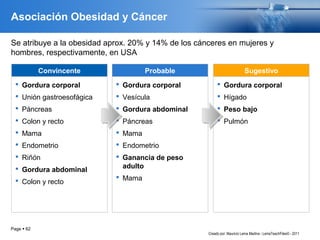
Asociación Obesidad y Cáncer
 Gordura corporal
 Unión gastroesofágica
 Páncreas
 Colon y recto
 Mama
 Endometrio
 Riñón
 Gordura abdominal
 Colon y recto
Convincente
 Gordura corporal
 Vesícula
 Gordura abdominal
 Páncreas
 Mama
 Endometrio
 Ganancia de peso
adulto
 Mama
Probable
 Gordura corporal
 Hígado
 Peso bajo
 Pulmón
Sugestivo
Se atribuye a la obesidad aprox. 20% y 14% de los cánceres en mujeres y
hombres, respectivamente, en USA
Creado por: Mauricio Lema Medina - LemaTeachFiles© - 2011
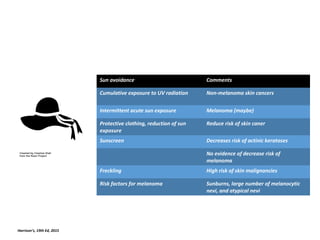
Sun avoidance Comments
Cumulative exposure to UV radiation Non-melanoma skin cancers
Intermittent acute sun exposure Melanoma (maybe)
Protective clothing, reduction of sun
exposure
Reduce risk of skin caner
Sunscreen Decreases risk of actinic keratoses
No evidence of decrease risk of
melanoma
Freckling High risk of skin malignancies
Risk factors for melanoma Sunburns, large number of melanocytic
nevi, and atypical nevi
Harrison’s, 19th Ed, 2015
Cancer chemoprevention
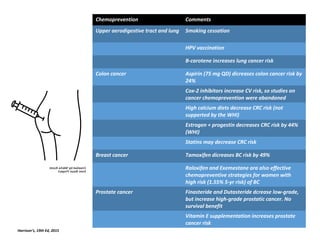
Chemoprevention Comments
Upper aerodigestive tract and lung Smoking cessation
HPV vaccination
B-carotene increases lung cancer risk
Colon cancer Aspirin (75 mg QD) dicreases colon cancer risk by
24%
Cox-2 inhibitors increase CV risk, so studies on
cancer chemoprevention were abandoned
High calcium diets decrease CRC risk (not
supperted by the WHI)
Estrogen + progestin decreases CRC risk by 44%
(WHI)
Statins may decrease CRC risk
Breast cancer Tamoxifen dicreases BC risk by 49%
Raloxifen and Exemestane ara also effective
chemopreventive strategies for women with
high risk (1.55% 5-yr risk) of BC
Prostate cancer Finasteride and Dutasteride dcrease low-grade,
but increase high-grade prostatic cancer. No
survival benefit
Vitamin E supplementation increases prostate
cancer risk
Harrison’s, 19th Ed, 2015
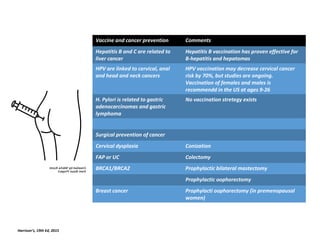
Vaccine and cancer prevention Comments
Hepatitis B and C are related to
liver cancer
Hepatitis B vaccination has proven effective for
B-hepatitis and hepatomas
HPV are linked to cervical, anal
and head and neck cancers
HPV vaccination may decrease cervical cancer
risk by 70%, but studies are ongoing.
Vaccination of females and males is
recommendd in the US at ages 9-26
H. Pylori is related to gastric
adenocarcinomas and gastric
lymphoma
No vaccination stretegy exists
Surgical prevention of cancer
Cervical dysplasia Conization
FAP or UC Colectomy
BRCA1/BRCA2 Prophylactic bilateral mastectomy
Prophylactic oophorectomy
Breast cancer Prophylacti oophorectomy (in premenopausal
women)
Harrison’s, 19th Ed, 2015
Cancer screening
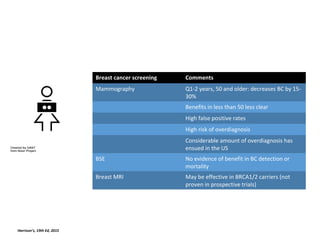
Breast cancer screening Comments
Mammography Q1-2 years, 50 and older: decreases BC by 15-
30%
Benefits in less than 50 less clear
High false positive rates
High risk of overdiagnosis
Considerable amount of overdiagnosis has
ensued in the US
BSE No evidence of benefit in BC detection or
mortality
Breast MRI May be effective in BRCA1/2 carriers (not
proven in prospective trials)
Harrison’s, 19th Ed, 2015
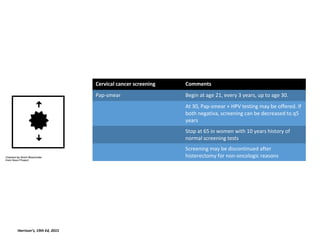
Cervical cancer screening Comments
Pap-smear Begin at age 21, every 3 years, up to age 30.
At 30, Pap-smear + HPV testing may be offered. If
both negativa, screening can be decreased to q5
years
Stop at 65 in women with 10 years history of
normal screening tests
Screening may be discontinued after
histerectomy for non-oncologic reasons
Harrison’s, 19th Ed, 2015
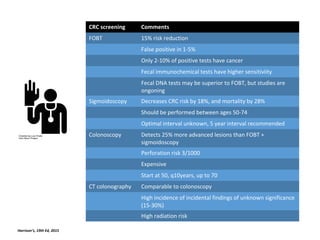
CRC screening Comments
FOBT 15% risk reduction
False positive in 1-5%
Only 2-10% of positive tests have cancer
Fecal immunochemical tests have higher sensitiviity
Fecal DNA tests may be superior to FOBT, but studies are
ongoning
Sigmoidoscopy Decreases CRC risk by 18%, and mortality by 28%
Should be performed between ages 50-74
Optimal interval unknown, 5 year interval recommended
Colonoscopy Detects 25% more advanced lesions than FOBT +
sigmoidoscopy
Perforation risk 3/1000
Expensive
Start at 50, q10years, up to 70
CT colonography Comparable to colonoscopy
High incidence of incidental findings of unknown significance
(15-30%)
High radiation risk
Harrison’s, 19th Ed, 2015
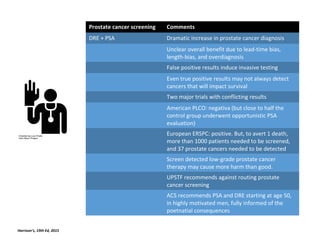
Prostate cancer screening Comments
DRE + PSA Dramatic increase in prostate cancer diagnosis
Unclear overall benefit due to lead-time bias,
length-bias, and overdiagnosis
False positive results induce invasive testing
Even true positive results may not always detect
cancers that will impact survival
Two major trials with conflicting results
American PLCO: negativa (but close to half the
control group underwent opportunistic PSA
evaluation)
European ERSPC: positive. But, to avert 1 death,
more than 1000 patients needed to be screened,
and 37 prostate cancers needed to be detected
Screen detected low-grade prostate cancer
therapy may cause more harm than good.
UPSTF recommends against routing prostate
cancer screening
ACS recommends PSA and DRE starting at age 50,
in highly motivated men, fully informed of the
poetnatial consequences
Harrison’s, 19th Ed, 2015
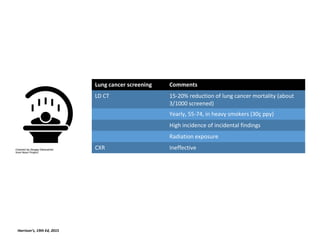
Lung cancer screening Comments
LD CT 15-20% reduction of lung cancer mortality (about
3/1000 screened)
Yearly, 55-74, in heavy smokers (30ç ppy)
High incidence of incidental findings
Radiation exposure
CXR Ineffective
Harrison’s, 19th Ed, 2015

CES201701-Clase 1

  • 1.
    Curso de Oncologíapara estudiantes de medicina – CES 2017.01 Mauricio Lema Medina MD
  • 2.
  • 3.
    Page  3 Sobreel cáncer, en general… Curable en casi 2/3 de los pacientes Evento catastrófico para el paciente y su entorno Cambio en la imagen propia, familiar y social Todo el cuerpo está enfermo – es una traición… Nada nunca será igual 1 2 3 4 5 Algunas notas
  • 4.
    Creado por: MauricioLema Medina - LemaTeachFiles© - 2004
  • 5.
  • 6.
    Adapted from GreenleeRT, et al. CA Cancer J Clin. 2000:50;22. % de muertes totales, US Enfermedades cardíacas Cáncer Cerebrovasculares EPOC Accidentes Pneumonia & Influenza Diabetes Mellitus Suicidio Homicidio HIV Creado por: Mauricio Lema Medina - LemaTeachFiles© - 2004 Principales causas de mortalidad
  • 7.
    Mortalidad por Cáncery Cardiopatía en USA
  • 8.
    Page  8 Cánceren el mundo 7.6 millones Hepatocelular (2x) Cérvix uterino (2x) Esófago (2-3x) 12.7 millones Pulmón (2x) Mama (3x) Próstata (2.5x) Colon y recto (3x) Estadísticas en 2008: Prevalencia – 25 millones
  • 9.
    Cáncer: 7.6 millones demuertes / año 20.000/día… 14/minuto… Aproximadamente la población de: • Suiza • Israel • Bulgaria
  • 10.
  • 11.
    Cáncer es unaenfermedad más común en adultos mayores y ancianos…
  • 12.
    Harrison’s, 19th Ed,2015 Lifetime risk: 44% Lifetime risk: 38%
  • 14.
    1 de cada3 cánceres causados por tabaquismo
  • 15.
    1 de cada5 cánceres causados por obesidad
  • 16.
    1 de cada6 cánceres causados por infecciones
  • 17.
    1 de cada6 cánceres causados por infecciones
  • 18.
    1 de cada20 cánceres causados por alcohol
  • 19.
    Page  19 Epidemiologíadel cáncer  Pulmón  Estómago  Hígado  Colon y recto  Mama  Esófago Mundo  Pulmón  Colon y recto  Mama  Páncreas  Próstata  Leucemia Estados Unidos  Estómago  Próstata  Pulmón  Mama  Cérvix  Colon y recto Colombia Mortalidad - Mundo, Estados Unidos, Colombia
  • 20.
    Testículo Mama HodgkinPróstata Vejiga Colon Ovario Pulmón Páncreas Supervivencia masculina Supervivencia femenina Muerte No todos los cánceres son igualmente letales
  • 21.
  • 22.
    Sospecha Clínica Confirmación patológica Creadopor: Mauricio Lema Medina - LemaTeachFiles© - 2004
  • 23.
    SIN DIAGNÓSTICO INCONTROVERTIBLE (PATOLOGÍA) NO ESPOSIBLE FORMULAR UN PLAN DE MANEJO ONCOLÓGICO ADECUADO Creado por: Mauricio Lema Medina - LemaTeachFiles© - 2004
  • 24.
    Page  24 Diagnósticode cáncer Tumor Método diagnóstico usual Comentario Cáncer de mama Biopsia guiada por ecografía/mamografía Core-needle Cáncer del pulmón Biopsia (broncoscopia/TAC) - Cáncer de próstata Biopsia guiada por ecografía Transrectal Cáncer de estómago Biopsia guiada por endoscopia - Cáncer de colon y rectal Biopsia guiada por endoscopia - Cérvix uterino Biopsia guida por colposcopia - Linfoma Biopsia escisional Arquitectura Carcinoma de ovario Laparotomía - Cáncer de páncreas Biopsia guiada por TAC - Carcinoma hepatocelular Clínico Biopsia Leucemia Biopsia de médula ósea Mielograma Estrategia diagnóstica usual (Colombia) Creado por: Mauricio Lema Medina - LemaTeachFiles© - 2016
  • 25.
    Confirmación patológica Estadificación Estadofuncional Creado por: Mauricio Lema Medina - LemaTeachFiles© - 2004
  • 26.
    Estadificación Estado funcional Curabilidad Estrategia Terapéutica Capacidad Paratolerar Tratamiento (tóxico) Creado por: Mauricio Lema Medina - LemaTeachFiles© - 2004
  • 27.
    Estadificación Localizado Metastásico Búsqueda sistemática De enfermedad Metastásicaen los Sitios donde es más común Creado por: Mauricio Lema Medina - LemaTeachFiles© - 2004
  • 28.
    Estadificación con elTNM •T: •Tumor •N: •Compromiso de los ganglios linfáticos regionales (lymph Nodes) •M: •Compromiso a distancia (Metastasis) Creado por: Mauricio Lema Medina - LemaTeachFiles© - 2004
  • 29.
    TNM – 1:T (Cáncer de colon y recto) Creado por: Mauricio Lema Medina - LemaTeachFiles© - 2011 AJCC – TNM 7th Ed, 2010 http://www.cancerstaging.org/ 06.02.2011
  • 30.
    TNM – 2:N (Cáncer de colon y recto) Creado por: Mauricio Lema Medina - LemaTeachFiles© - 2011 AJCC – TNM 7th Ed, 2010 http://www.cancerstaging.org/ 06.02.2011
  • 31.
    TNM – 2:Estadificación (Cáncer de colon) Creado por: Mauricio Lema Medina - LemaTeachFiles© - 2011 AJCC – TNM 7th Ed, 2010 http://www.cancerstaging.org/ 06.02.2011
  • 32.
    TNM – 1:T (Cáncer de mama) Creado por: Mauricio Lema Medina - LemaTeachFiles© - 2011 AJCC – TNM 7th Ed, 2010 http://www.cancerstaging.org/ 06.02.2011
  • 33.
    TNM – 2:N (Cáncer de mama) Creado por: Mauricio Lema Medina - LemaTeachFiles© - 2011 AJCC – TNM 7th Ed, 2010 http://www.cancerstaging.org/ 06.02.2011
  • 34.
    Page  34 Estadificacióndel cáncer Tumor Estadificación Otros Mama TAC de tórax, abdomen y pelvisl, Gammagrafía ósea Receptores hormonales, HER2 Pulmón TAC de tórax, RM cráneo, Gamma ósea / PET CT Mutación EGFR Próstata Gammagrafía ósea, Rayos X tórax / WBMRI PSA Estómago TAC de abdomen total, Rayos X de tórax, Laparoscopia - Colon y recto TAC (o RM) de tórax y abdomen total CEA, mutación KRAS (metastásico) Cérvix uterino RM de abdomen y pelvis, Rayos X de tórax - Linfoma TAC de cuello, tórax, abdomen y pelvis, biopsia médula ósea / PET CT CD20, CD5, Ciclina, bcl-2, LDH, etc Ovario TAC de abdomen total, rayos X de tórax Ca 125, resección óptima vs subóptima Páncreas TAC de abdomen total / PET-CT Ca 19.9 Hepatocelular TAC de abdomen, Childs-Pugh Alfa feto proteina Leucemia Citogenética, translocaciones, mutaciones - Estrategia diagnóstica usual (Colombia) Creado por: Mauricio Lema Medina - LemaTeachFiles© - 2016
  • 35.
    Tumor markers (1) Tumormarker Cancer Nonneoplastic condition Hormones hCG GTN, gonadal GCT Pregnancy Calcitonin MTC Catecholamines Pheochromocytoma Oncofetal antigens AFP HCC, gonadal GFT Cirrhosis, hepatitis CEA Adenocarcinomas of the colon, pancreas, lung, breast, ovary Pancreatitis, hepatitis, IBD, smoking Enzymes Prostatis Acid Phosphatase Prostatic cancer Porstatis, BPH Neuron-specific enolase SCLC, Neuroblastoma LDH Lymphomas, Ewing’s sarcoma, melanoma Hepatitis, hemolytici anemia, many others Harrison’s, 19th Ed, 2015
  • 36.
    Tumor markers (2) Tumormarker Cancer Nonneoplastic condition Tumor-associated antigens PSA Prostate cancer Prostatis, BPH Monoclonal IG Multiple myeloma Infection, MGUS Ca 125 Ovarian cancer, some lymphomas Mensturation, peritonitis, pregnancy Ca 19.9 Colon, pancreatic, breast cancer Pancreatitis, ulcerative colitis CD30 Hodgkin’s lymphoma, anaplastic large-cell lymphoma CD25 Heiry cell leukemia, Adult T cell leukemia / Lymphoma CD20 B-cell malignancies Harrison’s, 19th Ed, 2015
  • 37.
    Page  37 Desempeño(Performance status) ECOG Grado Actividad normal 0 Sintomático, ambulatorio 1 Confinado ≤ 50% tiempo vigilia 2 Confinado > 50% tiempo vigilia 3 Confinado 100% tiempo 4 Muerto 5 Estado funcional ECOG: Eastern Cooperative Oncology Group Karnofsky (KPS) Grado Actividad normal 100% No labora, cuida de si mismo 70% Incapaz de cuidar de si mismo 60% Hospitalizado/Institucionalizado 40% Moribundo 20% Muerto 0% Creado por: Mauricio Lema Medina - LemaTeachFiles© - 2011
  • 38.
    Estadío Desempeño E: Temprano D: Bueno E:Avanzado D: Bueno E: Temprano D: Malo E: Avanzado D: Malo Creado por: Mauricio Lema Medina - LemaTeachFiles© - 2004
  • 39.
    • Usualmente incurable •Expectativa de vida corta (< 3 meses) • Terapia para controlar los síntomas • Dolor • Disnea • Ansiedad • Constipación, etc • Alto riesgo de muerte por TOXICIDAD del tratamiento antineoplásico específico E: Avanzado D: Malo Creado por: Mauricio Lema Medina - LemaTeachFiles© - 2004
  • 40.
    Intención y agresividadterapéutica en oncología Estadío: Temprano Desempeño: Bueno (PS0-1) Estadío: Temprano Desempeño: Limítrofe (PS2) Estadío: Temprano Desempeño: Malo (PS3-4) Estadío: Avanzado Desempeño: Bueno (PS0-1) Estadío: Avanzado Desempeño: Limítrofe (PS2) Estadío: Avanzado Desempeño: Malo (PS3-4) Intención: Curativa Agresividad: Total Intención: Curativa Agresividad: Variable Intención: Curativo/paliativo Agresividad: Limitada Intención: Paliativo Agresividad: Total Intención: Paliativo Agresividad: Limitada Intención: Control síntomas Agresividad: Ninguna ONCOLOGÍAC.PALIATIVO
  • 41.
  • 42.
    Supportive care “To cure sometimes,to extend life often, and to confort always”
  • 43.
    Pain Setting Prevalence Diagnosis 25-30% Treatmentassociated 20% Progressive disease 75% Mechanism By the tumor 70% Caused by treatment 20% Unrelated to cancer 10% Treatment options Pharmacologic intervention Will help in 85% Antitumor therapy Neurostimulation Regional analgesia Neuroablative Refractory to all measures About 3% Harrison’s, 19th Ed, 2015
  • 44.
    Depression Dysphoria Sleep disturbances Appetite change Fatigue Lackof concentrati on Worthlessn ess Guilt Guilt Psychomot or retardatio n or agitation 25% 3 or more Anhedonia
  • 45.
  • 47.
    83% in 1982– 13% in 2016 CINV
  • 48.
    Taste Change Taste Change C et al.Support Care Cancer. 2005C et al. Support Care Cancer. 2005 Throm bocytopenia Throm bocytopenia MedianVASScores Rem ission Rem issionCINV 1 CINV 1 CurrentHealth CurrentHealthAlopecia Alopecia Depression Depression Ototoxicity Ototoxicity W eightGain W eightGain SexualDysfunction SexualDysfunction M em oryloss M em oryloss Constipation ConstipationLeg pain Leg painFatigue Fatigue Flu Flu PeripheralNeuropathy PeripheralNeuropathy Diarrhea Diarrhea Dysuria Dysuria CINV 4 CINV 4CINV 6 CINV 6CINV 5 CINV 5Death Death PerfectHealth CINV 2 CINV 2 M ucositis M ucositis CINV 3 CINV 3 Febrile Neutropenia Febrile Neutropenia CompleteComplete ControlControl Mucositis Death Moderate Delayed NauseaModerate Delayed Nausea Poorly ControlledPoorly Controlled Acute & Delayed CINVAcute & Delayed CINV Chemotherapy Experienced PatientsChemotherapy Experienced Patients Rank Severe CINV Near DeathRank Severe CINV Near Death
  • 49.
    49 Mecanismos de lasNáuseas y Vómito inducidos por la quimioterapia Quimioterapia Central Periférica
  • 50.
    50 Mecanismos de lasNáuseas y Vómito inducidos por la quimioterapia C. Enterocromafín Liberación de serotonina Quimioterapia Periférica
  • 51.
    51 Mecanismos de lasNáuseas y Vómito inducidos por la quimioterapia C. Enterocromafín Liberación de Serotonina Aferentes vagales receptores de 5-HT3 Quimioterapia Periférica
  • 52.
    52 Quimioterapia Mecanismos de lasNáuseas y Vómito inducidos por la quimioterapia Complejo Dorsal Vagal – área postrema Periférica Central C. Enterocromafín Liberación de Serotonina Aferentes vagales receptores de 5-HT3
  • 53.
    53 Quimioterapia Mecanismos de lasNáuseas y Vómito inducidos por la quimioterapia Receptores NK1 de Sustancia P Periférica Central Complejo Dorsal Vagal – área postrema C. Enterocromafín Liberación de Serotonina Aferentes vagales receptores de 5-HT3
  • 54.
    MASC ASCO NCCN 5-HT3-RA (ie, Ondansetron) Dexamethasone NK1-RA(ie, fosaprepitant) Guideline recommendations for acute CINV in Highly Emetogenic Chemotherapy (including AC) Olanzapine – Palonosetron – Dexamethasone (alternative) Navari RM, Aapro M, NEJM, 2016
  • 55.
    Nutrition Weight loss Decreasedappetite, citokynes, altered metabolism When to intervene? 10% unexplained weight loss Serum transferrin 150 mg/dL or less Ablumin 3.4 gr/dL, o less How to intervene? Enteral preferred over parenteral Harrison’s, 19th Ed, 2015
  • 56.
    RECIST: Response EvaluationCriteria In Solid Tumors Change in the sum of the longest diameters ↑20% (or new lesion): Progressive disease ↓30%: partial response (PR) ↓100%: unconfirmed complete response (uCR) ↓100% + Negative biopsy: complete response (CR)
  • 57.
  • 58.
    Tobacco Comments Risk factorCardiovascular disease, pulmonary diseasse and cancer Tobacco-related death 1/3 of smokers Cancers Lung, laryng, oropharynx, esophagus, kidney, bladder, pancreas, and stomach Risk after quitting 30-50% lower 10-yr lung cancer mortality Second-hand smoke also harmful Early adoption 80% smokers begin befor age 18 Cigars also increase cancer risk Oral and esophageal cancer Smokeless tobacco also increases cancer risk Oral cancer Benefits of e-cigarettes unclear Harrison’s, 19th Ed, 2015
  • 59.
    Physical inactivity Comments Riskfactor Colon and breast cancer Some biases may obscure this relationship Harrison’s, 19th Ed, 2015
  • 60.
    Diet modification Comments Highfat diet increases risk of Breast, colon, prostate, endometrium High dietary fiber decreases the risk Colonic polyps and colon cancer High fruit and vegetable intake NOT proven of benefit RCT Low-fat, High fiber diet faild to decrease risk of colonic polyp RCTx 2 No dietary intervention has proven effective in preventing cancer WHI Harrison’s, 19th Ed, 2015
  • 61.
    Energy balance Comments Obesityincreases risk of Colon, breast (postmenopausal), endometrial, kidney, esophagus (GEJ) Magnitud of the effect Colon cancer RR 1.5-2 in males, 1.2-15 in females Breast cancer Risk increases by 30-50% Adipose tissue harbors aromatase that can create estrogen from androgens Harrison’s, 19th Ed, 2015
  • 62.
    Page  62 AsociaciónObesidad y Cáncer  Gordura corporal  Unión gastroesofágica  Páncreas  Colon y recto  Mama  Endometrio  Riñón  Gordura abdominal  Colon y recto Convincente  Gordura corporal  Vesícula  Gordura abdominal  Páncreas  Mama  Endometrio  Ganancia de peso adulto  Mama Probable  Gordura corporal  Hígado  Peso bajo  Pulmón Sugestivo Se atribuye a la obesidad aprox. 20% y 14% de los cánceres en mujeres y hombres, respectivamente, en USA Creado por: Mauricio Lema Medina - LemaTeachFiles© - 2011
  • 63.
    Sun avoidance Comments Cumulativeexposure to UV radiation Non-melanoma skin cancers Intermittent acute sun exposure Melanoma (maybe) Protective clothing, reduction of sun exposure Reduce risk of skin caner Sunscreen Decreases risk of actinic keratoses No evidence of decrease risk of melanoma Freckling High risk of skin malignancies Risk factors for melanoma Sunburns, large number of melanocytic nevi, and atypical nevi Harrison’s, 19th Ed, 2015
  • 64.
  • 65.
    Chemoprevention Comments Upper aerodigestivetract and lung Smoking cessation HPV vaccination B-carotene increases lung cancer risk Colon cancer Aspirin (75 mg QD) dicreases colon cancer risk by 24% Cox-2 inhibitors increase CV risk, so studies on cancer chemoprevention were abandoned High calcium diets decrease CRC risk (not supperted by the WHI) Estrogen + progestin decreases CRC risk by 44% (WHI) Statins may decrease CRC risk Breast cancer Tamoxifen dicreases BC risk by 49% Raloxifen and Exemestane ara also effective chemopreventive strategies for women with high risk (1.55% 5-yr risk) of BC Prostate cancer Finasteride and Dutasteride dcrease low-grade, but increase high-grade prostatic cancer. No survival benefit Vitamin E supplementation increases prostate cancer risk Harrison’s, 19th Ed, 2015
  • 66.
    Vaccine and cancerprevention Comments Hepatitis B and C are related to liver cancer Hepatitis B vaccination has proven effective for B-hepatitis and hepatomas HPV are linked to cervical, anal and head and neck cancers HPV vaccination may decrease cervical cancer risk by 70%, but studies are ongoing. Vaccination of females and males is recommendd in the US at ages 9-26 H. Pylori is related to gastric adenocarcinomas and gastric lymphoma No vaccination stretegy exists Surgical prevention of cancer Cervical dysplasia Conization FAP or UC Colectomy BRCA1/BRCA2 Prophylactic bilateral mastectomy Prophylactic oophorectomy Breast cancer Prophylacti oophorectomy (in premenopausal women) Harrison’s, 19th Ed, 2015
  • 67.
  • 68.
    Breast cancer screeningComments Mammography Q1-2 years, 50 and older: decreases BC by 15- 30% Benefits in less than 50 less clear High false positive rates High risk of overdiagnosis Considerable amount of overdiagnosis has ensued in the US BSE No evidence of benefit in BC detection or mortality Breast MRI May be effective in BRCA1/2 carriers (not proven in prospective trials) Harrison’s, 19th Ed, 2015
  • 69.
    Cervical cancer screeningComments Pap-smear Begin at age 21, every 3 years, up to age 30. At 30, Pap-smear + HPV testing may be offered. If both negativa, screening can be decreased to q5 years Stop at 65 in women with 10 years history of normal screening tests Screening may be discontinued after histerectomy for non-oncologic reasons Harrison’s, 19th Ed, 2015
  • 70.
    CRC screening Comments FOBT15% risk reduction False positive in 1-5% Only 2-10% of positive tests have cancer Fecal immunochemical tests have higher sensitiviity Fecal DNA tests may be superior to FOBT, but studies are ongoning Sigmoidoscopy Decreases CRC risk by 18%, and mortality by 28% Should be performed between ages 50-74 Optimal interval unknown, 5 year interval recommended Colonoscopy Detects 25% more advanced lesions than FOBT + sigmoidoscopy Perforation risk 3/1000 Expensive Start at 50, q10years, up to 70 CT colonography Comparable to colonoscopy High incidence of incidental findings of unknown significance (15-30%) High radiation risk Harrison’s, 19th Ed, 2015
  • 71.
    Prostate cancer screeningComments DRE + PSA Dramatic increase in prostate cancer diagnosis Unclear overall benefit due to lead-time bias, length-bias, and overdiagnosis False positive results induce invasive testing Even true positive results may not always detect cancers that will impact survival Two major trials with conflicting results American PLCO: negativa (but close to half the control group underwent opportunistic PSA evaluation) European ERSPC: positive. But, to avert 1 death, more than 1000 patients needed to be screened, and 37 prostate cancers needed to be detected Screen detected low-grade prostate cancer therapy may cause more harm than good. UPSTF recommends against routing prostate cancer screening ACS recommends PSA and DRE starting at age 50, in highly motivated men, fully informed of the poetnatial consequences Harrison’s, 19th Ed, 2015
  • 72.
    Lung cancer screeningComments LD CT 15-20% reduction of lung cancer mortality (about 3/1000 screened) Yearly, 55-74, in heavy smokers (30ç ppy) High incidence of incidental findings Radiation exposure CXR Ineffective Harrison’s, 19th Ed, 2015

Editor's Notes

  • #49 Preliminary preference (utility) data from nausea and vomiting health states from 3 studies involving ovarian cancer patients, clinicians, and healthy female controls were evaluated. Preferences were assessed using the visual analog scale (VAS), with scores ranging from 0.0 (worst) to 1.0 (best). Definitions of CINV were: CINV 1 - Days 1-5 = little to no nausea or vomiting. CINV 2 - Day 1 = complete control; Days 2-5 = moderate nausea, no vomiting. CINV 3 - Day 1 = complete control; Days 2-5 = moderate nausea, severe vomiting. CINV 4 - Day 1 = nausea and vomiting; Days 2-5 = moderate nausea. CINV 5 - Day 1 = nausea and vomiting; Days 2-5 = moderate nausea, severe vomiting. CINV 6 - Day 1 = complete control; Days 2-5 = severe nausea. Patients rated significant CINV (CINV 3-6) comparable to the score for death. 1. Sun C, Bodurka D, Donato M et al. Nausea and vomiting side-effects of cancer therapies: preference assessments from patients, health care providers and healthy women. Support Care Cancer. 2002:10:378. Abstract #93.