Cervical Cancer Screening:
Importance, Methods, and
Recommendations
Based on USPSTF Recommendations
(Detailed Version)
Importance of Cervical Cancer
• • Cervical cancer is a major public health
concern, especially in low-resource settings.
• • Widespread screening has led to a
significant reduction in cervical cancer
incidence and mortality.
• • The mortality rate declined from 2.8 per
100,000 women in 2000 to 2.3 per 100,000
women in 2015.
• • Most cases of cervical cancer occur in
women who have not been adequately
Why Population Screening?
• • Screening helps detect high-grade
precancerous cervical lesions and cervical
cancer at an early stage.
• • Early detection allows for timely
intervention, preventing progression to
invasive cancer.
• • Cervical cancer screening strategies have
proven effective in reducing mortality rates.
• • HPV screening has emerged as a highly
sensitive method for detecting cervical
Epidemiology (Prevalence,
Incidence, Mortality)
• • Cervical cancer is the fourth most common
cancer among women worldwide.
• • In 2018, an estimated 13,240 new cases and
4,170 deaths were reported in the U.S.
• • Higher mortality rates are seen in certain
racial and ethnic groups due to disparities in
screening and treatment.
• • The primary cause of cervical cancer is
persistent infection with high-risk HPV types,
which are transmitted sexually.
Target Population for Screening
• • Women aged 21 to 65 years are the primary
target for cervical cancer screening.
• • Screening is NOT recommended for:
• - Women under 21 years (low risk, high rate
of spontaneous HPV clearance).
• - Women over 65 years with adequate prior
screening and no history of high-grade lesions.
• - Women who have undergone total
hysterectomy for benign reasons.
• • High-risk populations (e.g., women with HIV,
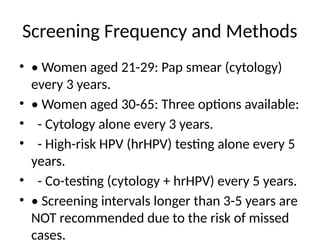
Screening Frequency and Methods
• • Women aged 21-29: Pap smear (cytology)
every 3 years.
• • Women aged 30-65: Three options available:
• - Cytology alone every 3 years.
• - High-risk HPV (hrHPV) testing alone every 5
years.
• - Co-testing (cytology + hrHPV) every 5 years.
• • Screening intervals longer than 3-5 years are
NOT recommended due to the risk of missed
cases.
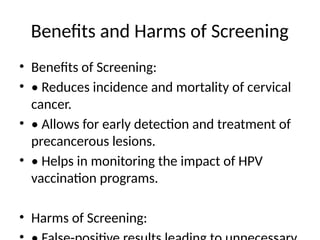
Benefits and Harms of Screening
• Benefits of Screening:
• • Reduces incidence and mortality of cervical
cancer.
• • Allows for early detection and treatment of
precancerous lesions.
• • Helps in monitoring the impact of HPV
vaccination programs.
• Harms of Screening:
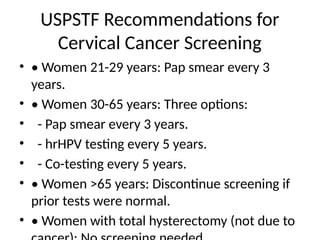
USPSTF Recommendations for
Cervical Cancer Screening
• • Women 21-29 years: Pap smear every 3
years.
• • Women 30-65 years: Three options:
• - Pap smear every 3 years.
• - hrHPV testing every 5 years.
• - Co-testing every 5 years.
• • Women >65 years: Discontinue screening if
prior tests were normal.
• • Women with total hysterectomy (not due to
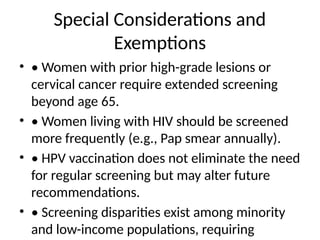
Special Considerations and
Exemptions
• • Women with prior high-grade lesions or
cervical cancer require extended screening
beyond age 65.
• • Women living with HIV should be screened
more frequently (e.g., Pap smear annually).
• • HPV vaccination does not eliminate the need
for regular screening but may alter future
recommendations.
• • Screening disparities exist among minority
and low-income populations, requiring
Conclusions and Future
Recommendations
• • Cervical cancer screening has been highly
effective in reducing mortality rates.
• • HPV testing may become the preferred
primary screening method in the future.
• • Self-sampling for HPV testing could improve
screening coverage in underserved
populations.
• • Ongoing research is needed to refine
screening strategies in vaccinated populations.
• • Efforts should be made to improve access to

Cervical_Cancer_Screening_powerpoint presentation

  • 1.
    Cervical Cancer Screening: Importance,Methods, and Recommendations Based on USPSTF Recommendations (Detailed Version)
  • 2.
    Importance of CervicalCancer • • Cervical cancer is a major public health concern, especially in low-resource settings. • • Widespread screening has led to a significant reduction in cervical cancer incidence and mortality. • • The mortality rate declined from 2.8 per 100,000 women in 2000 to 2.3 per 100,000 women in 2015. • • Most cases of cervical cancer occur in women who have not been adequately
  • 3.
    Why Population Screening? •• Screening helps detect high-grade precancerous cervical lesions and cervical cancer at an early stage. • • Early detection allows for timely intervention, preventing progression to invasive cancer. • • Cervical cancer screening strategies have proven effective in reducing mortality rates. • • HPV screening has emerged as a highly sensitive method for detecting cervical
  • 4.
    Epidemiology (Prevalence, Incidence, Mortality) •• Cervical cancer is the fourth most common cancer among women worldwide. • • In 2018, an estimated 13,240 new cases and 4,170 deaths were reported in the U.S. • • Higher mortality rates are seen in certain racial and ethnic groups due to disparities in screening and treatment. • • The primary cause of cervical cancer is persistent infection with high-risk HPV types, which are transmitted sexually.
  • 5.
    Target Population forScreening • • Women aged 21 to 65 years are the primary target for cervical cancer screening. • • Screening is NOT recommended for: • - Women under 21 years (low risk, high rate of spontaneous HPV clearance). • - Women over 65 years with adequate prior screening and no history of high-grade lesions. • - Women who have undergone total hysterectomy for benign reasons. • • High-risk populations (e.g., women with HIV,
  • 6.
    Screening Frequency andMethods • • Women aged 21-29: Pap smear (cytology) every 3 years. • • Women aged 30-65: Three options available: • - Cytology alone every 3 years. • - High-risk HPV (hrHPV) testing alone every 5 years. • - Co-testing (cytology + hrHPV) every 5 years. • • Screening intervals longer than 3-5 years are NOT recommended due to the risk of missed cases.
  • 7.
    Benefits and Harmsof Screening • Benefits of Screening: • • Reduces incidence and mortality of cervical cancer. • • Allows for early detection and treatment of precancerous lesions. • • Helps in monitoring the impact of HPV vaccination programs. • Harms of Screening:
  • 8.
    USPSTF Recommendations for CervicalCancer Screening • • Women 21-29 years: Pap smear every 3 years. • • Women 30-65 years: Three options: • - Pap smear every 3 years. • - hrHPV testing every 5 years. • - Co-testing every 5 years. • • Women >65 years: Discontinue screening if prior tests were normal. • • Women with total hysterectomy (not due to
  • 9.
    Special Considerations and Exemptions •• Women with prior high-grade lesions or cervical cancer require extended screening beyond age 65. • • Women living with HIV should be screened more frequently (e.g., Pap smear annually). • • HPV vaccination does not eliminate the need for regular screening but may alter future recommendations. • • Screening disparities exist among minority and low-income populations, requiring
  • 10.
    Conclusions and Future Recommendations •• Cervical cancer screening has been highly effective in reducing mortality rates. • • HPV testing may become the preferred primary screening method in the future. • • Self-sampling for HPV testing could improve screening coverage in underserved populations. • • Ongoing research is needed to refine screening strategies in vaccinated populations. • • Efforts should be made to improve access to