For updated information, please visit www.ibef.org July 2017
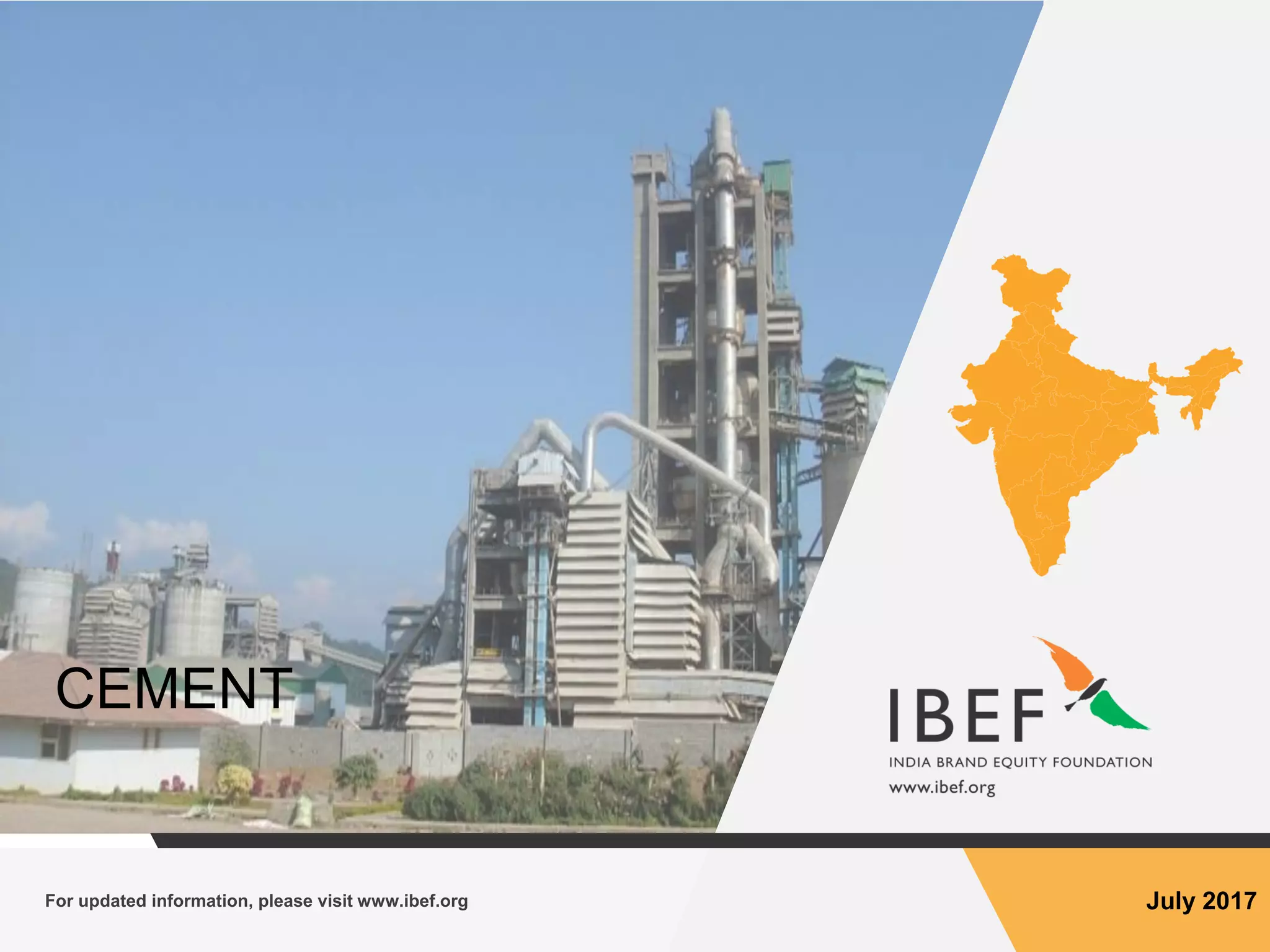
CEMENT
Table of Content
Executive Summary……………….….……………..3
Advantage India…………………..….……………...4
Market Overview and Trends………..………….....6
Porter’s Five Force Framework Analysis....……..18
Recent Trends…..………….……………..............42
Strategies Adopted………….……….......………..45
Growth Drivers and Opportunities...…….………..45
Investment Scenario……….……….......…………45
Policies and Initiatives……….……….......……….45
Case Studies……….……….......…………………45
Key Industry Organisations……….……….......…45
useful information……….……….......……………..45
For updated information, please visit www.ibef.orgCement3
EXECUTIVE SUMMARY
Source: Business Standard, Ministry of External Affairs, Ministry of External Affairs (Investment and Technology Promotion Division)
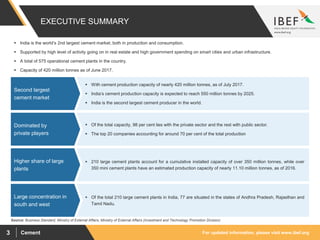
 With cement production capacity of nearly 420 million tonnes, as of July 2017.
 India’s cement production capacity is expected to reach 550 million tonnes by 2025.
 India is the second largest cement producer in the world.
Second largest
cement market
 Of the total capacity, 98 per cent lies with the private sector and the rest with public sector.
 The top 20 companies accounting for around 70 per cent of the total production
Dominated by
private players
 210 large cement plants account for a cumulative installed capacity of over 350 million tonnes, while over
350 mini cement plants have an estimated production capacity of nearly 11.10 million tonnes, as of 2016.
Higher share of large
plants
 Of the total 210 large cement plants in India, 77 are situated in the states of Andhra Pradesh, Rajasthan and
Tamil Nadu.
Large concentration in
south and west
 India is the world’s 2nd largest cement market, both in production and consumption.
 Supported by high level of activity going on in real estate and high government spending on smart cities and urban infrastructure.
 A total of 575 operational cement plants in the country.
 Capacity of 420 million tonnes as of June 2017.
Cement
ADVANTAGE INDIA
For updated information, please visit www.ibef.orgCement5
ADVANTAGE INDIA
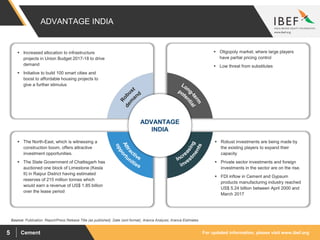
 Increased allocation to infrastructure
projects in Union Budget 2017-18 to drive
demand
 Initiative to build 100 smart cities and
boost to affordable housing projects to
give a further stimulus
 Oligopoly market, where large players
have partial pricing control
 Low threat from substitutes
 The North-East, which is witnessing a
construction boom, offers attractive
investment opportunities.
 The State Government of Chattisgarh has
auctioned one block of Limestone (Kesla
II) in Raipur District having estimated
reserves of 215 million tonnes which
would earn a revenue of US$ 1.85 billion
over the lease period
 Robust investments are being made by
the existing players to expand their
capacity
 Private sector investments and foreign
investments in the sector are on the rise.
 FDI inflow in Cement and Gypsum
products manufacturing industry reached
US$ 5.24 billion between April 2000 and
March 2017
ADVANTAGE
INDIA
Source: Publication. Report/Press Release Title (as published). Date (sort format); Aranca Analysis; Aranca Estimates
Cement
MARKET
OVERVIEW AND
TRENDS
For updated information, please visit www.ibef.orgCement7
MARKET OVERVIEW
Source: International Cement Review
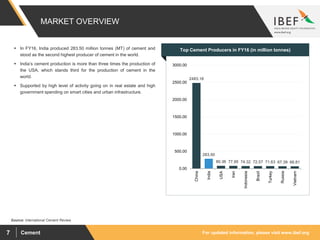
 In FY16, India produced 283.50 million tonnes (MT) of cement and
stood as the second highest producer of cement in the world.
 India’s cement production is more than three times the production of
the USA, which stands third for the production of cement in the
world.
 Supported by high level of activity going on in real estate and high
government spending on smart cities and urban infrastructure.
Visakhapatnam port traffic (million tonnes)Top Cement Producers in FY16 (in million tonnes)
2483.18
283.50
80.36 77.95 74.32 72.57 71.63 67.39 66.81
0.00
500.00
1000.00
1500.00
2000.00
2500.00
3000.00
China
India
USA
Iran
Indonesia
Brazil
Turkey
Russia
Vietnam
For updated information, please visit www.ibef.orgCement8
MARKET OVERVIEW
Source: Media sources, Aranca Research, Crisil
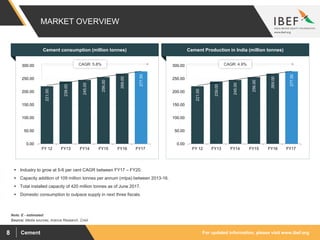
 Industry to grow at 5-6 per cent CAGR between FY17 – FY20.
 Capacity addition of 109 million tonnes per annum (mtpa) between 2013-16.
 Total installed capacity of 420 million tonnes as of June 2017.
 Domestic consumption to outpace supply in next three fiscals.
Cement consumption (million tonnes) Cement Production in India (million tonnes)
221.00
239.00
245.00
256.00
269.00
277.50
0.00
50.00
100.00
150.00
200.00
250.00
300.00
FY 12 FY13 FY14 FY15 FY16 FY17
221.00
239.00
245.00
256.00
269.00
277.50
0.00
50.00
100.00
150.00
200.00
250.00
300.00
FY 12 FY13 FY14 FY15 FY16 FY17
CAGR: 4.9%CAGR: 5.8%
Note: E - estimated
For updated information, please visit www.ibef.orgCement9
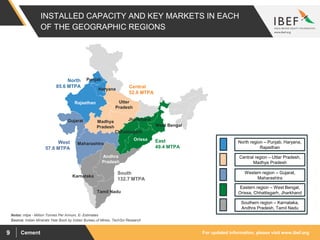
INSTALLED CAPACITY AND KEY MARKETS IN EACH
OF THE GEOGRAPHIC REGIONS
East
49.4 MTPA
Central
52.8 MTPA
South
132.7 MTPA
Tamil Nadu
Andhra
Pradesh
Karnataka
Gujarat
MaharashtraWest
57.6 MTPA
North
85.6 MTPA
Rajasthan
Punjab
Haryana
Madhya
Pradesh
Utter
Pradesh
Orissa
West Bengal
Chhattisgarh
Jharkhand
Source: Indian Minerals Year Book by Indian Bureau of Mines, TechSci Research
Notes: mtpa - Million Tonnes Per Annum, E- Estimates
North region – Punjab, Haryana,
Rajasthan
Central region – Uttar Pradesh,
Madhya Pradesh
Western region – Gujarat,
Maharashtra
Eastern region – West Bengal,
Orissa, Chhattisgarh, Jharkhand
Southern region – Karnataka,
Andhra Pradesh, Tamil Nadu
For updated information, please visit www.ibef.orgCement10
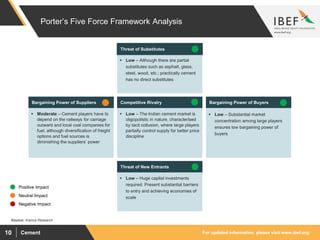
Porter’s Five Force Framework Analysis
 Moderate – Cement players have to
depend on the railways for carriage
outward and local coal companies for
fuel, although diversification of freight
options and fuel sources is
diminishing the suppliers’ power
Bargaining Power of Suppliers
 Low – Although there are partial
substitutes such as asphalt, glass,
steel, wood, etc.; practically cement
has no direct substitutes
Threat of Substitutes
 Low – The Indian cement market is
oligopolistic in nature, characterised
by tacit collusion, where large players
partially control supply for better price
discipline
Competitive Rivalry
 Low – Huge capital investments
required. Present substantial barriers
to entry and achieving economies of
scale
Threat of New Entrants
 Low – Substantial market
concentration among large players
ensures low bargaining power of
buyers
Bargaining Power of Buyers
Positive Impact
Neutral Impact
Negative Impact
Source: Aranca Research
For updated information, please visit www.ibef.orgCement11
RECENT TRENDS
Source: Union Budget 2016 – 17, Emkay Global Financial Services
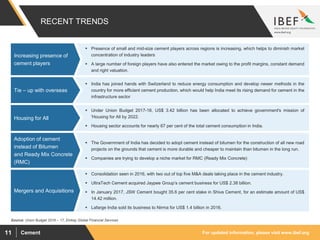
 Presence of small and mid-size cement players across regions is increasing, which helps to diminish market
concentration of industry leaders
 A large number of foreign players have also entered the market owing to the profit margins, constant demand
and right valuation.
Increasing presence of
cement players
 Consolidation seen in 2016, with two out of top five M&A deals taking place in the cement industry.
 UltraTech Cement acquired Jaypee Group’s cement business for US$ 2.38 billion.
 In January 2017, JSW Cement bought 35.6 per cent stake in Shiva Cement, for an estimate amount of US$
14.42 million.
 Lafarge India sold its business to Nirma for US$ 1.4 billion in 2016.
Mergers and Acquisitions
 India has joined hands with Switzerland to reduce energy consumption and develop newer methods in the
country for more efficient cement production, which would help India meet its rising demand for cement in the
infrastructure sector
Tie – up with overseas
 The Government of India has decided to adopt cement instead of bitumen for the construction of all new road
projects on the grounds that cement is more durable and cheaper to maintain than bitumen in the long run.
 Companies are trying to develop a niche market for RMC (Ready Mix Concrete)
Adoption of cement
instead of Bitumen
and Ready Mix Concrete
(RMC)
 Under Union Budget 2017-18, US$ 3.42 billion has been allocated to achieve government's mission of
'Housing for All by 2022.
 Housing sector accounts for nearly 67 per cent of the total cement consumption in India.
Housing for All
For updated information, please visit www.ibef.orgCement12
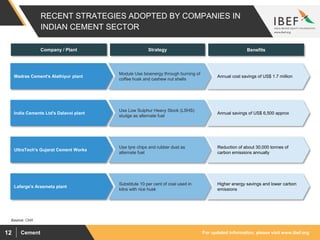
RECENT STRATEGIES ADOPTED BY COMPANIES IN
INDIAN CEMENT SECTOR
Company / Plant Strategy Benefits
Madras Cement's Alathiyur plant
Module Use bioenergy through burning of
coffee husk and cashew nut shells
Annual cost savings of US$ 1.7 million
Reduction of about 30,000 tonnes of
carbon emissions annually
UltraTech's Gujarat Cement Works
Use tyre chips and rubber dust as
alternate fuel
Higher energy savings and lower carbon
emissions
Lafarge's Arasmeta plant
Substitute 10 per cent of coal used in
kilns with rice husk
India Cements Ltd's Dalavoi plant
Use Low Sulphur Heavy Stock (LSHS)
sludge as alternate fuel
Annual savings of US$ 6,500 approx
Source: CMA
Cement
GROWTH DRIVERS
AND OPPORTUNITIES
For updated information, please visit www.ibef.orgCement14
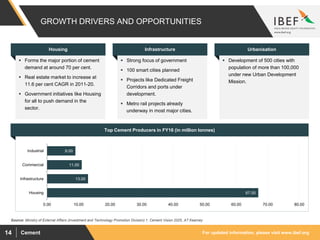
67.00
13.00
11.00
9.00
0.00 10.00 20.00 30.00 40.00 50.00 60.00 70.00 80.00
Housing
Infrastructure
Commercial
Industrial
GROWTH DRIVERS AND OPPORTUNITIES
Source: Ministry of External Affairs (Investment and Technology Promotion Division) 1. Cement Vision 2025, AT Kearney
 Strong focus of government
 100 smart cities planned
 Projects like Dedicated Freight
Corridors and ports under
development.
 Metro rail projects already
underway in most major cities.
Infrastructure
 Development of 500 cities with
population of more than 100,000
under new Urban Development
Mission.
Urbanisation
 Forms the major portion of cement
demand at around 70 per cent.
 Real estate market to increase at
11.6 per cent CAGR in 2011-20.
 Government initiatives like Housing
for all to push demand in the
sector.
Housing
Top Cement Producers in FY16 (in million tonnes)
Cement
INVESTMENT
SCENARIO
For updated information, please visit www.ibef.orgCement16
INVESTMENT SCENARIO
Source: Aranca Research
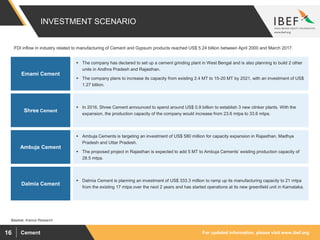
FDI inflow in industry related to manufacturing of Cement and Gypsum products reached US$ 5.24 billion between April 2000 and March 2017.
 Dalmia Cement is planning an investment of US$ 333.3 million to ramp up its manufacturing capacity to 21 mtpa
from the existing 17 mtpa over the next 2 years and has started operations at its new greenfield unit in Karnataka.
Dalmia Cement
 Ambuja Cements is targeting an investment of US$ 580 million for capacity expansion in Rajasthan, Madhya
Pradesh and Uttar Pradesh.
 The proposed project in Rajasthan is expected to add 5 MT to Ambuja Cements’ existing production capacity of
28.5 mtpa.
Ambuja Cement
 In 2016, Shree Cement announced to spend around US$ 0.9 billion to establish 3 new clinker plants. With the
expansion, the production capacity of the company would increase from 23.6 mtpa to 33.6 mtpa.
Shree Cement
 The company has declared to set up a cement grinding plant in West Bengal and is also planning to build 2 other
units in Andhra Pradesh and Rajasthan.
 The company plans to increase its capacity from existing 2.4 MT to 15-20 MT by 2021, with an investment of US$
1.27 billion.
Emami Cement
For updated information, please visit www.ibef.orgCement17
INVESTMENT SCENARIO
Source: Aranca Research
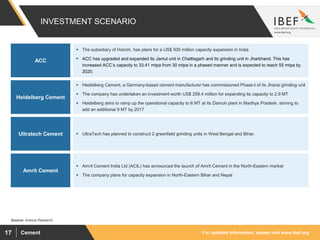
Amrit Cement
Ultratech Cement
Heidelberg Cement
ACC
 Amrit Cement India Ltd (ACIL) has announced the launch of Amrit Cement in the North-Eastern market
 The company plans for capacity expansion in North-Eastern Bihar and Nepal
 UltraTech has planned to construct 2 greenfield grinding units in West Bengal and Bihar.
 Heidelberg Cement, a Germany-based cement manufacturer has commissioned Phase-I of its Jhansi grinding unit
 The company has undertaken an investment worth US$ 259.4 million for expanding its capacity to 2.9 MT
 Heidelberg aims to ramp up the operational capacity to 6 MT at its Damoh plant in Madhya Pradesh, striving to
add an additional 9 MT by 2017
 The subsidiary of Holcim, has plans for a US$ 500 million capacity expansion in India
 ACC has upgraded and expanded its Jamul unit in Chattisgarh and its grinding unit in Jharkhand. This has
increased ACC’s capacity to 33.41 mtpa from 30 mtpa in a phased manner and is expected to reach 55 mtpa by
2020.
For updated information, please visit www.ibef.orgCement18
POLICIES AND INITIATIVES
Source: Aranca Research
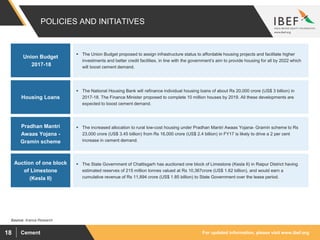
Auction of one block
of Limestone
(Kesla II)
Pradhan Mantri
Awaas Yojana -
Gramin scheme
Housing Loans
Union Budget
2017-18
 The State Government of Chattisgarh has auctioned one block of Limestone (Kesla II) in Raipur District having
estimated reserves of 215 million tonnes valued at Rs 10,367crore (US$ 1.62 billion), and would earn a
cumulative revenue of Rs 11,894 crore (US$ 1.85 billion) to State Government over the lease period.
 The increased allocation to rural low-cost housing under Pradhan Mantri Awaas Yojana- Gramin scheme to Rs
23,000 crore (US$ 3.45 billion) from Rs 16,000 crore (US$ 2.4 billion) in FY17 is likely to drive a 2 per cent
increase in cement demand.
 The National Housing Bank will refinance individual housing loans of about Rs 20,000 crore (US$ 3 billion) in
2017-18. The Finance Minister proposed to complete 10 million houses by 2019. All these developments are
expected to boost cement demand.
 The Union Budget proposed to assign infrastructure status to affordable housing projects and facilitate higher
investments and better credit facilities, in line with the government’s aim to provide housing for all by 2022 which
will boost cement demand.
Cement
CASE STUDIES
For updated information, please visit www.ibef.orgCement20
ULTRATECH CEMENT
Source: Aranca Research, Annual Report
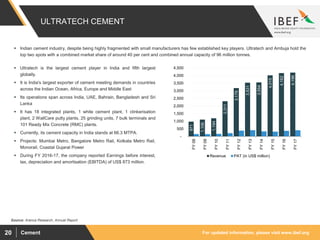
 Indian cement industry, despite being highly fragmented with small manufacturers has few established key players. Ultratech and Ambuja hold the
top two spots with a combined market share of around 40 per cent and combined annual capacity of 96 million tonnes.
 Ultratech is the largest cement player in India and fifth largest
globally.
 It is India's largest exporter of cement meeting demands in countries
across the Indian Ocean, Africa, Europe and Middle East
 Its operations span across India, UAE, Bahrain, Bangladesh and Sri
Lanka
 It has 18 integrated plants, 1 white cement plant, 1 clinkerisation
plant, 2 WallCare putty plants, 25 grinding units, 7 bulk terminals and
101 Ready Mix Concrete (RMC) plants.
 Currently, its cement capacity in India stands at 66.3 MTPA.
 Projects: Mumbai Metro, Bangalore Metro Rail, Kolkata Metro Rail,
Monorail, Coastal Gujarat Power
 During FY 2016-17, the company reported Earnings before interest,
tax, depreciation and amortisation (EBITDA) of US$ 873 million.
971
1,106
1,194
2,311
3,179
3,531
3,554
4,015
4,162
4,196
-
500
1,000
1,500
2,000
2,500
3,000
3,500
4,000
4,500
FY08
FY09
FY10
FY11
FY12
FY13
FY14
FY15
FY16
FY17
Revenue PAT (in US$ million)
For updated information, please visit www.ibef.orgCement21
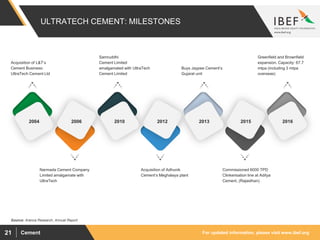
ULTRATECH CEMENT: MILESTONES
Source: Aranca Research, Annual Report
Acquisition of L&T’s
Cement Business:
UltraTech Cement Ltd
Samruddhi
Cement Limited
amalgamated with UltraTech
Cement Limited
Narmada Cement Company
Limited amalgamate with
UltraTech
Acquisition of Adhunik
Cement’s Meghalaya plant
2004 2006 20122010 20152013 2016
Buys Jaypee Cement’s
Gujarat unit
Greenfield and Brownfield
expansion. Capacity: 67.7
mtpa (including 3 mtpa
overseas)
Commissioned 6000 TPD
Clinkerisation line at Aditya
Cement, (Rajasthan)
For updated information, please visit www.ibef.orgCement22
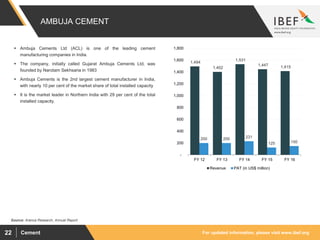
AMBUJA CEMENT
 Ambuja Cements Ltd (ACL) is one of the leading cement
manufacturing companies in India.
 The company, initially called Gujarat Ambuja Cements Ltd, was
founded by Narotam Sekhsaria in 1983
 Ambuja Cements is the 2nd largest cement manufacturer in India,
with nearly 10 per cent of the market share of total installed capacity
 It is the market leader in Northern India with 29 per cent of the total
installed capacity.
1,494
1,402
1,531
1,447 1,415
200 200 231
125 150
-
200
400
600
800
1,000
1,200
1,400
1,600
1,800
FY 12 FY 13 FY 14 FY 15 FY 16
Revenue PAT (in US$ million)
Source: Aranca Research, Annual Report
For updated information, please visit www.ibef.orgCement23
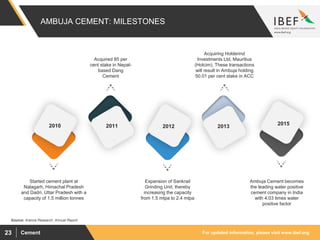
AMBUJA CEMENT: MILESTONES
Source: Aranca Research, Annual Report
Acquired 85 per
cent stake in Nepal-
based Dang
Cement
Acquiring Holderind
Investments Ltd, Mauritius
(Holcim), These transactions
will result in Ambuja holding
50.01 per cent stake in ACC
Ambuja Cement becomes
the leading water positive
cement company in India
with 4.03 times water
positive factor
Expansion of Sankrail
Grinding Unit, thereby
increasing the capacity
from 1.5 mtpa to 2.4 mtpa
Started cement plant at
Nalagarh, Himachal Pradesh
and Dadri, Uttar Pradesh with a
capacity of 1.5 million tonnes
2010 2015
201320122011
Cement
KEY INDUSTRY
ORGANISATIONS
For updated information, please visit www.ibef.orgCement25
INDUSTRY ORGANISATIONS
CMA Tower, A-2E, Sector 24 NOIDA – 201 301
Uttar Pradesh, India
Phone: 91-120-2411955, 2411957, 2411958
Fax: 91-120-2411956
E-mail: cmand@vsnl.com
Website: www.cmaindia.org/index.html
Cement Manufacturers' Association
Ocean Crest 79, Third Main Road, Gandhi Nagar, Adyar, Chennai –
600 020
Phone: 91-44-24912602
Fax: 91-44-24455148
E-mail: ici3@vsnl.in, ici4@airtelmail.in, vj6314@gmail.com
Website: www.indianconcreteinstitute.org
Indian Concrete Institute
34th Milestone, Delhi-Mathura Road, Ballabgarh – 121 004 Haryana,
India
Phone: 91-129-2242051/52/53/54/55/56; 4192222
Fax: 91-129-2242100; 2246175
E-mail: nccbm@vsnl.com; info@ncbindia.com
National Council for Cement and Building Materials
Cement
USEFUL
INFORMATION
For updated information, please visit www.ibef.orgCement27
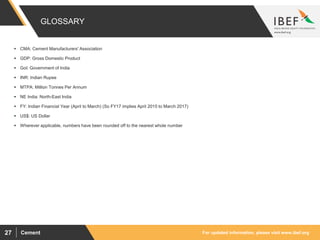
GLOSSARY
 CMA: Cement Manufacturers' Association
 GDP: Gross Domestic Product
 GoI: Government of India
 INR: Indian Rupee
 MTPA: Million Tonnes Per Annum
 NE India: North-East India
 FY: Indian Financial Year (April to March) (So FY17 implies April 2015 to March 2017)
 US$: US Dollar
 Wherever applicable, numbers have been rounded off to the nearest whole number
For updated information, please visit www.ibef.orgCement28
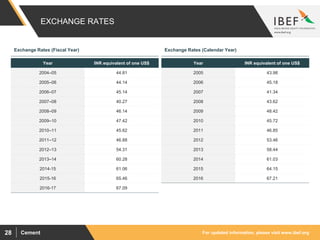
EXCHANGE RATES
Exchange Rates (Fiscal Year) Exchange Rates (Calendar Year)
Year INR equivalent of one US$
2004–05 44.81
2005–06 44.14
2006–07 45.14
2007–08 40.27
2008–09 46.14
2009–10 47.42
2010–11 45.62
2011–12 46.88
2012–13 54.31
2013–14 60.28
2014-15 61.06
2015-16 65.46
2016-17 67.09
Year INR equivalent of one US$
2005 43.98
2006 45.18
2007 41.34
2008 43.62
2009 48.42
2010 45.72
2011 46.85
2012 53.46
2013 58.44
2014 61.03
2015 64.15
2016 67.21
For updated information, please visit www.ibef.orgCement29
DISCLAIMER
India Brand Equity Foundation (IBEF) engaged Aranca to prepare this presentation and the same has been prepared by Aranca in consultation
with IBEF.
All rights reserved. All copyright in this presentation and related works is solely and exclusively owned by IBEF. The same may not be reproduced,
wholly or in part in any material form (including photocopying or storing it in any medium by electronic means and whether or not transiently or
incidentally to some other use of this presentation), modified or in any manner communicated to any third party except with the written approval
of IBEF.
This presentation is for information purposes only. While due care has been taken during the compilation of this presentation to ensure that the
information is accurate to the best of Aranca and IBEF’s knowledge and belief, the content is not to be construed in any manner whatsoever as a
substitute for professional advice.
Aranca and IBEF neither recommend nor endorse any specific products or services that may have been mentioned in this presentation and nor do
they assume any liability or responsibility for the outcome of decisions taken as a result of any reliance placed on this presentation.
Neither Aranca nor IBEF shall be liable for any direct or indirect damages that may arise due to any act or omission on the part of the user due to any
reliance placed or guidance taken from any portion of this presentation.

Cement Sector Report July 2017

  • 1.
    For updated information,please visit www.ibef.org July 2017 CEMENT
  • 2.
    Table of Content ExecutiveSummary……………….….……………..3 Advantage India…………………..….……………...4 Market Overview and Trends………..………….....6 Porter’s Five Force Framework Analysis....……..18 Recent Trends…..………….……………..............42 Strategies Adopted………….……….......………..45 Growth Drivers and Opportunities...…….………..45 Investment Scenario……….……….......…………45 Policies and Initiatives……….……….......……….45 Case Studies……….……….......…………………45 Key Industry Organisations……….……….......…45 useful information……….……….......……………..45
  • 3.
    For updated information,please visit www.ibef.orgCement3 EXECUTIVE SUMMARY Source: Business Standard, Ministry of External Affairs, Ministry of External Affairs (Investment and Technology Promotion Division)  With cement production capacity of nearly 420 million tonnes, as of July 2017.  India’s cement production capacity is expected to reach 550 million tonnes by 2025.  India is the second largest cement producer in the world. Second largest cement market  Of the total capacity, 98 per cent lies with the private sector and the rest with public sector.  The top 20 companies accounting for around 70 per cent of the total production Dominated by private players  210 large cement plants account for a cumulative installed capacity of over 350 million tonnes, while over 350 mini cement plants have an estimated production capacity of nearly 11.10 million tonnes, as of 2016. Higher share of large plants  Of the total 210 large cement plants in India, 77 are situated in the states of Andhra Pradesh, Rajasthan and Tamil Nadu. Large concentration in south and west  India is the world’s 2nd largest cement market, both in production and consumption.  Supported by high level of activity going on in real estate and high government spending on smart cities and urban infrastructure.  A total of 575 operational cement plants in the country.  Capacity of 420 million tonnes as of June 2017.
  • 4.
  • 5.
    For updated information,please visit www.ibef.orgCement5 ADVANTAGE INDIA  Increased allocation to infrastructure projects in Union Budget 2017-18 to drive demand  Initiative to build 100 smart cities and boost to affordable housing projects to give a further stimulus  Oligopoly market, where large players have partial pricing control  Low threat from substitutes  The North-East, which is witnessing a construction boom, offers attractive investment opportunities.  The State Government of Chattisgarh has auctioned one block of Limestone (Kesla II) in Raipur District having estimated reserves of 215 million tonnes which would earn a revenue of US$ 1.85 billion over the lease period  Robust investments are being made by the existing players to expand their capacity  Private sector investments and foreign investments in the sector are on the rise.  FDI inflow in Cement and Gypsum products manufacturing industry reached US$ 5.24 billion between April 2000 and March 2017 ADVANTAGE INDIA Source: Publication. Report/Press Release Title (as published). Date (sort format); Aranca Analysis; Aranca Estimates
  • 6.
  • 7.
    For updated information,please visit www.ibef.orgCement7 MARKET OVERVIEW Source: International Cement Review  In FY16, India produced 283.50 million tonnes (MT) of cement and stood as the second highest producer of cement in the world.  India’s cement production is more than three times the production of the USA, which stands third for the production of cement in the world.  Supported by high level of activity going on in real estate and high government spending on smart cities and urban infrastructure. Visakhapatnam port traffic (million tonnes)Top Cement Producers in FY16 (in million tonnes) 2483.18 283.50 80.36 77.95 74.32 72.57 71.63 67.39 66.81 0.00 500.00 1000.00 1500.00 2000.00 2500.00 3000.00 China India USA Iran Indonesia Brazil Turkey Russia Vietnam
  • 8.
    For updated information,please visit www.ibef.orgCement8 MARKET OVERVIEW Source: Media sources, Aranca Research, Crisil  Industry to grow at 5-6 per cent CAGR between FY17 – FY20.  Capacity addition of 109 million tonnes per annum (mtpa) between 2013-16.  Total installed capacity of 420 million tonnes as of June 2017.  Domestic consumption to outpace supply in next three fiscals. Cement consumption (million tonnes) Cement Production in India (million tonnes) 221.00 239.00 245.00 256.00 269.00 277.50 0.00 50.00 100.00 150.00 200.00 250.00 300.00 FY 12 FY13 FY14 FY15 FY16 FY17 221.00 239.00 245.00 256.00 269.00 277.50 0.00 50.00 100.00 150.00 200.00 250.00 300.00 FY 12 FY13 FY14 FY15 FY16 FY17 CAGR: 4.9%CAGR: 5.8% Note: E - estimated
  • 9.
    For updated information,please visit www.ibef.orgCement9 INSTALLED CAPACITY AND KEY MARKETS IN EACH OF THE GEOGRAPHIC REGIONS East 49.4 MTPA Central 52.8 MTPA South 132.7 MTPA Tamil Nadu Andhra Pradesh Karnataka Gujarat MaharashtraWest 57.6 MTPA North 85.6 MTPA Rajasthan Punjab Haryana Madhya Pradesh Utter Pradesh Orissa West Bengal Chhattisgarh Jharkhand Source: Indian Minerals Year Book by Indian Bureau of Mines, TechSci Research Notes: mtpa - Million Tonnes Per Annum, E- Estimates North region – Punjab, Haryana, Rajasthan Central region – Uttar Pradesh, Madhya Pradesh Western region – Gujarat, Maharashtra Eastern region – West Bengal, Orissa, Chhattisgarh, Jharkhand Southern region – Karnataka, Andhra Pradesh, Tamil Nadu
  • 10.
    For updated information,please visit www.ibef.orgCement10 Porter’s Five Force Framework Analysis  Moderate – Cement players have to depend on the railways for carriage outward and local coal companies for fuel, although diversification of freight options and fuel sources is diminishing the suppliers’ power Bargaining Power of Suppliers  Low – Although there are partial substitutes such as asphalt, glass, steel, wood, etc.; practically cement has no direct substitutes Threat of Substitutes  Low – The Indian cement market is oligopolistic in nature, characterised by tacit collusion, where large players partially control supply for better price discipline Competitive Rivalry  Low – Huge capital investments required. Present substantial barriers to entry and achieving economies of scale Threat of New Entrants  Low – Substantial market concentration among large players ensures low bargaining power of buyers Bargaining Power of Buyers Positive Impact Neutral Impact Negative Impact Source: Aranca Research
  • 11.
    For updated information,please visit www.ibef.orgCement11 RECENT TRENDS Source: Union Budget 2016 – 17, Emkay Global Financial Services  Presence of small and mid-size cement players across regions is increasing, which helps to diminish market concentration of industry leaders  A large number of foreign players have also entered the market owing to the profit margins, constant demand and right valuation. Increasing presence of cement players  Consolidation seen in 2016, with two out of top five M&A deals taking place in the cement industry.  UltraTech Cement acquired Jaypee Group’s cement business for US$ 2.38 billion.  In January 2017, JSW Cement bought 35.6 per cent stake in Shiva Cement, for an estimate amount of US$ 14.42 million.  Lafarge India sold its business to Nirma for US$ 1.4 billion in 2016. Mergers and Acquisitions  India has joined hands with Switzerland to reduce energy consumption and develop newer methods in the country for more efficient cement production, which would help India meet its rising demand for cement in the infrastructure sector Tie – up with overseas  The Government of India has decided to adopt cement instead of bitumen for the construction of all new road projects on the grounds that cement is more durable and cheaper to maintain than bitumen in the long run.  Companies are trying to develop a niche market for RMC (Ready Mix Concrete) Adoption of cement instead of Bitumen and Ready Mix Concrete (RMC)  Under Union Budget 2017-18, US$ 3.42 billion has been allocated to achieve government's mission of 'Housing for All by 2022.  Housing sector accounts for nearly 67 per cent of the total cement consumption in India. Housing for All
  • 12.
    For updated information,please visit www.ibef.orgCement12 RECENT STRATEGIES ADOPTED BY COMPANIES IN INDIAN CEMENT SECTOR Company / Plant Strategy Benefits Madras Cement's Alathiyur plant Module Use bioenergy through burning of coffee husk and cashew nut shells Annual cost savings of US$ 1.7 million Reduction of about 30,000 tonnes of carbon emissions annually UltraTech's Gujarat Cement Works Use tyre chips and rubber dust as alternate fuel Higher energy savings and lower carbon emissions Lafarge's Arasmeta plant Substitute 10 per cent of coal used in kilns with rice husk India Cements Ltd's Dalavoi plant Use Low Sulphur Heavy Stock (LSHS) sludge as alternate fuel Annual savings of US$ 6,500 approx Source: CMA
  • 13.
  • 14.
    For updated information,please visit www.ibef.orgCement14 67.00 13.00 11.00 9.00 0.00 10.00 20.00 30.00 40.00 50.00 60.00 70.00 80.00 Housing Infrastructure Commercial Industrial GROWTH DRIVERS AND OPPORTUNITIES Source: Ministry of External Affairs (Investment and Technology Promotion Division) 1. Cement Vision 2025, AT Kearney  Strong focus of government  100 smart cities planned  Projects like Dedicated Freight Corridors and ports under development.  Metro rail projects already underway in most major cities. Infrastructure  Development of 500 cities with population of more than 100,000 under new Urban Development Mission. Urbanisation  Forms the major portion of cement demand at around 70 per cent.  Real estate market to increase at 11.6 per cent CAGR in 2011-20.  Government initiatives like Housing for all to push demand in the sector. Housing Top Cement Producers in FY16 (in million tonnes)
  • 15.
  • 16.
    For updated information,please visit www.ibef.orgCement16 INVESTMENT SCENARIO Source: Aranca Research FDI inflow in industry related to manufacturing of Cement and Gypsum products reached US$ 5.24 billion between April 2000 and March 2017.  Dalmia Cement is planning an investment of US$ 333.3 million to ramp up its manufacturing capacity to 21 mtpa from the existing 17 mtpa over the next 2 years and has started operations at its new greenfield unit in Karnataka. Dalmia Cement  Ambuja Cements is targeting an investment of US$ 580 million for capacity expansion in Rajasthan, Madhya Pradesh and Uttar Pradesh.  The proposed project in Rajasthan is expected to add 5 MT to Ambuja Cements’ existing production capacity of 28.5 mtpa. Ambuja Cement  In 2016, Shree Cement announced to spend around US$ 0.9 billion to establish 3 new clinker plants. With the expansion, the production capacity of the company would increase from 23.6 mtpa to 33.6 mtpa. Shree Cement  The company has declared to set up a cement grinding plant in West Bengal and is also planning to build 2 other units in Andhra Pradesh and Rajasthan.  The company plans to increase its capacity from existing 2.4 MT to 15-20 MT by 2021, with an investment of US$ 1.27 billion. Emami Cement
  • 17.
    For updated information,please visit www.ibef.orgCement17 INVESTMENT SCENARIO Source: Aranca Research Amrit Cement Ultratech Cement Heidelberg Cement ACC  Amrit Cement India Ltd (ACIL) has announced the launch of Amrit Cement in the North-Eastern market  The company plans for capacity expansion in North-Eastern Bihar and Nepal  UltraTech has planned to construct 2 greenfield grinding units in West Bengal and Bihar.  Heidelberg Cement, a Germany-based cement manufacturer has commissioned Phase-I of its Jhansi grinding unit  The company has undertaken an investment worth US$ 259.4 million for expanding its capacity to 2.9 MT  Heidelberg aims to ramp up the operational capacity to 6 MT at its Damoh plant in Madhya Pradesh, striving to add an additional 9 MT by 2017  The subsidiary of Holcim, has plans for a US$ 500 million capacity expansion in India  ACC has upgraded and expanded its Jamul unit in Chattisgarh and its grinding unit in Jharkhand. This has increased ACC’s capacity to 33.41 mtpa from 30 mtpa in a phased manner and is expected to reach 55 mtpa by 2020.
  • 18.
    For updated information,please visit www.ibef.orgCement18 POLICIES AND INITIATIVES Source: Aranca Research Auction of one block of Limestone (Kesla II) Pradhan Mantri Awaas Yojana - Gramin scheme Housing Loans Union Budget 2017-18  The State Government of Chattisgarh has auctioned one block of Limestone (Kesla II) in Raipur District having estimated reserves of 215 million tonnes valued at Rs 10,367crore (US$ 1.62 billion), and would earn a cumulative revenue of Rs 11,894 crore (US$ 1.85 billion) to State Government over the lease period.  The increased allocation to rural low-cost housing under Pradhan Mantri Awaas Yojana- Gramin scheme to Rs 23,000 crore (US$ 3.45 billion) from Rs 16,000 crore (US$ 2.4 billion) in FY17 is likely to drive a 2 per cent increase in cement demand.  The National Housing Bank will refinance individual housing loans of about Rs 20,000 crore (US$ 3 billion) in 2017-18. The Finance Minister proposed to complete 10 million houses by 2019. All these developments are expected to boost cement demand.  The Union Budget proposed to assign infrastructure status to affordable housing projects and facilitate higher investments and better credit facilities, in line with the government’s aim to provide housing for all by 2022 which will boost cement demand.
  • 19.
  • 20.
    For updated information,please visit www.ibef.orgCement20 ULTRATECH CEMENT Source: Aranca Research, Annual Report  Indian cement industry, despite being highly fragmented with small manufacturers has few established key players. Ultratech and Ambuja hold the top two spots with a combined market share of around 40 per cent and combined annual capacity of 96 million tonnes.  Ultratech is the largest cement player in India and fifth largest globally.  It is India's largest exporter of cement meeting demands in countries across the Indian Ocean, Africa, Europe and Middle East  Its operations span across India, UAE, Bahrain, Bangladesh and Sri Lanka  It has 18 integrated plants, 1 white cement plant, 1 clinkerisation plant, 2 WallCare putty plants, 25 grinding units, 7 bulk terminals and 101 Ready Mix Concrete (RMC) plants.  Currently, its cement capacity in India stands at 66.3 MTPA.  Projects: Mumbai Metro, Bangalore Metro Rail, Kolkata Metro Rail, Monorail, Coastal Gujarat Power  During FY 2016-17, the company reported Earnings before interest, tax, depreciation and amortisation (EBITDA) of US$ 873 million. 971 1,106 1,194 2,311 3,179 3,531 3,554 4,015 4,162 4,196 - 500 1,000 1,500 2,000 2,500 3,000 3,500 4,000 4,500 FY08 FY09 FY10 FY11 FY12 FY13 FY14 FY15 FY16 FY17 Revenue PAT (in US$ million)
  • 21.
    For updated information,please visit www.ibef.orgCement21 ULTRATECH CEMENT: MILESTONES Source: Aranca Research, Annual Report Acquisition of L&T’s Cement Business: UltraTech Cement Ltd Samruddhi Cement Limited amalgamated with UltraTech Cement Limited Narmada Cement Company Limited amalgamate with UltraTech Acquisition of Adhunik Cement’s Meghalaya plant 2004 2006 20122010 20152013 2016 Buys Jaypee Cement’s Gujarat unit Greenfield and Brownfield expansion. Capacity: 67.7 mtpa (including 3 mtpa overseas) Commissioned 6000 TPD Clinkerisation line at Aditya Cement, (Rajasthan)
  • 22.
    For updated information,please visit www.ibef.orgCement22 AMBUJA CEMENT  Ambuja Cements Ltd (ACL) is one of the leading cement manufacturing companies in India.  The company, initially called Gujarat Ambuja Cements Ltd, was founded by Narotam Sekhsaria in 1983  Ambuja Cements is the 2nd largest cement manufacturer in India, with nearly 10 per cent of the market share of total installed capacity  It is the market leader in Northern India with 29 per cent of the total installed capacity. 1,494 1,402 1,531 1,447 1,415 200 200 231 125 150 - 200 400 600 800 1,000 1,200 1,400 1,600 1,800 FY 12 FY 13 FY 14 FY 15 FY 16 Revenue PAT (in US$ million) Source: Aranca Research, Annual Report
  • 23.
    For updated information,please visit www.ibef.orgCement23 AMBUJA CEMENT: MILESTONES Source: Aranca Research, Annual Report Acquired 85 per cent stake in Nepal- based Dang Cement Acquiring Holderind Investments Ltd, Mauritius (Holcim), These transactions will result in Ambuja holding 50.01 per cent stake in ACC Ambuja Cement becomes the leading water positive cement company in India with 4.03 times water positive factor Expansion of Sankrail Grinding Unit, thereby increasing the capacity from 1.5 mtpa to 2.4 mtpa Started cement plant at Nalagarh, Himachal Pradesh and Dadri, Uttar Pradesh with a capacity of 1.5 million tonnes 2010 2015 201320122011
  • 24.
  • 25.
    For updated information,please visit www.ibef.orgCement25 INDUSTRY ORGANISATIONS CMA Tower, A-2E, Sector 24 NOIDA – 201 301 Uttar Pradesh, India Phone: 91-120-2411955, 2411957, 2411958 Fax: 91-120-2411956 E-mail: cmand@vsnl.com Website: www.cmaindia.org/index.html Cement Manufacturers' Association Ocean Crest 79, Third Main Road, Gandhi Nagar, Adyar, Chennai – 600 020 Phone: 91-44-24912602 Fax: 91-44-24455148 E-mail: ici3@vsnl.in, ici4@airtelmail.in, vj6314@gmail.com Website: www.indianconcreteinstitute.org Indian Concrete Institute 34th Milestone, Delhi-Mathura Road, Ballabgarh – 121 004 Haryana, India Phone: 91-129-2242051/52/53/54/55/56; 4192222 Fax: 91-129-2242100; 2246175 E-mail: nccbm@vsnl.com; info@ncbindia.com National Council for Cement and Building Materials
  • 26.
  • 27.
    For updated information,please visit www.ibef.orgCement27 GLOSSARY  CMA: Cement Manufacturers' Association  GDP: Gross Domestic Product  GoI: Government of India  INR: Indian Rupee  MTPA: Million Tonnes Per Annum  NE India: North-East India  FY: Indian Financial Year (April to March) (So FY17 implies April 2015 to March 2017)  US$: US Dollar  Wherever applicable, numbers have been rounded off to the nearest whole number
  • 28.
    For updated information,please visit www.ibef.orgCement28 EXCHANGE RATES Exchange Rates (Fiscal Year) Exchange Rates (Calendar Year) Year INR equivalent of one US$ 2004–05 44.81 2005–06 44.14 2006–07 45.14 2007–08 40.27 2008–09 46.14 2009–10 47.42 2010–11 45.62 2011–12 46.88 2012–13 54.31 2013–14 60.28 2014-15 61.06 2015-16 65.46 2016-17 67.09 Year INR equivalent of one US$ 2005 43.98 2006 45.18 2007 41.34 2008 43.62 2009 48.42 2010 45.72 2011 46.85 2012 53.46 2013 58.44 2014 61.03 2015 64.15 2016 67.21
  • 29.
    For updated information,please visit www.ibef.orgCement29 DISCLAIMER India Brand Equity Foundation (IBEF) engaged Aranca to prepare this presentation and the same has been prepared by Aranca in consultation with IBEF. All rights reserved. All copyright in this presentation and related works is solely and exclusively owned by IBEF. The same may not be reproduced, wholly or in part in any material form (including photocopying or storing it in any medium by electronic means and whether or not transiently or incidentally to some other use of this presentation), modified or in any manner communicated to any third party except with the written approval of IBEF. This presentation is for information purposes only. While due care has been taken during the compilation of this presentation to ensure that the information is accurate to the best of Aranca and IBEF’s knowledge and belief, the content is not to be construed in any manner whatsoever as a substitute for professional advice. Aranca and IBEF neither recommend nor endorse any specific products or services that may have been mentioned in this presentation and nor do they assume any liability or responsibility for the outcome of decisions taken as a result of any reliance placed on this presentation. Neither Aranca nor IBEF shall be liable for any direct or indirect damages that may arise due to any act or omission on the part of the user due to any reliance placed or guidance taken from any portion of this presentation.