

Five Forces Analysis of Cement
Industry in India
ASSIGNMENT 2
HARDIK MUNGEKAR
2ND YR. M.ARCH.
MARKETING MANAGEMENT
HIRAY COLLEGE OF ARCHITECTURE
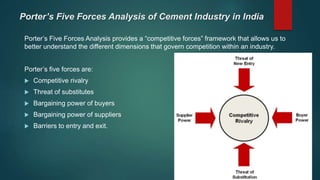
Porter’s Five Forces Analysis of Cement Industry in India
Porter’s Five Forces Analysis provides a “competitive forces” framework that allows us to
better understand the different dimensions that govern competition within an industry.
Porter’s five forces are:
 Competitive rivalry
 Threat of substitutes
 Bargaining power of buyers
 Bargaining power of suppliers
 Barriers to entry and exit.
Threat of New Entry
 Threat of New Entry Entering the business is expensive, given the capital cost of around
Rs7,200 per ton.
 Limited raw material sources (limestone, gypsum) and extreme government clearances also
limits new rivalry.
 Huge players advantage from economies of scale.
 Wide appropriation and showcasing channels are critical key resources that are hard to
imitate by new players, along these lines restricting entry.
 Increasing costs implies bring down IRR for new green-field capacities.
 Generally, high barriers to entry.
Buyer Power
 Around 65% of cement in India is consumed by the housing sector, with retail customers
accounting for the bulk of the customer base. But retail buyers do not have much
leverage in dictating the pricing.
 Lack of substitutes also causes no buyer power.
 Local markets are dominated by small number of cement firms.
 Demand is inelastic— exists at all price points.
 Overall, no buyer power.
 No threat, as there is no substitute for cement. Other building materials such as timber
are only suitable for low-rise buildings. On the other hand, although steel can be used for
medium to high-rise buildings, building regulations normally require structural steel to be
encased in concrete for fire protection purposes. This increases the importance of
cement and hence reduces the threat of its substitutes.
Threat of Substitution
Supplier Power
 Most companies have captive limestone reserves, so no supplier power here.
 Coal linkages have reduced so companies depend more on alternative fuel sources, where
suppliers can dictate prices.
 Cement manufacturers have argued that price hikes in the industry are due to increases in
the price of both transportation and raw materials.
 This means that suppliers are powerful enough to force new prices on the industry.
 Overall, moderate to high supplier power.
 Large companies enjoy economies of scale.
 Competition is regional is nature, as cement cannot be transported across regions.
 Given over-capacity, slowdown in demand weakens prices, so no real pricing power.
 Overall, moderate competitive rivalry.
Competitive Rivalry

Porter's 5 forces

  • 1.
    Five Forces Analysisof Cement Industry in India ASSIGNMENT 2 HARDIK MUNGEKAR 2ND YR. M.ARCH. MARKETING MANAGEMENT HIRAY COLLEGE OF ARCHITECTURE
  • 2.
    Porter’s Five ForcesAnalysis of Cement Industry in India Porter’s Five Forces Analysis provides a “competitive forces” framework that allows us to better understand the different dimensions that govern competition within an industry. Porter’s five forces are:  Competitive rivalry  Threat of substitutes  Bargaining power of buyers  Bargaining power of suppliers  Barriers to entry and exit.
  • 3.
    Threat of NewEntry  Threat of New Entry Entering the business is expensive, given the capital cost of around Rs7,200 per ton.  Limited raw material sources (limestone, gypsum) and extreme government clearances also limits new rivalry.  Huge players advantage from economies of scale.  Wide appropriation and showcasing channels are critical key resources that are hard to imitate by new players, along these lines restricting entry.  Increasing costs implies bring down IRR for new green-field capacities.  Generally, high barriers to entry.
  • 4.
    Buyer Power  Around65% of cement in India is consumed by the housing sector, with retail customers accounting for the bulk of the customer base. But retail buyers do not have much leverage in dictating the pricing.  Lack of substitutes also causes no buyer power.  Local markets are dominated by small number of cement firms.  Demand is inelastic— exists at all price points.  Overall, no buyer power.  No threat, as there is no substitute for cement. Other building materials such as timber are only suitable for low-rise buildings. On the other hand, although steel can be used for medium to high-rise buildings, building regulations normally require structural steel to be encased in concrete for fire protection purposes. This increases the importance of cement and hence reduces the threat of its substitutes. Threat of Substitution
  • 5.
    Supplier Power  Mostcompanies have captive limestone reserves, so no supplier power here.  Coal linkages have reduced so companies depend more on alternative fuel sources, where suppliers can dictate prices.  Cement manufacturers have argued that price hikes in the industry are due to increases in the price of both transportation and raw materials.  This means that suppliers are powerful enough to force new prices on the industry.  Overall, moderate to high supplier power.  Large companies enjoy economies of scale.  Competition is regional is nature, as cement cannot be transported across regions.  Given over-capacity, slowdown in demand weakens prices, so no real pricing power.  Overall, moderate competitive rivalry. Competitive Rivalry