Hacettepe University – Departmant of
Mining Engineering
Erman ÇELİKER
20623877
1
 Bolting Principles
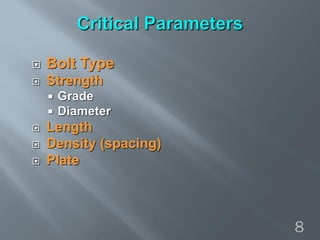
 Critical Parameters
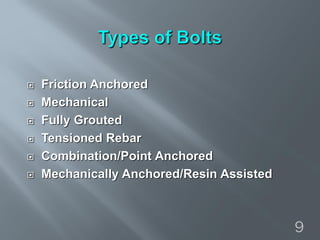
 Types of Bolts
 Grouting
 Mechanism of Fully Grouted Rock Bolts
 Effect of Water/Cement Ratio
 Types of Cement Grouted Rock Bolts
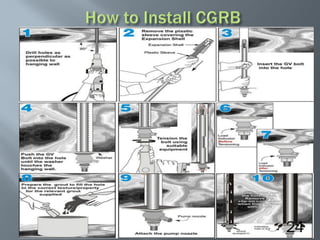
 How to Install Cement Grouted Rock Bolts
 Conclusion
2
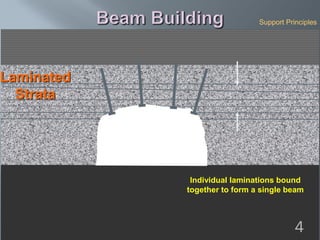
 Beam building
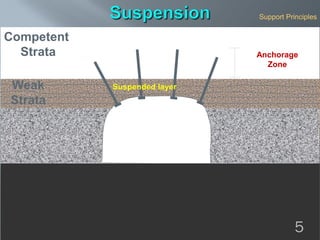
 Suspension
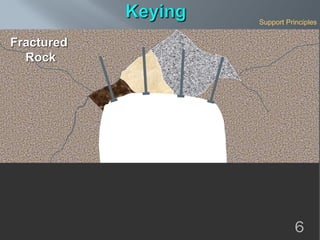
 Keying
 Surface control - natural arch
What is the Bolt System Designed to do?
Rock bolts are used as the main support
for structures such as tunnels and mines where
safety is critical.
3
Weak
Strata
Laminated
Strata
Individual laminations bound
together to form a single beam
Support Principles
4
Competent
Strata
Weak
Strata
Anchorage
Zone
Support Principles
Suspended layer
5
Weak
Strata
Fractured
Rock
Support Principles
6
Surface Control
Highly jointed, altered or
weathered rock
Support Principles
7
 Bolt Type
 Strength
 Grade
 Diameter
 Length
 Density (spacing)
 Plate
8
 Friction Anchored
 Mechanical
 Fully Grouted
 Tensioned Rebar
 Combination/Point Anchored
 Mechanically Anchored/Resin Assisted
9
A number of different grout materials are
used depending on the size of the opening and
the amount of the inflow.
Grouts generally;
such as micro-fine or ultra-fine cements
and/or sodium silicate can be injected.
10
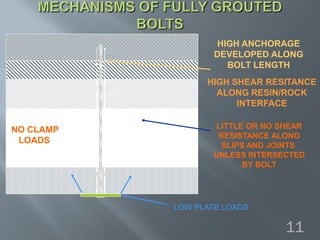
LOW PLATE LOADS
HIGH ANCHORAGE
DEVELOPED ALONG
BOLT LENGTH
NO CLAMP
LOADS
LITTLE OR NO SHEAR
RESISTANCE ALONG
SLIPS AND JOINTS
UNLESS INTERSECTED
BY BOLT
HIGH SHEAR RESITANCE
ALONG RESIN/ROCK
INTERFACE
11
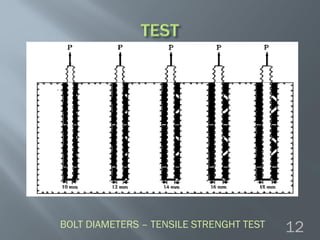
BOLT DIAMETERS – TENSILE STRENGHT TEST 12
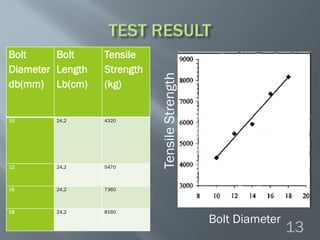
Bolt
Diameter
db(mm)
Bolt
Length
Lb(cm)
Tensile
Strength
(kg)
10 24,2 4320
12 24,2 5470
16 24,2 7360
18 24,2 8160
Bolt Diameter
TensileStrength
13
High speed cement grout mixers are commonly
used which can reasonably ensure uniform mixing
between grout and water.
The grout should be readily pumpable without
being too fluid and a typical water/cement ratio of
0.35 to 0.40 is a good starting point for a grout mix
for rock bolting.
14
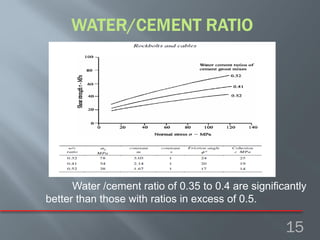
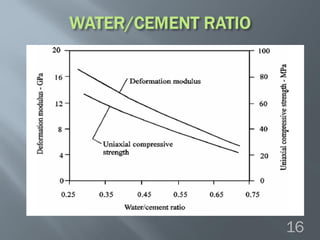
Water /cement ratio of 0.35 to 0.4 are significantly
better than those with ratios in excess of 0.5.
15
16
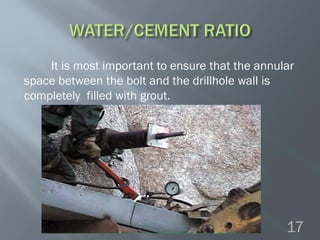
It is most important to ensure that the annular
space between the bolt and the drillhole wall is
completely filled with grout.
17
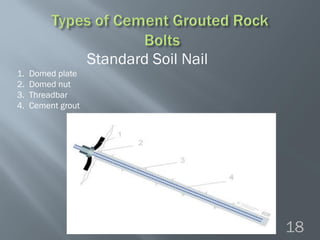
Standard Soil Nail
1. Domed plate
2. Domed nut
3. Threadbar
4. Cement grout
18
DCP-Soil Nail
1. Domed plate
2. Domed nut
3. Threadbar
4. Cement grout
5. Corrugated sheathing
6. Spacer
7. Grout cap
19
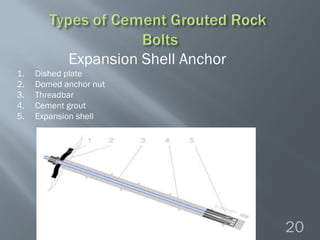
Expansion Shell Anchor
1. Dished plate
2. Domed anchor nut
3. Threadbar
4. Cement grout
5. Expansion shell
20
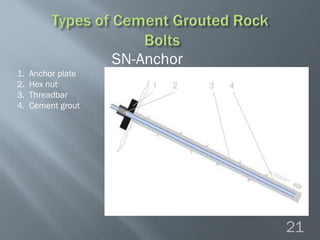
SN-Anchor
1. Anchor plate
2. Hex nut
3. Threadbar
4. Cement grout
21
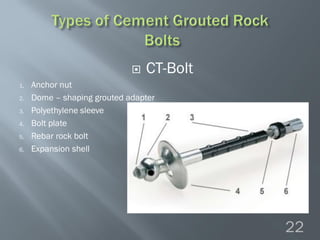
 CT-Bolt
1. Anchor nut
2. Dome – shaping grouted adapter
3. Polyethylene sleeve
4. Bolt plate
5. Rebar rock bolt
6. Expansion shell
22
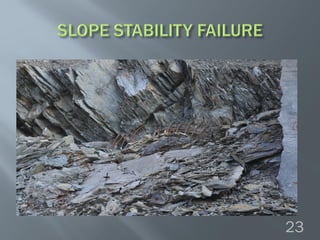
23
24
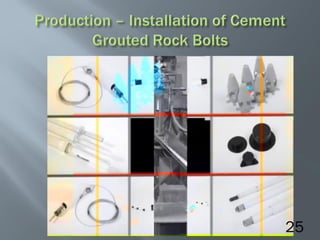
25
Selection of the appropriate cement
anchoring grout can provide many of
the following advantages:
• Rapid strength gain
• Excellent pumpability
• Durability of high strength and low porosity for
long term life
• Resistance to high saline and acidic ground water
shrinkage compensated.
26
 CGRB are the ideal instrument to support high-
medium stiffness zones.
 Cement grouted rock bolts reaches optimum
strenght in few days.
 CGRB are used mainly permanent supporting.
 Cheap and simple application process.
27
Stability control can be provided
during the tunneling operations by making
correct estimations and taking prompt
decisons.
28

Cement grouted rock_bolts (1)

  • 1.
    Hacettepe University –Departmant of Mining Engineering Erman ÇELİKER 20623877 1
  • 2.
     Bolting Principles Critical Parameters  Types of Bolts  Grouting  Mechanism of Fully Grouted Rock Bolts  Effect of Water/Cement Ratio  Types of Cement Grouted Rock Bolts  How to Install Cement Grouted Rock Bolts  Conclusion 2
  • 3.
     Beam building Suspension  Keying  Surface control - natural arch What is the Bolt System Designed to do? Rock bolts are used as the main support for structures such as tunnels and mines where safety is critical. 3
  • 4.
  • 5.
  • 6.
  • 7.
    Surface Control Highly jointed,altered or weathered rock Support Principles 7
  • 8.
     Bolt Type Strength  Grade  Diameter  Length  Density (spacing)  Plate 8
  • 9.
     Friction Anchored Mechanical  Fully Grouted  Tensioned Rebar  Combination/Point Anchored  Mechanically Anchored/Resin Assisted 9
  • 10.
    A number ofdifferent grout materials are used depending on the size of the opening and the amount of the inflow. Grouts generally; such as micro-fine or ultra-fine cements and/or sodium silicate can be injected. 10
  • 11.
    LOW PLATE LOADS HIGHANCHORAGE DEVELOPED ALONG BOLT LENGTH NO CLAMP LOADS LITTLE OR NO SHEAR RESISTANCE ALONG SLIPS AND JOINTS UNLESS INTERSECTED BY BOLT HIGH SHEAR RESITANCE ALONG RESIN/ROCK INTERFACE 11
  • 12.
    BOLT DIAMETERS –TENSILE STRENGHT TEST 12
  • 13.
    Bolt Diameter db(mm) Bolt Length Lb(cm) Tensile Strength (kg) 10 24,2 4320 1224,2 5470 16 24,2 7360 18 24,2 8160 Bolt Diameter TensileStrength 13
  • 14.
    High speed cementgrout mixers are commonly used which can reasonably ensure uniform mixing between grout and water. The grout should be readily pumpable without being too fluid and a typical water/cement ratio of 0.35 to 0.40 is a good starting point for a grout mix for rock bolting. 14
  • 15.
    Water /cement ratioof 0.35 to 0.4 are significantly better than those with ratios in excess of 0.5. 15
  • 16.
  • 17.
    It is mostimportant to ensure that the annular space between the bolt and the drillhole wall is completely filled with grout. 17
  • 18.
    Standard Soil Nail 1.Domed plate 2. Domed nut 3. Threadbar 4. Cement grout 18
  • 19.
    DCP-Soil Nail 1. Domedplate 2. Domed nut 3. Threadbar 4. Cement grout 5. Corrugated sheathing 6. Spacer 7. Grout cap 19
  • 20.
    Expansion Shell Anchor 1.Dished plate 2. Domed anchor nut 3. Threadbar 4. Cement grout 5. Expansion shell 20
  • 21.
    SN-Anchor 1. Anchor plate 2.Hex nut 3. Threadbar 4. Cement grout 21
  • 22.
     CT-Bolt 1. Anchornut 2. Dome – shaping grouted adapter 3. Polyethylene sleeve 4. Bolt plate 5. Rebar rock bolt 6. Expansion shell 22
  • 23.
  • 24.
  • 25.
  • 26.
    Selection of theappropriate cement anchoring grout can provide many of the following advantages: • Rapid strength gain • Excellent pumpability • Durability of high strength and low porosity for long term life • Resistance to high saline and acidic ground water shrinkage compensated. 26
  • 27.
     CGRB arethe ideal instrument to support high- medium stiffness zones.  Cement grouted rock bolts reaches optimum strenght in few days.  CGRB are used mainly permanent supporting.  Cheap and simple application process. 27
  • 28.
    Stability control canbe provided during the tunneling operations by making correct estimations and taking prompt decisons. 28