

P a g e | 1
Holcim Cement (Bangladesh) Ltd
Report on Industrial Attachment
Prepared by,
Md. RahamatUllah
AsmaAkhter
JoyeshreeBiswas
Dept. of Industrial Engineering & Management, KUET.
…………………………………
Md. EnayetHossain
Plant Manager, Holcim cement (Bangladesh) Ltd, Mongla, Bagerhat.
P a g e | 2
Supervised by,
Md. EnayetHossain
Plant Manager,
Holcim Cement (Bangladesh) Ltd, Mongla Plant, Bagerhat.
ATM Omar Faruque
Sr. Manager- Operations
Holcim Cement (Bangladesh) Ltd, Mongla Plant, Bagerhat.
Eng. Md. Rakibul Islam
Executive Engineer
Holcim Cement (Bangladesh) Ltd, Mongla Plant, Bagerhat.
Md. Tariqul Islam
Senior Executive-Taxation and Administration
Holcim Cement (Bangladesh) Ltd, Mongla Plant, Bagerhat.
Nisat Sultan
Executive-procurement
Holcim Cement (Bangladesh) Ltd, Mongla Plant, Bagerhat
SK Kabiril Islam
Sr. Executive-Quality Assurance
Holcim Cement (Bangladesh) Ltd, Mongla Plant, Bagerhat.
Md. Masud Rana
Quality Assurance
Holcim Cement (Bangladesh) Ltd, Mongla Plant, Bagerhat.
P a g e | 3
Contents page
Abstract and Introduction 04
Overview of the company 05
Cement production system 06
Occupational health and safety 08
Quality assurance 10
Maintenance 12
Procurement policy and procedure 13
P a g e | 4
Abstract:
The following report describes an overview of the outcomes of work performed under the
authority of Holcim Cement(Bangladesh) Ltd as an industrial attachment course.
In particular, the report examines our involvement in various particular instructions executed by
our host company Holcim Cement(Bangladesh) Ltd. The task relates to the plant review, safety
learning, production process, quality assurance, Electrical and mechanical maintenance, Taxation
and administration, procurement.
With the help of all professionals involved in the company the tasks we were assigned to were
completed satisfactorily and helped to enrich our knowledge in the cement manufacturing sector.
Introduction:
Cement is one of the most used materials in modern age. All the modern construction can be
called it’s blessing. In this era, cement of good qualities are needed most. Holcim Cement is a
pioneer in cement manufacturing industry. The company has being continuously supplying the
best cement all around the world. To assure the quality this company is working continuously.
In addition to this, this company is a pioneer in assuring safety and different facilities to its
employees.
The following attachment related topics are briefed here:
1.A short overview of the company
2. Cement production system
3. Occupational health and safety
4. Quality assurance
5. Maintenance
6. Procurement policy and procedure
P a g e | 5
# A short overview of the company:
Holcim Bangladesh limited,Mongla factory in a short view:
Holcim Company remains at 70 countries around the world. Here is a short brief of
it’sMongla plant is given:
 .Production has been started from 2002.
 45 Permanent employees.
 Plant area=9.75 acres.
 No of Ball Mills=1.
 There are 3 cement silo’s and capacity of each silo is 1,800MT.
 Four raw materials used extensively which are
i. Clinker
ii. Gypsum
iii. Fly ash
iv. Slag
 Holcim (Mongla plant) mostly produce two types of cement which are
1. OPC (Ordinary Portland cement).
2. Portland composite Cement.
 Packing capacity= 90MT/hour
P a g e | 6
# Cement production system:
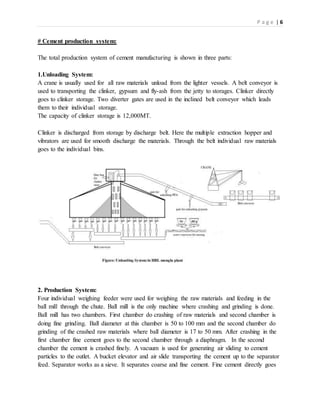
The total production system of cement manufacturing is shown in three parts:
1.Unloading System:
A crane is usually used for all raw materials unload from the lighter vessels. A belt conveyor is
used to transporting the clinker, gypsum and fly-ash from the jetty to storages. Clinker directly
goes to clinker storage. Two diverter gates are used in the inclined belt conveyor which leads
them to their individual storage.
The capacity of clinker storage is 12,000MT.
Clinker is discharged from storage by discharge belt. Here the multiple extraction hopper and
vibrators are used for smooth discharge the materials. Through the belt individual raw materials
goes to the individual bins.
2. Production System:
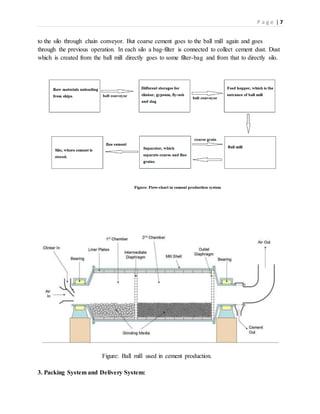
Four individual weighing feeder were used for weighing the raw materials and feeding in the
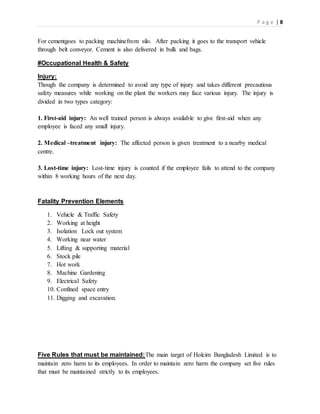
ball mill through the chute. Ball mill is the only machine where crashing and grinding is done.
Ball mill has two chambers. First chamber do crashing of raw materials and second chamber is
doing fine grinding. Ball diameter at this chamber is 50 to 100 mm and the second chamber do
grinding of the crashed raw materials where ball diameter is 17 to 50 mm. After crashing in the
first chamber fine cement goes to the second chamber through a diaphragm. In the second
chamber the cement is crashed finely. A vacuum is used for generating air sliding to cement
particles to the outlet. A bucket elevator and air slide transporting the cement up to the separator
feed. Separator works as a sieve. It separates coarse and fine cement. Fine cement directly goes
P a g e | 7
to the silo through chain conveyor. But coarse cement goes to the ball mill again and goes
through the previous operation. In each silo a bag-filter is connected to collect cement dust. Dust
which is created from the ball mill directly goes to some filter-bag and from that to directly silo.
Figure: Ball mill used in cement production.
3. Packing System and Delivery System:
P a g e | 8
For cementgoes to packing machinefrom silo. After packing it goes to the transport vehicle
through belt conveyor. Cement is also delivered in bulk and bags.
#Occupational Health & Safety
Injury:
Though the company is determined to avoid any type of injury and takes different precautious
safety measures while working on the plant the workers may face various injury. The injury is
divided in two types category:
1. First-aid injury: An well trained person is always available to give first-aid when any
employee is faced any small injury.
2. Medical –treatment injury: The affected person is given treatment to a nearby medical
centre.
3. Lost-time injury: Lost-time injury is counted if the employee fails to attend to the company
within 8 working hours of the next day.
Fatality Prevention Elements
1. Vehicle & Traffic Safety
2. Working at height
3. Isolation Lock out system
4. Working near water
5. Lifting & supporting material
6. Stock pile
7. Hot work
8. Machine Gardening
9. Electrical Safety
10. Confined space entry
11. Digging and excavation.
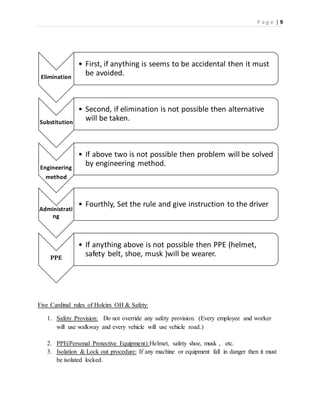
Five Rules that must be maintained:The main target of Holcim Bangladesh Limited is to
maintain zero harm to its employees. In order to maintain zero harm the company set five rules
that must be maintained strictly to its employees.
P a g e | 9
Elimination
• First, if anything is seems to be accidental then it must
be avoided.
Substitution
• Second, if elimination is not possible then alternative
will be taken.
Engineering
method
• If above two is not possible then problem will be solved
by engineering method.
Administrati
ng
• Fourthly, Set the rule and give instruction to the driver
PPE
• If anything above is not possible then PPE (helmet,
safety belt, shoe, musk )will be wearer.
Five Cardinal rules of Holcim OH & Safety:
1. Safety Provision: Do not override any safety provision. (Every employee and worker
will use walkway and every vehicle will use vehicle road.)
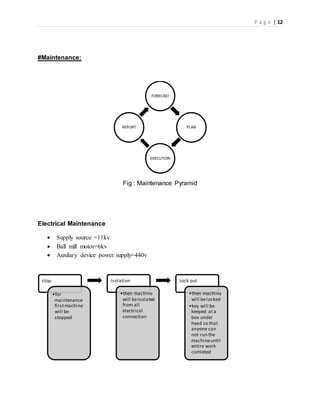
2. PPE(Personal Protective Equipment):Helmet, safety shoe, musk , etc.
3. Isolation & Lock out procedure: If any machine or equipment fall in danger then it must
be isolated locked.
P a g e | 10
For example, If an electrical equipment is under maintenance the power source of that
equipment must be switched off and locked.
4. No alcohol , No drug: Inside factory alcohol and drug taken must be avoided. No worker
is allowed to do his work while he is drunk.
5. Reporting Culture: If danger is seen by anyone, then it must be reported to management.
#Quality Assurance:
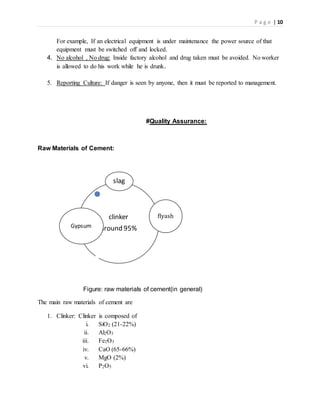
Raw Materials of Cement:
Figure: raw materials of cement(in general)
The main raw materials of cement are
1. Clinker: Clinker is composed of
i. SiO2 (21-22%)
ii. Al2O3
iii. Fe2O3
iv. CaO (65-66%)
v. MgO (2%)
vi. P2O5
clinker
around 95%Gypsum
slag
flyash
P a g e | 11
vii. SO2
viii. Alkalis(Na2O+K2O)
ix. Chloride(Cl-)
2. Gypsum
3. Fly Ash
4. Slag
 Clinker is the main element of cement. If clinker is grinded then grinded powder is
cement but its setting time is very low. So gypsum is added to it to expand its setting time
to facilitate construction work.
 C3S is the element that gives strength to cement.
Physical Test:
There are many ways of physical tests. Among them two parameters of physical test are:
1. Blaine Test (Requirement 3800-4000psi).
2. Residue Test (Requirement 4%-6%).
 Sample is collected at every hour before cement goes to SILO.
 Setting Time: Sample of each 8 hours is mixed and setting time of the block is measured
which is usually 200-220min (For PCC).
 Strength Requirement as per ASTM standard (minimum):
 After 3 days, ASTM= 1800psi.
 After 7 days, ASTM= 2800psi.
 After 28 days, ASTM= 4000psi.
Chemical Test:
In chemical test the chemical composition of raw materials and cement are tested. Chemical tests
give the exact composition of raw materials and fine cement. It also suggests what will be the
ratio of the raw materials during mixing in feed hopper.
P a g e | 12
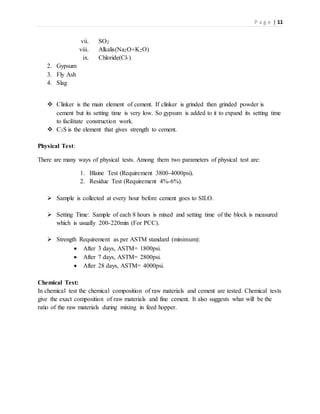
#Maintenance:
Fig : Maintenance Pyramid
Electrical Maintenance
 Supply source =11kv
 Ball mill motor=6kv
 Auxilary device power supply=440v
FORECAST
PLAN
EXECUTION
REPORT
stop
•for
maintenance
firstmachine
will be
stopped
Isolation
•then machine
will beisolated
from all
electrical
connection
Lock out
•then machine
will belocked
•key will be
keeped at a
box under
head so that
anyone can
not run the
machineuntil
entire work
comleted
P a g e | 13
# Procurement policy & procedure:
Procurement is defined as any activity that leads to an expenditure made by OpCos
in exchange for goods or services.
Policies & Procedures: In brief this implies the following:
# Procurement aims at minimizing Total Cost of Ownership including purchase
price, lifetime of goods or services and disposal at the end of lifetime.
# All procurement activity must support the overall company strategy.
# Procurement considers all risks.
# All procurement activities conform to the Code of Practice for Procurement.
# In case of doubt, employee should seek further advice of their respective
Business Process Owners (BPO) for clarifications.
SCOPE
This document applies to all procurement activities carried out at all Holcim in
Bangladesh.
Records:
POs
The Head of Procurement is responsible to file all documents related to the
procurement of goods and services for at least 1 year at the Procurement office.
Procurement and Warehouse & Inventories KPI Reports:
The Head of Procurement and the Warehouse & Inventories Manager are responsible to
keep all KPI reports at least 2 years in the computer server.
Inventory Management Documents:
The Warehouse & Inventories Manager / Supervisor is responsible to file all documents
related to inventory management at least 2 years at the Warehouse & Inventories office.
Logistics activity:
In Holcim Bangladesh Limited the procedure can be categorized for
1. Material purchase
2. Service.
P a g e | 14
purchase requisition and purchase policy:
#Purchase Requisition is a mandatory process preceding the following functions :
• Request for Quotation
• Purchase Order
# The user of respective department creates Purchase Requisition through PR form. The
supervisor of the user will then review the requested material code and cost center code
in the PR and approve the PR in accordance with the PR approval limit.
# The initiator of a PR must provide full details of the goods or services to be procured,
tentative delivery date & place and including an estimate of the purchase value. This is
to determine the level of approval authority. For unknown purchase values,
Procurement will help to determine the initial value.
# If supplier bids or price negotiations exceed by more than 10 percent the estimated
cost or maximum amount specified on the purchase requisition, Procurement will not
place the order unless authorized by the requesting department and will have to undergo
the approval again.
# Any changes which increase the PR amount will have to undergo the approval again.
# PR must meet company requirement such as Company need, QESH, price/budget, etc.
# A PR or WO leading to a PR can only be cancelled if a respective PO has not been
sent to the supplier yet by discussing with procurement.
# After PR is approved, Procurement Department will prepare the quotation from
vendor and appoint the winning vendor.
# POs are created in the SAP system and the system generates an individual sequential
PO number. Only authorized employees can release (approve) the purchase orders in
accordance to the approved release strategy.
# After job completion of a vender a job completion certificate is issued.
P a g e | 15
Conclusion: The industrial attachment to Holcim Cement (Bangladesh), Ltd was completed
successfully and satisfactorily with the help of all professionals involved to the company.
P a g e | 16

Report on Industrial attachment with HBL

  • 1.
    P a ge | 1 Holcim Cement (Bangladesh) Ltd Report on Industrial Attachment Prepared by, Md. RahamatUllah AsmaAkhter JoyeshreeBiswas Dept. of Industrial Engineering & Management, KUET. ………………………………… Md. EnayetHossain Plant Manager, Holcim cement (Bangladesh) Ltd, Mongla, Bagerhat.
  • 2.
    P a ge | 2 Supervised by, Md. EnayetHossain Plant Manager, Holcim Cement (Bangladesh) Ltd, Mongla Plant, Bagerhat. ATM Omar Faruque Sr. Manager- Operations Holcim Cement (Bangladesh) Ltd, Mongla Plant, Bagerhat. Eng. Md. Rakibul Islam Executive Engineer Holcim Cement (Bangladesh) Ltd, Mongla Plant, Bagerhat. Md. Tariqul Islam Senior Executive-Taxation and Administration Holcim Cement (Bangladesh) Ltd, Mongla Plant, Bagerhat. Nisat Sultan Executive-procurement Holcim Cement (Bangladesh) Ltd, Mongla Plant, Bagerhat SK Kabiril Islam Sr. Executive-Quality Assurance Holcim Cement (Bangladesh) Ltd, Mongla Plant, Bagerhat. Md. Masud Rana Quality Assurance Holcim Cement (Bangladesh) Ltd, Mongla Plant, Bagerhat.
  • 3.
    P a ge | 3 Contents page Abstract and Introduction 04 Overview of the company 05 Cement production system 06 Occupational health and safety 08 Quality assurance 10 Maintenance 12 Procurement policy and procedure 13
  • 4.
    P a ge | 4 Abstract: The following report describes an overview of the outcomes of work performed under the authority of Holcim Cement(Bangladesh) Ltd as an industrial attachment course. In particular, the report examines our involvement in various particular instructions executed by our host company Holcim Cement(Bangladesh) Ltd. The task relates to the plant review, safety learning, production process, quality assurance, Electrical and mechanical maintenance, Taxation and administration, procurement. With the help of all professionals involved in the company the tasks we were assigned to were completed satisfactorily and helped to enrich our knowledge in the cement manufacturing sector. Introduction: Cement is one of the most used materials in modern age. All the modern construction can be called it’s blessing. In this era, cement of good qualities are needed most. Holcim Cement is a pioneer in cement manufacturing industry. The company has being continuously supplying the best cement all around the world. To assure the quality this company is working continuously. In addition to this, this company is a pioneer in assuring safety and different facilities to its employees. The following attachment related topics are briefed here: 1.A short overview of the company 2. Cement production system 3. Occupational health and safety 4. Quality assurance 5. Maintenance 6. Procurement policy and procedure
  • 5.
    P a ge | 5 # A short overview of the company: Holcim Bangladesh limited,Mongla factory in a short view: Holcim Company remains at 70 countries around the world. Here is a short brief of it’sMongla plant is given:  .Production has been started from 2002.  45 Permanent employees.  Plant area=9.75 acres.  No of Ball Mills=1.  There are 3 cement silo’s and capacity of each silo is 1,800MT.  Four raw materials used extensively which are i. Clinker ii. Gypsum iii. Fly ash iv. Slag  Holcim (Mongla plant) mostly produce two types of cement which are 1. OPC (Ordinary Portland cement). 2. Portland composite Cement.  Packing capacity= 90MT/hour
  • 6.
    P a ge | 6 # Cement production system: The total production system of cement manufacturing is shown in three parts: 1.Unloading System: A crane is usually used for all raw materials unload from the lighter vessels. A belt conveyor is used to transporting the clinker, gypsum and fly-ash from the jetty to storages. Clinker directly goes to clinker storage. Two diverter gates are used in the inclined belt conveyor which leads them to their individual storage. The capacity of clinker storage is 12,000MT. Clinker is discharged from storage by discharge belt. Here the multiple extraction hopper and vibrators are used for smooth discharge the materials. Through the belt individual raw materials goes to the individual bins. 2. Production System: Four individual weighing feeder were used for weighing the raw materials and feeding in the ball mill through the chute. Ball mill is the only machine where crashing and grinding is done. Ball mill has two chambers. First chamber do crashing of raw materials and second chamber is doing fine grinding. Ball diameter at this chamber is 50 to 100 mm and the second chamber do grinding of the crashed raw materials where ball diameter is 17 to 50 mm. After crashing in the first chamber fine cement goes to the second chamber through a diaphragm. In the second chamber the cement is crashed finely. A vacuum is used for generating air sliding to cement particles to the outlet. A bucket elevator and air slide transporting the cement up to the separator feed. Separator works as a sieve. It separates coarse and fine cement. Fine cement directly goes
  • 7.
    P a ge | 7 to the silo through chain conveyor. But coarse cement goes to the ball mill again and goes through the previous operation. In each silo a bag-filter is connected to collect cement dust. Dust which is created from the ball mill directly goes to some filter-bag and from that to directly silo. Figure: Ball mill used in cement production. 3. Packing System and Delivery System:
  • 8.
    P a ge | 8 For cementgoes to packing machinefrom silo. After packing it goes to the transport vehicle through belt conveyor. Cement is also delivered in bulk and bags. #Occupational Health & Safety Injury: Though the company is determined to avoid any type of injury and takes different precautious safety measures while working on the plant the workers may face various injury. The injury is divided in two types category: 1. First-aid injury: An well trained person is always available to give first-aid when any employee is faced any small injury. 2. Medical –treatment injury: The affected person is given treatment to a nearby medical centre. 3. Lost-time injury: Lost-time injury is counted if the employee fails to attend to the company within 8 working hours of the next day. Fatality Prevention Elements 1. Vehicle & Traffic Safety 2. Working at height 3. Isolation Lock out system 4. Working near water 5. Lifting & supporting material 6. Stock pile 7. Hot work 8. Machine Gardening 9. Electrical Safety 10. Confined space entry 11. Digging and excavation. Five Rules that must be maintained:The main target of Holcim Bangladesh Limited is to maintain zero harm to its employees. In order to maintain zero harm the company set five rules that must be maintained strictly to its employees.
  • 9.
    P a ge | 9 Elimination • First, if anything is seems to be accidental then it must be avoided. Substitution • Second, if elimination is not possible then alternative will be taken. Engineering method • If above two is not possible then problem will be solved by engineering method. Administrati ng • Fourthly, Set the rule and give instruction to the driver PPE • If anything above is not possible then PPE (helmet, safety belt, shoe, musk )will be wearer. Five Cardinal rules of Holcim OH & Safety: 1. Safety Provision: Do not override any safety provision. (Every employee and worker will use walkway and every vehicle will use vehicle road.) 2. PPE(Personal Protective Equipment):Helmet, safety shoe, musk , etc. 3. Isolation & Lock out procedure: If any machine or equipment fall in danger then it must be isolated locked.
  • 10.
    P a ge | 10 For example, If an electrical equipment is under maintenance the power source of that equipment must be switched off and locked. 4. No alcohol , No drug: Inside factory alcohol and drug taken must be avoided. No worker is allowed to do his work while he is drunk. 5. Reporting Culture: If danger is seen by anyone, then it must be reported to management. #Quality Assurance: Raw Materials of Cement: Figure: raw materials of cement(in general) The main raw materials of cement are 1. Clinker: Clinker is composed of i. SiO2 (21-22%) ii. Al2O3 iii. Fe2O3 iv. CaO (65-66%) v. MgO (2%) vi. P2O5 clinker around 95%Gypsum slag flyash
  • 11.
    P a ge | 11 vii. SO2 viii. Alkalis(Na2O+K2O) ix. Chloride(Cl-) 2. Gypsum 3. Fly Ash 4. Slag  Clinker is the main element of cement. If clinker is grinded then grinded powder is cement but its setting time is very low. So gypsum is added to it to expand its setting time to facilitate construction work.  C3S is the element that gives strength to cement. Physical Test: There are many ways of physical tests. Among them two parameters of physical test are: 1. Blaine Test (Requirement 3800-4000psi). 2. Residue Test (Requirement 4%-6%).  Sample is collected at every hour before cement goes to SILO.  Setting Time: Sample of each 8 hours is mixed and setting time of the block is measured which is usually 200-220min (For PCC).  Strength Requirement as per ASTM standard (minimum):  After 3 days, ASTM= 1800psi.  After 7 days, ASTM= 2800psi.  After 28 days, ASTM= 4000psi. Chemical Test: In chemical test the chemical composition of raw materials and cement are tested. Chemical tests give the exact composition of raw materials and fine cement. It also suggests what will be the ratio of the raw materials during mixing in feed hopper.
  • 12.
    P a ge | 12 #Maintenance: Fig : Maintenance Pyramid Electrical Maintenance  Supply source =11kv  Ball mill motor=6kv  Auxilary device power supply=440v FORECAST PLAN EXECUTION REPORT stop •for maintenance firstmachine will be stopped Isolation •then machine will beisolated from all electrical connection Lock out •then machine will belocked •key will be keeped at a box under head so that anyone can not run the machineuntil entire work comleted
  • 13.
    P a ge | 13 # Procurement policy & procedure: Procurement is defined as any activity that leads to an expenditure made by OpCos in exchange for goods or services. Policies & Procedures: In brief this implies the following: # Procurement aims at minimizing Total Cost of Ownership including purchase price, lifetime of goods or services and disposal at the end of lifetime. # All procurement activity must support the overall company strategy. # Procurement considers all risks. # All procurement activities conform to the Code of Practice for Procurement. # In case of doubt, employee should seek further advice of their respective Business Process Owners (BPO) for clarifications. SCOPE This document applies to all procurement activities carried out at all Holcim in Bangladesh. Records: POs The Head of Procurement is responsible to file all documents related to the procurement of goods and services for at least 1 year at the Procurement office. Procurement and Warehouse & Inventories KPI Reports: The Head of Procurement and the Warehouse & Inventories Manager are responsible to keep all KPI reports at least 2 years in the computer server. Inventory Management Documents: The Warehouse & Inventories Manager / Supervisor is responsible to file all documents related to inventory management at least 2 years at the Warehouse & Inventories office. Logistics activity: In Holcim Bangladesh Limited the procedure can be categorized for 1. Material purchase 2. Service.
  • 14.
    P a ge | 14 purchase requisition and purchase policy: #Purchase Requisition is a mandatory process preceding the following functions : • Request for Quotation • Purchase Order # The user of respective department creates Purchase Requisition through PR form. The supervisor of the user will then review the requested material code and cost center code in the PR and approve the PR in accordance with the PR approval limit. # The initiator of a PR must provide full details of the goods or services to be procured, tentative delivery date & place and including an estimate of the purchase value. This is to determine the level of approval authority. For unknown purchase values, Procurement will help to determine the initial value. # If supplier bids or price negotiations exceed by more than 10 percent the estimated cost or maximum amount specified on the purchase requisition, Procurement will not place the order unless authorized by the requesting department and will have to undergo the approval again. # Any changes which increase the PR amount will have to undergo the approval again. # PR must meet company requirement such as Company need, QESH, price/budget, etc. # A PR or WO leading to a PR can only be cancelled if a respective PO has not been sent to the supplier yet by discussing with procurement. # After PR is approved, Procurement Department will prepare the quotation from vendor and appoint the winning vendor. # POs are created in the SAP system and the system generates an individual sequential PO number. Only authorized employees can release (approve) the purchase orders in accordance to the approved release strategy. # After job completion of a vender a job completion certificate is issued.
  • 15.
    P a ge | 15 Conclusion: The industrial attachment to Holcim Cement (Bangladesh), Ltd was completed successfully and satisfactorily with the help of all professionals involved to the company.
  • 16.
    P a ge | 16