There are two types of transport mechanisms: passive
and active transport.
Passive transport does not require to
expend energy to occur, while active
transport needs to use energy in the cell.
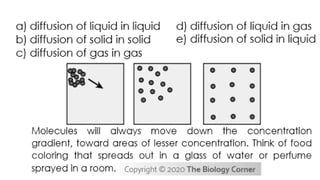
This is the movement of particles
from an area of higher
concentration to an area of lower
concentration, thus leading to
equalization of the concentration
throughout the area of diffusion.
It is also defined as the spreading of
the particles of one substance among
the particles of another substance
following a concentration gradient (or
“downhill” movement of the
substance).
This is the diffusion of water across a semi-
permeable membrane. The two important
requirements for osmosis to take place are 1)
presence of a semi-permeable membrane and
2) presence of a concentration gradient. These
two affects the cell’s ability to gain or lose
water called as tonicity (isotonic, hypertonic,
and hypotonic).

Cell Transport Mechanism.pptx

  • 3.
    There are twotypes of transport mechanisms: passive and active transport. Passive transport does not require to expend energy to occur, while active transport needs to use energy in the cell.
  • 4.
    This is themovement of particles from an area of higher concentration to an area of lower concentration, thus leading to equalization of the concentration throughout the area of diffusion.
  • 5.
    It is alsodefined as the spreading of the particles of one substance among the particles of another substance following a concentration gradient (or “downhill” movement of the substance).
  • 7.
    This is thediffusion of water across a semi- permeable membrane. The two important requirements for osmosis to take place are 1) presence of a semi-permeable membrane and 2) presence of a concentration gradient. These two affects the cell’s ability to gain or lose water called as tonicity (isotonic, hypertonic, and hypotonic).