Monday 17 October
  Topic: Cellular Respiration
DO NOW:
• Brainstorm everything that you can about energy.
Think about things such as where it comes from, how it
becomes available, how does it change into other forms,
what is it used for, what types there are, etc.
HW:
• 8-1 Reading for Understanding
Objective
   By the end of this class, you will be able
    to write the chemical equation for cell
    respiration and identify its reactants and
    products.


Agenda
   Notes on cell respiration
Why do we need energy?
 Heterotrophs and Autotrophs
 The ability to do work
 To live
 To power functions in the cell
 To do your homework (muscle fiber,
  thinking)
 To move
In what form is energy available?
 Solar energy
 Electric energy
 Kinetic
 Chemical
 Potential
 Nuclear
How does our body convert this
energy?
 ENERGY MUST BE AS ATP
 Adenosine Tri-phosphate
 We do not eat ATP
 The mitochondria makes it with
  metabolism
 What it takes in is called reactants
 Products come out of a reaction
Where do the waste products go?
 There are two waste products
 #1- Carbon dioxide-exhaling
 #2- Water-urinating, sweating, and
  exhaling
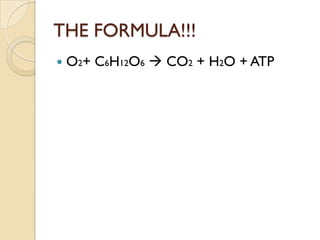
THE FORMULA!!!
   O2+ C6H12O6  CO2 + H2O + ATP
Tuesday 18 October
  Topic: Measuring energy in food
DO NOW:
• Pick up a lab packet from the kidney table and
complete the pre-lab assignment


HW:
• Post-lab analysis questions
Objective
 Identify 3 similarities and 2 differences
  between cell respiration and burning food.
 Calculate the number of calories in a Frito


Agenda
 Lab protocol
 Demo of burning food
 Labs part 1 & II
Lab Protocol
                 All bags/excess paper/etc must be off the
                  lab tables
                 Any hair long enough is to be tied back
                 During the burning portion, absolutely no
                  getting up for anything (wait until after
                  this portion of the lab is complete)


Identify 3 similarities and 2 differences between cell respiration and burning food.
Calculate the number of calories in a Frito
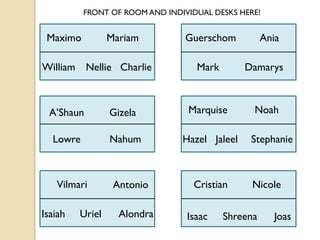
FRONT OF ROOM AND INDIVIDUAL DESKS HERE!


 Maximo          Mariam          Guerschom          Ania

William Nellie Charlie             Mark        Damarys


 A’Shaun         Gizela          Marquise       Noah

  Lowre          Nahum          Hazel Jaleel    Stephanie


   Vilmari        Antonio         Cristian      Nicole

Isaiah   Uriel     Alondra       Isaac    Shreena      Joas
If you’ve finished…
               Part I (burning food) of the lab
                ◦ Complete the table on pg 1
                ◦ Write the analysis comparing and contrasting
                  burning food to cell respiration

               Part II (measuring calories)
                ◦ Make sure all your data is filled in

               Both parts of the lab
                ◦ Make sure all lab pieces are in the metal tray
                ◦ Start on the remainder of the analysis questions
Identify 3 similarities and 2 differences between cell respiration and burning food.
Calculate the number of calories in a Frito
Thursday 20 October
Topic: Exercise, Cell Respiration, and
your body
DO NOW:
• Pick up a packet from the kidney table and complete the
front page (“pre-lab”). You should fill in the blanks and
write hypotheses for how exercise affects the body.


HW:
• Reflections and conclusions questions
• Study for quiz
Objective
   Explain how the chemical equation for
    cell respiration relates to breathing, and
    why we breathe harder during exercise.


Agenda
 Protocol for outdoor activity
 How to measure a pulse
 Outside activity!
Pulse & Breathing rate
 Everyone focus for a few seconds and
  note if your breathing is slow, medium, or
  fast (compared to how you normally
  breathe)
 Next, find your pulse on your neck or
  your wrist and we will measure it for 15
  seconds
    ◦ Multiply this number by 4 to get beats/min
      (bpm)
Before going outside…
 You only need to bring your lab and a pencil
  and can leave everything else here
 We go out the back stairs, out the door, and
  around to the crosswalk
 Line up with your partner along the edge of
  the basketball court by the red stairs
 Once everyone completes the activity, listen
  for me to say “Now” and “End” which will be
  the timed minute for pulse
 Swap with your partner
Friday 21 October
Topic: Cell Respiration Review & Quiz
DO NOW:
• Get a clicker from the kidney table and review sheet
• Take out your notes on cell respiration


HW:
• Read 38-1 and take notes in your notebook
• Think of a food/meal that contains carbohydrates, lipids
(fats), and proteins. Write it down after your reading
notes!
Objective
   By the end of this class, you will be able
    to apply knowledge of cellular respiration
    to answer short-answer and open-
    response questions on the quiz


Agenda
 Cell respiration review
 Quiz
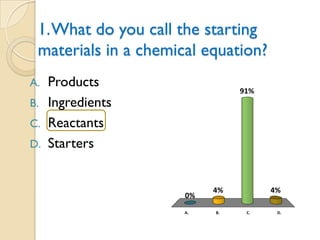
1. What do you call the starting
 materials in a chemical equation?
A.   Products
                                91%
B.   Ingredients
C.   Reactants
D.   Starters


                           4%         4%
                      0%
                      A.   B.    C.    D.
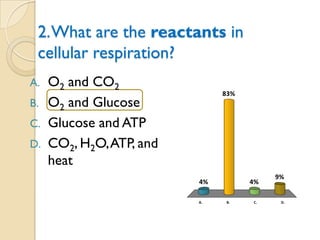
2. What are the reactants in
 cellular respiration?
A.   O2 and CO2
                               83%
B.   O2 and Glucose
C.   Glucose and ATP
D.   CO2, H2O, ATP, and
     heat
                                          9%
                          4%         4%

                          A.   B.    C.    D.
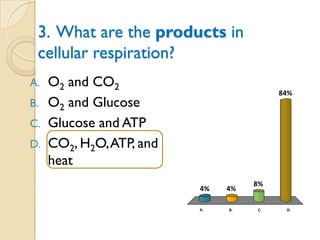
3. What are the products in
 cellular respiration?
A.   O2 and CO2
                                         84%
B.   O2 and Glucose
C.   Glucose and ATP
D.   CO2, H2O, ATP, and
     heat
                                    8%
                          4%   4%

                          A.   B.   C.    D.
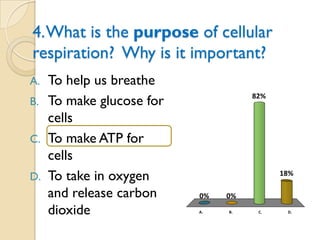
4. What is the purpose of cellular
respiration? Why is it important?
A.   To help us breathe
B.   To make glucose for             82%


     cells
C.   To make ATP for
     cells
D.   To take in oxygen                     18%

     and release carbon    0%   0%

     dioxide               A.   B.    C.    D.
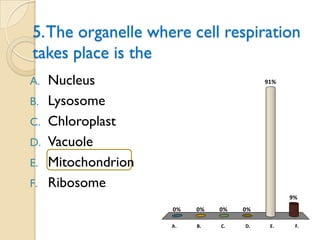
5. The organelle where cell respiration
takes place is the
A.   Nucleus                             91%


B.   Lysosome
C.   Chloroplast
D.   Vacuole
E.   Mitochondrion
F.   Ribosome
                                               9%
                     0%   0%   0%   0%

                     A.   B.   C.   D.    E.    F.
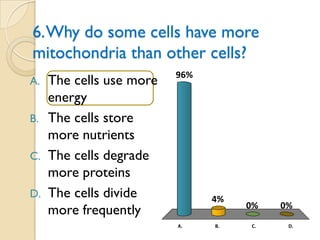
6. Why do some cells have more
mitochondria than other cells?
                          96%
A.   The cells use more
     energy
B.   The cells store
     more nutrients
C.   The cells degrade
     more proteins
D.   The cells divide           4%
     more frequently                 0%   0%
                          A.    B.   C.    D.
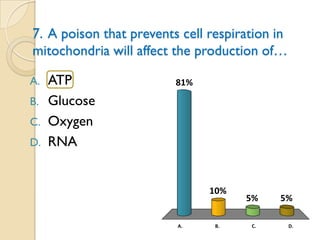
7. A poison that prevents cell respiration in
mitochondria will affect the production of…

A.   ATP                 81%

B.   Glucose
C.   Oxygen
D.   RNA


                               10%
                                     5%    5%

                         A.     B.    C.        D.
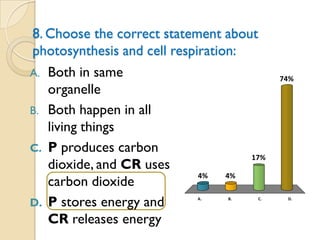
8. Choose the correct statement about
photosynthesis and cell respiration:
A.   Both in same                            74%
     organelle
B.   Both happen in all
     living things
C.   P produces carbon
                                      17%
     dioxide, and CR uses
                            4%   4%
     carbon dioxide
D.   P stores energy and    A.   B.     C.    D.


     CR releases energy
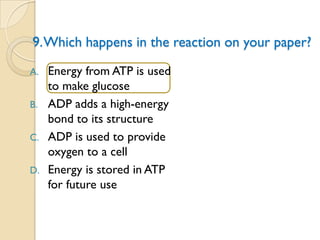
9. Which happens in the reaction on your paper?
A. Energy from ATP is used
   to make glucose
B. ADP adds a high-energy
   bond to its structure
C. ADP is used to provide
   oxygen to a cell
D. Energy is stored in ATP
   for future use
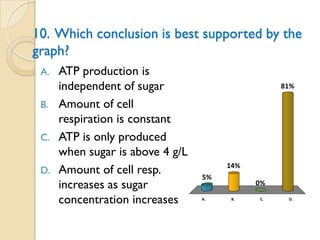
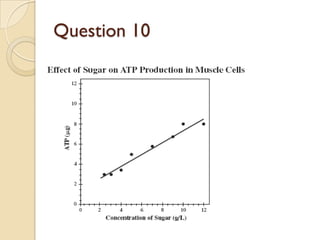
10. Which conclusion is best supported by the
graph?
 A. ATP production is
    independent of sugar                        81%

 B. Amount of cell
    respiration is constant
 C. ATP is only produced
    when sugar is above 4 g/L
 D. Amount of cell resp.
                                     14%
                                5%
    increases as sugar                     0%

    concentration increases     A.   B.    C.    D.
Question 10
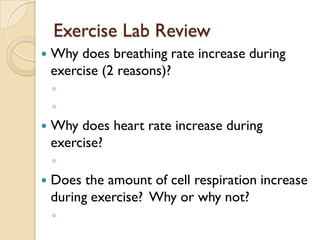
Exercise Lab Review
   Why does breathing rate increase during
    exercise (2 reasons)?
    ◦
    ◦
   Why does heart rate increase during
    exercise?
    ◦
   Does the amount of cell respiration increase
    during exercise? Why or why not?
    ◦

Cell respirationa

  • 1.
    Monday 17 October Topic: Cellular Respiration DO NOW: • Brainstorm everything that you can about energy. Think about things such as where it comes from, how it becomes available, how does it change into other forms, what is it used for, what types there are, etc. HW: • 8-1 Reading for Understanding
  • 2.
    Objective  By the end of this class, you will be able to write the chemical equation for cell respiration and identify its reactants and products. Agenda  Notes on cell respiration
  • 3.
    Why do weneed energy?  Heterotrophs and Autotrophs  The ability to do work  To live  To power functions in the cell  To do your homework (muscle fiber, thinking)  To move
  • 4.
    In what formis energy available?  Solar energy  Electric energy  Kinetic  Chemical  Potential  Nuclear
  • 5.
    How does ourbody convert this energy?  ENERGY MUST BE AS ATP  Adenosine Tri-phosphate  We do not eat ATP  The mitochondria makes it with metabolism  What it takes in is called reactants  Products come out of a reaction
  • 6.
    Where do thewaste products go?  There are two waste products  #1- Carbon dioxide-exhaling  #2- Water-urinating, sweating, and exhaling
  • 7.
    THE FORMULA!!!  O2+ C6H12O6  CO2 + H2O + ATP
  • 8.
    Tuesday 18 October Topic: Measuring energy in food DO NOW: • Pick up a lab packet from the kidney table and complete the pre-lab assignment HW: • Post-lab analysis questions
  • 9.
    Objective  Identify 3similarities and 2 differences between cell respiration and burning food.  Calculate the number of calories in a Frito Agenda  Lab protocol  Demo of burning food  Labs part 1 & II
  • 10.
    Lab Protocol  All bags/excess paper/etc must be off the lab tables  Any hair long enough is to be tied back  During the burning portion, absolutely no getting up for anything (wait until after this portion of the lab is complete) Identify 3 similarities and 2 differences between cell respiration and burning food. Calculate the number of calories in a Frito
  • 11.
    FRONT OF ROOMAND INDIVIDUAL DESKS HERE! Maximo Mariam Guerschom Ania William Nellie Charlie Mark Damarys A’Shaun Gizela Marquise Noah Lowre Nahum Hazel Jaleel Stephanie Vilmari Antonio Cristian Nicole Isaiah Uriel Alondra Isaac Shreena Joas
  • 12.
    If you’ve finished…  Part I (burning food) of the lab ◦ Complete the table on pg 1 ◦ Write the analysis comparing and contrasting burning food to cell respiration  Part II (measuring calories) ◦ Make sure all your data is filled in  Both parts of the lab ◦ Make sure all lab pieces are in the metal tray ◦ Start on the remainder of the analysis questions Identify 3 similarities and 2 differences between cell respiration and burning food. Calculate the number of calories in a Frito
  • 13.
    Thursday 20 October Topic:Exercise, Cell Respiration, and your body DO NOW: • Pick up a packet from the kidney table and complete the front page (“pre-lab”). You should fill in the blanks and write hypotheses for how exercise affects the body. HW: • Reflections and conclusions questions • Study for quiz
  • 14.
    Objective  Explain how the chemical equation for cell respiration relates to breathing, and why we breathe harder during exercise. Agenda  Protocol for outdoor activity  How to measure a pulse  Outside activity!
  • 15.
    Pulse & Breathingrate  Everyone focus for a few seconds and note if your breathing is slow, medium, or fast (compared to how you normally breathe)  Next, find your pulse on your neck or your wrist and we will measure it for 15 seconds ◦ Multiply this number by 4 to get beats/min (bpm)
  • 16.
    Before going outside… You only need to bring your lab and a pencil and can leave everything else here  We go out the back stairs, out the door, and around to the crosswalk  Line up with your partner along the edge of the basketball court by the red stairs  Once everyone completes the activity, listen for me to say “Now” and “End” which will be the timed minute for pulse  Swap with your partner
  • 17.
    Friday 21 October Topic:Cell Respiration Review & Quiz DO NOW: • Get a clicker from the kidney table and review sheet • Take out your notes on cell respiration HW: • Read 38-1 and take notes in your notebook • Think of a food/meal that contains carbohydrates, lipids (fats), and proteins. Write it down after your reading notes!
  • 18.
    Objective  By the end of this class, you will be able to apply knowledge of cellular respiration to answer short-answer and open- response questions on the quiz Agenda  Cell respiration review  Quiz
  • 19.
    1. What doyou call the starting materials in a chemical equation? A. Products 91% B. Ingredients C. Reactants D. Starters 4% 4% 0% A. B. C. D.
  • 20.
    2. What arethe reactants in cellular respiration? A. O2 and CO2 83% B. O2 and Glucose C. Glucose and ATP D. CO2, H2O, ATP, and heat 9% 4% 4% A. B. C. D.
  • 21.
    3. What arethe products in cellular respiration? A. O2 and CO2 84% B. O2 and Glucose C. Glucose and ATP D. CO2, H2O, ATP, and heat 8% 4% 4% A. B. C. D.
  • 22.
    4. What isthe purpose of cellular respiration? Why is it important? A. To help us breathe B. To make glucose for 82% cells C. To make ATP for cells D. To take in oxygen 18% and release carbon 0% 0% dioxide A. B. C. D.
  • 23.
    5. The organellewhere cell respiration takes place is the A. Nucleus 91% B. Lysosome C. Chloroplast D. Vacuole E. Mitochondrion F. Ribosome 9% 0% 0% 0% 0% A. B. C. D. E. F.
  • 24.
    6. Why dosome cells have more mitochondria than other cells? 96% A. The cells use more energy B. The cells store more nutrients C. The cells degrade more proteins D. The cells divide 4% more frequently 0% 0% A. B. C. D.
  • 25.
    7. A poisonthat prevents cell respiration in mitochondria will affect the production of… A. ATP 81% B. Glucose C. Oxygen D. RNA 10% 5% 5% A. B. C. D.
  • 26.
    8. Choose thecorrect statement about photosynthesis and cell respiration: A. Both in same 74% organelle B. Both happen in all living things C. P produces carbon 17% dioxide, and CR uses 4% 4% carbon dioxide D. P stores energy and A. B. C. D. CR releases energy
  • 27.
    9. Which happensin the reaction on your paper? A. Energy from ATP is used to make glucose B. ADP adds a high-energy bond to its structure C. ADP is used to provide oxygen to a cell D. Energy is stored in ATP for future use
  • 28.
    10. Which conclusionis best supported by the graph? A. ATP production is independent of sugar 81% B. Amount of cell respiration is constant C. ATP is only produced when sugar is above 4 g/L D. Amount of cell resp. 14% 5% increases as sugar 0% concentration increases A. B. C. D.
  • 29.
  • 30.
    Exercise Lab Review  Why does breathing rate increase during exercise (2 reasons)? ◦ ◦  Why does heart rate increase during exercise? ◦  Does the amount of cell respiration increase during exercise? Why or why not? ◦