Celebrations and Food
Comenius Project “Lost in Time”
Istituto Superiore “Majorana”
Palermo (Italy)
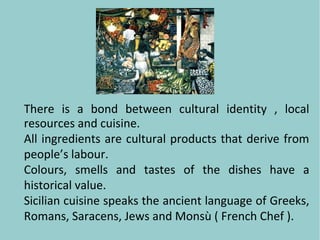
There is a bond between cultural identity , local
resources and cuisine.
All ingredients are cultural products that derive from
people’s labour.
Colours, smells and tastes of the dishes have a
historical value.
Sicilian cuisine speaks the ancient language of Greeks,
Romans, Saracens, Jews and Monsù ( French Chef ).
Carnival Carnevale
Carnival is a festival
celebrated in countries of
Christian tradition. Public
parades with allegoric
and playful elements take
place The typical feature
is the use of masks.
The most common
Carnival sweets are
different kinds of fritters
and doughnuts.
Le Frittelle di carnevale
Le Zeppole
Le Cicerchiate di carnevale
Le Castagnole
Le Chiacchiere
Le Ciambelle
Saint Joseph San Giuseppe
• St. Joseph is the patron of poor and indigent. To
thank the Lord for a grace received, on 19 March
some families set up “tavolate”, a banquet, at
home for indigent people who are special guests for
this day.
• Another important tradition on St. Joseph Eve is
the“vampa“, a large bonfire, to burn old things and
remove darkness and announce light (Summer
Solstice).
Saint Joseph
A form of charity was also the free
distribution of a loaf with a cross on
the top and flavoured with wild
fennel seeds. This bread is called
the "Bread of St. Joseph“.
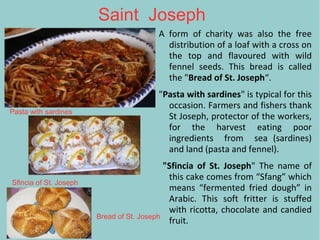
"Pasta with sardines" is typical for this
occasion. Farmers and fishers thank
St Joseph, protector of the workers,
for the harvest eating poor
ingredients from sea (sardines)
and land (pasta and fennel).
"Sfincia of St. Joseph" The name of
this cake comes from “Sfang” which
means “fermented fried dough” in
Arabic. This soft fritter is stuffed
with ricotta, chocolate and candied
fruit.
Pasta with sardines
Sfincia of St. Joseph
Bread of St. Joseph
Easter Pasqua
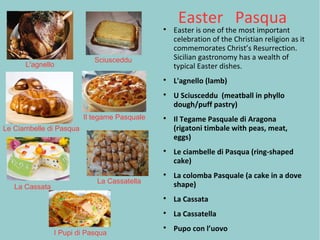
Easter is one of the most important
celebration of the Christian religion as it
commemorates Christ’s Resurrection.
Sicilian gastronomy has a wealth of
typical Easter dishes.

L'agnello (lamb)

U Sciusceddu (meatball in phyllo
dough/puff pastry)

Il Tegame Pasquale di Aragona
(rigatoni timbale with peas, meat,
eggs)

Le ciambelle di Pasqua (ring-shaped
cake)

La colomba Pasquale (a cake in a dove
shape)

La Cassata

La Cassatella

Pupo con l’uovo
L'agnello
Sciusceddu
Le Ciambelle di Pasqua
Il tegame Pasquale
La Cassata
La Cassatella
I Pupi di Pasqua
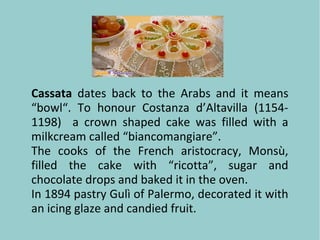
Cassata dates back to the Arabs and it means
“bowl“. To honour Costanza d’Altavilla (1154-
1198) a crown shaped cake was filled with a
milkcream called “biancomangiare”.
The cooks of the French aristocracy, Monsù,
filled the cake with “ricotta”, sugar and
chocolate drops and baked it in the oven.
In 1894 pastry Gulì of Palermo, decorated it with
an icing glaze and candied fruit.
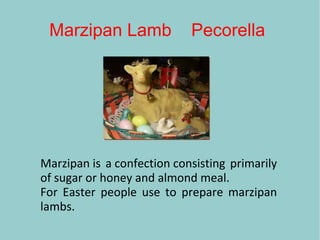
Marzipan Lamb Pecorella
Marzipan is a confection consisting primarily
of sugar or honey and almond meal.
For Easter people use to prepare marzipan
lambs.
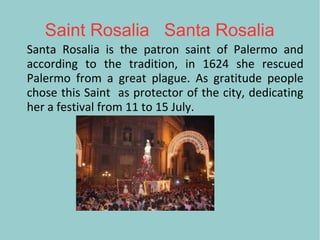
Saint Rosalia Santa Rosalia
Santa Rosalia is the patron saint of Palermo and
according to the tradition, in 1624 she rescued
Palermo from a great plague. As gratitude people
chose this Saint as protector of the city, dedicating
her a festival from 11 to 15 July.
Saint Rosalia
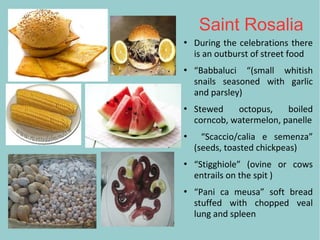
 During the celebrations there
is an outburst of street food
 “Babbaluci “(small whitish
snails seasoned with garlic
and parsley)
 Stewed octopus, boiled
corncob, watermelon, panelle
 “Scaccio/calia e semenza”
(seeds, toasted chickpeas)
 “Stigghiole” (ovine or cows
entrails on the spit )
 “Pani ca meusa” soft bread
stuffed with chopped veal
lung and spleen
All Saints’ Day “I Morti”
On 2 November Eve children receive
gifts from their dead relatives.
Parents hide toys at home and prepare
a wicker basket with dried figs,
marzipan fruits and vegetables and
“pupo di zucchero”, (sugar puppet).
“Pupi” can be referred to the pagan
Greek rite of remembering the dead
with little statues. Once people had
lunch at the graveyard with bread,
honey and almonds.
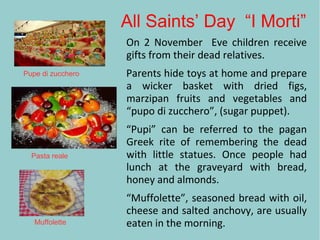
“Muffolette”, seasoned bread with oil,
cheese and salted anchovy, are usually
eaten in the morning.
Pupe di zucchero
Pasta reale
Muffolette
Feast Day of Virgin Mary Immacolata
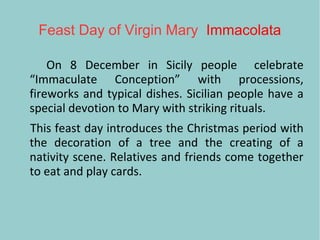
On 8 December in Sicily people celebrate
“Immaculate Conception” with processions,
fireworks and typical dishes. Sicilian people have a
special devotion to Mary with striking rituals.
This feast day introduces the Christmas period with
the decoration of a tree and the creating of a
nativity scene. Relatives and friends come together
to eat and play cards.
Feast Day of Virgin Mary
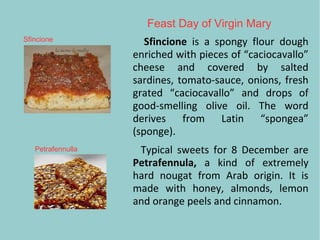
Sfincione is a spongy flour dough
enriched with pieces of “caciocavallo”
cheese and covered by salted
sardines, tomato-sauce, onions, fresh
grated “caciocavallo” and drops of
good-smelling olive oil. The word
derives from Latin “spongea”
(sponge).
Typical sweets for 8 December are
Petrafennula, a kind of extremely
hard nougat from Arab origin. It is
made with honey, almonds, lemon
and orange peels and cinnamon.
Sfincione
Petrafennulla
Saint Martin San Martino
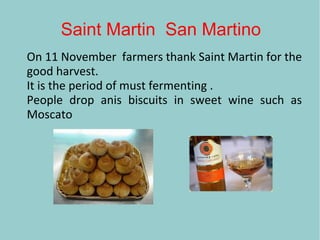
On 11 November farmers thank Saint Martin for the
good harvest.
It is the period of must fermenting .
People drop anis biscuits in sweet wine such as
Moscato
Saint Lucy Santa Lucia
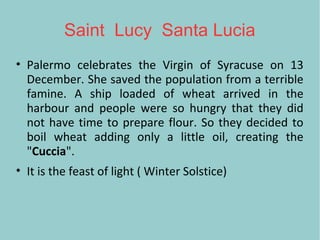
• Palermo celebrates the Virgin of Syracuse on 13
December. She saved the population from a terrible
famine. A ship loaded of wheat arrived in the
harbour and people were so hungry that they did
not have time to prepare flour. So they decided to
boil wheat adding only a little oil, creating the
"Cuccia".
• It is the feast of light ( Winter Solstice)
Santa Lucia
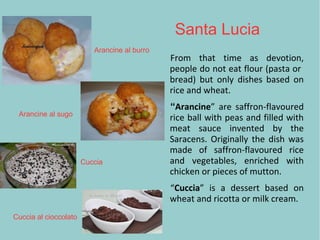
From that time as devotion,
people do not eat flour (pasta or
bread) but only dishes based on
rice and wheat.
“Arancine” are saffron-flavoured
rice ball with peas and filled with
meat sauce invented by the
Saracens. Originally the dish was
made of saffron-flavoured rice
and vegetables, enriched with
chicken or pieces of mutton.
“Cuccia” is a dessert based on
wheat and ricotta or milk cream.
Arancine al burro
Arancine al sugo
Cuccia
Cuccia al cioccolato
Christmas Natale
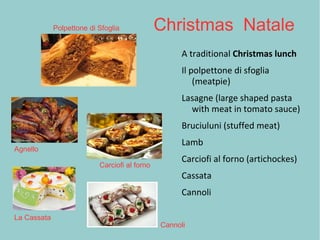
A traditional Christmas lunch
Il polpettone di sfoglia
(meatpie)
Lasagne (large shaped pasta
with meat in tomato sauce)
Bruciuluni (stuffed meat)
Lamb
Carciofi al forno (artichockes)
Cassata
Cannoli
Polpettone di Sfoglia
Agnello
Carciofi al forno
La Cassata
Cannoli
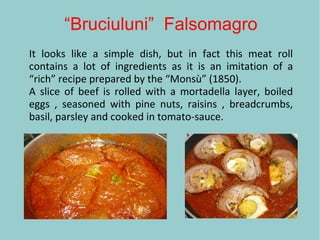
“Bruciuluni” Falsomagro
It looks like a simple dish, but in fact this meat roll
contains a lot of ingredients as it is an imitation of a
“rich” recipe prepared by the “Monsù” (1850).
A slice of beef is rolled with a mortadella layer, boiled
eggs , seasoned with pine nuts, raisins , breadcrumbs,
basil, parsley and cooked in tomato-sauce.
Celebrations & food

Celebrations & food

  • 1.
    Celebrations and Food ComeniusProject “Lost in Time” Istituto Superiore “Majorana” Palermo (Italy)
  • 2.
    There is abond between cultural identity , local resources and cuisine. All ingredients are cultural products that derive from people’s labour. Colours, smells and tastes of the dishes have a historical value. Sicilian cuisine speaks the ancient language of Greeks, Romans, Saracens, Jews and Monsù ( French Chef ).
  • 3.
    Carnival Carnevale Carnival isa festival celebrated in countries of Christian tradition. Public parades with allegoric and playful elements take place The typical feature is the use of masks. The most common Carnival sweets are different kinds of fritters and doughnuts. Le Frittelle di carnevale Le Zeppole Le Cicerchiate di carnevale Le Castagnole Le Chiacchiere Le Ciambelle
  • 4.
    Saint Joseph SanGiuseppe • St. Joseph is the patron of poor and indigent. To thank the Lord for a grace received, on 19 March some families set up “tavolate”, a banquet, at home for indigent people who are special guests for this day. • Another important tradition on St. Joseph Eve is the“vampa“, a large bonfire, to burn old things and remove darkness and announce light (Summer Solstice).
  • 5.
    Saint Joseph A formof charity was also the free distribution of a loaf with a cross on the top and flavoured with wild fennel seeds. This bread is called the "Bread of St. Joseph“. "Pasta with sardines" is typical for this occasion. Farmers and fishers thank St Joseph, protector of the workers, for the harvest eating poor ingredients from sea (sardines) and land (pasta and fennel). "Sfincia of St. Joseph" The name of this cake comes from “Sfang” which means “fermented fried dough” in Arabic. This soft fritter is stuffed with ricotta, chocolate and candied fruit. Pasta with sardines Sfincia of St. Joseph Bread of St. Joseph
  • 6.
    Easter Pasqua Easter isone of the most important celebration of the Christian religion as it commemorates Christ’s Resurrection. Sicilian gastronomy has a wealth of typical Easter dishes.  L'agnello (lamb)  U Sciusceddu (meatball in phyllo dough/puff pastry)  Il Tegame Pasquale di Aragona (rigatoni timbale with peas, meat, eggs)  Le ciambelle di Pasqua (ring-shaped cake)  La colomba Pasquale (a cake in a dove shape)  La Cassata  La Cassatella  Pupo con l’uovo L'agnello Sciusceddu Le Ciambelle di Pasqua Il tegame Pasquale La Cassata La Cassatella I Pupi di Pasqua
  • 7.
    Cassata dates backto the Arabs and it means “bowl“. To honour Costanza d’Altavilla (1154- 1198) a crown shaped cake was filled with a milkcream called “biancomangiare”. The cooks of the French aristocracy, Monsù, filled the cake with “ricotta”, sugar and chocolate drops and baked it in the oven. In 1894 pastry Gulì of Palermo, decorated it with an icing glaze and candied fruit.
  • 8.
    Marzipan Lamb Pecorella Marzipanis a confection consisting primarily of sugar or honey and almond meal. For Easter people use to prepare marzipan lambs.
  • 9.
    Saint Rosalia SantaRosalia Santa Rosalia is the patron saint of Palermo and according to the tradition, in 1624 she rescued Palermo from a great plague. As gratitude people chose this Saint as protector of the city, dedicating her a festival from 11 to 15 July.
  • 10.
    Saint Rosalia  Duringthe celebrations there is an outburst of street food  “Babbaluci “(small whitish snails seasoned with garlic and parsley)  Stewed octopus, boiled corncob, watermelon, panelle  “Scaccio/calia e semenza” (seeds, toasted chickpeas)  “Stigghiole” (ovine or cows entrails on the spit )  “Pani ca meusa” soft bread stuffed with chopped veal lung and spleen
  • 11.
    All Saints’ Day“I Morti” On 2 November Eve children receive gifts from their dead relatives. Parents hide toys at home and prepare a wicker basket with dried figs, marzipan fruits and vegetables and “pupo di zucchero”, (sugar puppet). “Pupi” can be referred to the pagan Greek rite of remembering the dead with little statues. Once people had lunch at the graveyard with bread, honey and almonds. “Muffolette”, seasoned bread with oil, cheese and salted anchovy, are usually eaten in the morning. Pupe di zucchero Pasta reale Muffolette
  • 12.
    Feast Day ofVirgin Mary Immacolata On 8 December in Sicily people celebrate “Immaculate Conception” with processions, fireworks and typical dishes. Sicilian people have a special devotion to Mary with striking rituals. This feast day introduces the Christmas period with the decoration of a tree and the creating of a nativity scene. Relatives and friends come together to eat and play cards.
  • 13.
    Feast Day ofVirgin Mary Sfincione is a spongy flour dough enriched with pieces of “caciocavallo” cheese and covered by salted sardines, tomato-sauce, onions, fresh grated “caciocavallo” and drops of good-smelling olive oil. The word derives from Latin “spongea” (sponge). Typical sweets for 8 December are Petrafennula, a kind of extremely hard nougat from Arab origin. It is made with honey, almonds, lemon and orange peels and cinnamon. Sfincione Petrafennulla
  • 14.
    Saint Martin SanMartino On 11 November farmers thank Saint Martin for the good harvest. It is the period of must fermenting . People drop anis biscuits in sweet wine such as Moscato
  • 15.
    Saint Lucy SantaLucia • Palermo celebrates the Virgin of Syracuse on 13 December. She saved the population from a terrible famine. A ship loaded of wheat arrived in the harbour and people were so hungry that they did not have time to prepare flour. So they decided to boil wheat adding only a little oil, creating the "Cuccia". • It is the feast of light ( Winter Solstice)
  • 16.
    Santa Lucia From thattime as devotion, people do not eat flour (pasta or bread) but only dishes based on rice and wheat. “Arancine” are saffron-flavoured rice ball with peas and filled with meat sauce invented by the Saracens. Originally the dish was made of saffron-flavoured rice and vegetables, enriched with chicken or pieces of mutton. “Cuccia” is a dessert based on wheat and ricotta or milk cream. Arancine al burro Arancine al sugo Cuccia Cuccia al cioccolato
  • 17.
    Christmas Natale A traditionalChristmas lunch Il polpettone di sfoglia (meatpie) Lasagne (large shaped pasta with meat in tomato sauce) Bruciuluni (stuffed meat) Lamb Carciofi al forno (artichockes) Cassata Cannoli Polpettone di Sfoglia Agnello Carciofi al forno La Cassata Cannoli
  • 18.
    “Bruciuluni” Falsomagro It lookslike a simple dish, but in fact this meat roll contains a lot of ingredients as it is an imitation of a “rich” recipe prepared by the “Monsù” (1850). A slice of beef is rolled with a mortadella layer, boiled eggs , seasoned with pine nuts, raisins , breadcrumbs, basil, parsley and cooked in tomato-sauce.