1
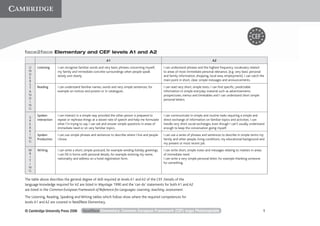
face2face Elementary and CEF levels A1 and A2
The table above describes the general degree of skill required at levels A1 and A2 of the CEF. Details of the
language knowledge required for A2 are listed in Waystage 1990 and the ‘can do’ statements for both A1 and A2
are listed in the Common European Framework of Reference for Languages: Learning, teaching, assessment.
The Listening, Reading, Speaking and Writing tables which follow show where the required competences for
levels A1 and A2 are covered in face2face Elementary.
A1 A2
U
N
D
E
R
S
T
A
N
D
I
N
G
Listening I can recognise familiar words and very basic phrases concerning myself,
my family and immediate concrete surroundings when people speak
slowly and clearly.
I can understand phrases and the highest frequency vocabulary related
to areas of most immediate personal relevance, (e.g. very basic personal
and family information, shopping, local area, employment). I can catch the
main point in short, clear, simple messages and announcements.
Reading I can understand familiar names, words and very simple sentences, for
example on notices and posters or in catalogues.
I can read very short, simple texts. I can find specific, predictable
information in simple everyday material such as advertisements,
prospectuses, menus and timetables and I can understand short simple
personal letters.
S
P
E
A
K
I
N
G
Spoken
interaction
I can interact in a simple way provided the other person is prepared to
repeat or rephrase things at a slower rate of speech and help me formulate
what I’m trying to say. I can ask and answer simple questions in areas of
immediate need or on very familiar topics.
I can communicate in simple and routine tasks requiring a simple and
direct exchange of information on familiar topics and activities. I can
handle very short social exchanges, even though I can’t usually understand
enough to keep the conversation going myself.
Spoken
Production
I can use simple phrases and sentences to describe where I live and people
I know.
I can use a series of phrases and sentences to describe in simple terms my
family and other people, living conditions, my educational background and
my present or most recent job.
W
R
I
T
I
N
G
Writing I can write a short, simple postcard, for example sending holiday greetings.
I can fill in forms with personal details, for example entering my name,
nationality and address on a hotel registration form.
I can write short, simple notes and messages relating to matters in areas
of immediate need.
I can write a very simple personal letter, for example thanking someone
for something.
© Cambridge University Press 2006 face2face Elementary: Common European Framework (CEF) maps Photocopiable
1
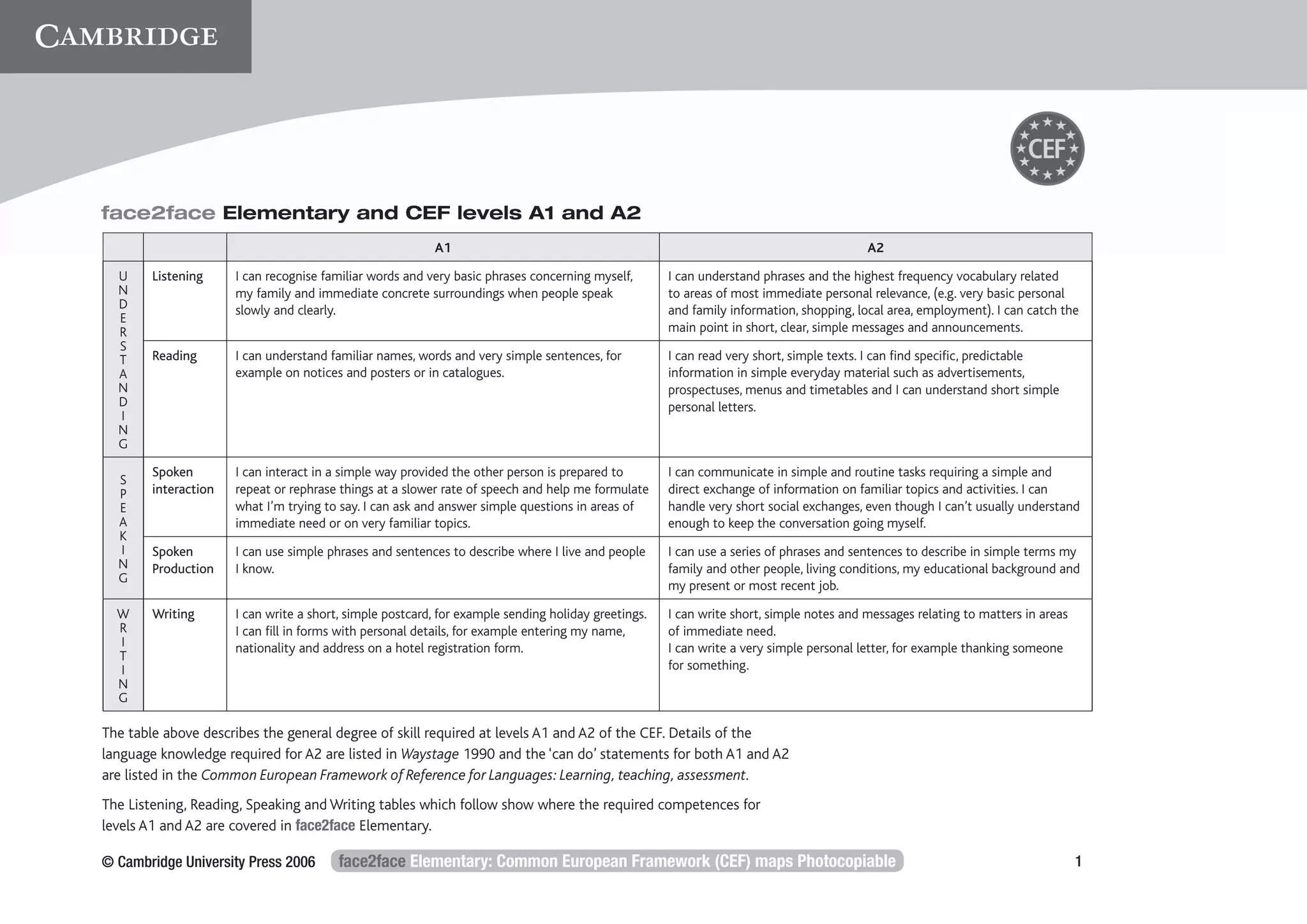
face2face Pre-intermediate and CEF level B1
B1
U
N
D
E
R
S
T
A
N
D
I
N
G
Listening I can understand the main points of clear standard speech on familiar matters regularly encountered in
work, school, leisure, etc. I can understand the main point of many radio or TV programmes on current
affairs or topics of personal or professional interest when the delivery is relatively slow and clear.
Reading I can understand texts that consist mainly of high frequency everyday or job-related language. I can
understand the description of events, feelings and wishes in personal letters.
S
P
E
A
K
I
N
G
Spoken
interaction
I can deal with most situations likely to arise whilst travelling in an area where the language is spoken.
I can enter unprepared into conversation on topics that are familiar, of personal interest or pertinent to
everyday life (e.g. family, hobbies, work, travel and current events).
Spoken
Production
I can connect phrases in a simple way in order to describe experiences and events, my dreams, hopes and
ambitions. I can briefly give reasons and explanations for opinions and plans. I can narrate a story or relate
the plot of a book or film and describe my reactions.
W
R
I
T
I
N
G
Writing I can write simple connected text on topics which are familiar or of personal interest. I can write personal
letters describing experiences and impressions.
The table above describes the general degree of skill required at level B1 of the CEF. Details of the language knowledge
required for B1 are listed in Threshold 1990.The ‘can do’ statements for B1 are listed in the Common European Framework
of Reference for Languages: Learning, teaching, assessment.
The Listening, Reading, Speaking and Writing tables which follow show where the required competences for level B1
are covered in face2face Pre-intermediate.
© Cambridge University Press 2006 face2face Pre-intermediate: Common European Framework (CEF) maps Photocopiable
© Cambridge University Press 2007 face2face Upper Intermediate: Common European Framework (CEF) B2 Skills Maps PHOTOCOPIABLE 1
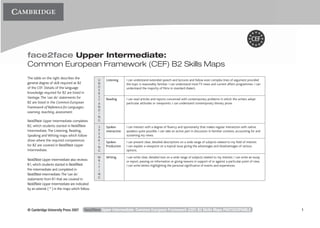
face2face Upper Intermediate:
Common European Framework (CEF) B2 Skills Maps
U
N
D
E
R
S
T
A
N
D
I
N
G
Listening I can understand extended speech and lectures and follow even complex lines of argument provided
the topic is reasonably familiar. I can understand most TV news and current affairs programmes. I can
understand the majority of films in standard dialect.
Reading I can read articles and reports concerned with contemporary problems in which the writers adopt
particular attitudes or viewpoints. I can understand contemporary literary prose.
S
P
E
A
K
I
N
G
Spoken
interaction
I can interact with a degree of fluency and spontaneity that makes regular interaction with native
speakers quite possible. I can take an active part in discussion in familiar contexts, accounting for and
sustaining my views.
Spoken
Production
I can present clear, detailed descriptions on a wide range of subjects related to my field of interest.
I can explain a viewpoint on a topical issue giving the advantages and disadvantages of various
options.
W
R
I
T
I
N
G
Writing I can write clear, detailed text on a wide range of subjects related to my interest. I can write an essay
or report, passing on information or giving reasons in support of or against a particular point of view.
I can write letters highlighting the personal significance of events and experiences.
The table on the right describes the
general degree of skill required at B2
of the CEF. Details of the language
knowledge required for B2 are listed in
Vantage.The ‘can do’ statements for
B2 are listed in the Common European
Framework of Reference for Languages:
Learning, teaching, assessment.
face2face Upper Intermediate completes
B2, which students started in face2face
Intermediate.The Listening, Reading,
Speaking and Writing maps which follow
show where the required competences
for B2 are covered in face2face Upper
Intermediate.
face2face Upper Intermediate also reviews
B1, which students started in face2face
Pre-intermediate and completed in
face2face Intermediate.The‘can do’
statements from B1 that are covered in
face2face Upper Intermediate are indicated
by an asterisk ( * ) in the maps which follow.
1© Cambridge University Press 2009    face2face Advanced: Common European Framework (CEF) C1 Skills Maps PHOTOCOPIABLE
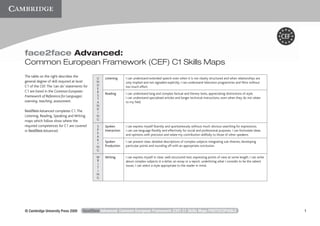
face2face Advanced:
Common European Framework (CEF) C1 Skills Maps
U
N
D
E
R
S
T
A
N
D
I
N
G
Listening I can understand extended speech even when it is not clearly structured and when relationships are
only implied and not signalled explicitly. I can understand television programmes and films without
too much effort.
Reading I can understand long and complex factual and literary texts, appreciating distinctions of style.
I can understand specialised articles and longer technical instructions, even when they do not relate
to my field.
S
P
E
A
K
I
N
G
Spoken
Interaction
I can express myself fluently and spontaneously without much obvious searching for expressions.
I can use language flexibly and effectively for social and professional purposes. I can formulate ideas
and opinions with precision and relate my contribution skillfully to those of other speakers.
Spoken
Production
I can present clear, detailed descriptions of complex subjects integrating sub-themes, developing
particular points and rounding off with an appropriate conclusion.
W
R
I
T
I
N
G
Writing I can express myself in clear, well-structured text, expressing points of view at some length. I can write
about complex subjects in a letter, an essay or a report, underlining what I consider to be the salient
issues. I can select a style appropriate to the reader in mind.
The table on the right describes the
general degree of skill required at level
C1 of the CEF.The ‘can do’ statements for
C1 are listed in the Common European
Framework of Reference for Languages:
Learning, teaching, assessment.
face2face Advanced completes C1.The
Listening, Reading, Speaking and Writing
maps which follow show where the
required competences for C1 are covered
in face2face Advanced.

Cef 'can do' statement

  • 1.
    1 face2face Elementary andCEF levels A1 and A2 The table above describes the general degree of skill required at levels A1 and A2 of the CEF. Details of the language knowledge required for A2 are listed in Waystage 1990 and the ‘can do’ statements for both A1 and A2 are listed in the Common European Framework of Reference for Languages: Learning, teaching, assessment. The Listening, Reading, Speaking and Writing tables which follow show where the required competences for levels A1 and A2 are covered in face2face Elementary. A1 A2 U N D E R S T A N D I N G Listening I can recognise familiar words and very basic phrases concerning myself, my family and immediate concrete surroundings when people speak slowly and clearly. I can understand phrases and the highest frequency vocabulary related to areas of most immediate personal relevance, (e.g. very basic personal and family information, shopping, local area, employment). I can catch the main point in short, clear, simple messages and announcements. Reading I can understand familiar names, words and very simple sentences, for example on notices and posters or in catalogues. I can read very short, simple texts. I can find specific, predictable information in simple everyday material such as advertisements, prospectuses, menus and timetables and I can understand short simple personal letters. S P E A K I N G Spoken interaction I can interact in a simple way provided the other person is prepared to repeat or rephrase things at a slower rate of speech and help me formulate what I’m trying to say. I can ask and answer simple questions in areas of immediate need or on very familiar topics. I can communicate in simple and routine tasks requiring a simple and direct exchange of information on familiar topics and activities. I can handle very short social exchanges, even though I can’t usually understand enough to keep the conversation going myself. Spoken Production I can use simple phrases and sentences to describe where I live and people I know. I can use a series of phrases and sentences to describe in simple terms my family and other people, living conditions, my educational background and my present or most recent job. W R I T I N G Writing I can write a short, simple postcard, for example sending holiday greetings. I can fill in forms with personal details, for example entering my name, nationality and address on a hotel registration form. I can write short, simple notes and messages relating to matters in areas of immediate need. I can write a very simple personal letter, for example thanking someone for something. © Cambridge University Press 2006 face2face Elementary: Common European Framework (CEF) maps Photocopiable
  • 2.
    1 face2face Pre-intermediate andCEF level B1 B1 U N D E R S T A N D I N G Listening I can understand the main points of clear standard speech on familiar matters regularly encountered in work, school, leisure, etc. I can understand the main point of many radio or TV programmes on current affairs or topics of personal or professional interest when the delivery is relatively slow and clear. Reading I can understand texts that consist mainly of high frequency everyday or job-related language. I can understand the description of events, feelings and wishes in personal letters. S P E A K I N G Spoken interaction I can deal with most situations likely to arise whilst travelling in an area where the language is spoken. I can enter unprepared into conversation on topics that are familiar, of personal interest or pertinent to everyday life (e.g. family, hobbies, work, travel and current events). Spoken Production I can connect phrases in a simple way in order to describe experiences and events, my dreams, hopes and ambitions. I can briefly give reasons and explanations for opinions and plans. I can narrate a story or relate the plot of a book or film and describe my reactions. W R I T I N G Writing I can write simple connected text on topics which are familiar or of personal interest. I can write personal letters describing experiences and impressions. The table above describes the general degree of skill required at level B1 of the CEF. Details of the language knowledge required for B1 are listed in Threshold 1990.The ‘can do’ statements for B1 are listed in the Common European Framework of Reference for Languages: Learning, teaching, assessment. The Listening, Reading, Speaking and Writing tables which follow show where the required competences for level B1 are covered in face2face Pre-intermediate. © Cambridge University Press 2006 face2face Pre-intermediate: Common European Framework (CEF) maps Photocopiable
  • 3.
    © Cambridge UniversityPress 2007 face2face Upper Intermediate: Common European Framework (CEF) B2 Skills Maps PHOTOCOPIABLE 1 face2face Upper Intermediate: Common European Framework (CEF) B2 Skills Maps U N D E R S T A N D I N G Listening I can understand extended speech and lectures and follow even complex lines of argument provided the topic is reasonably familiar. I can understand most TV news and current affairs programmes. I can understand the majority of films in standard dialect. Reading I can read articles and reports concerned with contemporary problems in which the writers adopt particular attitudes or viewpoints. I can understand contemporary literary prose. S P E A K I N G Spoken interaction I can interact with a degree of fluency and spontaneity that makes regular interaction with native speakers quite possible. I can take an active part in discussion in familiar contexts, accounting for and sustaining my views. Spoken Production I can present clear, detailed descriptions on a wide range of subjects related to my field of interest. I can explain a viewpoint on a topical issue giving the advantages and disadvantages of various options. W R I T I N G Writing I can write clear, detailed text on a wide range of subjects related to my interest. I can write an essay or report, passing on information or giving reasons in support of or against a particular point of view. I can write letters highlighting the personal significance of events and experiences. The table on the right describes the general degree of skill required at B2 of the CEF. Details of the language knowledge required for B2 are listed in Vantage.The ‘can do’ statements for B2 are listed in the Common European Framework of Reference for Languages: Learning, teaching, assessment. face2face Upper Intermediate completes B2, which students started in face2face Intermediate.The Listening, Reading, Speaking and Writing maps which follow show where the required competences for B2 are covered in face2face Upper Intermediate. face2face Upper Intermediate also reviews B1, which students started in face2face Pre-intermediate and completed in face2face Intermediate.The‘can do’ statements from B1 that are covered in face2face Upper Intermediate are indicated by an asterisk ( * ) in the maps which follow.
  • 4.
    1© Cambridge UniversityPress 2009    face2face Advanced: Common European Framework (CEF) C1 Skills Maps PHOTOCOPIABLE face2face Advanced: Common European Framework (CEF) C1 Skills Maps U N D E R S T A N D I N G Listening I can understand extended speech even when it is not clearly structured and when relationships are only implied and not signalled explicitly. I can understand television programmes and films without too much effort. Reading I can understand long and complex factual and literary texts, appreciating distinctions of style. I can understand specialised articles and longer technical instructions, even when they do not relate to my field. S P E A K I N G Spoken Interaction I can express myself fluently and spontaneously without much obvious searching for expressions. I can use language flexibly and effectively for social and professional purposes. I can formulate ideas and opinions with precision and relate my contribution skillfully to those of other speakers. Spoken Production I can present clear, detailed descriptions of complex subjects integrating sub-themes, developing particular points and rounding off with an appropriate conclusion. W R I T I N G Writing I can express myself in clear, well-structured text, expressing points of view at some length. I can write about complex subjects in a letter, an essay or a report, underlining what I consider to be the salient issues. I can select a style appropriate to the reader in mind. The table on the right describes the general degree of skill required at level C1 of the CEF.The ‘can do’ statements for C1 are listed in the Common European Framework of Reference for Languages: Learning, teaching, assessment. face2face Advanced completes C1.The Listening, Reading, Speaking and Writing maps which follow show where the required competences for C1 are covered in face2face Advanced.