2nd Philippine Human Rights Action Plan 2012-2016
Accomplishment Report of the Aquino Administration
Chapter on the Convention on the Elimination of All Forms of Discrimination
Against Women (CEDAW)
2
I. Overview
1. The Convention on the Elimination of All Forms of Discrimination Against Women (CEDAW) is the first
and only international treaty that comprehensively addresses the human rights of women. It is known as the
International Bill of Rights for Women and was adopted by the United Nations General Assembly (UNGA)
on December 18, 1979. Since then it has been ratified by 186 countries including the Philippines. CEDAW
was signed by the Philippine government on July 17, 1980 and ratified by the Senate on July 19, 1981. As
a State-party to CEDAW, the government acknowledged the existence of gender inequalities and
discrimination against women in the Philippine society. It also signified the Philippine Government’s
commitment to stop all discriminations against women.
2. Despite many gains on the implementation of CEDAW, there are still many challenges that hinder the
attainment of gender equality in the Philippines. The CEDAW Chapter of the Philippine Human Rights
Plan (PHRP) II, or CEDAW PHRP II, aims to address the gaps in the implementation and enforcement of
women-friendly laws through improved coordination, formulation of policy and development of legal
instruments and mechanisms, increased capacities of service providers, increased public awareness on
CEDAW, faster and increased number of court decisions and dispositions on cases of trafficking, and
improved monitoring and reporting on VAW.
3. CEDAW PHRP II focuses on the following major areas that correspond to priority rights of women: (1)
Protection of women against violence; (2) Promotion of women’s rights to equal treatment and non-
discrimination; and (3) Fulfillment of women’s rights through legal reforms. The CEDAW PHRP II report
highlights the preparation of mechanisms for the implementation of the Magna Carta of Women (MCW)
and on efforts to raise public awareness of women’s rights. It also highlights achievements on legal reforms
that complement or reinforce the implementation of the 5 priority laws on protection from violence against
women.
4. The three (3) thematic objectives that correspond to the priority human rights agenda that have been
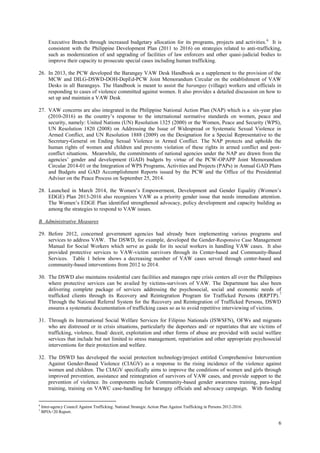
identified and prioritized for the CEDAW Chapter of the PHRP II are the following:
Thematic Objective 1: To enhance the capacity of the justice system to effectively and efficiently
implement existing laws which respect, protect and fulfill the rights of women against gender-based
violence.
Thematic Objective 2: To ensure the implementation of the provisions of the MCW, and institute legal
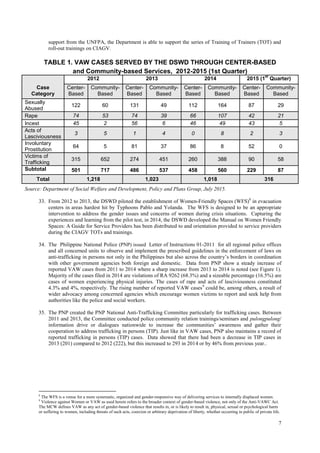
and administrative reform mechanisms in the national and local levels that will enhance the
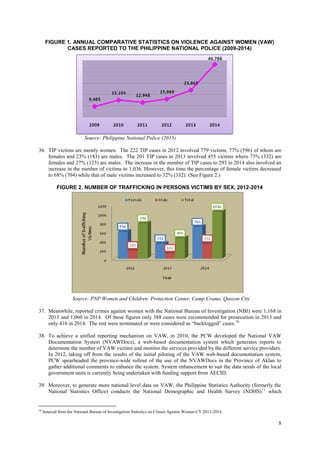
implementation and monitor its progress.
Thematic Objective 3: To raise the level of public awareness of duty bearers and claimholders on the
MCW and the CEDAW.
5. The report on Thematic Objective 1 is limited to the implementation and gaps in the implementation of the
following laws on gender-based violence or VAW:
(1) Anti-Violence against Women and their Children Act of 2004 (RA 9262);
(2) Anti-Sexual Harassment Law of 1995 (RA 7877);
(3) Anti-Rape Law of 1997 (RA 8353);
(4) Rape Victim Assistance and Protection Act of 1998 (RA 8505), and;
(5) Anti-Trafficking in Persons Act of 2003 (RA 9208).
6. Under Thematic Objective 1 are the following strategic indicators:
Strategic indicator 1: Legislative, administrative and judicial measures for improving the capacity of
the justice system in handling gender issues and concerns; and,
Strategic indicator 2: Gender-responsive national and local performance accountability mechanisms
in the justice system.
7. The report on Thematic Objective 2 covers progress in response to the strategic indicators on:
3
Strategic indicator 1: Administrative policies of concerned implementing agencies;
Strategic indicator 2: Mechanisms for the implementation and monitoring of the MCW are in place at
all levels; and
Strategic indicator 3: Commitment of accountable government agencies to undertake a vigorous
legislative advocacy program to support the passage of pro-women bills on:
(a) Anti-Prostitution Bill;
(b) Marital Infidelity Bill;
(c) Reproductive Health Bill;
(d) Magna Carta of Workers in the Informal Sector;
(e) Local Sectoral Representation Bill;
(f) Abolition of the Forgiveness Clause in the Rape Law;
(g) Review of punitive actions against women who undergo abortion; and,
(h) Amendment of PD 1083 or the Code of Muslim Personal Laws of the Philippines (CMPL),
which contains provisions that allow polygamy, forced marriages and child marriages.
8. The report on Thematic Objective 3 discusses the performances in the implementation on strategic
indicators as follows:
Strategic indicator 1: Rights-based matrix of results on the implementation of MCW; and,
Strategic Indicator 2: Key agencies and their respective personnel have been capacitated in the
application of CEDAW General Recommendations and Concluding Comments
9. The succeeding sections contain report on the implementation of national government agencies (NGAs) as
well as of some local government units (LGUs) on the three thematic objectives of the CEDAW Chapter of
the PHRP II. The report covers implementation of the government agencies and some local government
units (LGUs) from 2012 to June 2015. It also discusses the links of the CEDAW PHRP initiatives of the
government to other international and national commitments and development initiatives of the Philippines,
their resources and the monitoring and evaluation being done. The draft of this report was drawn from the
existing gender and development (GAD) data and information as well as from other related reports prepared
by the Philippine Commission on Women (PCW). A Validation Workshop was also conducted to validate
the draft report and gather additional data and information on the implementation of the government
agencies relative to the implementation of the CEDAW Chapter of the PHRP II.
II. Assessment of Implementation
A. Thematic Objective 1: To enhance the capacity of the justice system to effectively and efficiently
implement existing laws which respect, protect and fulfill the rights of women against gender-based
violence.
1. Introduction
10. The inventory of VAW-related laws showed that apart from the 5 priority laws on: (1) Anti-Violence
against Women and their Children Act of 2004 (RA 9262), (2) Anti-Sexual Harassment Law of 1995 (RA
7877), (3) Anti-Rape Law of 1997 (RA 8353), (4) Rape Victim Assistance and Protection Act of 1998 (RA
8505), and (5) Anti-Trafficking in Persons Act of 2003 (RA 9208), a number of other VAW-related laws
were enacted by Congress and were approved into law by 2012. These laws include:
a) Philippine Disaster Risk Reduction and Management (PDRRM) Act of 2010 which considers gender in
the context of disaster and rehabilitation. Its implementation highlights on the effects of disaster
situations to women who become victims of gender-based violence.
b) The Responsible Parenthood and Reproductive Health (RPRH) Law which gives emphasis on
providing health care services to VAW victims.
c) The Anti-Pornography and Cybercrime Prevention Acts which protects women from violence and
abuse as brought about by development in technology.
d) Expanded Anti-Trafficking in Persons Act of 2013 which provides for stiffer penalties to offender.
4
e) The Domestic Workers Act of 2013 which includes protection of workers from VAW as well
trafficking.
11. The past three-years and a half saw the continued and enhanced efforts of the justice system1
to close the
gaps in the implementation of the 5 priority laws. There have been an increasing number of accountability
mechanisms, e.g. LCAT-VAWC, created at the local levels to implement the Strategic Plans on VAWC and
on Trafficking in Persons. All member agencies of the inter-agency mechanisms including the local
governments actively contributed to eliminate violence against women.
12. Below are the detailed discussions on the accomplishments of the concerned government agencies on
Thematic Objective 1 taking into account their contributions in fulfilling the strategic indicators.
2. Updates and Performances
On Legislative, administrative and judicial measures for improving the capacity of the justice system in
handling gender issues and concerns, 2012-2015
A. Legislative and Policy-Related Measures
13. Prior to 2012, several laws had been enacted that aimed to protect women from violence and abuse. Apart
from the five (5) anti-VAW priority legislations [Anti-Violence against Women and their Children Act of
2004 (RA 9262), Anti-Sexual Harassment Law of 1995 (RA 7877), Anti-Rape Law of 1997 (RA 8353),
Rape Victim Assistance and Protection Act of 1998 (RA 8505) and Anti-Trafficking in Persons Act of 2003
(RA 9208)], other laws with anti-VAW related provisions that were enacted as of 2012 include the Anti-
Child Pornography Act (RA 9775, 2009), Anti Photo and Video Voyeurism Act (RA 9995, 2009), Magna
Carta of Women (RA 9710, 2009), Anti-Torture Act (RA 9745, 2009), Philippine Disaster Risk Reduction
and Management (PDRRM) Act (RA 10121, 2010), Cybercrime Prevention Act (RA 10175, 2012) and
Responsible Parenthood and Reproductive Health Act (RA 10354, 2012). These laws are captured in the
Baseline Study on the Magna of Women (MCW) 2009 and Progress Report on the Implementation of the
MCW 2010-20122
prepared by the PCW. They are also mentioned in the various gender-related reports
submitted by the agency to the United Nations as those on the Convention on the Elimination of All Forms
of Discrimination Against Women (CEDAW) and the Beijing Platform for Action (BPfA).
14. The Anti-Child Pornography Act protects every child from all forms of exploitation and abuse including,
the use of a child in pornographic performances and materials and the inducement or coercion of a child to
engage or be involved in pornography through whatever means. The Cybercrime Prevention Act also
comes in support to Anti-Child Pornography Act where it responds to the rapidly changing times ushered in
by the developments in technology by regulating the widespread use of the internet in the commission of
certain crimes.
15. Sections 9 of the MCW provides for the protection of women from all forms of violence, while Section 10
seeks to protect women in times of disaster, calamities and other crisis situation. Section 4 of the Anti-
Torture Act includes “rape and sexual abuse, including the insertion of foreign objects into the sex organ or
rectum…” among the list of acts of torture. The PDRRM Act ensures that disaster risk reduction and
climate change measures are gender responsive.
16. An important milestone achieved in 2012 is the passage of RA 10354 or the Responsible Parenthood and
Reproductive Health Act which included a section on Care for Victim-Survivors of Gender-Based
Violence, Maternal and Newborn Health Care in Crisis Situations which should also respond to cases of
gender-based violence, and Gender-Sensitive Handling of Clients.
17. Among the VAW-related laws that were approved between the years 2013 to 2015 include: a) Domestic
Workers Act (RA 10361, 2013); b) the Expanded Anti-Trafficking in Persons Act (RA 10364, 2013); c) the
Act Declaring the November 25 of Every Year as the “National Consciousness Day For The Elimination Of
1
As defined in the PHRP II-CEDAW Chapter, the justice system, as referred to under Thematic Objective 1, is composed of the five pillars
of justice: (a) community – DSWD and DILG; (b) police – PNP and its affiliate agencies; (c) prosecution – DOJ; (d) courts/judiciary –
Supreme Court; and (e) penology – Bureau of Corrections, Bureau of Jail Management and other similar offices of government.
2
The Baseline Study on the Magna Carta of Women (2009) and the First-Term Progress Report on the Implementation of the MCW (2010-
2012) is on its finalization stage. It will be presented in a Multi-stakeholders’ Meeting the soonest the report is finalized.
5
Violence Against Women And Children” (RA 10398, 2013); and (d) Amendment to the Revised Penal
Code Repealing the Crime of Premature Marriage Under Article 351 (RA 10655, 2015).
18. The Domestic Workers Act or the Batas Kasambahay had specific provisions to protect women from
violence and abuse. It also supports efforts to eliminate trafficking of women and children for domestic
work.
19. One of the new provisions under the Expanded Anti-Trafficking in Persons Act is the disclosure of the
identities and circumstances of human trafficking offenders, previously provided with confidentiality
protection under RA 9208. Under the RA 10364, recruitment in the guise of domestic or overseas
employment for sexual exploitation, forced labor or involuntary debt bondage, are now considered human
trafficking. Also considered as human trafficking are recruitment of any Filipino woman to marry a
foreigner, engagement in sex tourism, recruitment for organ removal, and recruitment of a child to engage
in armed activities abroad. 3
20. The commitment of the government to address gender-based violence was also reinforced with the
enactment of RA 10398 or the Act Declaring November 25 as National Consciousness Day to Eliminate
Violence against Women and Children in 2013. The law also mandates key agencies to undertake activities
designed to raise public awareness on VAW.
21. Another significant legislative achievement was the enactment of RA 10655 repealing Article 351 of the
Revised Penal Code and decriminalizing premature marriages where it was illegal for a woman to marry
within certain conditions after the death of her husband or annulment of marriage.
22. Among other VAW-related legislative measures pending in Congress are: (1) Enactment of the expanded
VAWC or e-VAW law to amend the RA 9262; (2) Amendment to RA 7877 or the Anti-Sexual Harassment
Law of 1995 to also include peer harassment as among the punishable conditions of sexual harassment; (3)
Amendment to RA 8353 or the Anti-Rape Law of 1997 provision that makes lack of consent the core
definition of rape and maintaining the criminal liability even if the victim forgives the rapist adding further
that the age of statutory rape is raised from 12 to 16. The Amendment to the Anti-Sexual Harassment Law
bill has been enacted in the Lower House but remain pending in the Senate.
23. A number of reinforcing policies, guidelines and tools were also issued or developed to ensure improved
implementation of policies relating to gender-based violence. These include the Implementing Rules and
Regulations of Magna Carta of Women which was approved in May 2010. Although passed into law in
December 2012, the Implementing Rules and Regulations (IRR) of RA 10364 or the Responsible
Parenthood and Reproductive Health Act was approved in March 2013. The implementation of the Act was
stalled due to the issuance of status quo ante order by the Supreme Court in order to assess on the
constitutionality of the Act. It was on April 8, 2014 that the highest court ruled that the law is not
unconstitutional, except for some provisions.4
The status quo ante order was lifted and the immediate
implementation of the law was ordered.
24. In order to harmonize the efforts to implement the VAW-related laws, member agencies of the interagency
council on VAWC (IACVAWC) formulated their midterm action plans. The IACVAWC formulated the
Strategic Action Plan, 2006 – 2010 to address RA 9262 cases. Building on the results of the assessment RA
9262 and the first IACVAWC Strategic Plan, the second Strategic Action Plan 2014 – 2016 allows for
synchronized and coordinated activities between and among Council member-agencies for the effective
implementation of the law.5
25. Similarly, the IACAT also formulated their Strategic Action Plan Against Trafficking 2004-2010. It also
developed the second StratPlan which covers the years 2012-2016. The second StratPlan provides the
roadmap towards progressive realization of human rights and came at the most critical period when human
trafficking data in the country had increased as a result of more aggressive and systematic awareness
campaign and data collection by IACAT. It is also complemented by a strong commitment from the
3
http://globalnation.inquirer.net/64303/aquino-signs-expanded-anti-trafficking-law#ixzz31U7By4uc
4
Some RPRH Law provisions that were declared unconstitutional included: giving absolute authority to the spouse who will undergo a
procedure; foregoing parental consent for minors who undergo procedure; no one can be forced to render health care contrary to one’s
religious belief. An exception was made on life threatening cases of the mother or a child, saying the right to life has preference over the
right to religious beliefs. Abortion is still illegal, but treatment of abortion complications is mandated;
5
Synergizing Efforts At Addressing Intimate Partner Violence: IAC-VAWC Strategic Action Plan 2014-2016.
6
Executive Branch through increased budgetary allocation for its programs, projects and activities.6
It is
consistent with the Philippine Development Plan (2011 to 2016) on strategies related to anti-trafficking,
such as modernization of and upgrading of facilities of law enforcers and other quasi-judicial bodies to
improve their capacity to prosecute special cases including human trafficking.
26. In 2013, the PCW developed the Barangay VAW Desk Handbook as a supplement to the provision of the
MCW and DILG-DSWD-DOH-DepEd-PCW Joint Memorandum Circular on the establishment of VAW
Desks in all Barangays. The Handbook is meant to assist the barangay (village) workers and officials in
responding to cases of violence committed against women. It also provides a detailed discussion on how to
set up and maintain a VAW Desk
27. VAW concerns are also integrated in the Philippine National Action Plan (NAP) which is a six-year plan
(2010-2016) as the country’s response to the international normative standards on women, peace and
security, namely: United Nations (UN) Resolution 1325 (2000) or the Women, Peace and Security (WPS),
UN Resolution 1820 (2008) on Addressing the Issue of Widespread or Systematic Sexual Violence in
Armed Conflict, and UN Resolution 1888 (2009) on the Designation for a Special Representative to the
Secretary-General on Ending Sexual Violence in Armed Conflict. The NAP protects and upholds the
human rights of women and children and prevents violation of these rights in armed conflict and post-
conflict situations. Meanwhile, the commitments of national agencies under the NAP are drawn from the
agencies’ gender and development (GAD) budgets by virtue of the PCW-OPAPP Joint Memorandum
Circular 2014-01 or the Integration of WPS Programs, Activities and Projects (PAPs) in Annual GAD Plans
and Budgets and GAD Accomplishment Reports issued by the PCW and the Office of the Presidential
Adviser on the Peace Process on September 25, 2014.
28. Launched in March 2014, the Women’s Empowerment, Development and Gender Equality (Women’s
EDGE) Plan 2013-2016 also recognizes VAW as a priority gender issue that needs immediate attention.
The Women’s EDGE Plan identified strengthened advocacy, policy development and capacity building as
among the strategies to respond to VAW issues.
B. Administrative Measures
29. Before 2012, concerned government agencies had already been implementing various programs and
services to address VAW. The DSWD, for example, developed the Gender-Responsive Case Management
Manual for Social Workers which serve as guide for its social workers in handling VAW cases. It also
provided protective services to VAW-victim survivors through its Center-based and Community-Based
Services. Table 1 below shows a decreasing number of VAW cases served through center-based and
community-based interventions from 2012 to 2014.
30. The DSWD also maintains residential care facilities and manages rape crisis centers all over the Philippines
where protective services can be availed by victims-survivors of VAW. The Department has also been
delivering complete package of services addressing the psychosocial, social and economic needs of
trafficked clients through its Recovery and Reintegration Program for Trafficked Persons (RRPTP).7
Through the National Referral System for the Recovery and Reintegration of Trafficked Persons, DSWD
ensures a systematic documentation of trafficking cases so as to avoid repetitive interviewing of victims.
31. Through its International Social Welfare Services for Filipino Nationals (ISWSFN), OFWs and migrants
who are distressed or in crisis situations, particularly the deportees and/ or repatriates that are victims of
trafficking, violence, fraud/ deceit, exploitation and other forms of abuse are provided with social welfare
services that include but not limited to stress management, repatriation and other appropriate psychosocial
interventions for their protection and welfare.
32. The DSWD has developed the social protection technology/project entitled Comprehensive Intervention
Against Gender-Based Violence (CIAGV) as a response to the rising incidence of the violence against
women and children. The CIAGV specifically aims to improve the conditions of women and girls through
improved prevention, assistance and reintegration of survivors of VAW cases, and provide support to the
prevention of violence. Its components include Community-based gender awareness training, para-legal
training, training on VAWC case-handling for barangay officials and advocacy campaign. With funding
6
Inter-agency Council Against Trafficking. National Strategic Action Plan Against Trafficking in Persons 2012-2016.
7
BPfA+20 Report.
7
support from the UNFPA, the Department is able to support the series of Training of Trainers (TOT) and
roll-out trainings on CIAGV.
TABLE 1. VAW CASES SERVED BY THE DSWD THROUGH CENTER-BASED
and Community-based Services, 2012-2015 (1st Quarter)
2012 2013 2014 2015 (1
st
Quarter)
Case
Category
Center-
Based
Community-
Based
Center-
Based
Community-
Based
Center-
Based
Community-
Based
Center-
Based
Community-
Based
Sexually
Abused
122 60 131 49 112 164 87 29
Rape 74 53 74 39 66 107 42 21
Incest 45 2 56 6 46 49 43 5
Acts of
Lasciviousness
3 5 1 4 0 8 2 3
Involuntary
Prostitution
64 5 81 37 86 8 52 0
Victims of
Trafficking
315 652 274 451 260 388 90 58
Subtotal 501 717 486 537 458 560 229 87
Total 1,218 1,023 1,018 316
Source: Department of Social Welfare and Development, Policy and Plans Group, July 2015.
33. From 2012 to 2013, the DSWD piloted the establishment of Women-Friendly Spaces (WFS)8
in evacuation
centers in areas hardest hit by Typhoons Pablo and Yolanda. The WFS is designed to be an appropriate
intervention to address the gender issues and concerns of women during crisis situations. Capturing the
experiences and learning from the pilot test, in 2014, the DSWD developed the Manual on Women Friendly
Spaces: A Guide for Service Providers has been distributed to and orientation provided to service providers
during the CIAGV TOTs and trainings.
34. The Philippine National Police (PNP) issued Letter of Instructions 01-2011 for all regional police offices
and all concerned units to observe and implement the prescribed guidelines in the enforcement of laws on
anti-trafficking in persons not only in the Philippines but also across the country’s borders in coordination
with other government agencies both foreign and domestic. Data from PNP show a steady increase of
reported VAW cases from 2011 to 2014 where a sharp increase from 2013 to 2014 is noted (see Figure 1).
Majority of the cases filed in 2014 are violations of RA 9262 (68.3%) and a sizeable percentage (16.5%) are
cases of women experiencing physical injuries. The cases of rape and acts of lasciviousness constituted
4.3% and 4%, respectively. The rising number of reported VAW cases9
could be, among others, a result of
wider advocacy among concerned agencies which encourage women victims to report and seek help from
authorities like the police and social workers.
35. The PNP created the PNP National Anti-Trafficking Committee particularly for trafficking cases. Between
2011 and 2013, the Committee conducted police community relation trainings/seminars and pulongpulong/
information drive or dialogues nationwide to increase the communities’ awareness and gather their
cooperation to address trafficking in persons (TIP). Just like in VAW cases, PNP also maintains a record of
reported trafficking in persons (TIP) cases. Data showed that there had been a decrease in TIP cases in
2013 (201) compared to 2012 (222), but this increased to 293 in 2014 or by 46% from previous year..
8
The WFS is a venue for a more systematic, organized and gender-responsive way of delivering services to internally displaced women.
9
Violence against Women or VAW as used herein refers to the broader context of gender-based violence, not only of the Anti-VAWC Act.
The MCW defines VAW as any act of gender-based violence that results in, or is likely to result in, physical, sexual or psychological harm
or suffering to women, including threats of such acts, coercion or arbitrary deprivation of liberty, whether occurring in public of private life.
8
FIGURE 1. ANNUAL COMPARATIVE STATISTICS ON VIOLENCE AGAINST WOMEN (VAW)
CASES REPORTED TO THE PHILIPPINE NATIONAL POLICE (2009-2014)
Source: Philippine National Police (2015)
36. TIP victims are mostly women. The 222 TIP cases in 2012 involved 779 victims, 77% (596) of whom are
females and 23% (183) are males. The 201 TIP cases in 2013 involved 455 victims where 73% (332) are
females and 27% (123) are males. The increase in the number of TIP cases to 293 in 2014 also involved an
increase in the number of victims to 1,036. However, this time the percentage of female victims decreased
to 68% (704) while that of male victims increased to 32% (332). (See Figure 2.)
FIGURE 2. NUMBER OF TRAFFICKING IN PERSONS VICTIMS BY SEX, 2012-2014
Source: PNP Women and Children Protection Center, Camp Crame, Quezon City
37. Meanwhile, reported crimes against women with the National Bureau of Investigation (NBI) were 1,168 in
2013 and 1,060 in 2014. Of these figures only 388 cases were recommended for prosecution in 2013 and
only 416 in 2014. The rest were terminated or were considered as “backlogged” cases.10
38. To achieve a unified reporting mechanism on VAW, in 2010, the PCW developed the National VAW
Documentation System (NVAWDocs), a web-based documentation system which generates reports to
determine the number of VAW victims and monitor the services provided by the different service providers.
In 2012, taking off from the results of the initial piloting of the VAW web-based documentation system,
PCW spearheaded the province-wide rollout of the use of the NVAWDocs in the Province of Aklan to
gather additional comments to enhance the system. System enhancement to suit the data needs of the local
government units is currently being undertaken with funding support from AECID.
39. Moreover, to generate more national level data on VAW, the Philippine Statistics Authority (formerly the
National Statistics Office) conducts the National Demographic and Health Survey (NDHS)11
which
10
Sourced from the National Bureau of Investigation Statistics on Crimes Against Women CY 2013-2014.
9
included a separate questionnaire called the Women’s Safety Questionnaire that focused on specific aspects
of violence against women in both its 2008 and 2013 surveys. The module sought to capture the prevalence,
extent and types of violence experienced by women of reproductive age (15-49 years old).
40. To provide medical intervention to VAWC victims, the Department of Health (DOH) established Women
and Children Protection Centers (WCPC) in DOH-retained and LGU-supported hospitals nation-wide.
Based on WCPC data, about 6,300 victims of abuse have sought assistance in 2014, and an annual increase
of 10% in reported VAW cases involving women and children victims was noted by the report. As of June
2015, there are about 73 functional WCPUs in DOH-retained and LGU-supported hospitals across the
country12
. Moreover, the agency has also been providing assistance in women friendly spaces in evacuation
centers. Their protocol indicates that in times of disasters, expectant women/mothers will no longer be
evacuated but rather accommodated in a government hospital. DOH also assists in the dissemination of
dignity kits (e.g. malong, sanitary napkin) for pregnant women in evacuation centers.
41. The DOH also partners with DepEd in improving and promoting sexual and reproductive education as well
as menstrual hygiene among girls and boys. The two agencies are closely working together to increase the
number of toilets and to improve the ratio of girls and boys to toilets considering the special hygiene
requirements of girls.
C. Judicial Measures
42. Prior to 2012, a number of judicial measures have already been in place to address VAW cases. In 2010,
the DOJ issued the Circular No. 57, series of 2010 or the Consolidated Guidelines in the Investigation and
Prosecution of Cases involving Violations of the Anti-Trafficking in Persons Act of 2003 which urge to
give preferential attention to the investigation an resolution of trafficking cases within the periods indicated
in the Revised Rules on Criminal Procedure. The guidelines also mentioned that all pending cases as of the
issuance should be resolved immediately.
43. The Supreme Court also issued OCA Circular No. 151-2010 directing all Judges in the Regional Trial
Courts, Metropolitan Trial Courts, Municipal Trial Courts in Cities and Municipal Trial Circuit Trial
Courts, to expedite and prioritize disposition of TIP cases, and submit the list and status of trafficking cases
pending in their respective courts.
44. In 2011, the Secretary of Justice issued Department Order No. 826 reconstituting task forces in the DOJ
main office, including the Task Force on Anti-Trafficking in Persons. Eighteen (18) prosecutors were
specifically designated to handle and prosecute TIP cases. There are about 60 prosecutors in the National
Capital Region and Local Offices of the DOJ who were likewise designated to handle and prosecute TIP
cases. In addition, there are 43 prosecutors designated to assist law enforcement operatives in their case
build up.
45. The judiciary and the courts also implemented measures to respond to the call to prioritize addressing VAW
cases from 2013 to 2014. The judiciary continued to capacitate their ranks on gender sensitivity as a result
of the assessment conducted in 2008 to 2009 on gender-responsive handling of VAW cases where
heads/officials of prosecution offices nationwide were respondents. In 2014, for example, the Department
of Justice (DOJ) conducted capacity development on gender-sensitive handling of VAW cases for 646
prosecutors and staff.13
46. The IACAT also continues to monitor TIP cases. Their data show that there were a total of 187 convictions
involving 209 convicted persons from 2005 to June 15, 2015. A sharp rise in conviction of TIP cases were
from 2010 to 2015 where nearly 86% occurred during the Aquino administration.14
Most of the convicted
human traffickers were involved in sex and cyber-sex trade preying on the poor by force, fraud or through a
11
The NDHS collected information on the following forms of spousal violence: 1) physical violence; 2) sexual violence; 3) emotional
violence; and 4) economic violence (the 3rd and 4th forms of VAW were grouped together in the survey as "other forms of violence"). The
module also included questions on marital control, which may fall either under emotional/psychological violence or economic violence.
12
As per data provided by Ms. Paulyn Jean Rosell-Ubial, Asst. Secretary/GAD Focal Person of DOH during the CEDAW-PHRP II
Validation on July 13, 2015 at the Mabini Social Hall, Malacanang, Manila.
13
CY 2014 DOJ GAD Accomplishment Report.
14
Source: http://www.iacat.net/indexphp/human-trafficking-related -statistics
10
promise of big money.15
The highest number of convictions of human traffickers occurred in 2014 with a
total of 52 convicted persons in 49 cases which is higher from 2013’s 37 convictions.16
47. Moreover, three fourths (76%) of the 18,215 violence against women and children (VAWC) cases of
violation of RA 9262 that reached the DOJ for investigation and prosecution in 2013 were resolved. Of the
76%, 9,286 cases were filed in court, 3,959 were dismissed and 552 were suspended/referred/other actions.
DOJ also handled 9,445 rape cases for investigation, of which 7,198 or about 76% were resolved: 59%
(5,614) were filed in court, 14% (1,310) were dismissed, and 3% (274) were suspended/referred/other
actions. In 2012, at least 1,233 court convictions were reported relative to RA 9262 violation, rape and acts
of lasciviousness, almost twice the reported 664 in 2011. (DOJ, 2014)
On Gender-responsive national and local performance accountability mechanisms in the justice system
48. The creation of national and local and performance accountability mechanisms in the justice system were
mandated for by the VAW laws especially the RA 9262 and RA 9208. As national mechanisms were
created – the Interagency Committee on Violence Against Women and their Children (IAC-VAWC) and
the Interagency Committee on Anti-Trafficking (IACAT) their local counterparts where subsequently
created. The Joint Memorandum Circular (JMC) 2010-1 was issued by the DOJ and the Department of
Social Welfare and Development (DSWD) on the Creation of Local Committees on Anti-Trafficking and
Violence against Women and Their Children (LCAT-VAWC). It provided for the creation of LCAT-
VAWC at the provincial, city and municipal levels. Since the issuance of JMC, there had been an increase
in the number of LCAT-VAWCs across the country. As of 2013, there were 36 out of 80 provinces with
Provincial CAT-VAWC, 106 out of 143 cities with City CAT-VAWC, and 1,051 out of 1491 municipalities
with Municipal CAT-VAWC. These local mechanisms are mandated to implement the program and
activities stipulated in the national action plans and to undertake information and advocacy campaign
against VAWC. The compliance of the LGUs to the said JMC is being monitored by the Department of the
Interior and Local Government (DILG).
49. As mandated by RA 9262 barangay VAW desks were created by virtue of the Joint Memorandum Circular
2010-02 on the Establishment of VAW Desks in all Barangays issued by the DILG, DSWD, Department of
Health (DOH), Department of Education (DepEd) and PCW. The DILG also monitors the compliance of
LGUs to the JMC 2010-02. As of May 2015, about 79.5% of the 42,028 barangays all over the country had
established their respective VAW desks.
50. The DSWD chairs the Inter-Agency Council Against Child Pornography (IACACP) which is mandated by
law to coordinate, monitor and oversee the implementation of the Anti-Child Pornography Law. The
Gender Ombud had been created in the Commission on Human Rights (CHR). Its soft launch including the
formulation of its guidelines was conducted in March 2015.
51. Meanwhile, the National and Regional Teams charged to manage the implementation of the RPRH Law at
the national and regional levels were also created by virtue of the Department of Health (DOH)
Administrative Order No. 2015-0002. Currently, member agencies are firming up their monitoring system
on the implementation of the law. Consequently, the DILG has also drafted a Memorandum Circular (MC)
to all DILG Regional, Provincial and City Directors and Provincial Governors, City and Municipal Mayors
in support to the implementation of the RPRH Act. The issuance of the MC is to reiterate the roles and
responsibilities of the DILG and the local government units as mandated in the Law and its IRR.
3. Challenges and Recommendations
52. The increase in number of reported VAW cases in 2014 could be attributed to the increasing public
awareness on VAW-related laws which resulted to empowerment of the victims to speak and report.
However, the figure is still alarming as to the extent of the VAW related crimes that could actually occur.
Thus, this calls for a strengthened and more proactive implementation of VAW-related laws as well as
those pertaining to other forms of crimes that result to victimization of women.
53. There is a need for an increased political will of the implementing agencies of the IACAT and IACVAWC
as well as of the local government units and to further increase their capacities to perform their duties and
15
GMA News Online. IACAT: 118 human traffickers convicted as of June 2013. Lifted from www.gmanetwork.com/news/story
16
Manila Times, 2015
11
responsibilities more effectively. The law enforcement agencies as well as the courts and the judiciary have
critical roles in resolving the increasing incidence of VAW more so with a few trafficking cases that are
resolved or decided in courts.
54. This condition also calls for the need to further mobilize the communities and to strengthen the monitoring
and evaluation of barangay VAW desks to ensure their functionality. It is high time that the Guidelines on
the Assessment on the Functionality of VAW Desks be issued and administered so that performances of the
barangay VAW desks will be improved. It is also proposed that the establishment of VAW desks be
included in the criteria for Seal of Good Local Governance to encourage the LGUs to give due attention to
VAW issues.
55. To achieve these ends, VAW concerns should be prioritized in the GAD budget allocations of both the
national government and the LGUs. With the creation of the Gender Ombud in the CHR, it is expected that
sanctions shall eventually be imposed to agencies and LGUs for violation or non-compliance to VAW laws.
B. Thematic Objective 2: To ensure the implementation of the provisions of the MCW, and institute
legal and administrative reform mechanisms in the national and local levels that will enhance the
implementation and monitor its progress.
1. Introduction
56. The years 2012 to 2015 saw significant reforms in the implementation of the MCW. Gender mainstreaming
was viewed as the effective strategy to ensure implementation of MCW. The first step to achieve this was
step through the establishment or strengthening of the GAD Focal Point Systems among the frontline
agencies implementing the MCW. The agencies would also ensure that their staffs are capacitated to
dispose of their duties in the implementation of their mandates under the Act.
57. Mechanisms were likewise being installed to ensure that progress on the implementation of the Act is
likewise monitored. The PCW developed an M&E System to ensure systematic monitoring and reporting
of the GAD-related performance of the Philippines including progress of implementation of MCW.
Monitoring of gender-related policies, programs and projects also exist at the agency level. It is from these
frontline implementing agencies that PCW also collect data and information on the updates on the
implementation of MCW.
58. Meanwhile, a milestone had been achieved on pushing for legal reforms to favor pro-women bills. The
Responsible Parenthood and Reproductive Health Act had been enacted and approved into law in 2012 and
its implementation had been pushed through against various legal obstacles. However, a number of pro-
women bills are still pending in the legislative mill and needs able support from the members of Congress
to be realized into law.
2. Updates and Performances
On Administrative policies of concerned implementing agencies
A. Institutionalization of Functional GFPS
59. Agencies’ GAD focal point systems have been instrumental in steering the gender mainstreaming (GM)
initiatives of their respective departments. Gender-responsive policies and PAPs responding to agencies’
obligations under the MCW and its IRR are the result of hard work by the agency focal point systems and
top level commitment from the agencies’ principals. Thus, policies establishing or reconstituting the GFPS
provided the basis for concretizing agency commitments under MCW and other women- and gender-related
laws.
60. GAD focal point systems were established and reconstituted among national government agencies, attached
agencies, regional offices, government-owned and controlled corporations and local government units in
response to the gender mainstreaming provisions of the MCW, executive issuances such as the PCW
Memorandum Circular 2011-01 or the Guidelines for the Creation, Strengthening, and Institutionalization
of the GAD Focal Point System and directives within the respective government departments and offices.
12
61. To date, there were 149 reported GFPS that were established among government offices at the national,
sub-national and local levels. Fourteen (14) of which are from the national government agencies, 107 are
from the attached agencies, bureaus and regional offices, 23 are from the government-owned and controlled
corporations (GOCCS), 3 from SUCs and 2 from the LGUs. Agencies that issued GFPS policies include
CHED, DOLE, NEDA, DOT, Office of the Civil Defense (OCD), Commission on Human Rights and
Commission on Audit (COA) while policies issued before the reporting period remain in force as in the
case of DOH, DENR and CSC17
.
B. Other Gender Responsive Administrative Policies
National Economic Development Authority
62. Efforts on gender mainstreaming policies are in place in many national government agencies. As the
oversight agency on national development, the role of the National Economic Development Authority
(NEDA) in ensuring that the policies, programs, activities and projects of the government are gender-
responsive. In 2012, together with the PCW and the Department of Budget (DBM), the agency co-issued
the Joint Circular (JC) 2012-01 or the Guidelines in the Preparation of the Annual GAD Plan and Budget
and GAD Accomplishment Report of the national government agencies and its instrumentalities. This
policy has served as guide for the NGAs to prepare their respective GAD plans and accomplishment
reports.
63. In 2013, NEDA together with the PCW and DILG also issued the Joint Memorandum Circular 2013-01 on
the Localization of the Magna Carta of Women which also guides the LGUs in the preparation of the Gad
plans and accomplishment report taking into account the provisions of the MCW for the LGUs.
Office of the Presidential Adviser on the Peace Process
64. Policy imperatives concerning peace and development were also in place. The Women’s EDGE Plan 2013-
2016 devotes a chapter on Peace and Security issues, strategies and programs addressed to OPAPP, PCW,
AFP, DND, PNP, DILG, DFA, NCIP, NCMF, DOJ, CHR, DSWD, DOH, DepEd, TESDA, CHED and
LGUs of conflict-affected areas as primary duty bearers. A National Action Plan on Women, Peace and
Security (NAPWPS) has been formulated in 2010 to implement the UN Security Council Resolutions 1325
and 182018
and has been updated to reflect clear indicators and targets. Simultaneously, the Peace and
Development section of the Magna Carta of Women recognizes the need to increase women’s participation
in the peace process, including conflict prevention and peace-building, protection of civilians in conflict-
affected communities and special consideration for the specific needs of women and girls.19
.
65. Cognizant of these key provisions in the MCW and the NAPWPS, the OPAPP and PCW issued Joint
Memorandum Circular 2014-01 on integrating women, peace and security-related PAPs in annual GPBs
and GAD ARs of government agencies. The agencies refer to those that are National Steering Committee of
Women, Peace and Security (NSCWPS) members and those that implement the Payapa at Masaganang
Pamayanan (PAMANA) program. PAMANA serves as a “complimentary track to peace negotiations”
aimed at improving the delivery of basic services and promoting a transparent and accountable government
in the country’s conflict-affected areas20
. OPAPP also responded to gender issues of its employees by
implementing a soft landing policy21
and institutionalizing its functional CODI in 2013.
Department of Labor and Employment
66. With the enactment of the Domestic Workers Act or Batas Kasambahay (RA 10361) the DOLE formulated
its IRR in consultation with relevant government agencies including PCW. Kasambahay desks were also
established in DOLE offices to hear complaints and provide assistance to domestic workers. Meanwhile,
the Labor and Employment Plan (LEP) 2010-2016 also articulated a gender perspective by identifying
gender issues in employment such as unchanged status of women’s share in employment, gender gap in
labor force participation and vulnerable employment. As its policy principle, the LEP provides that “gender
issues in work and in workplaces should be addressed for human capital investments to translate to growth
17
Based on GMEF assessment and analysis of the reports from the consultation workshop in July 13, 2015.
18
The National Action Plan on Women, Peace and Security. Retrieved from http://www.opapp.gov.ph/napwps on July 14, 2015.
19
An Act Providing for the Magna Carta of Women, 2009
20
OPAPP. “Government to formally launch PAMANA program for peace, development”. Retrieved from
http://www.opapp.gov.ph/news/govt-formally-launch-pamana-program-peace-devt last July 14, 2015.
21
Soft Landing Policy is a new policy of OPAPP where employees are allowed to work on shorter hours for 4 months after their maternity
and paternity leaves. Employees are allowed to work for 4 hours on the first month, 5 hours on the second month, 6 hours on the third
month and 7 hours on the fourth month. They resume working for 8 hours on the fifth month.
13
in employment and improvement in employment outcomes. Further, it exhorts strong adherence to the
“Constitutionally protected rights of workers” as guaranteed in the Philippine Constitution and provided for
in CEDAW and ILO Conventions22
”.
67. Further, the DOLE’s Department Order 131-13 on the Labor Laws Compliance System (LLCS) utilizes a
developmental approach in invoking its visitorial and enforcement power to ensure labor law compliance.
With the LLCS, the DOLE monitors private establishments’ compliance to labor laws and standards such as
occupational safety and health (OSH). The manual provides for monitoring the provision of leaves and
entitlements like those for maternity, paternity, solo parent, 10-day VAWC paid leave and special benefit
leave for women undergoing surgery due to gynecological disorders mandated by RA 9262, RA 9710 and
other laws and regulations.
Department of Health
68. On the other hand, the Department of Health’s GFPS was strengthened and re-institutionalized through its
Department Order 2013-0022 or Guidelines for the Implementation of the Gender and Development Focal
Point System (GFPS) to Mainstream Gender and Development in the Department of Health. While there
are efforts to re-institutionalize the CODI, the Department’s Integrity Development Committee instituted in
2007 handled sexual harassment concerns.
69. In 2014, DOH drafted the IRR of RA 10354 or RPRH Law in consultation with government agencies and
was published and enforced in 2015. In February 2015, it also issued a Department Order to all its Regional
Offices (ROs) and to all hospitals on the reorganization of DOH ROs as RH teams. This is complemented
by DOH’s National Safe Motherhood Program23
with the twin components of Basic Emergency Obstetric
and Newborn Care (BEmONC) and Comprehensive Emergency Obstetric and Newborn Care (CEmONC).
Department of Tourism
70. Also in 2014, the Department of Tourism developed the Gender Tourism Toolkit with funding support from
USAID. The toolkit included a tourism checklist that would form part of the Harmonized GAD Guidelines.
It also included the circular issued by the agency on reconstituting its GAD Focal Point System in
accordance with Memorandum Circular 2011-01.
71. One of the findings of the application of the HGDG Tourism Toolkit was on the role of DOT in
reprimanding tourism-related establishments that are violating gender laws, e.g. sex tourism. Thus, a
Tourism Guidebook was developed by DOT in partnership with the LGUs in consultation with women to
serve as guide for local planners to craft their LGUs’ tourism development plan.
72. The DOT also developed GAD modules which are used to train their employees on GAD. It also rolled out
gender mainstreaming and HGDG trainings in the regions, e.g. Regions 1, 4A and the Cordillera
Autonomous Region (CAR)
Commission on Higher Education
73. In 2014, the Commission on Higher Education (CHED) issued the Memorandum (CMO) No. 1 s. 2015
entitled “Establishing the Policies and Guidelines on Gender and Development in the Commission on
Higher Education and Higher Education Institutions”. The CMO guides the process of mainstreaming
GAD in instruction, curriculum, extension and research; establishes the CHED GFPS; and provides the
coordinative mechanism among CHED and public HEIs on GAD-related concerns. With this policy,
CHED has implemented programs such as review of policies as to usage of gender-fair language, public
orientations on CMO No. 1 s. 2015, conduct of nationwide survey on functional committees on decorum
and investigation (CODIs) among HEIs, and provision of technical assistance on the establishment of
CODIs and GFPS.
Commission on Human Rights
74. The Commission on Human Rights (CHR) also developed the Gender Ombud Guidelines in close
coordination with PCW and in consultation with other NGAs and CSOs. The Guidelines echo the mandates
of CHR as Gender Ombud such as the promotion and protection of women’s human rights, investigation of
violations including those committed by private institutions or by private individuals, monitoring
compliance and recommendation of appropriate measures for effective implementation. The Gender Ombud
22
http://www.dole.gov.ph/fndr/bong/files/PLEP-26%20April%20version.pdf.
23
http://www.doh.gov.ph/content/national-safe-motherhood-program.html
14
guidelines is seen as a mechanism to strengthen MCW implementation by calling the attention of
institutions and individuals, both public and private as to their non-compliance with the law’s provisions
through issuance of Gender Ombud advisories and referring their cases to the CSC, DILG, OP,
Sandiganbayan, Office of the Ombudsman and other pertinent bodies. The CHR through its existing legal
assistance, investigation and public awareness services can assist women and the aggrieved party in filing
complaints and in clarifying the remedies available to them under the Gender Ombud guidelines.
Department of Education
75. To ensure protection of both boys and girls, DepEd also issued the Child Protection Policy which ensures
special protection of children from all forms of abuse and exploitation and care.
Department of National Defense
76. Aside from ensuring that their GFPS was consistent with the MCW and MC 2011-01, the Department of
National Defense (DND) also issued DOs 181, s. 2002 and 262 s, 2007 on the Creation of CODI, and
memoranda on Flexible Working Hours for DND Proper and on Lifting of 3-Year Marriage Ban. It also
developed its GAD Strategic Framework 2016-2028 which is integrated in the agency’s Philippine Defense
Transformation Roadmap 2028.
House of Representatives
77. Further, the Committee on Women and Gender Equality (CWGE) of the House of Representatives endorsed
legislative measures for Senate’s action such as E-VAW law as an amendment of RA 9262, Expanded
Sexual Harassment Law, and Anti-Male Order Spouse which is a bill that recognizes men as victims of
sexual trafficking, Anti-Discrimination of SOGIE amendments of the Family Code. The Committee Chair
also directed the CWGE to assess the outcome of the GAD budget implementation of NGAs and LGUs.
On Mechanisms for the implementation and monitoring of the MCW are in place at all levels
78. GFPS serves as a mechanism at the agency/ LGU level to ensure that GAD plan and budget is prepared and
implemented and GAD accomplishment report is submitted to oversight agencies (PCW, DBM, and COA)
compliance to MCW. The PCW issued the MC 2011-01 or the Guidelines for the Creation, Strengthening,
and Institutionalization of the GAD Focal Point System. Each year, the PCW conducts GFPS assembly that
serves as venue for the GFPS to be renewed of their commitments for GAD and for them to be informed of
the GAD-related updates.
79. The GAD plans and accomplishment reports of implementing agencies include various forms of capacity
building activities implemented by the agencies and the LGUs that would prepare them to effectively
implement their mandates under the MCW. The capacity building activities ranged from GAD orientations
or Gender Sensitivity Trainings (GST), Gender Analysis through the use of gender audit tools such as the
Gender Mainstreaming Evaluation Framework (GMEF) for the organization and the Harmonized GAD
Guidelines (HGDG) for the programs or projects, and GAD planning and budgeting. For agencies who
have achieved certain levels of capacities or who achieved higher level of appreciation on the merits of
GAD, they have taken initiatives to translate their learning to ensure that their programs and projects are
also gender-responsive. They also ensure that progress of implementation of these programs and projects
are monitored.
80. As the national machinery on gender equality and women’s empowerment, the Magna Carta of Women
mandates the PCW to be the oversight on the implementation of the Act. As such, the PCW has revitalized
its monitoring function by coming up with a monitoring and evaluation (M&E) system replete with MCW
indicators. At present, the PCW is establishing its own GAD databank sourced from the data and
information from the frontline implementing agencies.
81. At the level of the implementing agencies, they maintain their own monitoring of gender-related programs,
activities, projects and services that they implement. The PNP, for example, maintains its database of
reported VAW cases. The DOJ-IACAT also monitors the number of TIP cases reported and the number of
convictions rendered. The DSWD also monitors the number of women who have availed of the protective
services program while the DOH also monitors its implementation of the Women and Children Protection
Centers (WCPC) in DOH-retained and LGU-supported hospitals.
82. OPAPP has also developed the NAPWPS Framework in consultation if other partner agencies. As such, it
also monitors the implementation of concerned agencies of their commitments under the NAP.
15
On Legislative advocacy program to support the passage of pro-women bills
83. Among the objectives of the CEDAW PHRP II is to amend or repeal discriminatory provisions to ensure
equal treatment of women and men before the law. Specifically, the CEDAW PHRP II has targeted the
passage of pro-women bills. In line with this target, the following bills have been filed for enactment: (a)
Anti-Prostitution Bill, (b) Amendment to RA 7877 or the Anti-Sexual Harrassment Law, (c)Amendment to
the Revised Penal Code provisions on death/physical injuries under exceptional circumstances, (d)
Amendment to Family Code discriminatory provisions to ensuring the Fundamental Equality of Men and
Women under the Laws on Marriage and Family Relations, (e) Legal Separation (f) Marital Infidelity Bill,
(g) Magna Carta of Workers in the Informal Economy, and (h) Abolition of the Forgiveness Clause in the
Rape Law,
84. The Responsible Parenthood and Reproductive Health Bill has been approved into law in 2012. The
Supreme Court has also lifted the suspension of the implementation of the Act last April 8, 2014.
Mechanisms and monitoring frameworks are also established to ensure success in implementation.
85. Meanwhile, updates on the status of the other bills are as follows:
Pro-Women Bills Updates
1. Anti-Prostitution Bill Six (6) versions of the bill are pending with the Committee on Justice and Human
Rights and Women, Family Relations and Gender Equality of the Senate. These
bills are authored by Sens. Escudero, Estrada, Defensor-Santiago and P. Cayetano
Five (5) versions of the bill are also pending with Committee on Revision of Laws
of the House of Representatives. These were authored by Representatives Susan
Yap, Evelina Escudero, Diosdado Arroyo and Gloria Arroyo, Rufus Rodriguez and
Maximo Rodriguez, and Gabriela, Anakpawis, Bayan Muna, Kabataan, and ACT
Teachers Partylists. In May 26, 2015, the Committee agreed to form a technical
working group (TWG) for the consolidation of bills.
2. Amendment to RA
7877 or the Anti-Sexual
Harassment Law of 1995
Three (3) versions of the bill are pending with the Committee on Public Services
and Labor, Employment and Human Resources Development. These bills are
authored by Sens. Legarda, Estrada and Defensor-Santiago.
One (1) version of this bill was approved on 19 May 2015 with the Committee on
Women and Gender Equality in the House of Representatives and was transmitted
to and received by the Senate on 21 May 2015. This bill is authored by
Representative Emmi de Jesus, Luzviminda Ilagan, et al.
3. Amendments to the
Revised Penal Code
provisions on
Death/Physical Injuries
Under Exceptional
Circumstances, and
serious physical injuries
as ground for legal
separation
One (1) version of this bill is pending with the Committee on Justice and Human
Rights in the Senate. This bill is authored by Sen. Defensor – Santiago.
One (1) version of this bill is also pending with the Committee on Revision of
Laws in the House of Representatives. This bill is authored by Representative Neri
Colmenares.
4. Amendments to the
Family Code on
discriminatory provisions
to ensuring the
Fundamental Equality of
Men and Women under
the Laws on Marriage and
Family Relations.
One (1) version of this bill is pending on second reading with the Committee on
Women, Family Relations and Gender Equality, Constitutional Amendments and
Revision of Codes in the Senate. This bill is authored by Sens. Binay, P. Cayetano
and Defensor – Santiago.
Five (5) versions of this bill are also pending with the Committee on Women and
Gender Equality in the House of Representatives. These bills were authored by
Representative Maria Lourdes Acosta – Alba, Linabelle Ruth Villarica, Henedina
Abad, Kaka Bag-ao, and Emmi de Jesus. Substituted by HB 5502 per Committee
Report No. 577 on February 26, 2015 but the Committee on Rules did not agree to
calendar the bill for floor discussion.
5. Legal Separation One (1) bill is pending first reading with the Committee on Revision of Laws in
16
Pro-Women Bills Updates
the House of Representatives. It is authored by Representative Emmi de Jesus.
6. Marital Infidelity Bill Four (4) versions of the bill are pending with the Committee on Women, Family
Relations and Gender Equality. These bills are authored by Senators Estrada,
Binay, Defensor-Santiago and Villar. Committee deliberations were already
conducted on 26 February 2014 and 8 April 2014.
Nine (9) bills related to marital infidelity are also pending with the Committee on
Revision of Laws awaiting consolidation. These are authored by Representatives
Susan Yap, Josephine Veronique Lacson-Noel, Linabelle Ruth Villarica, Mercedes
Kho Alvarez, Edcel Lagman, Gwendolyn F. Garcia, Henedina Abad, Akbayan and
Gabriela Partylists. .
7. Magna Carta of
Workers in the Informal
Economy
Four (4) versions of the bill are pending with the Committee on Social Justice,
Welfare, and Rural Development in the Senate. These were authored by Senators
Escudero, Defensor-Santiago, Angara and Estrada. The Committee conducted its
first public hearing on 10 June 2014and a TWG meeting was held on 10 July 2014.
The version by Senator Defensor-Santiago as used as the working document.
Four (4) versions of the bill are also pending with the Committee on Labor and
Employment of the House of Representatives since 2013. These bills were
authored by Representatives Escudero, Fernandez, Aglipay and Angara-Castillo.
It is also recommended that CHR headed by Chairperson Gazcon be involved in
the legislative matter.
8. Abolition of the
Forgiveness Clause in the
Rape Law
Three (3) related bills are pending in the Senate Committee on Justice and Human
Rights in the Senate and were filed by Senators Escudero and Defensor-Santiago.
Three (3) related bills are also pending with the Committee on Revision of Laws
of the House of Representatives. These bills were authored by Representatives
Emmi De Jesus of Gabriela Women’s Party, Evelina Escudero and Ibarra
Gutierrez III of Akbayan Partylist.
3. Challenges and Recommendations
86. While there have been significant efforts to mainstream gender in policies, programs and services of the
government, but the extent to which these have made impact on the lives of women especially those in the
grassroots is not yet determined. Thus, it is proposed that implementing agencies have to conduct a gender
impact evaluation to determine up to what extent the GAD-related initiatives have affected women; more so
that these initiatives also have budget implications. With the impact evaluation, areas for improvements in
the implementation of MCW can likewise be addressed.
87. On legal reforms, more legislative and other stakeholders’ support is needed to ensure that the pro-women
bills are moving forward in the legislative mill. Among other bills that need to be brought to legislative
actions are the following: (1) Act Redefining Violence against Women (VAW), (2) Expanding of Anti-
Sexual Harassment Law, (3) Amendment of “Anti Male Order Bride “changed to “Anti Male Order
Spouse”, (4) On Gender Equality: Prohibiting Discrimination re: Sexual Orientation and Gender Identity
and Expression (SOGIE), (5) Amendment to Rape Victim Assistance, (6) Increasing the maternity leave
benefits of pregnant women in public and private sector, (7) Local Sectoral Representation Bill, (8)
Amendment to Code of Muslim Personal Laws, (9) Bills on Justified Abortions, (10) Pre-Natal Leave
Benefits, (11) Divorce Bill, (12) Solo Parents Act, (13) Mental Health Bills and (14) Bills for Women
Prisoners.
C. Thematic Objective 3: To raise the level of public awareness of duty bearers and claimholders on the
MCW and the CEDAW.
1. Introduction
88. Since 2012, the PCW and the rest of the NGAs as well as the LGUs have embarked in massive information
campaign to popularize the Magna Carta of Women and other VAW-related laws. In 2011 to 2012, a
massive information campaign on the Magna Carta of Women was conducted by PCW through the
17
Women’s Empowerment Program or WEP with funding support from the Office of Senator Pia S.
Cayetano.
89. Beyond the WEP, PCW spearheads the conduct of advocacy campaigns on CEDAW and MCW especially
during the National Women’s Month Celebration in March of each year and the commemoration of the 18-
Day Campaign to End VAW every November 25 to December 12. The participation of national
government agencies and LGUs to these advocacy activities as well as their implementation advocacy
activities to promote the MCW is preceded by policy issuances issued by their top level as manifestation of
their agencies support to gender equality and the empowerment of women. Increased awareness on the
provisions of the MCW at the national and local level is manifested through the increasing participation of
agencies and other organizations during the aforementioned national observances. More government
agencies and local government units (LGUs) also conduct their respective information campaigns especially
on their respective mandates under the MCW.
2. Updates and Performances
Completion of Actual Campaign on MCW
90. Since 2012, NGAs and duty bearers of MCW and CEDAW have been actively engaged in implementing
various forms of information drives and campaigns and related programs that they are mandated to do to
raise public awareness towards women empowerment.
91. As part of agencies’ gender mainstreaming efforts, the MCW information campaigns were integrated in
their communication plans as illustrated by agencies such as DepEd, PNP and DOLE. Moreover, agencies
such as the CSC, CHED, DepEd, and DILG have issued policies, e.g. memorandum circulars, department
orders and announcements, to manifest their commitments to conduct public campaigns on the MCW.
Moreover, the GAD plans and budgets of agencies contain their annual GAD programs, activities and
projects including information campaigns pertaining to their mandates under MCW and CEDAW including
the observance of National Women’s Month and launching of the 18-day Campaign to End VAW which
also serve as venues to advocate adherence to MCW as well as CEDAW.
A. The Women’s Empowerment Program
92. With funding support from the Office of Senator Pia S. Cayetano, the WEP offered a whole package of
advocacy campaign to popularize the thrusts of the MCW from information caravans, capacity building
activities through seminars, fora, and trainings, and development and dissemination of information,
education and communication (IEC) materials on MCW. The Program aimed at building the capacities of
national government and local government units (LGUs) especially those in the grassroots to be able to
recognize, protect, and fulfill their rights as stipulated in the MCW. It sought to promote and advance the
MCW and increase the level of awareness on the claims and accountabilities of the various stakeholders
under the law. It also sought to drum up support for MCW implementation at the local level through
information dissemination on the provisions of the law, rights of claimholders and the roles of duty bearers.
B. The National Women’s Month Celebration
93. The Commission, as mandated by Proclamation No. 227, s. 1988, has been leading the observance of the
National Women’s Month Celebration every March. It issued the celebration’s themes that focused on
women’s issues and roles of that need to be addressed or emphasized. From 2012 to 2015, the themes of
the National Women’s Month Celebrations focused on need to address gender issues in times of disaster
and climate change and on women’s roles and participation in decision-making and governance. In 2012,
with the theme “Women Weathering Climate Change: Governance and Accountability, Everyone’s
Responsibility”, the observance focused on gender issues which women face in times of disaster and
climate change and the role of women as powerful agents of change in relation to disaster risk reduction
(DRR). The theme of the 2013 National Women’s Month was “Kababaihan: Gabay sa Pagtahak sa Tuwid
na Daan” which focused on women’s leadership roles, participation in-decision making, and participation
in the political arena, peace-building and conflict resolution. As part of the 2014 Women’s Month
Celebration with the theme “Juana, ang Tatag Mo ay Tatag Natin sa Pagbangon at Pagsulong”, the PCW
spearheaded the Kick-Off Activity which got the attention of the world. The event enjoined more than
10,000 participants, who recognized the equally important contributions of women in times of disaster,
conflict and calamity, their vital role in rehabilitation process and their over-all contributions to progress., to
18
the formation of the woman symbol which clinched the Guinness Book World Record of World’s Largest
Human Gender Formation. All government agencies and LGUs nationwide are mandated to observe the
National Women’s Month Celebration. This year’s National Women’s Month Celebration theme was
"Juana, Desisyon Mo ay Mahalaga sa Kinabukasan ng Bawat Isa, Ikaw Na!” which focused on women's
roles and accomplishments in leadership, power and decision-making and will likewise drum up the call for
“Juanas” to run in public office for the upcoming 2016 election.
C. The 18-Day Campaign to End VAW
94. PCW also led the observance of November 25 as National Consciousness Day to Eliminate Violence
against Women and Children by virtue of RA 10398. The day also commences the annual 18-Day
Campaign to End Violence Against Women which gives emphasis on the need to address the increasing
prevalence of gender based violence.
D. Launching Activities of Gender-Responsive Policies and Programs
95. The Women’s Month celebration was also an opportunity to launch important policies, programs and
projects aimed to achieve reduced gender inequality. In 2012, the GREAT Women Brand, a brand of high-
quality women micro-entrepreneurs products as a result of the interventions of the Gender Responsive
Economic Actions for the Transformation of Women (GREAT Women) Project was launched.24
The Great
Women Brand is an epitome of success that women micro entrepreneurs could achieve with increased
access to resources. In 2014, the Women’s EDGE Plan 2013-2016 was also launched as well while the
Gender Equality Guides for Media formulated by the Media Gender Equality Committee (MGEC) was
launched in 2013.
E. GADtimpala and Other Recognitions on the Implementation of MCW
96. In order to encourage agencies to implement gender-responsive policies and PAPs, the first awarding
ceremonies of the GADtimpala to deserving agencies was conveyed in 2014 as one of the highlights of the
National Women’s Month Celebration. Following this was the conferment of the first GADtimpala Awards
for Media in March 2015 which recognized the gender-fair practices of media organizations including print,
television, radio broadcast and film. Under its LGU technical assistance portfolio, PCW named five LGUs –
Quezon Province, Naga City, Iloilo City, Province of Aklan and Davao City - as GAD Local Learning Hubs
(LLH), in recognition of their notable gender-responsive programs and projects that benefited women in
their localities. The LLHs also offer their expertise to other LGUs in order to implement the MCW at the
grassroots level.
F. MCW and CEDAW IEC Materials
97. The distribution of IEC materials was also among the strategies employed by NGAs and LGUs relative to
the provisions of MCW and the recommendations of CEDAW. Government agencies and LGUs alike
developed IEC materials aimed at educating the public on various issues affecting women that they are
mandated to address. Since 2012, PCW developed various forms of IEC materials such as posters, fans, t-
shirts, flyers, campaign jingles, infographics and short videos or films bearing various anti-VAWC
messages which were distributed or shown in various events like the Women’s Month Celebrations or
uploaded in PCW website and social media accounts. NGAs also did the same. For example, the PNP
developed and distributed posters, flyers, manuals and handbooks containing best practices and lessons
learned on VAW, e.g. sexual harassment and rape that served as guide for respondents and investigators in
addressing VAWC. At the DOH, IEC materials on health education, reproductive health, breastfeeding,
and access to healthcare services were also produced and distributed. At the organization level, the PNP
also produced and distributed manuals or compendium of PNP policies providing privileges, claims and
benefits and other entitlements due to policewomen and their children.
98. Meanwhile, in 2013, DOLE distributed 400 pieces of folding hand fans bearing the 18-day Campaign logo,
slogan and information on the entitlement of VAW victims to 10 days paid leaves. In 2012 and 2013, it
also developed and distributed copies on the reference Guide on Laws, Issuances and International
Instruments Promoting the Rights of Women Employees in the Private Sectors. DOLE also included the
24
The GREAT Women Projects was funded by the government of Canada through its Department on Foreign Affairs, Trade and
Development (DFATD), formerly the Canadian International Development Authority (CIDA).
19
information on paid leave benefits for victims of RA 9262 in the Handbook on Workers Statutory Monetary
Benefits.
The DSWD is also among the NGAs who are at the forefront of efforts and services for the promotion of and
protection of women. Over the years, the agency has produced numerous of EIC materials to promote
advocacies on protecting women. To organize and systematize these knowledge products, in 2013, the DSWD
established a GAD knowledge center to promote the GAD efforts of the Department. In 2014, the PCW, with
funding support from the AECID Project, developed the first MCW Collapsible Exhibit featuring six salient
provisions of the law. The exhibit was first showcased during the 2014 Housing Fair in SM Megatrade Hall
Mandaluyong City. Said exhibit was also utilized as the “MCW Traveling Exhibit” in March 2015 and was
displayed in the offices of PMS, DTI and Senate of the Philippines. Another. In the same year, the Commission
and AECID Project launched a metro-wide contest among college students to develop an MCW Mobile
Application. The entry of National University named “Herdroid” clinched the top prize and was hailed as the
new MCW Mobile App.
G. Media Advocacy
99. A milestone in the advocacy in eliminating gender stereotyping of women in media was the creation of the
Media and Gender Equality Committee (MGEC) in 2012 pursuant to the MCW’s provision on non-
discriminatory and non-derogatory portrayal of women in media and film. As the lead agency in MGEC,
the PCOO spearheaded the publication, launching and distribution of Towards a Gender Fair Media, a
three-part media kit composed of the Code of Ethics for Media, Gender Equality Guidelines, and Media
Guidelines to Protect Women against Discrimination in Media and Film, which were launched in March
2013 for government media, self-regulatory bodies, schools of journalism, information and communication,
and national federations and associations to make media more gender sensitive while respecting media’s
self-regulation. The Executive Secretary of the President also issued a Memorandum Circular (2013)
“directing all concerned government agencies to adopt the gender equality guidelines in the development of
their respective media policies and implementing programs in order to promote gender mainstreaming.”
100.Many government agencies have also resorted to media advocacies to impart to the public the need for
women’s empowerment and protection and their rights and privileges under the law. The Bureau of
Broadcast Services (BBS), in partnership with PCW has been airing the weekly interactive radio program,
“Tinig Ng Kababaihan!” (Women’s Voices!) to raise public awareness on government's efforts to promote
gender equality and uphold women's human rights, including those guaranteed under the UN CEDAW.
Aside from TNK, BBS also launched “Musta Ka Mare” Program aired every Fridays on DZRM Radyo
Magazine and “Say Mo, Say Ko” also aired every Fridays at DZRB Radyo ng Bayan. The PNP would also
engage into radio and TV discussions on RA 9262, anti trafficking, anti sexual harassment and anti-rape
programs and initiatives of the agency. It also created social media accounts that serve as medium for
referral services. It also conducted school caravans to raise awareness on gender-based violence issues
including cyber pornography. Meanwhile, the DOH had also been airing family planning infomercials on
radio and TV.
Key agencies and their respective personnel have been capacitated in the application of CEDAW General
Recommendations and Concluding Comments
A. Capacity Building Activities and Other Educational Activities to Address Gender Issues
101.Advocacy campaigns such as the National Women’s Month Celebration and the 18-Day Campaign to End
VAW are usually embedded with activities such as fora, seminars and other capability building activities. In
2013, for example, the PCW conducted a Women’s Day Forum which tackled the various themes under the
MCW including Participation and Representation of Women. In 2014, a Beijing Platform for Action
(BPfA) Conference was conducted that paved the way for the drafting of the BPfA+20 Progress Report. In
2015, the Women and Leadership Forum was also conducted.
102.At the agency level, activities aimed at educating both the agency personnel and the constituencies on the
priority gender issues within the agencies’ mandates were also conducted. The PNP, for example included
orientations on GAD, MCW and RA 9262 in the program of instructions of PNP Mandatory Courses. The
DND also conducted capacity development and deepening sessions on GAD and implemented performance
standards in measuring the gender responsiveness of DND Policies
20
103.At the community level, the PNP conducted fora and inter-dialogue activities at the community level which
were participated by parents, children, and barangay leaders in order to mobilize communities against
trafficking in persons. Lectures and fora were also conducted among women and children in conflict-
stricken areas especially among the survivors of armed conflict in order to educate them of their rights and
support mechanisms available for them. The DOH also conducted lectures on reproductive health,
breastfeeding and abortion to pregnant women. The DOLE regional offices also conducted advocacies and
information dissemination to government and private institutions on various labor-related laws including
the provisions of MCW on Special Leave Benefits for Women. DepEd also conducted series of fora and
other information drive activities on Child Protection Policy. Another milestone to further strengthen the
implementation of MCW and CEDAW is the setting up of Gender Ombud in CHR. Gender Ombud. The
agency popularized the Gender Ombud mechanism in LGUs such as Quezon City, Manila, Legazpi City,
Baguio City and Bohol.
104.Men have also become partners in educating communities against VAW. The Men Opposed to VAW
Everywhere (MOVE) chapters within agencies like the PNP participated in various summits and organized
fora and lectures to disseminate their advocacy on VAW in national government agencies and in LGUs
down to the barangays (villages). The MOVE is an organization of men who committed to be actively
involved in the elimination of VAW. Meanwhile, the UN Women’s25
HeforShe movement also encourages
the involvement of more men to support women. It is a “solidarity movement for gender equality that
brings together one half of humanity in support of the other half of humanity, for the benefit of
all.”26
President Aquino is one of the 10 male leaders who committed to champion women rights. His
example challenges male personnel in the government to support HeforShe or be involved in endeavors that
support and promote women’s empowerment.
3. Challenges and Recommendations
105.While there had been massive advocacy campaigns and information dissemination activities conducted to
promote the Magna Carta of Women and CEDAW, the capacity of some staff of government agencies and
LGUs are not yet sufficient to respond to gender-issues at hand. This condition connotes absence or lack of
translation of gender mainstreaming in all aspects of work of each agency. This connotes the need for
continuous education and capacity building of NGAs, especially of LGU staff to better respond to their
mandates under the MCW. Moreover, continuous education of top level management is imperative to gain
more support for gender-related initiatives.
106.The establishment of sex-disaggregated database system remains a challenge in the in the MCW
implementation, thus, promoting MCW should carry along the emphasis on the need to collect and use sex-
disaggregated data for gender-responsive planning.
III. Linkages with Other Development Initiatives and
Plans
107.Initiatives of the government responding to the CEDAW Chapter of the PHRP are also aligned with the
thrust of the Philippine government for inclusive growth. Gender inequality in its various forms is not only
a reflection of the society’s bias regard against women; it is further exacerbated by an equally pervading
social issue of poverty. Violence against women is oftentimes associated with the issue of women being
economically disempowered. In addition, with women viewed as the ‘weaker sex’, they are often
victimized by violent reactions of men out of poverty.
108.Gender equality is among the priority thrusts of the President Benigno S. Aquino III’s 16-point “Social
Contract with the Filipino People” which envisions inclusive growth for all. Social Contract No. 13 states
“From a lack of concern for gender disparities and shortfalls to the promotion of equal gender opportunity
in all spheres of public policies and programs.” Anchored on President Aquino’s Social Contract with the
Filipino People, the Philippine Development Plan (2011–2016), thus, promotes gender equality assuring
alignment to the MCW and CEDAW.
25
UN Women is the UN organization dedicated to gender equality and the empowerment of women. A global champion for women and
girls, UN was established to accelerate progress on meeting their needs worldwide.
26
http://www.heforshe.org/
21
109.The CEDAW-PHRP II related initiatives have contributed towards the fulfillment of other international
commitments of the government. The efforts of the IACAT member agencies are aligned not only with the
social development indicators of the PDP but are also to the larger thrust and other international
commitments of the Philippines, such as: (1) the Protocol to Prevent, Suppress and Punish Trafficking in
Persons especially Women and Children or the Palermo Protocol and (2) the ASEAN Declaration Against
Trafficking in Persons Particularly Women and Children and the Convention on the Rights of the Child.
Most of these initiatives are also reflected in the plans and goals of the local government units (LGUs) who
serve as partners in the implementation at the local level.
110.Among these CEDAW-PHRP initiatives is the enactment of the Expanded Anti-Trafficking in Persons Act
of 2013 which mandates for stiffer penalties for trafficking offenders. As member of IACAT, the programs
of DSWD on gender-based violence such as the Community-based and Community-based Protective
Services, the Recovery and Reintegration Program for Trafficked Persons (RRPTP) and the International
Social Welfare Services for Filipino Nationals (ISWSFN) are also aligned with these international
commitments as well national and local plans. The Protective Services and the RRPTP, for example, are
implemented with the LGUs and NGOs while the ISWSFN is implemented in partnership with the
Department of Foreign Affairs, Department of Labor and Employment (DOLE) and the Philippine Overseas
Employment Authority (POEA).
111.The DOH programs are also inclusive of services that contribute to the realization of the country’s goal of
eliminating all forms of gender-based violence and promoting social justice. It implements the Women and
Children Protection Program that resulted to the establishment of women and children protection units that
ensure the universal access of women and children who are VAW survivors to medical services. Apart
from responding to CEDAW –PHRP, the Women and Children Protection Program also supports the
Government Health Reform Agenda, the Convention on the Rights of the Child, the Beijing Platform for
Action, the Child Protection Law, the Anti-Violence Against Women and Their Children’s Act of
2004, Anti-Rape Act of 1998, and the Rape Victim Assistance and Protection Act of 1998. The DOH
implements the program with support from PCW and local government units as well as international and
local NGOs such as the UNFPA, UNICEF, Center for Health Services and Child Protection Network
Foundation, Inc. Along with the DSWD and the National Disaster Risk Reduction and Management
Council (NDRRMC) agencies, the DOH also implements gender-based policies on camp management to
ensure that gender-based violence is avoided in evacuation centers.
112.Other important government programs with both local and international implications are the Department of
Education’s K to 12 Program which allows for equal access to quality education of boys and girls, and
Children Protection Policy which is also aligned with the Convention on the Rights of the Child.
IV. Resource Generation and Mobilization
113.Funds to implement the CEDAW-PHRP II initiatives are drawn from various sources. Among these
sources is the community of the Official Development Assistance (ODA) agencies like AECID, UNFPA,
and DFATD (Department of Foreign Affairs, Trade and Development formerly the Canadian International
Development Agency or CIDA). A major part is also drawn from General Appropriations Act (GAA) of
national government agencies as reflected in the agencies’ GAD plans and budgets. LGUs also provide
counterparts to the implementation of the CEDAW-PHRP II initiatives as reflected in their respective GAD
plans and budgets and Annual Investment Plans (AIPs).
114.For example, since 2012, the PCW spearheads the implementation of the “Institutional Strengthening of
National and Local Governance on Human Rights and Economic Empowerment with a Gender Focus:
Implementation of the Magna Carta of Women” with funding support of 1.5 million Euros or about P84.5
million. The strategic partners to the project implementation are oversight agencies like the DILG, the
National Economic and Development Authority (NEDA), the Civil Service Commission (CSC) and the
Commission on Higher Education, and 18 LGUs. Each of these partners provided counterparts to the
project implementation drawn from their respective GAD budgets and AIPs of the LGUs.
115.The DSWD’s Protective Services categorized into center-based and community-based had a total allocation
of Php 5,539,110,000.00 in 2014 and Php 5,249,980,000.00 in 2015. Its RRPTP is being implemented in
22
17 regions nationwide including ARMM with a total allocation of Php 23,635,000.00 for 2014 and 2015.
Funds for both projects are drawn from the General Appropriations Act.
116.The Women and Children Protection Program of the DOH is also funded by the GAD budgets of the
hospitals where the WCPUs are established. The agency’s implementation of gender-responsive camp
management also draws funds from GAD budget and GAA. The Commission on Human Rights’ provision
of legal assistance to VAW victims as well as the monitoring and investigation of state compliance to the
MCW is also sourced from the Maintenance and Other Operating Expenses (MOOE) of agency’s GAA.
The budgets for the implementation of K to 12 Program and the capacity development activities on Child
Protection Policy by DepEd are drawn from their GAD budgets sourced from GAA. DOLE’s budget for
information dissemination activities on Special Leave Benefits of Women is also drawn from their GAD
budget sourced from and GAA.
117.The GAD plans and budgets also reflect the initiatives of the agencies relative to their commitments to
MCW, which in effect, responding to the commitments to CEDAW. The GAD plans include the activities
conducted by the concerned government agencies relative to their mandates on the implementation of
MCW and CEDAW. A huge portion of the GAD budget was spent on providing capacity building
activities to both employees of the organization and their external women clients to introduce them to the
concepts of gender, their mandates under the MCW and CEDAW and on how are they going to respond to
these mandates. In 2013, the total GAD utilization was Php 47.8 billion.
118.Moreover, concerned agencies that are members of the National Steering Committee on Women, Peace
and Security (NSCWPS) and implementing agencies of the Payapa at Masaganang
Pamayanan (PAMANA) program have utilized their GAD budgets to support the implementation of
gender-responsive and conflict-sensitive and peace promoting PAPs under the PAMANA program and
Philippine National Action Plan on Women, Peace and Security (NAPWPS).
V. Monitoring and Evaluation
119.In lieu of periodic report preparation on the implementation of the CEDAW PHRP II as prescribed in
Section 9 of the plan, PCW will regularly collected data and information from implementing agencies on
their gender-related initiatives. PCW had been regularly gathering the same data and information in the
recent past and used these data to prepare the Combined 7th
and 8th
Report on the implementation of
CEDAW which was submitted by the Philippine government to the United Nations. The updated GAD-
related data and information were also used in preparing the Beijing Platform for Action +20 Report which
was submitted to UN Women in 2014. Within this reporting period, the PCW also prepared the draft
Baseline Study and Progress Report on the implementation of the Act. The Commission will be preparing
the second term progress report on the implementation of the Act in 2016. Thus, in terms of monitoring the
implementation of the government on CEDAW PHRP II, this action point has somehow been satisfied.
120.Yearly, the PCW also prepares the Accomplishment Report of the government on GAD based on the
previous year’s GAD plan implementation. The newly revised Gender Mainstreaming Evaluation
Framework (GMEF) would also enable the PCW to conduct assessment of the gender mainstreaming
efforts of the agencies. GMEF assessments were conducted to 31 agencies (attached bureaus and offices
included) in the first half of 2015 and results showed that most of agencies have achieved Levels 2 and 3
although the challenge is on translating gender application to affect women who are beneficiaries of the
GAD-related programs and services.
121.The development of the PCW M&E System is expected to systematize PCW’s efforts to conduct regular
monitoring and evaluation including the reporting of the performance of the government or duty-bearers on
GAD-related endeavors specifically on MCW and CEDAW to stakeholders especially the claimholders.
Fulfilling its mandate as oversight and of the implementation of MCW, PCW shall work with implementing
agencies in the conduct of gender impact evaluation of their GAD related PAPs to also ensure whether all
their efforts are helping improve the lives of women.

CEDAW Accomplishment Report

  • 1.
    2nd Philippine HumanRights Action Plan 2012-2016 Accomplishment Report of the Aquino Administration Chapter on the Convention on the Elimination of All Forms of Discrimination Against Women (CEDAW)
  • 2.
    2 I. Overview 1. TheConvention on the Elimination of All Forms of Discrimination Against Women (CEDAW) is the first and only international treaty that comprehensively addresses the human rights of women. It is known as the International Bill of Rights for Women and was adopted by the United Nations General Assembly (UNGA) on December 18, 1979. Since then it has been ratified by 186 countries including the Philippines. CEDAW was signed by the Philippine government on July 17, 1980 and ratified by the Senate on July 19, 1981. As a State-party to CEDAW, the government acknowledged the existence of gender inequalities and discrimination against women in the Philippine society. It also signified the Philippine Government’s commitment to stop all discriminations against women. 2. Despite many gains on the implementation of CEDAW, there are still many challenges that hinder the attainment of gender equality in the Philippines. The CEDAW Chapter of the Philippine Human Rights Plan (PHRP) II, or CEDAW PHRP II, aims to address the gaps in the implementation and enforcement of women-friendly laws through improved coordination, formulation of policy and development of legal instruments and mechanisms, increased capacities of service providers, increased public awareness on CEDAW, faster and increased number of court decisions and dispositions on cases of trafficking, and improved monitoring and reporting on VAW. 3. CEDAW PHRP II focuses on the following major areas that correspond to priority rights of women: (1) Protection of women against violence; (2) Promotion of women’s rights to equal treatment and non- discrimination; and (3) Fulfillment of women’s rights through legal reforms. The CEDAW PHRP II report highlights the preparation of mechanisms for the implementation of the Magna Carta of Women (MCW) and on efforts to raise public awareness of women’s rights. It also highlights achievements on legal reforms that complement or reinforce the implementation of the 5 priority laws on protection from violence against women. 4. The three (3) thematic objectives that correspond to the priority human rights agenda that have been identified and prioritized for the CEDAW Chapter of the PHRP II are the following: Thematic Objective 1: To enhance the capacity of the justice system to effectively and efficiently implement existing laws which respect, protect and fulfill the rights of women against gender-based violence. Thematic Objective 2: To ensure the implementation of the provisions of the MCW, and institute legal and administrative reform mechanisms in the national and local levels that will enhance the implementation and monitor its progress. Thematic Objective 3: To raise the level of public awareness of duty bearers and claimholders on the MCW and the CEDAW. 5. The report on Thematic Objective 1 is limited to the implementation and gaps in the implementation of the following laws on gender-based violence or VAW: (1) Anti-Violence against Women and their Children Act of 2004 (RA 9262); (2) Anti-Sexual Harassment Law of 1995 (RA 7877); (3) Anti-Rape Law of 1997 (RA 8353); (4) Rape Victim Assistance and Protection Act of 1998 (RA 8505), and; (5) Anti-Trafficking in Persons Act of 2003 (RA 9208). 6. Under Thematic Objective 1 are the following strategic indicators: Strategic indicator 1: Legislative, administrative and judicial measures for improving the capacity of the justice system in handling gender issues and concerns; and, Strategic indicator 2: Gender-responsive national and local performance accountability mechanisms in the justice system. 7. The report on Thematic Objective 2 covers progress in response to the strategic indicators on:
  • 3.
    3 Strategic indicator 1:Administrative policies of concerned implementing agencies; Strategic indicator 2: Mechanisms for the implementation and monitoring of the MCW are in place at all levels; and Strategic indicator 3: Commitment of accountable government agencies to undertake a vigorous legislative advocacy program to support the passage of pro-women bills on: (a) Anti-Prostitution Bill; (b) Marital Infidelity Bill; (c) Reproductive Health Bill; (d) Magna Carta of Workers in the Informal Sector; (e) Local Sectoral Representation Bill; (f) Abolition of the Forgiveness Clause in the Rape Law; (g) Review of punitive actions against women who undergo abortion; and, (h) Amendment of PD 1083 or the Code of Muslim Personal Laws of the Philippines (CMPL), which contains provisions that allow polygamy, forced marriages and child marriages. 8. The report on Thematic Objective 3 discusses the performances in the implementation on strategic indicators as follows: Strategic indicator 1: Rights-based matrix of results on the implementation of MCW; and, Strategic Indicator 2: Key agencies and their respective personnel have been capacitated in the application of CEDAW General Recommendations and Concluding Comments 9. The succeeding sections contain report on the implementation of national government agencies (NGAs) as well as of some local government units (LGUs) on the three thematic objectives of the CEDAW Chapter of the PHRP II. The report covers implementation of the government agencies and some local government units (LGUs) from 2012 to June 2015. It also discusses the links of the CEDAW PHRP initiatives of the government to other international and national commitments and development initiatives of the Philippines, their resources and the monitoring and evaluation being done. The draft of this report was drawn from the existing gender and development (GAD) data and information as well as from other related reports prepared by the Philippine Commission on Women (PCW). A Validation Workshop was also conducted to validate the draft report and gather additional data and information on the implementation of the government agencies relative to the implementation of the CEDAW Chapter of the PHRP II. II. Assessment of Implementation A. Thematic Objective 1: To enhance the capacity of the justice system to effectively and efficiently implement existing laws which respect, protect and fulfill the rights of women against gender-based violence. 1. Introduction 10. The inventory of VAW-related laws showed that apart from the 5 priority laws on: (1) Anti-Violence against Women and their Children Act of 2004 (RA 9262), (2) Anti-Sexual Harassment Law of 1995 (RA 7877), (3) Anti-Rape Law of 1997 (RA 8353), (4) Rape Victim Assistance and Protection Act of 1998 (RA 8505), and (5) Anti-Trafficking in Persons Act of 2003 (RA 9208), a number of other VAW-related laws were enacted by Congress and were approved into law by 2012. These laws include: a) Philippine Disaster Risk Reduction and Management (PDRRM) Act of 2010 which considers gender in the context of disaster and rehabilitation. Its implementation highlights on the effects of disaster situations to women who become victims of gender-based violence. b) The Responsible Parenthood and Reproductive Health (RPRH) Law which gives emphasis on providing health care services to VAW victims. c) The Anti-Pornography and Cybercrime Prevention Acts which protects women from violence and abuse as brought about by development in technology. d) Expanded Anti-Trafficking in Persons Act of 2013 which provides for stiffer penalties to offender.
  • 4.
    4 e) The DomesticWorkers Act of 2013 which includes protection of workers from VAW as well trafficking. 11. The past three-years and a half saw the continued and enhanced efforts of the justice system1 to close the gaps in the implementation of the 5 priority laws. There have been an increasing number of accountability mechanisms, e.g. LCAT-VAWC, created at the local levels to implement the Strategic Plans on VAWC and on Trafficking in Persons. All member agencies of the inter-agency mechanisms including the local governments actively contributed to eliminate violence against women. 12. Below are the detailed discussions on the accomplishments of the concerned government agencies on Thematic Objective 1 taking into account their contributions in fulfilling the strategic indicators. 2. Updates and Performances On Legislative, administrative and judicial measures for improving the capacity of the justice system in handling gender issues and concerns, 2012-2015 A. Legislative and Policy-Related Measures 13. Prior to 2012, several laws had been enacted that aimed to protect women from violence and abuse. Apart from the five (5) anti-VAW priority legislations [Anti-Violence against Women and their Children Act of 2004 (RA 9262), Anti-Sexual Harassment Law of 1995 (RA 7877), Anti-Rape Law of 1997 (RA 8353), Rape Victim Assistance and Protection Act of 1998 (RA 8505) and Anti-Trafficking in Persons Act of 2003 (RA 9208)], other laws with anti-VAW related provisions that were enacted as of 2012 include the Anti- Child Pornography Act (RA 9775, 2009), Anti Photo and Video Voyeurism Act (RA 9995, 2009), Magna Carta of Women (RA 9710, 2009), Anti-Torture Act (RA 9745, 2009), Philippine Disaster Risk Reduction and Management (PDRRM) Act (RA 10121, 2010), Cybercrime Prevention Act (RA 10175, 2012) and Responsible Parenthood and Reproductive Health Act (RA 10354, 2012). These laws are captured in the Baseline Study on the Magna of Women (MCW) 2009 and Progress Report on the Implementation of the MCW 2010-20122 prepared by the PCW. They are also mentioned in the various gender-related reports submitted by the agency to the United Nations as those on the Convention on the Elimination of All Forms of Discrimination Against Women (CEDAW) and the Beijing Platform for Action (BPfA). 14. The Anti-Child Pornography Act protects every child from all forms of exploitation and abuse including, the use of a child in pornographic performances and materials and the inducement or coercion of a child to engage or be involved in pornography through whatever means. The Cybercrime Prevention Act also comes in support to Anti-Child Pornography Act where it responds to the rapidly changing times ushered in by the developments in technology by regulating the widespread use of the internet in the commission of certain crimes. 15. Sections 9 of the MCW provides for the protection of women from all forms of violence, while Section 10 seeks to protect women in times of disaster, calamities and other crisis situation. Section 4 of the Anti- Torture Act includes “rape and sexual abuse, including the insertion of foreign objects into the sex organ or rectum…” among the list of acts of torture. The PDRRM Act ensures that disaster risk reduction and climate change measures are gender responsive. 16. An important milestone achieved in 2012 is the passage of RA 10354 or the Responsible Parenthood and Reproductive Health Act which included a section on Care for Victim-Survivors of Gender-Based Violence, Maternal and Newborn Health Care in Crisis Situations which should also respond to cases of gender-based violence, and Gender-Sensitive Handling of Clients. 17. Among the VAW-related laws that were approved between the years 2013 to 2015 include: a) Domestic Workers Act (RA 10361, 2013); b) the Expanded Anti-Trafficking in Persons Act (RA 10364, 2013); c) the Act Declaring the November 25 of Every Year as the “National Consciousness Day For The Elimination Of 1 As defined in the PHRP II-CEDAW Chapter, the justice system, as referred to under Thematic Objective 1, is composed of the five pillars of justice: (a) community – DSWD and DILG; (b) police – PNP and its affiliate agencies; (c) prosecution – DOJ; (d) courts/judiciary – Supreme Court; and (e) penology – Bureau of Corrections, Bureau of Jail Management and other similar offices of government. 2 The Baseline Study on the Magna Carta of Women (2009) and the First-Term Progress Report on the Implementation of the MCW (2010- 2012) is on its finalization stage. It will be presented in a Multi-stakeholders’ Meeting the soonest the report is finalized.
  • 5.
    5 Violence Against WomenAnd Children” (RA 10398, 2013); and (d) Amendment to the Revised Penal Code Repealing the Crime of Premature Marriage Under Article 351 (RA 10655, 2015). 18. The Domestic Workers Act or the Batas Kasambahay had specific provisions to protect women from violence and abuse. It also supports efforts to eliminate trafficking of women and children for domestic work. 19. One of the new provisions under the Expanded Anti-Trafficking in Persons Act is the disclosure of the identities and circumstances of human trafficking offenders, previously provided with confidentiality protection under RA 9208. Under the RA 10364, recruitment in the guise of domestic or overseas employment for sexual exploitation, forced labor or involuntary debt bondage, are now considered human trafficking. Also considered as human trafficking are recruitment of any Filipino woman to marry a foreigner, engagement in sex tourism, recruitment for organ removal, and recruitment of a child to engage in armed activities abroad. 3 20. The commitment of the government to address gender-based violence was also reinforced with the enactment of RA 10398 or the Act Declaring November 25 as National Consciousness Day to Eliminate Violence against Women and Children in 2013. The law also mandates key agencies to undertake activities designed to raise public awareness on VAW. 21. Another significant legislative achievement was the enactment of RA 10655 repealing Article 351 of the Revised Penal Code and decriminalizing premature marriages where it was illegal for a woman to marry within certain conditions after the death of her husband or annulment of marriage. 22. Among other VAW-related legislative measures pending in Congress are: (1) Enactment of the expanded VAWC or e-VAW law to amend the RA 9262; (2) Amendment to RA 7877 or the Anti-Sexual Harassment Law of 1995 to also include peer harassment as among the punishable conditions of sexual harassment; (3) Amendment to RA 8353 or the Anti-Rape Law of 1997 provision that makes lack of consent the core definition of rape and maintaining the criminal liability even if the victim forgives the rapist adding further that the age of statutory rape is raised from 12 to 16. The Amendment to the Anti-Sexual Harassment Law bill has been enacted in the Lower House but remain pending in the Senate. 23. A number of reinforcing policies, guidelines and tools were also issued or developed to ensure improved implementation of policies relating to gender-based violence. These include the Implementing Rules and Regulations of Magna Carta of Women which was approved in May 2010. Although passed into law in December 2012, the Implementing Rules and Regulations (IRR) of RA 10364 or the Responsible Parenthood and Reproductive Health Act was approved in March 2013. The implementation of the Act was stalled due to the issuance of status quo ante order by the Supreme Court in order to assess on the constitutionality of the Act. It was on April 8, 2014 that the highest court ruled that the law is not unconstitutional, except for some provisions.4 The status quo ante order was lifted and the immediate implementation of the law was ordered. 24. In order to harmonize the efforts to implement the VAW-related laws, member agencies of the interagency council on VAWC (IACVAWC) formulated their midterm action plans. The IACVAWC formulated the Strategic Action Plan, 2006 – 2010 to address RA 9262 cases. Building on the results of the assessment RA 9262 and the first IACVAWC Strategic Plan, the second Strategic Action Plan 2014 – 2016 allows for synchronized and coordinated activities between and among Council member-agencies for the effective implementation of the law.5 25. Similarly, the IACAT also formulated their Strategic Action Plan Against Trafficking 2004-2010. It also developed the second StratPlan which covers the years 2012-2016. The second StratPlan provides the roadmap towards progressive realization of human rights and came at the most critical period when human trafficking data in the country had increased as a result of more aggressive and systematic awareness campaign and data collection by IACAT. It is also complemented by a strong commitment from the 3 http://globalnation.inquirer.net/64303/aquino-signs-expanded-anti-trafficking-law#ixzz31U7By4uc 4 Some RPRH Law provisions that were declared unconstitutional included: giving absolute authority to the spouse who will undergo a procedure; foregoing parental consent for minors who undergo procedure; no one can be forced to render health care contrary to one’s religious belief. An exception was made on life threatening cases of the mother or a child, saying the right to life has preference over the right to religious beliefs. Abortion is still illegal, but treatment of abortion complications is mandated; 5 Synergizing Efforts At Addressing Intimate Partner Violence: IAC-VAWC Strategic Action Plan 2014-2016.
  • 6.
    6 Executive Branch throughincreased budgetary allocation for its programs, projects and activities.6 It is consistent with the Philippine Development Plan (2011 to 2016) on strategies related to anti-trafficking, such as modernization of and upgrading of facilities of law enforcers and other quasi-judicial bodies to improve their capacity to prosecute special cases including human trafficking. 26. In 2013, the PCW developed the Barangay VAW Desk Handbook as a supplement to the provision of the MCW and DILG-DSWD-DOH-DepEd-PCW Joint Memorandum Circular on the establishment of VAW Desks in all Barangays. The Handbook is meant to assist the barangay (village) workers and officials in responding to cases of violence committed against women. It also provides a detailed discussion on how to set up and maintain a VAW Desk 27. VAW concerns are also integrated in the Philippine National Action Plan (NAP) which is a six-year plan (2010-2016) as the country’s response to the international normative standards on women, peace and security, namely: United Nations (UN) Resolution 1325 (2000) or the Women, Peace and Security (WPS), UN Resolution 1820 (2008) on Addressing the Issue of Widespread or Systematic Sexual Violence in Armed Conflict, and UN Resolution 1888 (2009) on the Designation for a Special Representative to the Secretary-General on Ending Sexual Violence in Armed Conflict. The NAP protects and upholds the human rights of women and children and prevents violation of these rights in armed conflict and post- conflict situations. Meanwhile, the commitments of national agencies under the NAP are drawn from the agencies’ gender and development (GAD) budgets by virtue of the PCW-OPAPP Joint Memorandum Circular 2014-01 or the Integration of WPS Programs, Activities and Projects (PAPs) in Annual GAD Plans and Budgets and GAD Accomplishment Reports issued by the PCW and the Office of the Presidential Adviser on the Peace Process on September 25, 2014. 28. Launched in March 2014, the Women’s Empowerment, Development and Gender Equality (Women’s EDGE) Plan 2013-2016 also recognizes VAW as a priority gender issue that needs immediate attention. The Women’s EDGE Plan identified strengthened advocacy, policy development and capacity building as among the strategies to respond to VAW issues. B. Administrative Measures 29. Before 2012, concerned government agencies had already been implementing various programs and services to address VAW. The DSWD, for example, developed the Gender-Responsive Case Management Manual for Social Workers which serve as guide for its social workers in handling VAW cases. It also provided protective services to VAW-victim survivors through its Center-based and Community-Based Services. Table 1 below shows a decreasing number of VAW cases served through center-based and community-based interventions from 2012 to 2014. 30. The DSWD also maintains residential care facilities and manages rape crisis centers all over the Philippines where protective services can be availed by victims-survivors of VAW. The Department has also been delivering complete package of services addressing the psychosocial, social and economic needs of trafficked clients through its Recovery and Reintegration Program for Trafficked Persons (RRPTP).7 Through the National Referral System for the Recovery and Reintegration of Trafficked Persons, DSWD ensures a systematic documentation of trafficking cases so as to avoid repetitive interviewing of victims. 31. Through its International Social Welfare Services for Filipino Nationals (ISWSFN), OFWs and migrants who are distressed or in crisis situations, particularly the deportees and/ or repatriates that are victims of trafficking, violence, fraud/ deceit, exploitation and other forms of abuse are provided with social welfare services that include but not limited to stress management, repatriation and other appropriate psychosocial interventions for their protection and welfare. 32. The DSWD has developed the social protection technology/project entitled Comprehensive Intervention Against Gender-Based Violence (CIAGV) as a response to the rising incidence of the violence against women and children. The CIAGV specifically aims to improve the conditions of women and girls through improved prevention, assistance and reintegration of survivors of VAW cases, and provide support to the prevention of violence. Its components include Community-based gender awareness training, para-legal training, training on VAWC case-handling for barangay officials and advocacy campaign. With funding 6 Inter-agency Council Against Trafficking. National Strategic Action Plan Against Trafficking in Persons 2012-2016. 7 BPfA+20 Report.
  • 7.
    7 support from theUNFPA, the Department is able to support the series of Training of Trainers (TOT) and roll-out trainings on CIAGV. TABLE 1. VAW CASES SERVED BY THE DSWD THROUGH CENTER-BASED and Community-based Services, 2012-2015 (1st Quarter) 2012 2013 2014 2015 (1 st Quarter) Case Category Center- Based Community- Based Center- Based Community- Based Center- Based Community- Based Center- Based Community- Based Sexually Abused 122 60 131 49 112 164 87 29 Rape 74 53 74 39 66 107 42 21 Incest 45 2 56 6 46 49 43 5 Acts of Lasciviousness 3 5 1 4 0 8 2 3 Involuntary Prostitution 64 5 81 37 86 8 52 0 Victims of Trafficking 315 652 274 451 260 388 90 58 Subtotal 501 717 486 537 458 560 229 87 Total 1,218 1,023 1,018 316 Source: Department of Social Welfare and Development, Policy and Plans Group, July 2015. 33. From 2012 to 2013, the DSWD piloted the establishment of Women-Friendly Spaces (WFS)8 in evacuation centers in areas hardest hit by Typhoons Pablo and Yolanda. The WFS is designed to be an appropriate intervention to address the gender issues and concerns of women during crisis situations. Capturing the experiences and learning from the pilot test, in 2014, the DSWD developed the Manual on Women Friendly Spaces: A Guide for Service Providers has been distributed to and orientation provided to service providers during the CIAGV TOTs and trainings. 34. The Philippine National Police (PNP) issued Letter of Instructions 01-2011 for all regional police offices and all concerned units to observe and implement the prescribed guidelines in the enforcement of laws on anti-trafficking in persons not only in the Philippines but also across the country’s borders in coordination with other government agencies both foreign and domestic. Data from PNP show a steady increase of reported VAW cases from 2011 to 2014 where a sharp increase from 2013 to 2014 is noted (see Figure 1). Majority of the cases filed in 2014 are violations of RA 9262 (68.3%) and a sizeable percentage (16.5%) are cases of women experiencing physical injuries. The cases of rape and acts of lasciviousness constituted 4.3% and 4%, respectively. The rising number of reported VAW cases9 could be, among others, a result of wider advocacy among concerned agencies which encourage women victims to report and seek help from authorities like the police and social workers. 35. The PNP created the PNP National Anti-Trafficking Committee particularly for trafficking cases. Between 2011 and 2013, the Committee conducted police community relation trainings/seminars and pulongpulong/ information drive or dialogues nationwide to increase the communities’ awareness and gather their cooperation to address trafficking in persons (TIP). Just like in VAW cases, PNP also maintains a record of reported trafficking in persons (TIP) cases. Data showed that there had been a decrease in TIP cases in 2013 (201) compared to 2012 (222), but this increased to 293 in 2014 or by 46% from previous year.. 8 The WFS is a venue for a more systematic, organized and gender-responsive way of delivering services to internally displaced women. 9 Violence against Women or VAW as used herein refers to the broader context of gender-based violence, not only of the Anti-VAWC Act. The MCW defines VAW as any act of gender-based violence that results in, or is likely to result in, physical, sexual or psychological harm or suffering to women, including threats of such acts, coercion or arbitrary deprivation of liberty, whether occurring in public of private life.
  • 8.
    8 FIGURE 1. ANNUALCOMPARATIVE STATISTICS ON VIOLENCE AGAINST WOMEN (VAW) CASES REPORTED TO THE PHILIPPINE NATIONAL POLICE (2009-2014) Source: Philippine National Police (2015) 36. TIP victims are mostly women. The 222 TIP cases in 2012 involved 779 victims, 77% (596) of whom are females and 23% (183) are males. The 201 TIP cases in 2013 involved 455 victims where 73% (332) are females and 27% (123) are males. The increase in the number of TIP cases to 293 in 2014 also involved an increase in the number of victims to 1,036. However, this time the percentage of female victims decreased to 68% (704) while that of male victims increased to 32% (332). (See Figure 2.) FIGURE 2. NUMBER OF TRAFFICKING IN PERSONS VICTIMS BY SEX, 2012-2014 Source: PNP Women and Children Protection Center, Camp Crame, Quezon City 37. Meanwhile, reported crimes against women with the National Bureau of Investigation (NBI) were 1,168 in 2013 and 1,060 in 2014. Of these figures only 388 cases were recommended for prosecution in 2013 and only 416 in 2014. The rest were terminated or were considered as “backlogged” cases.10 38. To achieve a unified reporting mechanism on VAW, in 2010, the PCW developed the National VAW Documentation System (NVAWDocs), a web-based documentation system which generates reports to determine the number of VAW victims and monitor the services provided by the different service providers. In 2012, taking off from the results of the initial piloting of the VAW web-based documentation system, PCW spearheaded the province-wide rollout of the use of the NVAWDocs in the Province of Aklan to gather additional comments to enhance the system. System enhancement to suit the data needs of the local government units is currently being undertaken with funding support from AECID. 39. Moreover, to generate more national level data on VAW, the Philippine Statistics Authority (formerly the National Statistics Office) conducts the National Demographic and Health Survey (NDHS)11 which 10 Sourced from the National Bureau of Investigation Statistics on Crimes Against Women CY 2013-2014.
  • 9.
    9 included a separatequestionnaire called the Women’s Safety Questionnaire that focused on specific aspects of violence against women in both its 2008 and 2013 surveys. The module sought to capture the prevalence, extent and types of violence experienced by women of reproductive age (15-49 years old). 40. To provide medical intervention to VAWC victims, the Department of Health (DOH) established Women and Children Protection Centers (WCPC) in DOH-retained and LGU-supported hospitals nation-wide. Based on WCPC data, about 6,300 victims of abuse have sought assistance in 2014, and an annual increase of 10% in reported VAW cases involving women and children victims was noted by the report. As of June 2015, there are about 73 functional WCPUs in DOH-retained and LGU-supported hospitals across the country12 . Moreover, the agency has also been providing assistance in women friendly spaces in evacuation centers. Their protocol indicates that in times of disasters, expectant women/mothers will no longer be evacuated but rather accommodated in a government hospital. DOH also assists in the dissemination of dignity kits (e.g. malong, sanitary napkin) for pregnant women in evacuation centers. 41. The DOH also partners with DepEd in improving and promoting sexual and reproductive education as well as menstrual hygiene among girls and boys. The two agencies are closely working together to increase the number of toilets and to improve the ratio of girls and boys to toilets considering the special hygiene requirements of girls. C. Judicial Measures 42. Prior to 2012, a number of judicial measures have already been in place to address VAW cases. In 2010, the DOJ issued the Circular No. 57, series of 2010 or the Consolidated Guidelines in the Investigation and Prosecution of Cases involving Violations of the Anti-Trafficking in Persons Act of 2003 which urge to give preferential attention to the investigation an resolution of trafficking cases within the periods indicated in the Revised Rules on Criminal Procedure. The guidelines also mentioned that all pending cases as of the issuance should be resolved immediately. 43. The Supreme Court also issued OCA Circular No. 151-2010 directing all Judges in the Regional Trial Courts, Metropolitan Trial Courts, Municipal Trial Courts in Cities and Municipal Trial Circuit Trial Courts, to expedite and prioritize disposition of TIP cases, and submit the list and status of trafficking cases pending in their respective courts. 44. In 2011, the Secretary of Justice issued Department Order No. 826 reconstituting task forces in the DOJ main office, including the Task Force on Anti-Trafficking in Persons. Eighteen (18) prosecutors were specifically designated to handle and prosecute TIP cases. There are about 60 prosecutors in the National Capital Region and Local Offices of the DOJ who were likewise designated to handle and prosecute TIP cases. In addition, there are 43 prosecutors designated to assist law enforcement operatives in their case build up. 45. The judiciary and the courts also implemented measures to respond to the call to prioritize addressing VAW cases from 2013 to 2014. The judiciary continued to capacitate their ranks on gender sensitivity as a result of the assessment conducted in 2008 to 2009 on gender-responsive handling of VAW cases where heads/officials of prosecution offices nationwide were respondents. In 2014, for example, the Department of Justice (DOJ) conducted capacity development on gender-sensitive handling of VAW cases for 646 prosecutors and staff.13 46. The IACAT also continues to monitor TIP cases. Their data show that there were a total of 187 convictions involving 209 convicted persons from 2005 to June 15, 2015. A sharp rise in conviction of TIP cases were from 2010 to 2015 where nearly 86% occurred during the Aquino administration.14 Most of the convicted human traffickers were involved in sex and cyber-sex trade preying on the poor by force, fraud or through a 11 The NDHS collected information on the following forms of spousal violence: 1) physical violence; 2) sexual violence; 3) emotional violence; and 4) economic violence (the 3rd and 4th forms of VAW were grouped together in the survey as "other forms of violence"). The module also included questions on marital control, which may fall either under emotional/psychological violence or economic violence. 12 As per data provided by Ms. Paulyn Jean Rosell-Ubial, Asst. Secretary/GAD Focal Person of DOH during the CEDAW-PHRP II Validation on July 13, 2015 at the Mabini Social Hall, Malacanang, Manila. 13 CY 2014 DOJ GAD Accomplishment Report. 14 Source: http://www.iacat.net/indexphp/human-trafficking-related -statistics
  • 10.
    10 promise of bigmoney.15 The highest number of convictions of human traffickers occurred in 2014 with a total of 52 convicted persons in 49 cases which is higher from 2013’s 37 convictions.16 47. Moreover, three fourths (76%) of the 18,215 violence against women and children (VAWC) cases of violation of RA 9262 that reached the DOJ for investigation and prosecution in 2013 were resolved. Of the 76%, 9,286 cases were filed in court, 3,959 were dismissed and 552 were suspended/referred/other actions. DOJ also handled 9,445 rape cases for investigation, of which 7,198 or about 76% were resolved: 59% (5,614) were filed in court, 14% (1,310) were dismissed, and 3% (274) were suspended/referred/other actions. In 2012, at least 1,233 court convictions were reported relative to RA 9262 violation, rape and acts of lasciviousness, almost twice the reported 664 in 2011. (DOJ, 2014) On Gender-responsive national and local performance accountability mechanisms in the justice system 48. The creation of national and local and performance accountability mechanisms in the justice system were mandated for by the VAW laws especially the RA 9262 and RA 9208. As national mechanisms were created – the Interagency Committee on Violence Against Women and their Children (IAC-VAWC) and the Interagency Committee on Anti-Trafficking (IACAT) their local counterparts where subsequently created. The Joint Memorandum Circular (JMC) 2010-1 was issued by the DOJ and the Department of Social Welfare and Development (DSWD) on the Creation of Local Committees on Anti-Trafficking and Violence against Women and Their Children (LCAT-VAWC). It provided for the creation of LCAT- VAWC at the provincial, city and municipal levels. Since the issuance of JMC, there had been an increase in the number of LCAT-VAWCs across the country. As of 2013, there were 36 out of 80 provinces with Provincial CAT-VAWC, 106 out of 143 cities with City CAT-VAWC, and 1,051 out of 1491 municipalities with Municipal CAT-VAWC. These local mechanisms are mandated to implement the program and activities stipulated in the national action plans and to undertake information and advocacy campaign against VAWC. The compliance of the LGUs to the said JMC is being monitored by the Department of the Interior and Local Government (DILG). 49. As mandated by RA 9262 barangay VAW desks were created by virtue of the Joint Memorandum Circular 2010-02 on the Establishment of VAW Desks in all Barangays issued by the DILG, DSWD, Department of Health (DOH), Department of Education (DepEd) and PCW. The DILG also monitors the compliance of LGUs to the JMC 2010-02. As of May 2015, about 79.5% of the 42,028 barangays all over the country had established their respective VAW desks. 50. The DSWD chairs the Inter-Agency Council Against Child Pornography (IACACP) which is mandated by law to coordinate, monitor and oversee the implementation of the Anti-Child Pornography Law. The Gender Ombud had been created in the Commission on Human Rights (CHR). Its soft launch including the formulation of its guidelines was conducted in March 2015. 51. Meanwhile, the National and Regional Teams charged to manage the implementation of the RPRH Law at the national and regional levels were also created by virtue of the Department of Health (DOH) Administrative Order No. 2015-0002. Currently, member agencies are firming up their monitoring system on the implementation of the law. Consequently, the DILG has also drafted a Memorandum Circular (MC) to all DILG Regional, Provincial and City Directors and Provincial Governors, City and Municipal Mayors in support to the implementation of the RPRH Act. The issuance of the MC is to reiterate the roles and responsibilities of the DILG and the local government units as mandated in the Law and its IRR. 3. Challenges and Recommendations 52. The increase in number of reported VAW cases in 2014 could be attributed to the increasing public awareness on VAW-related laws which resulted to empowerment of the victims to speak and report. However, the figure is still alarming as to the extent of the VAW related crimes that could actually occur. Thus, this calls for a strengthened and more proactive implementation of VAW-related laws as well as those pertaining to other forms of crimes that result to victimization of women. 53. There is a need for an increased political will of the implementing agencies of the IACAT and IACVAWC as well as of the local government units and to further increase their capacities to perform their duties and 15 GMA News Online. IACAT: 118 human traffickers convicted as of June 2013. Lifted from www.gmanetwork.com/news/story 16 Manila Times, 2015
  • 11.
    11 responsibilities more effectively.The law enforcement agencies as well as the courts and the judiciary have critical roles in resolving the increasing incidence of VAW more so with a few trafficking cases that are resolved or decided in courts. 54. This condition also calls for the need to further mobilize the communities and to strengthen the monitoring and evaluation of barangay VAW desks to ensure their functionality. It is high time that the Guidelines on the Assessment on the Functionality of VAW Desks be issued and administered so that performances of the barangay VAW desks will be improved. It is also proposed that the establishment of VAW desks be included in the criteria for Seal of Good Local Governance to encourage the LGUs to give due attention to VAW issues. 55. To achieve these ends, VAW concerns should be prioritized in the GAD budget allocations of both the national government and the LGUs. With the creation of the Gender Ombud in the CHR, it is expected that sanctions shall eventually be imposed to agencies and LGUs for violation or non-compliance to VAW laws. B. Thematic Objective 2: To ensure the implementation of the provisions of the MCW, and institute legal and administrative reform mechanisms in the national and local levels that will enhance the implementation and monitor its progress. 1. Introduction 56. The years 2012 to 2015 saw significant reforms in the implementation of the MCW. Gender mainstreaming was viewed as the effective strategy to ensure implementation of MCW. The first step to achieve this was step through the establishment or strengthening of the GAD Focal Point Systems among the frontline agencies implementing the MCW. The agencies would also ensure that their staffs are capacitated to dispose of their duties in the implementation of their mandates under the Act. 57. Mechanisms were likewise being installed to ensure that progress on the implementation of the Act is likewise monitored. The PCW developed an M&E System to ensure systematic monitoring and reporting of the GAD-related performance of the Philippines including progress of implementation of MCW. Monitoring of gender-related policies, programs and projects also exist at the agency level. It is from these frontline implementing agencies that PCW also collect data and information on the updates on the implementation of MCW. 58. Meanwhile, a milestone had been achieved on pushing for legal reforms to favor pro-women bills. The Responsible Parenthood and Reproductive Health Act had been enacted and approved into law in 2012 and its implementation had been pushed through against various legal obstacles. However, a number of pro- women bills are still pending in the legislative mill and needs able support from the members of Congress to be realized into law. 2. Updates and Performances On Administrative policies of concerned implementing agencies A. Institutionalization of Functional GFPS 59. Agencies’ GAD focal point systems have been instrumental in steering the gender mainstreaming (GM) initiatives of their respective departments. Gender-responsive policies and PAPs responding to agencies’ obligations under the MCW and its IRR are the result of hard work by the agency focal point systems and top level commitment from the agencies’ principals. Thus, policies establishing or reconstituting the GFPS provided the basis for concretizing agency commitments under MCW and other women- and gender-related laws. 60. GAD focal point systems were established and reconstituted among national government agencies, attached agencies, regional offices, government-owned and controlled corporations and local government units in response to the gender mainstreaming provisions of the MCW, executive issuances such as the PCW Memorandum Circular 2011-01 or the Guidelines for the Creation, Strengthening, and Institutionalization of the GAD Focal Point System and directives within the respective government departments and offices.
  • 12.
    12 61. To date,there were 149 reported GFPS that were established among government offices at the national, sub-national and local levels. Fourteen (14) of which are from the national government agencies, 107 are from the attached agencies, bureaus and regional offices, 23 are from the government-owned and controlled corporations (GOCCS), 3 from SUCs and 2 from the LGUs. Agencies that issued GFPS policies include CHED, DOLE, NEDA, DOT, Office of the Civil Defense (OCD), Commission on Human Rights and Commission on Audit (COA) while policies issued before the reporting period remain in force as in the case of DOH, DENR and CSC17 . B. Other Gender Responsive Administrative Policies National Economic Development Authority 62. Efforts on gender mainstreaming policies are in place in many national government agencies. As the oversight agency on national development, the role of the National Economic Development Authority (NEDA) in ensuring that the policies, programs, activities and projects of the government are gender- responsive. In 2012, together with the PCW and the Department of Budget (DBM), the agency co-issued the Joint Circular (JC) 2012-01 or the Guidelines in the Preparation of the Annual GAD Plan and Budget and GAD Accomplishment Report of the national government agencies and its instrumentalities. This policy has served as guide for the NGAs to prepare their respective GAD plans and accomplishment reports. 63. In 2013, NEDA together with the PCW and DILG also issued the Joint Memorandum Circular 2013-01 on the Localization of the Magna Carta of Women which also guides the LGUs in the preparation of the Gad plans and accomplishment report taking into account the provisions of the MCW for the LGUs. Office of the Presidential Adviser on the Peace Process 64. Policy imperatives concerning peace and development were also in place. The Women’s EDGE Plan 2013- 2016 devotes a chapter on Peace and Security issues, strategies and programs addressed to OPAPP, PCW, AFP, DND, PNP, DILG, DFA, NCIP, NCMF, DOJ, CHR, DSWD, DOH, DepEd, TESDA, CHED and LGUs of conflict-affected areas as primary duty bearers. A National Action Plan on Women, Peace and Security (NAPWPS) has been formulated in 2010 to implement the UN Security Council Resolutions 1325 and 182018 and has been updated to reflect clear indicators and targets. Simultaneously, the Peace and Development section of the Magna Carta of Women recognizes the need to increase women’s participation in the peace process, including conflict prevention and peace-building, protection of civilians in conflict- affected communities and special consideration for the specific needs of women and girls.19 . 65. Cognizant of these key provisions in the MCW and the NAPWPS, the OPAPP and PCW issued Joint Memorandum Circular 2014-01 on integrating women, peace and security-related PAPs in annual GPBs and GAD ARs of government agencies. The agencies refer to those that are National Steering Committee of Women, Peace and Security (NSCWPS) members and those that implement the Payapa at Masaganang Pamayanan (PAMANA) program. PAMANA serves as a “complimentary track to peace negotiations” aimed at improving the delivery of basic services and promoting a transparent and accountable government in the country’s conflict-affected areas20 . OPAPP also responded to gender issues of its employees by implementing a soft landing policy21 and institutionalizing its functional CODI in 2013. Department of Labor and Employment 66. With the enactment of the Domestic Workers Act or Batas Kasambahay (RA 10361) the DOLE formulated its IRR in consultation with relevant government agencies including PCW. Kasambahay desks were also established in DOLE offices to hear complaints and provide assistance to domestic workers. Meanwhile, the Labor and Employment Plan (LEP) 2010-2016 also articulated a gender perspective by identifying gender issues in employment such as unchanged status of women’s share in employment, gender gap in labor force participation and vulnerable employment. As its policy principle, the LEP provides that “gender issues in work and in workplaces should be addressed for human capital investments to translate to growth 17 Based on GMEF assessment and analysis of the reports from the consultation workshop in July 13, 2015. 18 The National Action Plan on Women, Peace and Security. Retrieved from http://www.opapp.gov.ph/napwps on July 14, 2015. 19 An Act Providing for the Magna Carta of Women, 2009 20 OPAPP. “Government to formally launch PAMANA program for peace, development”. Retrieved from http://www.opapp.gov.ph/news/govt-formally-launch-pamana-program-peace-devt last July 14, 2015. 21 Soft Landing Policy is a new policy of OPAPP where employees are allowed to work on shorter hours for 4 months after their maternity and paternity leaves. Employees are allowed to work for 4 hours on the first month, 5 hours on the second month, 6 hours on the third month and 7 hours on the fourth month. They resume working for 8 hours on the fifth month.
  • 13.
    13 in employment andimprovement in employment outcomes. Further, it exhorts strong adherence to the “Constitutionally protected rights of workers” as guaranteed in the Philippine Constitution and provided for in CEDAW and ILO Conventions22 ”. 67. Further, the DOLE’s Department Order 131-13 on the Labor Laws Compliance System (LLCS) utilizes a developmental approach in invoking its visitorial and enforcement power to ensure labor law compliance. With the LLCS, the DOLE monitors private establishments’ compliance to labor laws and standards such as occupational safety and health (OSH). The manual provides for monitoring the provision of leaves and entitlements like those for maternity, paternity, solo parent, 10-day VAWC paid leave and special benefit leave for women undergoing surgery due to gynecological disorders mandated by RA 9262, RA 9710 and other laws and regulations. Department of Health 68. On the other hand, the Department of Health’s GFPS was strengthened and re-institutionalized through its Department Order 2013-0022 or Guidelines for the Implementation of the Gender and Development Focal Point System (GFPS) to Mainstream Gender and Development in the Department of Health. While there are efforts to re-institutionalize the CODI, the Department’s Integrity Development Committee instituted in 2007 handled sexual harassment concerns. 69. In 2014, DOH drafted the IRR of RA 10354 or RPRH Law in consultation with government agencies and was published and enforced in 2015. In February 2015, it also issued a Department Order to all its Regional Offices (ROs) and to all hospitals on the reorganization of DOH ROs as RH teams. This is complemented by DOH’s National Safe Motherhood Program23 with the twin components of Basic Emergency Obstetric and Newborn Care (BEmONC) and Comprehensive Emergency Obstetric and Newborn Care (CEmONC). Department of Tourism 70. Also in 2014, the Department of Tourism developed the Gender Tourism Toolkit with funding support from USAID. The toolkit included a tourism checklist that would form part of the Harmonized GAD Guidelines. It also included the circular issued by the agency on reconstituting its GAD Focal Point System in accordance with Memorandum Circular 2011-01. 71. One of the findings of the application of the HGDG Tourism Toolkit was on the role of DOT in reprimanding tourism-related establishments that are violating gender laws, e.g. sex tourism. Thus, a Tourism Guidebook was developed by DOT in partnership with the LGUs in consultation with women to serve as guide for local planners to craft their LGUs’ tourism development plan. 72. The DOT also developed GAD modules which are used to train their employees on GAD. It also rolled out gender mainstreaming and HGDG trainings in the regions, e.g. Regions 1, 4A and the Cordillera Autonomous Region (CAR) Commission on Higher Education 73. In 2014, the Commission on Higher Education (CHED) issued the Memorandum (CMO) No. 1 s. 2015 entitled “Establishing the Policies and Guidelines on Gender and Development in the Commission on Higher Education and Higher Education Institutions”. The CMO guides the process of mainstreaming GAD in instruction, curriculum, extension and research; establishes the CHED GFPS; and provides the coordinative mechanism among CHED and public HEIs on GAD-related concerns. With this policy, CHED has implemented programs such as review of policies as to usage of gender-fair language, public orientations on CMO No. 1 s. 2015, conduct of nationwide survey on functional committees on decorum and investigation (CODIs) among HEIs, and provision of technical assistance on the establishment of CODIs and GFPS. Commission on Human Rights 74. The Commission on Human Rights (CHR) also developed the Gender Ombud Guidelines in close coordination with PCW and in consultation with other NGAs and CSOs. The Guidelines echo the mandates of CHR as Gender Ombud such as the promotion and protection of women’s human rights, investigation of violations including those committed by private institutions or by private individuals, monitoring compliance and recommendation of appropriate measures for effective implementation. The Gender Ombud 22 http://www.dole.gov.ph/fndr/bong/files/PLEP-26%20April%20version.pdf. 23 http://www.doh.gov.ph/content/national-safe-motherhood-program.html
  • 14.
    14 guidelines is seenas a mechanism to strengthen MCW implementation by calling the attention of institutions and individuals, both public and private as to their non-compliance with the law’s provisions through issuance of Gender Ombud advisories and referring their cases to the CSC, DILG, OP, Sandiganbayan, Office of the Ombudsman and other pertinent bodies. The CHR through its existing legal assistance, investigation and public awareness services can assist women and the aggrieved party in filing complaints and in clarifying the remedies available to them under the Gender Ombud guidelines. Department of Education 75. To ensure protection of both boys and girls, DepEd also issued the Child Protection Policy which ensures special protection of children from all forms of abuse and exploitation and care. Department of National Defense 76. Aside from ensuring that their GFPS was consistent with the MCW and MC 2011-01, the Department of National Defense (DND) also issued DOs 181, s. 2002 and 262 s, 2007 on the Creation of CODI, and memoranda on Flexible Working Hours for DND Proper and on Lifting of 3-Year Marriage Ban. It also developed its GAD Strategic Framework 2016-2028 which is integrated in the agency’s Philippine Defense Transformation Roadmap 2028. House of Representatives 77. Further, the Committee on Women and Gender Equality (CWGE) of the House of Representatives endorsed legislative measures for Senate’s action such as E-VAW law as an amendment of RA 9262, Expanded Sexual Harassment Law, and Anti-Male Order Spouse which is a bill that recognizes men as victims of sexual trafficking, Anti-Discrimination of SOGIE amendments of the Family Code. The Committee Chair also directed the CWGE to assess the outcome of the GAD budget implementation of NGAs and LGUs. On Mechanisms for the implementation and monitoring of the MCW are in place at all levels 78. GFPS serves as a mechanism at the agency/ LGU level to ensure that GAD plan and budget is prepared and implemented and GAD accomplishment report is submitted to oversight agencies (PCW, DBM, and COA) compliance to MCW. The PCW issued the MC 2011-01 or the Guidelines for the Creation, Strengthening, and Institutionalization of the GAD Focal Point System. Each year, the PCW conducts GFPS assembly that serves as venue for the GFPS to be renewed of their commitments for GAD and for them to be informed of the GAD-related updates. 79. The GAD plans and accomplishment reports of implementing agencies include various forms of capacity building activities implemented by the agencies and the LGUs that would prepare them to effectively implement their mandates under the MCW. The capacity building activities ranged from GAD orientations or Gender Sensitivity Trainings (GST), Gender Analysis through the use of gender audit tools such as the Gender Mainstreaming Evaluation Framework (GMEF) for the organization and the Harmonized GAD Guidelines (HGDG) for the programs or projects, and GAD planning and budgeting. For agencies who have achieved certain levels of capacities or who achieved higher level of appreciation on the merits of GAD, they have taken initiatives to translate their learning to ensure that their programs and projects are also gender-responsive. They also ensure that progress of implementation of these programs and projects are monitored. 80. As the national machinery on gender equality and women’s empowerment, the Magna Carta of Women mandates the PCW to be the oversight on the implementation of the Act. As such, the PCW has revitalized its monitoring function by coming up with a monitoring and evaluation (M&E) system replete with MCW indicators. At present, the PCW is establishing its own GAD databank sourced from the data and information from the frontline implementing agencies. 81. At the level of the implementing agencies, they maintain their own monitoring of gender-related programs, activities, projects and services that they implement. The PNP, for example, maintains its database of reported VAW cases. The DOJ-IACAT also monitors the number of TIP cases reported and the number of convictions rendered. The DSWD also monitors the number of women who have availed of the protective services program while the DOH also monitors its implementation of the Women and Children Protection Centers (WCPC) in DOH-retained and LGU-supported hospitals. 82. OPAPP has also developed the NAPWPS Framework in consultation if other partner agencies. As such, it also monitors the implementation of concerned agencies of their commitments under the NAP.
  • 15.
    15 On Legislative advocacyprogram to support the passage of pro-women bills 83. Among the objectives of the CEDAW PHRP II is to amend or repeal discriminatory provisions to ensure equal treatment of women and men before the law. Specifically, the CEDAW PHRP II has targeted the passage of pro-women bills. In line with this target, the following bills have been filed for enactment: (a) Anti-Prostitution Bill, (b) Amendment to RA 7877 or the Anti-Sexual Harrassment Law, (c)Amendment to the Revised Penal Code provisions on death/physical injuries under exceptional circumstances, (d) Amendment to Family Code discriminatory provisions to ensuring the Fundamental Equality of Men and Women under the Laws on Marriage and Family Relations, (e) Legal Separation (f) Marital Infidelity Bill, (g) Magna Carta of Workers in the Informal Economy, and (h) Abolition of the Forgiveness Clause in the Rape Law, 84. The Responsible Parenthood and Reproductive Health Bill has been approved into law in 2012. The Supreme Court has also lifted the suspension of the implementation of the Act last April 8, 2014. Mechanisms and monitoring frameworks are also established to ensure success in implementation. 85. Meanwhile, updates on the status of the other bills are as follows: Pro-Women Bills Updates 1. Anti-Prostitution Bill Six (6) versions of the bill are pending with the Committee on Justice and Human Rights and Women, Family Relations and Gender Equality of the Senate. These bills are authored by Sens. Escudero, Estrada, Defensor-Santiago and P. Cayetano Five (5) versions of the bill are also pending with Committee on Revision of Laws of the House of Representatives. These were authored by Representatives Susan Yap, Evelina Escudero, Diosdado Arroyo and Gloria Arroyo, Rufus Rodriguez and Maximo Rodriguez, and Gabriela, Anakpawis, Bayan Muna, Kabataan, and ACT Teachers Partylists. In May 26, 2015, the Committee agreed to form a technical working group (TWG) for the consolidation of bills. 2. Amendment to RA 7877 or the Anti-Sexual Harassment Law of 1995 Three (3) versions of the bill are pending with the Committee on Public Services and Labor, Employment and Human Resources Development. These bills are authored by Sens. Legarda, Estrada and Defensor-Santiago. One (1) version of this bill was approved on 19 May 2015 with the Committee on Women and Gender Equality in the House of Representatives and was transmitted to and received by the Senate on 21 May 2015. This bill is authored by Representative Emmi de Jesus, Luzviminda Ilagan, et al. 3. Amendments to the Revised Penal Code provisions on Death/Physical Injuries Under Exceptional Circumstances, and serious physical injuries as ground for legal separation One (1) version of this bill is pending with the Committee on Justice and Human Rights in the Senate. This bill is authored by Sen. Defensor – Santiago. One (1) version of this bill is also pending with the Committee on Revision of Laws in the House of Representatives. This bill is authored by Representative Neri Colmenares. 4. Amendments to the Family Code on discriminatory provisions to ensuring the Fundamental Equality of Men and Women under the Laws on Marriage and Family Relations. One (1) version of this bill is pending on second reading with the Committee on Women, Family Relations and Gender Equality, Constitutional Amendments and Revision of Codes in the Senate. This bill is authored by Sens. Binay, P. Cayetano and Defensor – Santiago. Five (5) versions of this bill are also pending with the Committee on Women and Gender Equality in the House of Representatives. These bills were authored by Representative Maria Lourdes Acosta – Alba, Linabelle Ruth Villarica, Henedina Abad, Kaka Bag-ao, and Emmi de Jesus. Substituted by HB 5502 per Committee Report No. 577 on February 26, 2015 but the Committee on Rules did not agree to calendar the bill for floor discussion. 5. Legal Separation One (1) bill is pending first reading with the Committee on Revision of Laws in
  • 16.
    16 Pro-Women Bills Updates theHouse of Representatives. It is authored by Representative Emmi de Jesus. 6. Marital Infidelity Bill Four (4) versions of the bill are pending with the Committee on Women, Family Relations and Gender Equality. These bills are authored by Senators Estrada, Binay, Defensor-Santiago and Villar. Committee deliberations were already conducted on 26 February 2014 and 8 April 2014. Nine (9) bills related to marital infidelity are also pending with the Committee on Revision of Laws awaiting consolidation. These are authored by Representatives Susan Yap, Josephine Veronique Lacson-Noel, Linabelle Ruth Villarica, Mercedes Kho Alvarez, Edcel Lagman, Gwendolyn F. Garcia, Henedina Abad, Akbayan and Gabriela Partylists. . 7. Magna Carta of Workers in the Informal Economy Four (4) versions of the bill are pending with the Committee on Social Justice, Welfare, and Rural Development in the Senate. These were authored by Senators Escudero, Defensor-Santiago, Angara and Estrada. The Committee conducted its first public hearing on 10 June 2014and a TWG meeting was held on 10 July 2014. The version by Senator Defensor-Santiago as used as the working document. Four (4) versions of the bill are also pending with the Committee on Labor and Employment of the House of Representatives since 2013. These bills were authored by Representatives Escudero, Fernandez, Aglipay and Angara-Castillo. It is also recommended that CHR headed by Chairperson Gazcon be involved in the legislative matter. 8. Abolition of the Forgiveness Clause in the Rape Law Three (3) related bills are pending in the Senate Committee on Justice and Human Rights in the Senate and were filed by Senators Escudero and Defensor-Santiago. Three (3) related bills are also pending with the Committee on Revision of Laws of the House of Representatives. These bills were authored by Representatives Emmi De Jesus of Gabriela Women’s Party, Evelina Escudero and Ibarra Gutierrez III of Akbayan Partylist. 3. Challenges and Recommendations 86. While there have been significant efforts to mainstream gender in policies, programs and services of the government, but the extent to which these have made impact on the lives of women especially those in the grassroots is not yet determined. Thus, it is proposed that implementing agencies have to conduct a gender impact evaluation to determine up to what extent the GAD-related initiatives have affected women; more so that these initiatives also have budget implications. With the impact evaluation, areas for improvements in the implementation of MCW can likewise be addressed. 87. On legal reforms, more legislative and other stakeholders’ support is needed to ensure that the pro-women bills are moving forward in the legislative mill. Among other bills that need to be brought to legislative actions are the following: (1) Act Redefining Violence against Women (VAW), (2) Expanding of Anti- Sexual Harassment Law, (3) Amendment of “Anti Male Order Bride “changed to “Anti Male Order Spouse”, (4) On Gender Equality: Prohibiting Discrimination re: Sexual Orientation and Gender Identity and Expression (SOGIE), (5) Amendment to Rape Victim Assistance, (6) Increasing the maternity leave benefits of pregnant women in public and private sector, (7) Local Sectoral Representation Bill, (8) Amendment to Code of Muslim Personal Laws, (9) Bills on Justified Abortions, (10) Pre-Natal Leave Benefits, (11) Divorce Bill, (12) Solo Parents Act, (13) Mental Health Bills and (14) Bills for Women Prisoners. C. Thematic Objective 3: To raise the level of public awareness of duty bearers and claimholders on the MCW and the CEDAW. 1. Introduction 88. Since 2012, the PCW and the rest of the NGAs as well as the LGUs have embarked in massive information campaign to popularize the Magna Carta of Women and other VAW-related laws. In 2011 to 2012, a massive information campaign on the Magna Carta of Women was conducted by PCW through the
  • 17.
    17 Women’s Empowerment Programor WEP with funding support from the Office of Senator Pia S. Cayetano. 89. Beyond the WEP, PCW spearheads the conduct of advocacy campaigns on CEDAW and MCW especially during the National Women’s Month Celebration in March of each year and the commemoration of the 18- Day Campaign to End VAW every November 25 to December 12. The participation of national government agencies and LGUs to these advocacy activities as well as their implementation advocacy activities to promote the MCW is preceded by policy issuances issued by their top level as manifestation of their agencies support to gender equality and the empowerment of women. Increased awareness on the provisions of the MCW at the national and local level is manifested through the increasing participation of agencies and other organizations during the aforementioned national observances. More government agencies and local government units (LGUs) also conduct their respective information campaigns especially on their respective mandates under the MCW. 2. Updates and Performances Completion of Actual Campaign on MCW 90. Since 2012, NGAs and duty bearers of MCW and CEDAW have been actively engaged in implementing various forms of information drives and campaigns and related programs that they are mandated to do to raise public awareness towards women empowerment. 91. As part of agencies’ gender mainstreaming efforts, the MCW information campaigns were integrated in their communication plans as illustrated by agencies such as DepEd, PNP and DOLE. Moreover, agencies such as the CSC, CHED, DepEd, and DILG have issued policies, e.g. memorandum circulars, department orders and announcements, to manifest their commitments to conduct public campaigns on the MCW. Moreover, the GAD plans and budgets of agencies contain their annual GAD programs, activities and projects including information campaigns pertaining to their mandates under MCW and CEDAW including the observance of National Women’s Month and launching of the 18-day Campaign to End VAW which also serve as venues to advocate adherence to MCW as well as CEDAW. A. The Women’s Empowerment Program 92. With funding support from the Office of Senator Pia S. Cayetano, the WEP offered a whole package of advocacy campaign to popularize the thrusts of the MCW from information caravans, capacity building activities through seminars, fora, and trainings, and development and dissemination of information, education and communication (IEC) materials on MCW. The Program aimed at building the capacities of national government and local government units (LGUs) especially those in the grassroots to be able to recognize, protect, and fulfill their rights as stipulated in the MCW. It sought to promote and advance the MCW and increase the level of awareness on the claims and accountabilities of the various stakeholders under the law. It also sought to drum up support for MCW implementation at the local level through information dissemination on the provisions of the law, rights of claimholders and the roles of duty bearers. B. The National Women’s Month Celebration 93. The Commission, as mandated by Proclamation No. 227, s. 1988, has been leading the observance of the National Women’s Month Celebration every March. It issued the celebration’s themes that focused on women’s issues and roles of that need to be addressed or emphasized. From 2012 to 2015, the themes of the National Women’s Month Celebrations focused on need to address gender issues in times of disaster and climate change and on women’s roles and participation in decision-making and governance. In 2012, with the theme “Women Weathering Climate Change: Governance and Accountability, Everyone’s Responsibility”, the observance focused on gender issues which women face in times of disaster and climate change and the role of women as powerful agents of change in relation to disaster risk reduction (DRR). The theme of the 2013 National Women’s Month was “Kababaihan: Gabay sa Pagtahak sa Tuwid na Daan” which focused on women’s leadership roles, participation in-decision making, and participation in the political arena, peace-building and conflict resolution. As part of the 2014 Women’s Month Celebration with the theme “Juana, ang Tatag Mo ay Tatag Natin sa Pagbangon at Pagsulong”, the PCW spearheaded the Kick-Off Activity which got the attention of the world. The event enjoined more than 10,000 participants, who recognized the equally important contributions of women in times of disaster, conflict and calamity, their vital role in rehabilitation process and their over-all contributions to progress., to
  • 18.
    18 the formation ofthe woman symbol which clinched the Guinness Book World Record of World’s Largest Human Gender Formation. All government agencies and LGUs nationwide are mandated to observe the National Women’s Month Celebration. This year’s National Women’s Month Celebration theme was "Juana, Desisyon Mo ay Mahalaga sa Kinabukasan ng Bawat Isa, Ikaw Na!” which focused on women's roles and accomplishments in leadership, power and decision-making and will likewise drum up the call for “Juanas” to run in public office for the upcoming 2016 election. C. The 18-Day Campaign to End VAW 94. PCW also led the observance of November 25 as National Consciousness Day to Eliminate Violence against Women and Children by virtue of RA 10398. The day also commences the annual 18-Day Campaign to End Violence Against Women which gives emphasis on the need to address the increasing prevalence of gender based violence. D. Launching Activities of Gender-Responsive Policies and Programs 95. The Women’s Month celebration was also an opportunity to launch important policies, programs and projects aimed to achieve reduced gender inequality. In 2012, the GREAT Women Brand, a brand of high- quality women micro-entrepreneurs products as a result of the interventions of the Gender Responsive Economic Actions for the Transformation of Women (GREAT Women) Project was launched.24 The Great Women Brand is an epitome of success that women micro entrepreneurs could achieve with increased access to resources. In 2014, the Women’s EDGE Plan 2013-2016 was also launched as well while the Gender Equality Guides for Media formulated by the Media Gender Equality Committee (MGEC) was launched in 2013. E. GADtimpala and Other Recognitions on the Implementation of MCW 96. In order to encourage agencies to implement gender-responsive policies and PAPs, the first awarding ceremonies of the GADtimpala to deserving agencies was conveyed in 2014 as one of the highlights of the National Women’s Month Celebration. Following this was the conferment of the first GADtimpala Awards for Media in March 2015 which recognized the gender-fair practices of media organizations including print, television, radio broadcast and film. Under its LGU technical assistance portfolio, PCW named five LGUs – Quezon Province, Naga City, Iloilo City, Province of Aklan and Davao City - as GAD Local Learning Hubs (LLH), in recognition of their notable gender-responsive programs and projects that benefited women in their localities. The LLHs also offer their expertise to other LGUs in order to implement the MCW at the grassroots level. F. MCW and CEDAW IEC Materials 97. The distribution of IEC materials was also among the strategies employed by NGAs and LGUs relative to the provisions of MCW and the recommendations of CEDAW. Government agencies and LGUs alike developed IEC materials aimed at educating the public on various issues affecting women that they are mandated to address. Since 2012, PCW developed various forms of IEC materials such as posters, fans, t- shirts, flyers, campaign jingles, infographics and short videos or films bearing various anti-VAWC messages which were distributed or shown in various events like the Women’s Month Celebrations or uploaded in PCW website and social media accounts. NGAs also did the same. For example, the PNP developed and distributed posters, flyers, manuals and handbooks containing best practices and lessons learned on VAW, e.g. sexual harassment and rape that served as guide for respondents and investigators in addressing VAWC. At the DOH, IEC materials on health education, reproductive health, breastfeeding, and access to healthcare services were also produced and distributed. At the organization level, the PNP also produced and distributed manuals or compendium of PNP policies providing privileges, claims and benefits and other entitlements due to policewomen and their children. 98. Meanwhile, in 2013, DOLE distributed 400 pieces of folding hand fans bearing the 18-day Campaign logo, slogan and information on the entitlement of VAW victims to 10 days paid leaves. In 2012 and 2013, it also developed and distributed copies on the reference Guide on Laws, Issuances and International Instruments Promoting the Rights of Women Employees in the Private Sectors. DOLE also included the 24 The GREAT Women Projects was funded by the government of Canada through its Department on Foreign Affairs, Trade and Development (DFATD), formerly the Canadian International Development Authority (CIDA).
  • 19.
    19 information on paidleave benefits for victims of RA 9262 in the Handbook on Workers Statutory Monetary Benefits. The DSWD is also among the NGAs who are at the forefront of efforts and services for the promotion of and protection of women. Over the years, the agency has produced numerous of EIC materials to promote advocacies on protecting women. To organize and systematize these knowledge products, in 2013, the DSWD established a GAD knowledge center to promote the GAD efforts of the Department. In 2014, the PCW, with funding support from the AECID Project, developed the first MCW Collapsible Exhibit featuring six salient provisions of the law. The exhibit was first showcased during the 2014 Housing Fair in SM Megatrade Hall Mandaluyong City. Said exhibit was also utilized as the “MCW Traveling Exhibit” in March 2015 and was displayed in the offices of PMS, DTI and Senate of the Philippines. Another. In the same year, the Commission and AECID Project launched a metro-wide contest among college students to develop an MCW Mobile Application. The entry of National University named “Herdroid” clinched the top prize and was hailed as the new MCW Mobile App. G. Media Advocacy 99. A milestone in the advocacy in eliminating gender stereotyping of women in media was the creation of the Media and Gender Equality Committee (MGEC) in 2012 pursuant to the MCW’s provision on non- discriminatory and non-derogatory portrayal of women in media and film. As the lead agency in MGEC, the PCOO spearheaded the publication, launching and distribution of Towards a Gender Fair Media, a three-part media kit composed of the Code of Ethics for Media, Gender Equality Guidelines, and Media Guidelines to Protect Women against Discrimination in Media and Film, which were launched in March 2013 for government media, self-regulatory bodies, schools of journalism, information and communication, and national federations and associations to make media more gender sensitive while respecting media’s self-regulation. The Executive Secretary of the President also issued a Memorandum Circular (2013) “directing all concerned government agencies to adopt the gender equality guidelines in the development of their respective media policies and implementing programs in order to promote gender mainstreaming.” 100.Many government agencies have also resorted to media advocacies to impart to the public the need for women’s empowerment and protection and their rights and privileges under the law. The Bureau of Broadcast Services (BBS), in partnership with PCW has been airing the weekly interactive radio program, “Tinig Ng Kababaihan!” (Women’s Voices!) to raise public awareness on government's efforts to promote gender equality and uphold women's human rights, including those guaranteed under the UN CEDAW. Aside from TNK, BBS also launched “Musta Ka Mare” Program aired every Fridays on DZRM Radyo Magazine and “Say Mo, Say Ko” also aired every Fridays at DZRB Radyo ng Bayan. The PNP would also engage into radio and TV discussions on RA 9262, anti trafficking, anti sexual harassment and anti-rape programs and initiatives of the agency. It also created social media accounts that serve as medium for referral services. It also conducted school caravans to raise awareness on gender-based violence issues including cyber pornography. Meanwhile, the DOH had also been airing family planning infomercials on radio and TV. Key agencies and their respective personnel have been capacitated in the application of CEDAW General Recommendations and Concluding Comments A. Capacity Building Activities and Other Educational Activities to Address Gender Issues 101.Advocacy campaigns such as the National Women’s Month Celebration and the 18-Day Campaign to End VAW are usually embedded with activities such as fora, seminars and other capability building activities. In 2013, for example, the PCW conducted a Women’s Day Forum which tackled the various themes under the MCW including Participation and Representation of Women. In 2014, a Beijing Platform for Action (BPfA) Conference was conducted that paved the way for the drafting of the BPfA+20 Progress Report. In 2015, the Women and Leadership Forum was also conducted. 102.At the agency level, activities aimed at educating both the agency personnel and the constituencies on the priority gender issues within the agencies’ mandates were also conducted. The PNP, for example included orientations on GAD, MCW and RA 9262 in the program of instructions of PNP Mandatory Courses. The DND also conducted capacity development and deepening sessions on GAD and implemented performance standards in measuring the gender responsiveness of DND Policies
  • 20.
    20 103.At the communitylevel, the PNP conducted fora and inter-dialogue activities at the community level which were participated by parents, children, and barangay leaders in order to mobilize communities against trafficking in persons. Lectures and fora were also conducted among women and children in conflict- stricken areas especially among the survivors of armed conflict in order to educate them of their rights and support mechanisms available for them. The DOH also conducted lectures on reproductive health, breastfeeding and abortion to pregnant women. The DOLE regional offices also conducted advocacies and information dissemination to government and private institutions on various labor-related laws including the provisions of MCW on Special Leave Benefits for Women. DepEd also conducted series of fora and other information drive activities on Child Protection Policy. Another milestone to further strengthen the implementation of MCW and CEDAW is the setting up of Gender Ombud in CHR. Gender Ombud. The agency popularized the Gender Ombud mechanism in LGUs such as Quezon City, Manila, Legazpi City, Baguio City and Bohol. 104.Men have also become partners in educating communities against VAW. The Men Opposed to VAW Everywhere (MOVE) chapters within agencies like the PNP participated in various summits and organized fora and lectures to disseminate their advocacy on VAW in national government agencies and in LGUs down to the barangays (villages). The MOVE is an organization of men who committed to be actively involved in the elimination of VAW. Meanwhile, the UN Women’s25 HeforShe movement also encourages the involvement of more men to support women. It is a “solidarity movement for gender equality that brings together one half of humanity in support of the other half of humanity, for the benefit of all.”26 President Aquino is one of the 10 male leaders who committed to champion women rights. His example challenges male personnel in the government to support HeforShe or be involved in endeavors that support and promote women’s empowerment. 3. Challenges and Recommendations 105.While there had been massive advocacy campaigns and information dissemination activities conducted to promote the Magna Carta of Women and CEDAW, the capacity of some staff of government agencies and LGUs are not yet sufficient to respond to gender-issues at hand. This condition connotes absence or lack of translation of gender mainstreaming in all aspects of work of each agency. This connotes the need for continuous education and capacity building of NGAs, especially of LGU staff to better respond to their mandates under the MCW. Moreover, continuous education of top level management is imperative to gain more support for gender-related initiatives. 106.The establishment of sex-disaggregated database system remains a challenge in the in the MCW implementation, thus, promoting MCW should carry along the emphasis on the need to collect and use sex- disaggregated data for gender-responsive planning. III. Linkages with Other Development Initiatives and Plans 107.Initiatives of the government responding to the CEDAW Chapter of the PHRP are also aligned with the thrust of the Philippine government for inclusive growth. Gender inequality in its various forms is not only a reflection of the society’s bias regard against women; it is further exacerbated by an equally pervading social issue of poverty. Violence against women is oftentimes associated with the issue of women being economically disempowered. In addition, with women viewed as the ‘weaker sex’, they are often victimized by violent reactions of men out of poverty. 108.Gender equality is among the priority thrusts of the President Benigno S. Aquino III’s 16-point “Social Contract with the Filipino People” which envisions inclusive growth for all. Social Contract No. 13 states “From a lack of concern for gender disparities and shortfalls to the promotion of equal gender opportunity in all spheres of public policies and programs.” Anchored on President Aquino’s Social Contract with the Filipino People, the Philippine Development Plan (2011–2016), thus, promotes gender equality assuring alignment to the MCW and CEDAW. 25 UN Women is the UN organization dedicated to gender equality and the empowerment of women. A global champion for women and girls, UN was established to accelerate progress on meeting their needs worldwide. 26 http://www.heforshe.org/
  • 21.
    21 109.The CEDAW-PHRP IIrelated initiatives have contributed towards the fulfillment of other international commitments of the government. The efforts of the IACAT member agencies are aligned not only with the social development indicators of the PDP but are also to the larger thrust and other international commitments of the Philippines, such as: (1) the Protocol to Prevent, Suppress and Punish Trafficking in Persons especially Women and Children or the Palermo Protocol and (2) the ASEAN Declaration Against Trafficking in Persons Particularly Women and Children and the Convention on the Rights of the Child. Most of these initiatives are also reflected in the plans and goals of the local government units (LGUs) who serve as partners in the implementation at the local level. 110.Among these CEDAW-PHRP initiatives is the enactment of the Expanded Anti-Trafficking in Persons Act of 2013 which mandates for stiffer penalties for trafficking offenders. As member of IACAT, the programs of DSWD on gender-based violence such as the Community-based and Community-based Protective Services, the Recovery and Reintegration Program for Trafficked Persons (RRPTP) and the International Social Welfare Services for Filipino Nationals (ISWSFN) are also aligned with these international commitments as well national and local plans. The Protective Services and the RRPTP, for example, are implemented with the LGUs and NGOs while the ISWSFN is implemented in partnership with the Department of Foreign Affairs, Department of Labor and Employment (DOLE) and the Philippine Overseas Employment Authority (POEA). 111.The DOH programs are also inclusive of services that contribute to the realization of the country’s goal of eliminating all forms of gender-based violence and promoting social justice. It implements the Women and Children Protection Program that resulted to the establishment of women and children protection units that ensure the universal access of women and children who are VAW survivors to medical services. Apart from responding to CEDAW –PHRP, the Women and Children Protection Program also supports the Government Health Reform Agenda, the Convention on the Rights of the Child, the Beijing Platform for Action, the Child Protection Law, the Anti-Violence Against Women and Their Children’s Act of 2004, Anti-Rape Act of 1998, and the Rape Victim Assistance and Protection Act of 1998. The DOH implements the program with support from PCW and local government units as well as international and local NGOs such as the UNFPA, UNICEF, Center for Health Services and Child Protection Network Foundation, Inc. Along with the DSWD and the National Disaster Risk Reduction and Management Council (NDRRMC) agencies, the DOH also implements gender-based policies on camp management to ensure that gender-based violence is avoided in evacuation centers. 112.Other important government programs with both local and international implications are the Department of Education’s K to 12 Program which allows for equal access to quality education of boys and girls, and Children Protection Policy which is also aligned with the Convention on the Rights of the Child. IV. Resource Generation and Mobilization 113.Funds to implement the CEDAW-PHRP II initiatives are drawn from various sources. Among these sources is the community of the Official Development Assistance (ODA) agencies like AECID, UNFPA, and DFATD (Department of Foreign Affairs, Trade and Development formerly the Canadian International Development Agency or CIDA). A major part is also drawn from General Appropriations Act (GAA) of national government agencies as reflected in the agencies’ GAD plans and budgets. LGUs also provide counterparts to the implementation of the CEDAW-PHRP II initiatives as reflected in their respective GAD plans and budgets and Annual Investment Plans (AIPs). 114.For example, since 2012, the PCW spearheads the implementation of the “Institutional Strengthening of National and Local Governance on Human Rights and Economic Empowerment with a Gender Focus: Implementation of the Magna Carta of Women” with funding support of 1.5 million Euros or about P84.5 million. The strategic partners to the project implementation are oversight agencies like the DILG, the National Economic and Development Authority (NEDA), the Civil Service Commission (CSC) and the Commission on Higher Education, and 18 LGUs. Each of these partners provided counterparts to the project implementation drawn from their respective GAD budgets and AIPs of the LGUs. 115.The DSWD’s Protective Services categorized into center-based and community-based had a total allocation of Php 5,539,110,000.00 in 2014 and Php 5,249,980,000.00 in 2015. Its RRPTP is being implemented in
  • 22.
    22 17 regions nationwideincluding ARMM with a total allocation of Php 23,635,000.00 for 2014 and 2015. Funds for both projects are drawn from the General Appropriations Act. 116.The Women and Children Protection Program of the DOH is also funded by the GAD budgets of the hospitals where the WCPUs are established. The agency’s implementation of gender-responsive camp management also draws funds from GAD budget and GAA. The Commission on Human Rights’ provision of legal assistance to VAW victims as well as the monitoring and investigation of state compliance to the MCW is also sourced from the Maintenance and Other Operating Expenses (MOOE) of agency’s GAA. The budgets for the implementation of K to 12 Program and the capacity development activities on Child Protection Policy by DepEd are drawn from their GAD budgets sourced from GAA. DOLE’s budget for information dissemination activities on Special Leave Benefits of Women is also drawn from their GAD budget sourced from and GAA. 117.The GAD plans and budgets also reflect the initiatives of the agencies relative to their commitments to MCW, which in effect, responding to the commitments to CEDAW. The GAD plans include the activities conducted by the concerned government agencies relative to their mandates on the implementation of MCW and CEDAW. A huge portion of the GAD budget was spent on providing capacity building activities to both employees of the organization and their external women clients to introduce them to the concepts of gender, their mandates under the MCW and CEDAW and on how are they going to respond to these mandates. In 2013, the total GAD utilization was Php 47.8 billion. 118.Moreover, concerned agencies that are members of the National Steering Committee on Women, Peace and Security (NSCWPS) and implementing agencies of the Payapa at Masaganang Pamayanan (PAMANA) program have utilized their GAD budgets to support the implementation of gender-responsive and conflict-sensitive and peace promoting PAPs under the PAMANA program and Philippine National Action Plan on Women, Peace and Security (NAPWPS). V. Monitoring and Evaluation 119.In lieu of periodic report preparation on the implementation of the CEDAW PHRP II as prescribed in Section 9 of the plan, PCW will regularly collected data and information from implementing agencies on their gender-related initiatives. PCW had been regularly gathering the same data and information in the recent past and used these data to prepare the Combined 7th and 8th Report on the implementation of CEDAW which was submitted by the Philippine government to the United Nations. The updated GAD- related data and information were also used in preparing the Beijing Platform for Action +20 Report which was submitted to UN Women in 2014. Within this reporting period, the PCW also prepared the draft Baseline Study and Progress Report on the implementation of the Act. The Commission will be preparing the second term progress report on the implementation of the Act in 2016. Thus, in terms of monitoring the implementation of the government on CEDAW PHRP II, this action point has somehow been satisfied. 120.Yearly, the PCW also prepares the Accomplishment Report of the government on GAD based on the previous year’s GAD plan implementation. The newly revised Gender Mainstreaming Evaluation Framework (GMEF) would also enable the PCW to conduct assessment of the gender mainstreaming efforts of the agencies. GMEF assessments were conducted to 31 agencies (attached bureaus and offices included) in the first half of 2015 and results showed that most of agencies have achieved Levels 2 and 3 although the challenge is on translating gender application to affect women who are beneficiaries of the GAD-related programs and services. 121.The development of the PCW M&E System is expected to systematize PCW’s efforts to conduct regular monitoring and evaluation including the reporting of the performance of the government or duty-bearers on GAD-related endeavors specifically on MCW and CEDAW to stakeholders especially the claimholders. Fulfilling its mandate as oversight and of the implementation of MCW, PCW shall work with implementing agencies in the conduct of gender impact evaluation of their GAD related PAPs to also ensure whether all their efforts are helping improve the lives of women.