MEDIUM TERM
(2)
Full establishment of
mechanisms, and
measures toward
enforcement of RA 9745
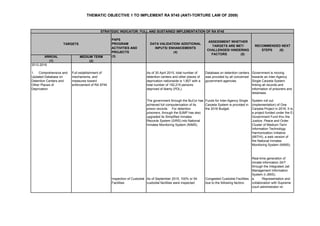
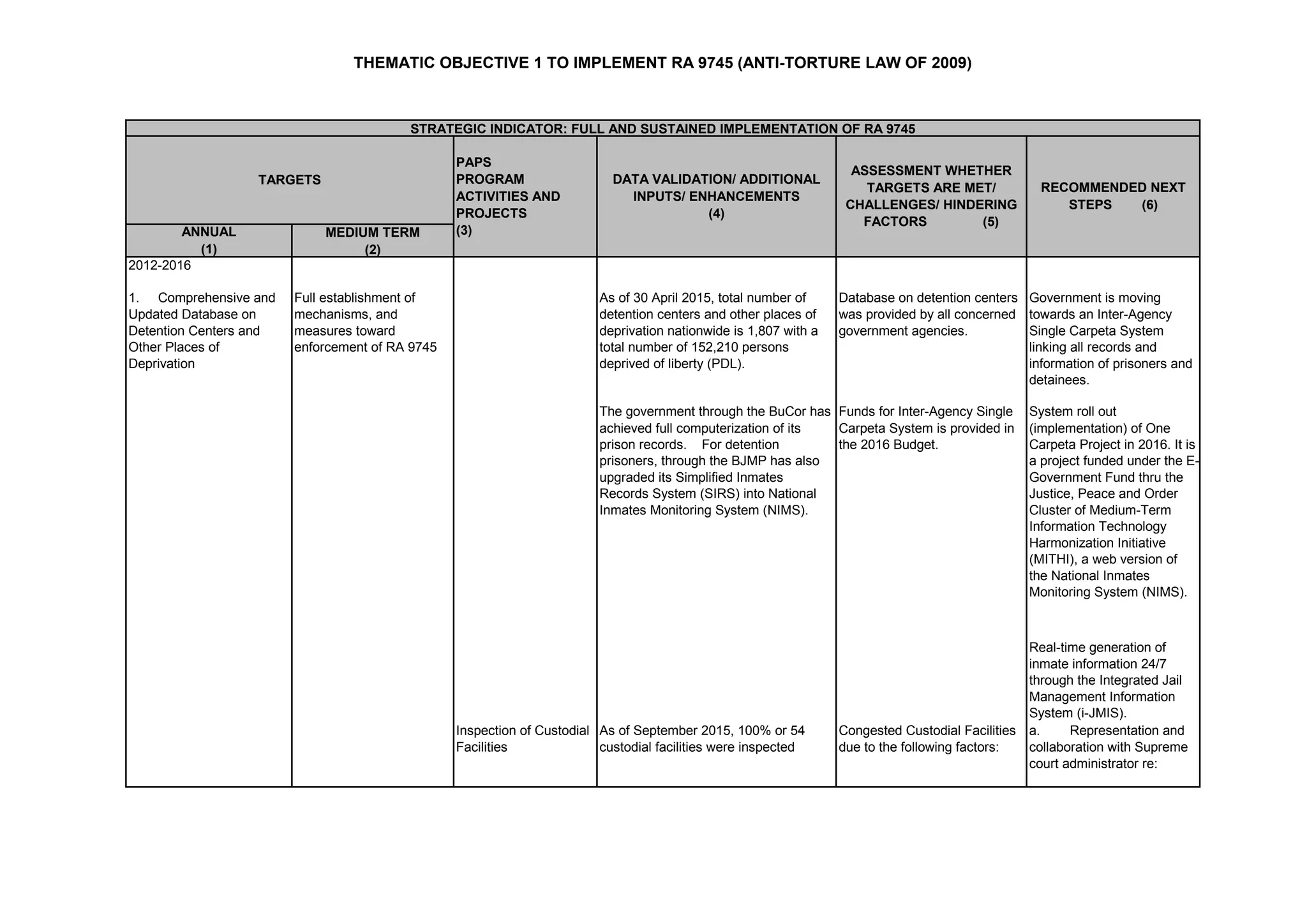
As of 30 April 2015, total number of
detention centers and other places of
deprivation nationwide is 1,807 with a
total number of 152,210 persons
deprived of liberty (PDL).
Database on detention centers
was provided by all concerned
government agencies.
Government is moving
towards an Inter-Agency
Single Carpeta System
linking all records and
information of prisoners and
detainees.
The government through the BuCor has
achieved full computerization of its
prison records. For detention
prisoners, through the BJMP has also
upgraded its Simplified Inmates
Records System (SIRS) into National
Inmates Monitoring System (NIMS).
Funds for Inter-Agency Single
Carpeta System is provided in
the 2016 Budget.
System roll out
(implementation) of One
Carpeta Project in 2016. It is
a project funded under the E-
Government Fund thru the
Justice, Peace and Order
Cluster of Medium-Term
Information Technology
Harmonization Initiative
(MITHI), a web version of
the National Inmates
Monitoring System (NIMS).
Real-time generation of
inmate information 24/7
through the Integrated Jail
Management Information
System (i-JMIS).
Inspection of Custodial
Facilities
As of September 2015, 100% or 54
custodial facilities were inspected
Congested Custodial Facilities
due to the following factors:
a. Representation and
collaboration with Supreme
court administrator re:
1. Comprehensive and
Updated Database on
Detention Centers and
Other Places of
Deprivation
THEMATIC OBJECTIVE 1 TO IMPLEMENT RA 9745 (ANTI-TORTURE LAW OF 2009)
STRATEGIC INDICATOR: FULL AND SUSTAINED IMPLEMENTATION OF RA 9745
TARGETS
2012-2016
PAPS
PROGRAM
ACTIVITIES AND
PROJECTS
(3)
DATA VALIDATION/ ADDITIONAL
INPUTS/ ENHANCEMENTS
(4)
ASSESSMENT WHETHER
TARGETS ARE MET/
CHALLENGES/ HINDERING
FACTORS (5)
RECOMMENDED NEXT
STEPS (6)
ANNUAL
(1)
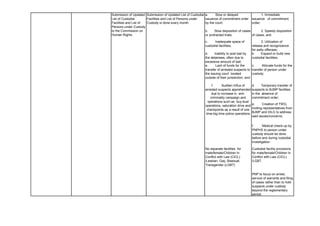
Submission of Updated List of Custodial
Facilities and List of Persons under
Custody is done every month.
a. Slow or delayed
issuance of commitment order
by the court;
1. Immediate
issuance of commitment
order;
b. Slow disposition of cases
or protracted trials;
2. Speedy disposition
of cases; and
c. Inadequate space of
custodial facilities;
3. Utilization of
release and recognizance
for petty offenses;
d. Inability to post bail by
the detainees, often due to
excessive amount of bail;
b. Expand or build new
custodial facilities;
e. Lack of funds for the
transfer of arrested suspects to
the issuing court located
outside of their jurisdiction; and
c. Allocate funds for the
transfer of person under
custody;
d. Temporary transfer of
suspects to BJMP facilities
in the absence of
commitment order;
e. Creation of TWG,
inviting representatives from
BJMP and DILG to address
said issues/concerns;
f. Medical check-up by
PNPHS to person under
custody should be done
before and during custodial
investigation
No separate facilities for
male/female/Children In
Conflict with Law (CICL)
/Lesbian, Gay, Bisexual,
Transgender (LGBT)
Custodial facility provisions
for male/female/Children In
Conflict with Law (CICL)
/LGBT.
PNP to focus on arrest,
service of warrants and filing
of cases rather than to hold
suspects under custody
beyond the reglementary
period.
Submission of Updated
List of Custodial
Facilities and List of
Persons under Custody
to the Commission on
Human Rights.
f. Sudden Influx of
arrested suspects apprehended
due to increase in anti-
criminality campaign and
operations such as buy-bust
operations, saturation drive and
checkpoints as a result of one
time-big time police operations
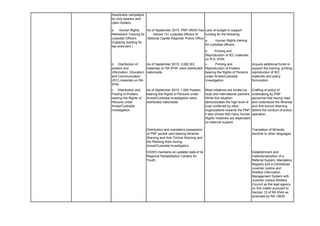
Awareness campaigns
for duty bearers and
claim holders
Lack of budget to support
funding for the following:
a. Human Rights training
for custodial officers;
b. Printing and
Reproduction of IEC materials
on R.A. 9745;
b. Distribution of
posters and
Information, Education,
and Communication
(IEC) materials on RA
9745
As of September 2015, 3,500 IEC
materials on RA 9745 were distributed
nationwide
c. Printing and
Reproduction of Posters
bearing the Rights of Persons
under Arrest/Custodial
Investigation
Acquire additional funds to
support the training, printing,
reproduction of IEC
materials and policy
formulation.
c. Distribution and
Posting of Posters
bearing the Rights of
Persons under
Arrest/Custodial
Investigation.
As of September 2015, 1,500 Posters
bearing the Rights of Persons under
Arrest/Custodial Investigation were
distributed nationwide
Most initiatives are funded by
local and international partners.
While this situation
demonstrates the high level of
trust conferred by other
organizations towards the PNP,
it also shows that many Human
Rights initiatives are dependent
on external support.
Crafting of policy of
undertaking by PNP
personnel that having read
and understood the Miranda
and Anti-torture Warning
before the conduct of police
operation.
Distribution and mandatory possession
of PNP pocket card bearing Miranda
Warning and Anti-Torture Warning and
the Reading them during
Arrest/Custodial Investigation.
Translation of Miranda
doctrine to other languages
DSWD maintains an updated data of its
Regional Rehabilitation Centers for
Youth.
Establishment and
Institutionalization of a
Referral System, Mandatory
Registry and a Centralized
Juvenile Justice and
Welfare Information
Management System with
Juvenile Justice Welfare
Council as the lead agency
on this matter pursuant to
Section 12 of RA 9344 as
amended by RA 10630.
As of September 2015, PNP HRAO has
trained 131 custodial officers of
National Capital Regional Police Office
a. Human Rights
Refreshers Training for
custodial Officers
(Capacity building for
law enforcers )
Juvenile Justice and Welfare Council
(JJWC) developed, issued and
disseminated the Revised Implementing
Rules and Regulations of RA 9344 as
amended by Republic Act Nr 10630
which provided for the creation of 17
Regional Juvenile Justice and Welfare
Committees to oversee the
implementation of the law and these
RJJWCs are already established.
JJWC passed Resolution No. 2012-50,
Urging the PNP to Cease from
Reporting Commission of Status
Offenses and Rugby-Sniffing Minors as
Crimes Committed by Children,
administered capacity building
interventions for government employees
involved in the administration of juvenile
justice and welfare system, and
prepared a 5-Year National ICT
Investment Plan towards the
establishment of a national information
management system on CICL cases.
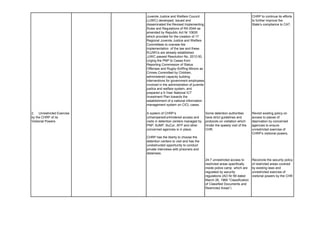
CHRP to continue its efforts
to further improve the
State’s compliance to CAT.
A system of CHRP’s
unhampered/unhindered access and
visits in detention centers managed by
PNP, BJMP, BuCor, AFP and other
concerned agencies is in place.
Some detention authorities
have strict guidelines and
protocols on visitation which
hinder the speedy visit of the
CHR.
Revisit existing policy on
access to places of
deprivation by concerned
agencies to ensure
unrestricted exercise of
CHRP's visitorial powers.
CHRP has the liberty to choose the
detention centers to visit and has the
unobstructed opportunity to conduct
private interviews with prisoners and
detainees.
24-7 unrestricted access to
restricted areas specifically
inside police camp which are
regulated by security
regulations (AO Nr 69 dated
March 26, 1969 “Classification
of Classified Documents and
Restricted Areas”)
Reconcile the security policy
of restricted areas covered
by existing laws and
unrestricted exercise of
visitorial powers by the CHR
2. Unrestricted Exercise
by the CHRP of its
Visitorial Powers
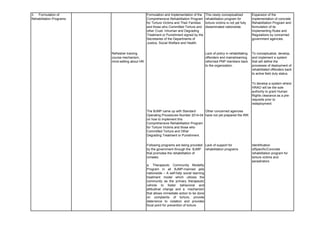
Formulation and Implementation of the
Comprehensive Rehabilitation Program
for Torture Victims and Their Families
and those who Committed Torture and
other Cruel, Inhuman and Degrading
Treatment or Punishment signed by the
Secretaries of the Departments of
Justice, Social Welfare and Health.
This newly conceptualized
rehabilitation program for
torture victims is not yet fully
disseminated nationwide.
Expansion of the
implementation of concrete
Rehabilitation Program and
formulation of its
Implementing Rules and
Regulations by concerned
government agencies.
Refresher training
course mechanism,
mind-setting about HR.
Lack of policy in rehabilitating
offenders and mainstreaming
reformed PNP members back
to the organization.
To conceptualize, develop,
and implement a system
that will define the
processes of deployment of
rehabilitated offenders back
to active field duty status.
To develop a system where
HRAO will be the sole
authority to grant Human
Rights clearance as a pre-
requisite prior to
redeployment.
The BJMP came up with Standard
Operating Procedures Number 2014-04
on how to implement this
Comprehensive Rehabilitation Program
for Torture Victims and those who
Committed Torture and Other
Degrading Treatment or Punishment.
Other concerned agencies
have not yet prepared the IRR
Following programs are being provided
by the government through the BJMP
that promotes the rehabilitation of
inmates:
Lack of support for
rehabilitation programs
Identification
ofSpecific/Concrete
rehabilitation program for
torture victims and
perpetrators
a. Therapeutic Community Modality
Program in all BJMP-manned jails
nationwide – A self-help social learning
treatment model which utilizes the
community as the primary therapeutic
vehicle to foster behavioral and
attitudinal change and a mechanism
that allows immediate action to be done
on complaints of torture, provide
deterrence to violation and provides
focal point for prevention of torture.
3. Formulation of
Rehabilitation Programs
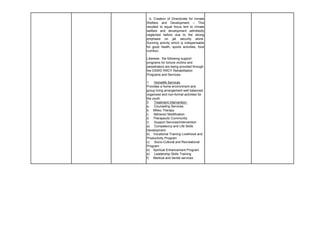
b. Creation of Directorate for Inmate
Welfare and Development – This
resulted to equal focus lent to inmate
welfare and development admittedly
neglected before due to the strong
emphasis on jail security alone.
Sunning activity which is indispensable
for good health, sports activities, food
nutrition.
Likewise, the following support
programs for torture victims and
perpetrators are being provided through
the DSWD RRCY Rehabilitation
Programs and Services:
1. Homelife Services
Provides a home environment and
group living arrangement well balanced,
organized and non-formal activities for
the youth
2. Treatment intervention-
a. Counseling Services
b. Milieu Therapy
c. Behavior Modification
d. Therapeutic Community
3. Support Services/Intervention
a) Competency and Life Skills
Development
b) Vocational Training Livelihood and
Productivity Program
c) Socio-Cultural and Recreational
Program
d) Spiritual Enhancement Program
e) Leadership Skills Training
f) Medical and dental services
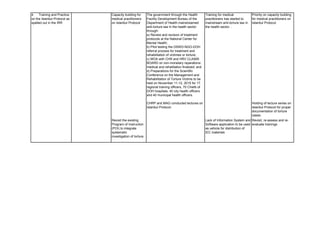
Capacity building for
medical practitioners
on Istanbul Protocol
The government through the Health
Facility Development Bureau of the
Department of Health mainstreamed
anti-torture law in the health sector
through:
a) Review and revision of treatment
protocols at the National Center for
Mental Health;
b) Pilot testing the DSWD-NGO-DOH
referral process for treatment and
rehabilitation of victimes or torture;
c) MOA with CHR and HRV CLAIMS
BOARD on non-monetary reparations:
medical and rehailitation finalized; and
d) Preparations for the Scientific
Conference on the Management and
Rehabilitation of Torture Victims to be
held on November 11-12, 2015 for 17
regional training officers, 70 Chiefs of
DOH hospitals; 40 city health officers
and 40 municipal health officers.
Training for medical
practitioners has started to
mainstream anti-torture law in
the health sector. .
Priority on capacity building
for medical practitioners on
Istanbul Protocol
CHRP and MAG conducted lectures on
Istanbul Protocol.
Holding of lecture series on
Istanbul Protocol for proper
documentation of torture
cases.
Revisit the existing
Program of Instruction
(POI) to integrate
systematic
investigation of torture.
Lack of Information System and
Software application to be used
as vehicle for distribution of
IEC materials
Revisit, re-assess and re-
evaluate trainings
4. Training and Practice
on the Istanbul Protocol as
spelled out in the IRR
BJMP continuously conduct
trainings/seminars/symposia for
custodial personnel charged with the
treatment of persons deprived of Liberty
and medical personnel involved with
detainees, on the guidelines to detect
signs of torture and ill-treatment in
accordance with international
standards. In the first semester of 2013
alone, 59 custodial personnel received
training on counselling and application
of Therapeutic community Modality
Program, a key component of the Anti-
torture strategy adopted by the BJMP.
In 2012, another 35 medical personnel
attended Emergency Medical Response
Team Training including detection of
signs of torture and ill-treatment.
Holding of Donors’ Forum
Ensure training as a priority
in annual planning sessions
To revisit, re-assess and re-
evaluate trainings.
Incorporation of 10%
Human Rights
Questions in the
Promotional
Examinations;
Promotional Exam is being conducted
twice a year.
To collaborate with other
agencies for a holistic
approach in the conduct of
HR trainings.
Certain trainings did not push
through or were significantly
delayed due to limited funds or
security concerns.
Series of Specialized Training is being
conducted every year wherein each
participant is required to conduct re-
echo training with a minimum of 100
PNP personnel for at least 16 hrs
training period.
Inclusion of Human
Rights-Based Policing
in the Program of
Instruction of all
Specialized Training in
the PNP;
5. Education and
information campaign for
security sector and law
enforcement agencies,
medical personnel, public
officials, and schools
Incorporation of 15%
Human Rights Module
in all mandatory
schooling and training.
Human Rights Module were already
incorporated in all mandatory
schoolings and trainings
Trainings and
Seminars on Human
Rights and the Anti-
Torture Law are given
to all law enforcers to
include the custodial
officers, prison and jail
personnel to heighten
their awareness of, and
respect for HR.
For CY 2015, PNP HRAO has trained
131 custodial officers of National
Capital Regional Police Office
DSWD accomplished the following:
1. Conduct of Physical and
Psychological examinations of CICL
before admission to Regional
Rehabilitation Centers for Youth to
identify possible incidents of torture or
trauma.
2. DSWD Central Office
comprehensively monitor and provide
technical assistance to RRCYs
nationwide through desk monitoring
(review or reports and provision of
inputs/comments) and field monitoring .
(Executive Order No. 15, series of 1998
as amended by Executive Order No.
221)
All PDEA detention facilities maintain a
register of detainees which is being
updated monthly and regularly
submitted to CHR
Spot visits to PDEA detention facilities
were conducted by CHR; relatives and
counsels were allowed to confer with
PDEA detainees
PDEA created the Detention Facility
Manual to standardize the rules and
procedures in all its detention facilities
and trained 86 prison guards
PDEA incorporated the Human Rights
Advocacy modules (with emphasis on
RA 9745, RA 7438, Rules on Arrests –
Rule 113 of the Rules of Court, Article
125 of the Revised Penal Code) in the
training for investigation, intelligence,
and leadership courses participated in
by 148 Drug Enforcement Officers
Lobby for prompt action
of concerned agencies
CHR convened the Committee in
February 5, 2014. During the first
meeting, the Rules of Procedures of the
Oversight Committee was drafted.
The meeting of the Oversight
Committee on October 19,
2015 purposely to approve the
internal procedures was moved
to a later date.
Follow-through/Second
Meeting for 2016 to approve
the proposed Rules and
Regulations of the Oversight
Committee
Review of the
Implementation of the Anti-
Torture Law
Strengthening Investigation
and Documentation of
Torture Cases and Actions
Taken
6. Convening of the
Oversight Committee.
MEDIUM TERM
(2)
Sustained/continuous
installation, and
enhancements of targeted
preventive, and protective
mechanisms
Lobby for appropriate
action/background
studies on measures
for institutional
protection of victims,
education and
information campaign
on preventive and
protective mechanisms
Submitted Position Papers before the
House of Representatives and Senate
on bills pertaining to establishment of
National Preventive Mechanism and
continues to support these bills.
House Bill No. 2152 re-filed
before the 16th
Congress aimed
to strengthen the Commission
on Human Rights and for Other
Purposes was likewise not
passed because of more urgent
concerns which need to be
acted upon by the legislators.
Continuous lobbying for the
enactment of the law to
accelerate the process of
establishing an independent
and effective NPM and to
strengthen the CHRP.
Development of Human
Rights Violation
Monitoring Mechanism
For CY 2015, 17 PNP personnel were
allegedly involved in Human Rights
violation cases.
Lack of accountability of
Human Rights Officers in the
field because they are not
directly answerable to HRAO.
Establishment of
mechanism to enhance
monitoring of HRV
incidents/cases involving
PNP personnel.
Creation and
Operationalization of
PNP Human Rights
Desks nationwide
2,108 PNP Human Rights Desks were
created and fully operational.
Conducted multi-
sectoral cooperation
activities.
For CY 2015, 165 dialogue, fora, and
symposia with other stakeholders were
conducted.
Part of anti-torture strategy, PNP
inspected 2,915 Police Custodial
Facilities
1. Setting-up of the
National Preventive
Mechanism, Unified
Penitentiary System,
enforcement, and
operationalization of
command responsibility in
the police, military and
custodial services;
ANNUAL
(1)
2012-2016
THEMATIC OBJECTIVE 2 TO ENHANCE PREVENTIVE AND PROTECTIVE MECHANISMS
STRATEGIC INDICATOR: PREVENTIVE, AND PROTECTIVE MECHANISMS FULLY ESTABLISHED, AND INSTITUTIONALIZED, WHICH REFERS TO AN EMPOWERED
COMMISSION ON HUMAN RIGHTS, SETTING UP OF THE NATIONAL PREVENTIVE MECHANISM, AND OTHER MEASURES
TARGETS
PAPS
PROGRAM
ACTIVITIES AND
PROJECTS
(3)
DATA VALIDATION/ ADDITIONAL
INPUTS/ ENHANCEMENTS
(4)
ASSESSMENT WHETHER
TARGETS ARE MET/
CHALLENGES/ HINDERING
FACTORS (5)
RECOMMENDED NEXT
STEPS (6)
Restructuring of the Human
Rights Affairs Office to
empower or capacitate
HRAO to implement the
programs, projects and
activities effectively under
LOI PAMANA and to
mobilize Human Rights
Officers at the National,
Regional, Provincial, City
and Municipal levels in the
conduct of Human Rights
related policy formulation,
human rights trainings and
education, human rights
prevention mechanisms,
fostering multi-sectoral
cooperation and provide
HRAO with the necessary
administrative and
operational control overall
PNP Human Rights Desks
and Officers.
Other PNP’s initiatives to prevent
torture include the strict implementation
of the Policies on Banning Hazing and
Other Forms of
Continuous collaboration
and strong partnership with
stakeholders
Maltreatment in all Police Education &
Training Activities and on Anti-Torture
and Human Rights Protection Training
for Detention Authorities.
DILG, CHRP and other government
agencies and civil society organizations
have signed the Declaration of Support
for the National Monitoring Mechanisms
(NMM) on Human Rights on December
16, 2014 to monitor and address
incidences of human rights violations in
the Philippines.
DILG issued Joint Memorandum
Circular No. 1, Series of 2014, dated 16
December 2014 on “Mainstreaming
Human Rights Through Rule of Law
and Access to Justice at the Level of
Provinces, Cities, Municipalities and
barangays”, which mandates the
creation of Human Rights Committee as
one of the standing committees of
respective Sanggunian. Also said
circular mandates the establishment of
Human Rights Action Teams and
Human Rights Action Center at all LGU
levels to ensure mainstreaming of HR in
local governance.
Part of anti-torture strategy, PNP
inspected 2,877 Police Custodial
Facilities, conducted multi-sectoral
cooperation activities. Other PNP’s
initiatives to prevent torture include the
strict implementation of the Policies on
Banning Hazing and Other Forms of
Maltreatment in all Police Education &
Training Activities and on Anti-Torture
and Human Rights Protection Training
for Detention Authorities.
On 14 March 2014, the BJMP issued a
Policy on Mandatory Reporting of
Torture Cases.
DSWD implements measures to
prevent torture through its Joint
Monitoring Team of Protective Services
Bureau and the National Inspectorate
Committee’s continuous assistance and
services.
DSWD implemented Community-Based
Programs which are preventive,
rehabilitative and developmental that
mobilize the family anad community to
respond to a problem/need/concern of
children, youth, women, person with
disabilities, older persons and families
who are in need and at risk; and Center-
Based Programs and Services
conducted in centers and facilities
which provide 24-hour alternative family
care to poor vulnerable and
disadvantaged individuals and families
in crisis whose need cannot be met by
their families and relatives or by any
other form of alternative family care for
a period of time.
Passage of RECOGNIZANCE ACT OF
2012 (RA 10389),
INSTITUTIONALIZING
RECOGNIZANCE AS A MODE OF
GRANTING THE RELEASE OF AN
INDIGENT PERSON IN CUSTODY AS
AN ACCUSED IN A CRIMINAL CASE
AND FOR OTHER PURPOSES”
Salient Features:
The right of persons, except those
charged with crimes punishable by
death, reclusion perpetua , or life
imprisonment, to be released on
recognizance before conviction by the
Regional Trial Court, irrespective of
whether the case was originally filed in
or appealed to it, upon compliance with
the requirements of this Act, is hereby
affirmed, recognized and guaranteed.
Section 5. Release on Recognizance
as a Matter of Right Guaranteed by the
Constitution. The release on
recognizance of any person in custody
or detention for the commission of an
offense is a matter of right when the
offense is not punishable by death,
reclusion perpetua , or life
imprisonment:
Provided, That the accused or any
person on behalf of the accused files
the application for such:
(a) Before or after conviction by the
Metropolitan Trial Court, Municipal Trial
Court, Municipal Trial Court in Cities
and Municipal Circuit Trial Court; and
2. Institutionalization of
Release on
Recognizance, and such
other paralegal measures
(b) Before conviction by the Regional
Trial Court: Provided, further, That a
person in custody for a period equal to
or more than the minimum of the
principal penalty prescribed for the
offense charged, without application of
the Indeterminate Sentence Law, or any
modifying circumstance, shall be
released on the person’s recognizance.
Along with the paralegal program, these
laws will substantially decongest the
jails which are the main cause of the
sub-human condition in many jails.
Reorganized BJMP Regional, Provincial
and
Unit Paralegal Offices and Activated
Paralegal Corners and Desks in every
city, district and municipal jails
nationwide, visible and accessible for
every inmate who wants to avail of the
services offered by the program
Reinforced the capability of the
Paralegal Officers to address the
concerns of inmates through the
conduct of Paralegal Trainings
Conducted surprise inspections to jails
to determine if paralegal programs are
implemented
Developed and Distributed BJMP
Paralegal Manual and Resource Book,
in partnership with the Humanitarian
Legal Assistance Foundation (HLAF)
PDEA created the Welfare Desk for
Children and Women to continuously
monitor the status of children and
women involved in illegal drugs
activities under PDEA custody.
MEDIUM TERM
(2)
90% of the police, military
and custodial services are
well trained on human
rights.
Impact/evaluation
studies on HR(i.e.
custodial system and
educational system)
A total of 41,000 PNP personnel have
undergone training on HR laws from
2012-2015 and 1,492 capability building
activities were also conducted from
2012 to 2014.
While the target number of
trained PNP personnel on HR
was not met, in 2014, the
following were achieved:
Recommendation to the
PNP leadership for
additional financial support
for the conduct of training on
Human Rights.
Under CY 2011-2016 National Security
Policy, police, military and other
concerned member-agencies made
great strides in the conduct of Human
Rights Education and Training for the
Security Sector.
a. Human Rights Module in
all PNP mandatory
schooling/trainings;
Close monitoring of
custodial facilities.
b. Anti-Torture and Human
Rights Protection Training is
mandatory for all custodial
personnel; and
Sustain harnessing of
support from CHRP, civil
society organizations and
other human rights
defenders in advancing the
country’s human rights
agenda.
c. Inclusion of Human Rights-
Based Policing module in all
PNP Career Courses.
Use of HR case studies
method in the conduct of
interview for promotion.
All PNP Custodial Personnel have
undergone the Anti-Torture and Human
Rights Protection Mandatory Training.
- 20% of the
manpower of law
enforcement agencies
trained annually.
ANNUAL
(1)
2012-2016
- Impact/evaluation
studies of education and
training on human rights
within security/custodial
system, and in the
THEMATIC OBJECTIVE 3 TO HEIGHTEN AWARENESS OF, AND RESPECT FOR HR AMONG STATE AGENTS, AND THE GENERAL PUBLIC.
Strategic Indicator: Decreased number or absence of complaints of human rights violations more particularly against CAT and RA 9745
TARGETS
PAPS
PROGRAM
ACTIVITIES AND
PROJECTS
(3)
DATA VALIDATION/ ADDITIONAL
INPUTS/ ENHANCEMENTS
(4)
ASSESSMENT WHETHER
TARGETS ARE MET/
CHALLENGES/ HINDERING
FACTORS (5)
RECOMMENDED NEXT
STEPS (6)
Conduct Actual field data, well-
funded research, methodology
of training, review
Conduct of study whether
the Human Rights cases
can redound to lesser
violations on human rights.
In 2013, the “Guidebook on the
Investigation and Prosecution of Human
Rights Cases” was developed by the
Department of Justice in partnership
with the CHRP, United Nations
Development Programme and the
University of the Philippines College of
Law. This guidebook is used as a
reference in all PNP human rights
training and anti-torture information and
advocacy activities.
Draft of Policy/Directive for
PNP personnel
(investigators and front
liners) for the mandatory
execution of affidavit that
they have read and inform
the accused of his/her rights
and also the
victims/complainants.
All BJMP personnel have undergone
training on HR laws.
All PDEA drug enforcement officers and
Custodial Officers have undergone
human rights training as it is part of the
Drug Enforcement Basic Course and
Custodial Officers Course. It is an SOP
as embodied in the PDEA Manual of
Anti-Drug Operations that all persons
arrested, detained or under custodial
investigation are apprised of the
Miranda rights, subjected to physical
and medical examination.
AFP persistently conducts an advocacy
campaign to prevent the occurrence of
torture in compliance with Anti-Torture
Act of 2009; the Philippine Act on
Crimes Against International
Humanitarian Law, Genocide and Other
Crimes Against Humanity; the Anti-
Enforced or Involuntary Disappearance
Act of 2012; and, the Comprehensive
Program Framework for Children in
Armed Conflict are incorporated in the
curriculum of AFP education and
training programs, specifically in pre-
entry, basic, advance, specialization
and general staff courses.
Downward trend in the number of
reported alleged torture incidents
involving PNP:
Close monitoring of
custodial and detention
facilities.
2011 - 38 incidents
2012 - 19 incidents
2013 - 15 incidents
2014 - 12 incidents
2015 - 2 incidents (As of June 2015)
From 2012 to date, BJMP has no
reported cases of torture involving jail
personnel.
For 2014, PDEA Internal Affairs Service
(IAS) did not receive any complaint on
human rights involving PDEA
personnel.
- Decrease in the
incidence of torture
involving law enforcement
agencies
Limited resources to support
infrastructure development,
technology enhancement and
training to address torture as
the main challenge in
implementing HR agenda and
RA 9745.
Sustained Harnessing of
Support from CHRP, civil
society organizations and
other human rights
defenders in advancing the
country’s human rights
agenda.
MEDIUM TERM
(2)
Advocacy for the
legislation of NPM, and for
the ratification of
ICPAPED
Lobby for appropriate
action/background
studies/ policy
statements/ positions.
Legislation of NPM in both Congress is
on-going.
However, landmark legislations passed
include the Enactment of Republic Act
No. 10575, "Bureau of Corrections
Modernization Act of 2013", highlighted
the government's effort to restructure,
modernize faclilities and professionalize
programs and services at par with
international standards on the treatment
of offenders.
House Bill No. 5193 filed before
the 16th
Congress which aims
to fulfill the obligation of
establishing the National
Committee for the Prevention
of Torture (NCPT) and the
National Preventive Mechanism
(NPM) was unfortunately not
passed within the period as
prescribed under Article 17 of
the OPCAT due to intervening
events.
Convene series of meetings
with the members of the
House of Representatives,
DOJ, CHR, AFP and other
stakeholders to pave way for
the drafting of a law/bill and
creation of an inter-agency
committee to address this
concern.
Passage also of following legislations
aimed to decongest jails and prisons:
Continue lobbying for the
approval of a legislation that
will establish an NPM with
independence, transparency
REPUBLIC ACT NO. 10159, "AN ACT
AMENDING ARTICLE 39 OF ACT NO.
3815, AS AMENDED, OTHERWISE
KNOWN AS THE REVISED PENAL
CODE", aimed to decongest jails and
prisons.
ANNUAL
(1)
2012-2016
-
Evaluation/assessment
studies of legal/judicial/
administrative measures,
and mechanisms relative to
the prevention of human
rights violation particularly
with reference to the CAT,
and RA 9745
THEMATIC OBJECTIVE 4 TO ENACT APPROPRIATE LEGISLATION AND SUPPORTING EOS, AOS
STRATEGIC INDICATOR: INSTITUTION AND/OR MODIFICATION OF APPROPRIATE LEGAL/JUDICIAL/ADMINISTRATIVE MEASURES AND MECHANISMS AT PAR WITH
TARGETS
PAPS
PROGRAM
ACTIVITIES AND
PROJECTS
(3)
DATA VALIDATION/ ADDITIONAL
INPUTS/ ENHANCEMENTS
(4)
ASSESSMENT WHETHER
TARGETS ARE MET/
CHALLENGES/ HINDERING
FACTORS (5)
RECOMMENDED NEXT
STEPS (6)
Senate Bill No. 2461 filed
before the 16th
Congress aimed
to eliminate inhuman conditions
in Philippine Prisons and Jails
but was not passed due to
more pressing issues that
require the attention of the
legislators.
2012-2013
- Legislative
Advocacy up to the 2nd
reading of the NPM
Silent Features:
SECTION 1. Article 39 of Act No. 3815,
as amended, is hereby further
ammended to read as follows:
"Art.39. Subsidiary Penalty. - If the
convict has no property with which to
meet the fine mentioned in paragraph 3
of the next preceding article, he shall be
subject to a subsidiary personal
liability at the rate of one day for
each aount equivalent to the highest
minimum wage rate prevailing in the
Philippines at the time of the
redention of judgement of conviction
by the trial court,xxx.
DILG issued Guidelines for Local
Government Units in the Development
of the Comprehensive Local Juvenile
Intervention Program and Memorandum
Circular No. 2012-120, directing all
LGUs to comply with Section 15, RA
9344 by allocating at least 1% of their
Internal Revenue Allotment for the
strengthening and implementation of
programs for the Local Council for the
Protection of Children.
Proposed bills aimed to
decongest jails and improve the
living condition of inmates were
not passed as planned due to
more pressing issues that
require the attention of the
legislators and these include
“An Act Placing the Provincial,
Sub-Provincial Jails under the
Jurisdiction of the BJMP” and
Jail Infrastructure Development
and BJMP Modernization Act”.
However, two (2) important
legislations targeted that were
passed include the Republic
Act No. 10592, An Act
Amending Articles 29, 94,97,98
and 99 of Act No. 3815, As
Amended Otherwise Known as
the Revised Penal Code was
passed on May 29, 2013,
,which grants not only the
Director of the Bureau of
Corrections the authority to
grant good conduct time
allowance to inmates but also
to the Chief of the BJMP and
Wardens of the Provincial, City,
District and Municipal Jails and
its Implementing Rules and
Regulations issued on 26
March 2014.
MEDIUM TERM
(2)
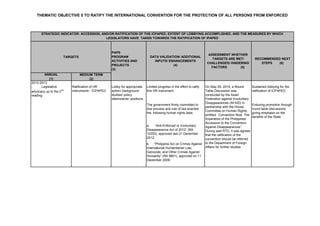
Ratification of HR
instruments - ICPAPED
Limited progress in the effort to ratify
this HR instrument.
Sustained lobbying for the
ratification of ICPAPED.
The government firmly committed to
due process and rule of law enacted
the following human rights laws:
Enduring promotion through
round table discussions
giving emphasis on the
benefits of the State.
a. “Anti-Enforced or Involuntary
Disappearance Act of 2012” (RA
10353), approved last 21 December
2012;
b. “Philippine Act on Crimes Against
International Humanitarian Law,
Genocide, and Other Crimes Against
Humanity” (RA 9851), approved on 11
December 2009;
RECOMMENDED NEXT
STEPS (6)
ANNUAL
(1)
On May 29, 2014, a Round
Table Discussion was
conducted by the Asian
Federation against Involuntary
Disappearances (AFAID) in
partnership with the House
Committee on Human Rights,
entitled: Convention Now. The
Imperative of the Philippines’
Accession to the Convention
Against Disappearances”.
During said RTD, it was agreed
that the ratification of the
convention should be referred
to the Department of Foreign
Affairs for further studies.
2012-2013
THEMATIC OBJECTIVE 5 TO RATIFY THE INTERNATIONAL CONVENTION FOR THE PROTECTION OF ALL PERSONS FROM ENFORCED
STRATEGIC INDICATOR: ACCESSION, AND/OR RATIFICATION OF THE ICPAPED; EXTENT OF LOBBYING ACCOMPLISHED, AND THE MEASURES BY WHICH
LEGISLATORS HAVE TAKEN TOWARDS THE RATIFICATION OF IPAPED
TARGETS
PAPS
PROGRAM
ACTIVITIES AND
PROJECTS
(3)
DATA VALIDATION/ ADDITIONAL
INPUTS/ ENHANCEMENTS
(4)
ASSESSMENT WHETHER
TARGETS ARE MET/
CHALLENGES/ HINDERING
FACTORS (5)
- Legislative
advocacy up to the 2nd
reading
Lobby for appropriate
action/ background
studies/ policy
sttemments/ positions.
c. An Act Defining Certain Rights of
Person Arrested, Detained or Under
Custodial Investigation as well as the
Duties of the Arresting, Detaining and
Investigating Officers, and Providing
Penalties for Violations Thereof (RA
7438), approved on 27 April 1992; and
Absence of an agency
champion that would look at the
obligations at the lens of the
benefits the State will gain from
this HR instrument.
d. Law on the Recognition and
Reparations for Victims of Martial Law
(RA 10368).
Also, Administrative Order No. 35,
series of 2012 was signed by the
President creating the Inter-Agency
Committee on Extra-Legal Killings,
Enforced Disappearance, Torture and
Other Grave Violations of the Right to
Life, Liberty and Security of Persons.
Greatest challenge of
ICPAPED for concerned
agencies are the obligations,
accountabilities and
responsibilities of the State.
Identification of agency
champion that can
orchestrate all efforts of
stakeholders toward the
ratification of ICPAPED.

CAT Tables

  • 1.
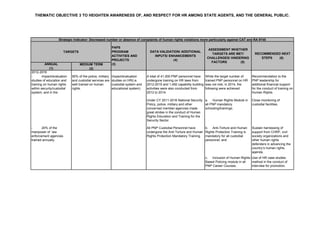
    MEDIUM TERM (2) Full establishmentof mechanisms, and measures toward enforcement of RA 9745 As of 30 April 2015, total number of detention centers and other places of deprivation nationwide is 1,807 with a total number of 152,210 persons deprived of liberty (PDL). Database on detention centers was provided by all concerned government agencies. Government is moving towards an Inter-Agency Single Carpeta System linking all records and information of prisoners and detainees. The government through the BuCor has achieved full computerization of its prison records. For detention prisoners, through the BJMP has also upgraded its Simplified Inmates Records System (SIRS) into National Inmates Monitoring System (NIMS). Funds for Inter-Agency Single Carpeta System is provided in the 2016 Budget. System roll out (implementation) of One Carpeta Project in 2016. It is a project funded under the E- Government Fund thru the Justice, Peace and Order Cluster of Medium-Term Information Technology Harmonization Initiative (MITHI), a web version of the National Inmates Monitoring System (NIMS). Real-time generation of inmate information 24/7 through the Integrated Jail Management Information System (i-JMIS). Inspection of Custodial Facilities As of September 2015, 100% or 54 custodial facilities were inspected Congested Custodial Facilities due to the following factors: a. Representation and collaboration with Supreme court administrator re: 1. Comprehensive and Updated Database on Detention Centers and Other Places of Deprivation THEMATIC OBJECTIVE 1 TO IMPLEMENT RA 9745 (ANTI-TORTURE LAW OF 2009) STRATEGIC INDICATOR: FULL AND SUSTAINED IMPLEMENTATION OF RA 9745 TARGETS 2012-2016 PAPS PROGRAM ACTIVITIES AND PROJECTS (3) DATA VALIDATION/ ADDITIONAL INPUTS/ ENHANCEMENTS (4) ASSESSMENT WHETHER TARGETS ARE MET/ CHALLENGES/ HINDERING FACTORS (5) RECOMMENDED NEXT STEPS (6) ANNUAL (1)
  • 2.
    Submission of UpdatedList of Custodial Facilities and List of Persons under Custody is done every month. a. Slow or delayed issuance of commitment order by the court; 1. Immediate issuance of commitment order; b. Slow disposition of cases or protracted trials; 2. Speedy disposition of cases; and c. Inadequate space of custodial facilities; 3. Utilization of release and recognizance for petty offenses; d. Inability to post bail by the detainees, often due to excessive amount of bail; b. Expand or build new custodial facilities; e. Lack of funds for the transfer of arrested suspects to the issuing court located outside of their jurisdiction; and c. Allocate funds for the transfer of person under custody; d. Temporary transfer of suspects to BJMP facilities in the absence of commitment order; e. Creation of TWG, inviting representatives from BJMP and DILG to address said issues/concerns; f. Medical check-up by PNPHS to person under custody should be done before and during custodial investigation No separate facilities for male/female/Children In Conflict with Law (CICL) /Lesbian, Gay, Bisexual, Transgender (LGBT) Custodial facility provisions for male/female/Children In Conflict with Law (CICL) /LGBT. PNP to focus on arrest, service of warrants and filing of cases rather than to hold suspects under custody beyond the reglementary period. Submission of Updated List of Custodial Facilities and List of Persons under Custody to the Commission on Human Rights. f. Sudden Influx of arrested suspects apprehended due to increase in anti- criminality campaign and operations such as buy-bust operations, saturation drive and checkpoints as a result of one time-big time police operations
  • 3.
    Awareness campaigns for dutybearers and claim holders Lack of budget to support funding for the following: a. Human Rights training for custodial officers; b. Printing and Reproduction of IEC materials on R.A. 9745; b. Distribution of posters and Information, Education, and Communication (IEC) materials on RA 9745 As of September 2015, 3,500 IEC materials on RA 9745 were distributed nationwide c. Printing and Reproduction of Posters bearing the Rights of Persons under Arrest/Custodial Investigation Acquire additional funds to support the training, printing, reproduction of IEC materials and policy formulation. c. Distribution and Posting of Posters bearing the Rights of Persons under Arrest/Custodial Investigation. As of September 2015, 1,500 Posters bearing the Rights of Persons under Arrest/Custodial Investigation were distributed nationwide Most initiatives are funded by local and international partners. While this situation demonstrates the high level of trust conferred by other organizations towards the PNP, it also shows that many Human Rights initiatives are dependent on external support. Crafting of policy of undertaking by PNP personnel that having read and understood the Miranda and Anti-torture Warning before the conduct of police operation. Distribution and mandatory possession of PNP pocket card bearing Miranda Warning and Anti-Torture Warning and the Reading them during Arrest/Custodial Investigation. Translation of Miranda doctrine to other languages DSWD maintains an updated data of its Regional Rehabilitation Centers for Youth. Establishment and Institutionalization of a Referral System, Mandatory Registry and a Centralized Juvenile Justice and Welfare Information Management System with Juvenile Justice Welfare Council as the lead agency on this matter pursuant to Section 12 of RA 9344 as amended by RA 10630. As of September 2015, PNP HRAO has trained 131 custodial officers of National Capital Regional Police Office a. Human Rights Refreshers Training for custodial Officers (Capacity building for law enforcers )
  • 4.
    Juvenile Justice andWelfare Council (JJWC) developed, issued and disseminated the Revised Implementing Rules and Regulations of RA 9344 as amended by Republic Act Nr 10630 which provided for the creation of 17 Regional Juvenile Justice and Welfare Committees to oversee the implementation of the law and these RJJWCs are already established. JJWC passed Resolution No. 2012-50, Urging the PNP to Cease from Reporting Commission of Status Offenses and Rugby-Sniffing Minors as Crimes Committed by Children, administered capacity building interventions for government employees involved in the administration of juvenile justice and welfare system, and prepared a 5-Year National ICT Investment Plan towards the establishment of a national information management system on CICL cases. CHRP to continue its efforts to further improve the State’s compliance to CAT. A system of CHRP’s unhampered/unhindered access and visits in detention centers managed by PNP, BJMP, BuCor, AFP and other concerned agencies is in place. Some detention authorities have strict guidelines and protocols on visitation which hinder the speedy visit of the CHR. Revisit existing policy on access to places of deprivation by concerned agencies to ensure unrestricted exercise of CHRP's visitorial powers. CHRP has the liberty to choose the detention centers to visit and has the unobstructed opportunity to conduct private interviews with prisoners and detainees. 24-7 unrestricted access to restricted areas specifically inside police camp which are regulated by security regulations (AO Nr 69 dated March 26, 1969 “Classification of Classified Documents and Restricted Areas”) Reconcile the security policy of restricted areas covered by existing laws and unrestricted exercise of visitorial powers by the CHR 2. Unrestricted Exercise by the CHRP of its Visitorial Powers
  • 5.
    Formulation and Implementationof the Comprehensive Rehabilitation Program for Torture Victims and Their Families and those who Committed Torture and other Cruel, Inhuman and Degrading Treatment or Punishment signed by the Secretaries of the Departments of Justice, Social Welfare and Health. This newly conceptualized rehabilitation program for torture victims is not yet fully disseminated nationwide. Expansion of the implementation of concrete Rehabilitation Program and formulation of its Implementing Rules and Regulations by concerned government agencies. Refresher training course mechanism, mind-setting about HR. Lack of policy in rehabilitating offenders and mainstreaming reformed PNP members back to the organization. To conceptualize, develop, and implement a system that will define the processes of deployment of rehabilitated offenders back to active field duty status. To develop a system where HRAO will be the sole authority to grant Human Rights clearance as a pre- requisite prior to redeployment. The BJMP came up with Standard Operating Procedures Number 2014-04 on how to implement this Comprehensive Rehabilitation Program for Torture Victims and those who Committed Torture and Other Degrading Treatment or Punishment. Other concerned agencies have not yet prepared the IRR Following programs are being provided by the government through the BJMP that promotes the rehabilitation of inmates: Lack of support for rehabilitation programs Identification ofSpecific/Concrete rehabilitation program for torture victims and perpetrators a. Therapeutic Community Modality Program in all BJMP-manned jails nationwide – A self-help social learning treatment model which utilizes the community as the primary therapeutic vehicle to foster behavioral and attitudinal change and a mechanism that allows immediate action to be done on complaints of torture, provide deterrence to violation and provides focal point for prevention of torture. 3. Formulation of Rehabilitation Programs
  • 6.
    b. Creation ofDirectorate for Inmate Welfare and Development – This resulted to equal focus lent to inmate welfare and development admittedly neglected before due to the strong emphasis on jail security alone. Sunning activity which is indispensable for good health, sports activities, food nutrition. Likewise, the following support programs for torture victims and perpetrators are being provided through the DSWD RRCY Rehabilitation Programs and Services: 1. Homelife Services Provides a home environment and group living arrangement well balanced, organized and non-formal activities for the youth 2. Treatment intervention- a. Counseling Services b. Milieu Therapy c. Behavior Modification d. Therapeutic Community 3. Support Services/Intervention a) Competency and Life Skills Development b) Vocational Training Livelihood and Productivity Program c) Socio-Cultural and Recreational Program d) Spiritual Enhancement Program e) Leadership Skills Training f) Medical and dental services
  • 7.
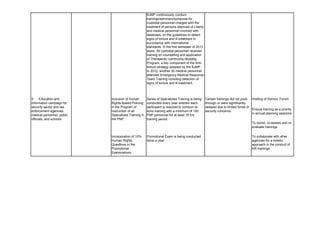
    Capacity building for medicalpractitioners on Istanbul Protocol The government through the Health Facility Development Bureau of the Department of Health mainstreamed anti-torture law in the health sector through: a) Review and revision of treatment protocols at the National Center for Mental Health; b) Pilot testing the DSWD-NGO-DOH referral process for treatment and rehabilitation of victimes or torture; c) MOA with CHR and HRV CLAIMS BOARD on non-monetary reparations: medical and rehailitation finalized; and d) Preparations for the Scientific Conference on the Management and Rehabilitation of Torture Victims to be held on November 11-12, 2015 for 17 regional training officers, 70 Chiefs of DOH hospitals; 40 city health officers and 40 municipal health officers. Training for medical practitioners has started to mainstream anti-torture law in the health sector. . Priority on capacity building for medical practitioners on Istanbul Protocol CHRP and MAG conducted lectures on Istanbul Protocol. Holding of lecture series on Istanbul Protocol for proper documentation of torture cases. Revisit the existing Program of Instruction (POI) to integrate systematic investigation of torture. Lack of Information System and Software application to be used as vehicle for distribution of IEC materials Revisit, re-assess and re- evaluate trainings 4. Training and Practice on the Istanbul Protocol as spelled out in the IRR
  • 8.
    BJMP continuously conduct trainings/seminars/symposiafor custodial personnel charged with the treatment of persons deprived of Liberty and medical personnel involved with detainees, on the guidelines to detect signs of torture and ill-treatment in accordance with international standards. In the first semester of 2013 alone, 59 custodial personnel received training on counselling and application of Therapeutic community Modality Program, a key component of the Anti- torture strategy adopted by the BJMP. In 2012, another 35 medical personnel attended Emergency Medical Response Team Training including detection of signs of torture and ill-treatment. Holding of Donors’ Forum Ensure training as a priority in annual planning sessions To revisit, re-assess and re- evaluate trainings. Incorporation of 10% Human Rights Questions in the Promotional Examinations; Promotional Exam is being conducted twice a year. To collaborate with other agencies for a holistic approach in the conduct of HR trainings. Certain trainings did not push through or were significantly delayed due to limited funds or security concerns. Series of Specialized Training is being conducted every year wherein each participant is required to conduct re- echo training with a minimum of 100 PNP personnel for at least 16 hrs training period. Inclusion of Human Rights-Based Policing in the Program of Instruction of all Specialized Training in the PNP; 5. Education and information campaign for security sector and law enforcement agencies, medical personnel, public officials, and schools
  • 9.
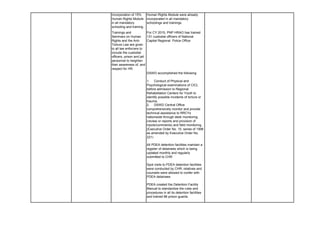
    Incorporation of 15% HumanRights Module in all mandatory schooling and training. Human Rights Module were already incorporated in all mandatory schoolings and trainings Trainings and Seminars on Human Rights and the Anti- Torture Law are given to all law enforcers to include the custodial officers, prison and jail personnel to heighten their awareness of, and respect for HR. For CY 2015, PNP HRAO has trained 131 custodial officers of National Capital Regional Police Office DSWD accomplished the following: 1. Conduct of Physical and Psychological examinations of CICL before admission to Regional Rehabilitation Centers for Youth to identify possible incidents of torture or trauma. 2. DSWD Central Office comprehensively monitor and provide technical assistance to RRCYs nationwide through desk monitoring (review or reports and provision of inputs/comments) and field monitoring . (Executive Order No. 15, series of 1998 as amended by Executive Order No. 221) All PDEA detention facilities maintain a register of detainees which is being updated monthly and regularly submitted to CHR Spot visits to PDEA detention facilities were conducted by CHR; relatives and counsels were allowed to confer with PDEA detainees PDEA created the Detention Facility Manual to standardize the rules and procedures in all its detention facilities and trained 86 prison guards
  • 10.
    PDEA incorporated theHuman Rights Advocacy modules (with emphasis on RA 9745, RA 7438, Rules on Arrests – Rule 113 of the Rules of Court, Article 125 of the Revised Penal Code) in the training for investigation, intelligence, and leadership courses participated in by 148 Drug Enforcement Officers Lobby for prompt action of concerned agencies CHR convened the Committee in February 5, 2014. During the first meeting, the Rules of Procedures of the Oversight Committee was drafted. The meeting of the Oversight Committee on October 19, 2015 purposely to approve the internal procedures was moved to a later date. Follow-through/Second Meeting for 2016 to approve the proposed Rules and Regulations of the Oversight Committee Review of the Implementation of the Anti- Torture Law Strengthening Investigation and Documentation of Torture Cases and Actions Taken 6. Convening of the Oversight Committee.
  • 11.
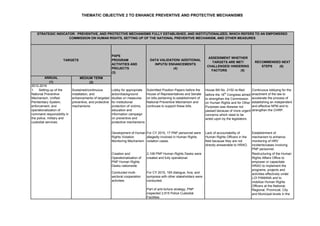
    MEDIUM TERM (2) Sustained/continuous installation, and enhancementsof targeted preventive, and protective mechanisms Lobby for appropriate action/background studies on measures for institutional protection of victims, education and information campaign on preventive and protective mechanisms Submitted Position Papers before the House of Representatives and Senate on bills pertaining to establishment of National Preventive Mechanism and continues to support these bills. House Bill No. 2152 re-filed before the 16th Congress aimed to strengthen the Commission on Human Rights and for Other Purposes was likewise not passed because of more urgent concerns which need to be acted upon by the legislators. Continuous lobbying for the enactment of the law to accelerate the process of establishing an independent and effective NPM and to strengthen the CHRP. Development of Human Rights Violation Monitoring Mechanism For CY 2015, 17 PNP personnel were allegedly involved in Human Rights violation cases. Lack of accountability of Human Rights Officers in the field because they are not directly answerable to HRAO. Establishment of mechanism to enhance monitoring of HRV incidents/cases involving PNP personnel. Creation and Operationalization of PNP Human Rights Desks nationwide 2,108 PNP Human Rights Desks were created and fully operational. Conducted multi- sectoral cooperation activities. For CY 2015, 165 dialogue, fora, and symposia with other stakeholders were conducted. Part of anti-torture strategy, PNP inspected 2,915 Police Custodial Facilities 1. Setting-up of the National Preventive Mechanism, Unified Penitentiary System, enforcement, and operationalization of command responsibility in the police, military and custodial services; ANNUAL (1) 2012-2016 THEMATIC OBJECTIVE 2 TO ENHANCE PREVENTIVE AND PROTECTIVE MECHANISMS STRATEGIC INDICATOR: PREVENTIVE, AND PROTECTIVE MECHANISMS FULLY ESTABLISHED, AND INSTITUTIONALIZED, WHICH REFERS TO AN EMPOWERED COMMISSION ON HUMAN RIGHTS, SETTING UP OF THE NATIONAL PREVENTIVE MECHANISM, AND OTHER MEASURES TARGETS PAPS PROGRAM ACTIVITIES AND PROJECTS (3) DATA VALIDATION/ ADDITIONAL INPUTS/ ENHANCEMENTS (4) ASSESSMENT WHETHER TARGETS ARE MET/ CHALLENGES/ HINDERING FACTORS (5) RECOMMENDED NEXT STEPS (6) Restructuring of the Human Rights Affairs Office to empower or capacitate HRAO to implement the programs, projects and activities effectively under LOI PAMANA and to mobilize Human Rights Officers at the National, Regional, Provincial, City and Municipal levels in the
  • 12.
    conduct of HumanRights related policy formulation, human rights trainings and education, human rights prevention mechanisms, fostering multi-sectoral cooperation and provide HRAO with the necessary administrative and operational control overall PNP Human Rights Desks and Officers. Other PNP’s initiatives to prevent torture include the strict implementation of the Policies on Banning Hazing and Other Forms of Continuous collaboration and strong partnership with stakeholders Maltreatment in all Police Education & Training Activities and on Anti-Torture and Human Rights Protection Training for Detention Authorities. DILG, CHRP and other government agencies and civil society organizations have signed the Declaration of Support for the National Monitoring Mechanisms (NMM) on Human Rights on December 16, 2014 to monitor and address incidences of human rights violations in the Philippines. DILG issued Joint Memorandum Circular No. 1, Series of 2014, dated 16 December 2014 on “Mainstreaming Human Rights Through Rule of Law and Access to Justice at the Level of Provinces, Cities, Municipalities and barangays”, which mandates the creation of Human Rights Committee as one of the standing committees of respective Sanggunian. Also said circular mandates the establishment of Human Rights Action Teams and Human Rights Action Center at all LGU levels to ensure mainstreaming of HR in local governance.
  • 13.
    Part of anti-torturestrategy, PNP inspected 2,877 Police Custodial Facilities, conducted multi-sectoral cooperation activities. Other PNP’s initiatives to prevent torture include the strict implementation of the Policies on Banning Hazing and Other Forms of Maltreatment in all Police Education & Training Activities and on Anti-Torture and Human Rights Protection Training for Detention Authorities. On 14 March 2014, the BJMP issued a Policy on Mandatory Reporting of Torture Cases. DSWD implements measures to prevent torture through its Joint Monitoring Team of Protective Services Bureau and the National Inspectorate Committee’s continuous assistance and services. DSWD implemented Community-Based Programs which are preventive, rehabilitative and developmental that mobilize the family anad community to respond to a problem/need/concern of children, youth, women, person with disabilities, older persons and families who are in need and at risk; and Center- Based Programs and Services conducted in centers and facilities which provide 24-hour alternative family care to poor vulnerable and disadvantaged individuals and families in crisis whose need cannot be met by their families and relatives or by any other form of alternative family care for a period of time.
  • 14.
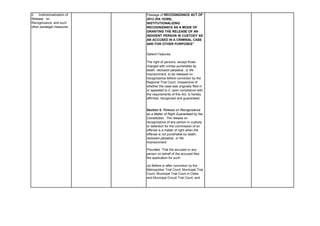
    Passage of RECOGNIZANCEACT OF 2012 (RA 10389), INSTITUTIONALIZING RECOGNIZANCE AS A MODE OF GRANTING THE RELEASE OF AN INDIGENT PERSON IN CUSTODY AS AN ACCUSED IN A CRIMINAL CASE AND FOR OTHER PURPOSES” Salient Features: The right of persons, except those charged with crimes punishable by death, reclusion perpetua , or life imprisonment, to be released on recognizance before conviction by the Regional Trial Court, irrespective of whether the case was originally filed in or appealed to it, upon compliance with the requirements of this Act, is hereby affirmed, recognized and guaranteed. Section 5. Release on Recognizance as a Matter of Right Guaranteed by the Constitution. The release on recognizance of any person in custody or detention for the commission of an offense is a matter of right when the offense is not punishable by death, reclusion perpetua , or life imprisonment: Provided, That the accused or any person on behalf of the accused files the application for such: (a) Before or after conviction by the Metropolitan Trial Court, Municipal Trial Court, Municipal Trial Court in Cities and Municipal Circuit Trial Court; and 2. Institutionalization of Release on Recognizance, and such other paralegal measures
  • 15.
    (b) Before convictionby the Regional Trial Court: Provided, further, That a person in custody for a period equal to or more than the minimum of the principal penalty prescribed for the offense charged, without application of the Indeterminate Sentence Law, or any modifying circumstance, shall be released on the person’s recognizance. Along with the paralegal program, these laws will substantially decongest the jails which are the main cause of the sub-human condition in many jails. Reorganized BJMP Regional, Provincial and Unit Paralegal Offices and Activated Paralegal Corners and Desks in every city, district and municipal jails nationwide, visible and accessible for every inmate who wants to avail of the services offered by the program Reinforced the capability of the Paralegal Officers to address the concerns of inmates through the conduct of Paralegal Trainings Conducted surprise inspections to jails to determine if paralegal programs are implemented Developed and Distributed BJMP Paralegal Manual and Resource Book, in partnership with the Humanitarian Legal Assistance Foundation (HLAF) PDEA created the Welfare Desk for Children and Women to continuously monitor the status of children and women involved in illegal drugs activities under PDEA custody.
  • 16.
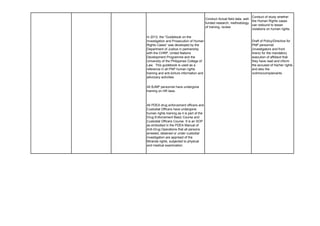
    MEDIUM TERM (2) 90% ofthe police, military and custodial services are well trained on human rights. Impact/evaluation studies on HR(i.e. custodial system and educational system) A total of 41,000 PNP personnel have undergone training on HR laws from 2012-2015 and 1,492 capability building activities were also conducted from 2012 to 2014. While the target number of trained PNP personnel on HR was not met, in 2014, the following were achieved: Recommendation to the PNP leadership for additional financial support for the conduct of training on Human Rights. Under CY 2011-2016 National Security Policy, police, military and other concerned member-agencies made great strides in the conduct of Human Rights Education and Training for the Security Sector. a. Human Rights Module in all PNP mandatory schooling/trainings; Close monitoring of custodial facilities. b. Anti-Torture and Human Rights Protection Training is mandatory for all custodial personnel; and Sustain harnessing of support from CHRP, civil society organizations and other human rights defenders in advancing the country’s human rights agenda. c. Inclusion of Human Rights- Based Policing module in all PNP Career Courses. Use of HR case studies method in the conduct of interview for promotion. All PNP Custodial Personnel have undergone the Anti-Torture and Human Rights Protection Mandatory Training. - 20% of the manpower of law enforcement agencies trained annually. ANNUAL (1) 2012-2016 - Impact/evaluation studies of education and training on human rights within security/custodial system, and in the THEMATIC OBJECTIVE 3 TO HEIGHTEN AWARENESS OF, AND RESPECT FOR HR AMONG STATE AGENTS, AND THE GENERAL PUBLIC. Strategic Indicator: Decreased number or absence of complaints of human rights violations more particularly against CAT and RA 9745 TARGETS PAPS PROGRAM ACTIVITIES AND PROJECTS (3) DATA VALIDATION/ ADDITIONAL INPUTS/ ENHANCEMENTS (4) ASSESSMENT WHETHER TARGETS ARE MET/ CHALLENGES/ HINDERING FACTORS (5) RECOMMENDED NEXT STEPS (6)
  • 17.
    Conduct Actual fielddata, well- funded research, methodology of training, review Conduct of study whether the Human Rights cases can redound to lesser violations on human rights. In 2013, the “Guidebook on the Investigation and Prosecution of Human Rights Cases” was developed by the Department of Justice in partnership with the CHRP, United Nations Development Programme and the University of the Philippines College of Law. This guidebook is used as a reference in all PNP human rights training and anti-torture information and advocacy activities. Draft of Policy/Directive for PNP personnel (investigators and front liners) for the mandatory execution of affidavit that they have read and inform the accused of his/her rights and also the victims/complainants. All BJMP personnel have undergone training on HR laws. All PDEA drug enforcement officers and Custodial Officers have undergone human rights training as it is part of the Drug Enforcement Basic Course and Custodial Officers Course. It is an SOP as embodied in the PDEA Manual of Anti-Drug Operations that all persons arrested, detained or under custodial investigation are apprised of the Miranda rights, subjected to physical and medical examination.
  • 18.
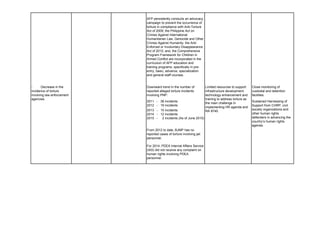
    AFP persistently conductsan advocacy campaign to prevent the occurrence of torture in compliance with Anti-Torture Act of 2009; the Philippine Act on Crimes Against International Humanitarian Law, Genocide and Other Crimes Against Humanity; the Anti- Enforced or Involuntary Disappearance Act of 2012; and, the Comprehensive Program Framework for Children in Armed Conflict are incorporated in the curriculum of AFP education and training programs, specifically in pre- entry, basic, advance, specialization and general staff courses. Downward trend in the number of reported alleged torture incidents involving PNP: Close monitoring of custodial and detention facilities. 2011 - 38 incidents 2012 - 19 incidents 2013 - 15 incidents 2014 - 12 incidents 2015 - 2 incidents (As of June 2015) From 2012 to date, BJMP has no reported cases of torture involving jail personnel. For 2014, PDEA Internal Affairs Service (IAS) did not receive any complaint on human rights involving PDEA personnel. - Decrease in the incidence of torture involving law enforcement agencies Limited resources to support infrastructure development, technology enhancement and training to address torture as the main challenge in implementing HR agenda and RA 9745. Sustained Harnessing of Support from CHRP, civil society organizations and other human rights defenders in advancing the country’s human rights agenda.
  • 19.
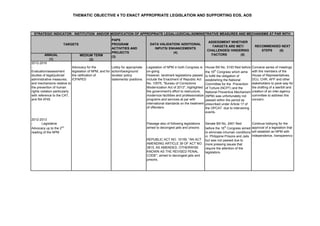
    MEDIUM TERM (2) Advocacy forthe legislation of NPM, and for the ratification of ICPAPED Lobby for appropriate action/background studies/ policy statements/ positions. Legislation of NPM in both Congress is on-going. However, landmark legislations passed include the Enactment of Republic Act No. 10575, "Bureau of Corrections Modernization Act of 2013", highlighted the government's effort to restructure, modernize faclilities and professionalize programs and services at par with international standards on the treatment of offenders. House Bill No. 5193 filed before the 16th Congress which aims to fulfill the obligation of establishing the National Committee for the Prevention of Torture (NCPT) and the National Preventive Mechanism (NPM) was unfortunately not passed within the period as prescribed under Article 17 of the OPCAT due to intervening events. Convene series of meetings with the members of the House of Representatives, DOJ, CHR, AFP and other stakeholders to pave way for the drafting of a law/bill and creation of an inter-agency committee to address this concern. Passage also of following legislations aimed to decongest jails and prisons: Continue lobbying for the approval of a legislation that will establish an NPM with independence, transparency REPUBLIC ACT NO. 10159, "AN ACT AMENDING ARTICLE 39 OF ACT NO. 3815, AS AMENDED, OTHERWISE KNOWN AS THE REVISED PENAL CODE", aimed to decongest jails and prisons. ANNUAL (1) 2012-2016 - Evaluation/assessment studies of legal/judicial/ administrative measures, and mechanisms relative to the prevention of human rights violation particularly with reference to the CAT, and RA 9745 THEMATIC OBJECTIVE 4 TO ENACT APPROPRIATE LEGISLATION AND SUPPORTING EOS, AOS STRATEGIC INDICATOR: INSTITUTION AND/OR MODIFICATION OF APPROPRIATE LEGAL/JUDICIAL/ADMINISTRATIVE MEASURES AND MECHANISMS AT PAR WITH TARGETS PAPS PROGRAM ACTIVITIES AND PROJECTS (3) DATA VALIDATION/ ADDITIONAL INPUTS/ ENHANCEMENTS (4) ASSESSMENT WHETHER TARGETS ARE MET/ CHALLENGES/ HINDERING FACTORS (5) RECOMMENDED NEXT STEPS (6) Senate Bill No. 2461 filed before the 16th Congress aimed to eliminate inhuman conditions in Philippine Prisons and Jails but was not passed due to more pressing issues that require the attention of the legislators. 2012-2013 - Legislative Advocacy up to the 2nd reading of the NPM
  • 20.
    Silent Features: SECTION 1.Article 39 of Act No. 3815, as amended, is hereby further ammended to read as follows: "Art.39. Subsidiary Penalty. - If the convict has no property with which to meet the fine mentioned in paragraph 3 of the next preceding article, he shall be subject to a subsidiary personal liability at the rate of one day for each aount equivalent to the highest minimum wage rate prevailing in the Philippines at the time of the redention of judgement of conviction by the trial court,xxx. DILG issued Guidelines for Local Government Units in the Development of the Comprehensive Local Juvenile Intervention Program and Memorandum Circular No. 2012-120, directing all LGUs to comply with Section 15, RA 9344 by allocating at least 1% of their Internal Revenue Allotment for the strengthening and implementation of programs for the Local Council for the Protection of Children. Proposed bills aimed to decongest jails and improve the living condition of inmates were not passed as planned due to more pressing issues that require the attention of the legislators and these include “An Act Placing the Provincial, Sub-Provincial Jails under the Jurisdiction of the BJMP” and Jail Infrastructure Development and BJMP Modernization Act”. However, two (2) important legislations targeted that were passed include the Republic Act No. 10592, An Act Amending Articles 29, 94,97,98 and 99 of Act No. 3815, As Amended Otherwise Known as the Revised Penal Code was passed on May 29, 2013, ,which grants not only the Director of the Bureau of Corrections the authority to grant good conduct time allowance to inmates but also to the Chief of the BJMP and Wardens of the Provincial, City, District and Municipal Jails and its Implementing Rules and Regulations issued on 26 March 2014.
  • 21.
    MEDIUM TERM (2) Ratification ofHR instruments - ICPAPED Limited progress in the effort to ratify this HR instrument. Sustained lobbying for the ratification of ICPAPED. The government firmly committed to due process and rule of law enacted the following human rights laws: Enduring promotion through round table discussions giving emphasis on the benefits of the State. a. “Anti-Enforced or Involuntary Disappearance Act of 2012” (RA 10353), approved last 21 December 2012; b. “Philippine Act on Crimes Against International Humanitarian Law, Genocide, and Other Crimes Against Humanity” (RA 9851), approved on 11 December 2009; RECOMMENDED NEXT STEPS (6) ANNUAL (1) On May 29, 2014, a Round Table Discussion was conducted by the Asian Federation against Involuntary Disappearances (AFAID) in partnership with the House Committee on Human Rights, entitled: Convention Now. The Imperative of the Philippines’ Accession to the Convention Against Disappearances”. During said RTD, it was agreed that the ratification of the convention should be referred to the Department of Foreign Affairs for further studies. 2012-2013 THEMATIC OBJECTIVE 5 TO RATIFY THE INTERNATIONAL CONVENTION FOR THE PROTECTION OF ALL PERSONS FROM ENFORCED STRATEGIC INDICATOR: ACCESSION, AND/OR RATIFICATION OF THE ICPAPED; EXTENT OF LOBBYING ACCOMPLISHED, AND THE MEASURES BY WHICH LEGISLATORS HAVE TAKEN TOWARDS THE RATIFICATION OF IPAPED TARGETS PAPS PROGRAM ACTIVITIES AND PROJECTS (3) DATA VALIDATION/ ADDITIONAL INPUTS/ ENHANCEMENTS (4) ASSESSMENT WHETHER TARGETS ARE MET/ CHALLENGES/ HINDERING FACTORS (5) - Legislative advocacy up to the 2nd reading Lobby for appropriate action/ background studies/ policy sttemments/ positions.
  • 22.
    c. An ActDefining Certain Rights of Person Arrested, Detained or Under Custodial Investigation as well as the Duties of the Arresting, Detaining and Investigating Officers, and Providing Penalties for Violations Thereof (RA 7438), approved on 27 April 1992; and Absence of an agency champion that would look at the obligations at the lens of the benefits the State will gain from this HR instrument. d. Law on the Recognition and Reparations for Victims of Martial Law (RA 10368). Also, Administrative Order No. 35, series of 2012 was signed by the President creating the Inter-Agency Committee on Extra-Legal Killings, Enforced Disappearance, Torture and Other Grave Violations of the Right to Life, Liberty and Security of Persons. Greatest challenge of ICPAPED for concerned agencies are the obligations, accountabilities and responsibilities of the State. Identification of agency champion that can orchestrate all efforts of stakeholders toward the ratification of ICPAPED.