Ontology-Driven Clinical Intelligence
Removing Data Barriers for Cross-Discipline Research	
  
Bruce Pharr | Vice President, Life Sciences Research Systems
Medical Informatics World | April 29, 2014
1	
  
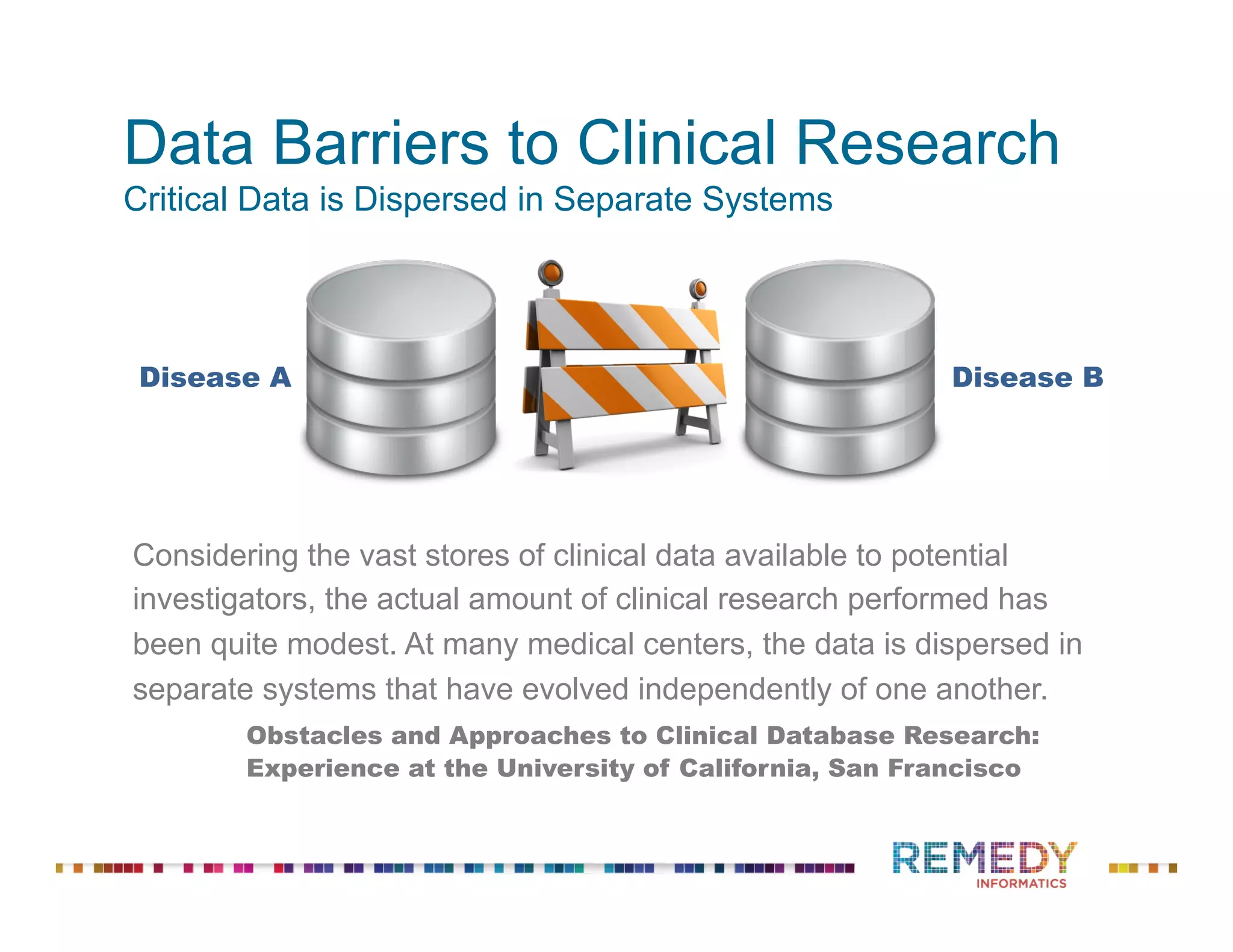
Data Barriers to Clinical Research
Critical Data is Dispersed in Separate Systems
Considering the vast stores of clinical data available to potential
investigators, the actual amount of clinical research performed has
been quite modest. At many medical centers, the data is dispersed in
separate systems that have evolved independently of one another.
Obstacles and Approaches to Clinical Database Research:
Experience at the University of California, San Francisco
Disease A Disease B
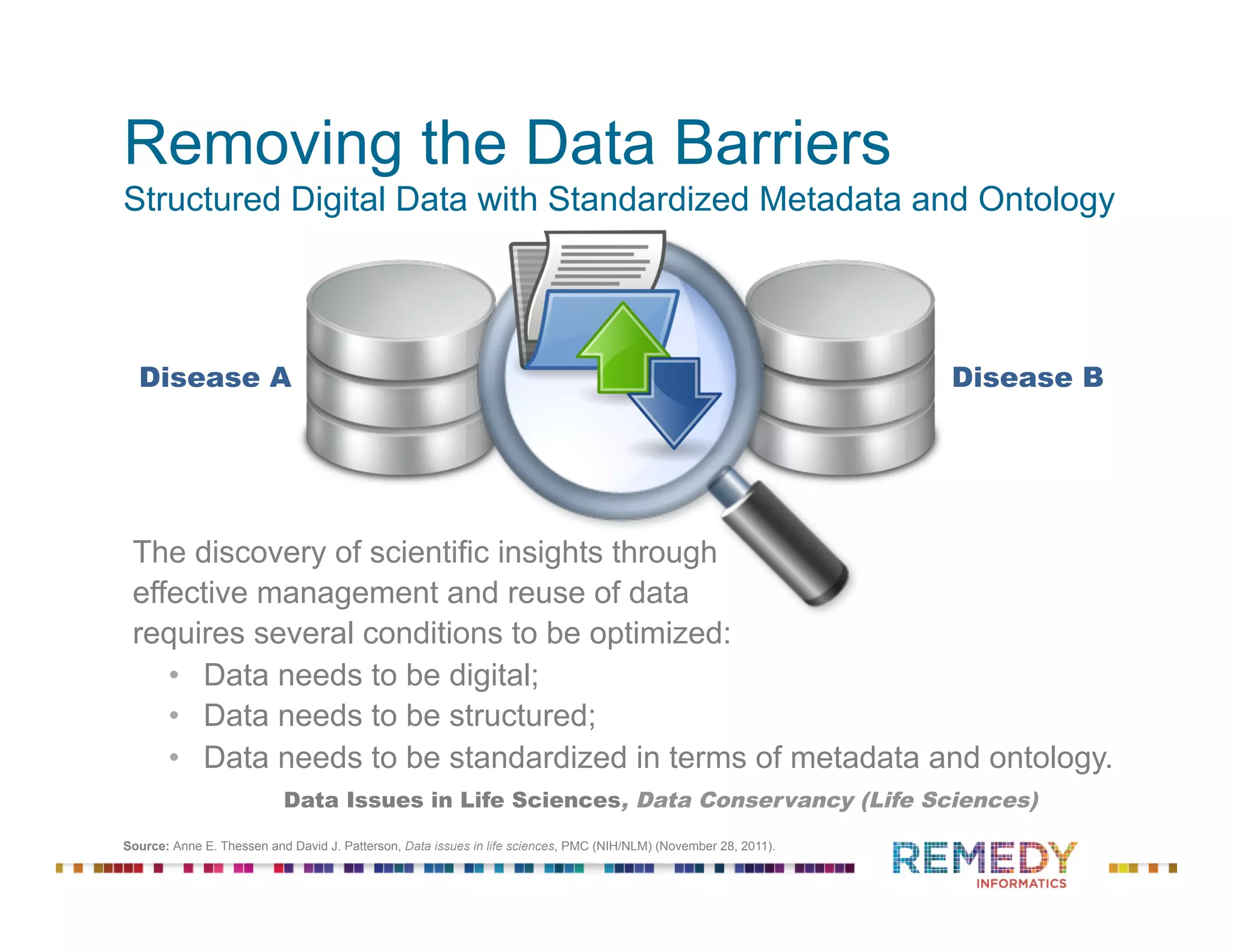
Removing the Data Barriers
Structured Digital Data with Standardized Metadata and Ontology
Source: Anne E. Thessen and David J. Patterson, Data issues in life sciences, PMC (NIH/NLM) (November 28, 2011).
Disease A Disease B
The discovery of scientific insights through
effective management and reuse of data
requires several conditions to be optimized:
•  Data needs to be digital;
•  Data needs to be structured;
•  Data needs to be standardized in terms of metadata and ontology.
Data Issues in Life Sciences, Data Conservancy (Life Sciences)
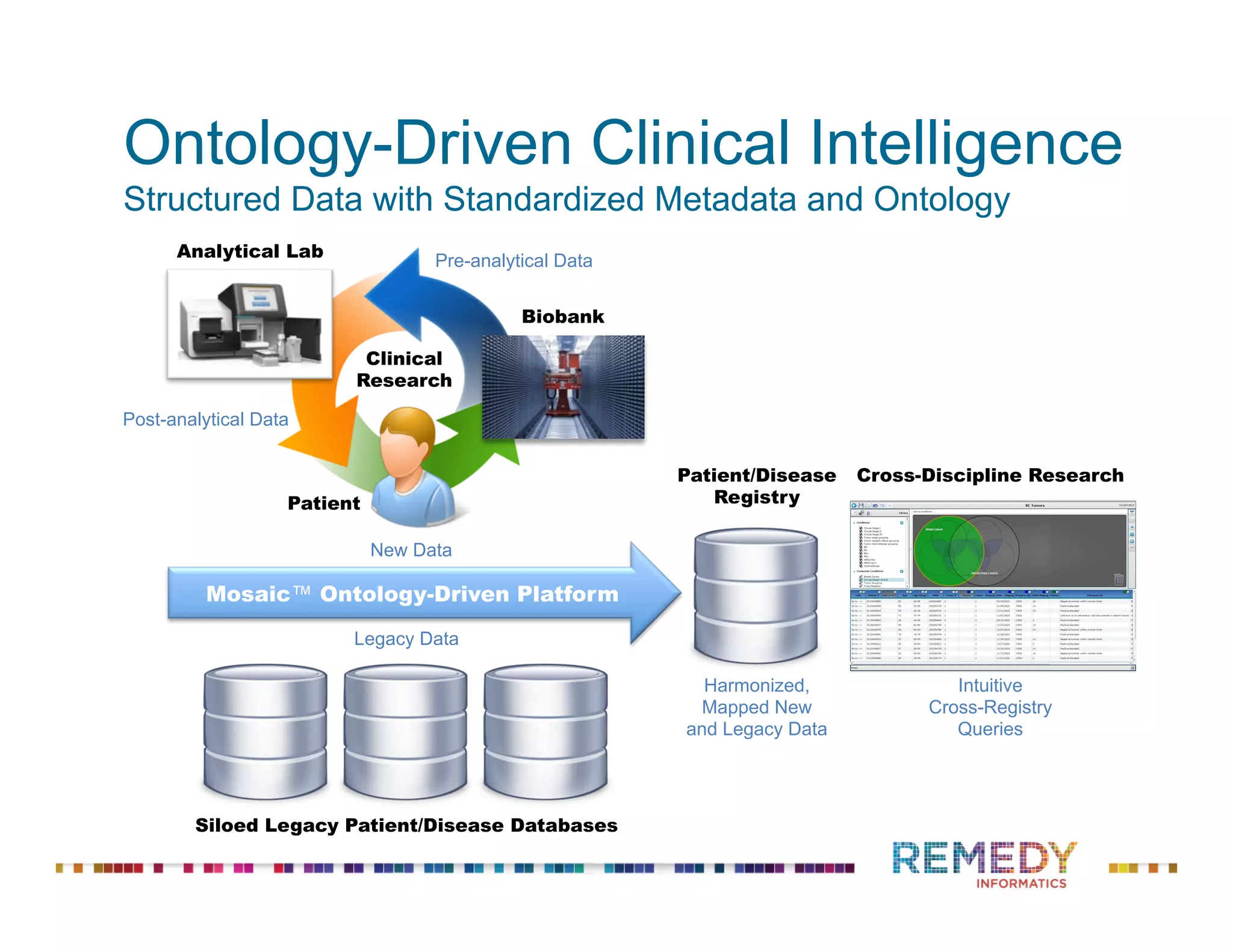
Ontology-Driven Clinical Intelligence
Structured Data with Standardized Metadata and Ontology
Siloed Legacy Patient/Disease Databases	

Clinical
Research	

Mosaic™ Ontology-Driven Platform	

Analytical Lab	

Biobank	

New Data	

Patient	

Pre-analytical Data	

Post-analytical Data	

Legacy Data	

Patient/Disease
Registry	

Harmonized,
Mapped New
and Legacy Data	

Cross-Discipline Research	

Intuitive
Cross-Registry
Queries
Ontology-Driven Clinical Intelligence
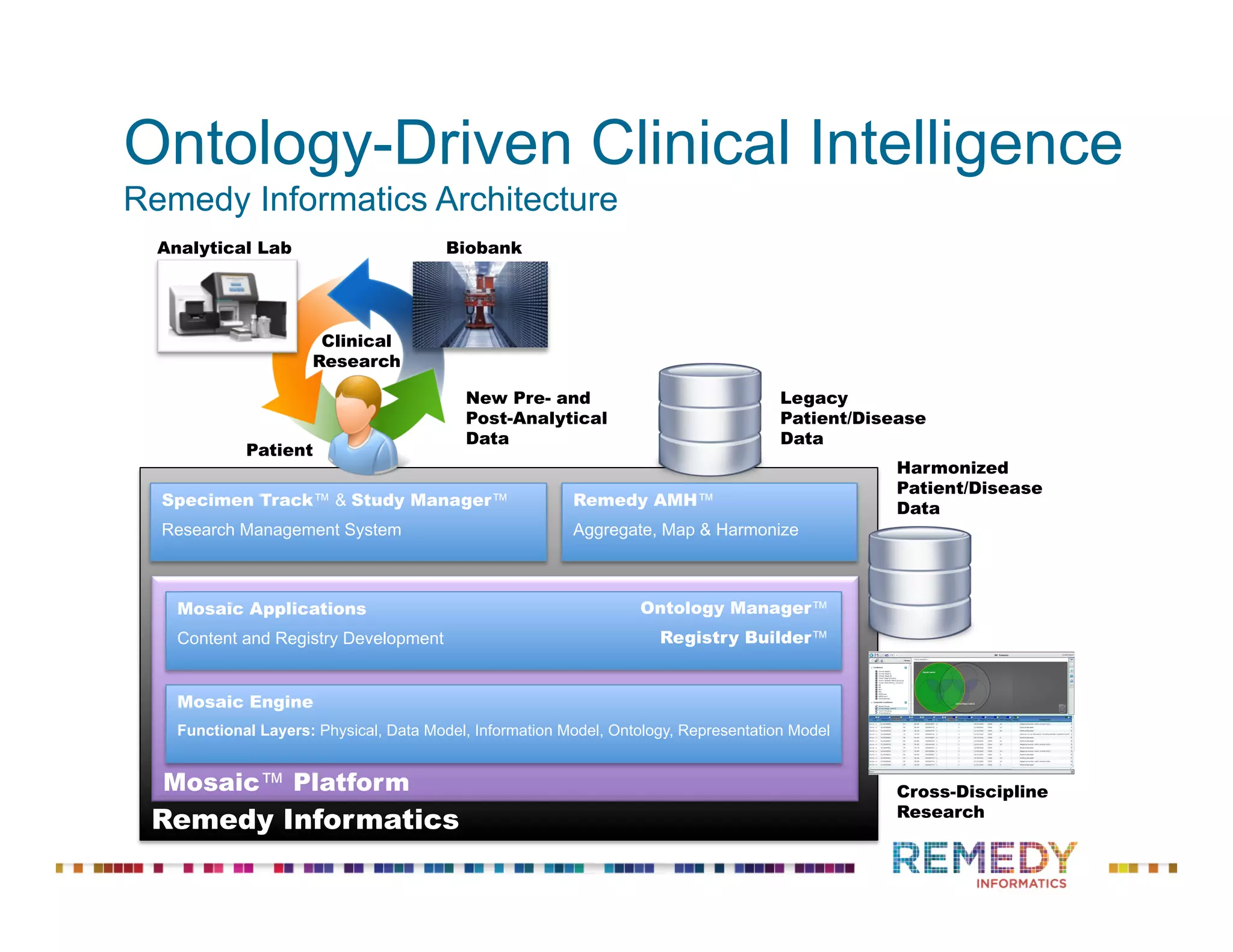
Remedy Informatics Architecture
Remedy Informatics	

Mosaic™ Platform	

Mosaic Engine	

Functional Layers: Physical, Data Model, Information Model, Ontology, Representation Model 	

Mosaic Applications	

Content and Registry Development	

Specimen Track™ & Study Manager™	

Research Management System	

Remedy AMH™
Aggregate, Map & Harmonize	

Legacy
Patient/Disease
Data	

Ontology Manager™
Registry Builder™
Harmonized
Patient/Disease
Data	

Cross-Discipline
Research	

Patient	

Biobank	

Analytical Lab	

Clinical
Research	

New Pre- and
Post-Analytical
Data
Ontology
What is it?
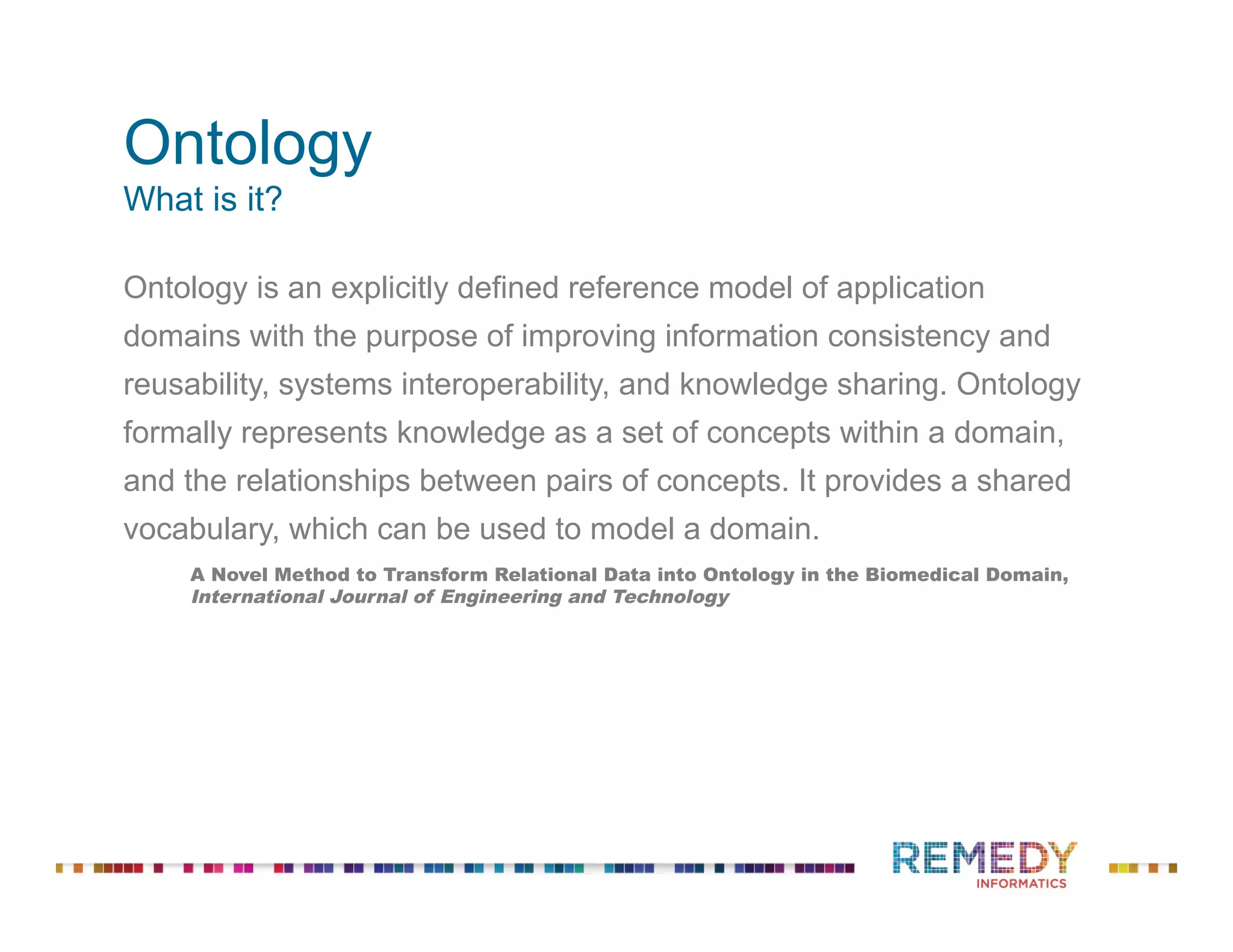
Ontology is an explicitly defined reference model of application
domains with the purpose of improving information consistency and
reusability, systems interoperability, and knowledge sharing. Ontology
formally represents knowledge as a set of concepts within a domain,
and the relationships between pairs of concepts. It provides a shared
vocabulary, which can be used to model a domain.
A Novel Method to Transform Relational Data into Ontology in the Biomedical Domain,
International Journal of Engineering and Technology
Mosaic Ontology
A Purpose-Specific Structured Data Model
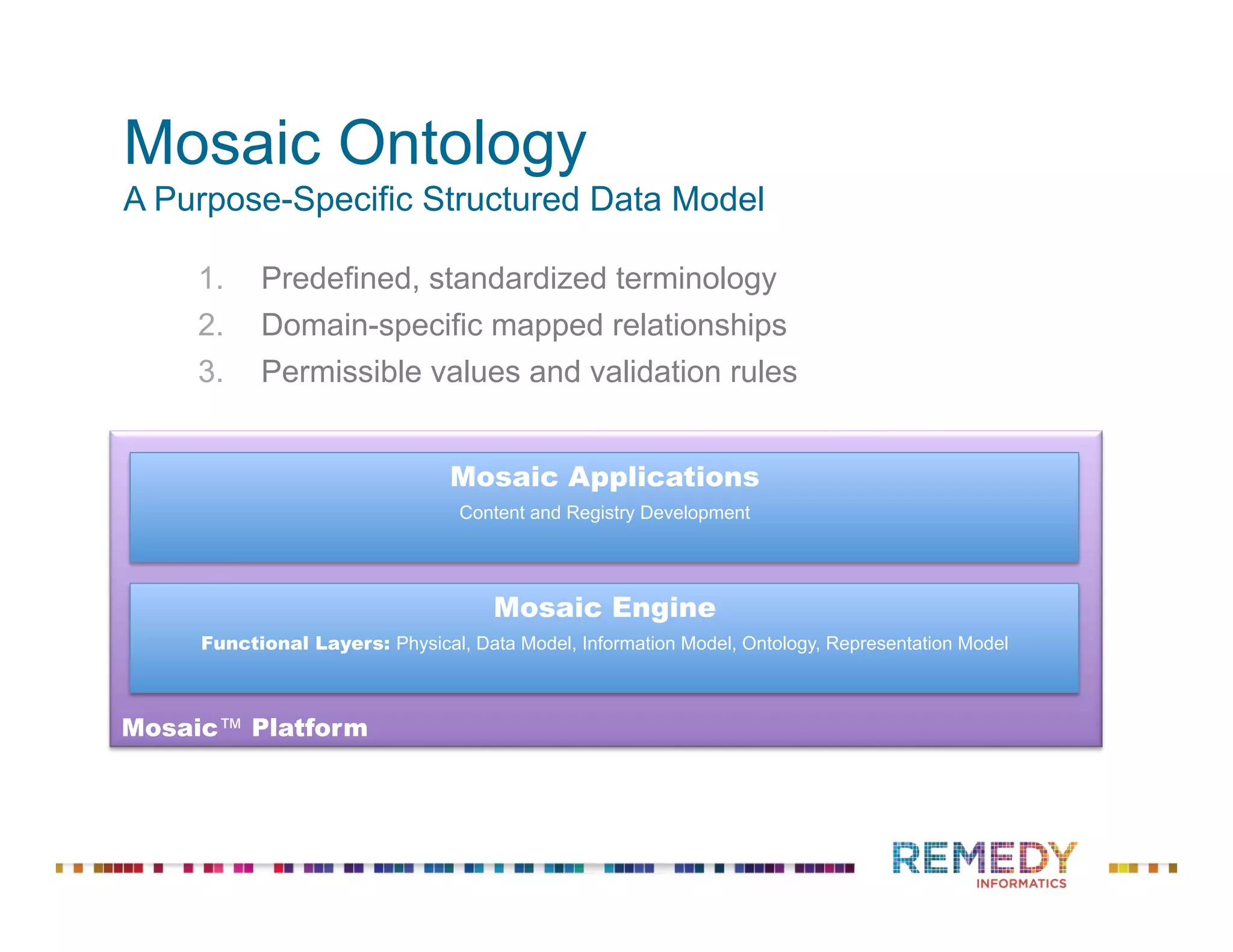
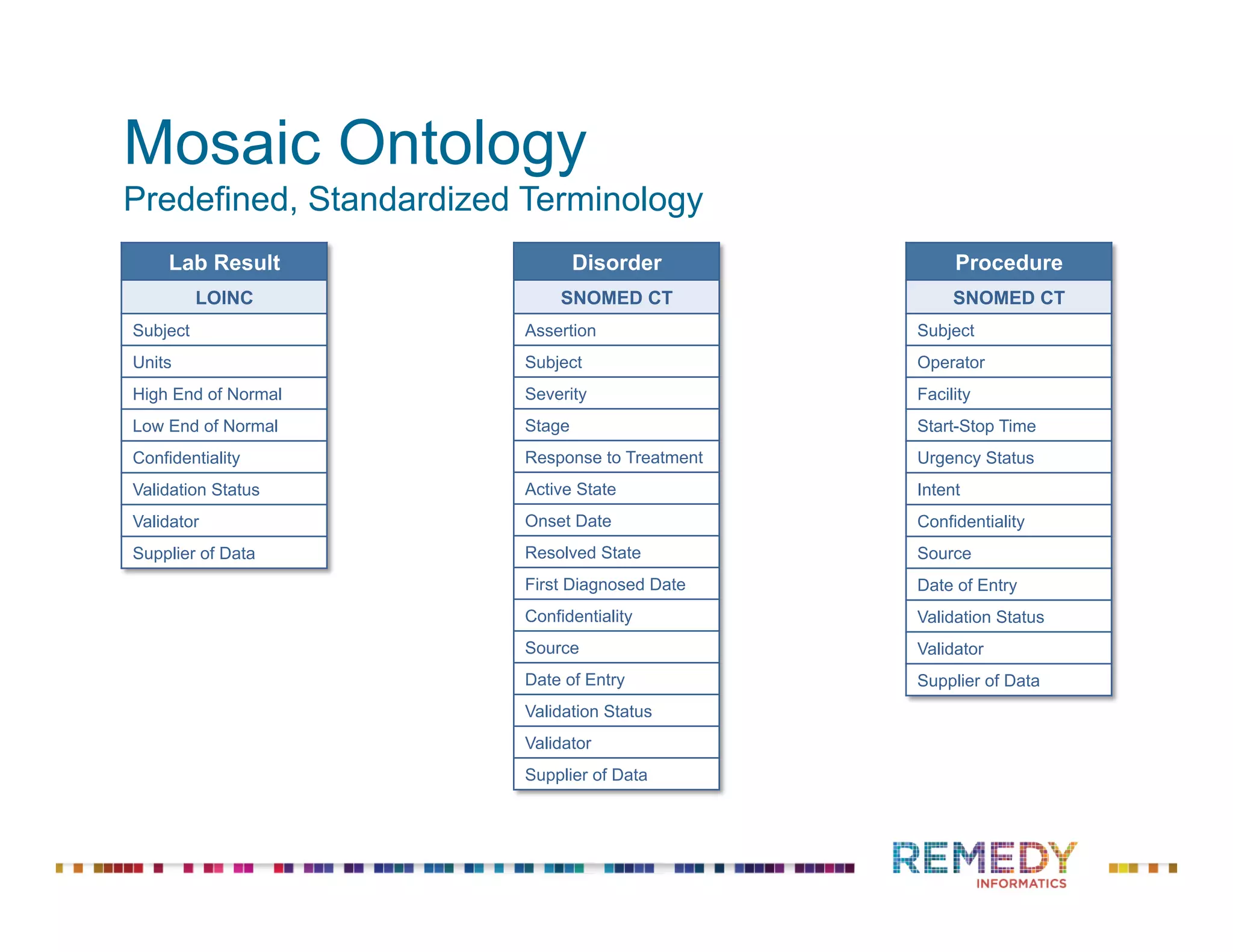
1.  Predefined, standardized terminology
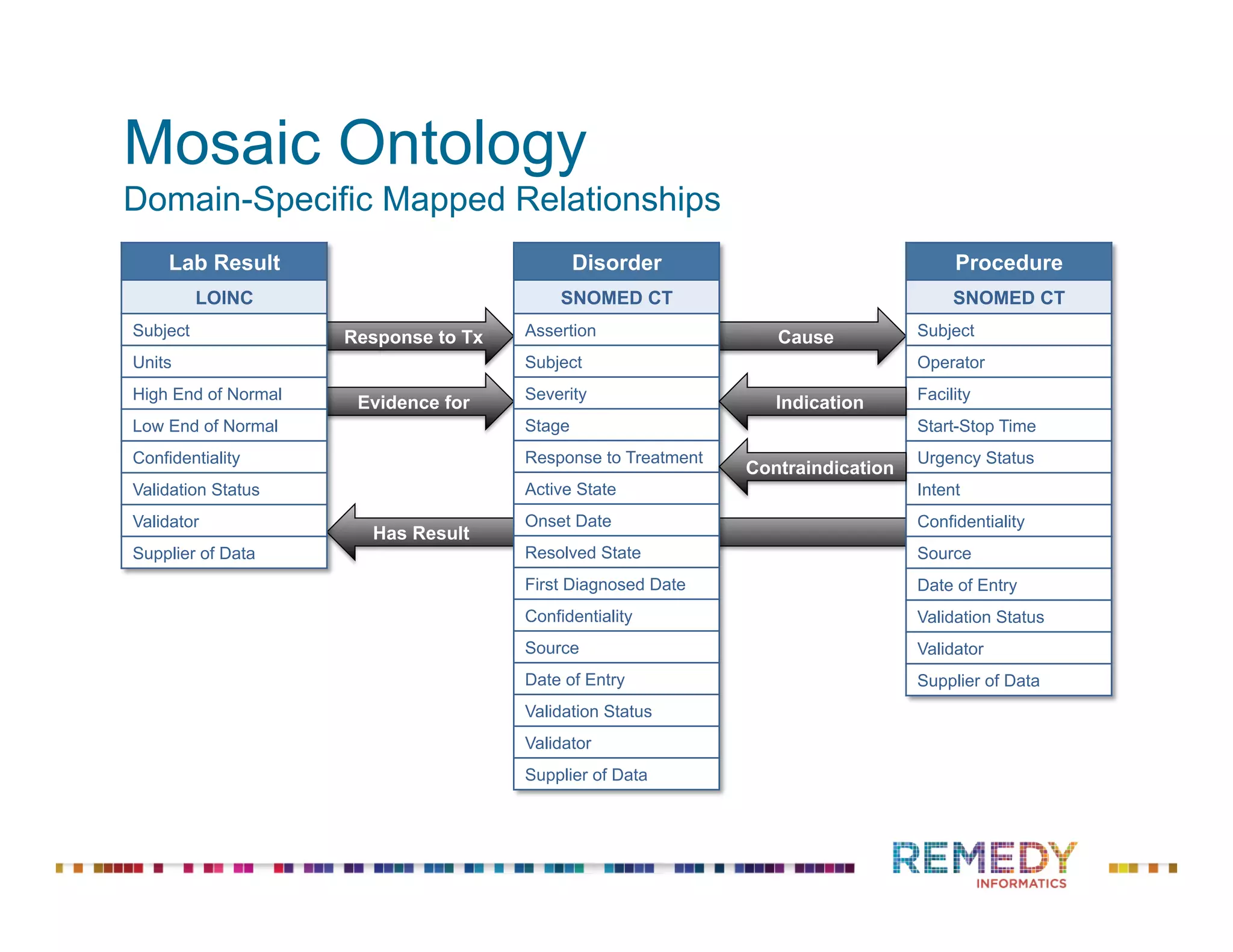
2.  Domain-specific mapped relationships
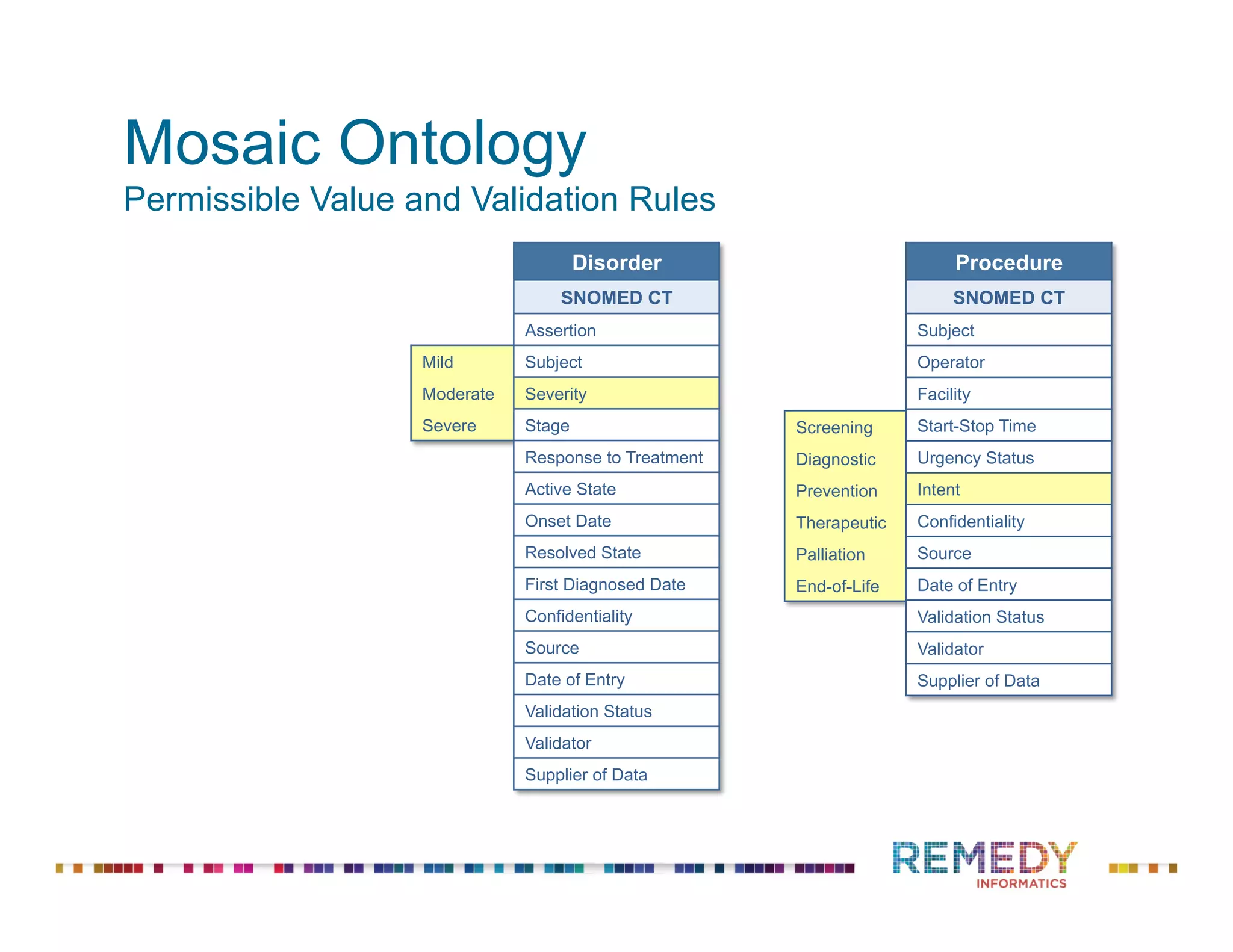
3.  Permissible values and validation rules
Mosaic™ Platform	

Mosaic Engine
Functional Layers: Physical, Data Model, Information Model, Ontology, Representation Model 	

Mosaic Applications
Content and Registry Development
Mosaic Ontology
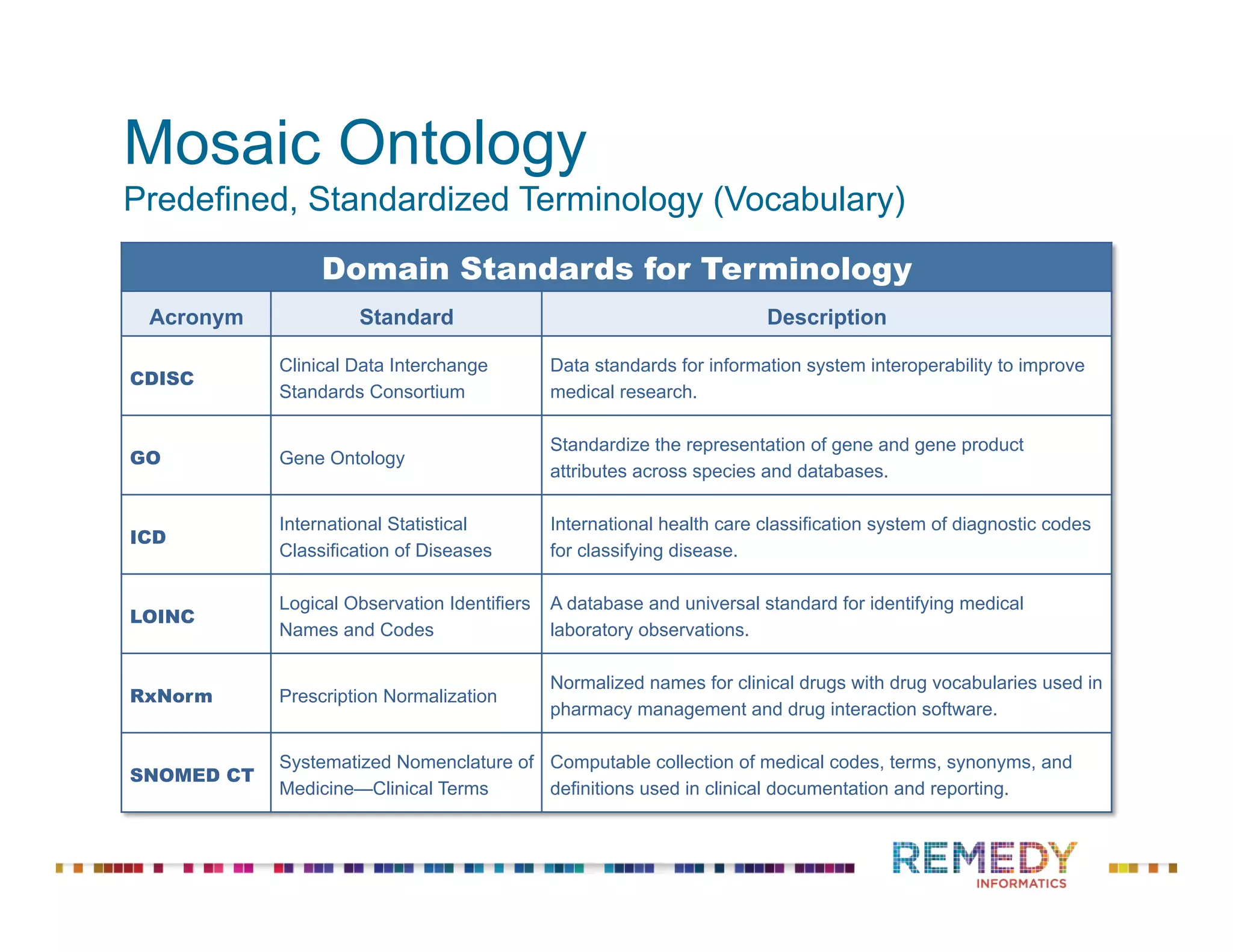
Predefined, Standardized Terminology (Vocabulary)
Domain Standards for Terminology
Acronym Standard Description
CDISC
Clinical Data Interchange
Standards Consortium
Data standards for information system interoperability to improve
medical research.
GO Gene Ontology
Standardize the representation of gene and gene product
attributes across species and databases.
ICD
International Statistical
Classification of Diseases
International health care classification system of diagnostic codes
for classifying disease.
LOINC
Logical Observation Identifiers
Names and Codes
A database and universal standard for identifying medical
laboratory observations.
RxNorm Prescription Normalization
Normalized names for clinical drugs with drug vocabularies used in
pharmacy management and drug interaction software.
SNOMED CT
Systematized Nomenclature of
Medicine—Clinical Terms
Computable collection of medical codes, terms, synonyms, and
definitions used in clinical documentation and reporting.
Mosaic Ontology
Predefined, Standardized Terminology
Lab Result
LOINC
Subject
Units
High End of Normal
Low End of Normal
Confidentiality
Validation Status
Validator
Supplier of Data
Disorder
SNOMED CT
Assertion
Subject
Severity
Stage
Response to Treatment
Active State
Onset Date
Resolved State
First Diagnosed Date
Confidentiality
Source
Date of Entry
Validation Status
Validator
Supplier of Data
Procedure
SNOMED CT
Subject
Operator
Facility
Start-Stop Time
Urgency Status
Intent
Confidentiality
Source
Date of Entry
Validation Status
Validator
Supplier of Data
Has Result
Response to Tx
Evidence for
Cause
Mosaic Ontology
Domain-Specific Mapped Relationships
Lab Result
LOINC
Subject
Units
High End of Normal
Low End of Normal
Confidentiality
Validation Status
Validator
Supplier of Data
Disorder
SNOMED CT
Assertion
Subject
Severity
Stage
Response to Treatment
Active State
Onset Date
Resolved State
First Diagnosed Date
Confidentiality
Source
Date of Entry
Validation Status
Validator
Supplier of Data
Procedure
SNOMED CT
Subject
Operator
Facility
Start-Stop Time
Urgency Status
Intent
Confidentiality
Source
Date of Entry
Validation Status
Validator
Supplier of Data
Indication
Contraindication
Mild
Moderate
Severe Screening
Diagnostic
Prevention
Therapeutic
Palliation
End-of-Life
Mosaic Ontology
Permissible Value and Validation Rules
Disorder
SNOMED CT
Assertion
Subject
Severity
Stage
Response to Treatment
Active State
Onset Date
Resolved State
First Diagnosed Date
Confidentiality
Source
Date of Entry
Validation Status
Validator
Supplier of Data
Procedure
SNOMED CT
Subject
Operator
Facility
Start-Stop Time
Urgency Status
Intent
Confidentiality
Source
Date of Entry
Validation Status
Validator
Supplier of Data
Mosaic Ontology
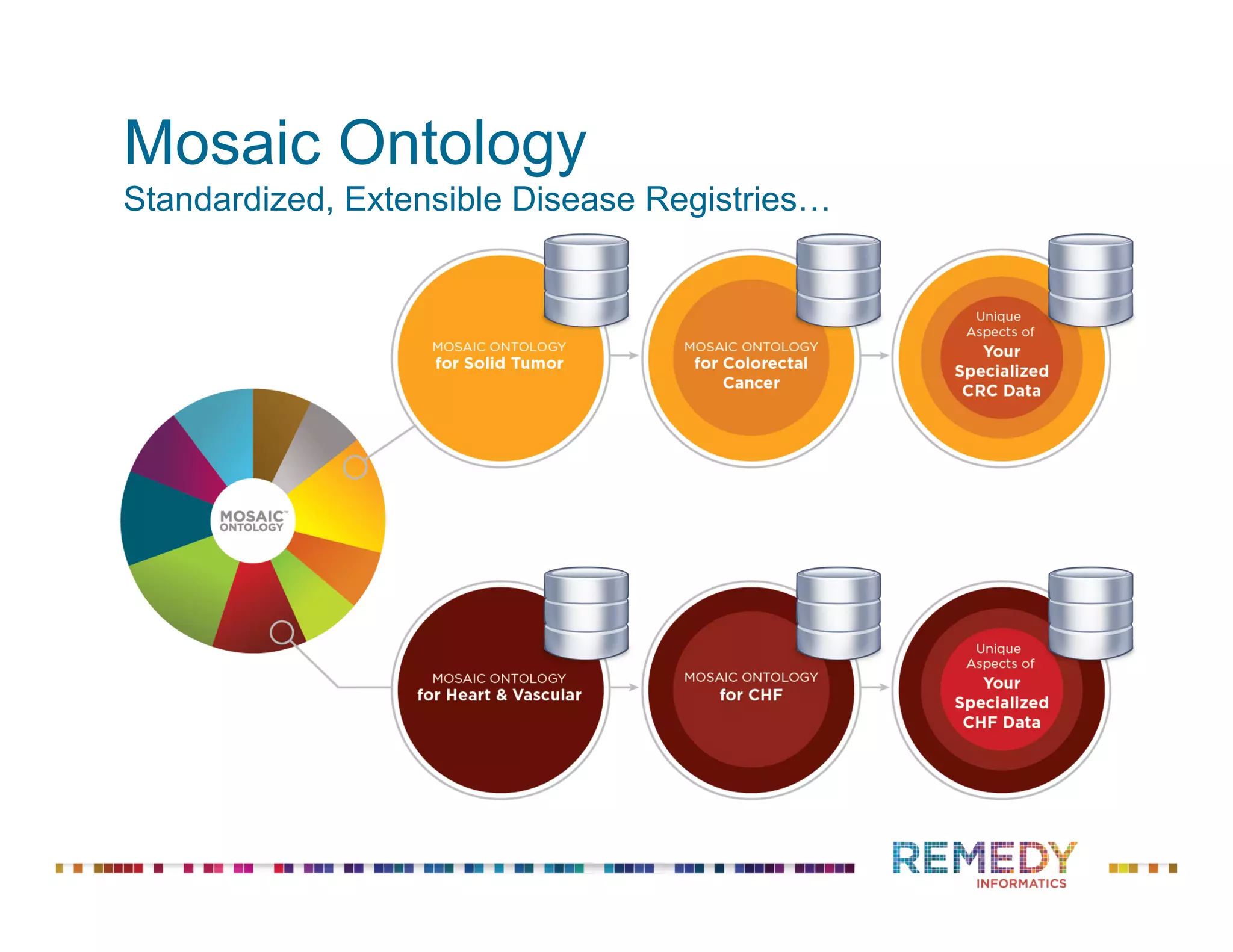
Standardized, Extensible Disease Registries…
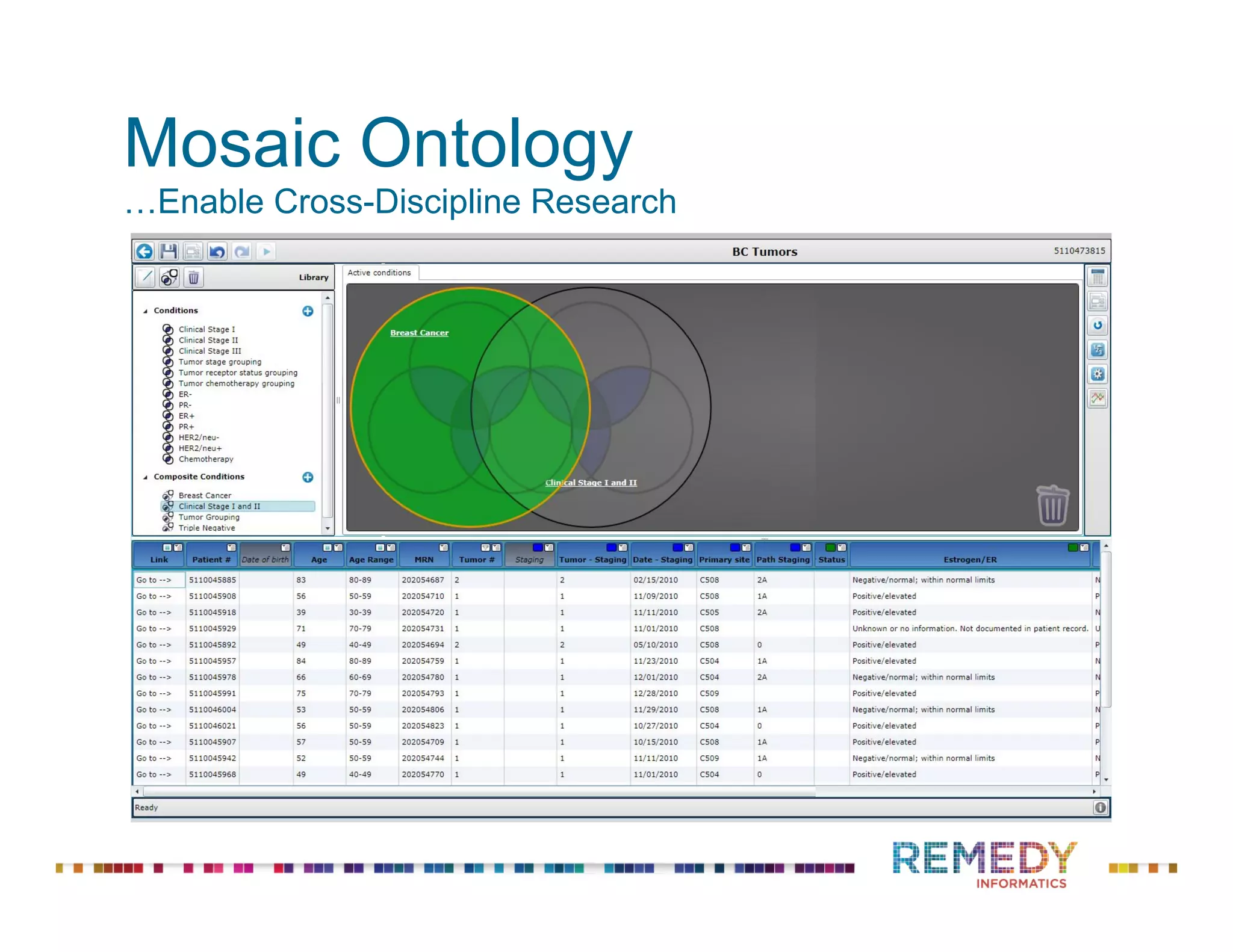
Mosaic Ontology
…Enable Cross-Discipline Research
Remedy Informatics
A Clinical Intelligence Company
Remedy Informatics is a clinical intelligence company
that is transforming global biomedical research and healthcare.
Our clients include:
Academic medical centers
Biopharmaceutical companies
Biomedical research organizations
Our solutions enable clients to:
Collect, harmonize, and analyze data across disciplines
Detect patterns in clinical data
Accelerate disease and therapeutic research
Ultimately, our solutions enable you to bring safe, effective, increasingly
personalized treatments to market faster and more efficiently.
Remedy Informatics
Systems and Solutions
RESEARCH SYSTEMS
Specimen Track™ Biobank Management System
Study Manager™ Clinical Research Management System
TECHNOLOGY SOLUTIONS
Mosaic™ Platform
Mosaic Ontology
Mosaic Engine
Mosaic Builder
TIMe™—The Informatics Marketplace™
CLINICAL REGISTRIES
Comprehensive Blood Cancer™
Comprehensive BMT™
Comprehensive Heart & Vascular™
Comprehensive Orthopedics™
Comprehensive Solid Tumor™
Thanks! – Questions?
Bruce Pharr
Vice President, Life Sciences Research Systems
bruce.pharr@remedyinformatics.com
Remedy Informatics
www.remedyinformatics.com

Ontology-Driven Clinical Intelligence: Removing Data Barriers for Cross-Discipline Research

  • 1.
    Ontology-Driven Clinical Intelligence RemovingData Barriers for Cross-Discipline Research   Bruce Pharr | Vice President, Life Sciences Research Systems Medical Informatics World | April 29, 2014 1  
  • 2.
    Data Barriers toClinical Research Critical Data is Dispersed in Separate Systems Considering the vast stores of clinical data available to potential investigators, the actual amount of clinical research performed has been quite modest. At many medical centers, the data is dispersed in separate systems that have evolved independently of one another. Obstacles and Approaches to Clinical Database Research: Experience at the University of California, San Francisco Disease A Disease B
  • 3.
    Removing the DataBarriers Structured Digital Data with Standardized Metadata and Ontology Source: Anne E. Thessen and David J. Patterson, Data issues in life sciences, PMC (NIH/NLM) (November 28, 2011). Disease A Disease B The discovery of scientific insights through effective management and reuse of data requires several conditions to be optimized: •  Data needs to be digital; •  Data needs to be structured; •  Data needs to be standardized in terms of metadata and ontology. Data Issues in Life Sciences, Data Conservancy (Life Sciences)
  • 4.
    Ontology-Driven Clinical Intelligence StructuredData with Standardized Metadata and Ontology Siloed Legacy Patient/Disease Databases Clinical Research Mosaic™ Ontology-Driven Platform Analytical Lab Biobank New Data Patient Pre-analytical Data Post-analytical Data Legacy Data Patient/Disease Registry Harmonized, Mapped New and Legacy Data Cross-Discipline Research Intuitive Cross-Registry Queries
  • 5.
    Ontology-Driven Clinical Intelligence RemedyInformatics Architecture Remedy Informatics Mosaic™ Platform Mosaic Engine Functional Layers: Physical, Data Model, Information Model, Ontology, Representation Model Mosaic Applications Content and Registry Development Specimen Track™ & Study Manager™ Research Management System Remedy AMH™ Aggregate, Map & Harmonize Legacy Patient/Disease Data Ontology Manager™ Registry Builder™ Harmonized Patient/Disease Data Cross-Discipline Research Patient Biobank Analytical Lab Clinical Research New Pre- and Post-Analytical Data
  • 6.
    Ontology What is it? Ontologyis an explicitly defined reference model of application domains with the purpose of improving information consistency and reusability, systems interoperability, and knowledge sharing. Ontology formally represents knowledge as a set of concepts within a domain, and the relationships between pairs of concepts. It provides a shared vocabulary, which can be used to model a domain. A Novel Method to Transform Relational Data into Ontology in the Biomedical Domain, International Journal of Engineering and Technology
  • 7.
    Mosaic Ontology A Purpose-SpecificStructured Data Model 1.  Predefined, standardized terminology 2.  Domain-specific mapped relationships 3.  Permissible values and validation rules Mosaic™ Platform Mosaic Engine Functional Layers: Physical, Data Model, Information Model, Ontology, Representation Model Mosaic Applications Content and Registry Development
  • 8.
    Mosaic Ontology Predefined, StandardizedTerminology (Vocabulary) Domain Standards for Terminology Acronym Standard Description CDISC Clinical Data Interchange Standards Consortium Data standards for information system interoperability to improve medical research. GO Gene Ontology Standardize the representation of gene and gene product attributes across species and databases. ICD International Statistical Classification of Diseases International health care classification system of diagnostic codes for classifying disease. LOINC Logical Observation Identifiers Names and Codes A database and universal standard for identifying medical laboratory observations. RxNorm Prescription Normalization Normalized names for clinical drugs with drug vocabularies used in pharmacy management and drug interaction software. SNOMED CT Systematized Nomenclature of Medicine—Clinical Terms Computable collection of medical codes, terms, synonyms, and definitions used in clinical documentation and reporting.
  • 9.
    Mosaic Ontology Predefined, StandardizedTerminology Lab Result LOINC Subject Units High End of Normal Low End of Normal Confidentiality Validation Status Validator Supplier of Data Disorder SNOMED CT Assertion Subject Severity Stage Response to Treatment Active State Onset Date Resolved State First Diagnosed Date Confidentiality Source Date of Entry Validation Status Validator Supplier of Data Procedure SNOMED CT Subject Operator Facility Start-Stop Time Urgency Status Intent Confidentiality Source Date of Entry Validation Status Validator Supplier of Data
  • 10.
    Has Result Response toTx Evidence for Cause Mosaic Ontology Domain-Specific Mapped Relationships Lab Result LOINC Subject Units High End of Normal Low End of Normal Confidentiality Validation Status Validator Supplier of Data Disorder SNOMED CT Assertion Subject Severity Stage Response to Treatment Active State Onset Date Resolved State First Diagnosed Date Confidentiality Source Date of Entry Validation Status Validator Supplier of Data Procedure SNOMED CT Subject Operator Facility Start-Stop Time Urgency Status Intent Confidentiality Source Date of Entry Validation Status Validator Supplier of Data Indication Contraindication
  • 11.
    Mild Moderate Severe Screening Diagnostic Prevention Therapeutic Palliation End-of-Life Mosaic Ontology PermissibleValue and Validation Rules Disorder SNOMED CT Assertion Subject Severity Stage Response to Treatment Active State Onset Date Resolved State First Diagnosed Date Confidentiality Source Date of Entry Validation Status Validator Supplier of Data Procedure SNOMED CT Subject Operator Facility Start-Stop Time Urgency Status Intent Confidentiality Source Date of Entry Validation Status Validator Supplier of Data
  • 12.
  • 13.
  • 14.
    Remedy Informatics A ClinicalIntelligence Company Remedy Informatics is a clinical intelligence company that is transforming global biomedical research and healthcare. Our clients include: Academic medical centers Biopharmaceutical companies Biomedical research organizations Our solutions enable clients to: Collect, harmonize, and analyze data across disciplines Detect patterns in clinical data Accelerate disease and therapeutic research Ultimately, our solutions enable you to bring safe, effective, increasingly personalized treatments to market faster and more efficiently.
  • 15.
    Remedy Informatics Systems andSolutions RESEARCH SYSTEMS Specimen Track™ Biobank Management System Study Manager™ Clinical Research Management System TECHNOLOGY SOLUTIONS Mosaic™ Platform Mosaic Ontology Mosaic Engine Mosaic Builder TIMe™—The Informatics Marketplace™ CLINICAL REGISTRIES Comprehensive Blood Cancer™ Comprehensive BMT™ Comprehensive Heart & Vascular™ Comprehensive Orthopedics™ Comprehensive Solid Tumor™
  • 16.
    Thanks! – Questions? BrucePharr Vice President, Life Sciences Research Systems bruce.pharr@remedyinformatics.com Remedy Informatics www.remedyinformatics.com