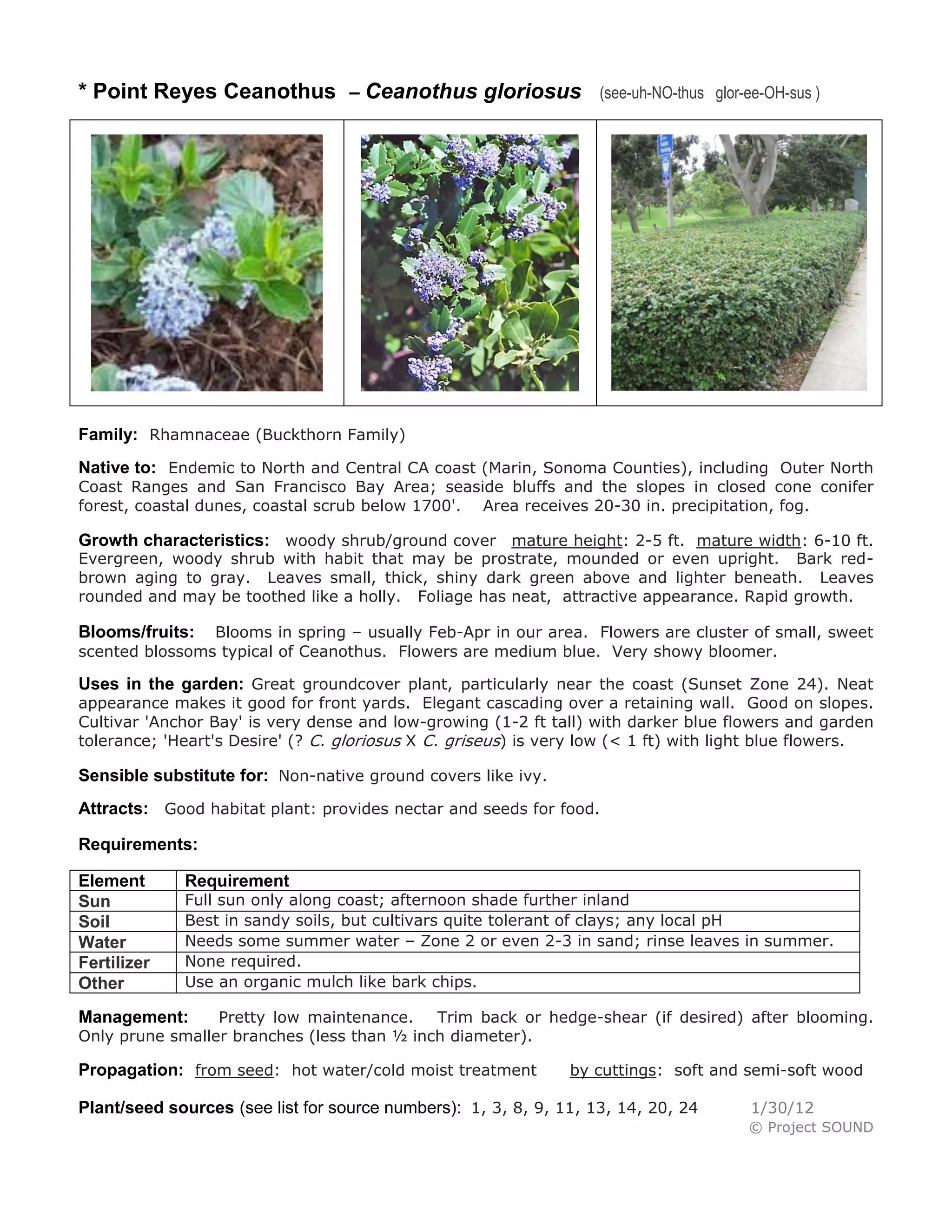
* Point Reyes Ceanothus – Ceanothus gloriosus

(see-uh-NO-thus glor-ee-OH-sus )

Family: Rhamnaceae (Buckthorn Family)
Native to: Endemic to North and Central CA coast (Marin, Sonoma Counties), including Outer North

Coast Ranges and San Francisco Bay Area; seaside bluffs and the slopes in closed cone conifer
forest, coastal dunes, coastal scrub below 1700'. Area receives 20-30 in. precipitation, fog.

Growth characteristics: woody shrub/ground cover mature height: 2-5 ft. mature width: 6-10 ft.

Evergreen, woody shrub with habit that may be prostrate, mounded or even upright. Bark redbrown aging to gray. Leaves small, thick, shiny dark green above and lighter beneath. Leaves
rounded and may be toothed like a holly. Foliage has neat, attractive appearance. Rapid growth.
Blooms in spring – usually Feb-Apr in our area. Flowers are cluster of small, sweet
scented blossoms typical of Ceanothus. Flowers are medium blue. Very showy bloomer.

Blooms/fruits:

Uses in the garden: Great groundcover plant, particularly near the coast (Sunset Zone 24). Neat

appearance makes it good for front yards. Elegant cascading over a retaining wall. Good on slopes.
Cultivar 'Anchor Bay' is very dense and low-growing (1-2 ft tall) with darker blue flowers and garden
tolerance; 'Heart's Desire' (? C. gloriosus X C. griseus) is very low (< 1 ft) with light blue flowers.

Sensible substitute for: Non-native ground covers like ivy.
Attracts: Good habitat plant: provides nectar and seeds for food.
Requirements:
Element
Sun
Soil
Water
Fertilizer
Other

Requirement

Full sun only along coast; afternoon shade further inland
Best in sandy soils, but cultivars quite tolerant of clays; any local pH
Needs some summer water – Zone 2 or even 2-3 in sand; rinse leaves in summer.
None required.
Use an organic mulch like bark chips.

Pretty low maintenance.
Trim back or hedge-shear (if desired) after blooming.
Only prune smaller branches (less than ½ inch diameter).

Management:

Propagation: from seed: hot water/cold moist treatment

by cuttings: soft and semi-soft wood

Plant/seed sources (see list for source numbers): 1, 3, 8, 9, 11, 13, 14, 20, 24

1/30/12
© Project SOUND

Ceanothus gloriosus

  • 1.
    * Point ReyesCeanothus – Ceanothus gloriosus (see-uh-NO-thus glor-ee-OH-sus ) Family: Rhamnaceae (Buckthorn Family) Native to: Endemic to North and Central CA coast (Marin, Sonoma Counties), including Outer North Coast Ranges and San Francisco Bay Area; seaside bluffs and the slopes in closed cone conifer forest, coastal dunes, coastal scrub below 1700'. Area receives 20-30 in. precipitation, fog. Growth characteristics: woody shrub/ground cover mature height: 2-5 ft. mature width: 6-10 ft. Evergreen, woody shrub with habit that may be prostrate, mounded or even upright. Bark redbrown aging to gray. Leaves small, thick, shiny dark green above and lighter beneath. Leaves rounded and may be toothed like a holly. Foliage has neat, attractive appearance. Rapid growth. Blooms in spring – usually Feb-Apr in our area. Flowers are cluster of small, sweet scented blossoms typical of Ceanothus. Flowers are medium blue. Very showy bloomer. Blooms/fruits: Uses in the garden: Great groundcover plant, particularly near the coast (Sunset Zone 24). Neat appearance makes it good for front yards. Elegant cascading over a retaining wall. Good on slopes. Cultivar 'Anchor Bay' is very dense and low-growing (1-2 ft tall) with darker blue flowers and garden tolerance; 'Heart's Desire' (? C. gloriosus X C. griseus) is very low (< 1 ft) with light blue flowers. Sensible substitute for: Non-native ground covers like ivy. Attracts: Good habitat plant: provides nectar and seeds for food. Requirements: Element Sun Soil Water Fertilizer Other Requirement Full sun only along coast; afternoon shade further inland Best in sandy soils, but cultivars quite tolerant of clays; any local pH Needs some summer water – Zone 2 or even 2-3 in sand; rinse leaves in summer. None required. Use an organic mulch like bark chips. Pretty low maintenance. Trim back or hedge-shear (if desired) after blooming. Only prune smaller branches (less than ½ inch diameter). Management: Propagation: from seed: hot water/cold moist treatment by cuttings: soft and semi-soft wood Plant/seed sources (see list for source numbers): 1, 3, 8, 9, 11, 13, 14, 20, 24 1/30/12 © Project SOUND