Bright Green Dudleya – Dudleya virens

(DUD-ley-uh VI-rens)

Family: Crassulaceae (Stonecrop Family)
Native to: Local coast of S. CA; ssp. insularis is endemic to Palos Verdes Peninsula, San Clemente
& Catalina Islands while ssp. hassei is only from Catalina Island. Grow on coastal bluffs and steep
slopes in chaparral, coastal bluff scrub, and coastal sage scrub below 1300 ft. elevation.

Growth characteristics:
clumping succulent
mature height: 1 ft.
mature width: 1-3 ft.
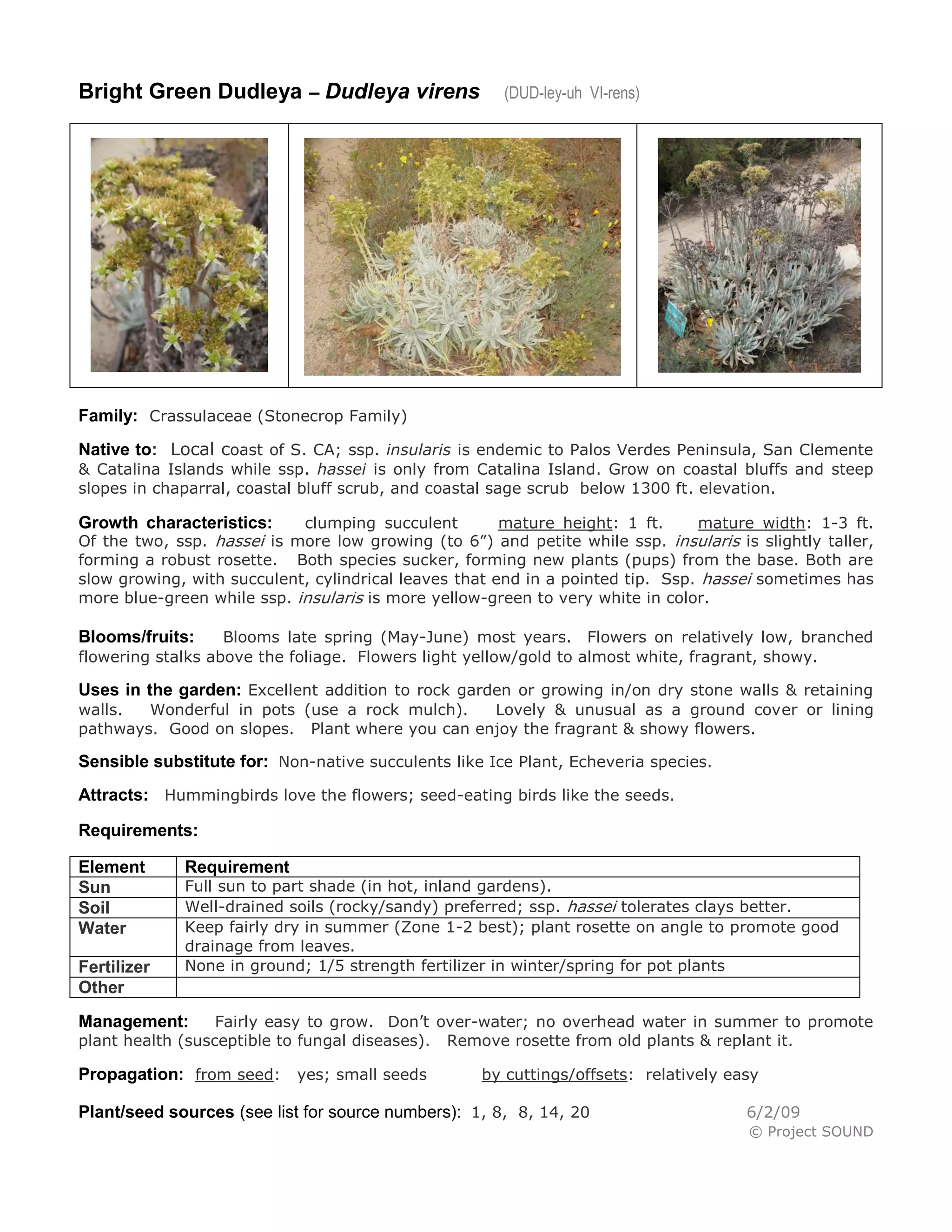
Of the two, ssp. hassei is more low growing (to 6”) and petite while ssp. insularis is slightly taller,
forming a robust rosette. Both species sucker, forming new plants (pups) from the base. Both are
slow growing, with succulent, cylindrical leaves that end in a pointed tip. Ssp. hassei sometimes has
more blue-green while ssp. insularis is more yellow-green to very white in color.
Blooms late spring (May-June) most years. Flowers on relatively low, branched
flowering stalks above the foliage. Flowers light yellow/gold to almost white, fragrant, showy.

Blooms/fruits:

Uses in the garden: Excellent addition to rock garden or growing in/on dry stone walls & retaining
walls.
Wonderful in pots (use a rock mulch).
Lovely & unusual as a ground cover or lining
pathways. Good on slopes. Plant where you can enjoy the fragrant & showy flowers.

Sensible substitute for: Non-native succulents like Ice Plant, Echeveria species.
Attracts: Hummingbirds love the flowers; seed-eating birds like the seeds.
Requirements:
Element
Sun
Soil
Water
Fertilizer
Other

Requirement

Full sun to part shade (in hot, inland gardens).
Well-drained soils (rocky/sandy) preferred; ssp. hassei tolerates clays better.
Keep fairly dry in summer (Zone 1-2 best); plant rosette on angle to promote good
drainage from leaves.
None in ground; 1/5 strength fertilizer in winter/spring for pot plants

Fairly easy to grow. Don’t over-water; no overhead water in summer to promote
plant health (susceptible to fungal diseases). Remove rosette from old plants & replant it.

Management:

Propagation: from seed: yes; small seeds

by cuttings/offsets: relatively easy

Plant/seed sources (see list for source numbers): 1, 8, 8, 14, 20

6/2/09
© Project SOUND

Gardening sheet dudleya virens

  • 1.
    Bright Green Dudleya– Dudleya virens (DUD-ley-uh VI-rens) Family: Crassulaceae (Stonecrop Family) Native to: Local coast of S. CA; ssp. insularis is endemic to Palos Verdes Peninsula, San Clemente & Catalina Islands while ssp. hassei is only from Catalina Island. Grow on coastal bluffs and steep slopes in chaparral, coastal bluff scrub, and coastal sage scrub below 1300 ft. elevation. Growth characteristics: clumping succulent mature height: 1 ft. mature width: 1-3 ft. Of the two, ssp. hassei is more low growing (to 6”) and petite while ssp. insularis is slightly taller, forming a robust rosette. Both species sucker, forming new plants (pups) from the base. Both are slow growing, with succulent, cylindrical leaves that end in a pointed tip. Ssp. hassei sometimes has more blue-green while ssp. insularis is more yellow-green to very white in color. Blooms late spring (May-June) most years. Flowers on relatively low, branched flowering stalks above the foliage. Flowers light yellow/gold to almost white, fragrant, showy. Blooms/fruits: Uses in the garden: Excellent addition to rock garden or growing in/on dry stone walls & retaining walls. Wonderful in pots (use a rock mulch). Lovely & unusual as a ground cover or lining pathways. Good on slopes. Plant where you can enjoy the fragrant & showy flowers. Sensible substitute for: Non-native succulents like Ice Plant, Echeveria species. Attracts: Hummingbirds love the flowers; seed-eating birds like the seeds. Requirements: Element Sun Soil Water Fertilizer Other Requirement Full sun to part shade (in hot, inland gardens). Well-drained soils (rocky/sandy) preferred; ssp. hassei tolerates clays better. Keep fairly dry in summer (Zone 1-2 best); plant rosette on angle to promote good drainage from leaves. None in ground; 1/5 strength fertilizer in winter/spring for pot plants Fairly easy to grow. Don’t over-water; no overhead water in summer to promote plant health (susceptible to fungal diseases). Remove rosette from old plants & replant it. Management: Propagation: from seed: yes; small seeds by cuttings/offsets: relatively easy Plant/seed sources (see list for source numbers): 1, 8, 8, 14, 20 6/2/09 © Project SOUND