Punch-bowl Clarkia – Clarkia bottae

(KLAR-kee-uh BOT-ee (or bot-TAY) )

Family: Onagraceae (Willowherb Family)
Native to: Coastal CA foothills from Monterey County to San Diego. Locally in Santa Monica Mtns;
endemic to dry openings in Coastal Sage Scrub, Closed-cone Pine Forest, Mixed Evergreen Forest,
Southern Oak Woodland, Foothill Woodland, Chaparral below about 3000 ft. elevation.

annual wildflower
mature height: 1-2 ft.
mature width: 1-2 ft.
Erect to sprawling – stems may be stout or slender. Sparse, narrow leaves are slightly hairy. Leaf
color gray-green to medium green – similar to Clarkia purpurea – sometimes with red or purple.

Growth characteristics:

Blooms from spring into summer – usually April to June or July in western L.A.
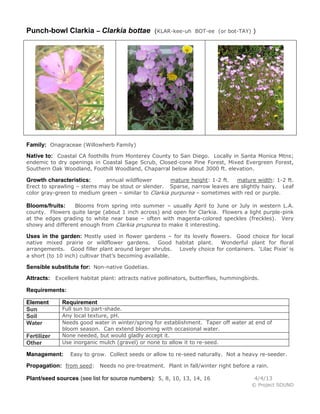
county. Flowers quite large (about 1 inch across) and open for Clarkia. Flowers a light purple-pink
at the edges grading to white near base – often with magenta-colored speckles (freckles). Very
showy and different enough from Clarkia prupurea to make it interesting.

Blooms/fruits:

Uses in the garden: Mostly used in flower gardens – for its lovely flowers. Good choice for local

native mixed prairie or wildflower gardens.
Good habitat plant.
Wonderful plant for floral
arrangements. Good filler plant around larger shrubs.
Lovely choice for containers. ‘Lilac Pixie’ is
a short (to 10 inch) cultivar that’s becoming available.

Sensible substitute for: Non-native Godetias.
Attracts: Excellent habitat plant: attracts native pollinators, butterflies, hummingbirds.
Requirements:
Element
Sun
Soil
Water
Fertilizer
Other

Requirement

Full sun to part-shade.
Any local texture, pH.
Needs good water in winter/spring for establishment. Taper off water at end of
bloom season. Can extend blooming with occasional water.
None needed, but would gladly accept it.
Use inorganic mulch (gravel) or none to allow it to re-seed.

Management:

Easy to grow. Collect seeds or allow to re-seed naturally. Not a heavy re-seeder.

Propagation: from seed: Needs no pre-treatment. Plant in fall/winter right before a rain.
Plant/seed sources (see list for source numbers): 5, 8, 10, 13, 14, 16

4/4/13
© Project SOUND

Gardening sheet clarkia bottae

  • 1.
    Punch-bowl Clarkia –Clarkia bottae (KLAR-kee-uh BOT-ee (or bot-TAY) ) Family: Onagraceae (Willowherb Family) Native to: Coastal CA foothills from Monterey County to San Diego. Locally in Santa Monica Mtns; endemic to dry openings in Coastal Sage Scrub, Closed-cone Pine Forest, Mixed Evergreen Forest, Southern Oak Woodland, Foothill Woodland, Chaparral below about 3000 ft. elevation. annual wildflower mature height: 1-2 ft. mature width: 1-2 ft. Erect to sprawling – stems may be stout or slender. Sparse, narrow leaves are slightly hairy. Leaf color gray-green to medium green – similar to Clarkia purpurea – sometimes with red or purple. Growth characteristics: Blooms from spring into summer – usually April to June or July in western L.A. county. Flowers quite large (about 1 inch across) and open for Clarkia. Flowers a light purple-pink at the edges grading to white near base – often with magenta-colored speckles (freckles). Very showy and different enough from Clarkia prupurea to make it interesting. Blooms/fruits: Uses in the garden: Mostly used in flower gardens – for its lovely flowers. Good choice for local native mixed prairie or wildflower gardens. Good habitat plant. Wonderful plant for floral arrangements. Good filler plant around larger shrubs. Lovely choice for containers. ‘Lilac Pixie’ is a short (to 10 inch) cultivar that’s becoming available. Sensible substitute for: Non-native Godetias. Attracts: Excellent habitat plant: attracts native pollinators, butterflies, hummingbirds. Requirements: Element Sun Soil Water Fertilizer Other Requirement Full sun to part-shade. Any local texture, pH. Needs good water in winter/spring for establishment. Taper off water at end of bloom season. Can extend blooming with occasional water. None needed, but would gladly accept it. Use inorganic mulch (gravel) or none to allow it to re-seed. Management: Easy to grow. Collect seeds or allow to re-seed naturally. Not a heavy re-seeder. Propagation: from seed: Needs no pre-treatment. Plant in fall/winter right before a rain. Plant/seed sources (see list for source numbers): 5, 8, 10, 13, 14, 16 4/4/13 © Project SOUND