THE CERTIFICATE PROGRAM IN
COMMUNITY DEVELOPMENT AND CIVIC EMPOWERMENT
(CDCE)
Faculty of Social Sciences
Chiang Mai University, Chiang Mai, Thailand
Introduction
The CDCE program is a three-month intensive program designed to provide basic knowledge
and skills for younger generations of community development workers, NGO managers and
grassroots change-makers in Myanmar. The trainees will learn the conceptual foundations of
community development skills that are applicable in complex institutional environments. The
training program will provide participatory and interactive classroom-based learning combined
with field trips and observation tours to study the real-world activities and best practices of
development NGOs and other civic groups.
First Two Weeks in Naypyitaw
The initial two weeks of the program are now held in Naypyitaw, the capital of Myanmar, in
order to promote understanding of the current political transition in Myanmar and to gain tools to
build stronger relationships between governmental agencies and civil society through
participatory policy making and advocacy. Then, we travel as a group to Chiang Mai, Thailand.
In-Class Lectures and Discussions
In-class lectures and discussions will have three core components. The first component, “Core
and Foundation,” deals with global issues and local trends of development while the second
component introduces the basics of “Development Management.” The third component focuses
on “Specialized Skills” that are applicable to the institutional contexts of Southeast Asia. In-
class lectures and discussions are designed to encourage active participation from the trainees.
Field Trips and Observation Tours
After a number of weeks of in-class training, the participants will travel to various areas of
Thailand to see and learn how development NGOs work in various streams of community
development activities. During this time, guest speakers comprising of seasoned practitioners
and experts in community development and other related areas will be invited to share their real-
life experiences and understanding of development challenges and issues.
Team Project and Active Learning
Participants will be required to carry out various group activities and a team project during the
training period. Participation and successful completion of the team project is a requirement for
the certificate of completion for the three-month program. Participants are strongly encouraged
to bring research papers, documents and other information that can be relevant in developing
projects of their own choice. Participants will receive hands-on learning about specific issues
concerning development work through active participation in various assignments of research,
documentation, discussions, sharing and writing the final presentation.
Requirements for CDCE Applicants
Applicants must meet the following qualifications:
1. Participants must hold a university degree from one of the recognized educational
institutions in your country of origin or elsewhere. Other candidates who have also
completed university-level degree program from distance learning institution or open
universities may also apply. Participants who do not hold a university degree as a result
of being from a marginal or vulnerable group whose educational opportunities are limited
due to social exclusion will be considered for the admission on case-by-case basis. The
applicants under such category should write a cover letter explaining the challenges he or
she has faced in obtaining an education.
2. Participants must have at least two years of experience in community work or similar
experience working with charity organizations, community-based organizations, local
NGOs, international development organizations, or religious organizations that conduct
community work.
3. Participants must have at least basic English language skills (speaking, understanding
spoken English, reading and basic writing).
4. Participants must demonstrate commitment to and flexibility in working with diverse
groups. They must respect all participants regardless of their race, religion, age, gender,
sexual orientation or opinions.
5. Participants must be able to participate in all activities, including group decision making-
process, sharing their knowledge and constructively engaging in group discussions.
6. Participations must be medically capable of joining the program. While students will
receive basic health care and accident insurance while participating in the CDCE
program, participants with pre-existing conditions are responsible for their own health
care and costs related to that condition.
7. Participants must strictly adhere to the prevailing laws and regulations of Thailand as
well as other rules set by the program throughout the period of training, and must
promptly return to their country after the program. CDCE reserves the right to dismiss
the trainee if he/she violates the rules.
8. Participants should begin the process of acquiring necessary travel formalities or
passports by the time of application. Participants are also required to submit the passport
details in photocopy to apply entry visa for Thailand.
All individuals who meet the above criteria are encouraged to apply. We strongly encourage
applications from women, representatives of minority ethnic groups, representatives of
traditionally marginalized groups, and other community development workers who aspire to
develop their own initiatives or programs benefiting their communities.
Program Fees and Scholarships:
The fee for the CDCE program is currently $2400 US. This covers international airfare,
accommodation, program fees, course material, and a modest stipend during the program
duration.
Scholarships: The CDCE Program is able to offer full scholarships for individuals who are
volunteering or working at locally-based community groups, CBOs, NGOs, self-help groups,
youth groups, schools, and religious organizations. All applicants from these local groups are
automatically offered this scholarship if selected as participants – there is no need to apply
separately for the scholarship.
INGO Applicants: While the CDCE training program is available primarily for civil society
actors from communities and local NGOs, there is limited room for staff from international
NGOs. CDCE values these INGO participants a great deal as their participation brings diversity
and depth to the dialogue and learning that takes place throughout the training period.
It is the CDCE program’s policy to require any INGO staff who would like to attend our
program to secure a sponsorship for half of the program fee or $1,200 US. This sponsorship
is usually assumed by the individuals’ mother organization.
If an INGO staff is interested in applying to our program, CDCE is more than happy to supply
them with information about CDCE and its INGO policy that they can present to their
supervisors. Likewise, CDCE is available to answer questions and provide information to
directors, managers and human resources representatives who have staff interested in our
program.
Application Process:
1. Application Form: Participants should fill out the application form and answer the essay
questions. Answers can be hand-written or typed. If more space is needed, answers can be
written on a separate sheet of paper. Applications can be sent by e-mail to
cdceprogram@gmail.com.
2. Recommendation Letters: Participants are required to submit two recommendation letters
from people who know them well. Ideally, one recommendation should be from the leader of
the organization the participant is involved with and the other letter should be from a
community member (teacher, religious or community leader, etc.) The person should
complete the attached recommendation form. Then the applicant can include it with their
application or the person who wrote the recommendation can send it to CDCE directly.
3. Interview: Applicants may be subject to an in-person or telephone interview, which will be
conducted by a selection panel of Chiang Mai University representatives.
4. Participant Selection: Based on their application, recommendation letters and interview
results, candidates will be chosen to participate in the CDCE program.
Program Timeline:
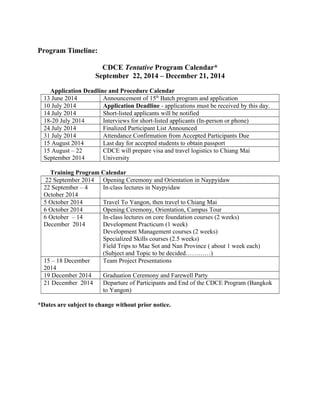
CDCE Tentative Program Calendar*
September 22, 2014 – December 21, 2014
Application Deadline and Procedure Calendar
13 June 2014 Announcement of 15th
Batch program and application
10 July 2014 Application Deadline - applications must be received by this day.
14 July 2014 Short-listed applicants will be notified
18-20 July 2014 Interviews for short-listed applicants (In-person or phone)
24 July 2014 Finalized Participant List Announced
31 July 2014 Attendance Confirmation from Accepted Participants Due
15 August 2014 Last day for accepted students to obtain passport
15 August – 22
September 2014
CDCE will prepare visa and travel logistics to Chiang Mai
University
Training Program Calendar
22 September 2014 Opening Ceremony and Orientation in Naypyidaw
22 September – 4
October 2014
In-class lectures in Naypyidaw
5 October 2014 Travel To Yangon, then travel to Chiang Mai
6 October 2014 Opening Ceremony, Orientation, Campus Tour
6 October – 14
December 2014
In-class lectures on core foundation courses (2 weeks)
Development Practicum (1 week)
Development Management courses (2 weeks)
Specialized Skills courses (2.5 weeks)
Field Trips to Mae Sot and Nan Province ( about 1 week each)
(Subject and Topic to be decided…………)
15 – 18 December
2014
Team Project Presentations
19 December 2014 Graduation Ceremony and Farewell Party
21 December 2014 Departure of Participants and End of the CDCE Program (Bangkok
to Yangon)
*Dates are subject to change without prior notice.

Cdce 2014 program summary 15th batch

  • 1.
    THE CERTIFICATE PROGRAMIN COMMUNITY DEVELOPMENT AND CIVIC EMPOWERMENT (CDCE) Faculty of Social Sciences Chiang Mai University, Chiang Mai, Thailand Introduction The CDCE program is a three-month intensive program designed to provide basic knowledge and skills for younger generations of community development workers, NGO managers and grassroots change-makers in Myanmar. The trainees will learn the conceptual foundations of community development skills that are applicable in complex institutional environments. The training program will provide participatory and interactive classroom-based learning combined with field trips and observation tours to study the real-world activities and best practices of development NGOs and other civic groups. First Two Weeks in Naypyitaw The initial two weeks of the program are now held in Naypyitaw, the capital of Myanmar, in order to promote understanding of the current political transition in Myanmar and to gain tools to build stronger relationships between governmental agencies and civil society through participatory policy making and advocacy. Then, we travel as a group to Chiang Mai, Thailand. In-Class Lectures and Discussions In-class lectures and discussions will have three core components. The first component, “Core and Foundation,” deals with global issues and local trends of development while the second component introduces the basics of “Development Management.” The third component focuses on “Specialized Skills” that are applicable to the institutional contexts of Southeast Asia. In- class lectures and discussions are designed to encourage active participation from the trainees. Field Trips and Observation Tours After a number of weeks of in-class training, the participants will travel to various areas of Thailand to see and learn how development NGOs work in various streams of community development activities. During this time, guest speakers comprising of seasoned practitioners and experts in community development and other related areas will be invited to share their real- life experiences and understanding of development challenges and issues. Team Project and Active Learning Participants will be required to carry out various group activities and a team project during the training period. Participation and successful completion of the team project is a requirement for the certificate of completion for the three-month program. Participants are strongly encouraged to bring research papers, documents and other information that can be relevant in developing projects of their own choice. Participants will receive hands-on learning about specific issues concerning development work through active participation in various assignments of research, documentation, discussions, sharing and writing the final presentation.
  • 2.
    Requirements for CDCEApplicants Applicants must meet the following qualifications: 1. Participants must hold a university degree from one of the recognized educational institutions in your country of origin or elsewhere. Other candidates who have also completed university-level degree program from distance learning institution or open universities may also apply. Participants who do not hold a university degree as a result of being from a marginal or vulnerable group whose educational opportunities are limited due to social exclusion will be considered for the admission on case-by-case basis. The applicants under such category should write a cover letter explaining the challenges he or she has faced in obtaining an education. 2. Participants must have at least two years of experience in community work or similar experience working with charity organizations, community-based organizations, local NGOs, international development organizations, or religious organizations that conduct community work. 3. Participants must have at least basic English language skills (speaking, understanding spoken English, reading and basic writing). 4. Participants must demonstrate commitment to and flexibility in working with diverse groups. They must respect all participants regardless of their race, religion, age, gender, sexual orientation or opinions. 5. Participants must be able to participate in all activities, including group decision making- process, sharing their knowledge and constructively engaging in group discussions. 6. Participations must be medically capable of joining the program. While students will receive basic health care and accident insurance while participating in the CDCE program, participants with pre-existing conditions are responsible for their own health care and costs related to that condition. 7. Participants must strictly adhere to the prevailing laws and regulations of Thailand as well as other rules set by the program throughout the period of training, and must promptly return to their country after the program. CDCE reserves the right to dismiss the trainee if he/she violates the rules. 8. Participants should begin the process of acquiring necessary travel formalities or passports by the time of application. Participants are also required to submit the passport details in photocopy to apply entry visa for Thailand. All individuals who meet the above criteria are encouraged to apply. We strongly encourage applications from women, representatives of minority ethnic groups, representatives of traditionally marginalized groups, and other community development workers who aspire to develop their own initiatives or programs benefiting their communities.
  • 3.
    Program Fees andScholarships: The fee for the CDCE program is currently $2400 US. This covers international airfare, accommodation, program fees, course material, and a modest stipend during the program duration. Scholarships: The CDCE Program is able to offer full scholarships for individuals who are volunteering or working at locally-based community groups, CBOs, NGOs, self-help groups, youth groups, schools, and religious organizations. All applicants from these local groups are automatically offered this scholarship if selected as participants – there is no need to apply separately for the scholarship. INGO Applicants: While the CDCE training program is available primarily for civil society actors from communities and local NGOs, there is limited room for staff from international NGOs. CDCE values these INGO participants a great deal as their participation brings diversity and depth to the dialogue and learning that takes place throughout the training period. It is the CDCE program’s policy to require any INGO staff who would like to attend our program to secure a sponsorship for half of the program fee or $1,200 US. This sponsorship is usually assumed by the individuals’ mother organization. If an INGO staff is interested in applying to our program, CDCE is more than happy to supply them with information about CDCE and its INGO policy that they can present to their supervisors. Likewise, CDCE is available to answer questions and provide information to directors, managers and human resources representatives who have staff interested in our program. Application Process: 1. Application Form: Participants should fill out the application form and answer the essay questions. Answers can be hand-written or typed. If more space is needed, answers can be written on a separate sheet of paper. Applications can be sent by e-mail to cdceprogram@gmail.com. 2. Recommendation Letters: Participants are required to submit two recommendation letters from people who know them well. Ideally, one recommendation should be from the leader of the organization the participant is involved with and the other letter should be from a community member (teacher, religious or community leader, etc.) The person should complete the attached recommendation form. Then the applicant can include it with their application or the person who wrote the recommendation can send it to CDCE directly. 3. Interview: Applicants may be subject to an in-person or telephone interview, which will be conducted by a selection panel of Chiang Mai University representatives. 4. Participant Selection: Based on their application, recommendation letters and interview results, candidates will be chosen to participate in the CDCE program.
  • 4.
    Program Timeline: CDCE TentativeProgram Calendar* September 22, 2014 – December 21, 2014 Application Deadline and Procedure Calendar 13 June 2014 Announcement of 15th Batch program and application 10 July 2014 Application Deadline - applications must be received by this day. 14 July 2014 Short-listed applicants will be notified 18-20 July 2014 Interviews for short-listed applicants (In-person or phone) 24 July 2014 Finalized Participant List Announced 31 July 2014 Attendance Confirmation from Accepted Participants Due 15 August 2014 Last day for accepted students to obtain passport 15 August – 22 September 2014 CDCE will prepare visa and travel logistics to Chiang Mai University Training Program Calendar 22 September 2014 Opening Ceremony and Orientation in Naypyidaw 22 September – 4 October 2014 In-class lectures in Naypyidaw 5 October 2014 Travel To Yangon, then travel to Chiang Mai 6 October 2014 Opening Ceremony, Orientation, Campus Tour 6 October – 14 December 2014 In-class lectures on core foundation courses (2 weeks) Development Practicum (1 week) Development Management courses (2 weeks) Specialized Skills courses (2.5 weeks) Field Trips to Mae Sot and Nan Province ( about 1 week each) (Subject and Topic to be decided…………) 15 – 18 December 2014 Team Project Presentations 19 December 2014 Graduation Ceremony and Farewell Party 21 December 2014 Departure of Participants and End of the CDCE Program (Bangkok to Yangon) *Dates are subject to change without prior notice.