Assessment
Assessment is an integral part of teaching and learning at Lyceum-School 6. Assessment is often the driver
in DP schools and creates the high stakes and the intense nature of the programme.
Summative assessment
Summative assessment measures student achievement. The approach to assessment used by the IB is
criterion-related, not norm-referenced. Candidates are judged by their performance in relation to pre-
specified assessment criteria based on the aims and objectives of each subject curriculum, and not in relation
to the work of other students. Universities value the rigour and consistency of the IB because the range of
scores that students attain remains statistically stable.
Both external and internal assessment is used:
External Assessment Internal Assessment
All external assessment is sent away to be
marked by external IB examiners. This may
include assessment tasks, or written
examinations taken in May of the second
year of the diploma.
All subjects have an internal assessment task
component worth roughly 25% of the marks awarded.
These are initially marked by the class teacher. The IB
then selects a random sample which is sent to an
external examiner who moderates the quality of the
teacher’s marking.
Formative assessment
Throughout the course, homework, tests and other assignments provide teachers and students with feedback
on the learning taking place, enabling the setting of targets to help drive further progress. Wherever possible
teachers use authentic IB assessment materials and assessment criteria. All work is given a mark out of 7.
The Core of the IB Diploma Programme
The core should encourage students to consider the contexts and views of others, allowing students to
examine links between the local and the global. The core has a special role to play in providing opportunities
for students to think about their own values and actions, to understand their place in the world, and to shape
their identity.
The core of the Diploma Programme features three compulsory elements that broaden students’ educational
experience and challenge them to apply their knowledge and skills. Theory of Knowledge, CAS and the
Extended Essay are compulsory subjects at the heart of the diploma. They serve to give coherence to the
programme and a focus for the group’s identity. Up to three bonus points may be awarded for performance in
Theory of Knowledge and the Extended Essay.
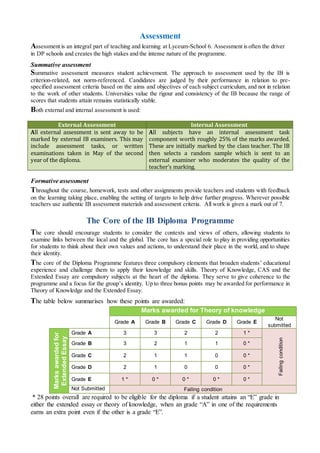
The table below summarises how these points are awarded:
Marks awarded for Theory of knowledge
Grade A Grade B Grade C Grade D Grade E
Not
submitted
Marksawardedfor
ExtendedEssay
Grade A 3 3 2 2 1 *
Failingcondition
Grade B 3 2 1 1 0 *
Grade C 2 1 1 0 0 *
Grade D 2 1 0 0 0 *
Grade E 1 * 0 * 0 * 0 * 0 *
Not Submitted Failing condition
* 28 points overall are required to be eligible for the diploma if a student attains an “E” grade in
either the extended essay or theory of knowledge, when an grade “A” in one of the requirements
earns an extra point even if the other is a grade “E”.

14. assessment

  • 1.
    Assessment Assessment is anintegral part of teaching and learning at Lyceum-School 6. Assessment is often the driver in DP schools and creates the high stakes and the intense nature of the programme. Summative assessment Summative assessment measures student achievement. The approach to assessment used by the IB is criterion-related, not norm-referenced. Candidates are judged by their performance in relation to pre- specified assessment criteria based on the aims and objectives of each subject curriculum, and not in relation to the work of other students. Universities value the rigour and consistency of the IB because the range of scores that students attain remains statistically stable. Both external and internal assessment is used: External Assessment Internal Assessment All external assessment is sent away to be marked by external IB examiners. This may include assessment tasks, or written examinations taken in May of the second year of the diploma. All subjects have an internal assessment task component worth roughly 25% of the marks awarded. These are initially marked by the class teacher. The IB then selects a random sample which is sent to an external examiner who moderates the quality of the teacher’s marking. Formative assessment Throughout the course, homework, tests and other assignments provide teachers and students with feedback on the learning taking place, enabling the setting of targets to help drive further progress. Wherever possible teachers use authentic IB assessment materials and assessment criteria. All work is given a mark out of 7. The Core of the IB Diploma Programme The core should encourage students to consider the contexts and views of others, allowing students to examine links between the local and the global. The core has a special role to play in providing opportunities for students to think about their own values and actions, to understand their place in the world, and to shape their identity. The core of the Diploma Programme features three compulsory elements that broaden students’ educational experience and challenge them to apply their knowledge and skills. Theory of Knowledge, CAS and the Extended Essay are compulsory subjects at the heart of the diploma. They serve to give coherence to the programme and a focus for the group’s identity. Up to three bonus points may be awarded for performance in Theory of Knowledge and the Extended Essay. The table below summarises how these points are awarded: Marks awarded for Theory of knowledge Grade A Grade B Grade C Grade D Grade E Not submitted Marksawardedfor ExtendedEssay Grade A 3 3 2 2 1 * Failingcondition Grade B 3 2 1 1 0 * Grade C 2 1 1 0 0 * Grade D 2 1 0 0 0 * Grade E 1 * 0 * 0 * 0 * 0 * Not Submitted Failing condition * 28 points overall are required to be eligible for the diploma if a student attains an “E” grade in either the extended essay or theory of knowledge, when an grade “A” in one of the requirements earns an extra point even if the other is a grade “E”.