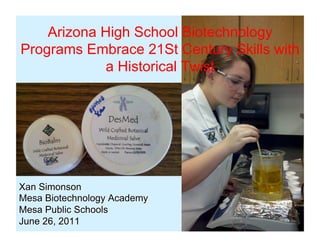
Arizona High School Biotechnology
Programs Embrace 21St Century Skills with
             a Historical Twist
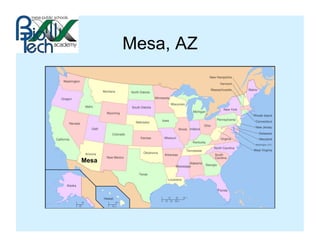
Mesa, AZ


Mesa
Biotechnology Academy
•  A 4 year program of study
   in biotechnology
•  Target the entire student
   body--with an emphasis
   on the middle 50%
•  Find the bright,
   underachieving students
•  School-within-a-school
   format
•  Rigorous college
   preparatory, career
   related curriculum
•  Students gain knowledge
   of the global impact of
   biotechnology
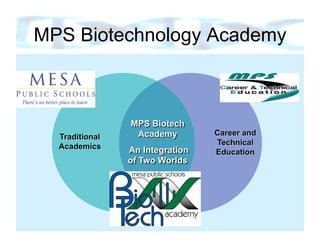
MPS Biotechnology Academy
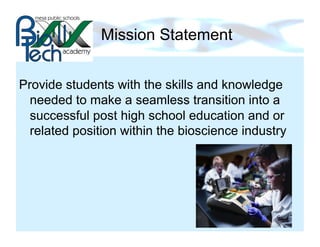
Mission Statement


Provide students with the skills and knowledge
  needed to make a seamless transition into a
  successful post high school education and or
  related position within the bioscience industry
Arizona Biotechnology Timeline
  2003- Team Plans and develops Biotech Class
  2004- Biotechnology I Class Begins and
   development of Academy model
  2005-Biotechnology Academy Opens up as a 2
   year program
  2005-2009- Program exists under Agriculture
   Pathway
  2009- AZ CTE opens new Emerging
   Technologies Pathway- Biotech moves over to
   this Pathway
  2010- AZ 1st CTE Program Assessment- MPS
   ranks #1 in the state
  2011- All Biotech programs in the state move
   over to Emerging Technologies Pathway
     ~50 AZ High Schools have started programs with our
      help
Arizona Biotechnology Partnerships

2005- Current Mesa Community College

   2007-2010 NSF Grant: Innovating Biotechnology
    Education: Incorporating Novel Genomics
    Research in the Development of a True 2+2+2
    Educational Pathway –
      Trained Students and Teachers –
      Mobile Lab Check Out
      Annual HS/CC Research Poster Symposium
      Annual Summer High School Biotech Institute
   2009-Current- Continues to add Adjunct Faculty to
    teach courses and now offers night classes
   7 HS Biotech Teachers participate in MCC
    Biotechnology Program
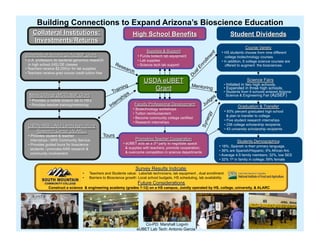
Building Connections to Expand Arizona’s Bioscience Education


                                                    Mentorin
                                                               g


                Tours


                            Co-PD: Marshall Logvin
                        eUBET Lab Tech: Antonio Garcia
Arizona Biotechnology Partnerships

Arizona Science Foundation

  2007-2010
   •  K-12 Discovery Grant- Bringing Biomedical and Genomic
      Research into High School Science Programs
       •  Trained 22 Phoenix Metropolitan HS Teachers genomic research
          skills and techniques who then incorporated these this into their
          courses.


  2009-Current
   •  STEM Initiative- To improve science and math in the classroom
       •  Video:
       http://www.youtube.com/user/scienceaz#p/a/u/1/YUmkgw4e8co
International Partnerships
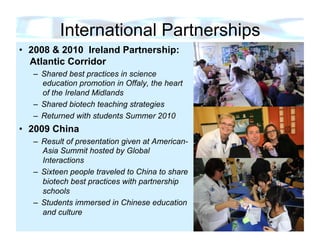
•  2008 & 2010 Ireland Partnership:
   Atlantic Corridor
   –  Shared best practices in science
      education promotion in Offaly, the heart
      of the Ireland Midlands
   –  Shared biotech teaching strategies
   –  Returned with students Summer 2010
•  2009 China
   –  Result of presentation given at American-
      Asia Summit hosted by Global
      Interactions
   –  Sixteen people traveled to China to share
      biotech best practices with partnership
      schools
   –  Students immersed in Chinese education
      and culture
Research-Based Teaching
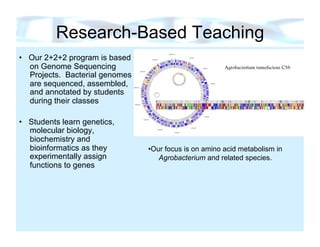
•  Our 2+2+2 program is based
   on Genome Sequencing
   Projects. Bacterial genomes
   are sequenced, assembled,
   and annotated by students
   during their classes

•  Students learn genetics,
   molecular biology,
   biochemistry and
   bioinformatics as they        • Our focus is on amino acid metabolism in
   experimentally assign             Agrobacterium and related species.
   functions to genes
Student Research
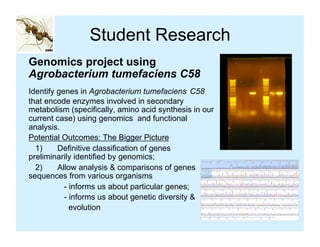
Genomics project using
Agrobacterium tumefaciens C58
Identify genes in Agrobacterium tumefaciens C58
that encode enzymes involved in secondary
metabolism (specifically, amino acid synthesis in our
current case) using genomics and functional
analysis.
Potential Outcomes: The Bigger Picture
  1)     Definitive classification of genes
preliminarily identified by genomics;
  2)     Allow analysis & comparisons of genes
sequences from various organisms
           - informs us about particular genes;
           - informs us about genetic diversity &
             evolution
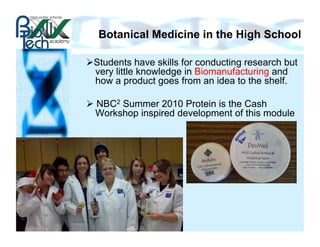
Botanical Medicine in the High School

 Students have skills for conducting research but
  very little knowledge in Biomanufacturing and
  how a product goes from an idea to the shelf.

  NBC2 Summer 2010 Protein is the Cash
   Workshop inspired development of this module
Botanical Medicine in the High School

  Students learned the following:

   1.  AZ Desert Medicinal Plants
   2.  Plant Identification and Function
   3.  Wild Crafting Etiquette
   4.  Plant Constituents Properties
   5.  Application of Chemistry Solution Making
   6.  Develop Skin Balm/Salve Formula
   7.  Made Infused Oils
   8.  Marketing skills: Researched bottles/jars and labels
   9.  Produced the BioBalm and Desmed Salve
   10. Gave away as Holiday Gifts
   11.  Customers returned for more-Now sold through the
        academy student organization
   12. Students designed and are planting on site a Desert
        Medicinal Garden- Fall 2011
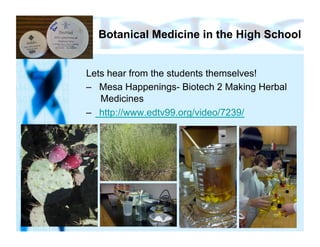
Botanical Medicine in the High School


Lets hear from the students themselves!
–  Mesa Happenings- Biotech 2 Making Herbal
   Medicines
–  http://www.edtv99.org/video/7239/
Contact Information

•  Amanda Grimes
  –  Mesa Public Schools
     Biotechnology Academy
     1630 E. Southern Avenue
     Mesa, AZ 85204
  –  aacgrime@mpsaz.org
  –  480-472-5783 Office

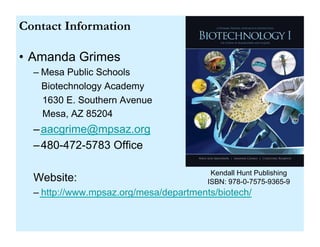
                                          Kendall Hunt Publishing
  Website:                               ISBN: 978-0-7575-9365-9
  –  http://www.mpsaz.org/mesa/departments/biotech/

Ccp2011 13 simonson

  • 1.
    Arizona High SchoolBiotechnology Programs Embrace 21St Century Skills with a Historical Twist
  • 2.
  • 3.
    Biotechnology Academy •  A4 year program of study in biotechnology •  Target the entire student body--with an emphasis on the middle 50% •  Find the bright, underachieving students •  School-within-a-school format •  Rigorous college preparatory, career related curriculum •  Students gain knowledge of the global impact of biotechnology
  • 4.
  • 5.
    Mission Statement Provide studentswith the skills and knowledge needed to make a seamless transition into a successful post high school education and or related position within the bioscience industry
  • 6.
    Arizona Biotechnology Timeline  2003- Team Plans and develops Biotech Class   2004- Biotechnology I Class Begins and development of Academy model   2005-Biotechnology Academy Opens up as a 2 year program   2005-2009- Program exists under Agriculture Pathway   2009- AZ CTE opens new Emerging Technologies Pathway- Biotech moves over to this Pathway   2010- AZ 1st CTE Program Assessment- MPS ranks #1 in the state   2011- All Biotech programs in the state move over to Emerging Technologies Pathway   ~50 AZ High Schools have started programs with our help
  • 7.
    Arizona Biotechnology Partnerships 2005-Current Mesa Community College  2007-2010 NSF Grant: Innovating Biotechnology Education: Incorporating Novel Genomics Research in the Development of a True 2+2+2 Educational Pathway –  Trained Students and Teachers –  Mobile Lab Check Out  Annual HS/CC Research Poster Symposium  Annual Summer High School Biotech Institute  2009-Current- Continues to add Adjunct Faculty to teach courses and now offers night classes  7 HS Biotech Teachers participate in MCC Biotechnology Program
  • 8.
    Building Connections toExpand Arizona’s Bioscience Education Mentorin g Tours Co-PD: Marshall Logvin eUBET Lab Tech: Antonio Garcia
  • 9.
    Arizona Biotechnology Partnerships ArizonaScience Foundation   2007-2010 •  K-12 Discovery Grant- Bringing Biomedical and Genomic Research into High School Science Programs •  Trained 22 Phoenix Metropolitan HS Teachers genomic research skills and techniques who then incorporated these this into their courses.   2009-Current •  STEM Initiative- To improve science and math in the classroom •  Video: http://www.youtube.com/user/scienceaz#p/a/u/1/YUmkgw4e8co
  • 10.
    International Partnerships •  2008& 2010 Ireland Partnership: Atlantic Corridor –  Shared best practices in science education promotion in Offaly, the heart of the Ireland Midlands –  Shared biotech teaching strategies –  Returned with students Summer 2010 •  2009 China –  Result of presentation given at American- Asia Summit hosted by Global Interactions –  Sixteen people traveled to China to share biotech best practices with partnership schools –  Students immersed in Chinese education and culture
  • 11.
    Research-Based Teaching •  Our2+2+2 program is based on Genome Sequencing Projects. Bacterial genomes are sequenced, assembled, and annotated by students during their classes •  Students learn genetics, molecular biology, biochemistry and bioinformatics as they • Our focus is on amino acid metabolism in experimentally assign Agrobacterium and related species. functions to genes
  • 12.
    Student Research Genomics projectusing Agrobacterium tumefaciens C58 Identify genes in Agrobacterium tumefaciens C58 that encode enzymes involved in secondary metabolism (specifically, amino acid synthesis in our current case) using genomics and functional analysis. Potential Outcomes: The Bigger Picture 1) Definitive classification of genes preliminarily identified by genomics; 2) Allow analysis & comparisons of genes sequences from various organisms - informs us about particular genes; - informs us about genetic diversity & evolution
  • 13.
    Botanical Medicine inthe High School  Students have skills for conducting research but very little knowledge in Biomanufacturing and how a product goes from an idea to the shelf.   NBC2 Summer 2010 Protein is the Cash Workshop inspired development of this module
  • 14.
    Botanical Medicine inthe High School   Students learned the following: 1.  AZ Desert Medicinal Plants 2.  Plant Identification and Function 3.  Wild Crafting Etiquette 4.  Plant Constituents Properties 5.  Application of Chemistry Solution Making 6.  Develop Skin Balm/Salve Formula 7.  Made Infused Oils 8.  Marketing skills: Researched bottles/jars and labels 9.  Produced the BioBalm and Desmed Salve 10. Gave away as Holiday Gifts 11.  Customers returned for more-Now sold through the academy student organization 12. Students designed and are planting on site a Desert Medicinal Garden- Fall 2011
  • 15.
    Botanical Medicine inthe High School Lets hear from the students themselves! –  Mesa Happenings- Biotech 2 Making Herbal Medicines –  http://www.edtv99.org/video/7239/
  • 16.
    Contact Information •  AmandaGrimes –  Mesa Public Schools Biotechnology Academy 1630 E. Southern Avenue Mesa, AZ 85204 –  aacgrime@mpsaz.org –  480-472-5783 Office Kendall Hunt Publishing Website: ISBN: 978-0-7575-9365-9 –  http://www.mpsaz.org/mesa/departments/biotech/