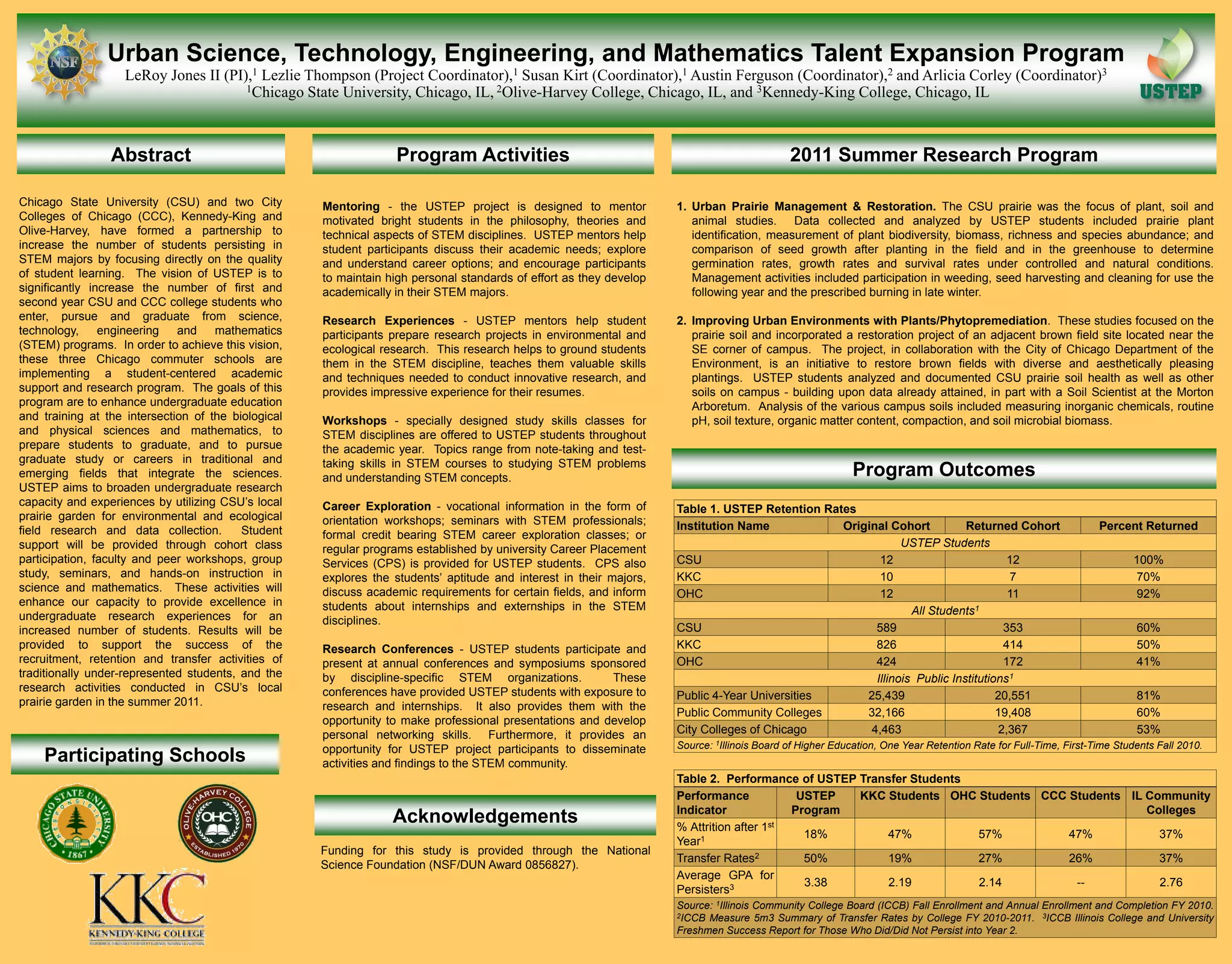
Urban Science, Technology, Engineering, and Mathematics Talent Expansion Program
LeRoy Jones II (PI),1 Lezlie Thompson (Project Coordinator),1 Susan Kirt (Coordinator),1 Austin Ferguson (Coordinator),2 and Arlicia Corley (Coordinator)3
1Chicago State University, Chicago, IL, 2Olive-Harvey College, Chicago, IL, and 3Kennedy-King College, Chicago, IL
Abstract
Chicago State University (CSU) and two City
Colleges of Chicago (CCC), Kennedy-King and
Olive-Harvey, have formed a partnership to
increase the number of students persisting in
STEM majors by focusing directly on the quality
of student learning. The vision of USTEP is to
significantly increase the number of first and
second year CSU and CCC college students who
enter, pursue and graduate from science,
technology, engineering and mathematics
(STEM) programs. In order to achieve this vision,
these three Chicago commuter schools are
implementing a student-centered academic
support and research program. The goals of this
program are to enhance undergraduate education
and training at the intersection of the biological
and physical sciences and mathematics, to
prepare students to graduate, and to pursue
graduate study or careers in traditional and
emerging fields that integrate the sciences.
USTEP aims to broaden undergraduate research
capacity and experiences by utilizing CSU’s local
prairie garden for environmental and ecological
field research and data collection. Student
support will be provided through cohort class
participation, faculty and peer workshops, group
study, seminars, and hands-on instruction in
science and mathematics. These activities will
enhance our capacity to provide excellence in
undergraduate research experiences for an
increased number of students. Results will be
provided to support the success of the
recruitment, retention and transfer activities of
traditionally under-represented students, and the
research activities conducted in CSU’s local
prairie garden in the summer 2011.
2011 Summer Research ProgramProgram Activities
(
Participating Schools
Acknowledgements
Funding for this study is provided through the National
Science Foundation (NSF/DUN Award 0856827).
1. Urban Prairie Management & Restoration. The CSU prairie was the focus of plant, soil and
animal studies. Data collected and analyzed by USTEP students included prairie plant
identification, measurement of plant biodiversity, biomass, richness and species abundance; and
comparison of seed growth after planting in the field and in the greenhouse to determine
germination rates, growth rates and survival rates under controlled and natural conditions.
Management activities included participation in weeding, seed harvesting and cleaning for use the
following year and the prescribed burning in late winter.
2. Improving Urban Environments with Plants/Phytopremediation. These studies focused on the
prairie soil and incorporated a restoration project of an adjacent brown field site located near the
SE corner of campus. The project, in collaboration with the City of Chicago Department of the
Environment, is an initiative to restore brown fields with diverse and aesthetically pleasing
plantings. USTEP students analyzed and documented CSU prairie soil health as well as other
soils on campus - building upon data already attained, in part with a Soil Scientist at the Morton
Arboretum. Analysis of the various campus soils included measuring inorganic chemicals, routine
pH, soil texture, organic matter content, compaction, and soil microbial biomass.
Mentoring - the USTEP project is designed to mentor
motivated bright students in the philosophy, theories and
technical aspects of STEM disciplines. USTEP mentors help
student participants discuss their academic needs; explore
and understand career options; and encourage participants
to maintain high personal standards of effort as they develop
academically in their STEM majors.
Research Experiences - USTEP mentors help student
participants prepare research projects in environmental and
ecological research. This research helps to ground students
them in the STEM discipline, teaches them valuable skills
and techniques needed to conduct innovative research, and
provides impressive experience for their resumes.
Workshops - specially designed study skills classes for
STEM disciplines are offered to USTEP students throughout
the academic year. Topics range from note-taking and test-
taking skills in STEM courses to studying STEM problems
and understanding STEM concepts.
Career Exploration - vocational information in the form of
orientation workshops; seminars with STEM professionals;
formal credit bearing STEM career exploration classes; or
regular programs established by university Career Placement
Services (CPS) is provided for USTEP students. CPS also
explores the students’ aptitude and interest in their majors,
discuss academic requirements for certain fields, and inform
students about internships and externships in the STEM
disciplines.
Research Conferences - USTEP students participate and
present at annual conferences and symposiums sponsored
by discipline-specific STEM organizations. These
conferences have provided USTEP students with exposure to
research and internships. It also provides them with the
opportunity to make professional presentations and develop
personal networking skills. Furthermore, it provides an
opportunity for USTEP project participants to disseminate
activities and findings to the STEM community.
Program Outcomes
Table 1. USTEP Retention Rates
Institution Name Original Cohort Returned Cohort Percent Returned
USTEP Students
CSU 12 12 100%
KKC 10 7 70%
OHC 12 11 92%
All Students1
CSU 589 353 60%
KKC 826 414 50%
OHC 424 172 41%
Illinois Public Institutions1
Public 4-Year Universities 25,439 20,551 81%
Public Community Colleges 32,166 19,408 60%
City Colleges of Chicago 4,463 2,367 53%
Source: 1Illinois Board of Higher Education, One Year Retention Rate for Full-Time, First-Time Students Fall 2010.
Table 2. Performance of USTEP Transfer Students
Performance
Indicator
USTEP
Program
KKC Students OHC Students CCC Students IL Community
Colleges
% Attrition after 1st
Year1 18% 47% 57% 47% 37%
Transfer Rates2 50% 19% 27% 26% 37%
Average GPA for
Persisters3 3.38 2.19 2.14 -- 2.76
Source: 1Illinois Community College Board (ICCB) Fall Enrollment and Annual Enrollment and Completion FY 2010.
2ICCB Measure 5m3 Summary of Transfer Rates by College FY 2010-2011. 3ICCB Illinois College and University
Freshmen Success Report for Those Who Did/Did Not Persist into Year 2.

2011_PROJECT

  • 1.
    Urban Science, Technology,Engineering, and Mathematics Talent Expansion Program LeRoy Jones II (PI),1 Lezlie Thompson (Project Coordinator),1 Susan Kirt (Coordinator),1 Austin Ferguson (Coordinator),2 and Arlicia Corley (Coordinator)3 1Chicago State University, Chicago, IL, 2Olive-Harvey College, Chicago, IL, and 3Kennedy-King College, Chicago, IL Abstract Chicago State University (CSU) and two City Colleges of Chicago (CCC), Kennedy-King and Olive-Harvey, have formed a partnership to increase the number of students persisting in STEM majors by focusing directly on the quality of student learning. The vision of USTEP is to significantly increase the number of first and second year CSU and CCC college students who enter, pursue and graduate from science, technology, engineering and mathematics (STEM) programs. In order to achieve this vision, these three Chicago commuter schools are implementing a student-centered academic support and research program. The goals of this program are to enhance undergraduate education and training at the intersection of the biological and physical sciences and mathematics, to prepare students to graduate, and to pursue graduate study or careers in traditional and emerging fields that integrate the sciences. USTEP aims to broaden undergraduate research capacity and experiences by utilizing CSU’s local prairie garden for environmental and ecological field research and data collection. Student support will be provided through cohort class participation, faculty and peer workshops, group study, seminars, and hands-on instruction in science and mathematics. These activities will enhance our capacity to provide excellence in undergraduate research experiences for an increased number of students. Results will be provided to support the success of the recruitment, retention and transfer activities of traditionally under-represented students, and the research activities conducted in CSU’s local prairie garden in the summer 2011. 2011 Summer Research ProgramProgram Activities ( Participating Schools Acknowledgements Funding for this study is provided through the National Science Foundation (NSF/DUN Award 0856827). 1. Urban Prairie Management & Restoration. The CSU prairie was the focus of plant, soil and animal studies. Data collected and analyzed by USTEP students included prairie plant identification, measurement of plant biodiversity, biomass, richness and species abundance; and comparison of seed growth after planting in the field and in the greenhouse to determine germination rates, growth rates and survival rates under controlled and natural conditions. Management activities included participation in weeding, seed harvesting and cleaning for use the following year and the prescribed burning in late winter. 2. Improving Urban Environments with Plants/Phytopremediation. These studies focused on the prairie soil and incorporated a restoration project of an adjacent brown field site located near the SE corner of campus. The project, in collaboration with the City of Chicago Department of the Environment, is an initiative to restore brown fields with diverse and aesthetically pleasing plantings. USTEP students analyzed and documented CSU prairie soil health as well as other soils on campus - building upon data already attained, in part with a Soil Scientist at the Morton Arboretum. Analysis of the various campus soils included measuring inorganic chemicals, routine pH, soil texture, organic matter content, compaction, and soil microbial biomass. Mentoring - the USTEP project is designed to mentor motivated bright students in the philosophy, theories and technical aspects of STEM disciplines. USTEP mentors help student participants discuss their academic needs; explore and understand career options; and encourage participants to maintain high personal standards of effort as they develop academically in their STEM majors. Research Experiences - USTEP mentors help student participants prepare research projects in environmental and ecological research. This research helps to ground students them in the STEM discipline, teaches them valuable skills and techniques needed to conduct innovative research, and provides impressive experience for their resumes. Workshops - specially designed study skills classes for STEM disciplines are offered to USTEP students throughout the academic year. Topics range from note-taking and test- taking skills in STEM courses to studying STEM problems and understanding STEM concepts. Career Exploration - vocational information in the form of orientation workshops; seminars with STEM professionals; formal credit bearing STEM career exploration classes; or regular programs established by university Career Placement Services (CPS) is provided for USTEP students. CPS also explores the students’ aptitude and interest in their majors, discuss academic requirements for certain fields, and inform students about internships and externships in the STEM disciplines. Research Conferences - USTEP students participate and present at annual conferences and symposiums sponsored by discipline-specific STEM organizations. These conferences have provided USTEP students with exposure to research and internships. It also provides them with the opportunity to make professional presentations and develop personal networking skills. Furthermore, it provides an opportunity for USTEP project participants to disseminate activities and findings to the STEM community. Program Outcomes Table 1. USTEP Retention Rates Institution Name Original Cohort Returned Cohort Percent Returned USTEP Students CSU 12 12 100% KKC 10 7 70% OHC 12 11 92% All Students1 CSU 589 353 60% KKC 826 414 50% OHC 424 172 41% Illinois Public Institutions1 Public 4-Year Universities 25,439 20,551 81% Public Community Colleges 32,166 19,408 60% City Colleges of Chicago 4,463 2,367 53% Source: 1Illinois Board of Higher Education, One Year Retention Rate for Full-Time, First-Time Students Fall 2010. Table 2. Performance of USTEP Transfer Students Performance Indicator USTEP Program KKC Students OHC Students CCC Students IL Community Colleges % Attrition after 1st Year1 18% 47% 57% 47% 37% Transfer Rates2 50% 19% 27% 26% 37% Average GPA for Persisters3 3.38 2.19 2.14 -- 2.76 Source: 1Illinois Community College Board (ICCB) Fall Enrollment and Annual Enrollment and Completion FY 2010. 2ICCB Measure 5m3 Summary of Transfer Rates by College FY 2010-2011. 3ICCB Illinois College and University Freshmen Success Report for Those Who Did/Did Not Persist into Year 2.