

Devolution of
Healthcare
Services in
Kenya
Conference Report
kpmg.com
Contents
Introduction 	 2
Training and Resourcing in a Devolved Government	 3
Key Points from Guest Speaker Presentation
Summary of Group Discussions
KPMG Food forThought
Public-Private Partnerships County Engagement in a
Devolved Government	 7
Key Points from Guest Speaker Presentation
Summary of Group Discussions
KPMG Food forThought
Devolution of Healthcare Services in Kenya | 1
Health Quality and Outcomes in a Devolved Government	 9
Key Points from Guest Speaker Presentation
KPMG Food forThought
Conclusion	12
Appendix I	 14
Appendix II	 16
Information Sources	 17
2 | Devolution of Healthcare Services in Kenya
Introduction
It can be argued that
no healthcare system
is perfect. Globally,
the healthcare sector
is facing enormous,
challenges around
both development
and maintenance. In
Africa, the sector is
undergoing major
policy, system, and
infrastructural changes.
Systems across the
globe have and are
experimenting with
old as well as new
approaches to “fix”
their health systems.
In efforts to improve
access, improve
service delivery,
bend the cost curve,
increase accountability,
and improve
responsiveness, to
mention a few.
Devolution is an approach that has been
used in both developing and developed
countries to achieve the afore-
mentioned. Kenya began her healthcare
devolution journey in 2010 after an
overwhelming vote by citizens for a new
form of government, for change, for
accountability.
In late 2013, KPMG published a report
titled, “Devolution of Healthcare
Services in Kenya. Lessons Learnt from
Other Countries.” The report explores
what lessons can be learnt from other
countries that have devolved their
health service delivery responsibilities
to sub-national government levels. As
such, it presents the building blocks that
need to be in place for devolution to be
successful in achieving its goals. These
building blocks were structured around
the following themes:
•	 Governance
•	 Strategy
•	 Finance
•	 Equity of Access
•	 Performance and outcomes
•	 Resources.
The report evaluates other countries’
successes in light of Kenya’s objectives
of devolution and the role the counties
play in achieving these goals. The
full report can be downloaded here:
Devolution of Healthcare Services in
Kenya.
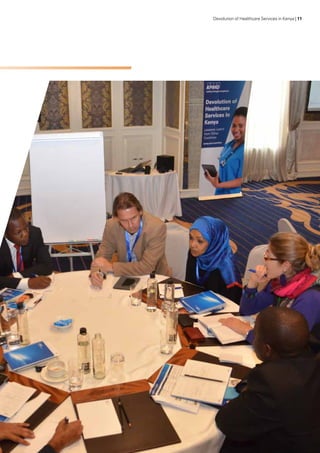
It is against this backdrop that on May
21, 2014, KPMG hosted a conference
“Devolution of Healthcare Services
in Kenya. Lessons Learnt from Other
Countries” in Nairobi. In attendance
were county health directors,
representatives from the Ministry of
Health, development partners, and
representatives from the private sector
for an interactive session to allow
participants to share i) their experiences
with devolution thus far and ii) ideas
on how to ensure the success of
healthcare devolution.
This post-conference report/document
captures the main highlights/key points
as articulated by our presenters, as well
as conference participant feedback
from group discussions on the
following topics and aforementioned
building blocks:
•	 Training and Resourcing in a
Devolved Government
•	 Public Private Partnerships County
Engagement in a Devolved
Government
•	 Health Outcomes and Quality in a
Devolved Government.
Devolution of Healthcare Services in Kenya | 3
On the impact of devolution on
human resources for health (HRH), Dr.
Mwanzia noted that Article 235 of the
Constitution empowers the counties to
establish offices and employ individuals
performing functions allocated to
them in Fourth Schedule. As a result,
individuals working in the county health
departments are employees of the
County governments. The advantage of
this is that it allows counties to employ
qualified healthcare providers to suit
their local needs.
For healthcare devolution to be
successful, Dr. Mwanzia noted that
as pertains to training and resourcing,
the following have to be taken into
consideration:
•	 There has to be a thorough
understanding of roles played by the
national and county governments
•	 The national government has to
accept that its role is now one
of stewardship and not one of
“ownership”
•	 There is need to ensure equitable
distribution of health resources
throughout the country
•	 The need for capacity building
especially in marginalised counties
•	 There is need for massive civic
education to be carried among
the various actors including the
members of public. The quality of
the leadership is key
•	 In preparing current health staff
and officers for the impending
challenges brought on by devolution,
there is a need for honesty.
Subsequently, the following two
questions were discussed during
group discussions:
1.	 What health training innovations
should the country pursue?
2.	 How best should we address the
issue of retention of health workers?
The topics brought up under each of
these two questions are set out below.
1. What health training
innovations should the
country pursue?
In response to this question, conference
participants grouped the innovations
into three categories: training, strategy,
service delivery, and infrastructure.
Training
In Kenya, distance as a barrier to access,
whether it be, healthcare, education,
or other services, is a real one and it is
one that is faced not only by consumers
of healthcare services, but also by
healthcare workers. To address this,
conference participants agreed that an
appropriate response is for healthcare
workers to embrace technology in
training. From e-Learning to online
training platforms for non-clinical
studies, conference participants felt that
technology can be harnessed to address
the challenge of distance between
trainers and trainees. Proposed non-
technology based innovations to
address the distance barrier included
the implementation of mobile training
units to meet training needs at the
county level, as well as the expansion of
the residence-based initiative, which is
currently available to nurses, to include
all healthcare workers.
Participants also expressed the need
for collaboration between national
and county governments in pursuing
innovative training mechanisms.
Participants felt that collaboration
should entail both levels of government
working together to:
•	 Execute the role of capacity building,
including needs assessments
•	 Ensure appropriate allocation of
training budgets for healthcare
workers to the counties to
supplement training facilitated at the
national level
•	 Make available to the counties,
conditional funding for training
•	 Strengthen the continuing
professional development (CPD)
process by creating a link between
MOH, regulatory bodies, and training
institutions at both levels
•	 Institute mentorship programs
between the national and county
governments (and also intra-county).
Training and Resourcing in a Devolved Government
Presenter: Dr. James Mwanzia, Chief of Party, FUNZOKenya
4 | Devolution of Healthcare Services in Kenya
Participants felt that when it
comes to training of healthcare
workers, healthcare facilities have
an accountability role to play. Their
proposal was that each facility should
be tasked with identifying their
training needs and presenting them
to the county health management
teams (CHMTs) for action. A CHMT
is according the Kenya Health
Policy, 2013- 2030, a “professional
and technical structure” tasked
with “coordinating delivery of the
constitutionally defined county health
services through the network of health
facilities in their respective counties.”
In addition to the innovations above,
conference participants proposed
the establishment of a training center
of excellence (COE). Participants
noted that the COE could be based
on a program modelled after the
East, Central, and Southern African
Health Community’s (ECSA-HC)
human resources development and
capacity building program. According
to ECSA-HC, the program, “aims to
support the capacity development of
Human Resources for Health (HRH)
and strengthen HRH systems and
processes in the heath sector.” The
program has a number of objectives
which include: strengthening health
workforce leadership and governance;
enhancing HRH information
dissemination, networking and
promoting sharing of best practices and
evidence-based policies and programs;
and coordinating and strengthening the
capacities of member states to train and
manage HRH, among others.
To help alleviate the heavy workload
burden currently shouldered by
healthcare workers, they are in essence
“the end-all, be all” for everyone,
participants proposed a quasi-task
shifting innovation. They proposed
implementing programs that facilitate
education of the general public on
health matters. For example, the
public can be educated on symptom
identification, and how, when, and
where to seek care. This can potentially
reduce overutilisation that results from
unnecessary physician visits, or delays
in seeking care that result in the need
for more complex interventions. Studies
have shown that awareness creation
through information, education, and
communication (IEC) can be an effective
healthcare tool for effecting behaviour
change. Awareness creation results
in an informed citizenry that is able to
anticipate and make informed decisions.
And finally, as the nation seeks to
prepare its healthcare workforce to
respond, not only to devolution, but
also to healthcare demands in the
21st century, participants proposed
revision of the healthcare worker
training curriculum. Kenya’s most
recent “National Human Resources
for Health Strategic Plan 2009 -2012”
identified as one of its objectives, the
institutionalisation of a competence-
based training program with the end-
goal of increasing workforce numbers,
quality, and skill mix. To achieve this,
one of the proposed strategies was the
regular review and development of a
health workforce curriculum in line with
international standards and local needs.
To this end, participants proposed
revision of the curriculum to include,
for example, training on public-private
partnerships (PPPs) and other areas that
are currently not included.
Strategy
Kenya rolled out its community health
strategy in 2006. The strategy is
intended to be a mechanism through
which households and communities
take an active role in health and health-
related issues. Implementation of
the strategy has however been piece
meal. It has been implemented and
is flourishing in some, but not all
communities. Conference participants
therefore proposed that the strategy
should be implemented in all counties.
Service Delivery and Infrastructure
A tenet of the Constitution of Kenya,
2010 (COK, 2010), is the right to
healthcare for every individual. To
this end, the government is working
towards achieving universal health
coverage (UHC) for its citizens. As the
government implements approaches to
increase demand, it will be imperative
to ensure that the supply side is able
to adequately respond. To address
this challenge, conference participants
proposed three solutions:
i.	 The use of telemedicine for
certain services – this will not only
addresses the geographic barrier
to access, it also addresses the
healthcare workers shortage and
arguably, the skills gap that is
typically exemplified in rural and
marginalised areas.
ii.	 Ensuring the availability of sufficient
numbers of healthcare facilities to
meet health needs at the county
level.
iii.	 Harmonisation of available resources
to ensure that the limited resources
available are utilised optimally.
Devolution of Healthcare Services in Kenya | 5
2. How best should we
address the issue of
retention of health
workers?
Response to this question are grouped
into five categories: innovation, policy,
rewards and incentives, staffing,
and infrastructure. The responses by
category are documented below:
Innovation
Participants called upon the counties
to “innovate county-specific” ways
to retaining healthcare workers. This
can be read more as a challenge to the
counties to think outside the proverbial
box as they seek to address what were
previously national challenges and that
now residing at the county level.
As is documented in the KPMG report,
devolution was implemented as a way
of addressing a legacy of inequity. This
inequity manifested itself (and still does
in these early days of devolution) in
many ways, including the “quality” and
the quantity of distributed healthcare
workers across the country. To
address the skills inequity and allow for
knowledge sharing and the sharing of
best practices, participants proposed
that opportunities be created for inter-
county transfers of healthcare workers.
And finally, to enhance staff retention
at healthcare facilities, participants
proposed the signing of a memoranda
of understanding (MOUs) between
healthcare workers and facilities that
endorse them for training. Conference
participants proposed that these
MOUs should stipulate a length of time
during which healthcare workers upon
completion of their training, will provide
services at the respective facilities.
Policy
As previously mentioned, Kenya’s most
recent human resources for health
HRH strategic plan (National Human
Resources for Health Strategic Plan,
2009 – 2012) was formulated prior
to devolution. It therefore logically
follows that a revised HRH policy that is
aligned to the new form of government
should be implemented, this was the
participants’ first proposal on policy.
One of the unintended consequences
of the devolution of healthcare workers,
as documented in the KPMG Devolution
report is that “career structures can
suffer, “ that is, smaller administrative
areas with fewer layers can reduce
opportunities for talented people
to progress up the career ladder.
Participants therefore proposed the
creation of policies that facilitate/
enhance career progression.
To keep healthcare workers
in the workforce longer, and
thus alleviate the shortage
of healthcare workers,
participants proposed the
revision of the retirement
age of healthcare
workers from 60 to
70. In addition, to
provide opportunities
to especially those
in marginalised
areas, participants
proposed the
implementation
of affirmative
action policies
in the training
of healthcare
workers.
Rewards and Incentives
Under “Rewards and Incentives,”
participants proposed better
remuneration packages for health
workers. Example cited included
reviewing hardship allowances and
harmonising all allowances. Conference
participants noted that currently,
housing allowances are greater for
those in urban counties than for those
in rural counties, yet those in rural
counties may at times need better
incentives than those in urban counties.
An incentive proposed to address the
distance barrier, was the provision of
housing for healthcare workers at or
near the healthcare facilities at which
they are employed. And finally, to
develop/nurture cohesive healthcare
worker teams that work well together,
participants proposed the inclusion of
team building activities in their places of
employment.
6 | Devolution of Healthcare Services in Kenya
Staffing
Counties are responsible for hiring
staff and the assignment of healthcare
workers to the counties has been
concluded. Participants recommended
that county governments should
ensure the availability of adequate staff
numbers to manage the work load at
each health facility. This is easier said
than done and presupposes that Kenya
has a large enough pool of healthcare
workers to draw from. According to
the World Health Organisation (WHO),
Kenya is one of 57 countries with a
critical shortage of healthcare workers.
Infrastructure
To enable healthcare workers to
focus on service delivery, conference
participants proposed improving
their work environment. Suggestions
included counties providing better
infrastructure, as well as ensuring
the availability of functioning medical
equipment. In addition to improving
work environment, participants
proposed improving social amenities
at the county level to encourage health
workers to stay near healthcare facilities
in which they work, especially in
hardship areas.
KPMG Food for Thought
A key issue raised in the KPMG Healthcare Devolution report that did
not come up during group discussions is that of “managerial capacity.”
Based on case studies cited in the report, managerial capacity is noted as
a prerequisite for the devolution of healthcare services to be successful.
Across the board, regions or districts with strong management capacity
reported stronger performance results.
To see through any training and resourcing propositions at the county level
will require competent managerial capacity. It is often assumed that local
capacity required to manage a local health system and/or health facility is
available, but in reality, this turns out differently. As previously mentioned,
Kenya Health Policy, 2012 – 2030 calls for the establishment of a
“professional and technical management structure”, that is, county health
management team (CHMT) in each county to, “coordinate delivery of
constitutionally defined county-level health services through the network of
healthcare facilities in the counties. It will therefore be important to ensure
that all county CHMT personnel have the requisite skills and capacity to
deliver their functions.
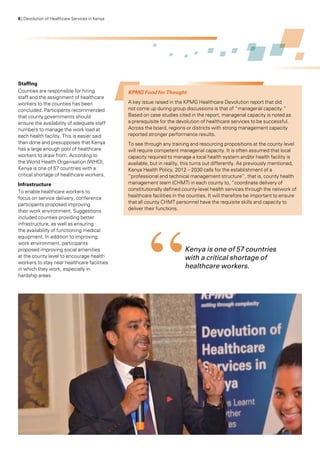
Kenya is one of 57 countries
with a critical shortage of
healthcare workers.
Devolution of Healthcare Services in Kenya | 7
Dr. Amit Thakker, Director and CEO
the Kenya Healthcare Federation (KHF)
noted that devolution presents a great
opportunity for a healthier Kenya; a
potential that can only be realised via
public private partnerships (PPPs).
The significance of PPPs is clearly
recognised in Kenya. Official PPP
legislation exists in the form of the
Public Private Partnership (PPP) Act, of
2013, an Act of Parliament designed
to provide for the participation of
the private sector in the financing,
construction, development, operation,
or maintenance of infrastructure
or development projects of the
Government through concession
or other contractual arrangements.
Specifically in the health sector, through
Private Public Partnerships Health -
KENYA (PPP-HK), state and non-state
actors in health have come together to
ensure improved access and quality of
care for all Kenyans.
In an effort to ensure continuous
interaction between private and public
sectors, a consultative approach to
addressing health issues in Kenya, and
to create an environment that enables
healthcare innovation, PPP-HK has
defined 3 levels of partnerships as
follows:
•	 P1: Public Private Dialog –
Policy dialogue between public and
the private sectors to share ideas
and concerns, to build trust
•	 P2: Public Private Interaction –
Public and private sectors working
together to reform policies and
collaborate on health priorities
•	 P3: Public private partnership –
Public and private sectors partnering
to deliver health services and
products and/or address health
system gaps.
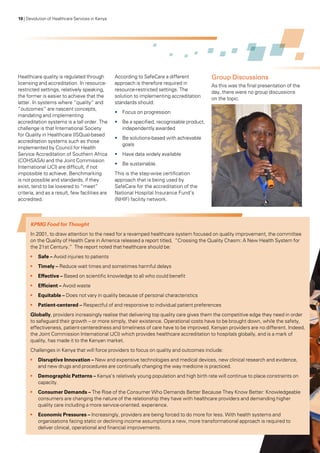
Group Discussions
On “Public Private Partnerships
County Engagement in a Devolved
Government,” conference participants
discussed the following four questions:
1.	 How should the Health PPP
engagement structure be
institutionalised within the counties?
2.	 What should be the role of Ministry
of Finance (MOF) in promoting PPP
in Health within the counties?
3.	 What are the current legislative
structures that support PPP and
which ones are prohibitive? What
can be done? (Please see Appendix I
for responses to this question)
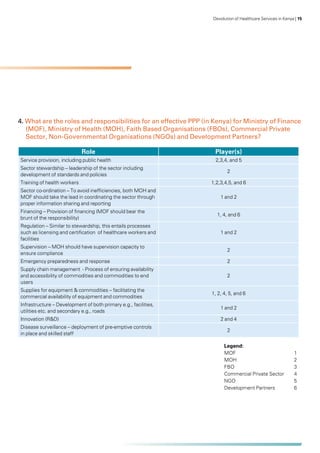
4.	 What are the roles and
responsibilities for an effective
PPP (in Kenya) for MOF, Ministry
of Health (MOH), Faith Based
Organisations (FBOs), Commercial
Private Sector, Non-Governmental
Organisations (NGOs) and
development partners? (Please see
Appendix I for responses to this
question).
Following are their thoughts as were
captured.
1. How should the Health PPP
engagement structure be
institutionalised within the
counties?
Conference participants felt that as a
starting point, a focal person drawn
from each county CHMT to act as
a county health PPP representative
should be identified. This individual’s
role would be to initiate health
PPP dialogue with the appropriate
audiences. Sensitisation of county
teams and county assemblies with
regards to PPPs was also proposed.
This will allow for focused engagement
and enable the county teams to better
understand the PPP concept, its
applicability in the counties, its potential,
and its benefits. Participants also noted
the importance of taking stock of the
current PPP situation in the counties,
an “as-is” assessment as relates to
healthcare PPPs. Participants felt that
this should be done to establish a
baseline, i.e., understanding, projects,
progress, etc., which can then inform
next steps for each county. To allow
for more informed dialogue between
the counties and the private sector,
conference participants proposed, i)
the development of comprehensive
county plan outlining what opportunities
they can sell/offer the private sector
and ii) development of a concept paper
by CHMTs, through a stakeholder
forum with both the public and private
sectors. And finally, participants called
for the health sector to take onus of
health PPPs by championing the PPP
model in the counties and also to raise
awareness of health PPP projects by for
example, launching them publicly in the
counties.
Public-Private Partnerships County Engagement in a
Devolved Government
Presenter: Dr. Amit Thakker, Director and Chief Executive Officer, Kenya Healthcare Federation
8 | Devolution of Healthcare Services in Kenya
2. What should be the role
of Ministry of Finance
(MOF) in promoting
PPPs in health within the
counties?*
To provide guidance and ensure
standardisation/uniformity in the
approach employed by the counties,
conference participants proposed that
MOF should facilitate the development
of regulations and policy guidelines, as
well as tool kits for use under the PPP
framework. In addition to providing
guidance, participants proposed
that MOF should facilitate capacity
building of personnel at the county
level, perform vetting/due diligence on
PPP partners on behalf of counties –
prequalify service providers, and provide
financial resources for preliminary
processes prior to PPP investments.
* The roles have broadly been
articulated in the PPP Act of 2013.
* The current PPP Act is silent on PPP at
the county level.
KPMG Food for Thought
PPPs in health are ubiquitous and are not necessarily as grandiose as one
might expect. A recent Oxfam report notes that every national health
system has some form of PPP with the most common (and probably the
simplest) being the sourcing of medical products by the public sector from
the private sector. Other health PPP models involve the construction of
health facilities and ongoing provision of services for a for-profit private
partner within a public system of provision. These include: franchising;
Design, Build, Finance, and Operate (DBFO); Build, Own, Operate (BOO);
among others.
PPPs should in essence be viewed as symbiotic relationships in which
both the private and public sectors benefit. To ensure their success, and
mutual benefit, objectives have to clearly articulated at the onset and clear
agreement reached on roles, responsibilities and deliverables.
Whatever form a PPP takes, whatever its magnitude, alignment of purpose
is important. As noted by Healthcare UK, “PPPs offer innovative and
entrepreneurial approaches to providing the services and facilities demanded
of 21st century healthcare. The emphasis is on generating quality service
outputs rather than treating infrastructure as an end in and of itself.”
As Dr. Thakker noted in his presentation, devolution offers the opportunity for
a healthier Kenya. A potential “that can only be realised” via the collaboration
between the public and private health sectors through PPPs. Devolution
gives counties the opportunity for “healthcare ownership.” This means that
counties will be able to identify their healthcare priorities and either alone,
or by forming strategic partnerships with the private sector/organisations,
develop solutions that are tailor- made to address their unique needs (local
solutions to local needs).
A recent example of this approach is evident by the recent opening of the
Philips Community Life Center (CLC) in Kiambu County. Developed by the
Philips Africa Innovation Hub, the CLC is an integrated solution for primary
healthcare and service facilities and in this case, addresses healthcare
challenges in Kiambu County, from infant and maternal mortality; lack of
access to primary healthcare facilities and services; and lack of electricity,
water and basic healthcare technology. The CLC converts a health facility
into a community hub where technology is bundled with services. The
technology package includes solar power for a reliable and clean energy
supply; efficient and durable indoor and outdoor LED-lighting that enables
extended business hours and provides security to patients and staff;
healthcare equipment to enable patient monitoring, diagnosis and triage;
laboratory equipment, especially for antenatal care tests; refrigeration for
vaccine storage; IT-solutions for the storage of patient data; and water
supply and purification for the prevention of waterborne diseases. The
county government for its part, focused on infrastructure construction and
staff hiring.
Devolution of Healthcare Services in Kenya | 9
In response to the Kenya Quality
Model for Health (KQMH)*, and its
predecessor, Kenya Quality Model
(KQM), there have been and there
currently are a number of quality
improvement initiatives that have
been implemented in the country. One
such initiative is being led by SafeCare
Kenya. SafeCare was established in
2011 and is a collaboration between
PharmAccess Foundation of the
Netherlands, the Joint Commission
International (JCI) of the United
States, and the Council for Health
Service Accreditation of Southern
Africa (COHSASA). It was established
to address the possibility of applying
universal quality standards for clinics in
developing countries and is focused on
standards that provide a solid, secure
and realistic framework to ensure that
patients receive safe and optimal care
despite resource constraints.
Ms. Olulo-Orera, presented on “Health
Quality and Outcomes in a Devolved
Government.” She spoke of, “the
unknown and unbearable risks” caused
by lack of transparency in healthcare.
These manifest themselves in four ways:
•	 Financial institutes unwilling to invest
in private institutions as a result of
high medical and financial risk
•	 Governments lack sufficient financial
resources to meet overall healthcare
needs, as a result, crowding in of
private capital is needed to increase
overall available resources for care
•	 Clinics faced with poor (self)
regulation, poor business
performance, lack of competition in
the market
•	 Patients have “low trust in the
system” lack information, there are
exists no benchmarking data, as
a result, patients rely on “word of
mouth” when choosing providers
and services.
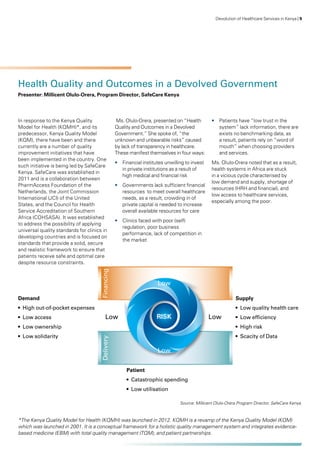
Ms. Olulo-Orera noted that as a result,
health systems in Africa are stuck
in a vicious cycle characterised by
low demand and supply, shortage of
resources (HRH and financial), and
low access to healthcare services,
especially among the poor.
Health Quality and Outcomes in a Devolved Government
Presenter: Millicent Olulo-Orera, Program Director, SafeCare Kenya
*The Kenya Quality Model for Health (KQMH) was launched in 2012. KQMH is a revamp of the Kenya Quality Model (KQM)
which was launched in 2001. It is a conceptual framework for a holistic quality management system and integrates evidence-
based medicine (EBM) with total quality management (TQM), and patient partnerships.
Source: Millicent Olulo-Orera.Program Director, SafeCare Kenya.
RISK
Low
Low
FinancingDelivery
Low
Low
Demand
•	 High out-of-pocket expenses
•	 Low access
•	 Low ownership
•	 Low solidarity
Supply
•	 Low quality health care
•	 Low efficiency
•	 High risk
•	 Scacity of Data
Patient
•	 Catastrophic spending
•	 Low utilisation
10 | Devolution of Healthcare Services in Kenya
Healthcare quality is regulated through
licensing and accreditation. In resource-
restricted settings, relatively speaking,
the former is easier to achieve that the
latter. In systems where “quality” and
“outcomes” are nascent concepts,
mandating and implementing
accreditation systems is a tall order. The
challenge is that International Society
for Quality in Healthcare (ISQua)-based
accreditation systems such as those
implemented by Council for Health
Service Accreditation of Southern Africa
(COHSASA) and the Joint Commission
International (JCI) are difficult, if not
impossible to achieve. Benchmarking
is not possible and standards, if they
exist, tend to be lowered to “meet”
criteria, and as a result, few facilities are
accredited.
According to SafeCare a different
approach is therefore required in
resource-restricted settings. The
solution to implementing accreditation
standards should:
•	 Focus on progression
•	 Be a specified, recognisable product,
independently awarded
•	 Be solutions-based with achievable
goals
•	 Have data widely available
•	 Be sustainable.
This is the step-wise certification
approach that is being used by
SafeCare for the accreditation of the
National Hospital Insurance Fund’s
(NHIF) facility network.
Group Discussions
As this was the final presentation of the
day, there were no group discussions
on the topic.
KPMG Food for Thought
In 2001, to draw attention to the need for a revamped healthcare system focused on quality improvement, the committee
on the Quality of Health Care in America released a report titled, “Crossing the Quality Chasm: A New Health System for
the 21st Century.” The report noted that healthcare should be:
•	 Safe – Avoid injuries to patients
•	 Timely – Reduce wait times and sometimes harmful delays
•	 Effective – Based on scientific knowledge to all who could benefit
•	 Efficient – Avoid waste
•	 Equitable – Does not vary in quality because of personal characteristics
•	 Patient-centered – Respectful of and responsive to individual patient preferences
Globally, providers increasingly realise that delivering top quality care gives them the competitive edge they need in order
to safeguard their growth – or more simply, their existence. Operational costs have to be brought down, while the safety,
effectiveness, patient-centeredness and timeliness of care have to be improved. Kenyan providers are no different. Indeed,
the Joint Commission International (JCI) which provides healthcare accreditation to hospitals globally, and is a mark of
quality, has made it to the Kenyan market.
Challenges in Kenya that will force providers to focus on quality and outcomes include:
•	 Disruptive Innovation – New and expensive technologies and medical devices, new clinical research and evidence,
and new drugs and procedures are continually changing the way medicine is practiced.
•	 Demographic Patterns – Kenya’s relatively young population and high birth rate will continue to place constraints on
capacity.
•	 Consumer Demands – The Rise of the Consumer Who Demands Better Because They Know Better: Knowledgeable
consumers are changing the nature of the relationship they have with healthcare providers and demanding higher
quality care including a more service-oriented. experience.
•	 Economic Pressures – Increasingly, providers are being forced to do more for less. With health systems and
organisations facing static or declining income assumptions a new, more transformational approach is required to
deliver clinical, operational and financial improvements.
Devolution of Healthcare Services in Kenya | 11
12 | Devolution of Healthcare Services in Kenya
Conclusion
There is no doubt that devolution is a
disruptive process. In Kenya’s case,
this disruption is compounded by
challenges that already plague the
system. No sector is more fragmented,
more crowded, as is evidenced by
multiple stakeholders (sometimes
with competing interests), more
complex than healthcare. Devolution
of healthcare services in Kenya,
however, should not be viewed as a
panacea for what ails the healthcare
system. Instead, it should be viewed
as a journey toward a “more perfect”
system. Its success depends to a great
extent on the presence of an enabling
environment, an environment that is
marked by the will and commitment
of all health stakeholders, a cogent
strategy that addresses the building
blocks articulated in the KPMG report,
and a well thought-out implementation
process. Indeed, according to
Couttolenc, “the success of
decentralisation depends more on the
consistency between objectives, design
and implementation of the process,
than on the theoretical model itself.”
Kenya sits in an advantageous position,
she does not have to reinvent the
healthcare devolution wheel. Countries
have experimented/implemented
devolution, some have been more
successful than others; Kenya gets to
learn from both camps on how to make
devolution of healthcare services work.
KPMG has a global healthcare advisory
practice, with an African regional centre
of excellence and a Kenyan healthcare
team. We have experience in working
across regional health ecosystems to
redesign patient pathways and shift the
provision of care to more appropriate
settings.
We have delivered a number of
highly successful projects throughout
Eastern, Central and Southern Africa
in recent years. As such, we have local
expertise to guide clients through major
transformational processes.
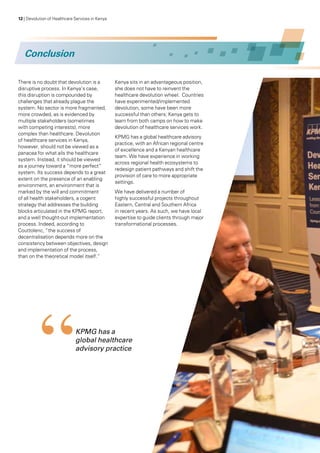
KPMG has a
global healthcare
advisory practice
Devolution of Healthcare Services in Kenya | 13
14 | Devolution of Healthcare Services in Kenya
Appendix I
3. What are the current legislative structures that support PPP and which ones are prohibitive?
What can be done?
Public Private Partnerships County Engagement in a
Devolved Government
Answers to Group Discussions – Questions 3 & 4
Support Prohibit What Can be Done?
•	 The PPP Act and Policy. Their
existence demonstrates
commitment to PPP by the
government and provides the basis
for the establishment of the PPP
Committee.
•	 Inter-Agency Coordinating
Committees (ICCs) that focus on
a range of issues within Kenya’s
health sector.
•	 The Constitution of Kenya, 2010.
•	 The Procurement Act which
provides for consultations between
the public and private sectors.
•	 The PPP Unit and Committee
which further demonstrate the
government’s goodwill towards
PPPs.
•	 The Constitution – the national
government has to guarantee loans
from the private sector, making
the process slow and at times
bureaucratic.
•	 PPP Unit** and Committee – there
is no county representation in either
one. Currently, the committee is
comprised of 6 members from the
national government and 4 private
sector members; while the Unit is
comprised of a director and other
staff recruited competitively by the
cabinet secretary.
•	 Revise the PPP Act to include
county representatives in the PPP
Committee.
•	 Reduce the level of discretion given
to national government with regards
to PPPs.
•	 Though county projects and
priorities must be aligned to national
policies, counties should be allowed
a level of autonomy in the case of
county specific issues.
•	 Set a ceiling every 5 years as to how
much can be invested in projects
annually.
** The PPA Act, establishes 3 structures for determining whether a project is eligible for a PPP. For a project to qualify, it would
has to be considered and approved by the following 3 structures: the PPP Node, the PPP Unit, and the PPP Committee.
Devolution of Healthcare Services in Kenya | 15
4. What are the roles and responsibilities for an effective PPP (in Kenya) for Ministry of Finance
(MOF), Ministry of Health (MOH), Faith Based Organisations (FBOs), Commercial Private
Sector, Non-Governmental Organisations (NGOs) and Development Partners?
Legend:
MOF	1
MOH	2
FBO	3
Commercial Private Sector	 4
NGO	5
Development Partners	 6
Role Player(s)
Service provision, including public health 2,3,4, and 5
Sector stewardship – leadership of the sector including
development of standards and policies
2
Training of health workers 1,2,3,4,5, and 6
Sector co-ordination – To avoid inefficiencies, both MOH and
MOF should take the lead in coordinating the sector through
proper information sharing and reporting
1 and 2
Financing – Provision of financing (MOF should bear the
brunt of the responsibility)
1, 4, and 6
Regulation – Similar to stewardship, this entails processes
such as licensing and certification of healthcare workers and
facilities
1 and 2
Supervision – MOH should have supervision capacity to
ensure compliance
2
Emergency preparedness and response 2
Supply chain management - Process of ensuring availability
and accessibility of commodities and commodities to end
users
2
Supplies for equipment & commodities – facilitating the
commercial availability of equipment and commodities
1, 2, 4, 5, and 6
Infrastructure – Development of both primary e.g., facilities,
utilities etc. and secondary e.g., roads
1 and 2
Innovation (R&D) 2 and 4
Disease surveillance – deployment of pre-emptive controls
in place and skilled staff
2
16 | Devolution of Healthcare Services in Kenya
Appendix II
Guest Speaker Bios
James Mwanzia, MD, MPH
Dr. James Mwanzia is a seasoned health professional and leader with over 15 years of experience
managing large multilateral, donor-funded projects in Kenya and throughout Africa. His areas of
expertise include health systems strengthening, medical services, and program management, and
he has demonstrated an ability to work with multiple stakeholders to achieve programmatic results.
Previously, he worked for Kenya’s Ministry of Health as well as for the World Health Organisation in
various leadership roles in the Republic of Congo, South Africa, and the Gambia. Most recently, he
served as IntraHealth’s deputy director for its Capacity Kenya project. Dr. Mwanzia holds an MPH
and an MD.
Dr. Amit N. Thakker
Dr. Thakker is the CEO and a founding director of Kenya Healthcare Federation, the Health Sector
Board for KEPSA. He is the visionary founder of the East Africa Healthcare Federation and Chair of
the EA Health Platform hosted by the East Africa Business Council.
A recognised medical doctor, entrepreneur and health sector champion, Dr. Thakker manages and
is affiliated with several companies in the private healthcare space. He holds a Medical Degree from
University of Nairobi, an eMBA from NIA in India and has completed the Health Leadership training
from George Washington University, USA.
He is the Co-chair of the Private Sector Advisory Panel through UNFPA, Private Sector Advisor with
IntraHealth International at FunzoKenya (USAID), and Vice-Chairman of the Public Private Partnership,
Health Kenya (PPP HK). He is an elected Director for EA Business Council and currently on the Council
of founding members for the Consortium of National Health Research (CNHR) in Kenya.
Millicent Olulo
Millicent Olulo is the Program Director SafeCare Kenya at PharmAccess Foundation.
PharmAccess, is a Dutch not-for-profit organisation dedicated to strengthening health systems
in sub-Saharan Africa. Millicent began working on SafeCare since its inception in Kenya in 2011.
SafeCare is a PharmAccess initiative that has surveyed approximately 400 health facilities funded
by various programs including APHIA, NHIF, Africa Health Market for Equity among others.
Millicent has a clinical background with a Master’s degree in health and development. She is
trained and certified by the Council for Health Services Accreditation of South Africa (COHSASA)
as a health service quality advisor and is experienced in clinical surveys, monitoring, measuring
improvement, and management of quality programs.
For over a decade she has worked in research, implementing health related projects, health
insurance in addition to service delivery. She previously worked for International Centre for
Reproductive Health, AAR, KNH, The Mombasa Hospital among others.
Devolution of Healthcare Services in Kenya | 17
Information Sources
•	 A Dangerous Diversion. Will the IFC’s Flagship Health PPP Bankrupt Lesotho’s Ministry of Health? Oxfam Briefing Note.
April 7, 2014.
•	 Constitution of Kenya, 2010
•	 Devolution of Healthcare Services in Kenya. Lessons Learnt from Other Countries
•	 Healthcare UK: Public Private Partnerships. 2013.
•	 Kenya Health Policy, 2012 - 2030
•	 National Human Resources for Health Strategic Plan, 2009 - 2012
•	 Taking the Kenya Essential Package for Health to the Community. A Strategy for the Delivery of Level One Services
•	 Couttolenc, Bernard F. Decentralisation and Governance in the Ghana Health Sector. Washington, D.C.: World Bank. DOI:
10.1596/978-0-8213-9589-9.
•	 http://www.ecsahc.org/programmes/human-resources-for-health-capacity-building-programme/
•	 http://www.treasury.go.ke/
•	 http://www.newscenter.philips.com/main/standard/news/press/2014/20141003-philips-inaugurates-africas-first-
community-life-center-aimed-at-strengthening-primary-health-care-and-enabling-community-development.wpd#.
VDtcNBXfrIU
The information contained herein is of a general nature and is not intended to address the circumstances of any particular individual or entity.
Although we endeavour to provide accurate and timely information, there can be no guarantee that such information is accurate as of the date it
is received or that it will continue to be accurate in the future. No one should act upon such information without appropriate professional advice
after a thorough examination of the particular situation.
© 2014 KPMG Services Proprietary Limited, a South African company and a member firm of the KPMG network of independent member firms
affiliated with KPMG International Cooperative (“KPMG International”), a Swiss entity. All rights reserved. Printed in South Africa. The KPMG
name, logo and “cutting through complexity” are registered trademarks or trademarks of KPMG International.
The opinions of the authors are not necessarily the opinions of KPMG. MC12629
Contact us
Rita Owino
Manager Healthcare Advisory, KPMG East Africa
T: +254709576159
E: rowino@kpmg.co.ke
Anuschka Coovadia
Head of Healthcare Markets
T: +27827192813
E: anuschka.coovadia@kpmg.co.za
www.kpmgafrica.com

Devolution of Healthcare Services Kenya_Conference Report

  • 1.
  • 2.
    Contents Introduction 2 Trainingand Resourcing in a Devolved Government 3 Key Points from Guest Speaker Presentation Summary of Group Discussions KPMG Food forThought Public-Private Partnerships County Engagement in a Devolved Government 7 Key Points from Guest Speaker Presentation Summary of Group Discussions KPMG Food forThought
  • 3.
    Devolution of HealthcareServices in Kenya | 1 Health Quality and Outcomes in a Devolved Government 9 Key Points from Guest Speaker Presentation KPMG Food forThought Conclusion 12 Appendix I 14 Appendix II 16 Information Sources 17
  • 4.
    2 | Devolutionof Healthcare Services in Kenya Introduction It can be argued that no healthcare system is perfect. Globally, the healthcare sector is facing enormous, challenges around both development and maintenance. In Africa, the sector is undergoing major policy, system, and infrastructural changes. Systems across the globe have and are experimenting with old as well as new approaches to “fix” their health systems. In efforts to improve access, improve service delivery, bend the cost curve, increase accountability, and improve responsiveness, to mention a few. Devolution is an approach that has been used in both developing and developed countries to achieve the afore- mentioned. Kenya began her healthcare devolution journey in 2010 after an overwhelming vote by citizens for a new form of government, for change, for accountability. In late 2013, KPMG published a report titled, “Devolution of Healthcare Services in Kenya. Lessons Learnt from Other Countries.” The report explores what lessons can be learnt from other countries that have devolved their health service delivery responsibilities to sub-national government levels. As such, it presents the building blocks that need to be in place for devolution to be successful in achieving its goals. These building blocks were structured around the following themes: • Governance • Strategy • Finance • Equity of Access • Performance and outcomes • Resources. The report evaluates other countries’ successes in light of Kenya’s objectives of devolution and the role the counties play in achieving these goals. The full report can be downloaded here: Devolution of Healthcare Services in Kenya. It is against this backdrop that on May 21, 2014, KPMG hosted a conference “Devolution of Healthcare Services in Kenya. Lessons Learnt from Other Countries” in Nairobi. In attendance were county health directors, representatives from the Ministry of Health, development partners, and representatives from the private sector for an interactive session to allow participants to share i) their experiences with devolution thus far and ii) ideas on how to ensure the success of healthcare devolution. This post-conference report/document captures the main highlights/key points as articulated by our presenters, as well as conference participant feedback from group discussions on the following topics and aforementioned building blocks: • Training and Resourcing in a Devolved Government • Public Private Partnerships County Engagement in a Devolved Government • Health Outcomes and Quality in a Devolved Government.
  • 5.
    Devolution of HealthcareServices in Kenya | 3 On the impact of devolution on human resources for health (HRH), Dr. Mwanzia noted that Article 235 of the Constitution empowers the counties to establish offices and employ individuals performing functions allocated to them in Fourth Schedule. As a result, individuals working in the county health departments are employees of the County governments. The advantage of this is that it allows counties to employ qualified healthcare providers to suit their local needs. For healthcare devolution to be successful, Dr. Mwanzia noted that as pertains to training and resourcing, the following have to be taken into consideration: • There has to be a thorough understanding of roles played by the national and county governments • The national government has to accept that its role is now one of stewardship and not one of “ownership” • There is need to ensure equitable distribution of health resources throughout the country • The need for capacity building especially in marginalised counties • There is need for massive civic education to be carried among the various actors including the members of public. The quality of the leadership is key • In preparing current health staff and officers for the impending challenges brought on by devolution, there is a need for honesty. Subsequently, the following two questions were discussed during group discussions: 1. What health training innovations should the country pursue? 2. How best should we address the issue of retention of health workers? The topics brought up under each of these two questions are set out below. 1. What health training innovations should the country pursue? In response to this question, conference participants grouped the innovations into three categories: training, strategy, service delivery, and infrastructure. Training In Kenya, distance as a barrier to access, whether it be, healthcare, education, or other services, is a real one and it is one that is faced not only by consumers of healthcare services, but also by healthcare workers. To address this, conference participants agreed that an appropriate response is for healthcare workers to embrace technology in training. From e-Learning to online training platforms for non-clinical studies, conference participants felt that technology can be harnessed to address the challenge of distance between trainers and trainees. Proposed non- technology based innovations to address the distance barrier included the implementation of mobile training units to meet training needs at the county level, as well as the expansion of the residence-based initiative, which is currently available to nurses, to include all healthcare workers. Participants also expressed the need for collaboration between national and county governments in pursuing innovative training mechanisms. Participants felt that collaboration should entail both levels of government working together to: • Execute the role of capacity building, including needs assessments • Ensure appropriate allocation of training budgets for healthcare workers to the counties to supplement training facilitated at the national level • Make available to the counties, conditional funding for training • Strengthen the continuing professional development (CPD) process by creating a link between MOH, regulatory bodies, and training institutions at both levels • Institute mentorship programs between the national and county governments (and also intra-county). Training and Resourcing in a Devolved Government Presenter: Dr. James Mwanzia, Chief of Party, FUNZOKenya
  • 6.
    4 | Devolutionof Healthcare Services in Kenya Participants felt that when it comes to training of healthcare workers, healthcare facilities have an accountability role to play. Their proposal was that each facility should be tasked with identifying their training needs and presenting them to the county health management teams (CHMTs) for action. A CHMT is according the Kenya Health Policy, 2013- 2030, a “professional and technical structure” tasked with “coordinating delivery of the constitutionally defined county health services through the network of health facilities in their respective counties.” In addition to the innovations above, conference participants proposed the establishment of a training center of excellence (COE). Participants noted that the COE could be based on a program modelled after the East, Central, and Southern African Health Community’s (ECSA-HC) human resources development and capacity building program. According to ECSA-HC, the program, “aims to support the capacity development of Human Resources for Health (HRH) and strengthen HRH systems and processes in the heath sector.” The program has a number of objectives which include: strengthening health workforce leadership and governance; enhancing HRH information dissemination, networking and promoting sharing of best practices and evidence-based policies and programs; and coordinating and strengthening the capacities of member states to train and manage HRH, among others. To help alleviate the heavy workload burden currently shouldered by healthcare workers, they are in essence “the end-all, be all” for everyone, participants proposed a quasi-task shifting innovation. They proposed implementing programs that facilitate education of the general public on health matters. For example, the public can be educated on symptom identification, and how, when, and where to seek care. This can potentially reduce overutilisation that results from unnecessary physician visits, or delays in seeking care that result in the need for more complex interventions. Studies have shown that awareness creation through information, education, and communication (IEC) can be an effective healthcare tool for effecting behaviour change. Awareness creation results in an informed citizenry that is able to anticipate and make informed decisions. And finally, as the nation seeks to prepare its healthcare workforce to respond, not only to devolution, but also to healthcare demands in the 21st century, participants proposed revision of the healthcare worker training curriculum. Kenya’s most recent “National Human Resources for Health Strategic Plan 2009 -2012” identified as one of its objectives, the institutionalisation of a competence- based training program with the end- goal of increasing workforce numbers, quality, and skill mix. To achieve this, one of the proposed strategies was the regular review and development of a health workforce curriculum in line with international standards and local needs. To this end, participants proposed revision of the curriculum to include, for example, training on public-private partnerships (PPPs) and other areas that are currently not included. Strategy Kenya rolled out its community health strategy in 2006. The strategy is intended to be a mechanism through which households and communities take an active role in health and health- related issues. Implementation of the strategy has however been piece meal. It has been implemented and is flourishing in some, but not all communities. Conference participants therefore proposed that the strategy should be implemented in all counties. Service Delivery and Infrastructure A tenet of the Constitution of Kenya, 2010 (COK, 2010), is the right to healthcare for every individual. To this end, the government is working towards achieving universal health coverage (UHC) for its citizens. As the government implements approaches to increase demand, it will be imperative to ensure that the supply side is able to adequately respond. To address this challenge, conference participants proposed three solutions: i. The use of telemedicine for certain services – this will not only addresses the geographic barrier to access, it also addresses the healthcare workers shortage and arguably, the skills gap that is typically exemplified in rural and marginalised areas. ii. Ensuring the availability of sufficient numbers of healthcare facilities to meet health needs at the county level. iii. Harmonisation of available resources to ensure that the limited resources available are utilised optimally.
  • 7.
    Devolution of HealthcareServices in Kenya | 5 2. How best should we address the issue of retention of health workers? Response to this question are grouped into five categories: innovation, policy, rewards and incentives, staffing, and infrastructure. The responses by category are documented below: Innovation Participants called upon the counties to “innovate county-specific” ways to retaining healthcare workers. This can be read more as a challenge to the counties to think outside the proverbial box as they seek to address what were previously national challenges and that now residing at the county level. As is documented in the KPMG report, devolution was implemented as a way of addressing a legacy of inequity. This inequity manifested itself (and still does in these early days of devolution) in many ways, including the “quality” and the quantity of distributed healthcare workers across the country. To address the skills inequity and allow for knowledge sharing and the sharing of best practices, participants proposed that opportunities be created for inter- county transfers of healthcare workers. And finally, to enhance staff retention at healthcare facilities, participants proposed the signing of a memoranda of understanding (MOUs) between healthcare workers and facilities that endorse them for training. Conference participants proposed that these MOUs should stipulate a length of time during which healthcare workers upon completion of their training, will provide services at the respective facilities. Policy As previously mentioned, Kenya’s most recent human resources for health HRH strategic plan (National Human Resources for Health Strategic Plan, 2009 – 2012) was formulated prior to devolution. It therefore logically follows that a revised HRH policy that is aligned to the new form of government should be implemented, this was the participants’ first proposal on policy. One of the unintended consequences of the devolution of healthcare workers, as documented in the KPMG Devolution report is that “career structures can suffer, “ that is, smaller administrative areas with fewer layers can reduce opportunities for talented people to progress up the career ladder. Participants therefore proposed the creation of policies that facilitate/ enhance career progression. To keep healthcare workers in the workforce longer, and thus alleviate the shortage of healthcare workers, participants proposed the revision of the retirement age of healthcare workers from 60 to 70. In addition, to provide opportunities to especially those in marginalised areas, participants proposed the implementation of affirmative action policies in the training of healthcare workers. Rewards and Incentives Under “Rewards and Incentives,” participants proposed better remuneration packages for health workers. Example cited included reviewing hardship allowances and harmonising all allowances. Conference participants noted that currently, housing allowances are greater for those in urban counties than for those in rural counties, yet those in rural counties may at times need better incentives than those in urban counties. An incentive proposed to address the distance barrier, was the provision of housing for healthcare workers at or near the healthcare facilities at which they are employed. And finally, to develop/nurture cohesive healthcare worker teams that work well together, participants proposed the inclusion of team building activities in their places of employment.
  • 8.
    6 | Devolutionof Healthcare Services in Kenya Staffing Counties are responsible for hiring staff and the assignment of healthcare workers to the counties has been concluded. Participants recommended that county governments should ensure the availability of adequate staff numbers to manage the work load at each health facility. This is easier said than done and presupposes that Kenya has a large enough pool of healthcare workers to draw from. According to the World Health Organisation (WHO), Kenya is one of 57 countries with a critical shortage of healthcare workers. Infrastructure To enable healthcare workers to focus on service delivery, conference participants proposed improving their work environment. Suggestions included counties providing better infrastructure, as well as ensuring the availability of functioning medical equipment. In addition to improving work environment, participants proposed improving social amenities at the county level to encourage health workers to stay near healthcare facilities in which they work, especially in hardship areas. KPMG Food for Thought A key issue raised in the KPMG Healthcare Devolution report that did not come up during group discussions is that of “managerial capacity.” Based on case studies cited in the report, managerial capacity is noted as a prerequisite for the devolution of healthcare services to be successful. Across the board, regions or districts with strong management capacity reported stronger performance results. To see through any training and resourcing propositions at the county level will require competent managerial capacity. It is often assumed that local capacity required to manage a local health system and/or health facility is available, but in reality, this turns out differently. As previously mentioned, Kenya Health Policy, 2012 – 2030 calls for the establishment of a “professional and technical management structure”, that is, county health management team (CHMT) in each county to, “coordinate delivery of constitutionally defined county-level health services through the network of healthcare facilities in the counties. It will therefore be important to ensure that all county CHMT personnel have the requisite skills and capacity to deliver their functions. Kenya is one of 57 countries with a critical shortage of healthcare workers.
  • 9.
    Devolution of HealthcareServices in Kenya | 7 Dr. Amit Thakker, Director and CEO the Kenya Healthcare Federation (KHF) noted that devolution presents a great opportunity for a healthier Kenya; a potential that can only be realised via public private partnerships (PPPs). The significance of PPPs is clearly recognised in Kenya. Official PPP legislation exists in the form of the Public Private Partnership (PPP) Act, of 2013, an Act of Parliament designed to provide for the participation of the private sector in the financing, construction, development, operation, or maintenance of infrastructure or development projects of the Government through concession or other contractual arrangements. Specifically in the health sector, through Private Public Partnerships Health - KENYA (PPP-HK), state and non-state actors in health have come together to ensure improved access and quality of care for all Kenyans. In an effort to ensure continuous interaction between private and public sectors, a consultative approach to addressing health issues in Kenya, and to create an environment that enables healthcare innovation, PPP-HK has defined 3 levels of partnerships as follows: • P1: Public Private Dialog – Policy dialogue between public and the private sectors to share ideas and concerns, to build trust • P2: Public Private Interaction – Public and private sectors working together to reform policies and collaborate on health priorities • P3: Public private partnership – Public and private sectors partnering to deliver health services and products and/or address health system gaps. Group Discussions On “Public Private Partnerships County Engagement in a Devolved Government,” conference participants discussed the following four questions: 1. How should the Health PPP engagement structure be institutionalised within the counties? 2. What should be the role of Ministry of Finance (MOF) in promoting PPP in Health within the counties? 3. What are the current legislative structures that support PPP and which ones are prohibitive? What can be done? (Please see Appendix I for responses to this question) 4. What are the roles and responsibilities for an effective PPP (in Kenya) for MOF, Ministry of Health (MOH), Faith Based Organisations (FBOs), Commercial Private Sector, Non-Governmental Organisations (NGOs) and development partners? (Please see Appendix I for responses to this question). Following are their thoughts as were captured. 1. How should the Health PPP engagement structure be institutionalised within the counties? Conference participants felt that as a starting point, a focal person drawn from each county CHMT to act as a county health PPP representative should be identified. This individual’s role would be to initiate health PPP dialogue with the appropriate audiences. Sensitisation of county teams and county assemblies with regards to PPPs was also proposed. This will allow for focused engagement and enable the county teams to better understand the PPP concept, its applicability in the counties, its potential, and its benefits. Participants also noted the importance of taking stock of the current PPP situation in the counties, an “as-is” assessment as relates to healthcare PPPs. Participants felt that this should be done to establish a baseline, i.e., understanding, projects, progress, etc., which can then inform next steps for each county. To allow for more informed dialogue between the counties and the private sector, conference participants proposed, i) the development of comprehensive county plan outlining what opportunities they can sell/offer the private sector and ii) development of a concept paper by CHMTs, through a stakeholder forum with both the public and private sectors. And finally, participants called for the health sector to take onus of health PPPs by championing the PPP model in the counties and also to raise awareness of health PPP projects by for example, launching them publicly in the counties. Public-Private Partnerships County Engagement in a Devolved Government Presenter: Dr. Amit Thakker, Director and Chief Executive Officer, Kenya Healthcare Federation
  • 10.
    8 | Devolutionof Healthcare Services in Kenya 2. What should be the role of Ministry of Finance (MOF) in promoting PPPs in health within the counties?* To provide guidance and ensure standardisation/uniformity in the approach employed by the counties, conference participants proposed that MOF should facilitate the development of regulations and policy guidelines, as well as tool kits for use under the PPP framework. In addition to providing guidance, participants proposed that MOF should facilitate capacity building of personnel at the county level, perform vetting/due diligence on PPP partners on behalf of counties – prequalify service providers, and provide financial resources for preliminary processes prior to PPP investments. * The roles have broadly been articulated in the PPP Act of 2013. * The current PPP Act is silent on PPP at the county level. KPMG Food for Thought PPPs in health are ubiquitous and are not necessarily as grandiose as one might expect. A recent Oxfam report notes that every national health system has some form of PPP with the most common (and probably the simplest) being the sourcing of medical products by the public sector from the private sector. Other health PPP models involve the construction of health facilities and ongoing provision of services for a for-profit private partner within a public system of provision. These include: franchising; Design, Build, Finance, and Operate (DBFO); Build, Own, Operate (BOO); among others. PPPs should in essence be viewed as symbiotic relationships in which both the private and public sectors benefit. To ensure their success, and mutual benefit, objectives have to clearly articulated at the onset and clear agreement reached on roles, responsibilities and deliverables. Whatever form a PPP takes, whatever its magnitude, alignment of purpose is important. As noted by Healthcare UK, “PPPs offer innovative and entrepreneurial approaches to providing the services and facilities demanded of 21st century healthcare. The emphasis is on generating quality service outputs rather than treating infrastructure as an end in and of itself.” As Dr. Thakker noted in his presentation, devolution offers the opportunity for a healthier Kenya. A potential “that can only be realised” via the collaboration between the public and private health sectors through PPPs. Devolution gives counties the opportunity for “healthcare ownership.” This means that counties will be able to identify their healthcare priorities and either alone, or by forming strategic partnerships with the private sector/organisations, develop solutions that are tailor- made to address their unique needs (local solutions to local needs). A recent example of this approach is evident by the recent opening of the Philips Community Life Center (CLC) in Kiambu County. Developed by the Philips Africa Innovation Hub, the CLC is an integrated solution for primary healthcare and service facilities and in this case, addresses healthcare challenges in Kiambu County, from infant and maternal mortality; lack of access to primary healthcare facilities and services; and lack of electricity, water and basic healthcare technology. The CLC converts a health facility into a community hub where technology is bundled with services. The technology package includes solar power for a reliable and clean energy supply; efficient and durable indoor and outdoor LED-lighting that enables extended business hours and provides security to patients and staff; healthcare equipment to enable patient monitoring, diagnosis and triage; laboratory equipment, especially for antenatal care tests; refrigeration for vaccine storage; IT-solutions for the storage of patient data; and water supply and purification for the prevention of waterborne diseases. The county government for its part, focused on infrastructure construction and staff hiring.
  • 11.
    Devolution of HealthcareServices in Kenya | 9 In response to the Kenya Quality Model for Health (KQMH)*, and its predecessor, Kenya Quality Model (KQM), there have been and there currently are a number of quality improvement initiatives that have been implemented in the country. One such initiative is being led by SafeCare Kenya. SafeCare was established in 2011 and is a collaboration between PharmAccess Foundation of the Netherlands, the Joint Commission International (JCI) of the United States, and the Council for Health Service Accreditation of Southern Africa (COHSASA). It was established to address the possibility of applying universal quality standards for clinics in developing countries and is focused on standards that provide a solid, secure and realistic framework to ensure that patients receive safe and optimal care despite resource constraints. Ms. Olulo-Orera, presented on “Health Quality and Outcomes in a Devolved Government.” She spoke of, “the unknown and unbearable risks” caused by lack of transparency in healthcare. These manifest themselves in four ways: • Financial institutes unwilling to invest in private institutions as a result of high medical and financial risk • Governments lack sufficient financial resources to meet overall healthcare needs, as a result, crowding in of private capital is needed to increase overall available resources for care • Clinics faced with poor (self) regulation, poor business performance, lack of competition in the market • Patients have “low trust in the system” lack information, there are exists no benchmarking data, as a result, patients rely on “word of mouth” when choosing providers and services. Ms. Olulo-Orera noted that as a result, health systems in Africa are stuck in a vicious cycle characterised by low demand and supply, shortage of resources (HRH and financial), and low access to healthcare services, especially among the poor. Health Quality and Outcomes in a Devolved Government Presenter: Millicent Olulo-Orera, Program Director, SafeCare Kenya *The Kenya Quality Model for Health (KQMH) was launched in 2012. KQMH is a revamp of the Kenya Quality Model (KQM) which was launched in 2001. It is a conceptual framework for a holistic quality management system and integrates evidence- based medicine (EBM) with total quality management (TQM), and patient partnerships. Source: Millicent Olulo-Orera.Program Director, SafeCare Kenya. RISK Low Low FinancingDelivery Low Low Demand • High out-of-pocket expenses • Low access • Low ownership • Low solidarity Supply • Low quality health care • Low efficiency • High risk • Scacity of Data Patient • Catastrophic spending • Low utilisation
  • 12.
    10 | Devolutionof Healthcare Services in Kenya Healthcare quality is regulated through licensing and accreditation. In resource- restricted settings, relatively speaking, the former is easier to achieve that the latter. In systems where “quality” and “outcomes” are nascent concepts, mandating and implementing accreditation systems is a tall order. The challenge is that International Society for Quality in Healthcare (ISQua)-based accreditation systems such as those implemented by Council for Health Service Accreditation of Southern Africa (COHSASA) and the Joint Commission International (JCI) are difficult, if not impossible to achieve. Benchmarking is not possible and standards, if they exist, tend to be lowered to “meet” criteria, and as a result, few facilities are accredited. According to SafeCare a different approach is therefore required in resource-restricted settings. The solution to implementing accreditation standards should: • Focus on progression • Be a specified, recognisable product, independently awarded • Be solutions-based with achievable goals • Have data widely available • Be sustainable. This is the step-wise certification approach that is being used by SafeCare for the accreditation of the National Hospital Insurance Fund’s (NHIF) facility network. Group Discussions As this was the final presentation of the day, there were no group discussions on the topic. KPMG Food for Thought In 2001, to draw attention to the need for a revamped healthcare system focused on quality improvement, the committee on the Quality of Health Care in America released a report titled, “Crossing the Quality Chasm: A New Health System for the 21st Century.” The report noted that healthcare should be: • Safe – Avoid injuries to patients • Timely – Reduce wait times and sometimes harmful delays • Effective – Based on scientific knowledge to all who could benefit • Efficient – Avoid waste • Equitable – Does not vary in quality because of personal characteristics • Patient-centered – Respectful of and responsive to individual patient preferences Globally, providers increasingly realise that delivering top quality care gives them the competitive edge they need in order to safeguard their growth – or more simply, their existence. Operational costs have to be brought down, while the safety, effectiveness, patient-centeredness and timeliness of care have to be improved. Kenyan providers are no different. Indeed, the Joint Commission International (JCI) which provides healthcare accreditation to hospitals globally, and is a mark of quality, has made it to the Kenyan market. Challenges in Kenya that will force providers to focus on quality and outcomes include: • Disruptive Innovation – New and expensive technologies and medical devices, new clinical research and evidence, and new drugs and procedures are continually changing the way medicine is practiced. • Demographic Patterns – Kenya’s relatively young population and high birth rate will continue to place constraints on capacity. • Consumer Demands – The Rise of the Consumer Who Demands Better Because They Know Better: Knowledgeable consumers are changing the nature of the relationship they have with healthcare providers and demanding higher quality care including a more service-oriented. experience. • Economic Pressures – Increasingly, providers are being forced to do more for less. With health systems and organisations facing static or declining income assumptions a new, more transformational approach is required to deliver clinical, operational and financial improvements.
  • 13.
    Devolution of HealthcareServices in Kenya | 11
  • 14.
    12 | Devolutionof Healthcare Services in Kenya Conclusion There is no doubt that devolution is a disruptive process. In Kenya’s case, this disruption is compounded by challenges that already plague the system. No sector is more fragmented, more crowded, as is evidenced by multiple stakeholders (sometimes with competing interests), more complex than healthcare. Devolution of healthcare services in Kenya, however, should not be viewed as a panacea for what ails the healthcare system. Instead, it should be viewed as a journey toward a “more perfect” system. Its success depends to a great extent on the presence of an enabling environment, an environment that is marked by the will and commitment of all health stakeholders, a cogent strategy that addresses the building blocks articulated in the KPMG report, and a well thought-out implementation process. Indeed, according to Couttolenc, “the success of decentralisation depends more on the consistency between objectives, design and implementation of the process, than on the theoretical model itself.” Kenya sits in an advantageous position, she does not have to reinvent the healthcare devolution wheel. Countries have experimented/implemented devolution, some have been more successful than others; Kenya gets to learn from both camps on how to make devolution of healthcare services work. KPMG has a global healthcare advisory practice, with an African regional centre of excellence and a Kenyan healthcare team. We have experience in working across regional health ecosystems to redesign patient pathways and shift the provision of care to more appropriate settings. We have delivered a number of highly successful projects throughout Eastern, Central and Southern Africa in recent years. As such, we have local expertise to guide clients through major transformational processes. KPMG has a global healthcare advisory practice
  • 15.
    Devolution of HealthcareServices in Kenya | 13
  • 16.
    14 | Devolutionof Healthcare Services in Kenya Appendix I 3. What are the current legislative structures that support PPP and which ones are prohibitive? What can be done? Public Private Partnerships County Engagement in a Devolved Government Answers to Group Discussions – Questions 3 & 4 Support Prohibit What Can be Done? • The PPP Act and Policy. Their existence demonstrates commitment to PPP by the government and provides the basis for the establishment of the PPP Committee. • Inter-Agency Coordinating Committees (ICCs) that focus on a range of issues within Kenya’s health sector. • The Constitution of Kenya, 2010. • The Procurement Act which provides for consultations between the public and private sectors. • The PPP Unit and Committee which further demonstrate the government’s goodwill towards PPPs. • The Constitution – the national government has to guarantee loans from the private sector, making the process slow and at times bureaucratic. • PPP Unit** and Committee – there is no county representation in either one. Currently, the committee is comprised of 6 members from the national government and 4 private sector members; while the Unit is comprised of a director and other staff recruited competitively by the cabinet secretary. • Revise the PPP Act to include county representatives in the PPP Committee. • Reduce the level of discretion given to national government with regards to PPPs. • Though county projects and priorities must be aligned to national policies, counties should be allowed a level of autonomy in the case of county specific issues. • Set a ceiling every 5 years as to how much can be invested in projects annually. ** The PPA Act, establishes 3 structures for determining whether a project is eligible for a PPP. For a project to qualify, it would has to be considered and approved by the following 3 structures: the PPP Node, the PPP Unit, and the PPP Committee.
  • 17.
    Devolution of HealthcareServices in Kenya | 15 4. What are the roles and responsibilities for an effective PPP (in Kenya) for Ministry of Finance (MOF), Ministry of Health (MOH), Faith Based Organisations (FBOs), Commercial Private Sector, Non-Governmental Organisations (NGOs) and Development Partners? Legend: MOF 1 MOH 2 FBO 3 Commercial Private Sector 4 NGO 5 Development Partners 6 Role Player(s) Service provision, including public health 2,3,4, and 5 Sector stewardship – leadership of the sector including development of standards and policies 2 Training of health workers 1,2,3,4,5, and 6 Sector co-ordination – To avoid inefficiencies, both MOH and MOF should take the lead in coordinating the sector through proper information sharing and reporting 1 and 2 Financing – Provision of financing (MOF should bear the brunt of the responsibility) 1, 4, and 6 Regulation – Similar to stewardship, this entails processes such as licensing and certification of healthcare workers and facilities 1 and 2 Supervision – MOH should have supervision capacity to ensure compliance 2 Emergency preparedness and response 2 Supply chain management - Process of ensuring availability and accessibility of commodities and commodities to end users 2 Supplies for equipment & commodities – facilitating the commercial availability of equipment and commodities 1, 2, 4, 5, and 6 Infrastructure – Development of both primary e.g., facilities, utilities etc. and secondary e.g., roads 1 and 2 Innovation (R&D) 2 and 4 Disease surveillance – deployment of pre-emptive controls in place and skilled staff 2
  • 18.
    16 | Devolutionof Healthcare Services in Kenya Appendix II Guest Speaker Bios James Mwanzia, MD, MPH Dr. James Mwanzia is a seasoned health professional and leader with over 15 years of experience managing large multilateral, donor-funded projects in Kenya and throughout Africa. His areas of expertise include health systems strengthening, medical services, and program management, and he has demonstrated an ability to work with multiple stakeholders to achieve programmatic results. Previously, he worked for Kenya’s Ministry of Health as well as for the World Health Organisation in various leadership roles in the Republic of Congo, South Africa, and the Gambia. Most recently, he served as IntraHealth’s deputy director for its Capacity Kenya project. Dr. Mwanzia holds an MPH and an MD. Dr. Amit N. Thakker Dr. Thakker is the CEO and a founding director of Kenya Healthcare Federation, the Health Sector Board for KEPSA. He is the visionary founder of the East Africa Healthcare Federation and Chair of the EA Health Platform hosted by the East Africa Business Council. A recognised medical doctor, entrepreneur and health sector champion, Dr. Thakker manages and is affiliated with several companies in the private healthcare space. He holds a Medical Degree from University of Nairobi, an eMBA from NIA in India and has completed the Health Leadership training from George Washington University, USA. He is the Co-chair of the Private Sector Advisory Panel through UNFPA, Private Sector Advisor with IntraHealth International at FunzoKenya (USAID), and Vice-Chairman of the Public Private Partnership, Health Kenya (PPP HK). He is an elected Director for EA Business Council and currently on the Council of founding members for the Consortium of National Health Research (CNHR) in Kenya. Millicent Olulo Millicent Olulo is the Program Director SafeCare Kenya at PharmAccess Foundation. PharmAccess, is a Dutch not-for-profit organisation dedicated to strengthening health systems in sub-Saharan Africa. Millicent began working on SafeCare since its inception in Kenya in 2011. SafeCare is a PharmAccess initiative that has surveyed approximately 400 health facilities funded by various programs including APHIA, NHIF, Africa Health Market for Equity among others. Millicent has a clinical background with a Master’s degree in health and development. She is trained and certified by the Council for Health Services Accreditation of South Africa (COHSASA) as a health service quality advisor and is experienced in clinical surveys, monitoring, measuring improvement, and management of quality programs. For over a decade she has worked in research, implementing health related projects, health insurance in addition to service delivery. She previously worked for International Centre for Reproductive Health, AAR, KNH, The Mombasa Hospital among others.
  • 19.
    Devolution of HealthcareServices in Kenya | 17 Information Sources • A Dangerous Diversion. Will the IFC’s Flagship Health PPP Bankrupt Lesotho’s Ministry of Health? Oxfam Briefing Note. April 7, 2014. • Constitution of Kenya, 2010 • Devolution of Healthcare Services in Kenya. Lessons Learnt from Other Countries • Healthcare UK: Public Private Partnerships. 2013. • Kenya Health Policy, 2012 - 2030 • National Human Resources for Health Strategic Plan, 2009 - 2012 • Taking the Kenya Essential Package for Health to the Community. A Strategy for the Delivery of Level One Services • Couttolenc, Bernard F. Decentralisation and Governance in the Ghana Health Sector. Washington, D.C.: World Bank. DOI: 10.1596/978-0-8213-9589-9. • http://www.ecsahc.org/programmes/human-resources-for-health-capacity-building-programme/ • http://www.treasury.go.ke/ • http://www.newscenter.philips.com/main/standard/news/press/2014/20141003-philips-inaugurates-africas-first- community-life-center-aimed-at-strengthening-primary-health-care-and-enabling-community-development.wpd#. VDtcNBXfrIU
  • 20.
    The information containedherein is of a general nature and is not intended to address the circumstances of any particular individual or entity. Although we endeavour to provide accurate and timely information, there can be no guarantee that such information is accurate as of the date it is received or that it will continue to be accurate in the future. No one should act upon such information without appropriate professional advice after a thorough examination of the particular situation. © 2014 KPMG Services Proprietary Limited, a South African company and a member firm of the KPMG network of independent member firms affiliated with KPMG International Cooperative (“KPMG International”), a Swiss entity. All rights reserved. Printed in South Africa. The KPMG name, logo and “cutting through complexity” are registered trademarks or trademarks of KPMG International. The opinions of the authors are not necessarily the opinions of KPMG. MC12629 Contact us Rita Owino Manager Healthcare Advisory, KPMG East Africa T: +254709576159 E: rowino@kpmg.co.ke Anuschka Coovadia Head of Healthcare Markets T: +27827192813 E: anuschka.coovadia@kpmg.co.za www.kpmgafrica.com