www.CareerCert.info


                 Designing for Cisco
                 Internetwork Solutions
                 (DESGN) v2.0


        © 2007 Cisco Systems, Inc. All rights reserved.                                                     DESGN v2.0-1

The PDF files and any printed representation for this material are the property of Cisco Systems, Inc.,
for the sole use by Cisco employees for personal study. The files or printed representations may not be
used in commercial training, and may not be distributed for purposes other than individual self-study.
www.CareerCert.info


                 Course Introduction


                 Designing for Cisco Internetwork Solutions v2.0


        © 2007 Cisco Systems, Inc. All rights reserved.                                                     DESGN v2.0-2

The PDF files and any printed representation for this material are the property of Cisco Systems, Inc.,
for the sole use by Cisco employees for personal study. The files or printed representations may not be
used in commercial training, and may not be distributed for purposes other than individual self-study.
www.CareerCert.info


                 Learner Skills and Knowledge

                          Prerequisite skills and knowledge
                             – Cisco CCNA® certification
                                           Recommended training Introduction to Cisco Network
                                           Technologies
                                           Recommended training Interconnecting Cisco Network
                                           Devices
                          Building Cisco Multilayer Switched Networks level knowledge of
                          wireless and QoS topics
                             – Recommended training Building Cisco Multilayer Switched
                               Networks
                          Practical experience with deploying and operating networks
                          based on Cisco network devices and Cisco IOS Software


        © 2007 Cisco Systems, Inc. All rights reserved.                                                     DESGN v2.0-3

The PDF files and any printed representation for this material are the property of Cisco Systems, Inc.,
for the sole use by Cisco employees for personal study. The files or printed representations may not be
used in commercial training, and may not be distributed for purposes other than individual self-study.
www.CareerCert.info


               Course Goal
               “To enable learners to gather customer internetworking
                  requirements, identify solutions, and design the
                  network infrastructure and services to ensure the
                  basic functionality of the proposed solutions”


                  Designing for Cisco Internetwork Solutions v2.0


        © 2007 Cisco Systems, Inc. All rights reserved.                                                     DESGN v2.0-4

The PDF files and any printed representation for this material are the property of Cisco Systems, Inc.,
for the sole use by Cisco employees for personal study. The files or printed representations may not be
used in commercial training, and may not be distributed for purposes other than individual self-study.
www.CareerCert.info


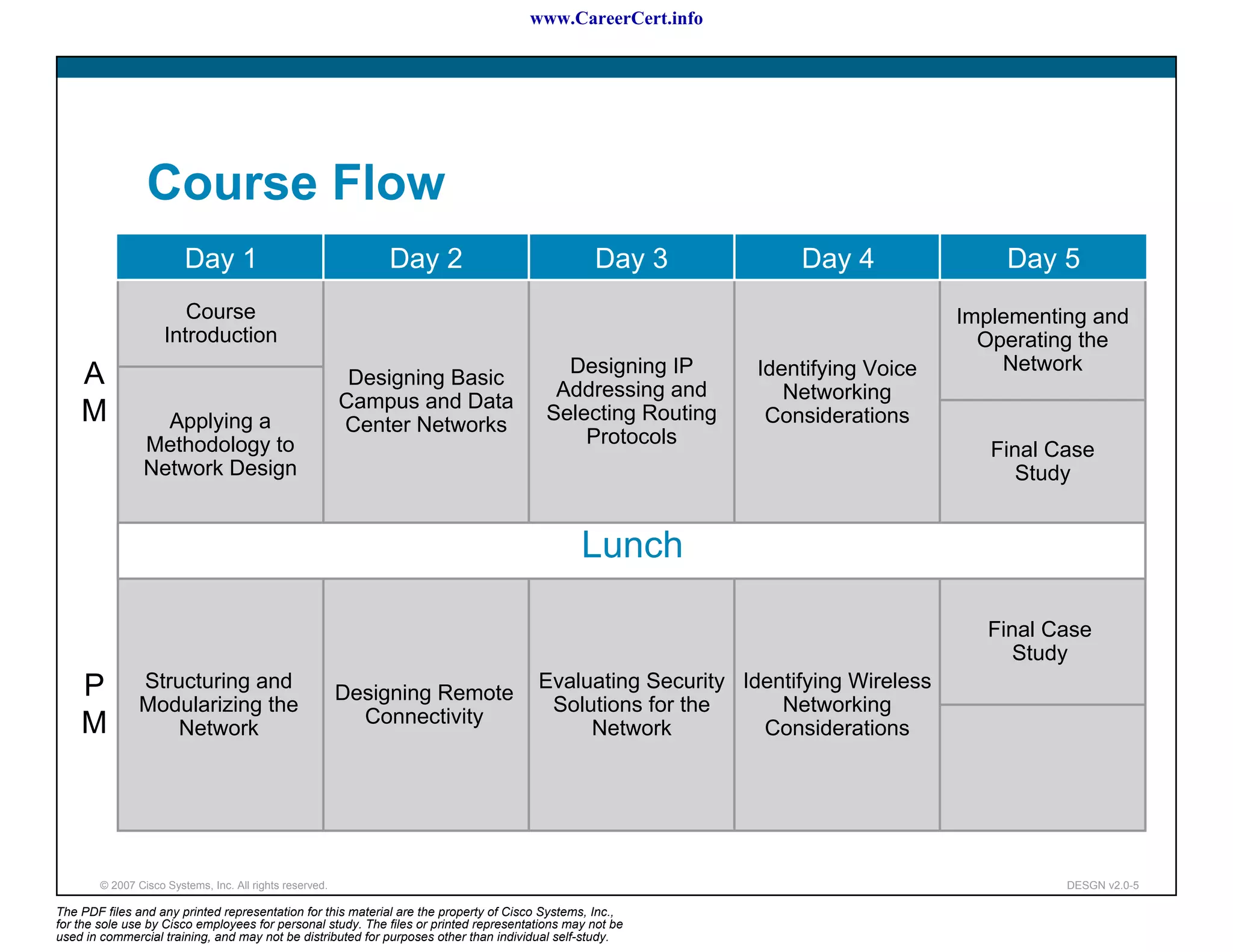
                 Course Flow
                         Day 1                                Day 2                              Day 3           Day 4                Day 5
                        Course                                                                                                    Implementing and
                     Introduction                                                                                                   Operating the
                                                                                           Designing IP      Identifying Voice        Network
    A                                                      Designing Basic
                                                                                          Addressing and        Networking
                                                          Campus and Data
    M             Applying a                              Center Networks
                                                                                         Selecting Routing    Considerations
                Methodology to                                                               Protocols
                                                                                                                                     Final Case
                Network Design                                                                                                          Study


                                                                                               Lunch

                                                                                                                                    Final Case
                                                                                                                                       Study
    P           Structuring and                                                        Evaluating Security Identifying Wireless
                                                          Designing Remote
                Modularizing the                                                        Solutions for the      Networking
    M                                                       Connectivity
                   Network                                                                  Network          Considerations


        © 2007 Cisco Systems, Inc. All rights reserved.                                                                                     DESGN v2.0-5

The PDF files and any printed representation for this material are the property of Cisco Systems, Inc.,
for the sole use by Cisco employees for personal study. The files or printed representations may not be
used in commercial training, and may not be distributed for purposes other than individual self-study.
www.CareerCert.info


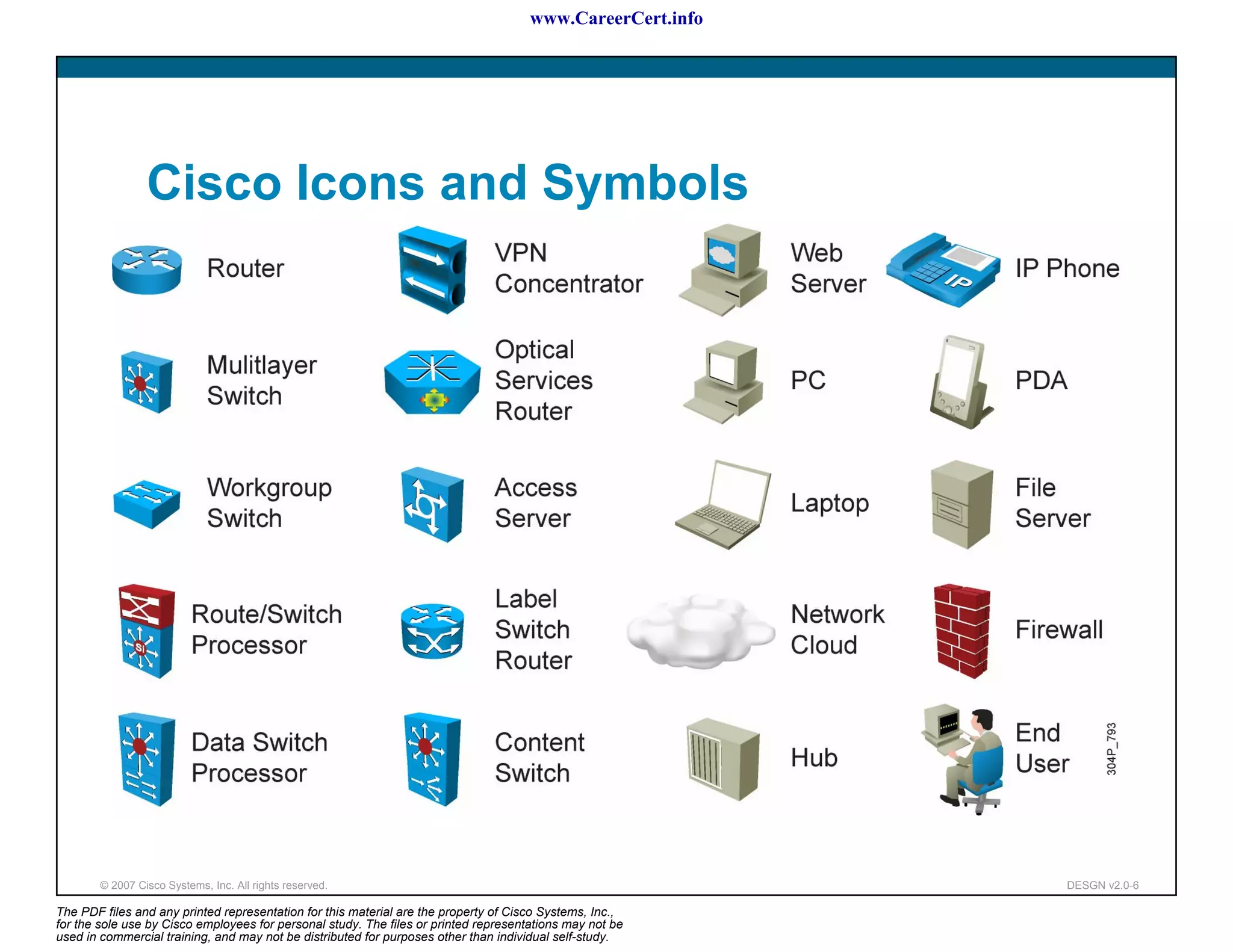
                 Cisco Icons and Symbols


        © 2007 Cisco Systems, Inc. All rights reserved.                                                     DESGN v2.0-6

The PDF files and any printed representation for this material are the property of Cisco Systems, Inc.,
for the sole use by Cisco employees for personal study. The files or printed representations may not be
used in commercial training, and may not be distributed for purposes other than individual self-study.
www.CareerCert.info


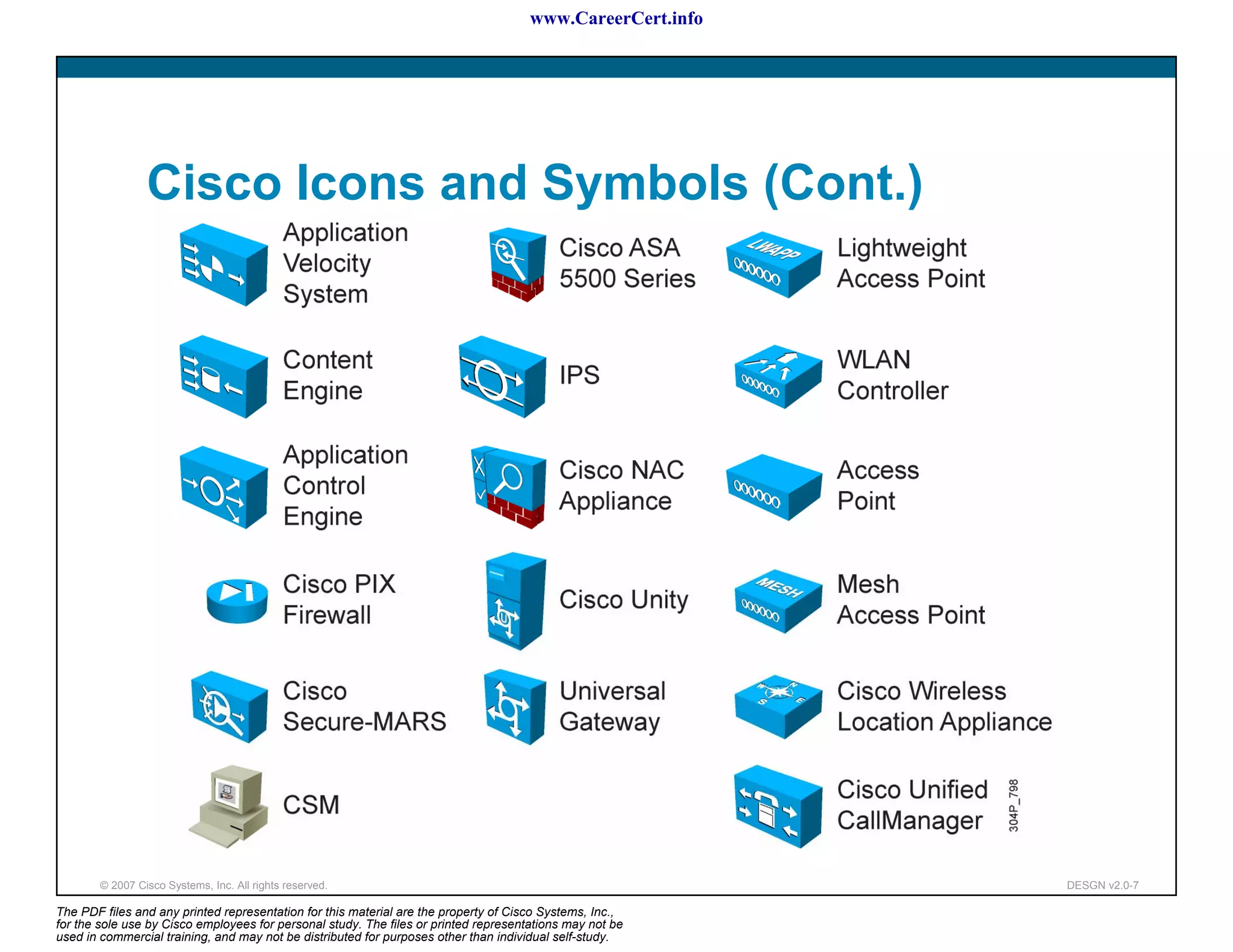
                 Cisco Icons and Symbols (Cont.)


        © 2007 Cisco Systems, Inc. All rights reserved.                                                     DESGN v2.0-7

The PDF files and any printed representation for this material are the property of Cisco Systems, Inc.,
for the sole use by Cisco employees for personal study. The files or printed representations may not be
used in commercial training, and may not be distributed for purposes other than individual self-study.
www.CareerCert.info


                 Cisco Certifications


        © 2007 Cisco Systems, Inc. All rights reserved.                                                     DESGN v2.0-8

The PDF files and any printed representation for this material are the property of Cisco Systems, Inc.,
for the sole use by Cisco employees for personal study. The files or printed representations may not be
used in commercial training, and may not be distributed for purposes other than individual self-study.
www.CareerCert.info


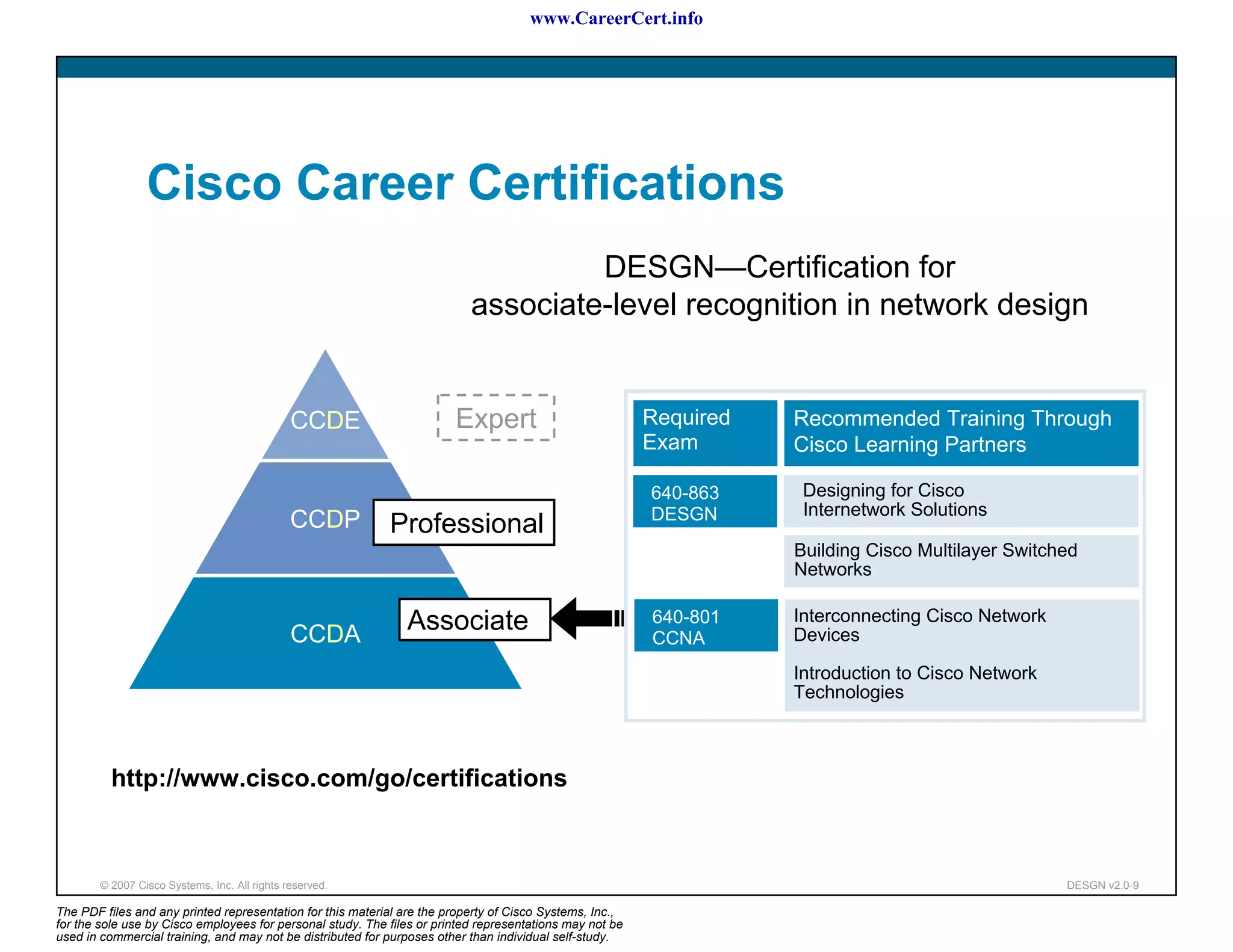
                 Cisco Career Certifications
                                                                                    DESGN—Certification for
                                                                           associate-level recognition in network design


                                               CCDE                     Expert                            Required   Recommended Training Through
                                                                                                          Exam       Cisco Learning Partners

                                                                                                          640-863     Designing for Cisco
                                                                                                          DESGN       Internetwork Solutions
                                               CCDP         Professional
                                                                                                                     Building Cisco Multilayer Switched
                                                                                                                     Networks

                                                               Associate                                  640-801    Interconnecting Cisco Network
                                               CCDA                                                       CCNA       Devices

                                                                                                                     Introduction to Cisco Network
                                                                                                                     Technologies


          http://www.cisco.com/go/certifications


        © 2007 Cisco Systems, Inc. All rights reserved.                                                                                              DESGN v2.0-9

The PDF files and any printed representation for this material are the property of Cisco Systems, Inc.,
for the sole use by Cisco employees for personal study. The files or printed representations may not be
used in commercial training, and may not be distributed for purposes other than individual self-study.
www.CareerCert.info


        © 2007 Cisco Systems, Inc. All rights reserved.                                                     DESGN v2.0-10

The PDF files and any printed representation for this material are the property of Cisco Systems, Inc.,
for the sole use by Cisco employees for personal study. The files or printed representations may not be
used in commercial training, and may not be distributed for purposes other than individual self-study.
www.CareerCert.info


                 Applying a
                 Methodology to
                 Network Design


                 Designing for Cisco Internetwork Solutions (DESGN) v2.0


        © 2007 Cisco Systems, Inc. All rights reserved.                                                     DESGN v2.0—1-1

The PDF files and any printed representation for this material are the property of Cisco Systems, Inc.,
for the sole use by Cisco employees for personal study. The files or printed representations may not be
used in commercial training, and may not be distributed for purposes other than individual self-study.
www.CareerCert.info


                 Applying a
                 Methodology to
                 Network Design


                 Introducing the Cisco Service-Oriented Network Architecture


        © 2007 Cisco Systems, Inc. All rights reserved.                                                     DESGN v2.0—1-1

The PDF files and any printed representation for this material are the property of Cisco Systems, Inc.,
for the sole use by Cisco employees for personal study. The files or printed representations may not be
used in commercial training, and may not be distributed for purposes other than individual self-study.
www.CareerCert.info


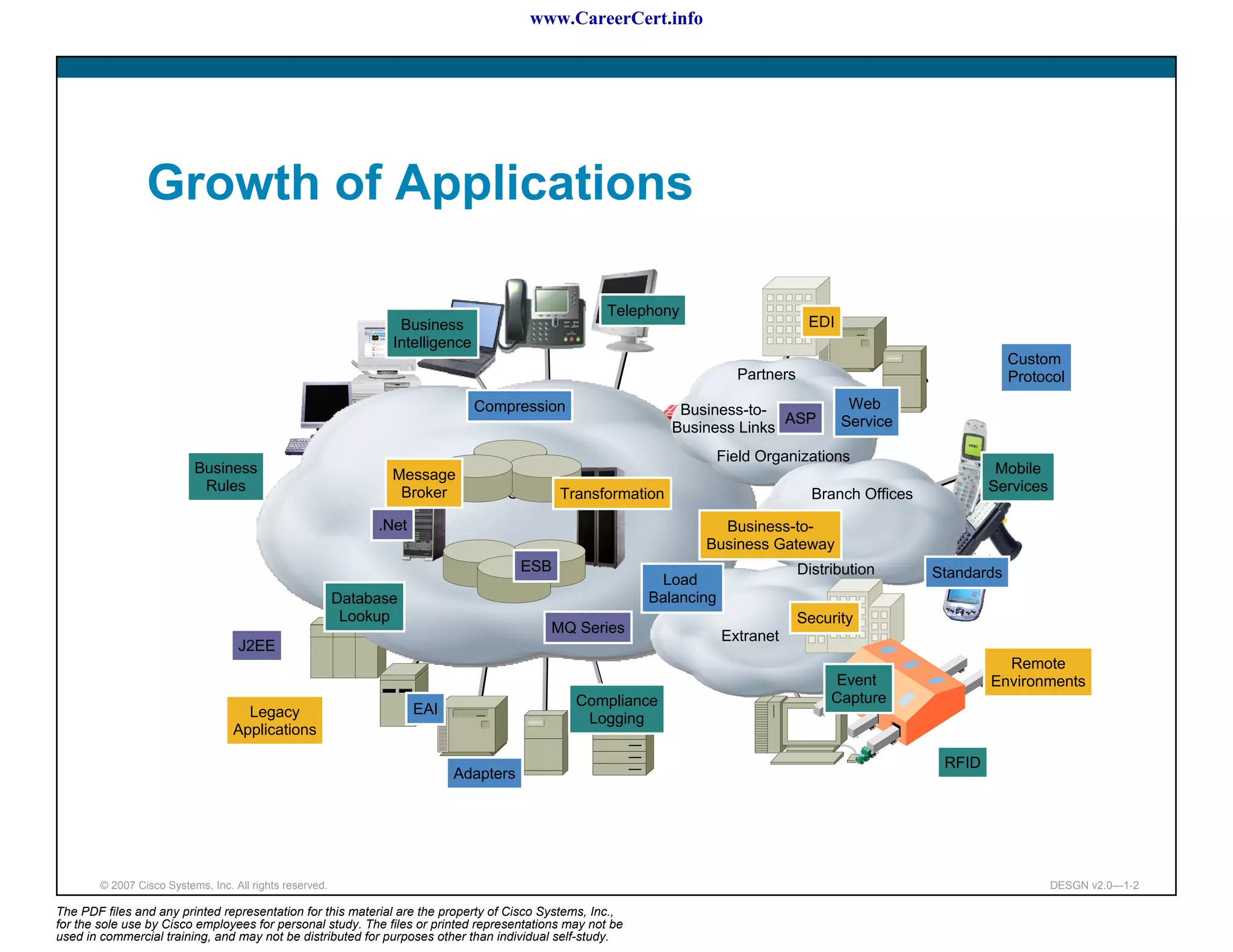
                 Growth of Applications

                                                                                                    Telephony
                                                                  Business                                                          EDI
                                                                 Intelligence
                                                                                                                                                                  Custom
                                                                                                                        Partners                                  Protocol
                                                                                Compression                   Business-to-                 Web
                                                                                                                            ASP           Service
                                                                                                             Business Links
                                                                                                                      Field Organizations
                           Business                              Message                                                                                       Mobile
                            Rules                                 Broker Data Center Transformation                                                           Services
                                                                                                                                     Branch Offices
                                                               .Net                                                Business-to-
                                                                                                                 Business Gateway
                                                                                       ESB                                         Distribution       Standards
                                                                                                           Load
                                                          Database                                        Balancing
                                                           Lookup                                                                  Security
                                                                                          MQ Series
                                                                                                                      Extranet
                                    J2EE
                                                                                                                                                                Remote
                                                                                                                                        Event                 Environments
                                                                                              Compliance                                Capture
                                     Legacy                           EAI
                                                                                               Logging
                                   Applications

                                                                                                                                                       RFID
                                                                            Adapters


        © 2007 Cisco Systems, Inc. All rights reserved.                                                                                                                  DESGN v2.0—1-2

The PDF files and any printed representation for this material are the property of Cisco Systems, Inc.,
for the sole use by Cisco employees for personal study. The files or printed representations may not be
used in commercial training, and may not be distributed for purposes other than individual self-study.
www.CareerCert.info


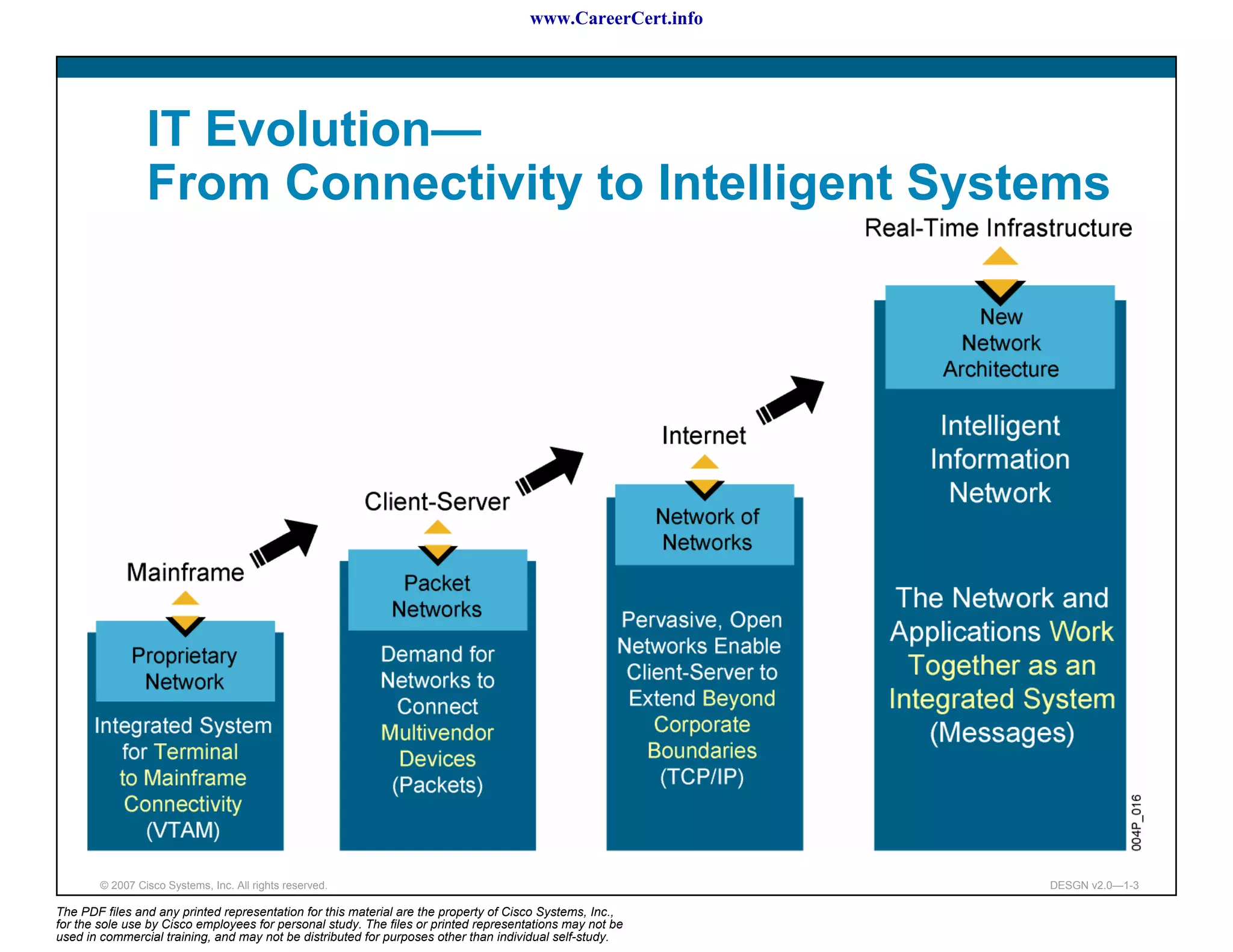
                 IT Evolution—
                 From Connectivity to Intelligent Systems


        © 2007 Cisco Systems, Inc. All rights reserved.                                                     DESGN v2.0—1-3

The PDF files and any printed representation for this material are the property of Cisco Systems, Inc.,
for the sole use by Cisco employees for personal study. The files or printed representations may not be
used in commercial training, and may not be distributed for purposes other than individual self-study.
www.CareerCert.info


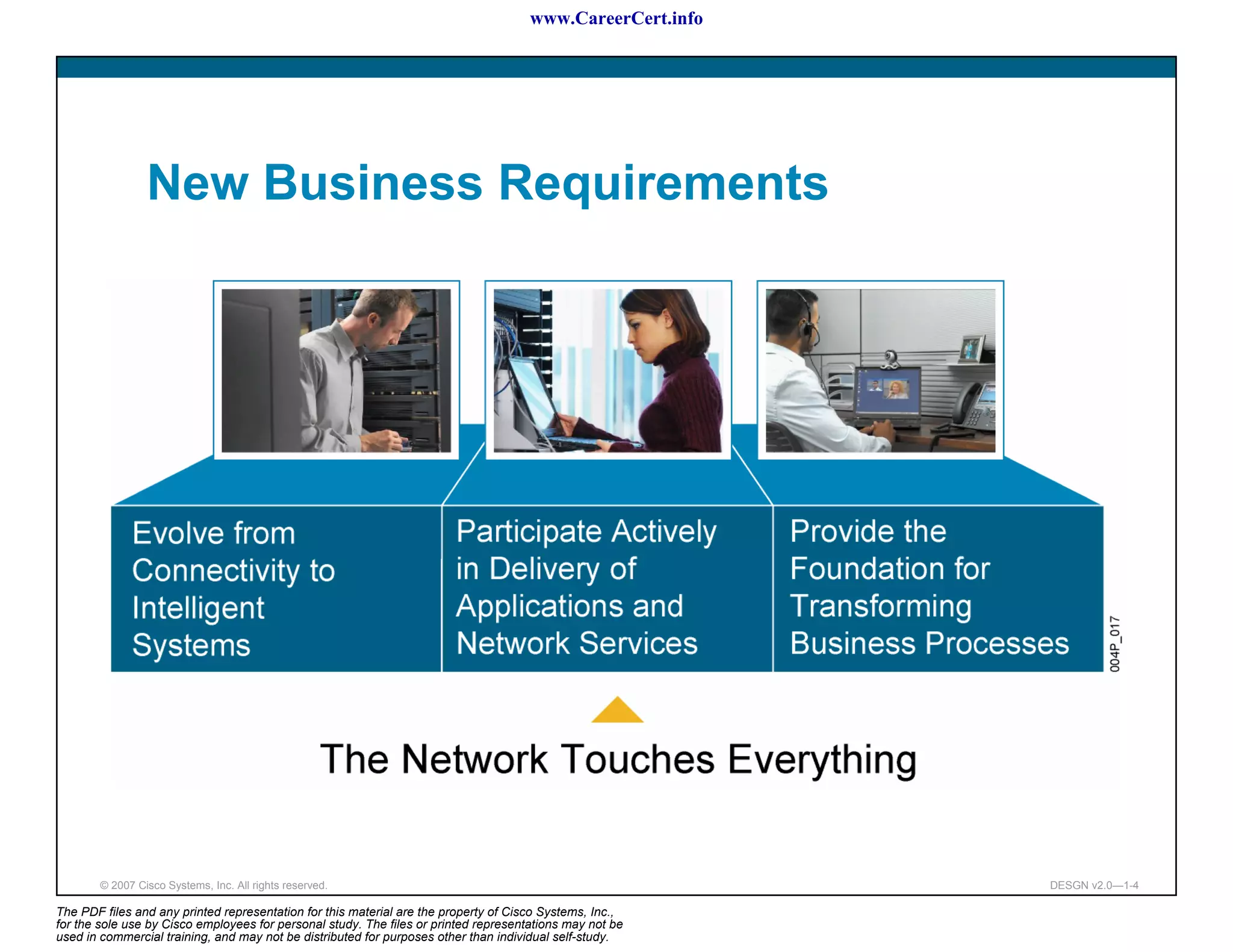
                 New Business Requirements


        © 2007 Cisco Systems, Inc. All rights reserved.                                                     DESGN v2.0—1-4

The PDF files and any printed representation for this material are the property of Cisco Systems, Inc.,
for the sole use by Cisco employees for personal study. The files or printed representations may not be
used in commercial training, and may not be distributed for purposes other than individual self-study.
www.CareerCert.info


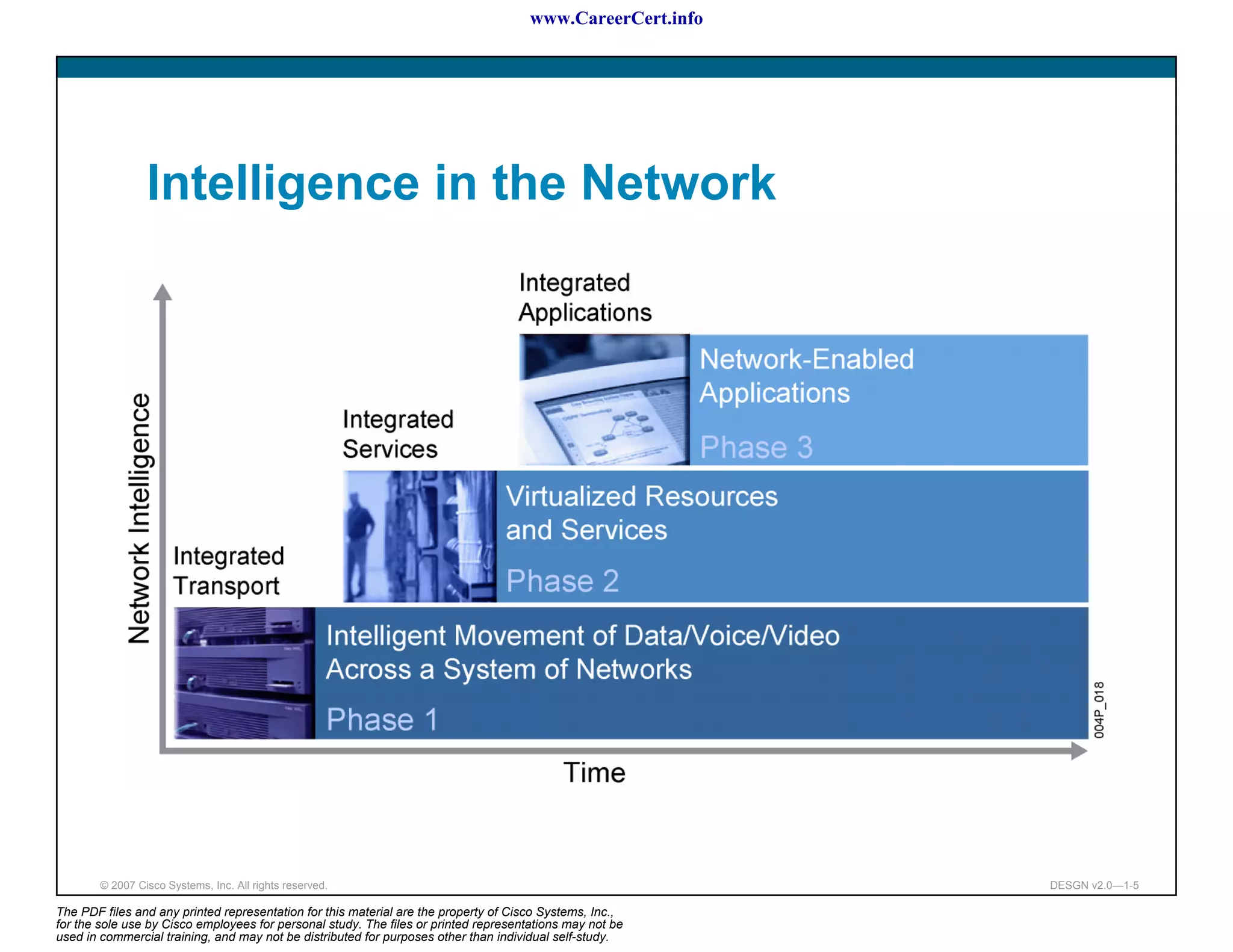
                 Intelligence in the Network


        © 2007 Cisco Systems, Inc. All rights reserved.                                                     DESGN v2.0—1-5

The PDF files and any printed representation for this material are the property of Cisco Systems, Inc.,
for the sole use by Cisco employees for personal study. The files or printed representations may not be
used in commercial training, and may not be distributed for purposes other than individual self-study.
www.CareerCert.info


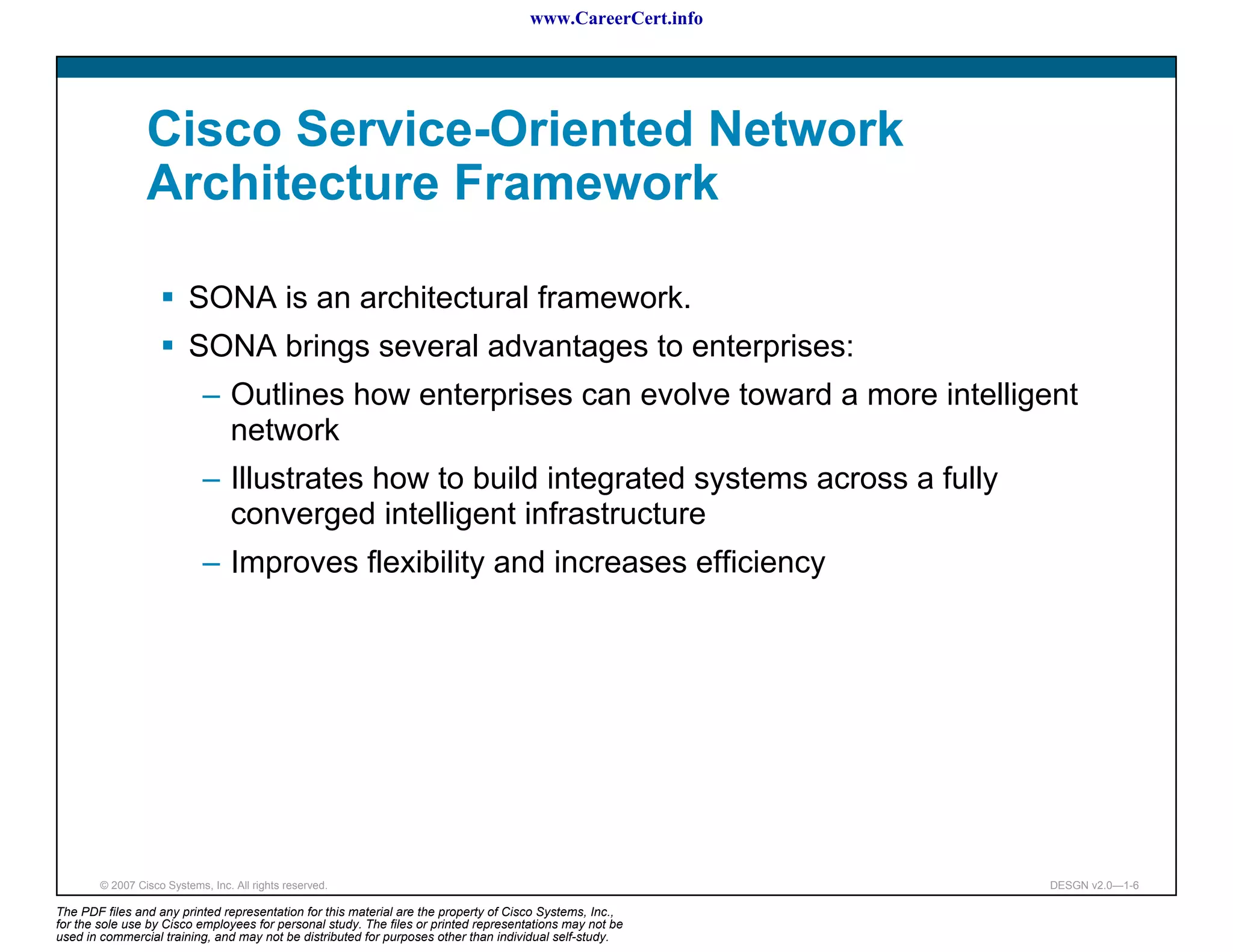
                 Cisco Service-Oriented Network
                 Architecture Framework

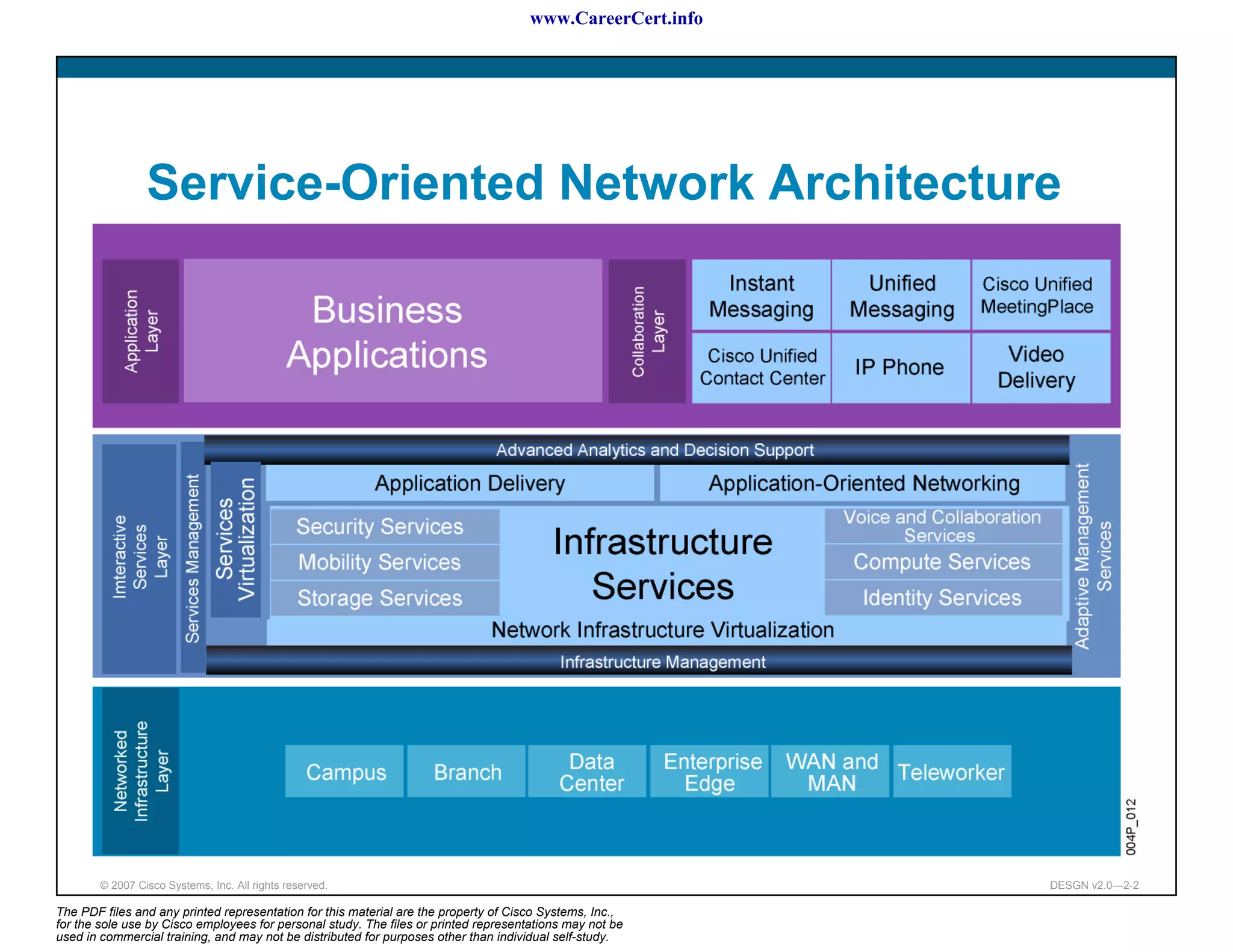
                          SONA is an architectural framework.
                          SONA brings several advantages to enterprises:
                             – Outlines how enterprises can evolve toward a more intelligent
                               network
                             – Illustrates how to build integrated systems across a fully
                               converged intelligent infrastructure
                             – Improves flexibility and increases efficiency


        © 2007 Cisco Systems, Inc. All rights reserved.                                                     DESGN v2.0—1-6

The PDF files and any printed representation for this material are the property of Cisco Systems, Inc.,
for the sole use by Cisco employees for personal study. The files or printed representations may not be
used in commercial training, and may not be distributed for purposes other than individual self-study.
www.CareerCert.info


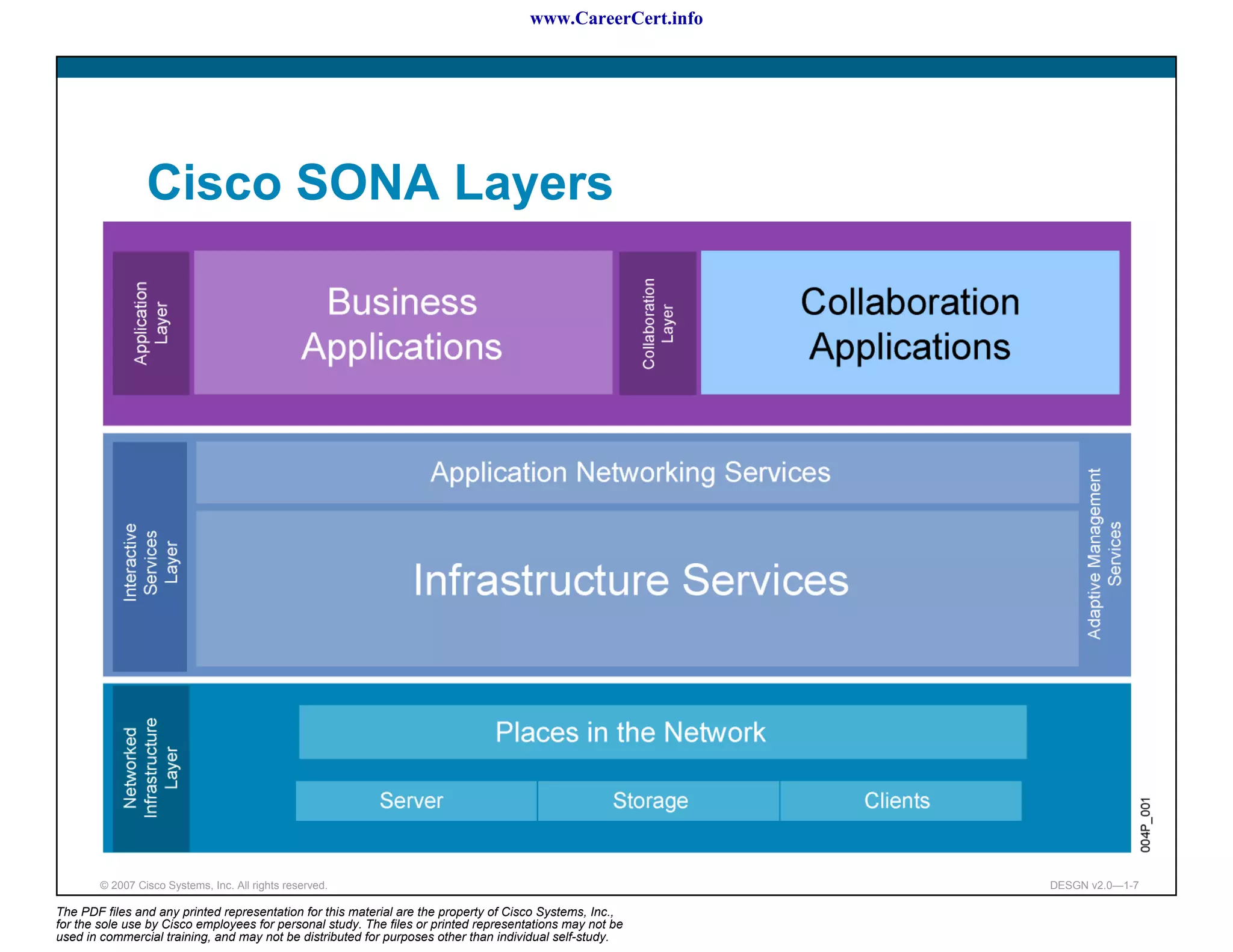
                 Cisco SONA Layers


        © 2007 Cisco Systems, Inc. All rights reserved.                                                     DESGN v2.0—1-7

The PDF files and any printed representation for this material are the property of Cisco Systems, Inc.,
for the sole use by Cisco employees for personal study. The files or printed representations may not be
used in commercial training, and may not be distributed for purposes other than individual self-study.
www.CareerCert.info


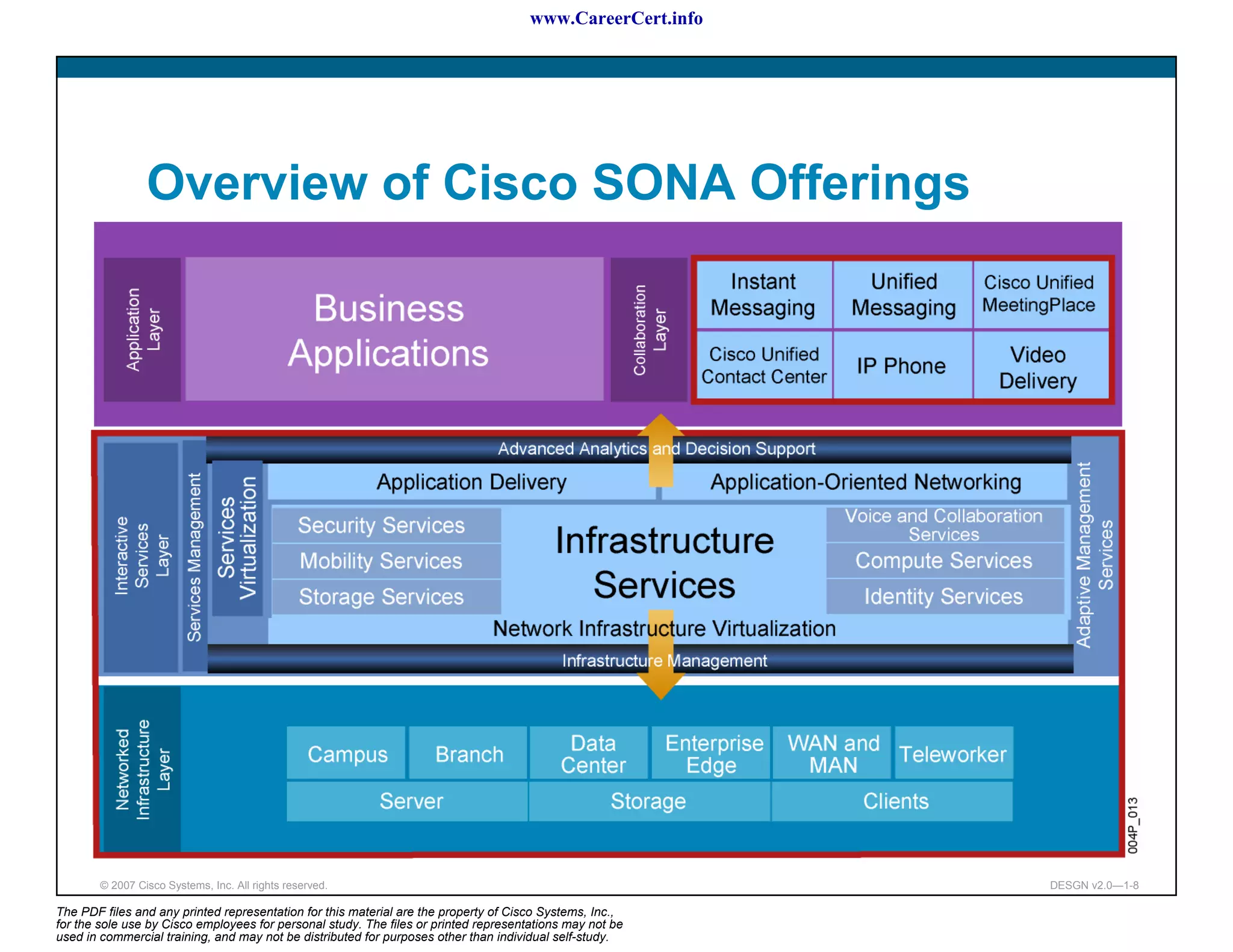
                 Overview of Cisco SONA Offerings


        © 2007 Cisco Systems, Inc. All rights reserved.                                                     DESGN v2.0—1-8

The PDF files and any printed representation for this material are the property of Cisco Systems, Inc.,
for the sole use by Cisco employees for personal study. The files or printed representations may not be
used in commercial training, and may not be distributed for purposes other than individual self-study.
www.CareerCert.info


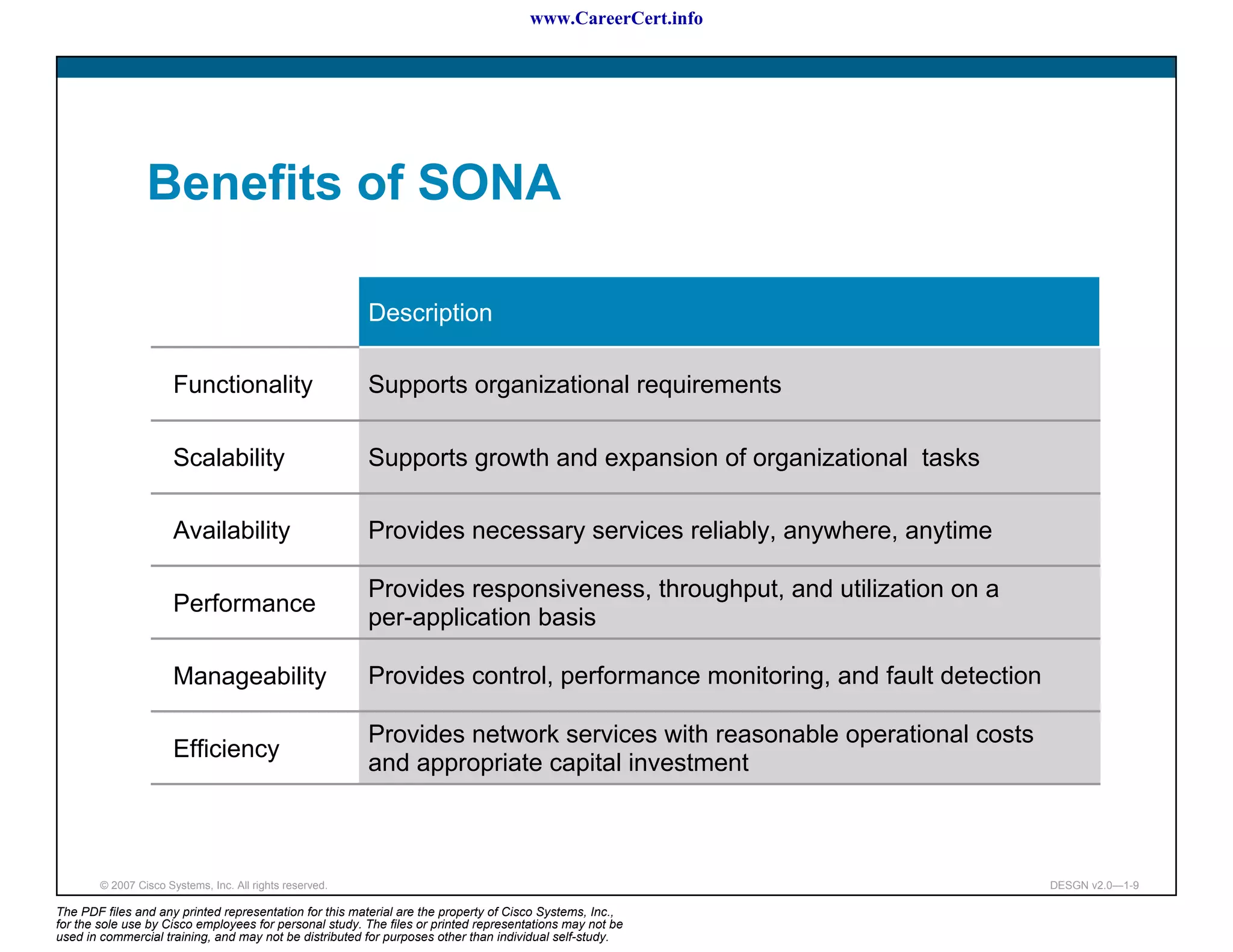
                 Benefits of SONA

                                                          Description

                       Functionality                      Supports organizational requirements

                       Scalability                        Supports growth and expansion of organizational tasks

                       Availability                       Provides necessary services reliably, anywhere, anytime

                                                          Provides responsiveness, throughput, and utilization on a
                       Performance
                                                          per-application basis

                       Manageability                      Provides control, performance monitoring, and fault detection

                                                          Provides network services with reasonable operational costs
                       Efficiency
                                                          and appropriate capital investment


        © 2007 Cisco Systems, Inc. All rights reserved.                                                                   DESGN v2.0—1-9

The PDF files and any printed representation for this material are the property of Cisco Systems, Inc.,
for the sole use by Cisco employees for personal study. The files or printed representations may not be
used in commercial training, and may not be distributed for purposes other than individual self-study.
www.CareerCert.info


                 Summary

                          Drivers for a new network architecture include these factors:
                           – Growth of applications
                           – IT evolution from connectivity to intelligent systems
                           – Increased business expectations for networks
                          Cisco’s vision of intelligence in the network aligns network and
                          business requirements in three phases:
                           – Phase 1 is integrated transport.
                           – Phase 2 is integrated services.
                           – Phase 3 is integrated applications.
                          Cisco SONA is the enterprise framework for building intelligence
                          in the network:
                           – Layer 1 is the integrated infrastructure layer.
                           – Layer 2 is the interactive services layer.
                           – Layer 3 is the application layer.

        © 2007 Cisco Systems, Inc. All rights reserved.                                                     DESGN v2.0—1-10

The PDF files and any printed representation for this material are the property of Cisco Systems, Inc.,
for the sole use by Cisco employees for personal study. The files or printed representations may not be
used in commercial training, and may not be distributed for purposes other than individual self-study.
www.CareerCert.info


        © 2007 Cisco Systems, Inc. All rights reserved.                                                     DESGN v2.0—1-11

The PDF files and any printed representation for this material are the property of Cisco Systems, Inc.,
for the sole use by Cisco employees for personal study. The files or printed representations may not be
used in commercial training, and may not be distributed for purposes other than individual self-study.
www.CareerCert.info


                 Identifying Design
                 Requirements


                 Applying a Methodology to Network Design


        © 2007 Cisco Systems, Inc. All rights reserved.                                                     DESGN v2.0—1-1

The PDF files and any printed representation for this material are the property of Cisco Systems, Inc.,
for the sole use by Cisco employees for personal study. The files or printed representations may not be
used in commercial training, and may not be distributed for purposes other than individual self-study.
www.CareerCert.info


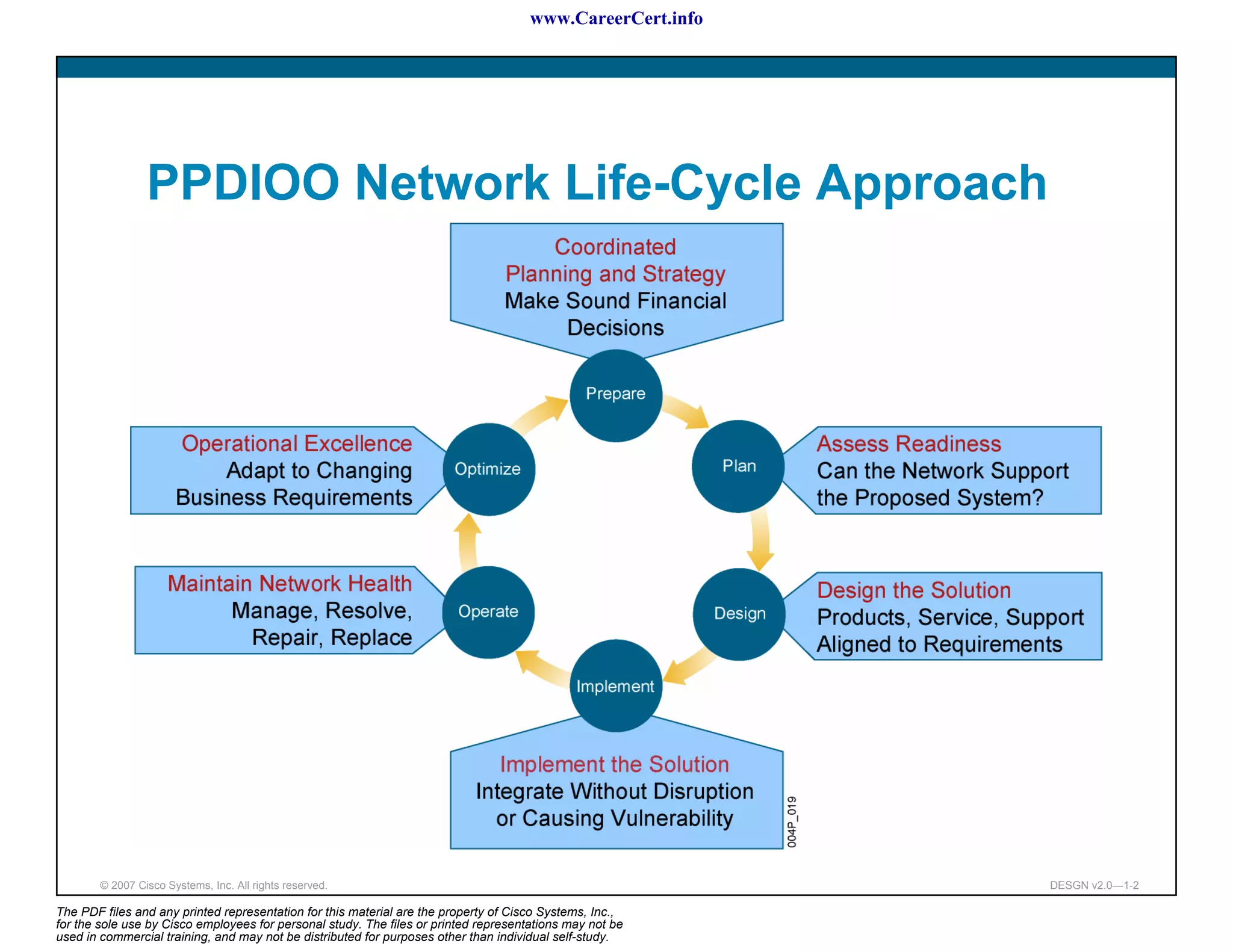
                 PPDIOO Network Life-Cycle Approach


        © 2007 Cisco Systems, Inc. All rights reserved.                                                     DESGN v2.0—1-2

The PDF files and any printed representation for this material are the property of Cisco Systems, Inc.,
for the sole use by Cisco employees for personal study. The files or printed representations may not be
used in commercial training, and may not be distributed for purposes other than individual self-study.
www.CareerCert.info


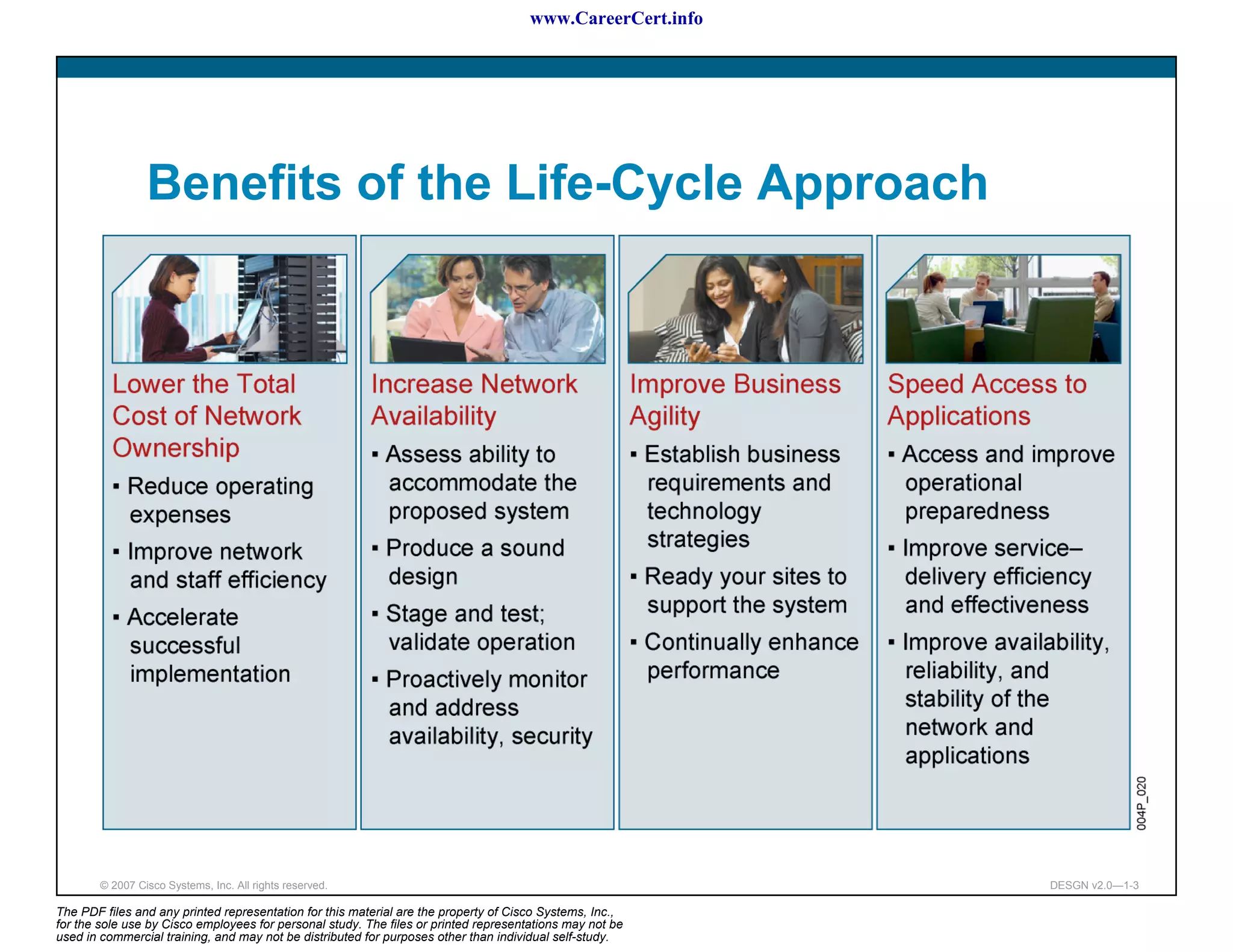
                 Benefits of the Life-Cycle Approach


        © 2007 Cisco Systems, Inc. All rights reserved.                                                     DESGN v2.0—1-3

The PDF files and any printed representation for this material are the property of Cisco Systems, Inc.,
for the sole use by Cisco employees for personal study. The files or printed representations may not be
used in commercial training, and may not be distributed for purposes other than individual self-study.
www.CareerCert.info


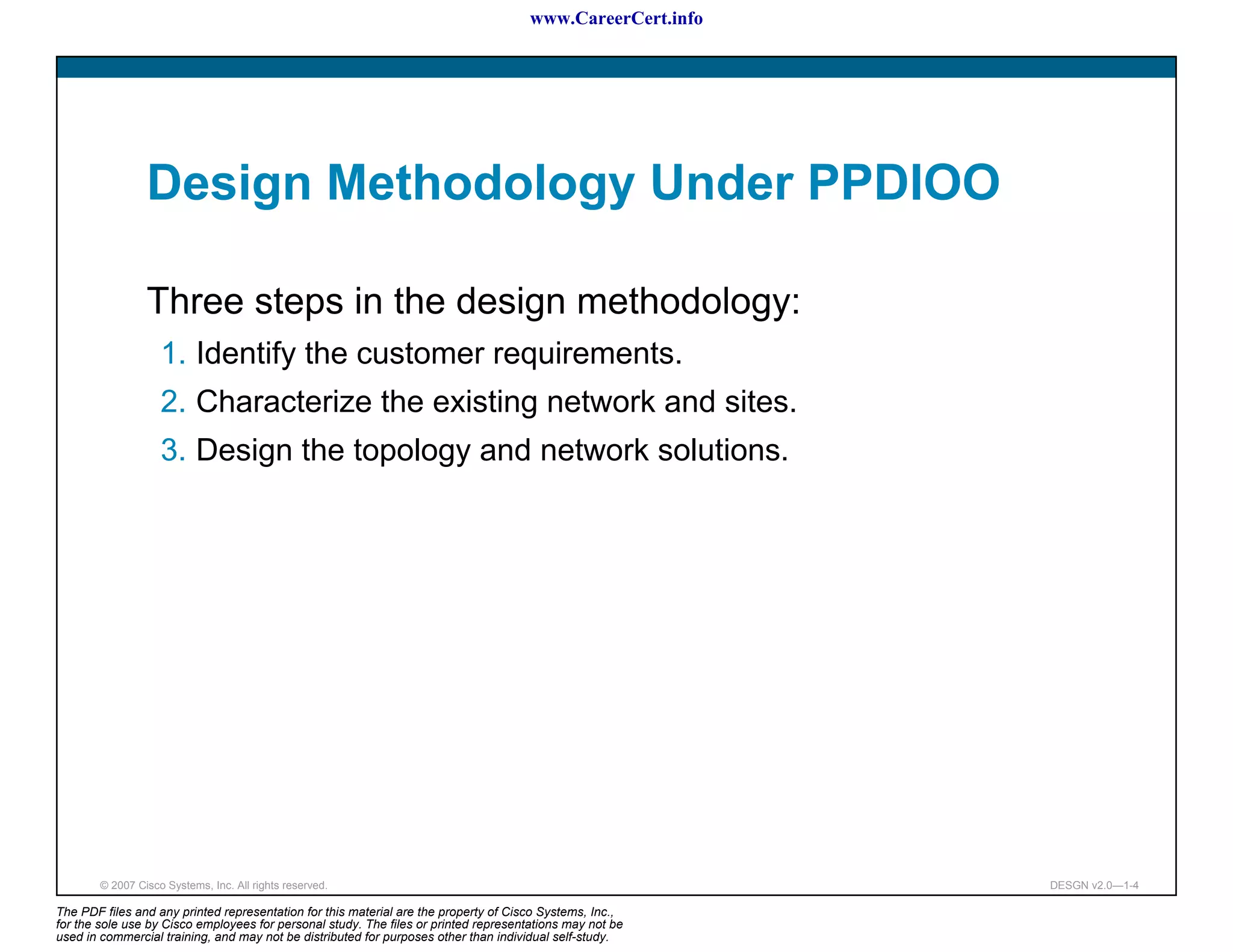
                 Design Methodology Under PPDIOO

                 Three steps in the design methodology:
                    1. Identify the customer requirements.
                    2. Characterize the existing network and sites.
                    3. Design the topology and network solutions.


        © 2007 Cisco Systems, Inc. All rights reserved.                                                     DESGN v2.0—1-4

The PDF files and any printed representation for this material are the property of Cisco Systems, Inc.,
for the sole use by Cisco employees for personal study. The files or printed representations may not be
used in commercial training, and may not be distributed for purposes other than individual self-study.
www.CareerCert.info


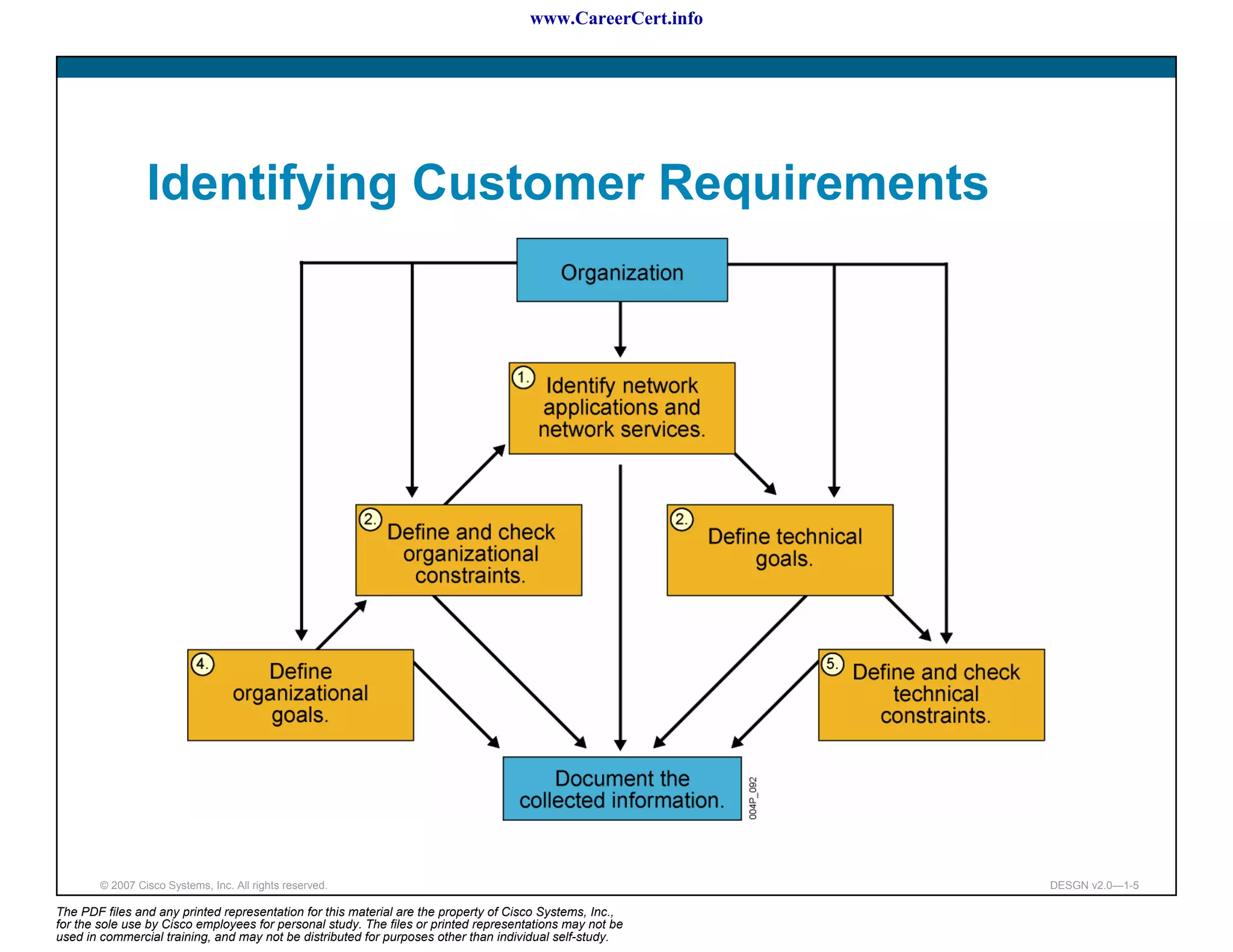
                 Identifying Customer Requirements


        © 2007 Cisco Systems, Inc. All rights reserved.                                                     DESGN v2.0—1-5

The PDF files and any printed representation for this material are the property of Cisco Systems, Inc.,
for the sole use by Cisco employees for personal study. The files or printed representations may not be
used in commercial training, and may not be distributed for purposes other than individual self-study.
www.CareerCert.info


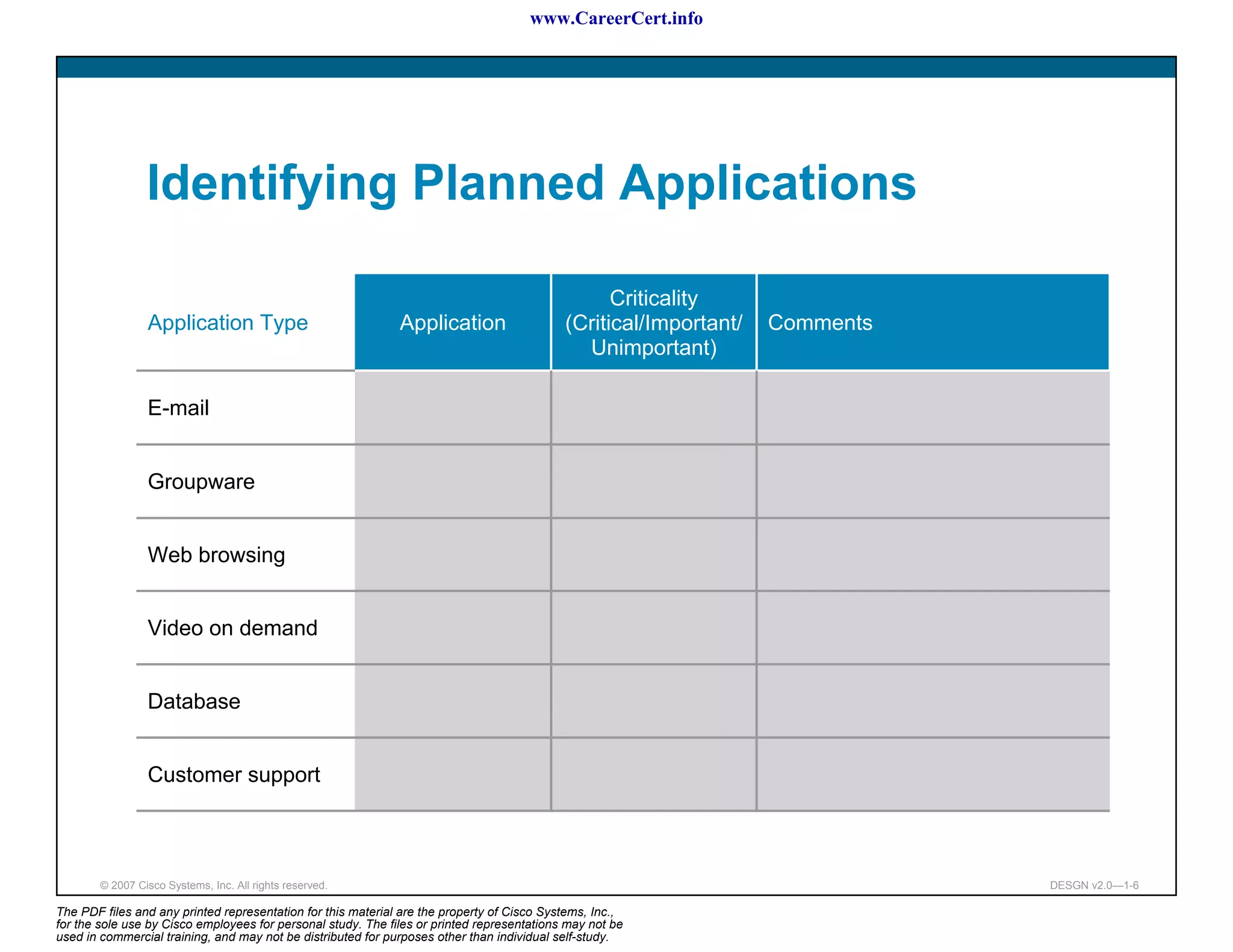
                 Identifying Planned Applications

                                                                                                  Criticality
                 Application Type                             Application                   (Critical/Important/   Comments
                                                                                              Unimportant)

                 E-mail


                 Groupware


                 Web browsing


                 Video on demand


                 Database


                 Customer support


        © 2007 Cisco Systems, Inc. All rights reserved.                                                                       DESGN v2.0—1-6

The PDF files and any printed representation for this material are the property of Cisco Systems, Inc.,
for the sole use by Cisco employees for personal study. The files or printed representations may not be
used in commercial training, and may not be distributed for purposes other than individual self-study.
www.CareerCert.info


                 Example: Planned Applications

                                                                                                   Criticality
                 Application Type                             Application                    (critical/important/   Comments
                                                                                                unimportant)

                 E-mail                                   Microsoft Outlook                         Important

                                                                                                                    We need to be able to share
                                                            Cisco Unified
                 Groupware                                                                          Important       presentations and applications
                                                            MeetingPlace
                                                                                                                    during remote meetings.

                                                          Microsoft Internet
                 Web browsing                             Explorer, Opera,                          Important
                                                              Netscape

                 Video on demand                                   IP/TV                              Critical

                                                                                                                    All data storage will be based
                 Database                                         Oracle                              Critical
                                                                                                                    on Oracle.

                                                              Customer
                 Customer support                                                                     Critical
                                                             applications

        © 2007 Cisco Systems, Inc. All rights reserved.                                                                                          DESGN v2.0—1-7

The PDF files and any printed representation for this material are the property of Cisco Systems, Inc.,
for the sole use by Cisco employees for personal study. The files or printed representations may not be
used in commercial training, and may not be distributed for purposes other than individual self-study.
www.CareerCert.info


                 Identifying Planned Infrastructure
                 Services

                 Service                                        Comments


                 Security


                 QoS


                 Network management


                 High availability


                 IP telephony


                 Mobility


        © 2007 Cisco Systems, Inc. All rights reserved.                                                     DESGN v2.0—1-8

The PDF files and any printed representation for this material are the property of Cisco Systems, Inc.,
for the sole use by Cisco employees for personal study. The files or printed representations may not be
used in commercial training, and may not be distributed for purposes other than individual self-study.
www.CareerCert.info


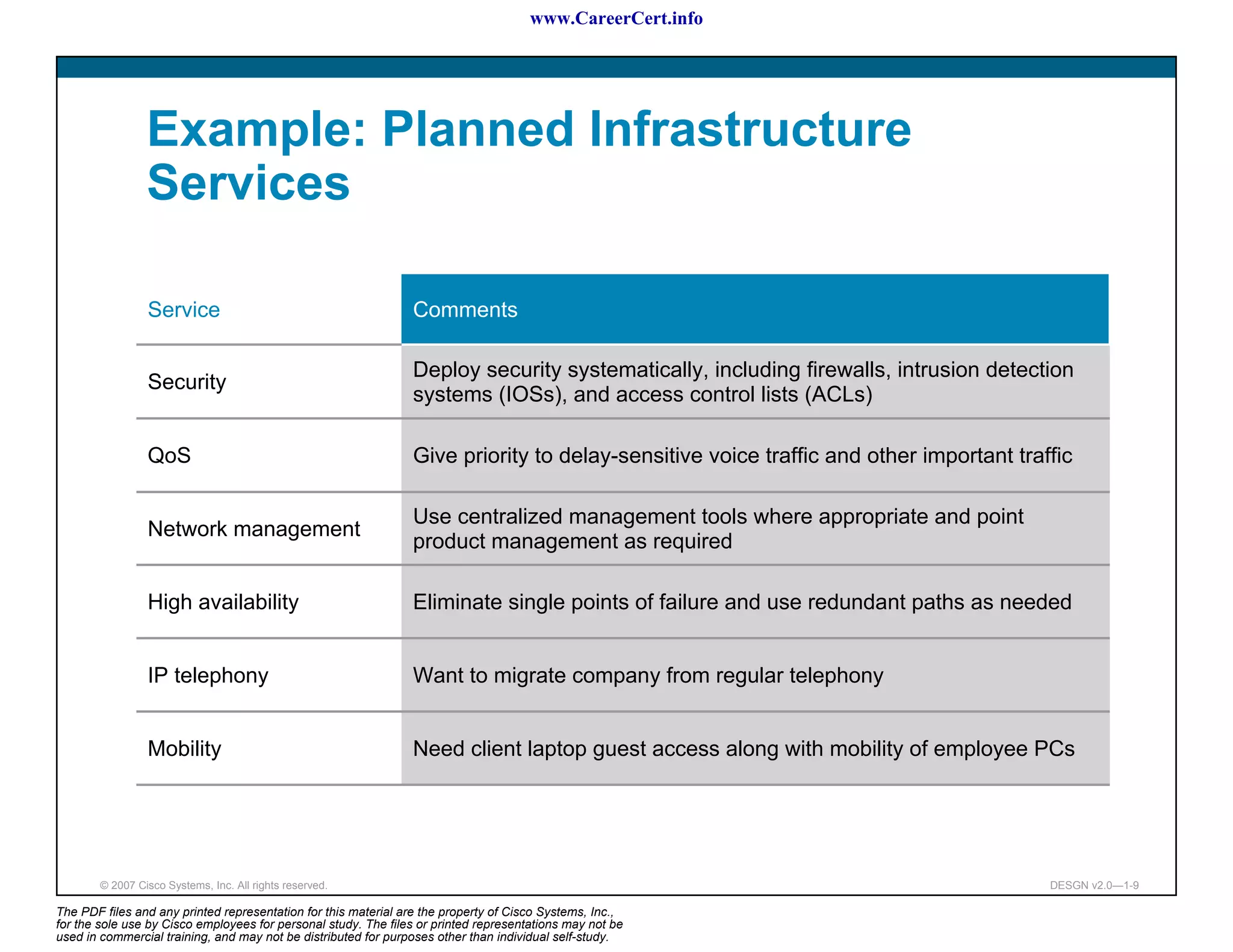
                 Example: Planned Infrastructure
                 Services

                 Service                                        Comments

                                                                Deploy security systematically, including firewalls, intrusion detection
                 Security
                                                                systems (IOSs), and access control lists (ACLs)

                 QoS                                            Give priority to delay-sensitive voice traffic and other important traffic

                                                                Use centralized management tools where appropriate and point
                 Network management
                                                                product management as required

                 High availability                              Eliminate single points of failure and use redundant paths as needed


                 IP telephony                                   Want to migrate company from regular telephony


                 Mobility                                       Need client laptop guest access along with mobility of employee PCs


        © 2007 Cisco Systems, Inc. All rights reserved.                                                                                DESGN v2.0—1-9

The PDF files and any printed representation for this material are the property of Cisco Systems, Inc.,
for the sole use by Cisco employees for personal study. The files or printed representations may not be
used in commercial training, and may not be distributed for purposes other than individual self-study.
www.CareerCert.info


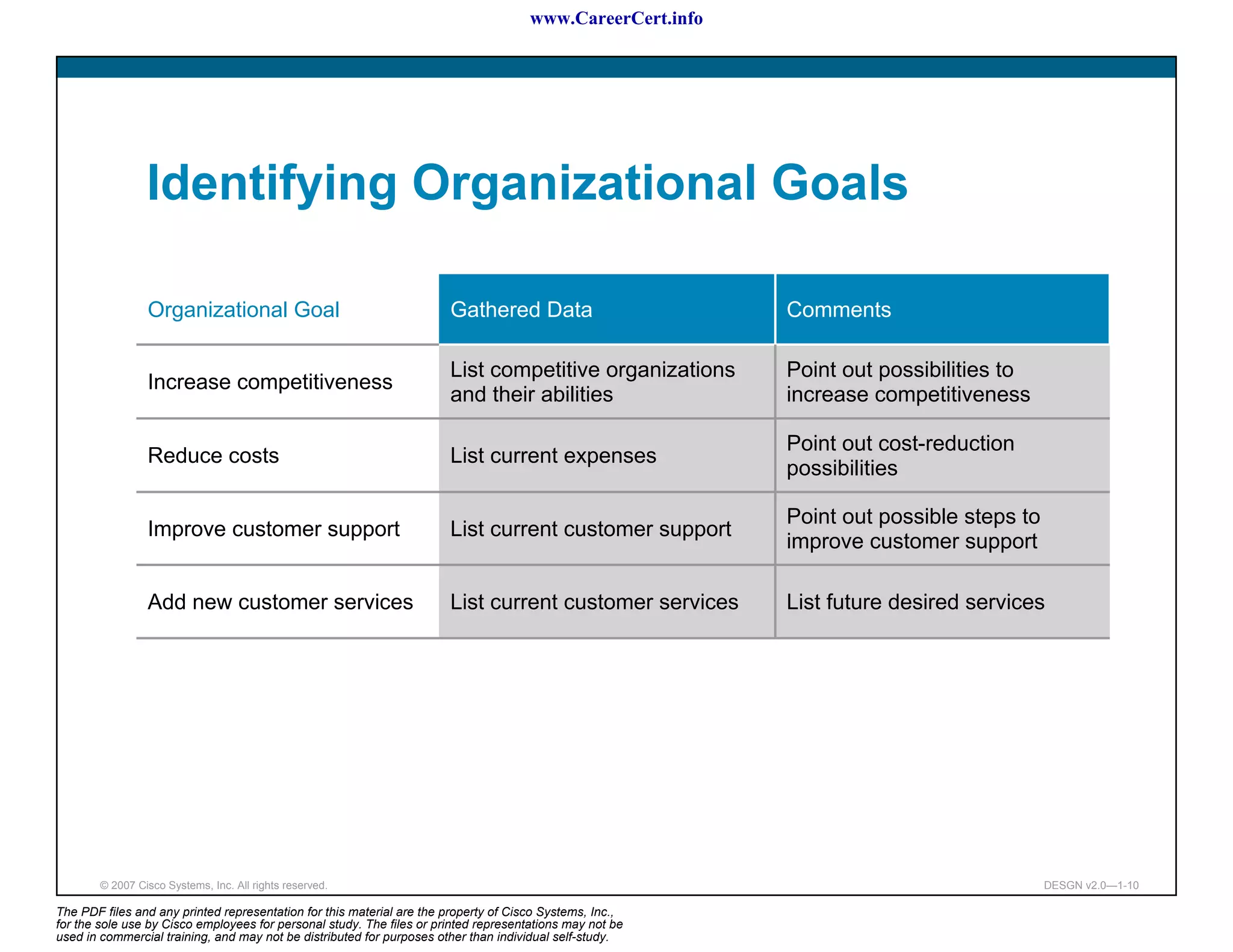
                 Identifying Organizational Goals

                 Organizational Goal                                   Gathered Data                        Comments

                                                                       List competitive organizations       Point out possibilities to
                 Increase competitiveness
                                                                       and their abilities                  increase competitiveness

                                                                                                            Point out cost-reduction
                 Reduce costs                                          List current expenses
                                                                                                            possibilities

                                                                                                            Point out possible steps to
                 Improve customer support                              List current customer support
                                                                                                            improve customer support

                 Add new customer services                             List current customer services       List future desired services


        © 2007 Cisco Systems, Inc. All rights reserved.                                                                                   DESGN v2.0—1-10

The PDF files and any printed representation for this material are the property of Cisco Systems, Inc.,
for the sole use by Cisco employees for personal study. The files or printed representations may not be
used in commercial training, and may not be distributed for purposes other than individual self-study.
www.CareerCert.info


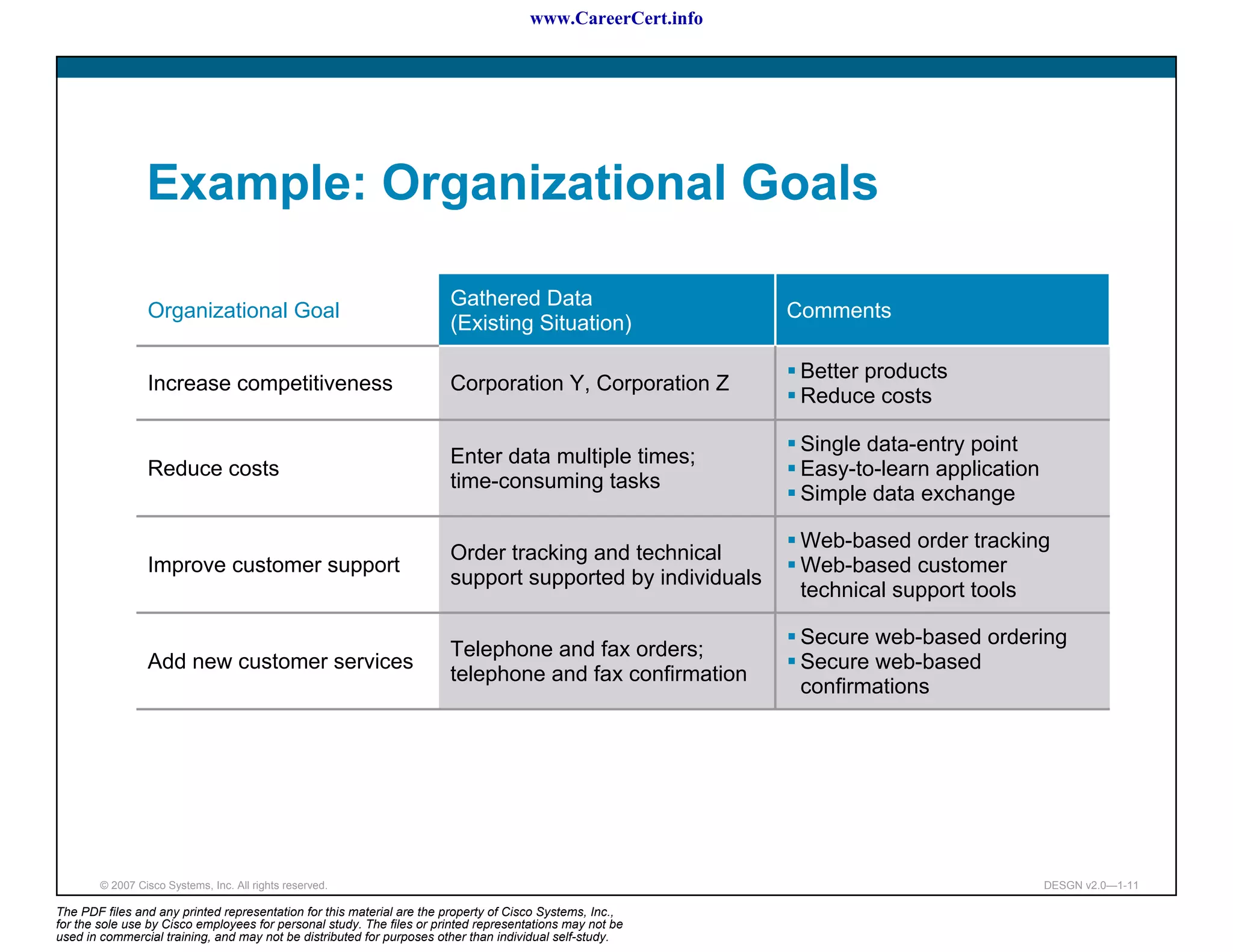
                 Example: Organizational Goals

                                                                       Gathered Data
                 Organizational Goal                                                                        Comments
                                                                       (Existing Situation)

                                                                                                             Better products
                 Increase competitiveness                              Corporation Y, Corporation Z
                                                                                                             Reduce costs

                                                                                                             Single data-entry point
                                                                       Enter data multiple times;
                 Reduce costs                                                                                Easy-to-learn application
                                                                       time-consuming tasks
                                                                                                             Simple data exchange

                                                                                                             Web-based order tracking
                                                                       Order tracking and technical
                 Improve customer support                                                                    Web-based customer
                                                                       support supported by individuals
                                                                                                             technical support tools

                                                                                                             Secure web-based ordering
                                                                       Telephone and fax orders;
                 Add new customer services                                                                   Secure web-based
                                                                       telephone and fax confirmation
                                                                                                             confirmations


        © 2007 Cisco Systems, Inc. All rights reserved.                                                                                  DESGN v2.0—1-11

The PDF files and any printed representation for this material are the property of Cisco Systems, Inc.,
for the sole use by Cisco employees for personal study. The files or printed representations may not be
used in commercial training, and may not be distributed for purposes other than individual self-study.
www.CareerCert.info


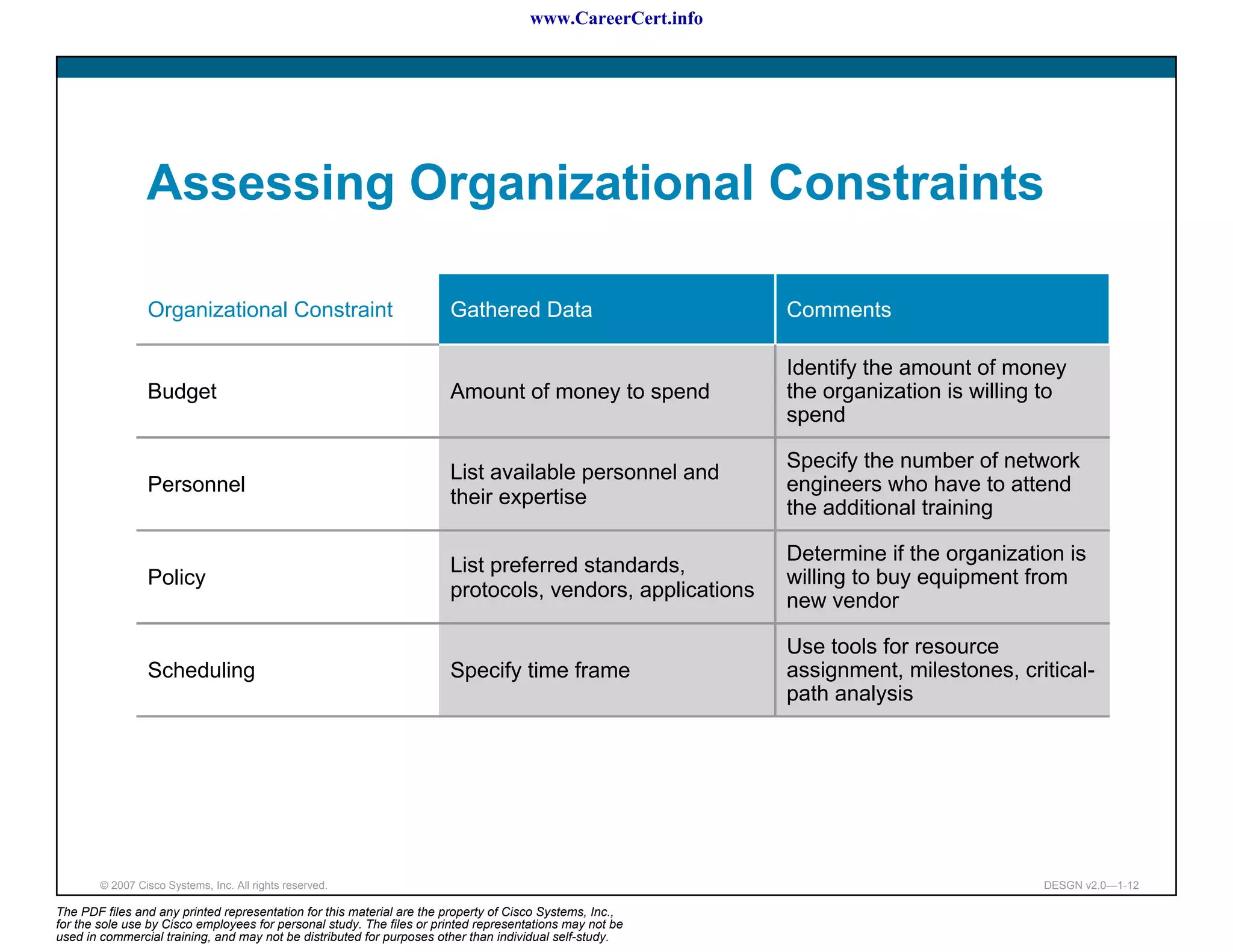
                 Assessing Organizational Constraints

                 Organizational Constraint                             Gathered Data                        Comments

                                                                                                            Identify the amount of money
                 Budget                                                Amount of money to spend             the organization is willing to
                                                                                                            spend

                                                                                                            Specify the number of network
                                                                       List available personnel and
                 Personnel                                                                                  engineers who have to attend
                                                                       their expertise                      the additional training

                                                                                                            Determine if the organization is
                                                                       List preferred standards,
                 Policy                                                                                     willing to buy equipment from
                                                                       protocols, vendors, applications     new vendor

                                                                                                            Use tools for resource
                 Scheduling                                            Specify time frame                   assignment, milestones, critical-
                                                                                                            path analysis


        © 2007 Cisco Systems, Inc. All rights reserved.                                                                                DESGN v2.0—1-12

The PDF files and any printed representation for this material are the property of Cisco Systems, Inc.,
for the sole use by Cisco employees for personal study. The files or printed representations may not be
used in commercial training, and may not be distributed for purposes other than individual self-study.
www.CareerCert.info


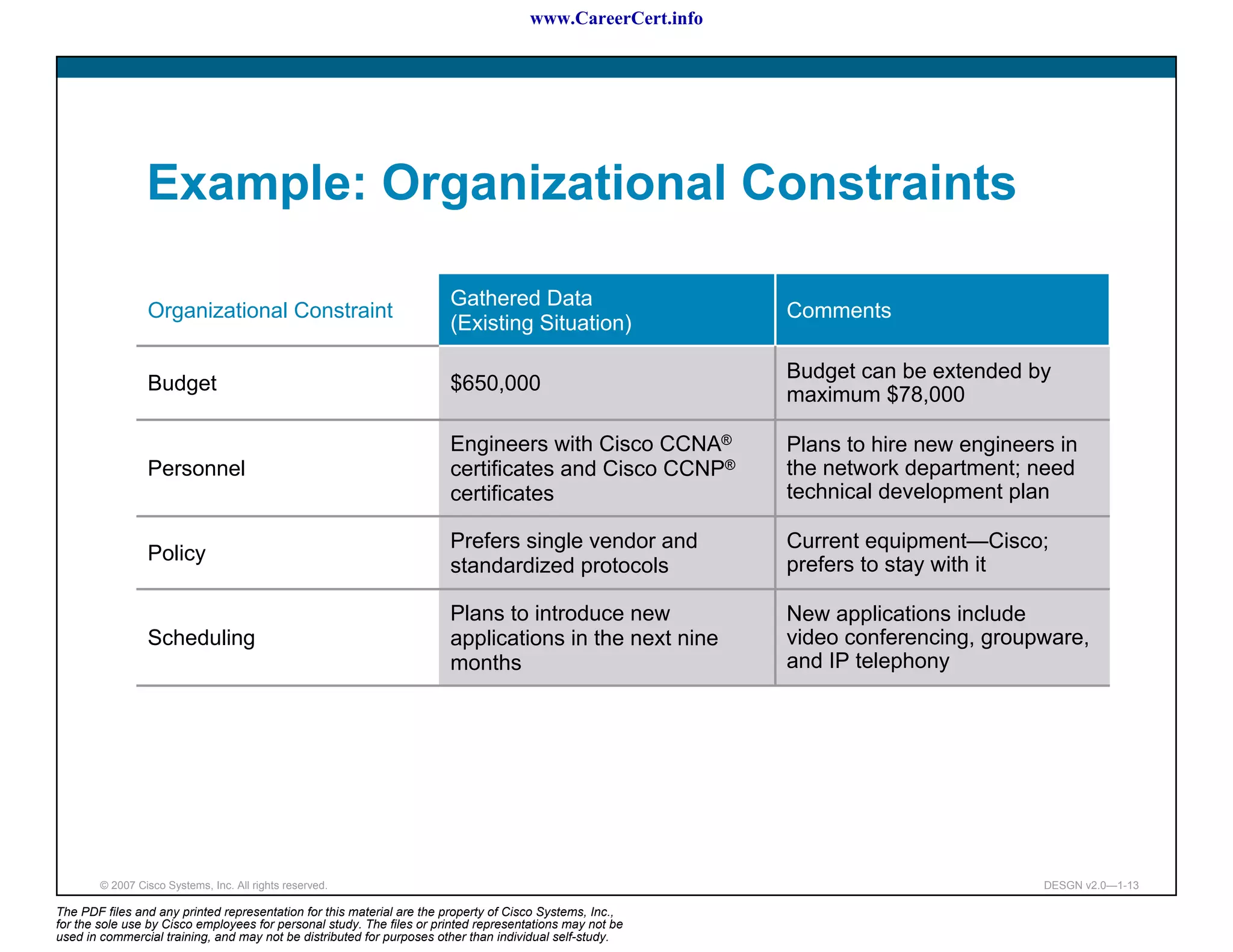
                 Example: Organizational Constraints

                                                                       Gathered Data
                 Organizational Constraint                                                                  Comments
                                                                       (Existing Situation)

                                                                                                            Budget can be extended by
                 Budget                                                $650,000
                                                                                                            maximum $78,000

                                                                       Engineers with Cisco CCNA®           Plans to hire new engineers in
                 Personnel                                             certificates and Cisco CCNP®         the network department; need
                                                                       certificates                         technical development plan

                                                                       Prefers single vendor and            Current equipment—Cisco;
                 Policy
                                                                       standardized protocols               prefers to stay with it

                                                                       Plans to introduce new               New applications include
                 Scheduling                                            applications in the next nine        video conferencing, groupware,
                                                                       months                               and IP telephony


        © 2007 Cisco Systems, Inc. All rights reserved.                                                                               DESGN v2.0—1-13

The PDF files and any printed representation for this material are the property of Cisco Systems, Inc.,
for the sole use by Cisco employees for personal study. The files or printed representations may not be
used in commercial training, and may not be distributed for purposes other than individual self-study.
www.CareerCert.info


                 Identifying Technical Goals

                 Technical Goals                                        Importance               Comments

                 Responsiveness and
                 throughput

                 Availability


                 Manageability


                 Security


                 Adaptability


                 Scalability


                 Total                                                         100

        © 2007 Cisco Systems, Inc. All rights reserved.                                                     DESGN v2.0—1-14

The PDF files and any printed representation for this material are the property of Cisco Systems, Inc.,
for the sole use by Cisco employees for personal study. The files or printed representations may not be
used in commercial training, and may not be distributed for purposes other than individual self-study.
www.CareerCert.info


                 Example: Technical Goals

                 Technical Goals                                        Importance               Comments

                                                                                                 Important of the central site, less important in branch
                 Performance                                                    20
                                                                                                 offices

                 Availability                                                   25               Should be 99.9 percent


                 Manageability                                                   5

                                                                                                 Security for critical data transactions is extremely
                 Security                                                       15
                                                                                                 important

                 Adaptability                                                   10


                 Scalability                                                    25               Scalability is critical


                 Total                                                         100

        © 2007 Cisco Systems, Inc. All rights reserved.                                                                                            DESGN v2.0—1-15

The PDF files and any printed representation for this material are the property of Cisco Systems, Inc.,
for the sole use by Cisco employees for personal study. The files or printed representations may not be
used in commercial training, and may not be distributed for purposes other than individual self-study.
www.CareerCert.info


                 Example: Technical Constraints

                 Technical Constraints                                 Gathered Data                        Comments

                                                                                                            Replace existing coaxial
                                                                                                            cabling. Use twisted-pair to
                 Existing wiring                                       Coaxial cabling
                                                                                                            desktop and fiber optics for
                                                                                                            uplinks and in the backbone.

                                                                                                            Upgrade speeds; consider
                 Bandwidth availability                                64-kbps WAN links                    another service provider with
                                                                                                            additional services to offer.

                                                                                                            Make sure new network
                 Application compatibility                             IPv6 based applications
                                                                                                            equipment supports IPv6.


        © 2007 Cisco Systems, Inc. All rights reserved.                                                                                DESGN v2.0—1-16

The PDF files and any printed representation for this material are the property of Cisco Systems, Inc.,
for the sole use by Cisco employees for personal study. The files or printed representations may not be
used in commercial training, and may not be distributed for purposes other than individual self-study.
www.CareerCert.info


                 Summary

                          The PPDIOO approach reflects the life cycle phases of a standard
                          network.
                          The design methodology under PPDIOO includes these
                          processes:
                             – Identifying customer requirements
                             – Characterizing the existing network and sites
                             – Designing the network topology and solutions
                          Key steps in identifying customer requirements include these:
                             – Identifying network applications and services
                             – Defining organizational goals and constraints
                             – Defining technical goals and constraints


        © 2007 Cisco Systems, Inc. All rights reserved.                                                     DESGN v2.0—1-17

The PDF files and any printed representation for this material are the property of Cisco Systems, Inc.,
for the sole use by Cisco employees for personal study. The files or printed representations may not be
used in commercial training, and may not be distributed for purposes other than individual self-study.
www.CareerCert.info


        © 2007 Cisco Systems, Inc. All rights reserved.                                                     DESGN v2.0—1-18

The PDF files and any printed representation for this material are the property of Cisco Systems, Inc.,
for the sole use by Cisco employees for personal study. The files or printed representations may not be
used in commercial training, and may not be distributed for purposes other than individual self-study.
www.CareerCert.info


                 Characterizing the
                 Existing Network
                 and Sites


                 Applying a Methodology to Network Design


        © 2007 Cisco Systems, Inc. All rights reserved.                                                     DESGN v2.0—1-1

The PDF files and any printed representation for this material are the property of Cisco Systems, Inc.,
for the sole use by Cisco employees for personal study. The files or printed representations may not be
used in commercial training, and may not be distributed for purposes other than individual self-study.
www.CareerCert.info


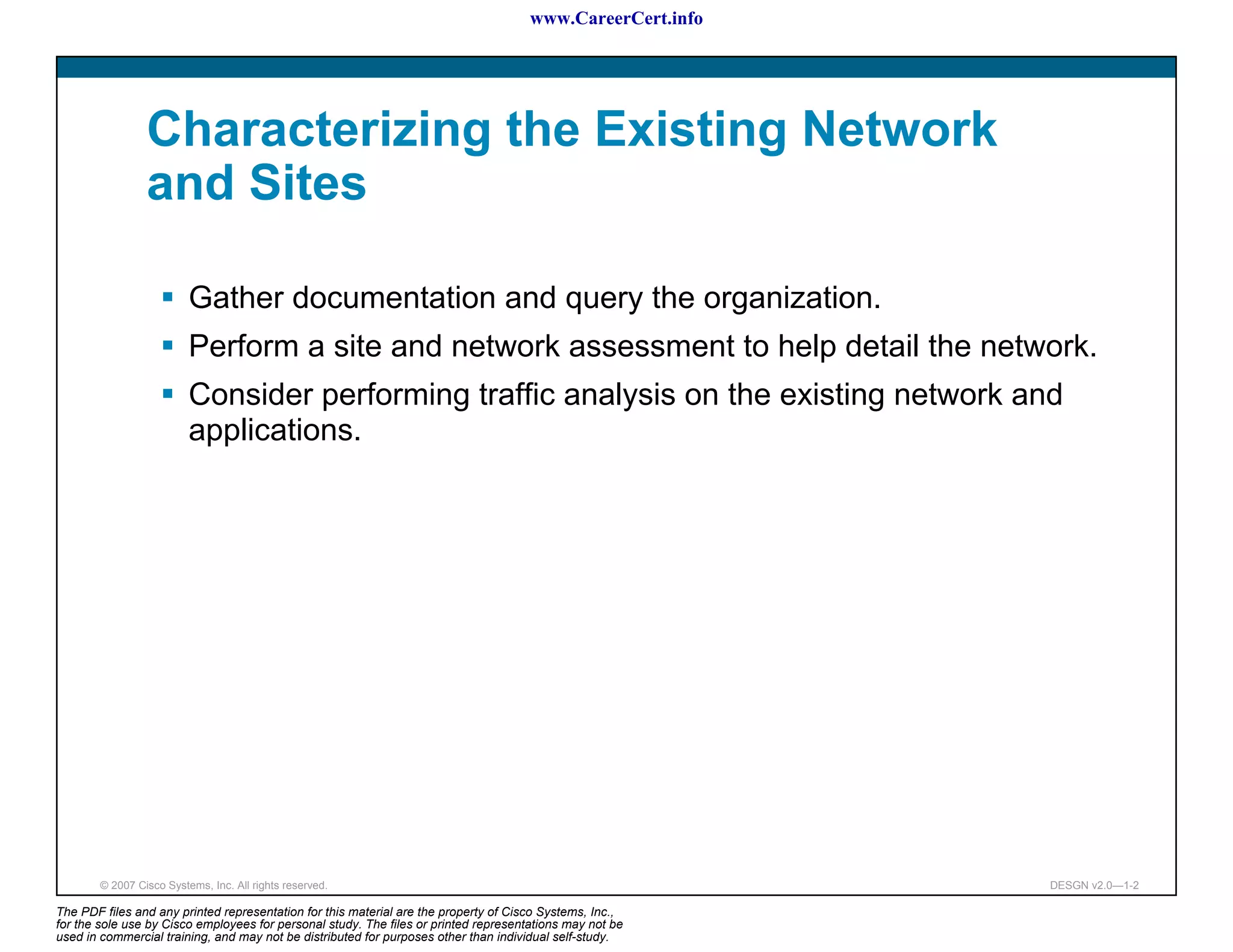
                 Characterizing the Existing Network
                 and Sites

                          Gather documentation and query the organization.
                          Perform a site and network assessment to help detail the network.
                          Consider performing traffic analysis on the existing network and
                          applications.


        © 2007 Cisco Systems, Inc. All rights reserved.                                                     DESGN v2.0—1-2

The PDF files and any printed representation for this material are the property of Cisco Systems, Inc.,
for the sole use by Cisco employees for personal study. The files or printed representations may not be
used in commercial training, and may not be distributed for purposes other than individual self-study.
www.CareerCert.info


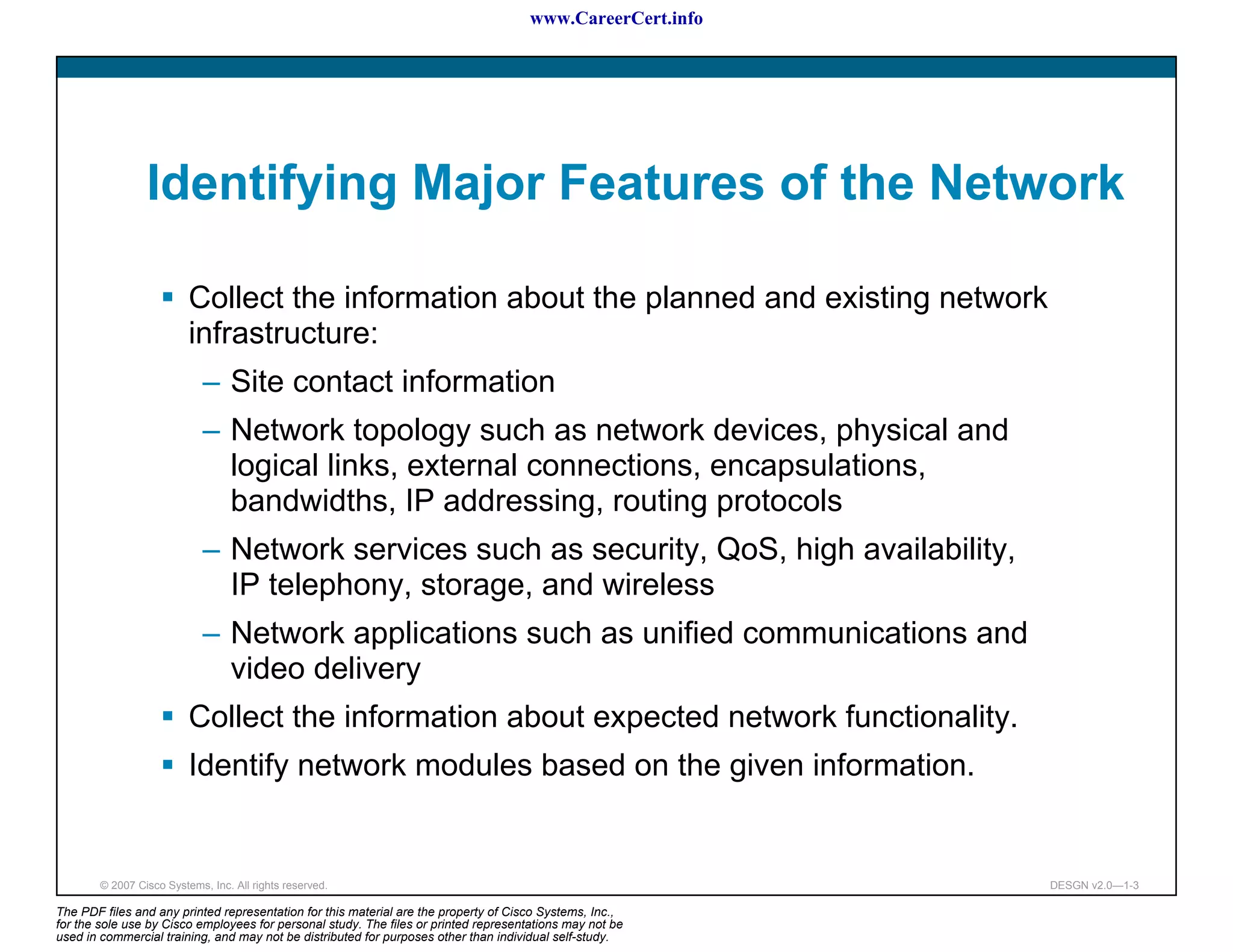
                 Identifying Major Features of the Network

                          Collect the information about the planned and existing network
                          infrastructure:
                             – Site contact information
                             – Network topology such as network devices, physical and
                               logical links, external connections, encapsulations,
                               bandwidths, IP addressing, routing protocols
                             – Network services such as security, QoS, high availability,
                               IP telephony, storage, and wireless
                             – Network applications such as unified communications and
                               video delivery
                          Collect the information about expected network functionality.
                          Identify network modules based on the given information.


        © 2007 Cisco Systems, Inc. All rights reserved.                                                     DESGN v2.0—1-3

The PDF files and any printed representation for this material are the property of Cisco Systems, Inc.,
for the sole use by Cisco employees for personal study. The files or printed representations may not be
used in commercial training, and may not be distributed for purposes other than individual self-study.
www.CareerCert.info


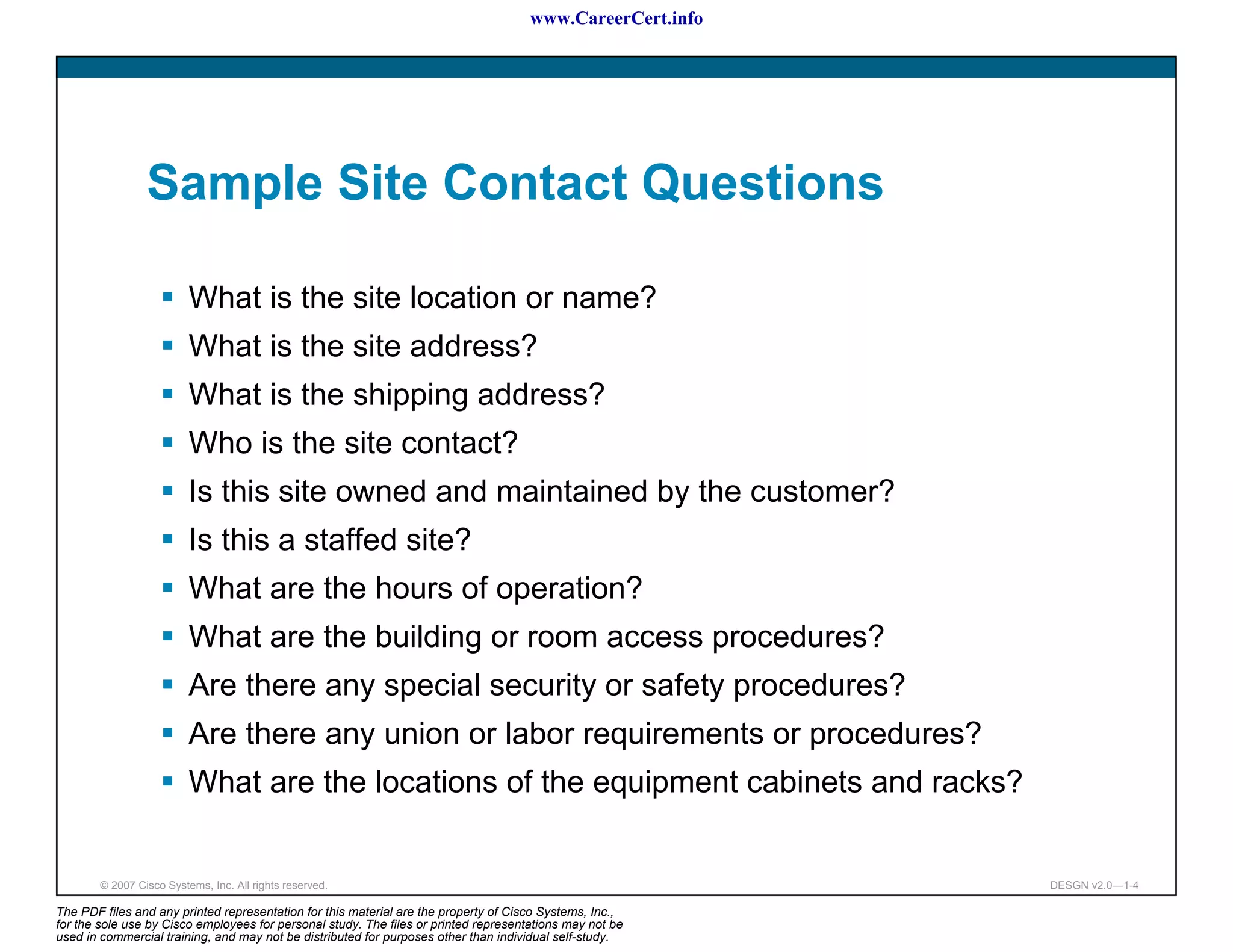
                 Sample Site Contact Questions

                          What is the site location or name?
                          What is the site address?
                          What is the shipping address?
                          Who is the site contact?
                          Is this site owned and maintained by the customer?
                          Is this a staffed site?
                          What are the hours of operation?
                          What are the building or room access procedures?
                          Are there any special security or safety procedures?
                          Are there any union or labor requirements or procedures?
                          What are the locations of the equipment cabinets and racks?


        © 2007 Cisco Systems, Inc. All rights reserved.                                                     DESGN v2.0—1-4

The PDF files and any printed representation for this material are the property of Cisco Systems, Inc.,
for the sole use by Cisco employees for personal study. The files or printed representations may not be
used in commercial training, and may not be distributed for purposes other than individual self-study.
www.CareerCert.info


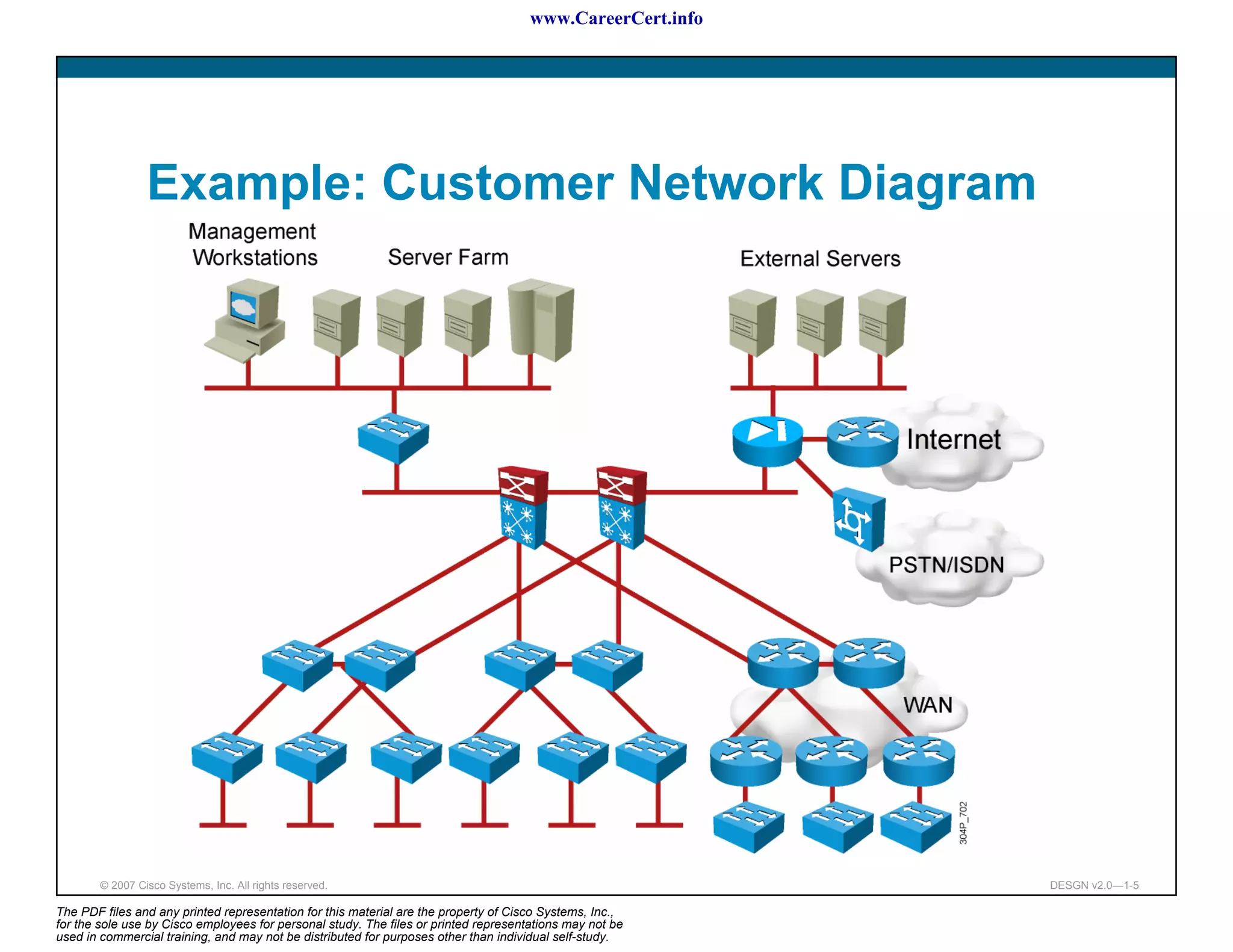
                 Example: Customer Network Diagram


        © 2007 Cisco Systems, Inc. All rights reserved.                                                     DESGN v2.0—1-5

The PDF files and any printed representation for this material are the property of Cisco Systems, Inc.,
for the sole use by Cisco employees for personal study. The files or printed representations may not be
used in commercial training, and may not be distributed for purposes other than individual self-study.
www.CareerCert.info


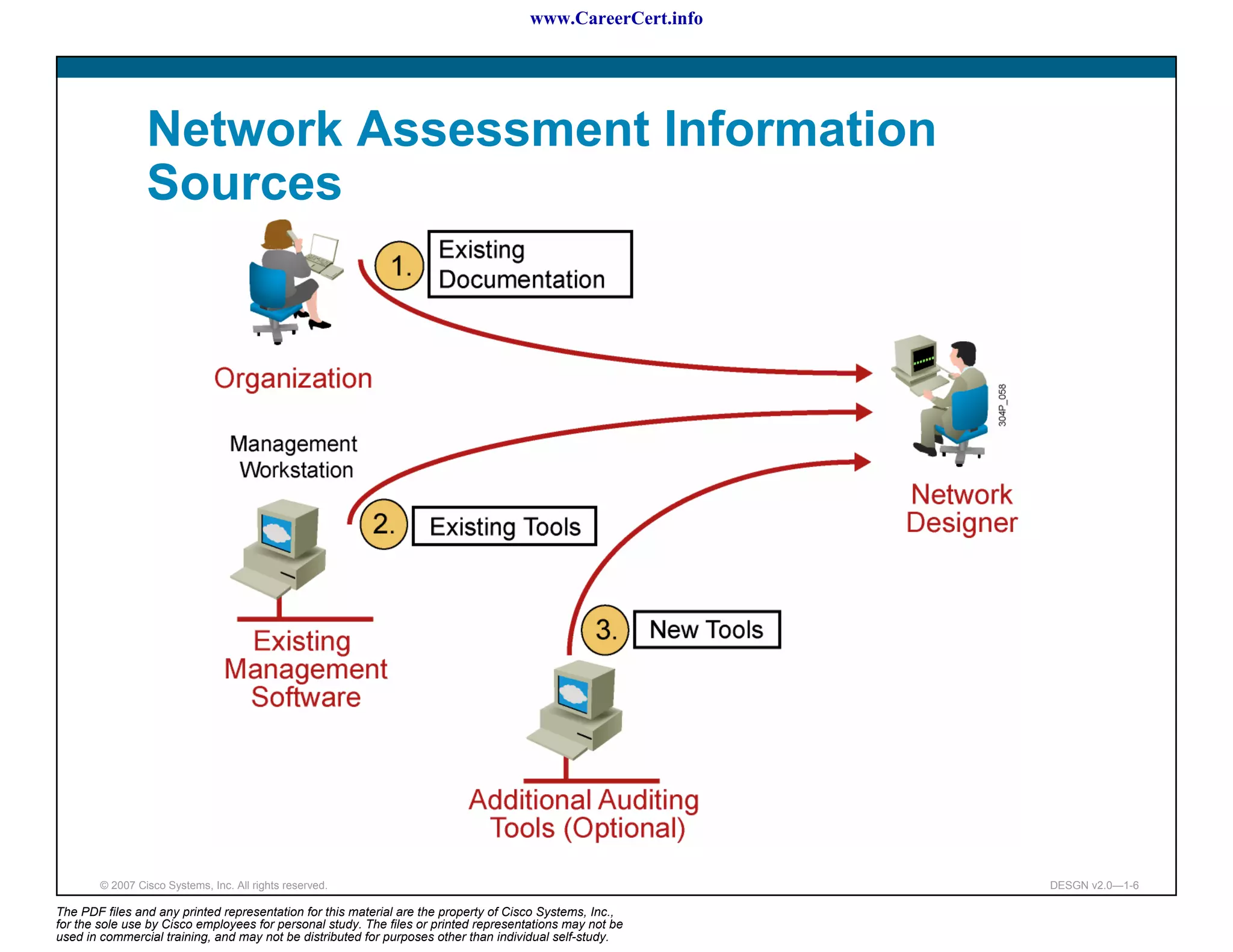
                 Network Assessment Information
                 Sources


        © 2007 Cisco Systems, Inc. All rights reserved.                                                     DESGN v2.0—1-6

The PDF files and any printed representation for this material are the property of Cisco Systems, Inc.,
for the sole use by Cisco employees for personal study. The files or printed representations may not be
used in commercial training, and may not be distributed for purposes other than individual self-study.
www.CareerCert.info


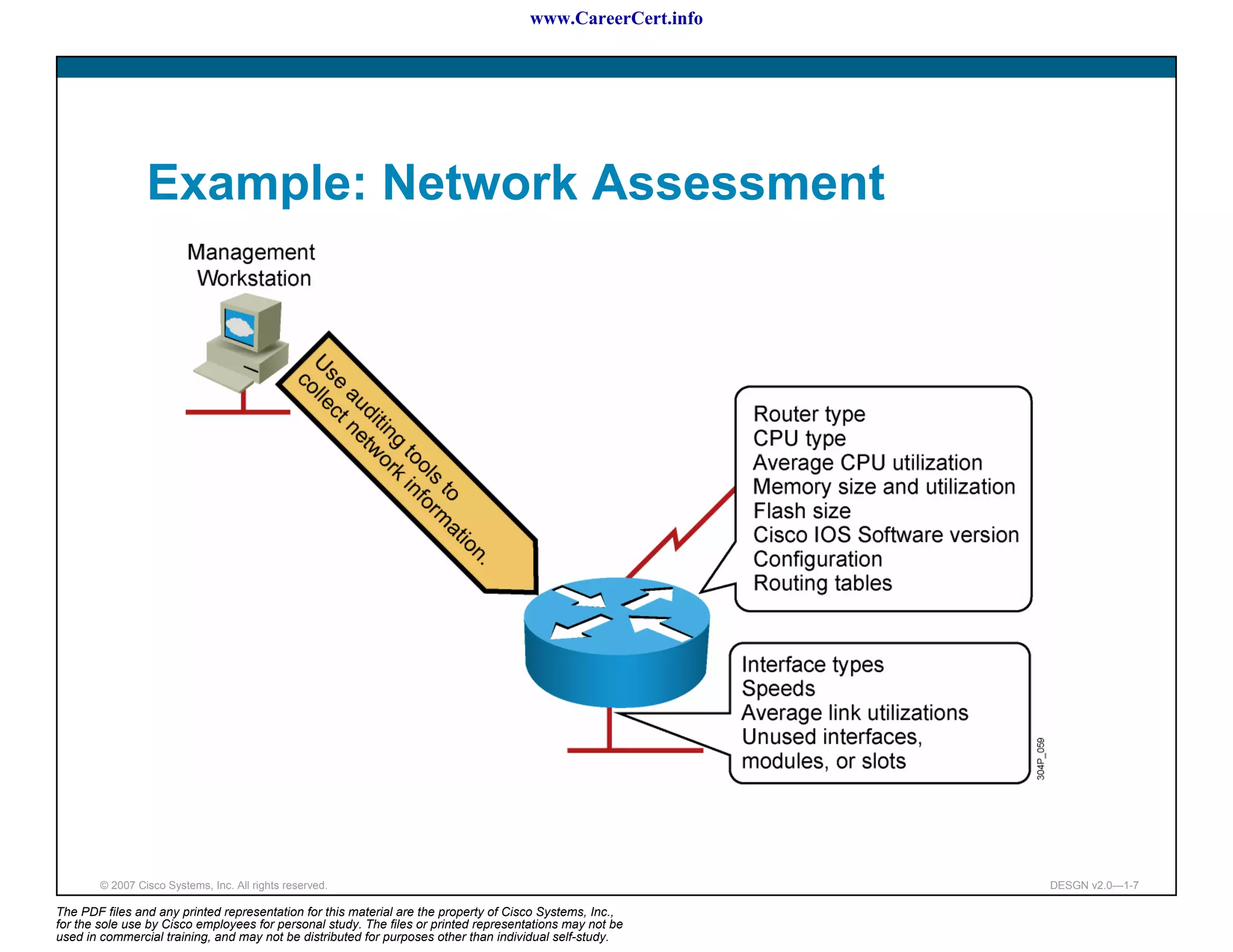
                 Example: Network Assessment


        © 2007 Cisco Systems, Inc. All rights reserved.                                                     DESGN v2.0—1-7

The PDF files and any printed representation for this material are the property of Cisco Systems, Inc.,
for the sole use by Cisco employees for personal study. The files or printed representations may not be
used in commercial training, and may not be distributed for purposes other than individual self-study.
www.CareerCert.info


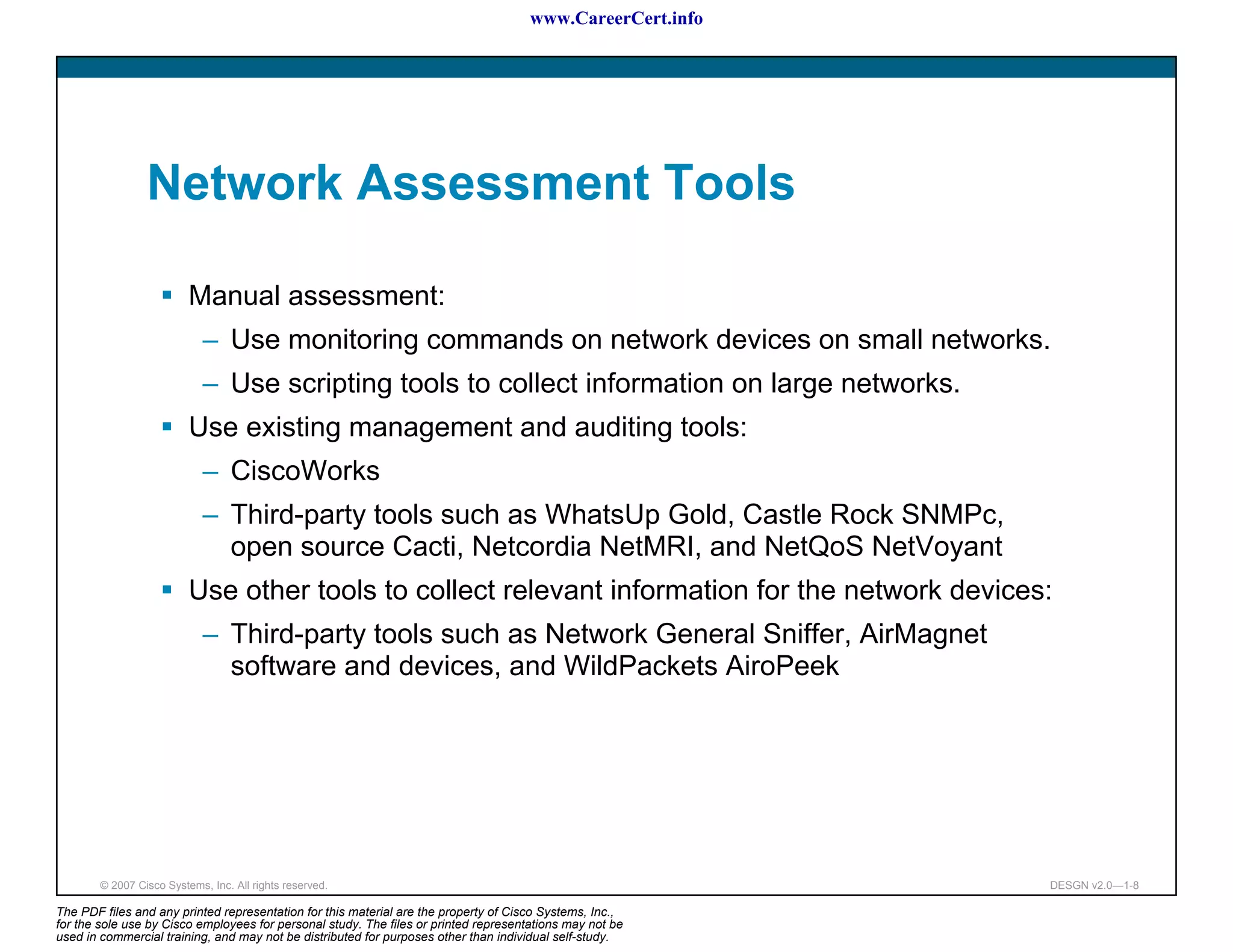
                 Network Assessment Tools

                          Manual assessment:
                             – Use monitoring commands on network devices on small networks.
                             – Use scripting tools to collect information on large networks.
                          Use existing management and auditing tools:
                             – CiscoWorks
                             – Third-party tools such as WhatsUp Gold, Castle Rock SNMPc,
                               open source Cacti, Netcordia NetMRI, and NetQoS NetVoyant
                          Use other tools to collect relevant information for the network devices:
                             – Third-party tools such as Network General Sniffer, AirMagnet
                               software and devices, and WildPackets AiroPeek


        © 2007 Cisco Systems, Inc. All rights reserved.                                                     DESGN v2.0—1-8

The PDF files and any printed representation for this material are the property of Cisco Systems, Inc.,
for the sole use by Cisco employees for personal study. The files or printed representations may not be
used in commercial training, and may not be distributed for purposes other than individual self-study.
www.CareerCert.info


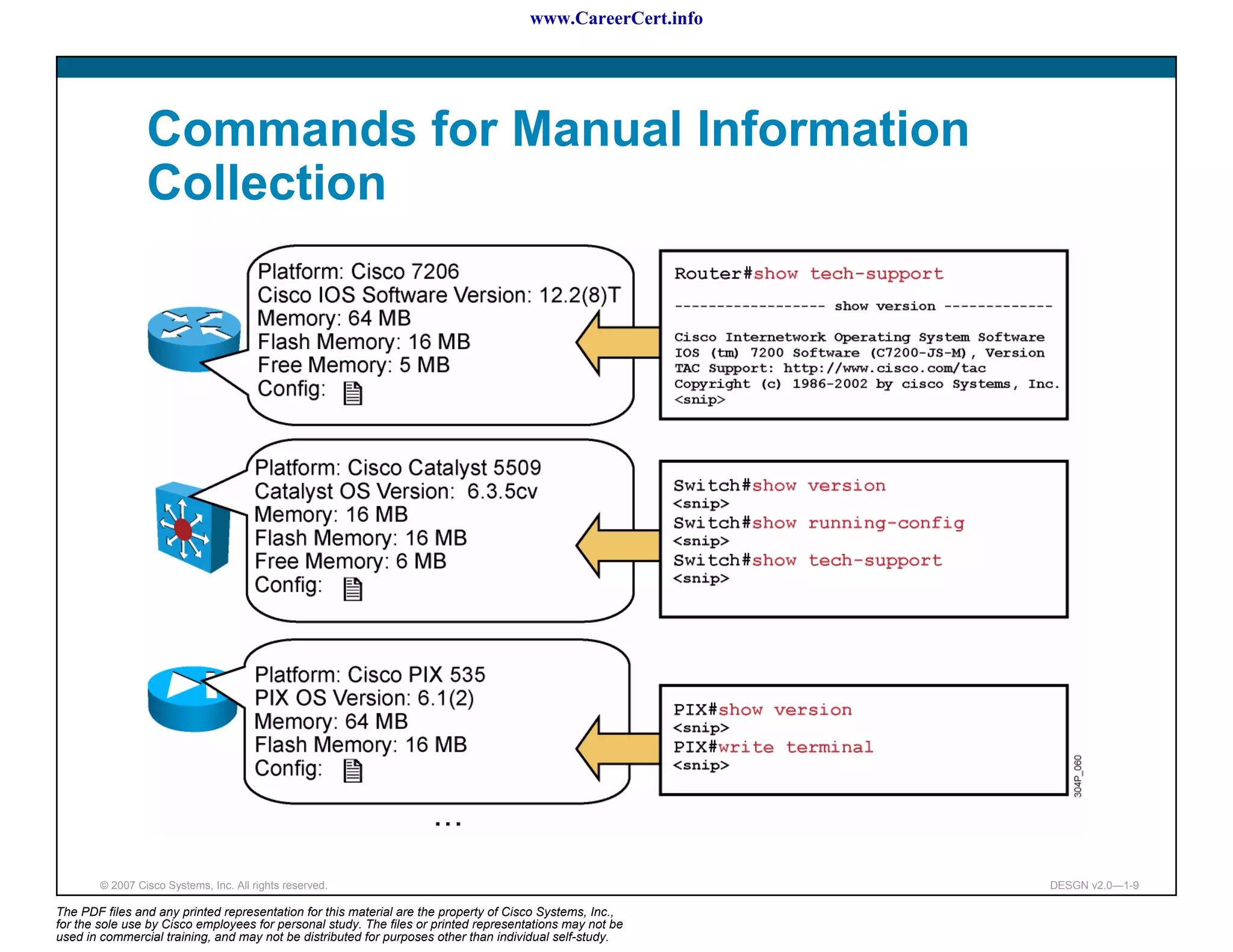
                 Commands for Manual Information
                 Collection


        © 2007 Cisco Systems, Inc. All rights reserved.                                                     DESGN v2.0—1-9

The PDF files and any printed representation for this material are the property of Cisco Systems, Inc.,
for the sole use by Cisco employees for personal study. The files or printed representations may not be
used in commercial training, and may not be distributed for purposes other than individual self-study.
www.CareerCert.info


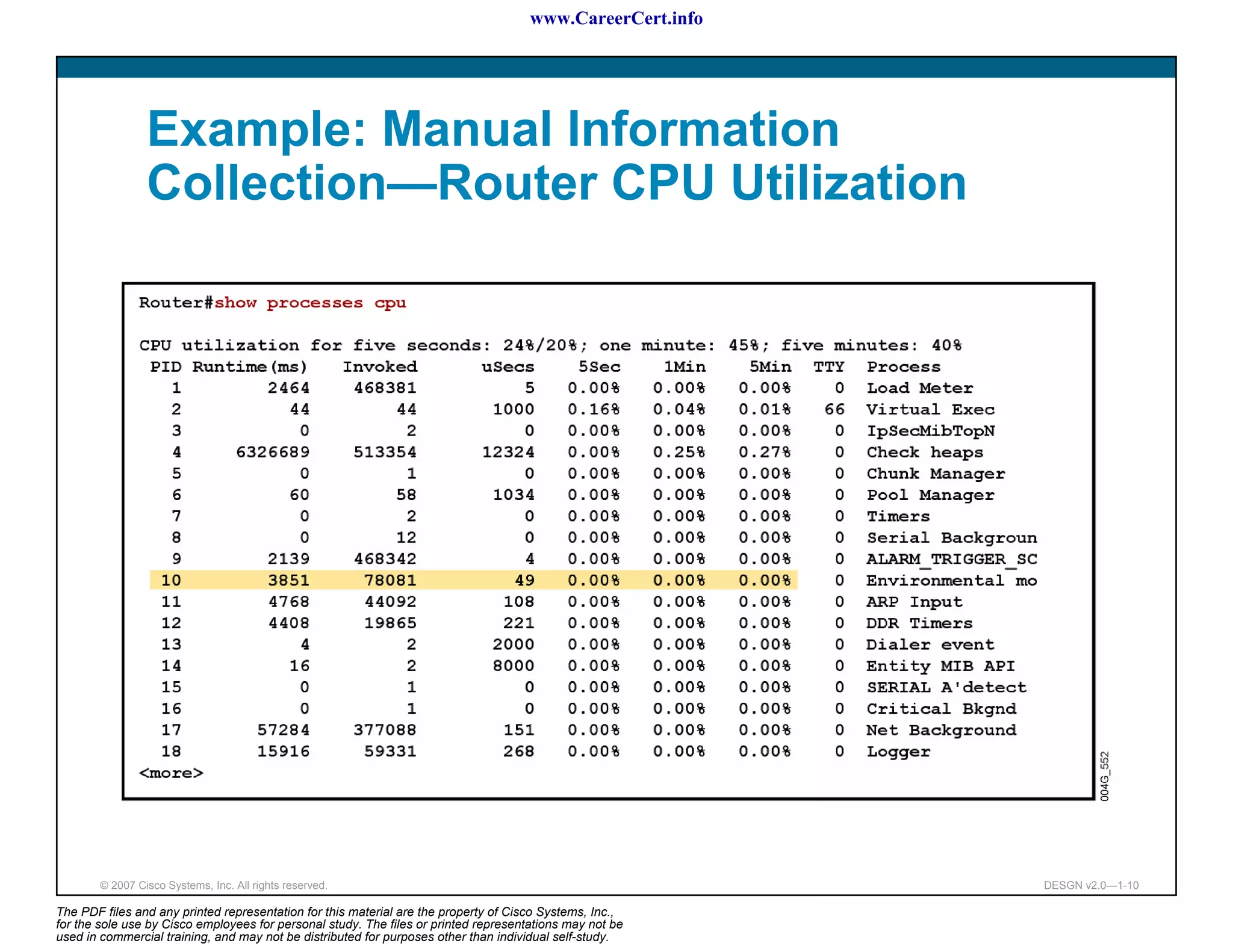
                 Example: Manual Information
                 Collection—Router CPU Utilization


        © 2007 Cisco Systems, Inc. All rights reserved.                                                     DESGN v2.0—1-10

The PDF files and any printed representation for this material are the property of Cisco Systems, Inc.,
for the sole use by Cisco employees for personal study. The files or printed representations may not be
used in commercial training, and may not be distributed for purposes other than individual self-study.
www.CareerCert.info


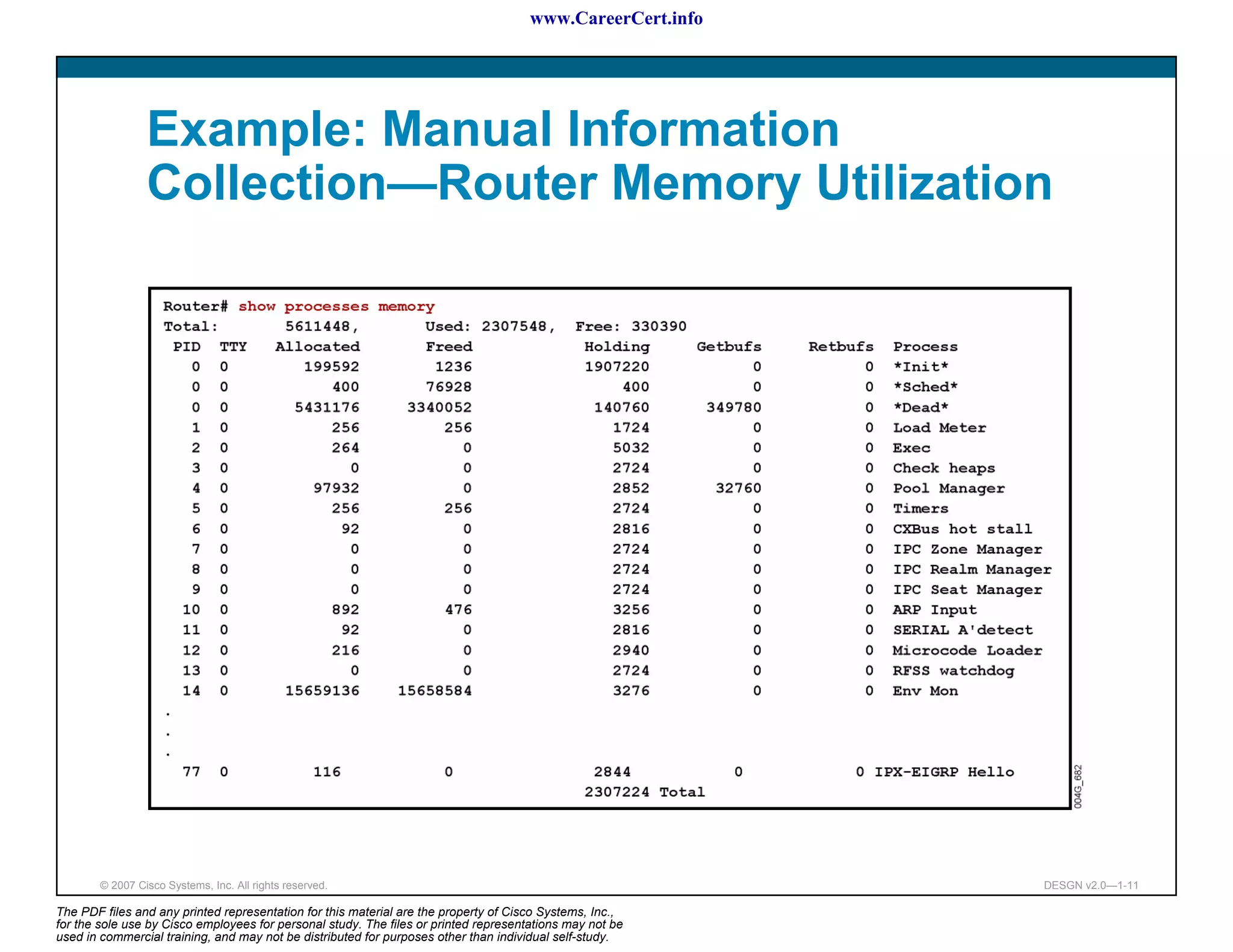
                 Example: Manual Information
                 Collection—Router Memory Utilization


        © 2007 Cisco Systems, Inc. All rights reserved.                                                     DESGN v2.0—1-11

The PDF files and any printed representation for this material are the property of Cisco Systems, Inc.,
for the sole use by Cisco employees for personal study. The files or printed representations may not be
used in commercial training, and may not be distributed for purposes other than individual self-study.
www.CareerCert.info


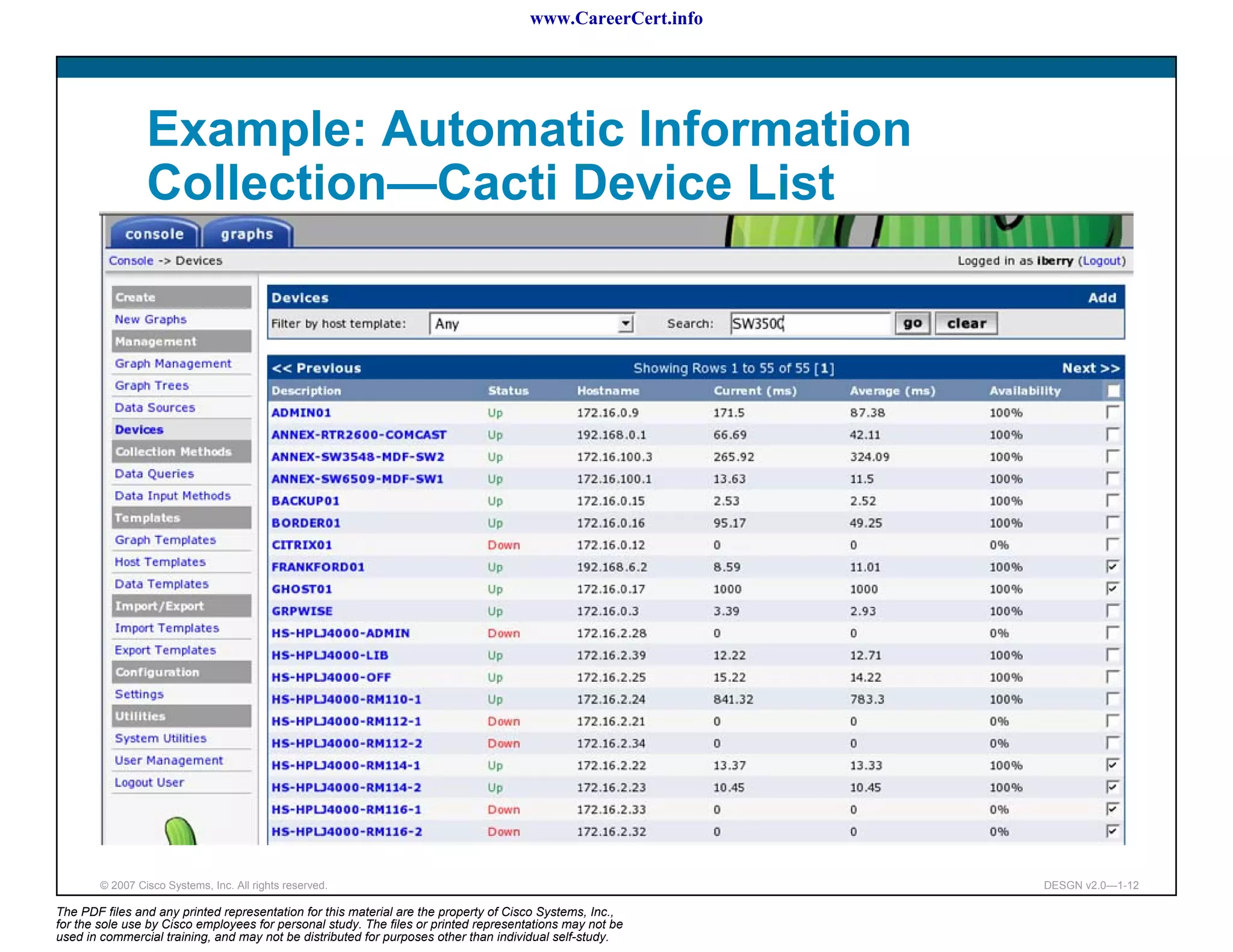
                 Example: Automatic Information
                 Collection—Cacti Device List


        © 2007 Cisco Systems, Inc. All rights reserved.                                                     DESGN v2.0—1-12

The PDF files and any printed representation for this material are the property of Cisco Systems, Inc.,
for the sole use by Cisco employees for personal study. The files or printed representations may not be
used in commercial training, and may not be distributed for purposes other than individual self-study.
www.CareerCert.info


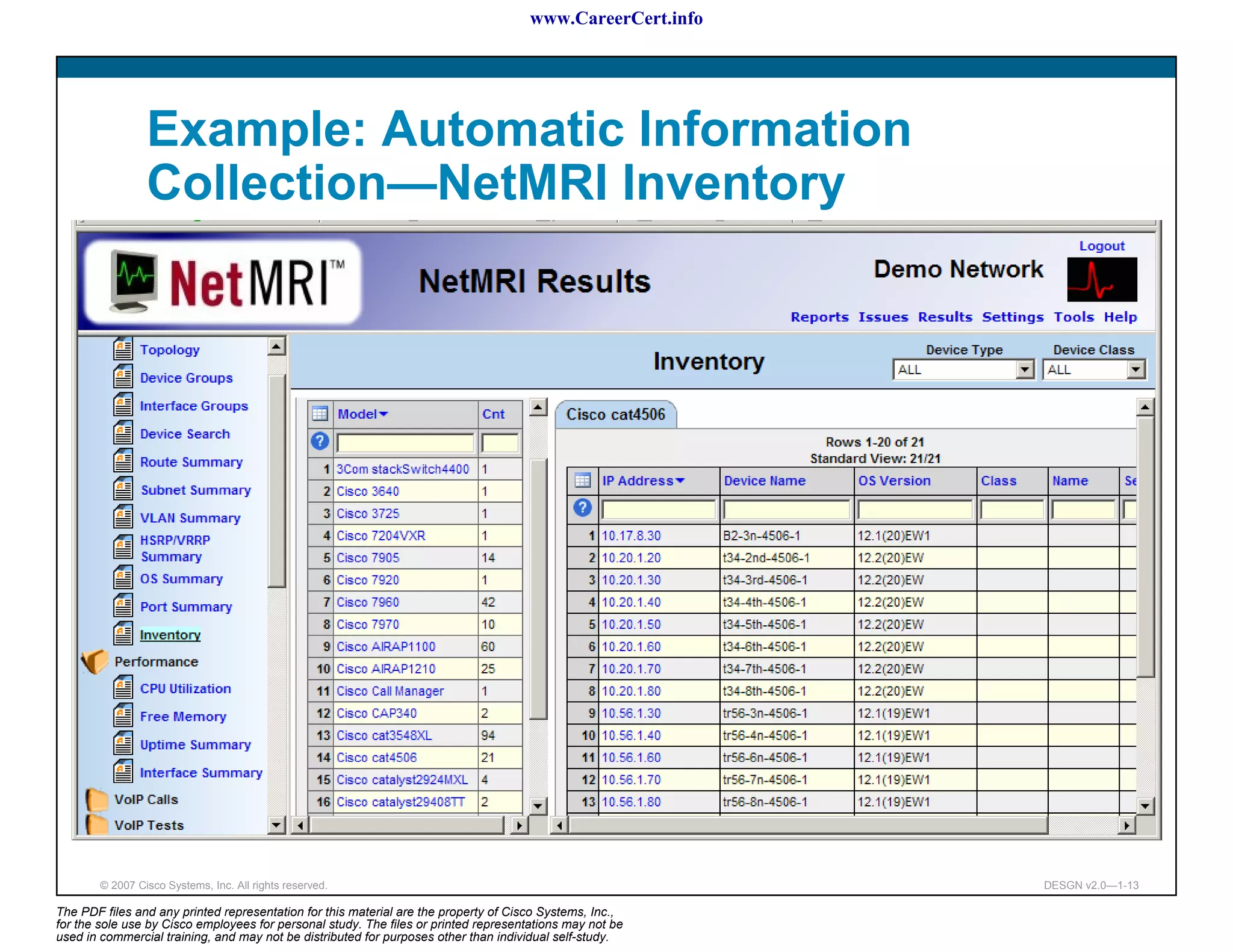
                 Example: Automatic Information
                 Collection—NetMRI Inventory


        © 2007 Cisco Systems, Inc. All rights reserved.                                                     DESGN v2.0—1-13

The PDF files and any printed representation for this material are the property of Cisco Systems, Inc.,
for the sole use by Cisco employees for personal study. The files or printed representations may not be
used in commercial training, and may not be distributed for purposes other than individual self-study.
www.CareerCert.info


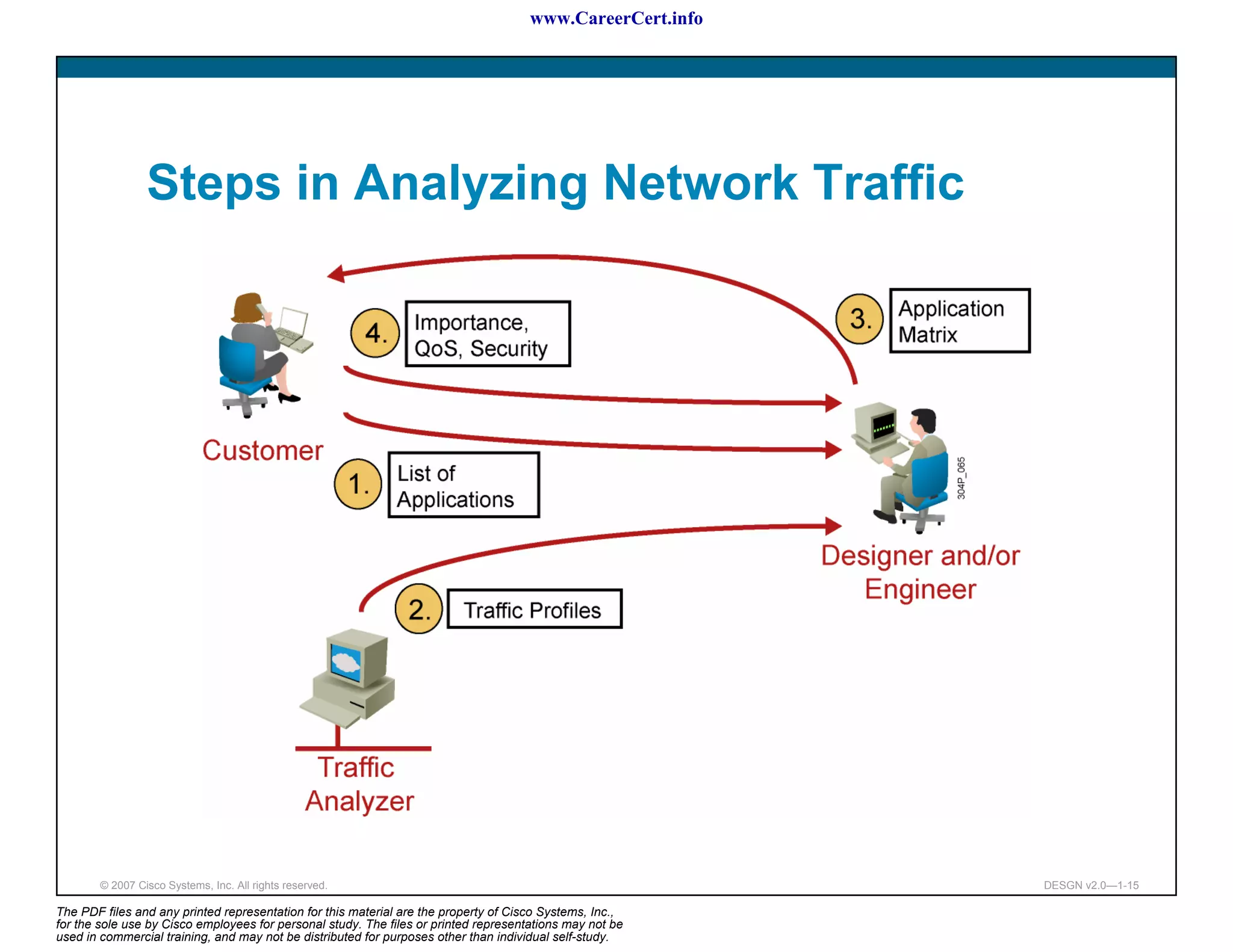
                 Network Traffic Analysis

                          Use organizational input to identify the applications used in the
                          existing network and their relative importance.
                          Perform a traffic analysis to reveal additional applications used in
                          the network.
                          Use the results and organizational input to define QoS and
                          security-related requirements for discovered applications.


        © 2007 Cisco Systems, Inc. All rights reserved.                                                     DESGN v2.0—1-14

The PDF files and any printed representation for this material are the property of Cisco Systems, Inc.,
for the sole use by Cisco employees for personal study. The files or printed representations may not be
used in commercial training, and may not be distributed for purposes other than individual self-study.
www.CareerCert.info


                 Steps in Analyzing Network Traffic


        © 2007 Cisco Systems, Inc. All rights reserved.                                                     DESGN v2.0—1-15

The PDF files and any printed representation for this material are the property of Cisco Systems, Inc.,
for the sole use by Cisco employees for personal study. The files or printed representations may not be
used in commercial training, and may not be distributed for purposes other than individual self-study.
www.CareerCert.info


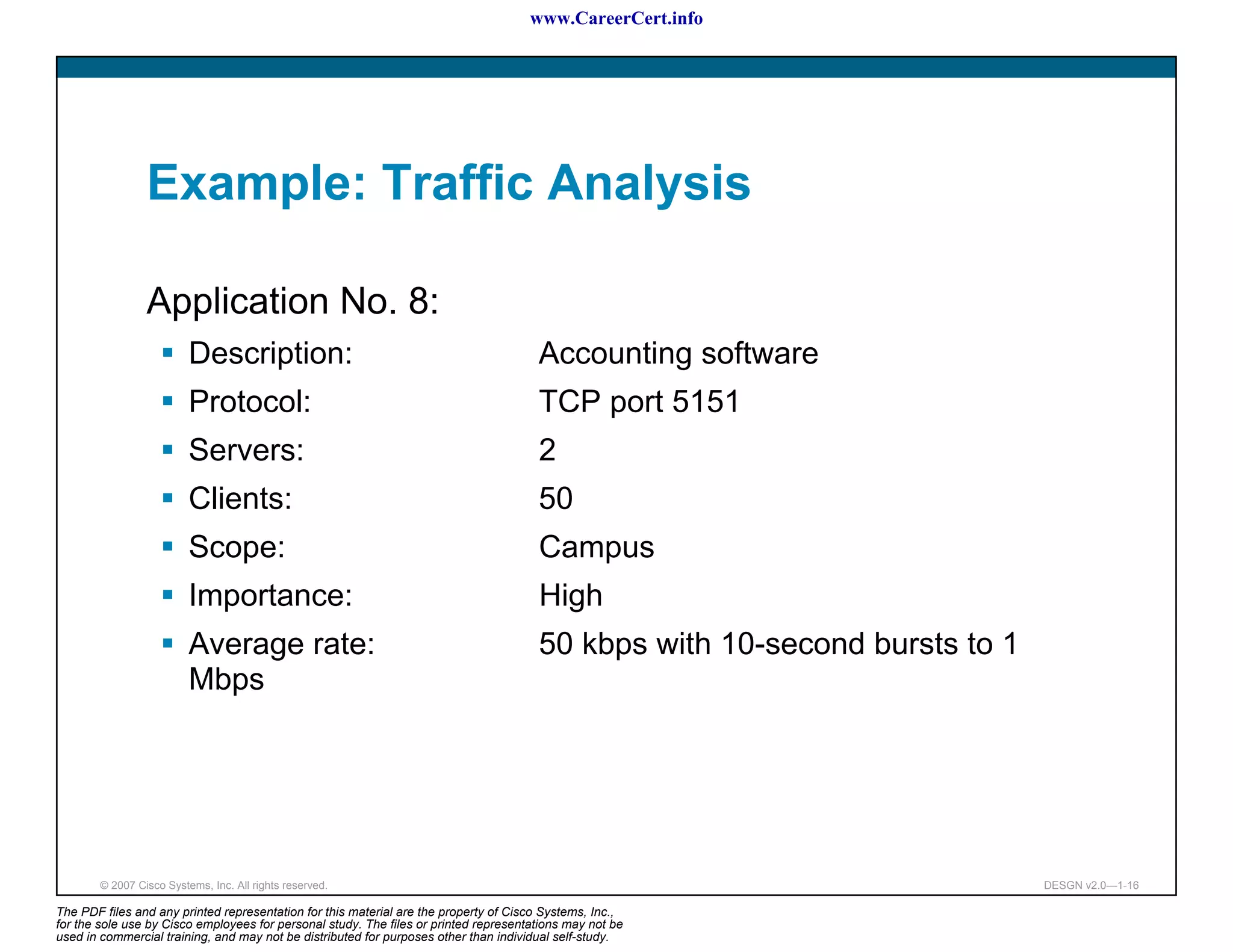
                 Example: Traffic Analysis

                 Application No. 8:
                          Description:                                                 Accounting software
                          Protocol:                                                    TCP port 5151
                          Servers:                                                     2
                          Clients:                                                     50
                          Scope:                                                       Campus
                          Importance:                                                  High
                          Average rate:                                                50 kbps with 10-second bursts to 1
                          Mbps


        © 2007 Cisco Systems, Inc. All rights reserved.                                                                     DESGN v2.0—1-16

The PDF files and any printed representation for this material are the property of Cisco Systems, Inc.,
for the sole use by Cisco employees for personal study. The files or printed representations may not be
used in commercial training, and may not be distributed for purposes other than individual self-study.
www.CareerCert.info


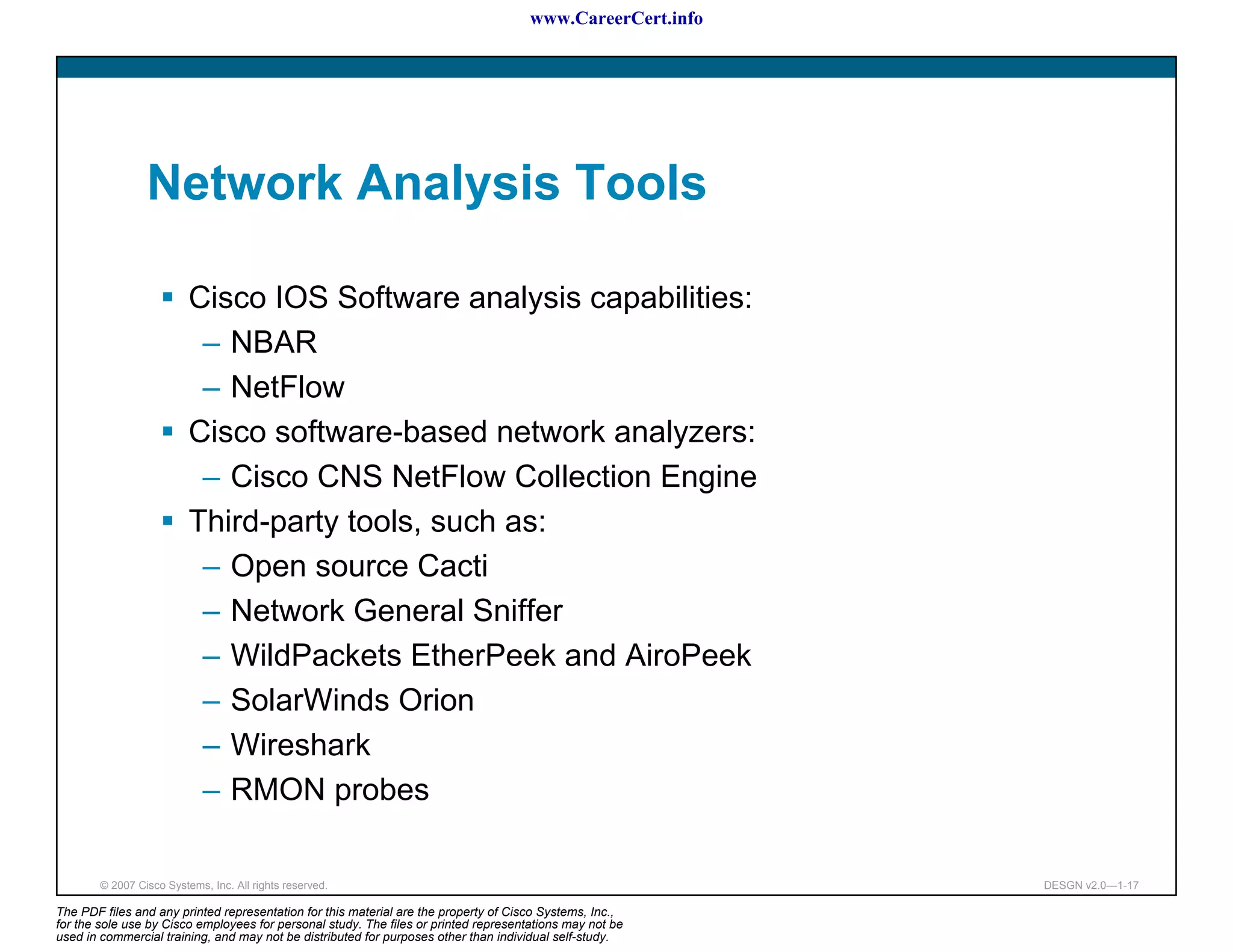
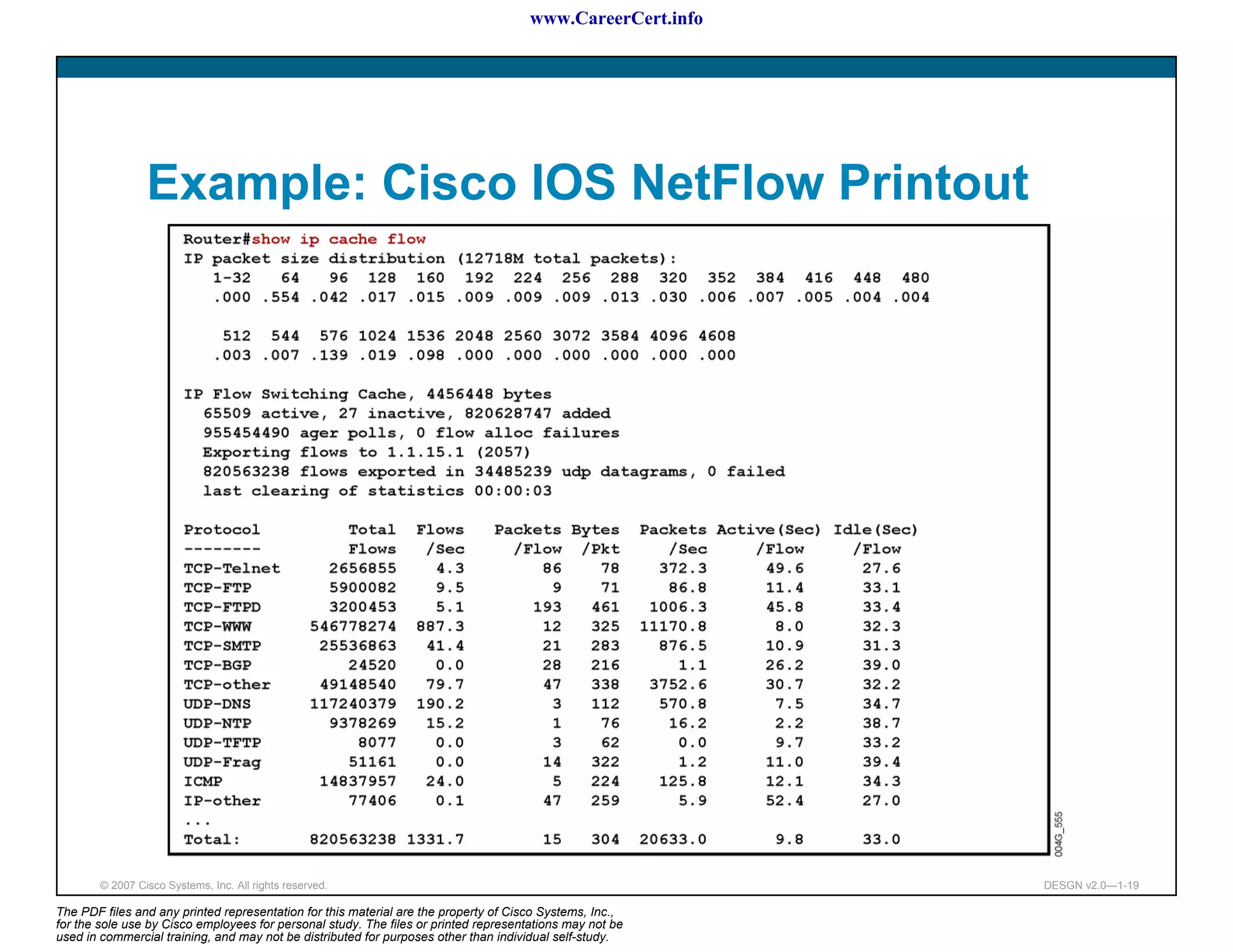
                 Network Analysis Tools

                          Cisco IOS Software analysis capabilities:
                           – NBAR
                           – NetFlow
                          Cisco software-based network analyzers:
                           – Cisco CNS NetFlow Collection Engine
                          Third-party tools, such as:
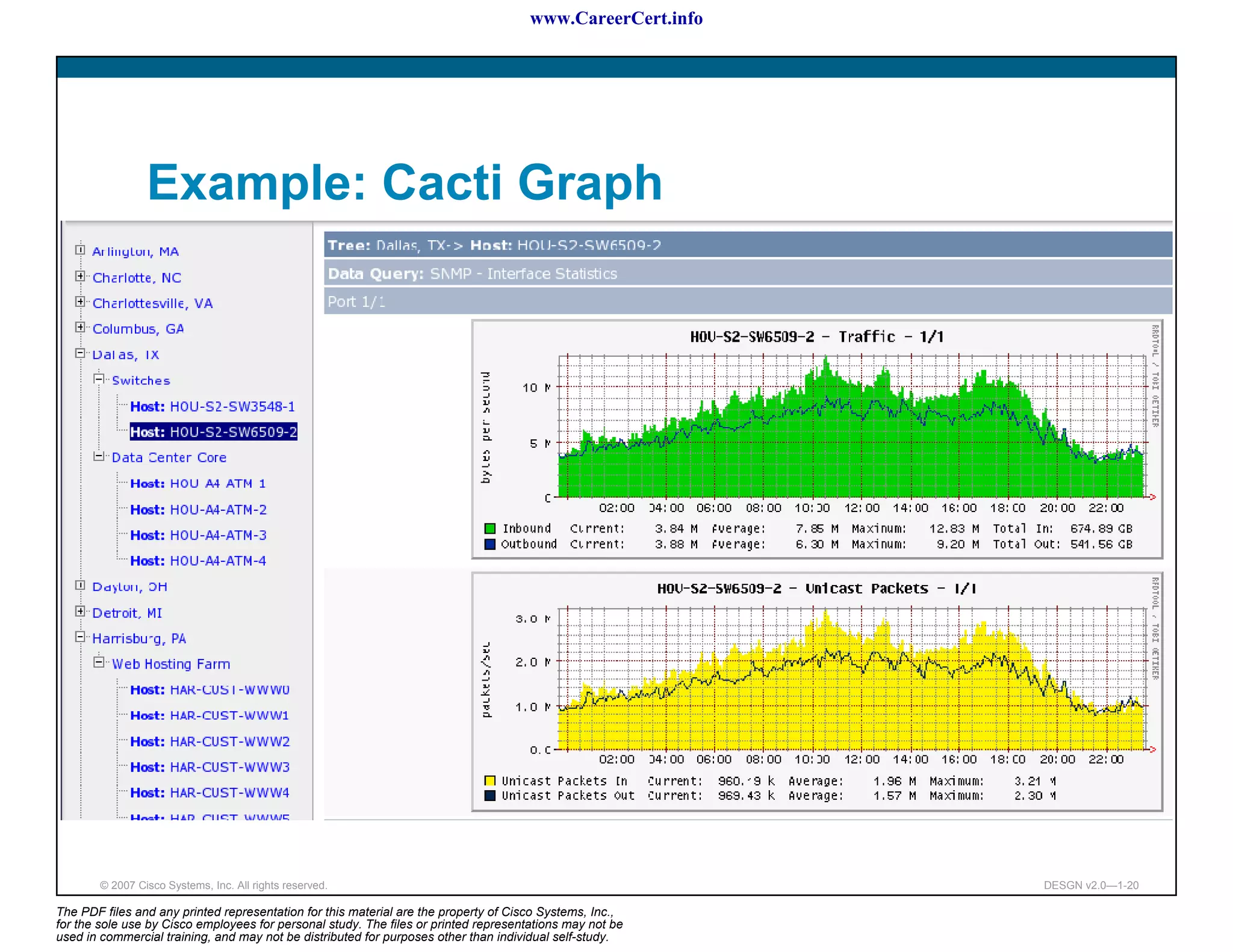
                           – Open source Cacti
                           – Network General Sniffer
                           – WildPackets EtherPeek and AiroPeek
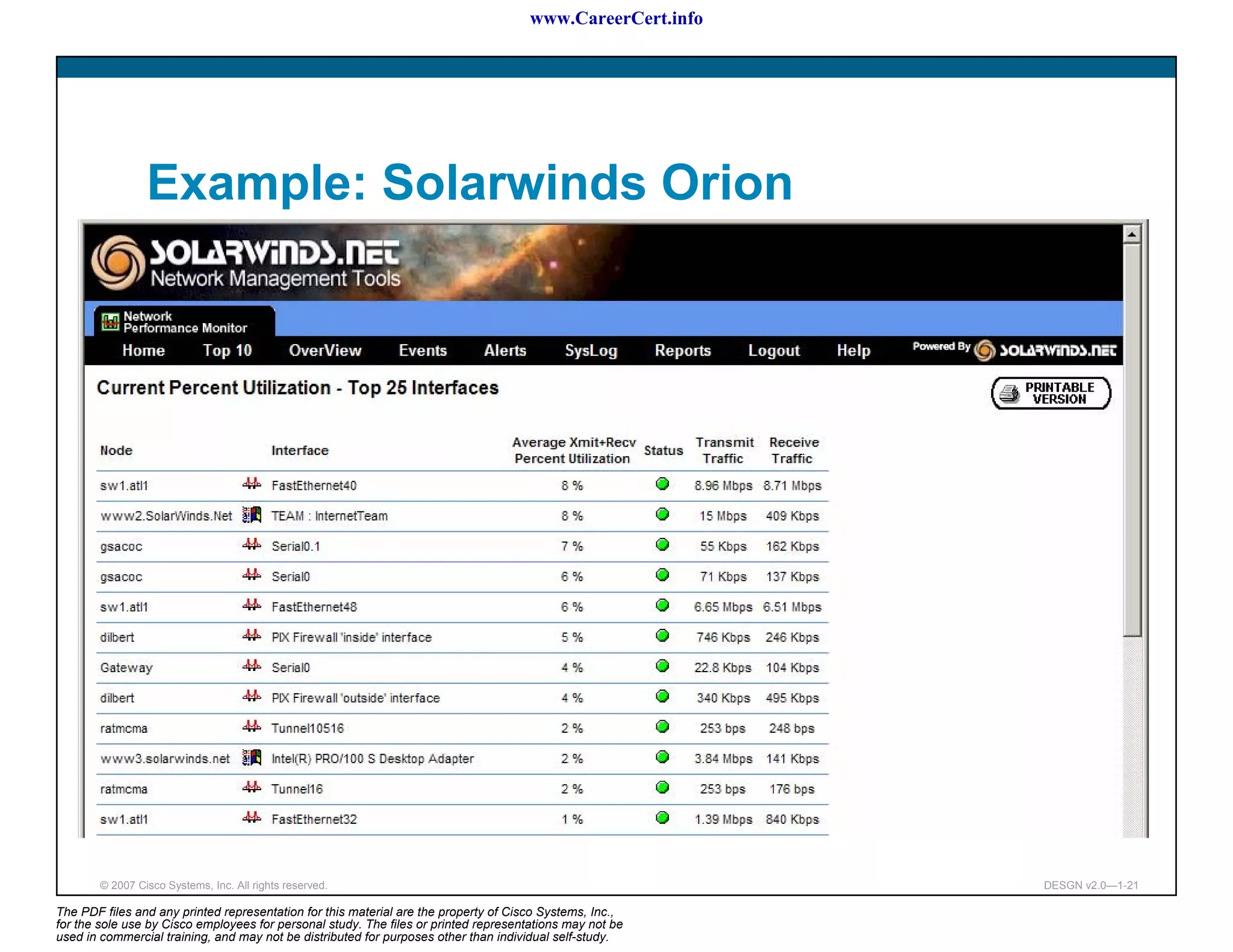
                           – SolarWinds Orion
                           – Wireshark
                           – RMON probes

        © 2007 Cisco Systems, Inc. All rights reserved.                                                     DESGN v2.0—1-17

The PDF files and any printed representation for this material are the property of Cisco Systems, Inc.,
for the sole use by Cisco employees for personal study. The files or printed representations may not be
used in commercial training, and may not be distributed for purposes other than individual self-study.
www.CareerCert.info


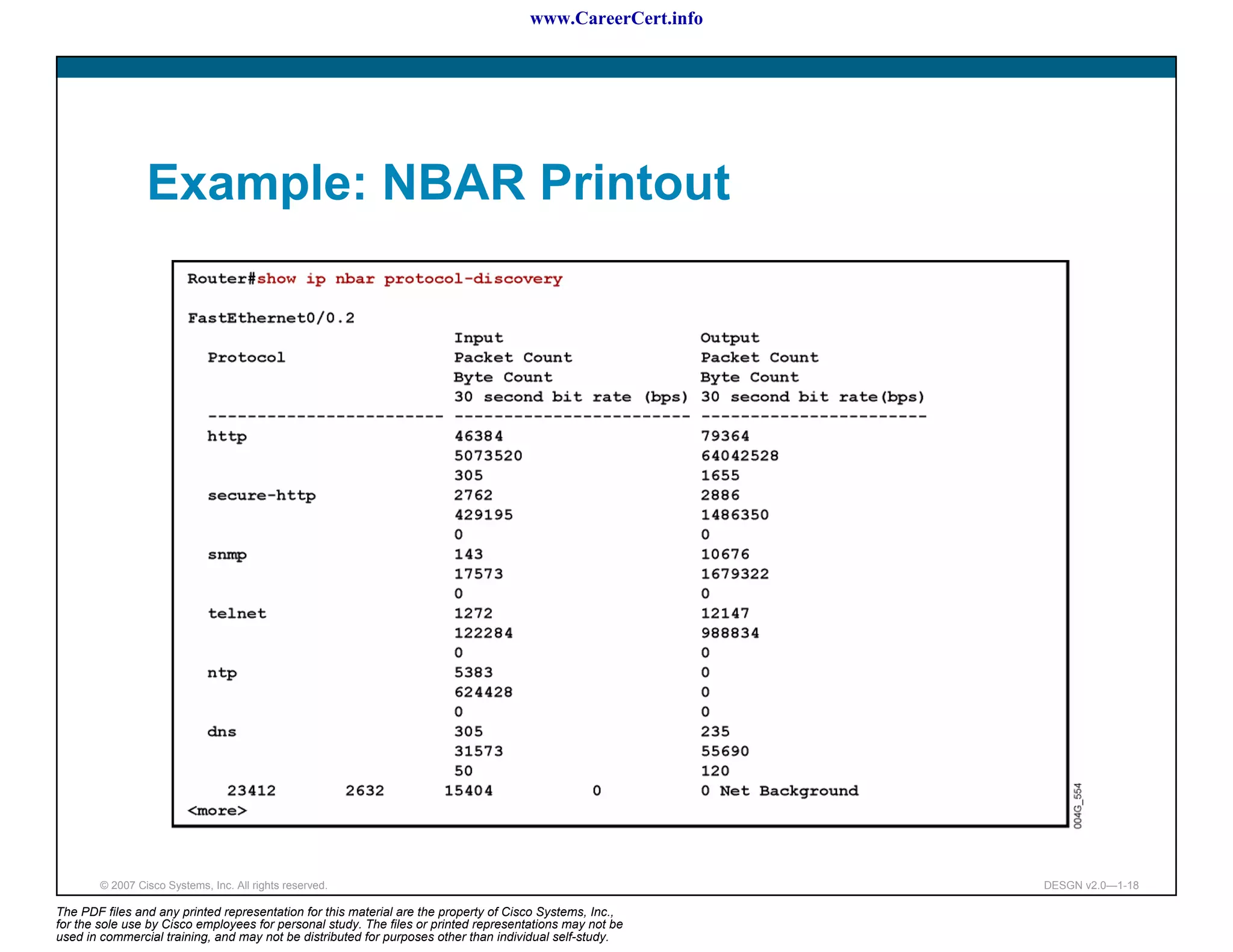
                 Example: NBAR Printout


        © 2007 Cisco Systems, Inc. All rights reserved.                                                     DESGN v2.0—1-18

The PDF files and any printed representation for this material are the property of Cisco Systems, Inc.,
for the sole use by Cisco employees for personal study. The files or printed representations may not be
used in commercial training, and may not be distributed for purposes other than individual self-study.
www.CareerCert.info


                 Example: Cisco IOS NetFlow Printout


        © 2007 Cisco Systems, Inc. All rights reserved.                                                     DESGN v2.0—1-19

The PDF files and any printed representation for this material are the property of Cisco Systems, Inc.,
for the sole use by Cisco employees for personal study. The files or printed representations may not be
used in commercial training, and may not be distributed for purposes other than individual self-study.
www.CareerCert.info


                 Example: Cacti Graph


        © 2007 Cisco Systems, Inc. All rights reserved.                                                     DESGN v2.0—1-20

The PDF files and any printed representation for this material are the property of Cisco Systems, Inc.,
for the sole use by Cisco employees for personal study. The files or printed representations may not be
used in commercial training, and may not be distributed for purposes other than individual self-study.
www.CareerCert.info


                 Example: Solarwinds Orion


        © 2007 Cisco Systems, Inc. All rights reserved.                                                     DESGN v2.0—1-21

The PDF files and any printed representation for this material are the property of Cisco Systems, Inc.,
for the sole use by Cisco employees for personal study. The files or printed representations may not be
used in commercial training, and may not be distributed for purposes other than individual self-study.
www.CareerCert.info


                 Summary Report

                 Characterization of the existing network results in a
                 summary report that is used to:
                          Describe the software features required in the network
                          Describe possible problems in the existing network
                          Identify the actions needed to prepare the network for the
                          implementation of the required features
                          Influence the customer requirements


        © 2007 Cisco Systems, Inc. All rights reserved.                                                     DESGN v2.0—1-22

The PDF files and any printed representation for this material are the property of Cisco Systems, Inc.,
for the sole use by Cisco employees for personal study. The files or printed representations may not be
used in commercial training, and may not be distributed for purposes other than individual self-study.
www.CareerCert.info


                 Example: Equipment Summary Report

                 The network uses 895 routers:
                          655 routers use Cisco IOS Software Release 12.2(10).
                          240 routers use an older Cisco IOS Software version.


        © 2007 Cisco Systems, Inc. All rights reserved.                                                     DESGN v2.0—1-23

The PDF files and any printed representation for this material are the property of Cisco Systems, Inc.,
for the sole use by Cisco employees for personal study. The files or printed representations may not be
used in commercial training, and may not be distributed for purposes other than individual self-study.
www.CareerCert.info


                 Example: Summary Report
                 Problem Statement

                          Requirement: Queuing in the WAN
                          Identified problem:
                           – Existing Cisco IOS Software version does not support new
                             queuing technologies.
                           – 15 out of 19 routers with older Cisco IOS Software are in the
                             WAN.
                           – 12 out of 15 routers do not have enough memory to upgrade to
                             Cisco IOS Software Release 12.3 or later.
                           – 5 out of 15 routers do not have enough flash memory to
                             upgrade to Cisco IOS Software Release 12.3 or later.


        © 2007 Cisco Systems, Inc. All rights reserved.                                                     DESGN v2.0—1-24

The PDF files and any printed representation for this material are the property of Cisco Systems, Inc.,
for the sole use by Cisco employees for personal study. The files or printed representations may not be
used in commercial training, and may not be distributed for purposes other than individual self-study.
www.CareerCert.info


                 Example: Summary Report
                 Recommendations

                          Recommended action:
                             – 12 memory upgrades to 64 MB
                             – 5 flash memory upgrades to 16 MB
                          Options:
                             – Replace hardware and software to support queuing.
                             – Find an alternative mechanism for that part of the network.
                             – Find an alternative mechanism and use it instead of queuing.
                             – Evaluate the consequences of not implementing the required
                               feature in that part of the network.


        © 2007 Cisco Systems, Inc. All rights reserved.                                                     DESGN v2.0—1-25

The PDF files and any printed representation for this material are the property of Cisco Systems, Inc.,
for the sole use by Cisco employees for personal study. The files or printed representations may not be
used in commercial training, and may not be distributed for purposes other than individual self-study.
www.CareerCert.info


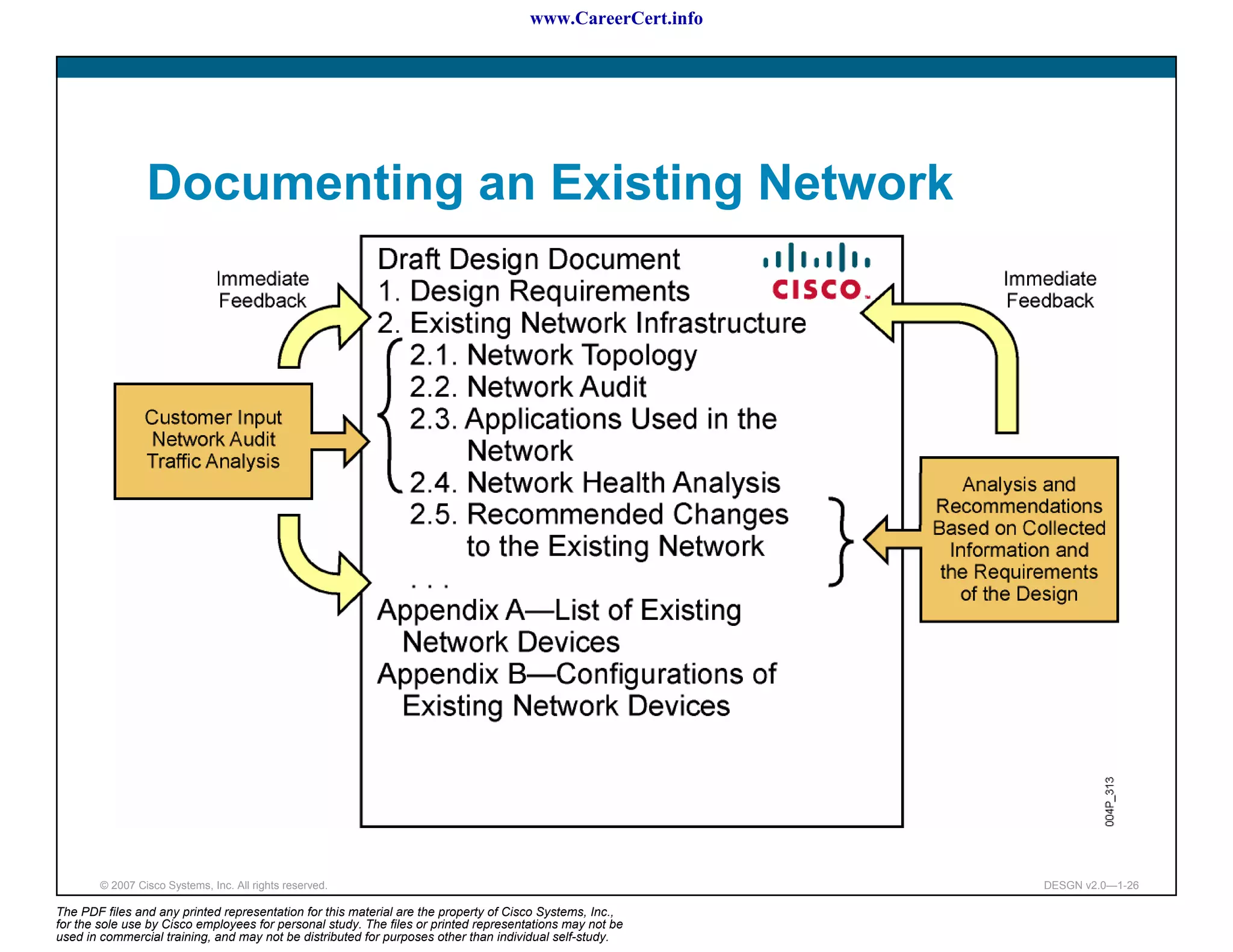
                 Documenting an Existing Network


        © 2007 Cisco Systems, Inc. All rights reserved.                                                     DESGN v2.0—1-26

The PDF files and any printed representation for this material are the property of Cisco Systems, Inc.,
for the sole use by Cisco employees for personal study. The files or printed representations may not be
used in commercial training, and may not be distributed for purposes other than individual self-study.
www.CareerCert.info


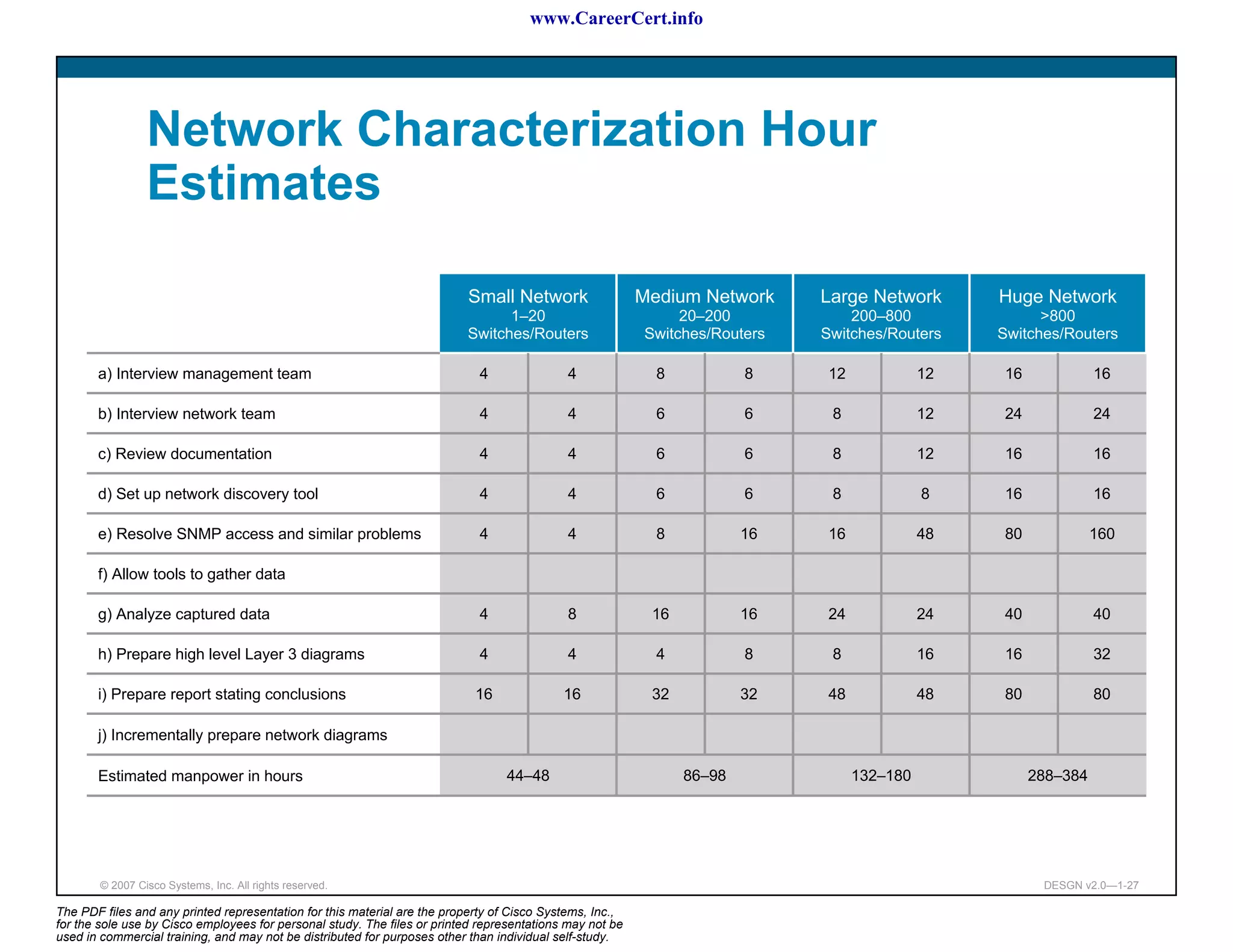
                 Network Characterization Hour
                 Estimates

                                                                          Small Network                   Medium Network     Large Network        Huge Network
                                                                                1–20                           20–200            200–800                >800
                                                                          Switches/Routers                Switches/Routers   Switches/Routers     Switches/Routers

       a) Interview management team                                         4               4               8           8     12             12    16             16

       b) Interview network team                                            4               4               6           6     8              12    24             24

       c) Review documentation                                              4               4               6           6     8              12    16             16

       d) Set up network discovery tool                                     4               4               6           6     8              8     16             16

       e) Resolve SNMP access and similar problems                          4               4               8           16    16             48    80             160

       f) Allow tools to gather data

       g) Analyze captured data                                             4               8              16           16    24             24    40             40

       h) Prepare high level Layer 3 diagrams                               4               4               4           8     8              16    16             32

       i) Prepare report stating conclusions                                16              16             32           32    48             48    80             80

       j) Incrementally prepare network diagrams

       Estimated manpower in hours                                               44–48                          86–98              132–180              288–384


        © 2007 Cisco Systems, Inc. All rights reserved.                                                                                                  DESGN v2.0—1-27

The PDF files and any printed representation for this material are the property of Cisco Systems, Inc.,
for the sole use by Cisco employees for personal study. The files or printed representations may not be
used in commercial training, and may not be distributed for purposes other than individual self-study.
www.CareerCert.info


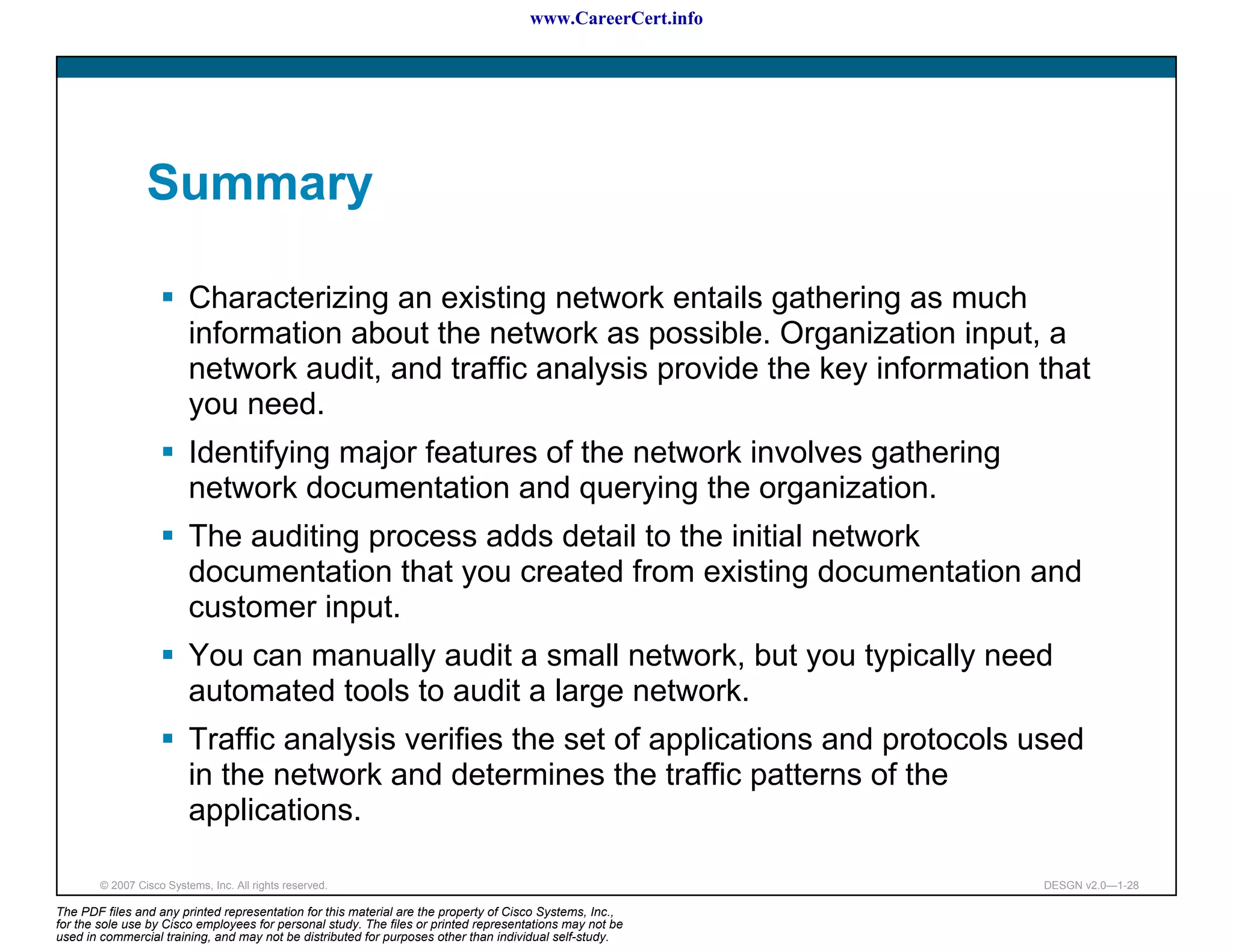
                 Summary

                          Characterizing an existing network entails gathering as much
                          information about the network as possible. Organization input, a
                          network audit, and traffic analysis provide the key information that
                          you need.
                          Identifying major features of the network involves gathering
                          network documentation and querying the organization.
                          The auditing process adds detail to the initial network
                          documentation that you created from existing documentation and
                          customer input.
                          You can manually audit a small network, but you typically need
                          automated tools to audit a large network.
                          Traffic analysis verifies the set of applications and protocols used
                          in the network and determines the traffic patterns of the
                          applications.

        © 2007 Cisco Systems, Inc. All rights reserved.                                                     DESGN v2.0—1-28

The PDF files and any printed representation for this material are the property of Cisco Systems, Inc.,
for the sole use by Cisco employees for personal study. The files or printed representations may not be
used in commercial training, and may not be distributed for purposes other than individual self-study.
www.CareerCert.info


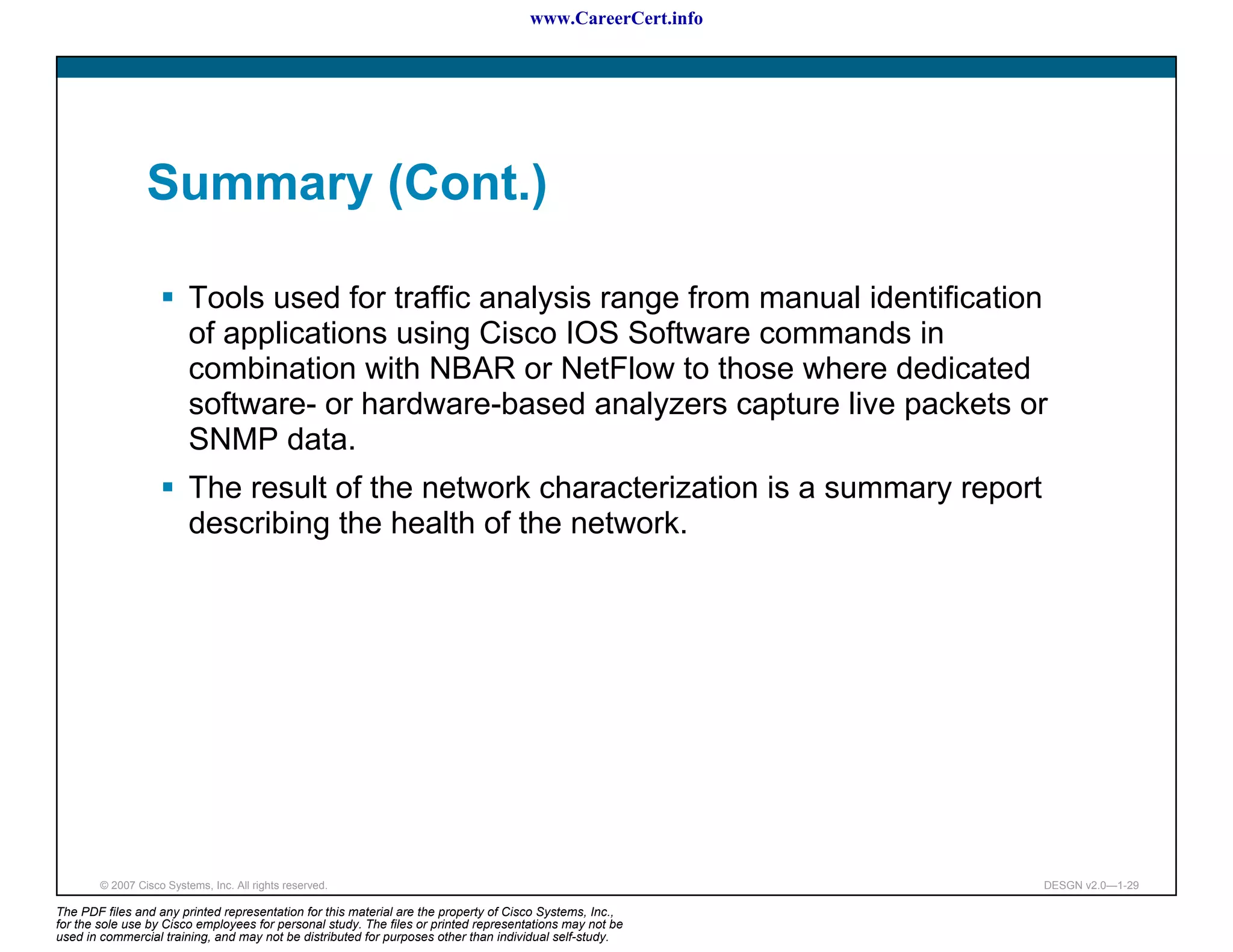
                 Summary (Cont.)

                          Tools used for traffic analysis range from manual identification
                          of applications using Cisco IOS Software commands in
                          combination with NBAR or NetFlow to those where dedicated
                          software- or hardware-based analyzers capture live packets or
                          SNMP data.
                          The result of the network characterization is a summary report
                          describing the health of the network.


        © 2007 Cisco Systems, Inc. All rights reserved.                                                     DESGN v2.0—1-29

The PDF files and any printed representation for this material are the property of Cisco Systems, Inc.,
for the sole use by Cisco employees for personal study. The files or printed representations may not be
used in commercial training, and may not be distributed for purposes other than individual self-study.
www.CareerCert.info


        © 2007 Cisco Systems, Inc. All rights reserved.                                                     DESGN v2.0—1-30

The PDF files and any printed representation for this material are the property of Cisco Systems, Inc.,
for the sole use by Cisco employees for personal study. The files or printed representations may not be
used in commercial training, and may not be distributed for purposes other than individual self-study.
www.CareerCert.info


                 Using the Top-Down
                 Approach to Network
                 Design


                 Applying a Methodology to Network Design


        © 2007 Cisco Systems, Inc. All rights reserved.                                                     DESGN v2.0—1-1

The PDF files and any printed representation for this material are the property of Cisco Systems, Inc.,
for the sole use by Cisco employees for personal study. The files or printed representations may not be
used in commercial training, and may not be distributed for purposes other than individual self-study.
www.CareerCert.info


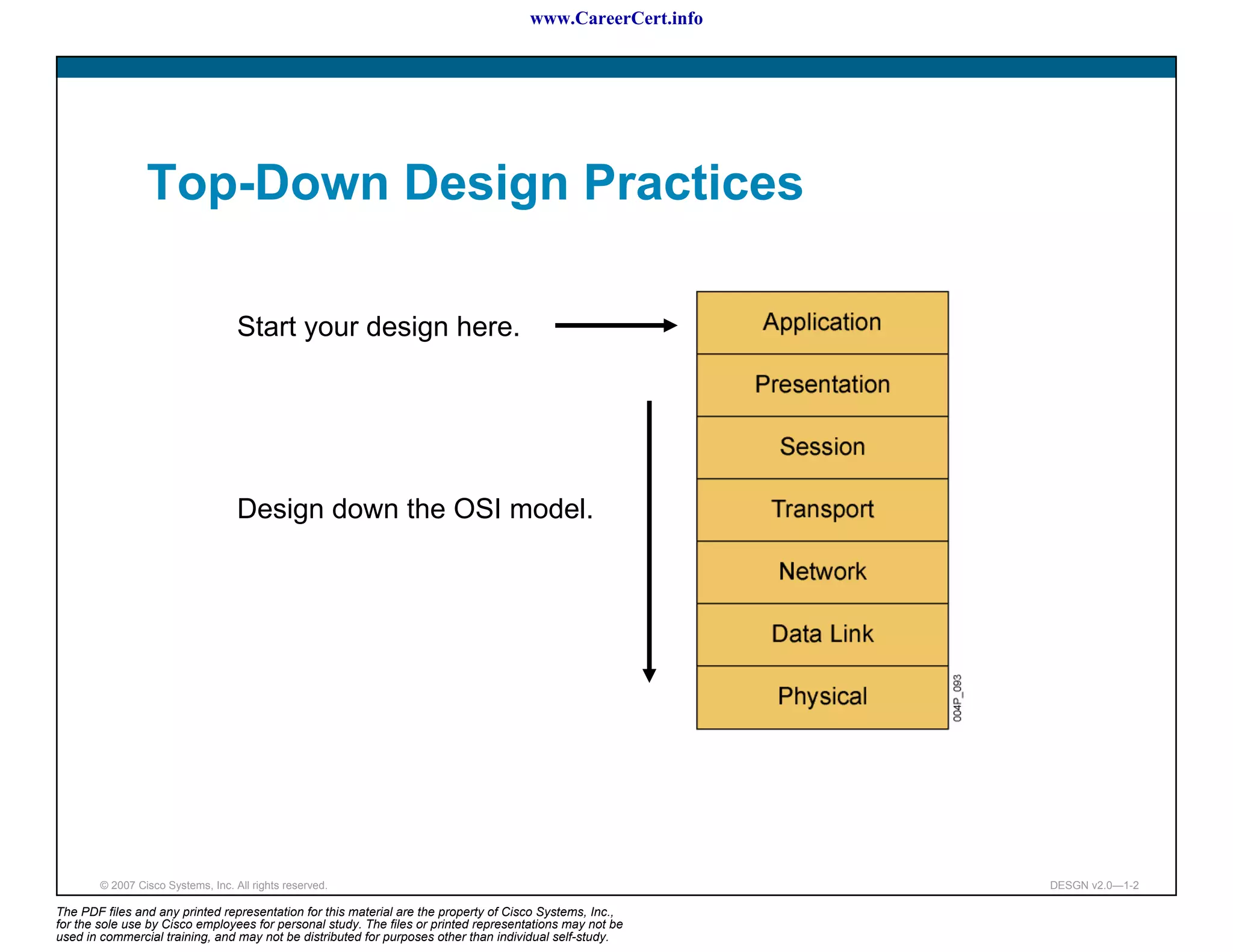
                 Top-Down Design Practices

                                    Start your design here.


                                    Design down the OSI model.


        © 2007 Cisco Systems, Inc. All rights reserved.                                                     DESGN v2.0—1-2

The PDF files and any printed representation for this material are the property of Cisco Systems, Inc.,
for the sole use by Cisco employees for personal study. The files or printed representations may not be
used in commercial training, and may not be distributed for purposes other than individual self-study.
www.CareerCert.info


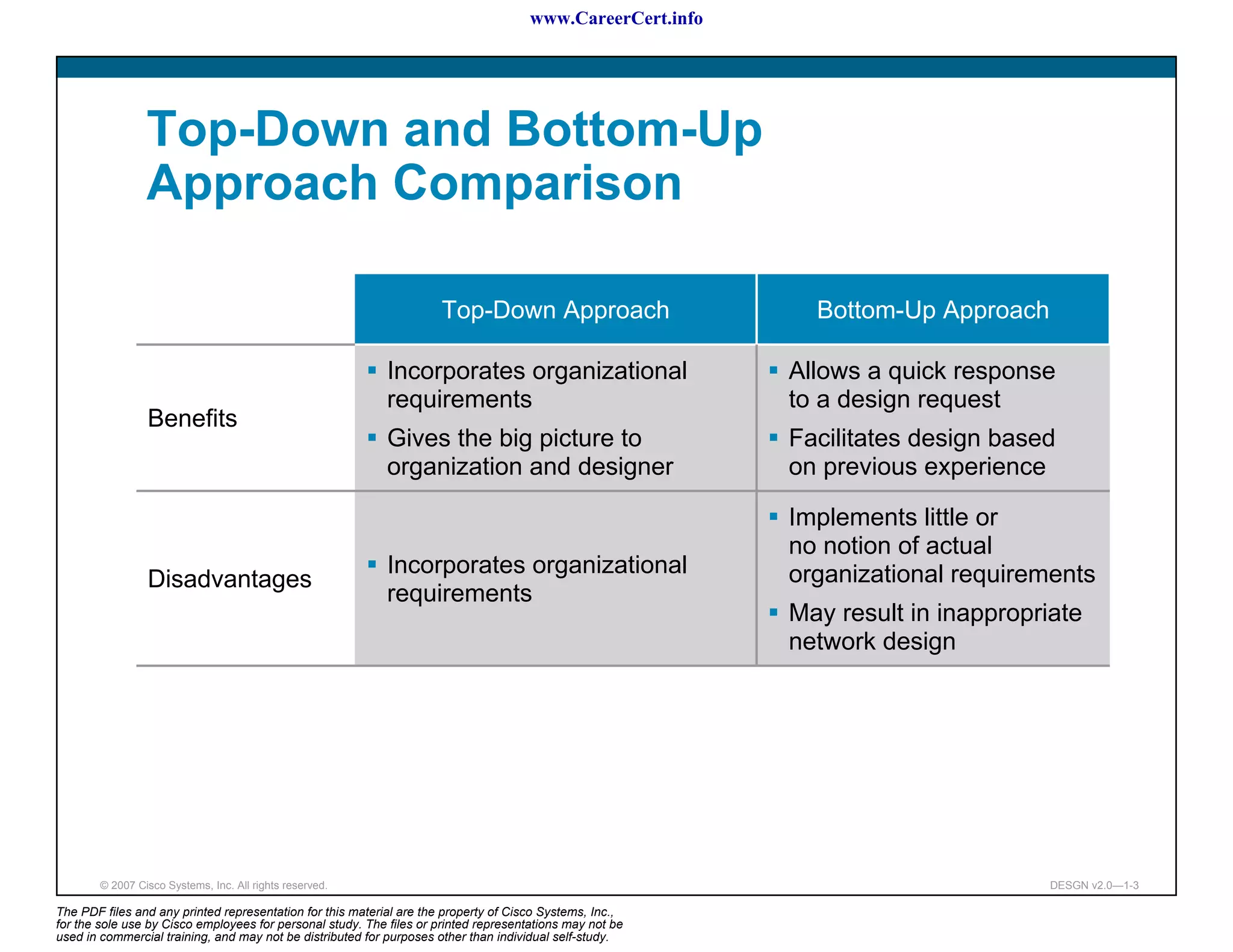
                 Top-Down and Bottom-Up
                 Approach Comparison

                                                                      Top-Down Approach                       Bottom-Up Approach

                                                            Incorporates organizational                     Allows a quick response
                                                            requirements                                    to a design request
                 Benefits
                                                            Gives the big picture to                        Facilitates design based
                                                            organization and designer                       on previous experience

                                                                                                            Implements little or
                                                                                                            no notion of actual
                                                            Incorporates organizational                     organizational requirements
                 Disadvantages
                                                            requirements
                                                                                                            May result in inappropriate
                                                                                                            network design


        © 2007 Cisco Systems, Inc. All rights reserved.                                                                             DESGN v2.0—1-3

The PDF files and any printed representation for this material are the property of Cisco Systems, Inc.,
for the sole use by Cisco employees for personal study. The files or printed representations may not be
used in commercial training, and may not be distributed for purposes other than individual self-study.
www.CareerCert.info


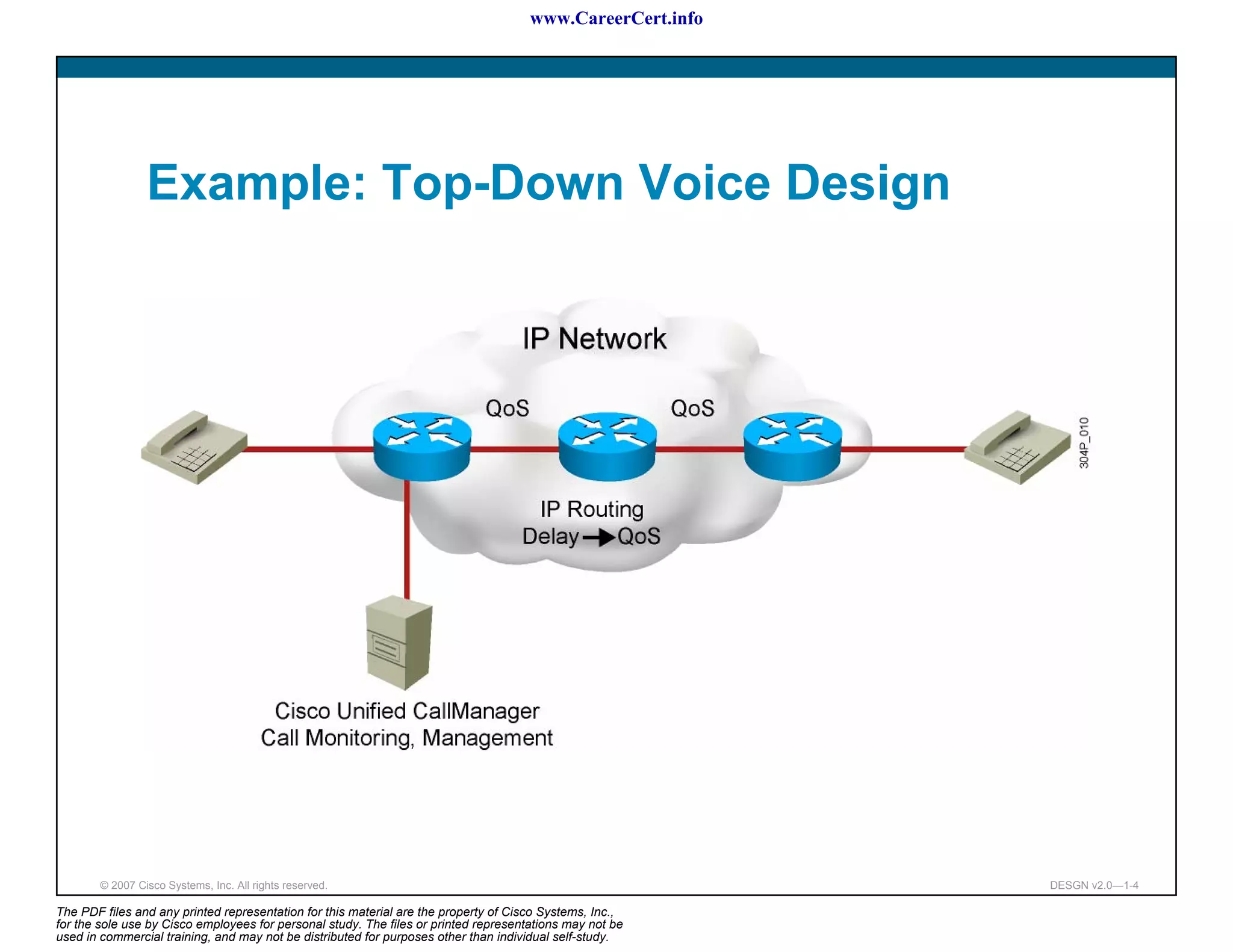
                 Example: Top-Down Voice Design


        © 2007 Cisco Systems, Inc. All rights reserved.                                                     DESGN v2.0—1-4

The PDF files and any printed representation for this material are the property of Cisco Systems, Inc.,
for the sole use by Cisco employees for personal study. The files or printed representations may not be
used in commercial training, and may not be distributed for purposes other than individual self-study.
www.CareerCert.info


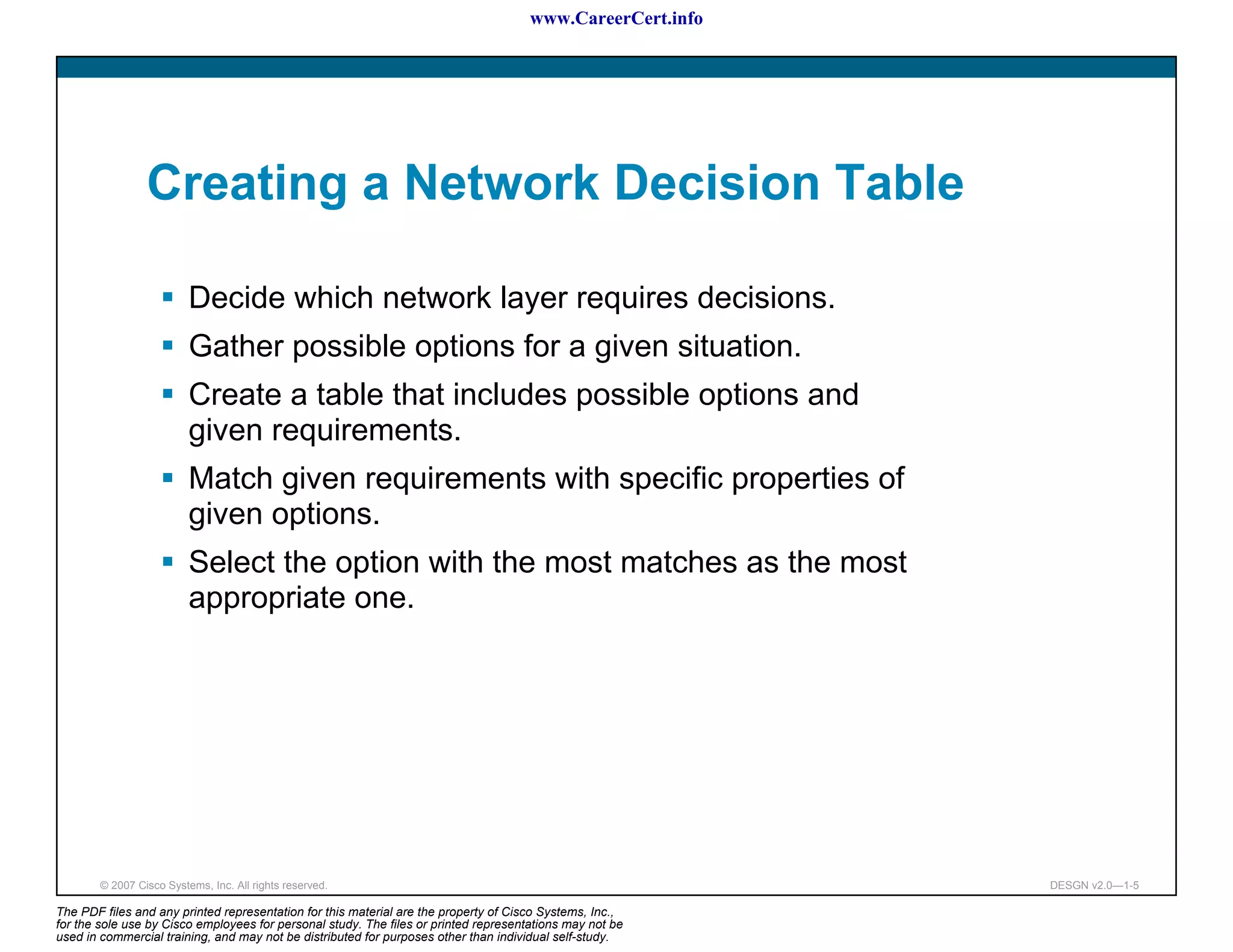
                 Creating a Network Decision Table

                          Decide which network layer requires decisions.
                          Gather possible options for a given situation.
                          Create a table that includes possible options and
                          given requirements.
                          Match given requirements with specific properties of
                          given options.
                          Select the option with the most matches as the most
                          appropriate one.


        © 2007 Cisco Systems, Inc. All rights reserved.                                                     DESGN v2.0—1-5

The PDF files and any printed representation for this material are the property of Cisco Systems, Inc.,
for the sole use by Cisco employees for personal study. The files or printed representations may not be
used in commercial training, and may not be distributed for purposes other than individual self-study.
www.CareerCert.info


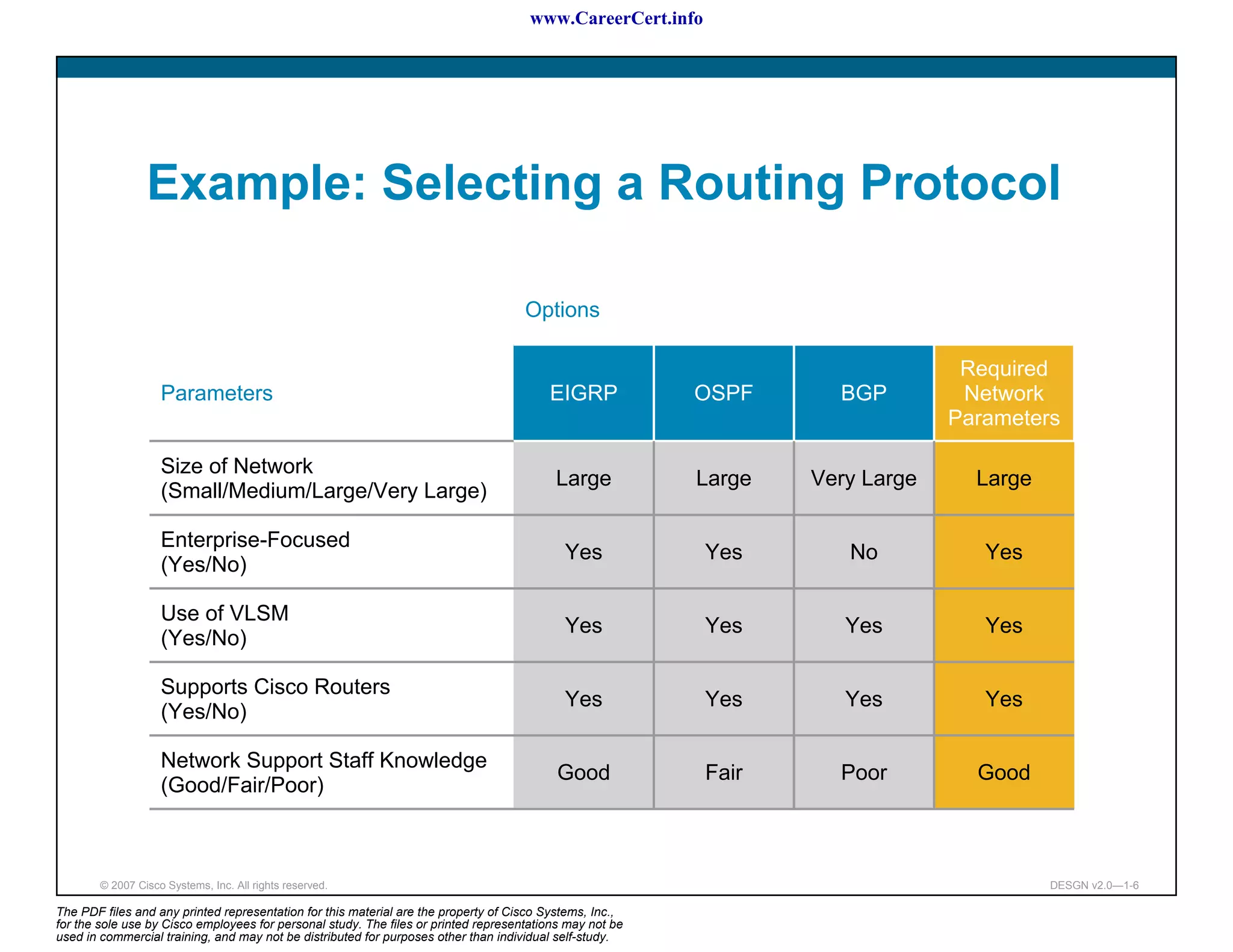
                 Example: Selecting a Routing Protocol

                                                                                     Options

                                                                                                                                 Required
                    Parameters                                                           EIGRP            OSPF       BGP         Network
                                                                                                                                Parameters

                    Size of Network
                                                                                          Large           Large    Very Large     Large
                    (Small/Medium/Large/Very Large)

                    Enterprise-Focused
                                                                                            Yes             Yes       No           Yes
                    (Yes/No)

                    Use of VLSM
                                                                                            Yes             Yes       Yes          Yes
                    (Yes/No)

                    Supports Cisco Routers
                                                                                            Yes             Yes       Yes          Yes
                    (Yes/No)

                    Network Support Staff Knowledge
                                                                                           Good             Fair     Poor         Good
                    (Good/Fair/Poor)


        © 2007 Cisco Systems, Inc. All rights reserved.                                                                                   DESGN v2.0—1-6

The PDF files and any printed representation for this material are the property of Cisco Systems, Inc.,
for the sole use by Cisco employees for personal study. The files or printed representations may not be
used in commercial training, and may not be distributed for purposes other than individual self-study.
www.CareerCert.info


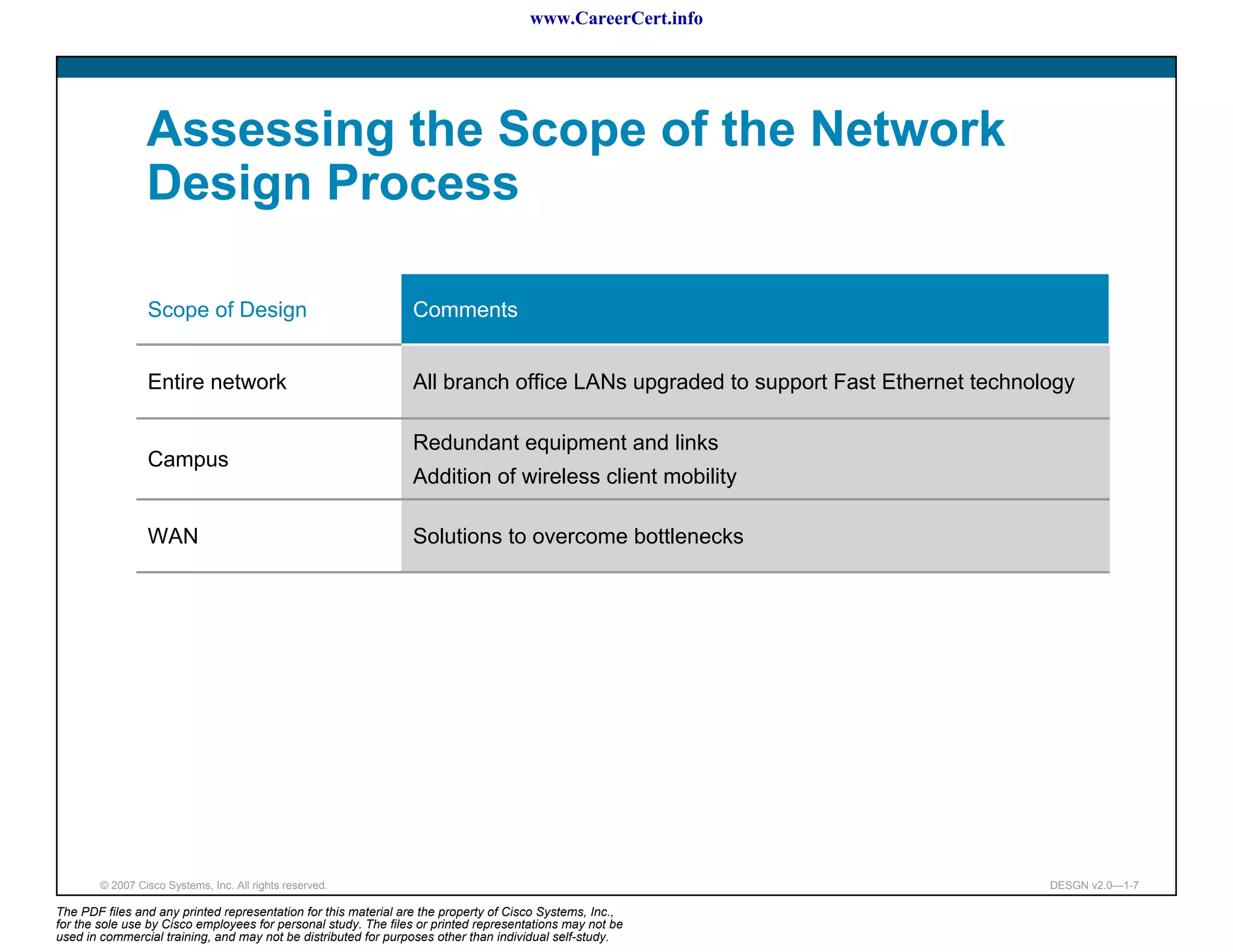
                 Assessing the Scope of the Network
                 Design Process

                 Scope of Design                                Comments


                 Entire network                                 All branch office LANs upgraded to support Fast Ethernet technology

                                                                Redundant equipment and links
                 Campus
                                                                Addition of wireless client mobility

                 WAN                                            Solutions to overcome bottlenecks


        © 2007 Cisco Systems, Inc. All rights reserved.                                                                         DESGN v2.0—1-7

The PDF files and any printed representation for this material are the property of Cisco Systems, Inc.,
for the sole use by Cisco employees for personal study. The files or printed representations may not be
used in commercial training, and may not be distributed for purposes other than individual self-study.
www.CareerCert.info


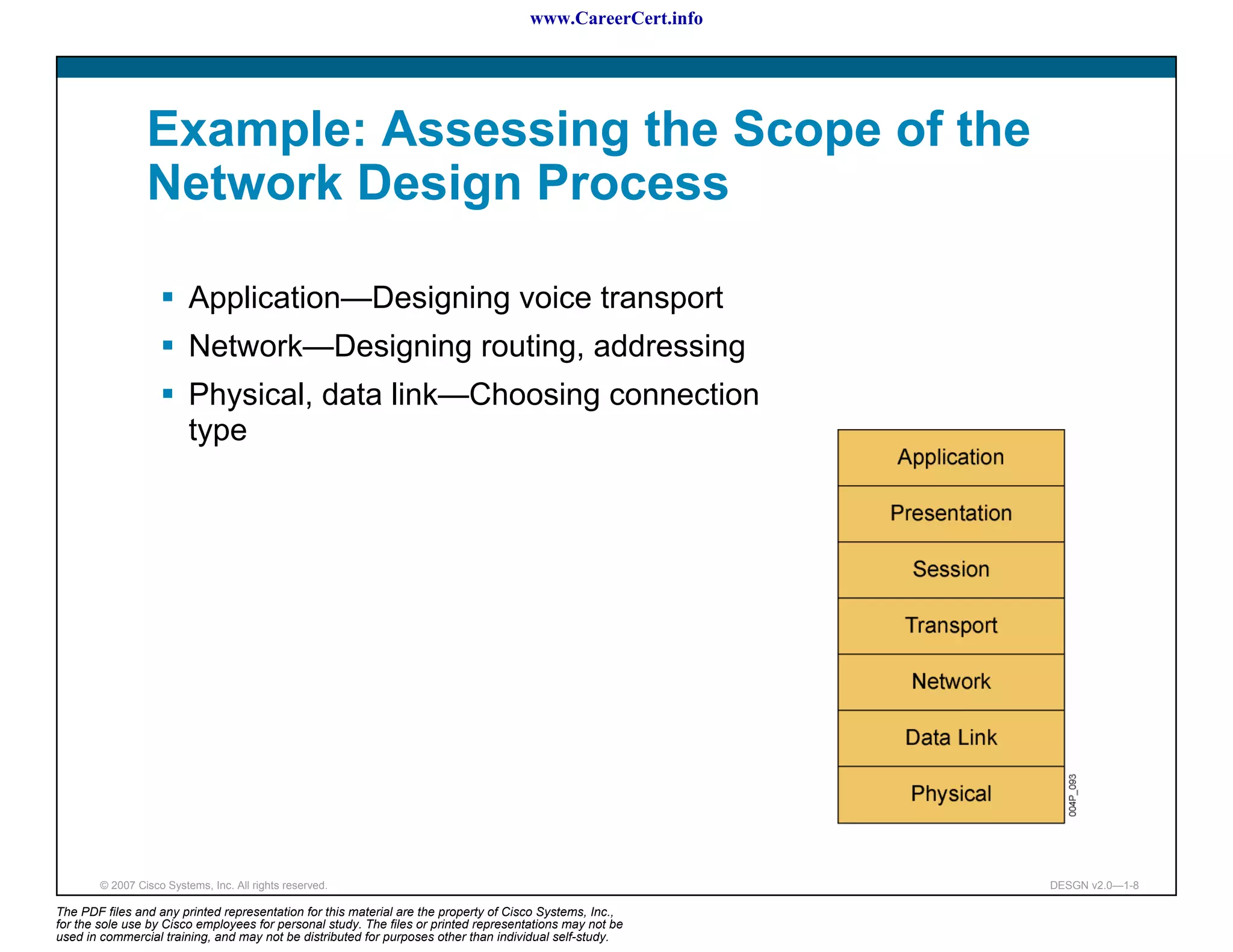
                 Example: Assessing the Scope of the
                 Network Design Process

                          Application—Designing voice transport
                          Network—Designing routing, addressing
                          Physical, data link—Choosing connection
                          type


        © 2007 Cisco Systems, Inc. All rights reserved.                                                     DESGN v2.0—1-8

The PDF files and any printed representation for this material are the property of Cisco Systems, Inc.,
for the sole use by Cisco employees for personal study. The files or printed representations may not be
used in commercial training, and may not be distributed for purposes other than individual self-study.
www.CareerCert.info


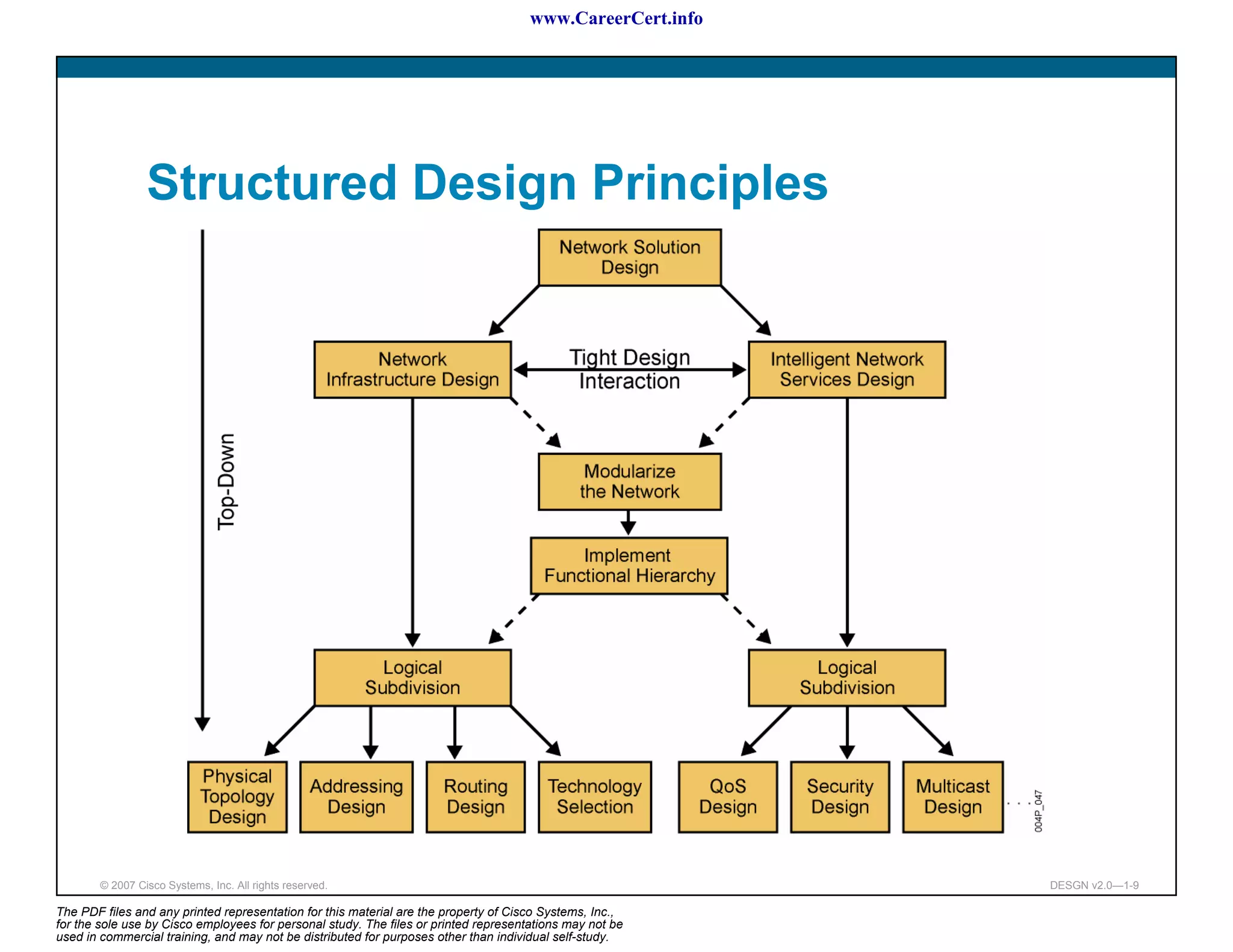
                 Structured Design Principles


        © 2007 Cisco Systems, Inc. All rights reserved.                                                     DESGN v2.0—1-9

The PDF files and any printed representation for this material are the property of Cisco Systems, Inc.,
for the sole use by Cisco employees for personal study. The files or printed representations may not be
used in commercial training, and may not be distributed for purposes other than individual self-study.
www.CareerCert.info


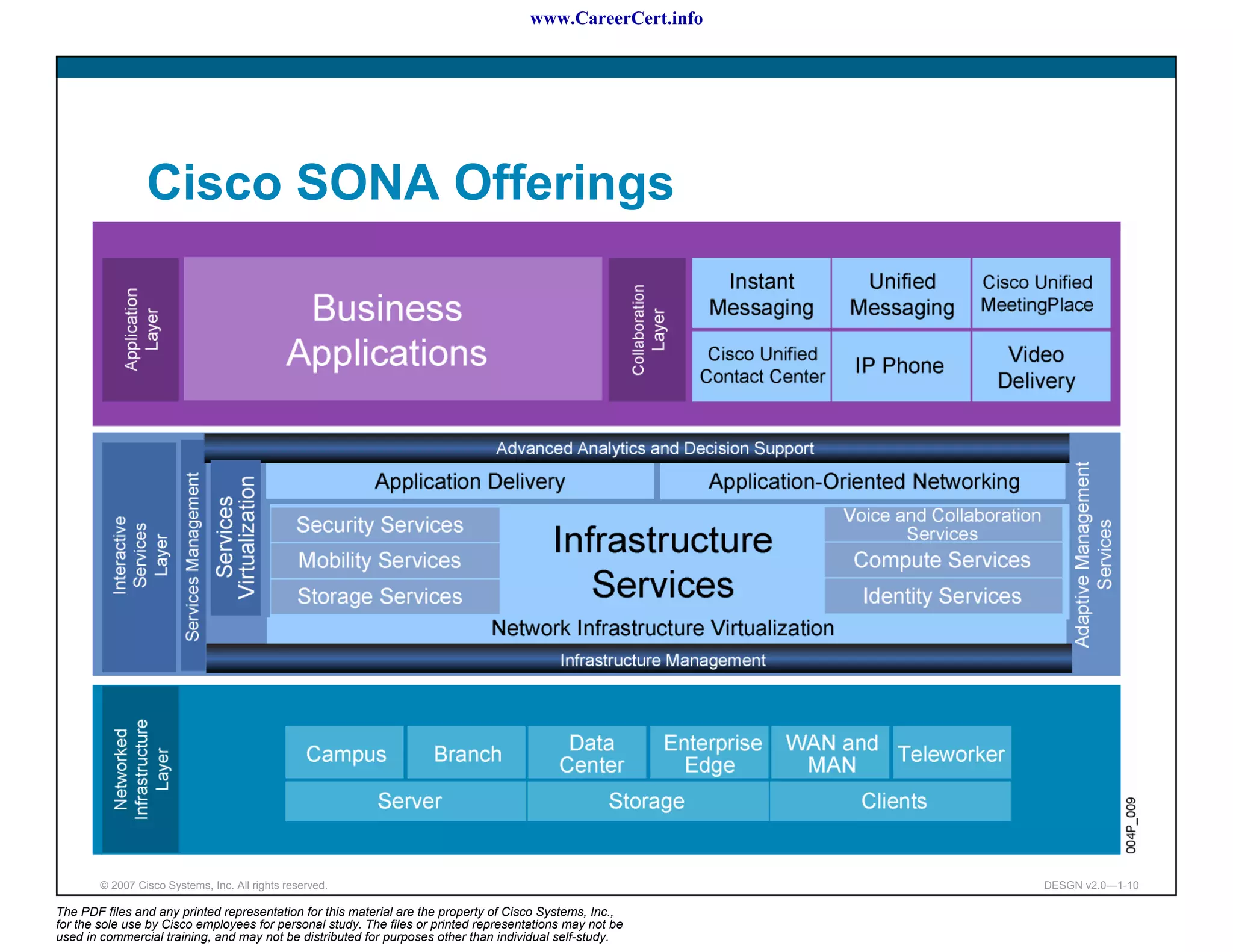
                 Cisco SONA Offerings


        © 2007 Cisco Systems, Inc. All rights reserved.                                                     DESGN v2.0—1-10

The PDF files and any printed representation for this material are the property of Cisco Systems, Inc.,
for the sole use by Cisco employees for personal study. The files or printed representations may not be
used in commercial training, and may not be distributed for purposes other than individual self-study.
www.CareerCert.info


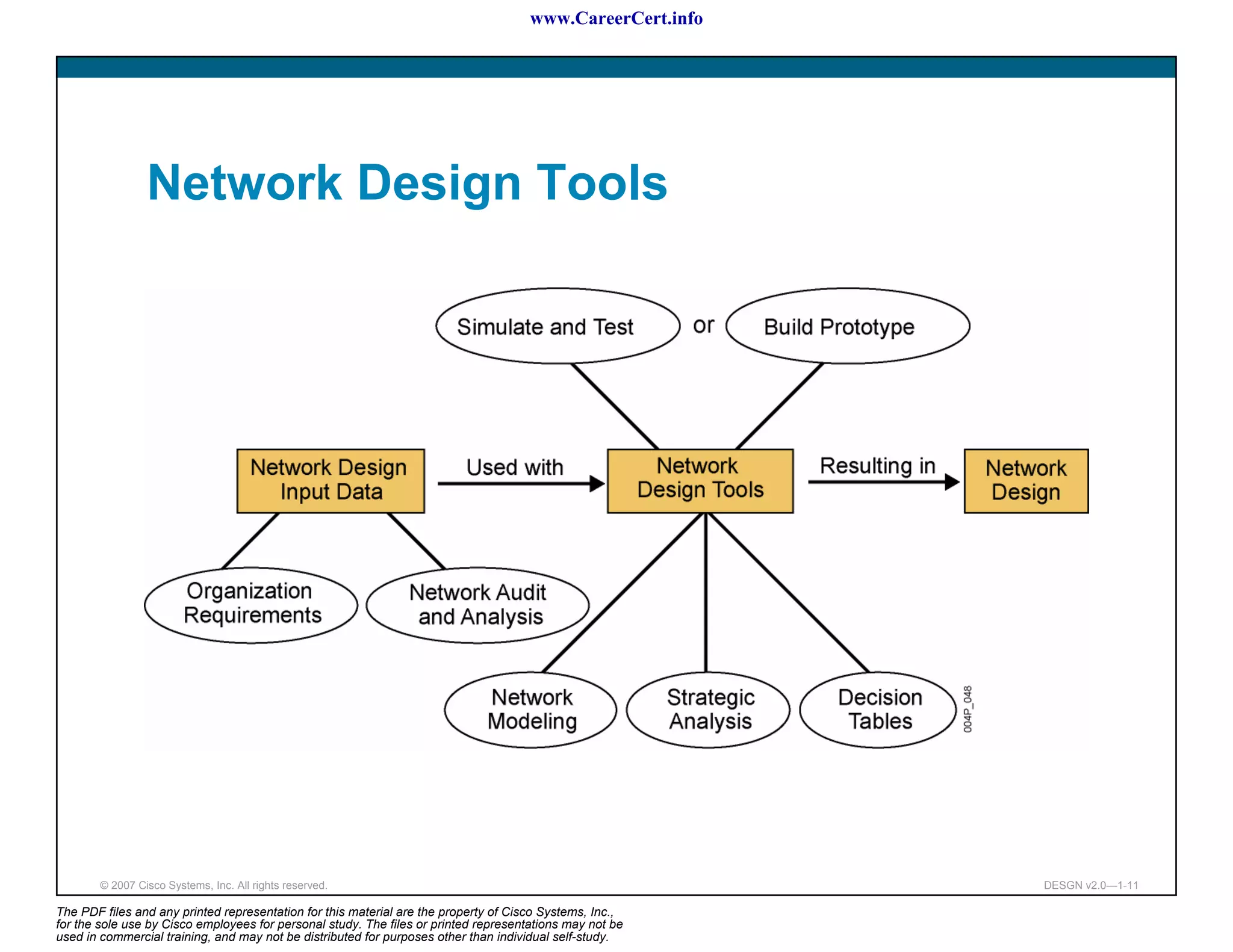
                 Network Design Tools


        © 2007 Cisco Systems, Inc. All rights reserved.                                                     DESGN v2.0—1-11

The PDF files and any printed representation for this material are the property of Cisco Systems, Inc.,
for the sole use by Cisco employees for personal study. The files or printed representations may not be
used in commercial training, and may not be distributed for purposes other than individual self-study.
www.CareerCert.info


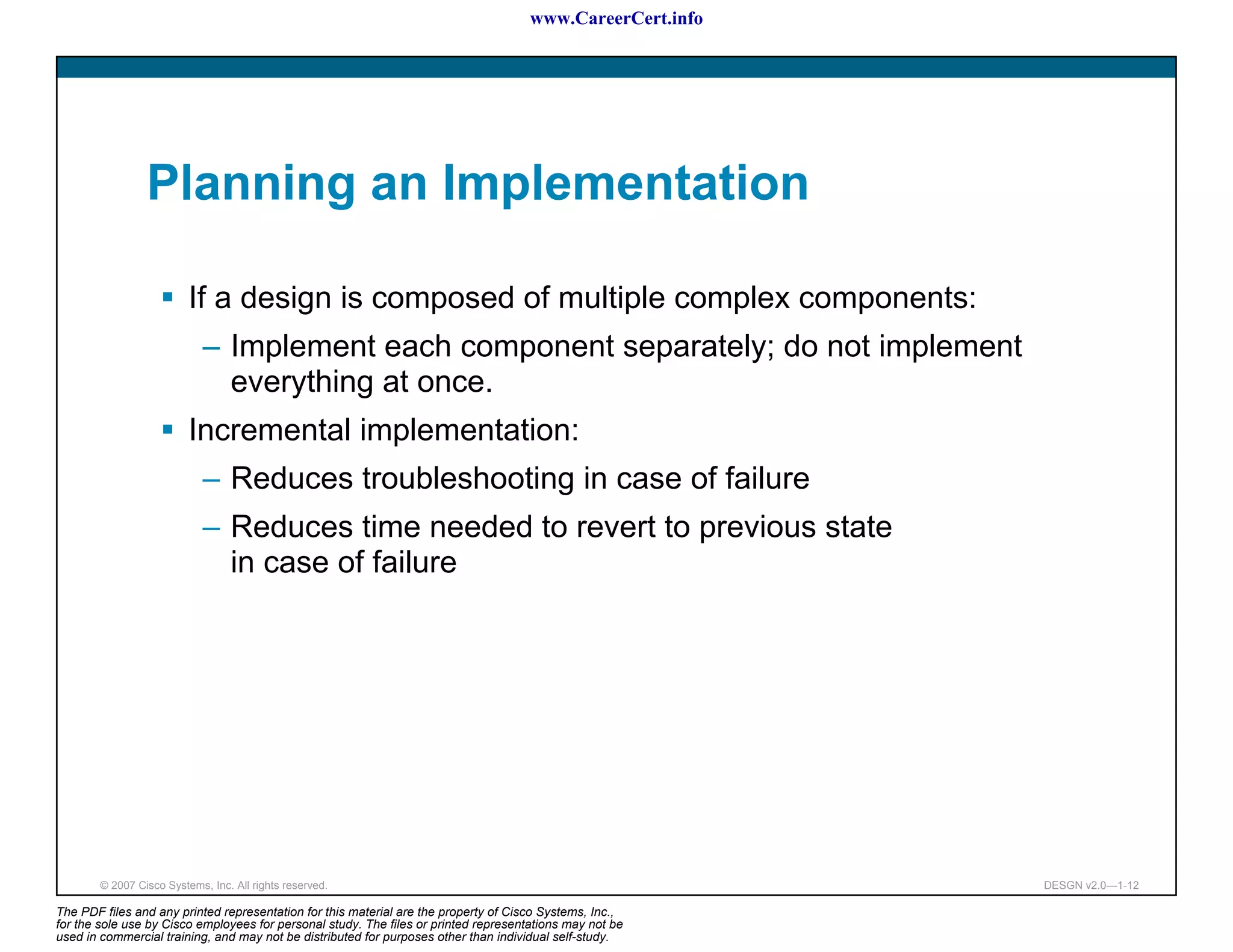
                 Planning an Implementation

                          If a design is composed of multiple complex components:
                             – Implement each component separately; do not implement
                               everything at once.
                          Incremental implementation:
                             – Reduces troubleshooting in case of failure
                             – Reduces time needed to revert to previous state
                               in case of failure


        © 2007 Cisco Systems, Inc. All rights reserved.                                                     DESGN v2.0—1-12

The PDF files and any printed representation for this material are the property of Cisco Systems, Inc.,
for the sole use by Cisco employees for personal study. The files or printed representations may not be
used in commercial training, and may not be distributed for purposes other than individual self-study.
www.CareerCert.info


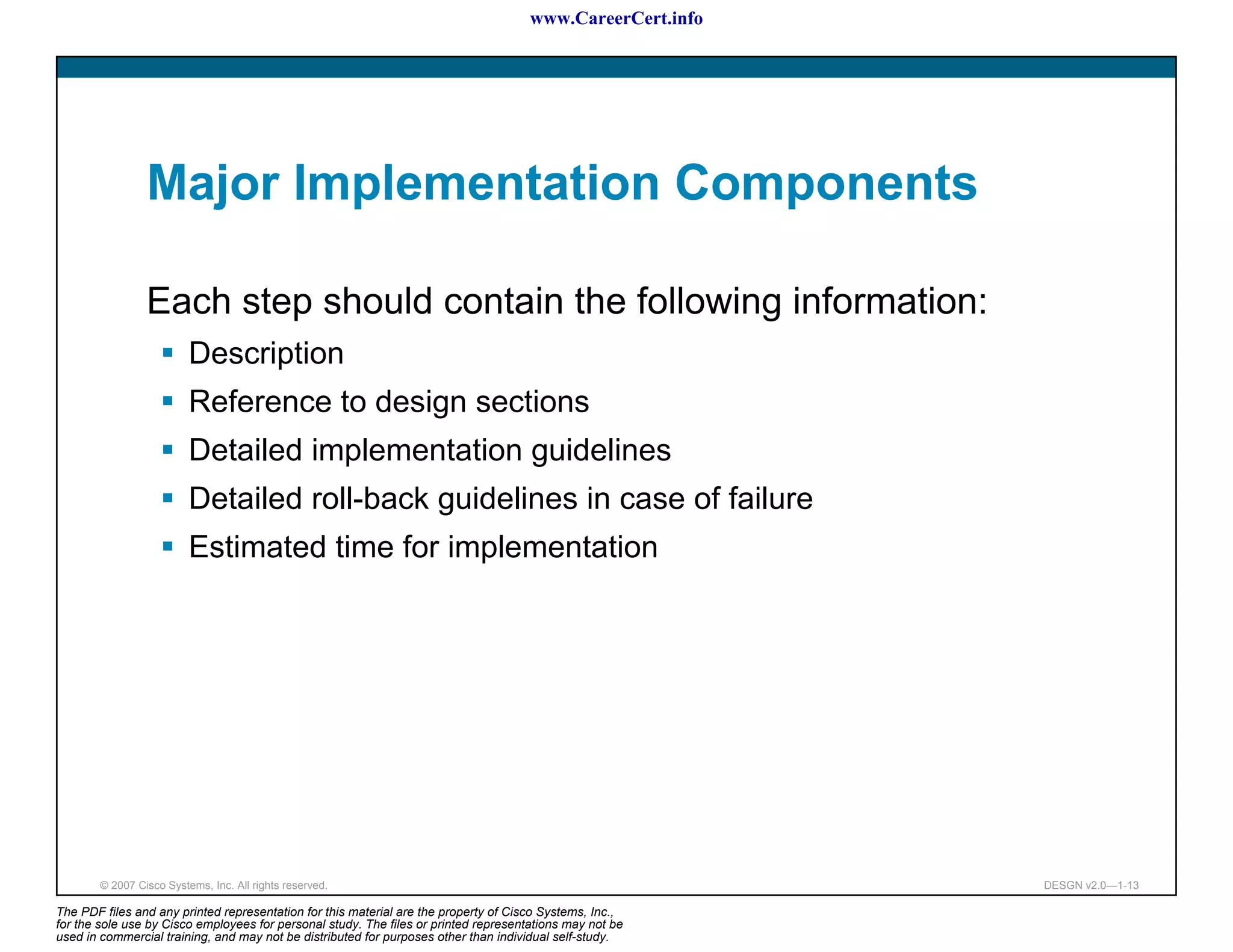
                 Major Implementation Components

                 Each step should contain the following information:
                          Description
                          Reference to design sections
                          Detailed implementation guidelines
                          Detailed roll-back guidelines in case of failure
                          Estimated time for implementation


        © 2007 Cisco Systems, Inc. All rights reserved.                                                     DESGN v2.0—1-13

The PDF files and any printed representation for this material are the property of Cisco Systems, Inc.,
for the sole use by Cisco employees for personal study. The files or printed representations may not be
used in commercial training, and may not be distributed for purposes other than individual self-study.
www.CareerCert.info


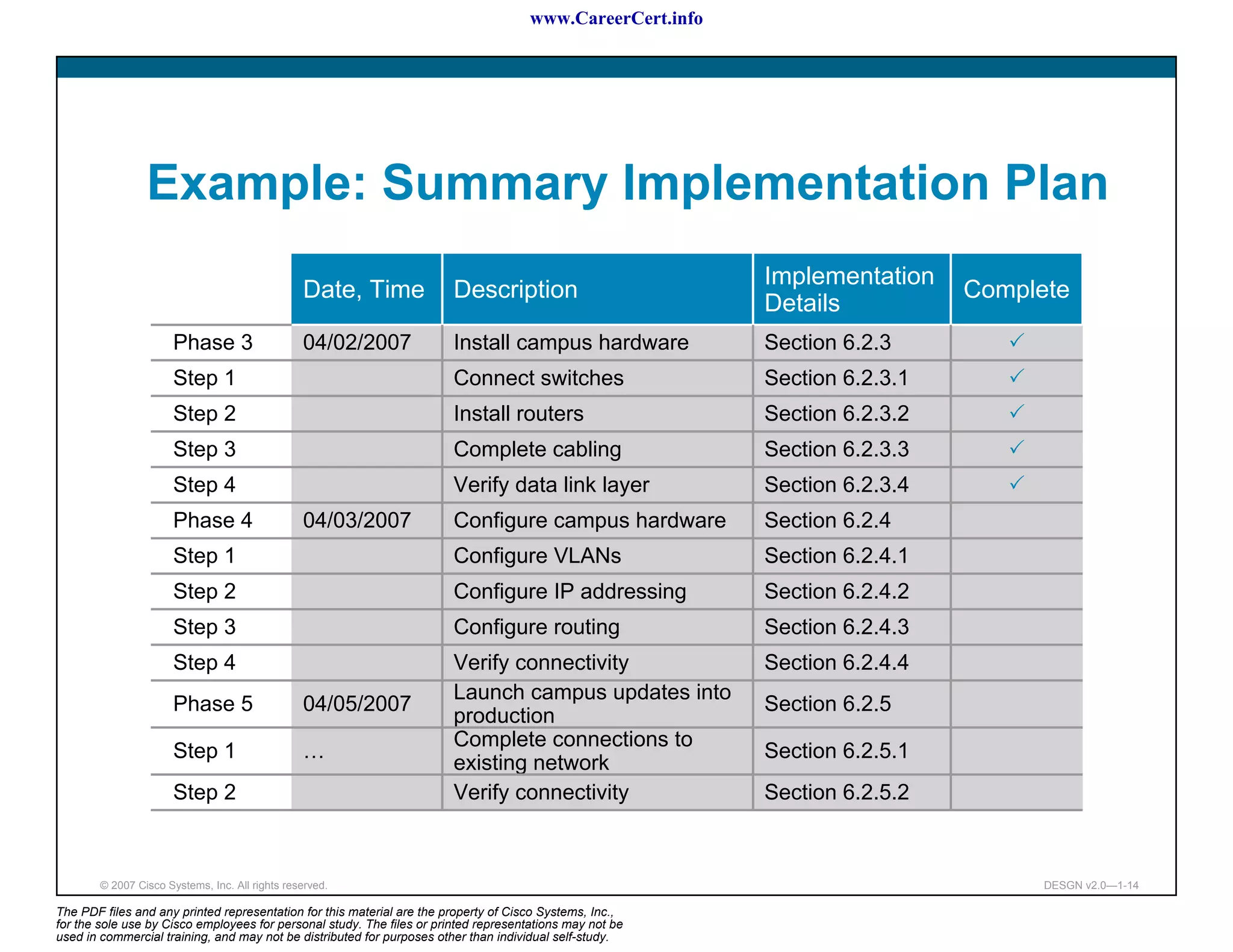
                 Example: Summary Implementation Plan
                                                                                                            Implementation
                                                 Date, Time             Description                                           Complete
                                                                                                            Details
                       Phase 3                   04/02/2007             Install campus hardware             Section 6.2.3
                       Step 1                                           Connect switches                    Section 6.2.3.1
                       Step 2                                           Install routers                     Section 6.2.3.2
                       Step 3                                           Complete cabling                    Section 6.2.3.3
                       Step 4                                           Verify data link layer              Section 6.2.3.4
                       Phase 4                   04/03/2007             Configure campus hardware           Section 6.2.4
                       Step 1                                           Configure VLANs                     Section 6.2.4.1
                       Step 2                                           Configure IP addressing             Section 6.2.4.2
                       Step 3                                           Configure routing                   Section 6.2.4.3
                       Step 4                                           Verify connectivity                 Section 6.2.4.4
                                                                        Launch campus updates into
                       Phase 5                   04/05/2007                                                 Section 6.2.5
                                                                        production
                                                                        Complete connections to
                       Step 1                    …                                                          Section 6.2.5.1
                                                                        existing network
                       Step 2                                           Verify connectivity                 Section 6.2.5.2


        © 2007 Cisco Systems, Inc. All rights reserved.                                                                             DESGN v2.0—1-14

The PDF files and any printed representation for this material are the property of Cisco Systems, Inc.,
for the sole use by Cisco employees for personal study. The files or printed representations may not be
used in commercial training, and may not be distributed for purposes other than individual self-study.
www.CareerCert.info


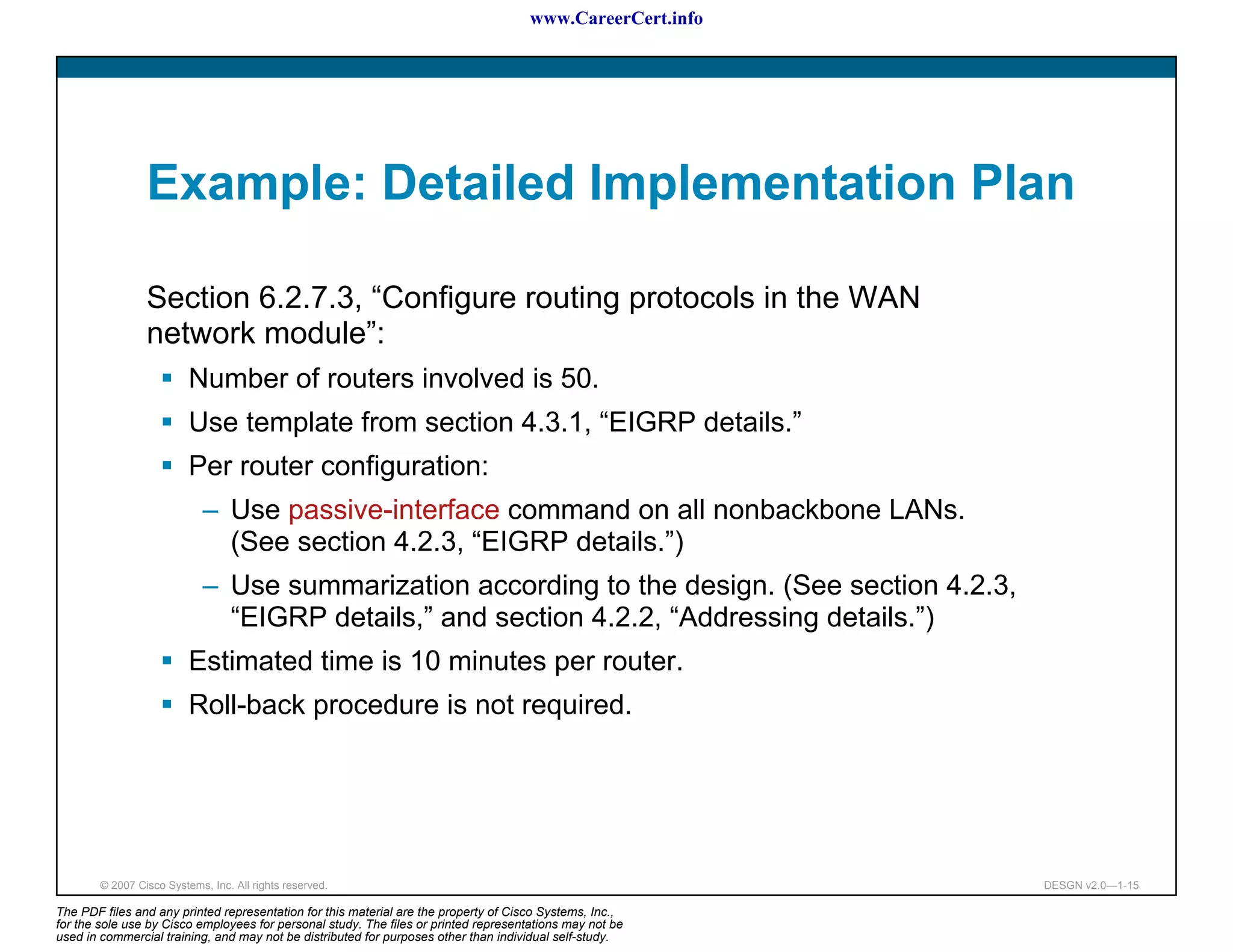
                 Example: Detailed Implementation Plan

                 Section 6.2.7.3, “Configure routing protocols in the WAN
                 network module”:
                          Number of routers involved is 50.
                          Use template from section 4.3.1, “EIGRP details.”
                          Per router configuration:
                             – Use passive-interface command on all nonbackbone LANs.
                               (See section 4.2.3, “EIGRP details.”)
                             – Use summarization according to the design. (See section 4.2.3,
                               “EIGRP details,” and section 4.2.2, “Addressing details.”)
                          Estimated time is 10 minutes per router.
                          Roll-back procedure is not required.


        © 2007 Cisco Systems, Inc. All rights reserved.                                                     DESGN v2.0—1-15

The PDF files and any printed representation for this material are the property of Cisco Systems, Inc.,
for the sole use by Cisco employees for personal study. The files or printed representations may not be
used in commercial training, and may not be distributed for purposes other than individual self-study.
www.CareerCert.info


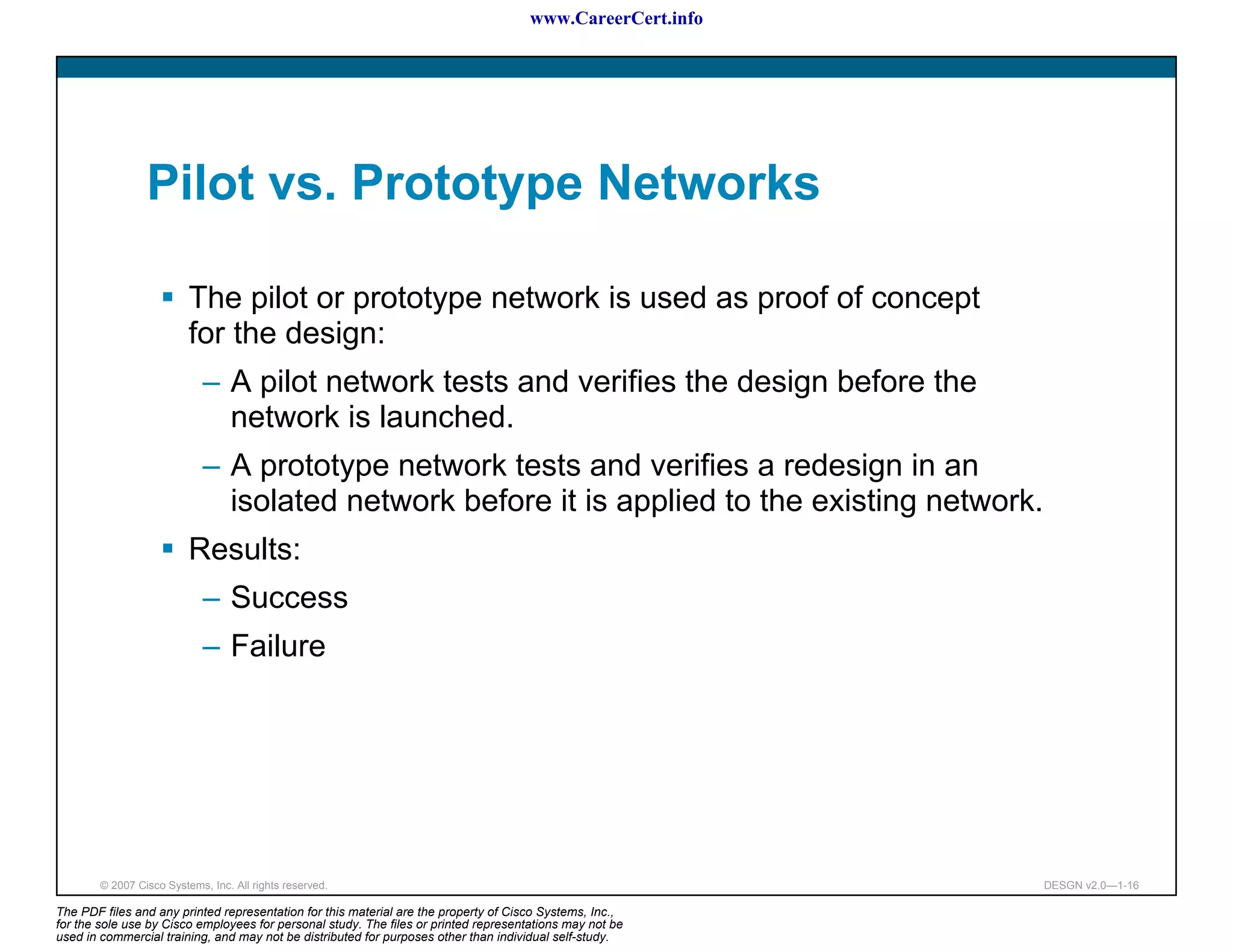
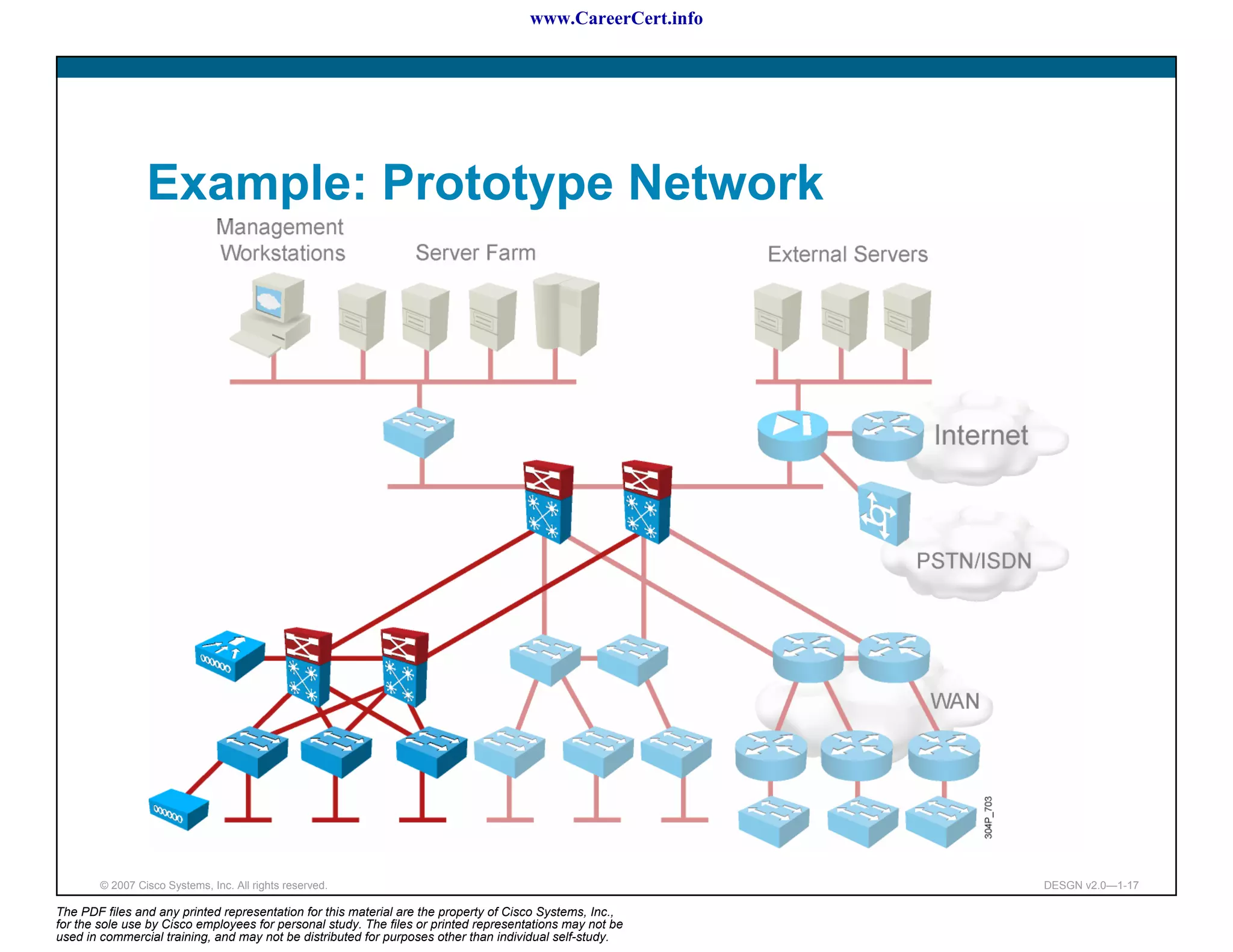
                 Pilot vs. Prototype Networks

                          The pilot or prototype network is used as proof of concept
                          for the design:
                             – A pilot network tests and verifies the design before the
                               network is launched.
                             – A prototype network tests and verifies a redesign in an
                               isolated network before it is applied to the existing network.
                          Results:
                             – Success
                             – Failure


        © 2007 Cisco Systems, Inc. All rights reserved.                                                     DESGN v2.0—1-16

The PDF files and any printed representation for this material are the property of Cisco Systems, Inc.,
for the sole use by Cisco employees for personal study. The files or printed representations may not be
used in commercial training, and may not be distributed for purposes other than individual self-study.
www.CareerCert.info


                 Example: Prototype Network


        © 2007 Cisco Systems, Inc. All rights reserved.                                                     DESGN v2.0—1-17

The PDF files and any printed representation for this material are the property of Cisco Systems, Inc.,
for the sole use by Cisco employees for personal study. The files or printed representations may not be
used in commercial training, and may not be distributed for purposes other than individual self-study.
www.CareerCert.info


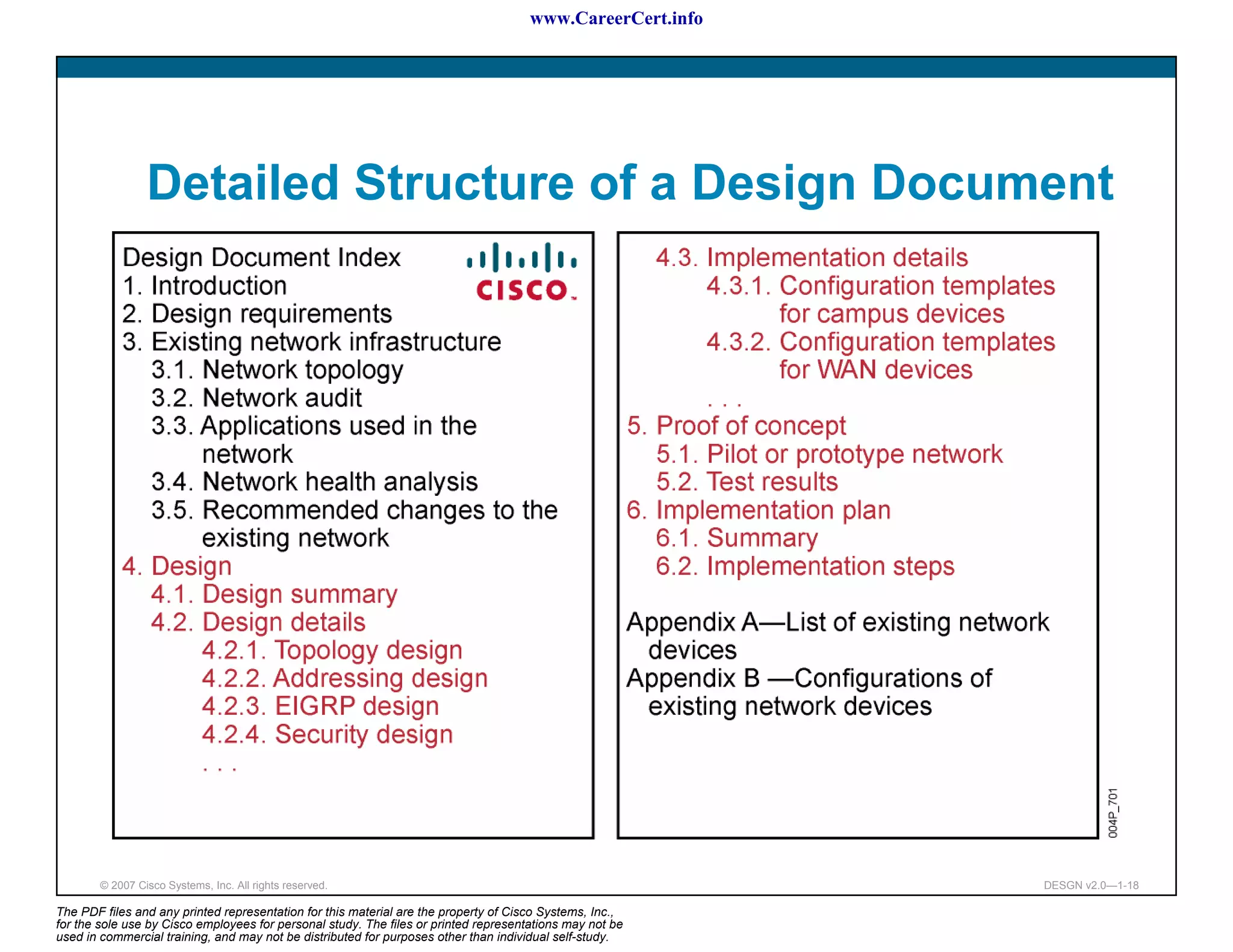
                 Detailed Structure of a Design Document


        © 2007 Cisco Systems, Inc. All rights reserved.                                                     DESGN v2.0—1-18

The PDF files and any printed representation for this material are the property of Cisco Systems, Inc.,
for the sole use by Cisco employees for personal study. The files or printed representations may not be
used in commercial training, and may not be distributed for purposes other than individual self-study.
www.CareerCert.info


                 Summary

                          Designing an enterprise network is a complex project.
                          Top-down design facilitates the process by dividing it into smaller,
                          more manageable steps.
                          Decision tables facilitate the selection of the most appropriate
                          option from many possibilities.
                          In assessing the scope of a network design, determine whether
                          the design is for a new network or is a modification of the entire
                          network, a single segment or module, a set of LANs, a WAN,
                          or a remote-access network.
                          The output of the design should be a model of the complete
                          system. To achieve this, the top-down approach is highly
                          recommended.


        © 2007 Cisco Systems, Inc. All rights reserved.                                                     DESGN v2.0—1-19

The PDF files and any printed representation for this material are the property of Cisco Systems, Inc.,
for the sole use by Cisco employees for personal study. The files or printed representations may not be
used in commercial training, and may not be distributed for purposes other than individual self-study.
www.CareerCert.info


                 Summary (Cont.)

                          When the design is complete, you are ready to document the
                          implementation and migration in as much detail as possible.
                          After a design is complete, you should verify it. You can test
                          the design in an existing or live network (pilot) or in a prototype
                          network that will not affect the existing network.
                          A design document lists the design requirements, documents
                          the existing network, documents the network design, identifies
                          the proof-of-concept strategy, and details an implementation plan.


        © 2007 Cisco Systems, Inc. All rights reserved.                                                     DESGN v2.0—1-20

The PDF files and any printed representation for this material are the property of Cisco Systems, Inc.,
for the sole use by Cisco employees for personal study. The files or printed representations may not be
used in commercial training, and may not be distributed for purposes other than individual self-study.
www.CareerCert.info


        © 2007 Cisco Systems, Inc. All rights reserved.                                                     DESGN v2.0—1-21

The PDF files and any printed representation for this material are the property of Cisco Systems, Inc.,
for the sole use by Cisco employees for personal study. The files or printed representations may not be
used in commercial training, and may not be distributed for purposes other than individual self-study.
www.CareerCert.info


                 Module Summary

                          Cisco SONA is the enterprise framework for implementing
                          intelligent networks and maps business requirements to network
                          requirements.
                          The design methodology under PPDIOO includes these tasks:
                             – Identifying customer requirements
                             – Characterizing the existing network and sites
                             – Designing the network topology and solutions
                          The result of network characterization is a summary report
                          describing the health of the network.
                          Top-down design facilitates network design.


        © 2007 Cisco Systems, Inc. All rights reserved.                                                     DESGN v2.0—1-1

The PDF files and any printed representation for this material are the property of Cisco Systems, Inc.,
for the sole use by Cisco employees for personal study. The files or printed representations may not be
used in commercial training, and may not be distributed for purposes other than individual self-study.
www.CareerCert.info


        © 2007 Cisco Systems, Inc. All rights reserved.                                                     DESGN v2.0—1-2

The PDF files and any printed representation for this material are the property of Cisco Systems, Inc.,
for the sole use by Cisco employees for personal study. The files or printed representations may not be
used in commercial training, and may not be distributed for purposes other than individual self-study.
www.CareerCert.info


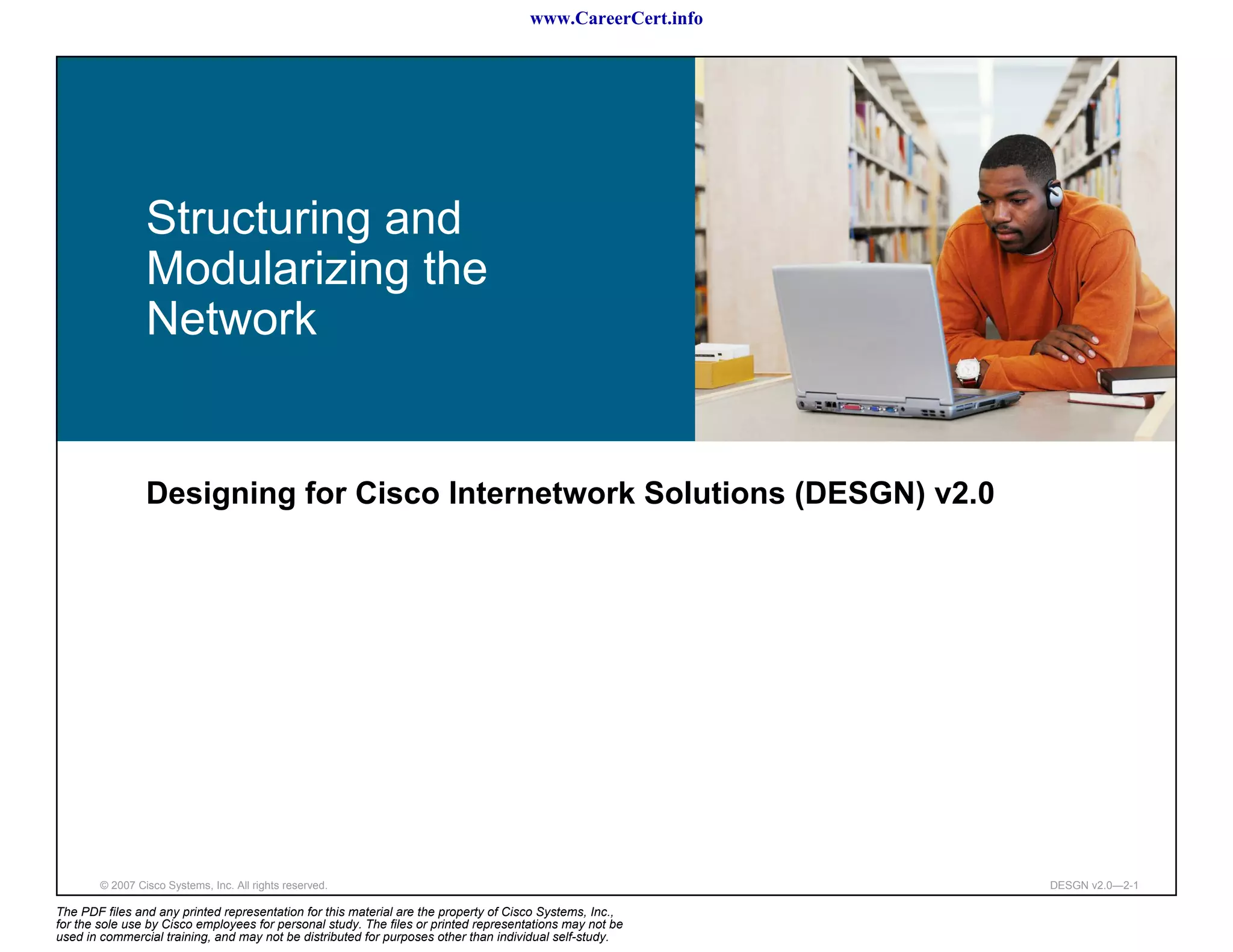
                 Structuring and
                 Modularizing the
                 Network


                 Designing for Cisco Internetwork Solutions (DESGN) v2.0


        © 2007 Cisco Systems, Inc. All rights reserved.                                                     DESGN v2.0—2-1

The PDF files and any printed representation for this material are the property of Cisco Systems, Inc.,
for the sole use by Cisco employees for personal study. The files or printed representations may not be
used in commercial training, and may not be distributed for purposes other than individual self-study.
www.CareerCert.info


                 Designing the
                 Network Hierarchy


                 Structuring and Modularizing the Network


        © 2007 Cisco Systems, Inc. All rights reserved.                                                     DESGN v2.0—2-1

The PDF files and any printed representation for this material are the property of Cisco Systems, Inc.,
for the sole use by Cisco employees for personal study. The files or printed representations may not be
used in commercial training, and may not be distributed for purposes other than individual self-study.
www.CareerCert.info


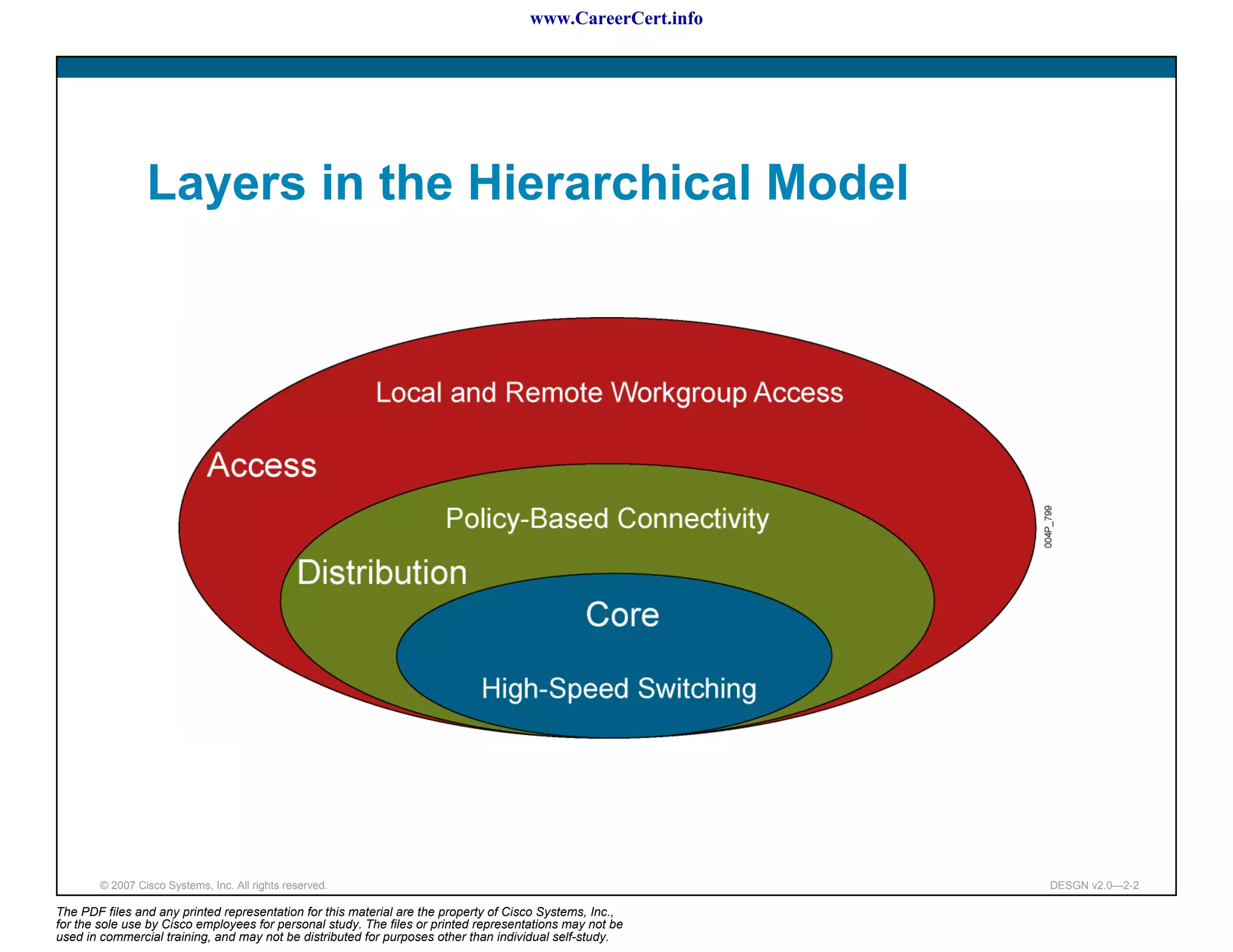
                 Layers in the Hierarchical Model


        © 2007 Cisco Systems, Inc. All rights reserved.                                                     DESGN v2.0—2-2

The PDF files and any printed representation for this material are the property of Cisco Systems, Inc.,
for the sole use by Cisco employees for personal study. The files or printed representations may not be
used in commercial training, and may not be distributed for purposes other than individual self-study.
www.CareerCert.info


                 Example: Hierarchical Network


        © 2007 Cisco Systems, Inc. All rights reserved.                                                     DESGN v2.0—2-3

The PDF files and any printed representation for this material are the property of Cisco Systems, Inc.,
for the sole use by Cisco employees for personal study. The files or printed representations may not be
used in commercial training, and may not be distributed for purposes other than individual self-study.
www.CareerCert.info


                 Access Layer

                          Concentration point at which clients access the network
                          Layer 2 switching in the access layer: Defines a single broadcast
                          domain
                          Multilayer switching in the campus access layer: Optimally
                          satisfies the needs of a particular user through routing, filtering,
                          authentication, security, or quality of service
                          Multilayer switching in the WAN access layer: Helps control WAN
                          costs using dial-on-demand routing (DDR) and static routing


        © 2007 Cisco Systems, Inc. All rights reserved.                                                     DESGN v2.0—2-4

The PDF files and any printed representation for this material are the property of Cisco Systems, Inc.,
for the sole use by Cisco employees for personal study. The files or printed representations may not be
used in commercial training, and may not be distributed for purposes other than individual self-study.
www.CareerCert.info


                 Example: Access Layer Connectivity in
                 the Campus LAN


                     Workstations are attached to VLANs with Layer 2 switches.
                     Recommended practice: Implement one VLAN (IP subnet) per access switch.
                     Access switches connect Layer 3 links (if only one VLAN per access switch)
                     or via VLAN trunk.
                     If needed, distribution routers route between VLANs.

        © 2007 Cisco Systems, Inc. All rights reserved.                                                     DESGN v2.0—2-5

The PDF files and any printed representation for this material are the property of Cisco Systems, Inc.,
for the sole use by Cisco employees for personal study. The files or printed representations may not be
used in commercial training, and may not be distributed for purposes other than individual self-study.
www.CareerCert.info


                 Distribution Layer

                 Provides multilayer switching between access and core layers:
                          Provides media transitions
                          Aggregates bandwidth by concentrating multiple low-speed access links into a
                          high-speed core link
                          Determines department or workgroup access
                          Provides redundant connections for access devices
                 Implements policy-based decisions:
                          Filtering by source or destination address
                          Filtering on input or output ports
                          Hiding internal network numbers by route filtering
                          Static routing
                          Security
                          Quality of service mechanisms


        © 2007 Cisco Systems, Inc. All rights reserved.                                                     DESGN v2.0—2-6

The PDF files and any printed representation for this material are the property of Cisco Systems, Inc.,
for the sole use by Cisco employees for personal study. The files or printed representations may not be
used in commercial training, and may not be distributed for purposes other than individual self-study.
www.CareerCert.info


                 Example: Distribution Layer in the
                 Routed Campus Network


        © 2007 Cisco Systems, Inc. All rights reserved.                                                     DESGN v2.0—2-7

The PDF files and any printed representation for this material are the property of Cisco Systems, Inc.,
for the sole use by Cisco employees for personal study. The files or printed representations may not be
used in commercial training, and may not be distributed for purposes other than individual self-study.
www.CareerCert.info


                 Core Layer

                 The function of the core layer is to provide fast and
                 efficent data transport that:
                          Forms a high-speed backbone with fast transport services
                          Provides redundancy and fault tolerance
                          Offers good manageability


                 Note: Core layer should avoid packet manipulation
                 for filtering or access list checking.


        © 2007 Cisco Systems, Inc. All rights reserved.                                                     DESGN v2.0—2-8

The PDF files and any printed representation for this material are the property of Cisco Systems, Inc.,
for the sole use by Cisco employees for personal study. The files or printed representations may not be
used in commercial training, and may not be distributed for purposes other than individual self-study.
www.CareerCert.info


                 Example: Multilayer Switching in the
                 Campus Core


        © 2007 Cisco Systems, Inc. All rights reserved.                                                     DESGN v2.0—2-9

The PDF files and any printed representation for this material are the property of Cisco Systems, Inc.,
for the sole use by Cisco employees for personal study. The files or printed representations may not be
used in commercial training, and may not be distributed for purposes other than individual self-study.
www.CareerCert.info


                 Example: Routing in the WAN Network


        © 2007 Cisco Systems, Inc. All rights reserved.                                                     DESGN v2.0—2-10

The PDF files and any printed representation for this material are the property of Cisco Systems, Inc.,
for the sole use by Cisco employees for personal study. The files or printed representations may not be
used in commercial training, and may not be distributed for purposes other than individual self-study.
www.CareerCert.info


                 Summary

                          The hierarchical network model provides a modular view of a
                          network, making it easier to design and build a network.
                          The purpose of the access layer is to grant end-user access to
                          network resources.
                          The distribution layer provides aggregation for the access layer
                          devices and uplinks to the core layer. It is also used to enforce
                          policy within the network.
                          The core layer provides a high-speed, highly available backbone
                          designed to switch packets as fast as possible.


        © 2007 Cisco Systems, Inc. All rights reserved.                                                     DESGN v2.0—2-11

The PDF files and any printed representation for this material are the property of Cisco Systems, Inc.,
for the sole use by Cisco employees for personal study. The files or printed representations may not be
used in commercial training, and may not be distributed for purposes other than individual self-study.
www.CareerCert.info


        © 2007 Cisco Systems, Inc. All rights reserved.                                                     DESGN v2.0—2-12

The PDF files and any printed representation for this material are the property of Cisco Systems, Inc.,
for the sole use by Cisco employees for personal study. The files or printed representations may not be
used in commercial training, and may not be distributed for purposes other than individual self-study.
www.CareerCert.info


                 Using a Modular
                 Approach in
                 Network Design


                 Structuring and Modularizing the Network


        © 2007 Cisco Systems, Inc. All rights reserved.                                                     DESGN v2.0—2-1

The PDF files and any printed representation for this material are the property of Cisco Systems, Inc.,
for the sole use by Cisco employees for personal study. The files or printed representations may not be
used in commercial training, and may not be distributed for purposes other than individual self-study.
www.CareerCert.info


                 Service-Oriented Network Architecture


        © 2007 Cisco Systems, Inc. All rights reserved.                                                     DESGN v2.0—2-2

The PDF files and any printed representation for this material are the property of Cisco Systems, Inc.,
for the sole use by Cisco employees for personal study. The files or printed representations may not be
used in commercial training, and may not be distributed for purposes other than individual self-study.
www.CareerCert.info


                 Example: Cisco Enterprise Campus
                 Architecture


        © 2007 Cisco Systems, Inc. All rights reserved.                                                     DESGN v2.0—2-3

The PDF files and any printed representation for this material are the property of Cisco Systems, Inc.,
for the sole use by Cisco employees for personal study. The files or printed representations may not be
used in commercial training, and may not be distributed for purposes other than individual self-study.
www.CareerCert.info


                 Cisco Enterprise Architecture


        © 2007 Cisco Systems, Inc. All rights reserved.                                                     DESGN v2.0—2-4

The PDF files and any printed representation for this material are the property of Cisco Systems, Inc.,
for the sole use by Cisco employees for personal study. The files or printed representations may not be
used in commercial training, and may not be distributed for purposes other than individual self-study.
www.CareerCert.info


                 Example: Dividing the Network into
                 Areas


        © 2007 Cisco Systems, Inc. All rights reserved.                                                     DESGN v2.0—2-5

The PDF files and any printed representation for this material are the property of Cisco Systems, Inc.,
for the sole use by Cisco employees for personal study. The files or printed representations may not be
used in commercial training, and may not be distributed for purposes other than individual self-study.
www.CareerCert.info


                 Enterprise Campus Infrastructure
                 Module


        © 2007 Cisco Systems, Inc. All rights reserved.                                                     DESGN v2.0—2-6

The PDF files and any printed representation for this material are the property of Cisco Systems, Inc.,
for the sole use by Cisco employees for personal study. The files or printed representations may not be
used in commercial training, and may not be distributed for purposes other than individual self-study.
www.CareerCert.info


                 Building Access Layer


        © 2007 Cisco Systems, Inc. All rights reserved.                                                     DESGN v2.0—2-7

The PDF files and any printed representation for this material are the property of Cisco Systems, Inc.,
for the sole use by Cisco employees for personal study. The files or printed representations may not be
used in commercial training, and may not be distributed for purposes other than individual self-study.
www.CareerCert.info


                 Building Distribution Layer


        © 2007 Cisco Systems, Inc. All rights reserved.                                                     DESGN v2.0—2-8

The PDF files and any printed representation for this material are the property of Cisco Systems, Inc.,
for the sole use by Cisco employees for personal study. The files or printed representations may not be
used in commercial training, and may not be distributed for purposes other than individual self-study.
www.CareerCert.info


                 Campus Core Layer


        © 2007 Cisco Systems, Inc. All rights reserved.                                                     DESGN v2.0—2-9

The PDF files and any printed representation for this material are the property of Cisco Systems, Inc.,
for the sole use by Cisco employees for personal study. The files or printed representations may not be
used in commercial training, and may not be distributed for purposes other than individual self-study.
www.CareerCert.info


                 Server Farm Module


        © 2007 Cisco Systems, Inc. All rights reserved.                                                     DESGN v2.0—2-10

The PDF files and any printed representation for this material are the property of Cisco Systems, Inc.,
for the sole use by Cisco employees for personal study. The files or printed representations may not be
used in commercial training, and may not be distributed for purposes other than individual self-study.
www.CareerCert.info


                 Enterprise Edge Modules


        © 2007 Cisco Systems, Inc. All rights reserved.                                                     DESGN v2.0—2-11

The PDF files and any printed representation for this material are the property of Cisco Systems, Inc.,
for the sole use by Cisco employees for personal study. The files or printed representations may not be
used in commercial training, and may not be distributed for purposes other than individual self-study.
www.CareerCert.info


                 E-Commerce Module


        © 2007 Cisco Systems, Inc. All rights reserved.                                                     DESGN v2.0—2-12

The PDF files and any printed representation for this material are the property of Cisco Systems, Inc.,
for the sole use by Cisco employees for personal study. The files or printed representations may not be
used in commercial training, and may not be distributed for purposes other than individual self-study.
www.CareerCert.info


                 Internet Connectivity Module


        © 2007 Cisco Systems, Inc. All rights reserved.                                                     DESGN v2.0—2-13

The PDF files and any printed representation for this material are the property of Cisco Systems, Inc.,
for the sole use by Cisco employees for personal study. The files or printed representations may not be
used in commercial training, and may not be distributed for purposes other than individual self-study.
www.CareerCert.info


                 Remote Access and VPN Module


        © 2007 Cisco Systems, Inc. All rights reserved.                                                     DESGN v2.0—2-14

The PDF files and any printed representation for this material are the property of Cisco Systems, Inc.,
for the sole use by Cisco employees for personal study. The files or printed representations may not be
used in commercial training, and may not be distributed for purposes other than individual self-study.
www.CareerCert.info


                 WAN and MAN and Site-to-Site
                 VPN Module


        © 2007 Cisco Systems, Inc. All rights reserved.                                                     DESGN v2.0—2-15

The PDF files and any printed representation for this material are the property of Cisco Systems, Inc.,
for the sole use by Cisco employees for personal study. The files or printed representations may not be
used in commercial training, and may not be distributed for purposes other than individual self-study.
www.CareerCert.info


                 Enterprise Edge Guidelines

                    1. Determine the connectivity needed to the Internet.
                    2. Create the e-commerce module ID needed.
                    3. Design the remote access and VPN module if needed.
                    4. Design the WAN module to support connections to remote
                       enterprise locations if needed.


        © 2007 Cisco Systems, Inc. All rights reserved.                                                     DESGN v2.0—2-16

The PDF files and any printed representation for this material are the property of Cisco Systems, Inc.,
for the sole use by Cisco employees for personal study. The files or printed representations may not be
used in commercial training, and may not be distributed for purposes other than individual self-study.
www.CareerCert.info


                 Service Provider Modules


        © 2007 Cisco Systems, Inc. All rights reserved.                                                     DESGN v2.0—2-17

The PDF files and any printed representation for this material are the property of Cisco Systems, Inc.,
for the sole use by Cisco employees for personal study. The files or printed representations may not be
used in commercial training, and may not be distributed for purposes other than individual self-study.
www.CareerCert.info


                 Enterprise Remote Modules


        © 2007 Cisco Systems, Inc. All rights reserved.                                                     DESGN v2.0—2-18

The PDF files and any printed representation for this material are the property of Cisco Systems, Inc.,
for the sole use by Cisco employees for personal study. The files or printed representations may not be
used in commercial training, and may not be distributed for purposes other than individual self-study.
www.CareerCert.info


                 Enterprise Branch Module


        © 2007 Cisco Systems, Inc. All rights reserved.                                                     DESGN v2.0—2-19

The PDF files and any printed representation for this material are the property of Cisco Systems, Inc.,
for the sole use by Cisco employees for personal study. The files or printed representations may not be
used in commercial training, and may not be distributed for purposes other than individual self-study.
www.CareerCert.info


                 Enterprise Data Center Module


        © 2007 Cisco Systems, Inc. All rights reserved.                                                     DESGN v2.0—2-20

The PDF files and any printed representation for this material are the property of Cisco Systems, Inc.,
for the sole use by Cisco employees for personal study. The files or printed representations may not be
used in commercial training, and may not be distributed for purposes other than individual self-study.
www.CareerCert.info


                 Enterprise Teleworker Module


        © 2007 Cisco Systems, Inc. All rights reserved.                                                     DESGN v2.0—2-21

The PDF files and any printed representation for this material are the property of Cisco Systems, Inc.,
for the sole use by Cisco employees for personal study. The files or printed representations may not be
used in commercial training, and may not be distributed for purposes other than individual self-study.
www.CareerCert.info


                 Summary

                          Based on SONA, the Cisco Enterprise Architecture provides a
                          modular enterprise-wide hierarchical approach for providing
                          network infrastructure and services to all places in the network.
                          The enterprise campus infrastructure module includes the
                          campus infrastructure module and the server farm module.
                          The enterprise edge modules include the e-commerce module,
                          the Internet connectivity module, the remote access and VPN
                          module, and the WAN and MAN and site-to-site modules.
                          The remote enterprise modules include the remote branches,
                          data centers, and teleworkers.


        © 2007 Cisco Systems, Inc. All rights reserved.                                                     DESGN v2.0—2-22

The PDF files and any printed representation for this material are the property of Cisco Systems, Inc.,
for the sole use by Cisco employees for personal study. The files or printed representations may not be
used in commercial training, and may not be distributed for purposes other than individual self-study.
www.CareerCert.info


        © 2007 Cisco Systems, Inc. All rights reserved.                                                     DESGN v2.0—2-23

The PDF files and any printed representation for this material are the property of Cisco Systems, Inc.,
for the sole use by Cisco employees for personal study. The files or printed representations may not be
used in commercial training, and may not be distributed for purposes other than individual self-study.
www.CareerCert.info


                 Using Infrastructure
                 Services


                 Structuring and Modularizing the Network


        © 2007 Cisco Systems, Inc. All rights reserved.                                                     DESGN v2.0—2-1

The PDF files and any printed representation for this material are the property of Cisco Systems, Inc.,
for the sole use by Cisco employees for personal study. The files or printed representations may not be
used in commercial training, and may not be distributed for purposes other than individual self-study.
www.CareerCert.info


                 Explaining the Role of Infrastructure
                 Services


        © 2007 Cisco Systems, Inc. All rights reserved.                                                     DESGN v2.0—2-2

The PDF files and any printed representation for this material are the property of Cisco Systems, Inc.,
for the sole use by Cisco employees for personal study. The files or printed representations may not be
used in commercial training, and may not be distributed for purposes other than individual self-study.
www.CareerCert.info


                 Modularizing Internal Security


        © 2007 Cisco Systems, Inc. All rights reserved.                                                     DESGN v2.0—2-3

The PDF files and any printed representation for this material are the property of Cisco Systems, Inc.,
for the sole use by Cisco employees for personal study. The files or printed representations may not be
used in commercial training, and may not be distributed for purposes other than individual self-study.
www.CareerCert.info


                 Reasons for Internal Security

                          The enterprise campus is protected by security functions in the
                          enterprise edge:
                             – If the enterprise edge security fails, the unprotected enterprise
                               campus is vulnerable.
                             – The potential attacker can gain physical access to the
                               enterprise campus.
                             – Some network solutions require indirect external access to the
                               enterprise campus.
                          All vital elements in the enterprise campus must be protected
                          independently.


        © 2007 Cisco Systems, Inc. All rights reserved.                                                     DESGN v2.0—2-4

The PDF files and any printed representation for this material are the property of Cisco Systems, Inc.,
for the sole use by Cisco employees for personal study. The files or printed representations may not be
used in commercial training, and may not be distributed for purposes other than individual self-study.
www.CareerCert.info


                 External Threats


        © 2007 Cisco Systems, Inc. All rights reserved.                                                     DESGN v2.0—2-5

The PDF files and any printed representation for this material are the property of Cisco Systems, Inc.,
for the sole use by Cisco employees for personal study. The files or printed representations may not be
used in commercial training, and may not be distributed for purposes other than individual self-study.
www.CareerCert.info


                 Designing High Availability

                          Analyze the business and technical goals.
                          Identify critical applications, systems, internetworking devices,
                          and links.
                          Document the trade-offs between redundancy and cost and
                          simplicity versus complexity.
                          Duplicate any component whose failure could disable critical
                          applications.
                          Duplicate vital links and connect them to different devices.


        © 2007 Cisco Systems, Inc. All rights reserved.                                                     DESGN v2.0—2-6

The PDF files and any printed representation for this material are the property of Cisco Systems, Inc.,
for the sole use by Cisco employees for personal study. The files or printed representations may not be
used in commercial training, and may not be distributed for purposes other than individual self-study.
www.CareerCert.info


                 Designing Route Redundancy

                 Design redundant routes:
                          Minimize the effect of link failures.
                          Minimize the effect of an internetworking device failure.
                 Make the connection redundant:
                          Parallel physical links between switches and routers
                          Backup LAN and WAN links
                 Make the network redundant:
                          Full mesh to provide complete redundancy and good performance
                          Partial mesh, which is cheaper and more scalable


        © 2007 Cisco Systems, Inc. All rights reserved.                                                     DESGN v2.0—2-7

The PDF files and any printed representation for this material are the property of Cisco Systems, Inc.,
for the sole use by Cisco employees for personal study. The files or printed representations may not be
used in commercial training, and may not be distributed for purposes other than individual self-study.
www.CareerCert.info


                 Example: Campus Infrastructure
                 Redundancy


                                                    The building access network is partially meshed
                                                    with the building distribution switches.
                                                    The building access switch has a chance to recover
                                                    from a link or building distribution switch failure.


        © 2007 Cisco Systems, Inc. All rights reserved.                                                     DESGN v2.0—2-8

The PDF files and any printed representation for this material are the property of Cisco Systems, Inc.,
for the sole use by Cisco employees for personal study. The files or printed representations may not be
used in commercial training, and may not be distributed for purposes other than individual self-study.
www.CareerCert.info


                 Example: Enterprise Edge Redundancy


                                                          The remote site establishes a backup connection
                                                          via an IPsec tunnel across the Internet.


        © 2007 Cisco Systems, Inc. All rights reserved.                                                     DESGN v2.0—2-9

The PDF files and any printed representation for this material are the property of Cisco Systems, Inc.,
for the sole use by Cisco employees for personal study. The files or printed representations may not be
used in commercial training, and may not be distributed for purposes other than individual self-study.
www.CareerCert.info


                 High Availability in the Server Farm
                 Module

                          Single attachment—not recommended:
                             – Requires alternative mechanisms to dynamically find
                               an alternative router
                          Dual attachment to increase availability and prevent session loss:
                             – Attachment through a redundant transceiver
                             – Attachment through a redundant NIC
                          Fast EtherChannel and Gigabit EtherChannel port bundles


        © 2007 Cisco Systems, Inc. All rights reserved.                                                     DESGN v2.0—2-10

The PDF files and any printed representation for this material are the property of Cisco Systems, Inc.,
for the sole use by Cisco employees for personal study. The files or printed representations may not be
used in commercial training, and may not be distributed for purposes other than individual self-study.
www.CareerCert.info


                 Example: Attachment Through a
                 Redundant Transceiver


                     Transceiver activates backup link on primary link failure.
                     Transceiver cannot detect failures beyond physical link.


        © 2007 Cisco Systems, Inc. All rights reserved.                                                     DESGN v2.0—2-11

The PDF files and any printed representation for this material are the property of Cisco Systems, Inc.,
for the sole use by Cisco employees for personal study. The files or printed representations may not be
used in commercial training, and may not be distributed for purposes other than individual self-study.
www.CareerCert.info


                 Example: Attachment Through a
                 Redundant NIC


                     Device driver presents two NIC cards as a single logical interface.
                     This setup uses one MAC address on both interfaces.
                     Backup card is activated when the primary link is gone.


        © 2007 Cisco Systems, Inc. All rights reserved.                                                     DESGN v2.0—2-12

The PDF files and any printed representation for this material are the property of Cisco Systems, Inc.,
for the sole use by Cisco employees for personal study. The files or printed representations may not be
used in commercial training, and may not be distributed for purposes other than individual self-study.
www.CareerCert.info


                 Voice Transport Overview

                          Two implementations:
                             – Voice over IP: Uses analog phones. Transports voice packets
                               over the IP network using voice-enabled routers.
                             – IP telephony: Implements voice in the network using Cisco
                               Unified CallManager and IP phones.
                          Both implementations require properly designed networks.
                          All modules of the enterprise network are involved in the voice
                          network solution.


        © 2007 Cisco Systems, Inc. All rights reserved.                                                     DESGN v2.0—2-13

The PDF files and any printed representation for this material are the property of Cisco Systems, Inc.,
for the sole use by Cisco employees for personal study. The files or printed representations may not be
used in commercial training, and may not be distributed for purposes other than individual self-study.
www.CareerCert.info


                 IP Telephony Components


        © 2007 Cisco Systems, Inc. All rights reserved.                                                     DESGN v2.0—2-14

The PDF files and any printed representation for this material are the property of Cisco Systems, Inc.,
for the sole use by Cisco employees for personal study. The files or printed representations may not be
used in commercial training, and may not be distributed for purposes other than individual self-study.
www.CareerCert.info


                 Modular Approach in Voice Network
                 Design


        © 2007 Cisco Systems, Inc. All rights reserved.                                                     DESGN v2.0—2-15

The PDF files and any printed representation for this material are the property of Cisco Systems, Inc.,
for the sole use by Cisco employees for personal study. The files or printed representations may not be
used in commercial training, and may not be distributed for purposes other than individual self-study.
www.CareerCert.info


                 Example: Voice Network Solution


        © 2007 Cisco Systems, Inc. All rights reserved.                                                     DESGN v2.0—2-16

The PDF files and any printed representation for this material are the property of Cisco Systems, Inc.,
for the sole use by Cisco employees for personal study. The files or printed representations may not be
used in commercial training, and may not be distributed for purposes other than individual self-study.
www.CareerCert.info


                 Evaluating the Existing Data
                 Infrastructure for Voice Design

                 Document and evaluate the existing data infrastructure
                 in each enterprise network module in terms of:
                          New voice performance requirements
                          Availability requirements
                          Feature requirements
                          Potential network capacity or impact


        © 2007 Cisco Systems, Inc. All rights reserved.                                                     DESGN v2.0—2-17

The PDF files and any printed representation for this material are the property of Cisco Systems, Inc.,
for the sole use by Cisco employees for personal study. The files or printed representations may not be
used in commercial training, and may not be distributed for purposes other than individual self-study.
www.CareerCert.info


                 Wireless LAN Overview

                          Supports connecting mobile clients to the enterprise network
                          Transports packets over radio waves
                          Has connectivity and privacy issues not found in wired networks
                          Can have implications for all modules of the enterprise network


        © 2007 Cisco Systems, Inc. All rights reserved.                                                     DESGN v2.0—2-18

The PDF files and any printed representation for this material are the property of Cisco Systems, Inc.,
for the sole use by Cisco employees for personal study. The files or printed representations may not be
used in commercial training, and may not be distributed for purposes other than individual self-study.
www.CareerCert.info


                 Centralized WLAN Model Components


        © 2007 Cisco Systems, Inc. All rights reserved.                                                     DESGN v2.0—2-19

The PDF files and any printed representation for this material are the property of Cisco Systems, Inc.,
for the sole use by Cisco employees for personal study. The files or printed representations may not be
used in commercial training, and may not be distributed for purposes other than individual self-study.
www.CareerCert.info


                 Application Networking Services
                 Introduction

                          Traditional networks handled static web pages,
                          e-mail, and routine client-server applications.
                          Applications are evolving into complex and highly visible services.
                          Application deployment issues are emerging.
                             – Consolidation of data centers can result in lower productivity
                               for remote users.
                             – A web-based ordering system may suffer because of poor
                               responsiveness.
                             – Business partners may need immediate and secure electronic
                               access to back-office applications.
                             – A purchasing application may need to track large orders.


        © 2007 Cisco Systems, Inc. All rights reserved.                                                     DESGN v2.0—2-20

The PDF files and any printed representation for this material are the property of Cisco Systems, Inc.,
for the sole use by Cisco employees for personal study. The files or printed representations may not be
used in commercial training, and may not be distributed for purposes other than individual self-study.
www.CareerCert.info


                 ANS Can Resolve Application Issues
                     Wide-area application services can compress, cache,
                     and optimize content.
                     Optimization of the web streams can reduce latency, suppress
                     unnecessary reloading of web objects, and offload the web server.
                     Security and remote connectivity services can validate requests,
                     route them appropriately, and encrypt and prioritize responses.
                     Application messaging services interpret purchase orders and log
                     large orders according to business policy rules.


        © 2007 Cisco Systems, Inc. All rights reserved.                                                     DESGN v2.0—2-21

The PDF files and any printed representation for this material are the property of Cisco Systems, Inc.,
for the sole use by Cisco employees for personal study. The files or printed representations may not be
used in commercial training, and may not be distributed for purposes other than individual self-study.
www.CareerCert.info


                 Example: ANS Components


        © 2007 Cisco Systems, Inc. All rights reserved.                                                     DESGN v2.0—2-22

The PDF files and any printed representation for this material are the property of Cisco Systems, Inc.,
for the sole use by Cisco employees for personal study. The files or printed representations may not be
used in commercial training, and may not be distributed for purposes other than individual self-study.
www.CareerCert.info


                 Summary

                          Network infrastructure services add intelligence to the network
                          infrastructure, supporting application awareness within the
                          network.
                          Security is a network infrastructure service that increases the
                          integrity of the network by protecting network resources and users
                          from internal and external threats.
                          High-availability services protect the integrity of mission-critical
                          information with networking platforms and topologies that offer a
                          sufficient level of resiliency.


        © 2007 Cisco Systems, Inc. All rights reserved.                                                     DESGN v2.0—2-23

The PDF files and any printed representation for this material are the property of Cisco Systems, Inc.,
for the sole use by Cisco employees for personal study. The files or printed representations may not be
used in commercial training, and may not be distributed for purposes other than individual self-study.
www.CareerCert.info


                 Summary (Cont.)

                          Voice infrastructure services throughout the enterprise are
                          needed to support IP telephony.
                          Wireless services support mobile clients and integrate with the
                          wired network.
                          Cisco ANS optimizes website performance, content delivery, and
                          the security and connectivity of applications.


        © 2007 Cisco Systems, Inc. All rights reserved.                                                     DESGN v2.0—2-24

The PDF files and any printed representation for this material are the property of Cisco Systems, Inc.,
for the sole use by Cisco employees for personal study. The files or printed representations may not be
used in commercial training, and may not be distributed for purposes other than individual self-study.
www.CareerCert.info


        © 2007 Cisco Systems, Inc. All rights reserved.                                                     DESGN v2.0—2-25

The PDF files and any printed representation for this material are the property of Cisco Systems, Inc.,
for the sole use by Cisco employees for personal study. The files or printed representations may not be
used in commercial training, and may not be distributed for purposes other than individual self-study.
www.CareerCert.info


                 Identifying Network
                 Management
                 Protocols and
                 Features


                 Structuring and Modularizing the Network


        © 2007 Cisco Systems, Inc. All rights reserved.                                                     DESGN v2.0—2-1

The PDF files and any printed representation for this material are the property of Cisco Systems, Inc.,
for the sole use by Cisco employees for personal study. The files or printed representations may not be
used in commercial training, and may not be distributed for purposes other than individual self-study.
www.CareerCert.info


                 Network Management Overview


        © 2007 Cisco Systems, Inc. All rights reserved.                                                     DESGN v2.0—2-2

The PDF files and any printed representation for this material are the property of Cisco Systems, Inc.,
for the sole use by Cisco employees for personal study. The files or printed representations may not be
used in commercial training, and may not be distributed for purposes other than individual self-study.
www.CareerCert.info


                 SNMP Overview
                                                                                                Manager:
                                                                                                          Polls agents on the network
                                                                                                          Correlates and displays information
                                                                                                SNMP:
                                                                                                          Supports message exchange
                                                                                                          Runs on IP
                                                                                                Agent:
                                                                                                          Collects and stores information
                                                                                                          Responds to manager requests for
                                                                                                          information
                                                                                                          Generates traps
                                                                                                MIB:
                                                                                                          Database of objects
                                                                                                          (information variables)
                                                                                                          Read and write community strings for
                                                                                                          controlling access


        © 2007 Cisco Systems, Inc. All rights reserved.                                                                                          DESGN v2.0—2-3

The PDF files and any printed representation for this material are the property of Cisco Systems, Inc.,
for the sole use by Cisco employees for personal study. The files or printed representations may not be
used in commercial training, and may not be distributed for purposes other than individual self-study.
www.CareerCert.info


                 SNMPv1 Message Types


        © 2007 Cisco Systems, Inc. All rights reserved.                                                     DESGN v2.0—2-4

The PDF files and any printed representation for this material are the property of Cisco Systems, Inc.,
for the sole use by Cisco employees for personal study. The files or printed representations may not be
used in commercial training, and may not be distributed for purposes other than individual self-study.
www.CareerCert.info


                 SNMP Version 2

                          SNMPv2 introduced in RFC 1441
                          SNMPv2C defined in RFC 1901
                          SNMPv2 new features:
                             – Get Bulk Request
                             – Inform Request
                             – Data types with 64-bit values


        © 2007 Cisco Systems, Inc. All rights reserved.                                                     DESGN v2.0—2-5

The PDF files and any printed representation for this material are the property of Cisco Systems, Inc.,
for the sole use by Cisco employees for personal study. The files or printed representations may not be
used in commercial training, and may not be distributed for purposes other than individual self-study.
www.CareerCert.info


                 SNMP Version 3

                          RFCs 3410 through 3415
                          Authentication and privacy
                          Authorization and access control
                          Usernames and key management
                          Remotely configurable via SNMP operations
                          Available since Cisco IOS Software Release 12.0


        © 2007 Cisco Systems, Inc. All rights reserved.                                                     DESGN v2.0—2-6

The PDF files and any printed representation for this material are the property of Cisco Systems, Inc.,
for the sole use by Cisco employees for personal study. The files or printed representations may not be
used in commercial training, and may not be distributed for purposes other than individual self-study.
www.CareerCert.info


                 MIB Definition

                     Collection of managed objects
                     Each object has a unique
                     identifier
                     Objects are grouped into
                     a “tree”
                     Standard MIBs = RFC xxxx
                     Private MIBs


        © 2007 Cisco Systems, Inc. All rights reserved.                                                     DESGN v2.0—2-7

The PDF files and any printed representation for this material are the property of Cisco Systems, Inc.,
for the sole use by Cisco employees for personal study. The files or printed representations may not be
used in commercial training, and may not be distributed for purposes other than individual self-study.
www.CareerCert.info


                 Example: Cisco Router MIB
               Standard managed                                                           Private managed
               objects:                                                                   objects:
                  – Interfaces                                                               – Small, medium, large,
                  – Buffers                                                                    and huge buffers
                  – Memory                                                                   – Primary and secondary
                                                                                               memory
                  – Standard protocols
                                                                                             – Proprietary protocols

                 Private extensions to MIB-II:
                    – 1.3.6.1.4.1.9
                          or
                    – iso.org.dod.internet.private.enterprise.cisco
                 Definitions available at
                 http://www.cisco.com/public/mibs
        © 2007 Cisco Systems, Inc. All rights reserved.                                                                DESGN v2.0—2-8

The PDF files and any printed representation for this material are the property of Cisco Systems, Inc.,
for the sole use by Cisco employees for personal study. The files or printed representations may not be
used in commercial training, and may not be distributed for purposes other than individual self-study.
www.CareerCert.info


                 Example: Variable Retrieval

               Base format to retrieve the number of errors on an interface
                  iso org dod internet mgmt mib interface ifTable ifEntry ifOutErrors
                   1   3    6      1      2    1       2         2        1         20

               Specific format to retrieve the number of errors on first interface
                  iso org dod internet mgmt mib interface ifTable ifEntry ifOutErrors Instance
                   1   3    6      1      2    1       2         2        1         20         0


        © 2007 Cisco Systems, Inc. All rights reserved.                                                     DESGN v2.0—2-9

The PDF files and any printed representation for this material are the property of Cisco Systems, Inc.,
for the sole use by Cisco employees for personal study. The files or printed representations may not be
used in commercial training, and may not be distributed for purposes other than individual self-study.
www.CareerCert.info


                 RMON1
                     Supports proactive monitoring of LAN traffic:
                        – Network fault diagnosis
                        – Planning
                        – Performance tuning
                     Works on MAC layer data:
                        – Monitors only the aggregate LAN traffic
                          for remote LAN segments
                        – Traffic statistics and analysis
                     Implemented on agents:
                        – Routers, switches, hubs, servers, hosts,
                          and dedicated probes


        © 2007 Cisco Systems, Inc. All rights reserved.                                                     DESGN v2.0—2-10

The PDF files and any printed representation for this material are the property of Cisco Systems, Inc.,
for the sole use by Cisco employees for personal study. The files or printed representations may not be
used in commercial training, and may not be distributed for purposes other than individual self-study.
www.CareerCert.info


                 RMON1 Groups (RFC 1513 and 2819)


        © 2007 Cisco Systems, Inc. All rights reserved.                                                     DESGN v2.0—2-11

The PDF files and any printed representation for this material are the property of Cisco Systems, Inc.,
for the sole use by Cisco employees for personal study. The files or printed representations may not be
used in commercial training, and may not be distributed for purposes other than individual self-study.
www.CareerCert.info


                 RMON2


        © 2007 Cisco Systems, Inc. All rights reserved.                                                     DESGN v2.0—2-12

The PDF files and any printed representation for this material are the property of Cisco Systems, Inc.,
for the sole use by Cisco employees for personal study. The files or printed representations may not be
used in commercial training, and may not be distributed for purposes other than individual self-study.
www.CareerCert.info


                 RMON2 (RFC 2021)


        © 2007 Cisco Systems, Inc. All rights reserved.                                                     DESGN v2.0—2-13

The PDF files and any printed representation for this material are the property of Cisco Systems, Inc.,
for the sole use by Cisco employees for personal study. The files or printed representations may not be
used in commercial training, and may not be distributed for purposes other than individual self-study.
www.CareerCert.info


                 NetFlow Infrastructure


        © 2007 Cisco Systems, Inc. All rights reserved.                                                     DESGN v2.0—2-14

The PDF files and any printed representation for this material are the property of Cisco Systems, Inc.,
for the sole use by Cisco employees for personal study. The files or printed representations may not be
used in commercial training, and may not be distributed for purposes other than individual self-study.
www.CareerCert.info


                 NetFlow vs. RMON Information
                 Gathering
                          NetFlow can be configured on individual interfaces.
                          NetFlow gathers more detailed information:
                             – Source and destination interface numbers
                             – Source and destination IP addresses
                             – TCP/UDP source port and destination ports
                             – Number of bytes and packets in the flow
                             – Source and destination autonomous system (AS) numbers
                             – IP type of service
                          NetFlow provides greater scalability, customized data
                          collection, and a lower performance impact.


        © 2007 Cisco Systems, Inc. All rights reserved.                                                     DESGN v2.0—2-15

The PDF files and any printed representation for this material are the property of Cisco Systems, Inc.,
for the sole use by Cisco employees for personal study. The files or printed representations may not be
used in commercial training, and may not be distributed for purposes other than individual self-study.
www.CareerCert.info


                 Applications Using NetFlow

                          Accounting and billing
                          Network planning and analysis
                          Network and security monitoring
                          Application monitoring and profiling
                          User monitoring and profiling
                          NetFlow data warehousing and mining


        © 2007 Cisco Systems, Inc. All rights reserved.                                                     DESGN v2.0—2-16

The PDF files and any printed representation for this material are the property of Cisco Systems, Inc.,
for the sole use by Cisco employees for personal study. The files or printed representations may not be
used in commercial training, and may not be distributed for purposes other than individual self-study.
www.CareerCert.info


                 Cisco Discovery Protocol
                 Upper-Layer Entry Addresses                                            TCP/IP             Novell IPX   AppleTalk   Others


                 Cisco Proprietary Data Link Protocol                                     CDP                CDP          CDP       CDP


                 Media Supporting SNAP                                                   LANs             Frame Relay     ATM       Others

           CDP = Cisco Discovery Protocol


                     Provides a summary of directly connected switches, routers, and other
                     Cisco devices
                     Discovers neighbor devices regardless of which protocol suite they are
                     running
                     Requires that physical media support SNAP encapsulation


        © 2007 Cisco Systems, Inc. All rights reserved.                                                                                      DESGN v2.0—2-17

The PDF files and any printed representation for this material are the property of Cisco Systems, Inc.,
for the sole use by Cisco employees for personal study. The files or printed representations may not be
used in commercial training, and may not be distributed for purposes other than individual self-study.
www.CareerCert.info


                 Discovering Neighbors with Cisco Discovery
                 Protocol


        © 2007 Cisco Systems, Inc. All rights reserved.                                                     DESGN v2.0—2-18

The PDF files and any printed representation for this material are the property of Cisco Systems, Inc.,
for the sole use by Cisco employees for personal study. The files or printed representations may not be
used in commercial training, and may not be distributed for purposes other than individual self-study.
www.CareerCert.info


                 Syslog Features
                     Devices produce syslog                                                               Syslog levels:
                     messages.                                                                             – Emergency (level 0, highest
                     Syslog messages contain level                                                           level)
                     and facility.                                                                         – Alert (level 1)
                     Common syslog facilities:                                                             – Critical (level 2)
                        – IP                                                                               – Error (level 3)
                        – OSPF protocol                                                                    – Warning (level 4)
                        – SYS operating system                                                             – Notice (level 5)
                        – IP Security (IPsec)                                                              – Informational (level 6)
                        – Route Switch Processor (RSP)                                                     – Debugging (level 7)
                        – Interface (IF)


        © 2007 Cisco Systems, Inc. All rights reserved.                                                                                DESGN v2.0—2-19

The PDF files and any printed representation for this material are the property of Cisco Systems, Inc.,
for the sole use by Cisco employees for personal study. The files or printed representations may not be
used in commercial training, and may not be distributed for purposes other than individual self-study.
www.CareerCert.info


                 Example: Syslog Messages


        © 2007 Cisco Systems, Inc. All rights reserved.                                                     DESGN v2.0—2-20

The PDF files and any printed representation for this material are the property of Cisco Systems, Inc.,
for the sole use by Cisco employees for personal study. The files or printed representations may not be
used in commercial training, and may not be distributed for purposes other than individual self-study.
www.CareerCert.info


                 Syslog Architecture


                         Centralized syslog daemon
                         Remote syslog daemons:
                           – Support for syslog filters
                           – Low bandwidth utilization


        © 2007 Cisco Systems, Inc. All rights reserved.                                                     DESGN v2.0—2-21

The PDF files and any printed representation for this material are the property of Cisco Systems, Inc.,
for the sole use by Cisco employees for personal study. The files or printed representations may not be
used in commercial training, and may not be distributed for purposes other than individual self-study.
www.CareerCert.info


                 Summary

                          Network management is supported with various devices and servers that
                          use network management protocols and standards.
                          SNMP is a simple network management protocol that is the foundation of
                          a network management architecture.
                          A MIB stores local management agent information on a managed device.
                          RMON is a MIB that supports proactive management of remote networks.
                          NetFlow collects network flow data to support network accounting,
                          usage-based billing, planning, performance monitoring, and QoS
                          applications.
                          Cisco Discovery Protocol is a Cisco proprietary protocol that enables you
                          to discover Cisco devices on the network.
                          Syslog reports system state information based on preset facilities and
                          severity levels.
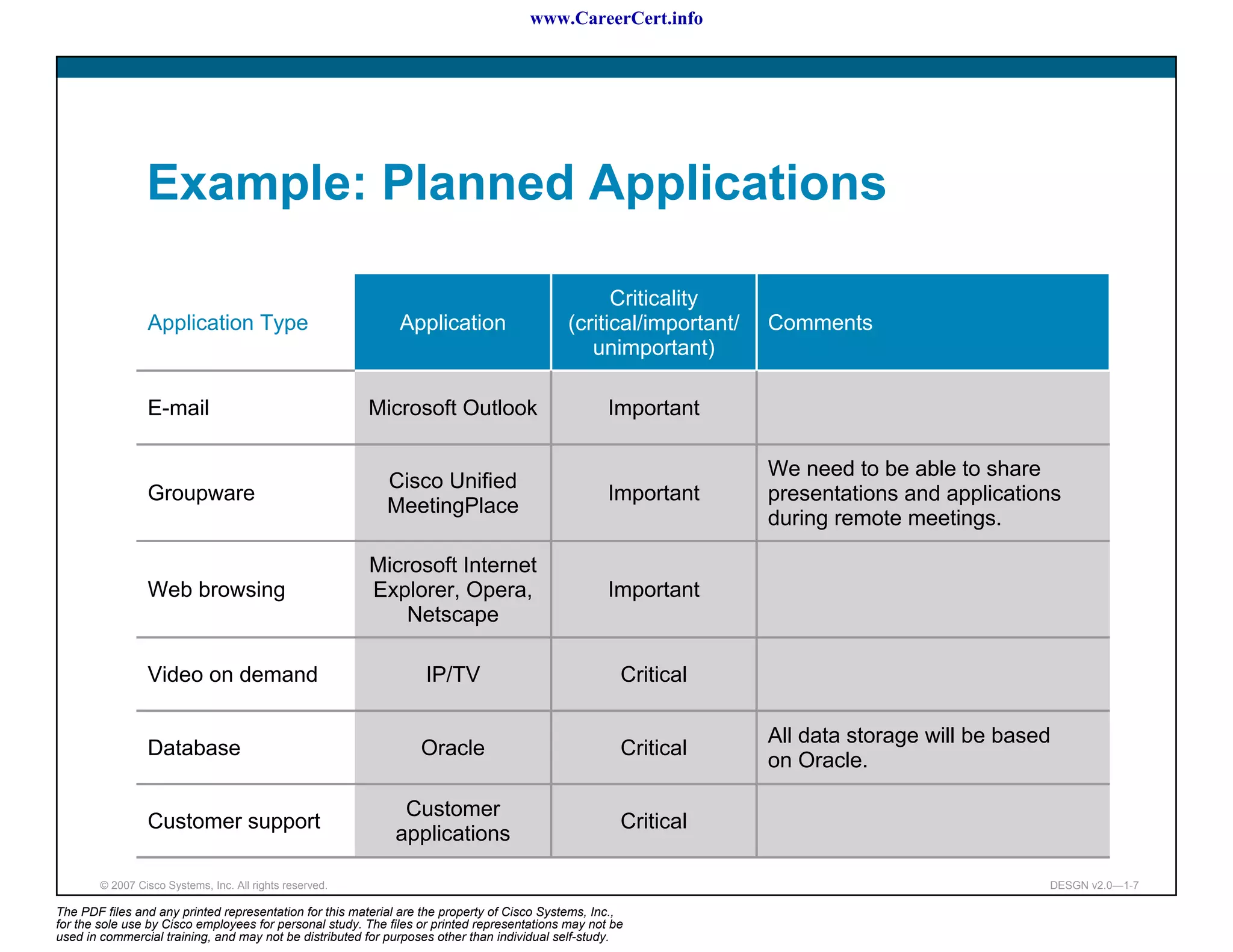


        © 2007 Cisco Systems, Inc. All rights reserved.                                                     DESGN v2.0—2-22

The PDF files and any printed representation for this material are the property of Cisco Systems, Inc.,
for the sole use by Cisco employees for personal study. The files or printed representations may not be
used in commercial training, and may not be distributed for purposes other than individual self-study.
www.CareerCert.info


        © 2007 Cisco Systems, Inc. All rights reserved.                                                     DESGN v2.0—2-23

The PDF files and any printed representation for this material are the property of Cisco Systems, Inc.,
for the sole use by Cisco employees for personal study. The files or printed representations may not be
used in commercial training, and may not be distributed for purposes other than individual self-study.
www.CareerCert.info


                 Module Summary
                         The hierarchical network structure is composed of the access,
                         distribution, and core layers.
                         Based on Cisco SONA, the Cisco Enterprise Architecture provides
                         a modular hierarchical approach for providing network
                         infrastructure and services to all places in the network.
                         Network infrastructure services add intelligence to the network
                         infrastructure, supporting application awareness within the network.
                         Network management protocols support the exchange of
                         management information between the network management
                         system and managed devices.


        © 2007 Cisco Systems, Inc. All rights reserved.                                                     DESGN v2.0—2-1

The PDF files and any printed representation for this material are the property of Cisco Systems, Inc.,
for the sole use by Cisco employees for personal study. The files or printed representations may not be
used in commercial training, and may not be distributed for purposes other than individual self-study.
www.CareerCert.info


        © 2007 Cisco Systems, Inc. All rights reserved.                                                     DESGN v2.0—2-2

The PDF files and any printed representation for this material are the property of Cisco Systems, Inc.,
for the sole use by Cisco employees for personal study. The files or printed representations may not be
used in commercial training, and may not be distributed for purposes other than individual self-study.
www.CareerCert.info


                 Designing Basic
                 Campus and Data
                 Center Networks


                 Designing for Cisco Internetwork Solutions (DESGN) v2.0


        © 2007 Cisco Systems, Inc. All rights reserved.                                                     DESGN v2.0—3-1

The PDF files and any printed representation for this material are the property of Cisco Systems, Inc.,
for the sole use by Cisco employees for personal study. The files or printed representations may not be
used in commercial training, and may not be distributed for purposes other than individual self-study.
www.CareerCert.info


                 Describing
                 Campus Design
                 Considerations

                 Designing Basic Enterprise Campus Networks


        © 2007 Cisco Systems, Inc. All rights reserved.                                                     DESGN v2.0—3-1

The PDF files and any printed representation for this material are the property of Cisco Systems, Inc.,
for the sole use by Cisco employees for personal study. The files or printed representations may not be
used in commercial training, and may not be distributed for purposes other than individual self-study.
www.CareerCert.info


                 Designing an Enterprise Campus

        Campus design factors:
                 Network applications
                 characteristics
                 Device characteristics
                 Environmental characteristics


        © 2007 Cisco Systems, Inc. All rights reserved.                                                     DESGN v2.0—3-2

The PDF files and any printed representation for this material are the property of Cisco Systems, Inc.,
for the sole use by Cisco employees for personal study. The files or printed representations may not be
used in commercial training, and may not be distributed for purposes other than individual self-study.
www.CareerCert.info


                 Overview of Network Application Types

                          Peer-to-peer
                          Client-local server
                          Client-server farm
                          Client-enterprise edge Server


        © 2007 Cisco Systems, Inc. All rights reserved.                                                     DESGN v2.0—3-3

The PDF files and any printed representation for this material are the property of Cisco Systems, Inc.,
for the sole use by Cisco employees for personal study. The files or printed representations may not be
used in commercial training, and may not be distributed for purposes other than individual self-study.
www.CareerCert.info


                 Network Requirements of Applications

                          Connectivity type
                          Total required throughput
                          High availability
                          Total network costs


        © 2007 Cisco Systems, Inc. All rights reserved.                                                     DESGN v2.0—3-4

The PDF files and any printed representation for this material are the property of Cisco Systems, Inc.,
for the sole use by Cisco employees for personal study. The files or printed representations may not be
used in commercial training, and may not be distributed for purposes other than individual self-study.
www.CareerCert.info


                 Example: Peer-to-Peer Applications

                 Instant messaging
                 File sharing
                 IP phone calls
                 Video conference systems


        © 2007 Cisco Systems, Inc. All rights reserved.                                                     DESGN v2.0—3-5

The PDF files and any printed representation for this material are the property of Cisco Systems, Inc.,
for the sole use by Cisco employees for personal study. The files or printed representations may not be
used in commercial training, and may not be distributed for purposes other than individual self-study.
www.CareerCert.info


                 Example: Client-Local
                 Server Applications

                          Servers are located close
                          to clients.
                          Servers and clients are in
                          the same LAN.
                          Request to servers from
                          nonlocal LANs is rare.


        © 2007 Cisco Systems, Inc. All rights reserved.                                                     DESGN v2.0—3-6

The PDF files and any printed representation for this material are the property of Cisco Systems, Inc.,
for the sole use by Cisco employees for personal study. The files or printed representations may not be
used in commercial training, and may not be distributed for purposes other than individual self-study.
www.CareerCert.info


                 Example: Client-Server
                 Farm Applications

                 Typical applications:
                          Mail servers
                          File servers
                          Database servers
                 Access to applications:
                          Fast
                          Reliable
                          Controlled (security)


        © 2007 Cisco Systems, Inc. All rights reserved.                                                     DESGN v2.0—3-7

The PDF files and any printed representation for this material are the property of Cisco Systems, Inc.,
for the sole use by Cisco employees for personal study. The files or printed representations may not be
used in commercial training, and may not be distributed for purposes other than individual self-study.
www.CareerCert.info


                 Example: Client-Enterprise
                 Edge Applications

                 Typical applications:
                          Internet applications
                             – Mail servers
                             – Web servers
                             – Public Internet servers
                          E-commerce applications


        © 2007 Cisco Systems, Inc. All rights reserved.                                                     DESGN v2.0—3-8

The PDF files and any printed representation for this material are the property of Cisco Systems, Inc.,
for the sole use by Cisco employees for personal study. The files or printed representations may not be
used in commercial training, and may not be distributed for purposes other than individual self-study.
www.CareerCert.info


                 Relative Network Requirements by
                 Application Type

                                                                                                          Client-Local   Client-Server   Client-Enterprise
                                                                          Peer-to-Peer
                                                                                                            Servers          Farm         Edge Servers

                 Connectivity type                                           Switched                      Switched       Switched          Switched


                 Total required throughput                             Medium to high                      Medium            High            Medium


                 High availability                                         Low to high                     Medium            High              High


                 Total network costs                                   Low to medium                       Medium            High            Medium


        © 2007 Cisco Systems, Inc. All rights reserved.                                                                                               DESGN v2.0—3-9

The PDF files and any printed representation for this material are the property of Cisco Systems, Inc.,
for the sole use by Cisco employees for personal study. The files or printed representations may not be
used in commercial training, and may not be distributed for purposes other than individual self-study.
www.CareerCert.info


                 Environmental Characteristics for
                 Network Design

                          The network devices and distances between them determine the
                          network geography.
                          The campus network design is scoped with respect to geography:
                             – Intrabuilding
                             – Interbuilding
                             – Distant remote buildings


        © 2007 Cisco Systems, Inc. All rights reserved.                                                     DESGN v2.0—3-10

The PDF files and any printed representation for this material are the property of Cisco Systems, Inc.,
for the sole use by Cisco employees for personal study. The files or printed representations may not be
used in commercial training, and may not be distributed for purposes other than individual self-study.
www.CareerCert.info


                 Intrabuilding Structure

                           Provides connectivity inside
                           the building
                           Built with the building access
                           and building distribution layers
                           Transmission options:
                             – Copper
                             – Optical fiber
                             – Wireless


        © 2007 Cisco Systems, Inc. All rights reserved.                                                     DESGN v2.0—3-11

The PDF files and any printed representation for this material are the property of Cisco Systems, Inc.,
for the sole use by Cisco employees for personal study. The files or printed representations may not be
used in commercial training, and may not be distributed for purposes other than individual self-study.
www.CareerCert.info


                 Interbuilding Structure

                 Connectivity between
                 buildings
                 Distances between buildings
                 within a few kilometers
                 Building distribution with
                 campus core layer
                 Typical transmission media:
                 optical fiber


        © 2007 Cisco Systems, Inc. All rights reserved.                                                     DESGN v2.0—3-12

The PDF files and any printed representation for this material are the property of Cisco Systems, Inc.,
for the sole use by Cisco employees for personal study. The files or printed representations may not be
used in commercial training, and may not be distributed for purposes other than individual self-study.
www.CareerCert.info


                 Distant Remote Building Structure

            Metropolitan-based network connectivity options:
              Using company-owned fiber
              Through enterprise WAN
              Through service provider offerings


                                                                                             WAN


        © 2007 Cisco Systems, Inc. All rights reserved.                                                     DESGN v2.0—3-13

The PDF files and any printed representation for this material are the property of Cisco Systems, Inc.,
for the sole use by Cisco employees for personal study. The files or printed representations may not be
used in commercial training, and may not be distributed for purposes other than individual self-study.
www.CareerCert.info


                 Campus Transmission Media

                          Physical media in network design influences:
                             – Network bandwidth
                             – Allowable distance between devices
                             – Copper design considerations:
                                           Electromagnetic interference, grounding, security
                                           Signal attenuation, distance limitations
                          Optical fiber design considerations:
                             – Light signal (LED or laser)
                             – Expensive, providing a long-term investment
                          Wireless design considerations:
                             – Distance, interference, bandwidth, security


        © 2007 Cisco Systems, Inc. All rights reserved.                                                     DESGN v2.0—3-14

The PDF files and any printed representation for this material are the property of Cisco Systems, Inc.,
for the sole use by Cisco employees for personal study. The files or printed representations may not be
used in commercial training, and may not be distributed for purposes other than individual self-study.
www.CareerCert.info


                 Comparison of Campus
                 Transmission Media

                                                    Copper
                                                                             Multimode Fiber                 Single-Mode Fiber        Wireless
                                                  Twisted Pair

                 Bandwidth                     Up to10 Gbps              Up to10 Gbps                     Up to10 Gbps or higher   Up to 54 Mbps*


                 Distance                      Up to 100 m               Up to 2 km                       Up to 80 km              Up to 500 m at
                                                                         (Fast Ethernet)                  (Fast Ethernet)          1 Mbps
                                                                         Up to 550 m                      Up to 100 m
                                                                         (Gigabit Ethernet)               (Gigabit Ethernet)
                                                                         Up to 300 m                      Up to 80 km
                                                                         (10 Gigabit Ethernet)            (10 Gigabit Ethernet)

                 Price                         Inexpensive               Moderate                         Moderate to expensive    Moderate


            *Wireless is half-duplex, so effective bandwidth will be no more than one half this rate.


        © 2007 Cisco Systems, Inc. All rights reserved.                                                                                       DESGN v2.0—3-15

The PDF files and any printed representation for this material are the property of Cisco Systems, Inc.,
for the sole use by Cisco employees for personal study. The files or printed representations may not be
used in commercial training, and may not be distributed for purposes other than individual self-study.
www.CareerCert.info


                 Example: Transmission Media


        © 2007 Cisco Systems, Inc. All rights reserved.                                                     DESGN v2.0—3-16

The PDF files and any printed representation for this material are the property of Cisco Systems, Inc.,
for the sole use by Cisco employees for personal study. The files or printed representations may not be
used in commercial training, and may not be distributed for purposes other than individual self-study.
www.CareerCert.info


                 Infrastructure Device Characteristics

                 Switches connect end devices as well as infrastructure devices:
                          Access layer is typically data link layer switches.
                          Distribution and core layer typically use multilayer switches.
                 Switch type and switching layer decision is influenced by:
                          Infrastructure services requirements(QoS, including policing, and so on)
                          Size of the network segments
                          Expected network failure convergence times
                          Cost


        © 2007 Cisco Systems, Inc. All rights reserved.                                                     DESGN v2.0—3-17

The PDF files and any printed representation for this material are the property of Cisco Systems, Inc.,
for the sole use by Cisco employees for personal study. The files or printed representations may not be
used in commercial training, and may not be distributed for purposes other than individual self-study.
www.CareerCert.info


                 Example Network Service:
                 QoS in LAN Switches


              Enterprise QoS guarantees that critical applications
              receive the required bandwidth or services.
        © 2007 Cisco Systems, Inc. All rights reserved.                                                     DESGN v2.0—3-18

The PDF files and any printed representation for this material are the property of Cisco Systems, Inc.,
for the sole use by Cisco employees for personal study. The files or printed representations may not be
used in commercial training, and may not be distributed for purposes other than individual self-study.
www.CareerCert.info


                 Summary

                          Campus network design is influenced by several factors; first by
                          applications characteristics, such as throughput and availability
                          requirements.
                          Second are environmental characteristics, such as the location
                          of devices and buildings and transmission media.
                          Third are infrastructure device characteristics, such switching type
                          and support for network services.


        © 2007 Cisco Systems, Inc. All rights reserved.                                                     DESGN v2.0—3-19

The PDF files and any printed representation for this material are the property of Cisco Systems, Inc.,
for the sole use by Cisco employees for personal study. The files or printed representations may not be
used in commercial training, and may not be distributed for purposes other than individual self-study.
www.CareerCert.info


        © 2007 Cisco Systems, Inc. All rights reserved.                                                     DESGN v2.0—3-20

The PDF files and any printed representation for this material are the property of Cisco Systems, Inc.,
for the sole use by Cisco employees for personal study. The files or printed representations may not be
used in commercial training, and may not be distributed for purposes other than individual self-study.
www.CareerCert.info


                 Designing the Campus
                 Infrastructure Module


                 Designing Basic Enterprise Campus Networks


        © 2007 Cisco Systems, Inc. All rights reserved.                                                     DESGN v2.0—3-1

The PDF files and any printed representation for this material are the property of Cisco Systems, Inc.,
for the sole use by Cisco employees for personal study. The files or printed representations may not be
used in commercial training, and may not be distributed for purposes other than individual self-study.
www.CareerCert.info


                 Relative Considerations for the
                 Campus Design
                                                                               Campus Infrastructure

                                                                          Building                         Building      Campus        Server
                                                                          Access                          Distribution    Core         Farm
                                                                 Data Link Layer/
                                                                                                          Multilayer     Multilayer   Multilayer
                          Technology                                Multilayer
                                                                                                          Switched       Switched     Switched
                                                                    Switched

                          Scalability                                        High                          Medium          Low        Medium

                          High availability                               Medium                           Medium          High         High

                          Performance                                     Medium                           Medium          High         High

                          Cost per Port                                      Low                           Medium          High         High


        © 2007 Cisco Systems, Inc. All rights reserved.                                                                                            DESGN v2.0—3-2

The PDF files and any printed representation for this material are the property of Cisco Systems, Inc.,
for the sole use by Cisco employees for personal study. The files or printed representations may not be
used in commercial training, and may not be distributed for purposes other than individual self-study.
www.CareerCert.info


                 Building Access Layer Design
                 Considerations

                          Number of users or ports
                          Cabling
                          Performance
                          Redundancy
                          Connectivity speed for hosts
                          and uplinks
                          VLAN deployment
                          Additional features such as QoS
                          and IP multicast


        © 2007 Cisco Systems, Inc. All rights reserved.                                                     DESGN v2.0—3-3

The PDF files and any printed representation for this material are the property of Cisco Systems, Inc.,
for the sole use by Cisco employees for personal study. The files or printed representations may not be
used in commercial training, and may not be distributed for purposes other than individual self-study.
www.CareerCert.info


                 Overview of Recommended Practices for the
                 Building Access Layer

                          Manage VLANs and STP:
                             – Limit VLANs to a single closet whenever possible.
                             – If STP is required, use RPVST+.
                             – Set trunks to desirable and desirable with negotiate.
                             – Manually prune unused VLANs.
                             – Use VTP transparent mode.
                          Manage trunks between switches.
                          Manage default PAgP settings between the catalyst operating
                          system and Cisco IOS Software.
                          Consider implementing routing in the access layer.


        © 2007 Cisco Systems, Inc. All rights reserved.                                                     DESGN v2.0—3-4

The PDF files and any printed representation for this material are the property of Cisco Systems, Inc.,
for the sole use by Cisco employees for personal study. The files or printed representations may not be
used in commercial training, and may not be distributed for purposes other than individual self-study.
www.CareerCert.info


                 STP Considerations
          Use only when you have to!
             – Required when a VLAN
               spans access layer switches
             – Required to protect against
               “user side” loops
             – More common in the
               data center
          Use RPVST+ for best
          convergence.
          Take advantage of the
          Spanning Tree Toolkit.


        © 2007 Cisco Systems, Inc. All rights reserved.                                                     DESGN v2.0—3-5

The PDF files and any printed representation for this material are the property of Cisco Systems, Inc.,
for the sole use by Cisco employees for personal study. The files or printed representations may not be
used in commercial training, and may not be distributed for purposes other than individual self-study.
www.CareerCert.info


                 Cisco STP Toolkit
                     PortFast: Bypass listening-learning
                     phase for access port*
                     UplinkFast: Three to five seconds
                     convergence after link failure
                     BackboneFast: Cuts convergence
                     time by max_age for indirect failure
                     LoopGuard: Prevents alternate or root
                     port from becoming designated in
                     absence of BPDUs*
                     RootGuard: Prevents external switches
                     from becoming root*
                     BPDUGuard: Disable PortFast-enabled
                     port if a BPDU is received*

                  * Also supported with RPVST+


        © 2007 Cisco Systems, Inc. All rights reserved.                                                     DESGN v2.0—3-6

The PDF files and any printed representation for this material are the property of Cisco Systems, Inc.,
for the sole use by Cisco employees for personal study. The files or printed representations may not be
used in commercial training, and may not be distributed for purposes other than individual self-study.
www.CareerCert.info


                 Trunk Considerations
          Set trunk mode to desirable
          and desirable and encapsulation
          negotiate on
          Manually prune all VLANS
          except those needed
          Use VTP transparent mode to
          decrease potential for operational
          error
          Disable trunks on host ports:
             – Catalyst Operating System:
               set port host
             – Cisco IOS Software:
               switchport host


        © 2007 Cisco Systems, Inc. All rights reserved.                                                     DESGN v2.0—3-7

The PDF files and any printed representation for this material are the property of Cisco Systems, Inc.,
for the sole use by Cisco employees for personal study. The files or printed representations may not be
used in commercial training, and may not be distributed for purposes other than individual self-study.
www.CareerCert.info


                 Layer 3 Access-to-Distribution Interconnection


                       Best option for fast convergence
                       Equal-cost Layer 3 load balancing on all links
                       No spanning tree required for convergence
                       No HSRP or GLBP configuration required
                       No VLAN spanning possible
        © 2007 Cisco Systems, Inc. All rights reserved.                                                     DESGN v2.0—3-8

The PDF files and any printed representation for this material are the property of Cisco Systems, Inc.,
for the sole use by Cisco employees for personal study. The files or printed representations may not be
used in commercial training, and may not be distributed for purposes other than individual self-study.
www.CareerCert.info


                 Building Distribution Layer Design
                 Considerations

                          Performance
                          Redundancy
                          Support for network
                          infrastructure services


        © 2007 Cisco Systems, Inc. All rights reserved.                                                     DESGN v2.0—3-9

The PDF files and any printed representation for this material are the property of Cisco Systems, Inc.,
for the sole use by Cisco employees for personal study. The files or printed representations may not be
used in commercial training, and may not be distributed for purposes other than individual self-study.
www.CareerCert.info


                 Overview of Recommended Practices for
                 the Building Distribution Layer

                          Use first-hop redundancy protocols (HSRP and GLBP).
                          Deploy Layer 3 routing protocols from distribution switches to
                          core switches.
                          If required, connect distribution switches to support Layer 2
                          VLAN spanning multiple access switches.


        © 2007 Cisco Systems, Inc. All rights reserved.                                                     DESGN v2.0—3-10

The PDF files and any printed representation for this material are the property of Cisco Systems, Inc.,
for the sole use by Cisco employees for personal study. The files or printed representations may not be
used in commercial training, and may not be distributed for purposes other than individual self-study.
www.CareerCert.info


                 Recommended Practices—
                 First-Hop Redundancy
                  Provides a resilient default
                  gateway or first-hop address
                  to end stations with HSRP,
                  VRRP, or GLBP
                  HSRP, VRRP, and GLBP
                  provide millisecond timers
                  and excellent convergence
                  performance
                  HSRP common in Cisco
                  environments
                  VRRP if you need
                  multi-vendor interoperability
                  GLBP facilitates uplink load
                  balancing


        © 2007 Cisco Systems, Inc. All rights reserved.                                                     DESGN v2.0—3-11

The PDF files and any printed representation for this material are the property of Cisco Systems, Inc.,
for the sole use by Cisco employees for personal study. The files or printed representations may not be
used in commercial training, and may not be distributed for purposes other than individual self-study.
www.CareerCert.info


                 Recommended Practices—Use Layer 3
                 Routing Protocols
                  Build triangles, not
                  squares, for deterministic
                  convergence.
                  Only peer on links that you
                  intend to use as transit.
                  Summarize routes from
                  distribution to core.


        © 2007 Cisco Systems, Inc. All rights reserved.                                                     DESGN v2.0—3-12

The PDF files and any printed representation for this material are the property of Cisco Systems, Inc.,
for the sole use by Cisco employees for personal study. The files or printed representations may not be
used in commercial training, and may not be distributed for purposes other than individual self-study.
www.CareerCert.info


                 Example: Build Redundant Triangles


                       Layer 3 redundant equal cost links support fast convergence.
                       Hardware based—recovery to remaining path is fast.
                       Convergence is extremely fast (dual equal-cost paths: no need for OSPF
                       or EIGRP to recalculate a new path).
        © 2007 Cisco Systems, Inc. All rights reserved.                                                     DESGN v2.0—3-13

The PDF files and any printed representation for this material are the property of Cisco Systems, Inc.,
for the sole use by Cisco employees for personal study. The files or printed representations may not be
used in commercial training, and may not be distributed for purposes other than individual self-study.
www.CareerCert.info


                 Layer 3 Distribution Interconnection


                       Recommended practice—tried and true
                       No STP convergence required for uplink failure and recovery
                       Distribution-to-distribution link required for route summarization
                       Map Layer 2 VLAN number to Layer 3 subnet for ease of use and
                       management
        © 2007 Cisco Systems, Inc. All rights reserved.                                                     DESGN v2.0—3-14

The PDF files and any printed representation for this material are the property of Cisco Systems, Inc.,
for the sole use by Cisco employees for personal study. The files or printed representations may not be
used in commercial training, and may not be distributed for purposes other than individual self-study.
www.CareerCert.info


                 Alternate: Layer 2 Distribution
                 Interconnection


                       Use only if Layer 2 VLAN spanning flexibility required
                       STP convergence required for uplink failure and recovery
                       More complex because STP root and HSRP should match
                       Distribution-to-distribution link required for route summarization

        © 2007 Cisco Systems, Inc. All rights reserved.                                                     DESGN v2.0—3-15

The PDF files and any printed representation for this material are the property of Cisco Systems, Inc.,
for the sole use by Cisco employees for personal study. The files or printed representations may not be
used in commercial training, and may not be distributed for purposes other than individual self-study.
www.CareerCert.info


                 Campus Core Design Considerations
               Determine if core is needed.
               Determine performance
               and capacity needed.
               Determine redundancy.
               Determine if enterprise
               edge and WAN connectivity
               is to core or data center.


        © 2007 Cisco Systems, Inc. All rights reserved.                                                     DESGN v2.0—3-16

The PDF files and any printed representation for this material are the property of Cisco Systems, Inc.,
for the sole use by Cisco employees for personal study. The files or printed representations may not be
used in commercial training, and may not be distributed for purposes other than individual self-study.
www.CareerCert.info


                 Example: Large Campus Multilayer
                 Switched Backbone Design

                 Reduced multilayer switch
                 peering
                 Topology with no spanning-tree
                 loops
                 Scalability to arbitrarily large
                 size
                 Improved network services
                 support
                 Two equal-cost paths to every
                 destination network
                 Fast recovery from link failure


        © 2007 Cisco Systems, Inc. All rights reserved.                                                     DESGN v2.0—3-17

The PDF files and any printed representation for this material are the property of Cisco Systems, Inc.,
for the sole use by Cisco employees for personal study. The files or printed representations may not be
used in commercial training, and may not be distributed for purposes other than individual self-study.
www.CareerCert.info


                 Small and Medium Campus Design
                 Options


        © 2007 Cisco Systems, Inc. All rights reserved.                                                     DESGN v2.0—3-18

The PDF files and any printed representation for this material are the property of Cisco Systems, Inc.,
for the sole use by Cisco employees for personal study. The files or printed representations may not be
used in commercial training, and may not be distributed for purposes other than individual self-study.
www.CareerCert.info


                 Edge Distribution Design
         Edge distribution switches
         have to protect the campus
         core from:
                  Unauthorized access
                  IP spoofing
                  Network reconnaissance
                  Packet sniffers


        © 2007 Cisco Systems, Inc. All rights reserved.                                                     DESGN v2.0—3-19

The PDF files and any printed representation for this material are the property of Cisco Systems, Inc.,
for the sole use by Cisco employees for personal study. The files or printed representations may not be
used in commercial training, and may not be distributed for purposes other than individual self-study.
www.CareerCert.info


                 Server Placement in a
                 Medium-Sized Network


        © 2007 Cisco Systems, Inc. All rights reserved.                                                     DESGN v2.0—3-20

The PDF files and any printed representation for this material are the property of Cisco Systems, Inc.,
for the sole use by Cisco employees for personal study. The files or printed representations may not be
used in commercial training, and may not be distributed for purposes other than individual self-study.
www.CareerCert.info


                 Server Placement in a Large Network


        © 2007 Cisco Systems, Inc. All rights reserved.                                                     DESGN v2.0—3-21

The PDF files and any printed representation for this material are the property of Cisco Systems, Inc.,
for the sole use by Cisco employees for personal study. The files or printed representations may not be
used in commercial training, and may not be distributed for purposes other than individual self-study.
www.CareerCert.info


                 Server Farm Design Guidelines
      Key design considerations:
        Access control
        Traffic demands
        Oversubscription
      Server connectivity options:
        Single NIC
        Dual-NIC redundancy
        Content switching (server
        load balancing)


        © 2007 Cisco Systems, Inc. All rights reserved.                                                     DESGN v2.0—3-22

The PDF files and any printed representation for this material are the property of Cisco Systems, Inc.,
for the sole use by Cisco employees for personal study. The files or printed representations may not be
used in commercial training, and may not be distributed for purposes other than individual self-study.
www.CareerCert.info


                 Summary

                 Design an enterprise campus network using
                 recommended practices:
                          Use low price per port and high port density on data link layer
                          switches for the building access layer.
                          Use redundant multilayer switching in the building distribution
                          layer for high availability and performance.
                          Use high-performance wire-rate multilayer switching in the
                          campus core design.
                          Group centralized servers into a server farm module for moderate
                          enterprise server requirements.


        © 2007 Cisco Systems, Inc. All rights reserved.                                                     DESGN v2.0—3-23

The PDF files and any printed representation for this material are the property of Cisco Systems, Inc.,
for the sole use by Cisco employees for personal study. The files or printed representations may not be
used in commercial training, and may not be distributed for purposes other than individual self-study.
www.CareerCert.info


        © 2007 Cisco Systems, Inc. All rights reserved.                                                     DESGN v2.0—3-24

The PDF files and any printed representation for this material are the property of Cisco Systems, Inc.,
for the sole use by Cisco employees for personal study. The files or printed representations may not be
used in commercial training, and may not be distributed for purposes other than individual self-study.
www.CareerCert.info


                 Describing Enterprise
                 Data Center
                 Considerations


                 Designing Basic Enterprise Campus Networks


        © 2007 Cisco Systems, Inc. All rights reserved.                                                     DESGN v2.0—3-1

The PDF files and any printed representation for this material are the property of Cisco Systems, Inc.,
for the sole use by Cisco employees for personal study. The files or printed representations may not be
used in commercial training, and may not be distributed for purposes other than individual self-study.
www.CareerCert.info


       Server-Centric to Service-Centric


        © 2007 Cisco Systems, Inc. All rights reserved.                                                     DESGN v2.0—3-2

The PDF files and any printed representation for this material are the property of Cisco Systems, Inc.,
for the sole use by Cisco employees for personal study. The files or printed representations may not be
used in commercial training, and may not be distributed for purposes other than individual self-study.
www.CareerCert.info


                 Cisco Data Center Network Architecture
                 Framework


        © 2007 Cisco Systems, Inc. All rights reserved.                                                     DESGN v2.0—3-3

The PDF files and any printed representation for this material are the property of Cisco Systems, Inc.,
for the sole use by Cisco employees for personal study. The files or printed representations may not be
used in commercial training, and may not be distributed for purposes other than individual self-study.
www.CareerCert.info


          Example: Data Center Network Topology


                                                                                                            IBM


                           3d icons not available
        © 2007 Cisco Systems, Inc. All rights reserved.                                                           DESGN v2.0—3-4

The PDF files and any printed representation for this material are the property of Cisco Systems, Inc.,
for the sole use by Cisco employees for personal study. The files or printed representations may not be
used in commercial training, and may not be distributed for purposes other than individual self-study.
www.CareerCert.info


                 Data Center Infrastructure Overview


        © 2007 Cisco Systems, Inc. All rights reserved.                                                     DESGN v2.0—3-5

The PDF files and any printed representation for this material are the property of Cisco Systems, Inc.,
for the sole use by Cisco employees for personal study. The files or printed representations may not be
used in commercial training, and may not be distributed for purposes other than individual self-study.
www.CareerCert.info


                 Defining the Data Center Access Layer
        Can support Layer 2 or Layer 3
        access
        Provides port density to server
        farm
        Supports dual and single-attached
        servers
        Provides high-performance,
        low-latency Layer 2 switching
        Mix of oversubscription
        requirements
        Many uplink options


        © 2007 Cisco Systems, Inc. All rights reserved.                                                     DESGN v2.0—3-6

The PDF files and any printed representation for this material are the property of Cisco Systems, Inc.,
for the sole use by Cisco employees for personal study. The files or printed representations may not be
used in commercial training, and may not be distributed for purposes other than individual self-study.
www.CareerCert.info


                 Density and Scalability Implications

                          Where are the issues?
                             – Cabling
                             – Power
                             – Cooling


        © 2007 Cisco Systems, Inc. All rights reserved.                                                                7
                                                                                                            DESGN v2.0—3-7

The PDF files and any printed representation for this material are the property of Cisco Systems, Inc.,
for the sole use by Cisco employees for personal study. The files or printed representations may not be
used in commercial training, and may not be distributed for purposes other than individual self-study.
www.CareerCert.info


                 Defining the Data Center Aggregation Layer
      • Aggregates traffic to data center
        core
      • Aggregates advanced application
        and security functions
      • Maintains connection and session
        state for redundancy
      • Layer 4–7 services: firewall,
        server load balancing, SSL, IDS
      • Large STP processing load
      • High flexibility and
        economies of scale


        © 2007 Cisco Systems, Inc. All rights reserved.                                                     DESGN v2.0—3-8

The PDF files and any printed representation for this material are the property of Cisco Systems, Inc.,
for the sole use by Cisco employees for personal study. The files or printed representations may not be
used in commercial training, and may not be distributed for purposes other than individual self-study.
www.CareerCert.info


                 Defining the Data Center Core Layer

          Drivers for a data center core:
                   10-Gigabit Ethernet port density
                   Administrative domains
                   Anticipate future requirements
          Key core characteristics:
                   Distributed forwarding architecture
                   Low latency switching
                   10-Gigabit Ethernet scalability
                   Scalable IP multicast support


        © 2007 Cisco Systems, Inc. All rights reserved.                                                     DESGN v2.0—3-9

The PDF files and any printed representation for this material are the property of Cisco Systems, Inc.,
for the sole use by Cisco employees for personal study. The files or printed representations may not be
used in commercial training, and may not be distributed for purposes other than individual self-study.
www.CareerCert.info


                 Summary

                 • Enterprise data centers support a rich set of
                   applications and servers.
                 • The SONA-based Cisco Enterprise Data Center
                   Architecture provides a modular hierarchical approach
                   to align data center resources with business
                   applications.


        © 2007 Cisco Systems, Inc. All rights reserved.                                                     DESGN v2.0—3-10

The PDF files and any printed representation for this material are the property of Cisco Systems, Inc.,
for the sole use by Cisco employees for personal study. The files or printed representations may not be
used in commercial training, and may not be distributed for purposes other than individual self-study.
www.CareerCert.info


        © 2007 Cisco Systems, Inc. All rights reserved.                                                     DESGN v2.0—3-11

The PDF files and any printed representation for this material are the property of Cisco Systems, Inc.,
for the sole use by Cisco employees for personal study. The files or printed representations may not be
used in commercial training, and may not be distributed for purposes other than individual self-study.
www.CareerCert.info


                 Enterprise Campus and Data Center
                 Design Review
                        Analyze organizational requirements:
                           – Type of applications, traffic volume, and traffic pattern
                           – Redundancy and backup needed
                        Characterize the existing network and sites:
                           – Technology used and location of hosts, servers, terminals,
                             and other end nodes
                        Develop enterprise campus and enterprise data center network
                        designs:
                           – Based on requirements, implement two or three hierarchical
                             layers.
                           – Select hardware and software components to support
                             requirements.


        © 2007 Cisco Systems, Inc. All rights reserved.                                                     DESGN v2.0—3-1

The PDF files and any printed representation for this material are the property of Cisco Systems, Inc.,
for the sole use by Cisco employees for personal study. The files or printed representations may not be
used in commercial training, and may not be distributed for purposes other than individual self-study.
www.CareerCert.info


                 Module Summary
                         Campus network design is influenced by application,
                         environmental, and infrastructure device characteristics.
                         An enterprise campus network is constructed hierarchically with
                         building access, building distribution, and campus core layers.
                         An enterprise data center network is constructed hierarchically,
                         with data center access, data center aggregation, and data center
                         core layers.


        © 2007 Cisco Systems, Inc. All rights reserved.                                                     DESGN v2.0—3-2

The PDF files and any printed representation for this material are the property of Cisco Systems, Inc.,
for the sole use by Cisco employees for personal study. The files or printed representations may not be
used in commercial training, and may not be distributed for purposes other than individual self-study.
www.CareerCert.info


        © 2007 Cisco Systems, Inc. All rights reserved.                                                     DESGN v2.0—3-3

The PDF files and any printed representation for this material are the property of Cisco Systems, Inc.,
for the sole use by Cisco employees for personal study. The files or printed representations may not be
used in commercial training, and may not be distributed for purposes other than individual self-study.
www.CareerCert.info


                 Designing Remote
                 Connectivity


                 Designing for Cisco Internetwork Solutions (DESGN) v2.0


        © 2007 Cisco Systems, Inc. All rights reserved.                                                     DESGN v2.0—4-1

The PDF files and any printed representation for this material are the property of Cisco Systems, Inc.,
for the sole use by Cisco employees for personal study. The files or printed representations may not be
used in commercial training, and may not be distributed for purposes other than individual self-study.
www.CareerCert.info


                 Identifying WAN
                 Technology
                 Considerations


                 Designing Remote Connectivity


        © 2007 Cisco Systems, Inc. All rights reserved.                                                     DESGN v2.0—4-1

The PDF files and any printed representation for this material are the property of Cisco Systems, Inc.,
for the sole use by Cisco employees for personal study. The files or printed representations may not be
used in commercial training, and may not be distributed for purposes other than individual self-study.
www.CareerCert.info


                 Role of a WAN


        © 2007 Cisco Systems, Inc. All rights reserved.                                                     DESGN v2.0—4-2

The PDF files and any printed representation for this material are the property of Cisco Systems, Inc.,
for the sole use by Cisco employees for personal study. The files or printed representations may not be
used in commercial training, and may not be distributed for purposes other than individual self-study.
www.CareerCert.info


                 Types of WAN Interconnections


        © 2007 Cisco Systems, Inc. All rights reserved.                                                     DESGN v2.0—4-3

The PDF files and any printed representation for this material are the property of Cisco Systems, Inc.,
for the sole use by Cisco employees for personal study. The files or printed representations may not be
used in commercial training, and may not be distributed for purposes other than individual self-study.
www.CareerCert.info


                 WAN Transport Technology Comparison
                                                                                Latency               Connect                  Initial
                                                          Bandwidth                                                Tariff                Reliability
                                                                               and Jitter              Time                    Cost
                       TDM                                     M                      L                   L          M           M           M
                       ISDN                                     L                  M/H                    M          M           L           M
                       Frame Relay                              L                     L                   L          M           M           M
                       ATM                                   M/H                      L                   L          M           M              H
                       MPLS                                  M/H                      L                   L          M           M              H
                       Metro Ethernet                        M/H                      L                   L          M           M              H
                       DSL                                   L/M*                  M/H                    L          L           L           M
                       Cable modem                           L/M*                  M/H                    L          L           M              L
                       Wireless                              L/M                   M/H                    L          L           M              L
                       SONET/SDH                               H                      L                   L          M           H              H
                       DWDM                                    H                      L                   L          M           H              H
                       Dark fiber                              H                      L                   L          M           H              H
                                             *Unbalanced        Tx and Rx                                       L = low, M = medium, H = high


        © 2007 Cisco Systems, Inc. All rights reserved.                                                                                             DESGN v2.0—4-4

The PDF files and any printed representation for this material are the property of Cisco Systems, Inc.,
for the sole use by Cisco employees for personal study. The files or printed representations may not be
used in commercial training, and may not be distributed for purposes other than individual self-study.
www.CareerCert.info


                 Example: ADSL Implementation


        © 2007 Cisco Systems, Inc. All rights reserved.                                                     DESGN v2.0—4-5

The PDF files and any printed representation for this material are the property of Cisco Systems, Inc.,
for the sole use by Cisco employees for personal study. The files or printed representations may not be
used in commercial training, and may not be distributed for purposes other than individual self-study.
www.CareerCert.info


                 Example: Data and Voice over Cable


        © 2007 Cisco Systems, Inc. All rights reserved.                                                     DESGN v2.0—4-6

The PDF files and any printed representation for this material are the property of Cisco Systems, Inc.,
for the sole use by Cisco employees for personal study. The files or printed representations may not be
used in commercial training, and may not be distributed for purposes other than individual self-study.
www.CareerCert.info


                 Example: Three Uses of Wireless


        © 2007 Cisco Systems, Inc. All rights reserved.                                                     DESGN v2.0—4-7

The PDF files and any printed representation for this material are the property of Cisco Systems, Inc.,
for the sole use by Cisco employees for personal study. The files or printed representations may not be
used in commercial training, and may not be distributed for purposes other than individual self-study.
www.CareerCert.info


                 Example: SONET/SDH


                                                                                                            Guaranteed bandwidth
                                                                                                            High line rates (from
                                                                                                            155 Mbps to 10 Gbps)
                                                                                                            Automatic recovery
                                                                                                            capabilities
                                                                                                            IP encapsulations:
                                                                                                            ATM or packet over
                                                                                                            SONET/SDH (POS)

        © 2007 Cisco Systems, Inc. All rights reserved.                                                                             DESGN v2.0—4-8

The PDF files and any printed representation for this material are the property of Cisco Systems, Inc.,
for the sole use by Cisco employees for personal study. The files or printed representations may not be
used in commercial training, and may not be distributed for purposes other than individual self-study.
www.CareerCert.info


                    Example: DWDM


                          Improved signaling mechanisms to optimize bandwidth usage
                          Used inside the SONET/SDH ring


        © 2007 Cisco Systems, Inc. All rights reserved.                                                     DESGN v2.0—4-9

The PDF files and any printed representation for this material are the property of Cisco Systems, Inc.,
for the sole use by Cisco employees for personal study. The files or printed representations may not be
used in commercial training, and may not be distributed for purposes other than individual self-study.
www.CareerCert.info


                 Example: Dark Fiber


                          Edge devices directly connected to regenerators or DWDM
                          concentrators
                          Edge devices able to use any Layer 2 encapsulation


        © 2007 Cisco Systems, Inc. All rights reserved.                                                     DESGN v2.0—4-10

The PDF files and any printed representation for this material are the property of Cisco Systems, Inc.,
for the sole use by Cisco employees for personal study. The files or printed representations may not be
used in commercial training, and may not be distributed for purposes other than individual self-study.
www.CareerCert.info


                 WAN Transport Technology
                 Pricing Considerations
                       Pricing used to include an access circuit and a
                       distance-sensitive rate.
                       Access circuit provisioning generally takes 60 days or more lead
                       time.
                          – Metro Ethernet availability is spotty, and lead times are long.
                       For Frame Relays and ATM, pricing includes an access circuit
                       charge,
                       per-PVC and possibly per-bandwidth (CIR or MIR) charges.
                       MPLS VPN pricing is generally comparable with Frame Relays
                       and ATM.


        © 2007 Cisco Systems, Inc. All rights reserved.                                                     DESGN v2.0—4-11

The PDF files and any printed representation for this material are the property of Cisco Systems, Inc.,
for the sole use by Cisco employees for personal study. The files or printed representations may not be
used in commercial training, and may not be distributed for purposes other than individual self-study.
www.CareerCert.info


                 WAN Transport Technology
                 Contract Considerations
                       Tariffed commercial services are at published rates and subject
                       to restrictions.
                       Time to contract can be one month for standard tariff rates, longer
                       if you negotiate SLAs.
                       Contract periods are usually one to five years for most WAN
                       services.
                       For dark fiber, contract periods are generally 20 years.


        © 2007 Cisco Systems, Inc. All rights reserved.                                                     DESGN v2.0—4-12

The PDF files and any printed representation for this material are the property of Cisco Systems, Inc.,
for the sole use by Cisco employees for personal study. The files or printed representations may not be
used in commercial training, and may not be distributed for purposes other than individual self-study.
www.CareerCert.info


                 Methodology Used in
                 Enterprise Edge Design
                Planning and designing the enterprise edge is based on the
                PPDIOO methodology:
                        Analyze network requirements, including type of applications,
                        traffic volume, and traffic patterns.
                        Characterize the existing network for technology used and
                        location of hosts, servers, terminals, and other end nodes.
                        Design the topology based on availability of technology, the
                        projected traffic pattern, and technology performance constraints
                        and reliability.


        © 2007 Cisco Systems, Inc. All rights reserved.                                                     DESGN v2.0—4-13

The PDF files and any printed representation for this material are the property of Cisco Systems, Inc.,
for the sole use by Cisco employees for personal study. The files or printed representations may not be
used in commercial training, and may not be distributed for purposes other than individual self-study.
www.CareerCert.info


                 Identifying Application Requirements

                                                                      Data File                Interactive Data         Real-Time          Real-Time
                                                                      Transfer                    Application             Voice              Video

                    Response time                                   Reasonable                 Within a second     Round trip less than    Minimum
                                                                                                                    250 ms with delay      delay and
                                                                                                                    and with low jitter      jitter

                    Throughput and packet                          High/medium                        Low/low            Low/low          High/medium
                    loss tolerance

                    Downtime (high                                 Reasonable                             Low             Low              Minimum
                    reliability has low
                    downtime)                                                                      Zero Downtime for Mission-Critical
                                                                                                             Applications


        © 2007 Cisco Systems, Inc. All rights reserved.                                                                                        DESGN v2.0—4-14

The PDF files and any printed representation for this material are the property of Cisco Systems, Inc.,
for the sole use by Cisco employees for personal study. The files or printed representations may not be
used in commercial training, and may not be distributed for purposes other than individual self-study.
www.CareerCert.info


                 Determining the Maximum Offered
                 Traffic


                        WAN resources have finite
                        capacity.
                        End users require minimum
                        response times.
                        Network managers require
                        maximum link utilization.


        © 2007 Cisco Systems, Inc. All rights reserved.                                                     DESGN v2.0—4-15

The PDF files and any printed representation for this material are the property of Cisco Systems, Inc.,
for the sole use by Cisco employees for personal study. The files or printed representations may not be
used in commercial training, and may not be distributed for purposes other than individual self-study.
www.CareerCert.info


                 Determining Physical Media Bandwidth
             Bandwidth                             <= 1.5/2 Mbps                  From 1.5/2 Mbps to        From 45/34       From 100 Mbps to
                                                                                  45/34 Mbps                Mbps to 100      10 Gbps
                                                                                                            Mbps

             Copper                                Serial or async                ADSL (8 Mbps
                                                   serial, ISDN,                  downstream
                                                   TDM, X.25, Frame
                                                   Relay, ADSL

             Fiber                                                                Ethernet,                 Fast Ethernet,   10-Gigabit Ethernet,
                                                                                  TDM (T3 or E3)            ATM over         Gigabit Ethernet,
                                                                                                            SONET/SDH,       ATM over
                                                                                                            POS              SONET/SDH, POS

             Coaxial                                                              Shared bandwidth:
                                                                                  27 Mbps
                                                                                  downstream, 2.5
                                                                                  upstream

             2.4/5 GHz WAN                                                        Varies based on
             wireless                                                             distance and RF
                                                                                  quality


        © 2007 Cisco Systems, Inc. All rights reserved.                                                                                  DESGN v2.0—4-16

The PDF files and any printed representation for this material are the property of Cisco Systems, Inc.,
for the sole use by Cisco employees for personal study. The files or printed representations may not be
used in commercial training, and may not be distributed for purposes other than individual self-study.
www.CareerCert.info


                 Evaluating Cost-Effectiveness of Design
                 and Implementation

                                           Investment and Running Costs

                  Private                  Owner must buy, configure, and maintain the physical layer connectivity
                                           and the terminal equipment that connects each location.

                  Leased                   Fixed bandwidth is leased from a carrier company with private or leased
                                           terminal equipment.

                  Shared                   Physical resources in campus backbone are shared with many users.


        © 2007 Cisco Systems, Inc. All rights reserved.                                                         DESGN v2.0—4-17

The PDF files and any printed representation for this material are the property of Cisco Systems, Inc.,
for the sole use by Cisco employees for personal study. The files or printed representations may not be
used in commercial training, and may not be distributed for purposes other than individual self-study.
www.CareerCert.info


                 Bandwidth Usage in a WAN

                 Optimize the bandwidth usage on WAN links to improve
                 network efficiency using:
                          Data compression: Reduces the size of a frame of data to
                          transmit over a network link
                          Bandwidth combination: Logically aggregates physical links
                          Window size: Adjusts link reliability versus throughput
                          Queuing: Avoids congestion for some traffic by giving it priority
                          over other traffic
                          Traffic shaping and policing: Avoids congestion by policing
                          inbound and outbound flows


        © 2007 Cisco Systems, Inc. All rights reserved.                                                     DESGN v2.0—4-18

The PDF files and any printed representation for this material are the property of Cisco Systems, Inc.,
for the sole use by Cisco employees for personal study. The files or printed representations may not be
used in commercial training, and may not be distributed for purposes other than individual self-study.
www.CareerCert.info


                 Queuing to Improve Link Utilization

                          Queuing allows network administrators to manage varying
                          demands of applications on networks and routers.
                          Key types of queuing:
                             – Priority queuing
                             – Custom queuing
                             – Weighted fair queuing
                             – Class-based
                               weighted fair
                               queuing
                             – Low latency
                               queuing


        © 2007 Cisco Systems, Inc. All rights reserved.                                                     DESGN v2.0—4-19

The PDF files and any printed representation for this material are the property of Cisco Systems, Inc.,
for the sole use by Cisco employees for personal study. The files or printed representations may not be
used in commercial training, and may not be distributed for purposes other than individual self-study.
www.CareerCert.info


                 Traffic Shaping and Policing


            • Usually found on egress ports, shaping buffers excess traffic, using a
              token bucket mechanism to release packets.
            • Policers typically “tag” or “drop” traffic, depending on the mechanism,
              protocol, and severity of offense.
            • Policing, historically in ATM, is on ingress ports and uses a “leaky
              bucket” mechanism.

        © 2007 Cisco Systems, Inc. All rights reserved.                                                     DESGN v2.0—4-20

The PDF files and any printed representation for this material are the property of Cisco Systems, Inc.,
for the sole use by Cisco employees for personal study. The files or printed representations may not be
used in commercial training, and may not be distributed for purposes other than individual self-study.
www.CareerCert.info


                 Data Compression and QoS to Optimize
                 Bandwidth Usage


        © 2007 Cisco Systems, Inc. All rights reserved.                                                     DESGN v2.0—4-21

The PDF files and any printed representation for this material are the property of Cisco Systems, Inc.,
for the sole use by Cisco employees for personal study. The files or printed representations may not be
used in commercial training, and may not be distributed for purposes other than individual self-study.
www.CareerCert.info


                 Summary
                        A WAN is a communications network that covers a relatively
                        broad geographic area and carries a variety of traffic types using
                        transmission facilities that are typically provided by service
                        providers.
                        The multiple WAN transport technologies vary in bandwidth,
                        performance characteristics, and cost.
                        In WAN design, enterprise edge connectivity requirements
                        influence the trade-off between the cost of bandwidth and
                        bandwidth efficiency.


        © 2007 Cisco Systems, Inc. All rights reserved.                                                     DESGN v2.0—4-22

The PDF files and any printed representation for this material are the property of Cisco Systems, Inc.,
for the sole use by Cisco employees for personal study. The files or printed representations may not be
used in commercial training, and may not be distributed for purposes other than individual self-study.
www.CareerCert.info


        © 2007 Cisco Systems, Inc. All rights reserved.                                                     DESGN v2.0—4-23

The PDF files and any printed representation for this material are the property of Cisco Systems, Inc.,
for the sole use by Cisco employees for personal study. The files or printed representations may not be
used in commercial training, and may not be distributed for purposes other than individual self-study.
www.CareerCert.info


                 Designing the
                 Enterprise WAN


                 Designing Remote Connectivity


        © 2007 Cisco Systems, Inc. All rights reserved.                                                     DESGN v2.0—4-1

The PDF files and any printed representation for this material are the property of Cisco Systems, Inc.,
for the sole use by Cisco employees for personal study. The files or printed representations may not be
used in commercial training, and may not be distributed for purposes other than individual self-study.
www.CareerCert.info


                 Traditional WAN Technologies


                                                                                                  Description

                       Leased lines                                                                   A service provider establishes a dedicated
                                                                                                      connection.

                       Circuit-switched PSTN (phone                                                   A dedicated circuit path is established for
                       service, analog modems, ISDN)                                                  the duration of a call.
                                                                                                      ISDN combines voice, data, and backup.

                       Packet- and cell-switched (Frame                                               A service provider creates PVCs or SVCs.
                       Relay, SMDS, ATM, MPLS)                                                        ATM uses cells and provides support for
                                                                                                      multiple QoS classes.


        © 2007 Cisco Systems, Inc. All rights reserved.                                                                                       DESGN v2.0—4-2

The PDF files and any printed representation for this material are the property of Cisco Systems, Inc.,
for the sole use by Cisco employees for personal study. The files or printed representations may not be
used in commercial training, and may not be distributed for purposes other than individual self-study.
www.CareerCert.info


                 WAN Topologies


        © 2007 Cisco Systems, Inc. All rights reserved.                                                     DESGN v2.0—4-3

The PDF files and any printed representation for this material are the property of Cisco Systems, Inc.,
for the sole use by Cisco employees for personal study. The files or printed representations may not be
used in commercial training, and may not be distributed for purposes other than individual self-study.
www.CareerCert.info


                 Designing the Remote-Access Network

                          Objective: Provide a unified solution for remote access
                          Grant the connection seamlessly, as if in company headquarters
                          Application requirements include:
                             – Low to medium-volume data file transfer and interactive traffic
                               for teleworkers and traveling workers
                             – Voice services for teleworkers
                          Connectivity option: IP access through an on-demand or
                          always-on connection
                          Technologies include dial-up, DSL, cable, and wireless


        © 2007 Cisco Systems, Inc. All rights reserved.                                                     DESGN v2.0—4-4

The PDF files and any printed representation for this material are the property of Cisco Systems, Inc.,
for the sole use by Cisco employees for personal study. The files or printed representations may not be
used in commercial training, and may not be distributed for purposes other than individual self-study.
www.CareerCert.info


                 Overview of Virtual Private Networks


        © 2007 Cisco Systems, Inc. All rights reserved.                                                     DESGN v2.0—4-5

The PDF files and any printed representation for this material are the property of Cisco Systems, Inc.,
for the sole use by Cisco employees for personal study. The files or printed representations may not be
used in commercial training, and may not be distributed for purposes other than individual self-study.
www.CareerCert.info


                 Connectivity Option: Overlay VPN


                        VPNs may replace dedicated point-to-point links with emulated
                        point-to-point links sharing common infrastructure.

        © 2007 Cisco Systems, Inc. All rights reserved.                                                     DESGN v2.0—4-6

The PDF files and any printed representation for this material are the property of Cisco Systems, Inc.,
for the sole use by Cisco employees for personal study. The files or printed representations may not be
used in commercial training, and may not be distributed for purposes other than individual self-study.
www.CareerCert.info


                 Connectivity Option: Virtual Private Dial-
                 Up Network


        © 2007 Cisco Systems, Inc. All rights reserved.                                                     DESGN v2.0—4-7

The PDF files and any printed representation for this material are the property of Cisco Systems, Inc.,
for the sole use by Cisco employees for personal study. The files or printed representations may not be
used in commercial training, and may not be distributed for purposes other than individual self-study.
www.CareerCert.info


                 Connectivity Option: Peer-to-Peer VPN

                 Provider participates in the enterprise routing:
                          Uses MPLS VPN technology
                          Enables organization to use any IP address space
                          No overlapping IP address space problems


        © 2007 Cisco Systems, Inc. All rights reserved.                                                     DESGN v2.0—4-8

The PDF files and any printed representation for this material are the property of Cisco Systems, Inc.,
for the sole use by Cisco employees for personal study. The files or printed representations may not be
used in commercial training, and may not be distributed for purposes other than individual self-study.
www.CareerCert.info


                 Benefits of VPNs


        © 2007 Cisco Systems, Inc. All rights reserved.                                                     DESGN v2.0—4-9

The PDF files and any printed representation for this material are the property of Cisco Systems, Inc.,
for the sole use by Cisco employees for personal study. The files or printed representations may not be
used in commercial training, and may not be distributed for purposes other than individual self-study.
www.CareerCert.info


                 WAN Backup Technologies


                                                          Backup options:
                                                              Dial backup—analog or ISDN
                                                              Permanent secondary WAN link
                                                              Shadow PVC
                                                              IPsec tunnel across Internet
        © 2007 Cisco Systems, Inc. All rights reserved.                                                     DESGN v2.0—4-10

The PDF files and any printed representation for this material are the property of Cisco Systems, Inc.,
for the sole use by Cisco employees for personal study. The files or printed representations may not be
used in commercial training, and may not be distributed for purposes other than individual self-study.
www.CareerCert.info


                 Example: Permanent Secondary
                 WAN Link


        © 2007 Cisco Systems, Inc. All rights reserved.                                                     DESGN v2.0—4-11

The PDF files and any printed representation for this material are the property of Cisco Systems, Inc.,
for the sole use by Cisco employees for personal study. The files or printed representations may not be
used in commercial training, and may not be distributed for purposes other than individual self-study.
www.CareerCert.info


                 Example: Shadow PVC


        © 2007 Cisco Systems, Inc. All rights reserved.                                                     DESGN v2.0—4-12

The PDF files and any printed representation for this material are the property of Cisco Systems, Inc.,
for the sole use by Cisco employees for personal study. The files or printed representations may not be
used in commercial training, and may not be distributed for purposes other than individual self-study.
www.CareerCert.info


                 WAN Backup over the Internet


        © 2007 Cisco Systems, Inc. All rights reserved.                                                     DESGN v2.0—4-13

The PDF files and any printed representation for this material are the property of Cisco Systems, Inc.,
for the sole use by Cisco employees for personal study. The files or printed representations may not be
used in commercial training, and may not be distributed for purposes other than individual self-study.
www.CareerCert.info


                 Layer 3 Tunneling

                          GRE can encapsulate a variety of protocol types inside IP tunnels.
                             – It is simple and flexible for basic IP VPNs.
                             – Packet payload is not encrypted.
                             – Provisioning of tunnels is not very scalable.
                          IPsec encapsulates IP inside of IPsec tunnels.
                             – Packet payload can be encrypted.
                             – IPsec receiver can authenticate source of packets.
                             – It uses IKE and PKI.


        © 2007 Cisco Systems, Inc. All rights reserved.                                                     DESGN v2.0—4-14

The PDF files and any printed representation for this material are the property of Cisco Systems, Inc.,
for the sole use by Cisco employees for personal study. The files or printed representations may not be
used in commercial training, and may not be distributed for purposes other than individual self-study.
www.CareerCert.info


                 Enterprise WAN Architecture
                 Considerations

                          Support for network growth
                          Appropriate availability
                          Operational expense
                          Operational complexity
                          Voice and video support
                          Effort and cost to implement
                          Support of network segmentation


        © 2007 Cisco Systems, Inc. All rights reserved.                                                     DESGN v2.0—4-15

The PDF files and any printed representation for this material are the property of Cisco Systems, Inc.,
for the sole use by Cisco employees for personal study. The files or printed representations may not be
used in commercial training, and may not be distributed for purposes other than individual self-study.
www.CareerCert.info


                 Cisco Enterprise MAN and WAN Architecture

                          Private WAN (optionally encrypted)
                          ISP service through site-to-site and remote-access IPsec VPN
                          Service provider-managed IP or MPLS VPN
                          Self-deployed MPLS


        © 2007 Cisco Systems, Inc. All rights reserved.                                                     DESGN v2.0—4-16

The PDF files and any printed representation for this material are the property of Cisco Systems, Inc.,
for the sole use by Cisco employees for personal study. The files or printed representations may not be
used in commercial training, and may not be distributed for purposes other than individual self-study.
www.CareerCert.info


                 Cisco Enterprise WAN and MAN
                 Architecture Comparison
                                                                                                                        SP
                                                                            Private                        ISP                    Self-Deployed
                                                                                                                    MPLS and IP
                                                                             WAN                          Service                     MPLS
                                                                                                                       VPN

                                                                            IPsec                     IPsec           IPsec         IPsec
                       Secure transport
                                                                          (optional)                (mandatory)     (mandatory)   (mandatory)

                       High availability                                  Excellent                       Good       Excellent      Excellent

                       Multicast                                             Good                         Good         Good         Excellent

                       Voice and video support                            Excellent                        Low       Excellent      Excellent

                       Scalable network growth                           Moderate                         Good       Excellent      Excellent

                       Easily shared WAN links                           Moderate                     Moderate       Moderate       Excellent

                                                                                                                     Moderate,
                                                                                                                                  Moderate to
                       Operational costs                                      High                         Low      depends on
                                                                                                                                     high
                                                                                                                     transport

                       Network control                                        High                    Moderate       Moderate         High

                       Effort to migrate from
                                                                              Low                     Moderate       Moderate         High
                       private to WAN

        © 2007 Cisco Systems, Inc. All rights reserved.                                                                                      DESGN v2.0—4-17

The PDF files and any printed representation for this material are the property of Cisco Systems, Inc.,
for the sole use by Cisco employees for personal study. The files or printed representations may not be
used in commercial training, and may not be distributed for purposes other than individual self-study.
www.CareerCert.info


                 Example: Cisco WAN Architectures in
                 the Healthcare Environment


        © 2007 Cisco Systems, Inc. All rights reserved.                                                     DESGN v2.0—4-18

The PDF files and any printed representation for this material are the property of Cisco Systems, Inc.,
for the sole use by Cisco employees for personal study. The files or printed representations may not be
used in commercial training, and may not be distributed for purposes other than individual self-study.
www.CareerCert.info


                 Selecting Enterprise Edge Hardware
                 Components and Software Features

                       Hardware selection incorporates the selection of data link layer
                       functions and features of a particular device
                       Considerations: Port density, packet throughput, future
                       expandability, redundancy
                       Software selection focuses on network layer performance
                       Considerations: Forwarding decisions, bandwidth optimization,
                       security


        © 2007 Cisco Systems, Inc. All rights reserved.                                                     DESGN v2.0—4-19

The PDF files and any printed representation for this material are the property of Cisco Systems, Inc.,
for the sole use by Cisco employees for personal study. The files or printed representations may not be
used in commercial training, and may not be distributed for purposes other than individual self-study.
www.CareerCert.info


                 Cisco IOS Software in the Network


             Cisco IOS Software T                                           Cisco IOS Software S            Cisco IOS Software XR
                 IP Services and Ease
                                                                       IP Services and Infrastructure         Scale and Availability
                    of Deployment

                    Broadband access                                       High-end enterprise core            Large-scale networks
                    Mobility and wireless                                  Service provider edge               High availability
                    Data center                                            Virtual Private Networks            In-service software
                    Security                                               (MPLS, Layer 2 and Layer 3)         upgrade
                    IP communications                                      Video and content multicast


        © 2007 Cisco Systems, Inc. All rights reserved.                                                                          DESGN v2.0—4-20

The PDF files and any printed representation for this material are the property of Cisco Systems, Inc.,
for the sole use by Cisco employees for personal study. The files or printed representations may not be
used in commercial training, and may not be distributed for purposes other than individual self-study.
www.CareerCert.info


                 Cisco IOS Packaging


        © 2007 Cisco Systems, Inc. All rights reserved.                                                     DESGN v2.0—4-21

The PDF files and any printed representation for this material are the property of Cisco Systems, Inc.,
for the sole use by Cisco employees for personal study. The files or printed representations may not be
used in commercial training, and may not be distributed for purposes other than individual self-study.
www.CareerCert.info


                 Cisco IOS Packaging Technology
                 Segmentation
                                                                                                                        AppleTalk,
                                                                 Data                    VoIP and         ATM, VoATM,                 Firewall,
                                                                                                                         IPX, IBM
                                                              Connectivity                VoFR               MPLS                    IDS, VPN
                                                                                                                        Protocols

                       IP Base                                         X

                       IP Voice                                        X                        X

                       Advanced Security                               X                                                                 X

                       Enterprise Base                                 X                                                    X

                       SP Services                                     X                        X             X

                       Advanced IP
                                                                       X                        X             X                          X
                       Services

                       Enterprise Services                             X                        X             X             X

                       Advanced
                                                                       X                        X             X             X            X
                       Enterprise Services


        © 2007 Cisco Systems, Inc. All rights reserved.                                                                                      DESGN v2.0—4-22

The PDF files and any printed representation for this material are the property of Cisco Systems, Inc.,
for the sole use by Cisco employees for personal study. The files or printed representations may not be
used in commercial training, and may not be distributed for purposes other than individual self-study.
www.CareerCert.info


                 Comparing Router Platforms and
                 Software Functions
                    Hardware                              Software                                        Function

                    800, 1800, 2800,                      Cisco IOS T Releases                            Supports access routing platforms providing
                    3800, 7200                            12.3, 12.4, 12.3T, 12.4T                        fast, scalable delivery of mission-critical
                                                                                                          enterprise applications

                    7200, 7301,                           Cisco IOS S Release                             Delivers midrange broadband and leased-line
                    7304, 7500, 10K                       12.2SB                                          aggregation for enterprise and service provider
                                                                                                          edge networks

                    7600                                  Cisco IOS S Release                             Delivers high-end Ethernet LAN switching
                                                          12.2SR                                          for enterprise access, distribution, core, and
                                                                                                          data center deployments, and high-end Metro
                                                                                                          Ethernet for service provider edge

                    12000, CRS-1                          Cisco IOS XR                                    Provides massive scale, continuous system
                                                                                                          availability, and service flexibility for service
                                                                                                          provider core and edge. (Takes advantage of
                                                                                                          the massively distributed processing
                                                                                                          capabilities of the Cisco CRS-1 routing system
                                                                                                          and the Cisco 12000)


        © 2007 Cisco Systems, Inc. All rights reserved.                                                                                               DESGN v2.0—4-23

The PDF files and any printed representation for this material are the property of Cisco Systems, Inc.,
for the sole use by Cisco employees for personal study. The files or printed representations may not be
used in commercial training, and may not be distributed for purposes other than individual self-study.
www.CareerCert.info


                 Comparing Multilayer Switch Platforms
                 and Software Functions
                    Hardware                              Software                                        Function

                    800, 1800, 2800,                      Cisco IOS S Release                             Provides low-end to midrange Ethernet LAN
                    3800, 7200                            12.2SE                                          switching for enterprise access and distribution
                                                                                                          deployments

                    4500, 4900                            Cisco IOS S Release                             Provides midrange Ethernet LAN switching
                                                          12.2SG                                          for enterprise access and distribution
                                                                                                          deployments in the campus, and supports
                                                                                                          Metro Ethernet

                    6500                                  Cisco IOS S Release                             Delivers high-end Ethernet LAN switching for
                                                          12.2SX                                          enterprise access, distribution, core, and data
                                                                                                          center deployments, and high-end Metro
                                                                                                          Ethernet for service provider edge

                  Use the Cisco Feature Navigator to find the right Cisco IOS
                  and Catalyst operating system software release and features.


        © 2007 Cisco Systems, Inc. All rights reserved.                                                                                              DESGN v2.0—4-24

The PDF files and any printed representation for this material are the property of Cisco Systems, Inc.,
for the sole use by Cisco employees for personal study. The files or printed representations may not be
used in commercial training, and may not be distributed for purposes other than individual self-study.
www.CareerCert.info


                 Summary
                         Traditional WAN technologies include leased lines,
                         circuit-switched PSTN, and packet-switched networks.
                         Remote-access networks connect teleworkers and traveling
                         employees.
                         A VPN provides connectivity over a shared infrastructure with the
                         same policies and performance as a private network.
                         WAN backup strategies are needed to provide high availability
                         between remote sites.
                         The Cisco Enterprise WAN and MAN Architecture provides
                         integrated QoS, network security, reliability, and manageability.
                         Enterprise WAN design includes selecting the appropriate
                         components, including hardware and software.


        © 2007 Cisco Systems, Inc. All rights reserved.                                                     DESGN v2.0—4-25

The PDF files and any printed representation for this material are the property of Cisco Systems, Inc.,
for the sole use by Cisco employees for personal study. The files or printed representations may not be
used in commercial training, and may not be distributed for purposes other than individual self-study.
www.CareerCert.info


        © 2007 Cisco Systems, Inc. All rights reserved.                                                     DESGN v2.0—4-26

The PDF files and any printed representation for this material are the property of Cisco Systems, Inc.,
for the sole use by Cisco employees for personal study. The files or printed representations may not be
used in commercial training, and may not be distributed for purposes other than individual self-study.
www.CareerCert.info


                 Designing the
                 Enterprise Branch


                 Designing Remote Connectivity


        © 2007 Cisco Systems, Inc. All rights reserved.                                                     DESGN v2.0—4-1

The PDF files and any printed representation for this material are the property of Cisco Systems, Inc.,
for the sole use by Cisco employees for personal study. The files or printed representations may not be
used in commercial training, and may not be distributed for purposes other than individual self-study.
www.CareerCert.info


                 Enterprise Branch Services


        © 2007 Cisco Systems, Inc. All rights reserved.                                                     DESGN v2.0—4-2

The PDF files and any printed representation for this material are the property of Cisco Systems, Inc.,
for the sole use by Cisco employees for personal study. The files or printed representations may not be
used in commercial training, and may not be distributed for purposes other than individual self-study.
www.CareerCert.info


                 Enterprise Branch Architecture


        © 2007 Cisco Systems, Inc. All rights reserved.                                                     DESGN v2.0—4-3

The PDF files and any printed representation for this material are the property of Cisco Systems, Inc.,
for the sole use by Cisco employees for personal study. The files or printed representations may not be
used in commercial training, and may not be distributed for purposes other than individual self-study.
www.CareerCert.info


                 Characterizing the Branch

                          Number of locations
                          Number of existing devices
                          Scalability needed
                          High-availability requirements
                          Security concerns
                          Management concerns
                          Wireless services needed
                          Approximate budget


        © 2007 Cisco Systems, Inc. All rights reserved.                                                     DESGN v2.0—4-4

The PDF files and any printed representation for this material are the property of Cisco Systems, Inc.,
for the sole use by Cisco employees for personal study. The files or printed representations may not be
used in commercial training, and may not be distributed for purposes other than individual self-study.
www.CareerCert.info


                 Enterprise Branch Profiles


        © 2007 Cisco Systems, Inc. All rights reserved.                                                     DESGN v2.0—4-5

The PDF files and any printed representation for this material are the property of Cisco Systems, Inc.,
for the sole use by Cisco employees for personal study. The files or printed representations may not be
used in commercial training, and may not be distributed for purposes other than individual self-study.
www.CareerCert.info


                 Small Branch Office Design
               Infrastructure components
                  – Access router
                  – Layer 2 Switching (integrated
                    or external stackable)
                  – Laptops, phones, printers
               WAN services and backup
                  – Internet deployment model
                  – T1 primary link
                  – ADSL secondary link
               Network fundamentals
                  – EIGRP
                  – High availability—floating statics,
                    T1 with aDSL
                  – QoS—shaping, policing,
                    scavenger class (applied to both
                    switch and router)


        © 2007 Cisco Systems, Inc. All rights reserved.                                                     DESGN v2.0—4-6

The PDF files and any printed representation for this material are the property of Cisco Systems, Inc.,
for the sole use by Cisco employees for personal study. The files or printed representations may not be
used in commercial training, and may not be distributed for purposes other than individual self-study.
www.CareerCert.info


                 Medium Branch Office Design
               Infrastructure components
                  – Dual access routers
                  – External stackable switch
                    (Layer 2 or Layer 3)
                  – Laptops, phones, printers
               WAN services
                  – Private WAN deployment
                  – Dual Frame Relay links
               Network fundamentals
                  – EIGRP
                  – High availability—dual routers,
                    HSRP
                  – QoS—shaping, policing,
                    scavenger class (applied to both
                    switch and router)


        © 2007 Cisco Systems, Inc. All rights reserved.                                                     DESGN v2.0—4-7

The PDF files and any printed representation for this material are the property of Cisco Systems, Inc.,
for the sole use by Cisco employees for personal study. The files or printed representations may not be
used in commercial training, and may not be distributed for purposes other than individual self-study.
www.CareerCert.info


                 Large Branch Office Design
               Infrastructure components
                  – Dual access routers for WAN
                    edge
                  – Dual ASAs for firewalls
                  – Dual multilayer switching
                    (stackable or modular)
                  – Laptops, phones, printers
               WAN services
                  – MPLS deployment model
                  – Dual links to WAN cloud
               Network fundamentals
                  – EIGRP
                  – High availability—dual routers at
                    every layer, HSRP
                  – Object tracking, ASA failover
                  – QoS—shaping, policing,
                    scavenger class (applied to all
                    routers and switches)


        © 2007 Cisco Systems, Inc. All rights reserved.                                                     DESGN v2.0—4-8

The PDF files and any printed representation for this material are the property of Cisco Systems, Inc.,
for the sole use by Cisco employees for personal study. The files or printed representations may not be
used in commercial training, and may not be distributed for purposes other than individual self-study.
www.CareerCert.info


                 Comparison of Teleworking Options
                                                                                                                               Part-Time or
                                                                                                             Occasional
                                                                                                                              Full-Time and
                                                                                                               Users
                                                                                                                              Day Extenders


                                                                                                          Occasional Remote
                                                                                                                              Branch of One
                                                                                                               Worker
            E-mail                                                                                               Yes               Yes
            Web-based applications                                                                               Yes               Yes
            Mission-critical applications                                                                     Best effort       Prioritized
            Real-time collaboration                                                                           Best effort       Prioritized
            Voice over IP                                                                                     Best effort      High quality
            Video on demand, Cisco IP/TV                                                                       Unlikely        High quality
            Video conferencing                                                                                 Unlikely        High quality
            Remote configuration and management                                                                  No                Yes
            Integrated security                                                                                 Basic              Full
            Resiliency and availability                                                                          No                Yes

        © 2007 Cisco Systems, Inc. All rights reserved.                                                                                   DESGN v2.0—4-9

The PDF files and any printed representation for this material are the property of Cisco Systems, Inc.,
for the sole use by Cisco employees for personal study. The files or printed representations may not be
used in commercial training, and may not be distributed for purposes other than individual self-study.
www.CareerCert.info


                 Branch of One Architecture

                           Advanced applications                                                            Centralized management
                           support (voice, video)                                                           IT managed security policies


                            Corporate-Pushed                                           Corporate Phone, Toll              Integrated Security
                            Security Policies                                          Bypass, Centralized                and Identity Services
                            (Not User-Managed)                                         Voice Mail


        © 2007 Cisco Systems, Inc. All rights reserved.                                                                                    DESGN v2.0—4-10

The PDF files and any printed representation for this material are the property of Cisco Systems, Inc.,
for the sole use by Cisco employees for personal study. The files or printed representations may not be
used in commercial training, and may not be distributed for purposes other than individual self-study.
www.CareerCert.info


                 Summary

                          The Cisco Enterprise Branch Architecture provides enterprise
                          services to remote users.
                          You should characterize each branch location to develop a
                          suitable design:
                           – Small branch office design typically uses a single WAN access
                              router with one or two access switches to support up to 50
                              users.
                           – Medium branch office design typically uses two WAN access
                              routers with multiple access switches to support up to 100
                              users.
                           – Large branch office design typically uses two WAN access
                              routers, one or more multilayer distribution switches, and
                              multiple access switches to support up to 100 to 1000 users.
                          An enterprise teleworker design can use a small ISR with
                          integrated switch ports and an always on VPN to support one
                          teleworker.
        © 2007 Cisco Systems, Inc. All rights reserved.                                                     DESGN v2.0—4-11

The PDF files and any printed representation for this material are the property of Cisco Systems, Inc.,
for the sole use by Cisco employees for personal study. The files or printed representations may not be
used in commercial training, and may not be distributed for purposes other than individual self-study.
www.CareerCert.info


        © 2007 Cisco Systems, Inc. All rights reserved.                                                     DESGN v2.0—4-12

The PDF files and any printed representation for this material are the property of Cisco Systems, Inc.,
for the sole use by Cisco employees for personal study. The files or printed representations may not be
used in commercial training, and may not be distributed for purposes other than individual self-study.
www.CareerCert.info


                 Remote Connectivity Design Review

                          Analyze network requirements:
                             – Type of applications, the traffic volume and traffic pattern
                             – Redundancy and backup needed
                          Characterize the existing network and sites:
                             – Technology used, and location of hosts, servers, terminals and
                               other end nodes
                          Develop WAN and branch network design:
                             – Select WAN and branch technology to support requirements.
                             – Select hardware and software components to support
                               requirements.


        © 2007 Cisco Systems, Inc. All rights reserved.                                                     DESGN v2.0—4-1

The PDF files and any printed representation for this material are the property of Cisco Systems, Inc.,
for the sole use by Cisco employees for personal study. The files or printed representations may not be
used in commercial training, and may not be distributed for purposes other than individual self-study.
www.CareerCert.info


                 Module Summary

                          Network application and connectivity requirements influence
                          the WAN design.
                          The Cisco Enterprise MAN and WAN architecture provides
                          integrated QoS, network security, reliability, and manageability
                          on:
                             – Private WANs
                             – ISP service through site-to-site and remote-access VPNs
                             – Service Provider-managed IP or MPLS VPNs
                          The Cisco Enterprise Branch Architecture supports small,
                          medium, large, and teleworker locations.


        © 2007 Cisco Systems, Inc. All rights reserved.                                                     DESGN v2.0—4-2

The PDF files and any printed representation for this material are the property of Cisco Systems, Inc.,
for the sole use by Cisco employees for personal study. The files or printed representations may not be
used in commercial training, and may not be distributed for purposes other than individual self-study.
www.CareerCert.info


        © 2007 Cisco Systems, Inc. All rights reserved.                                                     DESGN v2.0—4-3

The PDF files and any printed representation for this material are the property of Cisco Systems, Inc.,
for the sole use by Cisco employees for personal study. The files or printed representations may not be
used in commercial training, and may not be distributed for purposes other than individual self-study.
www.CareerCert.info


                 Designing IP
                 Addressing and
                 Selecting Routing
                 Protocols


                 Designing for Cisco Internetwork Solutions (DESGN) v2.0


        © 2007 Cisco Systems, Inc. All rights reserved.                                                     DESGN v2.0—5-1

The PDF files and any printed representation for this material are the property of Cisco Systems, Inc.,
for the sole use by Cisco employees for personal study. The files or printed representations may not be
used in commercial training, and may not be distributed for purposes other than individual self-study.
www.CareerCert.info


                 Designing IP
                 Addressing


                 Designing IP Addressing and Selecting Routing Protocols


        © 2007 Cisco Systems, Inc. All rights reserved.                                                     DESGN v2.0—5-1

The PDF files and any printed representation for this material are the property of Cisco Systems, Inc.,
for the sole use by Cisco employees for personal study. The files or printed representations may not be
used in commercial training, and may not be distributed for purposes other than individual self-study.
www.CareerCert.info


                 Prerequisite Knowledge

                          IPv4 address and mask structure
                          IPv4 classes and CIDR
                          Static addressing
                          Dynamic addressing with DHCP
                          DNS
                          Private and public addresses
                          NAT and PAT
                             – Static NAT
                             – Dynamic NAT
                             – Overloading


        © 2007 Cisco Systems, Inc. All rights reserved.                                                     DESGN v2.0—5-2

The PDF files and any printed representation for this material are the property of Cisco Systems, Inc.,
for the sole use by Cisco employees for personal study. The files or printed representations may not be
used in commercial training, and may not be distributed for purposes other than individual self-study.
www.CareerCert.info


                 Private and Public IPv4 Address
                 Guidelines


        © 2007 Cisco Systems, Inc. All rights reserved.                                                     DESGN v2.0—5-3

The PDF files and any printed representation for this material are the property of Cisco Systems, Inc.,
for the sole use by Cisco employees for personal study. The files or printed representations may not be
used in commercial training, and may not be distributed for purposes other than individual self-study.
www.CareerCert.info


                 Network Size and IP Addressing
                 Planning

                          How many locations are in the network?
                          How many devices in each location?
                          What are the IP addressing requirements for individual locations?
                          What subnet size is appropriate?


        © 2007 Cisco Systems, Inc. All rights reserved.                                                     DESGN v2.0—5-4

The PDF files and any printed representation for this material are the property of Cisco Systems, Inc.,
for the sole use by Cisco employees for personal study. The files or printed representations may not be
used in commercial training, and may not be distributed for purposes other than individual self-study.
www.CareerCert.info


                 Determining General Network Topology


        © 2007 Cisco Systems, Inc. All rights reserved.                                                     DESGN v2.0—5-5

The PDF files and any printed representation for this material are the property of Cisco Systems, Inc.,
for the sole use by Cisco employees for personal study. The files or printed representations may not be
used in commercial training, and may not be distributed for purposes other than individual self-study.
www.CareerCert.info


                 IP Address Requirements by Location


                                                                            Workstations


                                                                                                                                          Firewall and
                                                             Office Type


                                                                                                                                          Net Device
                                                                                                      IP Phones


                                                                                                                  Interfaces


                                                                                                                                          Interfaces
                                                                                                                               Switches


                                                                                                                                                         Reserve
                                                                                           Servers


                                                                                                                               Layer 3
                                                                                                                  Router
              Location                                                                                                                                             Total

              San Francisco                                Main            600             35        600           17           26           12          20%       1290

              Denver                                      Regional         210             7         210           10            4            0          20%       441

              Houston                                     Regional         155             5         155           10            4            0          20%       329

              Remote Office 1                             Remote            12             1          12             2           1            0          10%        28

              Remote Office 2                             Remote            15             1          15             3           1            0          10%        35

              Remote Office 3                             Remote             8             1           8             3           1            0          10%        21

              Total                                                        1000            50        1000          45           37           12                    2144


        © 2007 Cisco Systems, Inc. All rights reserved.                                                                                                                  DESGN v2.0—5-6

The PDF files and any printed representation for this material are the property of Cisco Systems, Inc.,
for the sole use by Cisco employees for personal study. The files or printed representations may not be
used in commercial training, and may not be distributed for purposes other than individual self-study.
www.CareerCert.info


                 IP Addressing Hierarchy

      Reasons to implement include:
       • Influence of IP addressing
         on routing
       • Modular design and
         scalable solutions
       • Support for route
         aggregation


        © 2007 Cisco Systems, Inc. All rights reserved.                                                     DESGN v2.0—5-7

The PDF files and any printed representation for this material are the property of Cisco Systems, Inc.,
for the sole use by Cisco employees for personal study. The files or printed representations may not be
used in commercial training, and may not be distributed for purposes other than individual self-study.
www.CareerCert.info


                 Route Summarization Groups

                          Benefits of hierarchical addressing include:
                             – Support for route summarization groups
                             – Efficient aggregation of routing advertisements
                          Poorly designed IP addressing results in:
                             – Excess routing traffic, leading to additional bandwidth
                               consumption
                             – Increased routing table recalculations, degrading router
                               performance


        © 2007 Cisco Systems, Inc. All rights reserved.                                                     DESGN v2.0—5-8

The PDF files and any printed representation for this material are the property of Cisco Systems, Inc.,
for the sole use by Cisco employees for personal study. The files or printed representations may not be
used in commercial training, and may not be distributed for purposes other than individual self-study.
www.CareerCert.info


                 Example: Address Blocks by Location

                  Location                                                 Counts                Rounded Power of 2   Address Block

                  San Francisco Campus                                     1290

                  Denver Region
                  Denver Office 1                                          441

                  Remote Office 1                                          28

                  Remote Office 2                                          35

                  Houston Region
                  Houston Campus                                           329

                  Remote Office 3                                          21


        © 2007 Cisco Systems, Inc. All rights reserved.                                                                               DESGN v2.0—5-9

The PDF files and any printed representation for this material are the property of Cisco Systems, Inc.,
for the sole use by Cisco employees for personal study. The files or printed representations may not be
used in commercial training, and may not be distributed for purposes other than individual self-study.
www.CareerCert.info


                 Example: Address Blocks by Location

                  Location                                                 Counts                Rounded Power of 2   Address Block

                  San Francisco Campus                                     1290                  2048

                  Denver Region
                  Denver Office 1                                          441                   512

                  Remote Office 1                                          28                    64

                  Remote Office 2                                          35                    64

                  Houston Region
                  Houston Campus                                           329                   512

                  Remote Office 3                                          21                    64


        © 2007 Cisco Systems, Inc. All rights reserved.                                                                               DESGN v2.0—5-10

The PDF files and any printed representation for this material are the property of Cisco Systems, Inc.,
for the sole use by Cisco employees for personal study. The files or printed representations may not be
used in commercial training, and may not be distributed for purposes other than individual self-study.
www.CareerCert.info


                 Example: Address Blocks by Location

                  Location                                                 Counts                Rounded Power of 2   Address Block

                  San Francisco Campus                                     1290                  2048

                  Denver Region                                                                  1024
                  Denver Office 1                                          441                   512

                  Remote Office 1                                          28                    64

                  Remote Office 2                                          35                    64

                  Houston Region                                                                 1024
                  Houston Campus                                           329                   512

                  Remote Office 3                                          21                    64


        © 2007 Cisco Systems, Inc. All rights reserved.                                                                               DESGN v2.0—5-11

The PDF files and any printed representation for this material are the property of Cisco Systems, Inc.,
for the sole use by Cisco employees for personal study. The files or printed representations may not be
used in commercial training, and may not be distributed for purposes other than individual self-study.
www.CareerCert.info


                 Example: Address Blocks by Location

                  Location                                                 Counts                Rounded Power of 2   Address Block

                  San Francisco Campus                                     1290                  2048                 172.16.0.0 –
                                                                                                                      172.16.7.255 /21

                  Denver Region                                                                  1024                 172.16.8.0 –
                                                                                                                      172.16.11.255 /22

                  Denver Office 1                                          441                   512                  172.16.8.0 –
                                                                                                                      172.16.9.255 /23

                  Remote Office 1                                          28                    64                   172.16.10.0 /26

                  Remote Office 2                                          35                    64                   172.16.10.64 /26

                  Houston Region                                                                 1024                 172.16.12.0 –
                                                                                                                      172.16.15.255 /22

                  Houston Campus                                           329                   512                  172.16.12.0 –
                                                                                                                      172.16.13.255 /23

                  Remote Office 3                                          21                    64                   172.16.14.0 /26


        © 2007 Cisco Systems, Inc. All rights reserved.                                                                                   DESGN v2.0—5-12

The PDF files and any printed representation for this material are the property of Cisco Systems, Inc.,
for the sole use by Cisco employees for personal study. The files or printed representations may not be
used in commercial training, and may not be distributed for purposes other than individual self-study.
www.CareerCert.info


                 Example: Hierarchical
                 IP Addressing Plan


        © 2007 Cisco Systems, Inc. All rights reserved.                                                     DESGN v2.0—5-13

The PDF files and any printed representation for this material are the property of Cisco Systems, Inc.,
for the sole use by Cisco employees for personal study. The files or printed representations may not be
used in commercial training, and may not be distributed for purposes other than individual self-study.
www.CareerCert.info


                 Example: Hierarchical
                 IP Addressing Plan


        © 2007 Cisco Systems, Inc. All rights reserved.                                                     DESGN v2.0—5-14

The PDF files and any printed representation for this material are the property of Cisco Systems, Inc.,
for the sole use by Cisco employees for personal study. The files or printed representations may not be
used in commercial training, and may not be distributed for purposes other than individual self-study.
www.CareerCert.info


                 Managing IP Addresses

                          Using DHCP in the enterprise.
                          Using DNS in the enterprise.
                          Using NAT in the enterprise.


        © 2007 Cisco Systems, Inc. All rights reserved.                                                     DESGN v2.0—5-15

The PDF files and any printed representation for this material are the property of Cisco Systems, Inc.,
for the sole use by Cisco employees for personal study. The files or printed representations may not be
used in commercial training, and may not be distributed for purposes other than individual self-study.
www.CareerCert.info


                 Recommended Practices for
                 IP Address Assignment

                                                                                                            Method

                  Criteria                                             Strategic Address Assignment            Dynamic Address Assignment
                                                                                                               with DHCP

                  Node type                                            Infrastructure devices such             End-user devices
                                                                       as routers and switches

                  Number of end user devices                           Up to 30 end-user devices               More than 30 end user devices

                  Renumbering                                          Requires manual                         Only DHCP server
                                                                       reconfiguration of all hosts            reconfiguration is needed

                  Address tracking                                     Easy address tracking                   Requires additional DHCP
                                                                                                               server configuration

                  Additional parameters                                Manual configuration of all             Only DHCP server needs to
                                                                       hosts required                          be configured

                  High availability                                    IP addresses are available              Redundant DHCP server
                                                                       at any time                             is required

                  Security concerns                                    Minor security risk                     Any device gets IP address

        © 2007 Cisco Systems, Inc. All rights reserved.                                                                                    DESGN v2.0—5-16

The PDF files and any printed representation for this material are the property of Cisco Systems, Inc.,
for the sole use by Cisco employees for personal study. The files or printed representations may not be
used in commercial training, and may not be distributed for purposes other than individual self-study.
www.CareerCert.info


                 Example: IP Address Assignment
                 Methods in an Enterprise Network


        © 2007 Cisco Systems, Inc. All rights reserved.                                                     DESGN v2.0—5-17

The PDF files and any printed representation for this material are the property of Cisco Systems, Inc.,
for the sole use by Cisco employees for personal study. The files or printed representations may not be
used in commercial training, and may not be distributed for purposes other than individual self-study.
www.CareerCert.info


                 Static vs. Dynamic Name Resolution

                          Names used to ease computer-human interaction
                          Names resolved to IP addresses
                          Different name resolution strategies:
                             – Static
                             – Dynamic


        © 2007 Cisco Systems, Inc. All rights reserved.                                                     DESGN v2.0—5-18

The PDF files and any printed representation for this material are the property of Cisco Systems, Inc.,
for the sole use by Cisco employees for personal study. The files or printed representations may not be
used in commercial training, and may not be distributed for purposes other than individual self-study.
www.CareerCert.info


                 Recommended Practices for
                 Name Resolution

                                                                                                            Method

                  Criteria                                             Static Name Resolution                  Dynamic Name Resolution

                  Number of hosts                                      Up to 30 hosts                          More than 30 hosts

                  Isolated network                                     Applicable                              Applicable

                  Internet connectivity                                Not applicable                          Mandatory

                  Frequent changes and                                 Not recommended                         Recommended
                  addition of names

                  Application depending on                             Not recommended                         Recommended
                  name resolution


        © 2007 Cisco Systems, Inc. All rights reserved.                                                                                  DESGN v2.0—5-19

The PDF files and any printed representation for this material are the property of Cisco Systems, Inc.,
for the sole use by Cisco employees for personal study. The files or printed representations may not be
used in commercial training, and may not be distributed for purposes other than individual self-study.
www.CareerCert.info


                 Using DNS for Name Resolution


        © 2007 Cisco Systems, Inc. All rights reserved.                                                     DESGN v2.0—5-20

The PDF files and any printed representation for this material are the property of Cisco Systems, Inc.,
for the sole use by Cisco employees for personal study. The files or printed representations may not be
used in commercial training, and may not be distributed for purposes other than individual self-study.
www.CareerCert.info


                 Example: Locating DHCP and DNS
                 Servers in the Network


        © 2007 Cisco Systems, Inc. All rights reserved.                                                     DESGN v2.0—5-21

The PDF files and any printed representation for this material are the property of Cisco Systems, Inc.,
for the sole use by Cisco employees for personal study. The files or printed representations may not be
used in commercial training, and may not be distributed for purposes other than individual self-study.
www.CareerCert.info


                 IPv6 Address Structure


            x:x:x:x:x:x:x:x, where x is 16 bits, represented by a hexadecimal
            number:
               2031:0000:130F:0000:0000:09C0:876A:130B
               Can be also written as 2031:0:130F::9C0:876A:130B


        © 2007 Cisco Systems, Inc. All rights reserved.                                                     DESGN v2.0—5-22

The PDF files and any printed representation for this material are the property of Cisco Systems, Inc.,
for the sole use by Cisco employees for personal study. The files or printed representations may not be
used in commercial training, and may not be distributed for purposes other than individual self-study.
www.CareerCert.info


                 Benefits of IPv6 Addressing

                          Larger address space
                          Globally unique IP addresses
                          Site multihoming
                          Header format efficiency
                          Improved privacy and security
                          Flow labeling capability
                          Increased mobility and multicast capabilities


        © 2007 Cisco Systems, Inc. All rights reserved.                                                     DESGN v2.0—5-23

The PDF files and any printed representation for this material are the property of Cisco Systems, Inc.,
for the sole use by Cisco employees for personal study. The files or printed representations may not be
used in commercial training, and may not be distributed for purposes other than individual self-study.
www.CareerCert.info


                 IPv6 Address Scope Types

                          IPv6 address scope types:
                             – Unicast (one to one)
                             – Anycast (one to nearest)
                             – Multicast (one to many)
                          Broadcast addresses not available


        © 2007 Cisco Systems, Inc. All rights reserved.                                                     DESGN v2.0—5-24

The PDF files and any printed representation for this material are the property of Cisco Systems, Inc.,
for the sole use by Cisco employees for personal study. The files or printed representations may not be
used in commercial training, and may not be distributed for purposes other than individual self-study.
www.CareerCert.info


                 IPv6 Address Types:
                 Link-Local and Site-Local
                  Link-Local Address


                  Site-Local Address


        © 2007 Cisco Systems, Inc. All rights reserved.                                                     DESGN v2.0—5-25

The PDF files and any printed representation for this material are the property of Cisco Systems, Inc.,
for the sole use by Cisco employees for personal study. The files or printed representations may not be
used in commercial training, and may not be distributed for purposes other than individual self-study.
www.CareerCert.info


                 IPv6 Address Types:
                 Global Aggregatable


                 Global Aggregatable Address


        © 2007 Cisco Systems, Inc. All rights reserved.                                                     DESGN v2.0—5-26

The PDF files and any printed representation for this material are the property of Cisco Systems, Inc.,
for the sole use by Cisco employees for personal study. The files or printed representations may not be
used in commercial training, and may not be distributed for purposes other than individual self-study.
www.CareerCert.info


                 IPv6 Routing Protocol Considerations


                     Interior Gateway Protocols (IGPs) for inside autonomous systems:
                        – RIPng
                        – EIGRP IPv6
                        – OSPFv3
                        – Integrated IS-IS
                     Exterior gateway protocols (EGPs) for peering between autonomous
                     systems:
                        – BGP+

        © 2007 Cisco Systems, Inc. All rights reserved.                                                     DESGN v2.0—5-27

The PDF files and any printed representation for this material are the property of Cisco Systems, Inc.,
for the sole use by Cisco employees for personal study. The files or printed representations may not be
used in commercial training, and may not be distributed for purposes other than individual self-study.
www.CareerCert.info


                 IPv6 Address Assignment Strategies

                 Static:
                          Same as IPv4
                 Dynamic:
                          Link-local
                          Stateless
                          Stateful using DHCPv6


        © 2007 Cisco Systems, Inc. All rights reserved.                                                     DESGN v2.0—5-28

The PDF files and any printed representation for this material are the property of Cisco Systems, Inc.,
for the sole use by Cisco employees for personal study. The files or printed representations may not be
used in commercial training, and may not be distributed for purposes other than individual self-study.
www.CareerCert.info


                 IPv6 Name Resolution
                 Static: Same as IPv4
                 Dynamic (autoconfiguration): DNS server with IPv6 stack
                 support


        © 2007 Cisco Systems, Inc. All rights reserved.                                                     DESGN v2.0—5-29

The PDF files and any printed representation for this material are the property of Cisco Systems, Inc.,
for the sole use by Cisco employees for personal study. The files or printed representations may not be
used in commercial training, and may not be distributed for purposes other than individual self-study.
www.CareerCert.info


                 IPv4- and IPv6-Aware Applications and
                 Name Resolution


                     In a dual-stack case, an application is IPv4- and IPv6-enabled.
                     The application decides which stack to use and asks DNS for the
                     address.


        © 2007 Cisco Systems, Inc. All rights reserved.                                                     DESGN v2.0—5-30

The PDF files and any printed representation for this material are the property of Cisco Systems, Inc.,
for the sole use by Cisco employees for personal study. The files or printed representations may not be
used in commercial training, and may not be distributed for purposes other than individual self-study.
www.CareerCert.info


                 IPv4-to-IPv6 Transition Strategies

                 Three major transition strategies are available:
                          Dual stack (IPv4 and IPv6 coexist in the same device and
                          networks)
                          Tunneling (IPv6 packets are encapsulated into IPv4 packets)
                          Translation (IPv6-only devices can talk to IPv4 devices)


        © 2007 Cisco Systems, Inc. All rights reserved.                                                     DESGN v2.0—5-31

The PDF files and any printed representation for this material are the property of Cisco Systems, Inc.,
for the sole use by Cisco employees for personal study. The files or printed representations may not be
used in commercial training, and may not be distributed for purposes other than individual self-study.
www.CareerCert.info


                 Dual-Stack Mechanism


                                                                                                          Both IPv4 and IPv6 stacks are
                                                                                                          enabled.
                                                                                                          Applications can talk to both
                                                                                                          stacks.
                                                                                                          IP version choice is based on
                                                                                                          name lookup and application
                                                                                                          preference.
                                                                                                          Popular operating systems
                                                                                                          support IPv6.


        © 2007 Cisco Systems, Inc. All rights reserved.                                                                               DESGN v2.0—5-32

The PDF files and any printed representation for this material are the property of Cisco Systems, Inc.,
for the sole use by Cisco employees for personal study. The files or printed representations may not be
used in commercial training, and may not be distributed for purposes other than individual self-study.
www.CareerCert.info


                 Tunneling Mechanism


                 Encapsulates the IPv6 packet in the IPv4 packet. Techniques:
                          Manually configured
                          Semiautomated
                          Automatic
        © 2007 Cisco Systems, Inc. All rights reserved.                                                     DESGN v2.0—5-33

The PDF files and any printed representation for this material are the property of Cisco Systems, Inc.,
for the sole use by Cisco employees for personal study. The files or printed representations may not be
used in commercial training, and may not be distributed for purposes other than individual self-study.
www.CareerCert.info


                 Translation Mechanism


        © 2007 Cisco Systems, Inc. All rights reserved.                                                     DESGN v2.0—5-34

The PDF files and any printed representation for this material are the property of Cisco Systems, Inc.,
for the sole use by Cisco employees for personal study. The files or printed representations may not be
used in commercial training, and may not be distributed for purposes other than individual self-study.
www.CareerCert.info


                 Summary

                          Key components of an IPv4 addressing scheme include IP address
                          structure, address classes, subnetting, and masking.
                          Well-designed hierarchical IP addressing enables efficient aggregation of
                          routing advertisements, which consumes less bandwidth and router CPU.
                             – Dynamic IP address assignment is a recommended practice in the
                               enterprise.
                             – Dynamic name resolution with a DNS server is a recommended
                               practice in the enterprise.
                          IPv6 was designed as a successor to IPv4 to overcome IPv4 limitations.
                             – The IPv6 address structure and address types support a much larger
                               address space than IPv4.
                             – IPv6 supports two address types: link-local and global aggregatable.


        © 2007 Cisco Systems, Inc. All rights reserved.                                                     DESGN v2.0—5-35

The PDF files and any printed representation for this material are the property of Cisco Systems, Inc.,
for the sole use by Cisco employees for personal study. The files or printed representations may not be
used in commercial training, and may not be distributed for purposes other than individual self-study.
www.CareerCert.info


        © 2007 Cisco Systems, Inc. All rights reserved.                                                     DESGN v2.0—5-36

The PDF files and any printed representation for this material are the property of Cisco Systems, Inc.,
for the sole use by Cisco employees for personal study. The files or printed representations may not be
used in commercial training, and may not be distributed for purposes other than individual self-study.
www.CareerCert.info


                 Reviewing Enterprise
                 Routing Protocols


                 Designing IP Addressing and Selecting Routing Protocols


        © 2007 Cisco Systems, Inc. All rights reserved.                                                     DESGN v2.0—5-1

The PDF files and any printed representation for this material are the property of Cisco Systems, Inc.,
for the sole use by Cisco employees for personal study. The files or printed representations may not be
used in commercial training, and may not be distributed for purposes other than individual self-study.
www.CareerCert.info


                 Distance Vector and Link-State
                 Comparison

                 Distance vector protocol characteristics:
                          Slow convergence
                          Easy implementation and maintenance
                          Limited scalability
                 Link-state protocol characteristics:
                          Fast convergence
                          Good scalability
                          Less routing traffic overhead
                          More knowledge needed for implementation and maintenance


        © 2007 Cisco Systems, Inc. All rights reserved.                                                     DESGN v2.0—5-2

The PDF files and any printed representation for this material are the property of Cisco Systems, Inc.,
for the sole use by Cisco employees for personal study. The files or printed representations may not be
used in commercial training, and may not be distributed for purposes other than individual self-study.
www.CareerCert.info


                 Example: Distance Vector Routing


                                                          Routing updates are periodic:
                                                             Include whole routing tables
                                                             Use gratuitous updates (except RIPv2)
        © 2007 Cisco Systems, Inc. All rights reserved.                                                     DESGN v2.0—5-3

The PDF files and any printed representation for this material are the property of Cisco Systems, Inc.,
for the sole use by Cisco employees for personal study. The files or printed representations may not be
used in commercial training, and may not be distributed for purposes other than individual self-study.
www.CareerCert.info


                 Example: Link-State Routing


                                                Triggered updates:
                                                          Include data on link states of changing links
                                                          Use multicast propagation
        © 2007 Cisco Systems, Inc. All rights reserved.                                                     DESGN v2.0—5-4

The PDF files and any printed representation for this material are the property of Cisco Systems, Inc.,
for the sole use by Cisco employees for personal study. The files or printed representations may not be
used in commercial training, and may not be distributed for purposes other than individual self-study.
www.CareerCert.info


                 Interior vs. Exterior Routing Protocols
                 Interior Gateway Protocols (IGPs):
                          Routing inside autonomous systems
                          Fast convergence and easy configuration
                          Low administrator influence on routing decisions
                 Exterior gateway protocols (EGPs):
                          Routing between autonomous systems
                          Slow convergence and more complex configuration
                          High administrator influence on routing decisions


        © 2007 Cisco Systems, Inc. All rights reserved.                                                     DESGN v2.0—5-5

The PDF files and any printed representation for this material are the property of Cisco Systems, Inc.,
for the sole use by Cisco employees for personal study. The files or printed representations may not be
used in commercial training, and may not be distributed for purposes other than individual self-study.
www.CareerCert.info


                 Example: Interior vs. Exterior Routing
                 Protocols


        © 2007 Cisco Systems, Inc. All rights reserved.                                                     DESGN v2.0—5-6

The PDF files and any printed representation for this material are the property of Cisco Systems, Inc.,
for the sole use by Cisco employees for personal study. The files or printed representations may not be
used in commercial training, and may not be distributed for purposes other than individual self-study.
www.CareerCert.info


                 Hierarchical vs. Flat Routing Protocols

                          Flat routing protocols propagate all routing information throughout
                          the network:
                             – Classful routing protocols
                             – Not appropriate for large networks
                             – RIPv1, IGRP, RIPv2 (classless)
                          Hierarchical routing protocols divide large networks into smaller
                          areas:
                             – Classless routing protocols
                             – Limited route propagation between areas
                             – EIGRP, OSPF, IS-IS


        © 2007 Cisco Systems, Inc. All rights reserved.                                                     DESGN v2.0—5-7

The PDF files and any printed representation for this material are the property of Cisco Systems, Inc.,
for the sole use by Cisco employees for personal study. The files or printed representations may not be
used in commercial training, and may not be distributed for purposes other than individual self-study.
www.CareerCert.info


                 Example: Flat and Hierarchical Networks


                                    Comparing flat and hierarchical networks:
                                             Hierarchical structure means less routing traffic overhead.
                                             Summarization is the key.

        © 2007 Cisco Systems, Inc. All rights reserved.                                                     DESGN v2.0—5-8

The PDF files and any printed representation for this material are the property of Cisco Systems, Inc.,
for the sole use by Cisco employees for personal study. The files or printed representations may not be
used in commercial training, and may not be distributed for purposes other than individual self-study.
www.CareerCert.info


                 Routing Protocol Convergence

                          A converged network is a stable network with all needed routing
                          information.
                          Network convergence takes place:
                             – Initially on network startup
                             – On topological changes
                          Enterprise routing protocols should have short convergence
                          times.


        © 2007 Cisco Systems, Inc. All rights reserved.                                                     DESGN v2.0—5-9

The PDF files and any printed representation for this material are the property of Cisco Systems, Inc.,
for the sole use by Cisco employees for personal study. The files or printed representations may not be
used in commercial training, and may not be distributed for purposes other than individual self-study.
www.CareerCert.info


                 Routing Protocol Convergence
                 Comparison


                                                          Protocol            Convergence Time to Router E

                                                          RIP                 Holddown + 1 or 2 update intervals

                                                          EIGRP               Matter of seconds

                                                          OSPF                Matter of seconds


        © 2007 Cisco Systems, Inc. All rights reserved.                                                            DESGN v2.0—5-10

The PDF files and any printed representation for this material are the property of Cisco Systems, Inc.,
for the sole use by Cisco employees for personal study. The files or printed representations may not be
used in commercial training, and may not be distributed for purposes other than individual self-study.
www.CareerCert.info


                 Enhanced IGRP (EIGRP)


                                                      Advanced distance vector protocol based on
                                                      IGRP with some link-state protocol features
                                                      Supports VLSM


        © 2007 Cisco Systems, Inc. All rights reserved.                                                     DESGN v2.0—5-11

The PDF files and any printed representation for this material are the property of Cisco Systems, Inc.,
for the sole use by Cisco employees for personal study. The files or printed representations may not be
used in commercial training, and may not be distributed for purposes other than individual self-study.
www.CareerCert.info


                 EIGRP Characteristics


                    EIGRP Characteristics                                                                 Implemented By

                    Fast convergence                                                                      Diffusing Update Algorithm (DUAL)

                    Improved scalability                                                                  Manual summarization, fast
                                                                                                          convergence

                    Use of VLSM                                                                           Subnet mask in updates

                    Reduced bandwidth usage                                                               No periodic updates

                    Multiple network layer protocol support                                               IPv4, IPv6
                                                                                                          (Protocol Dependent Modules for IPX,
                                                                                                          AppleTalk)


        © 2007 Cisco Systems, Inc. All rights reserved.                                                                                       DESGN v2.0—5-12

The PDF files and any printed representation for this material are the property of Cisco Systems, Inc.,
for the sole use by Cisco employees for personal study. The files or printed representations may not be
used in commercial training, and may not be distributed for purposes other than individual self-study.
www.CareerCert.info


                 Open Shortest Path First (OSPF)

                          Developed in 1988 by IETF, version 2 is described in RFC 2328.
                          OSPF was devised for use in large, scalable networks
                          where RIP failed:
                             – Improved speed of convergence
                             – Network reachability (no hop-count limitations)
                             – Support for VLSM
                             – Improved path calculation


        © 2007 Cisco Systems, Inc. All rights reserved.                                                     DESGN v2.0—5-13

The PDF files and any printed representation for this material are the property of Cisco Systems, Inc.,
for the sole use by Cisco employees for personal study. The files or printed representations may not be
used in commercial training, and may not be distributed for purposes other than individual self-study.
www.CareerCert.info


                 Example: OSPF Multiarea Network


        © 2007 Cisco Systems, Inc. All rights reserved.                                                     DESGN v2.0—5-14

The PDF files and any printed representation for this material are the property of Cisco Systems, Inc.,
for the sole use by Cisco employees for personal study. The files or printed representations may not be
used in commercial training, and may not be distributed for purposes other than individual self-study.
www.CareerCert.info


                 OSPF Characteristics


                          OSPF Characteristics                                     Implemented By

                          Fast convergence                                         Link-state updates (triggered), SPF calculation

                          Very good scalability                                    Multiple-area design

                          Use of VLSM                                              Subnet mask in updates

                          Reduced bandwidth usage                                  No periodic updates


        © 2007 Cisco Systems, Inc. All rights reserved.                                                                              DESGN v2.0—5-15

The PDF files and any printed representation for this material are the property of Cisco Systems, Inc.,
for the sole use by Cisco employees for personal study. The files or printed representations may not be
used in commercial training, and may not be distributed for purposes other than individual self-study.
www.CareerCert.info


                 Integrated IS-IS

                          Link-state protocol
                             – Supports IPv4, IPv6, and OSI CLNP
                             – Support for VLSM
                             – Based on Level 2 backbone to which Level 1 areas are
                               attached
                          Typically deployed in service provider environments, with
                          enterprise network administrators having limited knowledge
                          of IS-IS


        © 2007 Cisco Systems, Inc. All rights reserved.                                                     DESGN v2.0—5-16

The PDF files and any printed representation for this material are the property of Cisco Systems, Inc.,
for the sole use by Cisco employees for personal study. The files or printed representations may not be
used in commercial training, and may not be distributed for purposes other than individual self-study.
www.CareerCert.info


                 Border Gateway Protocol (BGP)

                          BGP is an exterior gateway protocol (EGP) used in Internet
                          routing.
                          BGP is a path vector protocol with enhancements:
                             – Suited for strategic routing policies used between autonomous
                               systems
                             – Allows administrators to adjust parameters to influence routing


        © 2007 Cisco Systems, Inc. All rights reserved.                                                     DESGN v2.0—5-17

The PDF files and any printed representation for this material are the property of Cisco Systems, Inc.,
for the sole use by Cisco employees for personal study. The files or printed representations may not be
used in commercial training, and may not be distributed for purposes other than individual self-study.
www.CareerCert.info


                 BGP Network Implementation


                                           BGP is primarily used for inter-AS system routing.

        © 2007 Cisco Systems, Inc. All rights reserved.                                                     DESGN v2.0—5-18

The PDF files and any printed representation for this material are the property of Cisco Systems, Inc.,
for the sole use by Cisco employees for personal study. The files or printed representations may not be
used in commercial training, and may not be distributed for purposes other than individual self-study.
www.CareerCert.info


                 Internal BGP

                          BGP can run between routers within one autonomous system.
                          IBGP neighbors need not be directly connected (use static routes
                          or an IGP to convey reachability information).
                          Other IBGP uses:
                             – Intra-autonomous system policy implementations
                             – QoS Policy Propagation on BGP (QPPB)
                             – MPLS VPNs (using multiprotocol IBGP)


        © 2007 Cisco Systems, Inc. All rights reserved.                                                     DESGN v2.0—5-19

The PDF files and any printed representation for this material are the property of Cisco Systems, Inc.,
for the sole use by Cisco employees for personal study. The files or printed representations may not be
used in commercial training, and may not be distributed for purposes other than individual self-study.
www.CareerCert.info


                 Recommended Enterprise Routing
                 Protocol Comparison


                                         Enterprise Characteristics                                         EIGRP   OSPF

                                         Fast convergence                                                    Yes    Yes

                                         Very good scalability                                               Yes    Yes

                                         Use of VLSM                                                         Yes    Yes

                                         Multiple network layer protocol support                             Yes     No

                                         Mixed vendor devices                                                No     Yes


        © 2007 Cisco Systems, Inc. All rights reserved.                                                                    DESGN v2.0—5-20

The PDF files and any printed representation for this material are the property of Cisco Systems, Inc.,
for the sole use by Cisco employees for personal study. The files or printed representations may not be
used in commercial training, and may not be distributed for purposes other than individual self-study.
www.CareerCert.info


                 Summary

                          Protocols with hierarchical and link-state attributes support the
                          fastest network convergence.
                          EIGRP and OSPF are the recommend IGPs for the enterprise.
                           – EIGRP is a Cisco proprietary protocol for routing IPv4, IPv6,
                             IPX, and AppleTalk traffic.
                           – OSPF is a standardized protocol for routing IPv4, developed to
                             replace RIP in larger, more diverse media networks. It also can
                             support IPv6.
                           – BGP is a representative EGP. It is primarily used to
                             interconnect autonomous systems or to connect enterprises
                             to an ISP.


        © 2007 Cisco Systems, Inc. All rights reserved.                                                     DESGN v2.0—5-21

The PDF files and any printed representation for this material are the property of Cisco Systems, Inc.,
for the sole use by Cisco employees for personal study. The files or printed representations may not be
used in commercial training, and may not be distributed for purposes other than individual self-study.
www.CareerCert.info


        © 2007 Cisco Systems, Inc. All rights reserved.                                                     DESGN v2.0—5-22

The PDF files and any printed representation for this material are the property of Cisco Systems, Inc.,
for the sole use by Cisco employees for personal study. The files or printed representations may not be
used in commercial training, and may not be distributed for purposes other than individual self-study.
www.CareerCert.info


                 Designing a Routing
                 Protocol Deployment


                 Designing IP Addressing and Selecting Routing Protocols


        © 2007 Cisco Systems, Inc. All rights reserved.                                                     DESGN v2.0—5-1

The PDF files and any printed representation for this material are the property of Cisco Systems, Inc.,
for the sole use by Cisco employees for personal study. The files or printed representations may not be
used in commercial training, and may not be distributed for purposes other than individual self-study.
www.CareerCert.info


                 Routing Protocols in the
                 Enterprise Architecture


        © 2007 Cisco Systems, Inc. All rights reserved.                                                     DESGN v2.0—5-2

The PDF files and any printed representation for this material are the property of Cisco Systems, Inc.,
for the sole use by Cisco employees for personal study. The files or printed representations may not be
used in commercial training, and may not be distributed for purposes other than individual self-study.
www.CareerCert.info


                 Route Redistribution


                                               Redistribution on routing protocols and domain
                                               boundaries occurs on the router.


        © 2007 Cisco Systems, Inc. All rights reserved.                                                     DESGN v2.0—5-3

The PDF files and any printed representation for this material are the property of Cisco Systems, Inc.,
for the sole use by Cisco employees for personal study. The files or printed representations may not be
used in commercial training, and may not be distributed for purposes other than individual self-study.
www.CareerCert.info


                 Route Redistribution Direction

                          Redistribution of routing protocols
                          (boundary router)
                          One-way redistribution in one
                          direction (for example, from
                          enterprise edge to campus core)
                          Two-way redistribution in both
                          directions


        © 2007 Cisco Systems, Inc. All rights reserved.                                                     DESGN v2.0—5-4

The PDF files and any printed representation for this material are the property of Cisco Systems, Inc.,
for the sole use by Cisco employees for personal study. The files or printed representations may not be
used in commercial training, and may not be distributed for purposes other than individual self-study.
www.CareerCert.info


                 Route Redistribution in
                 the Enterprise Network

   Redistribution:
           From selected
           building access
           protocols
           Between campus core
           and WAN routers
           From static routes to
           enterprise IGP
           Static routes or BGP
           routes into enterprise
           IGP


        © 2007 Cisco Systems, Inc. All rights reserved.                                                     DESGN v2.0—5-5

The PDF files and any printed representation for this material are the property of Cisco Systems, Inc.,
for the sole use by Cisco employees for personal study. The files or printed representations may not be
used in commercial training, and may not be distributed for purposes other than individual self-study.
www.CareerCert.info


                 Route Filtering

                 Filtering upon redistribution:
                          Avoids routing loops
                          Avoids suboptimal routing
                          Prevents certain routes from
                          entering routing domain


        © 2007 Cisco Systems, Inc. All rights reserved.                                                     DESGN v2.0—5-6

The PDF files and any printed representation for this material are the property of Cisco Systems, Inc.,
for the sole use by Cisco employees for personal study. The files or printed representations may not be
used in commercial training, and may not be distributed for purposes other than individual self-study.
www.CareerCert.info


                 Route Summarization


        © 2007 Cisco Systems, Inc. All rights reserved.                                                     DESGN v2.0—5-7

The PDF files and any printed representation for this material are the property of Cisco Systems, Inc.,
for the sole use by Cisco employees for personal study. The files or printed representations may not be
used in commercial training, and may not be distributed for purposes other than individual self-study.
www.CareerCert.info


                 Route Summarization


        © 2007 Cisco Systems, Inc. All rights reserved.                                                     DESGN v2.0—5-8

The PDF files and any printed representation for this material are the property of Cisco Systems, Inc.,
for the sole use by Cisco employees for personal study. The files or printed representations may not be
used in commercial training, and may not be distributed for purposes other than individual self-study.
www.CareerCert.info


                 Recommended Practice:
                 Summarize at the Distribution Layer
                     It is important to force
                     summarization at the
                     distribution layer toward
                     the core.
                     After link failure, for return
                     path traffic, an OSPF or
                     EIGRP reroute is required.


        © 2007 Cisco Systems, Inc. All rights reserved.                                                     DESGN v2.0—5-9

The PDF files and any printed representation for this material are the property of Cisco Systems, Inc.,
for the sole use by Cisco employees for personal study. The files or printed representations may not be
used in commercial training, and may not be distributed for purposes other than individual self-study.
www.CareerCert.info


                 Recommended Practice:
                 Summarize at the Distribution Layer
                     It is important to force
                     summarization at the
                     distribution layer toward
                     the core.
                     After link failure, for return
                     path traffic, an OSPF or
                     EIGRP reroute is required.
                     Summaries limit the number
                     of peers an EIGRP router
                     must query or the number
                     of LSAs an OSPF peer must
                     process.


        © 2007 Cisco Systems, Inc. All rights reserved.                                                     DESGN v2.0—5-10

The PDF files and any printed representation for this material are the property of Cisco Systems, Inc.,
for the sole use by Cisco employees for personal study. The files or printed representations may not be
used in commercial training, and may not be distributed for purposes other than individual self-study.
www.CareerCert.info


                 Recommended Practice:
                 Summarize at the Distribution Layer
                     It is important to force
                     summarization at the
                     distribution layer toward
                     the core.
                     After link failure, for return
                     path traffic, an OSPF or
                     EIGRP reroute is required.
                     Summaries limit the number
                     of peers an EIGRP router
                     must query or the number
                     of LSAs an OSPF peer must
                     process.
                     Summaries allow faster
                     reroutes.


        © 2007 Cisco Systems, Inc. All rights reserved.                                                     DESGN v2.0—5-11

The PDF files and any printed representation for this material are the property of Cisco Systems, Inc.,
for the sole use by Cisco employees for personal study. The files or printed representations may not be
used in commercial training, and may not be distributed for purposes other than individual self-study.
www.CareerCert.info


                 Recommended Practice:
                 Passive Interfaces for IGP at Access Layer


                          Limit unnecessary peering
                          Without passive interface:
                             – With four VLANs per wiring closet
                             – 12 adjacencies total
                             – Memory and CPU requirements increased with no real benefit
                             – Creates overhead for IGP
        © 2007 Cisco Systems, Inc. All rights reserved.                                                     DESGN v2.0—5-12

The PDF files and any printed representation for this material are the property of Cisco Systems, Inc.,
for the sole use by Cisco employees for personal study. The files or printed representations may not be
used in commercial training, and may not be distributed for purposes other than individual self-study.
www.CareerCert.info


                 Summary

                          Large networks may implement multiple protocols for different
                          modules of the Cisco Enterprise Architecture.
                          Advanced routing features such as redistribution, filtering, and
                          summarization allow multiple routing protocols to coexist and
                          provide greater scalability.
                             – Redistribution between different routing protocols passes
                               routing knowledge from one protocol to another.
                             – Route filtering prevents advertisement of certain routes
                               through the routing domain.
                             – Route summarization and an IP hierarchy reduce routing traffic
                               and unnecessary route recomputation.


        © 2007 Cisco Systems, Inc. All rights reserved.                                                     DESGN v2.0—5-13

The PDF files and any printed representation for this material are the property of Cisco Systems, Inc.,
for the sole use by Cisco employees for personal study. The files or printed representations may not be
used in commercial training, and may not be distributed for purposes other than individual self-study.
www.CareerCert.info


        © 2007 Cisco Systems, Inc. All rights reserved.                                                     DESGN v2.0—5-14

The PDF files and any printed representation for this material are the property of Cisco Systems, Inc.,
for the sole use by Cisco employees for personal study. The files or printed representations may not be
used in commercial training, and may not be distributed for purposes other than individual self-study.
www.CareerCert.info


                 IP Addressing and Routing Review

                          Define the IP addressing requirements.
                          Develop a hierarchical IP addressing plan:
                             – Use private addresses inside organization.
                             – Use public addresses facing the Internet.
                             – Use NAT or PAT for translation as needed.
                          Develop a plan for deploying DHCP and DNS.
                          Use EIGRP or OSPF, based on organizational requirements.
                          Implement recommended practices, including redistribution,
                          filtering, and summarization.


        © 2007 Cisco Systems, Inc. All rights reserved.                                                     DESGN v2.0—5-78

The PDF files and any printed representation for this material are the property of Cisco Systems, Inc.,
for the sole use by Cisco employees for personal study. The files or printed representations may not be
used in commercial training, and may not be distributed for purposes other than individual self-study.
www.CareerCert.info


                 Module Summary

                          IP address structure and IP address types have a large impact on
                          the address plan for both IPv4 and IPv6.
                          EIGRP and OSPF are the recommended IGPs for the enterprise.
                          Advanced routing features such as redistribution, filtering, and
                          summarization support scalability and multiple routing protocols.


        © 2007 Cisco Systems, Inc. All rights reserved.                                                     DESGN v2.0—5-79

The PDF files and any printed representation for this material are the property of Cisco Systems, Inc.,
for the sole use by Cisco employees for personal study. The files or printed representations may not be
used in commercial training, and may not be distributed for purposes other than individual self-study.
www.CareerCert.info


        © 2007 Cisco Systems, Inc. All rights reserved.                                                     DESGN v2.0—5-80

The PDF files and any printed representation for this material are the property of Cisco Systems, Inc.,
for the sole use by Cisco employees for personal study. The files or printed representations may not be
used in commercial training, and may not be distributed for purposes other than individual self-study.
www.CareerCert.info


                 Evaluating Security
                 Solutions for the
                 Network


                 Designing for Cisco Internetwork Solutions (DESGN) v2.0


        © 2007 Cisco Systems, Inc. All rights reserved.                                                     DESGN v2.0—6-1

The PDF files and any printed representation for this material are the property of Cisco Systems, Inc.,
for the sole use by Cisco employees for personal study. The files or printed representations may not be
used in commercial training, and may not be distributed for purposes other than individual self-study.
www.CareerCert.info


                 Defining Network
                 Security


                 Evaluating Security Solutions for the Network


        © 2007 Cisco Systems, Inc. All rights reserved.                                                     DESGN v2.0—6-1

The PDF files and any printed representation for this material are the property of Cisco Systems, Inc.,
for the sole use by Cisco employees for personal study. The files or printed representations may not be
used in commercial training, and may not be distributed for purposes other than individual self-study.
www.CareerCert.info


                 Reasons for Network Security

                          Defend against attacks
                          Prevent unauthorized access
                          Prevent data misuse and theft
                          Comply with security legislation
                          Comply with industry standards
                          Comply with company policy


        © 2007 Cisco Systems, Inc. All rights reserved.                                                     DESGN v2.0—6-2

The PDF files and any printed representation for this material are the property of Cisco Systems, Inc.,
for the sole use by Cisco employees for personal study. The files or printed representations may not be
used in commercial training, and may not be distributed for purposes other than individual self-study.
www.CareerCert.info


                 Example: Legislation and Directives

                 Legislation and industry directives that may affect
                 organizational security include:
                          GLBA—The Gramm-Leach-Bliley Act
                          HIPAA—Health Insurance Portability and Accountability Act
                          EU data protection Directive 95/46/EC
                          SOX—Sarbanes–Oxley Act
                          PCI DSS—Payment Card Industry Data Security Standard


        © 2007 Cisco Systems, Inc. All rights reserved.                                                     DESGN v2.0—6-3

The PDF files and any printed representation for this material are the property of Cisco Systems, Inc.,
for the sole use by Cisco employees for personal study. The files or printed representations may not be
used in commercial training, and may not be distributed for purposes other than individual self-study.
www.CareerCert.info


                 Threats and Risks


        © 2007 Cisco Systems, Inc. All rights reserved.                                                     DESGN v2.0—6-4

The PDF files and any printed representation for this material are the property of Cisco Systems, Inc.,
for the sole use by Cisco employees for personal study. The files or printed representations may not be
used in commercial training, and may not be distributed for purposes other than individual self-study.
www.CareerCert.info


                 Reconnaissance and Vulnerability
                 Scanning

                       Determine active targets
                       Determine running network services
                       Determine operating system platform
                       Find trust relationships
                       Check for proper file permissions
                       Identify user account information

                 Port-scanning tools include:
                             – Nmap                                                     – SuperScan
                             – NetStumbler                                              – Kismet


        © 2007 Cisco Systems, Inc. All rights reserved.                                                     DESGN v2.0—6-5

The PDF files and any printed representation for this material are the property of Cisco Systems, Inc.,
for the sole use by Cisco employees for personal study. The files or printed representations may not be
used in commercial training, and may not be distributed for purposes other than individual self-study.
www.CareerCert.info


                 Example: NMAP Screen


        © 2007 Cisco Systems, Inc. All rights reserved.                                                     DESGN v2.0—6-6

The PDF files and any printed representation for this material are the property of Cisco Systems, Inc.,
for the sole use by Cisco employees for personal study. The files or printed representations may not be
used in commercial training, and may not be distributed for purposes other than individual self-study.
www.CareerCert.info


                 Vulnerability Assessment
                          Active (sending packets) or passive (sniffer)
                          Published vulnerability information
                             – CERT/CC
                             – MITRE
                             – Microsoft
                             – Cisco security notices
                          Reconnaissance tools
                             – Nessus
                             – MBSA
                             – SAINT


        © 2007 Cisco Systems, Inc. All rights reserved.                                                     DESGN v2.0—6-7

The PDF files and any printed representation for this material are the property of Cisco Systems, Inc.,
for the sole use by Cisco employees for personal study. The files or printed representations may not be
used in commercial training, and may not be distributed for purposes other than individual self-study.
www.CareerCert.info


                 Gaining System Access

                          Using knowledge of usernames and passwords
                             – Improper escalation of privilege
                             – Default administrative and service accounts
                             – Gaining access to other systems via trust relationships
                          Using social engineering
                             – Physical access to information
                             – Psychological approach
                          Cracking captured passwords


        © 2007 Cisco Systems, Inc. All rights reserved.                                                     DESGN v2.0—6-8

The PDF files and any printed representation for this material are the property of Cisco Systems, Inc.,
for the sole use by Cisco employees for personal study. The files or printed representations may not be
used in commercial training, and may not be distributed for purposes other than individual self-study.
www.CareerCert.info


                 Integrity and Confidentiality Threats


        © 2007 Cisco Systems, Inc. All rights reserved.                                                     DESGN v2.0—6-9

The PDF files and any printed representation for this material are the property of Cisco Systems, Inc.,
for the sole use by Cisco employees for personal study. The files or printed representations may not be
used in commercial training, and may not be distributed for purposes other than individual self-study.
www.CareerCert.info


                 Availability Threats (Denial of Service)


        © 2007 Cisco Systems, Inc. All rights reserved.                                                     DESGN v2.0—6-10

The PDF files and any printed representation for this material are the property of Cisco Systems, Inc.,
for the sole use by Cisco employees for personal study. The files or printed representations may not be
used in commercial training, and may not be distributed for purposes other than individual self-study.
www.CareerCert.info


                 Everything Is a Potential Target

                          Hosts are the preferred target for worms
                          and viruses.
                             – In the past year, large number of attacks targeted hosts.
                             – Compromised hosts are often used as attack launch
                               points (botnets).
                          But there are other high-value alternative targets:
                             – Infrastructure devices: routers, switches
                             – Support services: DHCP servers, DNS servers
                             – Endpoints: management stations, IP phones
                             – Infrastructure: network capacity
                             – Security devices: IDS and IPS

        © 2007 Cisco Systems, Inc. All rights reserved.                                                     DESGN v2.0—6-11

The PDF files and any printed representation for this material are the property of Cisco Systems, Inc.,
for the sole use by Cisco employees for personal study. The files or printed representations may not be
used in commercial training, and may not be distributed for purposes other than individual self-study.
www.CareerCert.info


                 Network Security in the System Lifecycle
        Business needs:
        What does your organization want to do with
        the network?
        Risk analysis:
        What is the risk and cost balance?
        Security policy:
        What are the policies, standards, and guidelines
        to address business needs and risk?
        Industry recommended practices:
        What are the reliable, well-understood,
        and recommended security recommended
        practices?
        Security operations:
        What is the process for incident response,
        monitoring, maintenance, and compliance
        auditing of the system?


        © 2007 Cisco Systems, Inc. All rights reserved.                                                     DESGN v2.0—6-12

The PDF files and any printed representation for this material are the property of Cisco Systems, Inc.,
for the sole use by Cisco employees for personal study. The files or printed representations may not be
used in commercial training, and may not be distributed for purposes other than individual self-study.
www.CareerCert.info


                 What Is a Security Policy?

                 “A security policy is a formal statement of the rules by
                  which people who are given access to an organization’s
                  technology and information assets must abide.”

                     RFC 2196, Site Security Handbook


        © 2007 Cisco Systems, Inc. All rights reserved.                                                     DESGN v2.0—6-13

The PDF files and any printed representation for this material are the property of Cisco Systems, Inc.,
for the sole use by Cisco employees for personal study. The files or printed representations may not be
used in commercial training, and may not be distributed for purposes other than individual self-study.
www.CareerCert.info


                 Why Is a Security Policy Needed?
                     Sets the framework for the security implementation
                        – Defines organizational assets and the way to use them
                        – Defines and communicates roles
                        – Helps determine necessary tools and procedures
                        – Defines how to identify and handle security incidents
                     Creates a baseline of the current security posture
                        – Defines allowed and not-allowed system behaviors
                        – Informs users of their responsibilities and ramifications of asset
                          misuse
                        – Provides risk assessment and cost-benefit analysis


        © 2007 Cisco Systems, Inc. All rights reserved.                                                     DESGN v2.0—6-14

The PDF files and any printed representation for this material are the property of Cisco Systems, Inc.,
for the sole use by Cisco employees for personal study. The files or printed representations may not be
used in commercial training, and may not be distributed for purposes other than individual self-study.
www.CareerCert.info


                 Network Security and Risks


               Network security can
               reduce risks to acceptable levels:
                  – Risk assessment defines threats and their probability
                    and severity.
                  – A network security policy enumerates risks relevant to
                    the network and describes how risks will be controlled or
                    managed.
                  – A network security design implements the security policy.
               Justify security costs by the potential cost and
               inconvenience of incidents.

        © 2007 Cisco Systems, Inc. All rights reserved.                                                     DESGN v2.0—6-15

The PDF files and any printed representation for this material are the property of Cisco Systems, Inc.,
for the sole use by Cisco employees for personal study. The files or printed representations may not be
used in commercial training, and may not be distributed for purposes other than individual self-study.
www.CareerCert.info


                 Risk Index Calculation


                       Risk                                                            Probability        Severity   Control   Risk Index
                                                                                          (P)               (S)        (C)     (P * S) / C
                                                                                         (1–3)             (1–3)      (1–3)      (⅓–9)

                       1.

                       2.

                       3.

                       4.


        © 2007 Cisco Systems, Inc. All rights reserved.                                                                               DESGN v2.0—6-16

The PDF files and any printed representation for this material are the property of Cisco Systems, Inc.,
for the sole use by Cisco employees for personal study. The files or printed representations may not be
used in commercial training, and may not be distributed for purposes other than individual self-study.
www.CareerCert.info


                 Example: Risk Index Calculation


                       Risk                                                            Probability        Severity   Control   Risk Index
                                                                                          (P)               (S)        (C)     (P * S) / C
                                                                                         (1–3)             (1–3)      (1–3)      (⅓–9)

                       1. Breach of confidentiality                                             1            3         2          1.5
                       of customer database

                       2. DDoS attack sustained                                                 2            2         1           4
                       for more than 1 hour against
                       e-commerce server


        © 2007 Cisco Systems, Inc. All rights reserved.                                                                                 DESGN v2.0—6-17

The PDF files and any printed representation for this material are the property of Cisco Systems, Inc.,
for the sole use by Cisco employees for personal study. The files or printed representations may not be
used in commercial training, and may not be distributed for purposes other than individual self-study.
www.CareerCert.info


                 Components of a Security Policy


        © 2007 Cisco Systems, Inc. All rights reserved.                                                     DESGN v2.0—6-18

The PDF files and any printed representation for this material are the property of Cisco Systems, Inc.,
for the sole use by Cisco employees for personal study. The files or printed representations may not be
used in commercial training, and may not be distributed for purposes other than individual self-study.
www.CareerCert.info


                 Network Security Is a Continuous
                 Process
             Secure
                – Identity and authentication
                – Filtering and stateful inspection
                – Encryption and VPNs
             Monitor
                – Intrusion detection and response
                – Content-based detection and response
             Test
                – Security posture assessment
                – Vulnerability scanning
                – Patch verification and application auditing
             Improve
                – Event and data analysis and reporting
                – Network security intelligence


        © 2007 Cisco Systems, Inc. All rights reserved.                                                     DESGN v2.0—6-19

The PDF files and any printed representation for this material are the property of Cisco Systems, Inc.,
for the sole use by Cisco employees for personal study. The files or printed representations may not be
used in commercial training, and may not be distributed for purposes other than individual self-study.
www.CareerCert.info


                 Integrate Security Design and Network
                 Design

                          Security services can reside inside network infrastructure.
                          Security design coupled with network design is far more
                          manageable.
                          Recommended practice: Integrate security and network design.
                          Integrated security and network design requires coordination.


        © 2007 Cisco Systems, Inc. All rights reserved.                                                     DESGN v2.0—6-20

The PDF files and any printed representation for this material are the property of Cisco Systems, Inc.,
for the sole use by Cisco employees for personal study. The files or printed representations may not be
used in commercial training, and may not be distributed for purposes other than individual self-study.
www.CareerCert.info


                 Summary

                          Security services must provide adequate protection to conduct
                          business in a relatively open environment.
                             – There are many types security threats and associated risks.
                             – Each device on the network, such as a host, router, or switch,
                               is a potential security target.
                          Network security is part of the system life cycle.
                             – Network security is a continuous process built around a
                               security policy.
                             – Security design and network design should be integrated.


        © 2007 Cisco Systems, Inc. All rights reserved.                                                     DESGN v2.0—6-21

The PDF files and any printed representation for this material are the property of Cisco Systems, Inc.,
for the sole use by Cisco employees for personal study. The files or printed representations may not be
used in commercial training, and may not be distributed for purposes other than individual self-study.
www.CareerCert.info


        © 2007 Cisco Systems, Inc. All rights reserved.                                                     DESGN v2.0—6-22

The PDF files and any printed representation for this material are the property of Cisco Systems, Inc.,
for the sole use by Cisco employees for personal study. The files or printed representations may not be
used in commercial training, and may not be distributed for purposes other than individual self-study.
www.CareerCert.info


                 Understanding the
                 Cisco Self-Defending
                 Network


                 Evaluating Security Solutions for the Network


        © 2007 Cisco Systems, Inc. All rights reserved.                                                     DESGN v2.0—6-1

The PDF files and any printed representation for this material are the property of Cisco Systems, Inc.,
for the sole use by Cisco employees for personal study. The files or printed representations may not be
used in commercial training, and may not be distributed for purposes other than individual self-study.
www.CareerCert.info


                 Cisco Self-Defending Network
            Efficient security
         management, control, and
                response


        Advanced technologies
        and security services to:
         Protect critical assets
         Mitigate the effects of
         outbreaks
         Ensure privacy


         Network as Platform

        © 2007 Cisco Systems, Inc. All rights reserved.                                                     DESGN v2.0—6-2

The PDF files and any printed representation for this material are the property of Cisco Systems, Inc.,
for the sole use by Cisco employees for personal study. The files or printed representations may not be
used in commercial training, and may not be distributed for purposes other than individual self-study.
www.CareerCert.info


                 Network as Platform for Security
           Cisco Integrated Services Routers                                                              Cisco Adaptive Security
            – Integrate Cisco IOS Firewall, VPN, and                                                      Appliances
              intrusion prevention system (IPS)                                                            – High-performance firewall,
              services across the Cisco router                                                               IPS, network antivirus, and
              portfolio
                                                                                                             IPsec/SSL VPN technologies
            – Deploy new security features on                                                                all in one unified architecture
              existing routers using Cisco IOS
              Software                                                                                     – Device consolidation to
            – Cisco NAC-enabled                                                                              reduce overall deployment
                                                                                                             and operations costs and
           Cisco Catalyst Switches                                                                           complexities
            – Denial-of-service (DoS)
              attack mitigation                                                                             – Cisco NAC-enabled
            – Integrated security service modules for
              high-performance threat protection and
              secure connectivity
            – Man-in-the-middle attack mitigation


        © 2007 Cisco Systems, Inc. All rights reserved.                                                                                DESGN v2.0—6-3

The PDF files and any printed representation for this material are the property of Cisco Systems, Inc.,
for the sole use by Cisco employees for personal study. The files or printed representations may not be
used in commercial training, and may not be distributed for purposes other than individual self-study.
www.CareerCert.info


                 Self-Defending Network Phases


        © 2007 Cisco Systems, Inc. All rights reserved.                                                     DESGN v2.0—6-4

The PDF files and any printed representation for this material are the property of Cisco Systems, Inc.,
for the sole use by Cisco employees for personal study. The files or printed representations may not be
used in commercial training, and may not be distributed for purposes other than individual self-study.
www.CareerCert.info


                 Trust and Identity Management


        © 2007 Cisco Systems, Inc. All rights reserved.                                                     DESGN v2.0—6-5

The PDF files and any printed representation for this material are the property of Cisco Systems, Inc.,
for the sole use by Cisco employees for personal study. The files or printed representations may not be
used in commercial training, and may not be distributed for purposes other than individual self-study.
www.CareerCert.info


                 Trust Is the Root of Security

                          Trust is a relationship in which two (or more) network
                          entities are allowed to communicate.
                          Trust forms the root of all security policy decisions.
                          Trust and risk are opposites; security is based on
                          enforcing limitations to trust relationships.
                          Trust relationships:
                             – Can be explicit or implied
                             – Can be inherited
                             – Can be abused


        © 2007 Cisco Systems, Inc. All rights reserved.                                                     DESGN v2.0—6-6

The PDF files and any printed representation for this material are the property of Cisco Systems, Inc.,
for the sole use by Cisco employees for personal study. The files or printed representations may not be
used in commercial training, and may not be distributed for purposes other than individual self-study.
www.CareerCert.info


                 Domains of Trust


         Question: From a security design perspective, what is the key
                   difference between Case 1 and Case 2?


        © 2007 Cisco Systems, Inc. All rights reserved.                                                     DESGN v2.0—6-7

The PDF files and any printed representation for this material are the property of Cisco Systems, Inc.,
for the sole use by Cisco employees for personal study. The files or printed representations may not be
used in commercial training, and may not be distributed for purposes other than individual self-study.
www.CareerCert.info


                 Domains of Trust


         Question: From a security design perspective, what is the key
                   difference between Case 1 and Case 2?
                Answer: Case 2 is more segmented into domains of trust.

        © 2007 Cisco Systems, Inc. All rights reserved.                                                     DESGN v2.0—6-8

The PDF files and any printed representation for this material are the property of Cisco Systems, Inc.,
for the sole use by Cisco employees for personal study. The files or printed representations may not be
used in commercial training, and may not be distributed for purposes other than individual self-study.
www.CareerCert.info


                 Example: Domains of Trust


                Domains                                   Gradient                                        Safeguards Needed

                Private to Public                         Extreme                                         Advanced firewalling, flow-based
                                                          (high risk)                                     inspection, misuse detection (IPS),
                                                                                                          constant monitoring

                Production to Lab                         Minor                                           Basic access control, casual monitoring
                                                          (low risk)

                Headquarters to                           Steep                                           Communication security, authentication,
                Branch                                    (considerable risk)                             confidentiality, integrity concerns


        © 2007 Cisco Systems, Inc. All rights reserved.                                                                                         DESGN v2.0—6-9

The PDF files and any printed representation for this material are the property of Cisco Systems, Inc.,
for the sole use by Cisco employees for personal study. The files or printed representations may not be
used in commercial training, and may not be distributed for purposes other than individual self-study.
www.CareerCert.info


                 Identity

                 Identity is the “who” of a trust relationship. The identity of
                 a network entity is verified by credentials.
                          Both people and devices can be authenticated.
                          Three authentication attributes:
                             – Something you know
                             – Something you have
                             – Something you are
                          Common approaches to identity:
                             – Passwords
                             – Tokens
                             – Certificates


        © 2007 Cisco Systems, Inc. All rights reserved.                                                     DESGN v2.0—6-10

The PDF files and any printed representation for this material are the property of Cisco Systems, Inc.,
for the sole use by Cisco employees for personal study. The files or printed representations may not be
used in commercial training, and may not be distributed for purposes other than individual self-study.
www.CareerCert.info


                 Passwords

                 Correlates an
                 authorized user with
                 network resources


        © 2007 Cisco Systems, Inc. All rights reserved.                                                     DESGN v2.0—6-11

The PDF files and any printed representation for this material are the property of Cisco Systems, Inc.,
for the sole use by Cisco employees for personal study. The files or printed representations may not be
used in commercial training, and may not be distributed for purposes other than individual self-study.
www.CareerCert.info


                 Tokens

                               Strong (two-factor) authentication based
                               on “something you know” and “something
                               you have”


        © 2007 Cisco Systems, Inc. All rights reserved.                                                     DESGN v2.0—6-12

The PDF files and any printed representation for this material are the property of Cisco Systems, Inc.,
for the sole use by Cisco employees for personal study. The files or printed representations may not be
used in commercial training, and may not be distributed for purposes other than individual self-study.
www.CareerCert.info


                 Access Control in Networks
                     Confidentiality and integrity are traditionally supported through
                     access control.
                     Access control enforces rules about which entities can access which
                     resources.
                     Network access control is based on:
                        – Authentication, which establishes the identity of the subject
                        – Authorization, which defines what a subject can do in a network
                     Audit trails and real-time monitoring provide accounting and security
                     auditing information.


        © 2007 Cisco Systems, Inc. All rights reserved.                                                     DESGN v2.0—6-13

The PDF files and any printed representation for this material are the property of Cisco Systems, Inc.,
for the sole use by Cisco employees for personal study. The files or printed representations may not be
used in commercial training, and may not be distributed for purposes other than individual self-study.
www.CareerCert.info


                 Example: Trust and Identity Management
                 Technologies

                          Access control lists (ACLs)
                          Firewalls
                             – Stateful inspection
                             – Application inspection
                          Network Admission Control (NAC)
                             – NAC Framework
                             – Cisco NAC Appliance
                          IEEE 802.1X
                          Cisco IBNS


        © 2007 Cisco Systems, Inc. All rights reserved.                                                     DESGN v2.0—6-14

The PDF files and any printed representation for this material are the property of Cisco Systems, Inc.,
for the sole use by Cisco employees for personal study. The files or printed representations may not be
used in commercial training, and may not be distributed for purposes other than individual self-study.
www.CareerCert.info


                 Firewall Filtering Using ACLs


        © 2007 Cisco Systems, Inc. All rights reserved.                                                     DESGN v2.0—6-15

The PDF files and any printed representation for this material are the property of Cisco Systems, Inc.,
for the sole use by Cisco employees for personal study. The files or printed representations may not be
used in commercial training, and may not be distributed for purposes other than individual self-study.
www.CareerCert.info


                 NAC Framework and Appliance
                        Two approaches for Network Admission Control (NAC)
                                NAC Framework                                                             Cisco NAC Appliance
                                    Sold through NAC-                                                      Sold as virtual or
                                    enabled products                                                       integrated appliance
                                    Integrated solution                                                    Self-contained product
                                    leveraging Cisco                                                       integrates but does not
                                    network and vendor                                                     rely on partners
                                    products


                                                                        NAC Infrastructure
                                 Offers customers a deployment time-frame choice
                                 Adapts to investment protection requirements of customer


        © 2007 Cisco Systems, Inc. All rights reserved.                                                                              DESGN v2.0—6-16

The PDF files and any printed representation for this material are the property of Cisco Systems, Inc.,
for the sole use by Cisco employees for personal study. The files or printed representations may not be
used in commercial training, and may not be distributed for purposes other than individual self-study.
www.CareerCert.info


                 802.1X Protocol


        © 2007 Cisco Systems, Inc. All rights reserved.                                                     DESGN v2.0—6-17

The PDF files and any printed representation for this material are the property of Cisco Systems, Inc.,
for the sole use by Cisco employees for personal study. The files or printed representations may not be
used in commercial training, and may not be distributed for purposes other than individual self-study.
www.CareerCert.info


                 Identity and Access Control Deployment
                 Locations


           Authenticate
           at edge.
           Deploy ACLs
           based on
           policy.
           Practice
           defense in
           depth.


        © 2007 Cisco Systems, Inc. All rights reserved.                                                     DESGN v2.0—6-18

The PDF files and any printed representation for this material are the property of Cisco Systems, Inc.,
for the sole use by Cisco employees for personal study. The files or printed representations may not be
used in commercial training, and may not be distributed for purposes other than individual self-study.
www.CareerCert.info


                 Threat Defense

                          Enhances security in the existing network infrastructure
                             – Protects businesses from operation disruption, lost revenue,
                               and loss of reputation.
                          Adds comprehensive security on network endpoints
                             – Cisco Security Agent provides endpoint protection.
                          Adds dedicated security technologies to networking devices and
                          appliances
                             – Security technologies are implemented throughout the
                               network.


        © 2007 Cisco Systems, Inc. All rights reserved.                                                     DESGN v2.0—6-19

The PDF files and any printed representation for this material are the property of Cisco Systems, Inc.,
for the sole use by Cisco employees for personal study. The files or printed representations may not be
used in commercial training, and may not be distributed for purposes other than individual self-study.
www.CareerCert.info


                 Physical Security


        © 2007 Cisco Systems, Inc. All rights reserved.                                                     DESGN v2.0—6-20

The PDF files and any printed representation for this material are the property of Cisco Systems, Inc.,
for the sole use by Cisco employees for personal study. The files or printed representations may not be
used in commercial training, and may not be distributed for purposes other than individual self-study.
www.CareerCert.info


                 Physical Security Guidelines

                          Deploy adequate physical access control.
                          Evaluate whether physical access can compromise other security
                          features.
                          Identify additional security issues resulting from device theft.
                          Protect communications over infrastructure out of your control
                          using cryptography.


        © 2007 Cisco Systems, Inc. All rights reserved.                                                     DESGN v2.0—6-21

The PDF files and any printed representation for this material are the property of Cisco Systems, Inc.,
for the sole use by Cisco employees for personal study. The files or printed representations may not be
used in commercial training, and may not be distributed for purposes other than individual self-study.
www.CareerCert.info


                 Infrastructure Protection

                          The measures taken to preserve the integrity
                          and availability of the network infrastructure as
                          a transport and service entity
                          Goals:
                             – That the network devices are not accessed or altered in
                               an unauthorized manner
                             – That the end-to-end network transport and any integrated
                               services remain available
                          Policy enforcement technologies can help preserve, directly,
                          the integrity and availability of the network.


        © 2007 Cisco Systems, Inc. All rights reserved.                                                     DESGN v2.0—6-22

The PDF files and any printed representation for this material are the property of Cisco Systems, Inc.,
for the sole use by Cisco employees for personal study. The files or printed representations may not be
used in commercial training, and may not be distributed for purposes other than individual self-study.
www.CareerCert.info


                 Infrastructure Protection Deployment
                 Locations

                          Deploy on all network infrastructure devices
                             – Different mechanisms are used on different platforms,
                               but typically there are equivalent functions available.
                             – More advanced mechanisms are available mainly on
                               higher-end platforms.
                          Implement throughout the network


        © 2007 Cisco Systems, Inc. All rights reserved.                                                     DESGN v2.0—6-23

The PDF files and any printed representation for this material are the property of Cisco Systems, Inc.,
for the sole use by Cisco employees for personal study. The files or printed representations may not be
used in commercial training, and may not be distributed for purposes other than individual self-study.
www.CareerCert.info


                 Recommended Practices for
                 Infrastructure Protection

                          Use SSH to access devices.
                          Enable AAA and role-based access control for access to all
                          network devices.
                          Collect and archive syslog information.
                          Use SNMPv3.
                          Disable unused services.
                          Use SFTP (SSH FTP) or SCP and avoid FTP and TFTP.
                          Install vty access lists to limit access to management and CLI
                          services.
                          Enable control plane protocol authentication.
                          Consider one-step lockdown in SDM for basic router security.


        © 2007 Cisco Systems, Inc. All rights reserved.                                                     DESGN v2.0—6-24

The PDF files and any printed representation for this material are the property of Cisco Systems, Inc.,
for the sole use by Cisco employees for personal study. The files or printed representations may not be
used in commercial training, and may not be distributed for purposes other than individual self-study.
www.CareerCert.info


                 Threat Detection and Mitigation

                          Provide early detection and notification of unpredicted malicious
                          traffic or behavior.
                          Goals:
                             – To detect, notify of, and help stop an event or traffic that is
                               unauthorized and unpredicted
                             – To help preserve the availability of the network, particularly
                               against unknown or unforeseen attacks
                          Technologies include:
                             – Endpoint protection
                             – Infection containment
                             – Intrusion and anomaly detection
                             – Application security and anti-X defense

        © 2007 Cisco Systems, Inc. All rights reserved.                                                     DESGN v2.0—6-25

The PDF files and any printed representation for this material are the property of Cisco Systems, Inc.,
for the sole use by Cisco employees for personal study. The files or printed representations may not be
used in commercial training, and may not be distributed for purposes other than individual self-study.
www.CareerCert.info


                 Example: Threat Detection and Mitigation
                 Technologies

                          Network-based intrusion prevention systems (NIPS)
                             – Adaptive security appliance (ASA)
                             – IPS sensor applicance
                             – Cisco IOS IPS
                          Host-based intrusion prevention systems (HIPS)
                             – Cisco Security Agent
                          NetFlow
                          Syslog
                          Event correlation systems
                             – Cisco Security Monitoring, Analysis, and Response System
                               (MARS)
                          Cisco Traffic Anomaly Detector Module
        © 2007 Cisco Systems, Inc. All rights reserved.                                                     DESGN v2.0—6-26

The PDF files and any printed representation for this material are the property of Cisco Systems, Inc.,
for the sole use by Cisco employees for personal study. The files or printed representations may not be
used in commercial training, and may not be distributed for purposes other than individual self-study.
www.CareerCert.info


                 Threat Detection and Mitigation
                 Solutions Deployment Locations


        © 2007 Cisco Systems, Inc. All rights reserved.                                                     DESGN v2.0—6-27

The PDF files and any printed representation for this material are the property of Cisco Systems, Inc.,
for the sole use by Cisco employees for personal study. The files or printed representations may not be
used in commercial training, and may not be distributed for purposes other than individual self-study.
www.CareerCert.info


                 Secure Connectivity


        © 2007 Cisco Systems, Inc. All rights reserved.                                                     DESGN v2.0—6-28

The PDF files and any printed representation for this material are the property of Cisco Systems, Inc.,
for the sole use by Cisco employees for personal study. The files or printed representations may not be
used in commercial training, and may not be distributed for purposes other than individual self-study.
www.CareerCert.info


                 Encryption Fundamentals

                          A method of protecting the confidentiality of data
                          Uses keys to encrypt the data and decrypt it at a later time


        © 2007 Cisco Systems, Inc. All rights reserved.                                                     DESGN v2.0—6-29

The PDF files and any printed representation for this material are the property of Cisco Systems, Inc.,
for the sole use by Cisco employees for personal study. The files or printed representations may not be
used in commercial training, and may not be distributed for purposes other than individual self-study.
www.CareerCert.info


                 Encryption Keys

                 Shared secrets:
                          Secret key is carried “out of band” to the remote side.
                          Easiest mechanism, but it has inherent security concerns.


                 Public key infrastructure (PKI):
                          Uses “asymmetric cryptography” in which the encryption key is
                          different from the decryption key
                          Lets you publish the encryption key, while keeping the decryption
                          key secret
                          Widely used in e-commerce sites around the world


        © 2007 Cisco Systems, Inc. All rights reserved.                                                     DESGN v2.0—6-30

The PDF files and any printed representation for this material are the property of Cisco Systems, Inc.,
for the sole use by Cisco employees for personal study. The files or printed representations may not be
used in commercial training, and may not be distributed for purposes other than individual self-study.
www.CareerCert.info


                 VPN Protocols

                 IPsec (IP security)
                          Built directly on the IP layer (Protocol 50)
                          Uses IKE and ESP
                          Requires IPsec software on endpoints


                 SSL (Secure Socket Layer)
                          Built on top of the TCP layer (port 443)
                          Provides confidentiality for web traffic (HTTPS)
                          All major browsers can use SSL


        © 2007 Cisco Systems, Inc. All rights reserved.                                                     DESGN v2.0—6-31

The PDF files and any printed representation for this material are the property of Cisco Systems, Inc.,
for the sole use by Cisco employees for personal study. The files or printed representations may not be
used in commercial training, and may not be distributed for purposes other than individual self-study.
www.CareerCert.info


                 Transmission Confidentiality


        © 2007 Cisco Systems, Inc. All rights reserved.                                                     DESGN v2.0—6-32

The PDF files and any printed representation for this material are the property of Cisco Systems, Inc.,
for the sole use by Cisco employees for personal study. The files or printed representations may not be
used in commercial training, and may not be distributed for purposes other than individual self-study.
www.CareerCert.info


                 Transmission Confidentiality Guidelines

                          Evaluate the location for transmission confidentiality needs.
                          Use the strongest available cryptography, performance permitting.
                          Use well-known and established cryptographic algorithms.
                          Do not focus on confidentiality alone; integrity and authenticity are
                          also important.


        © 2007 Cisco Systems, Inc. All rights reserved.                                                     DESGN v2.0—6-33

The PDF files and any printed representation for this material are the property of Cisco Systems, Inc.,
for the sole use by Cisco employees for personal study. The files or printed representations may not be
used in commercial training, and may not be distributed for purposes other than individual self-study.
www.CareerCert.info


                 Data Integrity


        © 2007 Cisco Systems, Inc. All rights reserved.                                                     DESGN v2.0—6-34

The PDF files and any printed representation for this material are the property of Cisco Systems, Inc.,
for the sole use by Cisco employees for personal study. The files or printed representations may not be
used in commercial training, and may not be distributed for purposes other than individual self-study.
www.CareerCert.info


                 Data Integrity Guidelines

                          Evaluate the need for transmission integrity.
                          Use the strongest available cryptography, performance permitting.
                          Use well-known and established cryptographic algorithms.


        © 2007 Cisco Systems, Inc. All rights reserved.                                                     DESGN v2.0—6-35

The PDF files and any printed representation for this material are the property of Cisco Systems, Inc.,
for the sole use by Cisco employees for personal study. The files or printed representations may not be
used in commercial training, and may not be distributed for purposes other than individual self-study.
www.CareerCert.info


                 Security Management Overview

                          Security management does the following:
                             – Collects, analyzes, and presents data
                             – Provisions policies on security devices
                             – Maintains consistency and change control of policies
                             – Provides role-based access control and accounts for all user
                               activity
                          Security implementation is only as good as policies used.
                          Biggest risk to security in a properly planned architecture is policy
                          error.


        © 2007 Cisco Systems, Inc. All rights reserved.                                                     DESGN v2.0—6-36

The PDF files and any printed representation for this material are the property of Cisco Systems, Inc.,
for the sole use by Cisco employees for personal study. The files or printed representations may not be
used in commercial training, and may not be distributed for purposes other than individual self-study.
www.CareerCert.info


                 Security Management Solutions

                          Cisco Router and Security Device Manager (SDM)
                          Cisco Adaptive Security Device Manager (ASDM)
                          Cisco Intrusion Prevention System Device Manager (IDM)
                          Management Center for Cisco Security Agents
                          Cisco Secure Access Control Server (ACS)
                          Cisco Security Manager
                          Cisco Security Monitoring, Analysis, and
                          Response System (Cisco Security MARS)


        © 2007 Cisco Systems, Inc. All rights reserved.                                                     DESGN v2.0—6-37

The PDF files and any printed representation for this material are the property of Cisco Systems, Inc.,
for the sole use by Cisco employees for personal study. The files or printed representations may not be
used in commercial training, and may not be distributed for purposes other than individual self-study.
www.CareerCert.info


                 Summary

                          The Cisco Self-Defending Network integrates security into the
                          network to provide the network the ability to identify, prevent, and
                          adapt to threats.
                          Trust and identity management provide secure network access
                          and admission at any point in the network and isolate and control
                          infected or unpatched devices that attempt to access the network.
                          Threat defense provides a strong defense against known and
                          unknown attacks using security integrated in routers, switches,
                          and appliances.
                          Secure connectivity uses encryption and authentication to provide
                          secure transport across untrusted networks.
                          Security management is a framework for scalable policy
                          administration and enforcement.


        © 2007 Cisco Systems, Inc. All rights reserved.                                                     DESGN v2.0—6-38

The PDF files and any printed representation for this material are the property of Cisco Systems, Inc.,
for the sole use by Cisco employees for personal study. The files or printed representations may not be
used in commercial training, and may not be distributed for purposes other than individual self-study.
www.CareerCert.info


        © 2007 Cisco Systems, Inc. All rights reserved.                                                     DESGN v2.0—6-39

The PDF files and any printed representation for this material are the property of Cisco Systems, Inc.,
for the sole use by Cisco employees for personal study. The files or printed representations may not be
used in commercial training, and may not be distributed for purposes other than individual self-study.
www.CareerCert.info


                 Selecting Network
                 Security Solutions


                 Evaluating Security Solutions for the Network


        © 2007 Cisco Systems, Inc. All rights reserved.                                                     DESGN v2.0—6-1

The PDF files and any printed representation for this material are the property of Cisco Systems, Inc.,
for the sole use by Cisco employees for personal study. The files or printed representations may not be
used in commercial training, and may not be distributed for purposes other than individual self-study.
www.CareerCert.info


                 Network Devices Supporting
                 Integrated Security

                          Cisoc IOS router security
                          PIX security appliance
                          Adaptive security appliance (ASA)
                          VPN concentrator
                          Intrusion prevention system
                          Catalyst service modules
                          Endpoint security


        © 2007 Cisco Systems, Inc. All rights reserved.                                                     DESGN v2.0—6-2

The PDF files and any printed representation for this material are the property of Cisco Systems, Inc.,
for the sole use by Cisco employees for personal study. The files or printed representations may not be
used in commercial training, and may not be distributed for purposes other than individual self-study.
www.CareerCert.info


                 Integrated Security for
                 Cisco IOS Routers

                          Cisco IOS Firewall
                             – Stateful multiservice application-based filtering
                          Cisco IOS IPS
                             – In-line deep-packet inspection
                          Cisco IOS IPsec
                             – Data encryption at the IP packet level
                          Cisco IOS trust and identity
                             – AAA
                             – PKI
                             – SSH
                             – SSL


        © 2007 Cisco Systems, Inc. All rights reserved.                                                     DESGN v2.0—6-3

The PDF files and any printed representation for this material are the property of Cisco Systems, Inc.,
for the sole use by Cisco employees for personal study. The files or printed representations may not be
used in commercial training, and may not be distributed for purposes other than individual self-study.
www.CareerCert.info


                 Example: Security Hardware Options
                 for ISRs

                          Built-in VPN acceleration
                          Voice security options
                          High-performance AIM
                          Cisco IDS Network Module
                          Cisco Content Engine Module
                          Cisco Network Analysis Module


        © 2007 Cisco Systems, Inc. All rights reserved.                                                     DESGN v2.0—6-4

The PDF files and any printed representation for this material are the property of Cisco Systems, Inc.,
for the sole use by Cisco employees for personal study. The files or printed representations may not be
used in commercial training, and may not be distributed for purposes other than individual self-study.
www.CareerCert.info


                 Security Appliances

                          VPN concentrator
                             – IPsec and SSL VPN support
                          PIX security appliance
                             – Rich application and protocol inspection
                             – Integrated site-to-site and remote access VPNs
                          ASA, a multifunction security appliance
                             – Stateful firewall of PIX appliance, plus
                             – Adaptive threat defense capabilities
                                           Application security
                                           Anti-X defenses
                                           IPS
                             – Advanced integration modules
        © 2007 Cisco Systems, Inc. All rights reserved.                                                     DESGN v2.0—6-5

The PDF files and any printed representation for this material are the property of Cisco Systems, Inc.,
for the sole use by Cisco employees for personal study. The files or printed representations may not be
used in commercial training, and may not be distributed for purposes other than individual self-study.
www.CareerCert.info


                 Intrusion Prevention Systems

                          In line (IPS) or passive (IDS)
                          Multivector threat identification
                          Network speeds from multiple T1s to 1 Gbps
                             – IPS 4215 sensor protects up to 65 Mbps of traffic
                             – IPS 4240 sensor protects up to 250 Mbps of traffic
                             – IPS 4255 sensor protects up to 500 Mbps of traffic
                             – IPS 4260 sensor protects up to 1 Gbps of traffic


        © 2007 Cisco Systems, Inc. All rights reserved.                                                     DESGN v2.0—6-6

The PDF files and any printed representation for this material are the property of Cisco Systems, Inc.,
for the sole use by Cisco employees for personal study. The files or printed representations may not be
used in commercial training, and may not be distributed for purposes other than individual self-study.
www.CareerCert.info


                 Cisco Catalyst Service Modules

                          Cisco Firewall Services Module
                          Cisco Intrusion Detection System Services Module
                          Cisco SSL Services Module
                          Cisco IPSec VPN SPA
                          Cisco Traffic Anomaly Detector Module
                          Cisco Anomaly Guard Module
                          Cisco Network Analysis Module


        © 2007 Cisco Systems, Inc. All rights reserved.                                                     DESGN v2.0—6-7

The PDF files and any printed representation for this material are the property of Cisco Systems, Inc.,
for the sole use by Cisco employees for personal study. The files or printed representations may not be
used in commercial training, and may not be distributed for purposes other than individual self-study.
www.CareerCert.info


                 Cisco Security Agent

                          Spyware and adware protection
                          Protection against buffer overflows
                          Distributed firewall capabilities
                          Malicious mobile code protection
                          Operating-system integrity assurance
                          Application inventory
                          Audit log consolidation


        © 2007 Cisco Systems, Inc. All rights reserved.                                                     DESGN v2.0—6-8

The PDF files and any printed representation for this material are the property of Cisco Systems, Inc.,
for the sole use by Cisco employees for personal study. The files or printed representations may not be
used in commercial training, and may not be distributed for purposes other than individual self-study.
www.CareerCert.info


                 Securing the Enterprise Network

                          Embed Self-Defending Network features throughout the
                          network in:
                           – The enterprise campus
                           – The enterprise data center
                           – The enterprise edge
                          Use Self-Defending Network technologies, including:
                           – Identity and access control
                           – Threat defense
                           – Infrastructure protection
                           – Security management


        © 2007 Cisco Systems, Inc. All rights reserved.                                                     DESGN v2.0—6-9

The PDF files and any printed representation for this material are the property of Cisco Systems, Inc.,
for the sole use by Cisco employees for personal study. The files or printed representations may not be
used in commercial training, and may not be distributed for purposes other than individual self-study.
www.CareerCert.info


                 Deploying Security in the Enterprise
                 Campus—Identity and Access Control

                                                                                                            802.1X or NAC
                                                                                                            NAC appliance
                                                                                                            ACLs
                                                                                                            Firewall
                                                                                                             – Stateful inspection
                                                                                                             – Application inspection


        © 2007 Cisco Systems, Inc. All rights reserved.                                                                         DESGN v2.0—6-10

The PDF files and any printed representation for this material are the property of Cisco Systems, Inc.,
for the sole use by Cisco employees for personal study. The files or printed representations may not be
used in commercial training, and may not be distributed for purposes other than individual self-study.
www.CareerCert.info


                 Deploying Security in the Enterprise
                 Campus—Threat Detection and Mitigation

                                                                                                            NetFlow
                                                                                                            Syslog
                                                                                                            SNMP
                                                                                                            Host IPS (Cisco Security
                                                                                                            Agent)
                                                                                                            Network IPS
                                                                                                            Cisco Security MARS,
                                                                                                            Cisco Security Manager


        © 2007 Cisco Systems, Inc. All rights reserved.                                                                        DESGN v2.0—6-11

The PDF files and any printed representation for this material are the property of Cisco Systems, Inc.,
for the sole use by Cisco employees for personal study. The files or printed representations may not be
used in commercial training, and may not be distributed for purposes other than individual self-study.
www.CareerCert.info


                 Deploying Security in the Enterprise
                 Campus – Infrastructure Protection

                                                                                                            AAA
                                                                                                            SSH
                                                                                                            SNMPv3
                                                                                                            IGP or EGP Message
                                                                                                            Digest 5
                                                                                                            Layer 2 security features


        © 2007 Cisco Systems, Inc. All rights reserved.                                                                         DESGN v2.0—6-12

The PDF files and any printed representation for this material are the property of Cisco Systems, Inc.,
for the sole use by Cisco employees for personal study. The files or printed representations may not be
used in commercial training, and may not be distributed for purposes other than individual self-study.
www.CareerCert.info


                 Deploying Security in the Enterprise
                 Campus—Summary

                                                                                                            Identity and access control:
                                                                                                               802.1x, NAC, ACLs,
                                                                                                               firewalls
                                                                                                            Threat detection and
                                                                                                            mitigation:
                                                                                                               NetFlow, syslog, SNMP,
                                                                                                               Cisco Security-MARS,
                                                                                                               Network IPS, Host IPS
                                                                                                            Infrastructure protection:
                                                                                                               AAA, SSH, SNMPv3,
                                                                                                               IGP or EGP MD5, Layer 2
                                                                                                               security features
                                                                                                            Security management
                                                                                                               Cisco Security Manager,
                                                                                                               Cisco Security MARS
        © 2007 Cisco Systems, Inc. All rights reserved.                                                                             DESGN v2.0—6-13

The PDF files and any printed representation for this material are the property of Cisco Systems, Inc.,
for the sole use by Cisco employees for personal study. The files or printed representations may not be
used in commercial training, and may not be distributed for purposes other than individual self-study.
www.CareerCert.info


                 Deploying Security in the Enterprise Data
                 Center – Identity and Access Control

                                                                                                            802.1X
                                                                                                            ACLs
                                                                                                            Firewalls


        © 2007 Cisco Systems, Inc. All rights reserved.                                                                 DESGN v2.0—6-14

The PDF files and any printed representation for this material are the property of Cisco Systems, Inc.,
for the sole use by Cisco employees for personal study. The files or printed representations may not be
used in commercial training, and may not be distributed for purposes other than individual self-study.
www.CareerCert.info


                 Deploying Security in the Enterprise Data
                 Center—Threat Detection and Mitigation

                                                                                                            NetFlow
                                                                                                            Syslog
                                                                                                            SNMP
                                                                                                            Host IPS (Cisco Security
                                                                                                            Agent)
                                                                                                            Network IPS
                                                                                                            Cisco Security MARS,
                                                                                                            Cisco Security Manager


        © 2007 Cisco Systems, Inc. All rights reserved.                                                                        DESGN v2.0—6-15

The PDF files and any printed representation for this material are the property of Cisco Systems, Inc.,
for the sole use by Cisco employees for personal study. The files or printed representations may not be
used in commercial training, and may not be distributed for purposes other than individual self-study.
www.CareerCert.info


                 Deploying Security in the Enterprise
                 Data Center—Infrastructure Protection

                                                                                                            AAA
                                                                                                            SNMPv3
                                                                                                            SSH
                                                                                                            IGP or EGP MD5
                                                                                                            Layer 2 security features


        © 2007 Cisco Systems, Inc. All rights reserved.                                                                         DESGN v2.0—6-16

The PDF files and any printed representation for this material are the property of Cisco Systems, Inc.,
for the sole use by Cisco employees for personal study. The files or printed representations may not be
used in commercial training, and may not be distributed for purposes other than individual self-study.
www.CareerCert.info


                 Deploying Security in the Enterprise
                 Data Center—Summary

                                                                                                            Identity and access control:
                                                                                                               802.1X, ACLs, firewalls
                                                                                                            Threat detection and
                                                                                                            mitigation:
                                                                                                               NetFlow, syslog, SNMP,
                                                                                                               Cisco SecurityMARS,
                                                                                                               Network IPS, Host IPS
                                                                                                            Infrastructure protection:
                                                                                                               AAA, SSH, SNMPv3,
                                                                                                               IGP or EGP MD5, Layer 2
                                                                                                               security features
                                                                                                            Security management
                                                                                                               Cisco Security Manager,
                                                                                                               Cisco Security MARS

        © 2007 Cisco Systems, Inc. All rights reserved.                                                                             DESGN v2.0—6-17

The PDF files and any printed representation for this material are the property of Cisco Systems, Inc.,
for the sole use by Cisco employees for personal study. The files or printed representations may not be
used in commercial training, and may not be distributed for purposes other than individual self-study.
www.CareerCert.info


                 Deploying Security in the Enterprise
                 Edge—Identity and Access Control

                                                                                                            ACLs
                                                                                                            Firewall
                                                                                                            IPSec or SSL VPN
                                                                                                            NAC appliance


        © 2007 Cisco Systems, Inc. All rights reserved.                                                                        DESGN v2.0—6-18

The PDF files and any printed representation for this material are the property of Cisco Systems, Inc.,
for the sole use by Cisco employees for personal study. The files or printed representations may not be
used in commercial training, and may not be distributed for purposes other than individual self-study.
www.CareerCert.info


                 Deploying Security in the Enterprise
                 Edge—Threat Detection and Mitigation

                                                                                                            NetFlow
                                                                                                            Syslog
                                                                                                            SNMP
                                                                                                            IPS (host or network)
                                                                                                            Cisco Security MARS,
                                                                                                            Cisco Security Manager


        © 2007 Cisco Systems, Inc. All rights reserved.                                                                        DESGN v2.0—6-19

The PDF files and any printed representation for this material are the property of Cisco Systems, Inc.,
for the sole use by Cisco employees for personal study. The files or printed representations may not be
used in commercial training, and may not be distributed for purposes other than individual self-study.
www.CareerCert.info


                 Deploying Security in the Enterprise
                 Edge—Infrastructure Protection

                                                                                                            SNMPv3
                                                                                                            AAA
                                                                                                            SSH
                                                                                                            IGP or EGP MD5


        © 2007 Cisco Systems, Inc. All rights reserved.                                                                      DESGN v2.0—6-20

The PDF files and any printed representation for this material are the property of Cisco Systems, Inc.,
for the sole use by Cisco employees for personal study. The files or printed representations may not be
used in commercial training, and may not be distributed for purposes other than individual self-study.
www.CareerCert.info


                 Deploying Security in the Enterprise
                 Edge – Summary

                                                                                                            Identity and access control:
                                                                                                               Firewalls, IPSec, SSL VPN,
                                                                                                               ACLs
                                                                                                            Threat detection and
                                                                                                            mitigation:
                                                                                                               NetFlow, syslog, SNMP,
                                                                                                               Cisco Security MARS,
                                                                                                               Network IPS, Host IPS
                                                                                                            Infrastructure protection:
                                                                                                               AAA, CoPP, SSH, RFC 2827,
                                                                                                               SNMPv3, IGP/EGP MD5
                                                                                                            Security management
                                                                                                               Cisco Security Manager,
                                                                                                               Cisco Security MARS

        © 2007 Cisco Systems, Inc. All rights reserved.                                                                             DESGN v2.0—6-21

The PDF files and any printed representation for this material are the property of Cisco Systems, Inc.,
for the sole use by Cisco employees for personal study. The files or printed representations may not be
used in commercial training, and may not be distributed for purposes other than individual self-study.
www.CareerCert.info


                 Summary
                         Cisco has integrated security features into the network devices,
                         including ACLs, firewall support, VPNs, IPS, and event logging.
                         The Cisco Self-Defending Network elements and Cisco network
                         devices with integrated security are deployed throughout the
                         enterprise network.


        © 2007 Cisco Systems, Inc. All rights reserved.                                                     DESGN v2.0—6-22

The PDF files and any printed representation for this material are the property of Cisco Systems, Inc.,
for the sole use by Cisco employees for personal study. The files or printed representations may not be
used in commercial training, and may not be distributed for purposes other than individual self-study.
www.CareerCert.info


        © 2007 Cisco Systems, Inc. All rights reserved.                                                     DESGN v2.0—6-23

The PDF files and any printed representation for this material are the property of Cisco Systems, Inc.,
for the sole use by Cisco employees for personal study. The files or printed representations may not be
used in commercial training, and may not be distributed for purposes other than individual self-study.
www.CareerCert.info


                 Security Design Review

                          Define the security requirements.
                          Define the security policy.
                          Integrate security in the network design:
                             – Implement trust and identity management to secure network
                               access and admission.
                             – Deploy threat defense to provide a defense against known
                               and unknown attacks.
                             – Use secure connectivity for encryption and authentication
                               on untrusted networks.
                             – Deploy security management to scale policy administration
                               and enforcement.
                          Select locations to deploy appropriate Cisco Self-Defending
                          Network elements and Cisco network devices.

        © 2007 Cisco Systems, Inc. All rights reserved.                                                     DESGN v2.0—6-1

The PDF files and any printed representation for this material are the property of Cisco Systems, Inc.,
for the sole use by Cisco employees for personal study. The files or printed representations may not be
used in commercial training, and may not be distributed for purposes other than individual self-study.
www.CareerCert.info


                 Module Summary

                          Network security is a continuous process built around a security
                          policy and integrated with network design.
                          The Cisco Self-Defending Network is based on a secure network
                          platform and uses trust and identity management, threat defense,
                          and secure connectivity to integrate security into the network.
                          Cisco Self-Defending Network elements and Cisco network
                          devices with integrated security are deployed throughout the
                          enterprise network.


        © 2007 Cisco Systems, Inc. All rights reserved.                                                     DESGN v2.0—6-2

The PDF files and any printed representation for this material are the property of Cisco Systems, Inc.,
for the sole use by Cisco employees for personal study. The files or printed representations may not be
used in commercial training, and may not be distributed for purposes other than individual self-study.
www.CareerCert.info


        © 2007 Cisco Systems, Inc. All rights reserved.                                                     DESGN v2.0—6-3

The PDF files and any printed representation for this material are the property of Cisco Systems, Inc.,
for the sole use by Cisco employees for personal study. The files or printed representations may not be
used in commercial training, and may not be distributed for purposes other than individual self-study.
www.CareerCert.info


                 Identifying Voice
                 Networking
                 Considerations


                 Designing for Cisco Internetwork Solutions (DESGN) v2.0


        © 2007 Cisco Systems, Inc. All rights reserved.                                                     DESGN v2.0—7-1

The PDF files and any printed representation for this material are the property of Cisco Systems, Inc.,
for the sole use by Cisco employees for personal study. The files or printed representations may not be
used in commercial training, and may not be distributed for purposes other than individual self-study.
www.CareerCert.info


                 Reviewing Traditional
                 Voice Architectures
                 and Features


                 Identifying Voice Networking Considerations


        © 2007 Cisco Systems, Inc. All rights reserved.                                                     DESGN v2.0—7-4

The PDF files and any printed representation for this material are the property of Cisco Systems, Inc.,
for the sole use by Cisco employees for personal study. The files or printed representations may not be
used in commercial training, and may not be distributed for purposes other than individual self-study.
www.CareerCert.info


                 Analog-to-Digital Conversion


                                          Steps for converting analog signal to digital format:
                                                   Filtering
                                                   Sampling
                                                   Digitizing
                                                      – Quantization and coding
                                                      – Companding (a-law, mu-law)

        © 2007 Cisco Systems, Inc. All rights reserved.                                                     DESGN v2.0—7-5

The PDF files and any printed representation for this material are the property of Cisco Systems, Inc.,
for the sole use by Cisco employees for personal study. The files or printed representations may not be
used in commercial training, and may not be distributed for purposes other than individual self-study.
www.CareerCert.info


                 PBXs and Switches

              PBX:                                                                                        PSTN switch:
                       Used in private sector                                                               Used in public sector

                       Scales to n * 1000 phones                                                            Scales to n * 100,000 phones
                       Mostly digital                                                                       Mostly digital
                       Uses 64-kbps circuits                                                                Uses 64-kbps circuits
                       Uses proprietary protocols to control                                                Uses open-standard protocols
                       phones                                                                               between switches and phones
                       Interconnects remote branch                                                          Interconnects with other PSTN
                       subsystems and telephones                                                            switches, PBXs, and telephones


        © 2007 Cisco Systems, Inc. All rights reserved.                                                                                DESGN v2.0—7-6

The PDF files and any printed representation for this material are the property of Cisco Systems, Inc.,
for the sole use by Cisco employees for personal study. The files or printed representations may not be
used in commercial training, and may not be distributed for purposes other than individual self-study.
www.CareerCert.info


                 Example: PBXs and PSTN Switches


        © 2007 Cisco Systems, Inc. All rights reserved.                                                     DESGN v2.0—7-7

The PDF files and any printed representation for this material are the property of Cisco Systems, Inc.,
for the sole use by Cisco employees for personal study. The files or printed representations may not be
used in commercial training, and may not be distributed for purposes other than individual self-study.
www.CareerCert.info


                 PBX Features


                                                          PBX features:
                                                          – Call holding                            – Conferencing
                                                          – Transferring                            – Music on hold
                                                          – Forwarding                              – Call history
                                                          – Parking                                 – Voice mail
                                                          PBX can connect to PSTN through T1 or E1
        © 2007 Cisco Systems, Inc. All rights reserved.                                                               DESGN v2.0—7-8

The PDF files and any printed representation for this material are the property of Cisco Systems, Inc.,
for the sole use by Cisco employees for personal study. The files or printed representations may not be
used in commercial training, and may not be distributed for purposes other than individual self-study.
www.CareerCert.info


                 PSTN Switch


        © 2007 Cisco Systems, Inc. All rights reserved.                                                     DESGN v2.0—7-9

The PDF files and any printed representation for this material are the property of Cisco Systems, Inc.,
for the sole use by Cisco employees for personal study. The files or printed representations may not be
used in commercial training, and may not be distributed for purposes other than individual self-study.
www.CareerCert.info


                 Local Loops, Trunks, and Interoffice
                 Communications


        © 2007 Cisco Systems, Inc. All rights reserved.                                                     DESGN v2.0—7-10

The PDF files and any printed representation for this material are the property of Cisco Systems, Inc.,
for the sole use by Cisco employees for personal study. The files or printed representations may not be
used in commercial training, and may not be distributed for purposes other than individual self-study.
www.CareerCert.info


                 Foreign Exchange Trunks

        Foreign Exchange Office (FXO):
                 Emulates a phone
                 Connects to a station port of
                 a PBX or to the PSTN switch
        Foreign Exchange Station (FXS):
                 Emulates a PBX
                 Provides connections for standard
                 phones and fax machines


        © 2007 Cisco Systems, Inc. All rights reserved.                                                     DESGN v2.0—7-11

The PDF files and any printed representation for this material are the property of Cisco Systems, Inc.,
for the sole use by Cisco employees for personal study. The files or printed representations may not be
used in commercial training, and may not be distributed for purposes other than individual self-study.
www.CareerCert.info


                 Basic Telephony Signaling

            Local-loop signaling:
                     Telephone to switch
            Trunk signaling:
                     Switch to switch
                     PBX to switch
                     PBX to PBX

               Basic categories:
                     Supervision signaling
                     Address signaling
                     Informational signaling


        © 2007 Cisco Systems, Inc. All rights reserved.                                                     DESGN v2.0—7-12

The PDF files and any printed representation for this material are the property of Cisco Systems, Inc.,
for the sole use by Cisco employees for personal study. The files or printed representations may not be
used in commercial training, and may not be distributed for purposes other than individual self-study.
www.CareerCert.info


                 Analog Signaling on a PBX
                  Local-loop signaling:                                                               Trunk signaling:
                           Loop start:                                                                    E&M (recEive and transMit):
                             – The simplest                                                                – Between PBXs
                             – For subscriber loops                                                        – Five types of signaling
                             – Occurrences of glare                                                        – Separate paths for voice and
                           Ground start:                                                                     signaling
                             – Modification of loop start
                             – More intelligent
                             – For PBX loops
                             – Minimizes glare


        © 2007 Cisco Systems, Inc. All rights reserved.                                                                                 DESGN v2.0—7-13

The PDF files and any printed representation for this material are the property of Cisco Systems, Inc.,
for the sole use by Cisco employees for personal study. The files or printed representations may not be
used in commercial training, and may not be distributed for purposes other than individual self-study.
www.CareerCert.info


                 CAS and CCS Signaling

        Channel associated signaling:                                                                     Common channel signaling:
                 Signal for call setup in                                                                   Messages for call setup
                 the same channel as a                                                                      Examples:
                 voice call
                                                                                                             – ISDN
                 Examples:
                                                                                                             – DPNSS
                    – T1 or E1 signaling
                                                                                                             – QSIG
                    – DTMF
                                                                                                             – SS7


        © 2007 Cisco Systems, Inc. All rights reserved.                                                                               DESGN v2.0—7-14

The PDF files and any printed representation for this material are the property of Cisco Systems, Inc.,
for the sole use by Cisco employees for personal study. The files or printed representations may not be
used in commercial training, and may not be distributed for purposes other than individual self-study.
www.CareerCert.info


                 ISDN Digital Signaling
                                                          Channel           Capacity                      Mostly Used For

                                                          B                 64 kbps                       Circuit-switched data

                                                          D                 16/64 kbps                    Signaling information


        © 2007 Cisco Systems, Inc. All rights reserved.                                                                           DESGN v2.0—7-15

The PDF files and any printed representation for this material are the property of Cisco Systems, Inc.,
for the sole use by Cisco employees for personal study. The files or printed representations may not be
used in commercial training, and may not be distributed for purposes other than individual self-study.
www.CareerCert.info


                 Q Signaling

                          Standards-based protocol for
                          inter-PBX communications
                          Enables interconnection of
                          multivendor equipment
                          Enables basic services and
                          feature transparency between
                          PBXs
                          Is interoperable with public and
                          private ISDNs
                          Does not impose any
                          restrictions on private
                          numbering plans


        © 2007 Cisco Systems, Inc. All rights reserved.                                                     DESGN v2.0—7-16

The PDF files and any printed representation for this material are the property of Cisco Systems, Inc.,
for the sole use by Cisco employees for personal study. The files or printed representations may not be
used in commercial training, and may not be distributed for purposes other than individual self-study.
www.CareerCert.info


                 SS7 Signaling


                                Used between PSTN switches
                                Signaling implemented on a separate data network
                                Trunk channels used solely for voice transmission
                                Replaces per-trunk in-band signaling


        © 2007 Cisco Systems, Inc. All rights reserved.                                                     DESGN v2.0—7-17

The PDF files and any printed representation for this material are the property of Cisco Systems, Inc.,
for the sole use by Cisco employees for personal study. The files or printed representations may not be
used in commercial training, and may not be distributed for purposes other than individual self-study.
www.CareerCert.info


                 PSTN Numbering Plans
                               Set of rules for routing voice calls through the PSTN
                               Based on the ITU-T recommendation E.164
                               Example: North American Numbering Plan (NANP)


        © 2007 Cisco Systems, Inc. All rights reserved.                                                     DESGN v2.0—7-18

The PDF files and any printed representation for this material are the property of Cisco Systems, Inc.,
for the sole use by Cisco employees for personal study. The files or printed representations may not be
used in commercial training, and may not be distributed for purposes other than individual self-study.
www.CareerCert.info


                 Example Country Codes
        Country Zone                                 Country                                              Country Zone   Country
        Code                                                                                              Code
        1                       1                    Canada, United States                                51     5       Peru
        1242                    1                    Bahamas                                              52     5       Mexico
        1787                    1                    Puerto Rico                                          61     6       Australia
        1876                    1                    Jamaica                                              63     6       Philippines
        20                      2                    Egypt                                                679    6       Fiji Islands
        212                     2                    Morocco                                              7      7       Kazakhstan, Russia
        213                     2                    Nigeria                                              81     8       Japan
        30                      3                    Greece                                               86     8       China
        34                      3                    Spain                                                886    8       Taiwan
        386                     3                    Slovenia                                             91     9       India
        44                      4                    United Kingdom                                       966    9       Saudia Arabia
        45                      4                    Denmark                                              995    9       Georgia


        © 2007 Cisco Systems, Inc. All rights reserved.                                                                                  DESGN v2.0—7-19

The PDF files and any printed representation for this material are the property of Cisco Systems, Inc.,
for the sole use by Cisco employees for personal study. The files or printed representations may not be
used in commercial training, and may not be distributed for purposes other than individual self-study.
www.CareerCert.info


                 Example: Routing Calls Based on a
                 Numbering Plan


        © 2007 Cisco Systems, Inc. All rights reserved.                                                     DESGN v2.0—7-20

The PDF files and any printed representation for this material are the property of Cisco Systems, Inc.,
for the sole use by Cisco employees for personal study. The files or printed representations may not be
used in commercial training, and may not be distributed for purposes other than individual self-study.
www.CareerCert.info


                 Example: Routing Calls Based on a
                 Numbering Plan


        © 2007 Cisco Systems, Inc. All rights reserved.                                                     DESGN v2.0—7-21

The PDF files and any printed representation for this material are the property of Cisco Systems, Inc.,
for the sole use by Cisco employees for personal study. The files or printed representations may not be
used in commercial training, and may not be distributed for purposes other than individual self-study.
www.CareerCert.info


                 Example: Routing Calls Based on a
                 Numbering Plan


        © 2007 Cisco Systems, Inc. All rights reserved.                                                     DESGN v2.0—7-22

The PDF files and any printed representation for this material are the property of Cisco Systems, Inc.,
for the sole use by Cisco employees for personal study. The files or printed representations may not be
used in commercial training, and may not be distributed for purposes other than individual self-study.
www.CareerCert.info


                 Example: Routing Calls Based on a
                 Numbering Plan


        © 2007 Cisco Systems, Inc. All rights reserved.                                                     DESGN v2.0—7-23

The PDF files and any printed representation for this material are the property of Cisco Systems, Inc.,
for the sole use by Cisco employees for personal study. The files or printed representations may not be
used in commercial training, and may not be distributed for purposes other than individual self-study.
www.CareerCert.info


                 Example: Routing Calls Based on a
                 Numbering Plan


        © 2007 Cisco Systems, Inc. All rights reserved.                                                     DESGN v2.0—7-24

The PDF files and any printed representation for this material are the property of Cisco Systems, Inc.,
for the sole use by Cisco employees for personal study. The files or printed representations may not be
used in commercial training, and may not be distributed for purposes other than individual self-study.
www.CareerCert.info


                 Example: Routing Calls Based on a
                 Numbering Plan


        © 2007 Cisco Systems, Inc. All rights reserved.                                                     DESGN v2.0—7-25

The PDF files and any printed representation for this material are the property of Cisco Systems, Inc.,
for the sole use by Cisco employees for personal study. The files or printed representations may not be
used in commercial training, and may not be distributed for purposes other than individual self-study.
www.CareerCert.info


                 Example: Routing Calls Based on a
                 Numbering Plan


        © 2007 Cisco Systems, Inc. All rights reserved.                                                     DESGN v2.0—7-26

The PDF files and any printed representation for this material are the property of Cisco Systems, Inc.,
for the sole use by Cisco employees for personal study. The files or printed representations may not be
used in commercial training, and may not be distributed for purposes other than individual self-study.
www.CareerCert.info


                 Example: Routing Calls Based on a
                 Numbering Plan


        © 2007 Cisco Systems, Inc. All rights reserved.                                                     DESGN v2.0—7-27

The PDF files and any printed representation for this material are the property of Cisco Systems, Inc.,
for the sole use by Cisco employees for personal study. The files or printed representations may not be
used in commercial training, and may not be distributed for purposes other than individual self-study.
www.CareerCert.info


                 Portion of UK National Numbering Plan
                    Number Range                               Description
                    (01xxx) xxx xxx                            Trunk prefix (national long-distance calling prefix)
                    (01xxx) xxx xxx                            Geographic numbering options—area code and
                    (01x1) xxx xxxxx                           subscriber number
                    (011x) xxx xxxxx
                    (02x) xxxx xxxx
                    (01xxx[x]) xxxx[x]
                    (05x) xxxx xxxx                            Mobile phones, pagers, and personal numbering
                    (07xxx) xxxxxx                             Reserved for corporate numbering.
                    (0800) xxx xxx                             Freephone (except for mobile phone)
                    (0800) xxx xxxx
                    (0808) xxx xxxx
                    999                                        Free emergency number
                    112


        © 2007 Cisco Systems, Inc. All rights reserved.                                                               DESGN v2.0—7-28

The PDF files and any printed representation for this material are the property of Cisco Systems, Inc.,
for the sole use by Cisco employees for personal study. The files or printed representations may not be
used in commercial training, and may not be distributed for purposes other than individual self-study.
www.CareerCert.info


                 Summary
                          A telephone system transports analog speech over a digital
                          network.
                          PBXs and public telephone switches share many similarities,
                          but they also have differences.
                          The telephone infrastructure includes local loops and trunks.
                          In a telephony system, a signaling mechanism is required to
                          establish and disconnect telephone communications.
                          Each telephone must have a unique address based on the
                          E.164 standard.


        © 2007 Cisco Systems, Inc. All rights reserved.                                                     DESGN v2.0—7-29

The PDF files and any printed representation for this material are the property of Cisco Systems, Inc.,
for the sole use by Cisco employees for personal study. The files or printed representations may not be
used in commercial training, and may not be distributed for purposes other than individual self-study.
www.CareerCert.info


        © 2007 Cisco Systems, Inc. All rights reserved.                                                     DESGN v2.0—7-30

The PDF files and any printed representation for this material are the property of Cisco Systems, Inc.,
for the sole use by Cisco employees for personal study. The files or printed representations may not be
used in commercial training, and may not be distributed for purposes other than individual self-study.
www.CareerCert.info


                 Identifying Design
                 Considerations for
                 Voice Services


                 Identifying Voice Networking Considerations


        © 2007 Cisco Systems, Inc. All rights reserved.                                                     DESGN v2.0—7-1

The PDF files and any printed representation for this material are the property of Cisco Systems, Inc.,
for the sole use by Cisco employees for personal study. The files or printed representations may not be
used in commercial training, and may not be distributed for purposes other than individual self-study.
www.CareerCert.info


                 Separate Voice and Data Networks


           Companies want to reduce
           WAN costs by integration.
           Data is primary traffic on
           many voice networks.
           PSTN architecture is not
           flexible enough.
           PSTN can not integrate
           voice, data, and video.

        © 2007 Cisco Systems, Inc. All rights reserved.                                                     DESGN v2.0—7-2

The PDF files and any printed representation for this material are the property of Cisco Systems, Inc.,
for the sole use by Cisco employees for personal study. The files or printed representations may not be
used in commercial training, and may not be distributed for purposes other than individual self-study.
www.CareerCert.info


                 Example: Voice over IP


        © 2007 Cisco Systems, Inc. All rights reserved.                                                     DESGN v2.0—7-3

The PDF files and any printed representation for this material are the property of Cisco Systems, Inc.,
for the sole use by Cisco employees for personal study. The files or printed representations may not be
used in commercial training, and may not be distributed for purposes other than individual self-study.
www.CareerCert.info


                 Example: IP Telephony


        © 2007 Cisco Systems, Inc. All rights reserved.                                                     DESGN v2.0—7-4

The PDF files and any printed representation for this material are the property of Cisco Systems, Inc.,
for the sole use by Cisco employees for personal study. The files or printed representations may not be
used in commercial training, and may not be distributed for purposes other than individual self-study.
www.CareerCert.info


                 Introducing H.323

                          ITU-T standard
                          Describes packet-based video, audio, and data communication
                          across packet-based networks
                          Provides session setup, monitoring, and termination
                          Refers to a set of other standards:
                             – H.225 (Q.931): Call signaling
                             – H.245: Capability negotiation and media stream management


        © 2007 Cisco Systems, Inc. All rights reserved.                                                     DESGN v2.0—7-5

The PDF files and any printed representation for this material are the property of Cisco Systems, Inc.,
for the sole use by Cisco employees for personal study. The files or printed representations may not be
used in commercial training, and may not be distributed for purposes other than individual self-study.
www.CareerCert.info


                 H.323 Components


        © 2007 Cisco Systems, Inc. All rights reserved.                                                     DESGN v2.0—7-6

The PDF files and any printed representation for this material are the property of Cisco Systems, Inc.,
for the sole use by Cisco employees for personal study. The files or printed representations may not be
used in commercial training, and may not be distributed for purposes other than individual self-study.
www.CareerCert.info


                 Example: H.323 Components and
                 Their Interactions


        © 2007 Cisco Systems, Inc. All rights reserved.                                                     DESGN v2.0—7-7

The PDF files and any printed representation for this material are the property of Cisco Systems, Inc.,
for the sole use by Cisco employees for personal study. The files or printed representations may not be
used in commercial training, and may not be distributed for purposes other than individual self-study.
www.CareerCert.info


                 The Importance of a Gatekeeper


        © 2007 Cisco Systems, Inc. All rights reserved.                                                     DESGN v2.0—7-8

The PDF files and any printed representation for this material are the property of Cisco Systems, Inc.,
for the sole use by Cisco employees for personal study. The files or printed representations may not be
used in commercial training, and may not be distributed for purposes other than individual self-study.
www.CareerCert.info


                 IP Telephony Components


        © 2007 Cisco Systems, Inc. All rights reserved.                                                     DESGN v2.0—7-9

The PDF files and any printed representation for this material are the property of Cisco Systems, Inc.,
for the sole use by Cisco employees for personal study. The files or printed representations may not be
used in commercial training, and may not be distributed for purposes other than individual self-study.
www.CareerCert.info


                 Design Goals of IP Telephony

                          To use end-to-end IP telephony between sites with IP connectivity
                          To make IP telephony widely usable
                          To lower long-distance costs
                          To make IP telephony cost-effective
                          To provide high availability of IP telephony
                          To offer lower total cost of ownership and greater flexibility
                          To enable new applications on top of IP telephony via third-party
                          software
                          To improve remote worker, agent, and work-at-home staff
                          productivity
                          To facilitate data and telephony network consolidation


        © 2007 Cisco Systems, Inc. All rights reserved.                                                     DESGN v2.0—7-10

The PDF files and any printed representation for this material are the property of Cisco Systems, Inc.,
for the sole use by Cisco employees for personal study. The files or printed representations may not be
used in commercial training, and may not be distributed for purposes other than individual self-study.
www.CareerCert.info


                 Single-Site IP Telephony Design


        © 2007 Cisco Systems, Inc. All rights reserved.                                                     DESGN v2.0—7-11

The PDF files and any printed representation for this material are the property of Cisco Systems, Inc.,
for the sole use by Cisco employees for personal study. The files or printed representations may not be
used in commercial training, and may not be distributed for purposes other than individual self-study.
www.CareerCert.info


                 Multisite WAN with Centralized Call
                 Processing Design


        © 2007 Cisco Systems, Inc. All rights reserved.                                                     DESGN v2.0—7-12

The PDF files and any printed representation for this material are the property of Cisco Systems, Inc.,
for the sole use by Cisco employees for personal study. The files or printed representations may not be
used in commercial training, and may not be distributed for purposes other than individual self-study.
www.CareerCert.info


                 Multisite WAN with Distributed Call
                 Processing Design


        © 2007 Cisco Systems, Inc. All rights reserved.                                                     DESGN v2.0—7-13

The PDF files and any printed representation for this material are the property of Cisco Systems, Inc.,
for the sole use by Cisco employees for personal study. The files or printed representations may not be
used in commercial training, and may not be distributed for purposes other than individual self-study.
www.CareerCert.info


                 Call Control and Transport Protocols
                 Voice call control functions:
                    – Q.931 call setup
                      signaling
                    – H.245 call capability
                      control
                    – RAS signaling
                    – RTP Control
                      Protocol (RTCP)
                 Voice conversation:
                    – Real-Time Transport
                      Protocol (RTP)


        © 2007 Cisco Systems, Inc. All rights reserved.                                                     DESGN v2.0—7-14

The PDF files and any printed representation for this material are the property of Cisco Systems, Inc.,
for the sole use by Cisco employees for personal study. The files or printed representations may not be
used in commercial training, and may not be distributed for purposes other than individual self-study.
www.CareerCert.info


                 SCCP Control
               SCCP is a client-server protocol.
               SCCP clients register with Cisco Unified CallManager to receive
               their configuration information.
               Media connections between SCCP clients use RTP.


        © 2007 Cisco Systems, Inc. All rights reserved.                                                     DESGN v2.0—7-15

The PDF files and any printed representation for this material are the property of Cisco Systems, Inc.,
for the sole use by Cisco employees for personal study. The files or printed representations may not be
used in commercial training, and may not be distributed for purposes other than individual self-study.
www.CareerCert.info


                 SIP Control
               SIP is a peer-to-peer protocol.
               SIP user agents communicate with SIP proxy server.
               SIP phones can register with Cisco Unified CallManager.


        © 2007 Cisco Systems, Inc. All rights reserved.                                                     DESGN v2.0—7-16

The PDF files and any printed representation for this material are the property of Cisco Systems, Inc.,
for the sole use by Cisco employees for personal study. The files or printed representations may not be
used in commercial training, and may not be distributed for purposes other than individual self-study.
www.CareerCert.info


                 MGCP Control
             MGCP is a client-server protocol.
             MGCP gateway translates between endpoints and IP phones.
             Call agents control MGCP endpoints.


        © 2007 Cisco Systems, Inc. All rights reserved.                                                     DESGN v2.0—7-17

The PDF files and any printed representation for this material are the property of Cisco Systems, Inc.,
for the sole use by Cisco employees for personal study. The files or printed representations may not be
used in commercial training, and may not be distributed for purposes other than individual self-study.
www.CareerCert.info


                 Summary

                          Business needs are driving the need for unified voice and data
                          networks not on the PSTN.
                          The H.323 standard is a foundation for audio, video, and data
                          communications across IP-based networks, including the Internet.
                          IP telephony refers to communication services and voice,
                          facsimile, and voice-messaging applications
                          that are transported via the IP network rather than
                          the PSTN.
                          Voice communication over IP relies on control protocols such
                          as H.323, SCCP, SIP, and MGCP.


        © 2007 Cisco Systems, Inc. All rights reserved.                                                     DESGN v2.0—7-18

The PDF files and any printed representation for this material are the property of Cisco Systems, Inc.,
for the sole use by Cisco employees for personal study. The files or printed representations may not be
used in commercial training, and may not be distributed for purposes other than individual self-study.
www.CareerCert.info


        © 2007 Cisco Systems, Inc. All rights reserved.                                                     DESGN v2.0—7-19

The PDF files and any printed representation for this material are the property of Cisco Systems, Inc.,
for the sole use by Cisco employees for personal study. The files or printed representations may not be
used in commercial training, and may not be distributed for purposes other than individual self-study.
www.CareerCert.info


                 Identifying the
                 Requirements of
                 Voice Technologies


                 Identifying Voice Networking Considerations


        © 2007 Cisco Systems, Inc. All rights reserved.                                                     DESGN v2.0—7-1

The PDF files and any printed representation for this material are the property of Cisco Systems, Inc.,
for the sole use by Cisco employees for personal study. The files or printed representations may not be
used in commercial training, and may not be distributed for purposes other than individual self-study.
www.CareerCert.info


                 Voice Quality Considerations
                          Examine the possible causes of packet loss
                          and delay in the initial design.
                          Use QoS mechanisms as a groundwork
                          for a high-quality voice network.


        © 2007 Cisco Systems, Inc. All rights reserved.                                                     DESGN v2.0—7-2

The PDF files and any printed representation for this material are the property of Cisco Systems, Inc.,
for the sole use by Cisco employees for personal study. The files or printed representations may not be
used in commercial training, and may not be distributed for purposes other than individual self-study.
www.CareerCert.info


                 Fixed Network Delay Considerations
         Sources of delay:                                                                                Solutions:
               Propagation delay: 6 ms per km                                                                None
               Serialization delay: frame length / bit rate                                                  Faster link, smaller packets
               Processing delay: depends on codec                                                            Hardware DSPs, coding algorithm
                  – Coding and compression
                  – Packetization


        © 2007 Cisco Systems, Inc. All rights reserved.                                                                                     DESGN v2.0—7-3

The PDF files and any printed representation for this material are the property of Cisco Systems, Inc.,
for the sole use by Cisco employees for personal study. The files or printed representations may not be
used in commercial training, and may not be distributed for purposes other than individual self-study.
www.CareerCert.info


                 Variable Network Delay Considerations
                     Sources of delay:                                                      Solutions:
                           Queuing delay (variable                                                Link fragmentation and interleaving
                           packet sizes and number
                           of packets)
                                                                                                 Constant delay, uncongested network
                           Dejitter buffers


        © 2007 Cisco Systems, Inc. All rights reserved.                                                                                 DESGN v2.0—7-4

The PDF files and any printed representation for this material are the property of Cisco Systems, Inc.,
for the sole use by Cisco employees for personal study. The files or printed representations may not be
used in commercial training, and may not be distributed for purposes other than individual self-study.
www.CareerCert.info


                 Jitter

                     Variation in the delay of received packets
                     Caused by network congestion, improper queuing,
                     or configuration errors


        © 2007 Cisco Systems, Inc. All rights reserved.                                                     DESGN v2.0—7-5

The PDF files and any printed representation for this material are the property of Cisco Systems, Inc.,
for the sole use by Cisco employees for personal study. The files or printed representations may not be
used in commercial training, and may not be distributed for purposes other than individual self-study.
www.CareerCert.info


                 Packet Loss

                          Causes voice clipping
                          Caused by:
                             – Congested links
                             – Improper network QoS configuration
                             – Bad packet buffer management on the routers
                             – Routing problems
                          Up to 30 ms of lost voice correctable by DSP using interpolation
                          Packet losses up to one packet correctable with no voice quality
                          degradation


        © 2007 Cisco Systems, Inc. All rights reserved.                                                     DESGN v2.0—7-6

The PDF files and any printed representation for this material are the property of Cisco Systems, Inc.,
for the sole use by Cisco employees for personal study. The files or printed representations may not be
used in commercial training, and may not be distributed for purposes other than individual self-study.
www.CareerCert.info


                 Problem of Echo


        © 2007 Cisco Systems, Inc. All rights reserved.                                                     DESGN v2.0—7-7

The PDF files and any printed representation for this material are the property of Cisco Systems, Inc.,
for the sole use by Cisco employees for personal study. The files or printed representations may not be
used in commercial training, and may not be distributed for purposes other than individual self-study.
www.CareerCert.info


                 Echo Cancellers
                 Reduce the Level of Echo


        © 2007 Cisco Systems, Inc. All rights reserved.                                                     DESGN v2.0—7-8

The PDF files and any printed representation for this material are the property of Cisco Systems, Inc.,
for the sole use by Cisco employees for personal study. The files or printed representations may not be
used in commercial training, and may not be distributed for purposes other than individual self-study.
www.CareerCert.info


                 Voice Coding and Compression
                        The quality of transmitted speech is a subjective listener response.
                        MOS is a common benchmark to define sound quality.
                        MOS scales from 1 (bad) to 5 (excellent).

                                                                ITU Standard                                Data Rate*       MOS Score

                PCM                                                     G.711                                 64 kbps            4.1

                ADPCM                                            G.726/G.727                              16/24/32/40 kbps   3.85 or less

                LD-CELP                                                 G.728                                 16 kbps           3.61

                CS-ACELP                                                G.729                                 8 kbps            3.92

                ACELP/MPMLQ                                           G.723.1                               6.3/5.3 kbps      3.9/3.65


                                         *Note: Data rates shown are for digitized speech only and do
                                          not include overhead of RTP, UDP, IP, and Layer 2 headers.


        © 2007 Cisco Systems, Inc. All rights reserved.                                                                                     DESGN v2.0—7-9

The PDF files and any printed representation for this material are the property of Cisco Systems, Inc.,
for the sole use by Cisco employees for personal study. The files or printed representations may not be
used in commercial training, and may not be distributed for purposes other than individual self-study.
www.CareerCert.info


                 Example: Codec Complexity and Calls per DSP
                 on the Cisco AS54-PVDM2-64 Module


                      Low Complexity                                            Medium Complexity                High Complexity
                    (Maximum 64 Calls)                                          (Maximum 32 Calls)             (Maximum 24 Calls)

                             G.711 a-law                                                     G.729a           G.723.1: 5.3K and 6.3K

                           G.711 mu-law                                                     G.729ab          G.723.1A: 5.3K and 6.3K

                        Fax passthrough                                   G.726: 16K, 24K, and 32K                    G.728

                    Modem passthrough                                                  T.38 fax relay              Modem relay

                    Clear-channel codec                                             Cisco Fax Relay         AMR-NB: 75K, 5.15K, 5.9K,
                                                                                                             6.7K, 7.4K, 7.95K, 10.2K,
                                                                                                            12.2K, and silence insertion
                                                                                                                     descriptor


        © 2007 Cisco Systems, Inc. All rights reserved.                                                                           DESGN v2.0—7-10

The PDF files and any printed representation for this material are the property of Cisco Systems, Inc.,
for the sole use by Cisco employees for personal study. The files or printed representations may not be
used in commercial training, and may not be distributed for purposes other than individual self-study.
www.CareerCert.info


                 Bandwidth Availability

                          Goal: Reduce the amount of traffic per voice call
                          Solutions:
                             – Use an effective voice coding and compression mechanism.
                             – Compress IP headers by using compressed Real-Time
                               Transport Protocol.
                             – Suppress packets of silence by using voice activity detection.


        © 2007 Cisco Systems, Inc. All rights reserved.                                                     DESGN v2.0—7-11

The PDF files and any printed representation for this material are the property of Cisco Systems, Inc.,
for the sole use by Cisco employees for personal study. The files or printed representations may not be
used in commercial training, and may not be distributed for purposes other than individual self-study.
www.CareerCert.info


                 Calculating Voice Bandwidth

                          Voice packet size = (Layer 2 header) + (IP/UDP/RTP header) +
                          voice payload
                          Voice packets per second (pps) = (codec bit rate) / (voice payload
                          size)
                          Bandwidth = (voice packet size) * (pps)
                          Example for G.729 call with 8-kbps codec bit rate with cRTP and
                          20 bytes voice payload:
                             – Voice packet size = 6 bytes + 2 bytes + 20 bytes = 28 bytes
                             – Voice packet size = 28 bytes * 8 bits/byte = 244 bits
                             – Voice pps = 8000 bits/sec / 160 bits/packet = 50 pps
                             – Bandwidth = 244 bits * 50 pps = 11.2 kbps


        © 2007 Cisco Systems, Inc. All rights reserved.                                                     DESGN v2.0—7-12

The PDF files and any printed representation for this material are the property of Cisco Systems, Inc.,
for the sole use by Cisco employees for personal study. The files or printed representations may not be
used in commercial training, and may not be distributed for purposes other than individual self-study.
www.CareerCert.info


                 Example: Voice Codec Bandwidth
                 Calculator for G.729 Codec


        © 2007 Cisco Systems, Inc. All rights reserved.                                                     DESGN v2.0—7-13

The PDF files and any printed representation for this material are the property of Cisco Systems, Inc.,
for the sole use by Cisco employees for personal study. The files or printed representations may not be
used in commercial training, and may not be distributed for purposes other than individual self-study.
www.CareerCert.info


                 Voice Bandwidth and Codec Standards
            Compression                                      Payload                    Bandwidth           Bandwidth   No. of Calls on a
                                                              Size                                          with cRTP    512-kbps Link
                                                                                                                         (without cRTP/
                                                                                                                           with cRTP)

            G.711 (64 kbps)                                      160                            83             68             6/7

            G.726 (32 kbps)                                        60                           57             36             8/14

            G.726 (24 kbps)                                        40                           52             29             9/17

            G.728 (16 kbps)                                        40                           35             19            14/26

            G.729 (8 kbps)                                         20                           26             11            19/46

            G.723.1 (6.3 kbps)                                     24                           18             8             28/64

            G.723.1 (5.3 kbps)                                     20                           17             7             30/73


        © 2007 Cisco Systems, Inc. All rights reserved.                                                                              DESGN v2.0—7-14

The PDF files and any printed representation for this material are the property of Cisco Systems, Inc.,
for the sole use by Cisco employees for personal study. The files or printed representations may not be
used in commercial training, and may not be distributed for purposes other than individual self-study.
www.CareerCert.info


                 Enterprise QoS Mechanisms for Voice

                          Traffic classification
                          Queuing or scheduling
                          Bandwidth provisioning and call admission control


        © 2007 Cisco Systems, Inc. All rights reserved.                                                     DESGN v2.0—7-15

The PDF files and any printed representation for this material are the property of Cisco Systems, Inc.,
for the sole use by Cisco employees for personal study. The files or printed representations may not be
used in commercial training, and may not be distributed for purposes other than individual self-study.
www.CareerCert.info


                 Access Layer QoS Mechanisms for Voice

                          802.1Q trunking and 802.1p
                          Multiple egress queues
                          Traffic classification and network trust boundary
                          Layer 3 awareness and the ability to implement QoS access
                          control lists


        © 2007 Cisco Systems, Inc. All rights reserved.                                                     DESGN v2.0—7-16

The PDF files and any printed representation for this material are the property of Cisco Systems, Inc.,
for the sole use by Cisco employees for personal study. The files or printed representations may not be
used in commercial training, and may not be distributed for purposes other than individual self-study.
www.CareerCert.info


                 Recommended Practice: Separate Voice
                 and Data VLANs

                          Voice device protection from external networks
                          QoS trust boundary extension to voice devices
                          Protection from malicious network attacks
                          Ease of management and configuration


        © 2007 Cisco Systems, Inc. All rights reserved.                                                     DESGN v2.0—7-17

The PDF files and any printed representation for this material are the property of Cisco Systems, Inc.,
for the sole use by Cisco employees for personal study. The files or printed representations may not be
used in commercial training, and may not be distributed for purposes other than individual self-study.
www.CareerCert.info


                 Example: QoS Networking Mechanisms


        © 2007 Cisco Systems, Inc. All rights reserved.                                                     DESGN v2.0—7-18

The PDF files and any printed representation for this material are the property of Cisco Systems, Inc.,
for the sole use by Cisco employees for personal study. The files or printed representations may not be
used in commercial training, and may not be distributed for purposes other than individual self-study.
www.CareerCert.info


                 Example: Low Latency Queuing


        © 2007 Cisco Systems, Inc. All rights reserved.                                                     DESGN v2.0—7-19

The PDF files and any printed representation for this material are the property of Cisco Systems, Inc.,
for the sole use by Cisco employees for personal study. The files or printed representations may not be
used in commercial training, and may not be distributed for purposes other than individual self-study.
www.CareerCert.info


                 QoS Consideration for Voice in the WAN

                 WAN QoS mechanisms:
                          Bandwidth provisioning
                          Traffic classification
                          Queuing and scheduling
                          Traffic shaping
                          Link efficiency techniques
                          Call admission control


        © 2007 Cisco Systems, Inc. All rights reserved.                                                     DESGN v2.0—7-20

The PDF files and any printed representation for this material are the property of Cisco Systems, Inc.,
for the sole use by Cisco employees for personal study. The files or printed representations may not be
used in commercial training, and may not be distributed for purposes other than individual self-study.
www.CareerCert.info


                 Call Admission Control

                          Protects voice traffic from being negatively affected by other
                          voice traffic
                          Keeps excess voice traffic off the network
                          Reroutes excess voice traffic in the following scenarios:
                             – Call rerouted via an alternate packet
                               network path
                             – Call rerouted via the PSTN network path
                             – Call returned to the originating TDM switch with the reject
                               cause code


        © 2007 Cisco Systems, Inc. All rights reserved.                                                     DESGN v2.0—7-21

The PDF files and any printed representation for this material are the property of Cisco Systems, Inc.,
for the sole use by Cisco employees for personal study. The files or printed representations may not be
used in commercial training, and may not be distributed for purposes other than individual self-study.
www.CareerCert.info


                 Example: Call Admission Control
           VoIP Network Without CAC


           VoIP Network with CAC


        © 2007 Cisco Systems, Inc. All rights reserved.                                                     DESGN v2.0—7-22

The PDF files and any printed representation for this material are the property of Cisco Systems, Inc.,
for the sole use by Cisco employees for personal study. The files or printed representations may not be
used in commercial training, and may not be distributed for purposes other than individual self-study.
www.CareerCert.info


                 Implementing CAC with RSVP

                          RSVP is an industry-standard signaling protocol that enables an
                          application to reserve bandwidth dynamically.
                          RSVP signaling messages are exchanged between the source
                          and destination devices.
                          RSVP process interacts with the QoS manager on router
                          interfaces to "reserve" bandwidth resources.
                          Calls are admitted or rejected based on the outcome of the RSVP
                          reservations.


        © 2007 Cisco Systems, Inc. All rights reserved.                                                     DESGN v2.0—7-23

The PDF files and any printed representation for this material are the property of Cisco Systems, Inc.,
for the sole use by Cisco employees for personal study. The files or printed representations may not be
used in commercial training, and may not be distributed for purposes other than individual self-study.
www.CareerCert.info


                 Traffic Engineering Terms

                          Grade of service
                          Erlang
                          Centum call seconds
                          Busy hour
                          Busy hour traffic
                          Blocking probability
                          Call Detail Record


        © 2007 Cisco Systems, Inc. All rights reserved.                                                     DESGN v2.0—7-24

The PDF files and any printed representation for this material are the property of Cisco Systems, Inc.,
for the sole use by Cisco employees for personal study. The files or printed representations may not be
used in commercial training, and may not be distributed for purposes other than individual self-study.
www.CareerCert.info


                 Erlang Tables

                          Show erlangs of offered traffic, number of circuits, and grade
                          of service
                          Three common erlang tables:
                             – Erlang B assumes that calls receiving a busy signal are
                               immediately cleared.
                             – Extended Erlang B assumes that a certain percentage of calls
                               receiving a busy signal are redialed.
                             – Erlang C assumes that blocked calls are queued.


        © 2007 Cisco Systems, Inc. All rights reserved.                                                     DESGN v2.0—7-25

The PDF files and any printed representation for this material are the property of Cisco Systems, Inc.,
for the sole use by Cisco employees for personal study. The files or printed representations may not be
used in commercial training, and may not be distributed for purposes other than individual self-study.
www.CareerCert.info


                 Example: Erlang B Table
                                                          Number of erlangs decreases with                             Number of erlangs increases with the
                                                          the decreased blocking probability.                          number of simultaneous connections.


                                                                                                          Blocking Probability

               Number of Circuits                               .003                .005                   .01           .02         .03          .05
                                1                               .003                .006                  .011          .021         0.31        0.053
                                2                               .081                .106                  .153          .224        0.282         .382
                                3                               .289                .349                  .456          .603        0.716         .900
                                4                               .602                .702                  .870          1.093       1.259        1.525
                                5                               .996               1.132                  1.361         1.658       1.876        2.219
                                6                              1.447               1.822                  1.900         2.278       2.543        2.961
                                7                              1.947               2.158                  2.501         2.936       3.250        3.738
                                8                              2.484               2.730                  3.128         3.627       3.987        4.543
                                9                              3.053               3.333                  3.783         4.345       4.748        5.371
                               10                              3.648               3.961                  4.462         5.084       5.530        6.216

                             Busy hour traffic (BHT) in erlangs

        © 2007 Cisco Systems, Inc. All rights reserved.                                                                                           DESGN v2.0—7-26

The PDF files and any printed representation for this material are the property of Cisco Systems, Inc.,
for the sole use by Cisco employees for personal study. The files or printed representations may not be
used in commercial training, and may not be distributed for purposes other than individual self-study.
www.CareerCert.info


                 Summary
                          Voice quality in an IP network is directly affected by delay, jitter,
                          and packet loss.
                          An echo is the audible leak of the voice of the caller into the
                          receive (return) path.
                          Voice communication over IP relies on voice that is coded and
                          encapsulated into IP packets.
                          A primary WAN issue when network designers are designing
                          voice on IP networks is bandwidth availability.
                          QoS mechanisms are important for networks that carry voice.
                          Traffic engineering is a science of selecting the right number of
                          lines and the proper types of service to accommodate users.


        © 2007 Cisco Systems, Inc. All rights reserved.                                                     DESGN v2.0—7-27

The PDF files and any printed representation for this material are the property of Cisco Systems, Inc.,
for the sole use by Cisco employees for personal study. The files or printed representations may not be
used in commercial training, and may not be distributed for purposes other than individual self-study.
www.CareerCert.info


        © 2007 Cisco Systems, Inc. All rights reserved.                                                     DESGN v2.0—7-28

The PDF files and any printed representation for this material are the property of Cisco Systems, Inc.,
for the sole use by Cisco employees for personal study. The files or printed representations may not be
used in commercial training, and may not be distributed for purposes other than individual self-study.
www.CareerCert.info


                 Integrating Voice in the Network Design

                          Define the requirements for voice services.
                          Select an IP telephony design model based on the requirements.
                          Implement voice support in the infrastructure:
                             – Select appropriate call control and transport protocols.
                             – Select appropriate coding and compression mechanisms.
                             – Provision needed bandwidth.
                             – Deploy VoIP components.
                             – Implement end-to-end QoS.


        © 2007 Cisco Systems, Inc. All rights reserved.                                                     DESGN v2.0—7-1

The PDF files and any printed representation for this material are the property of Cisco Systems, Inc.,
for the sole use by Cisco employees for personal study. The files or printed representations may not be
used in commercial training, and may not be distributed for purposes other than individual self-study.
www.CareerCert.info


                 Module Summary

                          New IP telephony solutions must integrate into existing
                          environments and provide similar functionality.
                          Business needs are driving the need for unified networks
                          supporting unified communications networks.
                          There are many issues that affect voice traffic, such as delay,
                          jitter, packet loss, congestion, and slow-speed links. Compression
                          techniques, LFI, and QoS mechanisms can alleviate many of
                          these issues.


        © 2007 Cisco Systems, Inc. All rights reserved.                                                     DESGN v2.0—7-2

The PDF files and any printed representation for this material are the property of Cisco Systems, Inc.,
for the sole use by Cisco employees for personal study. The files or printed representations may not be
used in commercial training, and may not be distributed for purposes other than individual self-study.
www.CareerCert.info


        © 2007 Cisco Systems, Inc. All rights reserved.                                                     DESGN v2.0—7-3

The PDF files and any printed representation for this material are the property of Cisco Systems, Inc.,
for the sole use by Cisco employees for personal study. The files or printed representations may not be
used in commercial training, and may not be distributed for purposes other than individual self-study.
www.CareerCert.info


                 Identifying Wireless
                 Networking
                 Considerations


                 Designing for Cisco Internetwork Solutions (DESGN) v2.0


        © 2007 Cisco Systems, Inc. All rights reserved.                                                     DESGN v2.0—8-1

The PDF files and any printed representation for this material are the property of Cisco Systems, Inc.,
for the sole use by Cisco employees for personal study. The files or printed representations may not be
used in commercial training, and may not be distributed for purposes other than individual self-study.
www.CareerCert.info


                 Introducing the
                 Cisco Unified
                 Wireless Network


                 Identifying Wireless Networking Considerations


        © 2007 Cisco Systems, Inc. All rights reserved.                                                     DESGN v2.0—8-1

The PDF files and any printed representation for this material are the property of Cisco Systems, Inc.,
for the sole use by Cisco employees for personal study. The files or printed representations may not be
used in commercial training, and may not be distributed for purposes other than individual self-study.
www.CareerCert.info


                 Wireless LAN Background

                          WLANs provide network connectivity over radio waves.
                          Wireless stations connect to wireless access points.
                          Access points connect to the wired network.
                             – Access points were traditionally autonomous.
                             – Scaling the design and adding applications was challenging.


        © 2007 Cisco Systems, Inc. All rights reserved.                                                     DESGN v2.0—8-2

The PDF files and any printed representation for this material are the property of Cisco Systems, Inc.,
for the sole use by Cisco employees for personal study. The files or printed representations may not be
used in commercial training, and may not be distributed for purposes other than individual self-study.
www.CareerCert.info


                 Cisco Unified Wireless Network
                 Elements


                                                                                                          Intelligent information
                                                                                                          network elements:
   3d icon
     not                                                                                                    Mobility services
   available
                                                                                                            Network management
                                                                                                            Network unification
                                                                                                            Access points
                                                                                                            Client devices


        © 2007 Cisco Systems, Inc. All rights reserved.                                                                           DESGN v2.0—8-3

The PDF files and any printed representation for this material are the property of Cisco Systems, Inc.,
for the sole use by Cisco employees for personal study. The files or printed representations may not be
used in commercial training, and may not be distributed for purposes other than individual self-study.
www.CareerCert.info


                 Cisco Unified Wireless Network—
                 Split-MAC Operation


     Access point MAC functions:
             802.11: Beacons, probe response
             802.11 control: Packet acknowledgment                                                        Controller MAC functions:
             and transmission                                                                                802.11 MAC management: Association
             802.11e: Frame queuing and packet                                                               requests and actions
             prioritization                                                                                  802.11e Resource reservation
             802.11i: MAC layer data encryption and                                                          802.11i Authentication and key
             decryption                                                                                      management
        © 2007 Cisco Systems, Inc. All rights reserved.                                                                                       DESGN v2.0—8-4

The PDF files and any printed representation for this material are the property of Cisco Systems, Inc.,
for the sole use by Cisco employees for personal study. The files or printed representations may not be
used in commercial training, and may not be distributed for purposes other than individual self-study.
www.CareerCert.info


                 LWAPP Fundamentals

                          LWAPP is an IETF draft specification.
                          Access points communicate with a WLC using LWAPP:
                             – LWAPP control messages are exchanged between
                               a WLC and access points.
                             – LWAPP data messages encapsulate data frames.
                          LWAPP tunnel can be Layer 2 or Layer 3.
                          One WLC can manage multiple access points.
                             – The WLC supplies configuration and firmware updates
                               to access points.


        © 2007 Cisco Systems, Inc. All rights reserved.                                                     DESGN v2.0—8-5

The PDF files and any printed representation for this material are the property of Cisco Systems, Inc.,
for the sole use by Cisco employees for personal study. The files or printed representations may not be
used in commercial training, and may not be distributed for purposes other than individual self-study.
www.CareerCert.info


                 Example: Layer 2 LWAPP Architecture


                                              Access points do not require IP addressing.
                                              Controllers need to be on every subnet on which
                                              access points reside.
                                              Layer 2 LWAPP was an early part of the architecture;
                                              many current products do not support this functionality.

        © 2007 Cisco Systems, Inc. All rights reserved.                                                     DESGN v2.0—8-6

The PDF files and any printed representation for this material are the property of Cisco Systems, Inc.,
for the sole use by Cisco employees for personal study. The files or printed representations may not be
used in commercial training, and may not be distributed for purposes other than individual self-study.
www.CareerCert.info


                 Example: Layer 3 LWAPP Architecture


                                              Access points require IP addressing.
                                              Access points can communicate with a WLC
                                              across routed boundaries.
                                              Layer 3 LWAPP is more flexible than Layer 2 LWAPP;
                                              most current products support this LWAPP mode.

        © 2007 Cisco Systems, Inc. All rights reserved.                                                     DESGN v2.0—8-7

The PDF files and any printed representation for this material are the property of Cisco Systems, Inc.,
for the sole use by Cisco employees for personal study. The files or printed representations may not be
used in commercial training, and may not be distributed for purposes other than individual self-study.
www.CareerCert.info


                 Access Point Modes
                       Local mode is the default mode of operation.
                       REAP mode enables a remote access point across a WAN link
                       to communicate with the WLC.
                       Rogue detector mode allows the access point to monitor rogue
                       access points but cannot contain rogue access points.
                       Monitor mode allows the access points to act as dedicated
                       sensors for IDS and supports deauthentication capability.
                       Sniffer mode functions as a network sniffer and captures and
                       forwards all the packets on a particular channel to a remote
                       machine that runs AiroPeek.
                       Bridge mode allows the Cisco Aironet 1030 (indoor) and 1500
                       (outdoor mesh) access points to support point-to-point and point-
                       to-multipoint bridging.


        © 2007 Cisco Systems, Inc. All rights reserved.                                                     DESGN v2.0—8-8

The PDF files and any printed representation for this material are the property of Cisco Systems, Inc.,
for the sole use by Cisco employees for personal study. The files or printed representations may not be
used in commercial training, and may not be distributed for purposes other than individual self-study.
www.CareerCert.info


                 Wireless Infrastructure
     • Autonomous access point
       is an 802.1Q translational
       bridge.
     • WLAN controller bridges
       client traffic centrally.


        © 2007 Cisco Systems, Inc. All rights reserved.                                                     DESGN v2.0—8-9

The PDF files and any printed representation for this material are the property of Cisco Systems, Inc.,
for the sole use by Cisco employees for personal study. The files or printed representations may not be
used in commercial training, and may not be distributed for purposes other than individual self-study.
www.CareerCert.info


                 Wireless Authentication


        © 2007 Cisco Systems, Inc. All rights reserved.                                                     DESGN v2.0—8-10

The PDF files and any printed representation for this material are the property of Cisco Systems, Inc.,
for the sole use by Cisco employees for personal study. The files or printed representations may not be
used in commercial training, and may not be distributed for purposes other than individual self-study.
www.CareerCert.info


                 Example: Supported EAP Types
                      EAP-Transport Layer Security (EAP-TLS)
                         – Mutual client and server authentication using digital certificates
                      EAP-Protected EAP (EAP-PEAP)
                         – Authentication of RADIUS server in TLS using digital certificate
                         – Authentication of client using EAP-GTC or EAP-MSCHAPv2
                      EAP Tunneled Transport Layer Security (EAP-TTLS)
                         – Authentication of RADIUS server in TLS using server certificate
                         – Authentication of client using username and password
                      Cisco LEAP
                         – Early EAP method supported in Cisco Compatible Extensions
                      Cisco EAP-FAST
                         – Three-phase EAP method supported in Cisco Compatible Extensions


        © 2007 Cisco Systems, Inc. All rights reserved.                                                     DESGN v2.0—8-11

The PDF files and any printed representation for this material are the property of Cisco Systems, Inc.,
for the sole use by Cisco employees for personal study. The files or printed representations may not be
used in commercial training, and may not be distributed for purposes other than individual self-study.
www.CareerCert.info


                 Important WLAN Controller Components
                 Three important components to understand:
                          Port—Physical connection to a neighbor switch or router
                          Interface—Logical connection mapping to a VLAN on the wired
                          network
                          WLAN—Logical entity that maps an SSID to an interface at the
                          controller, along with security, QoS, radio policies, and other
                          wireless networking parameters


        © 2007 Cisco Systems, Inc. All rights reserved.                                                     DESGN v2.0—8-12

The PDF files and any printed representation for this material are the property of Cisco Systems, Inc.,
for the sole use by Cisco employees for personal study. The files or printed representations may not be
used in commercial training, and may not be distributed for purposes other than individual self-study.
www.CareerCert.info


                 Summary of WLC Interfaces
                          Management interface—Is used for in-band management,
                          connectivity to AAA and other enterprise services, and for Layer 2
                          access point auto discovery and association
                          AP-manager interface—Is the source IP address used for access
                          point-to-controller communication and Layer 3 access point
                          autodiscovery and association
                          Dynamic interface—Is designated for WLAN client data and
                          analogous to a VLAN
                          Virtual interface—Supports DHCP relay, Layer 3 security
                          authentication, and mobility management
                          Service-port interface—Provides out-of-band management of the
                          controller


        © 2007 Cisco Systems, Inc. All rights reserved.                                                     DESGN v2.0—8-13

The PDF files and any printed representation for this material are the property of Cisco Systems, Inc.,
for the sole use by Cisco employees for personal study. The files or printed representations may not be
used in commercial training, and may not be distributed for purposes other than individual self-study.
www.CareerCert.info


                 Example: WLANs, Interfaces, and Ports


        © 2007 Cisco Systems, Inc. All rights reserved.                                                     DESGN v2.0—8-14

The PDF files and any printed representation for this material are the property of Cisco Systems, Inc.,
for the sole use by Cisco employees for personal study. The files or printed representations may not be
used in commercial training, and may not be distributed for purposes other than individual self-study.
www.CareerCert.info


                 Cisco Wireless LAN Controller Platforms
                                                          Platform                                          Number of Access Points
                                                                                                                 Supported

                                                          Cisco 2000 Series Wireless LAN                              6
                                                          Controller

                                                          Cisco Wireless LAN Controller                               6
                                                          Module for ISRs

                                                          Cisco Catalyst 3750G Integrated                          Up to 50
                                                          Wireless LAN Controller

                                                          Cisco 4400 Series Wireless LAN                           Up to 100
                                                          Controller

                                                          Cisco Catalyst 6500 Series                               Up to 300
                                                          Wireless Services Module

                   Note: The number of access points supported may change as products
                   are updated. Check www.cisco.com for the latest information.


        © 2007 Cisco Systems, Inc. All rights reserved.                                                                         DESGN v2.0—8-15

The PDF files and any printed representation for this material are the property of Cisco Systems, Inc.,
for the sole use by Cisco employees for personal study. The files or printed representations may not be
used in commercial training, and may not be distributed for purposes other than individual self-study.
www.CareerCert.info


                 Access Point Scalability Considerations

                          4400x series controllers allow 48 access points per port in the
                          absence of link aggregation.
                          Two options for scaling are:
                             – Multiple AP manager interfaces (supported only on 4400x
                               appliance controllers).
                             – Link aggregation (supported on 4400x appliances, Cisco
                               WiSM, Cisco 3750G Integrated Wireless LAN Controller).
                          With multiple AP manager interfaces, the LWAPP algorithm
                          load-balance access points across the AP manager interfaces.
                          With LAG, one AP manager interface load-balances traffic
                          across an EtherChannel interface.


        © 2007 Cisco Systems, Inc. All rights reserved.                                                     DESGN v2.0—8-16

The PDF files and any printed representation for this material are the property of Cisco Systems, Inc.,
for the sole use by Cisco employees for personal study. The files or printed representations may not be
used in commercial training, and may not be distributed for purposes other than individual self-study.
www.CareerCert.info


                 Example: Multiple AP Manager Interfaces

         Each AP manager interface
         is mapped to a physical port.
         Access point load is
         dynamically distributed.
         Redundancy advantage:
         Platform can be connected
         to multiple devices.
          Redundancy concern:
         Only 48 access-points
         are supported per port.


        © 2007 Cisco Systems, Inc. All rights reserved.                                                     DESGN v2.0—8-17

The PDF files and any printed representation for this material are the property of Cisco Systems, Inc.,
for the sole use by Cisco employees for personal study. The files or printed representations may not be
used in commercial training, and may not be distributed for purposes other than individual self-study.
www.CareerCert.info


                 Example: LAG with a Single AP Manager
                 Interface

         One LAG group per Cisco
         Wireless LAN Controller
         is supported.
         Packets are forwarded out
         the same port they arrived
         on.
         It is recommended that
         you use LAG if possible.


        © 2007 Cisco Systems, Inc. All rights reserved.                                                     DESGN v2.0—8-18

The PDF files and any printed representation for this material are the property of Cisco Systems, Inc.,
for the sole use by Cisco employees for personal study. The files or printed representations may not be
used in commercial training, and may not be distributed for purposes other than individual self-study.
www.CareerCert.info


                 Summary

                          The Cisco Unified Wireless Network architecture centralizes
                          WLAN configuration and control on Cisco Wireless LAN
                          Controllers.
                          Cisco Wireless LAN Controllers manage access points using
                          LWAPP.
                          The Cisco Unified Wireless Network is based on devices
                          connecting to access points using RF signals, access points
                          sending client traffic to controllers across an LWAPP tunnel, and
                          Cisco Wireless LAN Controllers placing the traffic in the
                          appropriate VLAN in the wired network.
                          Cisco Wireless LAN Controllers components include ports
                          (physical connections), interfaces (logical mappings to a VLAN),
                          and WLANs (logical mappings of an SSID to an interface).
                          Cisco Wireless LAN Controller platforms can support 6 to 300
                          access points.

        © 2007 Cisco Systems, Inc. All rights reserved.                                                     DESGN v2.0—8-19

The PDF files and any printed representation for this material are the property of Cisco Systems, Inc.,
for the sole use by Cisco employees for personal study. The files or printed representations may not be
used in commercial training, and may not be distributed for purposes other than individual self-study.
www.CareerCert.info


        © 2007 Cisco Systems, Inc. All rights reserved.                                                     DESGN v2.0—8-20

The PDF files and any printed representation for this material are the property of Cisco Systems, Inc.,
for the sole use by Cisco employees for personal study. The files or printed representations may not be
used in commercial training, and may not be distributed for purposes other than individual self-study.
www.CareerCert.info


                 Understanding Wireless
                 Network Controller
                 Technology


                 Identifying Wireless Networking Considerations


        © 2007 Cisco Systems, Inc. All rights reserved.                                                     DESGN v2.0—8-1

The PDF files and any printed representation for this material are the property of Cisco Systems, Inc.,
for the sole use by Cisco employees for personal study. The files or printed representations may not be
used in commercial training, and may not be distributed for purposes other than individual self-study.
www.CareerCert.info


                 LWAPP Discovery


                     1. The access point issues a DHCPDISCOVER
                        to get an IP address.
                     2. If the access point supports Layer 2 LWAPP,
                        attempt Layer 2 discovery.
                     3. Else, attempt Layer 3 LWAPP discovery.
                     4. If no WLC response, then access point reboots
                        and returns to Step 1.
        © 2007 Cisco Systems, Inc. All rights reserved.                                                     DESGN v2.0—8-2

The PDF files and any printed representation for this material are the property of Cisco Systems, Inc.,
for the sole use by Cisco employees for personal study. The files or printed representations may not be
used in commercial training, and may not be distributed for purposes other than individual self-study.
www.CareerCert.info


                 Layer 3 LWAPP Discovery Algorithm

                              Access point sends Layer 3 LWAPP discovery requests:
                             1. As broadcasts on local subnet
                             2. As unicast LWAPP discovery requests to WLC IP addresses
                                advertised by other access points, if OTAP enabled on the
                                WLCs
                             3. To all previously stored WLC IP addresses
                             4. To IP addresses learned through DHCP Option 43
                             5. To IP addresses learned through DNS resolution of
                                CISCO-LWAPP-CONTROLLER.localdomain
                              WLCs receiving the discovery message reply with a unicast
                              LWAPP discovery response message.
                              Access point compiles a list of candidate controllers.


        © 2007 Cisco Systems, Inc. All rights reserved.                                                     DESGN v2.0—8-3

The PDF files and any printed representation for this material are the property of Cisco Systems, Inc.,
for the sole use by Cisco employees for personal study. The files or printed representations may not be
used in commercial training, and may not be distributed for purposes other than individual self-study.
www.CareerCert.info


                 WLC Selection Algorithm

                              LWAPP discovery and selection mechanism is a design
                              decision.
                              LWAPP discovery response contains WLC information.
                              After the LWAPP discovery interval timer, the access point
                              selects a WLC to send an LWAPP join request based on:
                                     1. Previously configured primary, secondary, or tertiary
                                        WLCs (specified in the controller sysName)
                                     2. WLC configured as a master controller
                                     3. WLC with the greatest capacity for access point
                                        associations
                              The WLC validates the access point and sends an
                              LWAPP join response. An encryption key is derived, and future
                              messages are encrypted.

        © 2007 Cisco Systems, Inc. All rights reserved.                                                     DESGN v2.0—8-4

The PDF files and any printed representation for this material are the property of Cisco Systems, Inc.,
for the sole use by Cisco employees for personal study. The files or printed representations may not be
used in commercial training, and may not be distributed for purposes other than individual self-study.
www.CareerCert.info


                 Access Point Operations

                          Access point downloads firmware from the WLC if its code version
                          does not match the WLC.
                          WLC provisions access point with the SSID, security, QoS, and
                          other parameters.
                          WLC periodically queries access points for status.
                          Access point periodically sends an LWAPP heartbeat (every 30
                          seconds):
                             – If heartbeat is not acknowledged, the access point resends.
                             – If heartbeat is not acknowledged in five attempts, access point
                               looks for a new WLC.


        © 2007 Cisco Systems, Inc. All rights reserved.                                                     DESGN v2.0—8-5

The PDF files and any printed representation for this material are the property of Cisco Systems, Inc.,
for the sole use by Cisco employees for personal study. The files or printed representations may not be
used in commercial training, and may not be distributed for purposes other than individual self-study.
www.CareerCert.info


                 WLC Deployment Considerations

                          Mobility
                          Radio management
                          Redundancy and load balancing
                          Scaling
                          IP addressing


        © 2007 Cisco Systems, Inc. All rights reserved.                                                     DESGN v2.0—8-6

The PDF files and any printed representation for this material are the property of Cisco Systems, Inc.,
for the sole use by Cisco employees for personal study. The files or printed representations may not be
used in commercial training, and may not be distributed for purposes other than individual self-study.
www.CareerCert.info


                 Mobility Defined

                          Mobility is a key reason for wireless networks.
                          Mobility means the end-user device is capable of moving to new
                          location.
                          Roaming occurs when a wireless client moves association from
                          one access point and reassociates to another.
                          Mobility presents new challenges:
                             – Need to scale the architecture to support client roaming—
                               roaming can occur intracontroller and intercontroller.
                             – Depending on the application, may need to support
                               Layer 2 or Layer 3 roaming.
                             – Need to support client roaming that is seamless (fast) and
                               preserves security.


        © 2007 Cisco Systems, Inc. All rights reserved.                                                     DESGN v2.0—8-7

The PDF files and any printed representation for this material are the property of Cisco Systems, Inc.,
for the sole use by Cisco employees for personal study. The files or printed representations may not be
used in commercial training, and may not be distributed for purposes other than individual self-study.
www.CareerCert.info


                 Intracontroller Roaming
                 Intracontroller roaming
                 occurs when a client moves
                 association to another access
                 point joined to the same WLC.
                 Client may need to be
                 reauthenticated and
                 new security session
                 established.
                 Controller updates client
                 database entry with new
                 access point and appropriate
                 security context.
                 No IP address refresh
                 is needed.


        © 2007 Cisco Systems, Inc. All rights reserved.                                                     DESGN v2.0—8-8

The PDF files and any printed representation for this material are the property of Cisco Systems, Inc.,
for the sole use by Cisco employees for personal study. The files or printed representations may not be
used in commercial training, and may not be distributed for purposes other than individual self-study.
www.CareerCert.info


                 Intercontroller Roaming—Layer 2


                                                                                                            Traffic on same IP subnet
                                                                                                            Client database entry moved
                                                                                                            to new WLC
                                                                                                            Reauthenticated and new
                                                                                                            security session established
                                                                                                            as needed
                                                                                                            No IP address refresh needed
        © 2007 Cisco Systems, Inc. All rights reserved.                                                                         DESGN v2.0—8-9

The PDF files and any printed representation for this material are the property of Cisco Systems, Inc.,
for the sole use by Cisco employees for personal study. The files or printed representations may not be
used in commercial training, and may not be distributed for purposes other than individual self-study.
www.CareerCert.info


                 Intercontroller Roaming—Layer 3


                                                                                                            Original WLC tagged
                                                                                                            as “anchor”
                                                                                                            Client database entry
                                                                                                            copied to new WLC,
             New WLC uses different                                                                         tagged as “foreign”
             subnet; client IP address
             does not change                                                                                Asymmetric traffic path

        © 2007 Cisco Systems, Inc. All rights reserved.                                                                       DESGN v2.0—8-10

The PDF files and any printed representation for this material are the property of Cisco Systems, Inc.,
for the sole use by Cisco employees for personal study. The files or printed representations may not be
used in commercial training, and may not be distributed for purposes other than individual self-study.
www.CareerCert.info


                 Scaling the Architecture with Mobility
                 Groups

                          Mobility groups allow controllers to peer with each other to
                          support seamless roaming across controller boundaries, access
                          point load balancing, and controller redundancy.
                             – Mobility messages are exchanged between controllers.
                             – Data is tunneled between controllers in Ethernet-in-IP
                               (EtherIP).
                          Each WLC in a mobility group is configured with a list of other
                          members.
                          Access points learn the IP addresses of the other members of the
                          mobility group after the LWAPP join process.
                          Mobility groups support up to 24 controllers and 3600 access
                          points.
                          WLC should be placed in mobility groups when intercontroller
                          roaming is possible and for controller redundancy.
        © 2007 Cisco Systems, Inc. All rights reserved.                                                     DESGN v2.0—8-11

The PDF files and any printed representation for this material are the property of Cisco Systems, Inc.,
for the sole use by Cisco employees for personal study. The files or printed representations may not be
used in commercial training, and may not be distributed for purposes other than individual self-study.
www.CareerCert.info


                 Mobility Group Requirements

                          IP connectivity must exist between the management interfaces of
                          all WLC devices.
                          All WLCs must be configured with the same mobility group name.
                          The mobility group name is case-sensitive.
                          All WLCs must be configured to use the same virtual interface IP
                          address.
                          Each WLC is configured with the MAC address and IP address of
                          all the other mobility group members.
                          The WLCs exchange messages using UDP port 16666
                          (unencrypted) or UDP port 16667 (encrypted) .


        © 2007 Cisco Systems, Inc. All rights reserved.                                                     DESGN v2.0—8-12

The PDF files and any printed representation for this material are the property of Cisco Systems, Inc.,
for the sole use by Cisco employees for personal study. The files or printed representations may not be
used in commercial training, and may not be distributed for purposes other than individual self-study.
www.CareerCert.info


                 Supporting Roaming—
                 Recommended Practices

                          Minimize intercontroller roaming in your designs.
                          Design the network for <= 10 ms RTT latency between
                          controllers.
                          Intercontroller Layer 2 roaming is more efficient than Layer 3
                          roaming.
                          Use PKC or CCKM to speed up and secure roaming.
                          Client roaming capabilities vary by vendor, driver, and supplicant.
                          Look for Cisco Compatible Extensions v4 feature set.


        © 2007 Cisco Systems, Inc. All rights reserved.                                                     DESGN v2.0—8-13

The PDF files and any printed representation for this material are the property of Cisco Systems, Inc.,
for the sole use by Cisco employees for personal study. The files or printed representations may not be
used in commercial training, and may not be distributed for purposes other than individual self-study.
www.CareerCert.info


                 Controller Redundancy Design

                 Access point selects its WLC with this sequence:
                          [Deterministic] If an access point has been previously configured
                          with a primary, secondary, or tertiary controller, the access point
                          attempts to join these first (specified by controller sysName).
                          [Initializing] The access point attempts to join a WLC configured
                          as a master controller.
                          [Dynamic] The access point attempts to join the WLC with the
                          greatest availability for access point associations.


        © 2007 Cisco Systems, Inc. All rights reserved.                                                     DESGN v2.0—8-14

The PDF files and any printed representation for this material are the property of Cisco Systems, Inc.,
for the sole use by Cisco employees for personal study. The files or printed representations may not be
used in commercial training, and may not be distributed for purposes other than individual self-study.
www.CareerCert.info


                 Deterministic Controller Redundancy

                          Administrator statically assigns each access point a primary,
                          secondary, or tertiary controller.
                          Advantages include:
                             – Predictability (easier operational management)
                             – More network stability
                             – More flexible and powerful redundancy design options
                             – Faster failover times
                             – “Fallback” option in the case of failover
                          Disadvantages include:
                             – More upfront planning and configuration
                          Recommended leading practice is to use deterministic
                          redundancy.

        © 2007 Cisco Systems, Inc. All rights reserved.                                                     DESGN v2.0—8-15

The PDF files and any printed representation for this material are the property of Cisco Systems, Inc.,
for the sole use by Cisco employees for personal study. The files or printed representations may not be
used in commercial training, and may not be distributed for purposes other than individual self-study.
www.CareerCert.info


                 Example:
                 Deterministic Controller Redundancy


        © 2007 Cisco Systems, Inc. All rights reserved.                                                     DESGN v2.0—8-16

The PDF files and any printed representation for this material are the property of Cisco Systems, Inc.,
for the sole use by Cisco employees for personal study. The files or printed representations may not be
used in commercial training, and may not be distributed for purposes other than individual self-study.
www.CareerCert.info


                 Dynamic Controller Redundancy

                          Design relies on LWAPP to load-balance access points across
                          controllers and populate access points with backup WLC
                          information.
                           – Design works better when controllers are “clustered” in a
                              centralized design.
                          Advantages include:
                           – Easy to deploy and configure
                           – Access points dynamically load-balance
                          Disadvantages include:
                           – More intercontroller roaming
                           – Bigger operational challenges due to unpredictability
                           – Longer failover times
                           – No fallback option in the event of controller failure
                          Recommended practice is not to use dynamic redundancy.
        © 2007 Cisco Systems, Inc. All rights reserved.                                                     DESGN v2.0—8-17

The PDF files and any printed representation for this material are the property of Cisco Systems, Inc.,
for the sole use by Cisco employees for personal study. The files or printed representations may not be
used in commercial training, and may not be distributed for purposes other than individual self-study.
www.CareerCert.info


                 Example: Dynamic Redundancy


        © 2007 Cisco Systems, Inc. All rights reserved.                                                     DESGN v2.0—8-18

The PDF files and any printed representation for this material are the property of Cisco Systems, Inc.,
for the sole use by Cisco employees for personal study. The files or printed representations may not be
used in commercial training, and may not be distributed for purposes other than individual self-study.
www.CareerCert.info


                 Deterministic Redundancy Designs:
                 N+1


        © 2007 Cisco Systems, Inc. All rights reserved.                                                     DESGN v2.0—8-19

The PDF files and any printed representation for this material are the property of Cisco Systems, Inc.,
for the sole use by Cisco employees for personal study. The files or printed representations may not be
used in commercial training, and may not be distributed for purposes other than individual self-study.
www.CareerCert.info


                 Deterministic Redundancy Designs:
                 N+N


        © 2007 Cisco Systems, Inc. All rights reserved.                                                     DESGN v2.0—8-20

The PDF files and any printed representation for this material are the property of Cisco Systems, Inc.,
for the sole use by Cisco employees for personal study. The files or printed representations may not be
used in commercial training, and may not be distributed for purposes other than individual self-study.
www.CareerCert.info


                 Deterministic Redundancy Designs:
                 N+N+1


        © 2007 Cisco Systems, Inc. All rights reserved.                                                     DESGN v2.0—8-21

The PDF files and any printed representation for this material are the property of Cisco Systems, Inc.,
for the sole use by Cisco employees for personal study. The files or printed representations may not be
used in commercial training, and may not be distributed for purposes other than individual self-study.
www.CareerCert.info


                 Radio Resource Management

                          Key RF challenges with 802.11:
                             – Limited nonoverlapping channels
                             – Physical characteristics of RF propagation
                             – Contention for the medium
                             – Transient nature of RF environments
                          RRM addresses these challenges:
                             – Continuous analysis of RF environment
                             – Dynamic channel assignment
                             – Interference detection and avoidance
                             – Dynamic transmit power control
                             – Coverage hole detection and correction
                             – Client and network load balancing
        © 2007 Cisco Systems, Inc. All rights reserved.                                                     DESGN v2.0—8-22

The PDF files and any printed representation for this material are the property of Cisco Systems, Inc.,
for the sole use by Cisco employees for personal study. The files or printed representations may not be
used in commercial training, and may not be distributed for purposes other than individual self-study.
www.CareerCert.info


                 RF Grouping


         1. Access points send and
            receive neighbor messages.


        © 2007 Cisco Systems, Inc. All rights reserved.                                                     DESGN v2.0—8-23

The PDF files and any printed representation for this material are the property of Cisco Systems, Inc.,
for the sole use by Cisco employees for personal study. The files or printed representations may not be
used in commercial training, and may not be distributed for purposes other than individual self-study.
www.CareerCert.info


                 RF Grouping


         1. Access points send and                                                                2. If access points on different WLCs
            receive neighbor messages.                                                               hear neighbor messages
                                                                                                     in the same RF group at -80 dBm
                                                                                                     or stronger, they pass information
                                                                                                     to their WLC.


        © 2007 Cisco Systems, Inc. All rights reserved.                                                                                   DESGN v2.0—8-24

The PDF files and any printed representation for this material are the property of Cisco Systems, Inc.,
for the sole use by Cisco employees for personal study. The files or printed representations may not be
used in commercial training, and may not be distributed for purposes other than individual self-study.
www.CareerCert.info


                 RF Grouping
                                                                                   3. Controllers elect an
                                                                                      RF group leader that
                                                                                      analyzes RF data.


         1. Access points send and                                                                2. If access points on different WLCs
            receive neighbor messages.                                                               hear neighbor messages
                                                                                                     in the same RF group at -80 dBm
                                                                                                     or stronger, they pass information
                                                                                                     to their WLC.


        © 2007 Cisco Systems, Inc. All rights reserved.                                                                                   DESGN v2.0—8-25

The PDF files and any printed representation for this material are the property of Cisco Systems, Inc.,
for the sole use by Cisco employees for personal study. The files or printed representations may not be
used in commercial training, and may not be distributed for purposes other than individual self-study.
www.CareerCert.info


                 Access Point Self-Healing

                          Access points receive neighbor messages from neighbor access
                          points.
                          Access points report a lost neighbor when they no longer receive
                          neighbor messages at –65 dBm.
                          RRM is used to increase power on access points near the lost
                          access point.
                          RRM can also adjust channel selection if needed.


        © 2007 Cisco Systems, Inc. All rights reserved.                                                     DESGN v2.0—8-26

The PDF files and any printed representation for this material are the property of Cisco Systems, Inc.,
for the sole use by Cisco employees for personal study. The files or printed representations may not be
used in commercial training, and may not be distributed for purposes other than individual self-study.
www.CareerCert.info


                 Summary

                          A lightweight access point uses an LWAPP discovery and join
                          process to connect to a WLC.
                          Lightweight access points operate by communicating with a WLC.
                          The Cisco Unified Wireless Network provides a high quality
                          transparent roaming experience for clients supporting both
                          intracontroller and intercontroller roaming.
                          It is recommended using that you use deterministic controller
                          redundancy over dynamic controller redundancy.
                          RRM using RF groups is a foundation of the Cisco Unified
                          Wireless Network architecture.


        © 2007 Cisco Systems, Inc. All rights reserved.                                                     DESGN v2.0—8-27

The PDF files and any printed representation for this material are the property of Cisco Systems, Inc.,
for the sole use by Cisco employees for personal study. The files or printed representations may not be
used in commercial training, and may not be distributed for purposes other than individual self-study.
www.CareerCert.info


        © 2007 Cisco Systems, Inc. All rights reserved.                                                     DESGN v2.0—8-28

The PDF files and any printed representation for this material are the property of Cisco Systems, Inc.,
for the sole use by Cisco employees for personal study. The files or printed representations may not be
used in commercial training, and may not be distributed for purposes other than individual self-study.
www.CareerCert.info


                 Designing Wireless
                 Networks with Controllers


                 Identifying Wireless Networking Considerations


        © 2007 Cisco Systems, Inc. All rights reserved.                                                     DESGN v2.0—8-1

The PDF files and any printed representation for this material are the property of Cisco Systems, Inc.,
for the sole use by Cisco employees for personal study. The files or printed representations may not be
used in commercial training, and may not be distributed for purposes other than individual self-study.
www.CareerCert.info


                 Reasons for an RF Site Survey

                              Defines RF characteristics in the environment:
                             – Discover RF coverage areas.
                             – Check for RF interference and issues.
                             – Provide RF spectrum analysis.
                             – Determine appropriate placement of wireless infrastructure
                               devices.
                              Helps define customer requirements


        © 2007 Cisco Systems, Inc. All rights reserved.                                                     DESGN v2.0—8-2

The PDF files and any printed representation for this material are the property of Cisco Systems, Inc.,
for the sole use by Cisco employees for personal study. The files or printed representations may not be
used in commercial training, and may not be distributed for purposes other than individual self-study.
www.CareerCert.info


                 RF Site Survey Process

                    1. Define customer requirements.
                    2. Identify coverage areas and user density.
                    3. Determine preliminary access point locations.
                    4. Perform the actual surveying.
                    5. Document the findings.


        © 2007 Cisco Systems, Inc. All rights reserved.                                                     DESGN v2.0—8-3

The PDF files and any printed representation for this material are the property of Cisco Systems, Inc.,
for the sole use by Cisco employees for personal study. The files or printed representations may not be
used in commercial training, and may not be distributed for purposes other than individual self-study.
www.CareerCert.info


                 RF Site Survey—
                 Customer Requirements

                          What type and number of wireless devices need to be supported?
                             – Is there current WLAN or RF equipment in place?
                             – Will the WLAN be used only for data?
                             – Will wireless phones be supported in the future?
                             – Are there peak periods to support?
                          Will users be stationary or on the move while using the WLAN?
                          Where should wireless coverage support be provided?
                          What level of support should be provided?


        © 2007 Cisco Systems, Inc. All rights reserved.                                                     DESGN v2.0—8-4

The PDF files and any printed representation for this material are the property of Cisco Systems, Inc.,
for the sole use by Cisco employees for personal study. The files or printed representations may not be
used in commercial training, and may not be distributed for purposes other than individual self-study.
www.CareerCert.info


                 RF Site Survey—
                 Identifying Coverage Areas
            File Room or                                                                             Elevator Office
           Supply Room:                                                                                Shafts
           Large Filing or
           Metal Cabinets                                                                                                  Test Lab


                                                                                                                       Break Room:
                                                                                                                       Microwave
                                                                                                                       Ovens


           Conference


                                                           Cubicles
                                                                                                     Stairwells
                                                                                                (Reinforced Building
                                                                                                       Area)

        © 2007 Cisco Systems, Inc. All rights reserved.                                                                    DESGN v2.0—8-5

The PDF files and any printed representation for this material are the property of Cisco Systems, Inc.,
for the sole use by Cisco employees for personal study. The files or printed representations may not be
used in commercial training, and may not be distributed for purposes other than individual self-study.
www.CareerCert.info


                 Determining Preliminary Access Point
                 Locations
                                                          Default Access Point Placement


        © 2007 Cisco Systems, Inc. All rights reserved.                                                     DESGN v2.0—8-6

The PDF files and any printed representation for this material are the property of Cisco Systems, Inc.,
for the sole use by Cisco employees for personal study. The files or printed representations may not be
used in commercial training, and may not be distributed for purposes other than individual self-study.
www.CareerCert.info


                 Visualizing RF Coverage


        © 2007 Cisco Systems, Inc. All rights reserved.                                                     DESGN v2.0—8-7

The PDF files and any printed representation for this material are the property of Cisco Systems, Inc.,
for the sole use by Cisco employees for personal study. The files or printed representations may not be
used in commercial training, and may not be distributed for purposes other than individual self-study.
www.CareerCert.info


                 Performing the Site Survey
   Use tools and
   processes to determine
   coverage:
    • Estimate the access
      point needed
      using planning.
    • Measure attenuation
      at the corner and edge
      of coverage areas.
    • Determine the
      coverage range.
    • Build the WLAN
      coverage.
    • Identify coverage
      holes.

        © 2007 Cisco Systems, Inc. All rights reserved.                                                     DESGN v2.0—8-8

The PDF files and any printed representation for this material are the property of Cisco Systems, Inc.,
for the sole use by Cisco employees for personal study. The files or printed representations may not be
used in commercial training, and may not be distributed for purposes other than individual self-study.
www.CareerCert.info


                 Site Survey Report
              All information gathered and developed during the site
              survey should be included in the report:
                       Detail customer requirements.
                       Describe and diagram access point coverage.
                          – Be very specific when describing equipment placement
                            locations.
                          – Mark areas that are covered as well as those not needing
                            coverage.
                       Parts list should include:
                          – Access points
                          – Antennas
                          – Accessories and network components
                       Discuss the tools that were used and survey methods.

        © 2007 Cisco Systems, Inc. All rights reserved.                                                     DESGN v2.0—8-9

The PDF files and any printed representation for this material are the property of Cisco Systems, Inc.,
for the sole use by Cisco employees for personal study. The files or printed representations may not be
used in commercial training, and may not be distributed for purposes other than individual self-study.
www.CareerCert.info


                 Supporting Guest Access


        © 2007 Cisco Systems, Inc. All rights reserved.                                                     DESGN v2.0—8-10

The PDF files and any printed representation for this material are the property of Cisco Systems, Inc.,
for the sole use by Cisco employees for personal study. The files or printed representations may not be
used in commercial training, and may not be distributed for purposes other than individual self-study.
www.CareerCert.info


                 Path Isolation with Ethernet in IP Tunnel
         Use of EtherIP tunnels to logically
         segment and transport the guest traffic
         between edge and anchor controllers
         Other traffic (employee for example)
         still locally bridged on the corresponding
         VLAN
         No need to define the guest VLANs
         on the switches connected to the edge
         controllers
         Original Ethernet frame from guest
         maintained across LWAPP and EtherIP
         tunnels
         EtherIP supported across all WLAN
         controllers
            – 2006 WLC cannot anchor EtherIP
              connections.


        © 2007 Cisco Systems, Inc. All rights reserved.                                                     DESGN v2.0—8-11

The PDF files and any printed representation for this material are the property of Cisco Systems, Inc.,
for the sole use by Cisco employees for personal study. The files or printed representations may not be
used in commercial training, and may not be distributed for purposes other than individual self-study.
www.CareerCert.info


                 Outdoor Wireless Deployment Options


        © 2007 Cisco Systems, Inc. All rights reserved.                                                     DESGN v2.0—8-12

The PDF files and any printed representation for this material are the property of Cisco Systems, Inc.,
for the sole use by Cisco employees for personal study. The files or printed representations may not be
used in commercial training, and may not be distributed for purposes other than individual self-study.
www.CareerCert.info


                 Outdoor Wireless Mesh Solution
                 Components


                Cisco Wireless                               Cisco Wireless                               Rooftop Access         Mesh Access
                Control System                               LAN Controller                                    Point                Point
                  Wireless mesh                                Links the wireless                         Serves as “root” or    Provides 802.11b/g
                  management                                   mesh access points                         “gateway” access       client access
                  system                                       to the wired network                       point to the wired     Connects to root
                  Enables network-                             Handles RF                                 network                access points via
                  wide policy                                  algorithms and                             Typically located on   802.11a
                  configuration and                            optimization                               rooftops or towers     Takes AC or DC
                  device                                       Seamless Layer 3                           Connects up to 32      power; PoE
                  management                                   Mobility                                   “pole-top” mesh        capable
                  Supports SNMP                                Provides security                          access points using    Ethernet port for
                  and syslog                                   and mobility                               802.11a                connecting
                                                               management                                                        peripheral devices


        © 2007 Cisco Systems, Inc. All rights reserved.                                                                                      DESGN v2.0—8-13

The PDF files and any printed representation for this material are the property of Cisco Systems, Inc.,
for the sole use by Cisco employees for personal study. The files or printed representations may not be
used in commercial training, and may not be distributed for purposes other than individual self-study.
www.CareerCert.info


                 Example: MAP-to-RAP Connectivity
                 in a Square Mile


        © 2007 Cisco Systems, Inc. All rights reserved.                                                     DESGN v2.0—8-14

The PDF files and any printed representation for this material are the property of Cisco Systems, Inc.,
for the sole use by Cisco employees for personal study. The files or printed representations may not be
used in commercial training, and may not be distributed for purposes other than individual self-study.
www.CareerCert.info


                 Mesh Design Recommendations


                                            Hops                         One                        Two      Three         Four
                                            Throughput                 ~10 Mbps                   ~5 Mbps   ~3 Mbps   Up to 1 Mbps*

                    Latency
                        < 10 ms per hop, 1–3 ms is typical
                    Hops
                        Outdoor: Code supports up to eight hops; four or fewer hops are recommended.
                        Indoor: One hop is supported.
                    Nodes per RAP
                        One RAP supports up to 32 MAPs; 20 nodes are recommended.

        © 2007 Cisco Systems, Inc. All rights reserved.                                                                               DESGN v2.0—8-15

The PDF files and any printed representation for this material are the property of Cisco Systems, Inc.,
for the sole use by Cisco employees for personal study. The files or printed representations may not be
used in commercial training, and may not be distributed for purposes other than individual self-study.
www.CareerCert.info


                 Common Wireless Design Questions

                          How many access points are needed?
                          Where will the access points be placed?
                          How will the access points receive power?
                          How many WLCs are needed?
                          Where should the WLCs be placed?


        © 2007 Cisco Systems, Inc. All rights reserved.                                                     DESGN v2.0—8-16

The PDF files and any printed representation for this material are the property of Cisco Systems, Inc.,
for the sole use by Cisco employees for personal study. The files or printed representations may not be
used in commercial training, and may not be distributed for purposes other than individual self-study.
www.CareerCert.info


                 LWAPP Access Point Feature Summary


                                                             10x0              1121 AG              1130 AG      1230 AG   1240 AG    1300          1500
                                                            Models              Models               Series       Series    Series    Series        Series

                                                                                                                                        Both
         Autonomous/LWAPP/both                              LWAPP                  Both                   Both    Both      Both     (LWAPP in     LWAPP
                                                                                                                                      AP mode)

         External antenna                                      Yes                  No                    No      Yes       Yes        Yes            Yes

         Outdoor install                                        No                  No                    No       No        No        Yes            Yes

         REAP or H-REAP support                              REAP                   No              H-REAP         No      H-REAP       No            Yes

                                                                                  No                                                    No
         Dual radio                                            Yes                                        Yes     Yes       Yes                       Yes
                                                                                (only g)                                              (only g)

         Power (watts)                                          13                   6                    15       14        15        N/A            N/A

         Memory (Mb)                                            16                  16                    32       16        32         16             16

         WLANs per radio supported                              18                   8                     8        8         8          8             16


        © 2007 Cisco Systems, Inc. All rights reserved.                                                                                          DESGN v2.0—8-17

The PDF files and any printed representation for this material are the property of Cisco Systems, Inc.,
for the sole use by Cisco employees for personal study. The files or printed representations may not be
used in commercial training, and may not be distributed for purposes other than individual self-study.
www.CareerCert.info


                 WLAN Controllers and Access Point
                 Support
                                                                                                             No. of Access
                 Part Number (Platform)
                                                                                                            Points Supported

                 AIR-WLC2006-K9 (Cisco Wireless LAN Controller appliance)                                          6

                 NM-AIR-WLC6-K9 (Cisco Wireless LAN Controller Module for
                                                                                                                   6
                 ISRs)
                 WS-C3750G-24WS-S25 (Cisco Catalyst 3750G Integrated
                                                                                                                  25
                 Wireless LAN Controller)
                 WS-C3750G-24WS-S50 (Cisco Catalyst 3750G Integrated
                                                                                                                  50
                 Wireless LAN Controller)

                 AIR-WLC4402-12-K9 (Cisco Wireless LAN Controller appliance)                                      12

                 AIR-WLC4402-25-K9 (Cisco Wireless LAN Controller appliance)                                      25

                 AIR-WLC4402-50-K9 (Cisco Wireless LAN Controller appliance)                                      50
                 AIR-WLC4402-100-K9 (Cisco Wireless LAN Controller appliance)                                     100

                 Cisco Catalyst 6500 Series Wireless Services Module                                           Up to 300

        © 2007 Cisco Systems, Inc. All rights reserved.                                                                 DESGN v2.0—8-18

The PDF files and any printed representation for this material are the property of Cisco Systems, Inc.,
for the sole use by Cisco employees for personal study. The files or printed representations may not be
used in commercial training, and may not be distributed for purposes other than individual self-study.
www.CareerCert.info


                 Controller Placement Design

                          Minimize intercontroller roaming.
                          Implement deterministic redundancy.
                          Centralized design supports the integrated platforms.
                             – Cisco Catalyst 3750G Integrated Wireless LAN Controller for
                               small-to-medium deployments
                             – Cisco WiSM for medium-to-large deployments
                          Distributed designs may work well with existing networks.
                          General recommendation is to use a centralized design,
                          but decide based on:
                             – Current network and policies
                             – Growth plans


        © 2007 Cisco Systems, Inc. All rights reserved.                                                     DESGN v2.0—8-19

The PDF files and any printed representation for this material are the property of Cisco Systems, Inc.,
for the sole use by Cisco employees for personal study. The files or printed representations may not be
used in commercial training, and may not be distributed for purposes other than individual self-study.
www.CareerCert.info


                 Example: Distributed WLC Design


        © 2007 Cisco Systems, Inc. All rights reserved.                                                     DESGN v2.0—8-20

The PDF files and any printed representation for this material are the property of Cisco Systems, Inc.,
for the sole use by Cisco employees for personal study. The files or printed representations may not be
used in commercial training, and may not be distributed for purposes other than individual self-study.
www.CareerCert.info


                 Example: Centralized WLC Design


        © 2007 Cisco Systems, Inc. All rights reserved.                                                     DESGN v2.0—8-21

The PDF files and any printed representation for this material are the property of Cisco Systems, Inc.,
for the sole use by Cisco employees for personal study. The files or printed representations may not be
used in commercial training, and may not be distributed for purposes other than individual self-study.
www.CareerCert.info


                 Campus WLC Options

                 Stand-alone appliance controller
                          Routed network on another platform
                          802.1Q trunk to switched or routed
                          network
                 Integrated controller
                          Routed network can exist on the
                          same platform.
                          Layer 2 connection is internal.
                          Layer 2 or 3 connection to routed
                          network can be used.


        © 2007 Cisco Systems, Inc. All rights reserved.                                                     DESGN v2.0—8-22

The PDF files and any printed representation for this material are the property of Cisco Systems, Inc.,
for the sole use by Cisco employees for personal study. The files or printed representations may not be
used in commercial training, and may not be distributed for purposes other than individual self-study.
www.CareerCert.info


                 Branch Wireless Network
                 Design Considerations

                          Number of access points needed at the branch
                             – Availability of switch ports
                             – Availability of power
                          Controller cost
                          WAN bandwidth constraints
                             – Latency between the access point and the WLC
                               should not exceed 200 ms RTT.
                             – For centralized controllers, use REAP or Hybrid REAP
                               access points.


        © 2007 Cisco Systems, Inc. All rights reserved.                                                     DESGN v2.0—8-23

The PDF files and any printed representation for this material are the property of Cisco Systems, Inc.,
for the sole use by Cisco employees for personal study. The files or printed representations may not be
used in commercial training, and may not be distributed for purposes other than individual self-study.
www.CareerCert.info


                 Local MAC


      Access point MAC functions:                                                                           Controller MAC functions:
               802.11: Beacons, probe response                                                                 802.11 proxy association requests
               802.11 control: Packet acknowledgment                                                           and actions
               and transmission                                                                                802.11e resource reservation
               802.11e: Frame queuing and packet prioritization                                                802.11i authentication and key
               802.11i: MAC layer data encryption and decryption                                               management
               802.11 MAC management: Association requests
               and actions

        © 2007 Cisco Systems, Inc. All rights reserved.                                                                                  DESGN v2.0—8-24

The PDF files and any printed representation for this material are the property of Cisco Systems, Inc.,
for the sole use by Cisco employees for personal study. The files or printed representations may not be
used in commercial training, and may not be distributed for purposes other than individual self-study.
www.CareerCert.info


                 Remote Edge Access Point

                          Lightweight access point designed to be controlled across WAN
                          links:
                             – REAP is designed to support remote offices by extending
                               LWAPP control timers.
                             – Control traffic is still LWAPP encapsulated and sent to Cisco
                               Wireless LAN Controller.
                             – Client data is not LWAPP-encapsulated but is locally bridged.
                          All management control and RF management is available when
                          the WAN link is up and connectivity is available to the Cisco
                          Wireless LAN Controller.
                          It will continue to provide local connectivity even if the WAN is
                          down.


        © 2007 Cisco Systems, Inc. All rights reserved.                                                     DESGN v2.0—8-25

The PDF files and any printed representation for this material are the property of Cisco Systems, Inc.,
for the sole use by Cisco employees for personal study. The files or printed representations may not be
used in commercial training, and may not be distributed for purposes other than individual self-study.
www.CareerCert.info


                 REAP Limitations
                          REAP devices do not support 802.1Q trunking. All WLANs
                          terminate on a single subnet.
                          If connectivity to the WLC is lost, only WLAN1 is supported.
                          Multiple WLANs are not recommend on REAP devices.
                          REAP devices support only Layer 2 security policies.
                          REAP devices and clients require a routable IP address provided
                          locally and do not support NAT.


        © 2007 Cisco Systems, Inc. All rights reserved.                                                     DESGN v2.0—8-26

The PDF files and any printed representation for this material are the property of Cisco Systems, Inc.,
for the sole use by Cisco employees for personal study. The files or printed representations may not be
used in commercial training, and may not be distributed for purposes other than individual self-study.
www.CareerCert.info


                 Hybrid REAP
                          H-REAP is a solution for small or branch offices and retail on the
                          LWAPP Cisco IOS platforms
                          H-REAP supports simultaneous tunneling and local bridging.
                             – “Local switching” supports bridging traffic onto local VLANs.
                             – “Central switching” supports tunneling traffic to the controller.
                          H-REAP provides more security options for the remote site:
                             – Stand-alone mode does client authentication by itself. (WPA-PSK,
                               WPA-PSK2)
                             – Connected mode uses the controller to complete client authentication.
                               (WPA-PSK, WPA-PSK2, VPNs, L2TP, EAP, and web auth)
                          Round-trip latency must not exceed 200 ms between the access
                          point and the controller.
                          H-REAP supports NAT and PAT.


        © 2007 Cisco Systems, Inc. All rights reserved.                                                     DESGN v2.0—8-27

The PDF files and any printed representation for this material are the property of Cisco Systems, Inc.,
for the sole use by Cisco employees for personal study. The files or printed representations may not be
used in commercial training, and may not be distributed for purposes other than individual self-study.
www.CareerCert.info


                 Example: H-REAP Deployment


        © 2007 Cisco Systems, Inc. All rights reserved.                                                     DESGN v2.0—8-28

The PDF files and any printed representation for this material are the property of Cisco Systems, Inc.,
for the sole use by Cisco employees for personal study. The files or printed representations may not be
used in commercial training, and may not be distributed for purposes other than individual self-study.
www.CareerCert.info


                 Branch Office WLC Options

                 Appliance controllers
                          Cisco 2006—Support for up to
                          six access points
                          Cisco 4402-12, 4402-24
                 Integrated controller
                          Cisco Wireless LAN Controller
                          Module for ISR
                          Cisco Catalyst 3750 Series
                          Integrated WLAN Controller
                          (support for 25, 50 access points)


        © 2007 Cisco Systems, Inc. All rights reserved.                                                     DESGN v2.0—8-29

The PDF files and any printed representation for this material are the property of Cisco Systems, Inc.,
for the sole use by Cisco employees for personal study. The files or printed representations may not be
used in commercial training, and may not be distributed for purposes other than individual self-study.
www.CareerCert.info


                 Summary
                          An RF site survey is used to determine the RF characteristics of a
                          wireless network and help determine access point placement.
                          Guest services are easily supported using EtherIP tunnels in the
                          Cisco Unified Wireless Network.
                          Outdoor wireless networks are supported using outdoor access
                          points and Cisco Wireless Mesh Networking access points.
                          Campus wireless network design provides RF coverage for
                          wireless clients in the campus using lightweight access points.
                          The access points are managed to Cisco Wireless LAN
                          Controllers.
                          Branch wireless network design is provides RF coverage for
                          wireless clients in the branch. Central management of REAP or
                          H-REAP access points can be supported.


        © 2007 Cisco Systems, Inc. All rights reserved.                                                     DESGN v2.0—8-30

The PDF files and any printed representation for this material are the property of Cisco Systems, Inc.,
for the sole use by Cisco employees for personal study. The files or printed representations may not be
used in commercial training, and may not be distributed for purposes other than individual self-study.
www.CareerCert.info


        © 2007 Cisco Systems, Inc. All rights reserved.                                                     DESGN v2.0—8-31

The PDF files and any printed representation for this material are the property of Cisco Systems, Inc.,
for the sole use by Cisco employees for personal study. The files or printed representations may not be
used in commercial training, and may not be distributed for purposes other than individual self-study.
www.CareerCert.info


                 Wireless Networking Review
                         Define the wireless requirements.
                         Conduct an RF site survey to define the RF characteristics in the
                         environment.
                         Define access point deployment locations based on the site survey
                         and customer requirements.
                         Determine the WLC design:
                           – Redundancy (primary, secondary, tertiary)
                           – Placement of WLCs in distribution layer
                           – Whether remote sites will use local centralized controllers
                         Determine the number of mobility groups that you will need.
                         Plan how to support internal VLANs and guest access if needed.


        © 2007 Cisco Systems, Inc. All rights reserved.                                                     DESGN v2.0—8-1

The PDF files and any printed representation for this material are the property of Cisco Systems, Inc.,
for the sole use by Cisco employees for personal study. The files or printed representations may not be
used in commercial training, and may not be distributed for purposes other than individual self-study.
www.CareerCert.info


                 Cisco Unified Wireless Network Review


        © 2007 Cisco Systems, Inc. All rights reserved.                                                     DESGN v2.0—8-2

The PDF files and any printed representation for this material are the property of Cisco Systems, Inc.,
for the sole use by Cisco employees for personal study. The files or printed representations may not be
used in commercial training, and may not be distributed for purposes other than individual self-study.
www.CareerCert.info


                 Module Summary
                   • Cisco Unified Wireless Network architecture centralizes WLAN
                     configuration and control on WLCs that control LWAPP access
                     points.
                         The Cisco Unified Wireless Network provides transparent roaming
                         supporting both intracontroller and intercontroller roaming.
                         Deterministic controller redundancy with integrated RRM provides
                         the highest-quality roaming experience.
                         An RF survey in a wireless network design determines the
                         characteristics of the wireless network and access point placement
                         to provide optimal RF coverage for wireless clients.


        © 2007 Cisco Systems, Inc. All rights reserved.                                                     DESGN v2.0—8-3

The PDF files and any printed representation for this material are the property of Cisco Systems, Inc.,
for the sole use by Cisco employees for personal study. The files or printed representations may not be
used in commercial training, and may not be distributed for purposes other than individual self-study.
www.CareerCert.info


        © 2007 Cisco Systems, Inc. All rights reserved.                                                     DESGN v2.0—8-4

The PDF files and any printed representation for this material are the property of Cisco Systems, Inc.,
for the sole use by Cisco employees for personal study. The files or printed representations may not be
used in commercial training, and may not be distributed for purposes other than individual self-study.
www.CareerCert.info


                 Implementing
                 and Operating
                 the Network


                 Designing for Cisco Internetwork Solutions (DESGN) v2.0


        © 2007 Cisco Systems, Inc. All rights reserved.                                                     DESGN v2.0—9-1

The PDF files and any printed representation for this material are the property of Cisco Systems, Inc.,
for the sole use by Cisco employees for personal study. The files or printed representations may not be
used in commercial training, and may not be distributed for purposes other than individual self-study.
www.CareerCert.info


                 Reviewing Design
                 and Implementation
                 Resources


                 Implementing and Operating the Network


        © 2007 Cisco Systems, Inc. All rights reserved.                                                     DESGN v2.0—9-1

The PDF files and any printed representation for this material are the property of Cisco Systems, Inc.,
for the sole use by Cisco employees for personal study. The files or printed representations may not be
used in commercial training, and may not be distributed for purposes other than individual self-study.
www.CareerCert.info


                 Solution Reference Network
                 Design Guides
                          Focus on the specific solution
                          Provide an overview of relevant technologies
                          Give a description of the architecture
                          Offer recommended design practices
                          Provide configuration examples
                          Are available for the following areas:
                           – Campus                                                                         – WAN and MAN
                           – Data center                                                                    – Security
                           – Branch office                                                                  – Unified communications
                           – Teleworker                                                                     – Wireless


        © 2007 Cisco Systems, Inc. All rights reserved.                                                                           DESGN v2.0—9-2

The PDF files and any printed representation for this material are the property of Cisco Systems, Inc.,
for the sole use by Cisco employees for personal study. The files or printed representations may not be
used in commercial training, and may not be distributed for purposes other than individual self-study.
www.CareerCert.info


                 Cisco Networkers Online Subscription
                 200+ technical training sessions, including:
                          Application Optimization Technologies
                          Contact Center Technologies
                          Data Center Technologies
                          Network Access and Aggregation Technologies
                          Network Management Services Technologies
                          Optical and Metro Ethernet Technologies
                          Routing and Switching Technologies
                          Security Technologies
                          Storage Technologies
                          Voice and Video Technologies

                                                                                         www.networkersonline.net
        © 2007 Cisco Systems, Inc. All rights reserved.                                                        DESGN v2.0—9-3

The PDF files and any printed representation for this material are the property of Cisco Systems, Inc.,
for the sole use by Cisco employees for personal study. The files or printed representations may not be
used in commercial training, and may not be distributed for purposes other than individual self-study.
www.CareerCert.info


                 Summary of Cisco CCNP Courses
                          Building Cisco Multilayer Switched Networks (BCMSN)
                             – Recommended prerequisite for Designing for Cisco
                               Internetwork Solutions
                          Building Scalable Cisco Internetworks (BSCI)
                          Implementing Secure Converged Wide Area Networks (ISCW)
                          Optimizing Converged Cisco Networks (ONT)


        © 2007 Cisco Systems, Inc. All rights reserved.                                                     DESGN v2.0—9-4

The PDF files and any printed representation for this material are the property of Cisco Systems, Inc.,
for the sole use by Cisco employees for personal study. The files or printed representations may not be
used in commercial training, and may not be distributed for purposes other than individual self-study.
www.CareerCert.info


                 Building Cisco Multilayer
                 Switched Networks v3.0

                       Use the Cisco hierarchical                                                         Implement high-availability
                       network model for campus                                                           technologies and techniques
                       networks                                                                           Describe and configure
                       Define VLANs to segment                                                            wireless LAN access
                       network traffic and use                                                            Describe and implement
                       Implement spanning-tree                                                            security features
                       operation                                                                          Describe and configure switch
                       Implement and verify                                                               to support voice
                       inter-VLAN routing


                       Covers skills required to build enterprise-class switched
                       networks with integrated VoIP and wireless applications


        © 2007 Cisco Systems, Inc. All rights reserved.                                                                             DESGN v2.0—9-5

The PDF files and any printed representation for this material are the property of Cisco Systems, Inc.,
for the sole use by Cisco employees for personal study. The files or printed representations may not be
used in commercial training, and may not be distributed for purposes other than individual self-study.
www.CareerCert.info


                 Building Cisco Multilayer Switched
                 Networks v3.0 Course Flow
                         Day 1                               Day 2                               Day 3      Day 4        Day 5
                        Course                                                                                         Configuring
                     Introduction                                                                                       Campus
                                                                                                                        Switches
    A               Network
                                                          Implementing
                                                                                              Inter-VLAN    Wireless
                                                                                                                        for Voice
                                                            Spanning
    M             Requirements
                                                              Tree
                                                                                                Routing      LAN
                                                                                                                        Minimizing
                        Defining                                                                                       Service Loss
                        VLANS

                                                                                               Lunch

                        Defining                          Implementing
                        VLANS                             Spanning Tree
    P                                                                                       Implementing
                                                                                                            Wireless    Minimizing
                                                                                                High
    M                                                                                                        LAN       Service Loss
                                                                                             Availability
                 Implementing                              Inter-VLAN
                 Spanning Tree                               Routing


        © 2007 Cisco Systems, Inc. All rights reserved.                                                                      DESGN v2.0—9-6

The PDF files and any printed representation for this material are the property of Cisco Systems, Inc.,
for the sole use by Cisco employees for personal study. The files or printed representations may not be
used in commercial training, and may not be distributed for purposes other than individual self-study.
www.CareerCert.info


                 Building Scalable Cisco Internetworks
                 v3.0

                       Explain routing in the                                                             Implement Cisco IOS routing
                       enterprise network                                                                 features
                       Implement and verify EIGRP                                                         Implement and verify BGP for
                       operations                                                                         enterprise ISP connectivity
                       Build a scalable multiarea                                                         Implement and verify multicast
                       network with OSPF                                                                  forwarding using PIM
                       Configure integrated IS-IS in                                                      Implement IPv6 in an
                       a single area                                                                      enterprise network


                       Covers skills required to build enterprise router networks
                       with mixed, integrated internal and external routing protocols


        © 2007 Cisco Systems, Inc. All rights reserved.                                                                              DESGN v2.0—9-7

The PDF files and any printed representation for this material are the property of Cisco Systems, Inc.,
for the sole use by Cisco employees for personal study. The files or printed representations may not be
used in commercial training, and may not be distributed for purposes other than individual self-study.
www.CareerCert.info


                 Building Scalable Cisco Internetworks v3.0
                 Course Flow
                         Day 1                              Day 2                                Day 3        Day 4          Day 5
                        Course                                                                Configuring
                     Introduction                                                                                          Implementing
                                                                                                IS-IS                        Multicast
                                                                                               Protocol
    A               Network                               Configuring                                       Implementing
    M             Requirements                              OSPF                                                BGP
                                                                                             Manipulating
                                                                                                                           Implementing
                     Configuring                                                              Routing
                                                                                                                               IPv6
                      EIGRP                                                                   Updates


                                                                                               Lunch
                                                                                             Manipulating
                     Configuring                          Configuring                                       Implementing
                                                                                              Routing
                      EIGRP                                 OSPF                                                BGP
                                                                                              Updates
    P                                                                                                                      Implementing
    M                                                                                                                          IPv6
                                                          Configuring
                     Configuring                                                            Implementing    Implementing
                                                            IS-IS
                       OSPF                                                                     BGP           Multicast
                                                           Protocol


        © 2007 Cisco Systems, Inc. All rights reserved.                                                                          DESGN v2.0—9-8

The PDF files and any printed representation for this material are the property of Cisco Systems, Inc.,
for the sole use by Cisco employees for personal study. The files or printed representations may not be
used in commercial training, and may not be distributed for purposes other than individual self-study.
www.CareerCert.info


                 Implementing Secure Converged Wide
                 Area Networks v1.0

                       Explain the Cisco hierarchical                                                     Describe and configure Cisco
                       network model as it pertains to                                                    Easy VPN
                       the WAN                                                                            Explain the strategies used to
                       Describe and implement                                                             mitigate network attacks
                       teleworker configuration and                                                       Describe and configure Cisco
                       access                                                                             device hardening
                       Implement and verify frame                                                         Describe and configure Cisco
                       mode MPLS                                                                          IOS firewall features
                       Describe and configure a site-
                       to-site IPsec VPN

                       Covers skills for securing and expanding the reach of the enterprise
                       network to teleworkers and remote sites. The focus is on securing
                       remote access and VPN client configuration.

        © 2007 Cisco Systems, Inc. All rights reserved.                                                                              DESGN v2.0—9-9

The PDF files and any printed representation for this material are the property of Cisco Systems, Inc.,
for the sole use by Cisco employees for personal study. The files or printed representations may not be
used in commercial training, and may not be distributed for purposes other than individual self-study.
www.CareerCert.info


                 Implementing Secure Converged Wide
                 Area Networks v1.0 Course Flow
                         Day 1                              Day 2                                Day 3        Day 4             Day 5
                                                          Implementing
                        Course                                                               IPsec VPNs     Cisco Device   Cisco IOS Threat
                                                           Frame Mode
                     Introduction                                                                            Hardening     Defense Features
                                                              MPLS
    A               Network
                                                                                                 Lab: 4-2
                                                            Lab: 3-1                                          Lab: 5-1         Lab: 6-1
    M             Requirements
                                                                                             IPsec VPNs
                                                          Implementing                                      Cisco Device
                    Connecting                                                                                             Cisco IOS Threat
                                                           Frame Mode                           Lab: 4-3     Hardening
                    Teleworkers                                                                                            Defense Features
                                                              MPLS

                                                                                               Lunch
                    Connecting                                                                                Lab: 5-2         Lab: 6-2
                                                                                             IPsec VPNs
                    Teleworkers
                                                              IPsec
                                                              VPNs
    P            Simulation: 2-1                                                                Lab: 4-4    Cisco Device   Cisco IOS Threat
    M                                                                                                        Hardening     Defense Features
                   Implementing
                                                                                             Cisco Device                      Lab: 6-3
                    Frame Mode                              Lab: 4-1                                          Lab: 5-3
                                                                                              Hardening
                       MPLS


        © 2007 Cisco Systems, Inc. All rights reserved.                                                                            DESGN v2.0—9-10

The PDF files and any printed representation for this material are the property of Cisco Systems, Inc.,
for the sole use by Cisco employees for personal study. The files or printed representations may not be
used in commercial training, and may not be distributed for purposes other than individual self-study.
www.CareerCert.info


                 Optimizing Converged Cisco Networks
                 v1.0
                     Explain the Cisco hierarchical
                     network model as it pertains to                                                      Explain the key IP QoS
                     an                                                                                   mechanisms used to
                     end-to-end enterprise network                                                        implement the DiffServ QoS
                                                                                                          model
                     Describe specific requirements
                     for implementing a VoIP                                                              Configure Auto QoS for
                     network                                                                              Enterprise
                     Describe the need to                                                                 Describe and configure
                     implement QoS and the                                                                wireless security and basic
                     methods for implementing QoS                                                         wireless management
                     on a converged network


                      Covers techniques and skills to optimize QoS in converged
                      networks supporting voice, wireless, and security applications


        © 2007 Cisco Systems, Inc. All rights reserved.                                                                             DESGN v2.0—9-11

The PDF files and any printed representation for this material are the property of Cisco Systems, Inc.,
for the sole use by Cisco employees for personal study. The files or printed representations may not be
used in commercial training, and may not be distributed for purposes other than individual self-study.
www.CareerCert.info


                 Optimizing Converged Cisco Networks
                 v1.0 Course Flow
                         Day 1                                 Day 2                             Day 3           Day 4             Day 5
                                                                                         Implement the      Implement the   Implement Wireless
                        Course
                                                                                      DIffServ QoS Model DIffServ QoS Model     Scalability
                     Introduction

    A                                                       Introduction to
                                                                                                 Lab: 4-1
             Describing Network                                                                                  Lab: 4-6         Lab: 6-1
    M          Requirements                                     IP QoS                    Implement the
                                                                                       DIffServ QoS Model
                   Describe
                  Cisco VoIP                                                                                   Implement the
                                                                                                Lab: 4-2                          Lab: 6-2
                Implementations                                                                             DIffServ QoS Model

                                                                                               Lunch
                                                                                          Implement the
                        Lab: 2-1                           Case Study: 3-1             DIffServ QoS Model        Lab: 5-1         Lab: 6-3
                                                                                                 Lab: 4-3
    P              Describe                                                                                                      Implement
                                                               Lab: 3-2                  Implement the           Lab: 5-2         Wireless
                  Cisco VoIP
    M                                                                                 DIffServ QoS Model                         Scalability
                Implementations
                                                                                                 Lab: 4-4
                                                             Implement the
                         Lab: 2-2                                                                                Lab: 5-3         Lab: 6-4
                                                          DIffServ QoS Model                     Lab: 4-5


        © 2007 Cisco Systems, Inc. All rights reserved.                                                                                DESGN v2.0—9-12

The PDF files and any printed representation for this material are the property of Cisco Systems, Inc.,
for the sole use by Cisco employees for personal study. The files or printed representations may not be
used in commercial training, and may not be distributed for purposes other than individual self-study.
www.CareerCert.info


                 Designing Cisco Network Service
                 Architectures (ARCH) v1.2
                          Presents the Cisco AVVID framework
                          Create intermediate network designs for:
                           – Enterprise campus infrastructure
                           – Enterprise edge infrastructure
                           – Network management
                           – High availability
                           – Security
                           – QoS
                           – IP multicast
                           – VPNs
                           – Wireless
                           – IP telephony

                          This is the next course in the design certification track.

        © 2007 Cisco Systems, Inc. All rights reserved.                                                     DESGN v2.0—9-13

The PDF files and any printed representation for this material are the property of Cisco Systems, Inc.,
for the sole use by Cisco employees for personal study. The files or printed representations may not be
used in commercial training, and may not be distributed for purposes other than individual self-study.
www.CareerCert.info


                 Designing Cisco Network Service
                 Architectures v1.2 Course Flow
                         Day 1                                Day 2                              Day 3          Day 4          Day 5
                        Course
                     Introduction                                                                             Designing
                                                                                                                QoS
    A         Introducing Cisco                             Designing                        Designing                         Designing
               Network Service                            Enterprise Edge                 High-Availability                  IP Telephony
    M           Architectures                              Connectivity                      Services                          Services
                                                                                                               Designing
                  Designing                                                                                   IP Multicast
             Enterprise Campus                                                                                  Services
                   Networks

                                                                                               Lunch
                                                            Designing                                         Designing
                                                          Enterprise Edge                                      VNPs
                      Designing                            Connectivity
    P                                                                                           Designing
                      Enterprise
                                                                                                 Security                     Wrap-Up
    M                  Campus                                                                                 Designing
                                                            Designing                           Services
                      Networks                                                                                Enterprise
                                                             Network
                                                           Management                                          Wireless
                                                            Services                                          Networks


        © 2007 Cisco Systems, Inc. All rights reserved.                                                                            DESGN v2.0—9-14

The PDF files and any printed representation for this material are the property of Cisco Systems, Inc.,
for the sole use by Cisco employees for personal study. The files or printed representations may not be
used in commercial training, and may not be distributed for purposes other than individual self-study.
www.CareerCert.info


                 Foundation Courses for
                 Channel Partners

                          Foundation Express for Account Managers (FXS)
                          Foundation Express for System Engineers (CFXSE)
                          Foundation Express for Field Engineers (CFXFE)


        © 2007 Cisco Systems, Inc. All rights reserved.                                                     DESGN v2.0—9-15

The PDF files and any printed representation for this material are the property of Cisco Systems, Inc.,
for the sole use by Cisco employees for personal study. The files or printed representations may not be
used in commercial training, and may not be distributed for purposes other than individual self-study.
www.CareerCert.info


                 Security Courses

                          Securing Cisco Network Devices (SND)
                          Securing Networks with Cisco Routers and Switches (SNRS)
                          Implementing Cisco Intrusion Prevention System (IPS)
                          Securing Networks with PIX and ASA (SNPA)
                          Cisco Secure Virtual Private Networks (CSVPN)


        © 2007 Cisco Systems, Inc. All rights reserved.                                                     DESGN v2.0—9-16

The PDF files and any printed representation for this material are the property of Cisco Systems, Inc.,
for the sole use by Cisco employees for personal study. The files or printed representations may not be
used in commercial training, and may not be distributed for purposes other than individual self-study.
www.CareerCert.info


                 Voice Courses

                          Implementing Cisco Quality of Service (QOS)
                          Cisco Voice over IP Fundamentals (CVF)
                          Cisco Voice over IP (CVOICE)
                          Cisco IP Telephony Part 1 (CIPT1)
                          Cisco IP Telephony Part 2 (CIPT2)
                          IP Telephony Troubleshooting (IPTT)
                          Implementing Cisco Voice Gateways and Gatekeepers (GWGK)
                          IP Telephony Design (IPTD)


        © 2007 Cisco Systems, Inc. All rights reserved.                                                     DESGN v2.0—9-17

The PDF files and any printed representation for this material are the property of Cisco Systems, Inc.,
for the sole use by Cisco employees for personal study. The files or printed representations may not be
used in commercial training, and may not be distributed for purposes other than individual self-study.
www.CareerCert.info


                 Wireless Courses

                          Aironet Wireless LAN Fundamentals and Site Survey (AWFSS)
                          Aironet Wireless LAN Advanced Topics (AWLAT)
                          Cisco Wireless LAN Fundamentals (CWLF)
                          Cisco Wireless LAN Advanced Topics (CWLAT)
                          Cisco Unified Wireless Networking (CUWN)
                          Cisco Wireless Mesh Networking (CWMN)


        © 2007 Cisco Systems, Inc. All rights reserved.                                                     DESGN v2.0—9-18

The PDF files and any printed representation for this material are the property of Cisco Systems, Inc.,
for the sole use by Cisco employees for personal study. The files or printed representations may not be
used in commercial training, and may not be distributed for purposes other than individual self-study.
www.CareerCert.info


                 Summary

                          SRND guides provide deployment scenarios incorporating Cisco
                          products and technologies into a tested architecture.
                          Cisco Networkers Online provides introductory to advanced
                          training sessions on a subscription basis.
                          The Building Scalable Cisco Internetworks, Implementing Secure
                          Converged Wide Area Networks and Optimizing Converged Cisco
                          Networks courses provide additional theory and detailed
                          configuration information that supports enterprise network design
                          and implementations.
                          Designing Cisco Network Service Architectures is the next course
                          in the design certification track.
                          Cisco specialization courses provide in-depth, hands-on training
                          supporting security, voice, and wireless.


        © 2007 Cisco Systems, Inc. All rights reserved.                                                     DESGN v2.0—9-19

The PDF files and any printed representation for this material are the property of Cisco Systems, Inc.,
for the sole use by Cisco employees for personal study. The files or printed representations may not be
used in commercial training, and may not be distributed for purposes other than individual self-study.
www.CareerCert.info


        © 2007 Cisco Systems, Inc. All rights reserved.                                                     DESGN v2.0—9-20

The PDF files and any printed representation for this material are the property of Cisco Systems, Inc.,
for the sole use by Cisco employees for personal study. The files or printed representations may not be
used in commercial training, and may not be distributed for purposes other than individual self-study.

Ccda desgn v2.0 sg ppt to pdf

  • 1.
    www.CareerCert.info Designing for Cisco Internetwork Solutions (DESGN) v2.0 © 2007 Cisco Systems, Inc. All rights reserved. DESGN v2.0-1 The PDF files and any printed representation for this material are the property of Cisco Systems, Inc., for the sole use by Cisco employees for personal study. The files or printed representations may not be used in commercial training, and may not be distributed for purposes other than individual self-study.
  • 2.
    www.CareerCert.info Course Introduction Designing for Cisco Internetwork Solutions v2.0 © 2007 Cisco Systems, Inc. All rights reserved. DESGN v2.0-2 The PDF files and any printed representation for this material are the property of Cisco Systems, Inc., for the sole use by Cisco employees for personal study. The files or printed representations may not be used in commercial training, and may not be distributed for purposes other than individual self-study.
  • 3.
    www.CareerCert.info Learner Skills and Knowledge Prerequisite skills and knowledge – Cisco CCNA® certification Recommended training Introduction to Cisco Network Technologies Recommended training Interconnecting Cisco Network Devices Building Cisco Multilayer Switched Networks level knowledge of wireless and QoS topics – Recommended training Building Cisco Multilayer Switched Networks Practical experience with deploying and operating networks based on Cisco network devices and Cisco IOS Software © 2007 Cisco Systems, Inc. All rights reserved. DESGN v2.0-3 The PDF files and any printed representation for this material are the property of Cisco Systems, Inc., for the sole use by Cisco employees for personal study. The files or printed representations may not be used in commercial training, and may not be distributed for purposes other than individual self-study.
  • 4.
    www.CareerCert.info Course Goal “To enable learners to gather customer internetworking requirements, identify solutions, and design the network infrastructure and services to ensure the basic functionality of the proposed solutions” Designing for Cisco Internetwork Solutions v2.0 © 2007 Cisco Systems, Inc. All rights reserved. DESGN v2.0-4 The PDF files and any printed representation for this material are the property of Cisco Systems, Inc., for the sole use by Cisco employees for personal study. The files or printed representations may not be used in commercial training, and may not be distributed for purposes other than individual self-study.
  • 5.
    www.CareerCert.info Course Flow Day 1 Day 2 Day 3 Day 4 Day 5 Course Implementing and Introduction Operating the Designing IP Identifying Voice Network A Designing Basic Addressing and Networking Campus and Data M Applying a Center Networks Selecting Routing Considerations Methodology to Protocols Final Case Network Design Study Lunch Final Case Study P Structuring and Evaluating Security Identifying Wireless Designing Remote Modularizing the Solutions for the Networking M Connectivity Network Network Considerations © 2007 Cisco Systems, Inc. All rights reserved. DESGN v2.0-5 The PDF files and any printed representation for this material are the property of Cisco Systems, Inc., for the sole use by Cisco employees for personal study. The files or printed representations may not be used in commercial training, and may not be distributed for purposes other than individual self-study.
  • 6.
    www.CareerCert.info Cisco Icons and Symbols © 2007 Cisco Systems, Inc. All rights reserved. DESGN v2.0-6 The PDF files and any printed representation for this material are the property of Cisco Systems, Inc., for the sole use by Cisco employees for personal study. The files or printed representations may not be used in commercial training, and may not be distributed for purposes other than individual self-study.
  • 7.
    www.CareerCert.info Cisco Icons and Symbols (Cont.) © 2007 Cisco Systems, Inc. All rights reserved. DESGN v2.0-7 The PDF files and any printed representation for this material are the property of Cisco Systems, Inc., for the sole use by Cisco employees for personal study. The files or printed representations may not be used in commercial training, and may not be distributed for purposes other than individual self-study.
  • 8.
    www.CareerCert.info Cisco Certifications © 2007 Cisco Systems, Inc. All rights reserved. DESGN v2.0-8 The PDF files and any printed representation for this material are the property of Cisco Systems, Inc., for the sole use by Cisco employees for personal study. The files or printed representations may not be used in commercial training, and may not be distributed for purposes other than individual self-study.
  • 9.
    www.CareerCert.info Cisco Career Certifications DESGN—Certification for associate-level recognition in network design CCDE Expert Required Recommended Training Through Exam Cisco Learning Partners 640-863 Designing for Cisco DESGN Internetwork Solutions CCDP Professional Building Cisco Multilayer Switched Networks Associate 640-801 Interconnecting Cisco Network CCDA CCNA Devices Introduction to Cisco Network Technologies http://www.cisco.com/go/certifications © 2007 Cisco Systems, Inc. All rights reserved. DESGN v2.0-9 The PDF files and any printed representation for this material are the property of Cisco Systems, Inc., for the sole use by Cisco employees for personal study. The files or printed representations may not be used in commercial training, and may not be distributed for purposes other than individual self-study.
  • 10.
    www.CareerCert.info © 2007 Cisco Systems, Inc. All rights reserved. DESGN v2.0-10 The PDF files and any printed representation for this material are the property of Cisco Systems, Inc., for the sole use by Cisco employees for personal study. The files or printed representations may not be used in commercial training, and may not be distributed for purposes other than individual self-study.
  • 11.
    www.CareerCert.info Applying a Methodology to Network Design Designing for Cisco Internetwork Solutions (DESGN) v2.0 © 2007 Cisco Systems, Inc. All rights reserved. DESGN v2.0—1-1 The PDF files and any printed representation for this material are the property of Cisco Systems, Inc., for the sole use by Cisco employees for personal study. The files or printed representations may not be used in commercial training, and may not be distributed for purposes other than individual self-study.
  • 12.
    www.CareerCert.info Applying a Methodology to Network Design Introducing the Cisco Service-Oriented Network Architecture © 2007 Cisco Systems, Inc. All rights reserved. DESGN v2.0—1-1 The PDF files and any printed representation for this material are the property of Cisco Systems, Inc., for the sole use by Cisco employees for personal study. The files or printed representations may not be used in commercial training, and may not be distributed for purposes other than individual self-study.
  • 13.
    www.CareerCert.info Growth of Applications Telephony Business EDI Intelligence Custom Partners Protocol Compression Business-to- Web ASP Service Business Links Field Organizations Business Message Mobile Rules Broker Data Center Transformation Services Branch Offices .Net Business-to- Business Gateway ESB Distribution Standards Load Database Balancing Lookup Security MQ Series Extranet J2EE Remote Event Environments Compliance Capture Legacy EAI Logging Applications RFID Adapters © 2007 Cisco Systems, Inc. All rights reserved. DESGN v2.0—1-2 The PDF files and any printed representation for this material are the property of Cisco Systems, Inc., for the sole use by Cisco employees for personal study. The files or printed representations may not be used in commercial training, and may not be distributed for purposes other than individual self-study.
  • 14.
    www.CareerCert.info IT Evolution— From Connectivity to Intelligent Systems © 2007 Cisco Systems, Inc. All rights reserved. DESGN v2.0—1-3 The PDF files and any printed representation for this material are the property of Cisco Systems, Inc., for the sole use by Cisco employees for personal study. The files or printed representations may not be used in commercial training, and may not be distributed for purposes other than individual self-study.
  • 15.
    www.CareerCert.info New Business Requirements © 2007 Cisco Systems, Inc. All rights reserved. DESGN v2.0—1-4 The PDF files and any printed representation for this material are the property of Cisco Systems, Inc., for the sole use by Cisco employees for personal study. The files or printed representations may not be used in commercial training, and may not be distributed for purposes other than individual self-study.
  • 16.
    www.CareerCert.info Intelligence in the Network © 2007 Cisco Systems, Inc. All rights reserved. DESGN v2.0—1-5 The PDF files and any printed representation for this material are the property of Cisco Systems, Inc., for the sole use by Cisco employees for personal study. The files or printed representations may not be used in commercial training, and may not be distributed for purposes other than individual self-study.
  • 17.
    www.CareerCert.info Cisco Service-Oriented Network Architecture Framework SONA is an architectural framework. SONA brings several advantages to enterprises: – Outlines how enterprises can evolve toward a more intelligent network – Illustrates how to build integrated systems across a fully converged intelligent infrastructure – Improves flexibility and increases efficiency © 2007 Cisco Systems, Inc. All rights reserved. DESGN v2.0—1-6 The PDF files and any printed representation for this material are the property of Cisco Systems, Inc., for the sole use by Cisco employees for personal study. The files or printed representations may not be used in commercial training, and may not be distributed for purposes other than individual self-study.
  • 18.
    www.CareerCert.info Cisco SONA Layers © 2007 Cisco Systems, Inc. All rights reserved. DESGN v2.0—1-7 The PDF files and any printed representation for this material are the property of Cisco Systems, Inc., for the sole use by Cisco employees for personal study. The files or printed representations may not be used in commercial training, and may not be distributed for purposes other than individual self-study.
  • 19.
    www.CareerCert.info Overview of Cisco SONA Offerings © 2007 Cisco Systems, Inc. All rights reserved. DESGN v2.0—1-8 The PDF files and any printed representation for this material are the property of Cisco Systems, Inc., for the sole use by Cisco employees for personal study. The files or printed representations may not be used in commercial training, and may not be distributed for purposes other than individual self-study.
  • 20.
    www.CareerCert.info Benefits of SONA Description Functionality Supports organizational requirements Scalability Supports growth and expansion of organizational tasks Availability Provides necessary services reliably, anywhere, anytime Provides responsiveness, throughput, and utilization on a Performance per-application basis Manageability Provides control, performance monitoring, and fault detection Provides network services with reasonable operational costs Efficiency and appropriate capital investment © 2007 Cisco Systems, Inc. All rights reserved. DESGN v2.0—1-9 The PDF files and any printed representation for this material are the property of Cisco Systems, Inc., for the sole use by Cisco employees for personal study. The files or printed representations may not be used in commercial training, and may not be distributed for purposes other than individual self-study.
  • 21.
    www.CareerCert.info Summary Drivers for a new network architecture include these factors: – Growth of applications – IT evolution from connectivity to intelligent systems – Increased business expectations for networks Cisco’s vision of intelligence in the network aligns network and business requirements in three phases: – Phase 1 is integrated transport. – Phase 2 is integrated services. – Phase 3 is integrated applications. Cisco SONA is the enterprise framework for building intelligence in the network: – Layer 1 is the integrated infrastructure layer. – Layer 2 is the interactive services layer. – Layer 3 is the application layer. © 2007 Cisco Systems, Inc. All rights reserved. DESGN v2.0—1-10 The PDF files and any printed representation for this material are the property of Cisco Systems, Inc., for the sole use by Cisco employees for personal study. The files or printed representations may not be used in commercial training, and may not be distributed for purposes other than individual self-study.
  • 22.
    www.CareerCert.info © 2007 Cisco Systems, Inc. All rights reserved. DESGN v2.0—1-11 The PDF files and any printed representation for this material are the property of Cisco Systems, Inc., for the sole use by Cisco employees for personal study. The files or printed representations may not be used in commercial training, and may not be distributed for purposes other than individual self-study.
  • 23.
    www.CareerCert.info Identifying Design Requirements Applying a Methodology to Network Design © 2007 Cisco Systems, Inc. All rights reserved. DESGN v2.0—1-1 The PDF files and any printed representation for this material are the property of Cisco Systems, Inc., for the sole use by Cisco employees for personal study. The files or printed representations may not be used in commercial training, and may not be distributed for purposes other than individual self-study.
  • 24.
    www.CareerCert.info PPDIOO Network Life-Cycle Approach © 2007 Cisco Systems, Inc. All rights reserved. DESGN v2.0—1-2 The PDF files and any printed representation for this material are the property of Cisco Systems, Inc., for the sole use by Cisco employees for personal study. The files or printed representations may not be used in commercial training, and may not be distributed for purposes other than individual self-study.
  • 25.
    www.CareerCert.info Benefits of the Life-Cycle Approach © 2007 Cisco Systems, Inc. All rights reserved. DESGN v2.0—1-3 The PDF files and any printed representation for this material are the property of Cisco Systems, Inc., for the sole use by Cisco employees for personal study. The files or printed representations may not be used in commercial training, and may not be distributed for purposes other than individual self-study.
  • 26.
    www.CareerCert.info Design Methodology Under PPDIOO Three steps in the design methodology: 1. Identify the customer requirements. 2. Characterize the existing network and sites. 3. Design the topology and network solutions. © 2007 Cisco Systems, Inc. All rights reserved. DESGN v2.0—1-4 The PDF files and any printed representation for this material are the property of Cisco Systems, Inc., for the sole use by Cisco employees for personal study. The files or printed representations may not be used in commercial training, and may not be distributed for purposes other than individual self-study.
  • 27.
    www.CareerCert.info Identifying Customer Requirements © 2007 Cisco Systems, Inc. All rights reserved. DESGN v2.0—1-5 The PDF files and any printed representation for this material are the property of Cisco Systems, Inc., for the sole use by Cisco employees for personal study. The files or printed representations may not be used in commercial training, and may not be distributed for purposes other than individual self-study.
  • 28.
    www.CareerCert.info Identifying Planned Applications Criticality Application Type Application (Critical/Important/ Comments Unimportant) E-mail Groupware Web browsing Video on demand Database Customer support © 2007 Cisco Systems, Inc. All rights reserved. DESGN v2.0—1-6 The PDF files and any printed representation for this material are the property of Cisco Systems, Inc., for the sole use by Cisco employees for personal study. The files or printed representations may not be used in commercial training, and may not be distributed for purposes other than individual self-study.
  • 29.
    www.CareerCert.info Example: Planned Applications Criticality Application Type Application (critical/important/ Comments unimportant) E-mail Microsoft Outlook Important We need to be able to share Cisco Unified Groupware Important presentations and applications MeetingPlace during remote meetings. Microsoft Internet Web browsing Explorer, Opera, Important Netscape Video on demand IP/TV Critical All data storage will be based Database Oracle Critical on Oracle. Customer Customer support Critical applications © 2007 Cisco Systems, Inc. All rights reserved. DESGN v2.0—1-7 The PDF files and any printed representation for this material are the property of Cisco Systems, Inc., for the sole use by Cisco employees for personal study. The files or printed representations may not be used in commercial training, and may not be distributed for purposes other than individual self-study.
  • 30.
    www.CareerCert.info Identifying Planned Infrastructure Services Service Comments Security QoS Network management High availability IP telephony Mobility © 2007 Cisco Systems, Inc. All rights reserved. DESGN v2.0—1-8 The PDF files and any printed representation for this material are the property of Cisco Systems, Inc., for the sole use by Cisco employees for personal study. The files or printed representations may not be used in commercial training, and may not be distributed for purposes other than individual self-study.
  • 31.
    www.CareerCert.info Example: Planned Infrastructure Services Service Comments Deploy security systematically, including firewalls, intrusion detection Security systems (IOSs), and access control lists (ACLs) QoS Give priority to delay-sensitive voice traffic and other important traffic Use centralized management tools where appropriate and point Network management product management as required High availability Eliminate single points of failure and use redundant paths as needed IP telephony Want to migrate company from regular telephony Mobility Need client laptop guest access along with mobility of employee PCs © 2007 Cisco Systems, Inc. All rights reserved. DESGN v2.0—1-9 The PDF files and any printed representation for this material are the property of Cisco Systems, Inc., for the sole use by Cisco employees for personal study. The files or printed representations may not be used in commercial training, and may not be distributed for purposes other than individual self-study.
  • 32.
    www.CareerCert.info Identifying Organizational Goals Organizational Goal Gathered Data Comments List competitive organizations Point out possibilities to Increase competitiveness and their abilities increase competitiveness Point out cost-reduction Reduce costs List current expenses possibilities Point out possible steps to Improve customer support List current customer support improve customer support Add new customer services List current customer services List future desired services © 2007 Cisco Systems, Inc. All rights reserved. DESGN v2.0—1-10 The PDF files and any printed representation for this material are the property of Cisco Systems, Inc., for the sole use by Cisco employees for personal study. The files or printed representations may not be used in commercial training, and may not be distributed for purposes other than individual self-study.
  • 33.
    www.CareerCert.info Example: Organizational Goals Gathered Data Organizational Goal Comments (Existing Situation) Better products Increase competitiveness Corporation Y, Corporation Z Reduce costs Single data-entry point Enter data multiple times; Reduce costs Easy-to-learn application time-consuming tasks Simple data exchange Web-based order tracking Order tracking and technical Improve customer support Web-based customer support supported by individuals technical support tools Secure web-based ordering Telephone and fax orders; Add new customer services Secure web-based telephone and fax confirmation confirmations © 2007 Cisco Systems, Inc. All rights reserved. DESGN v2.0—1-11 The PDF files and any printed representation for this material are the property of Cisco Systems, Inc., for the sole use by Cisco employees for personal study. The files or printed representations may not be used in commercial training, and may not be distributed for purposes other than individual self-study.
  • 34.
    www.CareerCert.info Assessing Organizational Constraints Organizational Constraint Gathered Data Comments Identify the amount of money Budget Amount of money to spend the organization is willing to spend Specify the number of network List available personnel and Personnel engineers who have to attend their expertise the additional training Determine if the organization is List preferred standards, Policy willing to buy equipment from protocols, vendors, applications new vendor Use tools for resource Scheduling Specify time frame assignment, milestones, critical- path analysis © 2007 Cisco Systems, Inc. All rights reserved. DESGN v2.0—1-12 The PDF files and any printed representation for this material are the property of Cisco Systems, Inc., for the sole use by Cisco employees for personal study. The files or printed representations may not be used in commercial training, and may not be distributed for purposes other than individual self-study.
  • 35.
    www.CareerCert.info Example: Organizational Constraints Gathered Data Organizational Constraint Comments (Existing Situation) Budget can be extended by Budget $650,000 maximum $78,000 Engineers with Cisco CCNA® Plans to hire new engineers in Personnel certificates and Cisco CCNP® the network department; need certificates technical development plan Prefers single vendor and Current equipment—Cisco; Policy standardized protocols prefers to stay with it Plans to introduce new New applications include Scheduling applications in the next nine video conferencing, groupware, months and IP telephony © 2007 Cisco Systems, Inc. All rights reserved. DESGN v2.0—1-13 The PDF files and any printed representation for this material are the property of Cisco Systems, Inc., for the sole use by Cisco employees for personal study. The files or printed representations may not be used in commercial training, and may not be distributed for purposes other than individual self-study.
  • 36.
    www.CareerCert.info Identifying Technical Goals Technical Goals Importance Comments Responsiveness and throughput Availability Manageability Security Adaptability Scalability Total 100 © 2007 Cisco Systems, Inc. All rights reserved. DESGN v2.0—1-14 The PDF files and any printed representation for this material are the property of Cisco Systems, Inc., for the sole use by Cisco employees for personal study. The files or printed representations may not be used in commercial training, and may not be distributed for purposes other than individual self-study.
  • 37.
    www.CareerCert.info Example: Technical Goals Technical Goals Importance Comments Important of the central site, less important in branch Performance 20 offices Availability 25 Should be 99.9 percent Manageability 5 Security for critical data transactions is extremely Security 15 important Adaptability 10 Scalability 25 Scalability is critical Total 100 © 2007 Cisco Systems, Inc. All rights reserved. DESGN v2.0—1-15 The PDF files and any printed representation for this material are the property of Cisco Systems, Inc., for the sole use by Cisco employees for personal study. The files or printed representations may not be used in commercial training, and may not be distributed for purposes other than individual self-study.
  • 38.
    www.CareerCert.info Example: Technical Constraints Technical Constraints Gathered Data Comments Replace existing coaxial cabling. Use twisted-pair to Existing wiring Coaxial cabling desktop and fiber optics for uplinks and in the backbone. Upgrade speeds; consider Bandwidth availability 64-kbps WAN links another service provider with additional services to offer. Make sure new network Application compatibility IPv6 based applications equipment supports IPv6. © 2007 Cisco Systems, Inc. All rights reserved. DESGN v2.0—1-16 The PDF files and any printed representation for this material are the property of Cisco Systems, Inc., for the sole use by Cisco employees for personal study. The files or printed representations may not be used in commercial training, and may not be distributed for purposes other than individual self-study.
  • 39.
    www.CareerCert.info Summary The PPDIOO approach reflects the life cycle phases of a standard network. The design methodology under PPDIOO includes these processes: – Identifying customer requirements – Characterizing the existing network and sites – Designing the network topology and solutions Key steps in identifying customer requirements include these: – Identifying network applications and services – Defining organizational goals and constraints – Defining technical goals and constraints © 2007 Cisco Systems, Inc. All rights reserved. DESGN v2.0—1-17 The PDF files and any printed representation for this material are the property of Cisco Systems, Inc., for the sole use by Cisco employees for personal study. The files or printed representations may not be used in commercial training, and may not be distributed for purposes other than individual self-study.
  • 40.
    www.CareerCert.info © 2007 Cisco Systems, Inc. All rights reserved. DESGN v2.0—1-18 The PDF files and any printed representation for this material are the property of Cisco Systems, Inc., for the sole use by Cisco employees for personal study. The files or printed representations may not be used in commercial training, and may not be distributed for purposes other than individual self-study.
  • 41.
    www.CareerCert.info Characterizing the Existing Network and Sites Applying a Methodology to Network Design © 2007 Cisco Systems, Inc. All rights reserved. DESGN v2.0—1-1 The PDF files and any printed representation for this material are the property of Cisco Systems, Inc., for the sole use by Cisco employees for personal study. The files or printed representations may not be used in commercial training, and may not be distributed for purposes other than individual self-study.
  • 42.
    www.CareerCert.info Characterizing the Existing Network and Sites Gather documentation and query the organization. Perform a site and network assessment to help detail the network. Consider performing traffic analysis on the existing network and applications. © 2007 Cisco Systems, Inc. All rights reserved. DESGN v2.0—1-2 The PDF files and any printed representation for this material are the property of Cisco Systems, Inc., for the sole use by Cisco employees for personal study. The files or printed representations may not be used in commercial training, and may not be distributed for purposes other than individual self-study.
  • 43.
    www.CareerCert.info Identifying Major Features of the Network Collect the information about the planned and existing network infrastructure: – Site contact information – Network topology such as network devices, physical and logical links, external connections, encapsulations, bandwidths, IP addressing, routing protocols – Network services such as security, QoS, high availability, IP telephony, storage, and wireless – Network applications such as unified communications and video delivery Collect the information about expected network functionality. Identify network modules based on the given information. © 2007 Cisco Systems, Inc. All rights reserved. DESGN v2.0—1-3 The PDF files and any printed representation for this material are the property of Cisco Systems, Inc., for the sole use by Cisco employees for personal study. The files or printed representations may not be used in commercial training, and may not be distributed for purposes other than individual self-study.
  • 44.
    www.CareerCert.info Sample Site Contact Questions What is the site location or name? What is the site address? What is the shipping address? Who is the site contact? Is this site owned and maintained by the customer? Is this a staffed site? What are the hours of operation? What are the building or room access procedures? Are there any special security or safety procedures? Are there any union or labor requirements or procedures? What are the locations of the equipment cabinets and racks? © 2007 Cisco Systems, Inc. All rights reserved. DESGN v2.0—1-4 The PDF files and any printed representation for this material are the property of Cisco Systems, Inc., for the sole use by Cisco employees for personal study. The files or printed representations may not be used in commercial training, and may not be distributed for purposes other than individual self-study.
  • 45.
    www.CareerCert.info Example: Customer Network Diagram © 2007 Cisco Systems, Inc. All rights reserved. DESGN v2.0—1-5 The PDF files and any printed representation for this material are the property of Cisco Systems, Inc., for the sole use by Cisco employees for personal study. The files or printed representations may not be used in commercial training, and may not be distributed for purposes other than individual self-study.
  • 46.
    www.CareerCert.info Network Assessment Information Sources © 2007 Cisco Systems, Inc. All rights reserved. DESGN v2.0—1-6 The PDF files and any printed representation for this material are the property of Cisco Systems, Inc., for the sole use by Cisco employees for personal study. The files or printed representations may not be used in commercial training, and may not be distributed for purposes other than individual self-study.
  • 47.
    www.CareerCert.info Example: Network Assessment © 2007 Cisco Systems, Inc. All rights reserved. DESGN v2.0—1-7 The PDF files and any printed representation for this material are the property of Cisco Systems, Inc., for the sole use by Cisco employees for personal study. The files or printed representations may not be used in commercial training, and may not be distributed for purposes other than individual self-study.
  • 48.
    www.CareerCert.info Network Assessment Tools Manual assessment: – Use monitoring commands on network devices on small networks. – Use scripting tools to collect information on large networks. Use existing management and auditing tools: – CiscoWorks – Third-party tools such as WhatsUp Gold, Castle Rock SNMPc, open source Cacti, Netcordia NetMRI, and NetQoS NetVoyant Use other tools to collect relevant information for the network devices: – Third-party tools such as Network General Sniffer, AirMagnet software and devices, and WildPackets AiroPeek © 2007 Cisco Systems, Inc. All rights reserved. DESGN v2.0—1-8 The PDF files and any printed representation for this material are the property of Cisco Systems, Inc., for the sole use by Cisco employees for personal study. The files or printed representations may not be used in commercial training, and may not be distributed for purposes other than individual self-study.
  • 49.
    www.CareerCert.info Commands for Manual Information Collection © 2007 Cisco Systems, Inc. All rights reserved. DESGN v2.0—1-9 The PDF files and any printed representation for this material are the property of Cisco Systems, Inc., for the sole use by Cisco employees for personal study. The files or printed representations may not be used in commercial training, and may not be distributed for purposes other than individual self-study.
  • 50.
    www.CareerCert.info Example: Manual Information Collection—Router CPU Utilization © 2007 Cisco Systems, Inc. All rights reserved. DESGN v2.0—1-10 The PDF files and any printed representation for this material are the property of Cisco Systems, Inc., for the sole use by Cisco employees for personal study. The files or printed representations may not be used in commercial training, and may not be distributed for purposes other than individual self-study.
  • 51.
    www.CareerCert.info Example: Manual Information Collection—Router Memory Utilization © 2007 Cisco Systems, Inc. All rights reserved. DESGN v2.0—1-11 The PDF files and any printed representation for this material are the property of Cisco Systems, Inc., for the sole use by Cisco employees for personal study. The files or printed representations may not be used in commercial training, and may not be distributed for purposes other than individual self-study.
  • 52.
    www.CareerCert.info Example: Automatic Information Collection—Cacti Device List © 2007 Cisco Systems, Inc. All rights reserved. DESGN v2.0—1-12 The PDF files and any printed representation for this material are the property of Cisco Systems, Inc., for the sole use by Cisco employees for personal study. The files or printed representations may not be used in commercial training, and may not be distributed for purposes other than individual self-study.
  • 53.
    www.CareerCert.info Example: Automatic Information Collection—NetMRI Inventory © 2007 Cisco Systems, Inc. All rights reserved. DESGN v2.0—1-13 The PDF files and any printed representation for this material are the property of Cisco Systems, Inc., for the sole use by Cisco employees for personal study. The files or printed representations may not be used in commercial training, and may not be distributed for purposes other than individual self-study.
  • 54.
    www.CareerCert.info Network Traffic Analysis Use organizational input to identify the applications used in the existing network and their relative importance. Perform a traffic analysis to reveal additional applications used in the network. Use the results and organizational input to define QoS and security-related requirements for discovered applications. © 2007 Cisco Systems, Inc. All rights reserved. DESGN v2.0—1-14 The PDF files and any printed representation for this material are the property of Cisco Systems, Inc., for the sole use by Cisco employees for personal study. The files or printed representations may not be used in commercial training, and may not be distributed for purposes other than individual self-study.
  • 55.
    www.CareerCert.info Steps in Analyzing Network Traffic © 2007 Cisco Systems, Inc. All rights reserved. DESGN v2.0—1-15 The PDF files and any printed representation for this material are the property of Cisco Systems, Inc., for the sole use by Cisco employees for personal study. The files or printed representations may not be used in commercial training, and may not be distributed for purposes other than individual self-study.
  • 56.
    www.CareerCert.info Example: Traffic Analysis Application No. 8: Description: Accounting software Protocol: TCP port 5151 Servers: 2 Clients: 50 Scope: Campus Importance: High Average rate: 50 kbps with 10-second bursts to 1 Mbps © 2007 Cisco Systems, Inc. All rights reserved. DESGN v2.0—1-16 The PDF files and any printed representation for this material are the property of Cisco Systems, Inc., for the sole use by Cisco employees for personal study. The files or printed representations may not be used in commercial training, and may not be distributed for purposes other than individual self-study.
  • 57.
    www.CareerCert.info Network Analysis Tools Cisco IOS Software analysis capabilities: – NBAR – NetFlow Cisco software-based network analyzers: – Cisco CNS NetFlow Collection Engine Third-party tools, such as: – Open source Cacti – Network General Sniffer – WildPackets EtherPeek and AiroPeek – SolarWinds Orion – Wireshark – RMON probes © 2007 Cisco Systems, Inc. All rights reserved. DESGN v2.0—1-17 The PDF files and any printed representation for this material are the property of Cisco Systems, Inc., for the sole use by Cisco employees for personal study. The files or printed representations may not be used in commercial training, and may not be distributed for purposes other than individual self-study.
  • 58.
    www.CareerCert.info Example: NBAR Printout © 2007 Cisco Systems, Inc. All rights reserved. DESGN v2.0—1-18 The PDF files and any printed representation for this material are the property of Cisco Systems, Inc., for the sole use by Cisco employees for personal study. The files or printed representations may not be used in commercial training, and may not be distributed for purposes other than individual self-study.
  • 59.
    www.CareerCert.info Example: Cisco IOS NetFlow Printout © 2007 Cisco Systems, Inc. All rights reserved. DESGN v2.0—1-19 The PDF files and any printed representation for this material are the property of Cisco Systems, Inc., for the sole use by Cisco employees for personal study. The files or printed representations may not be used in commercial training, and may not be distributed for purposes other than individual self-study.
  • 60.
    www.CareerCert.info Example: Cacti Graph © 2007 Cisco Systems, Inc. All rights reserved. DESGN v2.0—1-20 The PDF files and any printed representation for this material are the property of Cisco Systems, Inc., for the sole use by Cisco employees for personal study. The files or printed representations may not be used in commercial training, and may not be distributed for purposes other than individual self-study.
  • 61.
    www.CareerCert.info Example: Solarwinds Orion © 2007 Cisco Systems, Inc. All rights reserved. DESGN v2.0—1-21 The PDF files and any printed representation for this material are the property of Cisco Systems, Inc., for the sole use by Cisco employees for personal study. The files or printed representations may not be used in commercial training, and may not be distributed for purposes other than individual self-study.
  • 62.
    www.CareerCert.info Summary Report Characterization of the existing network results in a summary report that is used to: Describe the software features required in the network Describe possible problems in the existing network Identify the actions needed to prepare the network for the implementation of the required features Influence the customer requirements © 2007 Cisco Systems, Inc. All rights reserved. DESGN v2.0—1-22 The PDF files and any printed representation for this material are the property of Cisco Systems, Inc., for the sole use by Cisco employees for personal study. The files or printed representations may not be used in commercial training, and may not be distributed for purposes other than individual self-study.
  • 63.
    www.CareerCert.info Example: Equipment Summary Report The network uses 895 routers: 655 routers use Cisco IOS Software Release 12.2(10). 240 routers use an older Cisco IOS Software version. © 2007 Cisco Systems, Inc. All rights reserved. DESGN v2.0—1-23 The PDF files and any printed representation for this material are the property of Cisco Systems, Inc., for the sole use by Cisco employees for personal study. The files or printed representations may not be used in commercial training, and may not be distributed for purposes other than individual self-study.
  • 64.
    www.CareerCert.info Example: Summary Report Problem Statement Requirement: Queuing in the WAN Identified problem: – Existing Cisco IOS Software version does not support new queuing technologies. – 15 out of 19 routers with older Cisco IOS Software are in the WAN. – 12 out of 15 routers do not have enough memory to upgrade to Cisco IOS Software Release 12.3 or later. – 5 out of 15 routers do not have enough flash memory to upgrade to Cisco IOS Software Release 12.3 or later. © 2007 Cisco Systems, Inc. All rights reserved. DESGN v2.0—1-24 The PDF files and any printed representation for this material are the property of Cisco Systems, Inc., for the sole use by Cisco employees for personal study. The files or printed representations may not be used in commercial training, and may not be distributed for purposes other than individual self-study.
  • 65.
    www.CareerCert.info Example: Summary Report Recommendations Recommended action: – 12 memory upgrades to 64 MB – 5 flash memory upgrades to 16 MB Options: – Replace hardware and software to support queuing. – Find an alternative mechanism for that part of the network. – Find an alternative mechanism and use it instead of queuing. – Evaluate the consequences of not implementing the required feature in that part of the network. © 2007 Cisco Systems, Inc. All rights reserved. DESGN v2.0—1-25 The PDF files and any printed representation for this material are the property of Cisco Systems, Inc., for the sole use by Cisco employees for personal study. The files or printed representations may not be used in commercial training, and may not be distributed for purposes other than individual self-study.
  • 66.
    www.CareerCert.info Documenting an Existing Network © 2007 Cisco Systems, Inc. All rights reserved. DESGN v2.0—1-26 The PDF files and any printed representation for this material are the property of Cisco Systems, Inc., for the sole use by Cisco employees for personal study. The files or printed representations may not be used in commercial training, and may not be distributed for purposes other than individual self-study.
  • 67.
    www.CareerCert.info Network Characterization Hour Estimates Small Network Medium Network Large Network Huge Network 1–20 20–200 200–800 >800 Switches/Routers Switches/Routers Switches/Routers Switches/Routers a) Interview management team 4 4 8 8 12 12 16 16 b) Interview network team 4 4 6 6 8 12 24 24 c) Review documentation 4 4 6 6 8 12 16 16 d) Set up network discovery tool 4 4 6 6 8 8 16 16 e) Resolve SNMP access and similar problems 4 4 8 16 16 48 80 160 f) Allow tools to gather data g) Analyze captured data 4 8 16 16 24 24 40 40 h) Prepare high level Layer 3 diagrams 4 4 4 8 8 16 16 32 i) Prepare report stating conclusions 16 16 32 32 48 48 80 80 j) Incrementally prepare network diagrams Estimated manpower in hours 44–48 86–98 132–180 288–384 © 2007 Cisco Systems, Inc. All rights reserved. DESGN v2.0—1-27 The PDF files and any printed representation for this material are the property of Cisco Systems, Inc., for the sole use by Cisco employees for personal study. The files or printed representations may not be used in commercial training, and may not be distributed for purposes other than individual self-study.
  • 68.
    www.CareerCert.info Summary Characterizing an existing network entails gathering as much information about the network as possible. Organization input, a network audit, and traffic analysis provide the key information that you need. Identifying major features of the network involves gathering network documentation and querying the organization. The auditing process adds detail to the initial network documentation that you created from existing documentation and customer input. You can manually audit a small network, but you typically need automated tools to audit a large network. Traffic analysis verifies the set of applications and protocols used in the network and determines the traffic patterns of the applications. © 2007 Cisco Systems, Inc. All rights reserved. DESGN v2.0—1-28 The PDF files and any printed representation for this material are the property of Cisco Systems, Inc., for the sole use by Cisco employees for personal study. The files or printed representations may not be used in commercial training, and may not be distributed for purposes other than individual self-study.
  • 69.
    www.CareerCert.info Summary (Cont.) Tools used for traffic analysis range from manual identification of applications using Cisco IOS Software commands in combination with NBAR or NetFlow to those where dedicated software- or hardware-based analyzers capture live packets or SNMP data. The result of the network characterization is a summary report describing the health of the network. © 2007 Cisco Systems, Inc. All rights reserved. DESGN v2.0—1-29 The PDF files and any printed representation for this material are the property of Cisco Systems, Inc., for the sole use by Cisco employees for personal study. The files or printed representations may not be used in commercial training, and may not be distributed for purposes other than individual self-study.
  • 70.
    www.CareerCert.info © 2007 Cisco Systems, Inc. All rights reserved. DESGN v2.0—1-30 The PDF files and any printed representation for this material are the property of Cisco Systems, Inc., for the sole use by Cisco employees for personal study. The files or printed representations may not be used in commercial training, and may not be distributed for purposes other than individual self-study.
  • 71.
    www.CareerCert.info Using the Top-Down Approach to Network Design Applying a Methodology to Network Design © 2007 Cisco Systems, Inc. All rights reserved. DESGN v2.0—1-1 The PDF files and any printed representation for this material are the property of Cisco Systems, Inc., for the sole use by Cisco employees for personal study. The files or printed representations may not be used in commercial training, and may not be distributed for purposes other than individual self-study.
  • 72.
    www.CareerCert.info Top-Down Design Practices Start your design here. Design down the OSI model. © 2007 Cisco Systems, Inc. All rights reserved. DESGN v2.0—1-2 The PDF files and any printed representation for this material are the property of Cisco Systems, Inc., for the sole use by Cisco employees for personal study. The files or printed representations may not be used in commercial training, and may not be distributed for purposes other than individual self-study.
  • 73.
    www.CareerCert.info Top-Down and Bottom-Up Approach Comparison Top-Down Approach Bottom-Up Approach Incorporates organizational Allows a quick response requirements to a design request Benefits Gives the big picture to Facilitates design based organization and designer on previous experience Implements little or no notion of actual Incorporates organizational organizational requirements Disadvantages requirements May result in inappropriate network design © 2007 Cisco Systems, Inc. All rights reserved. DESGN v2.0—1-3 The PDF files and any printed representation for this material are the property of Cisco Systems, Inc., for the sole use by Cisco employees for personal study. The files or printed representations may not be used in commercial training, and may not be distributed for purposes other than individual self-study.
  • 74.
    www.CareerCert.info Example: Top-Down Voice Design © 2007 Cisco Systems, Inc. All rights reserved. DESGN v2.0—1-4 The PDF files and any printed representation for this material are the property of Cisco Systems, Inc., for the sole use by Cisco employees for personal study. The files or printed representations may not be used in commercial training, and may not be distributed for purposes other than individual self-study.
  • 75.
    www.CareerCert.info Creating a Network Decision Table Decide which network layer requires decisions. Gather possible options for a given situation. Create a table that includes possible options and given requirements. Match given requirements with specific properties of given options. Select the option with the most matches as the most appropriate one. © 2007 Cisco Systems, Inc. All rights reserved. DESGN v2.0—1-5 The PDF files and any printed representation for this material are the property of Cisco Systems, Inc., for the sole use by Cisco employees for personal study. The files or printed representations may not be used in commercial training, and may not be distributed for purposes other than individual self-study.
  • 76.
    www.CareerCert.info Example: Selecting a Routing Protocol Options Required Parameters EIGRP OSPF BGP Network Parameters Size of Network Large Large Very Large Large (Small/Medium/Large/Very Large) Enterprise-Focused Yes Yes No Yes (Yes/No) Use of VLSM Yes Yes Yes Yes (Yes/No) Supports Cisco Routers Yes Yes Yes Yes (Yes/No) Network Support Staff Knowledge Good Fair Poor Good (Good/Fair/Poor) © 2007 Cisco Systems, Inc. All rights reserved. DESGN v2.0—1-6 The PDF files and any printed representation for this material are the property of Cisco Systems, Inc., for the sole use by Cisco employees for personal study. The files or printed representations may not be used in commercial training, and may not be distributed for purposes other than individual self-study.
  • 77.
    www.CareerCert.info Assessing the Scope of the Network Design Process Scope of Design Comments Entire network All branch office LANs upgraded to support Fast Ethernet technology Redundant equipment and links Campus Addition of wireless client mobility WAN Solutions to overcome bottlenecks © 2007 Cisco Systems, Inc. All rights reserved. DESGN v2.0—1-7 The PDF files and any printed representation for this material are the property of Cisco Systems, Inc., for the sole use by Cisco employees for personal study. The files or printed representations may not be used in commercial training, and may not be distributed for purposes other than individual self-study.
  • 78.
    www.CareerCert.info Example: Assessing the Scope of the Network Design Process Application—Designing voice transport Network—Designing routing, addressing Physical, data link—Choosing connection type © 2007 Cisco Systems, Inc. All rights reserved. DESGN v2.0—1-8 The PDF files and any printed representation for this material are the property of Cisco Systems, Inc., for the sole use by Cisco employees for personal study. The files or printed representations may not be used in commercial training, and may not be distributed for purposes other than individual self-study.
  • 79.
    www.CareerCert.info Structured Design Principles © 2007 Cisco Systems, Inc. All rights reserved. DESGN v2.0—1-9 The PDF files and any printed representation for this material are the property of Cisco Systems, Inc., for the sole use by Cisco employees for personal study. The files or printed representations may not be used in commercial training, and may not be distributed for purposes other than individual self-study.
  • 80.
    www.CareerCert.info Cisco SONA Offerings © 2007 Cisco Systems, Inc. All rights reserved. DESGN v2.0—1-10 The PDF files and any printed representation for this material are the property of Cisco Systems, Inc., for the sole use by Cisco employees for personal study. The files or printed representations may not be used in commercial training, and may not be distributed for purposes other than individual self-study.
  • 81.
    www.CareerCert.info Network Design Tools © 2007 Cisco Systems, Inc. All rights reserved. DESGN v2.0—1-11 The PDF files and any printed representation for this material are the property of Cisco Systems, Inc., for the sole use by Cisco employees for personal study. The files or printed representations may not be used in commercial training, and may not be distributed for purposes other than individual self-study.
  • 82.
    www.CareerCert.info Planning an Implementation If a design is composed of multiple complex components: – Implement each component separately; do not implement everything at once. Incremental implementation: – Reduces troubleshooting in case of failure – Reduces time needed to revert to previous state in case of failure © 2007 Cisco Systems, Inc. All rights reserved. DESGN v2.0—1-12 The PDF files and any printed representation for this material are the property of Cisco Systems, Inc., for the sole use by Cisco employees for personal study. The files or printed representations may not be used in commercial training, and may not be distributed for purposes other than individual self-study.
  • 83.
    www.CareerCert.info Major Implementation Components Each step should contain the following information: Description Reference to design sections Detailed implementation guidelines Detailed roll-back guidelines in case of failure Estimated time for implementation © 2007 Cisco Systems, Inc. All rights reserved. DESGN v2.0—1-13 The PDF files and any printed representation for this material are the property of Cisco Systems, Inc., for the sole use by Cisco employees for personal study. The files or printed representations may not be used in commercial training, and may not be distributed for purposes other than individual self-study.
  • 84.
    www.CareerCert.info Example: Summary Implementation Plan Implementation Date, Time Description Complete Details Phase 3 04/02/2007 Install campus hardware Section 6.2.3 Step 1 Connect switches Section 6.2.3.1 Step 2 Install routers Section 6.2.3.2 Step 3 Complete cabling Section 6.2.3.3 Step 4 Verify data link layer Section 6.2.3.4 Phase 4 04/03/2007 Configure campus hardware Section 6.2.4 Step 1 Configure VLANs Section 6.2.4.1 Step 2 Configure IP addressing Section 6.2.4.2 Step 3 Configure routing Section 6.2.4.3 Step 4 Verify connectivity Section 6.2.4.4 Launch campus updates into Phase 5 04/05/2007 Section 6.2.5 production Complete connections to Step 1 … Section 6.2.5.1 existing network Step 2 Verify connectivity Section 6.2.5.2 © 2007 Cisco Systems, Inc. All rights reserved. DESGN v2.0—1-14 The PDF files and any printed representation for this material are the property of Cisco Systems, Inc., for the sole use by Cisco employees for personal study. The files or printed representations may not be used in commercial training, and may not be distributed for purposes other than individual self-study.
  • 85.
    www.CareerCert.info Example: Detailed Implementation Plan Section 6.2.7.3, “Configure routing protocols in the WAN network module”: Number of routers involved is 50. Use template from section 4.3.1, “EIGRP details.” Per router configuration: – Use passive-interface command on all nonbackbone LANs. (See section 4.2.3, “EIGRP details.”) – Use summarization according to the design. (See section 4.2.3, “EIGRP details,” and section 4.2.2, “Addressing details.”) Estimated time is 10 minutes per router. Roll-back procedure is not required. © 2007 Cisco Systems, Inc. All rights reserved. DESGN v2.0—1-15 The PDF files and any printed representation for this material are the property of Cisco Systems, Inc., for the sole use by Cisco employees for personal study. The files or printed representations may not be used in commercial training, and may not be distributed for purposes other than individual self-study.
  • 86.
    www.CareerCert.info Pilot vs. Prototype Networks The pilot or prototype network is used as proof of concept for the design: – A pilot network tests and verifies the design before the network is launched. – A prototype network tests and verifies a redesign in an isolated network before it is applied to the existing network. Results: – Success – Failure © 2007 Cisco Systems, Inc. All rights reserved. DESGN v2.0—1-16 The PDF files and any printed representation for this material are the property of Cisco Systems, Inc., for the sole use by Cisco employees for personal study. The files or printed representations may not be used in commercial training, and may not be distributed for purposes other than individual self-study.
  • 87.
    www.CareerCert.info Example: Prototype Network © 2007 Cisco Systems, Inc. All rights reserved. DESGN v2.0—1-17 The PDF files and any printed representation for this material are the property of Cisco Systems, Inc., for the sole use by Cisco employees for personal study. The files or printed representations may not be used in commercial training, and may not be distributed for purposes other than individual self-study.
  • 88.
    www.CareerCert.info Detailed Structure of a Design Document © 2007 Cisco Systems, Inc. All rights reserved. DESGN v2.0—1-18 The PDF files and any printed representation for this material are the property of Cisco Systems, Inc., for the sole use by Cisco employees for personal study. The files or printed representations may not be used in commercial training, and may not be distributed for purposes other than individual self-study.
  • 89.
    www.CareerCert.info Summary Designing an enterprise network is a complex project. Top-down design facilitates the process by dividing it into smaller, more manageable steps. Decision tables facilitate the selection of the most appropriate option from many possibilities. In assessing the scope of a network design, determine whether the design is for a new network or is a modification of the entire network, a single segment or module, a set of LANs, a WAN, or a remote-access network. The output of the design should be a model of the complete system. To achieve this, the top-down approach is highly recommended. © 2007 Cisco Systems, Inc. All rights reserved. DESGN v2.0—1-19 The PDF files and any printed representation for this material are the property of Cisco Systems, Inc., for the sole use by Cisco employees for personal study. The files or printed representations may not be used in commercial training, and may not be distributed for purposes other than individual self-study.
  • 90.
    www.CareerCert.info Summary (Cont.) When the design is complete, you are ready to document the implementation and migration in as much detail as possible. After a design is complete, you should verify it. You can test the design in an existing or live network (pilot) or in a prototype network that will not affect the existing network. A design document lists the design requirements, documents the existing network, documents the network design, identifies the proof-of-concept strategy, and details an implementation plan. © 2007 Cisco Systems, Inc. All rights reserved. DESGN v2.0—1-20 The PDF files and any printed representation for this material are the property of Cisco Systems, Inc., for the sole use by Cisco employees for personal study. The files or printed representations may not be used in commercial training, and may not be distributed for purposes other than individual self-study.
  • 91.
    www.CareerCert.info © 2007 Cisco Systems, Inc. All rights reserved. DESGN v2.0—1-21 The PDF files and any printed representation for this material are the property of Cisco Systems, Inc., for the sole use by Cisco employees for personal study. The files or printed representations may not be used in commercial training, and may not be distributed for purposes other than individual self-study.
  • 92.
    www.CareerCert.info Module Summary Cisco SONA is the enterprise framework for implementing intelligent networks and maps business requirements to network requirements. The design methodology under PPDIOO includes these tasks: – Identifying customer requirements – Characterizing the existing network and sites – Designing the network topology and solutions The result of network characterization is a summary report describing the health of the network. Top-down design facilitates network design. © 2007 Cisco Systems, Inc. All rights reserved. DESGN v2.0—1-1 The PDF files and any printed representation for this material are the property of Cisco Systems, Inc., for the sole use by Cisco employees for personal study. The files or printed representations may not be used in commercial training, and may not be distributed for purposes other than individual self-study.
  • 93.
    www.CareerCert.info © 2007 Cisco Systems, Inc. All rights reserved. DESGN v2.0—1-2 The PDF files and any printed representation for this material are the property of Cisco Systems, Inc., for the sole use by Cisco employees for personal study. The files or printed representations may not be used in commercial training, and may not be distributed for purposes other than individual self-study.
  • 94.
    www.CareerCert.info Structuring and Modularizing the Network Designing for Cisco Internetwork Solutions (DESGN) v2.0 © 2007 Cisco Systems, Inc. All rights reserved. DESGN v2.0—2-1 The PDF files and any printed representation for this material are the property of Cisco Systems, Inc., for the sole use by Cisco employees for personal study. The files or printed representations may not be used in commercial training, and may not be distributed for purposes other than individual self-study.
  • 95.
    www.CareerCert.info Designing the Network Hierarchy Structuring and Modularizing the Network © 2007 Cisco Systems, Inc. All rights reserved. DESGN v2.0—2-1 The PDF files and any printed representation for this material are the property of Cisco Systems, Inc., for the sole use by Cisco employees for personal study. The files or printed representations may not be used in commercial training, and may not be distributed for purposes other than individual self-study.
  • 96.
    www.CareerCert.info Layers in the Hierarchical Model © 2007 Cisco Systems, Inc. All rights reserved. DESGN v2.0—2-2 The PDF files and any printed representation for this material are the property of Cisco Systems, Inc., for the sole use by Cisco employees for personal study. The files or printed representations may not be used in commercial training, and may not be distributed for purposes other than individual self-study.
  • 97.
    www.CareerCert.info Example: Hierarchical Network © 2007 Cisco Systems, Inc. All rights reserved. DESGN v2.0—2-3 The PDF files and any printed representation for this material are the property of Cisco Systems, Inc., for the sole use by Cisco employees for personal study. The files or printed representations may not be used in commercial training, and may not be distributed for purposes other than individual self-study.
  • 98.
    www.CareerCert.info Access Layer Concentration point at which clients access the network Layer 2 switching in the access layer: Defines a single broadcast domain Multilayer switching in the campus access layer: Optimally satisfies the needs of a particular user through routing, filtering, authentication, security, or quality of service Multilayer switching in the WAN access layer: Helps control WAN costs using dial-on-demand routing (DDR) and static routing © 2007 Cisco Systems, Inc. All rights reserved. DESGN v2.0—2-4 The PDF files and any printed representation for this material are the property of Cisco Systems, Inc., for the sole use by Cisco employees for personal study. The files or printed representations may not be used in commercial training, and may not be distributed for purposes other than individual self-study.
  • 99.
    www.CareerCert.info Example: Access Layer Connectivity in the Campus LAN Workstations are attached to VLANs with Layer 2 switches. Recommended practice: Implement one VLAN (IP subnet) per access switch. Access switches connect Layer 3 links (if only one VLAN per access switch) or via VLAN trunk. If needed, distribution routers route between VLANs. © 2007 Cisco Systems, Inc. All rights reserved. DESGN v2.0—2-5 The PDF files and any printed representation for this material are the property of Cisco Systems, Inc., for the sole use by Cisco employees for personal study. The files or printed representations may not be used in commercial training, and may not be distributed for purposes other than individual self-study.
  • 100.
    www.CareerCert.info Distribution Layer Provides multilayer switching between access and core layers: Provides media transitions Aggregates bandwidth by concentrating multiple low-speed access links into a high-speed core link Determines department or workgroup access Provides redundant connections for access devices Implements policy-based decisions: Filtering by source or destination address Filtering on input or output ports Hiding internal network numbers by route filtering Static routing Security Quality of service mechanisms © 2007 Cisco Systems, Inc. All rights reserved. DESGN v2.0—2-6 The PDF files and any printed representation for this material are the property of Cisco Systems, Inc., for the sole use by Cisco employees for personal study. The files or printed representations may not be used in commercial training, and may not be distributed for purposes other than individual self-study.
  • 101.
    www.CareerCert.info Example: Distribution Layer in the Routed Campus Network © 2007 Cisco Systems, Inc. All rights reserved. DESGN v2.0—2-7 The PDF files and any printed representation for this material are the property of Cisco Systems, Inc., for the sole use by Cisco employees for personal study. The files or printed representations may not be used in commercial training, and may not be distributed for purposes other than individual self-study.
  • 102.
    www.CareerCert.info Core Layer The function of the core layer is to provide fast and efficent data transport that: Forms a high-speed backbone with fast transport services Provides redundancy and fault tolerance Offers good manageability Note: Core layer should avoid packet manipulation for filtering or access list checking. © 2007 Cisco Systems, Inc. All rights reserved. DESGN v2.0—2-8 The PDF files and any printed representation for this material are the property of Cisco Systems, Inc., for the sole use by Cisco employees for personal study. The files or printed representations may not be used in commercial training, and may not be distributed for purposes other than individual self-study.
  • 103.
    www.CareerCert.info Example: Multilayer Switching in the Campus Core © 2007 Cisco Systems, Inc. All rights reserved. DESGN v2.0—2-9 The PDF files and any printed representation for this material are the property of Cisco Systems, Inc., for the sole use by Cisco employees for personal study. The files or printed representations may not be used in commercial training, and may not be distributed for purposes other than individual self-study.
  • 104.
    www.CareerCert.info Example: Routing in the WAN Network © 2007 Cisco Systems, Inc. All rights reserved. DESGN v2.0—2-10 The PDF files and any printed representation for this material are the property of Cisco Systems, Inc., for the sole use by Cisco employees for personal study. The files or printed representations may not be used in commercial training, and may not be distributed for purposes other than individual self-study.
  • 105.
    www.CareerCert.info Summary The hierarchical network model provides a modular view of a network, making it easier to design and build a network. The purpose of the access layer is to grant end-user access to network resources. The distribution layer provides aggregation for the access layer devices and uplinks to the core layer. It is also used to enforce policy within the network. The core layer provides a high-speed, highly available backbone designed to switch packets as fast as possible. © 2007 Cisco Systems, Inc. All rights reserved. DESGN v2.0—2-11 The PDF files and any printed representation for this material are the property of Cisco Systems, Inc., for the sole use by Cisco employees for personal study. The files or printed representations may not be used in commercial training, and may not be distributed for purposes other than individual self-study.
  • 106.
    www.CareerCert.info © 2007 Cisco Systems, Inc. All rights reserved. DESGN v2.0—2-12 The PDF files and any printed representation for this material are the property of Cisco Systems, Inc., for the sole use by Cisco employees for personal study. The files or printed representations may not be used in commercial training, and may not be distributed for purposes other than individual self-study.
  • 107.
    www.CareerCert.info Using a Modular Approach in Network Design Structuring and Modularizing the Network © 2007 Cisco Systems, Inc. All rights reserved. DESGN v2.0—2-1 The PDF files and any printed representation for this material are the property of Cisco Systems, Inc., for the sole use by Cisco employees for personal study. The files or printed representations may not be used in commercial training, and may not be distributed for purposes other than individual self-study.
  • 108.
    www.CareerCert.info Service-Oriented Network Architecture © 2007 Cisco Systems, Inc. All rights reserved. DESGN v2.0—2-2 The PDF files and any printed representation for this material are the property of Cisco Systems, Inc., for the sole use by Cisco employees for personal study. The files or printed representations may not be used in commercial training, and may not be distributed for purposes other than individual self-study.
  • 109.
    www.CareerCert.info Example: Cisco Enterprise Campus Architecture © 2007 Cisco Systems, Inc. All rights reserved. DESGN v2.0—2-3 The PDF files and any printed representation for this material are the property of Cisco Systems, Inc., for the sole use by Cisco employees for personal study. The files or printed representations may not be used in commercial training, and may not be distributed for purposes other than individual self-study.
  • 110.
    www.CareerCert.info Cisco Enterprise Architecture © 2007 Cisco Systems, Inc. All rights reserved. DESGN v2.0—2-4 The PDF files and any printed representation for this material are the property of Cisco Systems, Inc., for the sole use by Cisco employees for personal study. The files or printed representations may not be used in commercial training, and may not be distributed for purposes other than individual self-study.
  • 111.
    www.CareerCert.info Example: Dividing the Network into Areas © 2007 Cisco Systems, Inc. All rights reserved. DESGN v2.0—2-5 The PDF files and any printed representation for this material are the property of Cisco Systems, Inc., for the sole use by Cisco employees for personal study. The files or printed representations may not be used in commercial training, and may not be distributed for purposes other than individual self-study.
  • 112.
    www.CareerCert.info Enterprise Campus Infrastructure Module © 2007 Cisco Systems, Inc. All rights reserved. DESGN v2.0—2-6 The PDF files and any printed representation for this material are the property of Cisco Systems, Inc., for the sole use by Cisco employees for personal study. The files or printed representations may not be used in commercial training, and may not be distributed for purposes other than individual self-study.
  • 113.
    www.CareerCert.info Building Access Layer © 2007 Cisco Systems, Inc. All rights reserved. DESGN v2.0—2-7 The PDF files and any printed representation for this material are the property of Cisco Systems, Inc., for the sole use by Cisco employees for personal study. The files or printed representations may not be used in commercial training, and may not be distributed for purposes other than individual self-study.
  • 114.
    www.CareerCert.info Building Distribution Layer © 2007 Cisco Systems, Inc. All rights reserved. DESGN v2.0—2-8 The PDF files and any printed representation for this material are the property of Cisco Systems, Inc., for the sole use by Cisco employees for personal study. The files or printed representations may not be used in commercial training, and may not be distributed for purposes other than individual self-study.
  • 115.
    www.CareerCert.info Campus Core Layer © 2007 Cisco Systems, Inc. All rights reserved. DESGN v2.0—2-9 The PDF files and any printed representation for this material are the property of Cisco Systems, Inc., for the sole use by Cisco employees for personal study. The files or printed representations may not be used in commercial training, and may not be distributed for purposes other than individual self-study.
  • 116.
    www.CareerCert.info Server Farm Module © 2007 Cisco Systems, Inc. All rights reserved. DESGN v2.0—2-10 The PDF files and any printed representation for this material are the property of Cisco Systems, Inc., for the sole use by Cisco employees for personal study. The files or printed representations may not be used in commercial training, and may not be distributed for purposes other than individual self-study.
  • 117.
    www.CareerCert.info Enterprise Edge Modules © 2007 Cisco Systems, Inc. All rights reserved. DESGN v2.0—2-11 The PDF files and any printed representation for this material are the property of Cisco Systems, Inc., for the sole use by Cisco employees for personal study. The files or printed representations may not be used in commercial training, and may not be distributed for purposes other than individual self-study.
  • 118.
    www.CareerCert.info E-Commerce Module © 2007 Cisco Systems, Inc. All rights reserved. DESGN v2.0—2-12 The PDF files and any printed representation for this material are the property of Cisco Systems, Inc., for the sole use by Cisco employees for personal study. The files or printed representations may not be used in commercial training, and may not be distributed for purposes other than individual self-study.
  • 119.
    www.CareerCert.info Internet Connectivity Module © 2007 Cisco Systems, Inc. All rights reserved. DESGN v2.0—2-13 The PDF files and any printed representation for this material are the property of Cisco Systems, Inc., for the sole use by Cisco employees for personal study. The files or printed representations may not be used in commercial training, and may not be distributed for purposes other than individual self-study.
  • 120.
    www.CareerCert.info Remote Access and VPN Module © 2007 Cisco Systems, Inc. All rights reserved. DESGN v2.0—2-14 The PDF files and any printed representation for this material are the property of Cisco Systems, Inc., for the sole use by Cisco employees for personal study. The files or printed representations may not be used in commercial training, and may not be distributed for purposes other than individual self-study.
  • 121.
    www.CareerCert.info WAN and MAN and Site-to-Site VPN Module © 2007 Cisco Systems, Inc. All rights reserved. DESGN v2.0—2-15 The PDF files and any printed representation for this material are the property of Cisco Systems, Inc., for the sole use by Cisco employees for personal study. The files or printed representations may not be used in commercial training, and may not be distributed for purposes other than individual self-study.
  • 122.
    www.CareerCert.info Enterprise Edge Guidelines 1. Determine the connectivity needed to the Internet. 2. Create the e-commerce module ID needed. 3. Design the remote access and VPN module if needed. 4. Design the WAN module to support connections to remote enterprise locations if needed. © 2007 Cisco Systems, Inc. All rights reserved. DESGN v2.0—2-16 The PDF files and any printed representation for this material are the property of Cisco Systems, Inc., for the sole use by Cisco employees for personal study. The files or printed representations may not be used in commercial training, and may not be distributed for purposes other than individual self-study.
  • 123.
    www.CareerCert.info Service Provider Modules © 2007 Cisco Systems, Inc. All rights reserved. DESGN v2.0—2-17 The PDF files and any printed representation for this material are the property of Cisco Systems, Inc., for the sole use by Cisco employees for personal study. The files or printed representations may not be used in commercial training, and may not be distributed for purposes other than individual self-study.
  • 124.
    www.CareerCert.info Enterprise Remote Modules © 2007 Cisco Systems, Inc. All rights reserved. DESGN v2.0—2-18 The PDF files and any printed representation for this material are the property of Cisco Systems, Inc., for the sole use by Cisco employees for personal study. The files or printed representations may not be used in commercial training, and may not be distributed for purposes other than individual self-study.
  • 125.
    www.CareerCert.info Enterprise Branch Module © 2007 Cisco Systems, Inc. All rights reserved. DESGN v2.0—2-19 The PDF files and any printed representation for this material are the property of Cisco Systems, Inc., for the sole use by Cisco employees for personal study. The files or printed representations may not be used in commercial training, and may not be distributed for purposes other than individual self-study.
  • 126.
    www.CareerCert.info Enterprise Data Center Module © 2007 Cisco Systems, Inc. All rights reserved. DESGN v2.0—2-20 The PDF files and any printed representation for this material are the property of Cisco Systems, Inc., for the sole use by Cisco employees for personal study. The files or printed representations may not be used in commercial training, and may not be distributed for purposes other than individual self-study.
  • 127.
    www.CareerCert.info Enterprise Teleworker Module © 2007 Cisco Systems, Inc. All rights reserved. DESGN v2.0—2-21 The PDF files and any printed representation for this material are the property of Cisco Systems, Inc., for the sole use by Cisco employees for personal study. The files or printed representations may not be used in commercial training, and may not be distributed for purposes other than individual self-study.
  • 128.
    www.CareerCert.info Summary Based on SONA, the Cisco Enterprise Architecture provides a modular enterprise-wide hierarchical approach for providing network infrastructure and services to all places in the network. The enterprise campus infrastructure module includes the campus infrastructure module and the server farm module. The enterprise edge modules include the e-commerce module, the Internet connectivity module, the remote access and VPN module, and the WAN and MAN and site-to-site modules. The remote enterprise modules include the remote branches, data centers, and teleworkers. © 2007 Cisco Systems, Inc. All rights reserved. DESGN v2.0—2-22 The PDF files and any printed representation for this material are the property of Cisco Systems, Inc., for the sole use by Cisco employees for personal study. The files or printed representations may not be used in commercial training, and may not be distributed for purposes other than individual self-study.
  • 129.
    www.CareerCert.info © 2007 Cisco Systems, Inc. All rights reserved. DESGN v2.0—2-23 The PDF files and any printed representation for this material are the property of Cisco Systems, Inc., for the sole use by Cisco employees for personal study. The files or printed representations may not be used in commercial training, and may not be distributed for purposes other than individual self-study.
  • 130.
    www.CareerCert.info Using Infrastructure Services Structuring and Modularizing the Network © 2007 Cisco Systems, Inc. All rights reserved. DESGN v2.0—2-1 The PDF files and any printed representation for this material are the property of Cisco Systems, Inc., for the sole use by Cisco employees for personal study. The files or printed representations may not be used in commercial training, and may not be distributed for purposes other than individual self-study.
  • 131.
    www.CareerCert.info Explaining the Role of Infrastructure Services © 2007 Cisco Systems, Inc. All rights reserved. DESGN v2.0—2-2 The PDF files and any printed representation for this material are the property of Cisco Systems, Inc., for the sole use by Cisco employees for personal study. The files or printed representations may not be used in commercial training, and may not be distributed for purposes other than individual self-study.
  • 132.
    www.CareerCert.info Modularizing Internal Security © 2007 Cisco Systems, Inc. All rights reserved. DESGN v2.0—2-3 The PDF files and any printed representation for this material are the property of Cisco Systems, Inc., for the sole use by Cisco employees for personal study. The files or printed representations may not be used in commercial training, and may not be distributed for purposes other than individual self-study.
  • 133.
    www.CareerCert.info Reasons for Internal Security The enterprise campus is protected by security functions in the enterprise edge: – If the enterprise edge security fails, the unprotected enterprise campus is vulnerable. – The potential attacker can gain physical access to the enterprise campus. – Some network solutions require indirect external access to the enterprise campus. All vital elements in the enterprise campus must be protected independently. © 2007 Cisco Systems, Inc. All rights reserved. DESGN v2.0—2-4 The PDF files and any printed representation for this material are the property of Cisco Systems, Inc., for the sole use by Cisco employees for personal study. The files or printed representations may not be used in commercial training, and may not be distributed for purposes other than individual self-study.
  • 134.
    www.CareerCert.info External Threats © 2007 Cisco Systems, Inc. All rights reserved. DESGN v2.0—2-5 The PDF files and any printed representation for this material are the property of Cisco Systems, Inc., for the sole use by Cisco employees for personal study. The files or printed representations may not be used in commercial training, and may not be distributed for purposes other than individual self-study.
  • 135.
    www.CareerCert.info Designing High Availability Analyze the business and technical goals. Identify critical applications, systems, internetworking devices, and links. Document the trade-offs between redundancy and cost and simplicity versus complexity. Duplicate any component whose failure could disable critical applications. Duplicate vital links and connect them to different devices. © 2007 Cisco Systems, Inc. All rights reserved. DESGN v2.0—2-6 The PDF files and any printed representation for this material are the property of Cisco Systems, Inc., for the sole use by Cisco employees for personal study. The files or printed representations may not be used in commercial training, and may not be distributed for purposes other than individual self-study.
  • 136.
    www.CareerCert.info Designing Route Redundancy Design redundant routes: Minimize the effect of link failures. Minimize the effect of an internetworking device failure. Make the connection redundant: Parallel physical links between switches and routers Backup LAN and WAN links Make the network redundant: Full mesh to provide complete redundancy and good performance Partial mesh, which is cheaper and more scalable © 2007 Cisco Systems, Inc. All rights reserved. DESGN v2.0—2-7 The PDF files and any printed representation for this material are the property of Cisco Systems, Inc., for the sole use by Cisco employees for personal study. The files or printed representations may not be used in commercial training, and may not be distributed for purposes other than individual self-study.
  • 137.
    www.CareerCert.info Example: Campus Infrastructure Redundancy The building access network is partially meshed with the building distribution switches. The building access switch has a chance to recover from a link or building distribution switch failure. © 2007 Cisco Systems, Inc. All rights reserved. DESGN v2.0—2-8 The PDF files and any printed representation for this material are the property of Cisco Systems, Inc., for the sole use by Cisco employees for personal study. The files or printed representations may not be used in commercial training, and may not be distributed for purposes other than individual self-study.
  • 138.
    www.CareerCert.info Example: Enterprise Edge Redundancy The remote site establishes a backup connection via an IPsec tunnel across the Internet. © 2007 Cisco Systems, Inc. All rights reserved. DESGN v2.0—2-9 The PDF files and any printed representation for this material are the property of Cisco Systems, Inc., for the sole use by Cisco employees for personal study. The files or printed representations may not be used in commercial training, and may not be distributed for purposes other than individual self-study.
  • 139.
    www.CareerCert.info High Availability in the Server Farm Module Single attachment—not recommended: – Requires alternative mechanisms to dynamically find an alternative router Dual attachment to increase availability and prevent session loss: – Attachment through a redundant transceiver – Attachment through a redundant NIC Fast EtherChannel and Gigabit EtherChannel port bundles © 2007 Cisco Systems, Inc. All rights reserved. DESGN v2.0—2-10 The PDF files and any printed representation for this material are the property of Cisco Systems, Inc., for the sole use by Cisco employees for personal study. The files or printed representations may not be used in commercial training, and may not be distributed for purposes other than individual self-study.
  • 140.
    www.CareerCert.info Example: Attachment Through a Redundant Transceiver Transceiver activates backup link on primary link failure. Transceiver cannot detect failures beyond physical link. © 2007 Cisco Systems, Inc. All rights reserved. DESGN v2.0—2-11 The PDF files and any printed representation for this material are the property of Cisco Systems, Inc., for the sole use by Cisco employees for personal study. The files or printed representations may not be used in commercial training, and may not be distributed for purposes other than individual self-study.
  • 141.
    www.CareerCert.info Example: Attachment Through a Redundant NIC Device driver presents two NIC cards as a single logical interface. This setup uses one MAC address on both interfaces. Backup card is activated when the primary link is gone. © 2007 Cisco Systems, Inc. All rights reserved. DESGN v2.0—2-12 The PDF files and any printed representation for this material are the property of Cisco Systems, Inc., for the sole use by Cisco employees for personal study. The files or printed representations may not be used in commercial training, and may not be distributed for purposes other than individual self-study.
  • 142.
    www.CareerCert.info Voice Transport Overview Two implementations: – Voice over IP: Uses analog phones. Transports voice packets over the IP network using voice-enabled routers. – IP telephony: Implements voice in the network using Cisco Unified CallManager and IP phones. Both implementations require properly designed networks. All modules of the enterprise network are involved in the voice network solution. © 2007 Cisco Systems, Inc. All rights reserved. DESGN v2.0—2-13 The PDF files and any printed representation for this material are the property of Cisco Systems, Inc., for the sole use by Cisco employees for personal study. The files or printed representations may not be used in commercial training, and may not be distributed for purposes other than individual self-study.
  • 143.
    www.CareerCert.info IP Telephony Components © 2007 Cisco Systems, Inc. All rights reserved. DESGN v2.0—2-14 The PDF files and any printed representation for this material are the property of Cisco Systems, Inc., for the sole use by Cisco employees for personal study. The files or printed representations may not be used in commercial training, and may not be distributed for purposes other than individual self-study.
  • 144.
    www.CareerCert.info Modular Approach in Voice Network Design © 2007 Cisco Systems, Inc. All rights reserved. DESGN v2.0—2-15 The PDF files and any printed representation for this material are the property of Cisco Systems, Inc., for the sole use by Cisco employees for personal study. The files or printed representations may not be used in commercial training, and may not be distributed for purposes other than individual self-study.
  • 145.
    www.CareerCert.info Example: Voice Network Solution © 2007 Cisco Systems, Inc. All rights reserved. DESGN v2.0—2-16 The PDF files and any printed representation for this material are the property of Cisco Systems, Inc., for the sole use by Cisco employees for personal study. The files or printed representations may not be used in commercial training, and may not be distributed for purposes other than individual self-study.
  • 146.
    www.CareerCert.info Evaluating the Existing Data Infrastructure for Voice Design Document and evaluate the existing data infrastructure in each enterprise network module in terms of: New voice performance requirements Availability requirements Feature requirements Potential network capacity or impact © 2007 Cisco Systems, Inc. All rights reserved. DESGN v2.0—2-17 The PDF files and any printed representation for this material are the property of Cisco Systems, Inc., for the sole use by Cisco employees for personal study. The files or printed representations may not be used in commercial training, and may not be distributed for purposes other than individual self-study.
  • 147.
    www.CareerCert.info Wireless LAN Overview Supports connecting mobile clients to the enterprise network Transports packets over radio waves Has connectivity and privacy issues not found in wired networks Can have implications for all modules of the enterprise network © 2007 Cisco Systems, Inc. All rights reserved. DESGN v2.0—2-18 The PDF files and any printed representation for this material are the property of Cisco Systems, Inc., for the sole use by Cisco employees for personal study. The files or printed representations may not be used in commercial training, and may not be distributed for purposes other than individual self-study.
  • 148.
    www.CareerCert.info Centralized WLAN Model Components © 2007 Cisco Systems, Inc. All rights reserved. DESGN v2.0—2-19 The PDF files and any printed representation for this material are the property of Cisco Systems, Inc., for the sole use by Cisco employees for personal study. The files or printed representations may not be used in commercial training, and may not be distributed for purposes other than individual self-study.
  • 149.
    www.CareerCert.info Application Networking Services Introduction Traditional networks handled static web pages, e-mail, and routine client-server applications. Applications are evolving into complex and highly visible services. Application deployment issues are emerging. – Consolidation of data centers can result in lower productivity for remote users. – A web-based ordering system may suffer because of poor responsiveness. – Business partners may need immediate and secure electronic access to back-office applications. – A purchasing application may need to track large orders. © 2007 Cisco Systems, Inc. All rights reserved. DESGN v2.0—2-20 The PDF files and any printed representation for this material are the property of Cisco Systems, Inc., for the sole use by Cisco employees for personal study. The files or printed representations may not be used in commercial training, and may not be distributed for purposes other than individual self-study.
  • 150.
    www.CareerCert.info ANS Can Resolve Application Issues Wide-area application services can compress, cache, and optimize content. Optimization of the web streams can reduce latency, suppress unnecessary reloading of web objects, and offload the web server. Security and remote connectivity services can validate requests, route them appropriately, and encrypt and prioritize responses. Application messaging services interpret purchase orders and log large orders according to business policy rules. © 2007 Cisco Systems, Inc. All rights reserved. DESGN v2.0—2-21 The PDF files and any printed representation for this material are the property of Cisco Systems, Inc., for the sole use by Cisco employees for personal study. The files or printed representations may not be used in commercial training, and may not be distributed for purposes other than individual self-study.
  • 151.
    www.CareerCert.info Example: ANS Components © 2007 Cisco Systems, Inc. All rights reserved. DESGN v2.0—2-22 The PDF files and any printed representation for this material are the property of Cisco Systems, Inc., for the sole use by Cisco employees for personal study. The files or printed representations may not be used in commercial training, and may not be distributed for purposes other than individual self-study.
  • 152.
    www.CareerCert.info Summary Network infrastructure services add intelligence to the network infrastructure, supporting application awareness within the network. Security is a network infrastructure service that increases the integrity of the network by protecting network resources and users from internal and external threats. High-availability services protect the integrity of mission-critical information with networking platforms and topologies that offer a sufficient level of resiliency. © 2007 Cisco Systems, Inc. All rights reserved. DESGN v2.0—2-23 The PDF files and any printed representation for this material are the property of Cisco Systems, Inc., for the sole use by Cisco employees for personal study. The files or printed representations may not be used in commercial training, and may not be distributed for purposes other than individual self-study.
  • 153.
    www.CareerCert.info Summary (Cont.) Voice infrastructure services throughout the enterprise are needed to support IP telephony. Wireless services support mobile clients and integrate with the wired network. Cisco ANS optimizes website performance, content delivery, and the security and connectivity of applications. © 2007 Cisco Systems, Inc. All rights reserved. DESGN v2.0—2-24 The PDF files and any printed representation for this material are the property of Cisco Systems, Inc., for the sole use by Cisco employees for personal study. The files or printed representations may not be used in commercial training, and may not be distributed for purposes other than individual self-study.
  • 154.
    www.CareerCert.info © 2007 Cisco Systems, Inc. All rights reserved. DESGN v2.0—2-25 The PDF files and any printed representation for this material are the property of Cisco Systems, Inc., for the sole use by Cisco employees for personal study. The files or printed representations may not be used in commercial training, and may not be distributed for purposes other than individual self-study.
  • 155.
    www.CareerCert.info Identifying Network Management Protocols and Features Structuring and Modularizing the Network © 2007 Cisco Systems, Inc. All rights reserved. DESGN v2.0—2-1 The PDF files and any printed representation for this material are the property of Cisco Systems, Inc., for the sole use by Cisco employees for personal study. The files or printed representations may not be used in commercial training, and may not be distributed for purposes other than individual self-study.
  • 156.
    www.CareerCert.info Network Management Overview © 2007 Cisco Systems, Inc. All rights reserved. DESGN v2.0—2-2 The PDF files and any printed representation for this material are the property of Cisco Systems, Inc., for the sole use by Cisco employees for personal study. The files or printed representations may not be used in commercial training, and may not be distributed for purposes other than individual self-study.
  • 157.
    www.CareerCert.info SNMP Overview Manager: Polls agents on the network Correlates and displays information SNMP: Supports message exchange Runs on IP Agent: Collects and stores information Responds to manager requests for information Generates traps MIB: Database of objects (information variables) Read and write community strings for controlling access © 2007 Cisco Systems, Inc. All rights reserved. DESGN v2.0—2-3 The PDF files and any printed representation for this material are the property of Cisco Systems, Inc., for the sole use by Cisco employees for personal study. The files or printed representations may not be used in commercial training, and may not be distributed for purposes other than individual self-study.
  • 158.
    www.CareerCert.info SNMPv1 Message Types © 2007 Cisco Systems, Inc. All rights reserved. DESGN v2.0—2-4 The PDF files and any printed representation for this material are the property of Cisco Systems, Inc., for the sole use by Cisco employees for personal study. The files or printed representations may not be used in commercial training, and may not be distributed for purposes other than individual self-study.
  • 159.
    www.CareerCert.info SNMP Version 2 SNMPv2 introduced in RFC 1441 SNMPv2C defined in RFC 1901 SNMPv2 new features: – Get Bulk Request – Inform Request – Data types with 64-bit values © 2007 Cisco Systems, Inc. All rights reserved. DESGN v2.0—2-5 The PDF files and any printed representation for this material are the property of Cisco Systems, Inc., for the sole use by Cisco employees for personal study. The files or printed representations may not be used in commercial training, and may not be distributed for purposes other than individual self-study.
  • 160.
    www.CareerCert.info SNMP Version 3 RFCs 3410 through 3415 Authentication and privacy Authorization and access control Usernames and key management Remotely configurable via SNMP operations Available since Cisco IOS Software Release 12.0 © 2007 Cisco Systems, Inc. All rights reserved. DESGN v2.0—2-6 The PDF files and any printed representation for this material are the property of Cisco Systems, Inc., for the sole use by Cisco employees for personal study. The files or printed representations may not be used in commercial training, and may not be distributed for purposes other than individual self-study.
  • 161.
    www.CareerCert.info MIB Definition Collection of managed objects Each object has a unique identifier Objects are grouped into a “tree” Standard MIBs = RFC xxxx Private MIBs © 2007 Cisco Systems, Inc. All rights reserved. DESGN v2.0—2-7 The PDF files and any printed representation for this material are the property of Cisco Systems, Inc., for the sole use by Cisco employees for personal study. The files or printed representations may not be used in commercial training, and may not be distributed for purposes other than individual self-study.
  • 162.
    www.CareerCert.info Example: Cisco Router MIB Standard managed Private managed objects: objects: – Interfaces – Small, medium, large, – Buffers and huge buffers – Memory – Primary and secondary memory – Standard protocols – Proprietary protocols Private extensions to MIB-II: – 1.3.6.1.4.1.9 or – iso.org.dod.internet.private.enterprise.cisco Definitions available at http://www.cisco.com/public/mibs © 2007 Cisco Systems, Inc. All rights reserved. DESGN v2.0—2-8 The PDF files and any printed representation for this material are the property of Cisco Systems, Inc., for the sole use by Cisco employees for personal study. The files or printed representations may not be used in commercial training, and may not be distributed for purposes other than individual self-study.
  • 163.
    www.CareerCert.info Example: Variable Retrieval Base format to retrieve the number of errors on an interface iso org dod internet mgmt mib interface ifTable ifEntry ifOutErrors 1 3 6 1 2 1 2 2 1 20 Specific format to retrieve the number of errors on first interface iso org dod internet mgmt mib interface ifTable ifEntry ifOutErrors Instance 1 3 6 1 2 1 2 2 1 20 0 © 2007 Cisco Systems, Inc. All rights reserved. DESGN v2.0—2-9 The PDF files and any printed representation for this material are the property of Cisco Systems, Inc., for the sole use by Cisco employees for personal study. The files or printed representations may not be used in commercial training, and may not be distributed for purposes other than individual self-study.
  • 164.
    www.CareerCert.info RMON1 Supports proactive monitoring of LAN traffic: – Network fault diagnosis – Planning – Performance tuning Works on MAC layer data: – Monitors only the aggregate LAN traffic for remote LAN segments – Traffic statistics and analysis Implemented on agents: – Routers, switches, hubs, servers, hosts, and dedicated probes © 2007 Cisco Systems, Inc. All rights reserved. DESGN v2.0—2-10 The PDF files and any printed representation for this material are the property of Cisco Systems, Inc., for the sole use by Cisco employees for personal study. The files or printed representations may not be used in commercial training, and may not be distributed for purposes other than individual self-study.
  • 165.
    www.CareerCert.info RMON1 Groups (RFC 1513 and 2819) © 2007 Cisco Systems, Inc. All rights reserved. DESGN v2.0—2-11 The PDF files and any printed representation for this material are the property of Cisco Systems, Inc., for the sole use by Cisco employees for personal study. The files or printed representations may not be used in commercial training, and may not be distributed for purposes other than individual self-study.
  • 166.
    www.CareerCert.info RMON2 © 2007 Cisco Systems, Inc. All rights reserved. DESGN v2.0—2-12 The PDF files and any printed representation for this material are the property of Cisco Systems, Inc., for the sole use by Cisco employees for personal study. The files or printed representations may not be used in commercial training, and may not be distributed for purposes other than individual self-study.
  • 167.
    www.CareerCert.info RMON2 (RFC 2021) © 2007 Cisco Systems, Inc. All rights reserved. DESGN v2.0—2-13 The PDF files and any printed representation for this material are the property of Cisco Systems, Inc., for the sole use by Cisco employees for personal study. The files or printed representations may not be used in commercial training, and may not be distributed for purposes other than individual self-study.
  • 168.
    www.CareerCert.info NetFlow Infrastructure © 2007 Cisco Systems, Inc. All rights reserved. DESGN v2.0—2-14 The PDF files and any printed representation for this material are the property of Cisco Systems, Inc., for the sole use by Cisco employees for personal study. The files or printed representations may not be used in commercial training, and may not be distributed for purposes other than individual self-study.
  • 169.
    www.CareerCert.info NetFlow vs. RMON Information Gathering NetFlow can be configured on individual interfaces. NetFlow gathers more detailed information: – Source and destination interface numbers – Source and destination IP addresses – TCP/UDP source port and destination ports – Number of bytes and packets in the flow – Source and destination autonomous system (AS) numbers – IP type of service NetFlow provides greater scalability, customized data collection, and a lower performance impact. © 2007 Cisco Systems, Inc. All rights reserved. DESGN v2.0—2-15 The PDF files and any printed representation for this material are the property of Cisco Systems, Inc., for the sole use by Cisco employees for personal study. The files or printed representations may not be used in commercial training, and may not be distributed for purposes other than individual self-study.
  • 170.
    www.CareerCert.info Applications Using NetFlow Accounting and billing Network planning and analysis Network and security monitoring Application monitoring and profiling User monitoring and profiling NetFlow data warehousing and mining © 2007 Cisco Systems, Inc. All rights reserved. DESGN v2.0—2-16 The PDF files and any printed representation for this material are the property of Cisco Systems, Inc., for the sole use by Cisco employees for personal study. The files or printed representations may not be used in commercial training, and may not be distributed for purposes other than individual self-study.
  • 171.
    www.CareerCert.info Cisco Discovery Protocol Upper-Layer Entry Addresses TCP/IP Novell IPX AppleTalk Others Cisco Proprietary Data Link Protocol CDP CDP CDP CDP Media Supporting SNAP LANs Frame Relay ATM Others CDP = Cisco Discovery Protocol Provides a summary of directly connected switches, routers, and other Cisco devices Discovers neighbor devices regardless of which protocol suite they are running Requires that physical media support SNAP encapsulation © 2007 Cisco Systems, Inc. All rights reserved. DESGN v2.0—2-17 The PDF files and any printed representation for this material are the property of Cisco Systems, Inc., for the sole use by Cisco employees for personal study. The files or printed representations may not be used in commercial training, and may not be distributed for purposes other than individual self-study.
  • 172.
    www.CareerCert.info Discovering Neighbors with Cisco Discovery Protocol © 2007 Cisco Systems, Inc. All rights reserved. DESGN v2.0—2-18 The PDF files and any printed representation for this material are the property of Cisco Systems, Inc., for the sole use by Cisco employees for personal study. The files or printed representations may not be used in commercial training, and may not be distributed for purposes other than individual self-study.
  • 173.
    www.CareerCert.info Syslog Features Devices produce syslog Syslog levels: messages. – Emergency (level 0, highest Syslog messages contain level level) and facility. – Alert (level 1) Common syslog facilities: – Critical (level 2) – IP – Error (level 3) – OSPF protocol – Warning (level 4) – SYS operating system – Notice (level 5) – IP Security (IPsec) – Informational (level 6) – Route Switch Processor (RSP) – Debugging (level 7) – Interface (IF) © 2007 Cisco Systems, Inc. All rights reserved. DESGN v2.0—2-19 The PDF files and any printed representation for this material are the property of Cisco Systems, Inc., for the sole use by Cisco employees for personal study. The files or printed representations may not be used in commercial training, and may not be distributed for purposes other than individual self-study.
  • 174.
    www.CareerCert.info Example: Syslog Messages © 2007 Cisco Systems, Inc. All rights reserved. DESGN v2.0—2-20 The PDF files and any printed representation for this material are the property of Cisco Systems, Inc., for the sole use by Cisco employees for personal study. The files or printed representations may not be used in commercial training, and may not be distributed for purposes other than individual self-study.
  • 175.
    www.CareerCert.info Syslog Architecture Centralized syslog daemon Remote syslog daemons: – Support for syslog filters – Low bandwidth utilization © 2007 Cisco Systems, Inc. All rights reserved. DESGN v2.0—2-21 The PDF files and any printed representation for this material are the property of Cisco Systems, Inc., for the sole use by Cisco employees for personal study. The files or printed representations may not be used in commercial training, and may not be distributed for purposes other than individual self-study.
  • 176.
    www.CareerCert.info Summary Network management is supported with various devices and servers that use network management protocols and standards. SNMP is a simple network management protocol that is the foundation of a network management architecture. A MIB stores local management agent information on a managed device. RMON is a MIB that supports proactive management of remote networks. NetFlow collects network flow data to support network accounting, usage-based billing, planning, performance monitoring, and QoS applications. Cisco Discovery Protocol is a Cisco proprietary protocol that enables you to discover Cisco devices on the network. Syslog reports system state information based on preset facilities and severity levels. © 2007 Cisco Systems, Inc. All rights reserved. DESGN v2.0—2-22 The PDF files and any printed representation for this material are the property of Cisco Systems, Inc., for the sole use by Cisco employees for personal study. The files or printed representations may not be used in commercial training, and may not be distributed for purposes other than individual self-study.
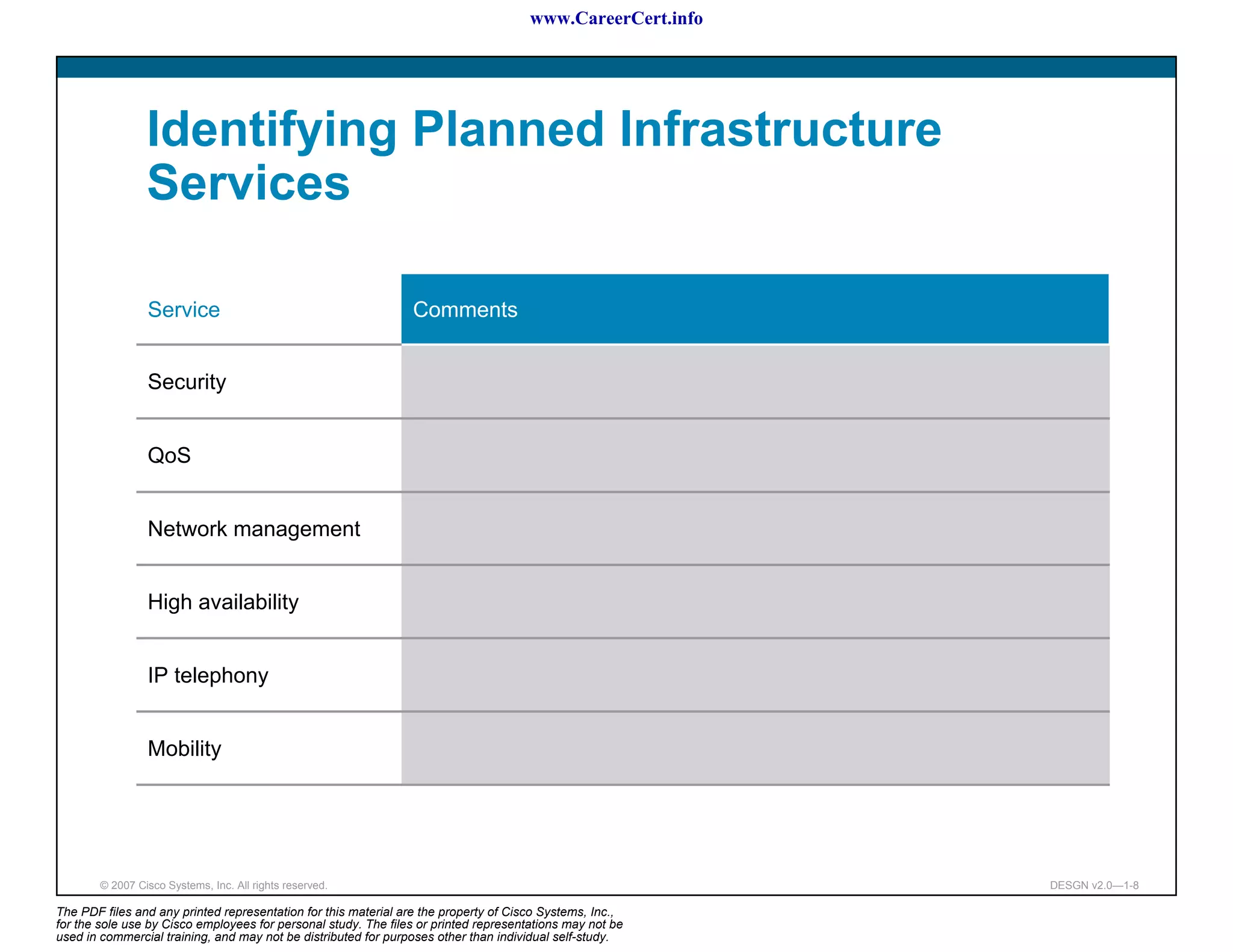
  • 177.
    www.CareerCert.info © 2007 Cisco Systems, Inc. All rights reserved. DESGN v2.0—2-23 The PDF files and any printed representation for this material are the property of Cisco Systems, Inc., for the sole use by Cisco employees for personal study. The files or printed representations may not be used in commercial training, and may not be distributed for purposes other than individual self-study.
  • 178.
    www.CareerCert.info Module Summary The hierarchical network structure is composed of the access, distribution, and core layers. Based on Cisco SONA, the Cisco Enterprise Architecture provides a modular hierarchical approach for providing network infrastructure and services to all places in the network. Network infrastructure services add intelligence to the network infrastructure, supporting application awareness within the network. Network management protocols support the exchange of management information between the network management system and managed devices. © 2007 Cisco Systems, Inc. All rights reserved. DESGN v2.0—2-1 The PDF files and any printed representation for this material are the property of Cisco Systems, Inc., for the sole use by Cisco employees for personal study. The files or printed representations may not be used in commercial training, and may not be distributed for purposes other than individual self-study.
  • 179.
    www.CareerCert.info © 2007 Cisco Systems, Inc. All rights reserved. DESGN v2.0—2-2 The PDF files and any printed representation for this material are the property of Cisco Systems, Inc., for the sole use by Cisco employees for personal study. The files or printed representations may not be used in commercial training, and may not be distributed for purposes other than individual self-study.
  • 180.
    www.CareerCert.info Designing Basic Campus and Data Center Networks Designing for Cisco Internetwork Solutions (DESGN) v2.0 © 2007 Cisco Systems, Inc. All rights reserved. DESGN v2.0—3-1 The PDF files and any printed representation for this material are the property of Cisco Systems, Inc., for the sole use by Cisco employees for personal study. The files or printed representations may not be used in commercial training, and may not be distributed for purposes other than individual self-study.
  • 181.
    www.CareerCert.info Describing Campus Design Considerations Designing Basic Enterprise Campus Networks © 2007 Cisco Systems, Inc. All rights reserved. DESGN v2.0—3-1 The PDF files and any printed representation for this material are the property of Cisco Systems, Inc., for the sole use by Cisco employees for personal study. The files or printed representations may not be used in commercial training, and may not be distributed for purposes other than individual self-study.
  • 182.
    www.CareerCert.info Designing an Enterprise Campus Campus design factors: Network applications characteristics Device characteristics Environmental characteristics © 2007 Cisco Systems, Inc. All rights reserved. DESGN v2.0—3-2 The PDF files and any printed representation for this material are the property of Cisco Systems, Inc., for the sole use by Cisco employees for personal study. The files or printed representations may not be used in commercial training, and may not be distributed for purposes other than individual self-study.
  • 183.
    www.CareerCert.info Overview of Network Application Types Peer-to-peer Client-local server Client-server farm Client-enterprise edge Server © 2007 Cisco Systems, Inc. All rights reserved. DESGN v2.0—3-3 The PDF files and any printed representation for this material are the property of Cisco Systems, Inc., for the sole use by Cisco employees for personal study. The files or printed representations may not be used in commercial training, and may not be distributed for purposes other than individual self-study.
  • 184.
    www.CareerCert.info Network Requirements of Applications Connectivity type Total required throughput High availability Total network costs © 2007 Cisco Systems, Inc. All rights reserved. DESGN v2.0—3-4 The PDF files and any printed representation for this material are the property of Cisco Systems, Inc., for the sole use by Cisco employees for personal study. The files or printed representations may not be used in commercial training, and may not be distributed for purposes other than individual self-study.
  • 185.
    www.CareerCert.info Example: Peer-to-Peer Applications Instant messaging File sharing IP phone calls Video conference systems © 2007 Cisco Systems, Inc. All rights reserved. DESGN v2.0—3-5 The PDF files and any printed representation for this material are the property of Cisco Systems, Inc., for the sole use by Cisco employees for personal study. The files or printed representations may not be used in commercial training, and may not be distributed for purposes other than individual self-study.
  • 186.
    www.CareerCert.info Example: Client-Local Server Applications Servers are located close to clients. Servers and clients are in the same LAN. Request to servers from nonlocal LANs is rare. © 2007 Cisco Systems, Inc. All rights reserved. DESGN v2.0—3-6 The PDF files and any printed representation for this material are the property of Cisco Systems, Inc., for the sole use by Cisco employees for personal study. The files or printed representations may not be used in commercial training, and may not be distributed for purposes other than individual self-study.
  • 187.
    www.CareerCert.info Example: Client-Server Farm Applications Typical applications: Mail servers File servers Database servers Access to applications: Fast Reliable Controlled (security) © 2007 Cisco Systems, Inc. All rights reserved. DESGN v2.0—3-7 The PDF files and any printed representation for this material are the property of Cisco Systems, Inc., for the sole use by Cisco employees for personal study. The files or printed representations may not be used in commercial training, and may not be distributed for purposes other than individual self-study.
  • 188.
    www.CareerCert.info Example: Client-Enterprise Edge Applications Typical applications: Internet applications – Mail servers – Web servers – Public Internet servers E-commerce applications © 2007 Cisco Systems, Inc. All rights reserved. DESGN v2.0—3-8 The PDF files and any printed representation for this material are the property of Cisco Systems, Inc., for the sole use by Cisco employees for personal study. The files or printed representations may not be used in commercial training, and may not be distributed for purposes other than individual self-study.
  • 189.
    www.CareerCert.info Relative Network Requirements by Application Type Client-Local Client-Server Client-Enterprise Peer-to-Peer Servers Farm Edge Servers Connectivity type Switched Switched Switched Switched Total required throughput Medium to high Medium High Medium High availability Low to high Medium High High Total network costs Low to medium Medium High Medium © 2007 Cisco Systems, Inc. All rights reserved. DESGN v2.0—3-9 The PDF files and any printed representation for this material are the property of Cisco Systems, Inc., for the sole use by Cisco employees for personal study. The files or printed representations may not be used in commercial training, and may not be distributed for purposes other than individual self-study.
  • 190.
    www.CareerCert.info Environmental Characteristics for Network Design The network devices and distances between them determine the network geography. The campus network design is scoped with respect to geography: – Intrabuilding – Interbuilding – Distant remote buildings © 2007 Cisco Systems, Inc. All rights reserved. DESGN v2.0—3-10 The PDF files and any printed representation for this material are the property of Cisco Systems, Inc., for the sole use by Cisco employees for personal study. The files or printed representations may not be used in commercial training, and may not be distributed for purposes other than individual self-study.
  • 191.
    www.CareerCert.info Intrabuilding Structure Provides connectivity inside the building Built with the building access and building distribution layers Transmission options: – Copper – Optical fiber – Wireless © 2007 Cisco Systems, Inc. All rights reserved. DESGN v2.0—3-11 The PDF files and any printed representation for this material are the property of Cisco Systems, Inc., for the sole use by Cisco employees for personal study. The files or printed representations may not be used in commercial training, and may not be distributed for purposes other than individual self-study.
  • 192.
    www.CareerCert.info Interbuilding Structure Connectivity between buildings Distances between buildings within a few kilometers Building distribution with campus core layer Typical transmission media: optical fiber © 2007 Cisco Systems, Inc. All rights reserved. DESGN v2.0—3-12 The PDF files and any printed representation for this material are the property of Cisco Systems, Inc., for the sole use by Cisco employees for personal study. The files or printed representations may not be used in commercial training, and may not be distributed for purposes other than individual self-study.
  • 193.
    www.CareerCert.info Distant Remote Building Structure Metropolitan-based network connectivity options: Using company-owned fiber Through enterprise WAN Through service provider offerings WAN © 2007 Cisco Systems, Inc. All rights reserved. DESGN v2.0—3-13 The PDF files and any printed representation for this material are the property of Cisco Systems, Inc., for the sole use by Cisco employees for personal study. The files or printed representations may not be used in commercial training, and may not be distributed for purposes other than individual self-study.
  • 194.
    www.CareerCert.info Campus Transmission Media Physical media in network design influences: – Network bandwidth – Allowable distance between devices – Copper design considerations: Electromagnetic interference, grounding, security Signal attenuation, distance limitations Optical fiber design considerations: – Light signal (LED or laser) – Expensive, providing a long-term investment Wireless design considerations: – Distance, interference, bandwidth, security © 2007 Cisco Systems, Inc. All rights reserved. DESGN v2.0—3-14 The PDF files and any printed representation for this material are the property of Cisco Systems, Inc., for the sole use by Cisco employees for personal study. The files or printed representations may not be used in commercial training, and may not be distributed for purposes other than individual self-study.
  • 195.
    www.CareerCert.info Comparison of Campus Transmission Media Copper Multimode Fiber Single-Mode Fiber Wireless Twisted Pair Bandwidth Up to10 Gbps Up to10 Gbps Up to10 Gbps or higher Up to 54 Mbps* Distance Up to 100 m Up to 2 km Up to 80 km Up to 500 m at (Fast Ethernet) (Fast Ethernet) 1 Mbps Up to 550 m Up to 100 m (Gigabit Ethernet) (Gigabit Ethernet) Up to 300 m Up to 80 km (10 Gigabit Ethernet) (10 Gigabit Ethernet) Price Inexpensive Moderate Moderate to expensive Moderate *Wireless is half-duplex, so effective bandwidth will be no more than one half this rate. © 2007 Cisco Systems, Inc. All rights reserved. DESGN v2.0—3-15 The PDF files and any printed representation for this material are the property of Cisco Systems, Inc., for the sole use by Cisco employees for personal study. The files or printed representations may not be used in commercial training, and may not be distributed for purposes other than individual self-study.
  • 196.
    www.CareerCert.info Example: Transmission Media © 2007 Cisco Systems, Inc. All rights reserved. DESGN v2.0—3-16 The PDF files and any printed representation for this material are the property of Cisco Systems, Inc., for the sole use by Cisco employees for personal study. The files or printed representations may not be used in commercial training, and may not be distributed for purposes other than individual self-study.
  • 197.
    www.CareerCert.info Infrastructure Device Characteristics Switches connect end devices as well as infrastructure devices: Access layer is typically data link layer switches. Distribution and core layer typically use multilayer switches. Switch type and switching layer decision is influenced by: Infrastructure services requirements(QoS, including policing, and so on) Size of the network segments Expected network failure convergence times Cost © 2007 Cisco Systems, Inc. All rights reserved. DESGN v2.0—3-17 The PDF files and any printed representation for this material are the property of Cisco Systems, Inc., for the sole use by Cisco employees for personal study. The files or printed representations may not be used in commercial training, and may not be distributed for purposes other than individual self-study.
  • 198.
    www.CareerCert.info Example Network Service: QoS in LAN Switches Enterprise QoS guarantees that critical applications receive the required bandwidth or services. © 2007 Cisco Systems, Inc. All rights reserved. DESGN v2.0—3-18 The PDF files and any printed representation for this material are the property of Cisco Systems, Inc., for the sole use by Cisco employees for personal study. The files or printed representations may not be used in commercial training, and may not be distributed for purposes other than individual self-study.
  • 199.
    www.CareerCert.info Summary Campus network design is influenced by several factors; first by applications characteristics, such as throughput and availability requirements. Second are environmental characteristics, such as the location of devices and buildings and transmission media. Third are infrastructure device characteristics, such switching type and support for network services. © 2007 Cisco Systems, Inc. All rights reserved. DESGN v2.0—3-19 The PDF files and any printed representation for this material are the property of Cisco Systems, Inc., for the sole use by Cisco employees for personal study. The files or printed representations may not be used in commercial training, and may not be distributed for purposes other than individual self-study.
  • 200.
    www.CareerCert.info © 2007 Cisco Systems, Inc. All rights reserved. DESGN v2.0—3-20 The PDF files and any printed representation for this material are the property of Cisco Systems, Inc., for the sole use by Cisco employees for personal study. The files or printed representations may not be used in commercial training, and may not be distributed for purposes other than individual self-study.
  • 201.
    www.CareerCert.info Designing the Campus Infrastructure Module Designing Basic Enterprise Campus Networks © 2007 Cisco Systems, Inc. All rights reserved. DESGN v2.0—3-1 The PDF files and any printed representation for this material are the property of Cisco Systems, Inc., for the sole use by Cisco employees for personal study. The files or printed representations may not be used in commercial training, and may not be distributed for purposes other than individual self-study.
  • 202.
    www.CareerCert.info Relative Considerations for the Campus Design Campus Infrastructure Building Building Campus Server Access Distribution Core Farm Data Link Layer/ Multilayer Multilayer Multilayer Technology Multilayer Switched Switched Switched Switched Scalability High Medium Low Medium High availability Medium Medium High High Performance Medium Medium High High Cost per Port Low Medium High High © 2007 Cisco Systems, Inc. All rights reserved. DESGN v2.0—3-2 The PDF files and any printed representation for this material are the property of Cisco Systems, Inc., for the sole use by Cisco employees for personal study. The files or printed representations may not be used in commercial training, and may not be distributed for purposes other than individual self-study.
  • 203.
    www.CareerCert.info Building Access Layer Design Considerations Number of users or ports Cabling Performance Redundancy Connectivity speed for hosts and uplinks VLAN deployment Additional features such as QoS and IP multicast © 2007 Cisco Systems, Inc. All rights reserved. DESGN v2.0—3-3 The PDF files and any printed representation for this material are the property of Cisco Systems, Inc., for the sole use by Cisco employees for personal study. The files or printed representations may not be used in commercial training, and may not be distributed for purposes other than individual self-study.
  • 204.
    www.CareerCert.info Overview of Recommended Practices for the Building Access Layer Manage VLANs and STP: – Limit VLANs to a single closet whenever possible. – If STP is required, use RPVST+. – Set trunks to desirable and desirable with negotiate. – Manually prune unused VLANs. – Use VTP transparent mode. Manage trunks between switches. Manage default PAgP settings between the catalyst operating system and Cisco IOS Software. Consider implementing routing in the access layer. © 2007 Cisco Systems, Inc. All rights reserved. DESGN v2.0—3-4 The PDF files and any printed representation for this material are the property of Cisco Systems, Inc., for the sole use by Cisco employees for personal study. The files or printed representations may not be used in commercial training, and may not be distributed for purposes other than individual self-study.
  • 205.
    www.CareerCert.info STP Considerations Use only when you have to! – Required when a VLAN spans access layer switches – Required to protect against “user side” loops – More common in the data center Use RPVST+ for best convergence. Take advantage of the Spanning Tree Toolkit. © 2007 Cisco Systems, Inc. All rights reserved. DESGN v2.0—3-5 The PDF files and any printed representation for this material are the property of Cisco Systems, Inc., for the sole use by Cisco employees for personal study. The files or printed representations may not be used in commercial training, and may not be distributed for purposes other than individual self-study.
  • 206.
    www.CareerCert.info Cisco STP Toolkit PortFast: Bypass listening-learning phase for access port* UplinkFast: Three to five seconds convergence after link failure BackboneFast: Cuts convergence time by max_age for indirect failure LoopGuard: Prevents alternate or root port from becoming designated in absence of BPDUs* RootGuard: Prevents external switches from becoming root* BPDUGuard: Disable PortFast-enabled port if a BPDU is received* * Also supported with RPVST+ © 2007 Cisco Systems, Inc. All rights reserved. DESGN v2.0—3-6 The PDF files and any printed representation for this material are the property of Cisco Systems, Inc., for the sole use by Cisco employees for personal study. The files or printed representations may not be used in commercial training, and may not be distributed for purposes other than individual self-study.
  • 207.
    www.CareerCert.info Trunk Considerations Set trunk mode to desirable and desirable and encapsulation negotiate on Manually prune all VLANS except those needed Use VTP transparent mode to decrease potential for operational error Disable trunks on host ports: – Catalyst Operating System: set port host – Cisco IOS Software: switchport host © 2007 Cisco Systems, Inc. All rights reserved. DESGN v2.0—3-7 The PDF files and any printed representation for this material are the property of Cisco Systems, Inc., for the sole use by Cisco employees for personal study. The files or printed representations may not be used in commercial training, and may not be distributed for purposes other than individual self-study.
  • 208.
    www.CareerCert.info Layer 3 Access-to-Distribution Interconnection Best option for fast convergence Equal-cost Layer 3 load balancing on all links No spanning tree required for convergence No HSRP or GLBP configuration required No VLAN spanning possible © 2007 Cisco Systems, Inc. All rights reserved. DESGN v2.0—3-8 The PDF files and any printed representation for this material are the property of Cisco Systems, Inc., for the sole use by Cisco employees for personal study. The files or printed representations may not be used in commercial training, and may not be distributed for purposes other than individual self-study.
  • 209.
    www.CareerCert.info Building Distribution Layer Design Considerations Performance Redundancy Support for network infrastructure services © 2007 Cisco Systems, Inc. All rights reserved. DESGN v2.0—3-9 The PDF files and any printed representation for this material are the property of Cisco Systems, Inc., for the sole use by Cisco employees for personal study. The files or printed representations may not be used in commercial training, and may not be distributed for purposes other than individual self-study.
  • 210.
    www.CareerCert.info Overview of Recommended Practices for the Building Distribution Layer Use first-hop redundancy protocols (HSRP and GLBP). Deploy Layer 3 routing protocols from distribution switches to core switches. If required, connect distribution switches to support Layer 2 VLAN spanning multiple access switches. © 2007 Cisco Systems, Inc. All rights reserved. DESGN v2.0—3-10 The PDF files and any printed representation for this material are the property of Cisco Systems, Inc., for the sole use by Cisco employees for personal study. The files or printed representations may not be used in commercial training, and may not be distributed for purposes other than individual self-study.
  • 211.
    www.CareerCert.info Recommended Practices— First-Hop Redundancy Provides a resilient default gateway or first-hop address to end stations with HSRP, VRRP, or GLBP HSRP, VRRP, and GLBP provide millisecond timers and excellent convergence performance HSRP common in Cisco environments VRRP if you need multi-vendor interoperability GLBP facilitates uplink load balancing © 2007 Cisco Systems, Inc. All rights reserved. DESGN v2.0—3-11 The PDF files and any printed representation for this material are the property of Cisco Systems, Inc., for the sole use by Cisco employees for personal study. The files or printed representations may not be used in commercial training, and may not be distributed for purposes other than individual self-study.
  • 212.
    www.CareerCert.info Recommended Practices—Use Layer 3 Routing Protocols Build triangles, not squares, for deterministic convergence. Only peer on links that you intend to use as transit. Summarize routes from distribution to core. © 2007 Cisco Systems, Inc. All rights reserved. DESGN v2.0—3-12 The PDF files and any printed representation for this material are the property of Cisco Systems, Inc., for the sole use by Cisco employees for personal study. The files or printed representations may not be used in commercial training, and may not be distributed for purposes other than individual self-study.
  • 213.
    www.CareerCert.info Example: Build Redundant Triangles Layer 3 redundant equal cost links support fast convergence. Hardware based—recovery to remaining path is fast. Convergence is extremely fast (dual equal-cost paths: no need for OSPF or EIGRP to recalculate a new path). © 2007 Cisco Systems, Inc. All rights reserved. DESGN v2.0—3-13 The PDF files and any printed representation for this material are the property of Cisco Systems, Inc., for the sole use by Cisco employees for personal study. The files or printed representations may not be used in commercial training, and may not be distributed for purposes other than individual self-study.
  • 214.
    www.CareerCert.info Layer 3 Distribution Interconnection Recommended practice—tried and true No STP convergence required for uplink failure and recovery Distribution-to-distribution link required for route summarization Map Layer 2 VLAN number to Layer 3 subnet for ease of use and management © 2007 Cisco Systems, Inc. All rights reserved. DESGN v2.0—3-14 The PDF files and any printed representation for this material are the property of Cisco Systems, Inc., for the sole use by Cisco employees for personal study. The files or printed representations may not be used in commercial training, and may not be distributed for purposes other than individual self-study.
  • 215.
    www.CareerCert.info Alternate: Layer 2 Distribution Interconnection Use only if Layer 2 VLAN spanning flexibility required STP convergence required for uplink failure and recovery More complex because STP root and HSRP should match Distribution-to-distribution link required for route summarization © 2007 Cisco Systems, Inc. All rights reserved. DESGN v2.0—3-15 The PDF files and any printed representation for this material are the property of Cisco Systems, Inc., for the sole use by Cisco employees for personal study. The files or printed representations may not be used in commercial training, and may not be distributed for purposes other than individual self-study.
  • 216.
    www.CareerCert.info Campus Core Design Considerations Determine if core is needed. Determine performance and capacity needed. Determine redundancy. Determine if enterprise edge and WAN connectivity is to core or data center. © 2007 Cisco Systems, Inc. All rights reserved. DESGN v2.0—3-16 The PDF files and any printed representation for this material are the property of Cisco Systems, Inc., for the sole use by Cisco employees for personal study. The files or printed representations may not be used in commercial training, and may not be distributed for purposes other than individual self-study.
  • 217.
    www.CareerCert.info Example: Large Campus Multilayer Switched Backbone Design Reduced multilayer switch peering Topology with no spanning-tree loops Scalability to arbitrarily large size Improved network services support Two equal-cost paths to every destination network Fast recovery from link failure © 2007 Cisco Systems, Inc. All rights reserved. DESGN v2.0—3-17 The PDF files and any printed representation for this material are the property of Cisco Systems, Inc., for the sole use by Cisco employees for personal study. The files or printed representations may not be used in commercial training, and may not be distributed for purposes other than individual self-study.
  • 218.
    www.CareerCert.info Small and Medium Campus Design Options © 2007 Cisco Systems, Inc. All rights reserved. DESGN v2.0—3-18 The PDF files and any printed representation for this material are the property of Cisco Systems, Inc., for the sole use by Cisco employees for personal study. The files or printed representations may not be used in commercial training, and may not be distributed for purposes other than individual self-study.
  • 219.
    www.CareerCert.info Edge Distribution Design Edge distribution switches have to protect the campus core from: Unauthorized access IP spoofing Network reconnaissance Packet sniffers © 2007 Cisco Systems, Inc. All rights reserved. DESGN v2.0—3-19 The PDF files and any printed representation for this material are the property of Cisco Systems, Inc., for the sole use by Cisco employees for personal study. The files or printed representations may not be used in commercial training, and may not be distributed for purposes other than individual self-study.
  • 220.
    www.CareerCert.info Server Placement in a Medium-Sized Network © 2007 Cisco Systems, Inc. All rights reserved. DESGN v2.0—3-20 The PDF files and any printed representation for this material are the property of Cisco Systems, Inc., for the sole use by Cisco employees for personal study. The files or printed representations may not be used in commercial training, and may not be distributed for purposes other than individual self-study.
  • 221.
    www.CareerCert.info Server Placement in a Large Network © 2007 Cisco Systems, Inc. All rights reserved. DESGN v2.0—3-21 The PDF files and any printed representation for this material are the property of Cisco Systems, Inc., for the sole use by Cisco employees for personal study. The files or printed representations may not be used in commercial training, and may not be distributed for purposes other than individual self-study.
  • 222.
    www.CareerCert.info Server Farm Design Guidelines Key design considerations: Access control Traffic demands Oversubscription Server connectivity options: Single NIC Dual-NIC redundancy Content switching (server load balancing) © 2007 Cisco Systems, Inc. All rights reserved. DESGN v2.0—3-22 The PDF files and any printed representation for this material are the property of Cisco Systems, Inc., for the sole use by Cisco employees for personal study. The files or printed representations may not be used in commercial training, and may not be distributed for purposes other than individual self-study.
  • 223.
    www.CareerCert.info Summary Design an enterprise campus network using recommended practices: Use low price per port and high port density on data link layer switches for the building access layer. Use redundant multilayer switching in the building distribution layer for high availability and performance. Use high-performance wire-rate multilayer switching in the campus core design. Group centralized servers into a server farm module for moderate enterprise server requirements. © 2007 Cisco Systems, Inc. All rights reserved. DESGN v2.0—3-23 The PDF files and any printed representation for this material are the property of Cisco Systems, Inc., for the sole use by Cisco employees for personal study. The files or printed representations may not be used in commercial training, and may not be distributed for purposes other than individual self-study.
  • 224.
    www.CareerCert.info © 2007 Cisco Systems, Inc. All rights reserved. DESGN v2.0—3-24 The PDF files and any printed representation for this material are the property of Cisco Systems, Inc., for the sole use by Cisco employees for personal study. The files or printed representations may not be used in commercial training, and may not be distributed for purposes other than individual self-study.
  • 225.
    www.CareerCert.info Describing Enterprise Data Center Considerations Designing Basic Enterprise Campus Networks © 2007 Cisco Systems, Inc. All rights reserved. DESGN v2.0—3-1 The PDF files and any printed representation for this material are the property of Cisco Systems, Inc., for the sole use by Cisco employees for personal study. The files or printed representations may not be used in commercial training, and may not be distributed for purposes other than individual self-study.
  • 226.
    www.CareerCert.info Server-Centric to Service-Centric © 2007 Cisco Systems, Inc. All rights reserved. DESGN v2.0—3-2 The PDF files and any printed representation for this material are the property of Cisco Systems, Inc., for the sole use by Cisco employees for personal study. The files or printed representations may not be used in commercial training, and may not be distributed for purposes other than individual self-study.
  • 227.
    www.CareerCert.info Cisco Data Center Network Architecture Framework © 2007 Cisco Systems, Inc. All rights reserved. DESGN v2.0—3-3 The PDF files and any printed representation for this material are the property of Cisco Systems, Inc., for the sole use by Cisco employees for personal study. The files or printed representations may not be used in commercial training, and may not be distributed for purposes other than individual self-study.
  • 228.
    www.CareerCert.info Example: Data Center Network Topology IBM 3d icons not available © 2007 Cisco Systems, Inc. All rights reserved. DESGN v2.0—3-4 The PDF files and any printed representation for this material are the property of Cisco Systems, Inc., for the sole use by Cisco employees for personal study. The files or printed representations may not be used in commercial training, and may not be distributed for purposes other than individual self-study.
  • 229.
    www.CareerCert.info Data Center Infrastructure Overview © 2007 Cisco Systems, Inc. All rights reserved. DESGN v2.0—3-5 The PDF files and any printed representation for this material are the property of Cisco Systems, Inc., for the sole use by Cisco employees for personal study. The files or printed representations may not be used in commercial training, and may not be distributed for purposes other than individual self-study.
  • 230.
    www.CareerCert.info Defining the Data Center Access Layer Can support Layer 2 or Layer 3 access Provides port density to server farm Supports dual and single-attached servers Provides high-performance, low-latency Layer 2 switching Mix of oversubscription requirements Many uplink options © 2007 Cisco Systems, Inc. All rights reserved. DESGN v2.0—3-6 The PDF files and any printed representation for this material are the property of Cisco Systems, Inc., for the sole use by Cisco employees for personal study. The files or printed representations may not be used in commercial training, and may not be distributed for purposes other than individual self-study.
  • 231.
    www.CareerCert.info Density and Scalability Implications Where are the issues? – Cabling – Power – Cooling © 2007 Cisco Systems, Inc. All rights reserved. 7 DESGN v2.0—3-7 The PDF files and any printed representation for this material are the property of Cisco Systems, Inc., for the sole use by Cisco employees for personal study. The files or printed representations may not be used in commercial training, and may not be distributed for purposes other than individual self-study.
  • 232.
    www.CareerCert.info Defining the Data Center Aggregation Layer • Aggregates traffic to data center core • Aggregates advanced application and security functions • Maintains connection and session state for redundancy • Layer 4–7 services: firewall, server load balancing, SSL, IDS • Large STP processing load • High flexibility and economies of scale © 2007 Cisco Systems, Inc. All rights reserved. DESGN v2.0—3-8 The PDF files and any printed representation for this material are the property of Cisco Systems, Inc., for the sole use by Cisco employees for personal study. The files or printed representations may not be used in commercial training, and may not be distributed for purposes other than individual self-study.
  • 233.
    www.CareerCert.info Defining the Data Center Core Layer Drivers for a data center core: 10-Gigabit Ethernet port density Administrative domains Anticipate future requirements Key core characteristics: Distributed forwarding architecture Low latency switching 10-Gigabit Ethernet scalability Scalable IP multicast support © 2007 Cisco Systems, Inc. All rights reserved. DESGN v2.0—3-9 The PDF files and any printed representation for this material are the property of Cisco Systems, Inc., for the sole use by Cisco employees for personal study. The files or printed representations may not be used in commercial training, and may not be distributed for purposes other than individual self-study.
  • 234.
    www.CareerCert.info Summary • Enterprise data centers support a rich set of applications and servers. • The SONA-based Cisco Enterprise Data Center Architecture provides a modular hierarchical approach to align data center resources with business applications. © 2007 Cisco Systems, Inc. All rights reserved. DESGN v2.0—3-10 The PDF files and any printed representation for this material are the property of Cisco Systems, Inc., for the sole use by Cisco employees for personal study. The files or printed representations may not be used in commercial training, and may not be distributed for purposes other than individual self-study.
  • 235.
    www.CareerCert.info © 2007 Cisco Systems, Inc. All rights reserved. DESGN v2.0—3-11 The PDF files and any printed representation for this material are the property of Cisco Systems, Inc., for the sole use by Cisco employees for personal study. The files or printed representations may not be used in commercial training, and may not be distributed for purposes other than individual self-study.
  • 236.
    www.CareerCert.info Enterprise Campus and Data Center Design Review Analyze organizational requirements: – Type of applications, traffic volume, and traffic pattern – Redundancy and backup needed Characterize the existing network and sites: – Technology used and location of hosts, servers, terminals, and other end nodes Develop enterprise campus and enterprise data center network designs: – Based on requirements, implement two or three hierarchical layers. – Select hardware and software components to support requirements. © 2007 Cisco Systems, Inc. All rights reserved. DESGN v2.0—3-1 The PDF files and any printed representation for this material are the property of Cisco Systems, Inc., for the sole use by Cisco employees for personal study. The files or printed representations may not be used in commercial training, and may not be distributed for purposes other than individual self-study.
  • 237.
    www.CareerCert.info Module Summary Campus network design is influenced by application, environmental, and infrastructure device characteristics. An enterprise campus network is constructed hierarchically with building access, building distribution, and campus core layers. An enterprise data center network is constructed hierarchically, with data center access, data center aggregation, and data center core layers. © 2007 Cisco Systems, Inc. All rights reserved. DESGN v2.0—3-2 The PDF files and any printed representation for this material are the property of Cisco Systems, Inc., for the sole use by Cisco employees for personal study. The files or printed representations may not be used in commercial training, and may not be distributed for purposes other than individual self-study.
  • 238.
    www.CareerCert.info © 2007 Cisco Systems, Inc. All rights reserved. DESGN v2.0—3-3 The PDF files and any printed representation for this material are the property of Cisco Systems, Inc., for the sole use by Cisco employees for personal study. The files or printed representations may not be used in commercial training, and may not be distributed for purposes other than individual self-study.
  • 239.
    www.CareerCert.info Designing Remote Connectivity Designing for Cisco Internetwork Solutions (DESGN) v2.0 © 2007 Cisco Systems, Inc. All rights reserved. DESGN v2.0—4-1 The PDF files and any printed representation for this material are the property of Cisco Systems, Inc., for the sole use by Cisco employees for personal study. The files or printed representations may not be used in commercial training, and may not be distributed for purposes other than individual self-study.
  • 240.
    www.CareerCert.info Identifying WAN Technology Considerations Designing Remote Connectivity © 2007 Cisco Systems, Inc. All rights reserved. DESGN v2.0—4-1 The PDF files and any printed representation for this material are the property of Cisco Systems, Inc., for the sole use by Cisco employees for personal study. The files or printed representations may not be used in commercial training, and may not be distributed for purposes other than individual self-study.
  • 241.
    www.CareerCert.info Role of a WAN © 2007 Cisco Systems, Inc. All rights reserved. DESGN v2.0—4-2 The PDF files and any printed representation for this material are the property of Cisco Systems, Inc., for the sole use by Cisco employees for personal study. The files or printed representations may not be used in commercial training, and may not be distributed for purposes other than individual self-study.
  • 242.
    www.CareerCert.info Types of WAN Interconnections © 2007 Cisco Systems, Inc. All rights reserved. DESGN v2.0—4-3 The PDF files and any printed representation for this material are the property of Cisco Systems, Inc., for the sole use by Cisco employees for personal study. The files or printed representations may not be used in commercial training, and may not be distributed for purposes other than individual self-study.
  • 243.
    www.CareerCert.info WAN Transport Technology Comparison Latency Connect Initial Bandwidth Tariff Reliability and Jitter Time Cost TDM M L L M M M ISDN L M/H M M L M Frame Relay L L L M M M ATM M/H L L M M H MPLS M/H L L M M H Metro Ethernet M/H L L M M H DSL L/M* M/H L L L M Cable modem L/M* M/H L L M L Wireless L/M M/H L L M L SONET/SDH H L L M H H DWDM H L L M H H Dark fiber H L L M H H *Unbalanced Tx and Rx L = low, M = medium, H = high © 2007 Cisco Systems, Inc. All rights reserved. DESGN v2.0—4-4 The PDF files and any printed representation for this material are the property of Cisco Systems, Inc., for the sole use by Cisco employees for personal study. The files or printed representations may not be used in commercial training, and may not be distributed for purposes other than individual self-study.
  • 244.
    www.CareerCert.info Example: ADSL Implementation © 2007 Cisco Systems, Inc. All rights reserved. DESGN v2.0—4-5 The PDF files and any printed representation for this material are the property of Cisco Systems, Inc., for the sole use by Cisco employees for personal study. The files or printed representations may not be used in commercial training, and may not be distributed for purposes other than individual self-study.
  • 245.
    www.CareerCert.info Example: Data and Voice over Cable © 2007 Cisco Systems, Inc. All rights reserved. DESGN v2.0—4-6 The PDF files and any printed representation for this material are the property of Cisco Systems, Inc., for the sole use by Cisco employees for personal study. The files or printed representations may not be used in commercial training, and may not be distributed for purposes other than individual self-study.
  • 246.
    www.CareerCert.info Example: Three Uses of Wireless © 2007 Cisco Systems, Inc. All rights reserved. DESGN v2.0—4-7 The PDF files and any printed representation for this material are the property of Cisco Systems, Inc., for the sole use by Cisco employees for personal study. The files or printed representations may not be used in commercial training, and may not be distributed for purposes other than individual self-study.
  • 247.
    www.CareerCert.info Example: SONET/SDH Guaranteed bandwidth High line rates (from 155 Mbps to 10 Gbps) Automatic recovery capabilities IP encapsulations: ATM or packet over SONET/SDH (POS) © 2007 Cisco Systems, Inc. All rights reserved. DESGN v2.0—4-8 The PDF files and any printed representation for this material are the property of Cisco Systems, Inc., for the sole use by Cisco employees for personal study. The files or printed representations may not be used in commercial training, and may not be distributed for purposes other than individual self-study.
  • 248.
    www.CareerCert.info Example: DWDM Improved signaling mechanisms to optimize bandwidth usage Used inside the SONET/SDH ring © 2007 Cisco Systems, Inc. All rights reserved. DESGN v2.0—4-9 The PDF files and any printed representation for this material are the property of Cisco Systems, Inc., for the sole use by Cisco employees for personal study. The files or printed representations may not be used in commercial training, and may not be distributed for purposes other than individual self-study.
  • 249.
    www.CareerCert.info Example: Dark Fiber Edge devices directly connected to regenerators or DWDM concentrators Edge devices able to use any Layer 2 encapsulation © 2007 Cisco Systems, Inc. All rights reserved. DESGN v2.0—4-10 The PDF files and any printed representation for this material are the property of Cisco Systems, Inc., for the sole use by Cisco employees for personal study. The files or printed representations may not be used in commercial training, and may not be distributed for purposes other than individual self-study.
  • 250.
    www.CareerCert.info WAN Transport Technology Pricing Considerations Pricing used to include an access circuit and a distance-sensitive rate. Access circuit provisioning generally takes 60 days or more lead time. – Metro Ethernet availability is spotty, and lead times are long. For Frame Relays and ATM, pricing includes an access circuit charge, per-PVC and possibly per-bandwidth (CIR or MIR) charges. MPLS VPN pricing is generally comparable with Frame Relays and ATM. © 2007 Cisco Systems, Inc. All rights reserved. DESGN v2.0—4-11 The PDF files and any printed representation for this material are the property of Cisco Systems, Inc., for the sole use by Cisco employees for personal study. The files or printed representations may not be used in commercial training, and may not be distributed for purposes other than individual self-study.
  • 251.
    www.CareerCert.info WAN Transport Technology Contract Considerations Tariffed commercial services are at published rates and subject to restrictions. Time to contract can be one month for standard tariff rates, longer if you negotiate SLAs. Contract periods are usually one to five years for most WAN services. For dark fiber, contract periods are generally 20 years. © 2007 Cisco Systems, Inc. All rights reserved. DESGN v2.0—4-12 The PDF files and any printed representation for this material are the property of Cisco Systems, Inc., for the sole use by Cisco employees for personal study. The files or printed representations may not be used in commercial training, and may not be distributed for purposes other than individual self-study.
  • 252.
    www.CareerCert.info Methodology Used in Enterprise Edge Design Planning and designing the enterprise edge is based on the PPDIOO methodology: Analyze network requirements, including type of applications, traffic volume, and traffic patterns. Characterize the existing network for technology used and location of hosts, servers, terminals, and other end nodes. Design the topology based on availability of technology, the projected traffic pattern, and technology performance constraints and reliability. © 2007 Cisco Systems, Inc. All rights reserved. DESGN v2.0—4-13 The PDF files and any printed representation for this material are the property of Cisco Systems, Inc., for the sole use by Cisco employees for personal study. The files or printed representations may not be used in commercial training, and may not be distributed for purposes other than individual self-study.
  • 253.
    www.CareerCert.info Identifying Application Requirements Data File Interactive Data Real-Time Real-Time Transfer Application Voice Video Response time Reasonable Within a second Round trip less than Minimum 250 ms with delay delay and and with low jitter jitter Throughput and packet High/medium Low/low Low/low High/medium loss tolerance Downtime (high Reasonable Low Low Minimum reliability has low downtime) Zero Downtime for Mission-Critical Applications © 2007 Cisco Systems, Inc. All rights reserved. DESGN v2.0—4-14 The PDF files and any printed representation for this material are the property of Cisco Systems, Inc., for the sole use by Cisco employees for personal study. The files or printed representations may not be used in commercial training, and may not be distributed for purposes other than individual self-study.
  • 254.
    www.CareerCert.info Determining the Maximum Offered Traffic WAN resources have finite capacity. End users require minimum response times. Network managers require maximum link utilization. © 2007 Cisco Systems, Inc. All rights reserved. DESGN v2.0—4-15 The PDF files and any printed representation for this material are the property of Cisco Systems, Inc., for the sole use by Cisco employees for personal study. The files or printed representations may not be used in commercial training, and may not be distributed for purposes other than individual self-study.
  • 255.
    www.CareerCert.info Determining Physical Media Bandwidth Bandwidth <= 1.5/2 Mbps From 1.5/2 Mbps to From 45/34 From 100 Mbps to 45/34 Mbps Mbps to 100 10 Gbps Mbps Copper Serial or async ADSL (8 Mbps serial, ISDN, downstream TDM, X.25, Frame Relay, ADSL Fiber Ethernet, Fast Ethernet, 10-Gigabit Ethernet, TDM (T3 or E3) ATM over Gigabit Ethernet, SONET/SDH, ATM over POS SONET/SDH, POS Coaxial Shared bandwidth: 27 Mbps downstream, 2.5 upstream 2.4/5 GHz WAN Varies based on wireless distance and RF quality © 2007 Cisco Systems, Inc. All rights reserved. DESGN v2.0—4-16 The PDF files and any printed representation for this material are the property of Cisco Systems, Inc., for the sole use by Cisco employees for personal study. The files or printed representations may not be used in commercial training, and may not be distributed for purposes other than individual self-study.
  • 256.
    www.CareerCert.info Evaluating Cost-Effectiveness of Design and Implementation Investment and Running Costs Private Owner must buy, configure, and maintain the physical layer connectivity and the terminal equipment that connects each location. Leased Fixed bandwidth is leased from a carrier company with private or leased terminal equipment. Shared Physical resources in campus backbone are shared with many users. © 2007 Cisco Systems, Inc. All rights reserved. DESGN v2.0—4-17 The PDF files and any printed representation for this material are the property of Cisco Systems, Inc., for the sole use by Cisco employees for personal study. The files or printed representations may not be used in commercial training, and may not be distributed for purposes other than individual self-study.
  • 257.
    www.CareerCert.info Bandwidth Usage in a WAN Optimize the bandwidth usage on WAN links to improve network efficiency using: Data compression: Reduces the size of a frame of data to transmit over a network link Bandwidth combination: Logically aggregates physical links Window size: Adjusts link reliability versus throughput Queuing: Avoids congestion for some traffic by giving it priority over other traffic Traffic shaping and policing: Avoids congestion by policing inbound and outbound flows © 2007 Cisco Systems, Inc. All rights reserved. DESGN v2.0—4-18 The PDF files and any printed representation for this material are the property of Cisco Systems, Inc., for the sole use by Cisco employees for personal study. The files or printed representations may not be used in commercial training, and may not be distributed for purposes other than individual self-study.
  • 258.
    www.CareerCert.info Queuing to Improve Link Utilization Queuing allows network administrators to manage varying demands of applications on networks and routers. Key types of queuing: – Priority queuing – Custom queuing – Weighted fair queuing – Class-based weighted fair queuing – Low latency queuing © 2007 Cisco Systems, Inc. All rights reserved. DESGN v2.0—4-19 The PDF files and any printed representation for this material are the property of Cisco Systems, Inc., for the sole use by Cisco employees for personal study. The files or printed representations may not be used in commercial training, and may not be distributed for purposes other than individual self-study.
  • 259.
    www.CareerCert.info Traffic Shaping and Policing • Usually found on egress ports, shaping buffers excess traffic, using a token bucket mechanism to release packets. • Policers typically “tag” or “drop” traffic, depending on the mechanism, protocol, and severity of offense. • Policing, historically in ATM, is on ingress ports and uses a “leaky bucket” mechanism. © 2007 Cisco Systems, Inc. All rights reserved. DESGN v2.0—4-20 The PDF files and any printed representation for this material are the property of Cisco Systems, Inc., for the sole use by Cisco employees for personal study. The files or printed representations may not be used in commercial training, and may not be distributed for purposes other than individual self-study.
  • 260.
    www.CareerCert.info Data Compression and QoS to Optimize Bandwidth Usage © 2007 Cisco Systems, Inc. All rights reserved. DESGN v2.0—4-21 The PDF files and any printed representation for this material are the property of Cisco Systems, Inc., for the sole use by Cisco employees for personal study. The files or printed representations may not be used in commercial training, and may not be distributed for purposes other than individual self-study.
  • 261.
    www.CareerCert.info Summary A WAN is a communications network that covers a relatively broad geographic area and carries a variety of traffic types using transmission facilities that are typically provided by service providers. The multiple WAN transport technologies vary in bandwidth, performance characteristics, and cost. In WAN design, enterprise edge connectivity requirements influence the trade-off between the cost of bandwidth and bandwidth efficiency. © 2007 Cisco Systems, Inc. All rights reserved. DESGN v2.0—4-22 The PDF files and any printed representation for this material are the property of Cisco Systems, Inc., for the sole use by Cisco employees for personal study. The files or printed representations may not be used in commercial training, and may not be distributed for purposes other than individual self-study.
  • 262.
    www.CareerCert.info © 2007 Cisco Systems, Inc. All rights reserved. DESGN v2.0—4-23 The PDF files and any printed representation for this material are the property of Cisco Systems, Inc., for the sole use by Cisco employees for personal study. The files or printed representations may not be used in commercial training, and may not be distributed for purposes other than individual self-study.
  • 263.
    www.CareerCert.info Designing the Enterprise WAN Designing Remote Connectivity © 2007 Cisco Systems, Inc. All rights reserved. DESGN v2.0—4-1 The PDF files and any printed representation for this material are the property of Cisco Systems, Inc., for the sole use by Cisco employees for personal study. The files or printed representations may not be used in commercial training, and may not be distributed for purposes other than individual self-study.
  • 264.
    www.CareerCert.info Traditional WAN Technologies Description Leased lines A service provider establishes a dedicated connection. Circuit-switched PSTN (phone A dedicated circuit path is established for service, analog modems, ISDN) the duration of a call. ISDN combines voice, data, and backup. Packet- and cell-switched (Frame A service provider creates PVCs or SVCs. Relay, SMDS, ATM, MPLS) ATM uses cells and provides support for multiple QoS classes. © 2007 Cisco Systems, Inc. All rights reserved. DESGN v2.0—4-2 The PDF files and any printed representation for this material are the property of Cisco Systems, Inc., for the sole use by Cisco employees for personal study. The files or printed representations may not be used in commercial training, and may not be distributed for purposes other than individual self-study.
  • 265.
    www.CareerCert.info WAN Topologies © 2007 Cisco Systems, Inc. All rights reserved. DESGN v2.0—4-3 The PDF files and any printed representation for this material are the property of Cisco Systems, Inc., for the sole use by Cisco employees for personal study. The files or printed representations may not be used in commercial training, and may not be distributed for purposes other than individual self-study.
  • 266.
    www.CareerCert.info Designing the Remote-Access Network Objective: Provide a unified solution for remote access Grant the connection seamlessly, as if in company headquarters Application requirements include: – Low to medium-volume data file transfer and interactive traffic for teleworkers and traveling workers – Voice services for teleworkers Connectivity option: IP access through an on-demand or always-on connection Technologies include dial-up, DSL, cable, and wireless © 2007 Cisco Systems, Inc. All rights reserved. DESGN v2.0—4-4 The PDF files and any printed representation for this material are the property of Cisco Systems, Inc., for the sole use by Cisco employees for personal study. The files or printed representations may not be used in commercial training, and may not be distributed for purposes other than individual self-study.
  • 267.
    www.CareerCert.info Overview of Virtual Private Networks © 2007 Cisco Systems, Inc. All rights reserved. DESGN v2.0—4-5 The PDF files and any printed representation for this material are the property of Cisco Systems, Inc., for the sole use by Cisco employees for personal study. The files or printed representations may not be used in commercial training, and may not be distributed for purposes other than individual self-study.
  • 268.
    www.CareerCert.info Connectivity Option: Overlay VPN VPNs may replace dedicated point-to-point links with emulated point-to-point links sharing common infrastructure. © 2007 Cisco Systems, Inc. All rights reserved. DESGN v2.0—4-6 The PDF files and any printed representation for this material are the property of Cisco Systems, Inc., for the sole use by Cisco employees for personal study. The files or printed representations may not be used in commercial training, and may not be distributed for purposes other than individual self-study.
  • 269.
    www.CareerCert.info Connectivity Option: Virtual Private Dial- Up Network © 2007 Cisco Systems, Inc. All rights reserved. DESGN v2.0—4-7 The PDF files and any printed representation for this material are the property of Cisco Systems, Inc., for the sole use by Cisco employees for personal study. The files or printed representations may not be used in commercial training, and may not be distributed for purposes other than individual self-study.
  • 270.
    www.CareerCert.info Connectivity Option: Peer-to-Peer VPN Provider participates in the enterprise routing: Uses MPLS VPN technology Enables organization to use any IP address space No overlapping IP address space problems © 2007 Cisco Systems, Inc. All rights reserved. DESGN v2.0—4-8 The PDF files and any printed representation for this material are the property of Cisco Systems, Inc., for the sole use by Cisco employees for personal study. The files or printed representations may not be used in commercial training, and may not be distributed for purposes other than individual self-study.
  • 271.
    www.CareerCert.info Benefits of VPNs © 2007 Cisco Systems, Inc. All rights reserved. DESGN v2.0—4-9 The PDF files and any printed representation for this material are the property of Cisco Systems, Inc., for the sole use by Cisco employees for personal study. The files or printed representations may not be used in commercial training, and may not be distributed for purposes other than individual self-study.
  • 272.
    www.CareerCert.info WAN Backup Technologies Backup options: Dial backup—analog or ISDN Permanent secondary WAN link Shadow PVC IPsec tunnel across Internet © 2007 Cisco Systems, Inc. All rights reserved. DESGN v2.0—4-10 The PDF files and any printed representation for this material are the property of Cisco Systems, Inc., for the sole use by Cisco employees for personal study. The files or printed representations may not be used in commercial training, and may not be distributed for purposes other than individual self-study.
  • 273.
    www.CareerCert.info Example: Permanent Secondary WAN Link © 2007 Cisco Systems, Inc. All rights reserved. DESGN v2.0—4-11 The PDF files and any printed representation for this material are the property of Cisco Systems, Inc., for the sole use by Cisco employees for personal study. The files or printed representations may not be used in commercial training, and may not be distributed for purposes other than individual self-study.
  • 274.
    www.CareerCert.info Example: Shadow PVC © 2007 Cisco Systems, Inc. All rights reserved. DESGN v2.0—4-12 The PDF files and any printed representation for this material are the property of Cisco Systems, Inc., for the sole use by Cisco employees for personal study. The files or printed representations may not be used in commercial training, and may not be distributed for purposes other than individual self-study.
  • 275.
    www.CareerCert.info WAN Backup over the Internet © 2007 Cisco Systems, Inc. All rights reserved. DESGN v2.0—4-13 The PDF files and any printed representation for this material are the property of Cisco Systems, Inc., for the sole use by Cisco employees for personal study. The files or printed representations may not be used in commercial training, and may not be distributed for purposes other than individual self-study.
  • 276.
    www.CareerCert.info Layer 3 Tunneling GRE can encapsulate a variety of protocol types inside IP tunnels. – It is simple and flexible for basic IP VPNs. – Packet payload is not encrypted. – Provisioning of tunnels is not very scalable. IPsec encapsulates IP inside of IPsec tunnels. – Packet payload can be encrypted. – IPsec receiver can authenticate source of packets. – It uses IKE and PKI. © 2007 Cisco Systems, Inc. All rights reserved. DESGN v2.0—4-14 The PDF files and any printed representation for this material are the property of Cisco Systems, Inc., for the sole use by Cisco employees for personal study. The files or printed representations may not be used in commercial training, and may not be distributed for purposes other than individual self-study.
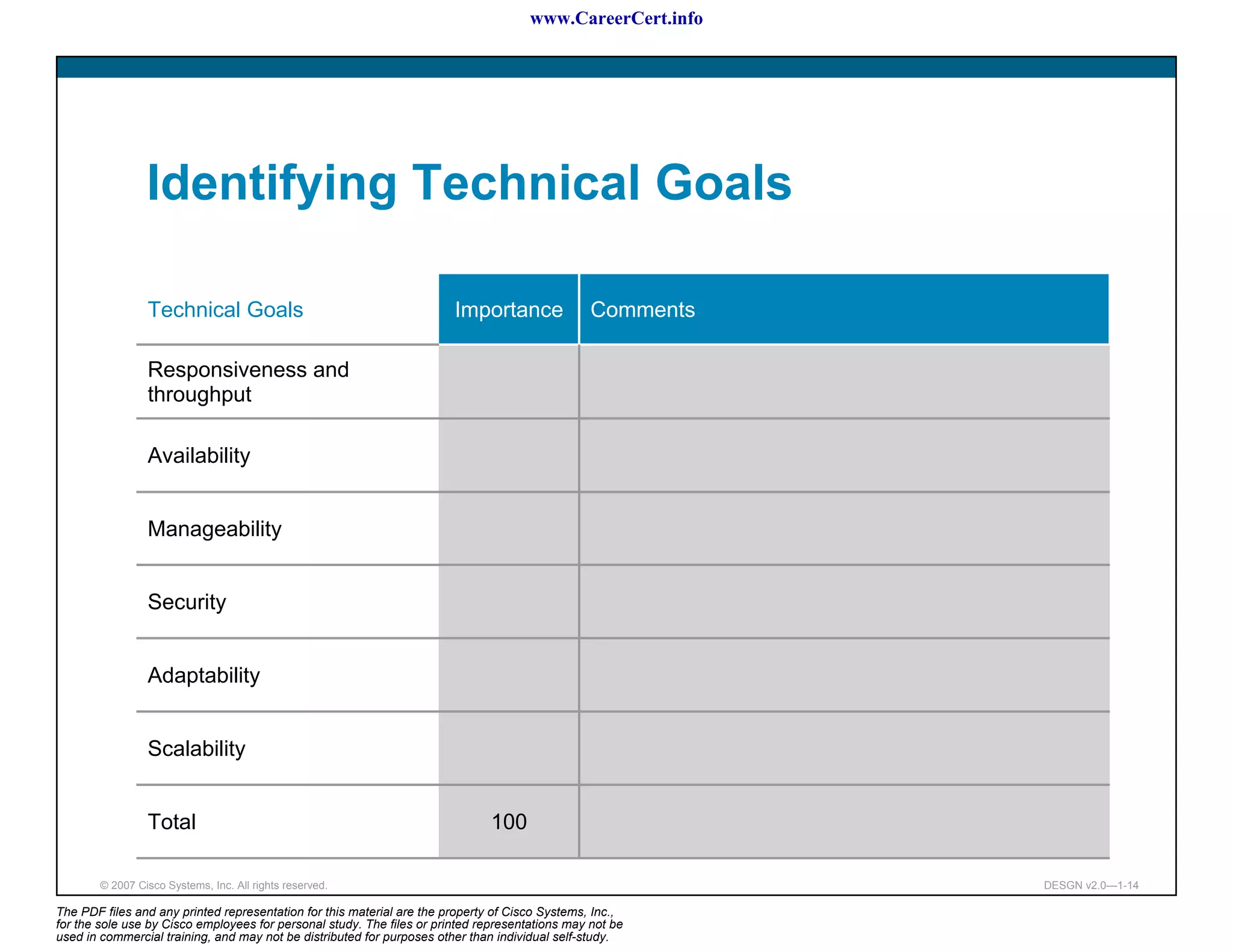
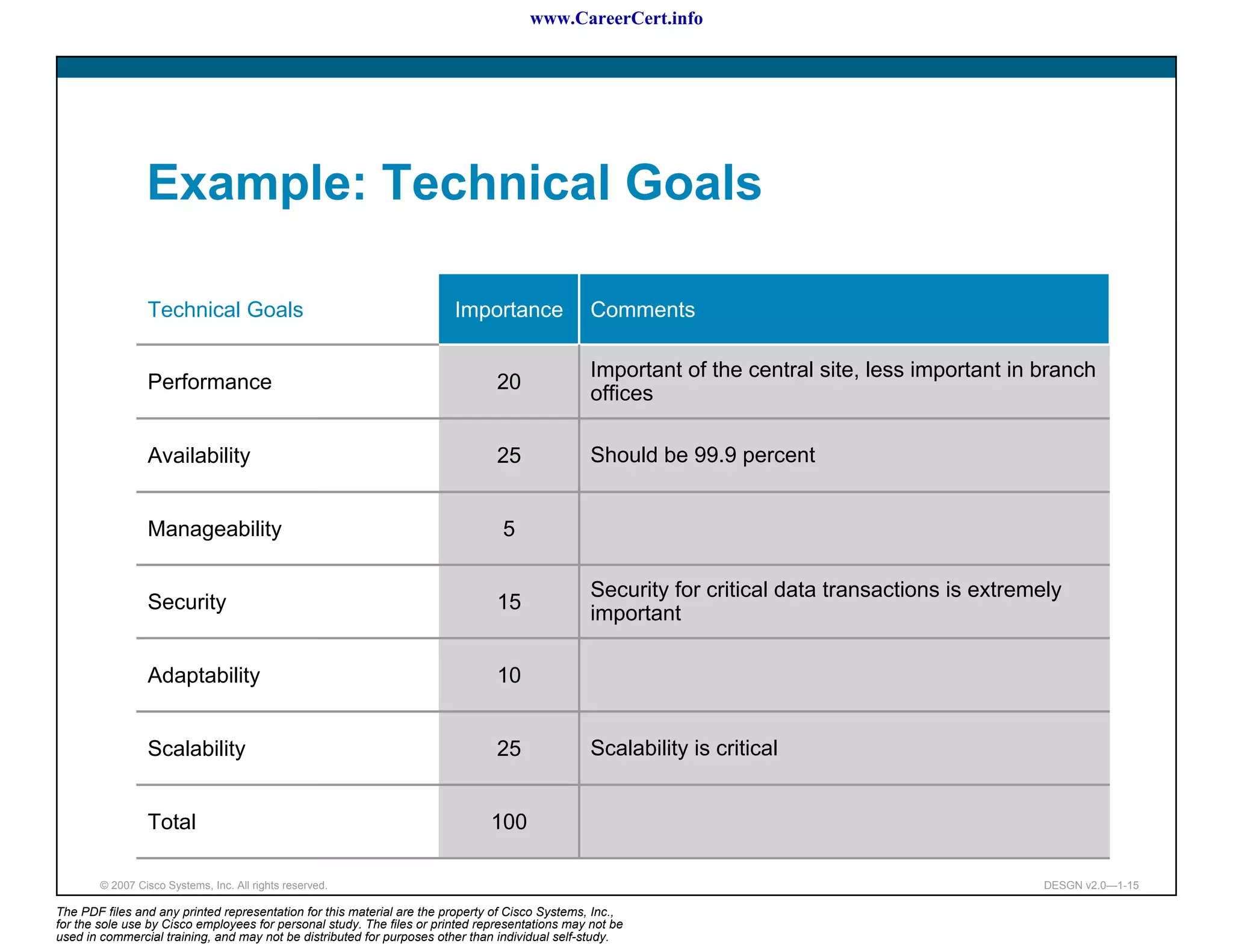
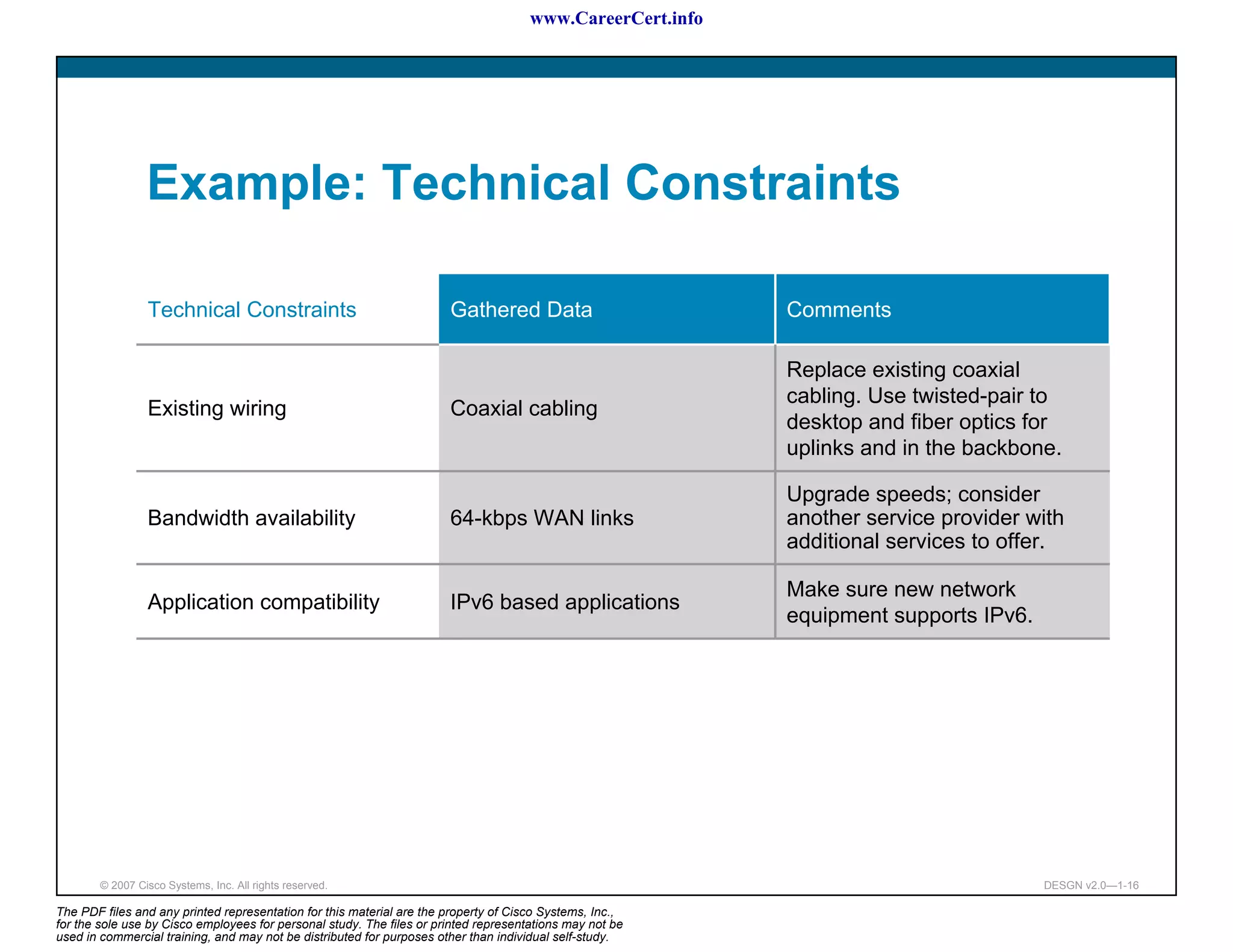
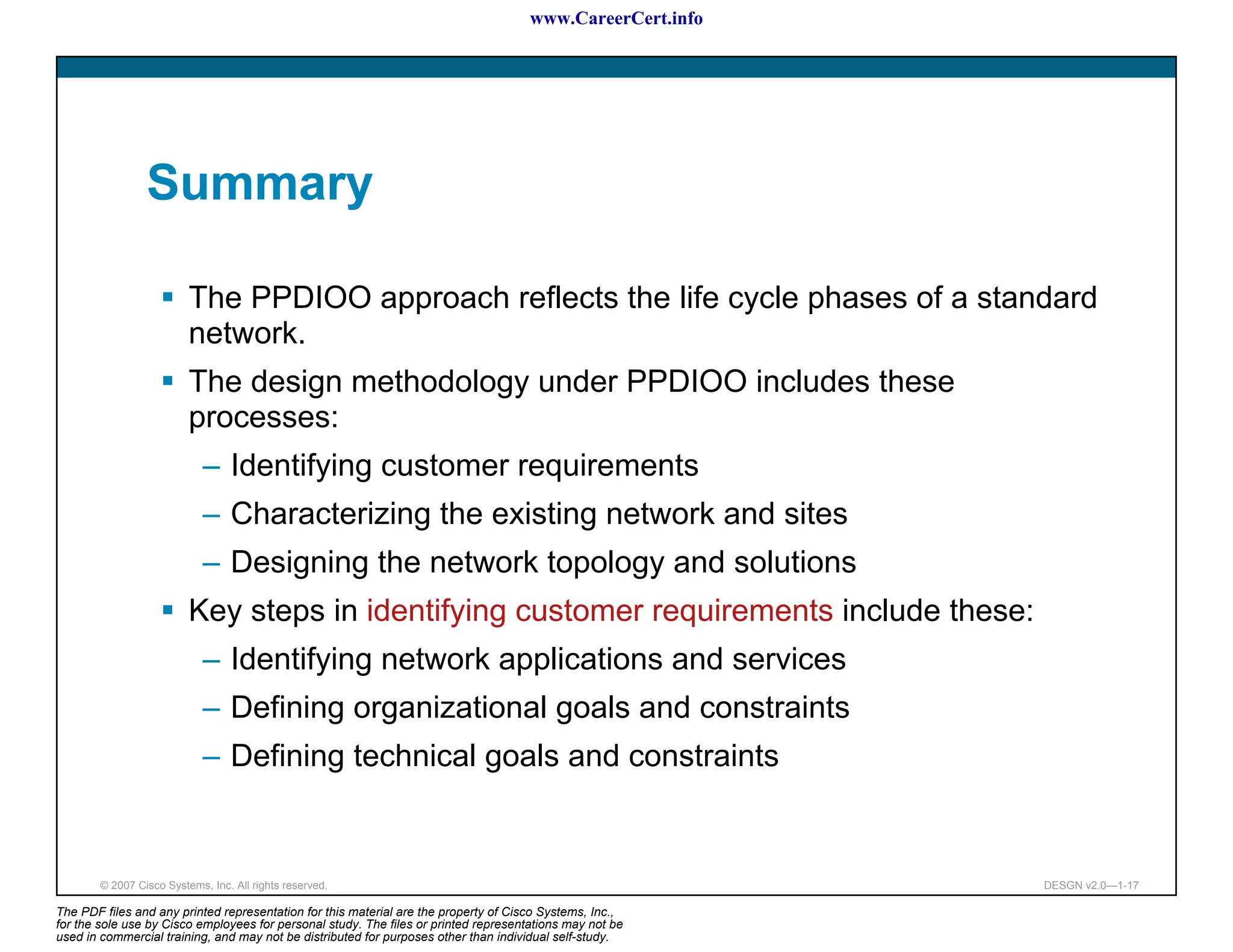
  • 277.
    www.CareerCert.info Enterprise WAN Architecture Considerations Support for network growth Appropriate availability Operational expense Operational complexity Voice and video support Effort and cost to implement Support of network segmentation © 2007 Cisco Systems, Inc. All rights reserved. DESGN v2.0—4-15 The PDF files and any printed representation for this material are the property of Cisco Systems, Inc., for the sole use by Cisco employees for personal study. The files or printed representations may not be used in commercial training, and may not be distributed for purposes other than individual self-study.
  • 278.
    www.CareerCert.info Cisco Enterprise MAN and WAN Architecture Private WAN (optionally encrypted) ISP service through site-to-site and remote-access IPsec VPN Service provider-managed IP or MPLS VPN Self-deployed MPLS © 2007 Cisco Systems, Inc. All rights reserved. DESGN v2.0—4-16 The PDF files and any printed representation for this material are the property of Cisco Systems, Inc., for the sole use by Cisco employees for personal study. The files or printed representations may not be used in commercial training, and may not be distributed for purposes other than individual self-study.
  • 279.
    www.CareerCert.info Cisco Enterprise WAN and MAN Architecture Comparison SP Private ISP Self-Deployed MPLS and IP WAN Service MPLS VPN IPsec IPsec IPsec IPsec Secure transport (optional) (mandatory) (mandatory) (mandatory) High availability Excellent Good Excellent Excellent Multicast Good Good Good Excellent Voice and video support Excellent Low Excellent Excellent Scalable network growth Moderate Good Excellent Excellent Easily shared WAN links Moderate Moderate Moderate Excellent Moderate, Moderate to Operational costs High Low depends on high transport Network control High Moderate Moderate High Effort to migrate from Low Moderate Moderate High private to WAN © 2007 Cisco Systems, Inc. All rights reserved. DESGN v2.0—4-17 The PDF files and any printed representation for this material are the property of Cisco Systems, Inc., for the sole use by Cisco employees for personal study. The files or printed representations may not be used in commercial training, and may not be distributed for purposes other than individual self-study.
  • 280.
    www.CareerCert.info Example: Cisco WAN Architectures in the Healthcare Environment © 2007 Cisco Systems, Inc. All rights reserved. DESGN v2.0—4-18 The PDF files and any printed representation for this material are the property of Cisco Systems, Inc., for the sole use by Cisco employees for personal study. The files or printed representations may not be used in commercial training, and may not be distributed for purposes other than individual self-study.
  • 281.
    www.CareerCert.info Selecting Enterprise Edge Hardware Components and Software Features Hardware selection incorporates the selection of data link layer functions and features of a particular device Considerations: Port density, packet throughput, future expandability, redundancy Software selection focuses on network layer performance Considerations: Forwarding decisions, bandwidth optimization, security © 2007 Cisco Systems, Inc. All rights reserved. DESGN v2.0—4-19 The PDF files and any printed representation for this material are the property of Cisco Systems, Inc., for the sole use by Cisco employees for personal study. The files or printed representations may not be used in commercial training, and may not be distributed for purposes other than individual self-study.
  • 282.
    www.CareerCert.info Cisco IOS Software in the Network Cisco IOS Software T Cisco IOS Software S Cisco IOS Software XR IP Services and Ease IP Services and Infrastructure Scale and Availability of Deployment Broadband access High-end enterprise core Large-scale networks Mobility and wireless Service provider edge High availability Data center Virtual Private Networks In-service software Security (MPLS, Layer 2 and Layer 3) upgrade IP communications Video and content multicast © 2007 Cisco Systems, Inc. All rights reserved. DESGN v2.0—4-20 The PDF files and any printed representation for this material are the property of Cisco Systems, Inc., for the sole use by Cisco employees for personal study. The files or printed representations may not be used in commercial training, and may not be distributed for purposes other than individual self-study.
  • 283.
    www.CareerCert.info Cisco IOS Packaging © 2007 Cisco Systems, Inc. All rights reserved. DESGN v2.0—4-21 The PDF files and any printed representation for this material are the property of Cisco Systems, Inc., for the sole use by Cisco employees for personal study. The files or printed representations may not be used in commercial training, and may not be distributed for purposes other than individual self-study.
  • 284.
    www.CareerCert.info Cisco IOS Packaging Technology Segmentation AppleTalk, Data VoIP and ATM, VoATM, Firewall, IPX, IBM Connectivity VoFR MPLS IDS, VPN Protocols IP Base X IP Voice X X Advanced Security X X Enterprise Base X X SP Services X X X Advanced IP X X X X Services Enterprise Services X X X X Advanced X X X X X Enterprise Services © 2007 Cisco Systems, Inc. All rights reserved. DESGN v2.0—4-22 The PDF files and any printed representation for this material are the property of Cisco Systems, Inc., for the sole use by Cisco employees for personal study. The files or printed representations may not be used in commercial training, and may not be distributed for purposes other than individual self-study.
  • 285.
    www.CareerCert.info Comparing Router Platforms and Software Functions Hardware Software Function 800, 1800, 2800, Cisco IOS T Releases Supports access routing platforms providing 3800, 7200 12.3, 12.4, 12.3T, 12.4T fast, scalable delivery of mission-critical enterprise applications 7200, 7301, Cisco IOS S Release Delivers midrange broadband and leased-line 7304, 7500, 10K 12.2SB aggregation for enterprise and service provider edge networks 7600 Cisco IOS S Release Delivers high-end Ethernet LAN switching 12.2SR for enterprise access, distribution, core, and data center deployments, and high-end Metro Ethernet for service provider edge 12000, CRS-1 Cisco IOS XR Provides massive scale, continuous system availability, and service flexibility for service provider core and edge. (Takes advantage of the massively distributed processing capabilities of the Cisco CRS-1 routing system and the Cisco 12000) © 2007 Cisco Systems, Inc. All rights reserved. DESGN v2.0—4-23 The PDF files and any printed representation for this material are the property of Cisco Systems, Inc., for the sole use by Cisco employees for personal study. The files or printed representations may not be used in commercial training, and may not be distributed for purposes other than individual self-study.
  • 286.
    www.CareerCert.info Comparing Multilayer Switch Platforms and Software Functions Hardware Software Function 800, 1800, 2800, Cisco IOS S Release Provides low-end to midrange Ethernet LAN 3800, 7200 12.2SE switching for enterprise access and distribution deployments 4500, 4900 Cisco IOS S Release Provides midrange Ethernet LAN switching 12.2SG for enterprise access and distribution deployments in the campus, and supports Metro Ethernet 6500 Cisco IOS S Release Delivers high-end Ethernet LAN switching for 12.2SX enterprise access, distribution, core, and data center deployments, and high-end Metro Ethernet for service provider edge Use the Cisco Feature Navigator to find the right Cisco IOS and Catalyst operating system software release and features. © 2007 Cisco Systems, Inc. All rights reserved. DESGN v2.0—4-24 The PDF files and any printed representation for this material are the property of Cisco Systems, Inc., for the sole use by Cisco employees for personal study. The files or printed representations may not be used in commercial training, and may not be distributed for purposes other than individual self-study.
  • 287.
    www.CareerCert.info Summary Traditional WAN technologies include leased lines, circuit-switched PSTN, and packet-switched networks. Remote-access networks connect teleworkers and traveling employees. A VPN provides connectivity over a shared infrastructure with the same policies and performance as a private network. WAN backup strategies are needed to provide high availability between remote sites. The Cisco Enterprise WAN and MAN Architecture provides integrated QoS, network security, reliability, and manageability. Enterprise WAN design includes selecting the appropriate components, including hardware and software. © 2007 Cisco Systems, Inc. All rights reserved. DESGN v2.0—4-25 The PDF files and any printed representation for this material are the property of Cisco Systems, Inc., for the sole use by Cisco employees for personal study. The files or printed representations may not be used in commercial training, and may not be distributed for purposes other than individual self-study.
  • 288.
    www.CareerCert.info © 2007 Cisco Systems, Inc. All rights reserved. DESGN v2.0—4-26 The PDF files and any printed representation for this material are the property of Cisco Systems, Inc., for the sole use by Cisco employees for personal study. The files or printed representations may not be used in commercial training, and may not be distributed for purposes other than individual self-study.
  • 289.
    www.CareerCert.info Designing the Enterprise Branch Designing Remote Connectivity © 2007 Cisco Systems, Inc. All rights reserved. DESGN v2.0—4-1 The PDF files and any printed representation for this material are the property of Cisco Systems, Inc., for the sole use by Cisco employees for personal study. The files or printed representations may not be used in commercial training, and may not be distributed for purposes other than individual self-study.
  • 290.
    www.CareerCert.info Enterprise Branch Services © 2007 Cisco Systems, Inc. All rights reserved. DESGN v2.0—4-2 The PDF files and any printed representation for this material are the property of Cisco Systems, Inc., for the sole use by Cisco employees for personal study. The files or printed representations may not be used in commercial training, and may not be distributed for purposes other than individual self-study.
  • 291.
    www.CareerCert.info Enterprise Branch Architecture © 2007 Cisco Systems, Inc. All rights reserved. DESGN v2.0—4-3 The PDF files and any printed representation for this material are the property of Cisco Systems, Inc., for the sole use by Cisco employees for personal study. The files or printed representations may not be used in commercial training, and may not be distributed for purposes other than individual self-study.
  • 292.
    www.CareerCert.info Characterizing the Branch Number of locations Number of existing devices Scalability needed High-availability requirements Security concerns Management concerns Wireless services needed Approximate budget © 2007 Cisco Systems, Inc. All rights reserved. DESGN v2.0—4-4 The PDF files and any printed representation for this material are the property of Cisco Systems, Inc., for the sole use by Cisco employees for personal study. The files or printed representations may not be used in commercial training, and may not be distributed for purposes other than individual self-study.
  • 293.
    www.CareerCert.info Enterprise Branch Profiles © 2007 Cisco Systems, Inc. All rights reserved. DESGN v2.0—4-5 The PDF files and any printed representation for this material are the property of Cisco Systems, Inc., for the sole use by Cisco employees for personal study. The files or printed representations may not be used in commercial training, and may not be distributed for purposes other than individual self-study.
  • 294.
    www.CareerCert.info Small Branch Office Design Infrastructure components – Access router – Layer 2 Switching (integrated or external stackable) – Laptops, phones, printers WAN services and backup – Internet deployment model – T1 primary link – ADSL secondary link Network fundamentals – EIGRP – High availability—floating statics, T1 with aDSL – QoS—shaping, policing, scavenger class (applied to both switch and router) © 2007 Cisco Systems, Inc. All rights reserved. DESGN v2.0—4-6 The PDF files and any printed representation for this material are the property of Cisco Systems, Inc., for the sole use by Cisco employees for personal study. The files or printed representations may not be used in commercial training, and may not be distributed for purposes other than individual self-study.
  • 295.
    www.CareerCert.info Medium Branch Office Design Infrastructure components – Dual access routers – External stackable switch (Layer 2 or Layer 3) – Laptops, phones, printers WAN services – Private WAN deployment – Dual Frame Relay links Network fundamentals – EIGRP – High availability—dual routers, HSRP – QoS—shaping, policing, scavenger class (applied to both switch and router) © 2007 Cisco Systems, Inc. All rights reserved. DESGN v2.0—4-7 The PDF files and any printed representation for this material are the property of Cisco Systems, Inc., for the sole use by Cisco employees for personal study. The files or printed representations may not be used in commercial training, and may not be distributed for purposes other than individual self-study.
  • 296.
    www.CareerCert.info Large Branch Office Design Infrastructure components – Dual access routers for WAN edge – Dual ASAs for firewalls – Dual multilayer switching (stackable or modular) – Laptops, phones, printers WAN services – MPLS deployment model – Dual links to WAN cloud Network fundamentals – EIGRP – High availability—dual routers at every layer, HSRP – Object tracking, ASA failover – QoS—shaping, policing, scavenger class (applied to all routers and switches) © 2007 Cisco Systems, Inc. All rights reserved. DESGN v2.0—4-8 The PDF files and any printed representation for this material are the property of Cisco Systems, Inc., for the sole use by Cisco employees for personal study. The files or printed representations may not be used in commercial training, and may not be distributed for purposes other than individual self-study.
  • 297.
    www.CareerCert.info Comparison of Teleworking Options Part-Time or Occasional Full-Time and Users Day Extenders Occasional Remote Branch of One Worker E-mail Yes Yes Web-based applications Yes Yes Mission-critical applications Best effort Prioritized Real-time collaboration Best effort Prioritized Voice over IP Best effort High quality Video on demand, Cisco IP/TV Unlikely High quality Video conferencing Unlikely High quality Remote configuration and management No Yes Integrated security Basic Full Resiliency and availability No Yes © 2007 Cisco Systems, Inc. All rights reserved. DESGN v2.0—4-9 The PDF files and any printed representation for this material are the property of Cisco Systems, Inc., for the sole use by Cisco employees for personal study. The files or printed representations may not be used in commercial training, and may not be distributed for purposes other than individual self-study.
  • 298.
    www.CareerCert.info Branch of One Architecture Advanced applications Centralized management support (voice, video) IT managed security policies Corporate-Pushed Corporate Phone, Toll Integrated Security Security Policies Bypass, Centralized and Identity Services (Not User-Managed) Voice Mail © 2007 Cisco Systems, Inc. All rights reserved. DESGN v2.0—4-10 The PDF files and any printed representation for this material are the property of Cisco Systems, Inc., for the sole use by Cisco employees for personal study. The files or printed representations may not be used in commercial training, and may not be distributed for purposes other than individual self-study.
  • 299.
    www.CareerCert.info Summary The Cisco Enterprise Branch Architecture provides enterprise services to remote users. You should characterize each branch location to develop a suitable design: – Small branch office design typically uses a single WAN access router with one or two access switches to support up to 50 users. – Medium branch office design typically uses two WAN access routers with multiple access switches to support up to 100 users. – Large branch office design typically uses two WAN access routers, one or more multilayer distribution switches, and multiple access switches to support up to 100 to 1000 users. An enterprise teleworker design can use a small ISR with integrated switch ports and an always on VPN to support one teleworker. © 2007 Cisco Systems, Inc. All rights reserved. DESGN v2.0—4-11 The PDF files and any printed representation for this material are the property of Cisco Systems, Inc., for the sole use by Cisco employees for personal study. The files or printed representations may not be used in commercial training, and may not be distributed for purposes other than individual self-study.
  • 300.
    www.CareerCert.info © 2007 Cisco Systems, Inc. All rights reserved. DESGN v2.0—4-12 The PDF files and any printed representation for this material are the property of Cisco Systems, Inc., for the sole use by Cisco employees for personal study. The files or printed representations may not be used in commercial training, and may not be distributed for purposes other than individual self-study.
  • 301.
    www.CareerCert.info Remote Connectivity Design Review Analyze network requirements: – Type of applications, the traffic volume and traffic pattern – Redundancy and backup needed Characterize the existing network and sites: – Technology used, and location of hosts, servers, terminals and other end nodes Develop WAN and branch network design: – Select WAN and branch technology to support requirements. – Select hardware and software components to support requirements. © 2007 Cisco Systems, Inc. All rights reserved. DESGN v2.0—4-1 The PDF files and any printed representation for this material are the property of Cisco Systems, Inc., for the sole use by Cisco employees for personal study. The files or printed representations may not be used in commercial training, and may not be distributed for purposes other than individual self-study.
  • 302.
    www.CareerCert.info Module Summary Network application and connectivity requirements influence the WAN design. The Cisco Enterprise MAN and WAN architecture provides integrated QoS, network security, reliability, and manageability on: – Private WANs – ISP service through site-to-site and remote-access VPNs – Service Provider-managed IP or MPLS VPNs The Cisco Enterprise Branch Architecture supports small, medium, large, and teleworker locations. © 2007 Cisco Systems, Inc. All rights reserved. DESGN v2.0—4-2 The PDF files and any printed representation for this material are the property of Cisco Systems, Inc., for the sole use by Cisco employees for personal study. The files or printed representations may not be used in commercial training, and may not be distributed for purposes other than individual self-study.
  • 303.
    www.CareerCert.info © 2007 Cisco Systems, Inc. All rights reserved. DESGN v2.0—4-3 The PDF files and any printed representation for this material are the property of Cisco Systems, Inc., for the sole use by Cisco employees for personal study. The files or printed representations may not be used in commercial training, and may not be distributed for purposes other than individual self-study.
  • 304.
    www.CareerCert.info Designing IP Addressing and Selecting Routing Protocols Designing for Cisco Internetwork Solutions (DESGN) v2.0 © 2007 Cisco Systems, Inc. All rights reserved. DESGN v2.0—5-1 The PDF files and any printed representation for this material are the property of Cisco Systems, Inc., for the sole use by Cisco employees for personal study. The files or printed representations may not be used in commercial training, and may not be distributed for purposes other than individual self-study.
  • 305.
    www.CareerCert.info Designing IP Addressing Designing IP Addressing and Selecting Routing Protocols © 2007 Cisco Systems, Inc. All rights reserved. DESGN v2.0—5-1 The PDF files and any printed representation for this material are the property of Cisco Systems, Inc., for the sole use by Cisco employees for personal study. The files or printed representations may not be used in commercial training, and may not be distributed for purposes other than individual self-study.
  • 306.
    www.CareerCert.info Prerequisite Knowledge IPv4 address and mask structure IPv4 classes and CIDR Static addressing Dynamic addressing with DHCP DNS Private and public addresses NAT and PAT – Static NAT – Dynamic NAT – Overloading © 2007 Cisco Systems, Inc. All rights reserved. DESGN v2.0—5-2 The PDF files and any printed representation for this material are the property of Cisco Systems, Inc., for the sole use by Cisco employees for personal study. The files or printed representations may not be used in commercial training, and may not be distributed for purposes other than individual self-study.
  • 307.
    www.CareerCert.info Private and Public IPv4 Address Guidelines © 2007 Cisco Systems, Inc. All rights reserved. DESGN v2.0—5-3 The PDF files and any printed representation for this material are the property of Cisco Systems, Inc., for the sole use by Cisco employees for personal study. The files or printed representations may not be used in commercial training, and may not be distributed for purposes other than individual self-study.
  • 308.
    www.CareerCert.info Network Size and IP Addressing Planning How many locations are in the network? How many devices in each location? What are the IP addressing requirements for individual locations? What subnet size is appropriate? © 2007 Cisco Systems, Inc. All rights reserved. DESGN v2.0—5-4 The PDF files and any printed representation for this material are the property of Cisco Systems, Inc., for the sole use by Cisco employees for personal study. The files or printed representations may not be used in commercial training, and may not be distributed for purposes other than individual self-study.
  • 309.
    www.CareerCert.info Determining General Network Topology © 2007 Cisco Systems, Inc. All rights reserved. DESGN v2.0—5-5 The PDF files and any printed representation for this material are the property of Cisco Systems, Inc., for the sole use by Cisco employees for personal study. The files or printed representations may not be used in commercial training, and may not be distributed for purposes other than individual self-study.
  • 310.
    www.CareerCert.info IP Address Requirements by Location Workstations Firewall and Office Type Net Device IP Phones Interfaces Interfaces Switches Reserve Servers Layer 3 Router Location Total San Francisco Main 600 35 600 17 26 12 20% 1290 Denver Regional 210 7 210 10 4 0 20% 441 Houston Regional 155 5 155 10 4 0 20% 329 Remote Office 1 Remote 12 1 12 2 1 0 10% 28 Remote Office 2 Remote 15 1 15 3 1 0 10% 35 Remote Office 3 Remote 8 1 8 3 1 0 10% 21 Total 1000 50 1000 45 37 12 2144 © 2007 Cisco Systems, Inc. All rights reserved. DESGN v2.0—5-6 The PDF files and any printed representation for this material are the property of Cisco Systems, Inc., for the sole use by Cisco employees for personal study. The files or printed representations may not be used in commercial training, and may not be distributed for purposes other than individual self-study.
  • 311.
    www.CareerCert.info IP Addressing Hierarchy Reasons to implement include: • Influence of IP addressing on routing • Modular design and scalable solutions • Support for route aggregation © 2007 Cisco Systems, Inc. All rights reserved. DESGN v2.0—5-7 The PDF files and any printed representation for this material are the property of Cisco Systems, Inc., for the sole use by Cisco employees for personal study. The files or printed representations may not be used in commercial training, and may not be distributed for purposes other than individual self-study.
  • 312.
    www.CareerCert.info Route Summarization Groups Benefits of hierarchical addressing include: – Support for route summarization groups – Efficient aggregation of routing advertisements Poorly designed IP addressing results in: – Excess routing traffic, leading to additional bandwidth consumption – Increased routing table recalculations, degrading router performance © 2007 Cisco Systems, Inc. All rights reserved. DESGN v2.0—5-8 The PDF files and any printed representation for this material are the property of Cisco Systems, Inc., for the sole use by Cisco employees for personal study. The files or printed representations may not be used in commercial training, and may not be distributed for purposes other than individual self-study.
  • 313.
    www.CareerCert.info Example: Address Blocks by Location Location Counts Rounded Power of 2 Address Block San Francisco Campus 1290 Denver Region Denver Office 1 441 Remote Office 1 28 Remote Office 2 35 Houston Region Houston Campus 329 Remote Office 3 21 © 2007 Cisco Systems, Inc. All rights reserved. DESGN v2.0—5-9 The PDF files and any printed representation for this material are the property of Cisco Systems, Inc., for the sole use by Cisco employees for personal study. The files or printed representations may not be used in commercial training, and may not be distributed for purposes other than individual self-study.
  • 314.
    www.CareerCert.info Example: Address Blocks by Location Location Counts Rounded Power of 2 Address Block San Francisco Campus 1290 2048 Denver Region Denver Office 1 441 512 Remote Office 1 28 64 Remote Office 2 35 64 Houston Region Houston Campus 329 512 Remote Office 3 21 64 © 2007 Cisco Systems, Inc. All rights reserved. DESGN v2.0—5-10 The PDF files and any printed representation for this material are the property of Cisco Systems, Inc., for the sole use by Cisco employees for personal study. The files or printed representations may not be used in commercial training, and may not be distributed for purposes other than individual self-study.
  • 315.
    www.CareerCert.info Example: Address Blocks by Location Location Counts Rounded Power of 2 Address Block San Francisco Campus 1290 2048 Denver Region 1024 Denver Office 1 441 512 Remote Office 1 28 64 Remote Office 2 35 64 Houston Region 1024 Houston Campus 329 512 Remote Office 3 21 64 © 2007 Cisco Systems, Inc. All rights reserved. DESGN v2.0—5-11 The PDF files and any printed representation for this material are the property of Cisco Systems, Inc., for the sole use by Cisco employees for personal study. The files or printed representations may not be used in commercial training, and may not be distributed for purposes other than individual self-study.
  • 316.
    www.CareerCert.info Example: Address Blocks by Location Location Counts Rounded Power of 2 Address Block San Francisco Campus 1290 2048 172.16.0.0 – 172.16.7.255 /21 Denver Region 1024 172.16.8.0 – 172.16.11.255 /22 Denver Office 1 441 512 172.16.8.0 – 172.16.9.255 /23 Remote Office 1 28 64 172.16.10.0 /26 Remote Office 2 35 64 172.16.10.64 /26 Houston Region 1024 172.16.12.0 – 172.16.15.255 /22 Houston Campus 329 512 172.16.12.0 – 172.16.13.255 /23 Remote Office 3 21 64 172.16.14.0 /26 © 2007 Cisco Systems, Inc. All rights reserved. DESGN v2.0—5-12 The PDF files and any printed representation for this material are the property of Cisco Systems, Inc., for the sole use by Cisco employees for personal study. The files or printed representations may not be used in commercial training, and may not be distributed for purposes other than individual self-study.
  • 317.
    www.CareerCert.info Example: Hierarchical IP Addressing Plan © 2007 Cisco Systems, Inc. All rights reserved. DESGN v2.0—5-13 The PDF files and any printed representation for this material are the property of Cisco Systems, Inc., for the sole use by Cisco employees for personal study. The files or printed representations may not be used in commercial training, and may not be distributed for purposes other than individual self-study.
  • 318.
    www.CareerCert.info Example: Hierarchical IP Addressing Plan © 2007 Cisco Systems, Inc. All rights reserved. DESGN v2.0—5-14 The PDF files and any printed representation for this material are the property of Cisco Systems, Inc., for the sole use by Cisco employees for personal study. The files or printed representations may not be used in commercial training, and may not be distributed for purposes other than individual self-study.
  • 319.
    www.CareerCert.info Managing IP Addresses Using DHCP in the enterprise. Using DNS in the enterprise. Using NAT in the enterprise. © 2007 Cisco Systems, Inc. All rights reserved. DESGN v2.0—5-15 The PDF files and any printed representation for this material are the property of Cisco Systems, Inc., for the sole use by Cisco employees for personal study. The files or printed representations may not be used in commercial training, and may not be distributed for purposes other than individual self-study.
  • 320.
    www.CareerCert.info Recommended Practices for IP Address Assignment Method Criteria Strategic Address Assignment Dynamic Address Assignment with DHCP Node type Infrastructure devices such End-user devices as routers and switches Number of end user devices Up to 30 end-user devices More than 30 end user devices Renumbering Requires manual Only DHCP server reconfiguration of all hosts reconfiguration is needed Address tracking Easy address tracking Requires additional DHCP server configuration Additional parameters Manual configuration of all Only DHCP server needs to hosts required be configured High availability IP addresses are available Redundant DHCP server at any time is required Security concerns Minor security risk Any device gets IP address © 2007 Cisco Systems, Inc. All rights reserved. DESGN v2.0—5-16 The PDF files and any printed representation for this material are the property of Cisco Systems, Inc., for the sole use by Cisco employees for personal study. The files or printed representations may not be used in commercial training, and may not be distributed for purposes other than individual self-study.
  • 321.
    www.CareerCert.info Example: IP Address Assignment Methods in an Enterprise Network © 2007 Cisco Systems, Inc. All rights reserved. DESGN v2.0—5-17 The PDF files and any printed representation for this material are the property of Cisco Systems, Inc., for the sole use by Cisco employees for personal study. The files or printed representations may not be used in commercial training, and may not be distributed for purposes other than individual self-study.
  • 322.
    www.CareerCert.info Static vs. Dynamic Name Resolution Names used to ease computer-human interaction Names resolved to IP addresses Different name resolution strategies: – Static – Dynamic © 2007 Cisco Systems, Inc. All rights reserved. DESGN v2.0—5-18 The PDF files and any printed representation for this material are the property of Cisco Systems, Inc., for the sole use by Cisco employees for personal study. The files or printed representations may not be used in commercial training, and may not be distributed for purposes other than individual self-study.
  • 323.
    www.CareerCert.info Recommended Practices for Name Resolution Method Criteria Static Name Resolution Dynamic Name Resolution Number of hosts Up to 30 hosts More than 30 hosts Isolated network Applicable Applicable Internet connectivity Not applicable Mandatory Frequent changes and Not recommended Recommended addition of names Application depending on Not recommended Recommended name resolution © 2007 Cisco Systems, Inc. All rights reserved. DESGN v2.0—5-19 The PDF files and any printed representation for this material are the property of Cisco Systems, Inc., for the sole use by Cisco employees for personal study. The files or printed representations may not be used in commercial training, and may not be distributed for purposes other than individual self-study.
  • 324.
    www.CareerCert.info Using DNS for Name Resolution © 2007 Cisco Systems, Inc. All rights reserved. DESGN v2.0—5-20 The PDF files and any printed representation for this material are the property of Cisco Systems, Inc., for the sole use by Cisco employees for personal study. The files or printed representations may not be used in commercial training, and may not be distributed for purposes other than individual self-study.
  • 325.
    www.CareerCert.info Example: Locating DHCP and DNS Servers in the Network © 2007 Cisco Systems, Inc. All rights reserved. DESGN v2.0—5-21 The PDF files and any printed representation for this material are the property of Cisco Systems, Inc., for the sole use by Cisco employees for personal study. The files or printed representations may not be used in commercial training, and may not be distributed for purposes other than individual self-study.
  • 326.
    www.CareerCert.info IPv6 Address Structure x:x:x:x:x:x:x:x, where x is 16 bits, represented by a hexadecimal number: 2031:0000:130F:0000:0000:09C0:876A:130B Can be also written as 2031:0:130F::9C0:876A:130B © 2007 Cisco Systems, Inc. All rights reserved. DESGN v2.0—5-22 The PDF files and any printed representation for this material are the property of Cisco Systems, Inc., for the sole use by Cisco employees for personal study. The files or printed representations may not be used in commercial training, and may not be distributed for purposes other than individual self-study.
  • 327.
    www.CareerCert.info Benefits of IPv6 Addressing Larger address space Globally unique IP addresses Site multihoming Header format efficiency Improved privacy and security Flow labeling capability Increased mobility and multicast capabilities © 2007 Cisco Systems, Inc. All rights reserved. DESGN v2.0—5-23 The PDF files and any printed representation for this material are the property of Cisco Systems, Inc., for the sole use by Cisco employees for personal study. The files or printed representations may not be used in commercial training, and may not be distributed for purposes other than individual self-study.
  • 328.
    www.CareerCert.info IPv6 Address Scope Types IPv6 address scope types: – Unicast (one to one) – Anycast (one to nearest) – Multicast (one to many) Broadcast addresses not available © 2007 Cisco Systems, Inc. All rights reserved. DESGN v2.0—5-24 The PDF files and any printed representation for this material are the property of Cisco Systems, Inc., for the sole use by Cisco employees for personal study. The files or printed representations may not be used in commercial training, and may not be distributed for purposes other than individual self-study.
  • 329.
    www.CareerCert.info IPv6 Address Types: Link-Local and Site-Local Link-Local Address Site-Local Address © 2007 Cisco Systems, Inc. All rights reserved. DESGN v2.0—5-25 The PDF files and any printed representation for this material are the property of Cisco Systems, Inc., for the sole use by Cisco employees for personal study. The files or printed representations may not be used in commercial training, and may not be distributed for purposes other than individual self-study.
  • 330.
    www.CareerCert.info IPv6 Address Types: Global Aggregatable Global Aggregatable Address © 2007 Cisco Systems, Inc. All rights reserved. DESGN v2.0—5-26 The PDF files and any printed representation for this material are the property of Cisco Systems, Inc., for the sole use by Cisco employees for personal study. The files or printed representations may not be used in commercial training, and may not be distributed for purposes other than individual self-study.
  • 331.
    www.CareerCert.info IPv6 Routing Protocol Considerations Interior Gateway Protocols (IGPs) for inside autonomous systems: – RIPng – EIGRP IPv6 – OSPFv3 – Integrated IS-IS Exterior gateway protocols (EGPs) for peering between autonomous systems: – BGP+ © 2007 Cisco Systems, Inc. All rights reserved. DESGN v2.0—5-27 The PDF files and any printed representation for this material are the property of Cisco Systems, Inc., for the sole use by Cisco employees for personal study. The files or printed representations may not be used in commercial training, and may not be distributed for purposes other than individual self-study.
  • 332.
    www.CareerCert.info IPv6 Address Assignment Strategies Static: Same as IPv4 Dynamic: Link-local Stateless Stateful using DHCPv6 © 2007 Cisco Systems, Inc. All rights reserved. DESGN v2.0—5-28 The PDF files and any printed representation for this material are the property of Cisco Systems, Inc., for the sole use by Cisco employees for personal study. The files or printed representations may not be used in commercial training, and may not be distributed for purposes other than individual self-study.
  • 333.
    www.CareerCert.info IPv6 Name Resolution Static: Same as IPv4 Dynamic (autoconfiguration): DNS server with IPv6 stack support © 2007 Cisco Systems, Inc. All rights reserved. DESGN v2.0—5-29 The PDF files and any printed representation for this material are the property of Cisco Systems, Inc., for the sole use by Cisco employees for personal study. The files or printed representations may not be used in commercial training, and may not be distributed for purposes other than individual self-study.
  • 334.
    www.CareerCert.info IPv4- and IPv6-Aware Applications and Name Resolution In a dual-stack case, an application is IPv4- and IPv6-enabled. The application decides which stack to use and asks DNS for the address. © 2007 Cisco Systems, Inc. All rights reserved. DESGN v2.0—5-30 The PDF files and any printed representation for this material are the property of Cisco Systems, Inc., for the sole use by Cisco employees for personal study. The files or printed representations may not be used in commercial training, and may not be distributed for purposes other than individual self-study.
  • 335.
    www.CareerCert.info IPv4-to-IPv6 Transition Strategies Three major transition strategies are available: Dual stack (IPv4 and IPv6 coexist in the same device and networks) Tunneling (IPv6 packets are encapsulated into IPv4 packets) Translation (IPv6-only devices can talk to IPv4 devices) © 2007 Cisco Systems, Inc. All rights reserved. DESGN v2.0—5-31 The PDF files and any printed representation for this material are the property of Cisco Systems, Inc., for the sole use by Cisco employees for personal study. The files or printed representations may not be used in commercial training, and may not be distributed for purposes other than individual self-study.
  • 336.
    www.CareerCert.info Dual-Stack Mechanism Both IPv4 and IPv6 stacks are enabled. Applications can talk to both stacks. IP version choice is based on name lookup and application preference. Popular operating systems support IPv6. © 2007 Cisco Systems, Inc. All rights reserved. DESGN v2.0—5-32 The PDF files and any printed representation for this material are the property of Cisco Systems, Inc., for the sole use by Cisco employees for personal study. The files or printed representations may not be used in commercial training, and may not be distributed for purposes other than individual self-study.
  • 337.
    www.CareerCert.info Tunneling Mechanism Encapsulates the IPv6 packet in the IPv4 packet. Techniques: Manually configured Semiautomated Automatic © 2007 Cisco Systems, Inc. All rights reserved. DESGN v2.0—5-33 The PDF files and any printed representation for this material are the property of Cisco Systems, Inc., for the sole use by Cisco employees for personal study. The files or printed representations may not be used in commercial training, and may not be distributed for purposes other than individual self-study.
  • 338.
    www.CareerCert.info Translation Mechanism © 2007 Cisco Systems, Inc. All rights reserved. DESGN v2.0—5-34 The PDF files and any printed representation for this material are the property of Cisco Systems, Inc., for the sole use by Cisco employees for personal study. The files or printed representations may not be used in commercial training, and may not be distributed for purposes other than individual self-study.
  • 339.
    www.CareerCert.info Summary Key components of an IPv4 addressing scheme include IP address structure, address classes, subnetting, and masking. Well-designed hierarchical IP addressing enables efficient aggregation of routing advertisements, which consumes less bandwidth and router CPU. – Dynamic IP address assignment is a recommended practice in the enterprise. – Dynamic name resolution with a DNS server is a recommended practice in the enterprise. IPv6 was designed as a successor to IPv4 to overcome IPv4 limitations. – The IPv6 address structure and address types support a much larger address space than IPv4. – IPv6 supports two address types: link-local and global aggregatable. © 2007 Cisco Systems, Inc. All rights reserved. DESGN v2.0—5-35 The PDF files and any printed representation for this material are the property of Cisco Systems, Inc., for the sole use by Cisco employees for personal study. The files or printed representations may not be used in commercial training, and may not be distributed for purposes other than individual self-study.
  • 340.
    www.CareerCert.info © 2007 Cisco Systems, Inc. All rights reserved. DESGN v2.0—5-36 The PDF files and any printed representation for this material are the property of Cisco Systems, Inc., for the sole use by Cisco employees for personal study. The files or printed representations may not be used in commercial training, and may not be distributed for purposes other than individual self-study.
  • 341.
    www.CareerCert.info Reviewing Enterprise Routing Protocols Designing IP Addressing and Selecting Routing Protocols © 2007 Cisco Systems, Inc. All rights reserved. DESGN v2.0—5-1 The PDF files and any printed representation for this material are the property of Cisco Systems, Inc., for the sole use by Cisco employees for personal study. The files or printed representations may not be used in commercial training, and may not be distributed for purposes other than individual self-study.
  • 342.
    www.CareerCert.info Distance Vector and Link-State Comparison Distance vector protocol characteristics: Slow convergence Easy implementation and maintenance Limited scalability Link-state protocol characteristics: Fast convergence Good scalability Less routing traffic overhead More knowledge needed for implementation and maintenance © 2007 Cisco Systems, Inc. All rights reserved. DESGN v2.0—5-2 The PDF files and any printed representation for this material are the property of Cisco Systems, Inc., for the sole use by Cisco employees for personal study. The files or printed representations may not be used in commercial training, and may not be distributed for purposes other than individual self-study.
  • 343.
    www.CareerCert.info Example: Distance Vector Routing Routing updates are periodic: Include whole routing tables Use gratuitous updates (except RIPv2) © 2007 Cisco Systems, Inc. All rights reserved. DESGN v2.0—5-3 The PDF files and any printed representation for this material are the property of Cisco Systems, Inc., for the sole use by Cisco employees for personal study. The files or printed representations may not be used in commercial training, and may not be distributed for purposes other than individual self-study.
  • 344.
    www.CareerCert.info Example: Link-State Routing Triggered updates: Include data on link states of changing links Use multicast propagation © 2007 Cisco Systems, Inc. All rights reserved. DESGN v2.0—5-4 The PDF files and any printed representation for this material are the property of Cisco Systems, Inc., for the sole use by Cisco employees for personal study. The files or printed representations may not be used in commercial training, and may not be distributed for purposes other than individual self-study.
  • 345.
    www.CareerCert.info Interior vs. Exterior Routing Protocols Interior Gateway Protocols (IGPs): Routing inside autonomous systems Fast convergence and easy configuration Low administrator influence on routing decisions Exterior gateway protocols (EGPs): Routing between autonomous systems Slow convergence and more complex configuration High administrator influence on routing decisions © 2007 Cisco Systems, Inc. All rights reserved. DESGN v2.0—5-5 The PDF files and any printed representation for this material are the property of Cisco Systems, Inc., for the sole use by Cisco employees for personal study. The files or printed representations may not be used in commercial training, and may not be distributed for purposes other than individual self-study.
  • 346.
    www.CareerCert.info Example: Interior vs. Exterior Routing Protocols © 2007 Cisco Systems, Inc. All rights reserved. DESGN v2.0—5-6 The PDF files and any printed representation for this material are the property of Cisco Systems, Inc., for the sole use by Cisco employees for personal study. The files or printed representations may not be used in commercial training, and may not be distributed for purposes other than individual self-study.
  • 347.
    www.CareerCert.info Hierarchical vs. Flat Routing Protocols Flat routing protocols propagate all routing information throughout the network: – Classful routing protocols – Not appropriate for large networks – RIPv1, IGRP, RIPv2 (classless) Hierarchical routing protocols divide large networks into smaller areas: – Classless routing protocols – Limited route propagation between areas – EIGRP, OSPF, IS-IS © 2007 Cisco Systems, Inc. All rights reserved. DESGN v2.0—5-7 The PDF files and any printed representation for this material are the property of Cisco Systems, Inc., for the sole use by Cisco employees for personal study. The files or printed representations may not be used in commercial training, and may not be distributed for purposes other than individual self-study.
  • 348.
    www.CareerCert.info Example: Flat and Hierarchical Networks Comparing flat and hierarchical networks: Hierarchical structure means less routing traffic overhead. Summarization is the key. © 2007 Cisco Systems, Inc. All rights reserved. DESGN v2.0—5-8 The PDF files and any printed representation for this material are the property of Cisco Systems, Inc., for the sole use by Cisco employees for personal study. The files or printed representations may not be used in commercial training, and may not be distributed for purposes other than individual self-study.
  • 349.
    www.CareerCert.info Routing Protocol Convergence A converged network is a stable network with all needed routing information. Network convergence takes place: – Initially on network startup – On topological changes Enterprise routing protocols should have short convergence times. © 2007 Cisco Systems, Inc. All rights reserved. DESGN v2.0—5-9 The PDF files and any printed representation for this material are the property of Cisco Systems, Inc., for the sole use by Cisco employees for personal study. The files or printed representations may not be used in commercial training, and may not be distributed for purposes other than individual self-study.
  • 350.
    www.CareerCert.info Routing Protocol Convergence Comparison Protocol Convergence Time to Router E RIP Holddown + 1 or 2 update intervals EIGRP Matter of seconds OSPF Matter of seconds © 2007 Cisco Systems, Inc. All rights reserved. DESGN v2.0—5-10 The PDF files and any printed representation for this material are the property of Cisco Systems, Inc., for the sole use by Cisco employees for personal study. The files or printed representations may not be used in commercial training, and may not be distributed for purposes other than individual self-study.
  • 351.
    www.CareerCert.info Enhanced IGRP (EIGRP) Advanced distance vector protocol based on IGRP with some link-state protocol features Supports VLSM © 2007 Cisco Systems, Inc. All rights reserved. DESGN v2.0—5-11 The PDF files and any printed representation for this material are the property of Cisco Systems, Inc., for the sole use by Cisco employees for personal study. The files or printed representations may not be used in commercial training, and may not be distributed for purposes other than individual self-study.
  • 352.
    www.CareerCert.info EIGRP Characteristics EIGRP Characteristics Implemented By Fast convergence Diffusing Update Algorithm (DUAL) Improved scalability Manual summarization, fast convergence Use of VLSM Subnet mask in updates Reduced bandwidth usage No periodic updates Multiple network layer protocol support IPv4, IPv6 (Protocol Dependent Modules for IPX, AppleTalk) © 2007 Cisco Systems, Inc. All rights reserved. DESGN v2.0—5-12 The PDF files and any printed representation for this material are the property of Cisco Systems, Inc., for the sole use by Cisco employees for personal study. The files or printed representations may not be used in commercial training, and may not be distributed for purposes other than individual self-study.
  • 353.
    www.CareerCert.info Open Shortest Path First (OSPF) Developed in 1988 by IETF, version 2 is described in RFC 2328. OSPF was devised for use in large, scalable networks where RIP failed: – Improved speed of convergence – Network reachability (no hop-count limitations) – Support for VLSM – Improved path calculation © 2007 Cisco Systems, Inc. All rights reserved. DESGN v2.0—5-13 The PDF files and any printed representation for this material are the property of Cisco Systems, Inc., for the sole use by Cisco employees for personal study. The files or printed representations may not be used in commercial training, and may not be distributed for purposes other than individual self-study.
  • 354.
    www.CareerCert.info Example: OSPF Multiarea Network © 2007 Cisco Systems, Inc. All rights reserved. DESGN v2.0—5-14 The PDF files and any printed representation for this material are the property of Cisco Systems, Inc., for the sole use by Cisco employees for personal study. The files or printed representations may not be used in commercial training, and may not be distributed for purposes other than individual self-study.
  • 355.
    www.CareerCert.info OSPF Characteristics OSPF Characteristics Implemented By Fast convergence Link-state updates (triggered), SPF calculation Very good scalability Multiple-area design Use of VLSM Subnet mask in updates Reduced bandwidth usage No periodic updates © 2007 Cisco Systems, Inc. All rights reserved. DESGN v2.0—5-15 The PDF files and any printed representation for this material are the property of Cisco Systems, Inc., for the sole use by Cisco employees for personal study. The files or printed representations may not be used in commercial training, and may not be distributed for purposes other than individual self-study.
  • 356.
    www.CareerCert.info Integrated IS-IS Link-state protocol – Supports IPv4, IPv6, and OSI CLNP – Support for VLSM – Based on Level 2 backbone to which Level 1 areas are attached Typically deployed in service provider environments, with enterprise network administrators having limited knowledge of IS-IS © 2007 Cisco Systems, Inc. All rights reserved. DESGN v2.0—5-16 The PDF files and any printed representation for this material are the property of Cisco Systems, Inc., for the sole use by Cisco employees for personal study. The files or printed representations may not be used in commercial training, and may not be distributed for purposes other than individual self-study.
  • 357.
    www.CareerCert.info Border Gateway Protocol (BGP) BGP is an exterior gateway protocol (EGP) used in Internet routing. BGP is a path vector protocol with enhancements: – Suited for strategic routing policies used between autonomous systems – Allows administrators to adjust parameters to influence routing © 2007 Cisco Systems, Inc. All rights reserved. DESGN v2.0—5-17 The PDF files and any printed representation for this material are the property of Cisco Systems, Inc., for the sole use by Cisco employees for personal study. The files or printed representations may not be used in commercial training, and may not be distributed for purposes other than individual self-study.
  • 358.
    www.CareerCert.info BGP Network Implementation BGP is primarily used for inter-AS system routing. © 2007 Cisco Systems, Inc. All rights reserved. DESGN v2.0—5-18 The PDF files and any printed representation for this material are the property of Cisco Systems, Inc., for the sole use by Cisco employees for personal study. The files or printed representations may not be used in commercial training, and may not be distributed for purposes other than individual self-study.
  • 359.
    www.CareerCert.info Internal BGP BGP can run between routers within one autonomous system. IBGP neighbors need not be directly connected (use static routes or an IGP to convey reachability information). Other IBGP uses: – Intra-autonomous system policy implementations – QoS Policy Propagation on BGP (QPPB) – MPLS VPNs (using multiprotocol IBGP) © 2007 Cisco Systems, Inc. All rights reserved. DESGN v2.0—5-19 The PDF files and any printed representation for this material are the property of Cisco Systems, Inc., for the sole use by Cisco employees for personal study. The files or printed representations may not be used in commercial training, and may not be distributed for purposes other than individual self-study.
  • 360.
    www.CareerCert.info Recommended Enterprise Routing Protocol Comparison Enterprise Characteristics EIGRP OSPF Fast convergence Yes Yes Very good scalability Yes Yes Use of VLSM Yes Yes Multiple network layer protocol support Yes No Mixed vendor devices No Yes © 2007 Cisco Systems, Inc. All rights reserved. DESGN v2.0—5-20 The PDF files and any printed representation for this material are the property of Cisco Systems, Inc., for the sole use by Cisco employees for personal study. The files or printed representations may not be used in commercial training, and may not be distributed for purposes other than individual self-study.
  • 361.
    www.CareerCert.info Summary Protocols with hierarchical and link-state attributes support the fastest network convergence. EIGRP and OSPF are the recommend IGPs for the enterprise. – EIGRP is a Cisco proprietary protocol for routing IPv4, IPv6, IPX, and AppleTalk traffic. – OSPF is a standardized protocol for routing IPv4, developed to replace RIP in larger, more diverse media networks. It also can support IPv6. – BGP is a representative EGP. It is primarily used to interconnect autonomous systems or to connect enterprises to an ISP. © 2007 Cisco Systems, Inc. All rights reserved. DESGN v2.0—5-21 The PDF files and any printed representation for this material are the property of Cisco Systems, Inc., for the sole use by Cisco employees for personal study. The files or printed representations may not be used in commercial training, and may not be distributed for purposes other than individual self-study.
  • 362.
    www.CareerCert.info © 2007 Cisco Systems, Inc. All rights reserved. DESGN v2.0—5-22 The PDF files and any printed representation for this material are the property of Cisco Systems, Inc., for the sole use by Cisco employees for personal study. The files or printed representations may not be used in commercial training, and may not be distributed for purposes other than individual self-study.
  • 363.
    www.CareerCert.info Designing a Routing Protocol Deployment Designing IP Addressing and Selecting Routing Protocols © 2007 Cisco Systems, Inc. All rights reserved. DESGN v2.0—5-1 The PDF files and any printed representation for this material are the property of Cisco Systems, Inc., for the sole use by Cisco employees for personal study. The files or printed representations may not be used in commercial training, and may not be distributed for purposes other than individual self-study.
  • 364.
    www.CareerCert.info Routing Protocols in the Enterprise Architecture © 2007 Cisco Systems, Inc. All rights reserved. DESGN v2.0—5-2 The PDF files and any printed representation for this material are the property of Cisco Systems, Inc., for the sole use by Cisco employees for personal study. The files or printed representations may not be used in commercial training, and may not be distributed for purposes other than individual self-study.
  • 365.
    www.CareerCert.info Route Redistribution Redistribution on routing protocols and domain boundaries occurs on the router. © 2007 Cisco Systems, Inc. All rights reserved. DESGN v2.0—5-3 The PDF files and any printed representation for this material are the property of Cisco Systems, Inc., for the sole use by Cisco employees for personal study. The files or printed representations may not be used in commercial training, and may not be distributed for purposes other than individual self-study.
  • 366.
    www.CareerCert.info Route Redistribution Direction Redistribution of routing protocols (boundary router) One-way redistribution in one direction (for example, from enterprise edge to campus core) Two-way redistribution in both directions © 2007 Cisco Systems, Inc. All rights reserved. DESGN v2.0—5-4 The PDF files and any printed representation for this material are the property of Cisco Systems, Inc., for the sole use by Cisco employees for personal study. The files or printed representations may not be used in commercial training, and may not be distributed for purposes other than individual self-study.
  • 367.
    www.CareerCert.info Route Redistribution in the Enterprise Network Redistribution: From selected building access protocols Between campus core and WAN routers From static routes to enterprise IGP Static routes or BGP routes into enterprise IGP © 2007 Cisco Systems, Inc. All rights reserved. DESGN v2.0—5-5 The PDF files and any printed representation for this material are the property of Cisco Systems, Inc., for the sole use by Cisco employees for personal study. The files or printed representations may not be used in commercial training, and may not be distributed for purposes other than individual self-study.
  • 368.
    www.CareerCert.info Route Filtering Filtering upon redistribution: Avoids routing loops Avoids suboptimal routing Prevents certain routes from entering routing domain © 2007 Cisco Systems, Inc. All rights reserved. DESGN v2.0—5-6 The PDF files and any printed representation for this material are the property of Cisco Systems, Inc., for the sole use by Cisco employees for personal study. The files or printed representations may not be used in commercial training, and may not be distributed for purposes other than individual self-study.
  • 369.
    www.CareerCert.info Route Summarization © 2007 Cisco Systems, Inc. All rights reserved. DESGN v2.0—5-7 The PDF files and any printed representation for this material are the property of Cisco Systems, Inc., for the sole use by Cisco employees for personal study. The files or printed representations may not be used in commercial training, and may not be distributed for purposes other than individual self-study.
  • 370.
    www.CareerCert.info Route Summarization © 2007 Cisco Systems, Inc. All rights reserved. DESGN v2.0—5-8 The PDF files and any printed representation for this material are the property of Cisco Systems, Inc., for the sole use by Cisco employees for personal study. The files or printed representations may not be used in commercial training, and may not be distributed for purposes other than individual self-study.
  • 371.
    www.CareerCert.info Recommended Practice: Summarize at the Distribution Layer It is important to force summarization at the distribution layer toward the core. After link failure, for return path traffic, an OSPF or EIGRP reroute is required. © 2007 Cisco Systems, Inc. All rights reserved. DESGN v2.0—5-9 The PDF files and any printed representation for this material are the property of Cisco Systems, Inc., for the sole use by Cisco employees for personal study. The files or printed representations may not be used in commercial training, and may not be distributed for purposes other than individual self-study.
  • 372.
    www.CareerCert.info Recommended Practice: Summarize at the Distribution Layer It is important to force summarization at the distribution layer toward the core. After link failure, for return path traffic, an OSPF or EIGRP reroute is required. Summaries limit the number of peers an EIGRP router must query or the number of LSAs an OSPF peer must process. © 2007 Cisco Systems, Inc. All rights reserved. DESGN v2.0—5-10 The PDF files and any printed representation for this material are the property of Cisco Systems, Inc., for the sole use by Cisco employees for personal study. The files or printed representations may not be used in commercial training, and may not be distributed for purposes other than individual self-study.
  • 373.
    www.CareerCert.info Recommended Practice: Summarize at the Distribution Layer It is important to force summarization at the distribution layer toward the core. After link failure, for return path traffic, an OSPF or EIGRP reroute is required. Summaries limit the number of peers an EIGRP router must query or the number of LSAs an OSPF peer must process. Summaries allow faster reroutes. © 2007 Cisco Systems, Inc. All rights reserved. DESGN v2.0—5-11 The PDF files and any printed representation for this material are the property of Cisco Systems, Inc., for the sole use by Cisco employees for personal study. The files or printed representations may not be used in commercial training, and may not be distributed for purposes other than individual self-study.
  • 374.
    www.CareerCert.info Recommended Practice: Passive Interfaces for IGP at Access Layer Limit unnecessary peering Without passive interface: – With four VLANs per wiring closet – 12 adjacencies total – Memory and CPU requirements increased with no real benefit – Creates overhead for IGP © 2007 Cisco Systems, Inc. All rights reserved. DESGN v2.0—5-12 The PDF files and any printed representation for this material are the property of Cisco Systems, Inc., for the sole use by Cisco employees for personal study. The files or printed representations may not be used in commercial training, and may not be distributed for purposes other than individual self-study.
  • 375.
    www.CareerCert.info Summary Large networks may implement multiple protocols for different modules of the Cisco Enterprise Architecture. Advanced routing features such as redistribution, filtering, and summarization allow multiple routing protocols to coexist and provide greater scalability. – Redistribution between different routing protocols passes routing knowledge from one protocol to another. – Route filtering prevents advertisement of certain routes through the routing domain. – Route summarization and an IP hierarchy reduce routing traffic and unnecessary route recomputation. © 2007 Cisco Systems, Inc. All rights reserved. DESGN v2.0—5-13 The PDF files and any printed representation for this material are the property of Cisco Systems, Inc., for the sole use by Cisco employees for personal study. The files or printed representations may not be used in commercial training, and may not be distributed for purposes other than individual self-study.
  • 376.
    www.CareerCert.info © 2007 Cisco Systems, Inc. All rights reserved. DESGN v2.0—5-14 The PDF files and any printed representation for this material are the property of Cisco Systems, Inc., for the sole use by Cisco employees for personal study. The files or printed representations may not be used in commercial training, and may not be distributed for purposes other than individual self-study.
  • 377.
    www.CareerCert.info IP Addressing and Routing Review Define the IP addressing requirements. Develop a hierarchical IP addressing plan: – Use private addresses inside organization. – Use public addresses facing the Internet. – Use NAT or PAT for translation as needed. Develop a plan for deploying DHCP and DNS. Use EIGRP or OSPF, based on organizational requirements. Implement recommended practices, including redistribution, filtering, and summarization. © 2007 Cisco Systems, Inc. All rights reserved. DESGN v2.0—5-78 The PDF files and any printed representation for this material are the property of Cisco Systems, Inc., for the sole use by Cisco employees for personal study. The files or printed representations may not be used in commercial training, and may not be distributed for purposes other than individual self-study.
  • 378.
    www.CareerCert.info Module Summary IP address structure and IP address types have a large impact on the address plan for both IPv4 and IPv6. EIGRP and OSPF are the recommended IGPs for the enterprise. Advanced routing features such as redistribution, filtering, and summarization support scalability and multiple routing protocols. © 2007 Cisco Systems, Inc. All rights reserved. DESGN v2.0—5-79 The PDF files and any printed representation for this material are the property of Cisco Systems, Inc., for the sole use by Cisco employees for personal study. The files or printed representations may not be used in commercial training, and may not be distributed for purposes other than individual self-study.
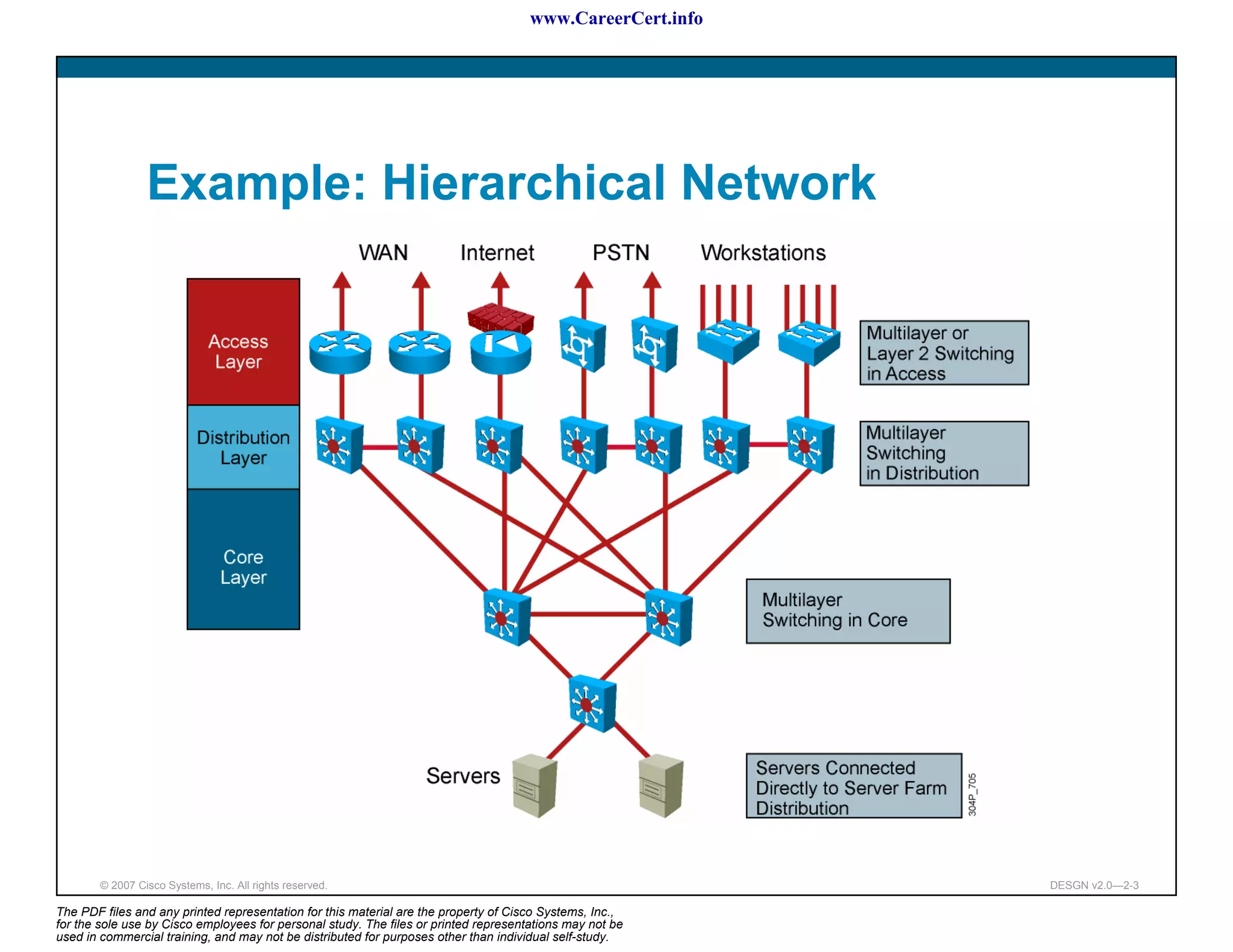
  • 379.
    www.CareerCert.info © 2007 Cisco Systems, Inc. All rights reserved. DESGN v2.0—5-80 The PDF files and any printed representation for this material are the property of Cisco Systems, Inc., for the sole use by Cisco employees for personal study. The files or printed representations may not be used in commercial training, and may not be distributed for purposes other than individual self-study.
  • 380.
    www.CareerCert.info Evaluating Security Solutions for the Network Designing for Cisco Internetwork Solutions (DESGN) v2.0 © 2007 Cisco Systems, Inc. All rights reserved. DESGN v2.0—6-1 The PDF files and any printed representation for this material are the property of Cisco Systems, Inc., for the sole use by Cisco employees for personal study. The files or printed representations may not be used in commercial training, and may not be distributed for purposes other than individual self-study.
  • 381.
    www.CareerCert.info Defining Network Security Evaluating Security Solutions for the Network © 2007 Cisco Systems, Inc. All rights reserved. DESGN v2.0—6-1 The PDF files and any printed representation for this material are the property of Cisco Systems, Inc., for the sole use by Cisco employees for personal study. The files or printed representations may not be used in commercial training, and may not be distributed for purposes other than individual self-study.
  • 382.
    www.CareerCert.info Reasons for Network Security Defend against attacks Prevent unauthorized access Prevent data misuse and theft Comply with security legislation Comply with industry standards Comply with company policy © 2007 Cisco Systems, Inc. All rights reserved. DESGN v2.0—6-2 The PDF files and any printed representation for this material are the property of Cisco Systems, Inc., for the sole use by Cisco employees for personal study. The files or printed representations may not be used in commercial training, and may not be distributed for purposes other than individual self-study.
  • 383.
    www.CareerCert.info Example: Legislation and Directives Legislation and industry directives that may affect organizational security include: GLBA—The Gramm-Leach-Bliley Act HIPAA—Health Insurance Portability and Accountability Act EU data protection Directive 95/46/EC SOX—Sarbanes–Oxley Act PCI DSS—Payment Card Industry Data Security Standard © 2007 Cisco Systems, Inc. All rights reserved. DESGN v2.0—6-3 The PDF files and any printed representation for this material are the property of Cisco Systems, Inc., for the sole use by Cisco employees for personal study. The files or printed representations may not be used in commercial training, and may not be distributed for purposes other than individual self-study.
  • 384.
    www.CareerCert.info Threats and Risks © 2007 Cisco Systems, Inc. All rights reserved. DESGN v2.0—6-4 The PDF files and any printed representation for this material are the property of Cisco Systems, Inc., for the sole use by Cisco employees for personal study. The files or printed representations may not be used in commercial training, and may not be distributed for purposes other than individual self-study.
  • 385.
    www.CareerCert.info Reconnaissance and Vulnerability Scanning Determine active targets Determine running network services Determine operating system platform Find trust relationships Check for proper file permissions Identify user account information Port-scanning tools include: – Nmap – SuperScan – NetStumbler – Kismet © 2007 Cisco Systems, Inc. All rights reserved. DESGN v2.0—6-5 The PDF files and any printed representation for this material are the property of Cisco Systems, Inc., for the sole use by Cisco employees for personal study. The files or printed representations may not be used in commercial training, and may not be distributed for purposes other than individual self-study.
  • 386.
    www.CareerCert.info Example: NMAP Screen © 2007 Cisco Systems, Inc. All rights reserved. DESGN v2.0—6-6 The PDF files and any printed representation for this material are the property of Cisco Systems, Inc., for the sole use by Cisco employees for personal study. The files or printed representations may not be used in commercial training, and may not be distributed for purposes other than individual self-study.
  • 387.
    www.CareerCert.info Vulnerability Assessment Active (sending packets) or passive (sniffer) Published vulnerability information – CERT/CC – MITRE – Microsoft – Cisco security notices Reconnaissance tools – Nessus – MBSA – SAINT © 2007 Cisco Systems, Inc. All rights reserved. DESGN v2.0—6-7 The PDF files and any printed representation for this material are the property of Cisco Systems, Inc., for the sole use by Cisco employees for personal study. The files or printed representations may not be used in commercial training, and may not be distributed for purposes other than individual self-study.
  • 388.
    www.CareerCert.info Gaining System Access Using knowledge of usernames and passwords – Improper escalation of privilege – Default administrative and service accounts – Gaining access to other systems via trust relationships Using social engineering – Physical access to information – Psychological approach Cracking captured passwords © 2007 Cisco Systems, Inc. All rights reserved. DESGN v2.0—6-8 The PDF files and any printed representation for this material are the property of Cisco Systems, Inc., for the sole use by Cisco employees for personal study. The files or printed representations may not be used in commercial training, and may not be distributed for purposes other than individual self-study.
  • 389.
    www.CareerCert.info Integrity and Confidentiality Threats © 2007 Cisco Systems, Inc. All rights reserved. DESGN v2.0—6-9 The PDF files and any printed representation for this material are the property of Cisco Systems, Inc., for the sole use by Cisco employees for personal study. The files or printed representations may not be used in commercial training, and may not be distributed for purposes other than individual self-study.
  • 390.
    www.CareerCert.info Availability Threats (Denial of Service) © 2007 Cisco Systems, Inc. All rights reserved. DESGN v2.0—6-10 The PDF files and any printed representation for this material are the property of Cisco Systems, Inc., for the sole use by Cisco employees for personal study. The files or printed representations may not be used in commercial training, and may not be distributed for purposes other than individual self-study.
  • 391.
    www.CareerCert.info Everything Is a Potential Target Hosts are the preferred target for worms and viruses. – In the past year, large number of attacks targeted hosts. – Compromised hosts are often used as attack launch points (botnets). But there are other high-value alternative targets: – Infrastructure devices: routers, switches – Support services: DHCP servers, DNS servers – Endpoints: management stations, IP phones – Infrastructure: network capacity – Security devices: IDS and IPS © 2007 Cisco Systems, Inc. All rights reserved. DESGN v2.0—6-11 The PDF files and any printed representation for this material are the property of Cisco Systems, Inc., for the sole use by Cisco employees for personal study. The files or printed representations may not be used in commercial training, and may not be distributed for purposes other than individual self-study.
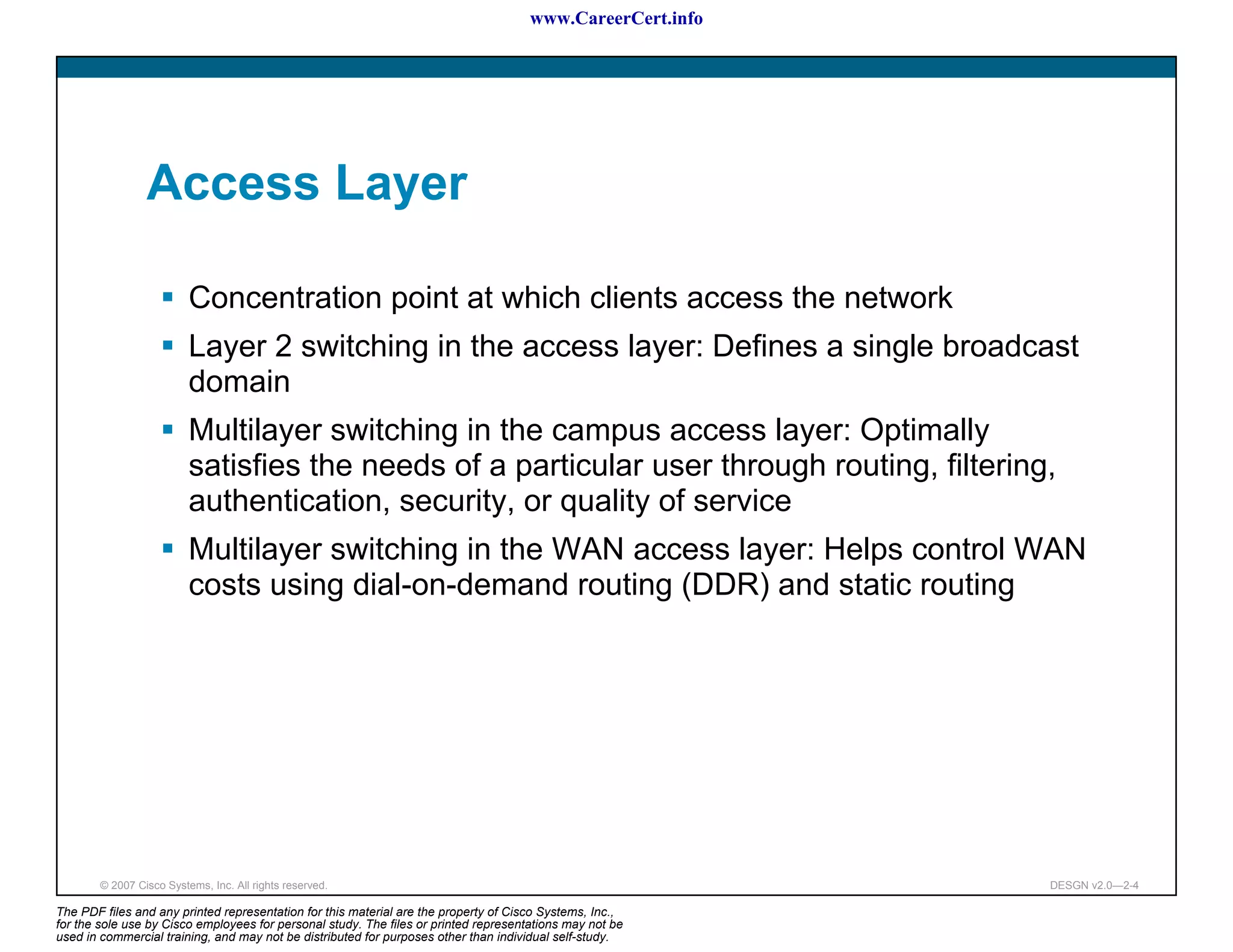
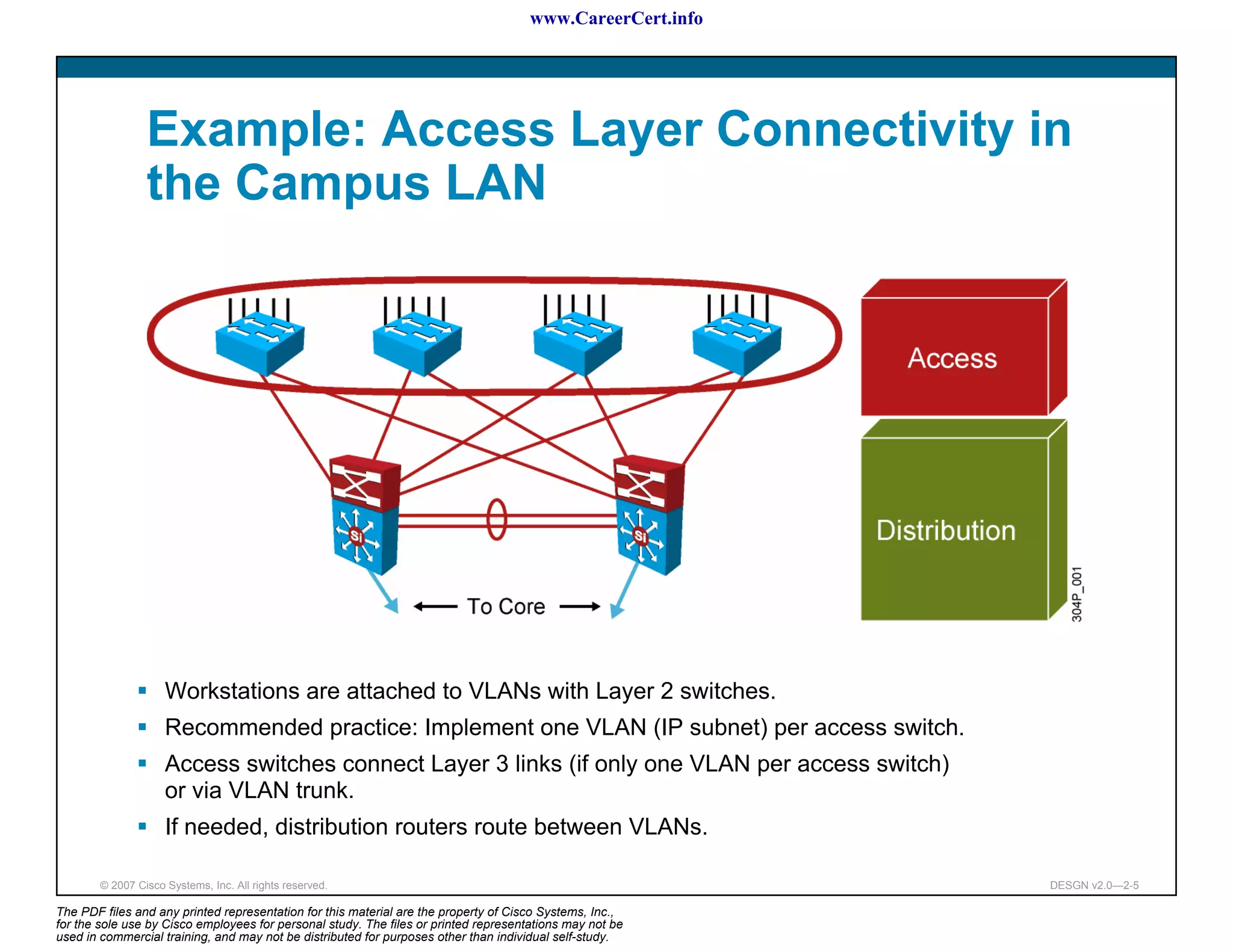
  • 392.
    www.CareerCert.info Network Security in the System Lifecycle Business needs: What does your organization want to do with the network? Risk analysis: What is the risk and cost balance? Security policy: What are the policies, standards, and guidelines to address business needs and risk? Industry recommended practices: What are the reliable, well-understood, and recommended security recommended practices? Security operations: What is the process for incident response, monitoring, maintenance, and compliance auditing of the system? © 2007 Cisco Systems, Inc. All rights reserved. DESGN v2.0—6-12 The PDF files and any printed representation for this material are the property of Cisco Systems, Inc., for the sole use by Cisco employees for personal study. The files or printed representations may not be used in commercial training, and may not be distributed for purposes other than individual self-study.
  • 393.
    www.CareerCert.info What Is a Security Policy? “A security policy is a formal statement of the rules by which people who are given access to an organization’s technology and information assets must abide.” RFC 2196, Site Security Handbook © 2007 Cisco Systems, Inc. All rights reserved. DESGN v2.0—6-13 The PDF files and any printed representation for this material are the property of Cisco Systems, Inc., for the sole use by Cisco employees for personal study. The files or printed representations may not be used in commercial training, and may not be distributed for purposes other than individual self-study.
  • 394.
    www.CareerCert.info Why Is a Security Policy Needed? Sets the framework for the security implementation – Defines organizational assets and the way to use them – Defines and communicates roles – Helps determine necessary tools and procedures – Defines how to identify and handle security incidents Creates a baseline of the current security posture – Defines allowed and not-allowed system behaviors – Informs users of their responsibilities and ramifications of asset misuse – Provides risk assessment and cost-benefit analysis © 2007 Cisco Systems, Inc. All rights reserved. DESGN v2.0—6-14 The PDF files and any printed representation for this material are the property of Cisco Systems, Inc., for the sole use by Cisco employees for personal study. The files or printed representations may not be used in commercial training, and may not be distributed for purposes other than individual self-study.
  • 395.
    www.CareerCert.info Network Security and Risks Network security can reduce risks to acceptable levels: – Risk assessment defines threats and their probability and severity. – A network security policy enumerates risks relevant to the network and describes how risks will be controlled or managed. – A network security design implements the security policy. Justify security costs by the potential cost and inconvenience of incidents. © 2007 Cisco Systems, Inc. All rights reserved. DESGN v2.0—6-15 The PDF files and any printed representation for this material are the property of Cisco Systems, Inc., for the sole use by Cisco employees for personal study. The files or printed representations may not be used in commercial training, and may not be distributed for purposes other than individual self-study.
  • 396.
    www.CareerCert.info Risk Index Calculation Risk Probability Severity Control Risk Index (P) (S) (C) (P * S) / C (1–3) (1–3) (1–3) (⅓–9) 1. 2. 3. 4. © 2007 Cisco Systems, Inc. All rights reserved. DESGN v2.0—6-16 The PDF files and any printed representation for this material are the property of Cisco Systems, Inc., for the sole use by Cisco employees for personal study. The files or printed representations may not be used in commercial training, and may not be distributed for purposes other than individual self-study.
  • 397.
    www.CareerCert.info Example: Risk Index Calculation Risk Probability Severity Control Risk Index (P) (S) (C) (P * S) / C (1–3) (1–3) (1–3) (⅓–9) 1. Breach of confidentiality 1 3 2 1.5 of customer database 2. DDoS attack sustained 2 2 1 4 for more than 1 hour against e-commerce server © 2007 Cisco Systems, Inc. All rights reserved. DESGN v2.0—6-17 The PDF files and any printed representation for this material are the property of Cisco Systems, Inc., for the sole use by Cisco employees for personal study. The files or printed representations may not be used in commercial training, and may not be distributed for purposes other than individual self-study.
  • 398.
    www.CareerCert.info Components of a Security Policy © 2007 Cisco Systems, Inc. All rights reserved. DESGN v2.0—6-18 The PDF files and any printed representation for this material are the property of Cisco Systems, Inc., for the sole use by Cisco employees for personal study. The files or printed representations may not be used in commercial training, and may not be distributed for purposes other than individual self-study.
  • 399.
    www.CareerCert.info Network Security Is a Continuous Process Secure – Identity and authentication – Filtering and stateful inspection – Encryption and VPNs Monitor – Intrusion detection and response – Content-based detection and response Test – Security posture assessment – Vulnerability scanning – Patch verification and application auditing Improve – Event and data analysis and reporting – Network security intelligence © 2007 Cisco Systems, Inc. All rights reserved. DESGN v2.0—6-19 The PDF files and any printed representation for this material are the property of Cisco Systems, Inc., for the sole use by Cisco employees for personal study. The files or printed representations may not be used in commercial training, and may not be distributed for purposes other than individual self-study.
  • 400.
    www.CareerCert.info Integrate Security Design and Network Design Security services can reside inside network infrastructure. Security design coupled with network design is far more manageable. Recommended practice: Integrate security and network design. Integrated security and network design requires coordination. © 2007 Cisco Systems, Inc. All rights reserved. DESGN v2.0—6-20 The PDF files and any printed representation for this material are the property of Cisco Systems, Inc., for the sole use by Cisco employees for personal study. The files or printed representations may not be used in commercial training, and may not be distributed for purposes other than individual self-study.
  • 401.
    www.CareerCert.info Summary Security services must provide adequate protection to conduct business in a relatively open environment. – There are many types security threats and associated risks. – Each device on the network, such as a host, router, or switch, is a potential security target. Network security is part of the system life cycle. – Network security is a continuous process built around a security policy. – Security design and network design should be integrated. © 2007 Cisco Systems, Inc. All rights reserved. DESGN v2.0—6-21 The PDF files and any printed representation for this material are the property of Cisco Systems, Inc., for the sole use by Cisco employees for personal study. The files or printed representations may not be used in commercial training, and may not be distributed for purposes other than individual self-study.
  • 402.
    www.CareerCert.info © 2007 Cisco Systems, Inc. All rights reserved. DESGN v2.0—6-22 The PDF files and any printed representation for this material are the property of Cisco Systems, Inc., for the sole use by Cisco employees for personal study. The files or printed representations may not be used in commercial training, and may not be distributed for purposes other than individual self-study.
  • 403.
    www.CareerCert.info Understanding the Cisco Self-Defending Network Evaluating Security Solutions for the Network © 2007 Cisco Systems, Inc. All rights reserved. DESGN v2.0—6-1 The PDF files and any printed representation for this material are the property of Cisco Systems, Inc., for the sole use by Cisco employees for personal study. The files or printed representations may not be used in commercial training, and may not be distributed for purposes other than individual self-study.
  • 404.
    www.CareerCert.info Cisco Self-Defending Network Efficient security management, control, and response Advanced technologies and security services to: Protect critical assets Mitigate the effects of outbreaks Ensure privacy Network as Platform © 2007 Cisco Systems, Inc. All rights reserved. DESGN v2.0—6-2 The PDF files and any printed representation for this material are the property of Cisco Systems, Inc., for the sole use by Cisco employees for personal study. The files or printed representations may not be used in commercial training, and may not be distributed for purposes other than individual self-study.
  • 405.
    www.CareerCert.info Network as Platform for Security Cisco Integrated Services Routers Cisco Adaptive Security – Integrate Cisco IOS Firewall, VPN, and Appliances intrusion prevention system (IPS) – High-performance firewall, services across the Cisco router IPS, network antivirus, and portfolio IPsec/SSL VPN technologies – Deploy new security features on all in one unified architecture existing routers using Cisco IOS Software – Device consolidation to – Cisco NAC-enabled reduce overall deployment and operations costs and Cisco Catalyst Switches complexities – Denial-of-service (DoS) attack mitigation – Cisco NAC-enabled – Integrated security service modules for high-performance threat protection and secure connectivity – Man-in-the-middle attack mitigation © 2007 Cisco Systems, Inc. All rights reserved. DESGN v2.0—6-3 The PDF files and any printed representation for this material are the property of Cisco Systems, Inc., for the sole use by Cisco employees for personal study. The files or printed representations may not be used in commercial training, and may not be distributed for purposes other than individual self-study.
  • 406.
    www.CareerCert.info Self-Defending Network Phases © 2007 Cisco Systems, Inc. All rights reserved. DESGN v2.0—6-4 The PDF files and any printed representation for this material are the property of Cisco Systems, Inc., for the sole use by Cisco employees for personal study. The files or printed representations may not be used in commercial training, and may not be distributed for purposes other than individual self-study.
  • 407.
    www.CareerCert.info Trust and Identity Management © 2007 Cisco Systems, Inc. All rights reserved. DESGN v2.0—6-5 The PDF files and any printed representation for this material are the property of Cisco Systems, Inc., for the sole use by Cisco employees for personal study. The files or printed representations may not be used in commercial training, and may not be distributed for purposes other than individual self-study.
  • 408.
    www.CareerCert.info Trust Is the Root of Security Trust is a relationship in which two (or more) network entities are allowed to communicate. Trust forms the root of all security policy decisions. Trust and risk are opposites; security is based on enforcing limitations to trust relationships. Trust relationships: – Can be explicit or implied – Can be inherited – Can be abused © 2007 Cisco Systems, Inc. All rights reserved. DESGN v2.0—6-6 The PDF files and any printed representation for this material are the property of Cisco Systems, Inc., for the sole use by Cisco employees for personal study. The files or printed representations may not be used in commercial training, and may not be distributed for purposes other than individual self-study.
  • 409.
    www.CareerCert.info Domains of Trust Question: From a security design perspective, what is the key difference between Case 1 and Case 2? © 2007 Cisco Systems, Inc. All rights reserved. DESGN v2.0—6-7 The PDF files and any printed representation for this material are the property of Cisco Systems, Inc., for the sole use by Cisco employees for personal study. The files or printed representations may not be used in commercial training, and may not be distributed for purposes other than individual self-study.
  • 410.
    www.CareerCert.info Domains of Trust Question: From a security design perspective, what is the key difference between Case 1 and Case 2? Answer: Case 2 is more segmented into domains of trust. © 2007 Cisco Systems, Inc. All rights reserved. DESGN v2.0—6-8 The PDF files and any printed representation for this material are the property of Cisco Systems, Inc., for the sole use by Cisco employees for personal study. The files or printed representations may not be used in commercial training, and may not be distributed for purposes other than individual self-study.
  • 411.
    www.CareerCert.info Example: Domains of Trust Domains Gradient Safeguards Needed Private to Public Extreme Advanced firewalling, flow-based (high risk) inspection, misuse detection (IPS), constant monitoring Production to Lab Minor Basic access control, casual monitoring (low risk) Headquarters to Steep Communication security, authentication, Branch (considerable risk) confidentiality, integrity concerns © 2007 Cisco Systems, Inc. All rights reserved. DESGN v2.0—6-9 The PDF files and any printed representation for this material are the property of Cisco Systems, Inc., for the sole use by Cisco employees for personal study. The files or printed representations may not be used in commercial training, and may not be distributed for purposes other than individual self-study.
  • 412.
    www.CareerCert.info Identity Identity is the “who” of a trust relationship. The identity of a network entity is verified by credentials. Both people and devices can be authenticated. Three authentication attributes: – Something you know – Something you have – Something you are Common approaches to identity: – Passwords – Tokens – Certificates © 2007 Cisco Systems, Inc. All rights reserved. DESGN v2.0—6-10 The PDF files and any printed representation for this material are the property of Cisco Systems, Inc., for the sole use by Cisco employees for personal study. The files or printed representations may not be used in commercial training, and may not be distributed for purposes other than individual self-study.
  • 413.
    www.CareerCert.info Passwords Correlates an authorized user with network resources © 2007 Cisco Systems, Inc. All rights reserved. DESGN v2.0—6-11 The PDF files and any printed representation for this material are the property of Cisco Systems, Inc., for the sole use by Cisco employees for personal study. The files or printed representations may not be used in commercial training, and may not be distributed for purposes other than individual self-study.
  • 414.
    www.CareerCert.info Tokens Strong (two-factor) authentication based on “something you know” and “something you have” © 2007 Cisco Systems, Inc. All rights reserved. DESGN v2.0—6-12 The PDF files and any printed representation for this material are the property of Cisco Systems, Inc., for the sole use by Cisco employees for personal study. The files or printed representations may not be used in commercial training, and may not be distributed for purposes other than individual self-study.
  • 415.
    www.CareerCert.info Access Control in Networks Confidentiality and integrity are traditionally supported through access control. Access control enforces rules about which entities can access which resources. Network access control is based on: – Authentication, which establishes the identity of the subject – Authorization, which defines what a subject can do in a network Audit trails and real-time monitoring provide accounting and security auditing information. © 2007 Cisco Systems, Inc. All rights reserved. DESGN v2.0—6-13 The PDF files and any printed representation for this material are the property of Cisco Systems, Inc., for the sole use by Cisco employees for personal study. The files or printed representations may not be used in commercial training, and may not be distributed for purposes other than individual self-study.
  • 416.
    www.CareerCert.info Example: Trust and Identity Management Technologies Access control lists (ACLs) Firewalls – Stateful inspection – Application inspection Network Admission Control (NAC) – NAC Framework – Cisco NAC Appliance IEEE 802.1X Cisco IBNS © 2007 Cisco Systems, Inc. All rights reserved. DESGN v2.0—6-14 The PDF files and any printed representation for this material are the property of Cisco Systems, Inc., for the sole use by Cisco employees for personal study. The files or printed representations may not be used in commercial training, and may not be distributed for purposes other than individual self-study.
  • 417.
    www.CareerCert.info Firewall Filtering Using ACLs © 2007 Cisco Systems, Inc. All rights reserved. DESGN v2.0—6-15 The PDF files and any printed representation for this material are the property of Cisco Systems, Inc., for the sole use by Cisco employees for personal study. The files or printed representations may not be used in commercial training, and may not be distributed for purposes other than individual self-study.
  • 418.
    www.CareerCert.info NAC Framework and Appliance Two approaches for Network Admission Control (NAC) NAC Framework Cisco NAC Appliance Sold through NAC- Sold as virtual or enabled products integrated appliance Integrated solution Self-contained product leveraging Cisco integrates but does not network and vendor rely on partners products NAC Infrastructure Offers customers a deployment time-frame choice Adapts to investment protection requirements of customer © 2007 Cisco Systems, Inc. All rights reserved. DESGN v2.0—6-16 The PDF files and any printed representation for this material are the property of Cisco Systems, Inc., for the sole use by Cisco employees for personal study. The files or printed representations may not be used in commercial training, and may not be distributed for purposes other than individual self-study.
  • 419.
    www.CareerCert.info 802.1X Protocol © 2007 Cisco Systems, Inc. All rights reserved. DESGN v2.0—6-17 The PDF files and any printed representation for this material are the property of Cisco Systems, Inc., for the sole use by Cisco employees for personal study. The files or printed representations may not be used in commercial training, and may not be distributed for purposes other than individual self-study.
  • 420.
    www.CareerCert.info Identity and Access Control Deployment Locations Authenticate at edge. Deploy ACLs based on policy. Practice defense in depth. © 2007 Cisco Systems, Inc. All rights reserved. DESGN v2.0—6-18 The PDF files and any printed representation for this material are the property of Cisco Systems, Inc., for the sole use by Cisco employees for personal study. The files or printed representations may not be used in commercial training, and may not be distributed for purposes other than individual self-study.
  • 421.
    www.CareerCert.info Threat Defense Enhances security in the existing network infrastructure – Protects businesses from operation disruption, lost revenue, and loss of reputation. Adds comprehensive security on network endpoints – Cisco Security Agent provides endpoint protection. Adds dedicated security technologies to networking devices and appliances – Security technologies are implemented throughout the network. © 2007 Cisco Systems, Inc. All rights reserved. DESGN v2.0—6-19 The PDF files and any printed representation for this material are the property of Cisco Systems, Inc., for the sole use by Cisco employees for personal study. The files or printed representations may not be used in commercial training, and may not be distributed for purposes other than individual self-study.
  • 422.
    www.CareerCert.info Physical Security © 2007 Cisco Systems, Inc. All rights reserved. DESGN v2.0—6-20 The PDF files and any printed representation for this material are the property of Cisco Systems, Inc., for the sole use by Cisco employees for personal study. The files or printed representations may not be used in commercial training, and may not be distributed for purposes other than individual self-study.
  • 423.
    www.CareerCert.info Physical Security Guidelines Deploy adequate physical access control. Evaluate whether physical access can compromise other security features. Identify additional security issues resulting from device theft. Protect communications over infrastructure out of your control using cryptography. © 2007 Cisco Systems, Inc. All rights reserved. DESGN v2.0—6-21 The PDF files and any printed representation for this material are the property of Cisco Systems, Inc., for the sole use by Cisco employees for personal study. The files or printed representations may not be used in commercial training, and may not be distributed for purposes other than individual self-study.
  • 424.
    www.CareerCert.info Infrastructure Protection The measures taken to preserve the integrity and availability of the network infrastructure as a transport and service entity Goals: – That the network devices are not accessed or altered in an unauthorized manner – That the end-to-end network transport and any integrated services remain available Policy enforcement technologies can help preserve, directly, the integrity and availability of the network. © 2007 Cisco Systems, Inc. All rights reserved. DESGN v2.0—6-22 The PDF files and any printed representation for this material are the property of Cisco Systems, Inc., for the sole use by Cisco employees for personal study. The files or printed representations may not be used in commercial training, and may not be distributed for purposes other than individual self-study.
  • 425.
    www.CareerCert.info Infrastructure Protection Deployment Locations Deploy on all network infrastructure devices – Different mechanisms are used on different platforms, but typically there are equivalent functions available. – More advanced mechanisms are available mainly on higher-end platforms. Implement throughout the network © 2007 Cisco Systems, Inc. All rights reserved. DESGN v2.0—6-23 The PDF files and any printed representation for this material are the property of Cisco Systems, Inc., for the sole use by Cisco employees for personal study. The files or printed representations may not be used in commercial training, and may not be distributed for purposes other than individual self-study.
  • 426.
    www.CareerCert.info Recommended Practices for Infrastructure Protection Use SSH to access devices. Enable AAA and role-based access control for access to all network devices. Collect and archive syslog information. Use SNMPv3. Disable unused services. Use SFTP (SSH FTP) or SCP and avoid FTP and TFTP. Install vty access lists to limit access to management and CLI services. Enable control plane protocol authentication. Consider one-step lockdown in SDM for basic router security. © 2007 Cisco Systems, Inc. All rights reserved. DESGN v2.0—6-24 The PDF files and any printed representation for this material are the property of Cisco Systems, Inc., for the sole use by Cisco employees for personal study. The files or printed representations may not be used in commercial training, and may not be distributed for purposes other than individual self-study.
  • 427.
    www.CareerCert.info Threat Detection and Mitigation Provide early detection and notification of unpredicted malicious traffic or behavior. Goals: – To detect, notify of, and help stop an event or traffic that is unauthorized and unpredicted – To help preserve the availability of the network, particularly against unknown or unforeseen attacks Technologies include: – Endpoint protection – Infection containment – Intrusion and anomaly detection – Application security and anti-X defense © 2007 Cisco Systems, Inc. All rights reserved. DESGN v2.0—6-25 The PDF files and any printed representation for this material are the property of Cisco Systems, Inc., for the sole use by Cisco employees for personal study. The files or printed representations may not be used in commercial training, and may not be distributed for purposes other than individual self-study.
  • 428.
    www.CareerCert.info Example: Threat Detection and Mitigation Technologies Network-based intrusion prevention systems (NIPS) – Adaptive security appliance (ASA) – IPS sensor applicance – Cisco IOS IPS Host-based intrusion prevention systems (HIPS) – Cisco Security Agent NetFlow Syslog Event correlation systems – Cisco Security Monitoring, Analysis, and Response System (MARS) Cisco Traffic Anomaly Detector Module © 2007 Cisco Systems, Inc. All rights reserved. DESGN v2.0—6-26 The PDF files and any printed representation for this material are the property of Cisco Systems, Inc., for the sole use by Cisco employees for personal study. The files or printed representations may not be used in commercial training, and may not be distributed for purposes other than individual self-study.
  • 429.
    www.CareerCert.info Threat Detection and Mitigation Solutions Deployment Locations © 2007 Cisco Systems, Inc. All rights reserved. DESGN v2.0—6-27 The PDF files and any printed representation for this material are the property of Cisco Systems, Inc., for the sole use by Cisco employees for personal study. The files or printed representations may not be used in commercial training, and may not be distributed for purposes other than individual self-study.
  • 430.
    www.CareerCert.info Secure Connectivity © 2007 Cisco Systems, Inc. All rights reserved. DESGN v2.0—6-28 The PDF files and any printed representation for this material are the property of Cisco Systems, Inc., for the sole use by Cisco employees for personal study. The files or printed representations may not be used in commercial training, and may not be distributed for purposes other than individual self-study.
  • 431.
    www.CareerCert.info Encryption Fundamentals A method of protecting the confidentiality of data Uses keys to encrypt the data and decrypt it at a later time © 2007 Cisco Systems, Inc. All rights reserved. DESGN v2.0—6-29 The PDF files and any printed representation for this material are the property of Cisco Systems, Inc., for the sole use by Cisco employees for personal study. The files or printed representations may not be used in commercial training, and may not be distributed for purposes other than individual self-study.
  • 432.
    www.CareerCert.info Encryption Keys Shared secrets: Secret key is carried “out of band” to the remote side. Easiest mechanism, but it has inherent security concerns. Public key infrastructure (PKI): Uses “asymmetric cryptography” in which the encryption key is different from the decryption key Lets you publish the encryption key, while keeping the decryption key secret Widely used in e-commerce sites around the world © 2007 Cisco Systems, Inc. All rights reserved. DESGN v2.0—6-30 The PDF files and any printed representation for this material are the property of Cisco Systems, Inc., for the sole use by Cisco employees for personal study. The files or printed representations may not be used in commercial training, and may not be distributed for purposes other than individual self-study.
  • 433.
    www.CareerCert.info VPN Protocols IPsec (IP security) Built directly on the IP layer (Protocol 50) Uses IKE and ESP Requires IPsec software on endpoints SSL (Secure Socket Layer) Built on top of the TCP layer (port 443) Provides confidentiality for web traffic (HTTPS) All major browsers can use SSL © 2007 Cisco Systems, Inc. All rights reserved. DESGN v2.0—6-31 The PDF files and any printed representation for this material are the property of Cisco Systems, Inc., for the sole use by Cisco employees for personal study. The files or printed representations may not be used in commercial training, and may not be distributed for purposes other than individual self-study.
  • 434.
    www.CareerCert.info Transmission Confidentiality © 2007 Cisco Systems, Inc. All rights reserved. DESGN v2.0—6-32 The PDF files and any printed representation for this material are the property of Cisco Systems, Inc., for the sole use by Cisco employees for personal study. The files or printed representations may not be used in commercial training, and may not be distributed for purposes other than individual self-study.
  • 435.
    www.CareerCert.info Transmission Confidentiality Guidelines Evaluate the location for transmission confidentiality needs. Use the strongest available cryptography, performance permitting. Use well-known and established cryptographic algorithms. Do not focus on confidentiality alone; integrity and authenticity are also important. © 2007 Cisco Systems, Inc. All rights reserved. DESGN v2.0—6-33 The PDF files and any printed representation for this material are the property of Cisco Systems, Inc., for the sole use by Cisco employees for personal study. The files or printed representations may not be used in commercial training, and may not be distributed for purposes other than individual self-study.
  • 436.
    www.CareerCert.info Data Integrity © 2007 Cisco Systems, Inc. All rights reserved. DESGN v2.0—6-34 The PDF files and any printed representation for this material are the property of Cisco Systems, Inc., for the sole use by Cisco employees for personal study. The files or printed representations may not be used in commercial training, and may not be distributed for purposes other than individual self-study.
  • 437.
    www.CareerCert.info Data Integrity Guidelines Evaluate the need for transmission integrity. Use the strongest available cryptography, performance permitting. Use well-known and established cryptographic algorithms. © 2007 Cisco Systems, Inc. All rights reserved. DESGN v2.0—6-35 The PDF files and any printed representation for this material are the property of Cisco Systems, Inc., for the sole use by Cisco employees for personal study. The files or printed representations may not be used in commercial training, and may not be distributed for purposes other than individual self-study.
  • 438.
    www.CareerCert.info Security Management Overview Security management does the following: – Collects, analyzes, and presents data – Provisions policies on security devices – Maintains consistency and change control of policies – Provides role-based access control and accounts for all user activity Security implementation is only as good as policies used. Biggest risk to security in a properly planned architecture is policy error. © 2007 Cisco Systems, Inc. All rights reserved. DESGN v2.0—6-36 The PDF files and any printed representation for this material are the property of Cisco Systems, Inc., for the sole use by Cisco employees for personal study. The files or printed representations may not be used in commercial training, and may not be distributed for purposes other than individual self-study.
  • 439.
    www.CareerCert.info Security Management Solutions Cisco Router and Security Device Manager (SDM) Cisco Adaptive Security Device Manager (ASDM) Cisco Intrusion Prevention System Device Manager (IDM) Management Center for Cisco Security Agents Cisco Secure Access Control Server (ACS) Cisco Security Manager Cisco Security Monitoring, Analysis, and Response System (Cisco Security MARS) © 2007 Cisco Systems, Inc. All rights reserved. DESGN v2.0—6-37 The PDF files and any printed representation for this material are the property of Cisco Systems, Inc., for the sole use by Cisco employees for personal study. The files or printed representations may not be used in commercial training, and may not be distributed for purposes other than individual self-study.
  • 440.
    www.CareerCert.info Summary The Cisco Self-Defending Network integrates security into the network to provide the network the ability to identify, prevent, and adapt to threats. Trust and identity management provide secure network access and admission at any point in the network and isolate and control infected or unpatched devices that attempt to access the network. Threat defense provides a strong defense against known and unknown attacks using security integrated in routers, switches, and appliances. Secure connectivity uses encryption and authentication to provide secure transport across untrusted networks. Security management is a framework for scalable policy administration and enforcement. © 2007 Cisco Systems, Inc. All rights reserved. DESGN v2.0—6-38 The PDF files and any printed representation for this material are the property of Cisco Systems, Inc., for the sole use by Cisco employees for personal study. The files or printed representations may not be used in commercial training, and may not be distributed for purposes other than individual self-study.
  • 441.
    www.CareerCert.info © 2007 Cisco Systems, Inc. All rights reserved. DESGN v2.0—6-39 The PDF files and any printed representation for this material are the property of Cisco Systems, Inc., for the sole use by Cisco employees for personal study. The files or printed representations may not be used in commercial training, and may not be distributed for purposes other than individual self-study.
  • 442.
    www.CareerCert.info Selecting Network Security Solutions Evaluating Security Solutions for the Network © 2007 Cisco Systems, Inc. All rights reserved. DESGN v2.0—6-1 The PDF files and any printed representation for this material are the property of Cisco Systems, Inc., for the sole use by Cisco employees for personal study. The files or printed representations may not be used in commercial training, and may not be distributed for purposes other than individual self-study.
  • 443.
    www.CareerCert.info Network Devices Supporting Integrated Security Cisoc IOS router security PIX security appliance Adaptive security appliance (ASA) VPN concentrator Intrusion prevention system Catalyst service modules Endpoint security © 2007 Cisco Systems, Inc. All rights reserved. DESGN v2.0—6-2 The PDF files and any printed representation for this material are the property of Cisco Systems, Inc., for the sole use by Cisco employees for personal study. The files or printed representations may not be used in commercial training, and may not be distributed for purposes other than individual self-study.
  • 444.
    www.CareerCert.info Integrated Security for Cisco IOS Routers Cisco IOS Firewall – Stateful multiservice application-based filtering Cisco IOS IPS – In-line deep-packet inspection Cisco IOS IPsec – Data encryption at the IP packet level Cisco IOS trust and identity – AAA – PKI – SSH – SSL © 2007 Cisco Systems, Inc. All rights reserved. DESGN v2.0—6-3 The PDF files and any printed representation for this material are the property of Cisco Systems, Inc., for the sole use by Cisco employees for personal study. The files or printed representations may not be used in commercial training, and may not be distributed for purposes other than individual self-study.
  • 445.
    www.CareerCert.info Example: Security Hardware Options for ISRs Built-in VPN acceleration Voice security options High-performance AIM Cisco IDS Network Module Cisco Content Engine Module Cisco Network Analysis Module © 2007 Cisco Systems, Inc. All rights reserved. DESGN v2.0—6-4 The PDF files and any printed representation for this material are the property of Cisco Systems, Inc., for the sole use by Cisco employees for personal study. The files or printed representations may not be used in commercial training, and may not be distributed for purposes other than individual self-study.
  • 446.
    www.CareerCert.info Security Appliances VPN concentrator – IPsec and SSL VPN support PIX security appliance – Rich application and protocol inspection – Integrated site-to-site and remote access VPNs ASA, a multifunction security appliance – Stateful firewall of PIX appliance, plus – Adaptive threat defense capabilities Application security Anti-X defenses IPS – Advanced integration modules © 2007 Cisco Systems, Inc. All rights reserved. DESGN v2.0—6-5 The PDF files and any printed representation for this material are the property of Cisco Systems, Inc., for the sole use by Cisco employees for personal study. The files or printed representations may not be used in commercial training, and may not be distributed for purposes other than individual self-study.
  • 447.
    www.CareerCert.info Intrusion Prevention Systems In line (IPS) or passive (IDS) Multivector threat identification Network speeds from multiple T1s to 1 Gbps – IPS 4215 sensor protects up to 65 Mbps of traffic – IPS 4240 sensor protects up to 250 Mbps of traffic – IPS 4255 sensor protects up to 500 Mbps of traffic – IPS 4260 sensor protects up to 1 Gbps of traffic © 2007 Cisco Systems, Inc. All rights reserved. DESGN v2.0—6-6 The PDF files and any printed representation for this material are the property of Cisco Systems, Inc., for the sole use by Cisco employees for personal study. The files or printed representations may not be used in commercial training, and may not be distributed for purposes other than individual self-study.
  • 448.
    www.CareerCert.info Cisco Catalyst Service Modules Cisco Firewall Services Module Cisco Intrusion Detection System Services Module Cisco SSL Services Module Cisco IPSec VPN SPA Cisco Traffic Anomaly Detector Module Cisco Anomaly Guard Module Cisco Network Analysis Module © 2007 Cisco Systems, Inc. All rights reserved. DESGN v2.0—6-7 The PDF files and any printed representation for this material are the property of Cisco Systems, Inc., for the sole use by Cisco employees for personal study. The files or printed representations may not be used in commercial training, and may not be distributed for purposes other than individual self-study.
  • 449.
    www.CareerCert.info Cisco Security Agent Spyware and adware protection Protection against buffer overflows Distributed firewall capabilities Malicious mobile code protection Operating-system integrity assurance Application inventory Audit log consolidation © 2007 Cisco Systems, Inc. All rights reserved. DESGN v2.0—6-8 The PDF files and any printed representation for this material are the property of Cisco Systems, Inc., for the sole use by Cisco employees for personal study. The files or printed representations may not be used in commercial training, and may not be distributed for purposes other than individual self-study.
  • 450.
    www.CareerCert.info Securing the Enterprise Network Embed Self-Defending Network features throughout the network in: – The enterprise campus – The enterprise data center – The enterprise edge Use Self-Defending Network technologies, including: – Identity and access control – Threat defense – Infrastructure protection – Security management © 2007 Cisco Systems, Inc. All rights reserved. DESGN v2.0—6-9 The PDF files and any printed representation for this material are the property of Cisco Systems, Inc., for the sole use by Cisco employees for personal study. The files or printed representations may not be used in commercial training, and may not be distributed for purposes other than individual self-study.
  • 451.
    www.CareerCert.info Deploying Security in the Enterprise Campus—Identity and Access Control 802.1X or NAC NAC appliance ACLs Firewall – Stateful inspection – Application inspection © 2007 Cisco Systems, Inc. All rights reserved. DESGN v2.0—6-10 The PDF files and any printed representation for this material are the property of Cisco Systems, Inc., for the sole use by Cisco employees for personal study. The files or printed representations may not be used in commercial training, and may not be distributed for purposes other than individual self-study.
  • 452.
    www.CareerCert.info Deploying Security in the Enterprise Campus—Threat Detection and Mitigation NetFlow Syslog SNMP Host IPS (Cisco Security Agent) Network IPS Cisco Security MARS, Cisco Security Manager © 2007 Cisco Systems, Inc. All rights reserved. DESGN v2.0—6-11 The PDF files and any printed representation for this material are the property of Cisco Systems, Inc., for the sole use by Cisco employees for personal study. The files or printed representations may not be used in commercial training, and may not be distributed for purposes other than individual self-study.
  • 453.
    www.CareerCert.info Deploying Security in the Enterprise Campus – Infrastructure Protection AAA SSH SNMPv3 IGP or EGP Message Digest 5 Layer 2 security features © 2007 Cisco Systems, Inc. All rights reserved. DESGN v2.0—6-12 The PDF files and any printed representation for this material are the property of Cisco Systems, Inc., for the sole use by Cisco employees for personal study. The files or printed representations may not be used in commercial training, and may not be distributed for purposes other than individual self-study.
  • 454.
    www.CareerCert.info Deploying Security in the Enterprise Campus—Summary Identity and access control: 802.1x, NAC, ACLs, firewalls Threat detection and mitigation: NetFlow, syslog, SNMP, Cisco Security-MARS, Network IPS, Host IPS Infrastructure protection: AAA, SSH, SNMPv3, IGP or EGP MD5, Layer 2 security features Security management Cisco Security Manager, Cisco Security MARS © 2007 Cisco Systems, Inc. All rights reserved. DESGN v2.0—6-13 The PDF files and any printed representation for this material are the property of Cisco Systems, Inc., for the sole use by Cisco employees for personal study. The files or printed representations may not be used in commercial training, and may not be distributed for purposes other than individual self-study.
  • 455.
    www.CareerCert.info Deploying Security in the Enterprise Data Center – Identity and Access Control 802.1X ACLs Firewalls © 2007 Cisco Systems, Inc. All rights reserved. DESGN v2.0—6-14 The PDF files and any printed representation for this material are the property of Cisco Systems, Inc., for the sole use by Cisco employees for personal study. The files or printed representations may not be used in commercial training, and may not be distributed for purposes other than individual self-study.
  • 456.
    www.CareerCert.info Deploying Security in the Enterprise Data Center—Threat Detection and Mitigation NetFlow Syslog SNMP Host IPS (Cisco Security Agent) Network IPS Cisco Security MARS, Cisco Security Manager © 2007 Cisco Systems, Inc. All rights reserved. DESGN v2.0—6-15 The PDF files and any printed representation for this material are the property of Cisco Systems, Inc., for the sole use by Cisco employees for personal study. The files or printed representations may not be used in commercial training, and may not be distributed for purposes other than individual self-study.
  • 457.
    www.CareerCert.info Deploying Security in the Enterprise Data Center—Infrastructure Protection AAA SNMPv3 SSH IGP or EGP MD5 Layer 2 security features © 2007 Cisco Systems, Inc. All rights reserved. DESGN v2.0—6-16 The PDF files and any printed representation for this material are the property of Cisco Systems, Inc., for the sole use by Cisco employees for personal study. The files or printed representations may not be used in commercial training, and may not be distributed for purposes other than individual self-study.
  • 458.
    www.CareerCert.info Deploying Security in the Enterprise Data Center—Summary Identity and access control: 802.1X, ACLs, firewalls Threat detection and mitigation: NetFlow, syslog, SNMP, Cisco SecurityMARS, Network IPS, Host IPS Infrastructure protection: AAA, SSH, SNMPv3, IGP or EGP MD5, Layer 2 security features Security management Cisco Security Manager, Cisco Security MARS © 2007 Cisco Systems, Inc. All rights reserved. DESGN v2.0—6-17 The PDF files and any printed representation for this material are the property of Cisco Systems, Inc., for the sole use by Cisco employees for personal study. The files or printed representations may not be used in commercial training, and may not be distributed for purposes other than individual self-study.
  • 459.
    www.CareerCert.info Deploying Security in the Enterprise Edge—Identity and Access Control ACLs Firewall IPSec or SSL VPN NAC appliance © 2007 Cisco Systems, Inc. All rights reserved. DESGN v2.0—6-18 The PDF files and any printed representation for this material are the property of Cisco Systems, Inc., for the sole use by Cisco employees for personal study. The files or printed representations may not be used in commercial training, and may not be distributed for purposes other than individual self-study.
  • 460.
    www.CareerCert.info Deploying Security in the Enterprise Edge—Threat Detection and Mitigation NetFlow Syslog SNMP IPS (host or network) Cisco Security MARS, Cisco Security Manager © 2007 Cisco Systems, Inc. All rights reserved. DESGN v2.0—6-19 The PDF files and any printed representation for this material are the property of Cisco Systems, Inc., for the sole use by Cisco employees for personal study. The files or printed representations may not be used in commercial training, and may not be distributed for purposes other than individual self-study.
  • 461.
    www.CareerCert.info Deploying Security in the Enterprise Edge—Infrastructure Protection SNMPv3 AAA SSH IGP or EGP MD5 © 2007 Cisco Systems, Inc. All rights reserved. DESGN v2.0—6-20 The PDF files and any printed representation for this material are the property of Cisco Systems, Inc., for the sole use by Cisco employees for personal study. The files or printed representations may not be used in commercial training, and may not be distributed for purposes other than individual self-study.
  • 462.
    www.CareerCert.info Deploying Security in the Enterprise Edge – Summary Identity and access control: Firewalls, IPSec, SSL VPN, ACLs Threat detection and mitigation: NetFlow, syslog, SNMP, Cisco Security MARS, Network IPS, Host IPS Infrastructure protection: AAA, CoPP, SSH, RFC 2827, SNMPv3, IGP/EGP MD5 Security management Cisco Security Manager, Cisco Security MARS © 2007 Cisco Systems, Inc. All rights reserved. DESGN v2.0—6-21 The PDF files and any printed representation for this material are the property of Cisco Systems, Inc., for the sole use by Cisco employees for personal study. The files or printed representations may not be used in commercial training, and may not be distributed for purposes other than individual self-study.
  • 463.
    www.CareerCert.info Summary Cisco has integrated security features into the network devices, including ACLs, firewall support, VPNs, IPS, and event logging. The Cisco Self-Defending Network elements and Cisco network devices with integrated security are deployed throughout the enterprise network. © 2007 Cisco Systems, Inc. All rights reserved. DESGN v2.0—6-22 The PDF files and any printed representation for this material are the property of Cisco Systems, Inc., for the sole use by Cisco employees for personal study. The files or printed representations may not be used in commercial training, and may not be distributed for purposes other than individual self-study.
  • 464.
    www.CareerCert.info © 2007 Cisco Systems, Inc. All rights reserved. DESGN v2.0—6-23 The PDF files and any printed representation for this material are the property of Cisco Systems, Inc., for the sole use by Cisco employees for personal study. The files or printed representations may not be used in commercial training, and may not be distributed for purposes other than individual self-study.
  • 465.
    www.CareerCert.info Security Design Review Define the security requirements. Define the security policy. Integrate security in the network design: – Implement trust and identity management to secure network access and admission. – Deploy threat defense to provide a defense against known and unknown attacks. – Use secure connectivity for encryption and authentication on untrusted networks. – Deploy security management to scale policy administration and enforcement. Select locations to deploy appropriate Cisco Self-Defending Network elements and Cisco network devices. © 2007 Cisco Systems, Inc. All rights reserved. DESGN v2.0—6-1 The PDF files and any printed representation for this material are the property of Cisco Systems, Inc., for the sole use by Cisco employees for personal study. The files or printed representations may not be used in commercial training, and may not be distributed for purposes other than individual self-study.
  • 466.
    www.CareerCert.info Module Summary Network security is a continuous process built around a security policy and integrated with network design. The Cisco Self-Defending Network is based on a secure network platform and uses trust and identity management, threat defense, and secure connectivity to integrate security into the network. Cisco Self-Defending Network elements and Cisco network devices with integrated security are deployed throughout the enterprise network. © 2007 Cisco Systems, Inc. All rights reserved. DESGN v2.0—6-2 The PDF files and any printed representation for this material are the property of Cisco Systems, Inc., for the sole use by Cisco employees for personal study. The files or printed representations may not be used in commercial training, and may not be distributed for purposes other than individual self-study.
  • 467.
    www.CareerCert.info © 2007 Cisco Systems, Inc. All rights reserved. DESGN v2.0—6-3 The PDF files and any printed representation for this material are the property of Cisco Systems, Inc., for the sole use by Cisco employees for personal study. The files or printed representations may not be used in commercial training, and may not be distributed for purposes other than individual self-study.
  • 468.
    www.CareerCert.info Identifying Voice Networking Considerations Designing for Cisco Internetwork Solutions (DESGN) v2.0 © 2007 Cisco Systems, Inc. All rights reserved. DESGN v2.0—7-1 The PDF files and any printed representation for this material are the property of Cisco Systems, Inc., for the sole use by Cisco employees for personal study. The files or printed representations may not be used in commercial training, and may not be distributed for purposes other than individual self-study.
  • 469.
    www.CareerCert.info Reviewing Traditional Voice Architectures and Features Identifying Voice Networking Considerations © 2007 Cisco Systems, Inc. All rights reserved. DESGN v2.0—7-4 The PDF files and any printed representation for this material are the property of Cisco Systems, Inc., for the sole use by Cisco employees for personal study. The files or printed representations may not be used in commercial training, and may not be distributed for purposes other than individual self-study.
  • 470.
    www.CareerCert.info Analog-to-Digital Conversion Steps for converting analog signal to digital format: Filtering Sampling Digitizing – Quantization and coding – Companding (a-law, mu-law) © 2007 Cisco Systems, Inc. All rights reserved. DESGN v2.0—7-5 The PDF files and any printed representation for this material are the property of Cisco Systems, Inc., for the sole use by Cisco employees for personal study. The files or printed representations may not be used in commercial training, and may not be distributed for purposes other than individual self-study.
  • 471.
    www.CareerCert.info PBXs and Switches PBX: PSTN switch: Used in private sector Used in public sector Scales to n * 1000 phones Scales to n * 100,000 phones Mostly digital Mostly digital Uses 64-kbps circuits Uses 64-kbps circuits Uses proprietary protocols to control Uses open-standard protocols phones between switches and phones Interconnects remote branch Interconnects with other PSTN subsystems and telephones switches, PBXs, and telephones © 2007 Cisco Systems, Inc. All rights reserved. DESGN v2.0—7-6 The PDF files and any printed representation for this material are the property of Cisco Systems, Inc., for the sole use by Cisco employees for personal study. The files or printed representations may not be used in commercial training, and may not be distributed for purposes other than individual self-study.
  • 472.
    www.CareerCert.info Example: PBXs and PSTN Switches © 2007 Cisco Systems, Inc. All rights reserved. DESGN v2.0—7-7 The PDF files and any printed representation for this material are the property of Cisco Systems, Inc., for the sole use by Cisco employees for personal study. The files or printed representations may not be used in commercial training, and may not be distributed for purposes other than individual self-study.
  • 473.
    www.CareerCert.info PBX Features PBX features: – Call holding – Conferencing – Transferring – Music on hold – Forwarding – Call history – Parking – Voice mail PBX can connect to PSTN through T1 or E1 © 2007 Cisco Systems, Inc. All rights reserved. DESGN v2.0—7-8 The PDF files and any printed representation for this material are the property of Cisco Systems, Inc., for the sole use by Cisco employees for personal study. The files or printed representations may not be used in commercial training, and may not be distributed for purposes other than individual self-study.
  • 474.
    www.CareerCert.info PSTN Switch © 2007 Cisco Systems, Inc. All rights reserved. DESGN v2.0—7-9 The PDF files and any printed representation for this material are the property of Cisco Systems, Inc., for the sole use by Cisco employees for personal study. The files or printed representations may not be used in commercial training, and may not be distributed for purposes other than individual self-study.
  • 475.
    www.CareerCert.info Local Loops, Trunks, and Interoffice Communications © 2007 Cisco Systems, Inc. All rights reserved. DESGN v2.0—7-10 The PDF files and any printed representation for this material are the property of Cisco Systems, Inc., for the sole use by Cisco employees for personal study. The files or printed representations may not be used in commercial training, and may not be distributed for purposes other than individual self-study.
  • 476.
    www.CareerCert.info Foreign Exchange Trunks Foreign Exchange Office (FXO): Emulates a phone Connects to a station port of a PBX or to the PSTN switch Foreign Exchange Station (FXS): Emulates a PBX Provides connections for standard phones and fax machines © 2007 Cisco Systems, Inc. All rights reserved. DESGN v2.0—7-11 The PDF files and any printed representation for this material are the property of Cisco Systems, Inc., for the sole use by Cisco employees for personal study. The files or printed representations may not be used in commercial training, and may not be distributed for purposes other than individual self-study.
  • 477.
    www.CareerCert.info Basic Telephony Signaling Local-loop signaling: Telephone to switch Trunk signaling: Switch to switch PBX to switch PBX to PBX Basic categories: Supervision signaling Address signaling Informational signaling © 2007 Cisco Systems, Inc. All rights reserved. DESGN v2.0—7-12 The PDF files and any printed representation for this material are the property of Cisco Systems, Inc., for the sole use by Cisco employees for personal study. The files or printed representations may not be used in commercial training, and may not be distributed for purposes other than individual self-study.
  • 478.
    www.CareerCert.info Analog Signaling on a PBX Local-loop signaling: Trunk signaling: Loop start: E&M (recEive and transMit): – The simplest – Between PBXs – For subscriber loops – Five types of signaling – Occurrences of glare – Separate paths for voice and Ground start: signaling – Modification of loop start – More intelligent – For PBX loops – Minimizes glare © 2007 Cisco Systems, Inc. All rights reserved. DESGN v2.0—7-13 The PDF files and any printed representation for this material are the property of Cisco Systems, Inc., for the sole use by Cisco employees for personal study. The files or printed representations may not be used in commercial training, and may not be distributed for purposes other than individual self-study.
  • 479.
    www.CareerCert.info CAS and CCS Signaling Channel associated signaling: Common channel signaling: Signal for call setup in Messages for call setup the same channel as a Examples: voice call – ISDN Examples: – DPNSS – T1 or E1 signaling – QSIG – DTMF – SS7 © 2007 Cisco Systems, Inc. All rights reserved. DESGN v2.0—7-14 The PDF files and any printed representation for this material are the property of Cisco Systems, Inc., for the sole use by Cisco employees for personal study. The files or printed representations may not be used in commercial training, and may not be distributed for purposes other than individual self-study.
  • 480.
    www.CareerCert.info ISDN Digital Signaling Channel Capacity Mostly Used For B 64 kbps Circuit-switched data D 16/64 kbps Signaling information © 2007 Cisco Systems, Inc. All rights reserved. DESGN v2.0—7-15 The PDF files and any printed representation for this material are the property of Cisco Systems, Inc., for the sole use by Cisco employees for personal study. The files or printed representations may not be used in commercial training, and may not be distributed for purposes other than individual self-study.
  • 481.
    www.CareerCert.info Q Signaling Standards-based protocol for inter-PBX communications Enables interconnection of multivendor equipment Enables basic services and feature transparency between PBXs Is interoperable with public and private ISDNs Does not impose any restrictions on private numbering plans © 2007 Cisco Systems, Inc. All rights reserved. DESGN v2.0—7-16 The PDF files and any printed representation for this material are the property of Cisco Systems, Inc., for the sole use by Cisco employees for personal study. The files or printed representations may not be used in commercial training, and may not be distributed for purposes other than individual self-study.
  • 482.
    www.CareerCert.info SS7 Signaling Used between PSTN switches Signaling implemented on a separate data network Trunk channels used solely for voice transmission Replaces per-trunk in-band signaling © 2007 Cisco Systems, Inc. All rights reserved. DESGN v2.0—7-17 The PDF files and any printed representation for this material are the property of Cisco Systems, Inc., for the sole use by Cisco employees for personal study. The files or printed representations may not be used in commercial training, and may not be distributed for purposes other than individual self-study.
  • 483.
    www.CareerCert.info PSTN Numbering Plans Set of rules for routing voice calls through the PSTN Based on the ITU-T recommendation E.164 Example: North American Numbering Plan (NANP) © 2007 Cisco Systems, Inc. All rights reserved. DESGN v2.0—7-18 The PDF files and any printed representation for this material are the property of Cisco Systems, Inc., for the sole use by Cisco employees for personal study. The files or printed representations may not be used in commercial training, and may not be distributed for purposes other than individual self-study.
  • 484.
    www.CareerCert.info Example Country Codes Country Zone Country Country Zone Country Code Code 1 1 Canada, United States 51 5 Peru 1242 1 Bahamas 52 5 Mexico 1787 1 Puerto Rico 61 6 Australia 1876 1 Jamaica 63 6 Philippines 20 2 Egypt 679 6 Fiji Islands 212 2 Morocco 7 7 Kazakhstan, Russia 213 2 Nigeria 81 8 Japan 30 3 Greece 86 8 China 34 3 Spain 886 8 Taiwan 386 3 Slovenia 91 9 India 44 4 United Kingdom 966 9 Saudia Arabia 45 4 Denmark 995 9 Georgia © 2007 Cisco Systems, Inc. All rights reserved. DESGN v2.0—7-19 The PDF files and any printed representation for this material are the property of Cisco Systems, Inc., for the sole use by Cisco employees for personal study. The files or printed representations may not be used in commercial training, and may not be distributed for purposes other than individual self-study.
  • 485.
    www.CareerCert.info Example: Routing Calls Based on a Numbering Plan © 2007 Cisco Systems, Inc. All rights reserved. DESGN v2.0—7-20 The PDF files and any printed representation for this material are the property of Cisco Systems, Inc., for the sole use by Cisco employees for personal study. The files or printed representations may not be used in commercial training, and may not be distributed for purposes other than individual self-study.
  • 486.
    www.CareerCert.info Example: Routing Calls Based on a Numbering Plan © 2007 Cisco Systems, Inc. All rights reserved. DESGN v2.0—7-21 The PDF files and any printed representation for this material are the property of Cisco Systems, Inc., for the sole use by Cisco employees for personal study. The files or printed representations may not be used in commercial training, and may not be distributed for purposes other than individual self-study.
  • 487.
    www.CareerCert.info Example: Routing Calls Based on a Numbering Plan © 2007 Cisco Systems, Inc. All rights reserved. DESGN v2.0—7-22 The PDF files and any printed representation for this material are the property of Cisco Systems, Inc., for the sole use by Cisco employees for personal study. The files or printed representations may not be used in commercial training, and may not be distributed for purposes other than individual self-study.
  • 488.
    www.CareerCert.info Example: Routing Calls Based on a Numbering Plan © 2007 Cisco Systems, Inc. All rights reserved. DESGN v2.0—7-23 The PDF files and any printed representation for this material are the property of Cisco Systems, Inc., for the sole use by Cisco employees for personal study. The files or printed representations may not be used in commercial training, and may not be distributed for purposes other than individual self-study.
  • 489.
    www.CareerCert.info Example: Routing Calls Based on a Numbering Plan © 2007 Cisco Systems, Inc. All rights reserved. DESGN v2.0—7-24 The PDF files and any printed representation for this material are the property of Cisco Systems, Inc., for the sole use by Cisco employees for personal study. The files or printed representations may not be used in commercial training, and may not be distributed for purposes other than individual self-study.
  • 490.
    www.CareerCert.info Example: Routing Calls Based on a Numbering Plan © 2007 Cisco Systems, Inc. All rights reserved. DESGN v2.0—7-25 The PDF files and any printed representation for this material are the property of Cisco Systems, Inc., for the sole use by Cisco employees for personal study. The files or printed representations may not be used in commercial training, and may not be distributed for purposes other than individual self-study.
  • 491.
    www.CareerCert.info Example: Routing Calls Based on a Numbering Plan © 2007 Cisco Systems, Inc. All rights reserved. DESGN v2.0—7-26 The PDF files and any printed representation for this material are the property of Cisco Systems, Inc., for the sole use by Cisco employees for personal study. The files or printed representations may not be used in commercial training, and may not be distributed for purposes other than individual self-study.
  • 492.
    www.CareerCert.info Example: Routing Calls Based on a Numbering Plan © 2007 Cisco Systems, Inc. All rights reserved. DESGN v2.0—7-27 The PDF files and any printed representation for this material are the property of Cisco Systems, Inc., for the sole use by Cisco employees for personal study. The files or printed representations may not be used in commercial training, and may not be distributed for purposes other than individual self-study.
  • 493.
    www.CareerCert.info Portion of UK National Numbering Plan Number Range Description (01xxx) xxx xxx Trunk prefix (national long-distance calling prefix) (01xxx) xxx xxx Geographic numbering options—area code and (01x1) xxx xxxxx subscriber number (011x) xxx xxxxx (02x) xxxx xxxx (01xxx[x]) xxxx[x] (05x) xxxx xxxx Mobile phones, pagers, and personal numbering (07xxx) xxxxxx Reserved for corporate numbering. (0800) xxx xxx Freephone (except for mobile phone) (0800) xxx xxxx (0808) xxx xxxx 999 Free emergency number 112 © 2007 Cisco Systems, Inc. All rights reserved. DESGN v2.0—7-28 The PDF files and any printed representation for this material are the property of Cisco Systems, Inc., for the sole use by Cisco employees for personal study. The files or printed representations may not be used in commercial training, and may not be distributed for purposes other than individual self-study.
  • 494.
    www.CareerCert.info Summary A telephone system transports analog speech over a digital network. PBXs and public telephone switches share many similarities, but they also have differences. The telephone infrastructure includes local loops and trunks. In a telephony system, a signaling mechanism is required to establish and disconnect telephone communications. Each telephone must have a unique address based on the E.164 standard. © 2007 Cisco Systems, Inc. All rights reserved. DESGN v2.0—7-29 The PDF files and any printed representation for this material are the property of Cisco Systems, Inc., for the sole use by Cisco employees for personal study. The files or printed representations may not be used in commercial training, and may not be distributed for purposes other than individual self-study.
  • 495.
    www.CareerCert.info © 2007 Cisco Systems, Inc. All rights reserved. DESGN v2.0—7-30 The PDF files and any printed representation for this material are the property of Cisco Systems, Inc., for the sole use by Cisco employees for personal study. The files or printed representations may not be used in commercial training, and may not be distributed for purposes other than individual self-study.
  • 496.
    www.CareerCert.info Identifying Design Considerations for Voice Services Identifying Voice Networking Considerations © 2007 Cisco Systems, Inc. All rights reserved. DESGN v2.0—7-1 The PDF files and any printed representation for this material are the property of Cisco Systems, Inc., for the sole use by Cisco employees for personal study. The files or printed representations may not be used in commercial training, and may not be distributed for purposes other than individual self-study.
  • 497.
    www.CareerCert.info Separate Voice and Data Networks Companies want to reduce WAN costs by integration. Data is primary traffic on many voice networks. PSTN architecture is not flexible enough. PSTN can not integrate voice, data, and video. © 2007 Cisco Systems, Inc. All rights reserved. DESGN v2.0—7-2 The PDF files and any printed representation for this material are the property of Cisco Systems, Inc., for the sole use by Cisco employees for personal study. The files or printed representations may not be used in commercial training, and may not be distributed for purposes other than individual self-study.
  • 498.
    www.CareerCert.info Example: Voice over IP © 2007 Cisco Systems, Inc. All rights reserved. DESGN v2.0—7-3 The PDF files and any printed representation for this material are the property of Cisco Systems, Inc., for the sole use by Cisco employees for personal study. The files or printed representations may not be used in commercial training, and may not be distributed for purposes other than individual self-study.
  • 499.
    www.CareerCert.info Example: IP Telephony © 2007 Cisco Systems, Inc. All rights reserved. DESGN v2.0—7-4 The PDF files and any printed representation for this material are the property of Cisco Systems, Inc., for the sole use by Cisco employees for personal study. The files or printed representations may not be used in commercial training, and may not be distributed for purposes other than individual self-study.
  • 500.
    www.CareerCert.info Introducing H.323 ITU-T standard Describes packet-based video, audio, and data communication across packet-based networks Provides session setup, monitoring, and termination Refers to a set of other standards: – H.225 (Q.931): Call signaling – H.245: Capability negotiation and media stream management © 2007 Cisco Systems, Inc. All rights reserved. DESGN v2.0—7-5 The PDF files and any printed representation for this material are the property of Cisco Systems, Inc., for the sole use by Cisco employees for personal study. The files or printed representations may not be used in commercial training, and may not be distributed for purposes other than individual self-study.
  • 501.
    www.CareerCert.info H.323 Components © 2007 Cisco Systems, Inc. All rights reserved. DESGN v2.0—7-6 The PDF files and any printed representation for this material are the property of Cisco Systems, Inc., for the sole use by Cisco employees for personal study. The files or printed representations may not be used in commercial training, and may not be distributed for purposes other than individual self-study.
  • 502.
    www.CareerCert.info Example: H.323 Components and Their Interactions © 2007 Cisco Systems, Inc. All rights reserved. DESGN v2.0—7-7 The PDF files and any printed representation for this material are the property of Cisco Systems, Inc., for the sole use by Cisco employees for personal study. The files or printed representations may not be used in commercial training, and may not be distributed for purposes other than individual self-study.
  • 503.
    www.CareerCert.info The Importance of a Gatekeeper © 2007 Cisco Systems, Inc. All rights reserved. DESGN v2.0—7-8 The PDF files and any printed representation for this material are the property of Cisco Systems, Inc., for the sole use by Cisco employees for personal study. The files or printed representations may not be used in commercial training, and may not be distributed for purposes other than individual self-study.
  • 504.
    www.CareerCert.info IP Telephony Components © 2007 Cisco Systems, Inc. All rights reserved. DESGN v2.0—7-9 The PDF files and any printed representation for this material are the property of Cisco Systems, Inc., for the sole use by Cisco employees for personal study. The files or printed representations may not be used in commercial training, and may not be distributed for purposes other than individual self-study.
  • 505.
    www.CareerCert.info Design Goals of IP Telephony To use end-to-end IP telephony between sites with IP connectivity To make IP telephony widely usable To lower long-distance costs To make IP telephony cost-effective To provide high availability of IP telephony To offer lower total cost of ownership and greater flexibility To enable new applications on top of IP telephony via third-party software To improve remote worker, agent, and work-at-home staff productivity To facilitate data and telephony network consolidation © 2007 Cisco Systems, Inc. All rights reserved. DESGN v2.0—7-10 The PDF files and any printed representation for this material are the property of Cisco Systems, Inc., for the sole use by Cisco employees for personal study. The files or printed representations may not be used in commercial training, and may not be distributed for purposes other than individual self-study.
  • 506.
    www.CareerCert.info Single-Site IP Telephony Design © 2007 Cisco Systems, Inc. All rights reserved. DESGN v2.0—7-11 The PDF files and any printed representation for this material are the property of Cisco Systems, Inc., for the sole use by Cisco employees for personal study. The files or printed representations may not be used in commercial training, and may not be distributed for purposes other than individual self-study.
  • 507.
    www.CareerCert.info Multisite WAN with Centralized Call Processing Design © 2007 Cisco Systems, Inc. All rights reserved. DESGN v2.0—7-12 The PDF files and any printed representation for this material are the property of Cisco Systems, Inc., for the sole use by Cisco employees for personal study. The files or printed representations may not be used in commercial training, and may not be distributed for purposes other than individual self-study.
  • 508.
    www.CareerCert.info Multisite WAN with Distributed Call Processing Design © 2007 Cisco Systems, Inc. All rights reserved. DESGN v2.0—7-13 The PDF files and any printed representation for this material are the property of Cisco Systems, Inc., for the sole use by Cisco employees for personal study. The files or printed representations may not be used in commercial training, and may not be distributed for purposes other than individual self-study.
  • 509.
    www.CareerCert.info Call Control and Transport Protocols Voice call control functions: – Q.931 call setup signaling – H.245 call capability control – RAS signaling – RTP Control Protocol (RTCP) Voice conversation: – Real-Time Transport Protocol (RTP) © 2007 Cisco Systems, Inc. All rights reserved. DESGN v2.0—7-14 The PDF files and any printed representation for this material are the property of Cisco Systems, Inc., for the sole use by Cisco employees for personal study. The files or printed representations may not be used in commercial training, and may not be distributed for purposes other than individual self-study.
  • 510.
    www.CareerCert.info SCCP Control SCCP is a client-server protocol. SCCP clients register with Cisco Unified CallManager to receive their configuration information. Media connections between SCCP clients use RTP. © 2007 Cisco Systems, Inc. All rights reserved. DESGN v2.0—7-15 The PDF files and any printed representation for this material are the property of Cisco Systems, Inc., for the sole use by Cisco employees for personal study. The files or printed representations may not be used in commercial training, and may not be distributed for purposes other than individual self-study.
  • 511.
    www.CareerCert.info SIP Control SIP is a peer-to-peer protocol. SIP user agents communicate with SIP proxy server. SIP phones can register with Cisco Unified CallManager. © 2007 Cisco Systems, Inc. All rights reserved. DESGN v2.0—7-16 The PDF files and any printed representation for this material are the property of Cisco Systems, Inc., for the sole use by Cisco employees for personal study. The files or printed representations may not be used in commercial training, and may not be distributed for purposes other than individual self-study.
  • 512.
    www.CareerCert.info MGCP Control MGCP is a client-server protocol. MGCP gateway translates between endpoints and IP phones. Call agents control MGCP endpoints. © 2007 Cisco Systems, Inc. All rights reserved. DESGN v2.0—7-17 The PDF files and any printed representation for this material are the property of Cisco Systems, Inc., for the sole use by Cisco employees for personal study. The files or printed representations may not be used in commercial training, and may not be distributed for purposes other than individual self-study.
  • 513.
    www.CareerCert.info Summary Business needs are driving the need for unified voice and data networks not on the PSTN. The H.323 standard is a foundation for audio, video, and data communications across IP-based networks, including the Internet. IP telephony refers to communication services and voice, facsimile, and voice-messaging applications that are transported via the IP network rather than the PSTN. Voice communication over IP relies on control protocols such as H.323, SCCP, SIP, and MGCP. © 2007 Cisco Systems, Inc. All rights reserved. DESGN v2.0—7-18 The PDF files and any printed representation for this material are the property of Cisco Systems, Inc., for the sole use by Cisco employees for personal study. The files or printed representations may not be used in commercial training, and may not be distributed for purposes other than individual self-study.
  • 514.
    www.CareerCert.info © 2007 Cisco Systems, Inc. All rights reserved. DESGN v2.0—7-19 The PDF files and any printed representation for this material are the property of Cisco Systems, Inc., for the sole use by Cisco employees for personal study. The files or printed representations may not be used in commercial training, and may not be distributed for purposes other than individual self-study.
  • 515.
    www.CareerCert.info Identifying the Requirements of Voice Technologies Identifying Voice Networking Considerations © 2007 Cisco Systems, Inc. All rights reserved. DESGN v2.0—7-1 The PDF files and any printed representation for this material are the property of Cisco Systems, Inc., for the sole use by Cisco employees for personal study. The files or printed representations may not be used in commercial training, and may not be distributed for purposes other than individual self-study.
  • 516.
    www.CareerCert.info Voice Quality Considerations Examine the possible causes of packet loss and delay in the initial design. Use QoS mechanisms as a groundwork for a high-quality voice network. © 2007 Cisco Systems, Inc. All rights reserved. DESGN v2.0—7-2 The PDF files and any printed representation for this material are the property of Cisco Systems, Inc., for the sole use by Cisco employees for personal study. The files or printed representations may not be used in commercial training, and may not be distributed for purposes other than individual self-study.
  • 517.
    www.CareerCert.info Fixed Network Delay Considerations Sources of delay: Solutions: Propagation delay: 6 ms per km None Serialization delay: frame length / bit rate Faster link, smaller packets Processing delay: depends on codec Hardware DSPs, coding algorithm – Coding and compression – Packetization © 2007 Cisco Systems, Inc. All rights reserved. DESGN v2.0—7-3 The PDF files and any printed representation for this material are the property of Cisco Systems, Inc., for the sole use by Cisco employees for personal study. The files or printed representations may not be used in commercial training, and may not be distributed for purposes other than individual self-study.
  • 518.
    www.CareerCert.info Variable Network Delay Considerations Sources of delay: Solutions: Queuing delay (variable Link fragmentation and interleaving packet sizes and number of packets) Constant delay, uncongested network Dejitter buffers © 2007 Cisco Systems, Inc. All rights reserved. DESGN v2.0—7-4 The PDF files and any printed representation for this material are the property of Cisco Systems, Inc., for the sole use by Cisco employees for personal study. The files or printed representations may not be used in commercial training, and may not be distributed for purposes other than individual self-study.
  • 519.
    www.CareerCert.info Jitter Variation in the delay of received packets Caused by network congestion, improper queuing, or configuration errors © 2007 Cisco Systems, Inc. All rights reserved. DESGN v2.0—7-5 The PDF files and any printed representation for this material are the property of Cisco Systems, Inc., for the sole use by Cisco employees for personal study. The files or printed representations may not be used in commercial training, and may not be distributed for purposes other than individual self-study.
  • 520.
    www.CareerCert.info Packet Loss Causes voice clipping Caused by: – Congested links – Improper network QoS configuration – Bad packet buffer management on the routers – Routing problems Up to 30 ms of lost voice correctable by DSP using interpolation Packet losses up to one packet correctable with no voice quality degradation © 2007 Cisco Systems, Inc. All rights reserved. DESGN v2.0—7-6 The PDF files and any printed representation for this material are the property of Cisco Systems, Inc., for the sole use by Cisco employees for personal study. The files or printed representations may not be used in commercial training, and may not be distributed for purposes other than individual self-study.
  • 521.
    www.CareerCert.info Problem of Echo © 2007 Cisco Systems, Inc. All rights reserved. DESGN v2.0—7-7 The PDF files and any printed representation for this material are the property of Cisco Systems, Inc., for the sole use by Cisco employees for personal study. The files or printed representations may not be used in commercial training, and may not be distributed for purposes other than individual self-study.
  • 522.
    www.CareerCert.info Echo Cancellers Reduce the Level of Echo © 2007 Cisco Systems, Inc. All rights reserved. DESGN v2.0—7-8 The PDF files and any printed representation for this material are the property of Cisco Systems, Inc., for the sole use by Cisco employees for personal study. The files or printed representations may not be used in commercial training, and may not be distributed for purposes other than individual self-study.
  • 523.
    www.CareerCert.info Voice Coding and Compression The quality of transmitted speech is a subjective listener response. MOS is a common benchmark to define sound quality. MOS scales from 1 (bad) to 5 (excellent). ITU Standard Data Rate* MOS Score PCM G.711 64 kbps 4.1 ADPCM G.726/G.727 16/24/32/40 kbps 3.85 or less LD-CELP G.728 16 kbps 3.61 CS-ACELP G.729 8 kbps 3.92 ACELP/MPMLQ G.723.1 6.3/5.3 kbps 3.9/3.65 *Note: Data rates shown are for digitized speech only and do not include overhead of RTP, UDP, IP, and Layer 2 headers. © 2007 Cisco Systems, Inc. All rights reserved. DESGN v2.0—7-9 The PDF files and any printed representation for this material are the property of Cisco Systems, Inc., for the sole use by Cisco employees for personal study. The files or printed representations may not be used in commercial training, and may not be distributed for purposes other than individual self-study.
  • 524.
    www.CareerCert.info Example: Codec Complexity and Calls per DSP on the Cisco AS54-PVDM2-64 Module Low Complexity Medium Complexity High Complexity (Maximum 64 Calls) (Maximum 32 Calls) (Maximum 24 Calls) G.711 a-law G.729a G.723.1: 5.3K and 6.3K G.711 mu-law G.729ab G.723.1A: 5.3K and 6.3K Fax passthrough G.726: 16K, 24K, and 32K G.728 Modem passthrough T.38 fax relay Modem relay Clear-channel codec Cisco Fax Relay AMR-NB: 75K, 5.15K, 5.9K, 6.7K, 7.4K, 7.95K, 10.2K, 12.2K, and silence insertion descriptor © 2007 Cisco Systems, Inc. All rights reserved. DESGN v2.0—7-10 The PDF files and any printed representation for this material are the property of Cisco Systems, Inc., for the sole use by Cisco employees for personal study. The files or printed representations may not be used in commercial training, and may not be distributed for purposes other than individual self-study.
  • 525.
    www.CareerCert.info Bandwidth Availability Goal: Reduce the amount of traffic per voice call Solutions: – Use an effective voice coding and compression mechanism. – Compress IP headers by using compressed Real-Time Transport Protocol. – Suppress packets of silence by using voice activity detection. © 2007 Cisco Systems, Inc. All rights reserved. DESGN v2.0—7-11 The PDF files and any printed representation for this material are the property of Cisco Systems, Inc., for the sole use by Cisco employees for personal study. The files or printed representations may not be used in commercial training, and may not be distributed for purposes other than individual self-study.
  • 526.
    www.CareerCert.info Calculating Voice Bandwidth Voice packet size = (Layer 2 header) + (IP/UDP/RTP header) + voice payload Voice packets per second (pps) = (codec bit rate) / (voice payload size) Bandwidth = (voice packet size) * (pps) Example for G.729 call with 8-kbps codec bit rate with cRTP and 20 bytes voice payload: – Voice packet size = 6 bytes + 2 bytes + 20 bytes = 28 bytes – Voice packet size = 28 bytes * 8 bits/byte = 244 bits – Voice pps = 8000 bits/sec / 160 bits/packet = 50 pps – Bandwidth = 244 bits * 50 pps = 11.2 kbps © 2007 Cisco Systems, Inc. All rights reserved. DESGN v2.0—7-12 The PDF files and any printed representation for this material are the property of Cisco Systems, Inc., for the sole use by Cisco employees for personal study. The files or printed representations may not be used in commercial training, and may not be distributed for purposes other than individual self-study.
  • 527.
    www.CareerCert.info Example: Voice Codec Bandwidth Calculator for G.729 Codec © 2007 Cisco Systems, Inc. All rights reserved. DESGN v2.0—7-13 The PDF files and any printed representation for this material are the property of Cisco Systems, Inc., for the sole use by Cisco employees for personal study. The files or printed representations may not be used in commercial training, and may not be distributed for purposes other than individual self-study.
  • 528.
    www.CareerCert.info Voice Bandwidth and Codec Standards Compression Payload Bandwidth Bandwidth No. of Calls on a Size with cRTP 512-kbps Link (without cRTP/ with cRTP) G.711 (64 kbps) 160 83 68 6/7 G.726 (32 kbps) 60 57 36 8/14 G.726 (24 kbps) 40 52 29 9/17 G.728 (16 kbps) 40 35 19 14/26 G.729 (8 kbps) 20 26 11 19/46 G.723.1 (6.3 kbps) 24 18 8 28/64 G.723.1 (5.3 kbps) 20 17 7 30/73 © 2007 Cisco Systems, Inc. All rights reserved. DESGN v2.0—7-14 The PDF files and any printed representation for this material are the property of Cisco Systems, Inc., for the sole use by Cisco employees for personal study. The files or printed representations may not be used in commercial training, and may not be distributed for purposes other than individual self-study.
  • 529.
    www.CareerCert.info Enterprise QoS Mechanisms for Voice Traffic classification Queuing or scheduling Bandwidth provisioning and call admission control © 2007 Cisco Systems, Inc. All rights reserved. DESGN v2.0—7-15 The PDF files and any printed representation for this material are the property of Cisco Systems, Inc., for the sole use by Cisco employees for personal study. The files or printed representations may not be used in commercial training, and may not be distributed for purposes other than individual self-study.
  • 530.
    www.CareerCert.info Access Layer QoS Mechanisms for Voice 802.1Q trunking and 802.1p Multiple egress queues Traffic classification and network trust boundary Layer 3 awareness and the ability to implement QoS access control lists © 2007 Cisco Systems, Inc. All rights reserved. DESGN v2.0—7-16 The PDF files and any printed representation for this material are the property of Cisco Systems, Inc., for the sole use by Cisco employees for personal study. The files or printed representations may not be used in commercial training, and may not be distributed for purposes other than individual self-study.
  • 531.
    www.CareerCert.info Recommended Practice: Separate Voice and Data VLANs Voice device protection from external networks QoS trust boundary extension to voice devices Protection from malicious network attacks Ease of management and configuration © 2007 Cisco Systems, Inc. All rights reserved. DESGN v2.0—7-17 The PDF files and any printed representation for this material are the property of Cisco Systems, Inc., for the sole use by Cisco employees for personal study. The files or printed representations may not be used in commercial training, and may not be distributed for purposes other than individual self-study.
  • 532.
    www.CareerCert.info Example: QoS Networking Mechanisms © 2007 Cisco Systems, Inc. All rights reserved. DESGN v2.0—7-18 The PDF files and any printed representation for this material are the property of Cisco Systems, Inc., for the sole use by Cisco employees for personal study. The files or printed representations may not be used in commercial training, and may not be distributed for purposes other than individual self-study.
  • 533.
    www.CareerCert.info Example: Low Latency Queuing © 2007 Cisco Systems, Inc. All rights reserved. DESGN v2.0—7-19 The PDF files and any printed representation for this material are the property of Cisco Systems, Inc., for the sole use by Cisco employees for personal study. The files or printed representations may not be used in commercial training, and may not be distributed for purposes other than individual self-study.
  • 534.
    www.CareerCert.info QoS Consideration for Voice in the WAN WAN QoS mechanisms: Bandwidth provisioning Traffic classification Queuing and scheduling Traffic shaping Link efficiency techniques Call admission control © 2007 Cisco Systems, Inc. All rights reserved. DESGN v2.0—7-20 The PDF files and any printed representation for this material are the property of Cisco Systems, Inc., for the sole use by Cisco employees for personal study. The files or printed representations may not be used in commercial training, and may not be distributed for purposes other than individual self-study.
  • 535.
    www.CareerCert.info Call Admission Control Protects voice traffic from being negatively affected by other voice traffic Keeps excess voice traffic off the network Reroutes excess voice traffic in the following scenarios: – Call rerouted via an alternate packet network path – Call rerouted via the PSTN network path – Call returned to the originating TDM switch with the reject cause code © 2007 Cisco Systems, Inc. All rights reserved. DESGN v2.0—7-21 The PDF files and any printed representation for this material are the property of Cisco Systems, Inc., for the sole use by Cisco employees for personal study. The files or printed representations may not be used in commercial training, and may not be distributed for purposes other than individual self-study.
  • 536.
    www.CareerCert.info Example: Call Admission Control VoIP Network Without CAC VoIP Network with CAC © 2007 Cisco Systems, Inc. All rights reserved. DESGN v2.0—7-22 The PDF files and any printed representation for this material are the property of Cisco Systems, Inc., for the sole use by Cisco employees for personal study. The files or printed representations may not be used in commercial training, and may not be distributed for purposes other than individual self-study.
  • 537.
    www.CareerCert.info Implementing CAC with RSVP RSVP is an industry-standard signaling protocol that enables an application to reserve bandwidth dynamically. RSVP signaling messages are exchanged between the source and destination devices. RSVP process interacts with the QoS manager on router interfaces to "reserve" bandwidth resources. Calls are admitted or rejected based on the outcome of the RSVP reservations. © 2007 Cisco Systems, Inc. All rights reserved. DESGN v2.0—7-23 The PDF files and any printed representation for this material are the property of Cisco Systems, Inc., for the sole use by Cisco employees for personal study. The files or printed representations may not be used in commercial training, and may not be distributed for purposes other than individual self-study.
  • 538.
    www.CareerCert.info Traffic Engineering Terms Grade of service Erlang Centum call seconds Busy hour Busy hour traffic Blocking probability Call Detail Record © 2007 Cisco Systems, Inc. All rights reserved. DESGN v2.0—7-24 The PDF files and any printed representation for this material are the property of Cisco Systems, Inc., for the sole use by Cisco employees for personal study. The files or printed representations may not be used in commercial training, and may not be distributed for purposes other than individual self-study.
  • 539.
    www.CareerCert.info Erlang Tables Show erlangs of offered traffic, number of circuits, and grade of service Three common erlang tables: – Erlang B assumes that calls receiving a busy signal are immediately cleared. – Extended Erlang B assumes that a certain percentage of calls receiving a busy signal are redialed. – Erlang C assumes that blocked calls are queued. © 2007 Cisco Systems, Inc. All rights reserved. DESGN v2.0—7-25 The PDF files and any printed representation for this material are the property of Cisco Systems, Inc., for the sole use by Cisco employees for personal study. The files or printed representations may not be used in commercial training, and may not be distributed for purposes other than individual self-study.
  • 540.
    www.CareerCert.info Example: Erlang B Table Number of erlangs decreases with Number of erlangs increases with the the decreased blocking probability. number of simultaneous connections. Blocking Probability Number of Circuits .003 .005 .01 .02 .03 .05 1 .003 .006 .011 .021 0.31 0.053 2 .081 .106 .153 .224 0.282 .382 3 .289 .349 .456 .603 0.716 .900 4 .602 .702 .870 1.093 1.259 1.525 5 .996 1.132 1.361 1.658 1.876 2.219 6 1.447 1.822 1.900 2.278 2.543 2.961 7 1.947 2.158 2.501 2.936 3.250 3.738 8 2.484 2.730 3.128 3.627 3.987 4.543 9 3.053 3.333 3.783 4.345 4.748 5.371 10 3.648 3.961 4.462 5.084 5.530 6.216 Busy hour traffic (BHT) in erlangs © 2007 Cisco Systems, Inc. All rights reserved. DESGN v2.0—7-26 The PDF files and any printed representation for this material are the property of Cisco Systems, Inc., for the sole use by Cisco employees for personal study. The files or printed representations may not be used in commercial training, and may not be distributed for purposes other than individual self-study.
  • 541.
    www.CareerCert.info Summary Voice quality in an IP network is directly affected by delay, jitter, and packet loss. An echo is the audible leak of the voice of the caller into the receive (return) path. Voice communication over IP relies on voice that is coded and encapsulated into IP packets. A primary WAN issue when network designers are designing voice on IP networks is bandwidth availability. QoS mechanisms are important for networks that carry voice. Traffic engineering is a science of selecting the right number of lines and the proper types of service to accommodate users. © 2007 Cisco Systems, Inc. All rights reserved. DESGN v2.0—7-27 The PDF files and any printed representation for this material are the property of Cisco Systems, Inc., for the sole use by Cisco employees for personal study. The files or printed representations may not be used in commercial training, and may not be distributed for purposes other than individual self-study.
  • 542.
    www.CareerCert.info © 2007 Cisco Systems, Inc. All rights reserved. DESGN v2.0—7-28 The PDF files and any printed representation for this material are the property of Cisco Systems, Inc., for the sole use by Cisco employees for personal study. The files or printed representations may not be used in commercial training, and may not be distributed for purposes other than individual self-study.
  • 543.
    www.CareerCert.info Integrating Voice in the Network Design Define the requirements for voice services. Select an IP telephony design model based on the requirements. Implement voice support in the infrastructure: – Select appropriate call control and transport protocols. – Select appropriate coding and compression mechanisms. – Provision needed bandwidth. – Deploy VoIP components. – Implement end-to-end QoS. © 2007 Cisco Systems, Inc. All rights reserved. DESGN v2.0—7-1 The PDF files and any printed representation for this material are the property of Cisco Systems, Inc., for the sole use by Cisco employees for personal study. The files or printed representations may not be used in commercial training, and may not be distributed for purposes other than individual self-study.
  • 544.
    www.CareerCert.info Module Summary New IP telephony solutions must integrate into existing environments and provide similar functionality. Business needs are driving the need for unified networks supporting unified communications networks. There are many issues that affect voice traffic, such as delay, jitter, packet loss, congestion, and slow-speed links. Compression techniques, LFI, and QoS mechanisms can alleviate many of these issues. © 2007 Cisco Systems, Inc. All rights reserved. DESGN v2.0—7-2 The PDF files and any printed representation for this material are the property of Cisco Systems, Inc., for the sole use by Cisco employees for personal study. The files or printed representations may not be used in commercial training, and may not be distributed for purposes other than individual self-study.
  • 545.
    www.CareerCert.info © 2007 Cisco Systems, Inc. All rights reserved. DESGN v2.0—7-3 The PDF files and any printed representation for this material are the property of Cisco Systems, Inc., for the sole use by Cisco employees for personal study. The files or printed representations may not be used in commercial training, and may not be distributed for purposes other than individual self-study.
  • 546.
    www.CareerCert.info Identifying Wireless Networking Considerations Designing for Cisco Internetwork Solutions (DESGN) v2.0 © 2007 Cisco Systems, Inc. All rights reserved. DESGN v2.0—8-1 The PDF files and any printed representation for this material are the property of Cisco Systems, Inc., for the sole use by Cisco employees for personal study. The files or printed representations may not be used in commercial training, and may not be distributed for purposes other than individual self-study.
  • 547.
    www.CareerCert.info Introducing the Cisco Unified Wireless Network Identifying Wireless Networking Considerations © 2007 Cisco Systems, Inc. All rights reserved. DESGN v2.0—8-1 The PDF files and any printed representation for this material are the property of Cisco Systems, Inc., for the sole use by Cisco employees for personal study. The files or printed representations may not be used in commercial training, and may not be distributed for purposes other than individual self-study.
  • 548.
    www.CareerCert.info Wireless LAN Background WLANs provide network connectivity over radio waves. Wireless stations connect to wireless access points. Access points connect to the wired network. – Access points were traditionally autonomous. – Scaling the design and adding applications was challenging. © 2007 Cisco Systems, Inc. All rights reserved. DESGN v2.0—8-2 The PDF files and any printed representation for this material are the property of Cisco Systems, Inc., for the sole use by Cisco employees for personal study. The files or printed representations may not be used in commercial training, and may not be distributed for purposes other than individual self-study.
  • 549.
    www.CareerCert.info Cisco Unified Wireless Network Elements Intelligent information network elements: 3d icon not Mobility services available Network management Network unification Access points Client devices © 2007 Cisco Systems, Inc. All rights reserved. DESGN v2.0—8-3 The PDF files and any printed representation for this material are the property of Cisco Systems, Inc., for the sole use by Cisco employees for personal study. The files or printed representations may not be used in commercial training, and may not be distributed for purposes other than individual self-study.
  • 550.
    www.CareerCert.info Cisco Unified Wireless Network— Split-MAC Operation Access point MAC functions: 802.11: Beacons, probe response 802.11 control: Packet acknowledgment Controller MAC functions: and transmission 802.11 MAC management: Association 802.11e: Frame queuing and packet requests and actions prioritization 802.11e Resource reservation 802.11i: MAC layer data encryption and 802.11i Authentication and key decryption management © 2007 Cisco Systems, Inc. All rights reserved. DESGN v2.0—8-4 The PDF files and any printed representation for this material are the property of Cisco Systems, Inc., for the sole use by Cisco employees for personal study. The files or printed representations may not be used in commercial training, and may not be distributed for purposes other than individual self-study.
  • 551.
    www.CareerCert.info LWAPP Fundamentals LWAPP is an IETF draft specification. Access points communicate with a WLC using LWAPP: – LWAPP control messages are exchanged between a WLC and access points. – LWAPP data messages encapsulate data frames. LWAPP tunnel can be Layer 2 or Layer 3. One WLC can manage multiple access points. – The WLC supplies configuration and firmware updates to access points. © 2007 Cisco Systems, Inc. All rights reserved. DESGN v2.0—8-5 The PDF files and any printed representation for this material are the property of Cisco Systems, Inc., for the sole use by Cisco employees for personal study. The files or printed representations may not be used in commercial training, and may not be distributed for purposes other than individual self-study.
  • 552.
    www.CareerCert.info Example: Layer 2 LWAPP Architecture Access points do not require IP addressing. Controllers need to be on every subnet on which access points reside. Layer 2 LWAPP was an early part of the architecture; many current products do not support this functionality. © 2007 Cisco Systems, Inc. All rights reserved. DESGN v2.0—8-6 The PDF files and any printed representation for this material are the property of Cisco Systems, Inc., for the sole use by Cisco employees for personal study. The files or printed representations may not be used in commercial training, and may not be distributed for purposes other than individual self-study.
  • 553.
    www.CareerCert.info Example: Layer 3 LWAPP Architecture Access points require IP addressing. Access points can communicate with a WLC across routed boundaries. Layer 3 LWAPP is more flexible than Layer 2 LWAPP; most current products support this LWAPP mode. © 2007 Cisco Systems, Inc. All rights reserved. DESGN v2.0—8-7 The PDF files and any printed representation for this material are the property of Cisco Systems, Inc., for the sole use by Cisco employees for personal study. The files or printed representations may not be used in commercial training, and may not be distributed for purposes other than individual self-study.
  • 554.
    www.CareerCert.info Access Point Modes Local mode is the default mode of operation. REAP mode enables a remote access point across a WAN link to communicate with the WLC. Rogue detector mode allows the access point to monitor rogue access points but cannot contain rogue access points. Monitor mode allows the access points to act as dedicated sensors for IDS and supports deauthentication capability. Sniffer mode functions as a network sniffer and captures and forwards all the packets on a particular channel to a remote machine that runs AiroPeek. Bridge mode allows the Cisco Aironet 1030 (indoor) and 1500 (outdoor mesh) access points to support point-to-point and point- to-multipoint bridging. © 2007 Cisco Systems, Inc. All rights reserved. DESGN v2.0—8-8 The PDF files and any printed representation for this material are the property of Cisco Systems, Inc., for the sole use by Cisco employees for personal study. The files or printed representations may not be used in commercial training, and may not be distributed for purposes other than individual self-study.
  • 555.
    www.CareerCert.info Wireless Infrastructure • Autonomous access point is an 802.1Q translational bridge. • WLAN controller bridges client traffic centrally. © 2007 Cisco Systems, Inc. All rights reserved. DESGN v2.0—8-9 The PDF files and any printed representation for this material are the property of Cisco Systems, Inc., for the sole use by Cisco employees for personal study. The files or printed representations may not be used in commercial training, and may not be distributed for purposes other than individual self-study.
  • 556.
    www.CareerCert.info Wireless Authentication © 2007 Cisco Systems, Inc. All rights reserved. DESGN v2.0—8-10 The PDF files and any printed representation for this material are the property of Cisco Systems, Inc., for the sole use by Cisco employees for personal study. The files or printed representations may not be used in commercial training, and may not be distributed for purposes other than individual self-study.
  • 557.
    www.CareerCert.info Example: Supported EAP Types EAP-Transport Layer Security (EAP-TLS) – Mutual client and server authentication using digital certificates EAP-Protected EAP (EAP-PEAP) – Authentication of RADIUS server in TLS using digital certificate – Authentication of client using EAP-GTC or EAP-MSCHAPv2 EAP Tunneled Transport Layer Security (EAP-TTLS) – Authentication of RADIUS server in TLS using server certificate – Authentication of client using username and password Cisco LEAP – Early EAP method supported in Cisco Compatible Extensions Cisco EAP-FAST – Three-phase EAP method supported in Cisco Compatible Extensions © 2007 Cisco Systems, Inc. All rights reserved. DESGN v2.0—8-11 The PDF files and any printed representation for this material are the property of Cisco Systems, Inc., for the sole use by Cisco employees for personal study. The files or printed representations may not be used in commercial training, and may not be distributed for purposes other than individual self-study.
  • 558.
    www.CareerCert.info Important WLAN Controller Components Three important components to understand: Port—Physical connection to a neighbor switch or router Interface—Logical connection mapping to a VLAN on the wired network WLAN—Logical entity that maps an SSID to an interface at the controller, along with security, QoS, radio policies, and other wireless networking parameters © 2007 Cisco Systems, Inc. All rights reserved. DESGN v2.0—8-12 The PDF files and any printed representation for this material are the property of Cisco Systems, Inc., for the sole use by Cisco employees for personal study. The files or printed representations may not be used in commercial training, and may not be distributed for purposes other than individual self-study.
  • 559.
    www.CareerCert.info Summary of WLC Interfaces Management interface—Is used for in-band management, connectivity to AAA and other enterprise services, and for Layer 2 access point auto discovery and association AP-manager interface—Is the source IP address used for access point-to-controller communication and Layer 3 access point autodiscovery and association Dynamic interface—Is designated for WLAN client data and analogous to a VLAN Virtual interface—Supports DHCP relay, Layer 3 security authentication, and mobility management Service-port interface—Provides out-of-band management of the controller © 2007 Cisco Systems, Inc. All rights reserved. DESGN v2.0—8-13 The PDF files and any printed representation for this material are the property of Cisco Systems, Inc., for the sole use by Cisco employees for personal study. The files or printed representations may not be used in commercial training, and may not be distributed for purposes other than individual self-study.
  • 560.
    www.CareerCert.info Example: WLANs, Interfaces, and Ports © 2007 Cisco Systems, Inc. All rights reserved. DESGN v2.0—8-14 The PDF files and any printed representation for this material are the property of Cisco Systems, Inc., for the sole use by Cisco employees for personal study. The files or printed representations may not be used in commercial training, and may not be distributed for purposes other than individual self-study.
  • 561.
    www.CareerCert.info Cisco Wireless LAN Controller Platforms Platform Number of Access Points Supported Cisco 2000 Series Wireless LAN 6 Controller Cisco Wireless LAN Controller 6 Module for ISRs Cisco Catalyst 3750G Integrated Up to 50 Wireless LAN Controller Cisco 4400 Series Wireless LAN Up to 100 Controller Cisco Catalyst 6500 Series Up to 300 Wireless Services Module Note: The number of access points supported may change as products are updated. Check www.cisco.com for the latest information. © 2007 Cisco Systems, Inc. All rights reserved. DESGN v2.0—8-15 The PDF files and any printed representation for this material are the property of Cisco Systems, Inc., for the sole use by Cisco employees for personal study. The files or printed representations may not be used in commercial training, and may not be distributed for purposes other than individual self-study.
  • 562.
    www.CareerCert.info Access Point Scalability Considerations 4400x series controllers allow 48 access points per port in the absence of link aggregation. Two options for scaling are: – Multiple AP manager interfaces (supported only on 4400x appliance controllers). – Link aggregation (supported on 4400x appliances, Cisco WiSM, Cisco 3750G Integrated Wireless LAN Controller). With multiple AP manager interfaces, the LWAPP algorithm load-balance access points across the AP manager interfaces. With LAG, one AP manager interface load-balances traffic across an EtherChannel interface. © 2007 Cisco Systems, Inc. All rights reserved. DESGN v2.0—8-16 The PDF files and any printed representation for this material are the property of Cisco Systems, Inc., for the sole use by Cisco employees for personal study. The files or printed representations may not be used in commercial training, and may not be distributed for purposes other than individual self-study.
  • 563.
    www.CareerCert.info Example: Multiple AP Manager Interfaces Each AP manager interface is mapped to a physical port. Access point load is dynamically distributed. Redundancy advantage: Platform can be connected to multiple devices. Redundancy concern: Only 48 access-points are supported per port. © 2007 Cisco Systems, Inc. All rights reserved. DESGN v2.0—8-17 The PDF files and any printed representation for this material are the property of Cisco Systems, Inc., for the sole use by Cisco employees for personal study. The files or printed representations may not be used in commercial training, and may not be distributed for purposes other than individual self-study.
  • 564.
    www.CareerCert.info Example: LAG with a Single AP Manager Interface One LAG group per Cisco Wireless LAN Controller is supported. Packets are forwarded out the same port they arrived on. It is recommended that you use LAG if possible. © 2007 Cisco Systems, Inc. All rights reserved. DESGN v2.0—8-18 The PDF files and any printed representation for this material are the property of Cisco Systems, Inc., for the sole use by Cisco employees for personal study. The files or printed representations may not be used in commercial training, and may not be distributed for purposes other than individual self-study.
  • 565.
    www.CareerCert.info Summary The Cisco Unified Wireless Network architecture centralizes WLAN configuration and control on Cisco Wireless LAN Controllers. Cisco Wireless LAN Controllers manage access points using LWAPP. The Cisco Unified Wireless Network is based on devices connecting to access points using RF signals, access points sending client traffic to controllers across an LWAPP tunnel, and Cisco Wireless LAN Controllers placing the traffic in the appropriate VLAN in the wired network. Cisco Wireless LAN Controllers components include ports (physical connections), interfaces (logical mappings to a VLAN), and WLANs (logical mappings of an SSID to an interface). Cisco Wireless LAN Controller platforms can support 6 to 300 access points. © 2007 Cisco Systems, Inc. All rights reserved. DESGN v2.0—8-19 The PDF files and any printed representation for this material are the property of Cisco Systems, Inc., for the sole use by Cisco employees for personal study. The files or printed representations may not be used in commercial training, and may not be distributed for purposes other than individual self-study.
  • 566.
    www.CareerCert.info © 2007 Cisco Systems, Inc. All rights reserved. DESGN v2.0—8-20 The PDF files and any printed representation for this material are the property of Cisco Systems, Inc., for the sole use by Cisco employees for personal study. The files or printed representations may not be used in commercial training, and may not be distributed for purposes other than individual self-study.
  • 567.
    www.CareerCert.info Understanding Wireless Network Controller Technology Identifying Wireless Networking Considerations © 2007 Cisco Systems, Inc. All rights reserved. DESGN v2.0—8-1 The PDF files and any printed representation for this material are the property of Cisco Systems, Inc., for the sole use by Cisco employees for personal study. The files or printed representations may not be used in commercial training, and may not be distributed for purposes other than individual self-study.
  • 568.
    www.CareerCert.info LWAPP Discovery 1. The access point issues a DHCPDISCOVER to get an IP address. 2. If the access point supports Layer 2 LWAPP, attempt Layer 2 discovery. 3. Else, attempt Layer 3 LWAPP discovery. 4. If no WLC response, then access point reboots and returns to Step 1. © 2007 Cisco Systems, Inc. All rights reserved. DESGN v2.0—8-2 The PDF files and any printed representation for this material are the property of Cisco Systems, Inc., for the sole use by Cisco employees for personal study. The files or printed representations may not be used in commercial training, and may not be distributed for purposes other than individual self-study.
  • 569.
    www.CareerCert.info Layer 3 LWAPP Discovery Algorithm Access point sends Layer 3 LWAPP discovery requests: 1. As broadcasts on local subnet 2. As unicast LWAPP discovery requests to WLC IP addresses advertised by other access points, if OTAP enabled on the WLCs 3. To all previously stored WLC IP addresses 4. To IP addresses learned through DHCP Option 43 5. To IP addresses learned through DNS resolution of CISCO-LWAPP-CONTROLLER.localdomain WLCs receiving the discovery message reply with a unicast LWAPP discovery response message. Access point compiles a list of candidate controllers. © 2007 Cisco Systems, Inc. All rights reserved. DESGN v2.0—8-3 The PDF files and any printed representation for this material are the property of Cisco Systems, Inc., for the sole use by Cisco employees for personal study. The files or printed representations may not be used in commercial training, and may not be distributed for purposes other than individual self-study.
  • 570.
    www.CareerCert.info WLC Selection Algorithm LWAPP discovery and selection mechanism is a design decision. LWAPP discovery response contains WLC information. After the LWAPP discovery interval timer, the access point selects a WLC to send an LWAPP join request based on: 1. Previously configured primary, secondary, or tertiary WLCs (specified in the controller sysName) 2. WLC configured as a master controller 3. WLC with the greatest capacity for access point associations The WLC validates the access point and sends an LWAPP join response. An encryption key is derived, and future messages are encrypted. © 2007 Cisco Systems, Inc. All rights reserved. DESGN v2.0—8-4 The PDF files and any printed representation for this material are the property of Cisco Systems, Inc., for the sole use by Cisco employees for personal study. The files or printed representations may not be used in commercial training, and may not be distributed for purposes other than individual self-study.
  • 571.
    www.CareerCert.info Access Point Operations Access point downloads firmware from the WLC if its code version does not match the WLC. WLC provisions access point with the SSID, security, QoS, and other parameters. WLC periodically queries access points for status. Access point periodically sends an LWAPP heartbeat (every 30 seconds): – If heartbeat is not acknowledged, the access point resends. – If heartbeat is not acknowledged in five attempts, access point looks for a new WLC. © 2007 Cisco Systems, Inc. All rights reserved. DESGN v2.0—8-5 The PDF files and any printed representation for this material are the property of Cisco Systems, Inc., for the sole use by Cisco employees for personal study. The files or printed representations may not be used in commercial training, and may not be distributed for purposes other than individual self-study.
  • 572.
    www.CareerCert.info WLC Deployment Considerations Mobility Radio management Redundancy and load balancing Scaling IP addressing © 2007 Cisco Systems, Inc. All rights reserved. DESGN v2.0—8-6 The PDF files and any printed representation for this material are the property of Cisco Systems, Inc., for the sole use by Cisco employees for personal study. The files or printed representations may not be used in commercial training, and may not be distributed for purposes other than individual self-study.
  • 573.
    www.CareerCert.info Mobility Defined Mobility is a key reason for wireless networks. Mobility means the end-user device is capable of moving to new location. Roaming occurs when a wireless client moves association from one access point and reassociates to another. Mobility presents new challenges: – Need to scale the architecture to support client roaming— roaming can occur intracontroller and intercontroller. – Depending on the application, may need to support Layer 2 or Layer 3 roaming. – Need to support client roaming that is seamless (fast) and preserves security. © 2007 Cisco Systems, Inc. All rights reserved. DESGN v2.0—8-7 The PDF files and any printed representation for this material are the property of Cisco Systems, Inc., for the sole use by Cisco employees for personal study. The files or printed representations may not be used in commercial training, and may not be distributed for purposes other than individual self-study.
  • 574.
    www.CareerCert.info Intracontroller Roaming Intracontroller roaming occurs when a client moves association to another access point joined to the same WLC. Client may need to be reauthenticated and new security session established. Controller updates client database entry with new access point and appropriate security context. No IP address refresh is needed. © 2007 Cisco Systems, Inc. All rights reserved. DESGN v2.0—8-8 The PDF files and any printed representation for this material are the property of Cisco Systems, Inc., for the sole use by Cisco employees for personal study. The files or printed representations may not be used in commercial training, and may not be distributed for purposes other than individual self-study.
  • 575.
    www.CareerCert.info Intercontroller Roaming—Layer 2 Traffic on same IP subnet Client database entry moved to new WLC Reauthenticated and new security session established as needed No IP address refresh needed © 2007 Cisco Systems, Inc. All rights reserved. DESGN v2.0—8-9 The PDF files and any printed representation for this material are the property of Cisco Systems, Inc., for the sole use by Cisco employees for personal study. The files or printed representations may not be used in commercial training, and may not be distributed for purposes other than individual self-study.
  • 576.
    www.CareerCert.info Intercontroller Roaming—Layer 3 Original WLC tagged as “anchor” Client database entry copied to new WLC, New WLC uses different tagged as “foreign” subnet; client IP address does not change Asymmetric traffic path © 2007 Cisco Systems, Inc. All rights reserved. DESGN v2.0—8-10 The PDF files and any printed representation for this material are the property of Cisco Systems, Inc., for the sole use by Cisco employees for personal study. The files or printed representations may not be used in commercial training, and may not be distributed for purposes other than individual self-study.
  • 577.
    www.CareerCert.info Scaling the Architecture with Mobility Groups Mobility groups allow controllers to peer with each other to support seamless roaming across controller boundaries, access point load balancing, and controller redundancy. – Mobility messages are exchanged between controllers. – Data is tunneled between controllers in Ethernet-in-IP (EtherIP). Each WLC in a mobility group is configured with a list of other members. Access points learn the IP addresses of the other members of the mobility group after the LWAPP join process. Mobility groups support up to 24 controllers and 3600 access points. WLC should be placed in mobility groups when intercontroller roaming is possible and for controller redundancy. © 2007 Cisco Systems, Inc. All rights reserved. DESGN v2.0—8-11 The PDF files and any printed representation for this material are the property of Cisco Systems, Inc., for the sole use by Cisco employees for personal study. The files or printed representations may not be used in commercial training, and may not be distributed for purposes other than individual self-study.
  • 578.
    www.CareerCert.info Mobility Group Requirements IP connectivity must exist between the management interfaces of all WLC devices. All WLCs must be configured with the same mobility group name. The mobility group name is case-sensitive. All WLCs must be configured to use the same virtual interface IP address. Each WLC is configured with the MAC address and IP address of all the other mobility group members. The WLCs exchange messages using UDP port 16666 (unencrypted) or UDP port 16667 (encrypted) . © 2007 Cisco Systems, Inc. All rights reserved. DESGN v2.0—8-12 The PDF files and any printed representation for this material are the property of Cisco Systems, Inc., for the sole use by Cisco employees for personal study. The files or printed representations may not be used in commercial training, and may not be distributed for purposes other than individual self-study.
  • 579.
    www.CareerCert.info Supporting Roaming— Recommended Practices Minimize intercontroller roaming in your designs. Design the network for <= 10 ms RTT latency between controllers. Intercontroller Layer 2 roaming is more efficient than Layer 3 roaming. Use PKC or CCKM to speed up and secure roaming. Client roaming capabilities vary by vendor, driver, and supplicant. Look for Cisco Compatible Extensions v4 feature set. © 2007 Cisco Systems, Inc. All rights reserved. DESGN v2.0—8-13 The PDF files and any printed representation for this material are the property of Cisco Systems, Inc., for the sole use by Cisco employees for personal study. The files or printed representations may not be used in commercial training, and may not be distributed for purposes other than individual self-study.
  • 580.
    www.CareerCert.info Controller Redundancy Design Access point selects its WLC with this sequence: [Deterministic] If an access point has been previously configured with a primary, secondary, or tertiary controller, the access point attempts to join these first (specified by controller sysName). [Initializing] The access point attempts to join a WLC configured as a master controller. [Dynamic] The access point attempts to join the WLC with the greatest availability for access point associations. © 2007 Cisco Systems, Inc. All rights reserved. DESGN v2.0—8-14 The PDF files and any printed representation for this material are the property of Cisco Systems, Inc., for the sole use by Cisco employees for personal study. The files or printed representations may not be used in commercial training, and may not be distributed for purposes other than individual self-study.
  • 581.
    www.CareerCert.info Deterministic Controller Redundancy Administrator statically assigns each access point a primary, secondary, or tertiary controller. Advantages include: – Predictability (easier operational management) – More network stability – More flexible and powerful redundancy design options – Faster failover times – “Fallback” option in the case of failover Disadvantages include: – More upfront planning and configuration Recommended leading practice is to use deterministic redundancy. © 2007 Cisco Systems, Inc. All rights reserved. DESGN v2.0—8-15 The PDF files and any printed representation for this material are the property of Cisco Systems, Inc., for the sole use by Cisco employees for personal study. The files or printed representations may not be used in commercial training, and may not be distributed for purposes other than individual self-study.
  • 582.
    www.CareerCert.info Example: Deterministic Controller Redundancy © 2007 Cisco Systems, Inc. All rights reserved. DESGN v2.0—8-16 The PDF files and any printed representation for this material are the property of Cisco Systems, Inc., for the sole use by Cisco employees for personal study. The files or printed representations may not be used in commercial training, and may not be distributed for purposes other than individual self-study.
  • 583.
    www.CareerCert.info Dynamic Controller Redundancy Design relies on LWAPP to load-balance access points across controllers and populate access points with backup WLC information. – Design works better when controllers are “clustered” in a centralized design. Advantages include: – Easy to deploy and configure – Access points dynamically load-balance Disadvantages include: – More intercontroller roaming – Bigger operational challenges due to unpredictability – Longer failover times – No fallback option in the event of controller failure Recommended practice is not to use dynamic redundancy. © 2007 Cisco Systems, Inc. All rights reserved. DESGN v2.0—8-17 The PDF files and any printed representation for this material are the property of Cisco Systems, Inc., for the sole use by Cisco employees for personal study. The files or printed representations may not be used in commercial training, and may not be distributed for purposes other than individual self-study.
  • 584.
    www.CareerCert.info Example: Dynamic Redundancy © 2007 Cisco Systems, Inc. All rights reserved. DESGN v2.0—8-18 The PDF files and any printed representation for this material are the property of Cisco Systems, Inc., for the sole use by Cisco employees for personal study. The files or printed representations may not be used in commercial training, and may not be distributed for purposes other than individual self-study.
  • 585.
    www.CareerCert.info Deterministic Redundancy Designs: N+1 © 2007 Cisco Systems, Inc. All rights reserved. DESGN v2.0—8-19 The PDF files and any printed representation for this material are the property of Cisco Systems, Inc., for the sole use by Cisco employees for personal study. The files or printed representations may not be used in commercial training, and may not be distributed for purposes other than individual self-study.
  • 586.
    www.CareerCert.info Deterministic Redundancy Designs: N+N © 2007 Cisco Systems, Inc. All rights reserved. DESGN v2.0—8-20 The PDF files and any printed representation for this material are the property of Cisco Systems, Inc., for the sole use by Cisco employees for personal study. The files or printed representations may not be used in commercial training, and may not be distributed for purposes other than individual self-study.
  • 587.
    www.CareerCert.info Deterministic Redundancy Designs: N+N+1 © 2007 Cisco Systems, Inc. All rights reserved. DESGN v2.0—8-21 The PDF files and any printed representation for this material are the property of Cisco Systems, Inc., for the sole use by Cisco employees for personal study. The files or printed representations may not be used in commercial training, and may not be distributed for purposes other than individual self-study.
  • 588.
    www.CareerCert.info Radio Resource Management Key RF challenges with 802.11: – Limited nonoverlapping channels – Physical characteristics of RF propagation – Contention for the medium – Transient nature of RF environments RRM addresses these challenges: – Continuous analysis of RF environment – Dynamic channel assignment – Interference detection and avoidance – Dynamic transmit power control – Coverage hole detection and correction – Client and network load balancing © 2007 Cisco Systems, Inc. All rights reserved. DESGN v2.0—8-22 The PDF files and any printed representation for this material are the property of Cisco Systems, Inc., for the sole use by Cisco employees for personal study. The files or printed representations may not be used in commercial training, and may not be distributed for purposes other than individual self-study.
  • 589.
    www.CareerCert.info RF Grouping 1. Access points send and receive neighbor messages. © 2007 Cisco Systems, Inc. All rights reserved. DESGN v2.0—8-23 The PDF files and any printed representation for this material are the property of Cisco Systems, Inc., for the sole use by Cisco employees for personal study. The files or printed representations may not be used in commercial training, and may not be distributed for purposes other than individual self-study.
  • 590.
    www.CareerCert.info RF Grouping 1. Access points send and 2. If access points on different WLCs receive neighbor messages. hear neighbor messages in the same RF group at -80 dBm or stronger, they pass information to their WLC. © 2007 Cisco Systems, Inc. All rights reserved. DESGN v2.0—8-24 The PDF files and any printed representation for this material are the property of Cisco Systems, Inc., for the sole use by Cisco employees for personal study. The files or printed representations may not be used in commercial training, and may not be distributed for purposes other than individual self-study.
  • 591.
    www.CareerCert.info RF Grouping 3. Controllers elect an RF group leader that analyzes RF data. 1. Access points send and 2. If access points on different WLCs receive neighbor messages. hear neighbor messages in the same RF group at -80 dBm or stronger, they pass information to their WLC. © 2007 Cisco Systems, Inc. All rights reserved. DESGN v2.0—8-25 The PDF files and any printed representation for this material are the property of Cisco Systems, Inc., for the sole use by Cisco employees for personal study. The files or printed representations may not be used in commercial training, and may not be distributed for purposes other than individual self-study.
  • 592.
    www.CareerCert.info Access Point Self-Healing Access points receive neighbor messages from neighbor access points. Access points report a lost neighbor when they no longer receive neighbor messages at –65 dBm. RRM is used to increase power on access points near the lost access point. RRM can also adjust channel selection if needed. © 2007 Cisco Systems, Inc. All rights reserved. DESGN v2.0—8-26 The PDF files and any printed representation for this material are the property of Cisco Systems, Inc., for the sole use by Cisco employees for personal study. The files or printed representations may not be used in commercial training, and may not be distributed for purposes other than individual self-study.
  • 593.
    www.CareerCert.info Summary A lightweight access point uses an LWAPP discovery and join process to connect to a WLC. Lightweight access points operate by communicating with a WLC. The Cisco Unified Wireless Network provides a high quality transparent roaming experience for clients supporting both intracontroller and intercontroller roaming. It is recommended using that you use deterministic controller redundancy over dynamic controller redundancy. RRM using RF groups is a foundation of the Cisco Unified Wireless Network architecture. © 2007 Cisco Systems, Inc. All rights reserved. DESGN v2.0—8-27 The PDF files and any printed representation for this material are the property of Cisco Systems, Inc., for the sole use by Cisco employees for personal study. The files or printed representations may not be used in commercial training, and may not be distributed for purposes other than individual self-study.
  • 594.
    www.CareerCert.info © 2007 Cisco Systems, Inc. All rights reserved. DESGN v2.0—8-28 The PDF files and any printed representation for this material are the property of Cisco Systems, Inc., for the sole use by Cisco employees for personal study. The files or printed representations may not be used in commercial training, and may not be distributed for purposes other than individual self-study.
  • 595.
    www.CareerCert.info Designing Wireless Networks with Controllers Identifying Wireless Networking Considerations © 2007 Cisco Systems, Inc. All rights reserved. DESGN v2.0—8-1 The PDF files and any printed representation for this material are the property of Cisco Systems, Inc., for the sole use by Cisco employees for personal study. The files or printed representations may not be used in commercial training, and may not be distributed for purposes other than individual self-study.
  • 596.
    www.CareerCert.info Reasons for an RF Site Survey Defines RF characteristics in the environment: – Discover RF coverage areas. – Check for RF interference and issues. – Provide RF spectrum analysis. – Determine appropriate placement of wireless infrastructure devices. Helps define customer requirements © 2007 Cisco Systems, Inc. All rights reserved. DESGN v2.0—8-2 The PDF files and any printed representation for this material are the property of Cisco Systems, Inc., for the sole use by Cisco employees for personal study. The files or printed representations may not be used in commercial training, and may not be distributed for purposes other than individual self-study.
  • 597.
    www.CareerCert.info RF Site Survey Process 1. Define customer requirements. 2. Identify coverage areas and user density. 3. Determine preliminary access point locations. 4. Perform the actual surveying. 5. Document the findings. © 2007 Cisco Systems, Inc. All rights reserved. DESGN v2.0—8-3 The PDF files and any printed representation for this material are the property of Cisco Systems, Inc., for the sole use by Cisco employees for personal study. The files or printed representations may not be used in commercial training, and may not be distributed for purposes other than individual self-study.
  • 598.
    www.CareerCert.info RF Site Survey— Customer Requirements What type and number of wireless devices need to be supported? – Is there current WLAN or RF equipment in place? – Will the WLAN be used only for data? – Will wireless phones be supported in the future? – Are there peak periods to support? Will users be stationary or on the move while using the WLAN? Where should wireless coverage support be provided? What level of support should be provided? © 2007 Cisco Systems, Inc. All rights reserved. DESGN v2.0—8-4 The PDF files and any printed representation for this material are the property of Cisco Systems, Inc., for the sole use by Cisco employees for personal study. The files or printed representations may not be used in commercial training, and may not be distributed for purposes other than individual self-study.
  • 599.
    www.CareerCert.info RF Site Survey— Identifying Coverage Areas File Room or Elevator Office Supply Room: Shafts Large Filing or Metal Cabinets Test Lab Break Room: Microwave Ovens Conference Cubicles Stairwells (Reinforced Building Area) © 2007 Cisco Systems, Inc. All rights reserved. DESGN v2.0—8-5 The PDF files and any printed representation for this material are the property of Cisco Systems, Inc., for the sole use by Cisco employees for personal study. The files or printed representations may not be used in commercial training, and may not be distributed for purposes other than individual self-study.
  • 600.
    www.CareerCert.info Determining Preliminary Access Point Locations Default Access Point Placement © 2007 Cisco Systems, Inc. All rights reserved. DESGN v2.0—8-6 The PDF files and any printed representation for this material are the property of Cisco Systems, Inc., for the sole use by Cisco employees for personal study. The files or printed representations may not be used in commercial training, and may not be distributed for purposes other than individual self-study.
  • 601.
    www.CareerCert.info Visualizing RF Coverage © 2007 Cisco Systems, Inc. All rights reserved. DESGN v2.0—8-7 The PDF files and any printed representation for this material are the property of Cisco Systems, Inc., for the sole use by Cisco employees for personal study. The files or printed representations may not be used in commercial training, and may not be distributed for purposes other than individual self-study.
  • 602.
    www.CareerCert.info Performing the Site Survey Use tools and processes to determine coverage: • Estimate the access point needed using planning. • Measure attenuation at the corner and edge of coverage areas. • Determine the coverage range. • Build the WLAN coverage. • Identify coverage holes. © 2007 Cisco Systems, Inc. All rights reserved. DESGN v2.0—8-8 The PDF files and any printed representation for this material are the property of Cisco Systems, Inc., for the sole use by Cisco employees for personal study. The files or printed representations may not be used in commercial training, and may not be distributed for purposes other than individual self-study.
  • 603.
    www.CareerCert.info Site Survey Report All information gathered and developed during the site survey should be included in the report: Detail customer requirements. Describe and diagram access point coverage. – Be very specific when describing equipment placement locations. – Mark areas that are covered as well as those not needing coverage. Parts list should include: – Access points – Antennas – Accessories and network components Discuss the tools that were used and survey methods. © 2007 Cisco Systems, Inc. All rights reserved. DESGN v2.0—8-9 The PDF files and any printed representation for this material are the property of Cisco Systems, Inc., for the sole use by Cisco employees for personal study. The files or printed representations may not be used in commercial training, and may not be distributed for purposes other than individual self-study.
  • 604.
    www.CareerCert.info Supporting Guest Access © 2007 Cisco Systems, Inc. All rights reserved. DESGN v2.0—8-10 The PDF files and any printed representation for this material are the property of Cisco Systems, Inc., for the sole use by Cisco employees for personal study. The files or printed representations may not be used in commercial training, and may not be distributed for purposes other than individual self-study.
  • 605.
    www.CareerCert.info Path Isolation with Ethernet in IP Tunnel Use of EtherIP tunnels to logically segment and transport the guest traffic between edge and anchor controllers Other traffic (employee for example) still locally bridged on the corresponding VLAN No need to define the guest VLANs on the switches connected to the edge controllers Original Ethernet frame from guest maintained across LWAPP and EtherIP tunnels EtherIP supported across all WLAN controllers – 2006 WLC cannot anchor EtherIP connections. © 2007 Cisco Systems, Inc. All rights reserved. DESGN v2.0—8-11 The PDF files and any printed representation for this material are the property of Cisco Systems, Inc., for the sole use by Cisco employees for personal study. The files or printed representations may not be used in commercial training, and may not be distributed for purposes other than individual self-study.
  • 606.
    www.CareerCert.info Outdoor Wireless Deployment Options © 2007 Cisco Systems, Inc. All rights reserved. DESGN v2.0—8-12 The PDF files and any printed representation for this material are the property of Cisco Systems, Inc., for the sole use by Cisco employees for personal study. The files or printed representations may not be used in commercial training, and may not be distributed for purposes other than individual self-study.
  • 607.
    www.CareerCert.info Outdoor Wireless Mesh Solution Components Cisco Wireless Cisco Wireless Rooftop Access Mesh Access Control System LAN Controller Point Point Wireless mesh Links the wireless Serves as “root” or Provides 802.11b/g management mesh access points “gateway” access client access system to the wired network point to the wired Connects to root Enables network- Handles RF network access points via wide policy algorithms and Typically located on 802.11a configuration and optimization rooftops or towers Takes AC or DC device Seamless Layer 3 Connects up to 32 power; PoE management Mobility “pole-top” mesh capable Supports SNMP Provides security access points using Ethernet port for and syslog and mobility 802.11a connecting management peripheral devices © 2007 Cisco Systems, Inc. All rights reserved. DESGN v2.0—8-13 The PDF files and any printed representation for this material are the property of Cisco Systems, Inc., for the sole use by Cisco employees for personal study. The files or printed representations may not be used in commercial training, and may not be distributed for purposes other than individual self-study.
  • 608.
    www.CareerCert.info Example: MAP-to-RAP Connectivity in a Square Mile © 2007 Cisco Systems, Inc. All rights reserved. DESGN v2.0—8-14 The PDF files and any printed representation for this material are the property of Cisco Systems, Inc., for the sole use by Cisco employees for personal study. The files or printed representations may not be used in commercial training, and may not be distributed for purposes other than individual self-study.
  • 609.
    www.CareerCert.info Mesh Design Recommendations Hops One Two Three Four Throughput ~10 Mbps ~5 Mbps ~3 Mbps Up to 1 Mbps* Latency < 10 ms per hop, 1–3 ms is typical Hops Outdoor: Code supports up to eight hops; four or fewer hops are recommended. Indoor: One hop is supported. Nodes per RAP One RAP supports up to 32 MAPs; 20 nodes are recommended. © 2007 Cisco Systems, Inc. All rights reserved. DESGN v2.0—8-15 The PDF files and any printed representation for this material are the property of Cisco Systems, Inc., for the sole use by Cisco employees for personal study. The files or printed representations may not be used in commercial training, and may not be distributed for purposes other than individual self-study.
  • 610.
    www.CareerCert.info Common Wireless Design Questions How many access points are needed? Where will the access points be placed? How will the access points receive power? How many WLCs are needed? Where should the WLCs be placed? © 2007 Cisco Systems, Inc. All rights reserved. DESGN v2.0—8-16 The PDF files and any printed representation for this material are the property of Cisco Systems, Inc., for the sole use by Cisco employees for personal study. The files or printed representations may not be used in commercial training, and may not be distributed for purposes other than individual self-study.
  • 611.
    www.CareerCert.info LWAPP Access Point Feature Summary 10x0 1121 AG 1130 AG 1230 AG 1240 AG 1300 1500 Models Models Series Series Series Series Series Both Autonomous/LWAPP/both LWAPP Both Both Both Both (LWAPP in LWAPP AP mode) External antenna Yes No No Yes Yes Yes Yes Outdoor install No No No No No Yes Yes REAP or H-REAP support REAP No H-REAP No H-REAP No Yes No No Dual radio Yes Yes Yes Yes Yes (only g) (only g) Power (watts) 13 6 15 14 15 N/A N/A Memory (Mb) 16 16 32 16 32 16 16 WLANs per radio supported 18 8 8 8 8 8 16 © 2007 Cisco Systems, Inc. All rights reserved. DESGN v2.0—8-17 The PDF files and any printed representation for this material are the property of Cisco Systems, Inc., for the sole use by Cisco employees for personal study. The files or printed representations may not be used in commercial training, and may not be distributed for purposes other than individual self-study.
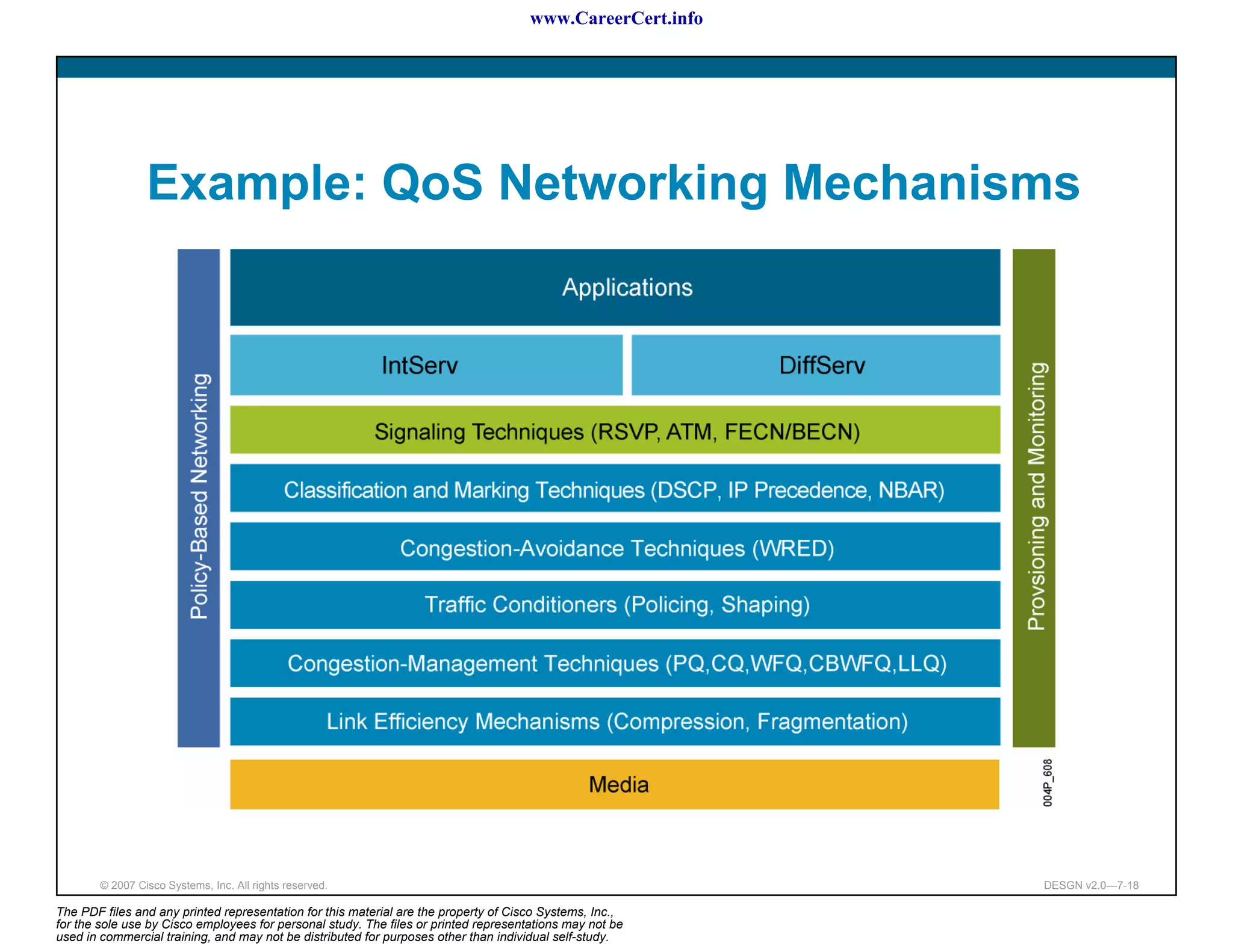
  • 612.
    www.CareerCert.info WLAN Controllers and Access Point Support No. of Access Part Number (Platform) Points Supported AIR-WLC2006-K9 (Cisco Wireless LAN Controller appliance) 6 NM-AIR-WLC6-K9 (Cisco Wireless LAN Controller Module for 6 ISRs) WS-C3750G-24WS-S25 (Cisco Catalyst 3750G Integrated 25 Wireless LAN Controller) WS-C3750G-24WS-S50 (Cisco Catalyst 3750G Integrated 50 Wireless LAN Controller) AIR-WLC4402-12-K9 (Cisco Wireless LAN Controller appliance) 12 AIR-WLC4402-25-K9 (Cisco Wireless LAN Controller appliance) 25 AIR-WLC4402-50-K9 (Cisco Wireless LAN Controller appliance) 50 AIR-WLC4402-100-K9 (Cisco Wireless LAN Controller appliance) 100 Cisco Catalyst 6500 Series Wireless Services Module Up to 300 © 2007 Cisco Systems, Inc. All rights reserved. DESGN v2.0—8-18 The PDF files and any printed representation for this material are the property of Cisco Systems, Inc., for the sole use by Cisco employees for personal study. The files or printed representations may not be used in commercial training, and may not be distributed for purposes other than individual self-study.
  • 613.
    www.CareerCert.info Controller Placement Design Minimize intercontroller roaming. Implement deterministic redundancy. Centralized design supports the integrated platforms. – Cisco Catalyst 3750G Integrated Wireless LAN Controller for small-to-medium deployments – Cisco WiSM for medium-to-large deployments Distributed designs may work well with existing networks. General recommendation is to use a centralized design, but decide based on: – Current network and policies – Growth plans © 2007 Cisco Systems, Inc. All rights reserved. DESGN v2.0—8-19 The PDF files and any printed representation for this material are the property of Cisco Systems, Inc., for the sole use by Cisco employees for personal study. The files or printed representations may not be used in commercial training, and may not be distributed for purposes other than individual self-study.
  • 614.
    www.CareerCert.info Example: Distributed WLC Design © 2007 Cisco Systems, Inc. All rights reserved. DESGN v2.0—8-20 The PDF files and any printed representation for this material are the property of Cisco Systems, Inc., for the sole use by Cisco employees for personal study. The files or printed representations may not be used in commercial training, and may not be distributed for purposes other than individual self-study.
  • 615.
    www.CareerCert.info Example: Centralized WLC Design © 2007 Cisco Systems, Inc. All rights reserved. DESGN v2.0—8-21 The PDF files and any printed representation for this material are the property of Cisco Systems, Inc., for the sole use by Cisco employees for personal study. The files or printed representations may not be used in commercial training, and may not be distributed for purposes other than individual self-study.
  • 616.
    www.CareerCert.info Campus WLC Options Stand-alone appliance controller Routed network on another platform 802.1Q trunk to switched or routed network Integrated controller Routed network can exist on the same platform. Layer 2 connection is internal. Layer 2 or 3 connection to routed network can be used. © 2007 Cisco Systems, Inc. All rights reserved. DESGN v2.0—8-22 The PDF files and any printed representation for this material are the property of Cisco Systems, Inc., for the sole use by Cisco employees for personal study. The files or printed representations may not be used in commercial training, and may not be distributed for purposes other than individual self-study.
  • 617.
    www.CareerCert.info Branch Wireless Network Design Considerations Number of access points needed at the branch – Availability of switch ports – Availability of power Controller cost WAN bandwidth constraints – Latency between the access point and the WLC should not exceed 200 ms RTT. – For centralized controllers, use REAP or Hybrid REAP access points. © 2007 Cisco Systems, Inc. All rights reserved. DESGN v2.0—8-23 The PDF files and any printed representation for this material are the property of Cisco Systems, Inc., for the sole use by Cisco employees for personal study. The files or printed representations may not be used in commercial training, and may not be distributed for purposes other than individual self-study.
  • 618.
    www.CareerCert.info Local MAC Access point MAC functions: Controller MAC functions: 802.11: Beacons, probe response 802.11 proxy association requests 802.11 control: Packet acknowledgment and actions and transmission 802.11e resource reservation 802.11e: Frame queuing and packet prioritization 802.11i authentication and key 802.11i: MAC layer data encryption and decryption management 802.11 MAC management: Association requests and actions © 2007 Cisco Systems, Inc. All rights reserved. DESGN v2.0—8-24 The PDF files and any printed representation for this material are the property of Cisco Systems, Inc., for the sole use by Cisco employees for personal study. The files or printed representations may not be used in commercial training, and may not be distributed for purposes other than individual self-study.
  • 619.
    www.CareerCert.info Remote Edge Access Point Lightweight access point designed to be controlled across WAN links: – REAP is designed to support remote offices by extending LWAPP control timers. – Control traffic is still LWAPP encapsulated and sent to Cisco Wireless LAN Controller. – Client data is not LWAPP-encapsulated but is locally bridged. All management control and RF management is available when the WAN link is up and connectivity is available to the Cisco Wireless LAN Controller. It will continue to provide local connectivity even if the WAN is down. © 2007 Cisco Systems, Inc. All rights reserved. DESGN v2.0—8-25 The PDF files and any printed representation for this material are the property of Cisco Systems, Inc., for the sole use by Cisco employees for personal study. The files or printed representations may not be used in commercial training, and may not be distributed for purposes other than individual self-study.
  • 620.
    www.CareerCert.info REAP Limitations REAP devices do not support 802.1Q trunking. All WLANs terminate on a single subnet. If connectivity to the WLC is lost, only WLAN1 is supported. Multiple WLANs are not recommend on REAP devices. REAP devices support only Layer 2 security policies. REAP devices and clients require a routable IP address provided locally and do not support NAT. © 2007 Cisco Systems, Inc. All rights reserved. DESGN v2.0—8-26 The PDF files and any printed representation for this material are the property of Cisco Systems, Inc., for the sole use by Cisco employees for personal study. The files or printed representations may not be used in commercial training, and may not be distributed for purposes other than individual self-study.
  • 621.
    www.CareerCert.info Hybrid REAP H-REAP is a solution for small or branch offices and retail on the LWAPP Cisco IOS platforms H-REAP supports simultaneous tunneling and local bridging. – “Local switching” supports bridging traffic onto local VLANs. – “Central switching” supports tunneling traffic to the controller. H-REAP provides more security options for the remote site: – Stand-alone mode does client authentication by itself. (WPA-PSK, WPA-PSK2) – Connected mode uses the controller to complete client authentication. (WPA-PSK, WPA-PSK2, VPNs, L2TP, EAP, and web auth) Round-trip latency must not exceed 200 ms between the access point and the controller. H-REAP supports NAT and PAT. © 2007 Cisco Systems, Inc. All rights reserved. DESGN v2.0—8-27 The PDF files and any printed representation for this material are the property of Cisco Systems, Inc., for the sole use by Cisco employees for personal study. The files or printed representations may not be used in commercial training, and may not be distributed for purposes other than individual self-study.
  • 622.
    www.CareerCert.info Example: H-REAP Deployment © 2007 Cisco Systems, Inc. All rights reserved. DESGN v2.0—8-28 The PDF files and any printed representation for this material are the property of Cisco Systems, Inc., for the sole use by Cisco employees for personal study. The files or printed representations may not be used in commercial training, and may not be distributed for purposes other than individual self-study.
  • 623.
    www.CareerCert.info Branch Office WLC Options Appliance controllers Cisco 2006—Support for up to six access points Cisco 4402-12, 4402-24 Integrated controller Cisco Wireless LAN Controller Module for ISR Cisco Catalyst 3750 Series Integrated WLAN Controller (support for 25, 50 access points) © 2007 Cisco Systems, Inc. All rights reserved. DESGN v2.0—8-29 The PDF files and any printed representation for this material are the property of Cisco Systems, Inc., for the sole use by Cisco employees for personal study. The files or printed representations may not be used in commercial training, and may not be distributed for purposes other than individual self-study.
  • 624.
    www.CareerCert.info Summary An RF site survey is used to determine the RF characteristics of a wireless network and help determine access point placement. Guest services are easily supported using EtherIP tunnels in the Cisco Unified Wireless Network. Outdoor wireless networks are supported using outdoor access points and Cisco Wireless Mesh Networking access points. Campus wireless network design provides RF coverage for wireless clients in the campus using lightweight access points. The access points are managed to Cisco Wireless LAN Controllers. Branch wireless network design is provides RF coverage for wireless clients in the branch. Central management of REAP or H-REAP access points can be supported. © 2007 Cisco Systems, Inc. All rights reserved. DESGN v2.0—8-30 The PDF files and any printed representation for this material are the property of Cisco Systems, Inc., for the sole use by Cisco employees for personal study. The files or printed representations may not be used in commercial training, and may not be distributed for purposes other than individual self-study.
  • 625.
    www.CareerCert.info © 2007 Cisco Systems, Inc. All rights reserved. DESGN v2.0—8-31 The PDF files and any printed representation for this material are the property of Cisco Systems, Inc., for the sole use by Cisco employees for personal study. The files or printed representations may not be used in commercial training, and may not be distributed for purposes other than individual self-study.
  • 626.
    www.CareerCert.info Wireless Networking Review Define the wireless requirements. Conduct an RF site survey to define the RF characteristics in the environment. Define access point deployment locations based on the site survey and customer requirements. Determine the WLC design: – Redundancy (primary, secondary, tertiary) – Placement of WLCs in distribution layer – Whether remote sites will use local centralized controllers Determine the number of mobility groups that you will need. Plan how to support internal VLANs and guest access if needed. © 2007 Cisco Systems, Inc. All rights reserved. DESGN v2.0—8-1 The PDF files and any printed representation for this material are the property of Cisco Systems, Inc., for the sole use by Cisco employees for personal study. The files or printed representations may not be used in commercial training, and may not be distributed for purposes other than individual self-study.
  • 627.
    www.CareerCert.info Cisco Unified Wireless Network Review © 2007 Cisco Systems, Inc. All rights reserved. DESGN v2.0—8-2 The PDF files and any printed representation for this material are the property of Cisco Systems, Inc., for the sole use by Cisco employees for personal study. The files or printed representations may not be used in commercial training, and may not be distributed for purposes other than individual self-study.
  • 628.
    www.CareerCert.info Module Summary • Cisco Unified Wireless Network architecture centralizes WLAN configuration and control on WLCs that control LWAPP access points. The Cisco Unified Wireless Network provides transparent roaming supporting both intracontroller and intercontroller roaming. Deterministic controller redundancy with integrated RRM provides the highest-quality roaming experience. An RF survey in a wireless network design determines the characteristics of the wireless network and access point placement to provide optimal RF coverage for wireless clients. © 2007 Cisco Systems, Inc. All rights reserved. DESGN v2.0—8-3 The PDF files and any printed representation for this material are the property of Cisco Systems, Inc., for the sole use by Cisco employees for personal study. The files or printed representations may not be used in commercial training, and may not be distributed for purposes other than individual self-study.
  • 629.
    www.CareerCert.info © 2007 Cisco Systems, Inc. All rights reserved. DESGN v2.0—8-4 The PDF files and any printed representation for this material are the property of Cisco Systems, Inc., for the sole use by Cisco employees for personal study. The files or printed representations may not be used in commercial training, and may not be distributed for purposes other than individual self-study.
  • 630.
    www.CareerCert.info Implementing and Operating the Network Designing for Cisco Internetwork Solutions (DESGN) v2.0 © 2007 Cisco Systems, Inc. All rights reserved. DESGN v2.0—9-1 The PDF files and any printed representation for this material are the property of Cisco Systems, Inc., for the sole use by Cisco employees for personal study. The files or printed representations may not be used in commercial training, and may not be distributed for purposes other than individual self-study.
  • 631.
    www.CareerCert.info Reviewing Design and Implementation Resources Implementing and Operating the Network © 2007 Cisco Systems, Inc. All rights reserved. DESGN v2.0—9-1 The PDF files and any printed representation for this material are the property of Cisco Systems, Inc., for the sole use by Cisco employees for personal study. The files or printed representations may not be used in commercial training, and may not be distributed for purposes other than individual self-study.
  • 632.
    www.CareerCert.info Solution Reference Network Design Guides Focus on the specific solution Provide an overview of relevant technologies Give a description of the architecture Offer recommended design practices Provide configuration examples Are available for the following areas: – Campus – WAN and MAN – Data center – Security – Branch office – Unified communications – Teleworker – Wireless © 2007 Cisco Systems, Inc. All rights reserved. DESGN v2.0—9-2 The PDF files and any printed representation for this material are the property of Cisco Systems, Inc., for the sole use by Cisco employees for personal study. The files or printed representations may not be used in commercial training, and may not be distributed for purposes other than individual self-study.
  • 633.
    www.CareerCert.info Cisco Networkers Online Subscription 200+ technical training sessions, including: Application Optimization Technologies Contact Center Technologies Data Center Technologies Network Access and Aggregation Technologies Network Management Services Technologies Optical and Metro Ethernet Technologies Routing and Switching Technologies Security Technologies Storage Technologies Voice and Video Technologies www.networkersonline.net © 2007 Cisco Systems, Inc. All rights reserved. DESGN v2.0—9-3 The PDF files and any printed representation for this material are the property of Cisco Systems, Inc., for the sole use by Cisco employees for personal study. The files or printed representations may not be used in commercial training, and may not be distributed for purposes other than individual self-study.
  • 634.
    www.CareerCert.info Summary of Cisco CCNP Courses Building Cisco Multilayer Switched Networks (BCMSN) – Recommended prerequisite for Designing for Cisco Internetwork Solutions Building Scalable Cisco Internetworks (BSCI) Implementing Secure Converged Wide Area Networks (ISCW) Optimizing Converged Cisco Networks (ONT) © 2007 Cisco Systems, Inc. All rights reserved. DESGN v2.0—9-4 The PDF files and any printed representation for this material are the property of Cisco Systems, Inc., for the sole use by Cisco employees for personal study. The files or printed representations may not be used in commercial training, and may not be distributed for purposes other than individual self-study.
  • 635.
    www.CareerCert.info Building Cisco Multilayer Switched Networks v3.0 Use the Cisco hierarchical Implement high-availability network model for campus technologies and techniques networks Describe and configure Define VLANs to segment wireless LAN access network traffic and use Describe and implement Implement spanning-tree security features operation Describe and configure switch Implement and verify to support voice inter-VLAN routing Covers skills required to build enterprise-class switched networks with integrated VoIP and wireless applications © 2007 Cisco Systems, Inc. All rights reserved. DESGN v2.0—9-5 The PDF files and any printed representation for this material are the property of Cisco Systems, Inc., for the sole use by Cisco employees for personal study. The files or printed representations may not be used in commercial training, and may not be distributed for purposes other than individual self-study.
  • 636.
    www.CareerCert.info Building Cisco Multilayer Switched Networks v3.0 Course Flow Day 1 Day 2 Day 3 Day 4 Day 5 Course Configuring Introduction Campus Switches A Network Implementing Inter-VLAN Wireless for Voice Spanning M Requirements Tree Routing LAN Minimizing Defining Service Loss VLANS Lunch Defining Implementing VLANS Spanning Tree P Implementing Wireless Minimizing High M LAN Service Loss Availability Implementing Inter-VLAN Spanning Tree Routing © 2007 Cisco Systems, Inc. All rights reserved. DESGN v2.0—9-6 The PDF files and any printed representation for this material are the property of Cisco Systems, Inc., for the sole use by Cisco employees for personal study. The files or printed representations may not be used in commercial training, and may not be distributed for purposes other than individual self-study.
  • 637.
    www.CareerCert.info Building Scalable Cisco Internetworks v3.0 Explain routing in the Implement Cisco IOS routing enterprise network features Implement and verify EIGRP Implement and verify BGP for operations enterprise ISP connectivity Build a scalable multiarea Implement and verify multicast network with OSPF forwarding using PIM Configure integrated IS-IS in Implement IPv6 in an a single area enterprise network Covers skills required to build enterprise router networks with mixed, integrated internal and external routing protocols © 2007 Cisco Systems, Inc. All rights reserved. DESGN v2.0—9-7 The PDF files and any printed representation for this material are the property of Cisco Systems, Inc., for the sole use by Cisco employees for personal study. The files or printed representations may not be used in commercial training, and may not be distributed for purposes other than individual self-study.
  • 638.
    www.CareerCert.info Building Scalable Cisco Internetworks v3.0 Course Flow Day 1 Day 2 Day 3 Day 4 Day 5 Course Configuring Introduction Implementing IS-IS Multicast Protocol A Network Configuring Implementing M Requirements OSPF BGP Manipulating Implementing Configuring Routing IPv6 EIGRP Updates Lunch Manipulating Configuring Configuring Implementing Routing EIGRP OSPF BGP Updates P Implementing M IPv6 Configuring Configuring Implementing Implementing IS-IS OSPF BGP Multicast Protocol © 2007 Cisco Systems, Inc. All rights reserved. DESGN v2.0—9-8 The PDF files and any printed representation for this material are the property of Cisco Systems, Inc., for the sole use by Cisco employees for personal study. The files or printed representations may not be used in commercial training, and may not be distributed for purposes other than individual self-study.
  • 639.
    www.CareerCert.info Implementing Secure Converged Wide Area Networks v1.0 Explain the Cisco hierarchical Describe and configure Cisco network model as it pertains to Easy VPN the WAN Explain the strategies used to Describe and implement mitigate network attacks teleworker configuration and Describe and configure Cisco access device hardening Implement and verify frame Describe and configure Cisco mode MPLS IOS firewall features Describe and configure a site- to-site IPsec VPN Covers skills for securing and expanding the reach of the enterprise network to teleworkers and remote sites. The focus is on securing remote access and VPN client configuration. © 2007 Cisco Systems, Inc. All rights reserved. DESGN v2.0—9-9 The PDF files and any printed representation for this material are the property of Cisco Systems, Inc., for the sole use by Cisco employees for personal study. The files or printed representations may not be used in commercial training, and may not be distributed for purposes other than individual self-study.
  • 640.
    www.CareerCert.info Implementing Secure Converged Wide Area Networks v1.0 Course Flow Day 1 Day 2 Day 3 Day 4 Day 5 Implementing Course IPsec VPNs Cisco Device Cisco IOS Threat Frame Mode Introduction Hardening Defense Features MPLS A Network Lab: 4-2 Lab: 3-1 Lab: 5-1 Lab: 6-1 M Requirements IPsec VPNs Implementing Cisco Device Connecting Cisco IOS Threat Frame Mode Lab: 4-3 Hardening Teleworkers Defense Features MPLS Lunch Connecting Lab: 5-2 Lab: 6-2 IPsec VPNs Teleworkers IPsec VPNs P Simulation: 2-1 Lab: 4-4 Cisco Device Cisco IOS Threat M Hardening Defense Features Implementing Cisco Device Lab: 6-3 Frame Mode Lab: 4-1 Lab: 5-3 Hardening MPLS © 2007 Cisco Systems, Inc. All rights reserved. DESGN v2.0—9-10 The PDF files and any printed representation for this material are the property of Cisco Systems, Inc., for the sole use by Cisco employees for personal study. The files or printed representations may not be used in commercial training, and may not be distributed for purposes other than individual self-study.
  • 641.
    www.CareerCert.info Optimizing Converged Cisco Networks v1.0 Explain the Cisco hierarchical network model as it pertains to Explain the key IP QoS an mechanisms used to end-to-end enterprise network implement the DiffServ QoS model Describe specific requirements for implementing a VoIP Configure Auto QoS for network Enterprise Describe the need to Describe and configure implement QoS and the wireless security and basic methods for implementing QoS wireless management on a converged network Covers techniques and skills to optimize QoS in converged networks supporting voice, wireless, and security applications © 2007 Cisco Systems, Inc. All rights reserved. DESGN v2.0—9-11 The PDF files and any printed representation for this material are the property of Cisco Systems, Inc., for the sole use by Cisco employees for personal study. The files or printed representations may not be used in commercial training, and may not be distributed for purposes other than individual self-study.
  • 642.
    www.CareerCert.info Optimizing Converged Cisco Networks v1.0 Course Flow Day 1 Day 2 Day 3 Day 4 Day 5 Implement the Implement the Implement Wireless Course DIffServ QoS Model DIffServ QoS Model Scalability Introduction A Introduction to Lab: 4-1 Describing Network Lab: 4-6 Lab: 6-1 M Requirements IP QoS Implement the DIffServ QoS Model Describe Cisco VoIP Implement the Lab: 4-2 Lab: 6-2 Implementations DIffServ QoS Model Lunch Implement the Lab: 2-1 Case Study: 3-1 DIffServ QoS Model Lab: 5-1 Lab: 6-3 Lab: 4-3 P Describe Implement Lab: 3-2 Implement the Lab: 5-2 Wireless Cisco VoIP M DIffServ QoS Model Scalability Implementations Lab: 4-4 Implement the Lab: 2-2 Lab: 5-3 Lab: 6-4 DIffServ QoS Model Lab: 4-5 © 2007 Cisco Systems, Inc. All rights reserved. DESGN v2.0—9-12 The PDF files and any printed representation for this material are the property of Cisco Systems, Inc., for the sole use by Cisco employees for personal study. The files or printed representations may not be used in commercial training, and may not be distributed for purposes other than individual self-study.
  • 643.
    www.CareerCert.info Designing Cisco Network Service Architectures (ARCH) v1.2 Presents the Cisco AVVID framework Create intermediate network designs for: – Enterprise campus infrastructure – Enterprise edge infrastructure – Network management – High availability – Security – QoS – IP multicast – VPNs – Wireless – IP telephony This is the next course in the design certification track. © 2007 Cisco Systems, Inc. All rights reserved. DESGN v2.0—9-13 The PDF files and any printed representation for this material are the property of Cisco Systems, Inc., for the sole use by Cisco employees for personal study. The files or printed representations may not be used in commercial training, and may not be distributed for purposes other than individual self-study.
  • 644.
    www.CareerCert.info Designing Cisco Network Service Architectures v1.2 Course Flow Day 1 Day 2 Day 3 Day 4 Day 5 Course Introduction Designing QoS A Introducing Cisco Designing Designing Designing Network Service Enterprise Edge High-Availability IP Telephony M Architectures Connectivity Services Services Designing Designing IP Multicast Enterprise Campus Services Networks Lunch Designing Designing Enterprise Edge VNPs Designing Connectivity P Designing Enterprise Security Wrap-Up M Campus Designing Designing Services Networks Enterprise Network Management Wireless Services Networks © 2007 Cisco Systems, Inc. All rights reserved. DESGN v2.0—9-14 The PDF files and any printed representation for this material are the property of Cisco Systems, Inc., for the sole use by Cisco employees for personal study. The files or printed representations may not be used in commercial training, and may not be distributed for purposes other than individual self-study.
  • 645.
    www.CareerCert.info Foundation Courses for Channel Partners Foundation Express for Account Managers (FXS) Foundation Express for System Engineers (CFXSE) Foundation Express for Field Engineers (CFXFE) © 2007 Cisco Systems, Inc. All rights reserved. DESGN v2.0—9-15 The PDF files and any printed representation for this material are the property of Cisco Systems, Inc., for the sole use by Cisco employees for personal study. The files or printed representations may not be used in commercial training, and may not be distributed for purposes other than individual self-study.
  • 646.
    www.CareerCert.info Security Courses Securing Cisco Network Devices (SND) Securing Networks with Cisco Routers and Switches (SNRS) Implementing Cisco Intrusion Prevention System (IPS) Securing Networks with PIX and ASA (SNPA) Cisco Secure Virtual Private Networks (CSVPN) © 2007 Cisco Systems, Inc. All rights reserved. DESGN v2.0—9-16 The PDF files and any printed representation for this material are the property of Cisco Systems, Inc., for the sole use by Cisco employees for personal study. The files or printed representations may not be used in commercial training, and may not be distributed for purposes other than individual self-study.
  • 647.
    www.CareerCert.info Voice Courses Implementing Cisco Quality of Service (QOS) Cisco Voice over IP Fundamentals (CVF) Cisco Voice over IP (CVOICE) Cisco IP Telephony Part 1 (CIPT1) Cisco IP Telephony Part 2 (CIPT2) IP Telephony Troubleshooting (IPTT) Implementing Cisco Voice Gateways and Gatekeepers (GWGK) IP Telephony Design (IPTD) © 2007 Cisco Systems, Inc. All rights reserved. DESGN v2.0—9-17 The PDF files and any printed representation for this material are the property of Cisco Systems, Inc., for the sole use by Cisco employees for personal study. The files or printed representations may not be used in commercial training, and may not be distributed for purposes other than individual self-study.
  • 648.
    www.CareerCert.info Wireless Courses Aironet Wireless LAN Fundamentals and Site Survey (AWFSS) Aironet Wireless LAN Advanced Topics (AWLAT) Cisco Wireless LAN Fundamentals (CWLF) Cisco Wireless LAN Advanced Topics (CWLAT) Cisco Unified Wireless Networking (CUWN) Cisco Wireless Mesh Networking (CWMN) © 2007 Cisco Systems, Inc. All rights reserved. DESGN v2.0—9-18 The PDF files and any printed representation for this material are the property of Cisco Systems, Inc., for the sole use by Cisco employees for personal study. The files or printed representations may not be used in commercial training, and may not be distributed for purposes other than individual self-study.
  • 649.
    www.CareerCert.info Summary SRND guides provide deployment scenarios incorporating Cisco products and technologies into a tested architecture. Cisco Networkers Online provides introductory to advanced training sessions on a subscription basis. The Building Scalable Cisco Internetworks, Implementing Secure Converged Wide Area Networks and Optimizing Converged Cisco Networks courses provide additional theory and detailed configuration information that supports enterprise network design and implementations. Designing Cisco Network Service Architectures is the next course in the design certification track. Cisco specialization courses provide in-depth, hands-on training supporting security, voice, and wireless. © 2007 Cisco Systems, Inc. All rights reserved. DESGN v2.0—9-19 The PDF files and any printed representation for this material are the property of Cisco Systems, Inc., for the sole use by Cisco employees for personal study. The files or printed representations may not be used in commercial training, and may not be distributed for purposes other than individual self-study.
  • 650.
    www.CareerCert.info © 2007 Cisco Systems, Inc. All rights reserved. DESGN v2.0—9-20 The PDF files and any printed representation for this material are the property of Cisco Systems, Inc., for the sole use by Cisco employees for personal study. The files or printed representations may not be used in commercial training, and may not be distributed for purposes other than individual self-study.