



Morgan J. Newson
EDUC 379
Dr. Jones
 The relationship between
behavior and reading
performance has been
demonstrated in a number of
studies.
 The balance of evidence from
long-standing research
suggests that problematic
behavior and academic
failure are clearly associated.
 From this evidence, it might
be predicted that high
reading scores would be
clearly associated with lack
of problematic behavior.
 The purpose of this study is to investigate the
relationship between the classroom behavior of
kindergarten students and their reading
performance.
 This study will concentrate on early childhood
students because this is the developmental
stage during which problematic behavior
begins.
 The general image of McIntosh’s results is one in
which children enter kindergarten with varying
reading skills.
 If they do not respond to literacy instruction
during kindergarten, and fall behind, a negative
spiral of achievement and behavior becomes more
likely.
 As the student’s literacy skills do not keep pace
with those of peers, academic tasks become more
aversive, and problem behaviors aimed towards
escaping from these tasks become more likely
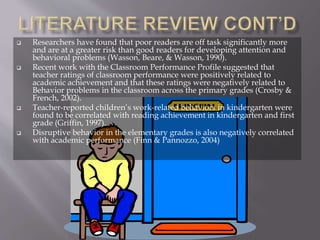
 Researchers have found that poor readers are off task significantly more
and are at a greater risk than good readers for developing attention and
behavioral problems (Wasson, Beare, & Wasson, 1990).
 Recent work with the Classroom Performance Profile suggested that
teacher ratings of classroom performance were positively related to
academic achievement and that these ratings were negatively related to
Behavior problems in the classroom across the primary grades (Crosby &
French, 2002).
 Teacher-reported children’s work-related behaviors in kindergarten were
found to be correlated with reading achievement in kindergarten and first
grade (Griffin, 1997).
 Disruptive behavior in the elementary grades is also negatively correlated
with academic performance (Finn & Pannozzo, 2004)
 Children’s classroom behavior in the early school
setting is closely related to their adjustment to
school and is an important factor of academic
progress (McIntosh, Horner, Chard, Dickey, &
Braun, 2008).
 School-related problem behaviors, such as
inattentiveness or oppositional behavior, affect
school readiness and academic performance
(Camp & Zimet, 1975).
 Students who had higher fall reading scores were
rated as having more positive approaches to
learning and fewer externalizing problem
behaviors than their peers with lower fall reading
scores.
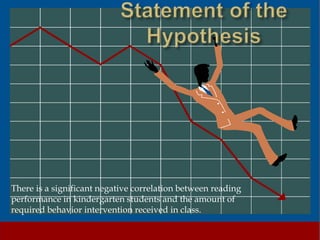
There is a significant negative correlation between reading
performance in kindergarten students and the amount of
required behavior intervention received in class.
 The researcher will use a self-created Behavior
Management Chart to document the number of
times teacher intervention is required to
modify specified behavior in the classroom.
 Dynamic Indicators of Basic Early Literacy
Skills (DIBELS) scores will be obtained.
 The DIBELS measures are designed to assess
the five major skill areas in early reading.
 The researcher will collect data by observing
each classroom for three hours a day over a
period of two days in January.
 The observed behaviors will be analyzed and
in February, the researchers will return to
obtain the results of the DIBELS assessment.
 The results of the assessment will categorize
the child into one of the categories, Low Risk,
Some Risk, and At Risk.
 The sample size is small and the
students came from a lower to
middle-class socioeconomic
background in an urban area.
Therefore, these results cannot
be generalized to a larger
population.
 The students were only
observed on two days during
the school year which may
effect the ability to accurately
measure individual students
classroom behavior.
 A replication of the findings
with a larger, more diverse
sample and more time spent
observing in the field is
desirable.
The relationship between classroom behavior and reading performance

The relationship between classroom behavior and reading performance

  • 1.
    Morgan J. Newson EDUC379 Dr. Jones
  • 3.
     The relationshipbetween behavior and reading performance has been demonstrated in a number of studies.  The balance of evidence from long-standing research suggests that problematic behavior and academic failure are clearly associated.  From this evidence, it might be predicted that high reading scores would be clearly associated with lack of problematic behavior.
  • 4.
     The purposeof this study is to investigate the relationship between the classroom behavior of kindergarten students and their reading performance.  This study will concentrate on early childhood students because this is the developmental stage during which problematic behavior begins.
  • 6.
     The generalimage of McIntosh’s results is one in which children enter kindergarten with varying reading skills.  If they do not respond to literacy instruction during kindergarten, and fall behind, a negative spiral of achievement and behavior becomes more likely.  As the student’s literacy skills do not keep pace with those of peers, academic tasks become more aversive, and problem behaviors aimed towards escaping from these tasks become more likely
  • 7.
     Researchers havefound that poor readers are off task significantly more and are at a greater risk than good readers for developing attention and behavioral problems (Wasson, Beare, & Wasson, 1990).  Recent work with the Classroom Performance Profile suggested that teacher ratings of classroom performance were positively related to academic achievement and that these ratings were negatively related to Behavior problems in the classroom across the primary grades (Crosby & French, 2002).  Teacher-reported children’s work-related behaviors in kindergarten were found to be correlated with reading achievement in kindergarten and first grade (Griffin, 1997).  Disruptive behavior in the elementary grades is also negatively correlated with academic performance (Finn & Pannozzo, 2004)
  • 8.
     Children’s classroombehavior in the early school setting is closely related to their adjustment to school and is an important factor of academic progress (McIntosh, Horner, Chard, Dickey, & Braun, 2008).  School-related problem behaviors, such as inattentiveness or oppositional behavior, affect school readiness and academic performance (Camp & Zimet, 1975).  Students who had higher fall reading scores were rated as having more positive approaches to learning and fewer externalizing problem behaviors than their peers with lower fall reading scores.
  • 9.
    There is asignificant negative correlation between reading performance in kindergarten students and the amount of required behavior intervention received in class.
  • 11.
     The researcherwill use a self-created Behavior Management Chart to document the number of times teacher intervention is required to modify specified behavior in the classroom.  Dynamic Indicators of Basic Early Literacy Skills (DIBELS) scores will be obtained.  The DIBELS measures are designed to assess the five major skill areas in early reading.
  • 13.
     The researcherwill collect data by observing each classroom for three hours a day over a period of two days in January.  The observed behaviors will be analyzed and in February, the researchers will return to obtain the results of the DIBELS assessment.  The results of the assessment will categorize the child into one of the categories, Low Risk, Some Risk, and At Risk.
  • 15.
     The samplesize is small and the students came from a lower to middle-class socioeconomic background in an urban area. Therefore, these results cannot be generalized to a larger population.  The students were only observed on two days during the school year which may effect the ability to accurately measure individual students classroom behavior.  A replication of the findings with a larger, more diverse sample and more time spent observing in the field is desirable.

Editor's Notes

  • #12 It primarily assesses three of those: Phonological Awareness, Alphabetic Principle, and Fluency with Connected Text. DIBELS are criterion-referenced because each measure has an empirically established goal (or benchmark) that changes across time to ensure students' skills are developing in a manner predictive of continued progress.
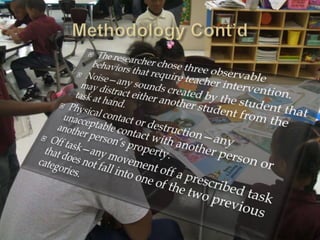
  • #13 Based on specified classroom behaviors, discussions with classroom teachers, and review of methods for objectively observing student behavior in classroom settings, researchers chose three observable behaviors that require teacher intervention.