Renee Sandusky
Advanced General Psychology 492
  Instructor Dr. Darcel Harris
       Argosy University
Thousands of children receive a diagnosis of traumatic brain injury
(TBI) every year (Wade, Cassedy, Walz, Taylor, Stancin, & Yeates,
2011). Many studies have previously reported on a child’s overall
recovery process and the potential for long-term post injury
behavioral disorders. The purpose of this literature review is to
identify and evaluate psychosocial attributes that can help enhance
and encourage the overall recovery process, as well as ascertain the
variables that help decrease dysfunctional behaviors in a child who
has undergone a TBI. Several previous peer-reviewed research
articles were obtained that directly reported on the topic of
childhood TBI, and the recovery outcomes documented during
various time increments. The cumulative findings support the
notion that many psychosocial elements such as family
functioning, parenting styles, and overall parent-child
relationships can influence a child’s recovery potential.
Implications for future research are assessing the value,
enhancement, or hindrance of sibling relationships on a child
recovering from a TBI.
One of the highest causes of death and
disability among children today is due
to obtaining a traumatic brain injury
(TBI) (Wade et al., 2011). The recovery
process and overall prognosis varies
from child to child and are influenced
by many factors. Several independent
studies highlight significant elements,
which can either enhance or inhibit the
child’s full recovery potential. Outside
of the medical requirements and
rehabilitation, little has been complied
to educate social services, medical
personnel, family members, and even
the public on the psychosocial elements
that help, hinder, or otherwise impede
the recovery process. I believe gaining
this insight can help empower
caregivers and offer aid during this very
difficult time in their lives.
When it comes to psychosocial elements…..


…what helps or hinders the recovery process?
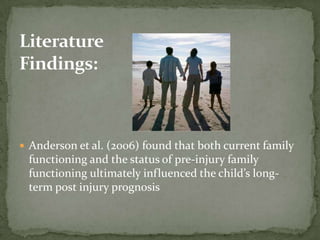
 Anderson et al. (2006) found that both current family
 functioning and the status of pre-injury family
 functioning ultimately influenced the child’s long-
 term post injury prognosis
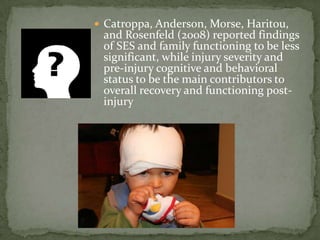
 Catroppa, Anderson, Morse, Haritou,
 and Rosenfeld (2008) reported findings
 of SES and family functioning to be less
 significant, while injury severity and
 pre-injury cognitive and behavioral
 status to be the main contributors to
 overall recovery and functioning post-
 injury
 Chapman et al. (2010) found variables such as “SES,
 family functioning, and permissible parenting style as
 significant” (p.55) influencers during the recovery
 process.

            Negative childhood
                                 
                                 
                                         
                                      Negative family
                behaviors
                                       functioning
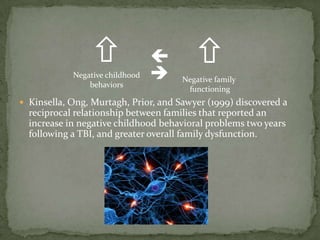
 Kinsella, Ong, Murtagh, Prior, and Sawyer (1999) discovered a
  reciprocal relationship between families that reported an
  increase in negative childhood behavioral problems two years
  following a TBI, and greater overall family dysfunction.
 Potter et al. (2011) reported a direct correlation
  between parenting styles and behavioral outcomes in
  children following a TBI.
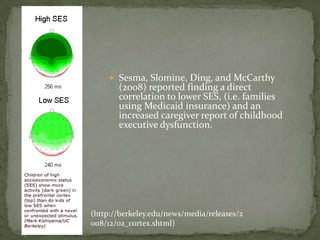
 Sesma, Slomine, Ding, and McCarthy
       (2008) reported finding a direct
       correlation to lower SES, (i.e. families
       using Medicaid insurance) and an
       increased caregiver report of childhood
       executive dysfunction.


(http://berkeley.edu/news/media/releases/2
008/12/02_cortex.shtml)
 Taylor et al. (2002) found that when looking at family
 influences, there is evidence of short-term catch-up
 growth in math when the family environment was
 ideal, healthy, and supportive.
 Wade et al. (2008) found that the
 parent-child relationship
 demonstrated a disruption after
 injury and perpetually
 demonstrated distress and
 impairment as the recovery
 process moved forward.
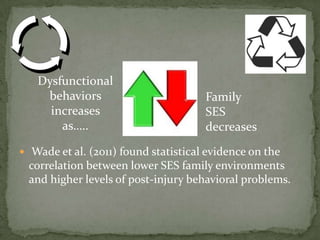
Dysfunctional
    behaviors                         Family
     increases                        SES
       as…..                          decreases
 Wade et al. (2011) found statistical evidence on the
 correlation between lower SES family environments
 and higher levels of post-injury behavioral problems.
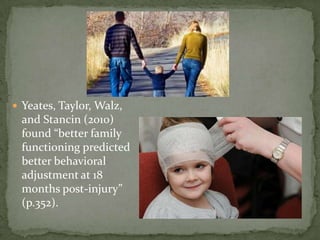
 Yeates, Taylor, Walz,
  and Stancin (2010)
  found “better family
  functioning predicted
  better behavioral
  adjustment at 18
  months post-injury”
  (p.352).
Common Themes:
Psychosocial factors do in fact influence a child’s
               recovery potential!
                Elements such as:
              Parental involvement
                Parental warmness
                 Family functioning
                   Parenting styles
                       SES level


           All are variables that can help or
                hinder a child’s recovery!
Implications and Future Research
        Looking towards the future
more information is needed to
determine if early identification and
intervention of these potentially
harmful and/or hindering elements
can, and to what extent, make a long-
term difference in a child reaching
their full recovery potential. Some
aspects to further consider are the
roles of siblings, and the impact this
relationship may have on the child’s
recovery capacity.
In this circle of parent-child relationships and post-
injury behavioral issues, how does the sibling variable
fit, if at all?
Thank you!
References


 Anderson, V. A., Catroppa, C., Dudgeon, P., Morse, S. A., Haritou, F., &
  Rosenfeld, J. V. (2006). Understanding predictors of functional recovery and
  outcome 30 months following early childhood head injury. Neuropsychology,
  20 (1), 42-57.


 Catroppa, C., Anderson, V. A., Morse, S. A., Haritou, F., & Rosenfeld, J. V.
  (2008). Outcome and predictors of functional recovery 5 years following
  pediatric traumatic brain injury. Journal of Pediatric Psychology, 33 (7), 707-718.


 Chapman, L. A., Wade, S. L., Walz, N. C., Taylor, H. G., Stancin, T., & Yeates, K.
  O. (2010). Clinically significant behavior problems during the initial 18 months
  following early childhood traumatic brain injury. Rehabilitation Psychology, 55
  (1), 48-57.
 Kinsella, G., Ong, B., Murtagh, D., Prior, M., & Sawyer, M. (1999). The role of
  the family for behavioral outcome in children and adolescents following
  traumatic brain injury. Journal of Consulting and Clinical Psychology, 67 (1),
  116-123.


 Potter, J. L., Wade, S. L., Walz, N. C., Cassedy, A., Stevens, M. H., Yeates, K. O.,
  & Taylor, H. G. (2011). Parenting style is related to executive dysfunction after
  brain injury in children. Rehabilitation Psychology, 1-8.


 Sesma, H. W., Slomine, B. S., Ding, R., & McCarthy, M. L. (2008). Executive
  functioning in the first year after pediatric traumatic brain injury. Pediatrics, 121
  (6), 1686-1695.


 Taylor, H. G., Yeates, K. O., Wade, S. L., Drotar, D., Stancin, T., & Minich, N.
  (2002). A prospective study of short- and long-term outcomes after traumatic
  brain injury in children: Behavior and achievement. Neuropsychology, 16 (1), 15-
  27.
 Wade, S. L., Cassedy, A., Walz, N. C., Taylor, H. G., Stancin, T., & Yeates, K. O.
  (2011). The relationship of parental warm responsiveness and negativity to
  emerging behavior problems following traumatic brain injury in young
  children. Developmental Psychology, 47 (1), 119-133.


 Wade, S. L., Taylor, H. G., Walz, N. C., Salisbury, S., Stancin, T., Bernard, L. A.,
  Oberjohn, K., & Yeates, K.O. (2008). Parent-child interactions during the
  initial weeks following brain injury in young children. Rehabilitation
  Psychology, 53 (2), 180-190.


 Yeates, K. O., Taylor, H., Walz, N. C., & Stancin, T. (2010). The family
  environment as a moderator of psychosocial outcomes following traumatic
  brain injury in young children. Neuropsychology, 24 (3), 345-356.

Review Paper

  • 1.
    Renee Sandusky Advanced GeneralPsychology 492 Instructor Dr. Darcel Harris Argosy University
  • 2.
    Thousands of childrenreceive a diagnosis of traumatic brain injury (TBI) every year (Wade, Cassedy, Walz, Taylor, Stancin, & Yeates, 2011). Many studies have previously reported on a child’s overall recovery process and the potential for long-term post injury behavioral disorders. The purpose of this literature review is to identify and evaluate psychosocial attributes that can help enhance and encourage the overall recovery process, as well as ascertain the variables that help decrease dysfunctional behaviors in a child who has undergone a TBI. Several previous peer-reviewed research articles were obtained that directly reported on the topic of childhood TBI, and the recovery outcomes documented during various time increments. The cumulative findings support the notion that many psychosocial elements such as family functioning, parenting styles, and overall parent-child relationships can influence a child’s recovery potential. Implications for future research are assessing the value, enhancement, or hindrance of sibling relationships on a child recovering from a TBI.
  • 3.
    One of thehighest causes of death and disability among children today is due to obtaining a traumatic brain injury (TBI) (Wade et al., 2011). The recovery process and overall prognosis varies from child to child and are influenced by many factors. Several independent studies highlight significant elements, which can either enhance or inhibit the child’s full recovery potential. Outside of the medical requirements and rehabilitation, little has been complied to educate social services, medical personnel, family members, and even the public on the psychosocial elements that help, hinder, or otherwise impede the recovery process. I believe gaining this insight can help empower caregivers and offer aid during this very difficult time in their lives.
  • 4.
    When it comesto psychosocial elements….. …what helps or hinders the recovery process?
  • 5.
     Anderson etal. (2006) found that both current family functioning and the status of pre-injury family functioning ultimately influenced the child’s long- term post injury prognosis
  • 6.
     Catroppa, Anderson,Morse, Haritou, and Rosenfeld (2008) reported findings of SES and family functioning to be less significant, while injury severity and pre-injury cognitive and behavioral status to be the main contributors to overall recovery and functioning post- injury
  • 7.
     Chapman etal. (2010) found variables such as “SES, family functioning, and permissible parenting style as significant” (p.55) influencers during the recovery process.
  • 8.
    Negative childhood    Negative family behaviors functioning  Kinsella, Ong, Murtagh, Prior, and Sawyer (1999) discovered a reciprocal relationship between families that reported an increase in negative childhood behavioral problems two years following a TBI, and greater overall family dysfunction.
  • 9.
     Potter etal. (2011) reported a direct correlation between parenting styles and behavioral outcomes in children following a TBI.
  • 10.
     Sesma, Slomine,Ding, and McCarthy (2008) reported finding a direct correlation to lower SES, (i.e. families using Medicaid insurance) and an increased caregiver report of childhood executive dysfunction. (http://berkeley.edu/news/media/releases/2 008/12/02_cortex.shtml)
  • 11.
     Taylor etal. (2002) found that when looking at family influences, there is evidence of short-term catch-up growth in math when the family environment was ideal, healthy, and supportive.
  • 12.
     Wade etal. (2008) found that the parent-child relationship demonstrated a disruption after injury and perpetually demonstrated distress and impairment as the recovery process moved forward.
  • 13.
    Dysfunctional behaviors Family increases SES as….. decreases  Wade et al. (2011) found statistical evidence on the correlation between lower SES family environments and higher levels of post-injury behavioral problems.
  • 14.
     Yeates, Taylor,Walz, and Stancin (2010) found “better family functioning predicted better behavioral adjustment at 18 months post-injury” (p.352).
  • 15.
    Common Themes: Psychosocial factorsdo in fact influence a child’s recovery potential! Elements such as:  Parental involvement  Parental warmness  Family functioning  Parenting styles  SES level All are variables that can help or hinder a child’s recovery!
  • 16.
    Implications and FutureResearch Looking towards the future more information is needed to determine if early identification and intervention of these potentially harmful and/or hindering elements can, and to what extent, make a long- term difference in a child reaching their full recovery potential. Some aspects to further consider are the roles of siblings, and the impact this relationship may have on the child’s recovery capacity.
  • 17.
    In this circleof parent-child relationships and post- injury behavioral issues, how does the sibling variable fit, if at all?
  • 18.
  • 19.
    References  Anderson, V.A., Catroppa, C., Dudgeon, P., Morse, S. A., Haritou, F., & Rosenfeld, J. V. (2006). Understanding predictors of functional recovery and outcome 30 months following early childhood head injury. Neuropsychology, 20 (1), 42-57.  Catroppa, C., Anderson, V. A., Morse, S. A., Haritou, F., & Rosenfeld, J. V. (2008). Outcome and predictors of functional recovery 5 years following pediatric traumatic brain injury. Journal of Pediatric Psychology, 33 (7), 707-718.  Chapman, L. A., Wade, S. L., Walz, N. C., Taylor, H. G., Stancin, T., & Yeates, K. O. (2010). Clinically significant behavior problems during the initial 18 months following early childhood traumatic brain injury. Rehabilitation Psychology, 55 (1), 48-57.
  • 20.
     Kinsella, G.,Ong, B., Murtagh, D., Prior, M., & Sawyer, M. (1999). The role of the family for behavioral outcome in children and adolescents following traumatic brain injury. Journal of Consulting and Clinical Psychology, 67 (1), 116-123.  Potter, J. L., Wade, S. L., Walz, N. C., Cassedy, A., Stevens, M. H., Yeates, K. O., & Taylor, H. G. (2011). Parenting style is related to executive dysfunction after brain injury in children. Rehabilitation Psychology, 1-8.  Sesma, H. W., Slomine, B. S., Ding, R., & McCarthy, M. L. (2008). Executive functioning in the first year after pediatric traumatic brain injury. Pediatrics, 121 (6), 1686-1695.  Taylor, H. G., Yeates, K. O., Wade, S. L., Drotar, D., Stancin, T., & Minich, N. (2002). A prospective study of short- and long-term outcomes after traumatic brain injury in children: Behavior and achievement. Neuropsychology, 16 (1), 15- 27.
  • 21.
     Wade, S.L., Cassedy, A., Walz, N. C., Taylor, H. G., Stancin, T., & Yeates, K. O. (2011). The relationship of parental warm responsiveness and negativity to emerging behavior problems following traumatic brain injury in young children. Developmental Psychology, 47 (1), 119-133.  Wade, S. L., Taylor, H. G., Walz, N. C., Salisbury, S., Stancin, T., Bernard, L. A., Oberjohn, K., & Yeates, K.O. (2008). Parent-child interactions during the initial weeks following brain injury in young children. Rehabilitation Psychology, 53 (2), 180-190.  Yeates, K. O., Taylor, H., Walz, N. C., & Stancin, T. (2010). The family environment as a moderator of psychosocial outcomes following traumatic brain injury in young children. Neuropsychology, 24 (3), 345-356.

Editor's Notes

  • #4 The prevalence of childhood TBI’s, which is defined as those between 0-14 years of age, is staggering. In fact a Centers for Disease Control and Prevention 2000report states:Each year traumatic brain injury results in an estimated3,000 deaths29,000 hospitalizations400,000 emergency department visits (http://www.cdc.gov/traumaticbraininjury/assessing_outcomes_in_children.html#3)
  • #6 When it comes to the recovery process of pediatric patients who have previously suffered from a TBI, Anderson et al. (2006) found that both current family functioning and the status of pre-injury family functioning ultimately influenced the child’s long-term post injury prognosis. Their evidence supported the notion that “children with severe injuries from socially disadvantaged families are at greatest risk of poor outcome” (p. 55). Interestingly, in areas such as educational and memory function, overall adaptive abilities and injury severity had a significant influence, while psychosocial factors were reported as less influential. The strength of this study was its longitudinal design spanning over a 30-month period. The weaknesses of this report were a small sample size used, and the use of parental questionnaires, which may have contained biased viewpoints.
  • #7 On the other hand, authors Catroppa, Anderson, Morse, Haritou, and Rosenfeld (2008) reported findings of SES and family functioning to be less significant, while injury severity and pre-injury cognitive and behavioral status to be the main contributors to overall recovery and functioning post-injury. Surprisingly however, performance recorded on math abilities did appear to be related to SES and family intimacy implying that “parental educational levels or degree of support in the family” (p. 715) influenced this specific area of testing. The strengths of this study were the inclusion of preschool children and its longitudinal design spanning over 5 years post injury. This reports weaknesses were a small sample size limiting the statistical options, and having only one parent and/or caregiver reporting on the child instead of gaining multiple feedbacks to compile together.
  • #8 While conversely, Chapman et al. (2010) found variables such as “SES, family functioning, and permissible parenting style as significant” (p.55) influencers during the recovery process. Likewise, these influences, when less than desirable, can negatively influence the child’s behavior and overall executive functioning. This reciprocal occurrence of parenting style, and the child’s overall behavior patterns, leads one to question where does it originate, with the child’s injury or with the overall family environment? The strengths of this study were that researchers explored the post injury effects on early childhood, an area lacking in reported measures, and examined the children’s executive functioning as well as behavioral patterns. The weaknesses of this report were parental questionnaires and potential bias, and the variations of tests given across age groups as no one test was given as a standard measure.
  • #9 Incidentally, authors Kinsella, Ong, Murtagh, Prior, and Sawyer (1999) discovered a reciprocal relationship between families that reported an increase in negative childhood behavioral problems two years following a TBI, and greater overall family dysfunction. The strength of this study was the use of time increments such as an assessment at 3 months, 1 year, and 2 years post-injury. The weaknesses were potential rater bias because researchers had the foreknowledge of the child’s diagnosis, and the parental bias potential when answering the questionnaires.
  • #10 Furthermore, Potter et al. (2011) reported a direct correlation between parenting styles and behavioral outcomes in children following a TBI. It was discovered that authoritarian and permissive parenting styles negatively influenced the child’s overall executive functioning and behavioral dysfunctions, while on the other hand authoritative parenting styles enhanced and encouraged the development of healthy executive functions. Remarkably, these differences in parenting styles and their influences did not show up during the first 6 months post injury, possibly due to the natural healing process the children underwent. The strengths of this report were focused on the direct result of parenting styles and executive functioning, an area with limited support and awareness. The weakness of this study was in the small sample size that was utilized.
  • #11 Likewise, authors Sesma, Slomine, Ding, and McCarthy (2008) reported finding a direct correlation to lower SES, (i.e. families using Medicaid insurance) and an increased caregiver report of childhood executive dysfunction. Furthermore, the greater the overall family dysfunction reported, the lower the children performed on measures of verbal, memory, and math skills. The strength of this report was the utilization of the Behavior Rating Inventory of Executive Function (BRIEF) measure, which records the events during the child’s daily activities. This measurement has been demonstrated as a reliable and valid measure of both the developing child, and children who have suffered a TBI. The weaknesses of this report were related to parental bias when answering a questionnaire and that the information was collected retrospectively.
  • #12 Continuing on, Taylor et al. (2002) reported on the long-term recovery process following a childhood TBI and found that there was “little evidence of recovery after the 1st post-injury year” (p.22). Interestingly, when looking at family influences, these researchers found evidence of short-term catch-up growth in math when the family environment was ideal, healthy, and supportive. Conversely, it was discovered that a long-term decline in academic performance was noticeable in “children from more disadvantaged backgrounds” (p.22). The strengths of this study included an orthopedic injury group of children for comparison and both short-term and long-term phases of recovery were recorded. The weakness of this study was that the attrition rate was high for lower SES children possibly affecting the overall results.
  • #13 Sadly, Wade et al. (2008) found that the parent-child relationship demonstrated a disruption after the brain injury was sustained and that the relationship perpetually demonstrated distress and impairment as the recovery process moved forward based on injury severity. Surprisingly, the injury severity accounted for more variance in parental warmness than both race and SES combined. The strengths of this study were that researchers used an observational approach when coding parent-child relationships instead of relying on biased questionnaires. The weakness of this report is that the parent-child relationships may have differed before injury making it difficult to gage these results.
  • #14 Additionally, Wade et al. (2011) found statistical evidence on the correlation between lower SES family environments and higher levels of post-injury behavioral problems. Furthermore, parental responsiveness appeared directly related to children exhibiting issues with internalizing and externalizing behaviors, regardless of “race, SES, parental distress, and family functioning” (p.130). Additionally, these researchers discovered that parental negativity also increased externalized behavioral issues as well as increasing ADHD symptoms. The strength of this report was including a comparison group of orthopedic injured children to contrast with children who suffered from a TBI. The weaknesses were potential coder bias during the interview as some were able to determine the child’s diagnosis based on a visible cast.
  • #15 Finally, Yeates, Taylor, Walz, and Stancin (2010) explored the family environment concerning its impact on recovery from childhood TBI. These researchers found “better family functioning predicted better behavioral adjustment at 18 months post-injury” (p.352). Furthermore, they agreed with the previous findings on the impact of parenting style on recovery whereas authoritative parenting was associated with better overall social competence. Remarkably, these findings stood true across both groups of children, those post TBI and those with orthopedic injuries. The strengths of this study were that researchers followed up in three separate time increments, the first at 6 months, the second at 12 months, and the last at 18 months. The weakness of this study was the use of various measurements as the test given varied based on child’s age.
  • #16 Most of the above reports support the notion that the overall family unit and its daily functioning abilities can enhance and/or hinder the recovery outcomes in children who suffer from a TBI. Intriguingly, a new pattern has emerged and that is the discovery of the impact parenting styles can have on recovering children. Of all the above reports, only one failed to find the impact of SES and family functioning as significantly related to the recovery process as all other factors. Instead, Catroppa et al. (2008) found that injury severity was the only statistically significant factor.