SESSION 1:
INTRODUCTION TO
COMPETENCE BASED
CURRICULUM (CBC)
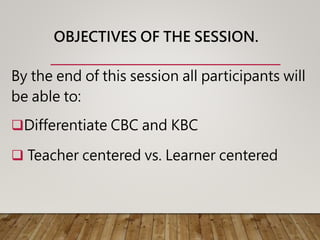
OBJECTIVES OF THE SESSION.
By the end of this session all participants will
be able to:
Differentiate CBC and KBC
 Teacher centered vs. Learner centered
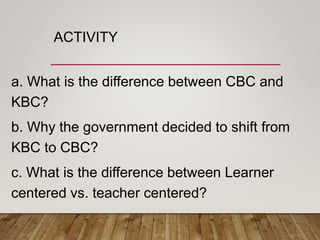
ACTIVITY
a. What is the difference between CBC and
KBC?
b. Why the government decided to shift from
KBC to CBC?
c. What is the difference between Learner
centered vs. teacher centered?
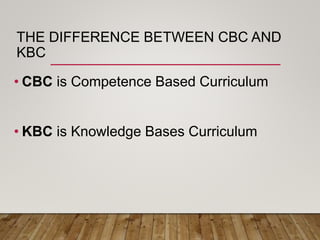
THE DIFFERENCE BETWEEN CBC AND
KBC
• CBC is Competence Based Curriculum
• KBC is Knowledge Bases Curriculum
REASON
The government decided to shift from
KBC to CBC
To meet the needs of society and,
The labor market
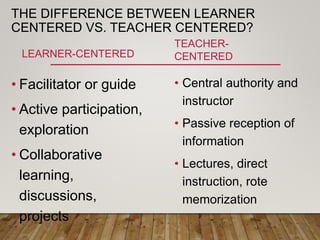
THE DIFFERENCE BETWEEN LEARNER
CENTERED VS. TEACHER CENTERED?
LEARNER-CENTERED
• Facilitator or guide
• Active participation,
exploration
• Collaborative
learning,
discussions,
projects
TEACHER-
CENTERED
• Central authority and
instructor
• Passive reception of
information
• Lectures, direct
instruction, rote
memorization
SESSION 1:
COMPETENCE
SESSION OBJECTIVES.
By the end of this session, all participants will be able
to:
Explain the term competence and identify
links between competencies at each level of
the curriculum.
Differentiate between basic and generic
competencies.
SESSION OBJECTIVES.
By the end of this session, all participants will be able
to:
To define and apply generic competencies in
teaching.
Explain and integrate cross-cutting issues into their
subject teaching.
To use and adapt pedagogical documents for
effective teaching.
ACTIVITY 1
What do you understand by the term competence?
(Using a Think Write Pair Share (TWPS)
technique)
COMPETENCE
EXAMPLE
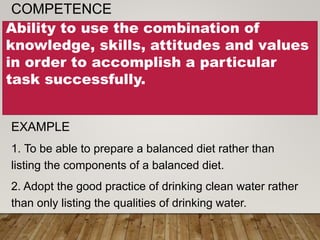
1. To be able to prepare a balanced diet rather than
listing the components of a balanced diet.
2. Adopt the good practice of drinking clean water rather
than only listing the qualities of drinking water.
Ability to use the combination of
knowledge, skills, attitudes and values
in order to accomplish a particular
task successfully.
CATEGORIES OF COMPETENCES
Basic Competences: Priority
competencies for all learners that are
developed into subject content as well
as developed across subjects.
Generic Competences: Competences
that lead learners to develop higher-
order thinking and can be developed
all subjects.
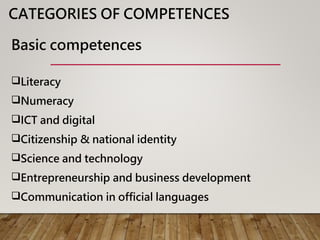
CATEGORIES OF COMPETENCES
Basic competences
Literacy
Numeracy
ICT and digital
Citizenship & national identity
Science and technology
Entrepreneurship and business development
Communication in official languages
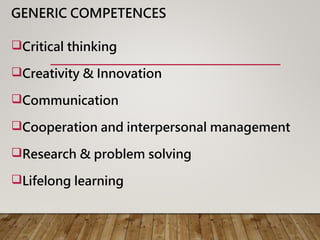
GENERIC COMPETENCES
Critical thinking
Creativity & Innovation
Communication
Cooperation and interpersonal management
Research & problem solving
Lifelong learning
ACTIVITY:
Brainstorm the issues
that we have in
Rwandan society.
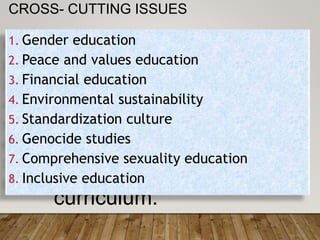
CROSS- CUTTING ISSUES
Brainstorm the
crosscutting issues in
the Rwandan
curriculum.
1. Gender education
2. Peace and values education
3. Financial education
4. Environmental sustainability
5. Standardization culture
6. Genocide studies
7. Comprehensive sexuality education
8. Inclusive education
ACTIVITY
1.Which documents have you seen
your teacher carrying?
Pedagogical/teaching documents
are the documents used by the
teacher in the presentation,
implementation and evaluation of
teaching/learning process to make
learning more effective.
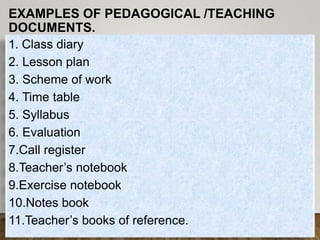
EXAMPLES OF PEDAGOGICAL /TEACHING
DOCUMENTS.
Brainstorm the
crosscutting issues in
the Rwandan
curriculum.
1. Class diary
2. Lesson plan
3. Scheme of work
4. Time table
5. Syllabus
6. Evaluation
7.Call register
8.Teacher’s notebook
9.Exercise notebook
10.Notes book
11.Teacher’s books of reference.
CBC KBC Presentation FINAL (1)hhhhhhh.pptx

CBC KBC Presentation FINAL (1)hhhhhhh.pptx

  • 1.
  • 2.
    OBJECTIVES OF THESESSION. By the end of this session all participants will be able to: Differentiate CBC and KBC  Teacher centered vs. Learner centered
  • 3.
    ACTIVITY a. What isthe difference between CBC and KBC? b. Why the government decided to shift from KBC to CBC? c. What is the difference between Learner centered vs. teacher centered?
  • 4.
    THE DIFFERENCE BETWEENCBC AND KBC • CBC is Competence Based Curriculum • KBC is Knowledge Bases Curriculum
  • 5.
    REASON The government decidedto shift from KBC to CBC To meet the needs of society and, The labor market
  • 6.
    THE DIFFERENCE BETWEENLEARNER CENTERED VS. TEACHER CENTERED? LEARNER-CENTERED • Facilitator or guide • Active participation, exploration • Collaborative learning, discussions, projects TEACHER- CENTERED • Central authority and instructor • Passive reception of information • Lectures, direct instruction, rote memorization
  • 7.
  • 8.
    SESSION OBJECTIVES. By theend of this session, all participants will be able to: Explain the term competence and identify links between competencies at each level of the curriculum. Differentiate between basic and generic competencies.
  • 9.
    SESSION OBJECTIVES. By theend of this session, all participants will be able to: To define and apply generic competencies in teaching. Explain and integrate cross-cutting issues into their subject teaching. To use and adapt pedagogical documents for effective teaching.
  • 10.
    ACTIVITY 1 What doyou understand by the term competence? (Using a Think Write Pair Share (TWPS) technique)
  • 11.
    COMPETENCE EXAMPLE 1. To beable to prepare a balanced diet rather than listing the components of a balanced diet. 2. Adopt the good practice of drinking clean water rather than only listing the qualities of drinking water. Ability to use the combination of knowledge, skills, attitudes and values in order to accomplish a particular task successfully.
  • 12.
    CATEGORIES OF COMPETENCES BasicCompetences: Priority competencies for all learners that are developed into subject content as well as developed across subjects. Generic Competences: Competences that lead learners to develop higher- order thinking and can be developed all subjects.
  • 13.
    CATEGORIES OF COMPETENCES Basiccompetences Literacy Numeracy ICT and digital Citizenship & national identity Science and technology Entrepreneurship and business development Communication in official languages
  • 14.
    GENERIC COMPETENCES Critical thinking Creativity& Innovation Communication Cooperation and interpersonal management Research & problem solving Lifelong learning
  • 15.
    ACTIVITY: Brainstorm the issues thatwe have in Rwandan society.
  • 16.
    CROSS- CUTTING ISSUES Brainstormthe crosscutting issues in the Rwandan curriculum. 1. Gender education 2. Peace and values education 3. Financial education 4. Environmental sustainability 5. Standardization culture 6. Genocide studies 7. Comprehensive sexuality education 8. Inclusive education
  • 17.
    ACTIVITY 1.Which documents haveyou seen your teacher carrying?
  • 18.
    Pedagogical/teaching documents are thedocuments used by the teacher in the presentation, implementation and evaluation of teaching/learning process to make learning more effective.
  • 19.
    EXAMPLES OF PEDAGOGICAL/TEACHING DOCUMENTS. Brainstorm the crosscutting issues in the Rwandan curriculum. 1. Class diary 2. Lesson plan 3. Scheme of work 4. Time table 5. Syllabus 6. Evaluation 7.Call register 8.Teacher’s notebook 9.Exercise notebook 10.Notes book 11.Teacher’s books of reference.