Prof. (Dr.) Dibyendu Bhattacharyya
Department of Education
University of Kalyani
Email: db.ku@rediffmail.com
Merging Curriculum & Skill for Productive Education
MMTTP forFaculty development programme
1ST HALF
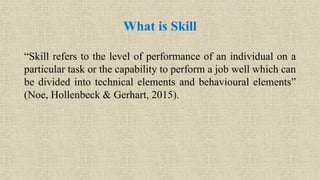
“Skill refers to the level of performance of an individual on a
particular task or the capability to perform a job well which can
be divided into technical elements and behavioural elements”
(Noe, Hollenbeck & Gerhart, 2015).
What is Skill
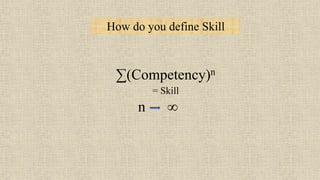
How do you define Skill
∑(Competency)n
= Skill
n ∞
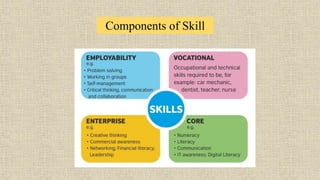
Components of Skill
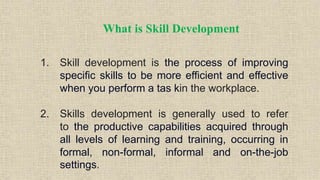
What is Skill Development
1. Skill development is the process of improving
specific skills to be more efficient and effective
when you perform a tas kin the workplace.
2. Skills development is generally used to refer
to the productive capabilities acquired through
all levels of learning and training, occurring in
formal, non-formal, informal and on-the-job
settings.
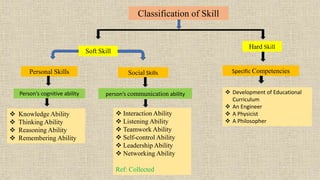
Classification of Skill
Soft Skill
Hard Skill
Personal Skills Social Skills
Person’s cognitive ability person’s communication ability
 Knowledge Ability
 Thinking Ability
 Reasoning Ability
 Remembering Ability
 Interaction Ability
 Listening Ability
 Teamwork Ability
 Self-control Ability
 Leadership Ability
 Networking Ability
Ref: Collected
 Development of Educational
Curriculum
 An Engineer
 A Physicist
 A Philosopher
Specific Competencies
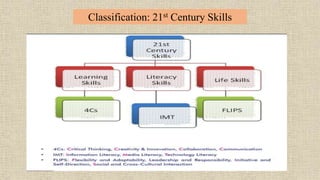
Classification: 21st Century Skills
The Componential Flexible Curriculum is an educational model that
breaks down the curriculum into modular components, allowing for
personalized and adaptable learning pathways. It emphasizes
individualized instruction, interdisciplinary connections, and continuous
improvement to meet the diverse needs of students in a dynamic
educational landscape. This approach fosters a more engaging and
relevant learning experience.
What is Componential Flexible curriculum
Characteristics of Componential Flexible curriculum
 Modularity: The curriculum is divided into modular components, allowing
educators to rearrange and customize learning pathways based on individual
student needs, interests, and abilities. This modular structure facilitates easy
integration of new content, technologies, and teaching methodologies.
 Personalization: A CFC is designed to accommodate diverse learning styles and
preferences. It allows for personalized learning experiences by enabling students
to progress at their own pace and explore topics aligned with their interests,
fostering a more engaging and student-centered approach.
 Adaptability: The curriculum is adaptable to changes in educational priorities,
emerging trends, and the evolving needs of the workforce. This adaptability
ensures that the curriculum remains relevant and responsive to the dynamic nature
of knowledge and skills required in the modern world.
Cont…
 Interdisciplinary Connections: A CFC promotes interdisciplinary connections by
breaking down the traditional subject silos. It encourages the integration of concepts
and content across various disciplines, fostering a more holistic understanding of real-
world issues and enhancing critical thinking skills.
 Continuous Improvement: The CFC emphasizes ongoing evaluation and
improvement. It allows for regular updates based on feedback, assessment data, and
educational research to enhance overall effectiveness. This characteristic ensures that
the curriculum remains current and aligned with best practices in education.
 Technology Integration: The use of technology is inherent in a Componential
Flexible Curriculum. It leverages educational technologies to facilitate personalized
learning, provide interactive resources, and support collaborative and project-based
activities, enhancing the overall learning experience.
Cont…
 Competency-Based Learning: The focus is on the development of
competencies rather than simply covering content. Students are assessed on
their mastery of specific skills and knowledge, allowing for a more nuanced
understanding of individual strengths and areas for improvement.
 Inclusivity: The CFC is designed to be inclusive, accommodating diverse
student populations. It considers different learning abilities, cultural
backgrounds, and socio-economic factors, ensuring that education is
accessible and beneficial to all students.
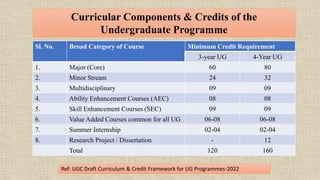
Sl. No. Broad Category of Course Minimum Credit Requirement
3-year UG 4-Year UG
1. Major (Core) 60 80
2. Minor Stream 24 32
3. Multidisciplinary 09 09
4. Ability Enhancement Courses (AEC) 08 08
5. Skill Enhancement Courses (SEC) 09 09
6. Value Added Courses common for all UG 06-08 06-08
7. Summer Internship 02-04 02-04
8. Research Project / Dissertation - 12
Total 120 160
Curricular Components & Credits of the
Undergraduate Programme
Ref: UGC Draft Curriculum & Credit Framework for UG Programmes-2022
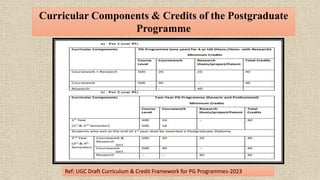
Curricular Components & Credits of the Postgraduate
Programme
Ref: UGC Draft Curriculum & Credit Framework for PG Programmes-2023
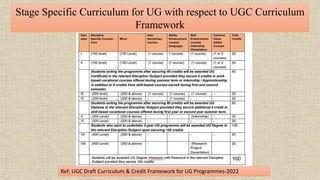
Stage Specific Curriculum for UG with respect to UGC Curriculum
Framework
Ref: UGC Draft Curriculum & Credit Framework for UG Programmes-2022
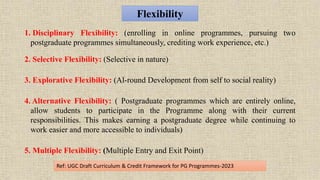
Flexibility
1. Disciplinary Flexibility: (enrolling in online programmes, pursuing two
postgraduate programmes simultaneously, crediting work experience, etc.)
2. Selective Flexibility: (Selective in nature)
3. Explorative Flexibility: (Al-round Development from self to social reality)
4. Alternative Flexibility: ( Postgraduate programmes which are entirely online,
allow students to participate in the Programme along with their current
responsibilities. This makes earning a postgraduate degree while continuing to
work easier and more accessible to individuals)
5. Multiple Flexibility: (Multiple Entry and Exit Point)
Ref: UGC Draft Curriculum & Credit Framework for PG Programmes-2023
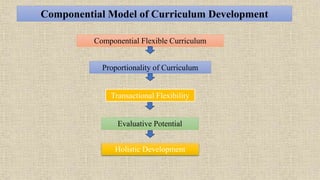
Componential Model of Curriculum Development
Proportionality of Curriculum
Transactional Flexibility
Evaluative Potential
Componential Flexible Curriculum
Holistic Development
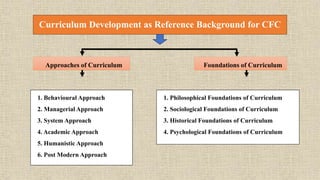
Curriculum Development as Reference Background for CFC
1. Behavioural Approach
2. Managerial Approach
3. System Approach
4. Academic Approach
5. Humanistic Approach
6. Post Modern Approach
Approaches of Curriculum Foundations of Curriculum
1. Philosophical Foundations of Curriculum
2. Sociological Foundations of Curriculum
3. Historical Foundations of Curriculum
4. Psychological Foundations of Curriculum
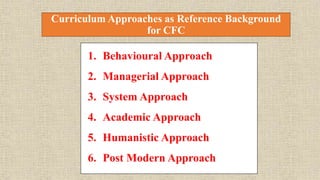
Curriculum Approaches as Reference Background
for CFC
1. Behavioural Approach
2. Managerial Approach
3. System Approach
4. Academic Approach
5. Humanistic Approach
6. Post Modern Approach
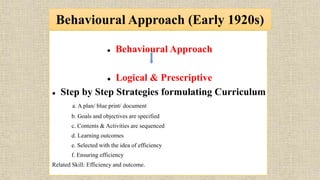
Behavioural Approach (Early 1920s)
 Behavioural Approach
 Logical & Prescriptive
 Step by Step Strategies formulating Curriculum
a. A plan/ blue print/ document
b. Goals and objectives are specified
c. Contents & Activities are sequenced
d. Learning outcomes
e. Selected with the idea of efficiency
f. Ensuring efficiency
Related Skill: Efficiency and outcome.
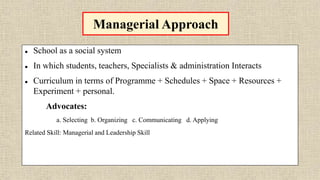
Managerial Approach
 School as a social system
 In which students, teachers, Specialists & administration Interacts
 Curriculum in terms of Programme + Schedules + Space + Resources +
Experiment + personal.
Advocates:
a. Selecting b. Organizing c. Communicating d. Applying
Related Skill: Managerial and Leadership Skill
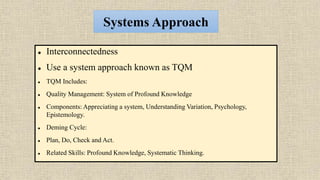
Systems Approach
 Interconnectedness
 Use a system approach known as TQM
 TQM Includes:
 Quality Management: System of Profound Knowledge
 Components: Appreciating a system, Understanding Variation, Psychology,
Epistemology.
 Deming Cycle:
 Plan, Do, Check and Act.
 Related Skills: Profound Knowledge, Systematic Thinking.
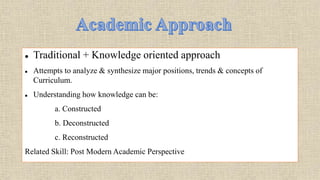
 Traditional + Knowledge oriented approach
 Attempts to analyze & synthesize major positions, trends & concepts of
Curriculum.
 Understanding how knowledge can be:
a. Constructed
b. Deconstructed
c. Reconstructed
Related Skill: Post Modern Academic Perspective
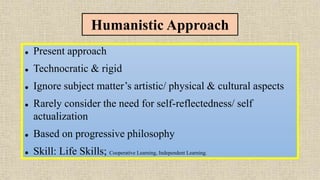
Humanistic Approach
 Present approach
 Technocratic & rigid
 Ignore subject matter’s artistic/ physical & cultural aspects
 Rarely consider the need for self-reflectedness/ self
actualization
 Based on progressive philosophy
 Skill: Life Skills; Cooperative Learning, Independent Learning.
 Extends the humanistic approach
 Post modernism is concerned chiefly with change & reform
 Focus on education’s larger ideological issues
 Investigate & influence societies' social, economic & political Institutions
 Interested in theory then practical application
 Curricula’s interactions with political + economic + social + moral + artistic focuses
 School as an extension of society
 Likely to speak in terms of inequality, discrimination & oppression
 Related Skill: Based on Change and reform inviting Skill based Education
Exclusive Knowledge Skill
• 1 Profound Knowledge
• 2 Practical Knowledge
• 3 Pedagogical Knowledge
• 4. Perceptual Knowledge
Behavioral Skill
1.Personality Pattern
2.Attitude
3.Communicational Skill
4. Interpersonal Skill
5.Others
Skill based on Digitalization
1.Computer based Teaching and Learning
2.Virtual Classroom
3.Online Education
4.Digital Transformation
5.Others
Social Resource based Skill Education
• 1. Agricultural Education
• 2 Art and Craft Education
• 3 Experiential Education
• 4 Oceanography
• 5Tourism
• 6 Publication
• 7Other Schools based on Social and Local Resources.
• 8 ITI based local Industrial Education
• 9 Work placed based ability
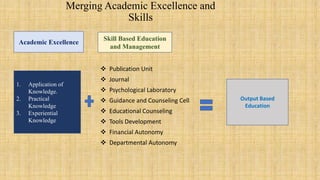
Merging Academic Excellence and
Skills
 Publication Unit
 Journal
 Psychological Laboratory
 Guidance and Counseling Cell
 Educational Counseling
 Tools Development
 Financial Autonomy
 Departmental Autonomy
1. Application of
Knowledge.
2. Practical
Knowledge
3. Experiential
Knowledge
Output Based
Education
Academic Excellence
Skill Based Education
and Management
THANK YOU

Merging_Curriculum_and_Skill_for_Productive_Education.pptx

  • 1.
    Prof. (Dr.) DibyenduBhattacharyya Department of Education University of Kalyani Email: db.ku@rediffmail.com Merging Curriculum & Skill for Productive Education MMTTP forFaculty development programme 1ST HALF
  • 2.
    “Skill refers tothe level of performance of an individual on a particular task or the capability to perform a job well which can be divided into technical elements and behavioural elements” (Noe, Hollenbeck & Gerhart, 2015). What is Skill
  • 3.
    How do youdefine Skill ∑(Competency)n = Skill n ∞
  • 4.
  • 5.
    What is SkillDevelopment 1. Skill development is the process of improving specific skills to be more efficient and effective when you perform a tas kin the workplace. 2. Skills development is generally used to refer to the productive capabilities acquired through all levels of learning and training, occurring in formal, non-formal, informal and on-the-job settings.
  • 6.
    Classification of Skill SoftSkill Hard Skill Personal Skills Social Skills Person’s cognitive ability person’s communication ability  Knowledge Ability  Thinking Ability  Reasoning Ability  Remembering Ability  Interaction Ability  Listening Ability  Teamwork Ability  Self-control Ability  Leadership Ability  Networking Ability Ref: Collected  Development of Educational Curriculum  An Engineer  A Physicist  A Philosopher Specific Competencies
  • 7.
  • 8.
    The Componential FlexibleCurriculum is an educational model that breaks down the curriculum into modular components, allowing for personalized and adaptable learning pathways. It emphasizes individualized instruction, interdisciplinary connections, and continuous improvement to meet the diverse needs of students in a dynamic educational landscape. This approach fosters a more engaging and relevant learning experience. What is Componential Flexible curriculum
  • 9.
    Characteristics of ComponentialFlexible curriculum  Modularity: The curriculum is divided into modular components, allowing educators to rearrange and customize learning pathways based on individual student needs, interests, and abilities. This modular structure facilitates easy integration of new content, technologies, and teaching methodologies.  Personalization: A CFC is designed to accommodate diverse learning styles and preferences. It allows for personalized learning experiences by enabling students to progress at their own pace and explore topics aligned with their interests, fostering a more engaging and student-centered approach.  Adaptability: The curriculum is adaptable to changes in educational priorities, emerging trends, and the evolving needs of the workforce. This adaptability ensures that the curriculum remains relevant and responsive to the dynamic nature of knowledge and skills required in the modern world.
  • 10.
    Cont…  Interdisciplinary Connections:A CFC promotes interdisciplinary connections by breaking down the traditional subject silos. It encourages the integration of concepts and content across various disciplines, fostering a more holistic understanding of real- world issues and enhancing critical thinking skills.  Continuous Improvement: The CFC emphasizes ongoing evaluation and improvement. It allows for regular updates based on feedback, assessment data, and educational research to enhance overall effectiveness. This characteristic ensures that the curriculum remains current and aligned with best practices in education.  Technology Integration: The use of technology is inherent in a Componential Flexible Curriculum. It leverages educational technologies to facilitate personalized learning, provide interactive resources, and support collaborative and project-based activities, enhancing the overall learning experience.
  • 11.
    Cont…  Competency-Based Learning:The focus is on the development of competencies rather than simply covering content. Students are assessed on their mastery of specific skills and knowledge, allowing for a more nuanced understanding of individual strengths and areas for improvement.  Inclusivity: The CFC is designed to be inclusive, accommodating diverse student populations. It considers different learning abilities, cultural backgrounds, and socio-economic factors, ensuring that education is accessible and beneficial to all students.
  • 12.
    Sl. No. BroadCategory of Course Minimum Credit Requirement 3-year UG 4-Year UG 1. Major (Core) 60 80 2. Minor Stream 24 32 3. Multidisciplinary 09 09 4. Ability Enhancement Courses (AEC) 08 08 5. Skill Enhancement Courses (SEC) 09 09 6. Value Added Courses common for all UG 06-08 06-08 7. Summer Internship 02-04 02-04 8. Research Project / Dissertation - 12 Total 120 160 Curricular Components & Credits of the Undergraduate Programme Ref: UGC Draft Curriculum & Credit Framework for UG Programmes-2022
  • 13.
    Curricular Components &Credits of the Postgraduate Programme Ref: UGC Draft Curriculum & Credit Framework for PG Programmes-2023
  • 14.
    Stage Specific Curriculumfor UG with respect to UGC Curriculum Framework Ref: UGC Draft Curriculum & Credit Framework for UG Programmes-2022
  • 15.
    Flexibility 1. Disciplinary Flexibility:(enrolling in online programmes, pursuing two postgraduate programmes simultaneously, crediting work experience, etc.) 2. Selective Flexibility: (Selective in nature) 3. Explorative Flexibility: (Al-round Development from self to social reality) 4. Alternative Flexibility: ( Postgraduate programmes which are entirely online, allow students to participate in the Programme along with their current responsibilities. This makes earning a postgraduate degree while continuing to work easier and more accessible to individuals) 5. Multiple Flexibility: (Multiple Entry and Exit Point) Ref: UGC Draft Curriculum & Credit Framework for PG Programmes-2023
  • 16.
    Componential Model ofCurriculum Development Proportionality of Curriculum Transactional Flexibility Evaluative Potential Componential Flexible Curriculum Holistic Development
  • 17.
    Curriculum Development asReference Background for CFC 1. Behavioural Approach 2. Managerial Approach 3. System Approach 4. Academic Approach 5. Humanistic Approach 6. Post Modern Approach Approaches of Curriculum Foundations of Curriculum 1. Philosophical Foundations of Curriculum 2. Sociological Foundations of Curriculum 3. Historical Foundations of Curriculum 4. Psychological Foundations of Curriculum
  • 18.
    Curriculum Approaches asReference Background for CFC 1. Behavioural Approach 2. Managerial Approach 3. System Approach 4. Academic Approach 5. Humanistic Approach 6. Post Modern Approach
  • 19.
    Behavioural Approach (Early1920s)  Behavioural Approach  Logical & Prescriptive  Step by Step Strategies formulating Curriculum a. A plan/ blue print/ document b. Goals and objectives are specified c. Contents & Activities are sequenced d. Learning outcomes e. Selected with the idea of efficiency f. Ensuring efficiency Related Skill: Efficiency and outcome.
  • 20.
    Managerial Approach  Schoolas a social system  In which students, teachers, Specialists & administration Interacts  Curriculum in terms of Programme + Schedules + Space + Resources + Experiment + personal. Advocates: a. Selecting b. Organizing c. Communicating d. Applying Related Skill: Managerial and Leadership Skill
  • 21.
    Systems Approach  Interconnectedness Use a system approach known as TQM  TQM Includes:  Quality Management: System of Profound Knowledge  Components: Appreciating a system, Understanding Variation, Psychology, Epistemology.  Deming Cycle:  Plan, Do, Check and Act.  Related Skills: Profound Knowledge, Systematic Thinking.
  • 22.
     Traditional +Knowledge oriented approach  Attempts to analyze & synthesize major positions, trends & concepts of Curriculum.  Understanding how knowledge can be: a. Constructed b. Deconstructed c. Reconstructed Related Skill: Post Modern Academic Perspective
  • 23.
    Humanistic Approach  Presentapproach  Technocratic & rigid  Ignore subject matter’s artistic/ physical & cultural aspects  Rarely consider the need for self-reflectedness/ self actualization  Based on progressive philosophy  Skill: Life Skills; Cooperative Learning, Independent Learning.
  • 24.
     Extends thehumanistic approach  Post modernism is concerned chiefly with change & reform  Focus on education’s larger ideological issues  Investigate & influence societies' social, economic & political Institutions  Interested in theory then practical application  Curricula’s interactions with political + economic + social + moral + artistic focuses  School as an extension of society  Likely to speak in terms of inequality, discrimination & oppression  Related Skill: Based on Change and reform inviting Skill based Education
  • 25.
    Exclusive Knowledge Skill •1 Profound Knowledge • 2 Practical Knowledge • 3 Pedagogical Knowledge • 4. Perceptual Knowledge
  • 26.
  • 27.
    Skill based onDigitalization 1.Computer based Teaching and Learning 2.Virtual Classroom 3.Online Education 4.Digital Transformation 5.Others
  • 28.
    Social Resource basedSkill Education • 1. Agricultural Education • 2 Art and Craft Education • 3 Experiential Education • 4 Oceanography • 5Tourism • 6 Publication • 7Other Schools based on Social and Local Resources. • 8 ITI based local Industrial Education • 9 Work placed based ability
  • 29.
    Merging Academic Excellenceand Skills  Publication Unit  Journal  Psychological Laboratory  Guidance and Counseling Cell  Educational Counseling  Tools Development  Financial Autonomy  Departmental Autonomy 1. Application of Knowledge. 2. Practical Knowledge 3. Experiential Knowledge Output Based Education Academic Excellence Skill Based Education and Management
  • 30.