Learning Objectives
• Bythe end of this workshop, you will be able
to:
• • Understand key principles of CBL.
• • Differentiate traditional vs competency-
based assessment.
• • Identify competencies and learning
outcomes.
• • Design competency-based questions.
• • Reflect on NEP 2020 classroom applications.
4.
Context: Why NEP2020 Matters
• • Focuses on holistic, flexible, and
multidisciplinary learning.
• • Encourages conceptual understanding, not
rote memorization.
• • Aims for competency-based education that
builds real-life skills.
• • Teachers are key implementers of this vision.
5.
The Shift inIndian Education
• Old Paradigm vs New Paradigm (NEP 2020)
• Content-heavy → Competency-based
• Marks-driven → Skill-driven
• Teacher-centered → Student-centered
• Recall-based → Application-based
6.
What is Competency?
•A competency is the ability to apply
knowledge, skills, and attitudes to perform a
task successfully.
• Components:
• 🧠 Knowledge
• 💪 Skill
• 💖 Attitude
7.
What is Competency-Based
Learning(CBL)?
• CBL ensures that students:
• • Demonstrate mastery of competencies.
• • Learn at their own pace.
• • Are assessed through application and
reasoning.
• • Receive feedback that promotes reflection.
8.
Features of CBL
•✅ Focuses on learning outcomes.
• ✅ Promotes real-world application.
• ✅ Encourages creativity and collaboration.
• ✅ Uses formative assessments.
• ✅ Allows flexible learning.
9.
NEP 2020 onCompetency-Based
Education
• Key Excerpts:
• • Assessment focuses on higher-order skills.
• • Curriculum develops competencies.
• • Students learn how to learn.
10.
Why Move toCBL
• • Encourages deep understanding.
• • Bridges school and real-life skills.
• • Builds lifelong learners.
• • Prepares students for future skills.
11.
Learning Outcomes vs
Competencies
•Learning Outcomes: What students know or
do.
• Competencies: Application of learning in real-
life situations.
• Focus: Results vs Process + Performance.
12.
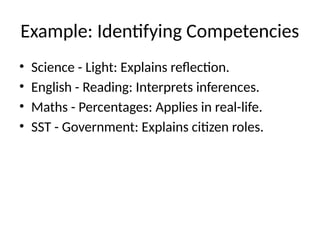
Example: Subject-Wise
Competencies
• English:Analyzes texts and interprets
meaning.
• Math: Applies reasoning to daily-life problems.
• Science: Uses concepts to explain natural
phenomena.
• Social Science: Connects past to present
issues.
13.
Question Transformation Examples
•Science: ❌ Define reflection. ✅ Explain how
reflection helps drivers.
• English: ❌ Write the meaning of perseverance.
✅ Describe a situation showing perseverance.
• Math: ❌ Find ½ of 36. ✅ You baked 36
cupcakes. Share half — how many given?
14.
The Teacher’s Rolein CBL
• • Acts as facilitator and mentor.
• • Designs competency-aligned experiences.
• • Encourages inquiry and exploration.
• • Uses continuous assessment.
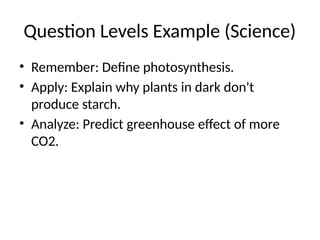
Question Levels Example(Science)
• Remember: Define photosynthesis.
• Apply: Explain why plants in dark don't
produce starch.
• Analyze: Predict greenhouse effect of more
CO2.
19.
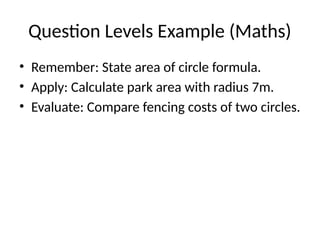
Question Levels Example(Maths)
• Remember: State area of circle formula.
• Apply: Calculate park area with radius 7m.
• Evaluate: Compare fencing costs of two circles.
20.
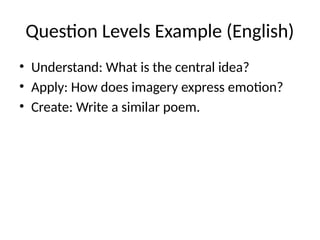
Question Levels Example(English)
• Understand: What is the central idea?
• Apply: How does imagery express emotion?
• Create: Write a similar poem.
21.
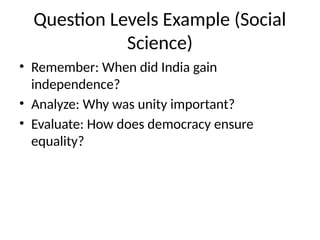
Question Levels Example(Social
Science)
• Remember: When did India gain
independence?
• Analyze: Why was unity important?
• Evaluate: How does democracy ensure
equality?
22.
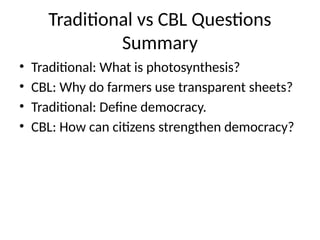
Traditional vs CBLQuestions
Summary
• Traditional: What is photosynthesis?
• CBL: Why do farmers use transparent sheets?
• Traditional: Define democracy.
• CBL: How can citizens strengthen democracy?
23.
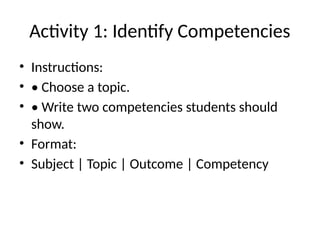
Activity 1: IdentifyCompetencies
• Instructions:
• • Choose a topic.
• • Write two competencies students should
show.
• Format:
• Subject | Topic | Outcome | Competency