Assessment in Competency
Based Education
The concept of assessment
• Educational assessment is the process of
determining the extent to which learners have
acquired specified knowledge, skills, values,
attitudes, abilities and competencies.
• A process of establishing the extent to which
the desired learning outcomes have been
developed
The concept of competencies
• Competency is “the ability to apply appropriate
knowledge and skills to successfully perform a
function” (KICD, 2017)
• Basic Education has the following core competencies
1. Communication and Collaboration
2. Self-efficacy
3. Critical Thinking and Problem Solving
4. Creativity and Imagination
5. Citizenship
6. Digital Literacy
7. Learning to Learn
The concept of learning outcomes
• Learning outcomes are statements of what a
learning pupil / student / person knows,
understands and can perform, based on
completion of the learning process, defined by
knowledge, skill and competence
• In the Kenya education system, the following
learning outcomes are stated for the early
years of learning and senor school respectively
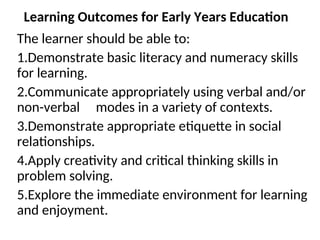
Learning Outcomes for Early Years Education
The learner should be able to:
1.Demonstrate basic literacy and numeracy skills
for learning.
2.Communicate appropriately using verbal and/or
non-verbal modes in a variety of contexts.
3.Demonstrate appropriate etiquette in social
relationships.
4.Apply creativity and critical thinking skills in
problem solving.
5.Explore the immediate environment for learning
and enjoyment.
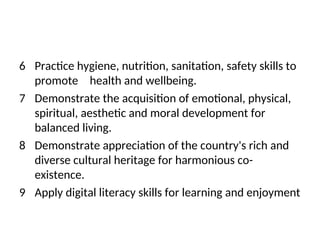
6 Practice hygiene, nutrition, sanitation, safety skills to
promote health and wellbeing.
7 Demonstrate the acquisition of emotional, physical,
spiritual, aesthetic and moral development for
balanced living.
8 Demonstrate appreciation of the country's rich and
diverse cultural heritage for harmonious co-
existence.
9 Apply digital literacy skills for learning and enjoyment
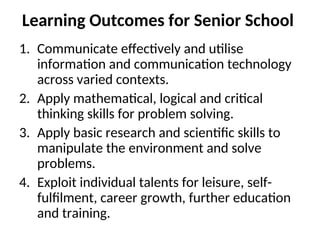
Learning Outcomes for Senior School
1. Communicate effectively and utilise
information and communication technology
across varied contexts.
2. Apply mathematical, logical and critical
thinking skills for problem solving.
3. Apply basic research and scientific skills to
manipulate the environment and solve
problems.
4. Exploit individual talents for leisure, self-
fulfilment, career growth, further education
and training.
5. Uphold national, moral and religious values and
apply them in day to day life.
6. Apply and promote health care strategies in day to
day life.
7. Protect, preserve and improve the environment for
sustainability.
8. Demonstrate active local and global citizenship for
harmonious co-existence.
9. Demonstrate appreciation of diversity in people and
cultures.
10. Manage pertinent and contemporary issues
responsibly
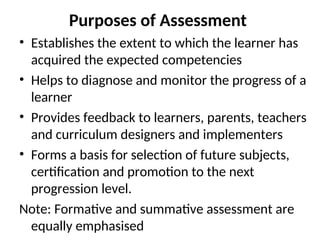
Purposes of Assessment
• Establishes the extent to which the learner has
acquired the expected competencies
• Helps to diagnose and monitor the progress of a
learner
• Provides feedback to learners, parents, teachers
and curriculum designers and implementers
• Forms a basis for selection of future subjects,
certification and promotion to the next
progression level.
Note: Formative and summative assessment are
equally emphasised
Guiding Principles of Competency Based
Assessment
a) Validity - The assessment score must reflect the
learner’s actual ability in the assessed criteria
b) Reliability - The assessment scores should be
consistent and interpreted in the same way by
the assessors
c) Fairness - Ensuring that the assessment
process does not disadvantage any learner
taking cognisance of gender, faith, cultural and
socio-economic factors.
d) Flexibility - Ensuring the skills, knowledge,
abilities and values can be demonstrated in a
variety of ways that are suitable to the
school.
e) Access – Providing an enabling assessment
environment for learners with disabilities by
making arrangements for them to
demonstrate their competency levels.
Strengths of Competency Based
Curriculum
1. Learner-focused - Responsive and relevant to
learners and enables flexibility for teachers
2. Focus on Competencies - More focus on
competencies and less on content.
Emphasises on application of knowledge,
and not necessarily just its acquisition.
3. Flexibility- Allows greater flexibility at the
local level. Teachers have autonomy in
implementing the curriculum while teaching
4. Balance Between Formative and Summative
Assessment – Allows for a range of assessment
that focuses on the development of student
learning outcomes, cross-curricular competencies,
and literacy and numeracy
5. Digitally Based – Has a collaborative digital
application that enables it to be improved
continuously and supports learning with flexible
timing and pacing through a range of learning
environments.
6. Collaborative and Co-development Models -
Involves all stakeholders in the curriculum
design and development.
7. Synchronous Development – Employs an
integrated approach to development of
programmes of study, assessments, and
learning and teaching resources.
Competence Based Curriculum Assessment.ppt

  • 1.
  • 2.
    The concept ofassessment • Educational assessment is the process of determining the extent to which learners have acquired specified knowledge, skills, values, attitudes, abilities and competencies. • A process of establishing the extent to which the desired learning outcomes have been developed
  • 4.
    The concept ofcompetencies • Competency is “the ability to apply appropriate knowledge and skills to successfully perform a function” (KICD, 2017) • Basic Education has the following core competencies 1. Communication and Collaboration 2. Self-efficacy 3. Critical Thinking and Problem Solving 4. Creativity and Imagination 5. Citizenship 6. Digital Literacy 7. Learning to Learn
  • 5.
    The concept oflearning outcomes • Learning outcomes are statements of what a learning pupil / student / person knows, understands and can perform, based on completion of the learning process, defined by knowledge, skill and competence • In the Kenya education system, the following learning outcomes are stated for the early years of learning and senor school respectively
  • 6.
    Learning Outcomes forEarly Years Education The learner should be able to: 1.Demonstrate basic literacy and numeracy skills for learning. 2.Communicate appropriately using verbal and/or non-verbal modes in a variety of contexts. 3.Demonstrate appropriate etiquette in social relationships. 4.Apply creativity and critical thinking skills in problem solving. 5.Explore the immediate environment for learning and enjoyment.
  • 7.
    6 Practice hygiene,nutrition, sanitation, safety skills to promote health and wellbeing. 7 Demonstrate the acquisition of emotional, physical, spiritual, aesthetic and moral development for balanced living. 8 Demonstrate appreciation of the country's rich and diverse cultural heritage for harmonious co- existence. 9 Apply digital literacy skills for learning and enjoyment
  • 8.
    Learning Outcomes forSenior School 1. Communicate effectively and utilise information and communication technology across varied contexts. 2. Apply mathematical, logical and critical thinking skills for problem solving. 3. Apply basic research and scientific skills to manipulate the environment and solve problems. 4. Exploit individual talents for leisure, self- fulfilment, career growth, further education and training.
  • 9.
    5. Uphold national,moral and religious values and apply them in day to day life. 6. Apply and promote health care strategies in day to day life. 7. Protect, preserve and improve the environment for sustainability. 8. Demonstrate active local and global citizenship for harmonious co-existence. 9. Demonstrate appreciation of diversity in people and cultures. 10. Manage pertinent and contemporary issues responsibly
  • 10.
    Purposes of Assessment •Establishes the extent to which the learner has acquired the expected competencies • Helps to diagnose and monitor the progress of a learner • Provides feedback to learners, parents, teachers and curriculum designers and implementers • Forms a basis for selection of future subjects, certification and promotion to the next progression level. Note: Formative and summative assessment are equally emphasised
  • 11.
    Guiding Principles ofCompetency Based Assessment a) Validity - The assessment score must reflect the learner’s actual ability in the assessed criteria b) Reliability - The assessment scores should be consistent and interpreted in the same way by the assessors c) Fairness - Ensuring that the assessment process does not disadvantage any learner taking cognisance of gender, faith, cultural and socio-economic factors.
  • 12.
    d) Flexibility -Ensuring the skills, knowledge, abilities and values can be demonstrated in a variety of ways that are suitable to the school. e) Access – Providing an enabling assessment environment for learners with disabilities by making arrangements for them to demonstrate their competency levels.
  • 13.
    Strengths of CompetencyBased Curriculum 1. Learner-focused - Responsive and relevant to learners and enables flexibility for teachers 2. Focus on Competencies - More focus on competencies and less on content. Emphasises on application of knowledge, and not necessarily just its acquisition. 3. Flexibility- Allows greater flexibility at the local level. Teachers have autonomy in implementing the curriculum while teaching
  • 14.
    4. Balance BetweenFormative and Summative Assessment – Allows for a range of assessment that focuses on the development of student learning outcomes, cross-curricular competencies, and literacy and numeracy 5. Digitally Based – Has a collaborative digital application that enables it to be improved continuously and supports learning with flexible timing and pacing through a range of learning environments.
  • 15.
    6. Collaborative andCo-development Models - Involves all stakeholders in the curriculum design and development. 7. Synchronous Development – Employs an integrated approach to development of programmes of study, assessments, and learning and teaching resources.