11 Int.J.Curr.Biotechnol. Volume 3; Issue 8; August, 2015
Pramodini Rout, Nikhil Kumar and Uday Chand Basak, Assessment of anti-nutritional properties in four edible
fruitsof mangrovesof Odisha coast, Int.J.Curr.Biotechnol.,2015, 3(8):11-16.
Assessment ofanti-nutritionalpropertiesinfourediblefruits ofmangrovesofOdisha coast
Pramodini Rout, Nikhil Kumar and Uday Chand Basak*
Seed Bank and Seed Biology Division, Regional Plant Resource Centre, (R & D Institute of Forest and
Environment Department), Bhubaneswar-15, Odisha, India.
A R T I C L E I N F O A B S T R A C T
Article History:
Received 10 August 2015
Receivedinrevisedform 15 August 2015
Accepted 18 August 2015
Available online 30 August 2015
Key words:
Mangrove fruits, anti-nutritional,
Phytate,Saponin
Though some mangrove fruits are known for their medicinal and edible properties, their anti
nutritional aspect has not yet been evaluated. Mangrove fruits provide innumerable direct and
indirect benefits to human beings. However, scientific report on anti nutrients in edible
mangrove fruits is still lacking. The present study was aimed to determine anti-nutritional
properties in four edible mangrove fruits viz. Bruguiera gymnorrhiza, Rhizophora apiculata,
Kandelia candel and Xylocarpus granatum found in Bhitarkanika and Mahanadi delta (buffer
zone) of Odisha. The fruit of X. granatum exhibited highest level of oxalate content (1.68±0.25
mg/g dry wt.) whereas lowest amount was observed in K. candel (1.02±0.12 mg/g dry wt.).
Highest phytate content was noted in K. candel (0.057±0.002 mg/g dry wt.) and lowest in B.
gymnorrhiza (0.052±0.001 mg/g dry wt.). Tannin content was highest in X. granatum
(0.89±0.01 TAE g/g dry wt.) and lowest in R. apiculata (0.57±0.03 TAE g/g dry wt.). Saponin
content was highest in K. candel (0.0301±0.007 g/g dry wt.) and lowest in R. apiculata
(0.022±0.001 g/g dry wt.). The present findings revealed that all the studied fruits can be
considered as ample sources of antinutrients. Thus, excess consumption of these fruits contained
high anti-nutrients may be avoided.
Introduction
Mangroves are specialized group of salt tolerant plants
that grow in the intertidal regions oftropic and subtropic
along the coastlines (Basak et al., 2000). They provide
innumerable direct and indirect benefits to human beings.
Keeping in mind, the edibility properties of mangrove
fruits, they have a good potentiality to become a food
source by the coastal people. Mangrove fruits are
considered as famine food (Patil and Chavan, 2013). But
mangrove fruits are utilized for food as well as bioactive
compound such as tannin, phenol etc reported by
(Bandaranayake, 1998). However, scientific evidences
regarding anti nutritional properties are still lacking.
Anti-nutritional factors including oxalate, tannins, phytic
acid, saponins (Makkar and Singh, 1993; Gupta et al.,
2005) whose presence greatly impair the digestion of
various nutrients, therefore, reducing the nutritional
value of such plants and limiting their utilization as food
(Gidamis et al., 2003; Prathibha et al., 1995). Oxalic acid
binds to calcium and is found naturally in a variety of
fruits, vegetables, nuts, grains and legumes. It has also
been reported earlier that oxalates causes irritation and
swelling in the mouth and throat (Ladeji et al., 2004).
Phytic acid constitutes manyessential elements like iron,
calcium, phosphorous etc. are combined by phytic acid
to form insoluble phytate salt, which are not absorbed
bythe body and thus limiting the bioavailabilityof these
elements (Weaver and Kannan, 2002). Saponin is
naturally occurring glycosides and occurs in wide
varieties of plants. Tannins have the abilityto precipitate
certain proteins. They combine with digestive enzymes
thereby making them unavailable for digestion (Binita
and Khetarpaul, 1997;Abara, 2003).
There is no comprehensive report on anti-nutritional
properties of edible mangrove fruits of Odisha coast.
Considering their extensive edibilityand therapeutic uses,
four mangrove species viz Bruguiera gymnorrhiza,
Rhizophora apiculata, Kandelia candel and Xylocarpus
granatum were subjected to analysis for evaluating
antinutrient properties with an aim to create awareness
on legitimate consumption of mangrove fruits.
Materialsand Methods
Collection of mangrove fruit sample
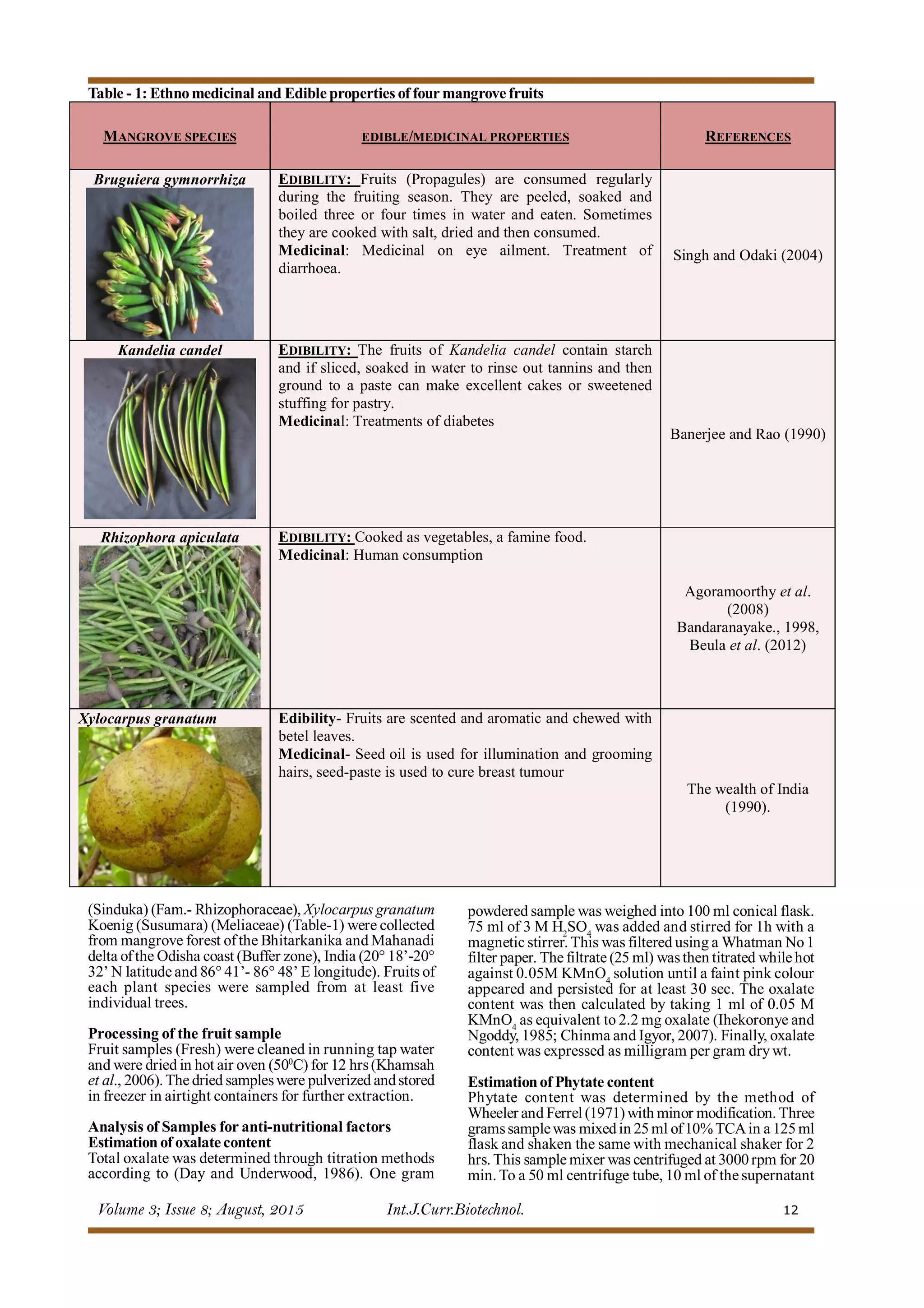
The fruits (at edible stage) of the species viz. Bruguiera
gymnorrhiza (Linn.) Savigny (Bandari) (Fam.-
Rhizophoraceae), Rhizophora apiculata BI (Rai) (Fam.-
Rhizophoraceae), Kandelia candel (Linn.) Druce
ISSN: 2321 - 8371
International Journal of Current
Biotechnology
Journal Homepage : http://ijcb.mainspringer.com
*Corresponding author.
Email address: uc_basak07@yahoo.co.in
Phone: 9437481352
Volume 3; Issue 8; August, 2015 Int.J.Curr.Biotechnol. 12
(Sinduka) (Fam.- Rhizophoraceae), Xylocarpus granatum
Koenig (Susumara) (Meliaceae) (Table-1) were collected
from mangrove forest ofthe Bhitarkanika and Mahanadi
delta ofthe Odisha coast (Buffer zone), India (20° 18’-20°
32’ N latitude and 86° 41’- 86° 48’ E longitude). Fruits of
each plant species were sampled from at least five
individual trees.
Processing of the fruit sample
Fruit samples (Fresh) were cleaned in running tap water
and were dried in hot air oven (500
C) for 12 hrs(Khamsah
et al., 2006). The dried sampleswere pulverized andstored
in freezer in airtight containers for further extraction.
Analysis of Samples for anti-nutritional factors
Estimation of oxalate content
Total oxalate was determined through titration methods
according to (Day and Underwood, 1986). One gram
powdered sample was weighed into 100 ml conical flask.
75 ml of 3 M H2
SO4
was added and stirred for 1h with a
magnetic stirrer. This was filtered using a Whatman No1
filter paper. The filtrate (25 ml) wasthen titrated while hot
against 0.05M KMnO4
solution until a faint pink colour
appeared and persisted for at least 30 sec. The oxalate
content was then calculated by taking 1 ml of 0.05 M
KMnO4
as equivalent to 2.2 mg oxalate (Ihekoronye and
Ngoddy, 1985; Chinma and Igyor, 2007). Finally, oxalate
content was expressed as milligram per gram drywt.
Estimationof Phytate content
Phytate content was determined by the method of
Wheeler and Ferrel (1971)with minor modification. Three
gramssamplewas mixedin 25ml of10%TCAin a 125ml
flask and shaken the same with mechanical shaker for 2
hrs. This sample mixer was centrifuged at 3000rpm for 20
min. To a 50 ml centrifuge tube, 10 ml of the supernatant
MANGROVE SPECIES EDIBLE/MEDICINAL PROPERTIES REFERENCES
Bruguiera gymnorrhiza EDIBILITY: Fruits (Propagules) are consumed regularly
during the fruiting season. They are peeled, soaked and
boiled three or four times in water and eaten. Sometimes
they are cooked with salt, dried and then consumed.
Medicinal: Medicinal on eye ailment. Treatment of
diarrhoea.
Singh and Odaki (2004)
Kandelia candel EDIBILITY: The fruits of Kandelia candel contain starch
and if sliced, soaked in water to rinse out tannins and then
ground to a paste can make excellent cakes or sweetened
stuffing for pastry.
Medicinal: Treatments of diabetes
Banerjee and Rao (1990)
Rhizophora apiculata EDIBILITY: Cooked as vegetables, a famine food.
Medicinal: Human consumption
Agoramoorthy et al.
(2008)
Bandaranayake., 1998,
Beula et al. (2012)
Xylocarpus granatum Edibility- Fruits are scented and aromatic and chewed with
betel leaves.
Medicinal- Seed oil is used for illumination and grooming
hairs, seed-paste is used to cure breast tumour
The wealth of India
(1990).
Table - 1: Ethnomedicinal and Edible properties of four mangrove fruits
13 Int.J.Curr.Biotechnol. Volume 3; Issue 8; August, 2015
Parameters
Fruit Species
Bruguiera
gymnorrhiza
Kandelia
candel
Rhizophora
apiculata
Xylocarpus
granatum
Oxalate Content (mg/g dry wt.) 1.02±0.25 1.02±0.12 1.39±0.12 1.68±0.25
Phytate Content (mg/g dry wt.) 0.052±0.001 0.057±0.002 0.055±0.001 0.054±0.002
Tannin Content (TAE g/g dry wt.) 0.61±0.01 0.59±0.01 0.57±0.03 0.89±0.01
Saponin Content (g/g dry wt.) 0.0235±0.004 0.0301±0.007 0.022±0.001 0.022±0.01
Table - 2:Anti nutritional factors in four edible mangrove fruits
Values are mentioned with mean ±SD values of three replicates; TAE-Tannic acid equivalent
Figure - 1: Oxalate content of four edible mangrove fruits
Figure - 2: Phytate content of four edible mangrove fruits
Volume 3; Issue 8; August, 2015 Int.J.Curr.Biotechnol. 14
Figure - 3: Tannin content of four edible mangrove fruits
Figure - 4: Saponin content of four edible mangrove fruits
15 Int.J.Curr.Biotechnol. Volume 3; Issue 8; August, 2015
was mixed with 4 ml of FeCl3
solution by rapid blowing
from the pipette. The solution was heated then in boiling
water bath for 45 min. To make the supernatant clear, one
or two drops of 3% sodium sulphate in 10% TCA was
added and continued heating; then centrifuged for 10 to
15 min at 3000 rpm and finallythe clear supernatant was
decanted. The precipitate so obtained was washed twice
by dispersing in 25 ml 10% TCA and heated again in
boiling water for 10 min and centrifuged after cooling to
room temperature. The precipitate was again dispersed
in a few ml of water followed byaddition of 3 ml of 1.5 N
NaOH and made the volume up to 30 ml with distilled
water. After heating in boiling water for 30 min, the
solution was filtered with Whatman No 2 paper; the
precipitatewas washedwith 70 ml hot water and thefiltrate
was discarded. The precipitate obtained on the filter paper
wasthen dissolvedwith 40 ml hot HNO3
(3.2 N) intoa 100
ml volumetric flask. A 5 ml aliquot taken in 100 ml
volumetric flask was diluted to 70 ml with dist. Water
followed byaddition of20 ml 1.5 M potassium thiocynate
(KSCN). The pinki-red colour soobtained was measured
immediately (within 1 min) at 480 nm in a
spectrophotometer (Specord 2000, Analytik Jena,
Germany) with reference to the Ferric nitrate as standard.
The phytate content was expressed as mg/g dry wt.
Estimation of tannincontent
Tannin was analyzed using the method of Schanderi
(1970). Powder sample (0.25g)was extracted with 37.5ml
distilled water and heated the flask gently and boiled for
30min. The sample mixer was centrifuged at 2000 rpm for
20min and the volume of the supernatant was finally
made up to 37.5 ml with distilled water in a 100 ml flask.
An aliquot of 500 l of the sample was treated with 1 ml
of Folin-Denis reagent followed by 2 ml of sodium
carbonate and allowed to stand for color development.
The absorbance of the reaction mixture was measured at
700 nm in a spectrophotometer (Spekol 2000, Analytik
Jena, Germany). Tannic acid used as standard. Tannin
content was expressed as Tannic acid equivalents (TAE)
in gram per gram drywt.
Estimation of Saponincontent
Saponin was determined using the method of Obadoni
and Ochuko (2001). The powder sample (3 g) was
dispersed in 30 ml of 20% aqueous ethanol. The
suspension was stirred for 12hrs with constant stirring
at about 55°
C on a hot plate (Spinot, Tarson make). The
mixture was filtered and the residue was re-extracted with
another 30 ml of 20% aqueous ethanol. The combined
extracts (filtrates) were reduced to 15 ml over water bath
at about 900
C. The concentrated sample extract was
transferred into 250 ml separating funnel and 10 ml of
diethyl ether was added and shaken vigorously. The
aqueous layer was recovered while the ether layer
discarded. The purification process was repeated twice.
To the combined aqueous, 20 ml of n-butanol was added.
The combined n-butanol extracts were washed twice with
10 ml of 5% aqueous NaCl. The remaining solution was
heated in a water bath. After evaporation, the
concentrated sample was dried in dry bath to a constant
weight and saponin content was calculated as detailed
below.
% Saponin=W2-W1/ Wt. of Sample × 100
Where, W1= Weight of evaporating disc
W2= Weight of disc + Sample
Saponin content was expressed as gram per gram drywt.
Statistical analysis
All the values are expressed as Mean±SD (n=3). The
results were analyzed statistically through two- way
ANOVAusing Graph pad Prism 6.0.
Results and Discussion
Anti nutritional analysis of four edible mangrove fruits
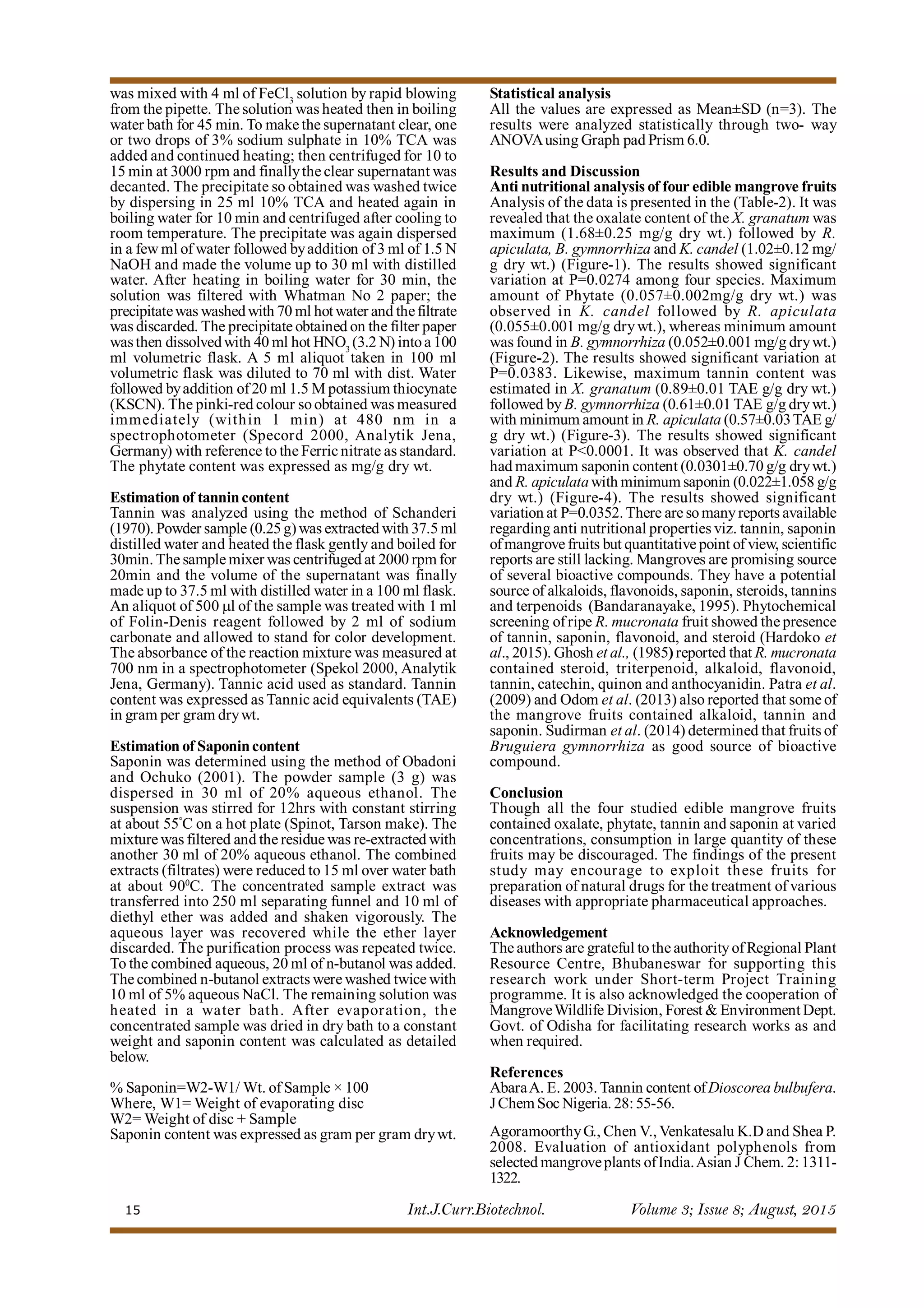
Analysis of the data is presented in the (Table-2). It was
revealed that the oxalate content of the X. granatum was
maximum (1.68±0.25 mg/g dry wt.) followed by R.
apiculata, B. gymnorrhiza and K. candel (1.02±0.12 mg/
g dry wt.) (Figure-1). The results showed significant
variation at P=0.0274 among four species. Maximum
amount of Phytate (0.057±0.002mg/g dry wt.) was
observed in K. candel followed by R. apiculata
(0.055±0.001 mg/g drywt.), whereas minimum amount
was found in B. gymnorrhiza (0.052±0.001 mg/g drywt.)
(Figure-2). The results showed significant variation at
P=0.0383. Likewise, maximum tannin content was
estimated in X. granatum (0.89±0.01 TAE g/g dry wt.)
followed by B. gymnorrhiza (0.61±0.01 TAE g/g drywt.)
with minimum amount in R. apiculata (0.57±0.03TAE g/
g dry wt.) (Figure-3). The results showed significant
variation at P<0.0001. It was observed that K. candel
had maximum saponin content (0.0301±0.70 g/g drywt.)
and R. apiculatawith minimum saponin (0.022±1.058 g/g
dry wt.) (Figure-4). The results showed significant
variation at P=0.0352. There are somanyreports available
regarding anti nutritional properties viz. tannin, saponin
ofmangrove fruits but quantitative point of view, scientific
reports are still lacking. Mangroves are promising source
of several bioactive compounds. They have a potential
source of alkaloids, flavonoids, saponin, steroids, tannins
and terpenoids (Bandaranayake, 1995). Phytochemical
screening ofripe R. mucronata fruit showed the presence
of tannin, saponin, flavonoid, and steroid (Hardoko et
al., 2015). Ghosh et al., (1985)reported that R. mucronata
contained steroid, triterpenoid, alkaloid, flavonoid,
tannin, catechin, quinon and anthocyanidin. Patra et al.
(2009) and Odom et al. (2013) also reported that some of
the mangrove fruits contained alkaloid, tannin and
saponin. Sudirman et al. (2014) determined that fruits of
Bruguiera gymnorrhiza as good source of bioactive
compound.
Conclusion
Though all the four studied edible mangrove fruits
contained oxalate, phytate, tannin and saponin at varied
concentrations, consumption in large quantity of these
fruits may be discouraged. The findings of the present
study may encourage to exploit these fruits for
preparation of natural drugs for the treatment of various
diseases with appropriate pharmaceutical approaches.
Acknowledgement
The authors are grateful tothe authorityofRegional Plant
Resource Centre, Bhubaneswar for supporting this
research work under Short-term Project Training
programme. It is also acknowledged the cooperation of
MangroveWildlife Division, Forest & Environment Dept.
Govt. of Odisha for facilitating research works as and
when required.
References
AbaraA. E. 2003. Tannin content ofDioscorea bulbufera.
JChem Soc Nigeria. 28: 55-56.
AgoramoorthyG., Chen V., Venkatesalu K.D and Shea P.
2008. Evaluation of antioxidant polyphenols from
selected mangroveplants ofIndia.Asian J Chem. 2: 1311-
1322.
Volume 3; Issue 8; August, 2015 Int.J.Curr.Biotechnol. 16
Bandaranayake W.M. 1995. Survey of mangrove plants
from Northern Australia for phytochemical constituents
and uv-absorbing compounds. Curr Topics Phytochem.
14:60–72.
Bandaranayake W.M. 1998. Traditional and medicinal
uses of mangroves. Mangroves Salt Marshes. 2:133-148.
Banerjee L.K and RaoT. A. 1990. Mangroves of Odisha
Coast and their ecology. Bishen Singh Mahendra Pal
Singh Dehra Dun India.
Basak U.C., Das, A.B., Das, P. 2000. Rooting response in
stem cuttings from five species of mangrove trees: effect
ofauxin and enzyme activities. Mar Biol.136:185-189.
BenzieI.F.F., Strain J.J. 1999. Ferricreducing/antioxidant
power assay: direct measure of total antioxidant activity
ofbiological fluids and modified version ofsimultaneous
measurement of total antioxidant power and ascorbic acid
concentration. Methods Enzymol. 299:15-27.
Beula J.M., Gnanadesigan M., Rajkumar P.B., Ravikumar
S., Anand M. 2012. Antiviral, antioxidant and
toxicological evaluation of mangrove plant from south
east coast of India. Asian Pac J Trop Biomed. 352-357.
Binita R., Khetarpaul N. 1997. Probiotic fermentation:
Effect on antinutrients and digestibility of starch and
protein of indigenous developed food mixture. J Nutr
Health.139-147.
Chinma C.E., Igyor M.A. 2007. Micronutrients and anti
nutritional contents of selected tropical vegetables grown
in southeast, Nigeria. Nigerian Food J. 25: 1-11.
DayR.A., UnderwoodA.L. 1986. Quantitative analysis.
5th Ed. Prentice-Hall publication. 701.
Ghosh A., Misra S., Duta A.K. and ChoudhuryA. 1985.
Pentacyclic triterpenoids and sterols from seven species
ofmangrove. Phytochem. 24:1725-1727.
GidamisA.B., Panga J.T.,Sarwatt S.,ChoveB.E andShayo
N.B. 2003. Nutrients and anti-nutrient contents in raw
and cooked young leaves and immature pods ofMoringa
oleifera. Ecol Food Nutr. 42: 399-411.
Gupta S., LakshmiaA.J., ManjunathbM.N and Prakash J.
2005. Analysis of nutrient and antinutrient content of
underutilized green leafy vegetables. LWT - Food Sci
Technol. 38: 339-345.
HardokoS.E., PuspitasariY.E andAmalia R. 2015. Study
of ripe Rhizophora mucronata flour as functional food
for antidiabetic. Int Food Res J. 22(3): 953-959.
Ihekoronye A.I and Ngoddy P.O. 1985. Integrated food
science and technologyor tropics. Mac Millan Publisher.
London, UK, 257-264.
Khamsah S.M., Akowah G., Zhari I. 2006. Antioxidant
activity and phenolic content of Orthosiphon stamineus
benth from different geographical origin. J ofSustainable
Sci Management. 1:14-20.
Ladeji O., Akin C.U and Umaru H.A. 2004. Level of
antinutritional factors in vegetables commonly eaten in
Nigeria.Afr J Nat Sci. 7: 71-73.
Makkar H. P. S. and Singh B. 1993. Effect of storage and
urea addition on detannification and in sacco dry matter
digestibilityof mature oak (Quercus incana) leaves.Anim
Feed SciTechnol. 41: 247-259.
Obadoni BO and OchukoPO. 2001. Phytochemical studies
and comparative efficacy of crude extracts of some
homeostatic plants in Edo and delta states of Nigeria.
Global J PureAppl Sci. 8: 203-208.
OdomT.C., Udensi E.Aand Ogbuji C.A. 2013. Evaluation
of hypoglycemic properties of Mucuna cochichinensis
unripe, Carica papaya and unripe Musa paradisiacal flour
blends. Eur J Biol Medic Sci Res. 1:15-22.
Patil P.D and Chavan N.S. 2013. A need conservation of
mangrove genus Bruguiera as a famine food. Anna Food
SciTechnol. 14: 294-297.
Patra J.K., Panigrahi T.K., Rath S., Dhal N.K. andThatoi
H. 2009. Phytochemical screening and antimicrobial
assessment of leaf extracts of Excoecaria agallocha L.:
Amangal species of bhitarkanika, orissa, India. Adv Nat
Appl Sci 3: 241-246.
Prathibha S., Bala B and Leelama S. 1995. Enzyme
inhibitors in tuber crops and their thermal stability. Plant
Food Hum Nutr. 48: 247–257.
Schanderi SH. 1970. Methods Food Analysis. Academic
press, pp 709.
Singh V.P and Odaki K. 2004. Mangrove ecosystem:
structure and function.
Sudirman S., Nurjanah and Jacoeb,A.M. 2014. Proximate
compositions, bioactive compounds and antioxidant
activity from large-leafed mangrove (Bruguiera
gymnorrhiza) fruit. Int Food Res J. 21: 2387-2391.
The wealth of India, Rawmaterials. 1970. Adictionaryof
Indian raw materials and industrial products, CSIR, New
Delhi.
Weaver C.M, Kannan S. 2002. Phytate and mineral
bioavailability. In: Reddy NR, SK Sathe (Eds.). Food
phytates, CRC Press, Boca Raton, FL, USA, pp: 211-223.

cb308005

  • 1.
    11 Int.J.Curr.Biotechnol. Volume3; Issue 8; August, 2015 Pramodini Rout, Nikhil Kumar and Uday Chand Basak, Assessment of anti-nutritional properties in four edible fruitsof mangrovesof Odisha coast, Int.J.Curr.Biotechnol.,2015, 3(8):11-16. Assessment ofanti-nutritionalpropertiesinfourediblefruits ofmangrovesofOdisha coast Pramodini Rout, Nikhil Kumar and Uday Chand Basak* Seed Bank and Seed Biology Division, Regional Plant Resource Centre, (R & D Institute of Forest and Environment Department), Bhubaneswar-15, Odisha, India. A R T I C L E I N F O A B S T R A C T Article History: Received 10 August 2015 Receivedinrevisedform 15 August 2015 Accepted 18 August 2015 Available online 30 August 2015 Key words: Mangrove fruits, anti-nutritional, Phytate,Saponin Though some mangrove fruits are known for their medicinal and edible properties, their anti nutritional aspect has not yet been evaluated. Mangrove fruits provide innumerable direct and indirect benefits to human beings. However, scientific report on anti nutrients in edible mangrove fruits is still lacking. The present study was aimed to determine anti-nutritional properties in four edible mangrove fruits viz. Bruguiera gymnorrhiza, Rhizophora apiculata, Kandelia candel and Xylocarpus granatum found in Bhitarkanika and Mahanadi delta (buffer zone) of Odisha. The fruit of X. granatum exhibited highest level of oxalate content (1.68±0.25 mg/g dry wt.) whereas lowest amount was observed in K. candel (1.02±0.12 mg/g dry wt.). Highest phytate content was noted in K. candel (0.057±0.002 mg/g dry wt.) and lowest in B. gymnorrhiza (0.052±0.001 mg/g dry wt.). Tannin content was highest in X. granatum (0.89±0.01 TAE g/g dry wt.) and lowest in R. apiculata (0.57±0.03 TAE g/g dry wt.). Saponin content was highest in K. candel (0.0301±0.007 g/g dry wt.) and lowest in R. apiculata (0.022±0.001 g/g dry wt.). The present findings revealed that all the studied fruits can be considered as ample sources of antinutrients. Thus, excess consumption of these fruits contained high anti-nutrients may be avoided. Introduction Mangroves are specialized group of salt tolerant plants that grow in the intertidal regions oftropic and subtropic along the coastlines (Basak et al., 2000). They provide innumerable direct and indirect benefits to human beings. Keeping in mind, the edibility properties of mangrove fruits, they have a good potentiality to become a food source by the coastal people. Mangrove fruits are considered as famine food (Patil and Chavan, 2013). But mangrove fruits are utilized for food as well as bioactive compound such as tannin, phenol etc reported by (Bandaranayake, 1998). However, scientific evidences regarding anti nutritional properties are still lacking. Anti-nutritional factors including oxalate, tannins, phytic acid, saponins (Makkar and Singh, 1993; Gupta et al., 2005) whose presence greatly impair the digestion of various nutrients, therefore, reducing the nutritional value of such plants and limiting their utilization as food (Gidamis et al., 2003; Prathibha et al., 1995). Oxalic acid binds to calcium and is found naturally in a variety of fruits, vegetables, nuts, grains and legumes. It has also been reported earlier that oxalates causes irritation and swelling in the mouth and throat (Ladeji et al., 2004). Phytic acid constitutes manyessential elements like iron, calcium, phosphorous etc. are combined by phytic acid to form insoluble phytate salt, which are not absorbed bythe body and thus limiting the bioavailabilityof these elements (Weaver and Kannan, 2002). Saponin is naturally occurring glycosides and occurs in wide varieties of plants. Tannins have the abilityto precipitate certain proteins. They combine with digestive enzymes thereby making them unavailable for digestion (Binita and Khetarpaul, 1997;Abara, 2003). There is no comprehensive report on anti-nutritional properties of edible mangrove fruits of Odisha coast. Considering their extensive edibilityand therapeutic uses, four mangrove species viz Bruguiera gymnorrhiza, Rhizophora apiculata, Kandelia candel and Xylocarpus granatum were subjected to analysis for evaluating antinutrient properties with an aim to create awareness on legitimate consumption of mangrove fruits. Materialsand Methods Collection of mangrove fruit sample The fruits (at edible stage) of the species viz. Bruguiera gymnorrhiza (Linn.) Savigny (Bandari) (Fam.- Rhizophoraceae), Rhizophora apiculata BI (Rai) (Fam.- Rhizophoraceae), Kandelia candel (Linn.) Druce ISSN: 2321 - 8371 International Journal of Current Biotechnology Journal Homepage : http://ijcb.mainspringer.com *Corresponding author. Email address: uc_basak07@yahoo.co.in Phone: 9437481352
  • 2.
    Volume 3; Issue8; August, 2015 Int.J.Curr.Biotechnol. 12 (Sinduka) (Fam.- Rhizophoraceae), Xylocarpus granatum Koenig (Susumara) (Meliaceae) (Table-1) were collected from mangrove forest ofthe Bhitarkanika and Mahanadi delta ofthe Odisha coast (Buffer zone), India (20° 18’-20° 32’ N latitude and 86° 41’- 86° 48’ E longitude). Fruits of each plant species were sampled from at least five individual trees. Processing of the fruit sample Fruit samples (Fresh) were cleaned in running tap water and were dried in hot air oven (500 C) for 12 hrs(Khamsah et al., 2006). The dried sampleswere pulverized andstored in freezer in airtight containers for further extraction. Analysis of Samples for anti-nutritional factors Estimation of oxalate content Total oxalate was determined through titration methods according to (Day and Underwood, 1986). One gram powdered sample was weighed into 100 ml conical flask. 75 ml of 3 M H2 SO4 was added and stirred for 1h with a magnetic stirrer. This was filtered using a Whatman No1 filter paper. The filtrate (25 ml) wasthen titrated while hot against 0.05M KMnO4 solution until a faint pink colour appeared and persisted for at least 30 sec. The oxalate content was then calculated by taking 1 ml of 0.05 M KMnO4 as equivalent to 2.2 mg oxalate (Ihekoronye and Ngoddy, 1985; Chinma and Igyor, 2007). Finally, oxalate content was expressed as milligram per gram drywt. Estimationof Phytate content Phytate content was determined by the method of Wheeler and Ferrel (1971)with minor modification. Three gramssamplewas mixedin 25ml of10%TCAin a 125ml flask and shaken the same with mechanical shaker for 2 hrs. This sample mixer was centrifuged at 3000rpm for 20 min. To a 50 ml centrifuge tube, 10 ml of the supernatant MANGROVE SPECIES EDIBLE/MEDICINAL PROPERTIES REFERENCES Bruguiera gymnorrhiza EDIBILITY: Fruits (Propagules) are consumed regularly during the fruiting season. They are peeled, soaked and boiled three or four times in water and eaten. Sometimes they are cooked with salt, dried and then consumed. Medicinal: Medicinal on eye ailment. Treatment of diarrhoea. Singh and Odaki (2004) Kandelia candel EDIBILITY: The fruits of Kandelia candel contain starch and if sliced, soaked in water to rinse out tannins and then ground to a paste can make excellent cakes or sweetened stuffing for pastry. Medicinal: Treatments of diabetes Banerjee and Rao (1990) Rhizophora apiculata EDIBILITY: Cooked as vegetables, a famine food. Medicinal: Human consumption Agoramoorthy et al. (2008) Bandaranayake., 1998, Beula et al. (2012) Xylocarpus granatum Edibility- Fruits are scented and aromatic and chewed with betel leaves. Medicinal- Seed oil is used for illumination and grooming hairs, seed-paste is used to cure breast tumour The wealth of India (1990). Table - 1: Ethnomedicinal and Edible properties of four mangrove fruits
  • 3.
    13 Int.J.Curr.Biotechnol. Volume3; Issue 8; August, 2015 Parameters Fruit Species Bruguiera gymnorrhiza Kandelia candel Rhizophora apiculata Xylocarpus granatum Oxalate Content (mg/g dry wt.) 1.02±0.25 1.02±0.12 1.39±0.12 1.68±0.25 Phytate Content (mg/g dry wt.) 0.052±0.001 0.057±0.002 0.055±0.001 0.054±0.002 Tannin Content (TAE g/g dry wt.) 0.61±0.01 0.59±0.01 0.57±0.03 0.89±0.01 Saponin Content (g/g dry wt.) 0.0235±0.004 0.0301±0.007 0.022±0.001 0.022±0.01 Table - 2:Anti nutritional factors in four edible mangrove fruits Values are mentioned with mean ±SD values of three replicates; TAE-Tannic acid equivalent Figure - 1: Oxalate content of four edible mangrove fruits Figure - 2: Phytate content of four edible mangrove fruits
  • 4.
    Volume 3; Issue8; August, 2015 Int.J.Curr.Biotechnol. 14 Figure - 3: Tannin content of four edible mangrove fruits Figure - 4: Saponin content of four edible mangrove fruits
  • 5.
    15 Int.J.Curr.Biotechnol. Volume3; Issue 8; August, 2015 was mixed with 4 ml of FeCl3 solution by rapid blowing from the pipette. The solution was heated then in boiling water bath for 45 min. To make the supernatant clear, one or two drops of 3% sodium sulphate in 10% TCA was added and continued heating; then centrifuged for 10 to 15 min at 3000 rpm and finallythe clear supernatant was decanted. The precipitate so obtained was washed twice by dispersing in 25 ml 10% TCA and heated again in boiling water for 10 min and centrifuged after cooling to room temperature. The precipitate was again dispersed in a few ml of water followed byaddition of 3 ml of 1.5 N NaOH and made the volume up to 30 ml with distilled water. After heating in boiling water for 30 min, the solution was filtered with Whatman No 2 paper; the precipitatewas washedwith 70 ml hot water and thefiltrate was discarded. The precipitate obtained on the filter paper wasthen dissolvedwith 40 ml hot HNO3 (3.2 N) intoa 100 ml volumetric flask. A 5 ml aliquot taken in 100 ml volumetric flask was diluted to 70 ml with dist. Water followed byaddition of20 ml 1.5 M potassium thiocynate (KSCN). The pinki-red colour soobtained was measured immediately (within 1 min) at 480 nm in a spectrophotometer (Specord 2000, Analytik Jena, Germany) with reference to the Ferric nitrate as standard. The phytate content was expressed as mg/g dry wt. Estimation of tannincontent Tannin was analyzed using the method of Schanderi (1970). Powder sample (0.25g)was extracted with 37.5ml distilled water and heated the flask gently and boiled for 30min. The sample mixer was centrifuged at 2000 rpm for 20min and the volume of the supernatant was finally made up to 37.5 ml with distilled water in a 100 ml flask. An aliquot of 500 l of the sample was treated with 1 ml of Folin-Denis reagent followed by 2 ml of sodium carbonate and allowed to stand for color development. The absorbance of the reaction mixture was measured at 700 nm in a spectrophotometer (Spekol 2000, Analytik Jena, Germany). Tannic acid used as standard. Tannin content was expressed as Tannic acid equivalents (TAE) in gram per gram drywt. Estimation of Saponincontent Saponin was determined using the method of Obadoni and Ochuko (2001). The powder sample (3 g) was dispersed in 30 ml of 20% aqueous ethanol. The suspension was stirred for 12hrs with constant stirring at about 55° C on a hot plate (Spinot, Tarson make). The mixture was filtered and the residue was re-extracted with another 30 ml of 20% aqueous ethanol. The combined extracts (filtrates) were reduced to 15 ml over water bath at about 900 C. The concentrated sample extract was transferred into 250 ml separating funnel and 10 ml of diethyl ether was added and shaken vigorously. The aqueous layer was recovered while the ether layer discarded. The purification process was repeated twice. To the combined aqueous, 20 ml of n-butanol was added. The combined n-butanol extracts were washed twice with 10 ml of 5% aqueous NaCl. The remaining solution was heated in a water bath. After evaporation, the concentrated sample was dried in dry bath to a constant weight and saponin content was calculated as detailed below. % Saponin=W2-W1/ Wt. of Sample × 100 Where, W1= Weight of evaporating disc W2= Weight of disc + Sample Saponin content was expressed as gram per gram drywt. Statistical analysis All the values are expressed as Mean±SD (n=3). The results were analyzed statistically through two- way ANOVAusing Graph pad Prism 6.0. Results and Discussion Anti nutritional analysis of four edible mangrove fruits Analysis of the data is presented in the (Table-2). It was revealed that the oxalate content of the X. granatum was maximum (1.68±0.25 mg/g dry wt.) followed by R. apiculata, B. gymnorrhiza and K. candel (1.02±0.12 mg/ g dry wt.) (Figure-1). The results showed significant variation at P=0.0274 among four species. Maximum amount of Phytate (0.057±0.002mg/g dry wt.) was observed in K. candel followed by R. apiculata (0.055±0.001 mg/g drywt.), whereas minimum amount was found in B. gymnorrhiza (0.052±0.001 mg/g drywt.) (Figure-2). The results showed significant variation at P=0.0383. Likewise, maximum tannin content was estimated in X. granatum (0.89±0.01 TAE g/g dry wt.) followed by B. gymnorrhiza (0.61±0.01 TAE g/g drywt.) with minimum amount in R. apiculata (0.57±0.03TAE g/ g dry wt.) (Figure-3). The results showed significant variation at P<0.0001. It was observed that K. candel had maximum saponin content (0.0301±0.70 g/g drywt.) and R. apiculatawith minimum saponin (0.022±1.058 g/g dry wt.) (Figure-4). The results showed significant variation at P=0.0352. There are somanyreports available regarding anti nutritional properties viz. tannin, saponin ofmangrove fruits but quantitative point of view, scientific reports are still lacking. Mangroves are promising source of several bioactive compounds. They have a potential source of alkaloids, flavonoids, saponin, steroids, tannins and terpenoids (Bandaranayake, 1995). Phytochemical screening ofripe R. mucronata fruit showed the presence of tannin, saponin, flavonoid, and steroid (Hardoko et al., 2015). Ghosh et al., (1985)reported that R. mucronata contained steroid, triterpenoid, alkaloid, flavonoid, tannin, catechin, quinon and anthocyanidin. Patra et al. (2009) and Odom et al. (2013) also reported that some of the mangrove fruits contained alkaloid, tannin and saponin. Sudirman et al. (2014) determined that fruits of Bruguiera gymnorrhiza as good source of bioactive compound. Conclusion Though all the four studied edible mangrove fruits contained oxalate, phytate, tannin and saponin at varied concentrations, consumption in large quantity of these fruits may be discouraged. The findings of the present study may encourage to exploit these fruits for preparation of natural drugs for the treatment of various diseases with appropriate pharmaceutical approaches. Acknowledgement The authors are grateful tothe authorityofRegional Plant Resource Centre, Bhubaneswar for supporting this research work under Short-term Project Training programme. It is also acknowledged the cooperation of MangroveWildlife Division, Forest & Environment Dept. Govt. of Odisha for facilitating research works as and when required. References AbaraA. E. 2003. Tannin content ofDioscorea bulbufera. JChem Soc Nigeria. 28: 55-56. AgoramoorthyG., Chen V., Venkatesalu K.D and Shea P. 2008. Evaluation of antioxidant polyphenols from selected mangroveplants ofIndia.Asian J Chem. 2: 1311- 1322.
  • 6.
    Volume 3; Issue8; August, 2015 Int.J.Curr.Biotechnol. 16 Bandaranayake W.M. 1995. Survey of mangrove plants from Northern Australia for phytochemical constituents and uv-absorbing compounds. Curr Topics Phytochem. 14:60–72. Bandaranayake W.M. 1998. Traditional and medicinal uses of mangroves. Mangroves Salt Marshes. 2:133-148. Banerjee L.K and RaoT. A. 1990. Mangroves of Odisha Coast and their ecology. Bishen Singh Mahendra Pal Singh Dehra Dun India. Basak U.C., Das, A.B., Das, P. 2000. Rooting response in stem cuttings from five species of mangrove trees: effect ofauxin and enzyme activities. Mar Biol.136:185-189. BenzieI.F.F., Strain J.J. 1999. Ferricreducing/antioxidant power assay: direct measure of total antioxidant activity ofbiological fluids and modified version ofsimultaneous measurement of total antioxidant power and ascorbic acid concentration. Methods Enzymol. 299:15-27. Beula J.M., Gnanadesigan M., Rajkumar P.B., Ravikumar S., Anand M. 2012. Antiviral, antioxidant and toxicological evaluation of mangrove plant from south east coast of India. Asian Pac J Trop Biomed. 352-357. Binita R., Khetarpaul N. 1997. Probiotic fermentation: Effect on antinutrients and digestibility of starch and protein of indigenous developed food mixture. J Nutr Health.139-147. Chinma C.E., Igyor M.A. 2007. Micronutrients and anti nutritional contents of selected tropical vegetables grown in southeast, Nigeria. Nigerian Food J. 25: 1-11. DayR.A., UnderwoodA.L. 1986. Quantitative analysis. 5th Ed. Prentice-Hall publication. 701. Ghosh A., Misra S., Duta A.K. and ChoudhuryA. 1985. Pentacyclic triterpenoids and sterols from seven species ofmangrove. Phytochem. 24:1725-1727. GidamisA.B., Panga J.T.,Sarwatt S.,ChoveB.E andShayo N.B. 2003. Nutrients and anti-nutrient contents in raw and cooked young leaves and immature pods ofMoringa oleifera. Ecol Food Nutr. 42: 399-411. Gupta S., LakshmiaA.J., ManjunathbM.N and Prakash J. 2005. Analysis of nutrient and antinutrient content of underutilized green leafy vegetables. LWT - Food Sci Technol. 38: 339-345. HardokoS.E., PuspitasariY.E andAmalia R. 2015. Study of ripe Rhizophora mucronata flour as functional food for antidiabetic. Int Food Res J. 22(3): 953-959. Ihekoronye A.I and Ngoddy P.O. 1985. Integrated food science and technologyor tropics. Mac Millan Publisher. London, UK, 257-264. Khamsah S.M., Akowah G., Zhari I. 2006. Antioxidant activity and phenolic content of Orthosiphon stamineus benth from different geographical origin. J ofSustainable Sci Management. 1:14-20. Ladeji O., Akin C.U and Umaru H.A. 2004. Level of antinutritional factors in vegetables commonly eaten in Nigeria.Afr J Nat Sci. 7: 71-73. Makkar H. P. S. and Singh B. 1993. Effect of storage and urea addition on detannification and in sacco dry matter digestibilityof mature oak (Quercus incana) leaves.Anim Feed SciTechnol. 41: 247-259. Obadoni BO and OchukoPO. 2001. Phytochemical studies and comparative efficacy of crude extracts of some homeostatic plants in Edo and delta states of Nigeria. Global J PureAppl Sci. 8: 203-208. OdomT.C., Udensi E.Aand Ogbuji C.A. 2013. Evaluation of hypoglycemic properties of Mucuna cochichinensis unripe, Carica papaya and unripe Musa paradisiacal flour blends. Eur J Biol Medic Sci Res. 1:15-22. Patil P.D and Chavan N.S. 2013. A need conservation of mangrove genus Bruguiera as a famine food. Anna Food SciTechnol. 14: 294-297. Patra J.K., Panigrahi T.K., Rath S., Dhal N.K. andThatoi H. 2009. Phytochemical screening and antimicrobial assessment of leaf extracts of Excoecaria agallocha L.: Amangal species of bhitarkanika, orissa, India. Adv Nat Appl Sci 3: 241-246. Prathibha S., Bala B and Leelama S. 1995. Enzyme inhibitors in tuber crops and their thermal stability. Plant Food Hum Nutr. 48: 247–257. Schanderi SH. 1970. Methods Food Analysis. Academic press, pp 709. Singh V.P and Odaki K. 2004. Mangrove ecosystem: structure and function. Sudirman S., Nurjanah and Jacoeb,A.M. 2014. Proximate compositions, bioactive compounds and antioxidant activity from large-leafed mangrove (Bruguiera gymnorrhiza) fruit. Int Food Res J. 21: 2387-2391. The wealth of India, Rawmaterials. 1970. Adictionaryof Indian raw materials and industrial products, CSIR, New Delhi. Weaver C.M, Kannan S. 2002. Phytate and mineral bioavailability. In: Reddy NR, SK Sathe (Eds.). Food phytates, CRC Press, Boca Raton, FL, USA, pp: 211-223.