Cause and Effect RelationshipsBy Kristin DavisMay 2010
Why teach cause and effect relationships?This unit is intended for 2nd grade students, including students with Early Intermediate and Intermediate English language proficiency I chose the theme of cause and effect relationships because it is a 2nd grade reading standard. The standard is listed as Literary Text: Develop an Interpretation- Describe cause-and-effect of specific events (EL.02.LI.06)I also chose this theme because it is something that students have some background knowledge about because of being in cause and effect situations themselves. It is an important concept for students to understand because it is something that they will experience throughout their lives
Texts for teaching cause and effect relationshipsAlexander and the Terrible, Horrible, No Good, Very Bad Day by Judith VioristThe Day Jimmy’s Boa Ate the Wash by Steven KelloggThe Berenstain Bears and the Truth by Jan and Stan BerenstainIf You Give a Mouse a Cookie by Laura NumeroffTops and Bottoms by Janet StevensAll of these texts include cause and effect situations/relationships.Thetexts include pictures and illustrations, which will be helpful for English Language Learners. The visuals of the illustrations will help them better understand the concept. Also, they are entertaining books that will keep students interested.
Strategies used throughout unit to help ell students  Visuals (pictures in books, pictures on posters, sentence frames, etc.)Sentence Frames(help students express their understanding of a cause and effect relationship and practice using the language)Think Aloud (teacher helps model cause and effect relationships in read alouds) Comprehension Questions (teacher asks comprehension questions about read alouds to help determine how well students are understanding cause and effect relationships in stories)Think-Pair-Share (students will share ideas with each and model language as they share)
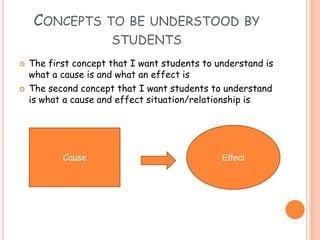
Concepts to be understood by studentsThe first concept that I want students to understand is what a cause is and what an effect is The second concept that I want students to understand is what a cause and effect situation/relationship isEffectCause
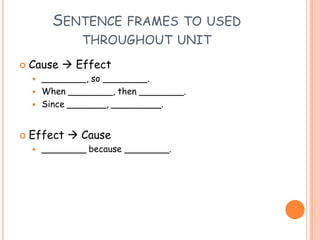
Sentence frames to used throughout unitCause Effect	________, so ________.When ________, then ________.Since _______, _________.Effect  Cause________ because ________.
Lesson #1: Introduction of the concept of cause and effectHang cause and effect poster and display sentence frames in pocket chartAsk students to share if they know what ‘cause’ or ‘effect’ mean (maybe Think-Pair-Share)Share with students the meaning of wordsShow students baggie with egg insideDrop egg and ask students what happened (students answer) and ask them why that happened (students answer)Draw a picture of the cause and effect on the poster and fill in sentence frames with student’s responses
Lesson #2: Cause and Effect read aloudReview egg activity and meaning of ‘cause’ and ‘effect’Review sentence frames Introduce Alexander and the Terrible, Horrible, No Good, Very Bad Day by having students Think-Pair-Share about a bad day they have had and what happened to themHave a few students share and discuss that the student’s job is to listen to the story for cause and effect situationsRead the storyHave students identify cause and effect situations and use cause and effect poster and sentence frames to record student’s responses
 Lesson #3: Cause and effect read aloud Review meaning of ‘cause’ and ‘effect’Introduce the read aloud by discussing what the words ‘boa’ and ‘wash’ meanAlso have students make predictions about what they think might happen in the story (maybe Think-Pair-Share)Read The Day Jimmy’s Boa Ate the WashDiscuss cause and effect situations throughout the story by modeling and thinking aloudFill in more on our cause and effect poster with a situation or two that happened in the story Students use sentence frames to write another cause and effect situation from the story
Lesson #4: Cause and Effect matching activityReview the meaning of ‘cause’ and ‘effect’Review cause and effect situations that we have discussed (in stories and in real-life) from previous lessonsGather students in a circle on the floor and pick a volunteer to help meShow students how to play cause and effect matching activity with a partnerStudents will play with a partner Afterwards, they will work with their partner to fill out cause and effect worksheet by picking 3 or 4 of their favorite cause and effect situations and drawing pictures or writing sentences
Lesson #5: Real-life cause and effect situationsReview the meaning of ‘cause’ and ‘effect’, as well as the poster and sentence framesIntroduce overhead with cause and effect fill-in-the-blank sentencesStudents help me fill in the blanksThink of more real-life cause and effect situations and write them in sentences  

Cause and effect relationships

  • 1.
    Cause and EffectRelationshipsBy Kristin DavisMay 2010
  • 2.
    Why teach causeand effect relationships?This unit is intended for 2nd grade students, including students with Early Intermediate and Intermediate English language proficiency I chose the theme of cause and effect relationships because it is a 2nd grade reading standard. The standard is listed as Literary Text: Develop an Interpretation- Describe cause-and-effect of specific events (EL.02.LI.06)I also chose this theme because it is something that students have some background knowledge about because of being in cause and effect situations themselves. It is an important concept for students to understand because it is something that they will experience throughout their lives
  • 3.
    Texts for teachingcause and effect relationshipsAlexander and the Terrible, Horrible, No Good, Very Bad Day by Judith VioristThe Day Jimmy’s Boa Ate the Wash by Steven KelloggThe Berenstain Bears and the Truth by Jan and Stan BerenstainIf You Give a Mouse a Cookie by Laura NumeroffTops and Bottoms by Janet StevensAll of these texts include cause and effect situations/relationships.Thetexts include pictures and illustrations, which will be helpful for English Language Learners. The visuals of the illustrations will help them better understand the concept. Also, they are entertaining books that will keep students interested.
  • 4.
    Strategies used throughoutunit to help ell students Visuals (pictures in books, pictures on posters, sentence frames, etc.)Sentence Frames(help students express their understanding of a cause and effect relationship and practice using the language)Think Aloud (teacher helps model cause and effect relationships in read alouds) Comprehension Questions (teacher asks comprehension questions about read alouds to help determine how well students are understanding cause and effect relationships in stories)Think-Pair-Share (students will share ideas with each and model language as they share)
  • 5.
    Concepts to beunderstood by studentsThe first concept that I want students to understand is what a cause is and what an effect is The second concept that I want students to understand is what a cause and effect situation/relationship isEffectCause
  • 6.
    Sentence frames toused throughout unitCause Effect ________, so ________.When ________, then ________.Since _______, _________.Effect  Cause________ because ________.
  • 7.
    Lesson #1: Introductionof the concept of cause and effectHang cause and effect poster and display sentence frames in pocket chartAsk students to share if they know what ‘cause’ or ‘effect’ mean (maybe Think-Pair-Share)Share with students the meaning of wordsShow students baggie with egg insideDrop egg and ask students what happened (students answer) and ask them why that happened (students answer)Draw a picture of the cause and effect on the poster and fill in sentence frames with student’s responses
  • 8.
    Lesson #2: Causeand Effect read aloudReview egg activity and meaning of ‘cause’ and ‘effect’Review sentence frames Introduce Alexander and the Terrible, Horrible, No Good, Very Bad Day by having students Think-Pair-Share about a bad day they have had and what happened to themHave a few students share and discuss that the student’s job is to listen to the story for cause and effect situationsRead the storyHave students identify cause and effect situations and use cause and effect poster and sentence frames to record student’s responses
  • 9.
    Lesson #3:Cause and effect read aloud Review meaning of ‘cause’ and ‘effect’Introduce the read aloud by discussing what the words ‘boa’ and ‘wash’ meanAlso have students make predictions about what they think might happen in the story (maybe Think-Pair-Share)Read The Day Jimmy’s Boa Ate the WashDiscuss cause and effect situations throughout the story by modeling and thinking aloudFill in more on our cause and effect poster with a situation or two that happened in the story Students use sentence frames to write another cause and effect situation from the story
  • 10.
    Lesson #4: Causeand Effect matching activityReview the meaning of ‘cause’ and ‘effect’Review cause and effect situations that we have discussed (in stories and in real-life) from previous lessonsGather students in a circle on the floor and pick a volunteer to help meShow students how to play cause and effect matching activity with a partnerStudents will play with a partner Afterwards, they will work with their partner to fill out cause and effect worksheet by picking 3 or 4 of their favorite cause and effect situations and drawing pictures or writing sentences
  • 11.
    Lesson #5: Real-lifecause and effect situationsReview the meaning of ‘cause’ and ‘effect’, as well as the poster and sentence framesIntroduce overhead with cause and effect fill-in-the-blank sentencesStudents help me fill in the blanksThink of more real-life cause and effect situations and write them in sentences