CATALYST
FILL IN THE EMPTINESS IN
ME!
LOG- IN TO Classpoint.app
Type the code___________
Type your name
Direction:
Filling in the blanks to complete the
passage.
CONCENTRATION ACTIVATION ENERGY CATALYST
TEMPERATURE PARTICLE SIZE
ENZYME
Increasing the ___________ of a system increases the average kinetic energy of its
constituent particles. As the average kinetic energy increases, the particles move
faster and collide more frequently per unit time and possess greater energy
when they collide. When the ___________ of all the reactants increases, more
molecules or ions interact to form new compounds, and the rate of reaction
increases. When solids and liquids react, increasing the surface area of the solid
will increase the reaction rate. Collisions only result in a reaction if the particles
collide with a certain minimum energy called the ___________ for the reaction. The
position of activation energy can be determined on a Maxwell-Boltzmann
distribution. To increase the rate of a reaction, the number of successful collisions
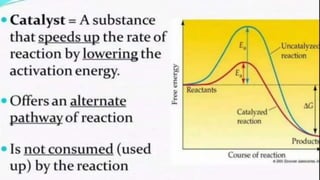
must be increased. One possible way of doing this is to provide an alternative way
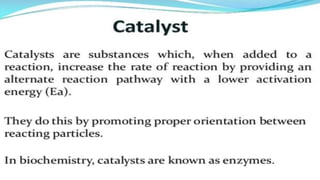
for the reaction to happen which has a lower activation energy. Adding ___________
has this effect on activation energy. It provides an alternative route for the reaction
with a lower activation energy. Catalysts are everywhere! Many biochemical
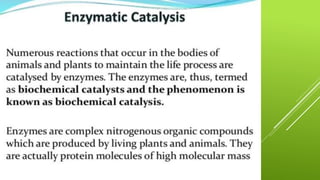
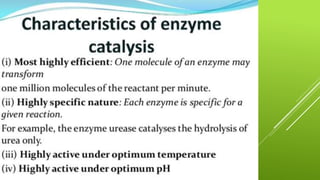
processes, such as the oxidation of glucose, are heavily dependent on ___________,
proteins that behave as catalysts.
CATALYST
A catalyst is a substance that speeds up
a chemical reaction, or lowers the
temperature or pressure needed to start
one, without itself being consumed
during the reaction.
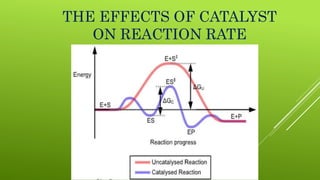
THE EFFECTS OF CATALYST
ON REACTION RATE
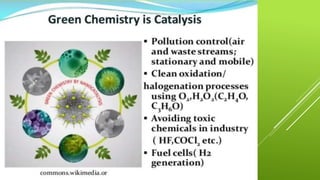
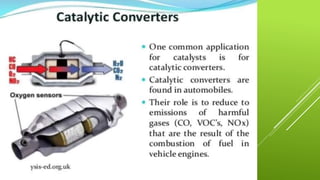
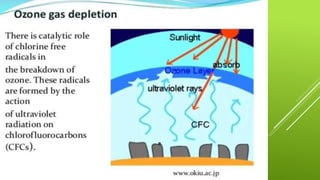
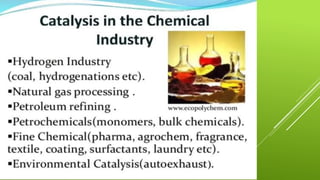
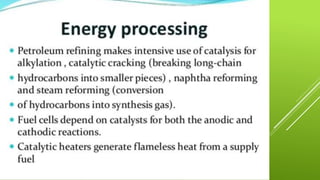
APPLICATION OF CATALYST
CATALYST.pptx
CATALYST.pptx
CATALYST.pptx
CATALYST.pptx
CATALYST.pptx
CATALYST.pptx
CATALYST.pptx

CATALYST.pptx

  • 1.
  • 2.
    FILL IN THEEMPTINESS IN ME! LOG- IN TO Classpoint.app Type the code___________ Type your name Direction: Filling in the blanks to complete the passage.
  • 3.
    CONCENTRATION ACTIVATION ENERGYCATALYST TEMPERATURE PARTICLE SIZE ENZYME Increasing the ___________ of a system increases the average kinetic energy of its constituent particles. As the average kinetic energy increases, the particles move faster and collide more frequently per unit time and possess greater energy when they collide. When the ___________ of all the reactants increases, more molecules or ions interact to form new compounds, and the rate of reaction increases. When solids and liquids react, increasing the surface area of the solid will increase the reaction rate. Collisions only result in a reaction if the particles collide with a certain minimum energy called the ___________ for the reaction. The position of activation energy can be determined on a Maxwell-Boltzmann distribution. To increase the rate of a reaction, the number of successful collisions must be increased. One possible way of doing this is to provide an alternative way for the reaction to happen which has a lower activation energy. Adding ___________ has this effect on activation energy. It provides an alternative route for the reaction with a lower activation energy. Catalysts are everywhere! Many biochemical processes, such as the oxidation of glucose, are heavily dependent on ___________, proteins that behave as catalysts.
  • 4.
    CATALYST A catalyst isa substance that speeds up a chemical reaction, or lowers the temperature or pressure needed to start one, without itself being consumed during the reaction.
  • 7.
    THE EFFECTS OFCATALYST ON REACTION RATE
  • 13.